EP3674952B1 - Verfahren und system zur suche nach mindestens einem spezifischen datum in einer benutzereinheit - Google Patents
Verfahren und system zur suche nach mindestens einem spezifischen datum in einer benutzereinheit Download PDFInfo
- Publication number
- EP3674952B1 EP3674952B1 EP19207814.5A EP19207814A EP3674952B1 EP 3674952 B1 EP3674952 B1 EP 3674952B1 EP 19207814 A EP19207814 A EP 19207814A EP 3674952 B1 EP3674952 B1 EP 3674952B1
- Authority
- EP
- European Patent Office
- Prior art keywords
- user unit
- processing key
- data
- computer
- converted
- Prior art date
- Legal status (The legal status is an assumption and is not a legal conclusion. Google has not performed a legal analysis and makes no representation as to the accuracy of the status listed.)
- Active
Links
Images

Classifications
-
- H—ELECTRICITY
- H04—ELECTRIC COMMUNICATION TECHNIQUE
- H04L—TRANSMISSION OF DIGITAL INFORMATION, e.g. TELEGRAPHIC COMMUNICATION
- H04L9/00—Cryptographic mechanisms or cryptographic arrangements for secret or secure communications; Network security protocols
- H04L9/50—Cryptographic mechanisms or cryptographic arrangements for secret or secure communications; Network security protocols using hash chains, e.g. blockchains or hash trees
-
- G—PHYSICS
- G06—COMPUTING OR CALCULATING; COUNTING
- G06F—ELECTRIC DIGITAL DATA PROCESSING
- G06F16/00—Information retrieval; Database structures therefor; File system structures therefor
- G06F16/20—Information retrieval; Database structures therefor; File system structures therefor of structured data, e.g. relational data
- G06F16/24—Querying
- G06F16/245—Query processing
- G06F16/2455—Query execution
-
- G—PHYSICS
- G06—COMPUTING OR CALCULATING; COUNTING
- G06F—ELECTRIC DIGITAL DATA PROCESSING
- G06F16/00—Information retrieval; Database structures therefor; File system structures therefor
- G06F16/20—Information retrieval; Database structures therefor; File system structures therefor of structured data, e.g. relational data
- G06F16/24—Querying
- G06F16/248—Presentation of query results
-
- G—PHYSICS
- G06—COMPUTING OR CALCULATING; COUNTING
- G06F—ELECTRIC DIGITAL DATA PROCESSING
- G06F21/00—Security arrangements for protecting computers, components thereof, programs or data against unauthorised activity
- G06F21/60—Protecting data
- G06F21/62—Protecting access to data via a platform, e.g. using keys or access control rules
- G06F21/6218—Protecting access to data via a platform, e.g. using keys or access control rules to a system of files or objects, e.g. local or distributed file system or database
- G06F21/6227—Protecting access to data via a platform, e.g. using keys or access control rules to a system of files or objects, e.g. local or distributed file system or database where protection concerns the structure of data, e.g. records, types, queries
-
- G—PHYSICS
- G06—COMPUTING OR CALCULATING; COUNTING
- G06F—ELECTRIC DIGITAL DATA PROCESSING
- G06F21/00—Security arrangements for protecting computers, components thereof, programs or data against unauthorised activity
- G06F21/60—Protecting data
- G06F21/62—Protecting access to data via a platform, e.g. using keys or access control rules
- G06F21/6218—Protecting access to data via a platform, e.g. using keys or access control rules to a system of files or objects, e.g. local or distributed file system or database
- G06F21/6245—Protecting personal data, e.g. for financial or medical purposes
- G06F21/6254—Protecting personal data, e.g. for financial or medical purposes by anonymising data, e.g. decorrelating personal data from the owner's identification
-
- H—ELECTRICITY
- H04—ELECTRIC COMMUNICATION TECHNIQUE
- H04L—TRANSMISSION OF DIGITAL INFORMATION, e.g. TELEGRAPHIC COMMUNICATION
- H04L9/00—Cryptographic mechanisms or cryptographic arrangements for secret or secure communications; Network security protocols
- H04L9/08—Key distribution or management, e.g. generation, sharing or updating, of cryptographic keys or passwords
- H04L9/0816—Key establishment, i.e. cryptographic processes or cryptographic protocols whereby a shared secret becomes available to two or more parties, for subsequent use
- H04L9/0838—Key agreement, i.e. key establishment technique in which a shared key is derived by parties as a function of information contributed by, or associated with, each of these
-
- H—ELECTRICITY
- H04—ELECTRIC COMMUNICATION TECHNIQUE
- H04L—TRANSMISSION OF DIGITAL INFORMATION, e.g. TELEGRAPHIC COMMUNICATION
- H04L9/00—Cryptographic mechanisms or cryptographic arrangements for secret or secure communications; Network security protocols
- H04L9/08—Key distribution or management, e.g. generation, sharing or updating, of cryptographic keys or passwords
- H04L9/0861—Generation of secret information including derivation or calculation of cryptographic keys or passwords
- H04L9/0863—Generation of secret information including derivation or calculation of cryptographic keys or passwords involving passwords or one-time passwords
-
- H—ELECTRICITY
- H04—ELECTRIC COMMUNICATION TECHNIQUE
- H04L—TRANSMISSION OF DIGITAL INFORMATION, e.g. TELEGRAPHIC COMMUNICATION
- H04L9/00—Cryptographic mechanisms or cryptographic arrangements for secret or secure communications; Network security protocols
- H04L9/32—Cryptographic mechanisms or cryptographic arrangements for secret or secure communications; Network security protocols including means for verifying the identity or authority of a user of the system or for message authentication, e.g. authorization, entity authentication, data integrity or data verification, non-repudiation, key authentication or verification of credentials
- H04L9/3271—Cryptographic mechanisms or cryptographic arrangements for secret or secure communications; Network security protocols including means for verifying the identity or authority of a user of the system or for message authentication, e.g. authorization, entity authentication, data integrity or data verification, non-repudiation, key authentication or verification of credentials using challenge-response
- H04L9/3273—Cryptographic mechanisms or cryptographic arrangements for secret or secure communications; Network security protocols including means for verifying the identity or authority of a user of the system or for message authentication, e.g. authorization, entity authentication, data integrity or data verification, non-repudiation, key authentication or verification of credentials using challenge-response for mutual authentication
Definitions
- the present invention concerns a method for determining whether a specific datum is present among data stored in a memory of a user unit. More specifically, the invention concerns a method for searching for at least a specific datum among data stored in a permanent memory of a user unit linked to a central authority.
- the present invention further concerns a system for searching for at least a specific datum among data stored in a permanent memory of a user unit.
- This invention is applicable in particular in cases where pattern-based searching is not applicable.
- the specific datum or data to be found is sent from a central unit or central authority to a user unit.
- the specific datum to be found is then compared to the data stored in a permanent memory of the user unit.
- a response is sent to the central authority, either only in the case where a match is found or also in the case where no match is found.
- This method has the drawback of exposing the data to be found during the process of searching. In other words, the data to be found appears in clear during the search. In some applications, this is not acceptable. This can be the case for example in medical applications, in the field of banking, for customer names etc, and more generally, in any application in which data should be kept secret. Moreover, this method requires that the user unit be trusted, which is not optimal from a security point of view.
- a second method is used to avoid exposing data during the search.
- This method consists in converting the specific datum or data to be found, using a one-way function such as a cryptographic hash function.
- the result of the conversion is a fingerprint, which is sent to the user unit upon which the search process is to be performed.
- Data stored in a permanent memory of the user unit, through which the search is to be performed, is also converted by the same one-way function.
- the fingerprint of the specific datum or data to be found is then compared to the fingerprint of the stored data and a response or a report is sent from the user unit to the central authority at least if this process produces a match.
- this one-way function the datum or data to be found is not exposed during the search and it is not possible to retrieve the original datum or data if a fingerprint is intercepted by a malicious third party.
- a malicious third party suspecting that a hash function might be being used for such searches, can test whether a given piece of information is stored in the user unit. He simply has to hash the given piece of information and to check if the hash corresponds to a fingerprint of data stored in the user unit. In other words, this method allows for "verifiability".
- the present invention proposes to solve drawbacks of the methods of the prior art summarized above, by proposing a method and a system enabling the determination of whether a specific datum or specific data is present in a memory of a user unit, without exposing said data and preventing a malicious party from being able to test whether the search process has been protected using known obfuscation methods, i.e. prevents verifiability.
- a system as defined in the preamble characterized in that it comprises:
- the data to be found is converted by a central authority or a search authority prior to being sent to the user unit upon which the search process is to be performed.
- This conversion is done in such a way that it is not possible, or extremely difficult, for a malicious third party to obtain the initial data or clear data from the converted data.
- the method of the invention avoids verifiability. This means that it is also difficult or impossible for a malicious third party to send forged data to a user unit and to obtain a correct response from this user unit. In other words, a malicious third party will not be able to obtain secret information enabling him either to extract information in clear or to verify information he has forged.
- user units can be considered as malicious entities and the communication channel between the central authority and the user units can be considered as insecure prior to being secured.
- the invention offers a good level of security, as user units do not need to store secret information. Therefore, trust in user units is not required.
- the method of the invention prevents a malicious user to check whether data is present, which means that even if a malicious user is able to send data to a user unit's database, he will not be able to forge data corresponding to a real specific datum. Accordingly, he will not be able to check if a specific datum is present in a user unit's memory.
- the method of the invention enables rapid scanning of the data stored in the permanent memory of the user unit. This can be important in the case that the quantity of data to be scanned is large. This can also be important as it minimizes the time during which sensitive data is exposed.
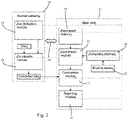
- a system of the present invention comprises at least two entities, namely a central authority 10 and at least one user unit 11.
- the central authority 10 can comprise one or several central units such as computers or servers.
- This central authority is linked to at least one user unit 11, and possibly several user units.
- the term "linked" means that the user unit and the central authority can communicate with each other and can exchange data. Therefore, the central authority and the user unit both comprise remote and/or local communication means which enable a bidirectional exchange of data between them.
- the central authority 10 comprises a key derivation module 12 containing at least a secret piece of information such as a password, and is configured to perform a key derivation function.
- the key derivation module 12 further comprises a random value generator.
- the key derivation function is a first iterative one-way function such as a hash function using several iterations to generate a fingerprint.
- the number of iterations is not strictly defined. In a preferred embodiment, the number of iterations is greater than 1000, and preferably greater than 10'000.
- Several iterative one-way functions can be used, such as for example functions known under the acronym SHA-1 or SHA-256.
- Another suitable function is known under the name SipHash and is documented on http://131002.net/siphash . In this function, the number of iterations can easily be tuned.
- the central authority 10 further comprises a conversion module 13 configured to perform a conversion function which is a second one-way function.
- the user unit 11 comprises a permanent memory 14 in which data is stored.
- the search for the specific datum or data will be performed on a set of data or a subset of the set of data stored in this permanent memory.
- the user unit 11 further comprises a conversion module 15 containing the same second one-way function as the second one-way function of the central authority's conversion module.
- the user unit 11 comprises a temporary memory 16 in which a processing key can be stored for a limited time. This processing key is deleted from the temporary memory 16 when it is not useful anymore.
- the temporary memory is emptied in any case when the user unit is switched off.
- the user unit 11 further comprises a comparison module 17 for comparing data coming from the user unit 11 with data coming from the central authority 10.
- the user unit 11 comprises a reporting module 18 for storing a report concerning the comparison of the data and possibly, of sending the report to the central authority 10.
- the system of the invention further comprises a secure communication channel 19 used for securely exchanging data between the central authority 10 and the user unit 11.
- the method of the invention comprises two phases, a first phase taking place essentially in the central authority 10 and a second phase taking place essentially in a user unit 11.
- a first step which precedes the actual method of searching data of the invention, consists in preparing the devices for secure communication or, in other words, establishing a secure communication channel between the central authority and the user unit.
- This preparation comprises a step 20 of mutual authentication of the devices in order to establish the secure communication channel 19.
- One of these known methods comprises the following steps: the central authority generates a root key RK from a master secret and an identifier of the user unit. This root key RK is sent to the user unit.
- the central authority and the user unit know the same pseudo-random function PRF.
- a suitable pseudo-random function can be SipHash with a 128-bit output size.
- the pair of values (c1; r1) is sent to the user unit.
- session key SK Once the session key SK is established, communications between the central authority and the user unit are protected using this session key.
- the key derivation module 12 of the central authority 10 derives a processing key PK in a step 21.
- This processing key PK can be derived from a password that can be specific to the user unit 11 upon which the search process is performed. It can also be common to a group of user units or even to all the user units linked to that central authority 10.
- the deriving of the processing key PK may further use "salt", which is usually a random number generated by the random number generator of the key derivation module 12. This salt enables the generation of different processing keys even if the password is the same. This is interesting for example in the case where several user units share the same password. This is also interesting even if the passwords are different for each user unit, as every time a communication is initiated with a same user unit, the salt enables deriving a different processing key.
- the processing key is derived by the first iterative one-way function.
- This function has several important features. First, it is a one-way function, which means that it is not possible, by knowing the value of the processing key and the result of the function on a password, to calculate or to determine the password in clear. Secondly, it is an iterative function. The number of iterations can be set arbitrarily. The aim of using an iterative function is to "consume" time for generating a processing key. Consuming time prevents a fraudulent user from generating a large number of processing keys over a short period, for a usual scenario used in a brute force attack or a dictionary attack, for example.
- the time required for generating a number of processing keys, among which there would be a non-negligible probability of finding a correct processing key, should be much greater than the time required to use a processing key found in such a manner. This time for generating a processing key can therefore be increased by increasing the number of iterations.
- the specific datum to be found is converted in a step 22, in the conversion module 13 of the central authority 10.
- the conversion uses a second one-way function such as a hash, this hash using the processing key PK derived from the password, the salt and the first iterative one-way function in step 21.
- the search can be carried out on a single specific datum or on a plurality of data. In any case, each specific datum or data is converted individually. Each converted specific datum or data can be aggregated in a list prior to being sent to the user unit for the search, or can be sent individually.
- the converted data as well as the processing key PK are sent to the user unit 11 in which the search is to be carried out. This transmission is made through the secure communication channel 19 between the central authority 10 and the user unit 11.
- the reception of the processing key PK corresponds to step 23 on Fig. 2 .
- the processing key PK obtained by the first iterative one-way function is sent to the user unit 11 but neither the password nor the salt are sent.
- the processing key PK and the converted data can be sent simultaneously or separately, as illustrated by Fig. 2 .
- the central authority 10 also sends an indication concerning the type of data that is to be found during the search.
- This type of data can be for example a name, an account number, other numbers related to banking, such as IBAN, etc. Indicating the type of data facilitates the search as only the data corresponding to the searched format are scrutinized. This also shortens the time required for the search.
- each specific datum is advantageously related to an index.
- This index is advantageously sent in clear with the converted data and can be used to indicate which specific datum among the list of data was found in the user unit.
- the second phase of the method of the invention takes place in the user unit 11.
- the user unit 11 receives the processing key PK derived by the central authority 10 and stores this processing key PK in the temporary memory 16 of the user unit 11.
- the user unit 11 does not receive, and does not know, either the password or the salt that was used to derive the processing key PK.
- the user unit 11 prepares a set of data through which the search will be made for the specific datum.
- This set of data is usually a subset of all the data stored in the permanent memory 14 of the user unit 11.
- the type of data to be found is defined, for example by defining a specific format corresponding to an account number, only the data stored in the permanent memory 14 of the user unit and corresponding to that specific format will be prepared in that step 24.
- the preparation of this subset of data is performed by the conversion module 15 of the user unit 11 and uses the same second one-way function and the same processing key PK that was used by the central authority 10 for preparing the specific datum in step 22.
- Each specific datum of the subset of data stored in the permanent memory 14 of the user unit 11 is converted by this second one-way function using the processing key PK.
- the result of the conversion can be stored in a memory of the user unit 11.
- the processing key PK can be deleted from the temporary memory 16 of the user unit 11. This deletion is performed by a processing key erasing means 25 and corresponds to step 26 of Fig. 2 .
- the deletion of the processing key PK can be performed by a secure wiping of the memory. This deletion could also be performed at the end of the search for example.
- the processing key PK is a piece of information that should be kept secret, it is preferable to store it only as long as it is necessary and to delete it once it is not useful anymore.
- the data stored in the permanent memory 14 of the user unit 11 is converted in step 24, it can be compared using the comparison module 17, in step 27, to the converted specific datum received from the central authority 10.
- the comparison module 17, in step 27 can then be used.
- one specific datum received from the central authority 10 is compared to the converted data of the user unit 11. If a match is found, a report is sent to the central unit 10. If no match is found, either no report is sent, or a report is sent indicating the "no-match" result.
- a report is stored in the user unit in the form of a log file, in step 28.
- This log file is transmitted to the central unit at a later stage in step 29.
- This embodiment is particularly useful when several pieces of specific data are to be found.
- the log file may contain an index, indicating which specific datum lead to a match, among the list of specific data that was to be found.
- the log file may be transmitted immediately after completion of the search or can be stored and sent later.
- This log file, as well as the "match” or “no-match” result in the case of a single specific datum search, can be sent in clear and even through a non secure channel as it gives virtually no information to a third party.
- An important feature of the invention is the fact that the derivation of the processing key PK, used for hashing the specific datum by the central authority 10, uses an iterative function. This feature goes hand in hand with the fact that the user unit 11 receives the processing key PK and does not have to calculate it. This means that a malicious third party needs time to generate several processing keys that could be used for a brute force attack or a dictionary attack. On the other side, i.e. in the user unit 11 which receives the processing key rather than having to calculate it, the processing key PK is used over a short period and can be deleted very quickly. This also enables the search to be quick, which is advantageous as it allows for the search to be performed among a large quantity of data over a limited period without exposing sensitive data over long periods of time.
- the method and the system of the invention are described in an embodiment in which the central authority 10 searches for a specific datum in one user unit 11.
- the search authority 10 can of course search for a specific datum or data in several user units.
- secure communication channels 19 are established between the central authority 10 and each individual user unit.
- the different user units are not authorized to communicate with each other, this in order to prevent a user unit from "grabbing" information from another user unit.
Landscapes
- Engineering & Computer Science (AREA)
- Theoretical Computer Science (AREA)
- Computer Security & Cryptography (AREA)
- Physics & Mathematics (AREA)
- General Engineering & Computer Science (AREA)
- General Physics & Mathematics (AREA)
- Databases & Information Systems (AREA)
- Computer Networks & Wireless Communication (AREA)
- Signal Processing (AREA)
- Health & Medical Sciences (AREA)
- Bioethics (AREA)
- General Health & Medical Sciences (AREA)
- Data Mining & Analysis (AREA)
- Software Systems (AREA)
- Computational Linguistics (AREA)
- Computer Hardware Design (AREA)
- Medical Informatics (AREA)
- Storage Device Security (AREA)
- Information Retrieval, Db Structures And Fs Structures Therefor (AREA)
Claims (15)
- Verfahren, das Folgendes umfasst:Empfangen, durch eine Benutzereinheit (11), von einem Computer (10), eines Verarbeitungsschlüssels (PK), der an dem Computer basierend auf einer ersten iterativen Einwegfunktion an dem Computer unter Verwendung wenigstens geheimer Informationen abgeleitet ist, wobei die iterative Einwegfunktion Zeit zum Generieren des Verarbeitungsschlüssels verbraucht;Empfangen, durch die Benutzereinheit, wenigstens eines spezifischen Datums, das an dem Computer durch eine zweite Einwegfunktion an dem Computer unter Verwendung des Verarbeitungsschlüssels umgewandelt wird;Umwandeln, durch die Benutzereinheit, unter Verwendung einer gleichen zweiten Einwegfunktion an der Benutzereinheit und des Verarbeitungsschlüssels, der von dem Computer empfangen wird, wenigstens eines Teils von Daten in einem Permanentspeicher der Benutzereinheit; undBereitstellen, durch die Benutzereinheit, eines Suchergebnisses basierend auf einem Vergleichen des umgewandelten wenigstens einen spezifischen Datums, das von dem Computer empfangen wird, mit dem umgewandelten Teil von Daten aus dem Permanentspeicher der Benutzereinheit.
- Verfahren nach Anspruch 1, wobei der Verarbeitungsschlüssel mittels eines gesicherten Kommunikationskanals empfangen wird und/oder wobei das umgewandelte wenigstens eine spezifische Datum durch die Benutzereinheit mittels eines gesicherten Kommunikationskanals empfangen wird.
- Verfahren nach Anspruch 1, das ferner ein Senden eines Berichts, der das Suchergebnis betrifft, an eine zentrale Autorität umfasst, wenn der Vergleich zu einer Übereinstimmung führt, wobei der Computer in der zentralen Autorität beinhaltet ist.
- Verfahren nach Anspruch 1, wobei das wenigstens eine spezifische, zu findende Datum mehrere Datenelemente enthält und wobei das Suchergebnis einen Hinweis enthält, der es ermöglicht, dass das spezifische Datenelement, das zu einer Übereinstimmung geführt hat, identifiziert wird.
- Verfahren nach Anspruch 4, wobei der Hinweis ein Index ist, der mit jedem spezifischen, zu findenden Datum verknüpft und für dieses spezifisch ist.
- Verfahren nach Anspruch 2, das ferner ein Ausführen einer wechselseitigen Authentifizierung zwischen einer zentralen Autorität und der Benutzereinheit umfasst, um den gesicherten Kommunikationskanal einzurichten, wobei der Computer in der zentralen Autorität beinhaltet ist.
- Verfahren nach Anspruch 1, wobei das Verfahren ferner ein Speichern des Verarbeitungsschlüssels in einem temporären Speicher der Benutzereinheit umfasst.
- Verfahren nach Anspruch 7, wobei das Verfahren ferner ein Löschen des Verarbeitungsschlüssels aus dem temporären Speicher der Benutzereinheit umfasst.
- Verfahren nach Anspruch 8, wobei das Löschen des Verarbeitungsschlüssels aus dem temporären Speicher der Benutzereinheit durchgeführt wirdsobald die Umwandlung des wenigstens einen Teils der in dem Permanentspeicher der Benutzereinheit gespeicherten Daten abgeschlossen ist, odersobald die Suche abgeschlossen ist.
- Verfahren nach Anspruch 8, wobei das Löschen des Verarbeitungsschlüssels durch ein gesichertes Streichen des temporären Speichers der Benutzereinheit erfolgt.
- Benutzereinheit (11), die Folgendes umfasst:eine Kommunikationsschnittstelle (19), um einen Verarbeitungsschlüssel (PK), der an einem Computer (10) basierend auf einer ersten iterativen Einwegfunktion an dem Computer unter Verwendung wenigstens geheimer Informationen abgeleitet ist, und wenigstens ein spezifisches Datum zu empfangen, das an dem Computer basierend auf einer zweiten Einwegfunktion an dem Computer unter Verwendung des Verarbeitungsschlüssels umgewandelt wird, wobei die erste iterative Einwegfunktion Zeit zum Generieren des Verarbeitungsschlüssels verbraucht;einen Permanentspeicher, um Daten zu speichern;ein Umwandlungsmodul, um, unter Verwendung der gleichen zweiten Einwegfunktion an der Benutzereinheit und des Verarbeitungsschlüssels, der von dem Computer empfangen wird, wenigstens einen Teil von Daten in dem Permanentspeicher umzuwandeln; undein Vergleichsmodul, um das umgewandelte wenigstens eine spezifische Datum, das von dem Computer empfangen wird, mit den umgewandelten Daten aus dem Permanentspeicher zu vergleichen.
- Benutzereinheit nach Anspruch 11, die ferner einen temporären Speicher umfasst, um den Verarbeitungsschlüssel zu speichern.
- Benutzereinheit nach Anspruch 11, die ferner ein Auslöschmodul umfasst, um den Verarbeitungsschlüssel aus dem temporären Speicher auszulöschen.
- Benutzereinheit nach Anspruch 11, die ferner ein Berichtsmodul zum Speichern eines Berichts umfasst, der auf einem Vergleich des empfangenen umgewandelten wenigstens einen spezifischen Datums mit den umgewandelten Daten aus dem Speicher der Benutzereinheit basiert.
- Benutzereinheit nach Anspruch 11, wobei die Kommunikationsschnittstelle einen gesicherten Kommunikationskanal bereitstellt, um den Verarbeitungsschlüssel und das wenigstens eine spezifische Datum, das basierend auf der zweiten Einwegfunktion unter Verwendung des Verarbeitungsschlüssels umgewandelt wird, zu empfangen.
Priority Applications (2)
| Application Number | Priority Date | Filing Date | Title |
|---|---|---|---|
| ES19207814T ES2924347T3 (es) | 2015-03-26 | 2015-03-26 | Método y sistema para buscar al menos un dato específico en una unidad de usuario |
| EP19207814.5A EP3674952B1 (de) | 2015-03-26 | 2015-03-26 | Verfahren und system zur suche nach mindestens einem spezifischen datum in einer benutzereinheit |
Applications Claiming Priority (2)
| Application Number | Priority Date | Filing Date | Title |
|---|---|---|---|
| EP15160956.7A EP3073407B1 (de) | 2015-03-26 | 2015-03-26 | Verfahren und system zur suche nach mindestens einem spezifischen datum in einer benutzereinheit |
| EP19207814.5A EP3674952B1 (de) | 2015-03-26 | 2015-03-26 | Verfahren und system zur suche nach mindestens einem spezifischen datum in einer benutzereinheit |
Related Parent Applications (2)
| Application Number | Title | Priority Date | Filing Date |
|---|---|---|---|
| EP15160956.7A Division-Into EP3073407B1 (de) | 2015-03-26 | 2015-03-26 | Verfahren und system zur suche nach mindestens einem spezifischen datum in einer benutzereinheit |
| EP15160956.7A Division EP3073407B1 (de) | 2015-03-26 | 2015-03-26 | Verfahren und system zur suche nach mindestens einem spezifischen datum in einer benutzereinheit |
Publications (2)
| Publication Number | Publication Date |
|---|---|
| EP3674952A1 EP3674952A1 (de) | 2020-07-01 |
| EP3674952B1 true EP3674952B1 (de) | 2022-06-15 |
Family
ID=52779538
Family Applications (2)
| Application Number | Title | Priority Date | Filing Date |
|---|---|---|---|
| EP19207814.5A Active EP3674952B1 (de) | 2015-03-26 | 2015-03-26 | Verfahren und system zur suche nach mindestens einem spezifischen datum in einer benutzereinheit |
| EP15160956.7A Active EP3073407B1 (de) | 2015-03-26 | 2015-03-26 | Verfahren und system zur suche nach mindestens einem spezifischen datum in einer benutzereinheit |
Family Applications After (1)
| Application Number | Title | Priority Date | Filing Date |
|---|---|---|---|
| EP15160956.7A Active EP3073407B1 (de) | 2015-03-26 | 2015-03-26 | Verfahren und system zur suche nach mindestens einem spezifischen datum in einer benutzereinheit |
Country Status (4)
| Country | Link |
|---|---|
| US (2) | US20160283553A1 (de) |
| EP (2) | EP3674952B1 (de) |
| CA (1) | CA2924017C (de) |
| ES (1) | ES2924347T3 (de) |
Families Citing this family (1)
| Publication number | Priority date | Publication date | Assignee | Title |
|---|---|---|---|---|
| CN111143580B (zh) * | 2019-12-26 | 2024-04-09 | 惠州Tcl移动通信有限公司 | 多媒体数据存储方法、装置、存储介质及电子设备 |
Citations (1)
| Publication number | Priority date | Publication date | Assignee | Title |
|---|---|---|---|---|
| EP2335165B1 (de) * | 2008-12-30 | 2015-01-21 | International Business Machines Corporation | Suchmaschinendienst mit hash-algorithmen |
Family Cites Families (38)
| Publication number | Priority date | Publication date | Assignee | Title |
|---|---|---|---|---|
| US6104810A (en) * | 1997-05-15 | 2000-08-15 | International Business Machines Corporation | Pseudorandom number generator with backup and restoration capability |
| US6493825B1 (en) * | 1998-06-29 | 2002-12-10 | Emc Corporation | Authentication of a host processor requesting service in a data processing network |
| US7577846B2 (en) * | 2000-10-04 | 2009-08-18 | Nagravision Sa | Mechanism of matching between a receiver and a security module |
| WO2003017136A1 (en) * | 2001-08-16 | 2003-02-27 | Etagon Israel Ltd. | Using associative memory to perform database operations |
| JP2003324418A (ja) * | 2002-02-27 | 2003-11-14 | Canon Inc | 画像処理装置、データ処理装置及びデータ処理方法 |
| US7502933B2 (en) * | 2002-11-27 | 2009-03-10 | Rsa Security Inc. | Identity authentication system and method |
| TW200507647A (en) * | 2003-02-06 | 2005-02-16 | Nagravision Sa | Storage and transmission method of information generated by a security module |
| EP1480371A1 (de) * | 2003-05-23 | 2004-11-24 | Mediacrypt AG | Vorrichtung und Verfahren zur Ver- und Entschlüsselung eines Datenblocks |
| EP1513285A1 (de) * | 2003-09-05 | 2005-03-09 | Mediacrypt AG | Verfahren zum Erzeugen einer Pseudofallsequenz |
| JP5058600B2 (ja) * | 2003-09-12 | 2012-10-24 | イーエムシー コーポレイション | 無連絡認証を提供するシステムおよび方法 |
| EP1784016A1 (de) * | 2005-11-03 | 2007-05-09 | Nagravision S.A. | Verfahren zur Sicherung der Datenübertragung zwischen einem Multimediaendgerät und einem Sicherheitsmodul |
| EP1883239A1 (de) * | 2006-07-24 | 2008-01-30 | Nagravision S.A. | Verfahren zum Speichern und zum Betrieb von Rundsendeereignisdaten |
| US7841000B2 (en) * | 2006-10-16 | 2010-11-23 | Lenovo (Singapore) Pte. Ltd. | Authentication password storage method and generation method, user authentication method, and computer |
| EP1916598A1 (de) * | 2006-10-23 | 2008-04-30 | Nagravision S.A. | Methode zum Aufladen und Verwalten einer Anwendung in einem mobilen Gerät |
| US7593938B2 (en) * | 2006-12-22 | 2009-09-22 | Isilon Systems, Inc. | Systems and methods of directory entry encodings |
| EP2015561A1 (de) * | 2007-07-10 | 2009-01-14 | Nagracard S.A. | Verfahren zum Senden eines ausführbaren Codes an eine Empfangsvorrichtung und Verfahren zur Ausführung dieses Codes |
| US7711786B2 (en) * | 2007-08-06 | 2010-05-04 | Zhu Yunzhou | Systems and methods for preventing spam |
| JP5248153B2 (ja) * | 2008-03-14 | 2013-07-31 | 株式会社東芝 | 情報処理装置、方法及びプログラム |
| MX2010014464A (es) * | 2008-06-24 | 2011-02-22 | Nagravision Sa | Sistema y metodo para el manejo seguro de memoria. |
| US9344924B2 (en) * | 2008-11-27 | 2016-05-17 | Htc Corporation | Method of handling handover security configuration and related communication device |
| US8843997B1 (en) * | 2009-01-02 | 2014-09-23 | Resilient Network Systems, Inc. | Resilient trust network services |
| US9442980B1 (en) * | 2010-04-21 | 2016-09-13 | Stan Trepetin | Mathematical method for performing homomorphic operations |
| US9940195B2 (en) * | 2010-08-25 | 2018-04-10 | International Business Machines Corporation | Encryption of slice partials |
| US8621189B2 (en) * | 2010-12-21 | 2013-12-31 | Blackberry Limited | System and method for hardware strengthened passwords |
| US8694752B2 (en) * | 2011-02-01 | 2014-04-08 | Cleversafe, Inc. | Transferring data in response to detection of a memory system imbalance |
| EP2680251B1 (de) * | 2011-02-22 | 2016-05-25 | Mitsubishi Electric Corporation | Suchsystem, suchverfahren für das suchsystem, informationsverarbeitungsvorrichtung, suchprogramm, entsprechende stichwortverwaltungsvorrichtung und entsprechendes stichwortverwaltungssystem |
| JP6072782B2 (ja) * | 2011-06-10 | 2017-02-01 | フィリップス ライティング ホールディング ビー ヴィ | ネットワークにおける安全なプロトコルの実行 |
| US20130238646A1 (en) * | 2012-03-06 | 2013-09-12 | Evrichart, Inc. | Partial-Match Searches of Encrypted Data Sets |
| US10114908B2 (en) * | 2012-11-13 | 2018-10-30 | International Business Machines Corporation | Hybrid table implementation by using buffer pool as permanent in-memory storage for memory-resident data |
| US9146877B2 (en) * | 2012-11-29 | 2015-09-29 | Infinidat Ltd. | Storage system capable of managing a plurality of snapshot families and method of snapshot family based read |
| JP2014119486A (ja) * | 2012-12-13 | 2014-06-30 | Hitachi Solutions Ltd | 秘匿検索処理システム、秘匿検索処理方法、および秘匿検索処理プログラム |
| US20140245023A1 (en) * | 2013-02-27 | 2014-08-28 | Kabushiki Kaisha Toshiba | Device and authentication method therefor |
| DK2811708T3 (en) * | 2013-06-06 | 2017-01-16 | Nagravision Sa | User authentication system and method |
| US10963431B2 (en) * | 2013-06-11 | 2021-03-30 | Red Hat, Inc. | Storing an object in a distributed storage system |
| US9355271B2 (en) * | 2013-10-18 | 2016-05-31 | Robert Bosch Gmbh | System and method for dynamic, non-interactive, and parallelizable searchable symmetric encryption |
| JP5568696B1 (ja) * | 2014-03-07 | 2014-08-06 | 株式会社 ディー・エヌ・エー | パスワード管理システム及びパスワード管理システム用プログラム |
| US10148437B2 (en) * | 2015-09-21 | 2018-12-04 | Oracle International Corporation | Encryption system with key recovery |
| US10795873B1 (en) * | 2016-11-22 | 2020-10-06 | Innovium, Inc. | Hash output manipulation |
-
2015
- 2015-03-26 EP EP19207814.5A patent/EP3674952B1/de active Active
- 2015-03-26 ES ES19207814T patent/ES2924347T3/es active Active
- 2015-03-26 EP EP15160956.7A patent/EP3073407B1/de active Active
-
2016
- 2016-03-18 CA CA2924017A patent/CA2924017C/en active Active
- 2016-03-22 US US15/076,985 patent/US20160283553A1/en not_active Abandoned
-
2019
- 2019-08-23 US US16/548,903 patent/US11321323B2/en active Active
Patent Citations (1)
| Publication number | Priority date | Publication date | Assignee | Title |
|---|---|---|---|---|
| EP2335165B1 (de) * | 2008-12-30 | 2015-01-21 | International Business Machines Corporation | Suchmaschinendienst mit hash-algorithmen |
Also Published As
| Publication number | Publication date |
|---|---|
| ES2924347T3 (es) | 2022-10-06 |
| US20200151171A1 (en) | 2020-05-14 |
| EP3073407B1 (de) | 2019-12-18 |
| EP3073407A1 (de) | 2016-09-28 |
| CA2924017A1 (en) | 2016-09-26 |
| US11321323B2 (en) | 2022-05-03 |
| CA2924017C (en) | 2023-09-12 |
| EP3674952A1 (de) | 2020-07-01 |
| US20160283553A1 (en) | 2016-09-29 |
Similar Documents
| Publication | Publication Date | Title |
|---|---|---|
| CN109614818B (zh) | 可授权的基于身份的带关键词搜索加密方法 | |
| US6959394B1 (en) | Splitting knowledge of a password | |
| US10810315B2 (en) | Enabling access to data | |
| US7739733B2 (en) | Storing digital secrets in a vault | |
| EP0962070B1 (de) | Verwaltung und benutzung von neuen geheimzahlen in einer netzwerkumgebung | |
| US11496326B2 (en) | Physical unclonable function-based encryption schemes with combination of hashing methods | |
| CN106713508B (zh) | 一种基于云服务器的数据存取方法及系统 | |
| US8438393B2 (en) | Quadratic residue based password authenticated key exchange method and system | |
| CN107370546A (zh) | 窃听检测方法、数据发送方法、装置及系统 | |
| CN114417073B (zh) | 一种加密图的邻居节点查询方法及装置、电子设备 | |
| CN111192050B (zh) | 一种数字资产私钥存储提取方法及装置 | |
| CN109905384B (zh) | 数据迁移方法及系统 | |
| US11184176B2 (en) | System and method for generating data signatures over non-continuously bidirectional communication channels | |
| CN107306181A (zh) | 鉴权系统及其鉴权信息的加密、验证方法与装置 | |
| Al Maqbali et al. | AutoPass: An automatic password generator | |
| KR101217491B1 (ko) | 공개키 기반의 키워드 검색 방법 | |
| US20240430087A1 (en) | One-way functions with polynomial computation | |
| US20250004722A1 (en) | Method for generating a pseudorandom number and method for symmetrically encrypting a message | |
| CN110851848B (zh) | 对称可搜索加密的隐私保护方法 | |
| US7574607B1 (en) | Secure pipeline processing | |
| EP3674952B1 (de) | Verfahren und system zur suche nach mindestens einem spezifischen datum in einer benutzereinheit | |
| CN111770081B (zh) | 基于角色认证的大数据机密文件访问方法 | |
| Yang et al. | Provable Ownership of Encrypted Files in De-duplication Cloud Storage. | |
| CN115730342B (zh) | 一种数据验真方法、装置和计算机可读存储介质 | |
| KR100986980B1 (ko) | 생체 인증 방법, 클라이언트 및 서버 |
Legal Events
| Date | Code | Title | Description |
|---|---|---|---|
| PUAI | Public reference made under article 153(3) epc to a published international application that has entered the european phase |
Free format text: ORIGINAL CODE: 0009012 |
|
| STAA | Information on the status of an ep patent application or granted ep patent |
Free format text: STATUS: THE APPLICATION HAS BEEN PUBLISHED |
|
| AC | Divisional application: reference to earlier application |
Ref document number: 3073407 Country of ref document: EP Kind code of ref document: P |
|
| AK | Designated contracting states |
Kind code of ref document: A1 Designated state(s): AL AT BE BG CH CY CZ DE DK EE ES FI FR GB GR HR HU IE IS IT LI LT LU LV MC MK MT NL NO PL PT RO RS SE SI SK SM TR |
|
| STAA | Information on the status of an ep patent application or granted ep patent |
Free format text: STATUS: REQUEST FOR EXAMINATION WAS MADE |
|
| 17P | Request for examination filed |
Effective date: 20201224 |
|
| RBV | Designated contracting states (corrected) |
Designated state(s): AL AT BE BG CH CY CZ DE DK EE ES FI FR GB GR HR HU IE IS IT LI LT LU LV MC MK MT NL NO PL PT RO RS SE SI SK SM TR |
|
| GRAP | Despatch of communication of intention to grant a patent |
Free format text: ORIGINAL CODE: EPIDOSNIGR1 |
|
| STAA | Information on the status of an ep patent application or granted ep patent |
Free format text: STATUS: GRANT OF PATENT IS INTENDED |
|
| INTG | Intention to grant announced |
Effective date: 20220110 |
|
| GRAS | Grant fee paid |
Free format text: ORIGINAL CODE: EPIDOSNIGR3 |
|
| GRAA | (expected) grant |
Free format text: ORIGINAL CODE: 0009210 |
|
| STAA | Information on the status of an ep patent application or granted ep patent |
Free format text: STATUS: THE PATENT HAS BEEN GRANTED |
|
| AC | Divisional application: reference to earlier application |
Ref document number: 3073407 Country of ref document: EP Kind code of ref document: P |
|
| AK | Designated contracting states |
Kind code of ref document: B1 Designated state(s): AL AT BE BG CH CY CZ DE DK EE ES FI FR GB GR HR HU IE IS IT LI LT LU LV MC MK MT NL NO PL PT RO RS SE SI SK SM TR |
|
| REG | Reference to a national code |
Ref country code: CH Ref legal event code: EP Ref country code: GB Ref legal event code: FG4D |
|
| REG | Reference to a national code |
Ref country code: NL Ref legal event code: FP |
|
| REG | Reference to a national code |
Ref country code: IE Ref legal event code: FG4D |
|
| REG | Reference to a national code |
Ref country code: DE Ref legal event code: R096 Ref document number: 602015079517 Country of ref document: DE |
|
| REG | Reference to a national code |
Ref country code: AT Ref legal event code: REF Ref document number: 1498814 Country of ref document: AT Kind code of ref document: T Effective date: 20220715 |
|
| REG | Reference to a national code |
Ref country code: ES Ref legal event code: FG2A Ref document number: 2924347 Country of ref document: ES Kind code of ref document: T3 Effective date: 20221006 |
|
| REG | Reference to a national code |
Ref country code: LT Ref legal event code: MG9D |
|
| PG25 | Lapsed in a contracting state [announced via postgrant information from national office to epo] |
Ref country code: SE Free format text: LAPSE BECAUSE OF FAILURE TO SUBMIT A TRANSLATION OF THE DESCRIPTION OR TO PAY THE FEE WITHIN THE PRESCRIBED TIME-LIMIT Effective date: 20220615 Ref country code: NO Free format text: LAPSE BECAUSE OF FAILURE TO SUBMIT A TRANSLATION OF THE DESCRIPTION OR TO PAY THE FEE WITHIN THE PRESCRIBED TIME-LIMIT Effective date: 20220915 Ref country code: LT Free format text: LAPSE BECAUSE OF FAILURE TO SUBMIT A TRANSLATION OF THE DESCRIPTION OR TO PAY THE FEE WITHIN THE PRESCRIBED TIME-LIMIT Effective date: 20220615 Ref country code: HR Free format text: LAPSE BECAUSE OF FAILURE TO SUBMIT A TRANSLATION OF THE DESCRIPTION OR TO PAY THE FEE WITHIN THE PRESCRIBED TIME-LIMIT Effective date: 20220615 Ref country code: GR Free format text: LAPSE BECAUSE OF FAILURE TO SUBMIT A TRANSLATION OF THE DESCRIPTION OR TO PAY THE FEE WITHIN THE PRESCRIBED TIME-LIMIT Effective date: 20220916 Ref country code: FI Free format text: LAPSE BECAUSE OF FAILURE TO SUBMIT A TRANSLATION OF THE DESCRIPTION OR TO PAY THE FEE WITHIN THE PRESCRIBED TIME-LIMIT Effective date: 20220615 Ref country code: BG Free format text: LAPSE BECAUSE OF FAILURE TO SUBMIT A TRANSLATION OF THE DESCRIPTION OR TO PAY THE FEE WITHIN THE PRESCRIBED TIME-LIMIT Effective date: 20220915 |
|
| REG | Reference to a national code |
Ref country code: AT Ref legal event code: MK05 Ref document number: 1498814 Country of ref document: AT Kind code of ref document: T Effective date: 20220615 |
|
| PG25 | Lapsed in a contracting state [announced via postgrant information from national office to epo] |
Ref country code: RS Free format text: LAPSE BECAUSE OF FAILURE TO SUBMIT A TRANSLATION OF THE DESCRIPTION OR TO PAY THE FEE WITHIN THE PRESCRIBED TIME-LIMIT Effective date: 20220615 Ref country code: LV Free format text: LAPSE BECAUSE OF FAILURE TO SUBMIT A TRANSLATION OF THE DESCRIPTION OR TO PAY THE FEE WITHIN THE PRESCRIBED TIME-LIMIT Effective date: 20220615 |
|
| PG25 | Lapsed in a contracting state [announced via postgrant information from national office to epo] |
Ref country code: SM Free format text: LAPSE BECAUSE OF FAILURE TO SUBMIT A TRANSLATION OF THE DESCRIPTION OR TO PAY THE FEE WITHIN THE PRESCRIBED TIME-LIMIT Effective date: 20220615 Ref country code: SK Free format text: LAPSE BECAUSE OF FAILURE TO SUBMIT A TRANSLATION OF THE DESCRIPTION OR TO PAY THE FEE WITHIN THE PRESCRIBED TIME-LIMIT Effective date: 20220615 Ref country code: RO Free format text: LAPSE BECAUSE OF FAILURE TO SUBMIT A TRANSLATION OF THE DESCRIPTION OR TO PAY THE FEE WITHIN THE PRESCRIBED TIME-LIMIT Effective date: 20220615 Ref country code: PT Free format text: LAPSE BECAUSE OF FAILURE TO SUBMIT A TRANSLATION OF THE DESCRIPTION OR TO PAY THE FEE WITHIN THE PRESCRIBED TIME-LIMIT Effective date: 20221017 Ref country code: EE Free format text: LAPSE BECAUSE OF FAILURE TO SUBMIT A TRANSLATION OF THE DESCRIPTION OR TO PAY THE FEE WITHIN THE PRESCRIBED TIME-LIMIT Effective date: 20220615 Ref country code: CZ Free format text: LAPSE BECAUSE OF FAILURE TO SUBMIT A TRANSLATION OF THE DESCRIPTION OR TO PAY THE FEE WITHIN THE PRESCRIBED TIME-LIMIT Effective date: 20220615 Ref country code: AT Free format text: LAPSE BECAUSE OF FAILURE TO SUBMIT A TRANSLATION OF THE DESCRIPTION OR TO PAY THE FEE WITHIN THE PRESCRIBED TIME-LIMIT Effective date: 20220615 |
|
| PG25 | Lapsed in a contracting state [announced via postgrant information from national office to epo] |
Ref country code: PL Free format text: LAPSE BECAUSE OF FAILURE TO SUBMIT A TRANSLATION OF THE DESCRIPTION OR TO PAY THE FEE WITHIN THE PRESCRIBED TIME-LIMIT Effective date: 20220615 Ref country code: IS Free format text: LAPSE BECAUSE OF FAILURE TO SUBMIT A TRANSLATION OF THE DESCRIPTION OR TO PAY THE FEE WITHIN THE PRESCRIBED TIME-LIMIT Effective date: 20221015 |
|
| REG | Reference to a national code |
Ref country code: DE Ref legal event code: R097 Ref document number: 602015079517 Country of ref document: DE |
|
| PG25 | Lapsed in a contracting state [announced via postgrant information from national office to epo] |
Ref country code: AL Free format text: LAPSE BECAUSE OF FAILURE TO SUBMIT A TRANSLATION OF THE DESCRIPTION OR TO PAY THE FEE WITHIN THE PRESCRIBED TIME-LIMIT Effective date: 20220615 |
|
| PLBE | No opposition filed within time limit |
Free format text: ORIGINAL CODE: 0009261 |
|
| STAA | Information on the status of an ep patent application or granted ep patent |
Free format text: STATUS: NO OPPOSITION FILED WITHIN TIME LIMIT |
|
| PG25 | Lapsed in a contracting state [announced via postgrant information from national office to epo] |
Ref country code: DK Free format text: LAPSE BECAUSE OF FAILURE TO SUBMIT A TRANSLATION OF THE DESCRIPTION OR TO PAY THE FEE WITHIN THE PRESCRIBED TIME-LIMIT Effective date: 20220615 |
|
| 26N | No opposition filed |
Effective date: 20230316 |
|
| PG25 | Lapsed in a contracting state [announced via postgrant information from national office to epo] |
Ref country code: SI Free format text: LAPSE BECAUSE OF FAILURE TO SUBMIT A TRANSLATION OF THE DESCRIPTION OR TO PAY THE FEE WITHIN THE PRESCRIBED TIME-LIMIT Effective date: 20220615 |
|
| PG25 | Lapsed in a contracting state [announced via postgrant information from national office to epo] |
Ref country code: MC Free format text: LAPSE BECAUSE OF FAILURE TO SUBMIT A TRANSLATION OF THE DESCRIPTION OR TO PAY THE FEE WITHIN THE PRESCRIBED TIME-LIMIT Effective date: 20220615 |
|
| REG | Reference to a national code |
Ref country code: CH Ref legal event code: PL |
|
| REG | Reference to a national code |
Ref country code: BE Ref legal event code: MM Effective date: 20230331 |
|
| PG25 | Lapsed in a contracting state [announced via postgrant information from national office to epo] |
Ref country code: LU Free format text: LAPSE BECAUSE OF NON-PAYMENT OF DUE FEES Effective date: 20230326 |
|
| REG | Reference to a national code |
Ref country code: IE Ref legal event code: MM4A |
|
| PG25 | Lapsed in a contracting state [announced via postgrant information from national office to epo] |
Ref country code: LI Free format text: LAPSE BECAUSE OF NON-PAYMENT OF DUE FEES Effective date: 20230331 Ref country code: IE Free format text: LAPSE BECAUSE OF NON-PAYMENT OF DUE FEES Effective date: 20230326 Ref country code: CH Free format text: LAPSE BECAUSE OF NON-PAYMENT OF DUE FEES Effective date: 20230331 |
|
| PG25 | Lapsed in a contracting state [announced via postgrant information from national office to epo] |
Ref country code: BE Free format text: LAPSE BECAUSE OF NON-PAYMENT OF DUE FEES Effective date: 20230331 |
|
| PG25 | Lapsed in a contracting state [announced via postgrant information from national office to epo] |
Ref country code: BG Free format text: LAPSE BECAUSE OF FAILURE TO SUBMIT A TRANSLATION OF THE DESCRIPTION OR TO PAY THE FEE WITHIN THE PRESCRIBED TIME-LIMIT Effective date: 20220615 |
|
| PG25 | Lapsed in a contracting state [announced via postgrant information from national office to epo] |
Ref country code: BG Free format text: LAPSE BECAUSE OF FAILURE TO SUBMIT A TRANSLATION OF THE DESCRIPTION OR TO PAY THE FEE WITHIN THE PRESCRIBED TIME-LIMIT Effective date: 20220615 |
|
| PGFP | Annual fee paid to national office [announced via postgrant information from national office to epo] |
Ref country code: DE Payment date: 20250218 Year of fee payment: 11 |
|
| PGFP | Annual fee paid to national office [announced via postgrant information from national office to epo] |
Ref country code: FR Payment date: 20250218 Year of fee payment: 11 |
|
| PGFP | Annual fee paid to national office [announced via postgrant information from national office to epo] |
Ref country code: GB Payment date: 20250221 Year of fee payment: 11 Ref country code: IT Payment date: 20250218 Year of fee payment: 11 |
|
| PGFP | Annual fee paid to national office [announced via postgrant information from national office to epo] |
Ref country code: ES Payment date: 20250401 Year of fee payment: 11 |
|
| PG25 | Lapsed in a contracting state [announced via postgrant information from national office to epo] |
Ref country code: CY Free format text: LAPSE BECAUSE OF FAILURE TO SUBMIT A TRANSLATION OF THE DESCRIPTION OR TO PAY THE FEE WITHIN THE PRESCRIBED TIME-LIMIT; INVALID AB INITIO Effective date: 20150326 |
|
| PG25 | Lapsed in a contracting state [announced via postgrant information from national office to epo] |
Ref country code: HU Free format text: LAPSE BECAUSE OF FAILURE TO SUBMIT A TRANSLATION OF THE DESCRIPTION OR TO PAY THE FEE WITHIN THE PRESCRIBED TIME-LIMIT; INVALID AB INITIO Effective date: 20150326 |
|
| PG25 | Lapsed in a contracting state [announced via postgrant information from national office to epo] |
Ref country code: TR Free format text: LAPSE BECAUSE OF FAILURE TO SUBMIT A TRANSLATION OF THE DESCRIPTION OR TO PAY THE FEE WITHIN THE PRESCRIBED TIME-LIMIT Effective date: 20220615 |
|
| PGFP | Annual fee paid to national office [announced via postgrant information from national office to epo] |
Ref country code: NL Payment date: 20260219 Year of fee payment: 12 |