EP3675267A1 - Solution électrolytique non aqueuse pour batteries, et batterie rechargeable au lithium - Google Patents
Solution électrolytique non aqueuse pour batteries, et batterie rechargeable au lithium Download PDFInfo
- Publication number
- EP3675267A1 EP3675267A1 EP18849021.3A EP18849021A EP3675267A1 EP 3675267 A1 EP3675267 A1 EP 3675267A1 EP 18849021 A EP18849021 A EP 18849021A EP 3675267 A1 EP3675267 A1 EP 3675267A1
- Authority
- EP
- European Patent Office
- Prior art keywords
- additive
- electrolyte solution
- carbonate
- nonaqueous electrolyte
- lithium
- Prior art date
- Legal status (The legal status is an assumption and is not a legal conclusion. Google has not performed a legal analysis and makes no representation as to the accuracy of the status listed.)
- Pending
Links
Images

Classifications
-
- H—ELECTRICITY
- H01—ELECTRIC ELEMENTS
- H01M—PROCESSES OR MEANS, e.g. BATTERIES, FOR THE DIRECT CONVERSION OF CHEMICAL ENERGY INTO ELECTRICAL ENERGY
- H01M6/00—Primary cells; Manufacture thereof
- H01M6/14—Cells with non-aqueous electrolyte
- H01M6/16—Cells with non-aqueous electrolyte with organic electrolyte
- H01M6/162—Cells with non-aqueous electrolyte with organic electrolyte characterised by the electrolyte
- H01M6/168—Cells with non-aqueous electrolyte with organic electrolyte characterised by the electrolyte by additives
-
- H—ELECTRICITY
- H01—ELECTRIC ELEMENTS
- H01M—PROCESSES OR MEANS, e.g. BATTERIES, FOR THE DIRECT CONVERSION OF CHEMICAL ENERGY INTO ELECTRICAL ENERGY
- H01M10/00—Secondary cells; Manufacture thereof
- H01M10/05—Accumulators with non-aqueous electrolyte
- H01M10/056—Accumulators with non-aqueous electrolyte characterised by the materials used as electrolytes, e.g. mixed inorganic/organic electrolytes
- H01M10/0564—Accumulators with non-aqueous electrolyte characterised by the materials used as electrolytes, e.g. mixed inorganic/organic electrolytes the electrolyte being constituted of organic materials only
- H01M10/0566—Liquid materials
- H01M10/0567—Liquid materials characterised by the additives
-
- H—ELECTRICITY
- H01—ELECTRIC ELEMENTS
- H01M—PROCESSES OR MEANS, e.g. BATTERIES, FOR THE DIRECT CONVERSION OF CHEMICAL ENERGY INTO ELECTRICAL ENERGY
- H01M10/00—Secondary cells; Manufacture thereof
- H01M10/05—Accumulators with non-aqueous electrolyte
- H01M10/052—Li-accumulators
-
- H—ELECTRICITY
- H01—ELECTRIC ELEMENTS
- H01M—PROCESSES OR MEANS, e.g. BATTERIES, FOR THE DIRECT CONVERSION OF CHEMICAL ENERGY INTO ELECTRICAL ENERGY
- H01M10/00—Secondary cells; Manufacture thereof
- H01M10/05—Accumulators with non-aqueous electrolyte
- H01M10/052—Li-accumulators
- H01M10/0525—Rocking-chair batteries, i.e. batteries with lithium insertion or intercalation in both electrodes; Lithium-ion batteries
-
- H—ELECTRICITY
- H01—ELECTRIC ELEMENTS
- H01M—PROCESSES OR MEANS, e.g. BATTERIES, FOR THE DIRECT CONVERSION OF CHEMICAL ENERGY INTO ELECTRICAL ENERGY
- H01M10/00—Secondary cells; Manufacture thereof
- H01M10/05—Accumulators with non-aqueous electrolyte
- H01M10/058—Construction or manufacture
- H01M10/0585—Construction or manufacture of accumulators having only flat construction elements, i.e. flat positive electrodes, flat negative electrodes and flat separators
-
- H—ELECTRICITY
- H01—ELECTRIC ELEMENTS
- H01M—PROCESSES OR MEANS, e.g. BATTERIES, FOR THE DIRECT CONVERSION OF CHEMICAL ENERGY INTO ELECTRICAL ENERGY
- H01M4/00—Electrodes
- H01M4/02—Electrodes composed of, or comprising, active material
- H01M4/36—Selection of substances as active materials, active masses, active liquids
- H01M4/38—Selection of substances as active materials, active masses, active liquids of elements or alloys
- H01M4/381—Alkaline or alkaline earth metals elements
- H01M4/382—Lithium
-
- H—ELECTRICITY
- H01—ELECTRIC ELEMENTS
- H01M—PROCESSES OR MEANS, e.g. BATTERIES, FOR THE DIRECT CONVERSION OF CHEMICAL ENERGY INTO ELECTRICAL ENERGY
- H01M4/00—Electrodes
- H01M4/02—Electrodes composed of, or comprising, active material
- H01M4/36—Selection of substances as active materials, active masses, active liquids
- H01M4/48—Selection of substances as active materials, active masses, active liquids of inorganic oxides or hydroxides
- H01M4/485—Selection of substances as active materials, active masses, active liquids of inorganic oxides or hydroxides of mixed oxides or hydroxides for inserting or intercalating light metals, e.g. LiTi2O4 or LiTi2OxFy
-
- H—ELECTRICITY
- H01—ELECTRIC ELEMENTS
- H01M—PROCESSES OR MEANS, e.g. BATTERIES, FOR THE DIRECT CONVERSION OF CHEMICAL ENERGY INTO ELECTRICAL ENERGY
- H01M4/00—Electrodes
- H01M4/02—Electrodes composed of, or comprising, active material
- H01M4/36—Selection of substances as active materials, active masses, active liquids
- H01M4/58—Selection of substances as active materials, active masses, active liquids of inorganic compounds other than oxides or hydroxides, e.g. sulfides, selenides, tellurides, halogenides or LiCoFy; of polyanionic structures, e.g. phosphates, silicates or borates
-
- H—ELECTRICITY
- H01—ELECTRIC ELEMENTS
- H01M—PROCESSES OR MEANS, e.g. BATTERIES, FOR THE DIRECT CONVERSION OF CHEMICAL ENERGY INTO ELECTRICAL ENERGY
- H01M4/00—Electrodes
- H01M4/02—Electrodes composed of, or comprising, active material
- H01M4/36—Selection of substances as active materials, active masses, active liquids
- H01M4/58—Selection of substances as active materials, active masses, active liquids of inorganic compounds other than oxides or hydroxides, e.g. sulfides, selenides, tellurides, halogenides or LiCoFy; of polyanionic structures, e.g. phosphates, silicates or borates
- H01M4/583—Carbonaceous material, e.g. graphite-intercalation compounds or CFx
- H01M4/587—Carbonaceous material, e.g. graphite-intercalation compounds or CFx for inserting or intercalating light metals
-
- H—ELECTRICITY
- H01—ELECTRIC ELEMENTS
- H01M—PROCESSES OR MEANS, e.g. BATTERIES, FOR THE DIRECT CONVERSION OF CHEMICAL ENERGY INTO ELECTRICAL ENERGY
- H01M50/00—Constructional details or processes of manufacture of the non-active parts of electrochemical cells other than fuel cells, e.g. hybrid cells
- H01M50/10—Primary casings; Jackets or wrappings
- H01M50/102—Primary casings; Jackets or wrappings characterised by their shape or physical structure
- H01M50/105—Pouches or flexible bags
-
- H—ELECTRICITY
- H01—ELECTRIC ELEMENTS
- H01M—PROCESSES OR MEANS, e.g. BATTERIES, FOR THE DIRECT CONVERSION OF CHEMICAL ENERGY INTO ELECTRICAL ENERGY
- H01M50/00—Constructional details or processes of manufacture of the non-active parts of electrochemical cells other than fuel cells, e.g. hybrid cells
- H01M50/10—Primary casings; Jackets or wrappings
- H01M50/102—Primary casings; Jackets or wrappings characterised by their shape or physical structure
- H01M50/109—Primary casings; Jackets or wrappings characterised by their shape or physical structure of button or coin shape
-
- H—ELECTRICITY
- H01—ELECTRIC ELEMENTS
- H01G—CAPACITORS; CAPACITORS, RECTIFIERS, DETECTORS, SWITCHING DEVICES, LIGHT-SENSITIVE OR TEMPERATURE-SENSITIVE DEVICES OF THE ELECTROLYTIC TYPE
- H01G11/00—Hybrid capacitors, i.e. capacitors having different positive and negative electrodes; Electric double-layer [EDL] capacitors; Processes for the manufacture thereof or of parts thereof
- H01G11/04—Hybrid capacitors
- H01G11/06—Hybrid capacitors with one of the electrodes allowing ions to be reversibly doped thereinto, e.g. lithium ion capacitors [LIC]
-
- H—ELECTRICITY
- H01—ELECTRIC ELEMENTS
- H01G—CAPACITORS; CAPACITORS, RECTIFIERS, DETECTORS, SWITCHING DEVICES, LIGHT-SENSITIVE OR TEMPERATURE-SENSITIVE DEVICES OF THE ELECTROLYTIC TYPE
- H01G11/00—Hybrid capacitors, i.e. capacitors having different positive and negative electrodes; Electric double-layer [EDL] capacitors; Processes for the manufacture thereof or of parts thereof
- H01G11/54—Electrolytes
- H01G11/58—Liquid electrolytes
- H01G11/64—Liquid electrolytes characterised by additives
-
- H—ELECTRICITY
- H01—ELECTRIC ELEMENTS
- H01G—CAPACITORS; CAPACITORS, RECTIFIERS, DETECTORS, SWITCHING DEVICES, LIGHT-SENSITIVE OR TEMPERATURE-SENSITIVE DEVICES OF THE ELECTROLYTIC TYPE
- H01G9/00—Electrolytic capacitors, rectifiers, detectors, switching devices, light-sensitive or temperature-sensitive devices; Processes of their manufacture
- H01G9/004—Details
- H01G9/022—Electrolytes; Absorbents
- H01G9/035—Liquid electrolytes, e.g. impregnating materials
-
- H—ELECTRICITY
- H01—ELECTRIC ELEMENTS
- H01M—PROCESSES OR MEANS, e.g. BATTERIES, FOR THE DIRECT CONVERSION OF CHEMICAL ENERGY INTO ELECTRICAL ENERGY
- H01M2300/00—Electrolytes
- H01M2300/0017—Non-aqueous electrolytes
- H01M2300/0025—Organic electrolyte
-
- Y—GENERAL TAGGING OF NEW TECHNOLOGICAL DEVELOPMENTS; GENERAL TAGGING OF CROSS-SECTIONAL TECHNOLOGIES SPANNING OVER SEVERAL SECTIONS OF THE IPC; TECHNICAL SUBJECTS COVERED BY FORMER USPC CROSS-REFERENCE ART COLLECTIONS [XRACs] AND DIGESTS
- Y02—TECHNOLOGIES OR APPLICATIONS FOR MITIGATION OR ADAPTATION AGAINST CLIMATE CHANGE
- Y02E—REDUCTION OF GREENHOUSE GAS [GHG] EMISSIONS, RELATED TO ENERGY GENERATION, TRANSMISSION OR DISTRIBUTION
- Y02E60/00—Enabling technologies; Technologies with a potential or indirect contribution to GHG emissions mitigation
- Y02E60/10—Energy storage using batteries
-
- Y—GENERAL TAGGING OF NEW TECHNOLOGICAL DEVELOPMENTS; GENERAL TAGGING OF CROSS-SECTIONAL TECHNOLOGIES SPANNING OVER SEVERAL SECTIONS OF THE IPC; TECHNICAL SUBJECTS COVERED BY FORMER USPC CROSS-REFERENCE ART COLLECTIONS [XRACs] AND DIGESTS
- Y02—TECHNOLOGIES OR APPLICATIONS FOR MITIGATION OR ADAPTATION AGAINST CLIMATE CHANGE
- Y02P—CLIMATE CHANGE MITIGATION TECHNOLOGIES IN THE PRODUCTION OR PROCESSING OF GOODS
- Y02P70/00—Climate change mitigation technologies in the production process for final industrial or consumer products
- Y02P70/50—Manufacturing or production processes characterised by the final manufactured product
-
- Y—GENERAL TAGGING OF NEW TECHNOLOGICAL DEVELOPMENTS; GENERAL TAGGING OF CROSS-SECTIONAL TECHNOLOGIES SPANNING OVER SEVERAL SECTIONS OF THE IPC; TECHNICAL SUBJECTS COVERED BY FORMER USPC CROSS-REFERENCE ART COLLECTIONS [XRACs] AND DIGESTS
- Y02—TECHNOLOGIES OR APPLICATIONS FOR MITIGATION OR ADAPTATION AGAINST CLIMATE CHANGE
- Y02T—CLIMATE CHANGE MITIGATION TECHNOLOGIES RELATED TO TRANSPORTATION
- Y02T10/00—Road transport of goods or passengers
- Y02T10/60—Other road transportation technologies with climate change mitigation effect
- Y02T10/70—Energy storage systems for electromobility, e.g. batteries
Definitions
- the present disclosure relates to a nonaqueous electrolyte solution for a battery and a lithium secondary battery.
- a lithium secondary battery has been widely used as a power source for electronic devices such as mobile phones and laptop computers, electric vehicles, and a power storage.
- electronic devices such as mobile phones and laptop computers, electric vehicles, and a power storage.
- a rapid increase in demand for a battery having high capacity, high output, and high energy density which can be mounted on hybrid vehicles and electric vehicles.
- nonaqueous electrolyte solution secondary battery also referred to as a nonaqueous electrolyte solution secondary battery and the like.
- Patent Document 1 discloses a nonaqueous electrolyte solution battery using lithium or a lithium alloy as a negative electrode active material and manganese dioxide as a positive electrode active material, which can suppress an increase in internal resistance occurring when a battery in which most of a discharge capacity is discharged is left for a long time and used again or when a battery is used for a long time at a low current of about several ⁇ A as a power source for memory backup, and can obtain good battery performance, in which the nonaqueous electrolyte solution battery includes a negative electrode containing lithium or a lithium alloy, a positive electrode mainly composed of manganese dioxide, and a nonaqueous electrolyte solution, and the nonaqueous electrolyte solution contains lithium boron oxide in a ratio of from 0.01 mol/l to 0.5 mol/l.
- Patent Document 2 discloses a nonaqueous electrolyte secondary battery which can improve a cycle characteristic by protecting a positive electrode active material from the action of hydrofluoric acid, in which the nonaqueous electrolyte secondary battery includes a nonaqueous electrolyte solution containing LiPF 6 as an electrolyte salt in a nonaqueous solvent, and the nonaqueous electrolyte solution contains lithium borate.
- Patent Document 2 discloses an example in which lithium manganate is used as the positive electrode active material.
- Patent Document 3 discloses a nonaqueous electrolyte solution secondary battery which can maintain a high battery capacity even when used or stored in a high-temperature environment such as inside a car in summer, in which a lithium manganese composite oxide is used as a positive electrode active material, lithium, a lithium alloy, or a carbon material which reversibly absorbs and desorbs lithium is used as a negative electrode active material, and a nonaqueous electrolyte solution includes from 0.01 mol% to 2 mol% of lithium boron oxide.
- An object of the present disclosure is to provide a nonaqueous electrolyte solution for a battery which can decrease an initial battery resistance before storage of a battery and suppress an increase in battery resistance due to storage, and a lithium secondary battery using the nonaqueous electrolyte solution for a battery.
- a nonaqueous electrolyte solution for a battery which can decrease an initial battery resistance before storage of a battery and suppress an increase in battery resistance due to storage, and a lithium secondary battery using the nonaqueous electrolyte solution for a battery, are provided.
- a numerical range expressed using “to” means a range including numerical values described before and after “to” as a lower limit value and an upper limit value.
- the amount of each component in the composition means, unless otherwise particularly stated, the total amount of the plurality of substances present in the composition, when there are the plurality of substances corresponding to each component in the composition.
- the nonaqueous electrolyte solution for a battery of the disclosure (hereinafter also simply referred to as a "nonaqueous electrolyte solution”) includes an additive A composed of a boron compound represented by the following Formula (1), and an additive B composed of a compound having a lower reductive decomposition potential than the additive A.
- n represents an integer from 1 to 5
- M + represents an Li + ion or an H + ion
- more than one M + may be the same as or different from each other.
- an initial battery resistance before storage of a battery can be decreased, and an increase in battery resistance due to storage can be suppressed.
- the reason for this effect is not clear, but is presumed as follows.
- an additive A that is, a boron compound represented by Formula (1)
- a boron compound represented by Formula (1) has a high reductive decomposition potential due to cyclic voltammetry (CV), and thus, is considered to be rapidly decomposed on a negative electrode during battery charging and discharging. As a result, it is considered that a low-resistance coated film is formed on the negative electrode by a decomposition product of Additive A.
- the nonaqueous electrolyte solution of the disclosure includes an additive B composed of a compound having a lower reductive decomposition potential than the additive A.
- a coated film by a decomposition product of Additive A is rapidly formed on the negative electrode, and then, this coated film is reinforced by a decomposition product of additive B, thereby forming a coated film having low resistance and excellent durability. It is presumed that the coated film having low resistance and excellent durability formed on the negative electrode has the effect of decreasing the initial battery resistance and the effect of suppressing the increase in battery resistance due to storage.
- the above Patent Document 1 JP-ANo. 2000-48828
- the above Patent Document 2 JP-ANo. 2005-71617
- the above Patent Document 3 JP-B No. 4366724
- the nonaqueous electrolyte solution of the disclosure exhibits the effects of decreasing the initial battery resistance and suppressing the increase in battery resistance due to storage by a mechanism completely different from the mechanisms described in Patent Documents 1 to 3, with a combination of the additive A and the additive B.
- the reductive decomposition potential of the additive means a value measured by the following method using cyclic voltammetry (CV).
- a sample solution is prepared as follows.
- ethylene carbonate (EC), dimethyl carbonate (DMC), and methyl ethyl carbonate (EMC) are mixed at a ratio of 34:33:33 (mass ratio), respectively, to obtain a mixed solvent.
- LiPF 6 as an electrolyte is dissolved such that the electrolyte concentration in a finally prepared sample solution is 1 mol/l.
- an additive as a measurement target of the reductive decomposition potential was added such that the additive concentration in the finally prepared sample solution is 0.5% by mass, thereby obtaining a sample solution.
- ALS electrochemical analyzer as cyclic voltammetry (CV) is used to sweep the electrode potential from 3 V to 0 V at a sweep rate of 1 mV/sec, in the state that a graphite electrode as a working electrode (WE), a Li metal electrode as a counter electrode (CE), and a Li metal electrode as a reference electrode (RE) are immersed in the sample solution.
- WE working electrode
- CE Li metal electrode
- RE reference electrode
- the nonaqueous electrolyte solution of the disclosure includes an additive A composed of a boron compound represented by the following Formula (1).
- the additive A included in the nonaqueous electrolyte solution of the disclosure may be one or two or more kinds.
- n represents an integer from 1 to 5
- M + represents an Li + ion or an H + ion
- more than one M + may be the same as or different from each other.
- n is preferably an integer from 1 to 3, and particularly preferably 2.
- M + is particularly preferably an Li + ion.
- Examples of the boron compound represented by Formula (1) includes:
- boron compound represented by Formula (1) a boron compound having a reductive decomposition potential in a range of from 2.0 V to 2.5 V is preferred.
- the content of the additive A (the total content when there are two or more kinds) with respect to the total amount of the nonaqueous electrolyte solution of the disclosure is preferably from 0.001% by mass to 10% by mass, more preferably from 0.005% by mass % to 5% by mass, still preferably from 0.01% by mass to 1% by mass, and particularly preferably from 0.01% by mass to 0.5% by mass.
- the nonaqueous electrolyte solution of the disclosure includes an additive B composed of a compound having a lower reductive decomposition potential than the additive A.
- the additive B may be any compound having a lower reductive decomposition potential than the additive A, and is not particularly limited. As long as additive B is a compound having a lower reductive decomposition potential than the additive A, the coated film formed by the decomposition product of the additive A which has been initially formed is reinforced by the decomposition product of the additive B, thereby forming a coated film having low resistance and excellent durability. As a result, effects of decreasing the initial battery resistance and suppressing an increase in battery resistance due to storage are achieved.
- the additive B included in the nonaqueous electrolyte solution may be only one or two or more kinds.
- a value obtained by subtracting the reductive decomposition potential B from the reductive decomposition potential A may be more than 0, and is preferably from 0.1 V to 1.5 V, more preferably from 0.2 V to 1.3 V, and particularly preferably from 0.3 V to 1.2 V.
- the reductive decomposition potential B is preferably from 0.5 V to 2.0 V, and more preferably from 0.9 V to 1.8 V.
- the additive B is more preferably at least one selected from the group consisting of a carbonate compound having a carbon-carbon unsaturated bond, a sultone compound, a cyclic sulfuric acid ester compound, a phosphoric acid ester compound, an oxalato compound, an aromatic compound substituted with a fluorine atom, an aliphatic compound substituted with a fluorine atom, a dinitrile compound, a sulfonyl compound having a fluorine atom, and a carbonate compound having a fluorine atom.
- the additive B is preferably a compound having a molecular weight of 1000 or less, and more preferably a compound having a molecular weight of 500 or less.
- Examples of the carbonate compound having a carbon-carbon unsaturated bond include chain carbonates such as methyl vinyl carbonate, ethyl vinyl carbonate, divinyl carbonate, methyl propynyl carbonate, ethyl propynyl carbonate, dipropynyl carbonate, methyl phenyl carbonate, ethyl phenyl carbonate, and diphenyl carbonate; cyclic carbonates such as vinylene carbonate, methyl vinylene carbonate, 4,4-dimethyl vinylene carbonate, 4,5-dimethyl vinylene carbonate, vinyl ethylene carbonate, 4,4-divinyl ethylene carbonate, 4,5-divinyl ethylene carbonate, ethynyl ethylene carbonate, 4,4-diethynyl ethylene carbonate, 4,5-diethynyl ethylene carbonate, propynyl ethylene carbonate, 4,4-dipropynyl ethylene carbonate, and 4,5-dipropyny
- methyl phenyl carbonate, ethyl phenyl carbonate, diphenyl carbonate, vinylene carbonate, vinyl ethylene carbonate, 4,4-divinyl ethylene carbonate, and 4,5-divinyl ethylene carbonate are preferred, and vinylene carbonate (reductive decomposition potential of 1.1 V) and vinyl ethylene carbonate (reductive decomposition potential of 1.0 V) are more preferred, and vinylene carbonate is particularly preferred.
- Examples of the sultone compound include 1,3-propane sultone, 1,4-butane sultone, 1,3-propene sultone, 1-methyl-1,3-propene sultone, 2-methyl-1,3-propene sultone, and 3-methyl-1,3-propene sultone.
- 1,3-propane sultone reductive decomposition potential of 1.2 V
- 1,3-propene sultone reductive decomposition potential of 1.4 V
- 1,3-propene sultone reductive decomposition potential of 1.4 V
- cyclic sulfuric acid ester compounds examples include:
- 4-methylsulfonyloxymethyl-2,2-dioxo-1,3,2-dioxathiolane (reductive decomposition potential of 1.3 V)
- 4,4'-bis(2,2-dioxo-1,3,2-dioxathiolane) (reductive decomposition potential of 1.2 V)
- 4-propyl-2,2-dioxo-1,3,2-dioxathiolane (reductive decomposition potential of 1.4 V)
- 4,4'-bis(2,2-dioxo-1,3,2-dioxathiolane) (reductive decomposition potential of 1.2 V) is particularly preferred.
- Examples of the phosphoric acid ester compound include lithium difluorophosphate, lithium monofluorophosphate, tristrimethylsilyl phosphate, dimethyltrimethylsilyl phosphate, methylditrimethylsilyl phosphate, trimethyl phosphate, tristriethylsilyl phosphate, triethyl phosphate, and trioctyl phosphate.
- lithium difluorophosphate reductive decomposition potential of 1.1 V
- tristrimethylsilyl phosphate reductive decomposition potential of 0.9 V
- the concept of the phosphoric acid ester compound herein does not include a phosphoric acid ester compound which is an oxalato compound described later.
- the phosphoric acid ester compound which is an oxalato compound is included in the concept of the oxalato compound.
- Examples of the oxalato compound include lithium difluorobis(oxalato) phosphate, lithium tetrafluoro(oxalato) phosphate, lithium tris(oxalato) phosphate, lithium difluoro(oxalato) borate, and lithium bis(oxalato) borate.
- lithium difluorobis(oxalato) phosphate reductive decomposition potential of 2.0 V
- lithium bis(oxalato) borate reductive decomposition potential of 1.8 V
- the aromatic compound substituted with a fluorine atom is preferably benzene substituted with at least one fluorine atom.
- the benzene substituted with at least one fluorine atom may be substituted with two or more fluorine atoms or may be substituted with a substituent other than a fluorine atom.
- aromatic compound substituted with a fluorine atom examples include orthofluorotoluene, metafluorotoluene, parafluorotoluene, difluorotoluene, trifluorotoluene, tetrafluorotoluene, pentafluorotoluene, fluorobenzene, orthodifluorobenzene, metadifluorobenzene, paradifluorobenzene, 1-fluoro-4-t-butylbenzene, 2-fluorobiphenyl, fluorocyclohexylbenzene (for example, 1-fluoro-2-cyclohexylbenzene, 1-fluoro-3-cyclohexylbenzene, 1-fluoro-4-cyclohexylbenzene), 2,4-difluoroanisole, 2,5-difluoroanisole, 2,6-difluoroanisole, and 3,5-difluoro
- the aliphatic compound substituted with a fluorine atom is preferably a fluorinated alkene.
- the fluorinated alkene refers to an alkene substituted with at least one fluorine atom.
- fluorinated alkene a fluorinated alkene having from 3 to 15 carbon atoms is more preferred.
- fluorinated alkene ethylene substituted with a fluorinated alkyl group having from 1 to 12 carbon atoms is preferred.
- the fluorinated alkyl group refers to an alkyl group substituted with at least one fluorine atom.
- fluorinated alkene examples include (perfluoromethyl) ethylene, (perfluoroethyl) ethylene, (perfluoropropyl) ethylene, (perfluorobutyl) ethylene, (perfluoropentyl) ethylene, (perfluorohexyl) ethylene, (perfluoroheptyl) ethylene, (perfluorooctyl) ethylene, (perfluorononyl) ethylene, (perfluorodecyl) ethylene, (perfluoroundecyl) ethylene, and (perfluorododecyl) ethylene.
- the dinitrile compound is preferably a dinitrile compound having from 2 to 10 carbon atoms.
- Examples of the dinitrile compound include malononitrile, succinonitrile, glutaronitrile, adiponitrile, pimelonitrile, suberonitrile, azelanitrile, sebaconitrile, undecandinitrile, dodecandinitrile, methylmalononitrile, ethylmalononitrile, isopropylmalononitrile, tert-butylmalononitrile, methylsuccinonitrile, 2,2-dimethylsuccinonitrile, 2,3-dimethylsuccinonitrile, trimethylsuccinonitrile, tetramethylsuccinonitrile, 3,3'-oxydipropionitrile, 3,3'- thiodipropionitrile, 3,3'-(ethylenedioxy)dipropionitrile, 3,3'-(ethylenedithio)dipropionitrile, 1,2-benzodinitrile, 1,3-benzodinitrile, 1, 4-benzodinitrile
- succinonitrile reductive decomposition potential of 1.2 V
- adiponitrile reductive decomposition potential of 1.2 V
- sulfonyl compound having a fluorine atom examples include a sulfonyl fluoride compound, a lithium fluorinated alkyl sulfonate compound, and a bis(fluorosulfonyl) imide compound.
- sulfonyl fluoride compound examples include methanesulfonyl fluoride, ethanesulfonyl fluoride, propanesulfonyl fluoride, 2-propanesulfonyl fluoride, butanesulfonyl fluoride, 2-butanesulfonyl fluoride, hexanesulfonyl fluoride, trifluoromethanesulfonyl fluoride, perfluoroethanesulfonyl fluoride, perfluoropropanesulfonyl fluoride, perfluorobutanesulfonyl fluoride, ethenesulfonyl fluoride, 1-propene-1-sulfonyl fluoride, and 2-propene-1-sulfonyl fluoride.
- lithium fluorinated alkyl sulfonate compound examples include lithium trifluoromethane sulfonate and lithium pentafluoroethane sulfonate.
- lithium trifluoromethane sulfonate reductive decomposition potential of 1.3 V is preferred.
- Examples of the bis(fluorosulfonyl) imide compound include lithium bis(fluorosulfonyl) imide.
- the compound has a reductive decomposition potential of 1.4 V.
- Examples of the carbonate compound having a fluorine atom include chain carbonates such as methyl trifluoromethyl carbonate, ethyl trifluoromethyl carbonate, bis(trifluoromethyl) carbonate, methyl(2,2,2-trifluoroethyl) carbonate, ethyl(2,2,2-trifluoroethyl) carbonate, bis(2,2,2-trifluoroethyl) carbonate; cyclic carbonates such as 4-fluoroethylene carbonate, 4,4-difluoroethylene carbonate, 4,5-difluoroethylene carbonate, and 4-trifluoromethylethylene carbonate.
- 4-fluoroethylene carbonate reductive decomposition potential of 1.3 V
- the additive B is more preferably at least one selected from the group consisting of vinylene carbonate, vinyl ethylene carbonate, 1,3-propane sultone, 1,3-propene sultone, 4-methylsulfonyloxymethyl-2,2-dioxo-1,3,2-dioxathiolane, 4,4'-bis(2,2-dioxo-1,3,2-dioxathiolane), 4-propyl-2,2-dioxo-1,3,2-dioxathiolane, lithium difluorophosphate, tristrimethylsilyl phosphate, lithium difluorobis(oxalato) phosphate, lithium bis(oxalato) borate, orthofluorotoluene, (perfluorohexyl) ethylene, succinonitrile, adiponitrile, methanesulfonyl fluoride, lithium trifluoromethanesulfonate, lithium bis(fluorosulfonyl
- the content of additive B (the total content when there are two or more kinds) with respect to the total amount of the nonaqueous electrolyte solution of the disclosure is preferably from 0.001% by mass to 10% by mass, more preferably from 0.05% by mass % to 5% by mass, still more preferably from 0.1% by mass to 4% by mass, further preferably from 0.1% by mass to 2% by mass, and particularly preferably from 0.1% by mass to 1% by mass.
- a content mass ratio of the additive B to the additive A is preferably from more than 1 to 20, more preferably from 1.2 to 15, and particularly preferably from 1.4 to 10.
- the nonaqueous electrolyte solution generally contains an electrolyte and a nonaqueous solvent.
- a nonaqueous electrolyte solution generally contains a nonaqueous solvent.
- nonaqueous solvent various known solvents can be appropriately selected, but at least one selected from cyclic aprotic solvents and chain aprotic solvents is preferably used.
- a cyclic aprotic solvent as the nonaqueous solvent.
- cyclic aprotic solvent cyclic carbonate, cyclic carboxylic acid ester, cyclic sulfone, and cyclic ether can be used.
- the cyclic aprotic solvent may be used singly, or in mixture of two or more kinds thereof.
- the mixing ratio of the cyclic aprotic solvent in the nonaqueous solvent is from 10% by mass to 100% by mass, more preferably from 20% by mass to 90% by mass, and particularly preferably from 30% by mass to 80% by mass. With the ratio as such, the electroconductivity of the electrolyte solution relating to the charge and discharge characteristics of the battery can be increased.
- cyclic carbonate examples include ethylene carbonate, propylene carbonate, 1,2-butylene carbonate, 2,3-butylene carbonate, 1,2-pentylene carbonate, and 2,3-pentylene carbonate.
- ethylene carbonate and propylene carbonate having a high dielectric constant are preferably used.
- ethylene carbonate is more preferred.
- These cyclic carbonates may be used in mixture of two or more kinds thereof.
- cyclic carboxylic acid ester examples include ⁇ -butyrolactone, ⁇ -valerolactone, or alkyl substituents such as methyl ⁇ -butyrolactone, ethyl ⁇ -butyrolactone, and ethyl ⁇ -valerolactone.
- the cyclic carboxylic acid ester has a low vapor pressure, a low viscosity, and a high dielectric constant, and can lower the viscosity of the electrolyte solution without lowering the flash point of the electrolyte solution and the dissociation degree of the electrolyte.
- the cyclic carboxylic acid ester since the cyclic carboxylic acid ester has the characteristics of improving the conductivity of the electrolyte solution, which is an indicator related to the discharge characteristic of the battery, without increasing the flammability of the electrolyte solution, it is preferred to use the cyclic carboxylic acid ester as the cyclic aprotic solvent, when it is intended to improve the flash point of the solvent.
- ⁇ -Butyrolactone is most preferred.
- the cyclic carboxylic acid ester is used by being mixed with another cyclic aprotic solvent.
- examples thereof include a mixture of the cyclic carboxylic acid ester with a cyclic carbonate and/or a chain carbonate.
- cyclic carboxylic acid esters with a cyclic carbonate and/or a chain carbonate include ⁇ -butyrolactone and ethylene carbonate; ⁇ -butyrolactone, ethylene carbonate, and dimethyl carbonate; ⁇ -butyrolactone, ethylene carbonate, and methyl ethyl carbonate; ⁇ -butyrolactone, ethylene carbonate, and diethyl carbonate; ⁇ -butyrolactone and propylene carbonate; ⁇ -butyrolactone, propylene carbonate, and dimethyl carbonate; ⁇ -butyrolactone, propylene carbonate, and methyl ethyl carbonate; ⁇ -butyrolactone, propylene carbonate, and diethyl carbonate; ⁇ -butyrolactone, ethylene carbonate, and propylene carbonate; ⁇ -butyrolactone, ethylene carbonate, and propylene carbonate; ⁇ -butyrolactone, ethylene carbonate, and propylene carbonate
- cyclic sulfone examples include sulfolane, 2-methylsulfolane, 3-methylsulfolane, dimethyl sulfone, diethyl sulfone, dipropyl sulfone, methyl ethyl sulfone, and methylpropyl sulfone.
- Examples of the cyclic ether include dioxolane.
- chain aprotic solvent a chain carbonate, a chain carboxylic acid ester, a chain ether, a chain phosphoric acid ester, and the like, can be used.
- the mixing ratio of the chain aprotic solvent in the nonaqueous solvent is from 10% by mass to 100% by mass, more preferably from 20% by mass to 90% by mass, and particularly preferably from 30% by mass to 80% by mass.
- chain carbonate examples include dimethyl carbonate, methyl ethyl carbonate, diethyl carbonate, methyl propyl carbonate, methyl isopropyl carbonate, ethyl propyl carbonate, dipropyl carbonate, methyl butyl carbonate, ethyl butyl carbonate, dibutyl carbonate, methyl pentyl carbonate, ethyl pentyl carbonate, dipentyl carbonate, methyl heptyl carbonate, ethyl heptyl carbonate, diheptyl carbonate, methyl hexyl carbonate, ethyl hexyl carbonate, dihexyl carbonate, methyl octyl carbonate, ethyl octyl carbonate, dioctyl carbonate, and methyltrifluoroethyl carbonate.
- These chain carbonates may be used in mixture of two or more kinds thereof.
- chain carboxylic acid ester examples include methyl pivalate.
- chain ether examples include dimethoxyethane.
- chain phosphoric acid ester examples include trimethyl phosphate.
- the nonaqueous solvent contained in the nonaqueous electrolyte solution of the disclosure may be only one or two or more kinds.
- cyclic aprotic solvents Only one or more kinds of cyclic aprotic solvents, only one or more kinds of chain aprotic solvents, or a mixture of a cyclic aprotic solvent and a chain protic solvent, may be used. When it is particularly intended to improve the load characteristics and low temperature characteristics of the battery, it is preferred to use a combination of a cyclic aprotic solvent and a chain aprotic solvent as the nonaqueous solvent.
- a cyclic carbonate to the cyclic aprotic solvent and a chain carbonate to the chain aprotic solvent.
- the conductivity of the electrolyte solution related to the charge and discharge characteristics of the battery can be increased by a combination of a cyclic carboxylic acid ester and a cyclic carbonate and/or a chain carbonate.
- a cyclic carbonate and a chain carbonate include ethylene carbonate and dimethyl carbonate; ethylene carbonate and methyl ethyl carbonate; ethylene carbonate and diethyl carbonate; propylene carbonate and dimethyl carbonate; propylene carbonate and methyl ethyl carbonate; propylene carbonate and diethyl carbonate; ethylene carbonate, propylene carbonate, and methyl ethyl carbonate; ethylene carbonate, propylene carbonate, and diethyl carbonate; ethylene carbonate, dimethyl carbonate, and methyl ethyl carbonate; ethylene carbonate, dimethyl carbonate, and diethyl carbonate; ethylene carbonate, methyl ethyl carbonate, and diethyl carbonate; ethylene carbonate, dimethyl carbonate, methyl ethyl carbonate, and diethyl carbonate; ethylene carbonate, dimethyl carbonate, methyl ethyl carbonate, and diethyl carbonate; ethylene carbonate
- the mixing ratio of the cyclic carbonate and the chain carbonate is expressed as a mass ratio, and cyclic carbonate:chain carbonate is from 5:95 to 80:20, more preferably from 10:90 to 70:30, and particularly preferably from 15:85 to 55:45. Since the ratio as such can suppress an increase in viscosity of the electrolyte solution and increase the dissociation degree of electrolyte, the conductivity of the electrolyte solution related to the charge and discharge characteristics of a battery can be increased. The solubility of the electrolyte can be further increased. Therefore, since the electrolyte solution can have excellent electrical conductivity at normal temperature or low temperature, the load characteristics of the battery from normal temperature to a low temperature can be improved.
- nonaqueous solvent examples include solvents other than those described above.
- solvents include amides such as dimethylformamide, chain carbamates such as methyl-N,N-dimethylcarbamate, cyclic amides such as N-methylpyrrolidone, cyclic ureas such as N,N-dimethylimidazolidinone, boron compounds such as trimethyl borate, triethyl borate, tributyl borate, trioctyl borate, and trimethylsilyl borate, and polyethylene glycol derivatives represented by the following general formula: HO(CH 2 CH 2 O) a H HO[CH 2 CH(CH 3 )O] b H CH 3 O(CH 2 CH 2 O) c H CH 3 O[CH 2 CH(CH 3 )O] d H CH 3 O(CH 2 CH 2 O) e CH 3 CH 3 O[CH 2 CH(CH 3 )O] f CH 3 C 9 H 19 PhO(CH 2C H 20 ) g [CH(CH 3 )O] h CH 3 (
- nonaqueous electrolyte solution of the disclosure various known electrolytes can be used, and any one can be used as long as it is usually used as an electrolyte for a nonaqueous electrolyte solution.
- the electrolyte is usually contained in the nonaqueous electrolyte solution at a concentration of from 0.1 mol/L to 3 mol/L, and preferably from 0.5 mol/L to 2 mol/L.
- the nonaqueous electrolyte solution of the disclosure when a cyclic carboxylic acid ester such as ⁇ -butyrolactone is used in combination as the nonaqueous solvent, it is particularly desirable to contain LiPF 6 . Since LiPF 6 has a high dissociation degree, the conductivity of the electrolyte solution can be increased, and the reductive decomposition reaction of the electrolyte solution on the negative electrode can be suppressed. LiPF 6 may be used singly, or LiPF 6 and other electrolytes may be used. Any other electrolyte can be used as long as it is usually used as an electrolyte for a nonaqueous electrolyte solution, but lithium salts other than LiPF 6 are preferred among the specific examples of the lithium salt described above.
- the ratio of LiPF 6 in the lithium salt is preferably from 1% by mass to 100% by mass, more preferably from 10% by mass to 100% by mass, and still more preferably from 50% by mass to 100% by mass.
- Such an electrolyte is contained in the nonaqueous electrolyte solution at a concentration of from 0.1 mol/L to 3 mol/L, preferably from 0.5 mol/L to 2 mol/L.
- the nonaqueous electrolyte of the disclosure is not only suitable as the nonaqueous electrolyte solution for a lithium secondary battery, but also usable as a nonaqueous electrolyte solution for a primary battery, a nonaqueous electrolyte solution for an electrochemical capacitor, and an electrolyte solution for an electric double layer capacitor and an aluminum electrolytic capacitor.
- a lithium secondary battery of the disclosure includes a positive electrode, a negative electrode and a nonaqueous electrolyte solution of the disclosure.
- the lithium secondary battery of the disclosure includes a negative electrode.
- the negative electrode may contain a negative electrode active material and a negative electrode current collector.
- Examples of a metal or alloy which can be alloyed with lithium (or lithium ions) include silicon, silicon alloys, tin, and tin alloys. Further, lithium titanate may be used.
- carbon materials which can be doped/undoped with lithium ions are preferred.
- the carbon material include carbon black, activated carbon, graphite material (artificial graphite or natural graphite), and amorphous carbon materials.
- the shape of the carbon material may be any of a fibrous shape, a spherical shape, a potato shape, and a flake shape.
- amorphous carbon material examples include hard carbon, coke, mesocarbon microbeads (MCMB) baked to 1500°C or less, and mesophase pitch carbon fiber (MCF).
- Examples of the graphite material include natural graphite and artificial graphite.
- As the artificial graphite graphitized MCMB, graphitized MCF, and the like are used.
- As the graphite material a graphite material containing boron can be used.
- As the graphite material those coated with a metal such as gold, platinum, silver, copper and tin, those coated with amorphous carbon, and those obtained by mixing amorphous carbon and graphite, can be used.
- These carbon materials may be used singly, or in mixture of two or more kinds thereof.
- the carbon material is particularly preferably a carbon material having a (002) plane spacing d (002) of 0.340 nm or less as measured by X-ray analysis.
- the carbon material is also preferably graphite having a true density of 1.70 g/cm 3 or more or a highly crystalline carbon material having properties close thereto. When the carbon material as described above is used, energy density of the battery can be further increased.
- the material of the negative electrode current collector in a negative electrode there is no particular limitation on the material of the negative electrode current collector in a negative electrode, and a well-known material can be optionally used.
- the negative electrode current collector include metal materials such as copper, nickel, stainless steel, and nickel-plated steel. Among these, copper is particularly preferred, from the viewpoint of ease of processing.
- the positive electrode may contain a positive electrode active material and a positive electrode current collector.
- a composite oxide composed of lithium and a transition metal is particularly preferred.
- the negative electrode is lithium metal or a lithium alloy
- a carbon material can be used as the positive electrode.
- a mixture of a composite oxide of lithium and a transition metal and a carbon material can be used as the positive electrode.
- the positive electrode active material may be used singly, or in mixture of two or more kinds thereof.
- the positive electrode active material When it has insufficient conductivity, it can be used together with a conductive auxiliary agent to constitute a positive electrode.
- the conductive auxiliary agent include carbon materials such as carbon black, amorphous whiskers, and graphite.
- the material of the positive electrode current collector in a positive electrode there is no particular limitation on the material of the positive electrode current collector in a positive electrode, and a well-known material can be optionally used.
- the positive electrode current collector include metal materials such as aluminum, an aluminum alloy, stainless steel, nickel, titanium, and tantalum; and carbon materials such as carbon cloth and carbon paper.
- the lithium secondary battery of the disclosure includes a separator between the negative electrode and the positive electrode.
- the separator is a film which electrically insulates the positive electrode and the negative electrode and permeates lithium ions, and examples thereof include a porous film and a polymer electrolyte.
- a microporous polymer film is preferably used, and examples of the material include polyolefin, polyimide, polyvinylidene fluoride, and polyester.
- porous polyolefin is preferred, and specific examples thereof include a porous polyethylene film, a porous polypropylene film, or a multilayer film of a porous polyethylene film and a polypropylene film. On the porous polyolefin film, other resins having excellent thermal stability may be coated.
- Examples of the polymer electrolyte include a polymer in which a lithium salt is dissolved and a polymer swollen with an electrolyte solution.
- the nonaqueous electrolyte solution of the disclosure may be used for the purpose of obtaining a polymer electrolyte by swelling a polymer.
- the lithium secondary battery of the disclosure can take various known shapes, and can be formed into a cylindrical type, a coin type, a square type, a laminate type, a film type, or any other shape.
- the basic structure of the battery is the same regardless of the shape, and the design can be changed according to the purpose.
- Examples of the lithium secondary battery of the disclosure include a laminate type battery.
- Fig. 1 is a schematic perspective view showing an example of a laminate type battery which is an example of the lithium secondary battery of the disclosure
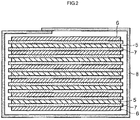
- Fig. 2 is a schematic cross-sectional view of the stacked electrode body accommodated in the laminate type battery shown in Fig. 1 in the thickness direction.
- the laminate type battery shown in Fig. 1 includes a nonaqueous electrolyte solution (not shown in Fig. 1 ) and a stacked electrode body (not shown in Fig. 1 ) inside, and also the periphery is sealed, so that the laminate outer package 1 with the inside being sealed is provided.
- the laminate exterior body 1 for example, an aluminum laminate outer package is used.
- the stacked electrode body accommodated in the laminate outer package 1 includes a laminate in which positive electrode plates 5 and negative electrode plates 6 are alternately laminated with separators 7 interposed therebetween, and a separator 8 surrounding the periphery of the laminate.
- the positive electrode plate 5, the negative electrode plate 6, the separator 7, and the separator 8 are impregnated with the nonaqueous electrolyte solution of the disclosure.
- the plurality of positive electrode plates 5 in the stacked electrode body are all electrically connected to the positive electrode terminal 2 via the positive electrode tab (not shown), and a part of the positive electrode terminal 2 protrudes outward from the peripheral end portion of the laminate outer package 1 ( Fig. 1 ). A portion where the positive electrode terminal 2 protrudes in the peripheral end portion of the laminate outer package 1 is sealed with an insulating seal 4.
- the plurality of negative electrode plates 6 in the stacked electrode body are all electrically connected to the negative electrode terminal 3 via the negative electrode tab (not shown), and a part of the negative electrode terminal 3 protrudes outward from the peripheral end portion of the laminate outer package 1 ( Fig. 1 ). A portion where the negative electrode terminal 3 protrudes in the peripheral end portion of the laminate outer package 1 is sealed with an insulating seal 4.
- the number of the positive electrode plates 5 is 5, the number of the negative electrode plates 6 is 6, and the positive electrode plates 5 and the negative electrode plates 6 are laminated with a separator 7 interposed therebetween, so that the outermost layers of both sides are the negative electrode plates 6.
- the number of positive electrode plates, the number of negative electrode plates, and the arrangement thereof are not limited to this example, and various changes may be made.
- lithium secondary battery of the disclosure examples include a coin type battery.
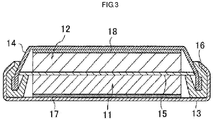
- Fig. 3 is a schematic perspective view showing an example of a coin type battery which is another example of the lithium secondary battery of the disclosure.
- a disc-shaped negative electrode 12 a separator 15 to which the nonaqueous electrolyte solution is injected, a disc-shaped positive electrode 11, and if necessary, spacer plates 17 and 18 made of for example, stainless steel or aluminum are accommodated between a positive electrode can 13 (hereinafter also referred to as “a battery can”) and a sealing plate 14 (hereinafter also referred to as "a battery can lid”), in a state of being laminated in this order.
- the positive electrode can 13 and the sealing plate 14 are caulked and sealed via a gasket 16.
- the nonaqueous electrolyte solution of the disclosure is used as the nonaqueous electrolyte solution injected to the separator 15.
- the lithium secondary battery of the disclosure may be a lithium secondary battery obtained by charging and discharging a lithium secondary battery (lithium secondary battery before charging and discharging) including a negative electrode, a positive electrode, and the nonaqueous electrolyte solution of the disclosure.
- a lithium secondary battery of the disclosure may be a lithium secondary battery (charged and discharged lithium secondary battery) produced by first, producing a lithium secondary battery before charging and discharging including a negative electrode, a positive electrode, and the nonaqueous electrolyte solution of the disclosure, and then, charging and discharging the lithium secondary battery before charging and discharging one or more times.
- a lithium secondary battery charged and discharged lithium secondary battery
- the lithium secondary battery of the disclosure is not particularly limited, and can be used for various known uses.
- the lithium secondary battery can be widely used, from small portable devices such as notebook PCs, mobile PCs, mobile phones, headphone stereos, video movies, LCD TVs, hand-held cleaners, electronic notebooks, calculators, radios, backup power applications, motors, automobiles, electric cars, motorcycles, electric bikes, bicycles, electric motors bicycles, lighting fixtures, game machines, watches, electric tools, and cameras to large devices.
- an “addition amount” represents the content in the finally obtained nonaqueous electrolyte solution (that is, the amount with respect to the total amount of the finally obtained nonaqueous electrolyte solution).
- wt% means % by mass.
- a coin type lithium secondary battery (hereinafter also referred to as a "coin type battery") having the configuration shown in Fig. 3 was produced by the following procedure.
- a paste-like negative electrode mixture slurry was prepared by kneading 97 parts by mass of natural graphite-based graphite, carboxymethyl cellulose (1 part by mass), and SBR latex (2 parts by mass) with an aqueous solvent.
- the negative electrode mixture slurry was applied to a negative electrode current collector made of a strip-shaped copper foil having a thickness of 18 ⁇ m, dried, and then compressed by a roll press to obtain a sheet-like negative electrode including a negative electrode current collector and a negative electrode active material layer.
- the coating density of the negative electrode active material layer in this case was 10 mg/cm 2 , and the packing density thereof was 1.5 g/ml.
- LiCoO2 (90 parts by mass), acetylene black (5 parts by mass), and polyvinylidene fluoride (5 parts by mass), were kneaded using N-methylpyrrolidinone as a solvent to prepare a paste-like positive electrode mixture slurry.
- the positive electrode mixture slurry was applied to a positive electrode current collector of a strip-shaped aluminum foil having a thickness of 20 ⁇ m, dried, and then compressed by a roll press to obtain a sheet-like positive electrode including a positive electrode current collector and a positive electrode active material.
- the coating density of the positive electrode active material layer in this case was 30 mg/cm 2 , and the packing density thereof was 2.5 g/ml.
- ethylene carbonate (EC), dimethyl carbonate (DMC), and methyl ethyl carbonate (EMC) were mixed at a ratio of 34:33:33 (mass ratio), respectively, to obtain a mixed solvent.
- LiPF 6 as an electrolyte was dissolved such that the electrolyte concentration in the finally prepared nonaqueous electrolyte solution was 1 mol/l.
- lithium tetraborate that is, a compound of Formula (1), where n is 2 and two M + 's are both a Li + ion
- additive A lithium tetraborate (that is, a compound of Formula (1), where n is 2 and two M + 's are both a Li + ion) was added such that the content was 0.1% by mass with respect to the total mass of the finally prepared nonaqueous electrolyte solution (that is, added at an addition amount of 0.1% by mass)
- additive B 4,4'-bis(2,2-dioxo-1,3,2-dioxathiolane) (hereinafter also referred to as "cyclic sulfuric acid ester (1)”) was added such that the content with respect to the finally prepared nonaqueous electrolyte solution was 0.5% by mass (that is, added at an addition amount of 0.5% by mass), so as to obtain a nonaqueous electrolyte solution.
- the negative electrode described above was punched into a disk shape having a diameter of 14 mm and the positive electrode was punched into a disk shape having a diameter of 13 mm, thereby obtaining a coin-shaped negative electrode and a coin-shaped positive electrode, respectively.
- a microporous polyethylene film having a thickness of 20 ⁇ m was punched into a disk shape having a diameter of 17 mm to obtain a separator.
- the obtained coin-shaped negative electrode, separator, and coin-shaped positive electrode were laminated in a stainless steel battery can (2032 size) in this order, and then 20 ⁇ l of the nonaqueous electrolyte solution was injected into the battery can and impregnated into the separator, the positive electrode, and the negative electrode.
- an aluminum plate (thickness of 1.2 mm, diameter of 16 mm) and a spring were placed on the positive electrode, and the battery was sealed by caulking the battery can lid, via a polypropylene gasket.
- a coin type battery that is, a coin type lithium secondary battery having the configuration shown in Fig. 3 having a diameter of 20 mm and a height of 3.2 mm was obtained.
- the coin type battery obtained above was charged and discharged three times at a constant voltage of 4.2 V, and then charged to a constant voltage of 3.9 V.
- the coin type battery after charging was kept at 25°C in a thermostatic bath, discharged at a constant current of 0.2 mA at 25°C, and a potential drop in the coin type battery was measured for 10 seconds after the start of discharge, thereby measuring a DC resistance [ ⁇ ] at 25°C of the coin type battery.
- the obtained value was defined as the initial battery resistance (25°C).
- Table 1 shows the initial battery resistance (25°C) of Example 1 as a relative value to the case in which the initial battery resistance (25°C) of Comparative Example 1 is 100.
- the coin type battery obtained above was charged and discharged three times at a constant voltage of 4.2 V, and then charged to a constant voltage of 3.9 V.
- the coin type battery after charging was kept at -20°C in a thermostatic bath, discharged at a constant current of 0.2 mA at -20°C, and a potential drop in the coin type battery was measured for 10 seconds after the start of discharge, thereby measuring a DC resistance [ ⁇ ] at -20°C of the coin type battery.
- the obtained value was defined as the initial battery resistance (-20°C).
- Table 1 shows the initial battery resistance (-20°C) of Example 1 as a relative value to the case in which the initial battery resistance (-20°C) of Comparative Example 1 is 100.
- the cyclic sulfuric acid ester (1) represents 4,4'-bis(2,2-dioxo-1,3,2-dioxathiolane) as a cyclic sulfuric acid ester compound.
- Tables 1 to 9 also show the reductive decomposition potential of each additive.
- Example 1 in which a nonaqueous electrolyte solution containing additive A and additive B is used, the initial battery resistance was decreased, as compared with Comparative Example 1 in which a nonaqueous electrolyte solution containing additive B and not containing additive A was used.
- the initial battery resistance (25°C) of Example 2 is represented as a relative value to the case in which the initial battery resistance (25°C) of Comparative Example 2 is 100
- the initial battery resistance of Example 2 (-20°C) is represented as a relative value to the case in which the initial battery resistance (-20°C) of Comparative Example 2 is 100.
- Example 2 in which a nonaqueous electrolyte solution containing additive A and additive B is used, the initial battery resistance was decreased, as compared with Comparative Example 2 in which a nonaqueous electrolyte solution containing additive B and not containing additive A was used.
- the initial battery resistance (25°C) of Example 3 is represented as a relative value to the case in which the initial battery resistance (25°C) of Comparative Example 3 is 100, and the initial battery resistance of Example 3 (-20°C) is represented as a relative value to the case in which the initial battery resistance (-20°C) of Comparative Example 3 is 100.
- VC represents vinylene carbonate as a carbonate compound having a carbon-carbon unsaturated bond.
- Table 3 Additive in nonaqueous electrolyte solution Initial battery resistance (relative value) Additive A Additive B 25°C -20°C Kind Reductive decomposition potential (V) Addition amount (wt%) Kind Reductive decomposition potential (V) Addition amount (wt%) None - - Cyclic sulfuric acid ester (1) 1.2 0.5 100 100 VC 1.1 0.2 Comparative Example 3 Lithium tetraborate 2.1 0.1 Cyclic sulfuric acid ester (1) 1.2 0.5 100 69 Example 3 VC 1.1 0.2
- Example 3 in which a nonaqueous electrolyte solution containing additive A and additive B is used, the initial battery resistance was decreased, as compared with Comparative Example 3 in which a nonaqueous electrolyte solution containing additive B and not containing additive A was used.
- Example 4 the initial battery resistance (25°C) of Example 4 is represented as a relative value to the case in which the initial battery resistance (25°C) of Comparative Example 4 is 100, and the initial battery resistance of Example 4 (-20°C) is represented as a relative value to the case in which the initial battery resistance (-20°C) of Comparative Example 4 is 100.
- TMSP represents tristrimethylsilyl phosphate as a phosphoric acid ester compound.
- Table 4 Additive in nonaqueous electrolyte solution Initial battery resistance (relative value) Additive A Additive B 25°C -20°C Kind Reductive decomposition potential (V) Addition amount (wt%) Kind Reductive decomposition potential (V) Addition amount (wt%) Comparative Example 4 None - - TMSP 0.9 0.2 100 100 Example 4 Lithium tetraborate 2.1 0.1 TMSP 0.9 0.2 93 94
- Example 4 in which a nonaqueous electrolyte solution containing additive A and additive B is used, the initial battery resistance was decreased, as compared with Comparative Example 4 in which a nonaqueous electrolyte solution containing additive B and not containing additive A was used.
- the initial battery resistance (25°C) of Example 5 is represented as a relative value to the case in which the initial battery resistance (25°C) of Comparative Example 5 is 100
- the initial battery resistance of Example 5 (-20°C) is represented as a relative value to the case in which the initial battery resistance (-20°C) of Comparative Example 5 is 100.
- Example 5 in which a nonaqueous electrolyte solution containing additive A and additive B is used, the initial battery resistance was decreased, as compared with Comparative Example 5 in which a nonaqueous electrolyte solution containing additive B and not containing additive A was used.
- Example 6 the initial battery resistance (25°C) of Example 6 is represented as a relative value to the case in which the initial battery resistance (25°C) of Comparative Example 6 is 100, and the initial battery resistance of Example 6 (-20°C) is represented as a relative value to the case in which the initial battery resistance (-20°C) of Comparative Example 6 is 100.
- LiDFP represents lithium difluorophosphate as a phosphorus acid ester compound.
- Table 6 Additive in nonaqueous electrolyte solution Initial battery resistance (relative value) Additive A Additive B 25°C -20°C Kind Reductive decomposition potential (V) Addition amount (wt%) Kind Reductive decomposition potential (V) Addition amount (wt%) Comparative Example 6 None - - LiDFP 1.1 0.5 100 100 100 Example 6 Lithium tetraborate 2.1 0.1 LiDFP 1.1 0.5 100 87
- Example 6 in which a nonaqueous electrolyte solution containing additive A and additive B is used, the initial battery resistance was decreased, as compared with Comparative Example 6 in which a nonaqueous electrolyte solution containing additive B and not containing additive A was used.
- Example 7 the initial battery resistance (25°C) of Example 7 is represented as a relative value to the case in which the initial battery resistance (25°C) of Comparative Example 7 is 100, and the initial battery resistance of Example 7 (-20°C) is represented as a relative value to the case in which the initial battery resistance (-20°C) of Comparative Example 7 is 100.
- LiBOB represents lithium bis(oxalato) borate as an oxalato compound.
- Additive in nonaqueous electrolyte solution Initial battery resistance (relative value) Additive A Additive B 25°C -20°C Kind Reductive decomposition potential (V) Addition amount (wt%) Kind Reductive decomposition potential (V) Addition amount (wt%) Comparative Example 7 None - - LiBOB 1.8 1.0 100 100 Example 7 Lithium tetraborate 2.1 0.1 LiBOB 1.8 1.0 95 85
- Example 7 in which a nonaqueous electrolyte solution containing additive A and additive B is used, the initial battery resistance was decreased, as compared with Comparative Example 7 in which a nonaqueous electrolyte solution containing additive B and not containing additive A was used.
- Example 8 the initial battery resistance (25°C) of Example 8 is represented as a relative value to the case in which the initial battery resistance (25°C) of Comparative Example 8 is 100, and the initial battery resistance of Example 8 (-20°C) is represented as a relative value to the case in which the initial battery resistance (-20°C) of Comparative Example 8 is 100.
- PRS represents 1,3-propene sultone as a sultone compound.
- Table 8 Additive in nonaqueous electrolyte solution Initial battery resistance (relative value) Additive A Additive B 25°C -20°C Kind Reductive decomposition potential (V) Addition amount (wt%) Kind Reductive decomposition potential (V) Addition amount (wt%) Comparative Example 8 None - - PRS 1.4 0.5 100 100 VC 1.1 0.2
- Example 8 Lithium tetraborate 2.1 0.5 PRS 1.4 0.5 85 69 VC 1.1 0.2
- Example 8 in which a nonaqueous electrolyte solution containing additive A and additive B is used, the initial battery resistance was decreased, as compared with Comparative Example 8 in which a nonaqueous electrolyte solution containing additive B and not containing additive A was used.
- the initial battery resistance (-20°C) was measured by the method described above.
- a coin type battery of which the initial battery resistance (-20°C) was measured was charged at a constant voltage of 4.2 V, and the charged coin type battery was stored in a thermostatic bath at 80°C for 2 days.
- the coin type battery after storage for 2 days was set to a constant voltage of 3.9 V, and the DC resistance [ ⁇ ] of the coin type battery at -20°C was measured in the same manner as in the initial battery resistance (-20°C). The obtained value was defined as the battery resistance after storage (-20°C).
- the battery resistance after storage was divided by the initial battery resistance (-20°C), thereby determining the battery resistance (-20°C) increase rate [after storage/initial stage].
- a coin type battery was produced in the same manner as in Example 1, except that Additive B was not used, and the battery resistance (-20°C) increase rate [after storage/initial stage] was determined in the same manner as in Example 1.
Landscapes
- Chemical & Material Sciences (AREA)
- Chemical Kinetics & Catalysis (AREA)
- Electrochemistry (AREA)
- Engineering & Computer Science (AREA)
- General Chemical & Material Sciences (AREA)
- Manufacturing & Machinery (AREA)
- Inorganic Chemistry (AREA)
- Power Engineering (AREA)
- Physics & Mathematics (AREA)
- Condensed Matter Physics & Semiconductors (AREA)
- General Physics & Mathematics (AREA)
- Materials Engineering (AREA)
- Microelectronics & Electronic Packaging (AREA)
- Secondary Cells (AREA)
- Primary Cells (AREA)
- Battery Electrode And Active Subsutance (AREA)
- Electric Double-Layer Capacitors Or The Like (AREA)
Applications Claiming Priority (2)
| Application Number | Priority Date | Filing Date | Title |
|---|---|---|---|
| JP2017161287 | 2017-08-24 | ||
| PCT/JP2018/030240 WO2019039346A1 (fr) | 2017-08-24 | 2018-08-13 | Solution électrolytique non aqueuse pour batteries, et batterie rechargeable au lithium |
Publications (2)
| Publication Number | Publication Date |
|---|---|
| EP3675267A1 true EP3675267A1 (fr) | 2020-07-01 |
| EP3675267A4 EP3675267A4 (fr) | 2021-05-19 |
Family
ID=65440018
Family Applications (1)
| Application Number | Title | Priority Date | Filing Date |
|---|---|---|---|
| EP18849021.3A Pending EP3675267A4 (fr) | 2017-08-24 | 2018-08-13 | Solution électrolytique non aqueuse pour batteries, et batterie rechargeable au lithium |
Country Status (6)
| Country | Link |
|---|---|
| US (1) | US11652237B2 (fr) |
| EP (1) | EP3675267A4 (fr) |
| JP (1) | JPWO2019039346A1 (fr) |
| KR (1) | KR102463794B1 (fr) |
| CN (1) | CN110998957B (fr) |
| WO (1) | WO2019039346A1 (fr) |
Families Citing this family (13)
| Publication number | Priority date | Publication date | Assignee | Title |
|---|---|---|---|---|
| CN112514130A (zh) * | 2018-07-30 | 2021-03-16 | 株式会社村田制作所 | 锂离子二次电池 |
| CN110943250B (zh) | 2018-09-21 | 2021-09-24 | 宁德新能源科技有限公司 | 电解液和含有电解液的锂离子电池 |
| JP7148872B2 (ja) * | 2019-01-28 | 2022-10-06 | トヨタ自動車株式会社 | リチウム二次電池用非水電解液 |
| CN112349958B (zh) | 2019-08-06 | 2022-02-11 | 珠海冠宇电池股份有限公司 | 一种电解液及其制备方法和锂离子电池 |
| JP7314458B2 (ja) * | 2019-12-13 | 2023-07-26 | 三井化学株式会社 | 電池用非水電解液及びリチウムイオン二次電池 |
| DE112021001189T5 (de) | 2020-02-21 | 2022-12-15 | Gs Yuasa International Ltd. | Nichtwässriger-elektrolyt-energiespeichervorrichtung und verfahren zum herstellen einer nichtwässriger-elektrolyt-energiespeichervorrichtung |
| CN111525191B (zh) * | 2020-04-29 | 2022-07-05 | 宁德新能源科技有限公司 | 一种电解液及电化学装置 |
| KR102927152B1 (ko) * | 2020-05-13 | 2026-02-12 | 주식회사 엘지에너지솔루션 | 리튬 이차전지용 비수전해액 및 이를 포함하는 리튬 이차전지 |
| CN112271330B (zh) * | 2020-10-21 | 2022-06-07 | 广州天赐高新材料股份有限公司 | 电解液添加剂、电解液及储能装置 |
| US20220149425A1 (en) * | 2020-11-07 | 2022-05-12 | Eocell Limited | Nonaqueous electrolyte for lithium ion secondary battery, and lithium ion secondary battery containing the same |
| WO2023277404A1 (fr) * | 2021-06-28 | 2023-01-05 | 주식회사 엘지에너지솔루션 | Batterie secondaire au lithium |
| CN115441057B (zh) * | 2022-10-09 | 2025-12-12 | 珠海冠宇电池股份有限公司 | 一种电解液及包括该电解液的电池 |
| CN115863764A (zh) * | 2022-12-20 | 2023-03-28 | 上海兰钧新能源科技有限公司 | 锂离子电池用添加剂、锂离子电池和用电设备 |
Family Cites Families (20)
| Publication number | Priority date | Publication date | Assignee | Title |
|---|---|---|---|---|
| FR2754177B1 (fr) | 1996-10-07 | 1999-08-06 | Sanofi Sa | Microspheres pharmaceutiques d'acide valproique pour administration orale |
| JP4366724B2 (ja) | 1998-03-02 | 2009-11-18 | パナソニック株式会社 | 非水電解液二次電池 |
| JP2000048828A (ja) | 1998-07-31 | 2000-02-18 | Matsushita Electric Ind Co Ltd | 非水電解液電池 |
| JP2005071617A (ja) | 2003-08-21 | 2005-03-17 | Japan Storage Battery Co Ltd | 非水電解質二次電池およびその製造方法 |
| WO2006057447A1 (fr) * | 2004-11-26 | 2006-06-01 | Otsuka Chemical Co., Ltd. | Solution électrolytique pour batterie secondaire au lithium non aqueuse et batterie secondaire au lithium non aqueuse |
| KR100705262B1 (ko) | 2004-12-07 | 2007-04-09 | 주식회사 엘지화학 | 산소 음이온을 포함하는 비수계 전해액 및 이를 이용한리튬 이차 전지 |
| JP2006236653A (ja) | 2005-02-23 | 2006-09-07 | Matsushita Electric Ind Co Ltd | 非水電解液ならびにそれを用いた非水電気化学装置 |
| JP5143568B2 (ja) | 2005-12-20 | 2013-02-13 | パナソニック株式会社 | 非水電解質二次電池 |
| US10312518B2 (en) * | 2007-10-26 | 2019-06-04 | Murata Manufacturing Co., Ltd. | Anode and method of manufacturing the same, and secondary battery |
| EP2631981B1 (fr) | 2010-10-22 | 2016-08-17 | Mitsui Chemicals, Inc. | Composé de sulfate cyclique, solution d'électrolyte non aqueux le contenant et batterie secondaire au lithium |
| JP2015232923A (ja) | 2012-09-28 | 2015-12-24 | 三洋電機株式会社 | 非水電解質二次電池 |
| KR20160032215A (ko) * | 2013-09-25 | 2016-03-23 | 미쓰이 가가쿠 가부시키가이샤 | 전지용 비수 전해액, 및 리튬 2차 전지 |
| JP6208560B2 (ja) * | 2013-11-26 | 2017-10-04 | 日立マクセル株式会社 | リチウム二次電池 |
| JP6368501B2 (ja) * | 2014-02-26 | 2018-08-01 | 三井化学株式会社 | 電池用非水電解液、及びリチウム二次電池 |
| JP2016051600A (ja) * | 2014-08-29 | 2016-04-11 | 富山薬品工業株式会社 | 蓄電デバイス用非水電解液 |
| JP2016066595A (ja) * | 2014-09-18 | 2016-04-28 | ソニー株式会社 | 電池及び電池用電解液 |
| JP2017139085A (ja) | 2016-02-02 | 2017-08-10 | 日立マクセル株式会社 | 密閉型電池 |
| JP2017152262A (ja) * | 2016-02-25 | 2017-08-31 | 富山薬品工業株式会社 | リチウムイオン二次電池 |
| JP6625451B2 (ja) | 2016-03-08 | 2019-12-25 | シチズン時計株式会社 | テン輪 |
| CN109103500B (zh) * | 2017-06-20 | 2020-05-26 | 中国科学院化学研究所 | 一种聚合物锂硒电池及其制备方法 |
-
2018
- 2018-08-13 EP EP18849021.3A patent/EP3675267A4/fr active Pending
- 2018-08-13 WO PCT/JP2018/030240 patent/WO2019039346A1/fr not_active Ceased
- 2018-08-13 JP JP2019537572A patent/JPWO2019039346A1/ja active Pending
- 2018-08-13 US US16/641,041 patent/US11652237B2/en active Active
- 2018-08-13 CN CN201880054178.0A patent/CN110998957B/zh active Active
- 2018-08-13 KR KR1020207005669A patent/KR102463794B1/ko active Active
Also Published As
| Publication number | Publication date |
|---|---|
| KR20200035094A (ko) | 2020-04-01 |
| EP3675267A4 (fr) | 2021-05-19 |
| US20210126288A1 (en) | 2021-04-29 |
| KR102463794B1 (ko) | 2022-11-04 |
| US11652237B2 (en) | 2023-05-16 |
| CN110998957B (zh) | 2023-03-24 |
| JPWO2019039346A1 (ja) | 2020-03-26 |
| CN110998957A (zh) | 2020-04-10 |
| WO2019039346A1 (fr) | 2019-02-28 |
Similar Documents
| Publication | Publication Date | Title |
|---|---|---|
| US11652237B2 (en) | Nonaqueous electrolyte solution including boron compound additive having higher reductive decomposition potential than additional additive and lithium secondary battery including the same | |
| EP3343687B1 (fr) | Solution électrolytique non-aqueuse pour batteries, et batterie rechargeable au lithium la comprenant | |
| JP6368501B2 (ja) | 電池用非水電解液、及びリチウム二次電池 | |
| CN112470320B (zh) | 电池用非水电解液及锂二次电池 | |
| JP7275455B2 (ja) | 電池用非水電解液及びリチウム二次電池 | |
| EP3675268A1 (fr) | Batterie secondaire au lithium et solution d'électrolyte non aqueux | |
| JP2019175577A (ja) | 電池用非水電解液及びリチウム二次電池 | |
| JP7669616B2 (ja) | 電池用非水電解液及びリチウム二次電池 | |
| JP2019175578A (ja) | 電池用非水電解液及びリチウム二次電池 | |
| JP6957179B2 (ja) | 電池用非水電解液及びリチウム二次電池 | |
| US12255288B2 (en) | Nonaqueous electrolytic solution for battery and lithium secondary battery | |
| US9466437B2 (en) | Electrolyte additive for a lithium-based energy storage device | |
| JP6879799B2 (ja) | 電池用非水電解液及びリチウム二次電池 | |
| JP6980502B2 (ja) | 電池用非水電解液及びリチウム二次電池 | |
| JP6894751B2 (ja) | 電池用非水電解液、電池用添加剤、及びリチウム二次電池 | |
| JP6607690B2 (ja) | 電池用非水電解液用の添加剤、電池用非水電解液、及びリチウム二次電池 | |
| JP2021022525A (ja) | 電池用非水電解液及びリチウム二次電池 | |
| JP7423889B2 (ja) | 電池用非水電解液及びリチウムイオン二次電池 | |
| JP2023132195A (ja) | 電池用非水電解液、リチウム二次電池前駆体、リチウム二次電池、及びリチウム二次電池の製造方法 | |
| JP2019179613A (ja) | 電池用非水電解液及びリチウム二次電池 |
Legal Events
| Date | Code | Title | Description |
|---|---|---|---|
| STAA | Information on the status of an ep patent application or granted ep patent |
Free format text: STATUS: THE INTERNATIONAL PUBLICATION HAS BEEN MADE |
|
| PUAI | Public reference made under article 153(3) epc to a published international application that has entered the european phase |
Free format text: ORIGINAL CODE: 0009012 |
|
| STAA | Information on the status of an ep patent application or granted ep patent |
Free format text: STATUS: REQUEST FOR EXAMINATION WAS MADE |
|
| 17P | Request for examination filed |
Effective date: 20200303 |
|
| AK | Designated contracting states |
Kind code of ref document: A1 Designated state(s): AL AT BE BG CH CY CZ DE DK EE ES FI FR GB GR HR HU IE IS IT LI LT LU LV MC MK MT NL NO PL PT RO RS SE SI SK SM TR |
|
| AX | Request for extension of the european patent |
Extension state: BA ME |
|
| DAV | Request for validation of the european patent (deleted) | ||
| DAX | Request for extension of the european patent (deleted) | ||
| A4 | Supplementary search report drawn up and despatched |
Effective date: 20210415 |
|
| RIC1 | Information provided on ipc code assigned before grant |
Ipc: H01M 10/0567 20100101AFI20210409BHEP Ipc: H01M 10/052 20100101ALI20210409BHEP Ipc: H01M 10/0525 20100101ALI20210409BHEP Ipc: H01M 10/0585 20100101ALI20210409BHEP Ipc: H01M 50/105 20210101ALI20210409BHEP Ipc: H01M 50/109 20210101ALI20210409BHEP Ipc: H01M 4/38 20060101ALI20210409BHEP Ipc: H01M 4/485 20100101ALI20210409BHEP Ipc: H01M 4/58 20100101ALI20210409BHEP Ipc: H01M 4/587 20100101ALI20210409BHEP Ipc: H01M 6/16 20060101ALI20210409BHEP Ipc: H01G 9/035 20060101ALI20210409BHEP Ipc: H01G 11/64 20130101ALI20210409BHEP |
|
| RAP3 | Party data changed (applicant data changed or rights of an application transferred) |
Owner name: MITSUI CHEMICALS, INC. |
|
| STAA | Information on the status of an ep patent application or granted ep patent |
Free format text: STATUS: EXAMINATION IS IN PROGRESS |
|
| 17Q | First examination report despatched |
Effective date: 20231018 |