EP3677448B1 - Pneumatique - Google Patents
Pneumatique Download PDFInfo
- Publication number
- EP3677448B1 EP3677448B1 EP18855781.3A EP18855781A EP3677448B1 EP 3677448 B1 EP3677448 B1 EP 3677448B1 EP 18855781 A EP18855781 A EP 18855781A EP 3677448 B1 EP3677448 B1 EP 3677448B1
- Authority
- EP
- European Patent Office
- Prior art keywords
- tan
- rubber member
- rubber
- electronic component
- mass
- Prior art date
- Legal status (The legal status is an assumption and is not a legal conclusion. Google has not performed a legal analysis and makes no representation as to the accuracy of the status listed.)
- Active
Links
Images
Classifications
-
- B—PERFORMING OPERATIONS; TRANSPORTING
- B60—VEHICLES IN GENERAL
- B60C—VEHICLE TYRES; TYRE INFLATION; TYRE CHANGING; CONNECTING VALVES TO INFLATABLE ELASTIC BODIES IN GENERAL; DEVICES OR ARRANGEMENTS RELATED TO TYRES
- B60C19/00—Tyre parts or constructions not otherwise provided for
-
- B—PERFORMING OPERATIONS; TRANSPORTING
- B60—VEHICLES IN GENERAL
- B60C—VEHICLE TYRES; TYRE INFLATION; TYRE CHANGING; CONNECTING VALVES TO INFLATABLE ELASTIC BODIES IN GENERAL; DEVICES OR ARRANGEMENTS RELATED TO TYRES
- B60C15/00—Tyre beads, e.g. ply turn-up or overlap
- B60C15/06—Flipper strips, fillers, or chafing strips and reinforcing layers for the construction of the bead
- B60C15/0603—Flipper strips, fillers, or chafing strips and reinforcing layers for the construction of the bead characterised by features of the bead filler or apex
-
- B—PERFORMING OPERATIONS; TRANSPORTING
- B60—VEHICLES IN GENERAL
- B60C—VEHICLE TYRES; TYRE INFLATION; TYRE CHANGING; CONNECTING VALVES TO INFLATABLE ELASTIC BODIES IN GENERAL; DEVICES OR ARRANGEMENTS RELATED TO TYRES
- B60C13/00—Tyre sidewalls; Protecting, decorating, marking, or the like, thereof
- B60C2013/005—Physical properties of the sidewall rubber
- B60C2013/006—Modulus; Hardness; Loss modulus or "tangens delta"
-
- B—PERFORMING OPERATIONS; TRANSPORTING
- B60—VEHICLES IN GENERAL
- B60C—VEHICLE TYRES; TYRE INFLATION; TYRE CHANGING; CONNECTING VALVES TO INFLATABLE ELASTIC BODIES IN GENERAL; DEVICES OR ARRANGEMENTS RELATED TO TYRES
- B60C15/00—Tyre beads, e.g. ply turn-up or overlap
- B60C15/06—Flipper strips, fillers, or chafing strips and reinforcing layers for the construction of the bead
- B60C2015/0614—Flipper strips, fillers, or chafing strips and reinforcing layers for the construction of the bead characterised by features of the chafer or clinch portion, i.e. the part of the bead contacting the rim
-
- B—PERFORMING OPERATIONS; TRANSPORTING
- B60—VEHICLES IN GENERAL
- B60C—VEHICLE TYRES; TYRE INFLATION; TYRE CHANGING; CONNECTING VALVES TO INFLATABLE ELASTIC BODIES IN GENERAL; DEVICES OR ARRANGEMENTS RELATED TO TYRES
- B60C19/00—Tyre parts or constructions not otherwise provided for
- B60C2019/004—Tyre sensors other than for detecting tyre pressure
-
- G—PHYSICS
- G06—COMPUTING OR CALCULATING; COUNTING
- G06K—GRAPHICAL DATA READING; PRESENTATION OF DATA; RECORD CARRIERS; HANDLING RECORD CARRIERS
- G06K19/00—Record carriers for use with machines and with at least a part designed to carry digital markings
- G06K19/06—Record carriers for use with machines and with at least a part designed to carry digital markings characterised by the kind of the digital marking, e.g. shape, nature, code
- G06K19/067—Record carriers with conductive marks, printed circuits or semiconductor circuit elements, e.g. credit or identity cards also with resonating or responding marks without active components
- G06K19/07—Record carriers with conductive marks, printed circuits or semiconductor circuit elements, e.g. credit or identity cards also with resonating or responding marks without active components with integrated circuit chips
- G06K19/077—Constructional details, e.g. mounting of circuits in the carrier
- G06K19/07749—Constructional details, e.g. mounting of circuits in the carrier the record carrier being capable of non-contact communication, e.g. constructional details of the antenna of a non-contact smart card
- G06K19/07758—Constructional details, e.g. mounting of circuits in the carrier the record carrier being capable of non-contact communication, e.g. constructional details of the antenna of a non-contact smart card arrangements for adhering the record carrier to further objects or living beings, functioning as an identification tag
- G06K19/07764—Constructional details, e.g. mounting of circuits in the carrier the record carrier being capable of non-contact communication, e.g. constructional details of the antenna of a non-contact smart card arrangements for adhering the record carrier to further objects or living beings, functioning as an identification tag the adhering arrangement making the record carrier attachable to a tyre
Definitions
- the present invention relates to a pneumatic tire in which an electronic component such as RFID is provided inside.
- the transponder is a small, lightweight electronic component consisting of a semiconductor chip with a transmitter/receiver circuit, a control circuit, a memory, etc., and an antenna.
- a transponder battery-less one is often used which can transmit various data as response radio waves when it receives an inquiry radio wave, which is used as electrical energy.
- Patent Document 2 discloses other tires with electronic components.
- an object of the present invention is to provide a manufacturing technology for tire which can suppress damage and deformation of the electronic component and can maintain sufficient reading performance, even in the case of traveling a tire having an electronic component provided therein under high speed and severe handling.
- a manufacturing technology for a tire which can manufacture a tire capable of suppressing damage and deformation of the electronic component and maintaining sufficient reading performance, even in the case of traveling a tire having an electronic component provided therein under high speed and severe handling.
- the internal temperature of tire is 50 to 70 °C in normal traveling, but, when performing traveling under high-speed and severe handling, the internal temperature of tire greatly rises to about 150 °C. Then, the present inventors have considered that, when the temperature is greatly increased, the deformation amount of the tire is increased accordingly, and the electronic component is subjected to a large impact, resulting in damage and deformation of the electronic component, and lowering the reading performance.
- the present inventors have considered that the impact in the periphery of the electronic component can be mitigated by diffusing the large impact to outside by heat generation instead of the deformation, and damage and deformation of the electronic component can be suppressed; and studied earnestly.
- the rubber member having the largest E*(50°C) at 50°C among the rubber members for a tire located outward is regarded as the first rubber member
- the rubber member having the largest E*(50°C) at 50°C among the rubber members for a tire located inward is regarded as the second rubber member; it is sufficient if tan ⁇ (1) 50°C at 50°C and tan ⁇ (1) 150°C at 150°C of the first rubber member and tan ⁇ (2) 50°C at 50°C and tan ⁇ (2) 150°C at 150°C of the second rubber member satisfy the following formula.
- tan ⁇ is the value measured under the conditions shown below using a visco-elastic spectrometer (for example, "VESF-3” manufactured by Iwamoto Seisakusho Ltd.) in accordance with the prescription of "JIS K 6394".
- Initial strain 10% Amplitude: ⁇ 2.0% Frequency: 10 Hz
- Deformation mode Tension Measurement temperature: 50 °C and 150 °C
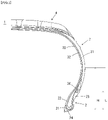
- FIG. 1 is a cross-sectional view showing the configuration of a tire according to an embodiment of the present invention, and more specifically, a cross-sectional view of a tire of size 225/ 60R16.
- 1 is a tire
- 2 is a bead portion
- 3 is a sidewall portion
- 4 is a tread
- 21 is a bead core
- 22 is a bead apex
- 23 is a clinch member (hereinafter also referred to as "clinch").
- the clinch is an external member located inside a sidewall in a tire radial direction, and located outer side of a bead apex in a tire axial direction.
- 24 is a chafer
- 31 is a sidewall
- 32 is a carcass
- 33 is an inner liner.
- Reference numeral 34 denotes an electronic component.
- H is the distance from the position of the maximum tire width to the bottom of bead core
- L is the distance of the electronic component 34 from the bottom of bead core.
- the clinch 23 is provided as a tire rubber member (first rubber member) having the largest E* (50 °C) at 50 °C among the tire rubber members located outward in the tire axial direction from the position where the electronic component is provided.
- E* 50 °C
- tan ⁇ (50 °C) of the rubber composition for clinch is, for example, 0.05 to 0.16
- tan ⁇ (150 °C) is, for example, 0.02 to 0.12.
- the bead apex 22 is provided as a tire rubber member (second rubber member) having the largest E* (50 °C) at 50 °C among the tire rubber members located inward in the tire axial direction from the position where the electronic component is provided.
- E* 50 °C
- tan ⁇ (50 °C) of the rubber composition for bead apex is, for example, 0.01 to 0.20
- tan ⁇ (150 °C) is, for example, 0.05 to 0.24.
- tan ⁇ (150 °C) of the rubber composition for clinch and tan ⁇ (50 °C) and tan ⁇ (150 °C) of rubber composition for bead apex are not limited to the ranges exemplified above as far as the above formula is satisfied.
- RFID can store and read a large volume of information without contact, so it can store tire manufacturing information, management information, customer information, etc. in addition to data such as pressure and temperature. Therefore, it is particularly preferable.
- Specific position where the electronic component 34 is to be provided is not particularly limited, as far as the position is a place where reliable information communication is possible and the electronic component is hardly damaged by the deformation of the tire.
- As the examples between the bead portion and the clinch, between the bead portion and the sidewall, and between the bead reinforcing layer which is disposed outer side in the axial direction of the bead apex to suppress the deformation of the bead apex and the clinch, between the bead reinforcing layer and the sidewall, etc. can be mentioned.
- the longitudinal size (overall length including the IC chip and the antenna) of the electronic component to be provided in the present embodiment is preferably 18 cm or less, more preferably 9 cm or less, further more preferably 4 cm or less, and most preferably 2 cm or less.
- the electronic components may be damaged or deformed due to the decrease in rigidity caused by the increase in internal temperature of the tire accompanying high speed and severe handling.
- the electronic component is not damaged or deformed even if the internal temperature of the tire rises, and the reading performance of the electronic component can be maintained, since tan ⁇ of the first rubber member and the second rubber member is appropriately controlled as described above. At this time, bending of the antenna portion can be kept to a minimum by arranging the antenna portion of the electronic component to extend in an orthogonal direction to the cord of carcass.
- the rubber composition used in the manufacture of clinch can be obtained by kneading and mixing a rubber component which is the main component and various compounding materials such as a reinforcing material, an anti-aging agent, an additive, and the like.
- diene rubbers such as natural rubber (NR), isoprene rubber (IR), butadiene rubber (BR), styrene butadiene rubber (SBR), acrylonitrile butadiene rubber (NBR), chloroprene rubber (CR), butyl rubber (IIR) and the like can be mentioned.
- NR natural rubber
- IR isoprene rubber
- BR butadiene rubber
- SBR styrene butadiene rubber
- NBR acrylonitrile butadiene rubber
- CR chloroprene rubber
- IIR butyl rubber
- Content of the isoprene-based rubber is preferably 10 parts by mass or more, and more preferably 30 parts by mass or more with respect to 100 parts by mass of the rubber component. Moreover, it is preferably 80 parts by mass or less, and more preferably 50 parts by mass or less.
- Content of BR is preferably 20 parts by mass or more, and more preferably 50 parts by mass or more with respect to 100 parts by mass of the rubber component. Moreover, it is preferably 90 parts by mass or less, and more preferably 70 parts by mass or less.
- the BR is not particularly limited.
- BR having a high cis content BR having a high cis content, BR containing syndiotactic polybutadiene crystals (SPB-containing BR), modified BR and the like can be used.
- SPB-containing BR is preferable from the viewpoint that extrusion processability can be greatly improved by the intrinsic orientation crystal component.
- total content of isoprene rubber (NR or IR) and BR is preferably 80 parts by mass or more, and more preferably 90 parts by mass or more, in 100 parts by mass of the rubber component.
- carbon black is compounded as a reinforcing material in the rubber composition of the present embodiment.
- examples of carbon black include GPF, HAF, ISAF, SAF, FF, FEF and the like.
- One of these carbon blacks may be used alone, or two or more thereof may be used in combination.
- hard carbon-based ISAF, SAF, and HAF are preferable from the viewpoint of securing the hardness, and among them, HAF is particularly preferable.
- Content of carbon black in the above rubber composition is preferably 50 parts by mass or more, and more preferably 60 parts by mass or more with respect to 100 parts by mass of the rubber component. Also, it is preferably 80 parts by mass or less, and more preferably 70 parts by mass or less. By setting the content of carbon black in the rubber composition within the above range, sufficient hardness can be obtained.
- Sulfur is used as a vulcanizing agent, and its content is preferably 1 part by mass or more, and more preferably 2 parts by mass or more with respect to 100 parts by mass of the rubber component. Moreover, it is preferably 8 parts by mass or less, and more preferably 6 parts by mass or less.
- Content of sulfur is pure sulfur content, and when using insoluble sulfur, it is content except oil content.
- Sulfur is usually used together with a vulcanization accelerator.
- Content of the vulcanization accelerator is preferably 2 parts by mass or more, and more preferably 5 parts by mass or more with respect to 100 parts by mass of the rubber component. Moreover, it is preferably 10 parts by mass or less, and more preferably 7 parts by mass or less.
- sulfenamide type As specific examples of the vulcanization accelerators, sulfenamide type, thiazole type, thiuram type, thiourea type, guanidine type, dithiocarbamic acid type, aldehyde-amine type or aldehyde-ammonia type, imidazoline type, and xanthate type vulcanization accelerators can be mentioned. These vulcanization accelerators may be used alone or in combination of two or more. Among these, sulfenamide type vulcanization accelerators is preferable because the scorch time and the vulcanization time can be balanced.
- stearic acid conventionally known products can be used. For example, products manufactured by NOF Corporation, Kao Corporation, Wako Pure Chemical Industries, Ltd., Chiba Fatty Acid Corporation, etc. can be used.
- content of stearic acid is preferably 0.5 part by mass or more, and more preferably 1 part by mass or more with respect to 100 parts by mass of the rubber component. Moreover, it is preferably 10 parts by mass or less, and more preferably 5 parts by mass or less.
- zinc oxide conventionally known ones can be used. For example, products manufactured by Mitsui Mining & Smelting Co., Ltd., Toho Zinc Co., Ltd., Hakusui Tech Co., Ltd., Shodo Chemical Industry Co., Ltd., Sakai Chemical Industry Co., Ltd., etc. can be used.
- content of zinc oxide is preferably 0.5 part by mass or more, and more preferably 1 part by mass or more, with respect to 100 parts by mass of the rubber component. Moreover, it is preferably 10 parts by mass or less, and more preferably 5 parts by mass or less.
- an amine-type anti-aging agent having an excellent ozone resistance effect is preferable.
- the amine-type anti-aging agent is not particularly limited, and examples thereof include amine derivatives such as diphenylamine-type, p-phenylenediamine-type, naphthylamine-type and ketone amine condensate-type ones. These may be used alone, and two or more may be used in combination.
- Examples of diphenylamine type derivatives include p-(p-toluenesulfonylamide) -diphenylamine, octylated diphenylamine, 4,4'-bis ( ⁇ , ⁇ '-dimethylbenzyl) diphenylamine and the like.
- Examples of p-phenylenediamine type derivatives include N-(1,3-dimethylbutyl) -N'-phenyl-p-phenylenediamine (6PPD), N-phenyl-N'-isopropyl-p-phenylenediamine (IPPD) and N, N'-di-2-naphthyl-p-phenylenediamine and the like.
- Examples of the naphthylamine type derivatives include phenyl- ⁇ -naphthylamine and the like. Among them, phenylenediamine type and ketone amine condensate type are preferable.
- Content of the anti-aging agent is preferably 0.3 part by mass or more, and more preferably 1 part by mass or more, with respect to 100 parts by mass of the rubber component. Moreover, it is preferably 8 parts by mass or less, and more preferably 4 parts by mass or less.
- Example of oils include process oils, vegetable oils and fats, and mixtures thereof.
- process oil for example, paraffin-based process oil, aroma-based process oil, naphthene-based process oil and the like can be used.
- vegetable fats and oils include castor oil, cottonseed oil, linseed oil, rapeseed oil, soybean oil, palm oil, coconut oil, peanut oil, rosin, pine oil, pine tar, tall oil, corn oil, rice oil, beni flower oil, sesame oil, olive oil, sunflower oil, palm kernel oil, camellia oil, jojoba oil, macadamia nut oil, tung oil and the like. These may be used alone or in combination of two or more.
- Content of oil is preferably 0.5 part by mass or more, and more preferably 1 part by mass or more with respect to 100 parts by mass of the rubber component. Moreover, it is preferably 10 parts by mass or less, and more preferably 5 parts by mass or less.
- the rubber composition of the present embodiment may also contain compounding materials conventionally used in the rubber industry.
- compounding materials conventionally used in the rubber industry.
- inorganic fillers such as silica, talc and calcium carbonate
- organic fillers such as cellulose fibers, softeners such as liquid rubber and adhesive resins, vulcanizing agents other than sulfur, organic crosslinking agents and the like can be compounded as needed.
- about the compounding quantity of each compounding material it can be selected suitably.
- the same materials as the rubber composition for clinch described above can be used. Further, each material shown below can also be used.
- a rubber component basically the same rubber component as for clinch can be used, but combined use of isoprene rubber (NR or IR) and SBR is preferable because excellent low fuel consumption and durability can be obtained.
- NR or IR isoprene rubber
- SBR isoprene rubber
- Content of the isoprene-based rubber is preferably 60 parts by mass or more, and more preferably 65 parts by mass or more in 100 parts by mass of the rubber component. Moreover, it is preferably 90 parts by mass or less, and more preferably 85 parts by mass or less.
- Content of the SBR is preferably 10 parts by mass or more, and more preferably 15 parts by mass or more in 100 parts by mass of the rubber component. Moreover, it is preferably 40 parts by mass or less, and more preferably 35 parts by mass or less.
- the SBR is not particularly limited, and for example, emulsion-polymerized styrene butadiene rubber (E-SBR), solution-polymerized styrene butadiene rubber (S-SBR) and the like can be used. Among them, E-SBR is preferable from the viewpoint that it can disperse carbon black well and its processability is good.
- E-SBR emulsion-polymerized styrene butadiene rubber
- S-SBR solution-polymerized styrene butadiene rubber
- Styrene content in SBR is preferably 10 to 40 wt%, more preferably 20 to 30 wt%. By making styrene content within the above range, sufficient hardness and low fuel consumption can be secured.
- a curable resin is compounded further for enhancing the rigidity.
- a phenol-type resin can be mentioned although it is not specifically limited.
- phenolic resins include phenolic resins and modified phenolic resins.
- the phenolic resin is obtained by reacting phenol with an aldehyde such as formaldehyde, acetaldehyde, furfural or the like by an acid or an alkali catalyst.
- the modified phenolic resin is a phenolic resin modified with a compound such as cashew oil, tall oil, linseed oil, various animal and vegetable oils, unsaturated fatty acids, rosin, alkylbenzene resins, aniline or melamine.
- a modified phenol resin is preferable from the viewpoint that a good hardness can be obtained by a curing reaction, and a cashew oil modified phenol resin and a rosin modified phenol resin are more preferable.
- Content of the curable resin in the rubber composition is preferably 5 parts by mass or more, and more preferably 10 parts by mass or more, with respect to 100 parts by mass of the rubber component. Moreover, it is preferably 25 parts by mass or less, and more preferably 20 parts by mass or less.
- a curing agent having a curing action with the phenolic resin is not particularly limited as far as it has the above-mentioned curing action, and, for example, hexamethylenetetramine (HMT), hexamethoxymethylolmelamine (HMMM), hexamethoxymethylolpentamethylether (HMMPME), melamine, methylolmelamine and the like can be mentioned.
- HMT, HMMM, and HMMPME are preferable from the viewpoint of being excellent in the action of increasing the hardness of the phenolic resin.
- Content of the curing agent is preferably 0.4 part by mass or more, and more preferably 0.5 part by mass or more with respect to 100 parts by mass of the phenolic resin. Moreover, it is preferably 3.5 parts by mass or less, and more preferably 2.5 parts by mass or less.
- an alkylphenol-sulfur chloride condensate it is preferable to contain 4 to 6 parts by mass of an alkylphenol-sulfur chloride condensate as a vulcanization aid in combination with sulfur which is a vulcanizing agent.
- the rubber composition of the clinch and bead apex can be manufactured by a known method, for example, by a method of kneading the above-mentioned components using a rubber kneading apparatus such as an open roll or a banbury mixer.
- the tire according to the present embodiment can be manufactured by a usual method except for disposing the electronic component in the rubber member during molding. That is, the clinch and the bead apex are molded by extrusion processing according to the shapes of the clinch and the bead apex at the unvulcanized stage of the rubber composition, pasted together with the other tire members on a tire forming machine according to a usual method, and an unvulcanized tire is formed. Then, in the middle of molding, the electronic component is embedded at a predetermined position between the clinch and the bead apex.
- the unvulcanized tire in which the electronic component is disposed is heated and pressed in a vulcanizer to manufacture a tire.
- Table 1 shows the compounding materials.
- Table 2 and Table 3 show the formulation.
- [Table 1] Compounding materials Product Name Manufacturer (Rubber component) NR TSR20 SBR SBR1502 Sumitomo Clemical Co., Ltd. BR UBEPOL BR 150B Ube Industries, Ltd. (Reinforcing material) Carbon Black 1 N550 Showa Cabot Co., Ltd. Carbon Black 2 N330 Showa Cabot Co., Ltd. (Curable resin ⁇ Curing agent) Curable resin PR 12686 Sumitomo Bakelite Co., Ltd. Curing agent SANCELER HMT Sanshin Chemical Industry Co., Ltd.
- the obtained unvulcanized rubber composition is formed into a shape of clinch or bead apex, then pasted together by laminating with other tire components in a tire molding machine, and an electronic component 34 coated with the unvulcanized rubber composition is provided at a position shown in FIG. 1 (a position of 40% from the bottom of bead core). Thereafter, a vulcanization is carried out for 30 minutes at 150 °C and a test tire (tire size: 225/60R16) can be obtained.
- the electronic component 34 an RFID in which a 30 mm antenna is provided on each of both sides of a 3 mm ⁇ 3 mm ⁇ 0.4 mm IC chip can be used.
- a rubber sample is extracted from each clinch member and bead apex of each pneumatic tire, and a viscoelastic spectrometer ("VESF-3" manufactured by Iwamoto Seisakusho) is used to measure tan 8 under the following conditions.
- Initial strain 10% Amplitude: ⁇ 2.0% Frequency: 10 Hz
- Deformation mode Tension Measurement temperature: 50 °C and 150 °C
- Table 4 and Table 5 show the relationship between the composition and physical properties of clinch and bead apex, the position of the electronic component, the durability of the tire, and the communication performance of the electronic component.
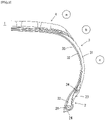
- the evaluation method of communication property is a method where transceivers for the electronic component are installed at three measurement points (a to c) of the circle shown in FIG. 2 and it is judged whether communication of data with the electronic component is possible.
- the tire is assembled in a rim and mounted in a vehicle for conducting the measurement, and the ratio of (the number of readable positions after the durability evaluation / the number of readable positions before the durability evaluation) is calculated.
- the evaluation result is "EX"(excellent), if the average value of the four tires is 60% or more; "G"(good), if 50% or more and less than 60%; "Y”(acceptable), if more than 0% and less than 50%; and "NG”(not acceptable), if 0% or readable position before durability evaluation is 0.
Landscapes
- Engineering & Computer Science (AREA)
- Mechanical Engineering (AREA)
- Tires In General (AREA)
- Compositions Of Macromolecular Compounds (AREA)
Claims (11)
- Bandage pneumatique (1) doté d'un composant électronique (34) à une position du côté extérieur de la carcasse (32) dans la direction axiale du pneumatique, dans lequeltan δ (1)50 °C à 50 °C et tan δ (1)150 °C à 150 °C du premier élément en caoutchouc (23) ayant le plus grand E*(50 °C) à 50 °C parmi des éléments en caoutchouc pour un pneumatique situé à l'extérieur dans la direction axiale du pneumatique par rapport à la position dans laquelle le composant électronique (34) est prévu, ettan δ (2)50 °C à 50 °C et tan δ (2)150°C à 150 °C du second élément en caoutchouc (22) ayant le plus grand E*(50 °C) à 50 °C parmi des éléments en caoutchouc pour un pneumatique situé à l'intérieur dans la direction axiale du pneumatique par rapport à la position dans laquelle le composant électronique (34) est prévu,satisfont la formule suivante, dans laquelle tan δ est la valeur mesurée en utilisant un spectromètre de viscoélasticité en accord avec la prescription de la norme industrielle japonaise « JIS K 6394 » à une contrainte initiale de 10 %, une amplitude de ± 2,0 % et une fréquence de 10 Hz dans un mode de déformation en traction :

- Bandage pneumatique selon la revendication 1, dans lequel
tan δ (1)50 °C à 50 °C et tan δ (1)150 °C à 150 °C du premier élément en caoutchouc et tan δ (2)50 °C à 50 °C et tan δ (2)150 °C à 150 °C du second élément en caoutchouc satisfont la formule suivante :
- Bandage pneumatique selon la revendication 2, dans lequel
tan δ (1)50 °C à 50 °C et tan δ (1)150 °C à 150 °C du premier élément en caoutchouc et tan δ (2)50 °C à 50 °C et tan δ (2)150 °C à 150 °C du second élément en caoutchouc satisfont la formule suivante :
- Bandage pneumatique selon la revendication 3, dans lequel
tan δ (1)50 °C à 50 °C et tan δ (1)150 °C à 150 °C du premier élément en caoutchouc et tan δ (2)50 °C à 50 °C et tan δ (2)150 °C à 150 °C du second élément en caoutchouc satisfont la formule suivante :
- Bandage pneumatique selon la revendication 4, dans lequel
tan δ (1)50 °C à 50 °C et tan δ (1)150 °C à 150 °C du premier élément en caoutchouc et tan δ (2)50 °C à 50 °C et tan δ (2)150 °C à 150 °C du second élément en caoutchouc satisfont la formule suivante :
- Bandage pneumatique selon la revendication 5, dans lequel
tan δ (1)50 °C à 50 °C et tan δ (1)150 °C à 150 °C du premier élément en caoutchouc et tan δ (2)50 °C à 50 °C et tan δ (2)150 °C à 150 °C du second élément en caoutchouc satisfont la formule suivante :
- Bandage pneumatique selon la revendication 6, dans lequel
tan δ (1)50 °C à 50 °C et tan δ (1)150 °C à 150 °C du premier élément en caoutchouc et tan δ (2)50 °C à 50 °C et tan δ (2)150 °C à 150 °C du second élément en caoutchouc satisfont la formule suivante :
- Bandage pneumatique selon l'une quelconque des revendications 1 à 7, dans lequel
tan δ (1)50 °C à 50 °C et tan δ (1)150 °C à 150 °C du premier élément en caoutchouc et tan δ (2)50 °C à 50 °C et tan δ (2)150 °C à 150 °C du second élément en caoutchouc satisfont la formule suivante :
- Bandage pneumatique selon la revendication 8, dans lequel
tan δ (1)50 °C à 50 °C et tan δ (1)150 °C à 150 °C du premier élément en caoutchouc et tan δ (2)50 °C à 50 °C et tan δ (2)150 °C à 150 °C du second élément en caoutchouc satisfont la formule suivante :
- Bandage pneumatique selon l'une quelconque des revendications 1 à 9, dans lequel
le composant électronique (34) est situé du côté extérieur de la carcasse (32) dans la direction axiale du pneumatique dans la vue de section transversale, et est encastré à une position de 20 à 80 % depuis le fond d'âme de talon (21) par rapport à la distance (H) depuis la position de la largeur maximum du pneumatique jusqu'au fond d'âme de talon (21) dans la direction de l'équateur. - Bandage pneumatique selon l'une quelconque des revendications 1 à 10, dans lequel le composant électronique (34) est un transpondeur pour RFID.
Applications Claiming Priority (2)
| Application Number | Priority Date | Filing Date | Title |
|---|---|---|---|
| JP2017175255 | 2017-09-12 | ||
| PCT/JP2018/032460 WO2019054210A1 (fr) | 2017-09-12 | 2018-08-31 | Pneumatique |
Publications (3)
| Publication Number | Publication Date |
|---|---|
| EP3677448A1 EP3677448A1 (fr) | 2020-07-08 |
| EP3677448A4 EP3677448A4 (fr) | 2021-04-28 |
| EP3677448B1 true EP3677448B1 (fr) | 2022-07-13 |
Family
ID=65722824
Family Applications (1)
| Application Number | Title | Priority Date | Filing Date |
|---|---|---|---|
| EP18855781.3A Active EP3677448B1 (fr) | 2017-09-12 | 2018-08-31 | Pneumatique |
Country Status (5)
| Country | Link |
|---|---|
| US (1) | US11760135B2 (fr) |
| EP (1) | EP3677448B1 (fr) |
| JP (1) | JP6529003B1 (fr) |
| CN (1) | CN111094022B (fr) |
| WO (1) | WO2019054210A1 (fr) |
Families Citing this family (11)
| Publication number | Priority date | Publication date | Assignee | Title |
|---|---|---|---|---|
| JP7842522B2 (ja) * | 2020-02-17 | 2026-04-08 | 横浜ゴム株式会社 | 空気入りタイヤ |
| DE112021000288B4 (de) | 2020-02-17 | 2023-12-14 | The Yokohama Rubber Co., Ltd. | Luftreifen |
| WO2021166793A1 (fr) * | 2020-02-17 | 2021-08-26 | 横浜ゴム株式会社 | Pneumatique |
| JP7343785B2 (ja) * | 2020-02-17 | 2023-09-13 | 横浜ゴム株式会社 | 空気入りタイヤ |
| JP7842524B2 (ja) * | 2020-02-17 | 2026-04-08 | 横浜ゴム株式会社 | 空気入りタイヤ |
| JP7343786B2 (ja) * | 2020-02-17 | 2023-09-13 | 横浜ゴム株式会社 | 空気入りタイヤ |
| JP7469606B2 (ja) * | 2020-02-17 | 2024-04-17 | 横浜ゴム株式会社 | 空気入りタイヤ |
| WO2021166792A1 (fr) * | 2020-02-17 | 2021-08-26 | 横浜ゴム株式会社 | Pneumatique |
| JP7842523B2 (ja) * | 2020-02-17 | 2026-04-08 | 横浜ゴム株式会社 | 空気入りタイヤ |
| JP7469605B2 (ja) * | 2020-02-17 | 2024-04-17 | 横浜ゴム株式会社 | 空気入りタイヤ |
| JP7343784B2 (ja) * | 2020-02-17 | 2023-09-13 | 横浜ゴム株式会社 | 空気入りタイヤ |
Family Cites Families (28)
| Publication number | Priority date | Publication date | Assignee | Title |
|---|---|---|---|---|
| US5181975A (en) * | 1991-03-27 | 1993-01-26 | The Goodyear Tire & Rubber Company | Integrated circuit transponder with coil antenna in a pneumatic tire for use in tire identification |
| DE4426022C1 (de) * | 1994-07-22 | 1996-02-22 | Continental Ag | Identifikationsmittel zur Anbringung an Reifen |
| JP3860921B2 (ja) * | 1998-10-01 | 2006-12-20 | 横浜ゴム株式会社 | タイヤ用トランスポンダの補助部品 |
| EP0997325B1 (fr) * | 1998-10-29 | 2003-08-20 | Sumitomo Rubber Industries Ltd. | Bandage pneumatique |
| JP2002105248A (ja) * | 2000-07-28 | 2002-04-10 | Bridgestone Corp | ビードフィラー用ゴム組成物 |
| JP4501097B2 (ja) * | 2001-01-12 | 2010-07-14 | 横浜ゴム株式会社 | タイヤ装着用トランスポンダ及びトランスポンダ装着タイヤの製造方法 |
| JP4331528B2 (ja) | 2003-07-29 | 2009-09-16 | 株式会社ブリヂストン | 空気入りラジアルタイヤの製造方法およびその製造方法を用いて製造された空気入りラジアルタイヤ |
| JP4555673B2 (ja) | 2004-12-14 | 2010-10-06 | 住友ゴム工業株式会社 | 電子部品の収納具を具える空気入りタイヤ、及びその製造方法 |
| JP2007230261A (ja) * | 2006-02-27 | 2007-09-13 | Yokohama Rubber Co Ltd:The | ゴム被覆rfidモジュール及びそれを埋設した空気入りタイヤ |
| CN101535065A (zh) * | 2006-10-11 | 2009-09-16 | 东洋橡胶工业株式会社 | 充气轮胎 |
| WO2008059838A1 (fr) * | 2006-11-14 | 2008-05-22 | Kabushiki Kaisha Bridgestone | Pneu avec capteur et procédé pour mesurer le niveau de distorsion du pneu |
| FR2914585B1 (fr) | 2007-04-03 | 2009-07-03 | Michelin Soc Tech | Pneumatique comprenant un organe electronique et procede de fabrication d'un tel pneumatique |
| JP4276686B2 (ja) * | 2007-08-21 | 2009-06-10 | 住友ゴム工業株式会社 | タイヤ作用力の検出方法 |
| FR2936185B1 (fr) * | 2008-09-25 | 2011-09-23 | Michelin Soc Tech | Pneumatique muni d'un organe a antenne deportee |
| JP5446301B2 (ja) * | 2009-02-13 | 2014-03-19 | 横浜ゴム株式会社 | 空気入りタイヤ |
| US20120291936A1 (en) * | 2011-05-19 | 2012-11-22 | Robert Edward Lionetti | Embedded transponder and tire assembly and method of construction thereof |
| JP5421400B2 (ja) * | 2011-06-21 | 2014-02-19 | 住友ゴム工業株式会社 | クリンチ又はチェーファー用ゴム組成物及び空気入りタイヤ |
| CN103183876B (zh) * | 2011-12-27 | 2015-07-15 | 青岛博玉特橡塑制品有限公司 | 封装传感器的介电橡胶体及其作为载体的无线电通讯系统 |
| JP5977083B2 (ja) | 2012-05-29 | 2016-08-24 | 住友ゴム工業株式会社 | ケーストッピング用ゴム組成物及び空気入りタイヤ |
| US20160108213A1 (en) * | 2013-05-31 | 2016-04-21 | Sumitomo Rubber Industries, Ltd. | Pneumatic tire and rubber masterbatch |
| US20160303921A1 (en) | 2013-12-13 | 2016-10-20 | Bridgestone Americas Tire Operations, Llc | Tire having an electronic device in a lower sidewall |
| JP6754168B2 (ja) | 2014-08-08 | 2020-09-09 | 株式会社ブリヂストン | タイヤ |
| JP6150770B2 (ja) * | 2014-08-14 | 2017-06-21 | 住友ゴム工業株式会社 | 空気入りタイヤ |
| JP6423653B2 (ja) | 2014-09-01 | 2018-11-14 | 株式会社ブリヂストン | タイヤ |
| US20160107490A1 (en) * | 2014-10-16 | 2016-04-21 | Bridgestone Americas Tire Operations, Llc | Tire having embedded electronic device affixed with adhesive |
| JP6218298B2 (ja) * | 2015-08-24 | 2017-10-25 | 高周波粘弾性株式会社 | タイヤ及びタイヤの特性評価方法 |
| US10406866B2 (en) * | 2016-02-26 | 2019-09-10 | The Goodyear Tire & Rubber Company | Tire sensor for a tire monitoring system |
| DE102018202249A1 (de) * | 2018-02-14 | 2019-08-14 | Continental Reifen Deutschland Gmbh | Fahrzeugreifen |
-
2018
- 2018-08-31 JP JP2019502036A patent/JP6529003B1/ja active Active
- 2018-08-31 US US16/642,533 patent/US11760135B2/en active Active
- 2018-08-31 CN CN201880057549.0A patent/CN111094022B/zh active Active
- 2018-08-31 EP EP18855781.3A patent/EP3677448B1/fr active Active
- 2018-08-31 WO PCT/JP2018/032460 patent/WO2019054210A1/fr not_active Ceased
Also Published As
| Publication number | Publication date |
|---|---|
| WO2019054210A1 (fr) | 2019-03-21 |
| RU2020112058A3 (fr) | 2021-12-17 |
| EP3677448A1 (fr) | 2020-07-08 |
| JPWO2019054210A1 (ja) | 2019-11-07 |
| US20210070112A1 (en) | 2021-03-11 |
| JP6529003B1 (ja) | 2019-06-12 |
| US11760135B2 (en) | 2023-09-19 |
| CN111094022A (zh) | 2020-05-01 |
| RU2020112058A (ru) | 2021-10-13 |
| CN111094022B (zh) | 2022-01-14 |
| EP3677448A4 (fr) | 2021-04-28 |
Similar Documents
| Publication | Publication Date | Title |
|---|---|---|
| EP3677451B1 (fr) | Pneumatique | |
| EP3677452B1 (fr) | Pneumatique | |
| EP3677448B1 (fr) | Pneumatique | |
| EP3677449B1 (fr) | Pneumatique | |
| EP3677450B1 (fr) | Pneumatique | |
| EP3677439B1 (fr) | Pneumatique | |
| EP3677447B1 (fr) | Pneu | |
| RU2773734C2 (ru) | Пневматическая шина |
Legal Events
| Date | Code | Title | Description |
|---|---|---|---|
| STAA | Information on the status of an ep patent application or granted ep patent |
Free format text: STATUS: THE INTERNATIONAL PUBLICATION HAS BEEN MADE |
|
| PUAI | Public reference made under article 153(3) epc to a published international application that has entered the european phase |
Free format text: ORIGINAL CODE: 0009012 |
|
| STAA | Information on the status of an ep patent application or granted ep patent |
Free format text: STATUS: REQUEST FOR EXAMINATION WAS MADE |
|
| 17P | Request for examination filed |
Effective date: 20200331 |
|
| AK | Designated contracting states |
Kind code of ref document: A1 Designated state(s): AL AT BE BG CH CY CZ DE DK EE ES FI FR GB GR HR HU IE IS IT LI LT LU LV MC MK MT NL NO PL PT RO RS SE SI SK SM TR |
|
| AX | Request for extension of the european patent |
Extension state: BA ME |
|
| DAV | Request for validation of the european patent (deleted) | ||
| DAX | Request for extension of the european patent (deleted) | ||
| A4 | Supplementary search report drawn up and despatched |
Effective date: 20210326 |
|
| RIC1 | Information provided on ipc code assigned before grant |
Ipc: B60C 19/00 20060101AFI20210322BHEP Ipc: B60C 15/06 20060101ALI20210322BHEP Ipc: B60C 13/00 20060101ALN20210322BHEP |
|
| GRAP | Despatch of communication of intention to grant a patent |
Free format text: ORIGINAL CODE: EPIDOSNIGR1 |
|
| STAA | Information on the status of an ep patent application or granted ep patent |
Free format text: STATUS: GRANT OF PATENT IS INTENDED |
|
| RIC1 | Information provided on ipc code assigned before grant |
Ipc: B60C 13/00 20060101ALN20220126BHEP Ipc: B60C 15/06 20060101ALI20220126BHEP Ipc: B60C 19/00 20060101AFI20220126BHEP |
|
| INTG | Intention to grant announced |
Effective date: 20220301 |
|
| GRAS | Grant fee paid |
Free format text: ORIGINAL CODE: EPIDOSNIGR3 |
|
| GRAA | (expected) grant |
Free format text: ORIGINAL CODE: 0009210 |
|
| STAA | Information on the status of an ep patent application or granted ep patent |
Free format text: STATUS: THE PATENT HAS BEEN GRANTED |
|
| AK | Designated contracting states |
Kind code of ref document: B1 Designated state(s): AL AT BE BG CH CY CZ DE DK EE ES FI FR GB GR HR HU IE IS IT LI LT LU LV MC MK MT NL NO PL PT RO RS SE SI SK SM TR |
|
| REG | Reference to a national code |
Ref country code: CH Ref legal event code: EP |
|
| REG | Reference to a national code |
Ref country code: DE Ref legal event code: R096 Ref document number: 602018037982 Country of ref document: DE |
|
| REG | Reference to a national code |
Ref country code: AT Ref legal event code: REF Ref document number: 1504097 Country of ref document: AT Kind code of ref document: T Effective date: 20220815 |
|
| REG | Reference to a national code |
Ref country code: IE Ref legal event code: FG4D |
|
| REG | Reference to a national code |
Ref country code: LT Ref legal event code: MG9D |
|
| REG | Reference to a national code |
Ref country code: NL Ref legal event code: MP Effective date: 20220713 |
|
| PG25 | Lapsed in a contracting state [announced via postgrant information from national office to epo] |
Ref country code: SE Free format text: LAPSE BECAUSE OF FAILURE TO SUBMIT A TRANSLATION OF THE DESCRIPTION OR TO PAY THE FEE WITHIN THE PRESCRIBED TIME-LIMIT Effective date: 20220713 Ref country code: RS Free format text: LAPSE BECAUSE OF FAILURE TO SUBMIT A TRANSLATION OF THE DESCRIPTION OR TO PAY THE FEE WITHIN THE PRESCRIBED TIME-LIMIT Effective date: 20220713 Ref country code: PT Free format text: LAPSE BECAUSE OF FAILURE TO SUBMIT A TRANSLATION OF THE DESCRIPTION OR TO PAY THE FEE WITHIN THE PRESCRIBED TIME-LIMIT Effective date: 20221114 Ref country code: NO Free format text: LAPSE BECAUSE OF FAILURE TO SUBMIT A TRANSLATION OF THE DESCRIPTION OR TO PAY THE FEE WITHIN THE PRESCRIBED TIME-LIMIT Effective date: 20221013 Ref country code: NL Free format text: LAPSE BECAUSE OF FAILURE TO SUBMIT A TRANSLATION OF THE DESCRIPTION OR TO PAY THE FEE WITHIN THE PRESCRIBED TIME-LIMIT Effective date: 20220713 Ref country code: LV Free format text: LAPSE BECAUSE OF FAILURE TO SUBMIT A TRANSLATION OF THE DESCRIPTION OR TO PAY THE FEE WITHIN THE PRESCRIBED TIME-LIMIT Effective date: 20220713 Ref country code: LT Free format text: LAPSE BECAUSE OF FAILURE TO SUBMIT A TRANSLATION OF THE DESCRIPTION OR TO PAY THE FEE WITHIN THE PRESCRIBED TIME-LIMIT Effective date: 20220713 Ref country code: FI Free format text: LAPSE BECAUSE OF FAILURE TO SUBMIT A TRANSLATION OF THE DESCRIPTION OR TO PAY THE FEE WITHIN THE PRESCRIBED TIME-LIMIT Effective date: 20220713 Ref country code: ES Free format text: LAPSE BECAUSE OF FAILURE TO SUBMIT A TRANSLATION OF THE DESCRIPTION OR TO PAY THE FEE WITHIN THE PRESCRIBED TIME-LIMIT Effective date: 20220713 |
|
| REG | Reference to a national code |
Ref country code: AT Ref legal event code: MK05 Ref document number: 1504097 Country of ref document: AT Kind code of ref document: T Effective date: 20220713 |
|
| PG25 | Lapsed in a contracting state [announced via postgrant information from national office to epo] |
Ref country code: PL Free format text: LAPSE BECAUSE OF FAILURE TO SUBMIT A TRANSLATION OF THE DESCRIPTION OR TO PAY THE FEE WITHIN THE PRESCRIBED TIME-LIMIT Effective date: 20220713 Ref country code: IS Free format text: LAPSE BECAUSE OF FAILURE TO SUBMIT A TRANSLATION OF THE DESCRIPTION OR TO PAY THE FEE WITHIN THE PRESCRIBED TIME-LIMIT Effective date: 20221113 Ref country code: HR Free format text: LAPSE BECAUSE OF FAILURE TO SUBMIT A TRANSLATION OF THE DESCRIPTION OR TO PAY THE FEE WITHIN THE PRESCRIBED TIME-LIMIT Effective date: 20220713 Ref country code: GR Free format text: LAPSE BECAUSE OF FAILURE TO SUBMIT A TRANSLATION OF THE DESCRIPTION OR TO PAY THE FEE WITHIN THE PRESCRIBED TIME-LIMIT Effective date: 20221014 |
|
| REG | Reference to a national code |
Ref country code: CH Ref legal event code: PL |
|
| REG | Reference to a national code |
Ref country code: DE Ref legal event code: R097 Ref document number: 602018037982 Country of ref document: DE |
|
| PG25 | Lapsed in a contracting state [announced via postgrant information from national office to epo] |
Ref country code: SM Free format text: LAPSE BECAUSE OF FAILURE TO SUBMIT A TRANSLATION OF THE DESCRIPTION OR TO PAY THE FEE WITHIN THE PRESCRIBED TIME-LIMIT Effective date: 20220713 Ref country code: RO Free format text: LAPSE BECAUSE OF FAILURE TO SUBMIT A TRANSLATION OF THE DESCRIPTION OR TO PAY THE FEE WITHIN THE PRESCRIBED TIME-LIMIT Effective date: 20220713 Ref country code: MC Free format text: LAPSE BECAUSE OF FAILURE TO SUBMIT A TRANSLATION OF THE DESCRIPTION OR TO PAY THE FEE WITHIN THE PRESCRIBED TIME-LIMIT Effective date: 20220713 Ref country code: LU Free format text: LAPSE BECAUSE OF NON-PAYMENT OF DUE FEES Effective date: 20220831 Ref country code: LI Free format text: LAPSE BECAUSE OF NON-PAYMENT OF DUE FEES Effective date: 20220831 Ref country code: DK Free format text: LAPSE BECAUSE OF FAILURE TO SUBMIT A TRANSLATION OF THE DESCRIPTION OR TO PAY THE FEE WITHIN THE PRESCRIBED TIME-LIMIT Effective date: 20220713 Ref country code: CZ Free format text: LAPSE BECAUSE OF FAILURE TO SUBMIT A TRANSLATION OF THE DESCRIPTION OR TO PAY THE FEE WITHIN THE PRESCRIBED TIME-LIMIT Effective date: 20220713 Ref country code: CH Free format text: LAPSE BECAUSE OF NON-PAYMENT OF DUE FEES Effective date: 20220831 Ref country code: AT Free format text: LAPSE BECAUSE OF FAILURE TO SUBMIT A TRANSLATION OF THE DESCRIPTION OR TO PAY THE FEE WITHIN THE PRESCRIBED TIME-LIMIT Effective date: 20220713 |
|
| REG | Reference to a national code |
Ref country code: BE Ref legal event code: MM Effective date: 20220831 |
|
| PLBE | No opposition filed within time limit |
Free format text: ORIGINAL CODE: 0009261 |
|
| STAA | Information on the status of an ep patent application or granted ep patent |
Free format text: STATUS: NO OPPOSITION FILED WITHIN TIME LIMIT |
|
| PG25 | Lapsed in a contracting state [announced via postgrant information from national office to epo] |
Ref country code: SK Free format text: LAPSE BECAUSE OF FAILURE TO SUBMIT A TRANSLATION OF THE DESCRIPTION OR TO PAY THE FEE WITHIN THE PRESCRIBED TIME-LIMIT Effective date: 20220713 Ref country code: EE Free format text: LAPSE BECAUSE OF FAILURE TO SUBMIT A TRANSLATION OF THE DESCRIPTION OR TO PAY THE FEE WITHIN THE PRESCRIBED TIME-LIMIT Effective date: 20220713 |
|
| P01 | Opt-out of the competence of the unified patent court (upc) registered |
Effective date: 20230510 |
|
| 26N | No opposition filed |
Effective date: 20230414 |
|
| GBPC | Gb: european patent ceased through non-payment of renewal fee |
Effective date: 20221013 |
|
| PG25 | Lapsed in a contracting state [announced via postgrant information from national office to epo] |
Ref country code: AL Free format text: LAPSE BECAUSE OF FAILURE TO SUBMIT A TRANSLATION OF THE DESCRIPTION OR TO PAY THE FEE WITHIN THE PRESCRIBED TIME-LIMIT Effective date: 20220713 |
|
| PG25 | Lapsed in a contracting state [announced via postgrant information from national office to epo] |
Ref country code: IE Free format text: LAPSE BECAUSE OF NON-PAYMENT OF DUE FEES Effective date: 20220831 |
|
| PG25 | Lapsed in a contracting state [announced via postgrant information from national office to epo] |
Ref country code: SI Free format text: LAPSE BECAUSE OF FAILURE TO SUBMIT A TRANSLATION OF THE DESCRIPTION OR TO PAY THE FEE WITHIN THE PRESCRIBED TIME-LIMIT Effective date: 20220713 |
|
| PG25 | Lapsed in a contracting state [announced via postgrant information from national office to epo] |
Ref country code: BE Free format text: LAPSE BECAUSE OF NON-PAYMENT OF DUE FEES Effective date: 20220831 |
|
| PG25 | Lapsed in a contracting state [announced via postgrant information from national office to epo] |
Ref country code: GB Free format text: LAPSE BECAUSE OF NON-PAYMENT OF DUE FEES Effective date: 20221013 |
|
| PG25 | Lapsed in a contracting state [announced via postgrant information from national office to epo] |
Ref country code: CY Free format text: LAPSE BECAUSE OF FAILURE TO SUBMIT A TRANSLATION OF THE DESCRIPTION OR TO PAY THE FEE WITHIN THE PRESCRIBED TIME-LIMIT Effective date: 20220713 |
|
| PG25 | Lapsed in a contracting state [announced via postgrant information from national office to epo] |
Ref country code: MK Free format text: LAPSE BECAUSE OF FAILURE TO SUBMIT A TRANSLATION OF THE DESCRIPTION OR TO PAY THE FEE WITHIN THE PRESCRIBED TIME-LIMIT Effective date: 20220713 Ref country code: HU Free format text: LAPSE BECAUSE OF FAILURE TO SUBMIT A TRANSLATION OF THE DESCRIPTION OR TO PAY THE FEE WITHIN THE PRESCRIBED TIME-LIMIT; INVALID AB INITIO Effective date: 20180831 |
|
| PG25 | Lapsed in a contracting state [announced via postgrant information from national office to epo] |
Ref country code: TR Free format text: LAPSE BECAUSE OF FAILURE TO SUBMIT A TRANSLATION OF THE DESCRIPTION OR TO PAY THE FEE WITHIN THE PRESCRIBED TIME-LIMIT Effective date: 20220713 |
|
| PG25 | Lapsed in a contracting state [announced via postgrant information from national office to epo] |
Ref country code: BG Free format text: LAPSE BECAUSE OF FAILURE TO SUBMIT A TRANSLATION OF THE DESCRIPTION OR TO PAY THE FEE WITHIN THE PRESCRIBED TIME-LIMIT Effective date: 20220713 |
|
| PG25 | Lapsed in a contracting state [announced via postgrant information from national office to epo] |
Ref country code: MT Free format text: LAPSE BECAUSE OF FAILURE TO SUBMIT A TRANSLATION OF THE DESCRIPTION OR TO PAY THE FEE WITHIN THE PRESCRIBED TIME-LIMIT Effective date: 20220713 |
|
| PGFP | Annual fee paid to national office [announced via postgrant information from national office to epo] |
Ref country code: DE Payment date: 20250702 Year of fee payment: 8 |
|
| PGFP | Annual fee paid to national office [announced via postgrant information from national office to epo] |
Ref country code: IT Payment date: 20250722 Year of fee payment: 8 |
|
| PGFP | Annual fee paid to national office [announced via postgrant information from national office to epo] |
Ref country code: FR Payment date: 20250703 Year of fee payment: 8 |