EP3677536B1 - Benne preneuse en ciseau actionnée par quatre câbles - Google Patents
Benne preneuse en ciseau actionnée par quatre câbles Download PDFInfo
- Publication number
- EP3677536B1 EP3677536B1 EP20154730.4A EP20154730A EP3677536B1 EP 3677536 B1 EP3677536 B1 EP 3677536B1 EP 20154730 A EP20154730 A EP 20154730A EP 3677536 B1 EP3677536 B1 EP 3677536B1
- Authority
- EP
- European Patent Office
- Prior art keywords
- grab
- lever
- closing
- cable
- sheave
- Prior art date
- Legal status (The legal status is an assumption and is not a legal conclusion. Google has not performed a legal analysis and makes no representation as to the accuracy of the status listed.)
- Active
Links
Images








Classifications
-
- B—PERFORMING OPERATIONS; TRANSPORTING
- B66—HOISTING; LIFTING; HAULING
- B66C—CRANES; LOAD-ENGAGING ELEMENTS OR DEVICES FOR CRANES, CAPSTANS, WINCHES, OR TACKLES
- B66C3/00—Load-engaging elements or devices attached to lifting or lowering gear of cranes or adapted for connection therewith and intended primarily for transmitting lifting forces to loose materials; Grabs
- B66C3/12—Grabs actuated by two or more ropes
-
- B—PERFORMING OPERATIONS; TRANSPORTING
- B66—HOISTING; LIFTING; HAULING
- B66C—CRANES; LOAD-ENGAGING ELEMENTS OR DEVICES FOR CRANES, CAPSTANS, WINCHES, OR TACKLES
- B66C3/00—Load-engaging elements or devices attached to lifting or lowering gear of cranes or adapted for connection therewith and intended primarily for transmitting lifting forces to loose materials; Grabs
- B66C3/005—Grab supports, e.g. articulations; Oscillation dampers; Orientation
-
- B—PERFORMING OPERATIONS; TRANSPORTING
- B66—HOISTING; LIFTING; HAULING
- B66C—CRANES; LOAD-ENGAGING ELEMENTS OR DEVICES FOR CRANES, CAPSTANS, WINCHES, OR TACKLES
- B66C3/00—Load-engaging elements or devices attached to lifting or lowering gear of cranes or adapted for connection therewith and intended primarily for transmitting lifting forces to loose materials; Grabs
- B66C3/02—Bucket grabs
-
- E—FIXED CONSTRUCTIONS
- E02—HYDRAULIC ENGINEERING; FOUNDATIONS; SOIL SHIFTING
- E02F—DREDGING; SOIL-SHIFTING
- E02F3/00—Dredgers; Soil-shifting machines
- E02F3/04—Dredgers; Soil-shifting machines mechanically-driven
- E02F3/46—Dredgers; Soil-shifting machines mechanically-driven with reciprocating digging or scraping elements moved by cables or hoisting ropes ; Drives or control devices therefor
- E02F3/47—Dredgers; Soil-shifting machines mechanically-driven with reciprocating digging or scraping elements moved by cables or hoisting ropes ; Drives or control devices therefor with grab buckets
Definitions
- the invention relates to a four cable operated scissors grab.
- Such scissors grabs are well known in the art and are commonly used for handling of bulk materials, such as coal or iron ore.
- a commercially successful four cable operated scissors grab is disclosed in US 4 538 848 and comprises a pair of scissor levers that are connected via a pivot joint to pivot about a pivoting axis, which scissor levers each include a grab shell and a hoist cable connection situated on a first side of the lever with respect to the pivot joint, and a closing cable connection situated on a second side of the lever that is opposite with respect to the pivot joint, so that in use a dedicated hoisting cable is fastened to each lever on the first side of the lever, and a dedicated closing cable is fastened to each lever at the second side of the lever.
- One or both scissor levers may include a closing sheave on the second side of the lever.
- scissor grabs Compared to other types of grabs, for example clamshell grabs that include a triangular frame with pivoting supporting arms, scissor grabs have a number of operational characteristics that are particularly favorable for bulk handling. For example, the scissored configuration allows a relatively low center of gravity, a broad spread of the grab shells, a horizontal closing path of the bottom edges of the shells, flexible chain connections that prevent damage to cargo holds, and a relatively low number of pivot connections that require maintenance.
- the construction of the scissors grab is relatively expensive compared to a clamshell grab.
- US 813 528 and US 485 193 disclose a four cable operated grab with a maximum opening angle not in the range of 50 - 70 degrees.
- US 485 193 depicts in Fig. 1 a dredge grab with a maximum opening angle included in the range of 50 - 70 degrees.
- CN 2 747 209 discloses a grab in which the closing cable connection is included on the first side of the lever.
- the maximum opening angle is defined by end stops. This document discloses the preamble of claim 1.
- CN 103 010 945 discloses a grab in which the closing cable connection is included on the first side of the lever, and the hoist cable connection is included on the second side of the lever.
- the maximum opening angle is defined by end stops.
- US 3 807 783 discloses a grab in which the grab shells are pivotally connected to the levers.
- US2617211 discloses a cable grab in which the hoist cable connection is included on the second side of the lever instead of the first side of the lever.
- the maximum opening angle is defined by end stops.
- the present invention aims to improve a scissors grab, in particular with respect to the efficiency of the grab construction and/or its operational characteristics.
- the grab comprises a pair of scissor levers that are connected via a pivot joint to pivot about a pivoting axis, which scissor levers each include a grab shell and a hoist cable connection situated on a first side of the lever with respect to the pivot joint, and a closing cable connection situated on a second side of the lever that is opposite with respect to the pivot joint, so that in use a dedicated hoisting cable is fastened to each lever on the first side of the lever, and a dedicated closing cable is fastened to each lever at the second side of the lever, wherein the scissor levers each include a sheave on the second side of the lever, wherein said sheaves are each arranged as a first and final closing sheave for the closing cable.
- each of the two closing cables may extend in a single pass from a closing cable connection on the second side of one lever via the closing sheave on the second side of the other lever, and may then depart from the grab and continue upward to a crane carrying the grab.
- each scissor lever needs to include only one closing sheave, and may be free of further closing sheaves that guide the closing cable. This increases the efficiency of the grab and improves operational characteristics as apart from any rotational cable connections, the grab needs to only include maintenance at rotational connections at the final closing sheaves and at the pivot joint. As the two closing cables extend in a single pass from the closing cable connection via the closing sheaves to depart from the grab, the stroke of the closing cables needed to adjust the grab between a closed position and a fully opened position may be significantly shortened. This improves operational characteristics, as the grab may be used more efficiently due to reduced opening and closing times.
- a closing sheave is meant to be a sheave which, in operation, is continuously in contact with the closing cable, as opposed to e.g. a push-up sheave or guide which is only during part of an opening and closing cycle in contact with the closing cable.
- a closing sheave as used in the context of this patent specification is meant to be a sheave which guides the closing cable about at least 60 degrees, preferably at least 85 or 90 degrees its circumference.
- a closing sheave as used in the context of this patent specification is preferably meant to be a sheave which is rotatably connected to the lever.
- a cable is meant to be a flexible, tension loadable connection element such as a wire, cable or chain, in particular made of steel.
- each final closing sheave By situating each final closing sheave at or near an end of the second side of the lever that faces away from the pivot joint, the closing momentum can be maximized.
- each scissor lever By constructing each scissor lever to include two lever plates that extend in interspaced relation, a relatively stiff, strong and light weight lever may be obtained.
- the scissor levers By arranging the scissor levers to include stiffening profiles on the first sides that extend parallel to the pivoting axis, the construction may be stiff, yet of relatively low weight.
- the profiles may be embodied as pipes, tubes or beams having open or closed cross section.
- the stiffening profiles may be arranged to form a cross stiffener that continues from one side of the shell to another. This significantly adds to providing an efficient, light weight yet stiff construction.
- the profiles may e.g. extend between the lever plates and between the lever plates and the sides of the grab shells.
- the final closing sheaves may each be provided with a cable guide that covers part of the circumference of the final closing sheave to hold the closing cable on the final closing sheave, e.g. when the closing cable is slack.
- the cable guide may guide the closing cable along the circumference to a point of departure from the final closing sheave and from the grab.
- the cable guide By disposing the cable guide movably relative to the final closing sheave, it may be achieved that the cable guide covers the relevant part of the circumference of the final closing sheave independent of the position or orientation of the grab.
- the cable guide is preferably rotatably disposed relative to the final closing sheave.
- the cable guide may include the closing cable connection so as to allow movement relative to the final closing sheave.
- the end of the closing cable may be used to move, in particular rotate, the cable guide to a part of the circumference of the final closing sheave that needs to be covered to keep the closing cable on the circumference.
- the closing cable connection is rotatably disposed relatively to the lever to prevent wear.
- the closing cable connection and the cable guide may be integrated to form a closing cable connector with integral cable guide.
- Such a cable connector with integral cable guide may comprise a carrier, which in use may be rotatably connected to a grab, in particular to a second part of the lever.
- the carrier may include a first portion to which the cable connects that extends from a rotational joint in a first direction, and may further include a second portion that is provided with a cable guide that extends from the rotational joint in a second, opposite direction, and that covers part of the circumference of a sheave of the grab to hold the cable on the circumference of the sheave.
- a cable connector may be used with any type of grab, and is not limited to use with the grab as claimed, but may also be used in other types of scissor grabs or even other types of grabs.
- the rotational joint of the carrier may be carried on the pivot axle of the final closing sheave.
- the final closing sheave and the carrier may be arranged to be independently rotatable relative to the lever.
- the scissor levers may be arranged to pivot about the pivot axis between a closed position of the grab in which side and bottom edges of the shells are adjacent each other and the shells cooperate to form a bucket to hold material to be handled, and a fully opened position of the grab in which the side and bottom edges are spaced apart and define a maximum opening there between through which material to handled can pass.
- the grab is arranged such that, when the grab moves from the closed position to the fully opened position, a plane through the pivot axis and the side and bottom edges of the grab shall has an angular displacement about the pivot axis that is included in the range 50-70 degrees.
- the grab shells each have a maximum opening angle ⁇ that lies between 50 and 70 degrees.
- the maximum opening angle ⁇ of each shell is at least 55 degrees.
- the grab structure as claimed may include a set of two hoisting cables that are connected to the hoisting cable connections.
- the grab structure as claimed may alternatively or in addition include a set of two closing cables that are connected to the closing cable connections.
- the closing cables may be interconnected via a connecting piece.
- Such connecting piece may be stiff, such as a yoke, or flexible, such as a chain or rope.
- Such connecting piece may be affixed to the closing cables near the grab to move along with the cables on the opening and closing stroke of the grab.
- Such connecting piece may in combination with the arrangement of the sheaves as first and final closing sheaves be useful to enhance the closing force. In addition it may assists to provide a correct fleet angle of the closing cable with respect of the sheaves of the crane carrying the grab.
- Such a connecting piece may also advantageously be provided on the hoisting cables near the grab.
- a four cable operated scissors grab as claimed in claim 1 comprises a pair of scissor levers that are pivotably connected via a pivot joint, which scissor levers each include a grab shell and a hoist cable connection situated on a first side of the lever with respect to the pivot joint, and a closing cable connection situated on a second side of the lever that is opposite with respect to the pivot joint, so that in use a dedicated hoisting cable is fastened to each lever on the first side of the lever, and a dedicated closing cable is fastened to each lever at the second side of the lever, in which the scissor the levers are arranged to pivot about the pivot axis between a closed position of the grab in which side and bottom edges of the shells are adjacent each other and the shells cooperate to form a bucket that can hold material to be handled, and a fully opened position of the grab in which the side and bottom edges are spaced apart and define a maximum opening there between through which material to be handled can pass, wherein when the grab moves from the closed position to the fully opened open position,
- the grab shells may each have a maximum opening angle ⁇ that lies between 50 and 70 degrees.
- the maximum opening angle ⁇ of each shell is at least 55 degrees.
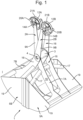
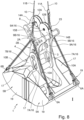
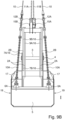
- the scissor levers 2a, 2b are substantially identical and are connected via the pivot joint 3 in mirrored arrangement, so that an symmetrical construction is achieved.
- the closing cable connection 8a, 8b respectively is situated at the end 14a, 14b of the second side 9a, 9b of the respective first and second levers 2a, 2b.
- the final closing sheaves 12a, 12b are each provided with a cable guide 20a, 20b that covers part of the circumference 21a, 21b of the final closing sheaves 12a, 12b to hold the closing cable 10a, 10b on the final closing sheave 12a, 12b. This is particularly useful when during operating, the closing cable becomes slack.
- the cable guide 20a, 20b is rotatably disposed relative to the final closing sheave 12a, 12b.
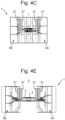
- Figs 4 it is shown that the grab is suspended from a crane 13, from which structure only its sheaves 37 are shown.
- the crane 13 includes a set of two hoisting cables 10a, 10b that are connected to the hoisting cable connections 6a, 6b.
- the grab 1 also includes a set of two closing cables 11a, 11b that are connected to the closing cable connections 8a, 8b.
- the hoisting cables 10a, 10b may be interconnected via a connecting piece 36.
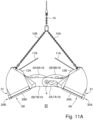
- the connecting piece 36 may be separate, and can be affixed to the hoisting cables 10a, 10b near the grab 1 to move along with the opening cables on the opening and closing stroke S of the grab 1 when it moves between the closed position I and the fully opened position II.
- a portion of such a connecting piece 36 for the hoisting cables 10a, 10b is shown in Fig 4d in dotted lines.
- a connecting piece may also assist to provide a correct fleet angle of the cable with respect of the sheaves 37 of the crane 13 carrying the grab 1.
- the operation of the grab is a follows.
- the grab 1 can move from the closed position I to the fully opened position II under the influence of gravity when the closing cables 11a, 11b are reeled off.
- the crane 13 then 1 reels the closing cables 11a, 11b off via its sheaves to make an opening stroke S.
- the crane 13 winches the closing cables 11a, 11b back up on a closing stroke S to move the grab 1 from the fully opened position II to the closed position I.
- the crane 13 can lift the grab 1 without moving it between the closed and opened positions I, II by winching both the hoisting cables 10a, 10b and the closing cables 11a, 11b up via its sheaves 37, and can lower the grab 1 again by reeling the hoisting cables 10a, 10b and closing cables 11a, 11b off.
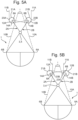
- FIGs. 5A -B show two schematic front views of the grab according to the invention, to illustrate reeving of the closing cables 11a, 11b.
- FIG. 5a and Fig. 5b show alternative reeving patterns. In both patterns, each closing cable 11a, 11b extends only in a single reeve between its point of connection 8a, 8b on the lever 2a, 2b and the final closing sheave 12a, 12b, then extends around a part of the circumference of the final closing sheave 12a, 12b to a point of departure 23a, 23b on the circumference 21a, 21b of the final closing sheave 23a, 23b, to depart from the grab 1 and continue upward to the crane 13.
- the closing cable 11a, 11b extends around about 90 degrees of the circumference of the final closing sheave 12a, 12b. No further or auxiliary closing sheaves 12a, 12b need be provided. As is illustrated in Fig. 5a and Fig. 5b , the point of departure 23a, 23b may be located on the outside or inside of the grab 1 respectively. When located on the inside, the closing cable 11a, 11b extends around about 270 degrees of the circumference of the final closing sheave 12a, 12b.
- the closing cables 11a, 11b in the closed position I of the grab 1 typically extend upward to the crane 13 spaced apart and mirrored from an upright center plane A of the grab 1 passing through or including the rotation axis of the grab.
- the closing 11a, 11b cables extend to the crane 13 without passing over the center of the grab, and in particular without being guided back through the upright center plane A to the lever arm that carries its cable connection.
- the closing cable connector with integral cable guide 32 is shown more in detail. It comprises a carrier 24 that is rotatably connected to the second side 9a, 9b of the first and second lever 2a, 2b respectively.
- the carrier 24 comprises a first portion 25 with a cable connecting part 33 to which the closing cable 10a, 10b connects, and that extends from a rotational joint 26 in a first direction.
- the carrier 24 further includes a second portion 25 that is provided with a cable guide part 34 and that extends from the rotational joint in a second, opposite direction.
- the rotational joint 26 of the carrier 24 is carried on the pivot axle 28 of the final closing sheave 12a, 12b, and is independently rotatable.
- the cable guide part 34 covers a part of the circumference 21a, 21b of the final closing sheave 12a, 12b. During operation, it holds the closing cable 10a, 10b on the circumference 21a, 21b of the closing sheave 12a, 12b.
- the cable connector with integral guide 32 is embodied to only guide at the point on the circumference 21a, 21b.
- the closing cable connecting part 33 on the first portion 25 of the carrier 24 is embodied as a so called rope wedge socket.
- the cable guide part 34 is arranged to guide the closing cable about an arc section of the circumference 21a, 21b of the closing sheave 21a, 21b, e.g. about 90 degrees.
- the cable connecting part 33 includes a cable pear.
- a further embodiment of a grab 1 in accordance with the invention is shown.
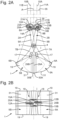
- the second sides 9a, 9b of the scissor levers 2a, 2b are curved outwardly, and the final closing sheaves 12a, 12b are located in gaff sections 38a, 38b that form the ends 14a, 14b of the second sides 9a,9b of the scissor levers 2a, 2b.
- the gaff sections 38a, 38b include parallel planar gaff plates 40 that are non-rotatably affixed to a transverse stiffener, here embodied as a tube 39.
- the two parallel planar plates 40 of each gaff house a final closing sheave 12 between them.
- Each final closing sheave 12 is bearing mounted on an axle so as to form a rotational connection 15.
- the closing cable connections 8 are here formed by a conventional rope wedge socket that is rotatably carried a the gaff plate 40.
- Stationary cable guides 42 formed as a curved skirt extend along a part of the final closing sheave, as can be seen in Fig. 12 .
- the gaff guides 42 are mounted with the base of the skirt on one of the gaff plates 40, and along their height extend transversely toward the facing gaff plate 40.
- the grab 1 has the same basic structure and functionality as the grab 1 of the first embodiment.
- the scissor levers 2a, 2b are configured differently than in the first embodiment.
- the scissor levers are each built up of parallel planar plates that are interspaced by transverse stiff elements.
- One scissor lever 2b extends continuously at the pivot axis 4, while the other scissor 2a lever is interrupted at the pivot axis 4.
- An inner portion of the crossing lever 2a, i.e. the second side 9a, includes an extension 43 that extends beyond a transverse tube 44 to partially overlap with an outer portion of the crossing lever 2a, i.e.
- transverse stiffener 45 that is arranged in parallel to the pivot tube.
- the transverse stiffener is embodied as a tube.
- the ends 14a, 14b of the scissor levers 2a, 2b comprise transverse stiffeners 39, here also embodied as tubes, that carry gaff sections 38.
- the gaff sections 38 are again arranged as parallel planar gaff plates 40.
- Such arrangement of the scissor levers as parallel planar plates interspaced by transverse stiffening elements allows for a lightweight, yet stiff construction, with e.g. a relatively light pivot joint 3.
- the invention therefore also relates to a four cable operated scissors grab, comprising a pair of scissor levers that are pivotably connected via a pivot joint, which scissor levers each include a grab shell and a hoist cable connection situated on a first side of the lever with respect to the pivot joint, and a closing cable connection situated on a second side of the lever that is opposite with respect to the pivot joint, so that in use a dedicated hoisting cable is fastened to each lever on the first side of the lever, and a dedicated closing cable is fastened to each lever at the second side of the lever, in which the scissor levers are arranged to pivot about the pivot axis between a closed position of the grab in which side and bottom edges of the shells are adjacent each other and the shells cooperate to form a bucket that can hold material to be handled, and a fully opened position of the grab in which the side and bottom edges are spaced apart and define a maximum opening there between through which material to be handled can pass, wherein the scissor levers are arranged as
Landscapes
- Engineering & Computer Science (AREA)
- Mechanical Engineering (AREA)
- Mining & Mineral Resources (AREA)
- Civil Engineering (AREA)
- General Engineering & Computer Science (AREA)
- Structural Engineering (AREA)
- Load-Engaging Elements For Cranes (AREA)
- Jib Cranes (AREA)
Claims (11)
- Benne preneuse en ciseau actionnée par quatre câbles (1), comprenant une paire de leviers de ciseau (2a, 2b) qui sont raccordés, de manière pivotante, via une articulation à pivot (3), lesquels leviers de ciseau (2a, 2b) comprennent chacun une coque de benne (5a, 5b) et un raccordement de câble de levage (6a, 6b) situé sur un premier côté du levier (7a, 7b) par rapport à l'articulation à pivot (3) et un raccordement de câble de fermeture (8a, 8b) situé sur un deuxième côté du levier (9a, 9b) qui est opposé par rapport à l'articulation à pivot (3), de sorte qu'à l'usage, un câble de levage dédié (10a, 10b) est fixé à chaque levier (2a, 2b) sur le premier côté du levier (7a, 7b) et un câble de fermeture dédié (11a, 11b) est fixé à chaque levier (2a, 2b) au niveau du deuxième côté du levier (9a, 9b), dans laquelle les leviers de ciseau (2a, 2b) sont agencés pour pivoter autour de l'axe de pivot (4) entre une position fermée (I) de la benne (1), dans laquelle les bords latéraux (29a, 29b) et inférieurs (30a, 30b) des coques (5a, 5b) sont adjacents entre eux et les coques (5a, 5b) coopèrent pour former un godet qui peut contenir le matériau à manipuler, et une position complètement ouverte (II) de la benne (1) dans laquelle les bords latéraux (29a, 29b) et inférieurs (30a, 30b) sont espacés et définissent une ouverture maximum entre laquelle le matériau à manipuler peut passer, dans laquelle lorsque la benne (1) passe de la position fermée (I) à la position complètement ouverte (II), un plan (A) à travers l'axe de pivot (4) et les bords latéraux (29a, 29b) et inférieurs (30a, 30b) de chaque coque de benne (5a, 5b) a un déplacement angulaire limité (α) autour de l'axe de pivot (4) qui est inclus dans la plage de 50 à 70 degrés, caractérisée en ce que les leviers de ciseau (2a, 2b) sont agencés comme des plaques planes parallèles espacées par des éléments rigides transversaux qui comprennent des profils de raidissement (17) sur les premiers côtés (7a, 7b) desdits leviers de ciseau, ledit déplacement angulaire limité permettant de fournir lesdits profils de raidissement sur les premiers côtés (7a, 7b) desdits leviers de ciseau (2a, 2b).
- Benne (1) selon la revendication 1, dans laquelle le déplacement angulaire (α) est d'au moins 55 degrés et en particulier n'est pas supérieur à 65 degrés.
- Benne (1) selon les revendications 1 ou 2, dans laquelle les profils de raidissement (17) sont agencés pour former un croisillon raidisseur (18) qui continue d'un côté de la coque (19) à l'autre.
- Benne (1) selon la revendication 3, dans laquelle les profils de raidissement (17) s'étendent entre les plaques de levier (16) des leviers de ciseau (2a, 2b) et entre les plaques de levier (16) et les côtés des coques de benne (19).
- Benne (1) selon la revendication 3 ou 4, dans laquelle les profils de raidissement (17) s'étendent avec un espace intermédiaire le long du fond des coques de benne (5a, 5b).
- Benne (1) selon l'une quelconque des revendications précédentes, dans laquelle les deuxièmes côtés des leviers de ciseau (2a, 2b) sont courbés vers l'extérieur.
- Benne (1) selon l'une quelconque des revendications précédentes, dans laquelle un levier de ciseau (2a, 2b) s'étend, de manière continue, au niveau de l'axe de pivot (4), alors que l'autre levier de ciseau (2a, 2b) est interrompu au niveau de l'axe de pivot (4).
- Benne (1) selon l'une quelconque des revendications précédentes, dans laquelle les leviers de ciseau (2a, 2b) comprennent chacun une poulie à gorge (12a, 12b) sur le deuxième côté du levier (9a, 9b).
- Benne (1) selon la revendication 8, dans laquelle lesdites poulies à gorge (12a, 12b) sont chacune agencées comme une première et dernière poulie à gorge de fermeture (12a, 12b) pour le câble de fermeture (11a, 11b), de sorte que, à l'usage, chacun des deux câbles de fermeture (11a, 11b) s'étend en un seul passage, à partir du raccordement de câble de fermeture (8a, 8b) sur le deuxième côté d'un levier (9a, 9b) via la poulie à gorge de fermeture (12a, 12b) sur le deuxième côté de l'autre levier (9a, 9b) pour s'éloigner de la benne (1) et continue vers le haut jusqu'à une grue (13) portant la benne (1).
- Benne (1) selon la revendication 9, dans laquelle chaque première et dernière poulie à gorge de fermeture (12a, 12b) est située au niveau de ou à proximité d'une extrémité du deuxième côté du levier (14a, 14b) qui est orientée à l'opposé de l'articulation à pivot (3).
- Benne (1) selon l'une quelconque des revendications 8 à 10, dans laquelle les leviers de ciseau (2a, 2b) comprennent chacun uniquement une poulie à gorge de fermeture (12a, 12b).
Priority Applications (2)
| Application Number | Priority Date | Filing Date | Title |
|---|---|---|---|
| HRP20250883TT HRP20250883T1 (hr) | 2015-05-01 | 2016-05-02 | Škarasti hvatač upravljan pomoću četiri užeta |
| RS20250722A RS67125B1 (sr) | 2015-05-01 | 2016-05-02 | Hvatač sa makazama upravljan pomoću četiri užeta |
Applications Claiming Priority (3)
| Application Number | Priority Date | Filing Date | Title |
|---|---|---|---|
| NL2014756A NL2014756B1 (en) | 2015-05-01 | 2015-05-01 | Four cable operated scissors grab. |
| PCT/NL2016/050314 WO2016178568A1 (fr) | 2015-05-01 | 2016-05-02 | Benne preneuse en ciseau actionnée par quatre câbles |
| EP16731379.0A EP3288888B1 (fr) | 2015-05-01 | 2016-05-02 | Benne preneuse en ciseau actionnée par quatre câbles |
Related Parent Applications (1)
| Application Number | Title | Priority Date | Filing Date |
|---|---|---|---|
| EP16731379.0A Division EP3288888B1 (fr) | 2015-05-01 | 2016-05-02 | Benne preneuse en ciseau actionnée par quatre câbles |
Publications (3)
| Publication Number | Publication Date |
|---|---|
| EP3677536A1 EP3677536A1 (fr) | 2020-07-08 |
| EP3677536B1 true EP3677536B1 (fr) | 2025-07-02 |
| EP3677536C0 EP3677536C0 (fr) | 2025-07-02 |
Family
ID=53488410
Family Applications (2)
| Application Number | Title | Priority Date | Filing Date |
|---|---|---|---|
| EP16731379.0A Active EP3288888B1 (fr) | 2015-05-01 | 2016-05-02 | Benne preneuse en ciseau actionnée par quatre câbles |
| EP20154730.4A Active EP3677536B1 (fr) | 2015-05-01 | 2016-05-02 | Benne preneuse en ciseau actionnée par quatre câbles |
Family Applications Before (1)
| Application Number | Title | Priority Date | Filing Date |
|---|---|---|---|
| EP16731379.0A Active EP3288888B1 (fr) | 2015-05-01 | 2016-05-02 | Benne preneuse en ciseau actionnée par quatre câbles |
Country Status (13)
| Country | Link |
|---|---|
| US (1) | US10252892B2 (fr) |
| EP (2) | EP3288888B1 (fr) |
| JP (1) | JP6647316B2 (fr) |
| KR (1) | KR102492291B1 (fr) |
| CN (2) | CN111252662B (fr) |
| BR (1) | BR112017023611B8 (fr) |
| ES (1) | ES2777824T3 (fr) |
| HR (1) | HRP20250883T1 (fr) |
| LT (1) | LT3288888T (fr) |
| NL (1) | NL2014756B1 (fr) |
| PL (1) | PL3288888T3 (fr) |
| RS (1) | RS67125B1 (fr) |
| WO (1) | WO2016178568A1 (fr) |
Families Citing this family (6)
| Publication number | Priority date | Publication date | Assignee | Title |
|---|---|---|---|---|
| EP3768900A4 (fr) * | 2018-03-23 | 2022-03-23 | Cashman Dredging & Marine Contracting Co., Llc | Godet à découpe de niveau de pente |
| USD969880S1 (en) * | 2019-09-25 | 2022-11-15 | Raymond E. Bergeron | Clamshell dredging bucket |
| CN114250359A (zh) * | 2020-09-21 | 2022-03-29 | 杭州中冶有色科技有限公司 | 一种萃取箱潜室沉淀清理工具及其使用方法 |
| USD1021977S1 (en) * | 2022-11-16 | 2024-04-09 | Raymond E. Bergeron | Level cut clamshell dredging bucket |
| KR102574223B1 (ko) * | 2023-03-22 | 2023-09-06 | 주식회사 나우건설산업 | 보조풀리유닛을 갖는 와이어 쏘 절단장치의 방향전환지그 |
| CN116290158B (zh) * | 2023-03-31 | 2025-11-25 | 中冶建工集团有限公司 | 桩间土层清理装置及桩间土层清理的施工方法 |
Citations (4)
| Publication number | Priority date | Publication date | Assignee | Title |
|---|---|---|---|---|
| US2617211A (en) * | 1947-07-21 | 1952-11-11 | William A Olson | Clamshell bucket |
| US3807783A (en) * | 1971-10-07 | 1974-04-30 | Nemag Nv | Cable-operated mechanical grapple |
| CN2747209Y (zh) * | 2004-10-28 | 2005-12-21 | 漳州招商局码头有限公司 | 一种轻型耙集式散货抓斗 |
| CN103010945A (zh) * | 2012-12-18 | 2013-04-03 | 上海海事大学 | 一种高抓取比散货抓斗 |
Family Cites Families (17)
| Publication number | Priority date | Publication date | Assignee | Title |
|---|---|---|---|---|
| US64169A (en) * | 1867-04-23 | Israel d | ||
| US528375A (en) * | 1894-10-30 | Dredging implement | ||
| US485193A (en) * | 1892-11-01 | Dredging implement | ||
| US813528A (en) * | 1904-07-06 | 1906-02-27 | Joseph A Jeffrey | Clam-shell bucket. |
| US1545591A (en) * | 1923-03-06 | 1925-07-14 | Western Electric Co | Manufacture of electron-discharge devices |
| US1571838A (en) * | 1924-06-11 | 1926-02-02 | Hutson Archibald | Clamshell-dredger bucket |
| US1909867A (en) * | 1932-12-20 | 1933-05-16 | William A Olson | Clamshell bucket |
| US3975044A (en) * | 1973-08-07 | 1976-08-17 | Dravo Corporation | Reeving system for a scissor-type clamshell bucket |
| GB1456328A (en) * | 1973-08-07 | 1976-11-24 | Dravo Corp | Bucket assembly for material handling apparatus |
| NL182212C (nl) * | 1975-11-13 | 1988-02-01 | Nemag Nv | Grijper. |
| NL8204386A (nl) | 1982-11-12 | 1984-06-01 | Nemag Nv | Vorkschaargrijper. |
| JP3606851B2 (ja) * | 2002-06-07 | 2005-01-05 | 明彦 苑田 | グラブバケット |
| CN2649555Y (zh) * | 2003-10-22 | 2004-10-20 | 天津五洋港口机械有限公司 | 弹簧式异步多颚抓斗 |
| CN102070076A (zh) * | 2009-11-19 | 2011-05-25 | 陈莲秀 | 钳剪抓斗 |
| CN102674149A (zh) * | 2012-05-05 | 2012-09-19 | 无锡市新华起重工具有限公司 | 剪式防漏抓斗 |
| CN203740882U (zh) * | 2014-03-20 | 2014-07-30 | 迟树廷 | 新型剪式抓斗 |
| CN104310210B (zh) * | 2014-10-31 | 2016-07-20 | 武汉理工大学 | 碎石平挖抓斗及其控制方法 |
-
2015
- 2015-05-01 NL NL2014756A patent/NL2014756B1/en active
-
2016
- 2016-05-02 CN CN202010222638.5A patent/CN111252662B/zh active Active
- 2016-05-02 US US15/568,289 patent/US10252892B2/en active Active
- 2016-05-02 LT LTEP16731379.0T patent/LT3288888T/lt unknown
- 2016-05-02 EP EP16731379.0A patent/EP3288888B1/fr active Active
- 2016-05-02 CN CN201680025118.7A patent/CN107690416B/zh active Active
- 2016-05-02 RS RS20250722A patent/RS67125B1/sr unknown
- 2016-05-02 EP EP20154730.4A patent/EP3677536B1/fr active Active
- 2016-05-02 ES ES16731379T patent/ES2777824T3/es active Active
- 2016-05-02 PL PL16731379T patent/PL3288888T3/pl unknown
- 2016-05-02 BR BR112017023611A patent/BR112017023611B8/pt active IP Right Grant
- 2016-05-02 HR HRP20250883TT patent/HRP20250883T1/hr unknown
- 2016-05-02 WO PCT/NL2016/050314 patent/WO2016178568A1/fr not_active Ceased
- 2016-05-02 KR KR1020177034910A patent/KR102492291B1/ko active Active
- 2016-05-02 JP JP2017555808A patent/JP6647316B2/ja active Active
Patent Citations (4)
| Publication number | Priority date | Publication date | Assignee | Title |
|---|---|---|---|---|
| US2617211A (en) * | 1947-07-21 | 1952-11-11 | William A Olson | Clamshell bucket |
| US3807783A (en) * | 1971-10-07 | 1974-04-30 | Nemag Nv | Cable-operated mechanical grapple |
| CN2747209Y (zh) * | 2004-10-28 | 2005-12-21 | 漳州招商局码头有限公司 | 一种轻型耙集式散货抓斗 |
| CN103010945A (zh) * | 2012-12-18 | 2013-04-03 | 上海海事大学 | 一种高抓取比散货抓斗 |
Also Published As
| Publication number | Publication date |
|---|---|
| HRP20250883T1 (hr) | 2025-11-07 |
| PL3288888T3 (pl) | 2020-06-29 |
| WO2016178568A1 (fr) | 2016-11-10 |
| US10252892B2 (en) | 2019-04-09 |
| CN111252662B (zh) | 2022-06-28 |
| CN107690416A (zh) | 2018-02-13 |
| EP3288888A1 (fr) | 2018-03-07 |
| EP3677536A1 (fr) | 2020-07-08 |
| BR112017023611B8 (pt) | 2022-10-25 |
| JP6647316B2 (ja) | 2020-02-14 |
| US20180134525A1 (en) | 2018-05-17 |
| BR112017023611A2 (pt) | 2018-07-24 |
| NL2014756A (en) | 2016-11-07 |
| WO2016178568A9 (fr) | 2017-02-09 |
| NL2014756B1 (en) | 2017-01-25 |
| EP3288888B1 (fr) | 2020-02-12 |
| EP3677536C0 (fr) | 2025-07-02 |
| ES2777824T3 (es) | 2020-08-06 |
| KR20180005201A (ko) | 2018-01-15 |
| RS67125B1 (sr) | 2025-09-30 |
| LT3288888T (lt) | 2020-03-25 |
| CN107690416B (zh) | 2020-07-07 |
| JP2018514484A (ja) | 2018-06-07 |
| CN111252662A (zh) | 2020-06-09 |
| KR102492291B1 (ko) | 2023-01-26 |
| BR112017023611B1 (pt) | 2021-08-03 |
Similar Documents
| Publication | Publication Date | Title |
|---|---|---|
| EP3288888B1 (fr) | Benne preneuse en ciseau actionnée par quatre câbles | |
| TWI701204B (zh) | 荷重搬運機械 | |
| EP3097043B1 (fr) | Chariot à faible profil pour treuil à câble métallique | |
| JP2017506202A (ja) | クレーンのための運転台傾け機構 | |
| JP5766980B2 (ja) | クレーン及びその制御方法 | |
| US4538848A (en) | Grab | |
| US3582127A (en) | Swivel-head grapple | |
| GB2168310A (en) | Dredger | |
| US3975044A (en) | Reeving system for a scissor-type clamshell bucket | |
| CN214692965U (zh) | 一种起重机 | |
| WO2023118584A1 (fr) | Benne preneuse mécanique actionnée par câble | |
| JP2015189542A (ja) | 岸壁クレーン | |
| US4328987A (en) | Rope-actuated implements | |
| KR101411537B1 (ko) | 후크 블록 | |
| JP7028635B2 (ja) | 水平ジブを備えた揚重装置 | |
| JP7042080B2 (ja) | 水平ジブを備えた揚重装置 | |
| JP7826731B2 (ja) | クレーン | |
| US1914613A (en) | Rod grab for heapable material | |
| CN219885518U (zh) | 起重臂及起重机 | |
| RU2463242C1 (ru) | Подъемник | |
| US1225186A (en) | Grab-bucket for derricks. | |
| JP7039291B2 (ja) | 水平ジブを備えた揚重装置 | |
| EP0999171A1 (fr) | Flèche repliable pour grue à tour | |
| JP7028636B2 (ja) | 水平ジブを備えた揚重装置 | |
| JP2002115263A (ja) | 船槽の荷揚げ用バケット装置 |
Legal Events
| Date | Code | Title | Description |
|---|---|---|---|
| REG | Reference to a national code |
Ref country code: HR Ref legal event code: TUEP Ref document number: P20250883T Country of ref document: HR |
|
| PUAI | Public reference made under article 153(3) epc to a published international application that has entered the european phase |
Free format text: ORIGINAL CODE: 0009012 |
|
| STAA | Information on the status of an ep patent application or granted ep patent |
Free format text: STATUS: REQUEST FOR EXAMINATION WAS MADE |
|
| 17P | Request for examination filed |
Effective date: 20200130 |
|
| AC | Divisional application: reference to earlier application |
Ref document number: 3288888 Country of ref document: EP Kind code of ref document: P |
|
| AK | Designated contracting states |
Kind code of ref document: A1 Designated state(s): AL AT BE BG CH CY CZ DE DK EE ES FI FR GB GR HR HU IE IS IT LI LT LU LV MC MK MT NL NO PL PT RO RS SE SI SK SM TR |
|
| RAP1 | Party data changed (applicant data changed or rights of an application transferred) |
Owner name: NEMAG IP B.V. |
|
| STAA | Information on the status of an ep patent application or granted ep patent |
Free format text: STATUS: EXAMINATION IS IN PROGRESS |
|
| 17Q | First examination report despatched |
Effective date: 20230412 |
|
| GRAP | Despatch of communication of intention to grant a patent |
Free format text: ORIGINAL CODE: EPIDOSNIGR1 |
|
| STAA | Information on the status of an ep patent application or granted ep patent |
Free format text: STATUS: GRANT OF PATENT IS INTENDED |
|
| INTG | Intention to grant announced |
Effective date: 20250131 |
|
| GRAS | Grant fee paid |
Free format text: ORIGINAL CODE: EPIDOSNIGR3 |
|
| GRAA | (expected) grant |
Free format text: ORIGINAL CODE: 0009210 |
|
| STAA | Information on the status of an ep patent application or granted ep patent |
Free format text: STATUS: THE PATENT HAS BEEN GRANTED |
|
| AC | Divisional application: reference to earlier application |
Ref document number: 3288888 Country of ref document: EP Kind code of ref document: P |
|
| AK | Designated contracting states |
Kind code of ref document: B1 Designated state(s): AL AT BE BG CH CY CZ DE DK EE ES FI FR GB GR HR HU IE IS IT LI LT LU LV MC MK MT NL NO PL PT RO RS SE SI SK SM TR |
|
| REG | Reference to a national code |
Ref country code: GB Ref legal event code: FG4D |
|
| REG | Reference to a national code |
Ref country code: CH Ref legal event code: EP |
|
| REG | Reference to a national code |
Ref country code: DE Ref legal event code: R096 Ref document number: 602016092801 Country of ref document: DE |
|
| REG | Reference to a national code |
Ref country code: IE Ref legal event code: FG4D |
|
| U01 | Request for unitary effect filed |
Effective date: 20250731 |
|
| U07 | Unitary effect registered |
Designated state(s): AT BE BG DE DK EE FI FR IT LT LU LV MT NL PT RO SE SI Effective date: 20250808 |
|
| REG | Reference to a national code |
Ref country code: GR Ref legal event code: EP Ref document number: 20250401638 Country of ref document: GR Effective date: 20251009 |
|
| REG | Reference to a national code |
Ref country code: HR Ref legal event code: T1PR Ref document number: P20250883 Country of ref document: HR |
|
| PG25 | Lapsed in a contracting state [announced via postgrant information from national office to epo] |
Ref country code: IS Free format text: LAPSE BECAUSE OF FAILURE TO SUBMIT A TRANSLATION OF THE DESCRIPTION OR TO PAY THE FEE WITHIN THE PRESCRIBED TIME-LIMIT Effective date: 20251102 |
|
| PG25 | Lapsed in a contracting state [announced via postgrant information from national office to epo] |
Ref country code: NO Free format text: LAPSE BECAUSE OF FAILURE TO SUBMIT A TRANSLATION OF THE DESCRIPTION OR TO PAY THE FEE WITHIN THE PRESCRIBED TIME-LIMIT Effective date: 20251002 |
|
| PG25 | Lapsed in a contracting state [announced via postgrant information from national office to epo] |
Ref country code: CZ Free format text: LAPSE BECAUSE OF FAILURE TO SUBMIT A TRANSLATION OF THE DESCRIPTION OR TO PAY THE FEE WITHIN THE PRESCRIBED TIME-LIMIT Effective date: 20250702 |
|
| PG25 | Lapsed in a contracting state [announced via postgrant information from national office to epo] |
Ref country code: PL Free format text: LAPSE BECAUSE OF FAILURE TO SUBMIT A TRANSLATION OF THE DESCRIPTION OR TO PAY THE FEE WITHIN THE PRESCRIBED TIME-LIMIT Effective date: 20250702 |
|
| PG25 | Lapsed in a contracting state [announced via postgrant information from national office to epo] |
Ref country code: ES Free format text: LAPSE BECAUSE OF FAILURE TO SUBMIT A TRANSLATION OF THE DESCRIPTION OR TO PAY THE FEE WITHIN THE PRESCRIBED TIME-LIMIT Effective date: 20250702 |
|
| PG25 | Lapsed in a contracting state [announced via postgrant information from national office to epo] |
Ref country code: SM Free format text: LAPSE BECAUSE OF FAILURE TO SUBMIT A TRANSLATION OF THE DESCRIPTION OR TO PAY THE FEE WITHIN THE PRESCRIBED TIME-LIMIT Effective date: 20250702 |
|
| PGFP | Annual fee paid to national office [announced via postgrant information from national office to epo] |
Ref country code: GB Payment date: 20260324 Year of fee payment: 11 |
|
| PG25 | Lapsed in a contracting state [announced via postgrant information from national office to epo] |
Ref country code: SK Free format text: LAPSE BECAUSE OF FAILURE TO SUBMIT A TRANSLATION OF THE DESCRIPTION OR TO PAY THE FEE WITHIN THE PRESCRIBED TIME-LIMIT Effective date: 20250702 |
|
| PLBE | No opposition filed within time limit |
Free format text: ORIGINAL CODE: 0009261 |
|
| STAA | Information on the status of an ep patent application or granted ep patent |
Free format text: STATUS: NO OPPOSITION FILED WITHIN TIME LIMIT |