EP3678057B1 - Procédé et dispositif de détermination de trajet de cible humaine - Google Patents
Procédé et dispositif de détermination de trajet de cible humaine Download PDFInfo
- Publication number
- EP3678057B1 EP3678057B1 EP18852621.4A EP18852621A EP3678057B1 EP 3678057 B1 EP3678057 B1 EP 3678057B1 EP 18852621 A EP18852621 A EP 18852621A EP 3678057 B1 EP3678057 B1 EP 3678057B1
- Authority
- EP
- European Patent Office
- Prior art keywords
- acquisition
- target
- searched
- feature
- target feature
- Prior art date
- Legal status (The legal status is an assumption and is not a legal conclusion. Google has not performed a legal analysis and makes no representation as to the accuracy of the status listed.)
- Active
Links
Images

Classifications
-
- G—PHYSICS
- G06—COMPUTING OR CALCULATING; COUNTING
- G06V—IMAGE OR VIDEO RECOGNITION OR UNDERSTANDING
- G06V40/00—Recognition of biometric, human-related or animal-related patterns in image or video data
- G06V40/10—Human or animal bodies, e.g. vehicle occupants or pedestrians; Body parts, e.g. hands
-
- G—PHYSICS
- G06—COMPUTING OR CALCULATING; COUNTING
- G06V—IMAGE OR VIDEO RECOGNITION OR UNDERSTANDING
- G06V40/00—Recognition of biometric, human-related or animal-related patterns in image or video data
- G06V40/10—Human or animal bodies, e.g. vehicle occupants or pedestrians; Body parts, e.g. hands
- G06V40/16—Human faces, e.g. facial parts, sketches or expressions
- G06V40/172—Classification, e.g. identification
-
- G—PHYSICS
- G06—COMPUTING OR CALCULATING; COUNTING
- G06F—ELECTRIC DIGITAL DATA PROCESSING
- G06F18/00—Pattern recognition
- G06F18/20—Analysing
- G06F18/22—Matching criteria, e.g. proximity measures
-
- G—PHYSICS
- G06—COMPUTING OR CALCULATING; COUNTING
- G06T—IMAGE DATA PROCESSING OR GENERATION, IN GENERAL
- G06T7/00—Image analysis
- G06T7/70—Determining position or orientation of objects or cameras
- G06T7/73—Determining position or orientation of objects or cameras using feature-based methods
-
- G—PHYSICS
- G06—COMPUTING OR CALCULATING; COUNTING
- G06V—IMAGE OR VIDEO RECOGNITION OR UNDERSTANDING
- G06V10/00—Arrangements for image or video recognition or understanding
- G06V10/70—Arrangements for image or video recognition or understanding using pattern recognition or machine learning
- G06V10/74—Image or video pattern matching; Proximity measures in feature spaces
- G06V10/75—Organisation of the matching processes, e.g. simultaneous or sequential comparisons of image or video features; Coarse-fine approaches, e.g. multi-scale approaches; using context analysis; Selection of dictionaries
-
- G—PHYSICS
- G06—COMPUTING OR CALCULATING; COUNTING
- G06V—IMAGE OR VIDEO RECOGNITION OR UNDERSTANDING
- G06V20/00—Scenes; Scene-specific elements
- G06V20/50—Context or environment of the image
- G06V20/52—Surveillance or monitoring of activities, e.g. for recognising suspicious objects
-
- G—PHYSICS
- G06—COMPUTING OR CALCULATING; COUNTING
- G06V—IMAGE OR VIDEO RECOGNITION OR UNDERSTANDING
- G06V40/00—Recognition of biometric, human-related or animal-related patterns in image or video data
- G06V40/10—Human or animal bodies, e.g. vehicle occupants or pedestrians; Body parts, e.g. hands
- G06V40/16—Human faces, e.g. facial parts, sketches or expressions
-
- G—PHYSICS
- G06—COMPUTING OR CALCULATING; COUNTING
- G06V—IMAGE OR VIDEO RECOGNITION OR UNDERSTANDING
- G06V40/00—Recognition of biometric, human-related or animal-related patterns in image or video data
- G06V40/10—Human or animal bodies, e.g. vehicle occupants or pedestrians; Body parts, e.g. hands
- G06V40/16—Human faces, e.g. facial parts, sketches or expressions
- G06V40/161—Detection; Localisation; Normalisation
-
- G—PHYSICS
- G06—COMPUTING OR CALCULATING; COUNTING
- G06V—IMAGE OR VIDEO RECOGNITION OR UNDERSTANDING
- G06V40/00—Recognition of biometric, human-related or animal-related patterns in image or video data
- G06V40/10—Human or animal bodies, e.g. vehicle occupants or pedestrians; Body parts, e.g. hands
- G06V40/16—Human faces, e.g. facial parts, sketches or expressions
- G06V40/168—Feature extraction; Face representation
-
- G—PHYSICS
- G06—COMPUTING OR CALCULATING; COUNTING
- G06T—IMAGE DATA PROCESSING OR GENERATION, IN GENERAL
- G06T2207/00—Indexing scheme for image analysis or image enhancement
- G06T2207/30—Subject of image; Context of image processing
- G06T2207/30196—Human being; Person
-
- G—PHYSICS
- G06—COMPUTING OR CALCULATING; COUNTING
- G06T—IMAGE DATA PROCESSING OR GENERATION, IN GENERAL
- G06T2207/00—Indexing scheme for image analysis or image enhancement
- G06T2207/30—Subject of image; Context of image processing
- G06T2207/30241—Trajectory
Definitions
- the present application relates to the technical field of image processing, and in particular, to a method and an apparatus for determining a trajectory of a human target.
- a person's trajectory is usually tracked with a face capture camera.
- Face capture cameras are set up in various places such as roads and public places. The time and place of a specific person are determined based on the face images captured by the face capture camera, thereby tracking the trajectory of the particular person.
- US20110317010A1 relates to a method, system and computer program product for tracking a person in a pre-defined area.
- the pre-defined area includes a plurality of imaging devices placed at respective pre-defined locations to capture images of the person.
- the system in conjunction with the plurality of imaging devices locates the person at the pre-defined area based on the captured images of the person.
- US20060062431A1 relates to a method of producing a transit graph of a priori information relating to movements of a plurality of targets from a first of a plurality of targets locations to a second of the plurality of locations, including: processing a plurality of target observations from a plurality of image capture devices to produce at least one primary track for at least one target, wherein each primary track includes ordered sequences of observation events having similarities in their visual signatures; and processing the at least one primary track to determine a priori information relating to movement of a target from a first of a plurality of locations to a second of the plurality of locations.
- US20150023596A1 relates to a person clothing feature extraction device, person search device and processing method thereof.
- a person's region is detected from input video of a surveillance camera; a person's direction in the person's region is determined; the separability of person's clothes is determined to generate clothing segment separation information; furthermore, clothing features representing visual features of person's clothes in the person's region are extracted in consideration of the person's direction and the clothing segment separation information.
- the person's direction is determined based on a person's face direction, person's motion, and clothing symmetry.
- the clothing segment separation information is generated based on analysis information regarding a geometrical shape of the person's region and visual segment information representing person's clothing segments which are visible based on the person's region and background prior information.
- a person is searched out based on a result of matching between a clothing query text, representing a type and a color of person's clothes, and the extracted person's clothing features.
- An objective of the embodiments of the present application is to provide a method and an apparatus for determining a trajectory of a human target, to improve the accuracy of determining a trajectory of a person.
- embodiments of the present application provide a method and apparatus for determining a trajectory of a human target.
- the method and apparatus may be applied to a device having an image processing function, which is not specifically limited.
- a method for determining a trajectory of a human target according to an embodiment of the present application is described first in detail below.
- Fig. 1 is a flowchart of a method for determining a trajectory of a human target according to an embodiment of the present application. The method includes:
- a target feature of the to-be-tracked human target in the image is extracted as the to-be-searched target feature; the acquisition attribute corresponding to the to-be-searched target feature is searched for based on the pre-established correspondence between the target features and the acquisition attributes, and the trajectory of the to-be-tracked person is determined according to the found acquisition attribute.
- Fig. 1 The embodiment shown in Fig. 1 is described in detail below.
- the to-be-processed image is an image containing a to-be-tracked human target.
- S101 may include: receiving a to-be-processed image input by a user; or, as another implementation, S101 may include: obtaining a to-be-processed image from a designated acquisition device.
- a user may input an image containing the human target; or, an acquisition device that acquires the human target may be determined and an image containing the human target may be obtained from the acquisition device.
- the to-be-processed image may also be obtained by other methods, which are not specifically limited.
- S102 extracting a target feature of a to-be-tracked human target in the to-be-processed image as a to-be-searched target feature.
- the target feature of the human target may include features such as color, texture, size.
- the target feature may also include features of clothing worn by the human target, such as whether there is a backpack, the type of clothes, or the like.
- the target feature may also include features such as the height, body shape of the human target. These are not specifically limited.
- a target feature in an image There are many ways to extract a target feature in an image. For example, an area of a human target in the image is detected by using an edge detection algorithm and then the image feature of that area is extracted; or the target feature of the human target in the image is extracted by using a neural network trained and obtained in advance; or so on. These are not specifically limited.
- S103 based on a pre-established correspondence between target features and acquisition attributes, searching for an acquisition attribute corresponding to the to-be-searched target feature; wherein an acquisition attribute corresponding to one target feature in the correspondence is an acquisition attribute of an image containing the target feature, the acquisition attribute containing an acquisition location.
- the acquisition attribute only includes the acquisition location; in a second case, the acquisition attribute includes the acquisition location and the acquisition time.
- one or more acquisition devices communicate with one server, and these acquisition devices send the acquired images to the server in real time.
- the server receives the images, extracts the target features of the human targets in the images and stores the target features of the images in sequence of reception time.
- the server determines the acquisition location of each received image, and establishes the correspondence between the acquisition location and the target feature of the same image.
- the server determines the acquisition location of each received image. For example, the server obtains an acquisition location of each device in advance, and establishes the correspondence between an identifier of the device and the acquisition location. When receiving an image sent by a device, the server determines an acquisition location corresponding to an identifier of the device as an acquisition location of the image; or, an acquisition device may send an acquired image to the server together with an acquisition location thereof; or the like, which will not be enumerated one by one.
- the server first receives an image A1 sent by an acquisition device A, extracts a target feature A2 of a human target in A1, determines an acquisition location A3 of the image A1, and establishes a correspondence between the target feature A2 and the acquisition location A3. Then, the server receives an image B1 sent by an acquisition device B, extracts a target feature B2 of a human target in B1, determines an acquisition location B3 of the image B1, and establishes a correspondence between the target feature B2 and the acquisition location B3.
- the server also receives an image C1 sent by an acquisition device C, extracts a target feature C2 of a human target in C1, determines an acquisition location C3 of the image C1, and establishes a correspondence between the target feature C2 and the acquisition location C3.
- the correspondence established by the server may be shown in Table 1: Table 1 Target feature Acquisition location C2 C3 B2 B3 A2 A3
- the correspondence is stored in order of reception time from latest to earliest.
- the correspondence may be stored in order of reception time from from earliest to latest, which is not specifically limited.
- the established correspondence (such as Table 1) is stored in a local database of the server or in a database connected to the server.
- the execution subject of this embodiment of the present application and the server may be a same device or different devices.
- Table 1 is only a simple example, and does not limit the correspondence actually established.
- one or more acquisition devices communicatively with a same server, and these acquisition devices send acquired images to the server in real time or non-real time; the server receives the images, extracts target features of human targets in the images, determines acquisition time and acquisition location of each received image, and establishes the correspondence between the acquisition time, acquisition location, and target feature of a same image.
- the server may use the time when the image is received as the acquisition time; or, the acquisition device may also send the acquired images along with the acquisition time of the images to the server.
- the acquisition device sends the acquired images to the server in non-real time
- the acquisition device sends the acquired images along with the acquisition time of the images to the server.
- the server determines the acquisition location of each received image. For example, the server obtains the acquisition location of each device in advance, and establishes the correspondence between an identifier of the device and the acquisition location. When receiving an image sent by a device, the server determines an acquisition location corresponding to an identifier of the device as an acquisition location of the image; or, the acquisition device may send an acquired image to the server together with an acquisition location thereof; or the like, which will not be enumerated one by one.
- the server receives an image A1 sent by an acquisition device A, extracts a target feature A2 of a human target in A1, determines an acquisition location A3 and acquisition time A4 of the image A1, and establishes a correspondence among the target feature A2, the acquisition location A3 and the acquisition time A4.
- the server receives an image B1 sent by an acquisition device B, extracts a target feature B2 of a human target in B1, determines an acquisition location B3 and acquisition time B4 of the image B1, and establishes a correspondence among the target feature B2, the acquisition location B3 and the acquisition time B4.
- the server also receives an image C1 sent by an acquisition device C, extracts a target feature C2 of a human target in C1, determines an acquisition location C3 and acquisition time C4 of the image C1, and establishes a correspondence among the target feature C2, the acquisition location C3 and the acquisition time C4.
- the correspondence established by the server may be shown in Table 2: Target feature Acquisition location Acquisition time C2 C3 C4 B2 B3 B4 A2 A3 A4
- the established correspondence (such as Table 2) is stored in a local database of the server or in a database connected to the server.
- the execution subject of this embodiment of the present application and the server may be a same device or different devices.
- Table 2 is only a simple example, and does not limit the correspondence actually established.
- S104 determining a trajectory of the to-be-tracked human target according to the found acquisition attribute.
- the acquisition attribute includes the acquisition time and the acquisition location.
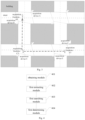
- the trajectory can be determined based on the time and location. For example, in the scenario shown in Fig. 3 , three acquisition attributes of a same human target are found in the established correspondence, which include: 1. acquisition time: 9:05 am on July 14, 2017, and acquisition location: B3; 2. acquisition time: 9:03 am on July 14, 2017, acquisition location: C3; 3, acquisition time: 9:00 am, July 14, 2017, acquisition location: F3. Therefore, the trajectory of the person can be determined as shown by the dotted line in Fig. 3 , from F3 to C3 and then to B3.
- the trajectory can also be determined based on the order and the acquisition locations.
- three acquisition attributes of a same human target are found in the established correspondence, which are sequentially: 1, acquisition location: B3; 2, acquisition location: C3; 3, acquisition location: F3.
- the storage order of the correspondence is stored in order of reception time from latest to earliest, that is, the third acquisition attribute with the earliest reception time and the first acquisition attribute with the latest reception time.
- the trajectory of the person is as shown by the dotted line in Fig. 3 , from F3 to C3 and then to B3.
- a correspondence between facial features and acquisition attributes may also be established.
- the method may further include: extracting a facial feature of the to-be-tracked human target in the to-be-processed image, as a to-be-searched facial feature; based on a pre-established correspondence between facial features and acquisition attributes, searching for an acquisition attribute corresponding to the to-be-searched facial feature; wherein the acquisition attribute corresponding to one facial feature in the correspondence is an acquisition attribute of an image containing the facial feature.
- establishing a correspondence between the facial features and the acquisition attributes may include:
- the process of establishing the correspondence between facial features and acquisition attributes is similar to the process of establishing the correspondence between target features and acquisition attributes, and thus is not repeated here.
- the to-be-processed image includes not only the target feature of the human target, but also the facial feature of the human target.
- the correspondence between the facial features and the acquisition attributes is also established. In this way, on the basis of the embodiment shown in Fig. 1 , more acquisition attributes can be found by the facial features, and the trajectory can be determined more accurately based on more acquisition attributes.
- a correspondence among the target features, facial features, and acquisition attributes may be established.
- the specific process may include:
- the process of establishing the correspondence among the target features, facial features, and acquisition attributes is similar to the process of establishing the correspondence between the target features and the acquisition attributes, which is not repeated here.
- the method may further include: extracting a facial feature of the to-be-tracked human target in the to-be-processed image as the to-be-searched facial feature;
- S103 may include: based on a pre-established correspondence among the target features, the facial features and the acquisition attributes, searching for an acquisition attribute matching the to-be-searched target feature and the to-be-searched facial feature as the acquisition attribute corresponding to the to-be-searched target feature.
- a matching rule may be set. For example, the similarity between the target feature and the to-be-searched target feature in the correspondence is greater than a first preset threshold, and the similarity between the facial feature and the to-be-searched facial feature in the correspondence is greater than a second preset threshold.
- the first preset threshold and the second preset threshold may be set according to actual conditions, and may be same or different.
- the specific matching rules are not limited.
- a target feature and facial feature of each to-be-tracked human target may be extracted as the to-be-searched target feature and the to-be-searched facial feature.
- An acquisition attribute that matches the to-be-searched target feature and the to-be-searched facial feature are searched for in the established correspondence among the target features, facial features and acquisition attributes. In other words, in searching for the acquisition attribute matching with the to-be-searched target feature and the to-be-searched facial feature, it is reasonable that the to-be-searched target feature and the to-be-searched facial feature belong to a same human target.
- searching for the acquisition attribute that match both of the target feature and the facial feature can improve the accuracy of the search.
- the target feature and the facial feature of the human target may be represented by a hash value.
- the target feature extracted in S102 is a hash value
- the target feature in the pre-established correspondence is also a hash value.
- S103 may include extracting an original target feature of a to-be-identified human target in the to-be-processed image, and calculating a hash value of the original target feature as a to-be-searched hash value.
- Extracting a facial feature may include extracting an original facial feature of a to-be-identified human target in the to-be-processed image, and calculating a hash value of the original facial feature as a to-be-searched hash value.
- S104 or searching for the acquisition attribute corresponding to the facial feature may include searching for the acquisition attribute corresponding to the to-be-searched hash value based on a pre-established correspondence between hash values and acquisition attributes.
- the representation of the target feature and the facial feature by hash values can improve search efficiency.
- searching for the acquisition attribute corresponding to the to-be-searched hash value based on the pre-established correspondence between hash values and acquisition attributes may include: calculating similarity between each hash value included in the pre-established correspondence between hash values and acquisition attributes and the to-be-searched hash value, respectively; and determining an acquisition attribute corresponding to a hash value whose similarity with the to-be-searched hash value meets preset conditions.
- Hamming distance between hash values may be used to calculate the similarity between hash values.
- the hash values in the correspondence may be arranged in order of similarities from high to low, and then the first preset number of hash values are selected as hash values whose similarities with the to-be-searched hash value meet the preset conditions.
- the acquisition attributes corresponding to the selected hash values are used as the acquisition attributes corresponding to the to-be-searched target features.
- only a hash value having the highest similarity with the to-be-searched hash value may be used as a hash value whose similarity with the to-be-searched hash value meets the preset conditions; or, only a hash value whose similarity with the to-be-searched hash value is greater than a preset threshold may be used as a hash value whose similarity with the to-be-searched hash value meets the preset conditions; or so on.
- the method may further include determining the acquisition attribute of the to-be-identified image as the to-be-searched acquisition attribute.
- the acquisition attribute is first used to narrow down the search range, and then further search is performed in the search range being narrowed down.
- the movement trajectory of the to-be-identified human target is generally continuous, and the probability that the same human target is included in images with relatively close acquisition attributes is relatively large. Therefore, a more accurate searching result can be obtained by this implementation.
- the target features or facial features stored in the correspondences may be periodically combined. It can be understood that if the similarity between multiple target features/facial features is high in the stored correspondence, the multiple target features/facial features are considered to belong to the same human target, and the multiple target features/facial features may be combined into one target feature group.
- searching for the to-be-searched target feature in the correspondence is to search for a target feature group that matches the to-be-searched target feature.
- S103 includes searching the pre-established correspondence between target features and acquisition attributes for a target feature group matching the to-be-searched target feature; wherein the target feature group is composed of target features belonging to the same human target; using an acquisition attribute corresponding to each target feature included in the target feature group as the acquisition attribute corresponding to the to-be-searched target feature.
- searching for the acquisition attribute corresponding to the to-be-searched facial feature includes: searching the pre-established correspondence between facial features and acquisition attributes for a facial feature group matching the to-be-searched facial feature; wherein the facial feature group is composed of facial features belonging to the same human target; using an acquisition attribute corresponding to each facial feature included in the facial feature group as the acquisition attribute corresponding to the to-be-searched facial feature.
- the correspondence between target features, facial features, and acquisition attributes is established.
- the target feature and the facial feature may be combined together, so that the target feature and the facial feature belonging to the same human target form one feature group.
- searching for the acquisition attribute corresponding to the to-be-searched facial feature and the to-be-searched target feature includes: searching the pre-established correspondence between target features, facial features and acquisition attributes for a feature group matching the to-be-searched facial feature and the to-be-searched target feature, wherein the feature group is composed of pairs of target feature and facial feature belonging to the same human target; and using an acquisition attribute corresponding to each pair of target feature and facial feature included in the feature group as the acquisition attribute corresponding to the to-be-searched facial feature.
- a matching rule may be set. For example, the similarities between the to-be-searched feature and all the features in the feature group are greater than a preset threshold, or the number of features in the feature group whose similarities with the to-be-searched feature is greater than a preset threshold is relatively large, or the like.
- the specific matching rule is not limited here.
- a target feature of a to-be-tracked human target in the image is extracted as a to-be-searched target feature; an acquisition attribute corresponding to the to-be-searched target feature is searched for in a pre-established correspondence between target features and acquisition attributes; and a trajectory of a to-be-tarcked person is determined according to the found acquisition attribute.
- an embodiment of the present application further provides an apparatus for determining a trajectory of a human target.
- Fig. 4 is a schematic structural diagram of an apparatus for determining a trajectory of a human target according to an embodiment of the present application, including: an obtaining module 401, configured for obtaining a to-be-processed image; a first extracting module 402, configured for extracting a target feature of a to-be-tracked human target in the to-be-processed image as a to-be-searched target feature; a first searching module 403, configured for searching for an acquisition attribute corresponding to the to-be-searched target feature based on a pre-established correspondence between target features and acquisition attributes; wherein an acquisition attribute corresponding to one target feature in the correspondence is an acquisition attribute of an image containing the target feature, and the acquisition attribute contains an acquisition location; a first determining module 404, configured for determining a trajectory of the to-be-tracked human target based on the found acquisition attribute.
- the apparatus may further include a second extracting module and a second searching module (not shown in the figures), wherein the second extracting module is configured for extracting a facial feature of the to-be-tracked human target in the to-be-processed image, as a to-be-searched facial feature; the second searching module is configured for searching for an acquisition attribute corresponding to the to-be-searched facial feature based on a pre-established correspondence between facial features and acquisition attributes; wherein an acquisition attribute corresponding to one facial feature in the correspondence is an acquisition attribute of an image containing the facial feature.
- a second extracting module is configured for extracting a facial feature of the to-be-tracked human target in the to-be-processed image, as a to-be-searched facial feature
- the second searching module is configured for searching for an acquisition attribute corresponding to the to-be-searched facial feature based on a pre-established correspondence between facial features and acquisition attributes; wherein an acquisition attribute corresponding to one facial feature in the correspondence is an acquisition
- the apparatus may further include a third extracting module (not shown in the figures), configured for extracting a facial feature of the to-be-tracked human target in the to-be-processed image as a to-be-searched facial feature;
- the first searching module 403 may be further configured for searching for an acquisition attribute matching the to-be-searched target feature and the to-be-searched facial feature as the acquisition attribute corresponding to the to-be-searched target feature based on a pre-established correspondence among target features, facial features and acquisition attributes; wherein one pair of target feature and facial feature in the correspondence belongs to the same human target, and an acquisition feature corresponding to one pair of target feature and facial feature in the correspondence is an acquisition attribute of an image containing the target feature and the facial feature.
- the first searching module 403 may be further configured for calculating a similarity between each hash value included in the pre-established correspondence between hash values and acquisition attributes and the to-be-searched hash value, respectively; and determining an acquisition attribute corresponding to a hash value whose similarity with the to-be-searched hash value meets a preset condition.
- the apparatus may further include: a second determining module (not shown in the figures), configured for determining an acquisition attribute of the to-be-processed image as the to-be-searched acquisition attribute; the first searching module 403 may be further configured for searching the pre-established correspondence between target attributes and acquisition attributes for a target acquisition attribute whose difference from the to-be-searched acquisition attribute is less than a preset threshold, and a target feature corresponding to the target acquisition attribute as a to-be-matched target feature; determining whether the to-be-matched target feature matches the to-be-searched target feature; when the to-be-matched target feature matches the to-be-searched target feature, using the target acquisition attribute as the acquisition attribute corresponding to the to-be-searched target feature.
- a second determining module (not shown in the figures), configured for determining an acquisition attribute of the to-be-processed image as the to-be-searched acquisition attribute
- the first searching module 403 may be further configured for searching the pre-established correspondence between target
- the first searching module 403 may be further configured for searching the pre-established correspondence between target features and acquisition attributes for a target feature group matching the to-be-searched target feature; wherein the target feature group is composed of target features belonging to the same human target; and using an acquisition attribute corresponding to each target feature included in the target feature group as the acquisition attribute corresponding to the to-be-searched target feature.
- the acquisition attribute may further include acquisition time.
- a target feature of the to-be-tracked human target in the image is extracted as the to-be-searched target feature; the acquisition attribute corresponding to the to-be-searched target feature is searched for based on the pre-established correspondence between target features and acquisition attributes; and the trajectory of the to-be-tracked person is determined based on the found acquisition attribute.
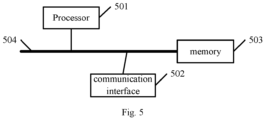
- An embodiment of the present application further provides an electronic device, as shown in Fig. 5 , comprising a processor 501, a communication interface 502, a memory 503, and a communication bus 504.
- the processor 501, the communication interface 502, and the memory 503 communicate with each other through the communication bus 504, the memory 503 is configured to store a computer program, and the processor 501 is configured to execute the program stored on the memory 503 to perform steps of: obtaining a to-be-processed image; extracting a target feature of a to-be-tracked human target in the to-be-processed image as a to-be-searched target feature; searching for an acquisition attribute corresponding to the to-be-searched target feature based on a pre-established correspondence between target features and acquisition attributes; wherein an acquisition attribute corresponding to one target feature in the correspondence is an acquisition attribute of an image containing the target feature, and the acquisition attribute contains an acquisition location; and determining a trajectory of the to-be-tracked human target based on the
- the processor 501 may be further configured to perform steps of: after obtaining the to-be-processed image, extracting a facial feature of the to-be-tracked human target in the to-be-processed image, as a to-be-searched facial feature; searching for an acquisition attribute corresponding to the to-be-searched facial feature based on a pre-established correspondence between facial features and acquisition attributes; wherein an acquisition attribute corresponding to one facial feature in the correspondence is an acquisition attribute of an image containing the facial feature.
- the processor 501 may be further configured to perform steps of: extracting a facial feature of the to-be-tracked human target in the to-be-processed image as a to-be-searched facial feature; the step of searching for an acquisition attribute corresponding to the to-be-searched target feature based on a pre-established correspondence between target features and acquisition attributes includes: searching for an acquisition attribute matching the to-be-searched target feature and the to-be-searched facial feature as the acquisition attribute corresponding to the to-be-searched target feature based on a pre-established correspondence among target features, facial features and acquisition attributes; wherein one pair of target feature and facial feature in the correspondence belongs to the same human target, and an acquisition feature corresponding to one pair of target feature and facial feature in the correspondence is an acquisition attribute of an image containing the target feature and the facial feature.
- the step of extracting a target feature of a to-be-tracked human target in the to-be-processed image as a to-be-searched target feature includes: extracting an original target feature of the to-be-tracked human target in the to-be-processed image, and calculating a hash value of the original target feature as a to-be-searched hash value; the step of searching for an acquisition attribute corresponding to the to-be-searched target feature based on a pre-established correspondence between target features and acquisition attributes includes: searching for an acquisition attribute corresponding to the to-be-searched hash value based on a pre-established correspondence between hash values and acquisition attributes.
- the step of searching for an acquisition attribute corresponding to the to-be-searched hash value based on a pre-established correspondence between hash values and acquisition attributes includes: calculating a similarity between each hash value included in the pre-established correspondence between hash values and acquisition attributes and the to-be-searched hash value, respectively; and determining an acquisition attribute corresponding to a hash value whose similarity with the to-be-searched hash value meets a preset condition.
- the processor 501 may be further configured to perform a step of: after obtaining the to-be-processed image, determining an acquisition attribute of the to-be-processed image as the to-be-searched acquisition attribute; the step of searching for an acquisition attribute corresponding to the to-be-searched target feature based on a pre-established correspondence between target features and acquisition attributes includes: searching the pre-established correspondence between target attributes and acquisition attributes for a target acquisition attribute whose difference from the to-be-searched acquisition attribute is less than a preset threshold, and a target feature corresponding to the target acquisition attribute as a to-be-matched target feature; determining whether the to-be-matched target feature matches the to-be-searched target feature; when the to-be-matched target feature matches the to-be-searched target feature, using the target acquisition attribute as the acquisition attribute corresponding to the to-be-searched target feature.
- the step of searching for an acquisition attribute corresponding to the to-be-searched target feature based on a pre-established correspondence between target features and acquisition attributes includes: searching the pre-established correspondence between target features and acquisition attributes for a target feature group matching the to-be-searched target feature; wherein the target feature group is composed of target features belonging to the same human target; and using an acquisition attribute corresponding to each target feature included in the target feature group as the acquisition attribute corresponding to the to-be-searched target feature.
- the acquisition attribute may further include acquisition time.
- the communication bus mentioned in the above electronic device may be a Peripheral Component Interconnect (PCI) bus or an Extended Industry Standard Architecture (EISA) bus.
- PCI Peripheral Component Interconnect
- EISA Extended Industry Standard Architecture
- the communication bus may be divided into an address bus, a data bus, a control bus, and the like. For convenience of representation, only a thick line is used in the figures to represent the communication bus, but it does not mean that there is only one bus or one type of bus.
- the communication interface is used for communication between the aforementioned electronic device and other devices.
- the memory may include Random Access Memory (RAM), and may also include Non-Volatile Memory (NVM), such as at least one disk memory.
- RAM Random Access Memory
- NVM Non-Volatile Memory
- the memory may also be at least one storage device located away from the foregoing processor.
- the above processor may be a general-purpose processor, including a central Processing Unit (CPU), a Network Processor (NP), and the like; it may also be a Digital Signal Processor (DSP), an Application Specific Integrated Circuit (ASIC), a Field-Programmable Gate Array (FPGA) or other programmable logic devices, discrete gate or transistor logic devices, discrete hardware components.
- CPU central Processing Unit
- NP Network Processor
- DSP Digital Signal Processor
- ASIC Application Specific Integrated Circuit
- FPGA Field-Programmable Gate Array
- a target feature of the to-be-tracked human target in the image is extracted as the to-be-searched target feature; the acquisition attribute corresponding to the to-be-searched target feature is searched for based on the pre-established correspondence between target features and acquisition attributes; and the trajectory of the to-be-tracked person is determined based on the found acquisition attribute.
- An exemplary implementation of the present application provides a computer-readable storage medium.
- the computer-readable storage medium stores a computer program, which is executed by a processor, so as to cause the processor to perform steps of: obtaining a to-be-processed image; extracting a target feature of a to-be-tracked human target in the to-be-processed image as a to-be-searched target feature; searching for an acquisition attribute corresponding to the to-be-searched target feature based on a pre-established correspondence between target features and acquisition attributes; wherein an acquisition attribute corresponding to one target feature in the correspondence is an acquisition attribute of an image containing the target feature, and the acquisition attribute contains an acquisition location; and determining a trajectory of the to-be-tracked human target based on the found acquisition attribute.
- the computer program may be executed by a processor, so as to cause the processor to perform steps of: after obtaining the to-be-processed image, extracting a facial feature of the to-be-tracked human target in the to-be-processed image, as a to-be-searched facial feature; searching for an acquisition attribute corresponding to the to-be-searched facial feature based on a pre-established correspondence between facial features and acquisition attributes; wherein an acquisition attribute corresponding to one facial feature in the correspondence is an acquisition attribute of an image containing the facial feature.
- the computer program may be executed by a processor, so as to cause the processor to perform a step of: extracting a facial feature of the to-be-tracked human target in the to-be-processed image as a to-be-searched facial feature; the step of searching for an acquisition attribute corresponding to the to-be-searched target feature based on a pre-established correspondence between target features and acquisition attributes includes: searching for an acquisition attribute matching the to-be-searched target feature and the to-be-searched facial feature as the acquisition attribute corresponding to the to-be-searched target feature based on a pre-established correspondence among target features, facial features and acquisition attributes; wherein one pair of target feature and facial feature in the correspondence belongs to the same human target, and an acquisition feature corresponding to one pair of target feature and facial feature in the correspondence is an acquisition attribute of an image containing the target feature and the facial feature.
- the step of extracting a target feature of a to-be-tracked human target in the to-be-processed image as a to-be-searched target feature includes: extracting an original target feature of the to-be-tracked human target in the to-be-processed image, and calculating a hash value of the original target feature as a to-be-searched hash value; the step of searching for an acquisition attribute corresponding to the to-be-searched target feature based on a pre-established correspondence between target features and acquisition attributes includes: searching for an acquisition attribute corresponding to the to-be-searched hash value based on a pre-established correspondence between hash values and acquisition attributes.
- the step of searching for an acquisition attribute corresponding to the to-be-searched hash value based on a pre-established correspondence between hash values and acquisition attributes includes: calculating a similarity between each hash value includes in the pre-established correspondence between hash values and acquisition attributes and the to-be-searched hash value, respectively; and determining an acquisition attribute corresponding to a hash value whose similarity with the to-be-searched hash value meets a preset condition.
- the computer program may be executed by a processor, so as to cause the processor to perform a step of: after obtaining the to-be-processed image, determining an acquisition attribute of the to-be-processed image as the to-be-searched acquisition attribute; the step of searching for an acquisition attribute corresponding to the to-be-searched target feature based on a pre-established correspondence between target features and acquisition attributes includes: searching the pre-established correspondence between target attributes and acquisition attributes for a target acquisition attribute whose difference from the to-be-searched acquisition attribute is less than a preset threshold, and a target feature corresponding to the target acquisition attribute as a to-be-matched target feature; determining whether the to-be-matched target feature matches the to-be-searched target feature; when the to-be-matched target feature matches the to-be-searched target feature, using the target acquisition attribute as the acquisition attribute corresponding to the to-be-searched target feature.
- the step of searching for an acquisition attribute corresponding to the to-be-searched target feature based on a pre-established correspondence between target features and acquisition attributes includes: searching the pre-established correspondence between target features and acquisition attributes for a target feature group matching the to-be-searched target feature; wherein the target feature group is composed of target features belonging to the same human target; and using an acquisition attribute corresponding to each target feature included in the target feature group as the acquisition attribute corresponding to the to-be-searched target feature.
- the acquisition attribute may further include acquisition time.
- An exemplary implementation of the present application further discloses an executable program code, wherein the executable program code is executed to implement any one of the methods for determining a trajectory of a human target described above.
Landscapes
- Engineering & Computer Science (AREA)
- Theoretical Computer Science (AREA)
- General Physics & Mathematics (AREA)
- Physics & Mathematics (AREA)
- Multimedia (AREA)
- Computer Vision & Pattern Recognition (AREA)
- Health & Medical Sciences (AREA)
- Oral & Maxillofacial Surgery (AREA)
- General Health & Medical Sciences (AREA)
- Human Computer Interaction (AREA)
- Data Mining & Analysis (AREA)
- Evolutionary Computation (AREA)
- Artificial Intelligence (AREA)
- Bioinformatics & Cheminformatics (AREA)
- Life Sciences & Earth Sciences (AREA)
- Bioinformatics & Computational Biology (AREA)
- Evolutionary Biology (AREA)
- General Engineering & Computer Science (AREA)
- Medical Informatics (AREA)
- Software Systems (AREA)
- Databases & Information Systems (AREA)
- Computing Systems (AREA)
- Image Analysis (AREA)
- Collating Specific Patterns (AREA)
Claims (12)
- Procédé de détermination d'une trajectoire d'une cible humaine, comprenant :l'obtention d'une image à traiter ;l'extraction d'une caractéristique cible d'une cible humaine à suivre dans l'image à traiter en tant que caractéristique cible à rechercher, dans lequel la caractéristique cible est une caractéristique non faciale ;la recherche d'attributs d'acquisition correspondant à la caractéristique cible à rechercher sur la base d'un tableau de correspondances établies et stockées entre des caractéristiques cibles et des attributs d'acquisition en fonction de l'ordre de moment de réception ; dans lequel un attribut d'acquisition correspondant à une caractéristique cible dans les correspondances est un attribut d'acquisition d'une image contenant la caractéristique cible, et l'attribut d'acquisition contient un emplacement d'acquisition ou un emplacement d'acquisition et un moment d'acquisition de l'image, dans lequel les caractéristiques cibles dans les correspondances sont extraites d'images incluant des cibles humaines ; les images sont capturées par des dispositifs d'acquisition en communication avec un même serveur, dans lequel les correspondances sont stockées dans une base de données locale du serveur ou dans une base de données connectée au serveur ; etla détermination d'une trajectoire de la cible humaine à suivre sur la base des attributs d'acquisition trouvés et soit de leur moment d'acquisition soit de leur ordre dans les correspondances stockées,dans lequel, lorsque l'attribut d'acquisition contient l'emplacement d'acquisition, la correspondance est établie par le serveur effectuant des opérations de : réception des images capturées envoyées en temps réel par les dispositifs d'acquisition ; extraction de caractéristiques cibles de cibles humaines dans les images reçues ; stockage des caractéristiques cibles des images dans l'ordre du moment de réception ; détermination de l'emplacement d'acquisition de chacune des images reçues et établissement de la correspondance entre l'emplacement d'acquisition et la caractéristique cible de la même image ; oudans lequel, lorsque l'attribut d'acquisition contient l'emplacement d'acquisition et le moment d'acquisition, la correspondance est établie par le serveur effectuant des opérations de : réception des images capturées envoyées en temps réel par les dispositifs d'acquisition ; extraction de caractéristiques cibles de cibles humaines dans les images reçues; détermination du moment d'acquisition et de l'emplacement d'acquisition de chacune des images reçues ; et établissement de la correspondance entre l'emplacement d'acquisition, le moment d'acquisition et la caractéristique cible de la même image.
- Procédé selon la revendication 1, dans lequel, après obtention de l'image à traiter, le procédé comprend en outre :l'extraction d'une caractéristique faciale de la cible humaine à suivre dans l'image à traiter en tant que caractéristique faciale à rechercher ;l'étape de recherche d'attributs d'acquisition correspondant à la caractéristique cible à rechercher sur la base d'un tableau de correspondances établies et stockées entre des caractéristiques cibles et des attributs d'acquisition en fonction de l'ordre de moment de réception comprend :
la recherche d'attributs d'acquisition associés à la caractéristique cible à rechercher et à la caractéristique faciale à rechercher en tant qu'attributs d'acquisition correspondant à la caractéristique cible à rechercher sur la base d'un tableau de correspondances établies et stockées entre les caractéristiques cibles, caractéristiques faciales et attributs d'acquisition ; dans lequel une paire de caractéristique cible et de caractéristique faciale dans les correspondances appartient à la même cible humaine, et un attribut d'acquisition correspondant à une paire de caractéristique cible et de caractéristique faciale dans les correspondances est un attribut d'acquisition d'une image contenant la caractéristique cible et la caractéristique faciale ; la correspondance entre les caractéristiques cibles, caractéristiques faciales et attributs d'acquisition est établie par des opérations de : obtention d'images capturées par les dispositifs d'acquisition et d'attributs d'acquisition correspondant aux images ; pour chacune des images obtenues, extraction d'une caractéristique cible et d'une caractéristique faciale de chaque cible humaine dans l'image ; et établissement d'une correspondance entre les caractéristiques cibles, les caractéristiques faciales et les attributs d'acquisition. - Procédé selon la revendication 1, dans lequel l'étape d'extraction d'une caractéristique cible d'une cible humaine à suivre dans l'image à traiter en tant que caractéristique cible à rechercher comprend :l'extraction d'une caractéristique cible d'origine de la cible humaine à suivre dans l'image à traiter, et le calcul d'une valeur de hachage de la caractéristique cible d'origine en tant que valeur de hachage à rechercher ;l'étape de recherche d'attributs d'acquisition correspondant à la caractéristique cible à rechercher sur la base d'un tableau de correspondances établies et stockées entre des caractéristiques cibles et des attributs d'acquisition en fonction de l'ordre de moment de réception comprend :
la recherche d'attributs d'acquisition correspondant à la valeur de hachage à rechercher sur la base d'un tableau de correspondances établies et stockées entre les valeurs de hachage et les attributs d'acquisition. - Procédé selon la revendication 3, dans lequel l'étape de recherche d'attributs d'acquisition correspondant à la valeur de hachage à rechercher sur la base d'un tableau de correspondances établies et stockées entre les valeurs de hachage et les attributs d'acquisition comprend :le calcul d'une similarité entre chaque valeur de hachage comprise dans le tableau de correspondances établies et stockées entre les valeurs de hachage et les attributs d'acquisition et la valeur de hachage à rechercher, respectivement ; etla détermination d'un attribut d'acquisition correspondant à une valeur de hachage dont la similarité avec la valeur de hachage à rechercher répond à une condition prédéfinie.
- Procédé selon la revendication 1, dans lequel, après obtention de l'image à traiter, le procédé comprend en outre :la détermination d'un attribut d'acquisition de l'image à traiter en tant qu'attribut d'acquisition à rechercher ;l'étape de recherche d'attributs d'acquisition correspondant à la caractéristique cible à rechercher sur la base d'un tableau de correspondances établies et stockées entre des caractéristiques cibles et des attributs d'acquisition en fonction de l'ordre de moment de réception comprend :la recherche, dans le tableau de correspondances établies et stockées entre des attributs cibles et des attributs d'acquisition, d'un attribut d'acquisition cible dont la différence par rapport à l'attribut d'acquisition à rechercher est inférieure à un seuil prédéfini, et d'une caractéristique cible correspondant à l'attribut d'acquisition cible en tant que caractéristique cible à associer ;le fait de déterminer si la caractéristique cible à associer est associée à la caractéristique cible à rechercher ;lorsque la caractéristique cible à associer est associée à la caractéristique cible à rechercher, l'utilisation de l'attribut d'acquisition cible en tant qu'attribut d'acquisition correspondant à la caractéristique cible à rechercher.
- Procédé selon la revendication 1, dans lequel l'étape de recherche d'attributs d'acquisition correspondant à la caractéristique cible à rechercher sur la base d'un tableau de correspondances établies et stockées entre les caractéristiques cibles et les attributs d'acquisition en fonction de l'ordre de moment de réception comprend :la recherche, dans le tableau de correspondances établies et stockées entre les caractéristiques cibles et les attributs d'acquisition, d'un groupe de caractéristiques cibles associé à la caractéristique cible à rechercher ; dans lequel le groupe de caractéristiques cibles est composé de caractéristiques cibles appartenant à la même cible humaine ; etl'utilisation d'un attribut d'acquisition correspondant à chaque caractéristique cible comprise dans le groupe de caractéristiques cibles en tant qu'attribut d'acquisition correspondant à la caractéristique cible à rechercher.
- Appareil de détermination d'une trajectoire d'une cible humaine, comprenant :un module d'obtention, configuré pour obtenir une image à traiter ;un premier module d'extraction, configuré pour extraire une caractéristique cible d'une cible humaine à suivre dans l'image à traiter en tant que caractéristique cible à rechercher, dans lequel la caractéristique cible est une caractéristique non faciale ;un premier module de recherche, configuré pour rechercher des attributs d'acquisition correspondant à la caractéristique cible à rechercher sur la base d'un tableau de correspondances établies et stockées entre des caractéristiques cibles et des attributs d'acquisition en fonction de l'ordre de moment de réception ; dans lequel un attribut d'acquisition correspondant à une caractéristique cible dans les correspondances est un attribut d'acquisition d'une image contenant la caractéristique cible, et l'attribut d'acquisition contient un emplacement d'acquisition ou un emplacement d'acquisition et un moment d'acquisition de l'image, dans lequel les caractéristiques cibles dans les correspondances sont extraites d'images incluant des cibles humaines ; les images sont capturées par des dispositifs d'acquisition en communication avec un même serveur, dans lequel les correspondances sont stockées dans une base de données locale du serveur ou dans une base de données connectée au serveur ; etun premier module de détermination, configuré pour déterminer une trajectoire de la cible humaine à suivre sur la base des attributs d'acquisition trouvés et soit de leur moment d'acquisition soit de leur ordre dans les correspondances stockées,dans lequel, lorsque l'attribut d'acquisition contient l'emplacement d'acquisition, la correspondance est établie par le serveur effectuant des opérations de : réception des images capturées envoyées en temps réel par les dispositifs d'acquisition ; extraction de caractéristiques cibles de cibles humaines dans les images reçues ; stockage des caractéristiques cibles des images dans l'ordre du moment de réception ; détermination de l'emplacement d'acquisition de chacune des images reçues et établissement de la correspondance entre l'emplacement d'acquisition et la caractéristique cible de la même image ; oudans lequel, lorsque l'attribut d'acquisition contient l'emplacement d'acquisition et le moment d'acquisition, la correspondance est établie par le serveur effectuant des opérations de : réception des images capturées envoyées en temps réel par les dispositifs d'acquisition ; extraction de caractéristiques cibles de cibles humaines dans les images reçues; détermination du moment d'acquisition et de l'emplacement d'acquisition de chacune des images reçues ; et établissement de la correspondance entre l'emplacement d'acquisition, le moment d'acquisition et la caractéristique cible de la même image.
- Appareil selon la revendication 7, comprenant en outre :un troisième module d'extraction, configuré pour extraire une caractéristique faciale de la cible humaine à suivre dans l'image à traiter en tant que caractéristique faciale à rechercher ;le premier module de recherche est en outre configuré pour :
rechercher des attributs d'acquisition associés à la caractéristique cible à rechercher et à la caractéristique faciale à rechercher en tant qu'attribut d'acquisition correspondant à la caractéristique cible à rechercher sur la base d'un tableau de correspondances établies et stockées entre les caractéristiques cibles, caractéristiques faciales et attributs d'acquisition ; dans lequel une paire de caractéristique cible et de caractéristique faciale dans les correspondances appartient à la même cible humaine, et un attribut d'acquisition correspondant à une paire de caractéristique cible et de caractéristique faciale dans les correspondances est un attribut d'acquisition d'une image contenant la caractéristique cible et la caractéristique faciale ; la correspondance entre les caractéristiques cibles, caractéristiques faciales et attributs d'acquisition est établie par des opérations de : obtention d'images capturées par les dispositifs d'acquisition et d'attributs d'acquisition correspondant aux images ; pour chacune des images obtenues, extraction d'une caractéristique cible et d'une caractéristique faciale de chaque cible humaine dans l'image ; et établissement d'une correspondance entre les caractéristiques cibles, les caractéristiques faciales et les attributs d'acquisition. - Appareil selon la revendication 7, dans lequel, le premier module d'extraction est en outre configuré pour :extraire une caractéristique cible d'origine de la cible humaine à suivre dans l'image à traiter, et calculer une valeur de hachage de la caractéristique cible d'origine en tant que valeur de hachage à rechercher ;le premier module de recherche est en outre configuré pour :
rechercher des attributs d'acquisition correspondant à la valeur de hachage à rechercher sur la base d'un tableau de correspondances établies et stockées entre les valeurs de hachage et les attributs d'acquisition. - Appareil selon la revendication 9, dans lequel, le premier module de recherche est en outre configuré pour calculer une similarité entre chaque valeur de hachage comprise dans le tableau de correspondances établies et stockées entre les valeurs de hachage et les attributs d'acquisition et la valeur de hachage à rechercher, respectivement ; et
déterminer un attribut d'acquisition correspondant à une valeur de hachage dont la similarité avec la valeur de hachage à rechercher répond à une condition prédéfinie. - Appareil selon la revendication 7, comprenant en outre :un deuxième module de détermination, configuré pour déterminer un attribut d'acquisition de l'image à traiter en tant qu'attribut d'acquisition à rechercher ;le premier module de recherche est en outre configuré pour :rechercher, dans le tableau de correspondances établies et stockées entre des attributs cibles et des attributs d'acquisition, un attribut d'acquisition cible dont la différence par rapport à l'attribut d'acquisition à rechercher est inférieure à un seuil prédéfini, et une caractéristique cible correspondant à l'attribut d'acquisition cible en tant que caractéristique cible à associer ;déterminer si la caractéristique cible à associer est associée à la caractéristique cible à rechercher ;lorsque la caractéristique cible à associer est associée à la caractéristique cible à rechercher, utiliser l'attribut d'acquisition cible en tant qu'attribut d'acquisition correspondant à la caractéristique cible à rechercher.
- Appareil selon la revendication 7, dans lequel, le premier module de recherche est en outre configuré pour :rechercher, dans le tableau de correspondances établies et stockées entre les caractéristiques cibles et les attributs d'acquisition, un groupe de caractéristiques cibles associé à la caractéristique cible à rechercher ; dans lequel le groupe de caractéristiques cibles est composé de caractéristiques cibles appartenant à la même cible humaine ; etutiliser un attribut d'acquisition correspondant à chaque caractéristique cible comprise dans le groupe de caractéristiques cibles en tant qu'attribut d'acquisition correspondant à la caractéristique cible à rechercher ;ou, dans lequel, l'attribut d'acquisition comprend en outre un moment d'acquisition.
Applications Claiming Priority (2)
| Application Number | Priority Date | Filing Date | Title |
|---|---|---|---|
| CN201710770254.5A CN109426787A (zh) | 2017-08-31 | 2017-08-31 | 一种人体目标轨迹确定方法及装置 |
| PCT/CN2018/101666 WO2019042196A1 (fr) | 2017-08-31 | 2018-08-22 | Procédé et dispositif de détermination de trajet de cible humaine |
Publications (3)
| Publication Number | Publication Date |
|---|---|
| EP3678057A1 EP3678057A1 (fr) | 2020-07-08 |
| EP3678057A4 EP3678057A4 (fr) | 2020-07-29 |
| EP3678057B1 true EP3678057B1 (fr) | 2023-06-28 |
Family
ID=65504644
Family Applications (1)
| Application Number | Title | Priority Date | Filing Date |
|---|---|---|---|
| EP18852621.4A Active EP3678057B1 (fr) | 2017-08-31 | 2018-08-22 | Procédé et dispositif de détermination de trajet de cible humaine |
Country Status (4)
| Country | Link |
|---|---|
| US (1) | US11157720B2 (fr) |
| EP (1) | EP3678057B1 (fr) |
| CN (1) | CN109426787A (fr) |
| WO (1) | WO2019042196A1 (fr) |
Families Citing this family (13)
| Publication number | Priority date | Publication date | Assignee | Title |
|---|---|---|---|---|
| SG10201807675TA (en) * | 2018-09-06 | 2020-04-29 | Nec Asia Pacific Pte Ltd | Duration and Potential Region of Interest for Suspicious Activities |
| CN109376256B (zh) * | 2018-09-29 | 2021-03-26 | 京东方科技集团股份有限公司 | 图像搜索方法及装置 |
| JP7207431B2 (ja) * | 2018-12-27 | 2023-01-18 | 日本電気株式会社 | 情報処理システム、情報処理装置、情報処理方法、およびプログラム |
| CN110418076A (zh) * | 2019-08-02 | 2019-11-05 | 新华智云科技有限公司 | 视频集锦生成方法、装置、电子设备及存储介质 |
| CN110942003A (zh) * | 2019-11-20 | 2020-03-31 | 中国建设银行股份有限公司 | 人员轨迹搜索方法及系统 |
| CN112861575A (zh) * | 2019-11-27 | 2021-05-28 | 中兴通讯股份有限公司 | 一种行人结构化方法、装置、设备和存储介质 |
| US11361189B2 (en) * | 2019-12-03 | 2022-06-14 | Ping An Technology (Shenzhen) Co., Ltd. | Image generation method and computing device |
| CN112541384B (zh) * | 2020-07-30 | 2023-04-28 | 深圳市商汤科技有限公司 | 可疑对象查找方法及装置、电子设备及存储介质 |
| CN112033454B (zh) * | 2020-08-28 | 2022-07-12 | 杭州海康威视数字技术股份有限公司 | 轨迹数据处理方法和装置 |
| CN111898592B (zh) * | 2020-09-29 | 2020-12-29 | 腾讯科技(深圳)有限公司 | 一种轨迹数据处理方法、装置以及计算机可读存储介质 |
| CN112232210B (zh) * | 2020-10-16 | 2024-06-28 | 京东方科技集团股份有限公司 | 一种人员流量分析方法和系统、电子设备和可读存储介质 |
| CN113158953B (zh) * | 2021-04-30 | 2022-11-25 | 青岛海信智慧生活科技股份有限公司 | 一种人员查找方法、装置、设备及介质 |
| KR102465437B1 (ko) * | 2022-05-30 | 2022-11-10 | (주)이앤제너텍 | 인공지능 기반 객체 추적 장치 및 방법 |
Family Cites Families (11)
| Publication number | Priority date | Publication date | Assignee | Title |
|---|---|---|---|---|
| GB2418312A (en) * | 2004-09-18 | 2006-03-22 | Hewlett Packard Development Co | Wide area tracking system |
| WO2011046128A1 (fr) | 2009-10-16 | 2011-04-21 | 日本電気株式会社 | Dispositif d'extraction d'élément de vêtement, dispositif d'extraction de personne, et procédé de traitement associé |
| US20110317010A1 (en) | 2010-06-24 | 2011-12-29 | Infosys Technologies Limited | System and method for tracking a person in a pre-defined area |
| CN104794458A (zh) * | 2015-05-07 | 2015-07-22 | 北京丰华联合科技有限公司 | 一种从模糊视频中识别人员的方法 |
| CN104881637B (zh) | 2015-05-09 | 2018-06-19 | 广东顺德中山大学卡内基梅隆大学国际联合研究院 | 基于传感信息及目标追踪的多模信息系统及其融合方法 |
| CN105447466B (zh) * | 2015-12-01 | 2019-07-23 | 深圳市图灵机器人有限公司 | 一种基于Kinect传感器的身份综合识别方法 |
| CN105808709B (zh) * | 2016-03-04 | 2019-10-29 | 智慧眼科技股份有限公司 | 人脸识别快速检索方法及装置 |
| CN106650652A (zh) * | 2016-12-14 | 2017-05-10 | 黄先开 | 基于人脸识别技术的轨迹跟踪系统及其方法 |
| CN106599866B (zh) * | 2016-12-22 | 2020-06-02 | 上海百芝龙网络科技有限公司 | 一种多维度用户身份识别方法 |
| CN106874347B (zh) * | 2016-12-26 | 2020-12-01 | 深圳市深网视界科技有限公司 | 一种匹配人体特征与mac地址的方法及系统 |
| CN107016374A (zh) * | 2017-04-12 | 2017-08-04 | 电子科技大学 | 面向特定目标的智能检测追踪及时空轨迹的生成方法 |
-
2017
- 2017-08-31 CN CN201710770254.5A patent/CN109426787A/zh active Pending
-
2018
- 2018-08-22 US US16/643,373 patent/US11157720B2/en active Active
- 2018-08-22 WO PCT/CN2018/101666 patent/WO2019042196A1/fr not_active Ceased
- 2018-08-22 EP EP18852621.4A patent/EP3678057B1/fr active Active
Also Published As
| Publication number | Publication date |
|---|---|
| EP3678057A4 (fr) | 2020-07-29 |
| CN109426787A (zh) | 2019-03-05 |
| US11157720B2 (en) | 2021-10-26 |
| US20200257890A1 (en) | 2020-08-13 |
| WO2019042196A1 (fr) | 2019-03-07 |
| EP3678057A1 (fr) | 2020-07-08 |
Similar Documents
| Publication | Publication Date | Title |
|---|---|---|
| EP3678057B1 (fr) | Procédé et dispositif de détermination de trajet de cible humaine | |
| US11126828B2 (en) | Method and device for recognizing identity of human target | |
| CN108985199B (zh) | 商品取放操作的检测方法、装置及存储介质 | |
| US11393103B2 (en) | Target tracking method, device, system and non-transitory computer readable medium | |
| CN109635657B (zh) | 目标跟踪方法、装置、设备及存储介质 | |
| CN111512317B (zh) | 一种多目标实时跟踪方法、装置及电子设备 | |
| US20220301317A1 (en) | Method and device for constructing object motion trajectory, and computer storage medium | |
| US11354883B2 (en) | Image processing method and apparatus, and electronic device | |
| EP3648448A1 (fr) | Procédé et dispositif d'extraction de caractéristiques de cible, et système d'application | |
| CN104376575B (zh) | 一种基于多摄像头监控的行人计数方法和装置 | |
| CN108960211A (zh) | 一种多目标人体姿态检测方法以及系统 | |
| CN112232148A (zh) | 图像聚类、目标轨迹追踪方法、电子设备及存储介质 | |
| CN109255802B (zh) | 行人跟踪方法、装置、计算机设备及存储介质 | |
| EP3531340B1 (fr) | Procédé, appareil et dispositif de suivi du corps humain et support de stockage | |
| CN106228121B (zh) | 手势特征识别方法和装置 | |
| CN114048344A (zh) | 一种相似人脸搜索方法、装置、设备和可读存储介质 | |
| US11074696B2 (en) | Image processing device, image processing method, and recording medium storing program | |
| CN112733650B (zh) | 目标人脸检测方法、装置、终端设备及存储介质 | |
| CN111429476A (zh) | 确定目标人物行动轨迹的方法和装置 | |
| CN115018886B (zh) | 运动轨迹识别方法、装置、设备及介质 | |
| Cokbas et al. | Spatio-visual fusion-based person re-identification for overhead fisheye images | |
| JP2022534314A (ja) | ピクチャに基づいた多次元情報の統合方法及び関連機器 | |
| KR20160148806A (ko) | 방향정보를 이용한 객체 검출기 생성 방법, 이를 이용한 객체 검출 장치 및 방법 | |
| CN115115675A (zh) | 遗留物检测的方法、电子设备、计算机可读介质 | |
| Wu et al. | A new personnel identification and position estimation algorithm using binocular camera |
Legal Events
| Date | Code | Title | Description |
|---|---|---|---|
| STAA | Information on the status of an ep patent application or granted ep patent |
Free format text: STATUS: THE INTERNATIONAL PUBLICATION HAS BEEN MADE |
|
| PUAI | Public reference made under article 153(3) epc to a published international application that has entered the european phase |
Free format text: ORIGINAL CODE: 0009012 |
|
| STAA | Information on the status of an ep patent application or granted ep patent |
Free format text: STATUS: REQUEST FOR EXAMINATION WAS MADE |
|
| 17P | Request for examination filed |
Effective date: 20200316 |
|
| AK | Designated contracting states |
Kind code of ref document: A1 Designated state(s): AL AT BE BG CH CY CZ DE DK EE ES FI FR GB GR HR HU IE IS IT LI LT LU LV MC MK MT NL NO PL PT RO RS SE SI SK SM TR |
|
| AX | Request for extension of the european patent |
Extension state: BA ME |
|
| A4 | Supplementary search report drawn up and despatched |
Effective date: 20200701 |
|
| RIC1 | Information provided on ipc code assigned before grant |
Ipc: G06K 9/00 20060101ALI20200625BHEP Ipc: G06K 9/62 20060101AFI20200625BHEP |
|
| DAV | Request for validation of the european patent (deleted) | ||
| DAX | Request for extension of the european patent (deleted) | ||
| STAA | Information on the status of an ep patent application or granted ep patent |
Free format text: STATUS: EXAMINATION IS IN PROGRESS |
|
| 17Q | First examination report despatched |
Effective date: 20210218 |
|
| REG | Reference to a national code |
Ref legal event code: R079 Ref country code: DE Ref legal event code: R079 Ref document number: 602018052590 Country of ref document: DE Free format text: PREVIOUS MAIN CLASS: G06K0009620000 Ipc: G06V0010750000 |
|
| GRAP | Despatch of communication of intention to grant a patent |
Free format text: ORIGINAL CODE: EPIDOSNIGR1 |
|
| STAA | Information on the status of an ep patent application or granted ep patent |
Free format text: STATUS: GRANT OF PATENT IS INTENDED |
|
| RIC1 | Information provided on ipc code assigned before grant |
Ipc: G06F 18/22 20230101ALI20230126BHEP Ipc: G06V 40/16 20220101ALI20230126BHEP Ipc: G06V 20/52 20220101ALI20230126BHEP Ipc: G06V 10/75 20220101AFI20230126BHEP |
|
| INTG | Intention to grant announced |
Effective date: 20230215 |
|
| GRAS | Grant fee paid |
Free format text: ORIGINAL CODE: EPIDOSNIGR3 |
|
| GRAA | (expected) grant |
Free format text: ORIGINAL CODE: 0009210 |
|
| STAA | Information on the status of an ep patent application or granted ep patent |
Free format text: STATUS: THE PATENT HAS BEEN GRANTED |
|
| AK | Designated contracting states |
Kind code of ref document: B1 Designated state(s): AL AT BE BG CH CY CZ DE DK EE ES FI FR GB GR HR HU IE IS IT LI LT LU LV MC MK MT NL NO PL PT RO RS SE SI SK SM TR |
|
| REG | Reference to a national code |
Ref country code: CH Ref legal event code: EP |
|
| REG | Reference to a national code |
Ref country code: AT Ref legal event code: REF Ref document number: 1583402 Country of ref document: AT Kind code of ref document: T Effective date: 20230715 |
|
| REG | Reference to a national code |
Ref country code: IE Ref legal event code: FG4D |
|
| REG | Reference to a national code |
Ref country code: DE Ref legal event code: R096 Ref document number: 602018052590 Country of ref document: DE |
|
| REG | Reference to a national code |
Ref country code: LT Ref legal event code: MG9D |
|
| PG25 | Lapsed in a contracting state [announced via postgrant information from national office to epo] |
Ref country code: SE Free format text: LAPSE BECAUSE OF FAILURE TO SUBMIT A TRANSLATION OF THE DESCRIPTION OR TO PAY THE FEE WITHIN THE PRESCRIBED TIME-LIMIT Effective date: 20230628 Ref country code: NO Free format text: LAPSE BECAUSE OF FAILURE TO SUBMIT A TRANSLATION OF THE DESCRIPTION OR TO PAY THE FEE WITHIN THE PRESCRIBED TIME-LIMIT Effective date: 20230928 |
|
| REG | Reference to a national code |
Ref country code: NL Ref legal event code: MP Effective date: 20230628 |
|
| REG | Reference to a national code |
Ref country code: AT Ref legal event code: MK05 Ref document number: 1583402 Country of ref document: AT Kind code of ref document: T Effective date: 20230628 |
|
| PG25 | Lapsed in a contracting state [announced via postgrant information from national office to epo] |
Ref country code: RS Free format text: LAPSE BECAUSE OF FAILURE TO SUBMIT A TRANSLATION OF THE DESCRIPTION OR TO PAY THE FEE WITHIN THE PRESCRIBED TIME-LIMIT Effective date: 20230628 Ref country code: NL Free format text: LAPSE BECAUSE OF FAILURE TO SUBMIT A TRANSLATION OF THE DESCRIPTION OR TO PAY THE FEE WITHIN THE PRESCRIBED TIME-LIMIT Effective date: 20230628 Ref country code: LV Free format text: LAPSE BECAUSE OF FAILURE TO SUBMIT A TRANSLATION OF THE DESCRIPTION OR TO PAY THE FEE WITHIN THE PRESCRIBED TIME-LIMIT Effective date: 20230628 Ref country code: LT Free format text: LAPSE BECAUSE OF FAILURE TO SUBMIT A TRANSLATION OF THE DESCRIPTION OR TO PAY THE FEE WITHIN THE PRESCRIBED TIME-LIMIT Effective date: 20230628 Ref country code: HR Free format text: LAPSE BECAUSE OF FAILURE TO SUBMIT A TRANSLATION OF THE DESCRIPTION OR TO PAY THE FEE WITHIN THE PRESCRIBED TIME-LIMIT Effective date: 20230628 Ref country code: GR Free format text: LAPSE BECAUSE OF FAILURE TO SUBMIT A TRANSLATION OF THE DESCRIPTION OR TO PAY THE FEE WITHIN THE PRESCRIBED TIME-LIMIT Effective date: 20230929 |
|
| PG25 | Lapsed in a contracting state [announced via postgrant information from national office to epo] |
Ref country code: FI Free format text: LAPSE BECAUSE OF FAILURE TO SUBMIT A TRANSLATION OF THE DESCRIPTION OR TO PAY THE FEE WITHIN THE PRESCRIBED TIME-LIMIT Effective date: 20230628 |
|
| PG25 | Lapsed in a contracting state [announced via postgrant information from national office to epo] |
Ref country code: SK Free format text: LAPSE BECAUSE OF FAILURE TO SUBMIT A TRANSLATION OF THE DESCRIPTION OR TO PAY THE FEE WITHIN THE PRESCRIBED TIME-LIMIT Effective date: 20230628 |
|
| PG25 | Lapsed in a contracting state [announced via postgrant information from national office to epo] |
Ref country code: ES Free format text: LAPSE BECAUSE OF FAILURE TO SUBMIT A TRANSLATION OF THE DESCRIPTION OR TO PAY THE FEE WITHIN THE PRESCRIBED TIME-LIMIT Effective date: 20230628 |
|
| PG25 | Lapsed in a contracting state [announced via postgrant information from national office to epo] |
Ref country code: IS Free format text: LAPSE BECAUSE OF FAILURE TO SUBMIT A TRANSLATION OF THE DESCRIPTION OR TO PAY THE FEE WITHIN THE PRESCRIBED TIME-LIMIT Effective date: 20231028 |
|
| PG25 | Lapsed in a contracting state [announced via postgrant information from national office to epo] |
Ref country code: SM Free format text: LAPSE BECAUSE OF FAILURE TO SUBMIT A TRANSLATION OF THE DESCRIPTION OR TO PAY THE FEE WITHIN THE PRESCRIBED TIME-LIMIT Effective date: 20230628 Ref country code: SK Free format text: LAPSE BECAUSE OF FAILURE TO SUBMIT A TRANSLATION OF THE DESCRIPTION OR TO PAY THE FEE WITHIN THE PRESCRIBED TIME-LIMIT Effective date: 20230628 Ref country code: RO Free format text: LAPSE BECAUSE OF FAILURE TO SUBMIT A TRANSLATION OF THE DESCRIPTION OR TO PAY THE FEE WITHIN THE PRESCRIBED TIME-LIMIT Effective date: 20230628 Ref country code: PT Free format text: LAPSE BECAUSE OF FAILURE TO SUBMIT A TRANSLATION OF THE DESCRIPTION OR TO PAY THE FEE WITHIN THE PRESCRIBED TIME-LIMIT Effective date: 20231030 Ref country code: IS Free format text: LAPSE BECAUSE OF FAILURE TO SUBMIT A TRANSLATION OF THE DESCRIPTION OR TO PAY THE FEE WITHIN THE PRESCRIBED TIME-LIMIT Effective date: 20231028 Ref country code: ES Free format text: LAPSE BECAUSE OF FAILURE TO SUBMIT A TRANSLATION OF THE DESCRIPTION OR TO PAY THE FEE WITHIN THE PRESCRIBED TIME-LIMIT Effective date: 20230628 Ref country code: EE Free format text: LAPSE BECAUSE OF FAILURE TO SUBMIT A TRANSLATION OF THE DESCRIPTION OR TO PAY THE FEE WITHIN THE PRESCRIBED TIME-LIMIT Effective date: 20230628 Ref country code: CZ Free format text: LAPSE BECAUSE OF FAILURE TO SUBMIT A TRANSLATION OF THE DESCRIPTION OR TO PAY THE FEE WITHIN THE PRESCRIBED TIME-LIMIT Effective date: 20230628 Ref country code: AT Free format text: LAPSE BECAUSE OF FAILURE TO SUBMIT A TRANSLATION OF THE DESCRIPTION OR TO PAY THE FEE WITHIN THE PRESCRIBED TIME-LIMIT Effective date: 20230628 |
|
| P01 | Opt-out of the competence of the unified patent court (upc) registered |
Effective date: 20240109 |
|
| PG25 | Lapsed in a contracting state [announced via postgrant information from national office to epo] |
Ref country code: PL Free format text: LAPSE BECAUSE OF FAILURE TO SUBMIT A TRANSLATION OF THE DESCRIPTION OR TO PAY THE FEE WITHIN THE PRESCRIBED TIME-LIMIT Effective date: 20230628 |
|
| PG25 | Lapsed in a contracting state [announced via postgrant information from national office to epo] |
Ref country code: MC Free format text: LAPSE BECAUSE OF FAILURE TO SUBMIT A TRANSLATION OF THE DESCRIPTION OR TO PAY THE FEE WITHIN THE PRESCRIBED TIME-LIMIT Effective date: 20230628 |
|
| REG | Reference to a national code |
Ref country code: CH Ref legal event code: PL |
|
| PG25 | Lapsed in a contracting state [announced via postgrant information from national office to epo] |
Ref country code: MC Free format text: LAPSE BECAUSE OF FAILURE TO SUBMIT A TRANSLATION OF THE DESCRIPTION OR TO PAY THE FEE WITHIN THE PRESCRIBED TIME-LIMIT Effective date: 20230628 |
|
| REG | Reference to a national code |
Ref country code: DE Ref legal event code: R097 Ref document number: 602018052590 Country of ref document: DE |
|
| PG25 | Lapsed in a contracting state [announced via postgrant information from national office to epo] |
Ref country code: LU Free format text: LAPSE BECAUSE OF NON-PAYMENT OF DUE FEES Effective date: 20230822 |
|
| PG25 | Lapsed in a contracting state [announced via postgrant information from national office to epo] |
Ref country code: LU Free format text: LAPSE BECAUSE OF NON-PAYMENT OF DUE FEES Effective date: 20230822 Ref country code: DK Free format text: LAPSE BECAUSE OF FAILURE TO SUBMIT A TRANSLATION OF THE DESCRIPTION OR TO PAY THE FEE WITHIN THE PRESCRIBED TIME-LIMIT Effective date: 20230628 Ref country code: CH Free format text: LAPSE BECAUSE OF NON-PAYMENT OF DUE FEES Effective date: 20230831 |
|
| PLBE | No opposition filed within time limit |
Free format text: ORIGINAL CODE: 0009261 |
|
| STAA | Information on the status of an ep patent application or granted ep patent |
Free format text: STATUS: NO OPPOSITION FILED WITHIN TIME LIMIT |
|
| REG | Reference to a national code |
Ref country code: BE Ref legal event code: MM Effective date: 20230831 |
|
| REG | Reference to a national code |
Ref country code: IE Ref legal event code: MM4A |
|
| PG25 | Lapsed in a contracting state [announced via postgrant information from national office to epo] |
Ref country code: IT Free format text: LAPSE BECAUSE OF FAILURE TO SUBMIT A TRANSLATION OF THE DESCRIPTION OR TO PAY THE FEE WITHIN THE PRESCRIBED TIME-LIMIT Effective date: 20230628 |
|
| 26N | No opposition filed |
Effective date: 20240402 |
|
| PG25 | Lapsed in a contracting state [announced via postgrant information from national office to epo] |
Ref country code: IE Free format text: LAPSE BECAUSE OF NON-PAYMENT OF DUE FEES Effective date: 20230822 |
|
| PG25 | Lapsed in a contracting state [announced via postgrant information from national office to epo] |
Ref country code: IE Free format text: LAPSE BECAUSE OF NON-PAYMENT OF DUE FEES Effective date: 20230822 Ref country code: SI Free format text: LAPSE BECAUSE OF FAILURE TO SUBMIT A TRANSLATION OF THE DESCRIPTION OR TO PAY THE FEE WITHIN THE PRESCRIBED TIME-LIMIT Effective date: 20230628 |
|
| PG25 | Lapsed in a contracting state [announced via postgrant information from national office to epo] |
Ref country code: BE Free format text: LAPSE BECAUSE OF NON-PAYMENT OF DUE FEES Effective date: 20230831 |
|
| PG25 | Lapsed in a contracting state [announced via postgrant information from national office to epo] |
Ref country code: BG Free format text: LAPSE BECAUSE OF FAILURE TO SUBMIT A TRANSLATION OF THE DESCRIPTION OR TO PAY THE FEE WITHIN THE PRESCRIBED TIME-LIMIT Effective date: 20230628 |
|
| PG25 | Lapsed in a contracting state [announced via postgrant information from national office to epo] |
Ref country code: BG Free format text: LAPSE BECAUSE OF FAILURE TO SUBMIT A TRANSLATION OF THE DESCRIPTION OR TO PAY THE FEE WITHIN THE PRESCRIBED TIME-LIMIT Effective date: 20230628 |
|
| PG25 | Lapsed in a contracting state [announced via postgrant information from national office to epo] |
Ref country code: CY Free format text: LAPSE BECAUSE OF FAILURE TO SUBMIT A TRANSLATION OF THE DESCRIPTION OR TO PAY THE FEE WITHIN THE PRESCRIBED TIME-LIMIT; INVALID AB INITIO Effective date: 20180822 |
|
| PG25 | Lapsed in a contracting state [announced via postgrant information from national office to epo] |
Ref country code: HU Free format text: LAPSE BECAUSE OF FAILURE TO SUBMIT A TRANSLATION OF THE DESCRIPTION OR TO PAY THE FEE WITHIN THE PRESCRIBED TIME-LIMIT; INVALID AB INITIO Effective date: 20180822 |
|
| PGFP | Annual fee paid to national office [announced via postgrant information from national office to epo] |
Ref country code: DE Payment date: 20250812 Year of fee payment: 8 |
|
| PGFP | Annual fee paid to national office [announced via postgrant information from national office to epo] |
Ref country code: GB Payment date: 20250826 Year of fee payment: 8 |
|
| PGFP | Annual fee paid to national office [announced via postgrant information from national office to epo] |
Ref country code: FR Payment date: 20250828 Year of fee payment: 8 |
|
| PG25 | Lapsed in a contracting state [announced via postgrant information from national office to epo] |
Ref country code: TR Free format text: LAPSE BECAUSE OF FAILURE TO SUBMIT A TRANSLATION OF THE DESCRIPTION OR TO PAY THE FEE WITHIN THE PRESCRIBED TIME-LIMIT Effective date: 20230628 |