EP3678532B1 - Decodierung der visuellen aufmerksamkeit eines individuums aus elektroenzephalographischen signalen - Google Patents
Decodierung der visuellen aufmerksamkeit eines individuums aus elektroenzephalographischen signalen Download PDFInfo
- Publication number
- EP3678532B1 EP3678532B1 EP18778371.7A EP18778371A EP3678532B1 EP 3678532 B1 EP3678532 B1 EP 3678532B1 EP 18778371 A EP18778371 A EP 18778371A EP 3678532 B1 EP3678532 B1 EP 3678532B1
- Authority
- EP
- European Patent Office
- Prior art keywords
- signals
- modulation signal
- modulation
- visual
- degree
- Prior art date
- Legal status (The legal status is an assumption and is not a legal conclusion. Google has not performed a legal analysis and makes no representation as to the accuracy of the status listed.)
- Active
Links
Images




Classifications
-
- A—HUMAN NECESSITIES
- A61—MEDICAL OR VETERINARY SCIENCE; HYGIENE
- A61B—DIAGNOSIS; SURGERY; IDENTIFICATION
- A61B5/00—Measuring for diagnostic purposes; Identification of persons
- A61B5/24—Detecting, measuring or recording bioelectric or biomagnetic signals of the body or parts thereof
- A61B5/316—Modalities, i.e. specific diagnostic methods
- A61B5/369—Electroencephalography [EEG]
- A61B5/377—Electroencephalography [EEG] using evoked responses
- A61B5/378—Visual stimuli
-
- A—HUMAN NECESSITIES
- A61—MEDICAL OR VETERINARY SCIENCE; HYGIENE
- A61B—DIAGNOSIS; SURGERY; IDENTIFICATION
- A61B5/00—Measuring for diagnostic purposes; Identification of persons
- A61B5/16—Devices for psychotechnics; Testing reaction times ; Devices for evaluating the psychological state
- A61B5/168—Evaluating attention deficit, hyperactivity
-
- A—HUMAN NECESSITIES
- A61—MEDICAL OR VETERINARY SCIENCE; HYGIENE
- A61B—DIAGNOSIS; SURGERY; IDENTIFICATION
- A61B5/00—Measuring for diagnostic purposes; Identification of persons
- A61B5/72—Signal processing specially adapted for physiological signals or for diagnostic purposes
- A61B5/7235—Details of waveform analysis
- A61B5/7246—Details of waveform analysis using correlation, e.g. template matching or determination of similarity
-
- A—HUMAN NECESSITIES
- A61—MEDICAL OR VETERINARY SCIENCE; HYGIENE
- A61B—DIAGNOSIS; SURGERY; IDENTIFICATION
- A61B5/00—Measuring for diagnostic purposes; Identification of persons
- A61B5/72—Signal processing specially adapted for physiological signals or for diagnostic purposes
- A61B5/7235—Details of waveform analysis
- A61B5/7264—Classification of physiological signals or data, e.g. using neural networks, statistical classifiers, expert systems or fuzzy systems
- A61B5/7267—Classification of physiological signals or data, e.g. using neural networks, statistical classifiers, expert systems or fuzzy systems involving training the classification device
-
- A—HUMAN NECESSITIES
- A61—MEDICAL OR VETERINARY SCIENCE; HYGIENE
- A61B—DIAGNOSIS; SURGERY; IDENTIFICATION
- A61B5/00—Measuring for diagnostic purposes; Identification of persons
- A61B5/74—Details of notification to user or communication with user or patient; User input means
- A61B5/742—Details of notification to user or communication with user or patient; User input means using visual displays
-
- G—PHYSICS
- G16—INFORMATION AND COMMUNICATION TECHNOLOGY [ICT] SPECIALLY ADAPTED FOR SPECIFIC APPLICATION FIELDS
- G16H—HEALTHCARE INFORMATICS, i.e. INFORMATION AND COMMUNICATION TECHNOLOGY [ICT] SPECIALLY ADAPTED FOR THE HANDLING OR PROCESSING OF MEDICAL OR HEALTHCARE DATA
- G16H50/00—ICT specially adapted for medical diagnosis, medical simulation or medical data mining; ICT specially adapted for detecting, monitoring or modelling epidemics or pandemics
- G16H50/20—ICT specially adapted for medical diagnosis, medical simulation or medical data mining; ICT specially adapted for detecting, monitoring or modelling epidemics or pandemics for computer-aided diagnosis, e.g. based on medical expert systems
Definitions
- the present description relates to a method and system for determining the focus of visual attention of an individual from electroencephalographic signals.
- EEG signals electroencephalographic signals
- Some decoding techniques rely on extracting electrophysiological descriptors from EEG signals to predict in real time the relationships between brain activity and visual stimuli in the environment. The challenge here is to identify, in the EEG signal and in real time, the descriptors specific to a specific visual stimulus to which an individual pays attention among a multitude of other visual contents.
- Such decoding must be robust, i.e. must allow, quickly and accurately, to determine towards which specific content the individual's visual attention is paid in order to be able to trigger a command corresponding to the visual stimulus focused by the individual.
- the patent document US8391966B2 describes a technique for analyzing EEG signals produced by an individual observing stimuli, each stimulus consisting of a light source flashing at a given frequency. Different kinds of descriptors are generated to allow a classification of the EEG signals into classes corresponding to the different stimuli with a view to identifying the visual stimulus observed at a given instant.
- EEG signals are cut into successive segments and correlation coefficients between pairs of segments of the same signal are calculated to produce a first type of descriptor.
- An average correlation coefficient is calculated and then compared to a threshold to determine whether or not the user is observing the stimulus.
- the correlation between an EEG signal and the stimulus can be analyzed to generate a second type of descriptor: the degree of correlation with a stimulus will be higher if the individual actually observes this stimulus.
- the coefficients of an autoregressive model can be calculated from an average EEG signal, with the coefficients of the model constituting a third type of descriptor.
- This technique assumes a prior classification of EEGs using several types of descriptors in association with a discrimination method by thresholding, search for nearest neighbors, neural networks, etc. The technique is therefore dependent on the relevance of the descriptors used and the discrimination method chosen.
- the present description relates, according to a first aspect, to a method for determining the focus of the visual attention of an individual from electroencephalographic signals.
- the method comprises a generation of a set of at least one visual stimulus to be displayed from at least one graphic object, from at least one elementary transformation and from a set of at least one modulation signal, a visual stimulus being an animated graphic object obtained by applying to a graphic object a temporal sequence of elementary transformations temporally parameterized by a corresponding modulation signal; a reconstruction of a modulation signal from a plurality of electroencephalographic signals produced by the individual to obtain a reconstructed modulation signal; a calculation of a degree of statistical dependence between the reconstructed modulation signal and each modulation signal of the set of at least one modulation signal; an identification of at least one visual stimulus corresponding to a modulation signal for which the degree of statistical dependence is greater than a first threshold.
- the method according to the first aspect consists of a hybrid decoding method which combines an approach by stimulus reconstruction from electroencephalographic (EEG) signals with an excitation method by means of one or more stimuli having given temporal characteristics, capable of being reproduced at the level of the brain of an individual observing this or these stimuli, these temporal characteristics being found in the EEG signals and therefore being directly identifiable in the EEG signals.
- EEG electroencephalographic
- Such a combination makes it possible both to increase the sensitivity (i.e. the signal-to-noise ratio) of the EEG signal to the stimuli generated and to have a robust analysis method applicable in real time.
- the method is applicable to one or more visual stimuli.
- the technique is thus adaptable for example to a keyboard display of alphanumeric characters for the purpose of identifying the alphanumeric character on which the attention of a user is focused or more generally to a display of a plurality of logos, menus, graphic elements, etc.
- the modulation provided by the modulation signal does not affect viewing comfort provided that the frequency components of this modulation signal are less than approximately 25 Hz.
- a modulation signal has for example a periodic pattern, repeating with a frequency of between 2 and 20 Hz, this modulation signal being sampled at a sampling frequency corresponding to the refresh rate (generally greater than 60 Hz) of the screen on which the stimuli are displayed.
- the reconstruction and statistical dependency search can be performed in real time, which allows to identify in real time the graphic object on which the individual focuses his attention.
- no prior classification of the EEG signals into classes corresponding respectively to the different stimuli is required for the reconstruction of the modulation signal.
- the set of at least one visual stimulus comprises a plurality of visual stimuli and the set of at least one modulation signal comprises a plurality of modulation signals and the method further comprises a search, among the plurality of modulation signals, for a modulation signal for which the degree of statistical dependence with the reconstructed modulation signal is maximum; and an identification of the visual stimulus corresponding to the modulation signal for which the degree of statistical dependence is maximum; the modulation signals being composed so that an overall degree of statistical dependence, determined in the time and/or frequency domain, for all pairs of modulation signals corresponding to two distinct visual stimuli, is less than a second threshold.
- the reconstruction is performed by applying a reconstruction model to the plurality of electroencephalographic signals.
- the reconstruction model establishes the mathematical relationship between a modulation signal used for the generation of a visual stimulus and the electroencephalographic response of the individual focusing his attention on this visual stimulus.
- the reconstruction model is thus used to extract from the EEG signals the relevant information in relation to a type of stimulus. This relationship is mainly dependent on the position on the skull of an individual (also called user) of the electrodes of the EEG signal acquisition equipment.
- the visual characteristics of the stimuli (type, size, position, color, etc.) have in fact a reduced impact on this relationship.
- the reconstruction model is capable of using various mathematical models, linear or not, allowing to combine the EEG signals to reconstruct a modulation signal. Because a modulation signal is reconstructed, and not the visual stimulus as such (i.e., the animated graphic object that is displayed on a screen), the reconstruction is possible simply and accurately, for example by simple linear combination of the EEG signals, and this without restriction as to the nature or semantic content of the animated graphic object, usable as a visual stimulus.
- the search for statistical dependence between the reconstructed modulation signal and the different modulation signal(s) is also facilitated.
- the visual stimulus(s) can be displayed on all commonly available screens, such as: computer screen, tablet screen, telephone terminal screen, etc. It is therefore not necessary to have a dedicated stimulus production system.
- modulation signals for the generation of visual stimuli not only allows a reconstruction and search for easy statistical dependency, but also makes the method flexible and adaptable to any type of visual stimuli in the form of an animated graphic object.
- the reconstruction model comprises a plurality of electroencephalographic signal combination parameters and the method comprises determining values of the parameters of the plurality of electroencephalographic signal combination parameters during an initial learning phase.
- the method further comprises, during an initial learning phase applied to a subset of at least one visual stimulus among the plurality of visual stimuli, obtaining, for each visual stimulus of said subset of at least one visual stimulus, electroencephalographic test signals produced by the individual focusing his attention on the visual stimulus considered; and determining optimal values of the plurality of electroencephalographic signal combination parameters for which the application of the reconstruction model to the plurality of electroencephalographic test signals recorded for a visual stimulus makes it possible to generate a reconstructed modulation signal that best approximates the modulation signal corresponding to the visual stimulus considered.
- EEG signal combination parameters for a given acquisition device, one can reliably generate a reconstructed modulation signal and compare it to those used for the generation of visual stimuli. This relationship being stable over time, and little dependent on visual stimuli and graphic objects, these EEG signal combination parameters are reusable for all subsequent visual stimuli likely to be presented to an individual, even if these stimuli are different from those used for the learning phase for the determination of the reconstruction model.
- the reconstruction model finally allows for managing possible variability from one individual to another in that the parameters of the reconstruction model can be adjusted for each individual.
- an elementary transformation is a transformation of the set of transformations consisting of a variation of luminous intensity, a variation of contrast, a colorimetric transformation, a geometric deformation, a rotation, an oscillation, a displacement along a trajectory, a change of shape and a change of graphic object or a combination of transformations selected from said set of transformations.
- the present description relates, according to a second aspect, to a computer program comprising code instructions for executing the steps of a method according to the first aspect, when this computer program is executed by a data processor.
- the present description relates, according to a third aspect, to a computer system comprising at least one memory for storing code instructions of a computer program configured for the execution of a method according to the first aspect and at least one data processor configured to execute such a computer program.
- the present description relates, according to a fourth aspect, to a system for determining the focus of an individual's visual attention from electroencephalographic signals, the system comprising means for implementing the method according to the first aspect, according to any one of the embodiments described.
- the system comprises in particular a display signal generation device configured to generate a set of at least one visual stimulus to be displayed from at least one graphic object, from at least one elementary transformation and from a set of at least one modulation signal, a visual stimulus being an animated graphic object obtained by applying to a graphic object a temporal sequence of elementary transformations temporally parameterized by a corresponding modulation signal; a signal processing device configured to obtain a plurality of electroencephalographic signals produced by the individual; obtain a reconstructed modulation signal by reconstructing a modulation signal from the plurality of electroencephalographic signals; calculate a degree of statistical dependence between the reconstructed modulation signal and each modulation signal of said set of at least one modulation signal; and identify at least one visual stimulus corresponding to a modulation signal for which the degree of statistical dependence is greater than a first threshold.
- a display signal generation device configured to generate a set of at least one visual stimulus to be displayed from at least one graphic object, from at least one elementary transformation and from a set of at least one modulation signal,
- the set of at least one visual stimulus comprises a plurality of visual stimuli and the set of at least one modulation signal comprises a plurality of modulation signals and the signal processing system is further configured to search, among the plurality of modulation signals, for the modulation signal for which the degree of statistical dependence with the reconstructed modulation signal is maximum; identify the visual stimulus corresponding to the modulation signal for which the degree of statistical dependence is maximum; the modulation signals being composed such that a degree of global statistical dependence, determined in the time and/or frequency domain, for all pairs of modulation signals corresponding to two distinct visual stimuli, i.e. less than a second threshold.
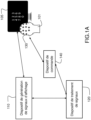
- FIG. 1A schematically represents an exemplary embodiment of a system 100 for determining the focus of visual attention of an individual (also referred to hereinafter as user) 101 from electroencephalographic signals.
- the system 100 includes a display screen 105 configured to display animated graphic objects, a display signal generation device 110, a signal processing device 120, an EEG signal acquisition device 130, and a device 140 for controlling the device 130.
- the display signal generating device 110 is configured to generate display signals to be displayed by the display screen 105. These display signals encode a plurality of visual stimuli intended to be presented to the user 101 by means of the display screen 105.
- the equipment 130 is configured for the acquisition of EEG signals.
- This equipment is for example produced in the form of a helmet, provided with electrodes intended to come into contact with the skull of the user 101.
- a helmet is for example a helmet manufactured by the company Biosemi ® , equipped with 64 electrodes.
- Other types of equipment can be used: for example the Geodesic TM EEG devices from the company Electrical Geodesics Inc. (EGI) ® , or those from the company Compumedics NeuroScan ® usually having between 16 and 256 electrodes.
- EGI Electrical Geodesics Inc.
- Compumedics NeuroScan ® usually having between 16 and 256 electrodes.
- the signal processing device 120 is configured to process the EEG signals acquired using the EEG signal acquisition headset 130.
- the device 140 for controlling the equipment 130 is a device serving as an interface between the headset 130 and/or the signal processing device 120.
- the control device 140 is configured to control the acquisition of EEG signals and to obtain the EEG signals acquired by the headset 130.
- the device 140 for controlling the headset 130 is configured to send a command to trigger the acquisition of EEG signals.
- All or part of the functions described herein for the display signal generation device 110, the signal processing device 120 and the control device 140 may be performed by software and/or hardware and implemented in at least one computing device comprising a data processor and at least one data storage memory.
- each device 110, 120, 140 and each of the steps of the methods described are implemented by one or more physically distinct computing devices. Conversely, the different devices 110, 120, 140 can be integrated into a single computing device. Similarly, the steps of the methods described here can be implemented by a single computing device.
- the EEG signal acquisition equipment 130 can also comprise a computing device and be configured (data processor, memory, etc.) to implement all or part of the steps of the methods described in this document.
- Each computing device generally presents the architecture of a computer, including constituents of such architecture: data memory(s), processor(s), communication bus, user interface(s), hardware interface(s) for connecting this computing device to a network or other equipment, etc.
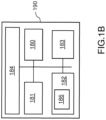
- FIG. 1B An example of the implementation of such an architecture is illustrated in Figure 1B .
- This architecture comprises a processing unit 180 including at least one data processor, at least one memory 181, one or more data storage media 182, and hardware interfaces 183 such as network interfaces, interfaces for connecting peripherals, at least one user interface 184 including one or more input/output devices such as mouse, keyboard, display, etc.
- the data storage medium 182 comprises code instructions of a computer program 186.
- Such a storage medium 182 may be an optical storage device such as a compact disc (CD, CD-R or CD-RW), DVD (DVD-Rom or DVD-RW) or Blu-ray, a magnetic medium such as a hard disk, flash memory disk, magnetic tape or floppy disk, a removable storage medium such as a USB key, an SD or micro SD memory card, etc.
- the memory 181 may be a random access memory (RAM), a read only memory (ROM), a cache memory, a non-volatile memory, a backup memory (for example programmable or flash memories), read only memories or any combination of these types of memory.
- the processing unit 180 may be any microprocessor, integrated circuit, or central processing unit having at least one hardware-based processing processor.
- FIG. 2A schematically represents the data and signals used in a system and method for determining the focus of visual attention. The corresponding notations are introduced.
- a plurality of graphical objects O1, O2, ..., ON intended to be presented to a user 101 is used.
- Each of these graphical objects can be an alphanumeric character (number or letter or other character), a logo, an image, a text, a user interface menu item, a user interface button, an avatar, a 3D object, etc.
- Each of these graphical objects can be encoded by a bitmap or vector image.
- one or more elementary transformations T1, T2, ..., TP are defined to be applied to the graphic objects O1, O2, ..., ON.
- An elementary transformation can be: a variation in light intensity, a variation in contrast, a colorimetric transformation, a geometric deformation, a rotation, an oscillation, a displacement along a plane or three-dimensional trajectory, a change in shape, or even a change of graphic object, etc.
- a change of graphic object can for example correspond to a transformation that replaces a graphic object with another graphic object of the same category, for example, the replacement of a letter (e.g. A) with another letter (e.g. B), of a number with another number, a logo with another logo, etc.
- An elementary transformation can also be a combination of several of the aforementioned elementary transformations.
- Each of these elementary transformations can be configured by at least one application parameter.
- an application parameter defines a transformation degree of the elementary transformation on a predetermined scale. For example, a scale of 0 to 100 or -100 to +100 may be used.
- this variation of intensity can be applied with a variable transformation degree between 0 and 100, a transformation degree equal to 0 meaning that the image encoding the graphic object is not modified, a transformation degree equal to 100 indicating that the image becomes completely white or, on the contrary, black.
- a transformation degree between 0 and 100 we obtain a flashing effect of the image.
- this variation of contrast can be applied with a degree of transformation variable between 0 and 100, a degree of transformation equal to 0 meaning that the image encoding the graphic object is not modified, a degree of transformation equal to 100 indicating that the contrast of the image becomes maximum (the image becomes a black and white image, if it is encoded in gray level).
- a degree of transformation can correspond to the degree of morphing.
- a degree of transformation can correspond to an angle of rotation.
- a degree of transformation can correspond to a speed and/or amplitude of oscillation.
- a degree of transformation can correspond to a distance traveled and/or speed of movement on the trajectory.
- a degree of transformation can correspond to a speed and/or amplitude reflecting the passage from one shape (respectively from category to another).
- a corresponding modulation signal SM1, SM2, ..., SMN is generated.
- a modulation signal is used to define the variations as a function of time of one or more application parameters of the elementary transformation applied to the graphic object considered. For example, the degree of transformation di(t) at time t is defined by the amplitude SMi(t) of the modulation signal SMi at time t.
- an animated graphic object OA1, OA2, ..., OAN is generated for each corresponding graphic object O1, O2, ..., ON from of one or more corresponding elementary transformations and a corresponding modulation signal.
- the animated graphic object OA1, OA2, ..., OAN thus generated is presented on a display screen 105.
- a visual stimulus is an animated graphic object OAi (i an integer between 1 and N) obtained by applying to a corresponding graphic object Oi a temporal sequence STi of elementary transformations temporally parameterized by a corresponding modulation signal SMi.
- a modified graphic object OAi(tz) is generated, by applying a corresponding elementary transformation Ti to the graphic object Oi with a degree of transformation di(tz) corresponding to the amplitude SMi(tz) at instant tz of the modulation signal SMi corresponding to the graphic object Oi.
- the animated graphic object thus corresponds to the temporal succession of the modified graphic objects OAi(tz) when tz varies in the time interval [tmin, tmax].
- EEG signals denoted E1, E2, ..., EX
- E1, E2, ..., EX are acquired by means of an EEG signal acquisition device 130. From the EEG signals E1, E2, ..., EX, a reconstructed modulation signal SMR is generated.
- the reconstructed SMR modulation signal is generated by applying an MR reconstruction model to the signals E1, E2, ..., EX.
- the parameters of the MR reconstruction model are denoted P1, P2, ...PK.
- the MR reconstruction model can be a linear model, with the reconstructed modulation signal being a linear combination of the signals E1, E2, ..., EX.
- neural network models Other more sophisticated models can be used, including neural network models.
- a modulation signal is composed of elementary signals. These elementary signals can be rectangular, triangular, sinusoidal, etc. signals. The modulation signals can have different durations. In one or more embodiments, the modulation signals are periodic, a temporal pattern being reproduced periodically by each modulation signal. A modulation signal has for example a periodic temporal pattern, repeating with a frequency between 2 and 20 Hz, this modulation signal being sampled at a sampling frequency corresponding to the refresh rate (in general, greater than 60 Hz) of the screen on which the visual stimuli (i.e. animated graphic objects) generated from the modulation signals are displayed.
- the refresh rate in general, greater than 60 Hz
- the amplitude of the SMi modulation signal is used to define a degree of transformation.
- the relationship between the amplitude of the SMi modulation signal and the degree of transformation can be linear or not.
- the amplitude of a SMi modulation signal can vary between a minimum value (corresponding to a first degree of transformation) and a maximum value (corresponding to a second degree of transformation).
- the modulation signals are in this case independent two by two: the modulation signals are composed so that the dependence, measured in the time and/or frequency domain, between any two distinct modulation signals is minimal (for example zero) or less than a given threshold SC1.
- the dependence between two signals can be quantified by a degree of statistical dependence.
- the degree of statistical dependence between two modulation signals can be calculated, in the time domain, for example by a temporal correlation coefficient and/or, in the frequency domain, for example by the spectral coherence rate.
- the modulation signals are temporally decorrelated two by two.
- a statistical degree of dependence may be calculated for each pair of modulation signals corresponding to distinct visual stimuli, and then an overall statistical degree of dependence (e.g., the average degree of dependence, the maximum degree of dependence, or the cumulative degree of dependence) may be calculated for all pairs of modulation signals. Determining the modulation signals is performed by searching for modulation signals that minimize this overall statistical degree of dependence or achieve an overall statistical degree of dependence below a predetermined threshold SC1.
- an overall statistical degree of dependence e.g., the average degree of dependence, the maximum degree of dependence, or the cumulative degree of dependence
- the degree of statistical dependence calculated for each pair of modulation signals corresponding to distinct visual stimuli is zero or less than a threshold SC1.
- the temporal correlation coefficient is between 0 and 1, the value 0 corresponding to temporally decorrelated signals.
- the degree of statistical dependence between modulating signals can be determined by other mathematical criteria, such as Spearman's correlation or Kendall's rate, or replaced by measures of statistical dependence such as mutual information.
- the spectral coherence rate between two signals x(t) and y(t) is a real-valued function which can be defined for example by the ratio Gxy f 2 / Gxx f * Gyy f where Gxy(f) is the cross spectral density between x and y, and Gxx(f) and Gyy(f) the autospectral density of x and y respectively.
- the degree of statistical dependence is calculated over a reference period, corresponding for example to the duration of the reconstruction window (see step 414) and/or the decoding window (see step 415).
- Effective discrimination of the modulation signals is possible when the overall statistical degree of dependence (calculated for example as the average degree of dependence, the maximum degree of dependence or a cumulative degree of dependence), calculated on all pairs of modulation signals corresponding to distinct visual stimuli, is zero (for example for temporally decorrelated signals) or lower than a threshold SC1, chosen for example equal to 0.2 (i.e. 20% respectively if this degree is expressed as a percentage).
- SC1 a threshold
- the probability of discrimination error (corresponding to the percentage of cases in which the visual stimulus identified in step 415 is not the one to which the individual actually directs his visual attention) among all the modulation signals, of the modulation signal which was used to generate the visual stimulus observed by the subject, is also all the lower.
- the threshold SC1 can depend on the choice of the type of modulation signals. In practice, one can set a maximum probability of discrimination error (an acceptable probability for a given application for example), and adjust the modulation signals so as to remain below this maximum discrimination error rate. It is understood here that, even in the case where the reconstruction (see step 414) is ideal (i.e.
- the quality of the decoding depends on the degree of statistical dependence between the modulation signals, because if the modulation signals SMi are entirely dependent on each other, it will be impossible to select one modulation signal SMi rather than another.
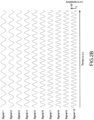
- FIGS. 2B , 2C , 2D , 2E schematically represents a set of modulation signals usable in a system for determining the focus of visual attention for the generation of visual stimuli.
- These 10 signals are sinusoidal, periodic signals, having different frequencies (and therefore periods) between 1 Hz and 2 Hz in steps of 0.2 Hz, such that any two signals taken from this first set do not have the same frequency.
- the phases of these signals can be arbitrary.
- the amplitude of these signals varies between 0% and 100% meaning that the corresponding degree of transformation varies (with an adapted proportionality coefficient) between a minimum value and a maximum value.
- the spectral overlap rate is zero (i.e. absence of common frequency component) and the maximum temporal correlation coefficient on all pairs of modulation signals is 0.2, this temporal correlation coefficient being calculated on a 4-second correlation window.
- FIG. 2C is shown a second example set of 10 modulation signals, signal 1 to signal 10, which are temporally decorrelated two by two.
- These 10 signals are rectangular, periodic signals, having different frequencies (and therefore periods) between 1 Hz and 2 Hz in steps of 0.2 Hz, such that any two signals taken from this second set do not have the same frequency.
- the phases of these signals can be arbitrary.
- the amplitude of these signals varies between 0% and 100% meaning that the corresponding degree of transformation varies (with an adapted proportionality coefficient) between a minimum value and a maximum value.
- the spectral overlap rate can be non-zero if some harmonic components are common but the maximum temporal correlation coefficient on all pairs of modulation signals is 0.17, this temporal correlation coefficient being calculated on a 4 second correlation window.
- These 10 signals are periodic signals having the same period (called the reference period on the FIG. 2D ) and are composed of elementary rectangular signals such that the temporal patterns of any two signals taken from this third set are distinct during the reference period.
- the phase of each of the signals is important in that it must be adjusted so as to limit the temporal correlation coefficient, and therefore the degree of statistical dependence, to a maximum value for each pair of distinct modulation signals selected from this set of 10 modulation signals.
- the amplitude of these signals varies between 0% and 100% meaning that the corresponding degree of transformation varies (with an adapted proportionality coefficient) between a minimum value and a maximum value.
- a third example set of 9 modulation signals, signal 1 to signal 9, is shown, which are temporally decorrelated two by two. These signals are periodic signals having the same period (called reference period on the FIG. 2E ).
- Each of the modulation signals comprises a temporal pattern composed of a short rectangular pulse of amplitude 100% followed by a longer duration signal of amplitude 0%, the rectangular pulses of the different visual modulation signals being shifted in time relative to each other so that at a given instant, only one modulation signal has an amplitude at 100% while the others have an amplitude at 0%.
- modulation signals all having the same temporal pattern (with a different phase shift), it is by adjusting the phase of each of the signals that one can control the temporal correlation coefficient, and therefore the degree of statistical dependence, between two signals.
- the transformation function used is a brightness change function, the graphic object being visible (unchanged brightness) when the modulation signal is at 100% and invisible when the modulation signal is at 0% (zero brightness), the animated graphic objects, which are obtained from these modulation signals and this elementary transformation obtained, flash by appearing and disappearing in a given order, only one visual stimulus being visible at a given time.
- the temporal correlation coefficient is zero.
- FIG. 3 schematically represents aspects of a method and system for determining the focus of visual attention.
- the reconstructed modulation signal SMR is compared to each of the modulation signals SM1, SM2, ..., SMN to search for a modulation signal for which the degree of statistical dependence is maximum. For example, if the degree of statistical dependence is maximum for the modulation signal SM4, this means that the visual attention of an individual is focused on the visual stimulus OA4 generated from this modulation signal SM4.
- the visual stimuli are the numbers 0 to 9, the individual's visual attention is focused on the number 4 corresponding to the visual stimulus OA4.
- the maximum statistical dependence degree is found with the corresponding modulation signal SM4.
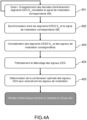
- FIG. 4A An exemplary embodiment of a method for generating an MR reconstruction model is schematically illustrated by the Figure 4A . Although the steps of this method are presented sequentially, at least some of these steps may be omitted or performed in a different order or performed in parallel or combined to form a single step.
- a trial i (i ⁇ [1; N]) is performed with a visual stimulus generated from a modulation signal SMi: the visual stimulus is presented on a display screen and an individual is invited to observe the visual stimulus, i.e. to focus his visual attention on this visual stimulus.
- Each visual stimulus is an animated graphic object obtained by applying to a graphic object a temporal sequence of elementary transformations temporally parameterized by a corresponding modulation signal.
- Test EEG signals Ei,j are recorded while the individual focuses his attention on the visual stimulus considered, where i is the index identifying the trial and the modulation signal corresponding, and j the index identifying the recorded EEG channel.
- Each of these EEG signals Ei,j is composed of a plurality of EEG segments Ei,j,k, where k is the index identifying the segment.
- step 401 ten visual stimuli in the form of flashing digits (digits ranging from 0 to 9) are displayed on a screen, each flashing at a slightly different frequency.
- the individual is equipped with an EEG headset and views a display screen on which the ten digits flash at different frequencies.
- a succession of trials is carried out. Each trial lasts for example about ten seconds, the interval between two trials being for example 1 or 2 seconds.
- the individual is instructed to focus his attention on one of the digits and must ignore the others until the next trial. The individual thus switches his attention from one stimulus to another and generates in EEG signals E1, E2, ..., EX at different frequencies depending on the visual attention focus.
- a timestamp of the EEG segments is performed during step 401.
- a timestamp of the modulation signals is also performed during step 401.
- the timestamp can be performed by any method.
- the clock of the acquisition equipment 130 is used to time stamp the EEG segments and produce a time stamp t i ' (or "timecode" according to English terminology) for each EEG segment.
- the clock of the control device 140 is used to time stamp the modulation signals and produce a time stamp each time a predetermined event occurs in the stimulation (corresponding for example to the appearance of a new visual stimulus on the screen or to the start of the display of a stimulus).
- an additional EEG channel is used, via which short electrical pulses of known amplitude are transmitted each time a predetermined event occurs in the stimulation (corresponding for example to the appearance of a new visual stimulus on the screen or to the start of the display of a stimulus).
- This additional EEG channel containing the short pulses is saved with the EEG data segments.
- Step 401 is repeated several times, for each visual stimulus of a plurality of visual stimuli, so as to record the corresponding EEG signals produced by the individual when he focuses his visual attention on the visual stimulus considered.
- a step 402 the temporal alignment (or synchronization) between the EEG segments Ei,j,k and the modulation signals SMi is carried out.
- This synchronization can be done by any method.
- This synchronization can use the double timestamping of EEG segments and modulation signals, or the additional EEG channel.
- each point (t', diff(t')) is obtained from the successive sending of n time stamps t k by the control device 140 to the acquisition equipment 130 which produces a time stamp t k ' on each reception.
- the timestamping and time recalibration steps are however optional and are in particular not necessary when the acquisition equipment 130 and the control device operate on the basis of the same clock.
- the EEG segments Ei,j,k are concatenated so as to generate the EEG signals Ei,j.
- preprocessing and denoising can be applied to the EEG signals so as to optimize the signal/noise ratio.
- the EEG signals can indeed be considerably contaminated by artifacts of both intra- and extra-cerebral origin, for example electrical artifacts, such as 50 Hz, the current of the electrical network in Europe; or biological artifacts, such as eye movements, the electrocardiogram, muscular activity, etc.).
- the signals E1, E2, ..., EX are thus denoised prior to the generation of the reconstructed modulation signal SMR.
- This denoising can consist of simply filtering the high frequencies in the signals E1, E2, ..., EX, for example all frequencies greater than 40 Hz to eliminate the electrical noise produced by the electrical network.
- Multivariate statistical approaches can be used, including principal components analysis (PCA), independent components analysis (ICA), and canonical correlation analysis (CCA), to separate useful EEG signal components (originating from brain activity related to the ongoing cognitive task) from irrelevant components.
- PCA principal components analysis
- ICA independent
- the parameters of the reconstruction model are determined. This determination can be made so as to minimize the reconstruction error.
- the reconstruction model comprises for example a plurality of EEG signal combination parameters. These combination parameters are determined by a method of solving mathematical equations so as to determine optimal combination parameter values, i.e. the values for which the application of the reconstruction model to the plurality of EEG signals Ei,j of tests recorded for a visual stimulus makes it possible to generate a reconstructed modulation signal that best approximates the modulation signal corresponding to the visual stimulus considered, i.e. the values for which the reconstruction error is minimal.
- the values ⁇ j of the combination parameters may be fixed (time independent). In other embodiments, these values may be adjusted in real time to take into account a possible adaptation of the brain activity of the user 101, or an evolution of the signal-to-noise ratio in the EEG signal during a recording session.
- the MR reconstruction model can be a linear model, producing a modulation signal by linear combination of the signals Ei,j.
- neural network models for which the modulation signal is obtained by applying a cascade of non-linear mathematical operations to the signals Ei,j.
- a Siamese network for which a neural network is trained (from calibration data) to match any EEG signal E with a one-dimensional temporal signal R (in this case, a modulation signal) so that for two EEG signals E1 and E2 recorded at different times, they produce respectively one-dimensional signals R1 and R2 (in this case, modulation signals) which are similar when the individual's attention is focused on the same animated graphic object, and dissimilar when the individual's attention is focused on two distinct animated graphic objects.
- the reconstructed modulation signal is the one-dimensional signal R generated by the neural network from a newly acquired EEG sample E.
- the steps of the method of generating a reconstruction model are implemented by a system 100 according to the Figure 1A , for example by the signal processing device 120.
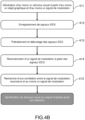
- FIG. 4B An exemplary embodiment of a method for determining the focus of an individual's visual attention is schematically illustrated by the FIG. 4B . Although the steps of this method are presented sequentially, at least some of these steps may be omitted or performed in a different order or performed in parallel or combined to form a single step.
- the steps of the method for determining the focus of visual attention are implemented by a system 100 according to the Figure 1A , for example by the signal processing device 120 and the display signal generation device 110.
- the display signal generation device 110 is configured to generate a plurality of visual stimuli from a plurality of graphic objects O1, O2, ..., ON, a plurality of elementary transformations T1, T2, ..., TP and a plurality of modulation signals SM1, SM2, ..., SMN.
- a visual stimulus is an animated graphic object OAi (i between 1 and N) obtained by applying to a corresponding graphic object Oi a temporal sequence STi of elementary transformations temporally parameterized by a corresponding modulation signal SMi.
- the number N of visual stimuli, modulation signals and graphic objects is equal to 1.
- the number P of elementary transformations is equal to 1.
- Each elementary transformation of the time sequence STi of elementary transformations can thus correspond to the same elementary transformation of which an application parameter varies over time.
- the individual can shift his visual attention from one animated graphic object to another.
- the electroencephalographic signals E1, E2, ..., Ej, ..., EX produced by the individual are recorded by the acquisition equipment 130.
- the signal processing device 120 is configured to obtain a plurality of electroencephalographic signals E1, E2, ..., Ej, ..., EX produced by the individual focusing his attention towards one of the visual stimuli OAi.
- the electroencephalographic signals E1, E2, ...Ej, ...EX are preprocessed and denoised so as to improve the reliability of the method for determining the focus of visual attention.
- the preprocessing may consist of synchronizing the segments of electroencephalographic signals E1, E2, ...Ej, ...EX with respect to a reference clock, as explained above for step 402, concatenating the segments of electroencephalographic signals as explained above for step 403, and/or performing a denoising of the electroencephalographic signals as explained above for step 404.
- the signal processing device 120 is configured to, in a step 414, obtain a reconstructed SMR modulation signal by reconstructing a modulation signal from a plurality of signals electroencephalographic E1, E2, ..., Ej, ..., EX.
- the signal processing device 120 is configured to reconstruct a modulation signal and generate a reconstructed modulation signal SMR from the plurality of electroencephalographic signals obtained in step 413 or 412 (with or without preprocessing and/or denoising).
- the reconstruction is performed by applying a reconstruction model to the plurality of electroencephalographic signals obtained in step 413 or 412 (with or without preprocessing and/or denoising). This reconstruction can be performed over a given sliding time window, herein referred to as a reconstruction window, and repeated periodically for each time position of the reconstruction window.
- the signal processing device 120 is configured to, during a step 415 (called the decoding step), calculate a degree of statistical dependence between the reconstructed modulation signal and each modulation signal of the set of modulation signals and identify at least one visual stimulus corresponding to a modulation signal for which the degree of statistical dependence is greater than a threshold SC2, with a value of for example between 0.2 and 0.3.
- a threshold SC2 with a value of for example between 0.2 and 0.3.
- the degree of statistical dependence can be determined as described earlier in this document.
- the degree of statistical dependence is for example a temporal correlation coefficient between the reconstructed modulation signal and a modulation signal of the set of modulation signals.
- the number N of visual stimuli, modulation signals and graphic objects is strictly greater than 1 and the signal processing device 120 is configured to, in addition, during a step 415, search, among the plurality of modulation signals SM1, SM2, ..., SMN, the modulation signal SMi for which the degree of statistical dependence with the reconstructed modulation signal SMR is maximum and identify the visual stimulus OAi corresponding to the modulation signal SMi for which the degree of statistical dependence is maximum.
- Visual attention is a priori focused towards the identified visual stimulus OAi.
- the search is carried out for example by calculating a degree of statistical dependence between the reconstructed modulation signal SMR and each signal of the plurality of modulation signals SM1, SM2, ..., SMN.
- This decoding step can be carried out on a given sliding time window, here called a decoding window, and repeated periodically for each time position of the decoding window.
- the duration of the decoding window can be the same as that of the reconstruction window.
- one or more visual stimuli can be displayed at a given time on the display screen 105.
- the decoding step 415 can nevertheless be identical regardless of the number of visual stimuli displayed at a given time, the statistical dependence can be sought with any one of the modulation signals SM1, SM2, ..., SMN corresponding to the visual stimuli likely to be displayed. This eliminates the need for dynamic modification and synchronization of the processing performed during the decoding step 415 with respect to the variations in the content actually displayed. This can be very useful when the visual stimuli are integrated into a video or when the user interface, in which the visual stimuli are integrated, is dynamically modified as the user interacts with this user interface.
- ten visual stimuli in the form of flashing digits are displayed on a screen, each flashing at a slightly different frequency or with the same frequency but appearing alternately on the screen.
- the individual is equipped with an EEG headset and views a display screen on which the ten digits flash at different frequencies.
- the modulation signals of the visual stimuli can be temporarily modified (for example, for the duration necessary to remove the ambiguity or to find less disturbed signals). This modification can be carried out so as, for example, to display only the visual stimuli for which there is ambiguity and/or to modify the modulation signals of the visual stimuli for which there is ambiguity.
- the modification of the modulation signals may consist in modifying the frequency or the temporal pattern of the modulation signals, so as to increase the frequency and/or the total duration of visibility and/or the degree of transformation of the visual stimuli for which there is ambiguity and reduce the frequency and/or the total duration of visibility and/or the degree of transformation of the other visual stimuli.
- the modification may also consist in permuting the modulation signals with each other, without changing their temporal pattern or their frequency. This permutation may be random. Such permutation amounts to, when the modulation signals and the elementary transformation are defined so that the visual stimuli flash by appearing and disappearing on the display screen in a given order (see the example of the FIG.
- the permutation can be combined with a modification of the modulation signals aimed at increasing the frequency and/or the total duration of visibility and/or the degree of transformation of the visual stimuli for which there is ambiguity.
- the signal processing device 120 makes it possible to automatically identify, without any other information than the EEG, the visual stimulus on which attention is focused.
- a reconstruction model makes it possible to generate, from the raw EEG, the reconstructed modulation signal.
- the modulation signal is correlated to the modulation signals corresponding to the different animated graphic objects, the observed visual stimulus being that corresponding to the modulation signal for which the degree of statistical dependence is maximum.
- Tests obtained by grouping the results of several individuals show that the method for determining the observed visual stimulus is very robust (error rate less than 10% for E1, E2, ..., EX signals recorded for a duration of 1 second), even with a very short learning phase, of a few minutes (for example, less than 5 minutes) or even a few seconds (for example, less than 5 seconds) implemented on a few typical stimuli.
- the method of determining the focus of visual attention is applicable not only to numbers but to many human-machine interfaces, for example to a full alphanumeric keyboard with 26 or more characters.
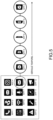
- Fig. 5 illustrates another example of a human-machine interface to which this method is applicable.
- dynamic stimuli consist of logos or icons that are animated, not by elementary transformations that act on the light intensity of the logo, but by applying movements so as to move the logo on itself, in a plane or in a three-dimensional space. These movements are for example oscillations or rotations, at different frequencies decodable in real time.
- the amplitude of the corresponding modulation signal indicates the degree of transformation at a given instant, that is to say the angle of rotation to be applied at a given instant.
- These movements are for example periodic.
- FIG. 5 12 logos APP1 to APP12 are shown, arranged in a grid of 4 X 3 logos. Although this figure is shown in black and white, the logos can also be in color.
- the logos rotate on themselves at different frequencies, as illustrated by the FIG. 5 for the APP8 logo.
- Each of these logos is animated by rotating oscillation on itself at a frequency distinct from that of the other logos.
- the periodic rotation applied to the icons induces brain responses detectable in the EEG signals at the natural rotation frequency, which can be decoded in real time using the techniques described above.
- This type of interface is highly flexible and can be adapted in particular for smartphones or tablets. Such a human-machine interface makes it possible, for example, to create graphical interfaces for any type of computer device, for example for software applications and/or operating systems on a mobile terminal or computer, whether the display screen is a touch screen or not.
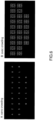
- Fig. 6 illustrates another example of a usable human-machine interface.
- a technique called crowding can be used. This technique consists of surrounding each visual stimulus with lateral masks, animated or not, which reduce the visual disturbances linked to the animation of neighboring visual stimuli and allow the individual to focus his attention more effectively on a particular stimulus, and consequently to improve its decoding.
- Fig. 7 illustrates another example of a human-machine interface in which feedback is given to the user on the visual stimulus that has been identified as being observed by the user.
- the human-machine interface includes the digits 0 through 9.
- the user observes the number 6 and the feedback consists of enlarging the number identified as being observed by applying a method of determining the focusing visual attention according to the present disclosure.
- the feedback given to the user may consist of highlighting the identified visual stimulus, for example, by highlighting, flashing, zooming, changing position, changing size or changing color, etc.,
- the visual stimuli are part of a human-machine interface of a software application or computing device, and a command is sent to trigger execution of one or more operations associated with the identified visual stimulus following identification of the observed visual stimulus by implementing a method for determining the focus of visual attention according to the present disclosure.
- the various steps of the method(s) described in this document are implemented by software or computer program.
- the present description thus relates to software or computer program comprising software instructions or program code instructions, readable and/or executable by a computer or by a data processor, these instructions being configured to control the execution of the steps of one or more methods described in this document when this computer program is executed by a computer or data processor.
- These instructions may use any programming language, and may be in the form of source code, object code, or intermediate code between source code and object code, such as in a partially compiled form, or in any other desirable form.
- These instructions are intended to be stored in a memory of a computing device or computer system, loaded and then executed by a processing unit or data processor of this computing device or computer system in order to implement the steps of the method or methods described in this document.
- These instructions may be stored, temporarily or permanently, in whole or in part, on a non-transitory, computer-readable medium of a local or remote storage device comprising one or more storage media.
- the present disclosure also relates to a data processor-readable data carrier comprising instructions of a computer software or program as mentioned above.
- the data carrier may be any entity or device capable of storing such instructions.
- Embodiments of computer-readable media include, but are not limited to, both storage media computer and communication media comprising any medium that facilitates the transfer of a computer program from one location to another.
- Such a storage medium may be an optical storage device such as a compact disc (CD, CD-R or CD-RW), DVD (DVD-Rom or DVD-RW) or Blu-ray, a magnetic medium such as a hard disk, magnetic tape or floppy disk, a removable storage medium such as a USB key, an SD or micro SD memory card, or a memory, such as random access memory (RAM), read only memory (ROM), cache memory, non-volatile memory, backup memory (for example programmable or flash memories), etc.
- an optical storage device such as a compact disc (CD, CD-R or CD-RW), DVD (DVD-Rom or DVD-RW) or Blu-ray
- a magnetic medium such as a hard disk, magnetic tape or floppy disk
- a removable storage medium such as a USB key
- SD or micro SD memory card such as an SD or micro SD memory card
- a memory such as random access memory (RAM), read only memory (ROM), cache memory, non-volatile memory, backup memory (
- This description also relates to a computer device or computer system comprising means for implementing the steps of the method(s) described in this document. These means are software and/or hardware means for implementing the steps of the method(s) described in this document.
- the present description also relates to a computer device or computer system comprising at least one memory for storing code instructions of a computer program for the execution of all or part of the steps of one or more methods described in this document and at least one data processor configured to execute such a computer program.
Landscapes
- Health & Medical Sciences (AREA)
- Life Sciences & Earth Sciences (AREA)
- Engineering & Computer Science (AREA)
- Biomedical Technology (AREA)
- Public Health (AREA)
- Medical Informatics (AREA)
- General Health & Medical Sciences (AREA)
- Physics & Mathematics (AREA)
- Pathology (AREA)
- Surgery (AREA)
- Animal Behavior & Ethology (AREA)
- Molecular Biology (AREA)
- Heart & Thoracic Surgery (AREA)
- Veterinary Medicine (AREA)
- Biophysics (AREA)
- Artificial Intelligence (AREA)
- Psychiatry (AREA)
- Developmental Disabilities (AREA)
- Physiology (AREA)
- Signal Processing (AREA)
- Computer Vision & Pattern Recognition (AREA)
- Psychology (AREA)
- Evolutionary Computation (AREA)
- Data Mining & Analysis (AREA)
- Fuzzy Systems (AREA)
- Child & Adolescent Psychology (AREA)
- Educational Technology (AREA)
- Hospice & Palliative Care (AREA)
- Social Psychology (AREA)
- Mathematical Physics (AREA)
- Databases & Information Systems (AREA)
- Epidemiology (AREA)
- Primary Health Care (AREA)
- Measurement And Recording Of Electrical Phenomena And Electrical Characteristics Of The Living Body (AREA)
- Controls And Circuits For Display Device (AREA)
- Processing Or Creating Images (AREA)
- User Interface Of Digital Computer (AREA)
- Image Processing (AREA)
Claims (12)
- Computerimplementiertes Verfahren zum Bestimmen des visuellen Aufmerksamkeitsfokus eines Individuums auf der Basis von elektroenzephalographischen Signalen, wobei das Verfahren Folgendes beinhaltet:Erzeugen (411) eines Satzes von mindestens einem auf der Basis von mindestens einem graphischen Objekt anzuzeigenden visuellen Reiz, mindestens einer Elementartransformation und eines Satzes von mindestens einem Modulationssignal, wobei ein visueller Reiz ein animiertes graphisches Objekt ist, das durch Anwenden einer durch ein entsprechendes Modulationssignal zeitlich parametrisierten zeitlichen Sequenz von Elementartransformationen auf ein graphisches Objekt erhalten wird;Rekonstruieren (414) eines Modulationssignals auf der Basis von mehreren elektroenzephalografischen Signalen, die von dem Individuum erzeugt wurden, um ein rekonstruiertes Modulationssignal zu erhalten;Berechnen (415) eines statistischen Abhängigkeitsgrads zwischen dem rekonstruierten Modulationssignal und jedem Modulationssignal des Satzes von mindestens einem Modulationssignal;Identifizieren (415) mindestens eines visuellen Reiz entsprechend einem Modulationssignal, wobei der statistische Abhängigkeitsgrad über einem ersten Schwellenwert liegt.
- Verfahren nach Anspruch 1, wobei der Satz von mindestens einem visuellen Reiz mehrere visuelle Reize umfasst und der Satz von mindestens einem Modulationssignal mehrere Modulationssignale umfasst, wobei das Verfahren Folgendes beinhaltet:Suchen (415), unter den mehreren Modulationssignalen, nach einem Modulationssignal, für das ein statistischer Abhängigkeitsgrad von dem rekonstruierten Modulationssignal maximal ist; undIdentifizieren (415) des visuellen Reizes entsprechend dem Modulationssignal, für das der statistische Abhängigkeitsgrad maximal ist;wobei die Modulationssignale so zusammengesetzt sind, dass ein in der Zeit- und/oder Frequenzdomäne bestimmter globaler statistischer Abhängigkeitsgrad für alle Paare von Modulationssignalen entsprechend zwei verschiedenen visuellen Reizen unter einem zweiten Schwellenwert liegt.
- Verfahren nach Anspruch 1 oder 2, wobei die Rekonstruktion durch Anwenden eines Rekonstruktionsmodells auf die mehreren elektroenzephalografischen Signale erfolgt.
- Verfahren nach Anspruch 3, wobei das Rekonstruktionsmodell mehrere Kombinationsparameter von elektroenzephalographischen Signalen umfasst, wobei das Verfahren das Bestimmen von Werten mehrere Kombinationsparameter von elektroenzephalographischen Signalen in einer anfänglichen Lernphase beinhaltet.
- Verfahren nach Anspruch 4, wobei das Verfahren ferner in der anfänglichen Lernphase, die auf eine Teilmenge von mindestens einem visuellen Reiz unter den mehreren visuellen Reizen angewendet wird, Folgendes beinhaltet:Erhalten, für jeden visuellen Reiz der genannten Teilmenge von mindestens einem visuellen Reiz, von elektroenzephalographischen Testsignalen, die von dem Individuum erzeugt werden, das seine Aufmerksamkeit auf den visuellen Reiz richtet; undBestimmen optimaler Werte der mehreren Kombinationsparameter von elektroenzephalographischen Signalen, bei denen die Anwendung des Rekonstruktionsmodells auf die für einen visuellen Reiz aufgezeichneten mehreren elektroenzephalographischen Testsignale ein rekonstruiertes Modulationssignal erzeugt, das dem Modulationssignal entsprechend dem betrachteten visuellen Reiz am nächsten kommt.
- Verfahren nach einem der vorherigen Ansprüche, wobei jedes Modulationssignal zeitabhängige Variationen von mindestens einem Parameter für die Anwendung einer Elementartransformation auf ein grafisches Objekt definiert.
- Verfahren nach Anspruch 6, wobei ein Anwendungsparameter ein Transformationsgrad oder eine Anwendungsgeschwindigkeit einer Elementartransformation ist.
- Verfahren nach einem der vorherigen Ansprüche, wobei eine Elementartransformation eine Transformation aus dem Satz von Transformationen ist, der aus einer Lichtintensitätsänderung, einer Kontraständerung, einer Farbtransformation, einer geometrischen Verformung, einer Rotation, einer Oszillation, einer Bewegung entlang einer Bahn, einer Formänderung und einer Änderung des grafischen Objekts oder einer Kombination von aus dem genannten Satz von Transformationen ausgewählten Transformationen besteht.
- Computerprogramm mit Programmcode-Befehlen zur Ausführung der Schritte eines Verfahrens nach einem der vorherigen Ansprüche, wenn das Computerprogramm von einem Datenprozessor ausgeführt wird.
- Computersystem mit mindestens einem Speicher zum Speichern von Code-Befehlen eines Computerprogramms, das zum Ausführen eines Verfahrens nach einem der Ansprüche 1 bis 7 konfiguriert ist, und mit mindestens einem zur Ausführung des Computerprogramms konfigurierten Datenprozessor.
- System zur Bestimmung des visuellen Aufmerksamkeitsfokus eines Individuums auf der Basis von elektroenzephalographischen Signalen, wobei das System Folgendes umfasst:ein Gerät (110) zum Erzeugen von Anzeigesignalen, konfiguriert zum Erzeugen (410) eines Satzes von mindestens einem auf der Basis von mindestens einem grafischen Objekt anzuzeigenden visuellen Reiz, mindestens einer Elementartransformation und einem Satz von mindestens einem Modulationssignal, wobei ein visueller Reiz ein animiertes grafisches Objekt ist, das durch Anwenden einer durch ein entsprechendes Modulationssignal zeitlich parametrisierten zeitlichen Sequenz von Elementartransformationen auf ein grafisches Objekt erhalten wird;ein Signalverarbeitungsgerät (120), konfiguriert zum:- Erhalten (411) mehrerer elektroenzephalografischer Signale, die von dem Individuum erzeugt wurden;- Erhalten (414) eines rekonstruierten Modulationssignals durch Rekonstruktion eines Modulationssignals auf der Basis der mehreren elektroenzephalographischen Signale;- Berechnen (415) eines statistischen Abhängigkeitsgrads zwischen dem rekonstruierten Modulationssignal und jedem Modulationssignal des genannten Satzes von mindestens einem Modulationssignal; und- Identifizieren (415) mindestens eines visuellen Reizes entsprechend einem Modulationssignal, für das der statistische Abhängigkeitsgrad größer als ein erster Schwellenwert ist.
- System nach Anspruch 11, wobei der Satz von mindestens einem visuellen Reiz mehrere visuelle Reize umfasst und der Satz von mindestens einem Modulationssignal mehrere Modulationssignale umfasst, wobei das Signalverarbeitungsgerät (120) ferner konfiguriert ist zum:- Suchen (415), unter den mehreren Modulationssignalen, des Modulationssignals, für das der statistische Abhängigkeitsgrad mit dem rekonstruierten Modulationssignal maximal ist;- Identifizieren (415) des visuellen Reizes entsprechend dem Modulationssignal, für das der statistische Abhängigkeitsgrad maximal ist;wobei die Modulationssignale so zusammengesetzt sind, dass ein in der Zeit- und/oder Frequenzdomäne für alle Paare von Modulationssignalen entsprechend zwei verschiedenen visuellen Reizen bestimmter globaler statistischer Abhängigkeitsgrad kleiner als ein zweiter Schwellenwert ist.
Applications Claiming Priority (2)
| Application Number | Priority Date | Filing Date | Title |
|---|---|---|---|
| FR1758305A FR3070852B1 (fr) | 2017-09-08 | 2017-09-08 | Decodage de l'attention visuelle d'un individu a partir de signaux electroencephalographiques |
| PCT/EP2018/073961 WO2019048525A1 (fr) | 2017-09-08 | 2018-09-06 | Decodage de l'attention visuelle d'un individu a partir de signaux electroencephalographiques |
Publications (2)
| Publication Number | Publication Date |
|---|---|
| EP3678532A1 EP3678532A1 (de) | 2020-07-15 |
| EP3678532B1 true EP3678532B1 (de) | 2024-10-09 |
Family
ID=60202193
Family Applications (1)
| Application Number | Title | Priority Date | Filing Date |
|---|---|---|---|
| EP18778371.7A Active EP3678532B1 (de) | 2017-09-08 | 2018-09-06 | Decodierung der visuellen aufmerksamkeit eines individuums aus elektroenzephalographischen signalen |
Country Status (8)
| Country | Link |
|---|---|
| US (2) | US11717204B2 (de) |
| EP (1) | EP3678532B1 (de) |
| JP (2) | JP7124090B2 (de) |
| KR (2) | KR102755731B1 (de) |
| CN (2) | CN111511269B (de) |
| CA (1) | CA3075210A1 (de) |
| FR (1) | FR3070852B1 (de) |
| WO (1) | WO2019048525A1 (de) |
Families Citing this family (14)
| Publication number | Priority date | Publication date | Assignee | Title |
|---|---|---|---|---|
| EP3397146A4 (de) * | 2015-12-29 | 2019-08-07 | LifeQ Global Limited | Kardio-kinetische kreuzspektrale dichte zur beurteilung der schlafphysiologie |
| FR3070852B1 (fr) | 2017-09-08 | 2019-09-20 | Centre National De La Recherche Scientifique | Decodage de l'attention visuelle d'un individu a partir de signaux electroencephalographiques |
| US10782865B2 (en) * | 2018-05-08 | 2020-09-22 | Philip Eli Manfield | Parameterized sensory system |
| KR20210016752A (ko) * | 2019-08-05 | 2021-02-17 | 윤현진 | 중증 환자를 위한 영문 입력자판 |
| EP4078341B1 (de) | 2019-12-18 | 2026-08-05 | Snap Inc. | Gehirn-computer-schnittstelle |
| KR102396520B1 (ko) * | 2020-02-11 | 2022-05-11 | 고려대학교 산학협력단 | 뇌-컴퓨터 인터페이스에 기초하여 색 자극으로부터 사용자의 의도를 판단하는 스마트 제어 장치 및 그 제어 방법 |
| CN112022152B (zh) * | 2020-08-28 | 2024-05-31 | 江西脑虎科技有限公司 | 一种脑电信号的归类处理方法、装置、电子设备及存储介质 |
| CN112826509A (zh) * | 2020-09-30 | 2021-05-25 | 天津大学 | 视觉注意力水平识别方法 |
| CN113080998B (zh) * | 2021-03-16 | 2022-06-03 | 北京交通大学 | 一种基于脑电的专注状态等级评定方法和系统 |
| KR20230007139A (ko) | 2021-07-05 | 2023-01-12 | 현대자동차주식회사 | Ssvep 기반의 자극 검출 장치 및 그 방법 |
| CN114343677B (zh) * | 2022-01-12 | 2023-06-20 | 合肥哈工艾斯德康智能科技有限公司 | 一种方向性实体面孔刺激的n170脑电信号采集分析系统 |
| CN115414053B (zh) * | 2022-09-21 | 2025-11-04 | 安徽七度生命科学集团有限公司 | 基于脑波数据预训练模型的视觉场景重构方法及存储介质 |
| CN115857701B (zh) * | 2023-02-15 | 2023-06-02 | 季华实验室 | 一种ssvep脑电信号处理方法及相关设备 |
| CN118939119B (zh) * | 2024-07-29 | 2025-04-22 | 上海韶脑传感技术有限公司 | 一种基于fbcca的视觉注意力自适应方法及系统 |
Family Cites Families (17)
| Publication number | Priority date | Publication date | Assignee | Title |
|---|---|---|---|---|
| WO2004100766A2 (en) | 2003-05-06 | 2004-11-25 | George Mason Intellectual Property | Phase and state dependent eeg and brain imaging |
| US7338171B2 (en) * | 2003-10-27 | 2008-03-04 | Jen-Chuen Hsieh | Method and apparatus for visual drive control |
| FR2929427B1 (fr) | 2008-03-26 | 2012-12-28 | Univ Rennes | Procede d'evaluation de la sante et/ou de la forme, dispositif et produit programme d'ordinateur correspondants |
| JP2009268826A (ja) * | 2008-05-09 | 2009-11-19 | Panasonic Corp | 脳波識別方法調整装置および方法 |
| US8687844B2 (en) | 2008-06-13 | 2014-04-01 | Raytheon Company | Visual detection system for identifying objects within region of interest |
| WO2010016244A1 (ja) | 2008-08-05 | 2010-02-11 | パナソニック株式会社 | 運転注意量判定装置、方法およびプログラム |
| AU2009327552A1 (en) | 2008-12-19 | 2011-08-11 | Agency For Science, Technology And Research | Device and method for generating a representation of a subject's attention level |
| US8391966B2 (en) * | 2009-03-16 | 2013-03-05 | Neurosky, Inc. | Sensory-evoked potential (SEP) classification/detection in the time domain |
| JP2010257343A (ja) | 2009-04-27 | 2010-11-11 | Niigata Univ | 意思伝達支援装置 |
| JP5360895B2 (ja) | 2009-07-08 | 2013-12-04 | 学校法人慶應義塾 | 視覚誘発電位信号検出システム |
| JP5711056B2 (ja) * | 2011-06-21 | 2015-04-30 | アイシン精機株式会社 | 脳波インターフェースシステム |
| US9378658B2 (en) * | 2012-07-02 | 2016-06-28 | Think-Now Inc. | Systems and methods for training meta-attention |
| US10342472B2 (en) * | 2013-07-01 | 2019-07-09 | Think-Now Inc. | Systems and methods for assessing and improving sustained attention |
| US10383540B2 (en) * | 2014-01-23 | 2019-08-20 | National Institute Of Advanced Industrial Science And Technology | Cognitive function evaluation apparatus, method, system and program |
| JP2015226723A (ja) | 2014-06-02 | 2015-12-17 | トヨタ自動車株式会社 | 脳波検出装置 |
| CN104825159B (zh) | 2015-04-23 | 2017-08-22 | 张鸣沙 | 脑电同频检测方法、脑电同频刺激方法与装置 |
| FR3070852B1 (fr) | 2017-09-08 | 2019-09-20 | Centre National De La Recherche Scientifique | Decodage de l'attention visuelle d'un individu a partir de signaux electroencephalographiques |
-
2017
- 2017-09-08 FR FR1758305A patent/FR3070852B1/fr active Active
-
2018
- 2018-09-06 US US16/645,294 patent/US11717204B2/en active Active
- 2018-09-06 CN CN201880072508.9A patent/CN111511269B/zh active Active
- 2018-09-06 KR KR1020207009509A patent/KR102755731B1/ko active Active
- 2018-09-06 CA CA3075210A patent/CA3075210A1/en active Pending
- 2018-09-06 EP EP18778371.7A patent/EP3678532B1/de active Active
- 2018-09-06 WO PCT/EP2018/073961 patent/WO2019048525A1/fr not_active Ceased
- 2018-09-06 CN CN202310541524.0A patent/CN117158966A/zh active Pending
- 2018-09-06 KR KR1020257001066A patent/KR20250013296A/ko active Pending
- 2018-09-06 JP JP2020535297A patent/JP7124090B2/ja active Active
-
2022
- 2022-08-10 JP JP2022127543A patent/JP7462126B2/ja active Active
-
2023
- 2023-05-19 US US18/320,719 patent/US20230284949A1/en active Pending
Also Published As
| Publication number | Publication date |
|---|---|
| CN117158966A (zh) | 2023-12-05 |
| CA3075210A1 (en) | 2019-03-14 |
| JP7462126B2 (ja) | 2024-04-05 |
| US11717204B2 (en) | 2023-08-08 |
| US20200297263A1 (en) | 2020-09-24 |
| FR3070852A1 (fr) | 2019-03-15 |
| JP7124090B2 (ja) | 2022-08-23 |
| WO2019048525A1 (fr) | 2019-03-14 |
| KR20200097681A (ko) | 2020-08-19 |
| KR20250013296A (ko) | 2025-01-31 |
| EP3678532A1 (de) | 2020-07-15 |
| FR3070852B1 (fr) | 2019-09-20 |
| KR102755731B1 (ko) | 2025-01-20 |
| US20230284949A1 (en) | 2023-09-14 |
| CN111511269A (zh) | 2020-08-07 |
| JP2020537583A (ja) | 2020-12-24 |
| JP2022163153A (ja) | 2022-10-25 |
| CN111511269B (zh) | 2023-06-06 |
Similar Documents
| Publication | Publication Date | Title |
|---|---|---|
| FR3070852B1 (fr) | Decodage de l'attention visuelle d'un individu a partir de signaux electroencephalographiques | |
| Sharma et al. | A systematic literature review on deepfake detection techniques | |
| CN111260545B (zh) | 生成图像的方法和装置 | |
| EP2407912B1 (de) | Verfahren und System zur Klassifikation von neuronalen Signalen und Verfahren zur Auswahl von Elektroden für direkte neuronale Steuerung | |
| Kothinti et al. | Auditory salience using natural scenes: An online study | |
| CH715893A9 (fr) | Système et procédé destinés à lire et analyser le comportement, y compris le langage verbal, le langage corporel et les expressions faciales, afin de déterminer la congruence d'une personne. | |
| EP3324326A1 (de) | Verfahren und system zum aufdecken der verletzlichkeit einer bordvorrichtung | |
| Yao et al. | Identifying temporal correlations between natural single-shot videos and EEG signals | |
| CN117251741A (zh) | 视频识别方法、装置、存储介质及电子设备 | |
| EP2988249B1 (de) | Verfahren zur bestimmung auf einem bild mindestens einer geeigneten zone zur darstellung mindestens eines fingers einer person | |
| Wu et al. | Graphical perception in animated bar charts | |
| WO2016050960A1 (fr) | Procédé et dispositif d'aide à la décision | |
| EP3155609B1 (de) | Frequenzanalyse mittels phasendemodulation von einem akustischen signal | |
| EP4646147A1 (de) | Verfahren zur bestimmung des emotionalen zustands einer person und zugehörige vorrichtung | |
| KR20240018874A (ko) | 이미지 데이터로부터 민감 정보를 제거하기 위한 방법 및 전자 장치 | |
| EP3698274B1 (de) | Verfahren zur berechnung eines globalen deskriptors eines bildes | |
| FR3102591A1 (fr) | Prédiction d’état et commande d’un dispositif en fonction d’un état estimé | |
| FR3151118A3 (fr) | Dispositifs, systèmes et procédés de ludification d’annotation vidéo | |
| FR3138291A1 (fr) | dispositif et procédé de mesure de la rapidité d’un utilisateur à déchiffrer une information visuelle | |
| EP4668143A1 (de) | Verfahren zur sicherung des zugriffs auf eine datenquelle | |
| FR3117643A1 (fr) | Systemes et procedes de comptage, localisation et visualisation d’acne | |
| FR3114426A1 (fr) | Système pour générer des recommandations de produits en utilisant des données biométriques | |
| CN112906789A (zh) | 区域生成网络负例选择方法、装置和计算机设备 |
Legal Events
| Date | Code | Title | Description |
|---|---|---|---|
| STAA | Information on the status of an ep patent application or granted ep patent |
Free format text: STATUS: UNKNOWN |
|
| STAA | Information on the status of an ep patent application or granted ep patent |
Free format text: STATUS: THE INTERNATIONAL PUBLICATION HAS BEEN MADE |
|
| PUAI | Public reference made under article 153(3) epc to a published international application that has entered the european phase |
Free format text: ORIGINAL CODE: 0009012 |
|
| STAA | Information on the status of an ep patent application or granted ep patent |
Free format text: STATUS: REQUEST FOR EXAMINATION WAS MADE |
|
| 17P | Request for examination filed |
Effective date: 20200330 |
|
| AK | Designated contracting states |
Kind code of ref document: A1 Designated state(s): AL AT BE BG CH CY CZ DE DK EE ES FI FR GB GR HR HU IE IS IT LI LT LU LV MC MK MT NL NO PL PT RO RS SE SI SK SM TR |
|
| AX | Request for extension of the european patent |
Extension state: BA ME |
|
| DAV | Request for validation of the european patent (deleted) | ||
| DAX | Request for extension of the european patent (deleted) | ||
| RAP1 | Party data changed (applicant data changed or rights of an application transferred) |
Owner name: NEXTMIND SAS |
|
| GRAP | Despatch of communication of intention to grant a patent |
Free format text: ORIGINAL CODE: EPIDOSNIGR1 |
|
| STAA | Information on the status of an ep patent application or granted ep patent |
Free format text: STATUS: GRANT OF PATENT IS INTENDED |
|
| RIC1 | Information provided on ipc code assigned before grant |
Ipc: A61B 5/16 20060101ALI20240318BHEP Ipc: A61B 5/00 20060101AFI20240318BHEP |
|
| INTG | Intention to grant announced |
Effective date: 20240415 |
|
| P01 | Opt-out of the competence of the unified patent court (upc) registered |
Effective date: 20240517 |
|
| GRAS | Grant fee paid |
Free format text: ORIGINAL CODE: EPIDOSNIGR3 |
|
| GRAA | (expected) grant |
Free format text: ORIGINAL CODE: 0009210 |
|
| STAA | Information on the status of an ep patent application or granted ep patent |
Free format text: STATUS: THE PATENT HAS BEEN GRANTED |
|
| AK | Designated contracting states |
Kind code of ref document: B1 Designated state(s): AL AT BE BG CH CY CZ DE DK EE ES FI FR GB GR HR HU IE IS IT LI LT LU LV MC MK MT NL NO PL PT RO RS SE SI SK SM TR |
|
| REG | Reference to a national code |
Ref country code: CH Ref legal event code: EP |
|
| REG | Reference to a national code |
Ref country code: DE Ref legal event code: R096 Ref document number: 602018075230 Country of ref document: DE |
|
| REG | Reference to a national code |
Ref country code: IE Ref legal event code: FG4D Free format text: LANGUAGE OF EP DOCUMENT: FRENCH |
|
| REG | Reference to a national code |
Ref country code: NL Ref legal event code: FP |
|
| REG | Reference to a national code |
Ref country code: LT Ref legal event code: MG9D |
|
| REG | Reference to a national code |
Ref country code: AT Ref legal event code: MK05 Ref document number: 1729641 Country of ref document: AT Kind code of ref document: T Effective date: 20241009 |
|
| PG25 | Lapsed in a contracting state [announced via postgrant information from national office to epo] |
Ref country code: HR Free format text: LAPSE BECAUSE OF FAILURE TO SUBMIT A TRANSLATION OF THE DESCRIPTION OR TO PAY THE FEE WITHIN THE PRESCRIBED TIME-LIMIT Effective date: 20241009 Ref country code: IS Free format text: LAPSE BECAUSE OF FAILURE TO SUBMIT A TRANSLATION OF THE DESCRIPTION OR TO PAY THE FEE WITHIN THE PRESCRIBED TIME-LIMIT Effective date: 20250209 Ref country code: PT Free format text: LAPSE BECAUSE OF FAILURE TO SUBMIT A TRANSLATION OF THE DESCRIPTION OR TO PAY THE FEE WITHIN THE PRESCRIBED TIME-LIMIT Effective date: 20250210 |
|
| PG25 | Lapsed in a contracting state [announced via postgrant information from national office to epo] |
Ref country code: FI Free format text: LAPSE BECAUSE OF FAILURE TO SUBMIT A TRANSLATION OF THE DESCRIPTION OR TO PAY THE FEE WITHIN THE PRESCRIBED TIME-LIMIT Effective date: 20241009 |
|
| PG25 | Lapsed in a contracting state [announced via postgrant information from national office to epo] |
Ref country code: BG Free format text: LAPSE BECAUSE OF FAILURE TO SUBMIT A TRANSLATION OF THE DESCRIPTION OR TO PAY THE FEE WITHIN THE PRESCRIBED TIME-LIMIT Effective date: 20241009 |
|
| PG25 | Lapsed in a contracting state [announced via postgrant information from national office to epo] |
Ref country code: ES Free format text: LAPSE BECAUSE OF FAILURE TO SUBMIT A TRANSLATION OF THE DESCRIPTION OR TO PAY THE FEE WITHIN THE PRESCRIBED TIME-LIMIT Effective date: 20241009 |
|
| PG25 | Lapsed in a contracting state [announced via postgrant information from national office to epo] |
Ref country code: NO Free format text: LAPSE BECAUSE OF FAILURE TO SUBMIT A TRANSLATION OF THE DESCRIPTION OR TO PAY THE FEE WITHIN THE PRESCRIBED TIME-LIMIT Effective date: 20250109 |
|
| PG25 | Lapsed in a contracting state [announced via postgrant information from national office to epo] |
Ref country code: LV Free format text: LAPSE BECAUSE OF FAILURE TO SUBMIT A TRANSLATION OF THE DESCRIPTION OR TO PAY THE FEE WITHIN THE PRESCRIBED TIME-LIMIT Effective date: 20241009 Ref country code: GR Free format text: LAPSE BECAUSE OF FAILURE TO SUBMIT A TRANSLATION OF THE DESCRIPTION OR TO PAY THE FEE WITHIN THE PRESCRIBED TIME-LIMIT Effective date: 20250110 Ref country code: AT Free format text: LAPSE BECAUSE OF FAILURE TO SUBMIT A TRANSLATION OF THE DESCRIPTION OR TO PAY THE FEE WITHIN THE PRESCRIBED TIME-LIMIT Effective date: 20241009 |
|
| PG25 | Lapsed in a contracting state [announced via postgrant information from national office to epo] |
Ref country code: PL Free format text: LAPSE BECAUSE OF FAILURE TO SUBMIT A TRANSLATION OF THE DESCRIPTION OR TO PAY THE FEE WITHIN THE PRESCRIBED TIME-LIMIT Effective date: 20241009 |
|
| PG25 | Lapsed in a contracting state [announced via postgrant information from national office to epo] |
Ref country code: RS Free format text: LAPSE BECAUSE OF FAILURE TO SUBMIT A TRANSLATION OF THE DESCRIPTION OR TO PAY THE FEE WITHIN THE PRESCRIBED TIME-LIMIT Effective date: 20250109 |
|
| PG25 | Lapsed in a contracting state [announced via postgrant information from national office to epo] |
Ref country code: SM Free format text: LAPSE BECAUSE OF FAILURE TO SUBMIT A TRANSLATION OF THE DESCRIPTION OR TO PAY THE FEE WITHIN THE PRESCRIBED TIME-LIMIT Effective date: 20241009 |
|
| PG25 | Lapsed in a contracting state [announced via postgrant information from national office to epo] |
Ref country code: DK Free format text: LAPSE BECAUSE OF FAILURE TO SUBMIT A TRANSLATION OF THE DESCRIPTION OR TO PAY THE FEE WITHIN THE PRESCRIBED TIME-LIMIT Effective date: 20241009 |
|
| REG | Reference to a national code |
Ref country code: DE Ref legal event code: R097 Ref document number: 602018075230 Country of ref document: DE |
|
| PG25 | Lapsed in a contracting state [announced via postgrant information from national office to epo] |
Ref country code: EE Free format text: LAPSE BECAUSE OF FAILURE TO SUBMIT A TRANSLATION OF THE DESCRIPTION OR TO PAY THE FEE WITHIN THE PRESCRIBED TIME-LIMIT Effective date: 20241009 |
|
| PG25 | Lapsed in a contracting state [announced via postgrant information from national office to epo] |
Ref country code: RO Free format text: LAPSE BECAUSE OF FAILURE TO SUBMIT A TRANSLATION OF THE DESCRIPTION OR TO PAY THE FEE WITHIN THE PRESCRIBED TIME-LIMIT Effective date: 20241009 |
|
| PG25 | Lapsed in a contracting state [announced via postgrant information from national office to epo] |
Ref country code: SK Free format text: LAPSE BECAUSE OF FAILURE TO SUBMIT A TRANSLATION OF THE DESCRIPTION OR TO PAY THE FEE WITHIN THE PRESCRIBED TIME-LIMIT Effective date: 20241009 |
|
| PG25 | Lapsed in a contracting state [announced via postgrant information from national office to epo] |
Ref country code: CZ Free format text: LAPSE BECAUSE OF FAILURE TO SUBMIT A TRANSLATION OF THE DESCRIPTION OR TO PAY THE FEE WITHIN THE PRESCRIBED TIME-LIMIT Effective date: 20241009 |
|
| PG25 | Lapsed in a contracting state [announced via postgrant information from national office to epo] |
Ref country code: IT Free format text: LAPSE BECAUSE OF FAILURE TO SUBMIT A TRANSLATION OF THE DESCRIPTION OR TO PAY THE FEE WITHIN THE PRESCRIBED TIME-LIMIT Effective date: 20241009 |
|
| PLBE | No opposition filed within time limit |
Free format text: ORIGINAL CODE: 0009261 |
|
| STAA | Information on the status of an ep patent application or granted ep patent |
Free format text: STATUS: NO OPPOSITION FILED WITHIN TIME LIMIT |
|
| PG25 | Lapsed in a contracting state [announced via postgrant information from national office to epo] |
Ref country code: SE Free format text: LAPSE BECAUSE OF FAILURE TO SUBMIT A TRANSLATION OF THE DESCRIPTION OR TO PAY THE FEE WITHIN THE PRESCRIBED TIME-LIMIT Effective date: 20241009 |
|
| PGFP | Annual fee paid to national office [announced via postgrant information from national office to epo] |
Ref country code: NL Payment date: 20250805 Year of fee payment: 8 |
|
| 26N | No opposition filed |
Effective date: 20250710 |
|
| PGFP | Annual fee paid to national office [announced via postgrant information from national office to epo] |
Ref country code: DE Payment date: 20250806 Year of fee payment: 8 |
|
| PGFP | Annual fee paid to national office [announced via postgrant information from national office to epo] |
Ref country code: GB Payment date: 20250805 Year of fee payment: 8 |
|
| PGFP | Annual fee paid to national office [announced via postgrant information from national office to epo] |
Ref country code: FR Payment date: 20250807 Year of fee payment: 8 |
|
| REG | Reference to a national code |
Ref country code: DE Ref legal event code: R081 Ref document number: 602018075230 Country of ref document: DE Owner name: SPECS FRANCE SAS, FR Free format text: FORMER OWNER: NEXTMIND SAS, PARIS, FR Ref country code: DE Ref legal event code: R081 Ref document number: 602018075230 Country of ref document: DE Owner name: SNAP INC. (N.D.GES. DES STAATES DELAWARE), SAN, US Free format text: FORMER OWNER: NEXTMIND SAS, PARIS, FR |
|
| REG | Reference to a national code |
Ref country code: CH Ref legal event code: H13 Free format text: ST27 STATUS EVENT CODE: U-0-0-H10-H13 (AS PROVIDED BY THE NATIONAL OFFICE) Effective date: 20260425 |
|
| PG25 | Lapsed in a contracting state [announced via postgrant information from national office to epo] |
Ref country code: LU Free format text: LAPSE BECAUSE OF NON-PAYMENT OF DUE FEES Effective date: 20250906 |
|
| REG | Reference to a national code |
Ref country code: DE Ref legal event code: R081 Ref document number: 602018075230 Country of ref document: DE Owner name: SNAP INC. (N.D.GES. DES STAATES DELAWARE), SAN, US Free format text: FORMER OWNER: SPECS FRANCE SAS, PARIS, FR |
|
| REG | Reference to a national code |
Ref country code: NL Ref legal event code: HC Owner name: SPECS FRANCE SAS; FR Free format text: DETAILS ASSIGNMENT: CHANGE OF OWNER(S), CHANGE OF OWNER(S) NAME; FORMER OWNER NAME: NEXTMIND SAS Effective date: 20260501 |
|
| REG | Reference to a national code |
Ref country code: BE Ref legal event code: MM Effective date: 20250930 |
|
| REG | Reference to a national code |
Ref country code: GB Ref legal event code: 732E Free format text: REGISTERED BETWEEN 20260528 AND 20260603 |
|
| PG25 | Lapsed in a contracting state [announced via postgrant information from national office to epo] |
Ref country code: LT Free format text: LAPSE BECAUSE OF FAILURE TO SUBMIT A TRANSLATION OF THE DESCRIPTION OR TO PAY THE FEE WITHIN THE PRESCRIBED TIME-LIMIT Effective date: 20241009 |
|
| PG25 | Lapsed in a contracting state [announced via postgrant information from national office to epo] |
Ref country code: MC Free format text: LAPSE BECAUSE OF FAILURE TO SUBMIT A TRANSLATION OF THE DESCRIPTION OR TO PAY THE FEE WITHIN THE PRESCRIBED TIME-LIMIT Effective date: 20241009 |
|
| REG | Reference to a national code |
Ref country code: NL Ref legal event code: PD Owner name: SNAP INC.; US Free format text: DETAILS ASSIGNMENT: CHANGE OF OWNER(S), ASSIGNMENT; FORMER OWNER NAME: SPECS FRANCE SAS Effective date: 20260630 |
|
| PG25 | Lapsed in a contracting state [announced via postgrant information from national office to epo] |
Ref country code: IE Free format text: LAPSE BECAUSE OF NON-PAYMENT OF DUE FEES Effective date: 20250906 Ref country code: CH Free format text: LAPSE BECAUSE OF NON-PAYMENT OF DUE FEES Effective date: 20250930 Ref country code: BE Free format text: LAPSE BECAUSE OF NON-PAYMENT OF DUE FEES Effective date: 20250930 |