EP3678620B1 - Systèmes et procédés permettant d'atténuer la désactivation prématurée par la lumière de champs opératoires adhésifs désactivés par la lumière - Google Patents
Systèmes et procédés permettant d'atténuer la désactivation prématurée par la lumière de champs opératoires adhésifs désactivés par la lumière Download PDFInfo
- Publication number
- EP3678620B1 EP3678620B1 EP18779122.3A EP18779122A EP3678620B1 EP 3678620 B1 EP3678620 B1 EP 3678620B1 EP 18779122 A EP18779122 A EP 18779122A EP 3678620 B1 EP3678620 B1 EP 3678620B1
- Authority
- EP
- European Patent Office
- Prior art keywords
- layer
- drape
- light
- photochromic
- wavelengths
- Prior art date
- Legal status (The legal status is an assumption and is not a legal conclusion. Google has not performed a legal analysis and makes no representation as to the accuracy of the status listed.)
- Active
Links
Images




Classifications
-
- A—HUMAN NECESSITIES
- A61—MEDICAL OR VETERINARY SCIENCE; HYGIENE
- A61B—DIAGNOSIS; SURGERY; IDENTIFICATION
- A61B46/00—Surgical drapes
- A61B46/20—Surgical drapes specially adapted for patients
-
- A—HUMAN NECESSITIES
- A61—MEDICAL OR VETERINARY SCIENCE; HYGIENE
- A61F—FILTERS IMPLANTABLE INTO BLOOD VESSELS; PROSTHESES; DEVICES PROVIDING PATENCY TO, OR PREVENTING COLLAPSING OF, TUBULAR STRUCTURES OF THE BODY, e.g. STENTS; ORTHOPAEDIC, NURSING OR CONTRACEPTIVE DEVICES; FOMENTATION; TREATMENT OR PROTECTION OF EYES OR EARS; BANDAGES, DRESSINGS OR ABSORBENT PADS; FIRST-AID KITS
- A61F13/00—Bandages or dressings; Absorbent pads
- A61F13/02—Adhesive bandages or dressings
- A61F13/0246—Adhesive bandages or dressings characterised by the skin-adhering layer
- A61F13/0253—Adhesive bandages or dressings characterised by the skin-adhering layer characterized by the adhesive material
-
- A—HUMAN NECESSITIES
- A61—MEDICAL OR VETERINARY SCIENCE; HYGIENE
- A61B—DIAGNOSIS; SURGERY; IDENTIFICATION
- A61B46/00—Surgical drapes
-
- A—HUMAN NECESSITIES
- A61—MEDICAL OR VETERINARY SCIENCE; HYGIENE
- A61B—DIAGNOSIS; SURGERY; IDENTIFICATION
- A61B46/00—Surgical drapes
- A61B46/40—Drape material, e.g. laminates; Manufacture thereof
-
- A—HUMAN NECESSITIES
- A61—MEDICAL OR VETERINARY SCIENCE; HYGIENE
- A61L—METHODS OR APPARATUS FOR STERILISING MATERIALS OR OBJECTS IN GENERAL; DISINFECTION, STERILISATION OR DEODORISATION OF AIR; CHEMICAL ASPECTS OF BANDAGES, DRESSINGS, ABSORBENT PADS OR SURGICAL ARTICLES; MATERIALS FOR BANDAGES, DRESSINGS, ABSORBENT PADS OR SURGICAL ARTICLES
- A61L15/00—Chemical aspects of, or use of materials for, bandages, dressings or absorbent pads
- A61L15/16—Bandages, dressings or absorbent pads for physiological fluids such as urine or blood, e.g. sanitary towels, tampons
- A61L15/42—Use of materials characterised by their function or physical properties
- A61L15/58—Adhesives
-
- A—HUMAN NECESSITIES
- A61—MEDICAL OR VETERINARY SCIENCE; HYGIENE
- A61B—DIAGNOSIS; SURGERY; IDENTIFICATION
- A61B17/00—Surgical instruments, devices or methods
- A61B2017/00831—Material properties
- A61B2017/00902—Material properties transparent or translucent
- A61B2017/00907—Material properties transparent or translucent for light
-
- A—HUMAN NECESSITIES
- A61—MEDICAL OR VETERINARY SCIENCE; HYGIENE
- A61B—DIAGNOSIS; SURGERY; IDENTIFICATION
- A61B46/00—Surgical drapes
- A61B46/20—Surgical drapes specially adapted for patients
- A61B2046/205—Adhesive drapes
Definitions
- the present application relates generally to the field of tissue treatment, and more specifically to a system for facilitating the application and removal of a drape from a tissue site.
- tissue treatment systems require the use of an adhesive drape to secure all or a portion of the tissue treatment system to a tissue site.
- an adhesive drape can be used to secure a gauze portion of a bandage to a wound site by adhering to the skin or other tissue surrounding the wound.
- Drapes intended for use with negative pressure wound therapy (NPWT) have certain desirable characteristics, not all of which are met by current solutions.
- the drape is easy to apply, doesn't adhere well to itself if folded (e.g., adhesive to adhesive) upon application to tissue, achieves a good seal with the tissue, adheres well to tissue and to its film (e.g., polyurethane) covering when layered or overlapped, enables atraumatic removal, is highly breathable, is repositionable upon application, and achieves adhesion that is not affected by patient heat or sweat.
- US 2009/216170 discloses a system comprising a drape, and adhesive layer, and a release agent, where the system is adapted to be coupled to a tissue site and released therefrom upon or after exposure to an external stimulus.
- Certain light sensitive or light deactivated adhesive drape systems have been proposed to allow easier removal of the drape system from a patient.
- the first generation of these light sensitive or light deactivated adhesive drape systems were sensitive to visible light. These drapes were effective at maintaining a seal until they were exposed to visible light. The visible light would deactivate the adhesive tack of the drape system by crosslinking the adhesive so that it irreversibly transformed the adhesive composition from a viscoelastic state to an elastic state.
- the obvious limitation to this approach was the need for an opaque cover layer to block out the visible light to prevent premature adhesive cross linking and its subsequent deactivation. Unfortunately, these opaque cover layers meant that these drape systems were not particularly transparent for the clinician or nurse to be able to see the wound or periwound area through the dressing.
- the disclosed embodiments describe a light deactivated adhesive drape system having a photochromic or auto-darkening polymer layer to selectively trigger and further block out/protect the light deactivating adhesive drape system from premature deactivation upon inadvertent exposure to UV light spectra (for example sunlight).
- UV light spectra for example sunlight.
- the illustrative embodiments described herein are directed to systems and methods for mitigating premature light deactivation of UV light deactivated adhesive drapes.
- a light deactivated adhesive drape system is configured to be coupled to tissue, the system comprising: a drape comprising: a photosensitive adhesive layer having at least one release agent disposed within the adhesive layer, wherein the at least one release agent is configured to weaken a bond of the adhesive layer to the tissue upon exposure to at least one of a plurality of light wavelengths, and a flexible film layer; and a photochromic layer configured to darken upon exposure to at least one of a plurality of light wavelengths and change between a plurality of transmittance states, wherein the plurality of transmittance states includes: a blocking transmittance state configured to block the at least one of the plurality of light wavelengths from passing through the photochromic layer; and a non-blocking transmittance state configured to allow at least some visible light wavelengths to pass through the photochromic layer.
- the plurality of light wavelengths include ultraviolet (UV) light wavelengths. In some embodiments, the plurality of light wavelengths are between 280 nm and 385 nm. In some embodiments, the photochromic layer is triggered to change from the non-blocking transmittance state to the blocking transmittance state upon exposure to a plurality of light wavelengths between 375 nm and 385 nm. In some embodiments, the photochromic layer is triggered to change from the blocking transmittance state to the non-blocking transmittance state upon a cessation of exposure to a plurality of light wavelengths between 375 nm and 385 nm. In some embodiments, the photochromic layer comprises glass.
- the photochromic layer comprises at least one polymer.
- the at least one polymer is one or more of polycarbonate and CR-39.
- the glass comprises a plurality of embedded microcrystalline halides.
- the plurality of embedded microcrystalline halides comprises silver chloride.
- the at least one polymer comprises a plurality of embedded organic photochromic molecules.
- the plurality of embedded organic photochromic molecules comprises one or more of oxazines and naphthopyrans.
- the photochromic layer is disposed on an outer surface of the drape.
- the system further comprises a filter layer configured to block the at least one of the plurality of light wavelengths that activate the at least one release agent, wherein the plurality of light wavelengths are wavelengths comprising a portion of the visible light spectrum.
- the at least one of plurality of light wavelengths is a wavelength in a blue through violet portion of the visible light spectrum.
- the filter layer is further configured to allow a plurality of light wavelengths that do not activate the at least one release agent to pass through the filter layer, wherein the plurality of light wavelengths that do not activate the at least one release agent are wavelengths comprising red through green portions of the visible light spectrum.
- the filter layer is a printed layer.
- the filter layer has one or more of a red and orange color. In some embodiments, the filter layer comprises one or more of a red and orange dye. In some embodiments, the filter layer is disposed between the drape and the photochromic layer. In some embodiments, the filter layer and photochromic layer block some of the same wavelengths. In some embodiments, the some of the same wavelengths include one or more of wavelengths corresponding blue visible light, wavelengths corresponding to violet visible light, and UV wavelengths. In some embodiments, the photochromic layer comprises one or more of a photochromic ink, pigment, and film. In some embodiments, the photochromic layer and the filter layer comprise a single, combined layer.
- the photochromic layer is removable from one or more of the drape and the filter layer. In some embodiments, the photochromic layer is configured to be peeled off from an outer surface of one or more of the drape and the filter layer. In some embodiments, the filter layer is removable from the drape. In some embodiments, the filter layer is configured to be peeled off from an outer surface of the drape.
- Reduced pressure generally refers to a pressure less than the ambient pressure at a tissue site that is being subjected to treatment. In most cases, this reduced pressure will be less than the atmospheric pressure of the location at which the patient is located.
- vacuum and “negative pressure” can be used to describe the pressure applied to the tissue site, the actual pressure applied to the tissue site can be significantly less than the pressure normally associated with a complete vacuum. Consistent with this nomenclature, an increase in reduced pressure or vacuum pressure refers to a relative reduction of absolute pressure, while a decrease in reduced pressure or vacuum pressure refers to a relative increase of absolute pressure.
- the term “coupled” includes “indirect coupling” via a separate object.
- a drape can be coupled to the tissue site if both the drape and the tissue site are coupled to one or more third objects, such as a release agent or a second adhesive layer.
- the term “coupled” also includes “directly coupled,” in which case the two objects touch each other in some way.
- the term “coupled” also encompasses two or more components that are continuous with one another by virtue of each of the components being formed from the same piece of material.
- the term “coupled” includes chemical coupling, such as via a chemical bond, and electrostatic coupling.
- Various aspects of the present invention comprise a system and method for systems and methods for mitigating premature light deactivation of light deactivated adhesive drapes, a portion of which is shown in each of the FIGS. 1A-8 .
- Various embodiments can facilitate the removal of the drape from the tissue site with less trauma to a patient than conventional drapes while preventing premature deactivation of the adhesive.
- the tissue site may be skin tissue, wound tissue, bone tissue, or any other type of tissue.
- Various embodiments of the system and method described herein comprise, or can be used with reduced or negative pressure wound healing technology.
- a light deactivated adhesive drape system 100 disposed onto patient tissue 104 comprises a photosensitive adhesive layer 108 coupled to a flexible film layer 112.
- the drape includes both adhesive layer 108 and flexible film layer 112.
- a drape can be generally understood to be a covering over a tissue 104 that is preferably sterilizable.
- a drape can comprise a biocompatible thin film material, such as a polymer, a woven or non-woven material, an elastic or non-elastic material, an occlusive or nonocclusive material, and a flexible or inflexible material.
- a drape can comprise an impermeable, semi-permeable, or permeable material. Permeability characteristics can be selected according to desired moisture and gas (e.g., oxygen) transmission.
- the drape comprises a material relatively impermeable to moisture and relatively permeable to oxygen.
- a drape can be coated with a material, for example, to control breathability.
- a drape can comprise a material which allows or facilitates transmission of external stimuli, such as light, sound, moisture or heat.
- a drape material can be semi- or substantially transparent to electromagnetic radiation, such as visible, ultraviolet (UV), or infrared light.
- a drape can be composed of one or more layers.
- a drape can be a bilayer drape.
- a bilayer drape can comprise flexible film layer 112 comprising any biocompatible thin film suitable for tissue or wound contact and a second layer 114 comprising a protective material.
- flexible film layer 112 comprising any biocompatible thin film suitable for tissue or wound contact
- second layer 114 comprising a protective material.
- three, four, or more drape layers may be used, with combinations of materials selected according to desired function.
- the flexible film layer 112 may be a breathable and/or semiporous film such as polyurethane but other suitable materials may be used.
- the adhesive layer 108 adheres to the tissue 104 thereby coupling the flexible film layer 112 to the tissue 104.
- the adhesive layer 108 may cover any portion of the flexible film layer 112 and the tissue 104 as may be required.
- the adhesive layer 108 can comprise any material, in single or multiple layers, capable of adhering to tissue 104.
- the adhesive layer 108 prior to the application of a drape to a tissue 104, the adhesive layer 108 can also be covered by an adhesive support layer (not shown).
- the adhesive support layer can provide rigidity to the drape prior to application and can also aid in the actual application of the drape onto tissue 104.
- the adhesive support layer can be peeled off or otherwise removed to expose adhesive layer 108 before applying the drape to the tissue.
- the adhesive layer 108 can comprise one or more materials including, but not limited to, polyurethane, acrylic (e.g., cyanoacrylate), hydrogel, silicon or silicone based material, natural rubber, synthetic rubber, styrene block copolymers, polyvinyl ethers, poly(meth)acrylates, polyolefins, hydrocolloid (e.g., a rubber based hydrocolloid), or a combination thereof.
- the adhesive layer 108 comprises a polymer or co-polymer.
- the adhesive layer 108 can comprise a co-polymer of polyurethane and silicone or various acrylic co-polymers.
- the adhesive layer 108 may include at least one release agent 116 comprising a release material.
- adhesive layer 108 has a plurality of release agents 116 (represented by dots).
- the release agent 116 can physically or chemically affect adhesion characteristics between a drape and a tissue 104.
- a release agent 116 can comprise a variety of molecular compositions depending on the particular embodiment being implemented, including but not limited to a photopolymer, an oil particle, a gas particle, a solvent, a lipid, and/or one or more microstructures. Release agents 116 can be present in an inert or inactive form in, on, or near an adhesive layer 108.
- a release agent 116 can be mixed with the adhesive; on the surface of the adhesive with a random or patterned coverage; coupled to the drape with a random or patterned coverage; or contained within a microstructure located in these or other locations.
- release agents 116 can migrate within the adhesive layer 108 or along an interface between an adhesive layer 108 and a tissue 104 to facilitate the removal of a drape affixed thereto.
- the release agent 116 is configured to transition from an unreleased state (shown in FIG. 1A ) to a release state 120 (represented by diagonal lines in FIG. 1B ) to weaken a bond of the adhesive layer 108 to the tissue 104 upon exposure to an external stimulus.
- Non-limiting examples of the external stimulus include electromagnetic (e.g., UV, visible, or infrared light), magnetic, sound, pH, pressure (e.g., positive atmospheric pressure, negative atmospheric pressure, shear force, direct force), thermal, moisture, or a substance.
- the external stimulus can also be a substance, compound, liquid, or gas capable of reacting with a release agent 116 in adhesive layer 108 such that the release agent 116 transitions from an unreleased state to a released state.
- the external stimulus is one or more of a plurality of light wavelengths.
- the weakened bond that occurs as a result of the release of release agent 116 allows a user of the light deactivated adhesive drape system 100 to apply an upward force on flexible film layer 112, such as a force indicated by arrow 124, to remove flexible film layer 112 from tissue 104.
- the weakened bond reduces the stress applied to tissue 104 in the removal of flexible film layer 112 from tissue 104.
- a residue of molecules from adhesive layer 108 might remain on tissue 104 after removal of flexible film layer 112 depending on a variety of factors such as the type of release agent used.
- release agents 116 are inertly dispersed within adhesive layer 108 and can be located anywhere within adhesive layer 108, as well as any of the outer surfaces of adhesive layer 108, such as an interface between adhesive layer 108 and flexible film layer 112.
- release agents 116 can be bonded or coupled directly to flexible film layer 112, and a separate film layer (not shown in FIG. 1A ), can separate release agents 116 from adhesive layer 108.
- the presence of an external stimulus can weaken, breakdown, or increase the permeability of the separate film layer such that release agents 116 are allowed to migrate into adhesive layer 108 to facilitate the removal of flexible film layer 112 from tissue site 105. As shown in FIG.
- release agents 116 may be released in the presence of external stimulus such that release agents 116 are allowed to migrate within adhesive layer 108 and the interface between adhesive layer 108 and tissue 104.
- a UV light source 128 exposes flexible film layer 112 and adhesive 108 to a plurality of light wavelengths 132.
- exposure to the plurality of light wavelengths 132 can cause microstructures containing release agents 116 to rupture or tear, thereby releasing release agents 116 from the interior of the microstructures.
- These released release agents 116 can then be interspersed into adhesive layer 108 and the interface between adhesive layer 108 and tissue 104, thereby weakening the bond between flexible film layer 112 and tissue 104 and facilitating the removal of flexible film layer 112 from tissue 104.
- release agents 116 may transition from an unreleased state (as shown in FIG. 1A ) to a released state 120 (as shown in FIG. 1B ) as they are exposed to the plurality of light wavelengths 132.
- the plurality of light wavelengths 132 are UV wavelengths.
- the UV wavelengths may be within a range of 280 nm - 380 nm, although it may be preferable to have the UV wavelengths be UVA wavelengths within a range of 315 nm - 380 nm.
- light deactivated adhesive drape system 200 is configured to release adhesive layer 108 upon exposure to ambient, visible light instead of UV light.
- adhesive layer 108 release upon exposure to visible light is advantageous in that it doesn't require a specific UV light source and enables release to occur in any environment having ambient light, it also can increase a likelihood that the adhesive layer 108 will prematurely deactivate.
- the adhesive layer 108 may be constructed with release agents 116 that only release upon exposure to certain wavelengths of visible light.
- release agents 116 will only transition to an unreleased state 120 when exposed to visible light wavelengths in the blue and violet portions of the visible light spectrum.
- a filter layer 204 is disposed over flexible film layer 112 of the drape.
- filter layer 204 is configured to block the visible light wavelengths that release the adhesive layer 108 while allowing other visible light wavelengths to pass through.
- filter layer 204 when exposed to visible light, filter layer 204 will block the blue and violet wavelengths but allow the red, orange, yellow, and/or green wavelengths to pass through. In this way, filter layer 204 is partially transparent and enables a clinician or a nurse to visually inspect the drape and the wound site without premature deactivation of the adhesive layer 108.
- filter layer 204 is a colored layer that contains a dye or other coloring agent corresponding to one or more colors of the visible light spectrum that have wavelengths that do not deactivate the adhesive layer 108 (e.g., red, orange, yellow, and/or green).
- the filter layer 204 is a film layer or a printed layer disposed over the drape or the adhesive layer 108.
- filter layer 204 is configured to be removable. This enables the adhesive layer 108 to be deactivated at a time a user desires to remove the drape from tissue 104.
- filter layer 204 is removed from flexible film layer 112 using an upward or other directional force represented by arrows 208.
- filter layer 204 can be a film that can be peeled off a surface of flexible film layer 112. However, any suitable method of removing filter layer 204 can be used.
- adhesive layer 108 Upon removal of the filter layer 204, adhesive layer 108 can be exposed to ambient, visible light 212 that comprises light wavelengths configured to deactivate adhesive layer 108 (e.g., blue and/or violet wavelengths).
- release agents 116 can transition from an unreleased state to a released state 120.
- the drape including flexible film layer 112 can then be removed from tissue 104. If any residue of adhesive layer 108 remains on tissue 104 after removal of the drape, it may be removed.
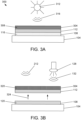
- a photochromic layer 304 is disposed over flexible film layer 112 of the drape.
- photochromic layer 304 may be ink, pigment, and/or a film.
- the photochromic layer 304 is configured to darken upon exposure to specific types of light of sufficient intensity and/or a specific wavelength, most commonly UV radiation. In the absence of activating light, the photochromic layer 304 returns to a clear state.
- Photochromic layer 304 may be made of glass, plastic, polycarbonate, CR-39, or other polymers.
- Photochromic layer 304 may darken significantly within seconds of exposure to triggering light wavelengths and take somewhat longer to clear. Photochromic layer 304 may fall within a range of clear and dark transmittances. For example, photochromic layer 304 may have a transmittance reducing from 87% to 20% while another may a transmittance reducing from 45% to 9%. The transmittance and/or material of photochromic layer 304 may be chosen for use with a particular type of deactivating adhesive layer.
- a glass photochromic layer 304 may achieve photochromic properties through the embedding of microcrystalline silver halides (e.g., silver chloride) within a glass substrate.
- a plastic photochromic layer 304 may organic photochromic molecules (e.g., oxazines and/or naphthopyrans) to achieve the reversible darkening effect.
- organic photochromic molecules can be bathchromically modified to trigger at different wavelengths.
- a CR-39 photochromic layer 304 may block UV light and therefore be selectively impermeable to UV light spectra but may enable the passage of some visible light for the benefit of the being able to see the underlying drape. Additionally, CR-39 is highly resistant to abrasion.
- photochromic layer 304 may darken when exposed to UV light of the intensity present in sunlight, but not in artificial and/or ambient light. Thus, the use of photochromic layer 304 with light deactivating adhesive drape system 300 make it compatible with indoor and outdoor wear/use.
- photochromic layer 304 is configured to change between at least two transmittance states that allow and/or block certain light wavelengths from passing through photochromic layer 304.
- a blocking transmittance state 308 photochromic layer 304 blocks certain UV light wavelengths from reaching adhesive layer 108.
- the triggering wavelength can be a UV light wavelength.
- the triggering wavelength can be in a range of 375 nm - 385 nm although other suitable triggering wavelengths can be used.
- blocking transmittance state 308 blocks one or more visible light wavelengths from passing through to adhesive layer 108, making the photochromic layer 304 at least partially opaque to the human eye.
- the photochromic layer 304 may transition to a non-blocking transmittance state 320.
- photochromic layer 304 allows certain light wavelengths to pass through to the adhesive layer 108.
- non-blocking transmittance state 320 allows certain ambient light 212 wavelengths to pass through to the adhesive layer 108, making the photochromic layer 304 at least partially transparent to the human eye.
- photochromic layer 304 does not transition based upon exposure to a triggering wavelength but instead transitions upon exposure to a particular light intensity over a certain intensity threshold.
- photochromic layer 304 may transition to blocking transmittance state 308 upon exposure to a high light intensity from sun 312 and may transition back to non-blocking transmittance state 320 when the light intensity falls back below the intensity threshold.
- photochromic layer has transitioned back to non-blocking transmittance state 320.
- a UV light source 128 may apply a plurality of light wavelengths 132 to photochromic layer 304.
- the intensity of the light emitted by UV light source 128 is not over the light intensity threshold and does not trigger photochromic layer 304 to transition to blocking transmittance state 308. Because photochromic layer 304 is in non-blocking transmittance state 320, it allows the plurality of light wavelengths 132 to reach adhesive layer 108 and deactivate the adhesive. The flexible film layer 112 and photochromic layer 304 can then be removed from tissue 104 with a force represented by arrows 324.
- a photochromic layer 304 is disposed over filter layer 204 which is disposed over flexible film layer 112 of the drape.
- photochromic layer 304 can be in same layer as filter layer 204 or on one or more opposite sides of filter layer 204.
- filter layer 204 may be able to filter out the deactivating wavelengths (e.g., blue and violet wavelengths) but may not be able to fully filter the wavelengths at a higher light intensity above a certain intensity threshold. Therefore, photochromic layer 304 can block the deactivating wavelengths by transitioning to blocking transmittance state 308 upon exposure to high light intensity wavelengths or exposure to a triggering wavelength as discussed previously. As shown in FIG. 4A , photochromic layer 304 is exposed to the sun 312 and certain light wavelengths 316 that can deactivate the adhesive layer 108.
- the deactivating wavelengths e.g., blue and violet wavelengths
- photochromic layer 304 transitions to blocking transmittance state 308 and blocks all deactivating wavelengths from passing through photochromic layer 304.
- photochromic layer 304 transitions back to non-blocking transmittance state 320.
- photochromic layer 304 can be configured to allow certain wavelengths of visible light (e.g., blue and violet wavelengths) that can deactivate the adhesive layer 104 to pass through photochromic layer 304 when in non-blocking transmittance state 320.
- these deactivating wavelengths are filtered out by filter layer 204 while allowing other non-deactivating wavelengths of visible light (e.g., red and orange wavelengths) to pass through to adhesive layer 108.
- This combination of photochromic layer 304 with filter layer 204 enables a drape configuration that prevents premature deactivation of adhesive layer 108 by blocking all deactivating wavelengths when exposed to both ambient light and UV light, even at high intensities such as sunlight.
- This combination also enables certain visible light wavelengths of ambient light to pass through the drape to enable a user of the drape to be able to see a condition of a wound in tissue 104 covered by the drape.
- photochromic layer 304 is configured to be removable. This enables the adhesive layer 108 to be deactivated at a time a user desires to remove the drape from tissue 104.
- photochromic layer 304 is removed from flexible film layer 112 using an upward or other directional force represented by arrows 324.
- photochromic layer 304 can be a film that can be peeled off a surface of filter layer 204 or flexible film layer 112.
- any suitable method of removing photochromic layer 304 can be used, including the use of solvents and or other chemical compounds.
- photochromic layer 304 may be isopropyl alcohol (IPA) or ethanol soluble, which are readily available in hospital setting. This may allow photochromic layer 304 to dissolve upon application of the solvent prior to dressing removal. These embodiments may facilitate easy removal of the photochromic layer 304 with a minimum of residue.
- IPA isopropyl alcohol
- filter layer 204 can be removed from flexible film layer 112 using an upward or other directional force represented by arrows 208. As shown in FIG.
- adhesive layer 108 upon removal of the photochromic layer 304 and filter layer 204, adhesive layer 108 can be exposed to ambient, visible light 212 that comprises light wavelengths configured to deactivate adhesive layer 108 (e.g., blue and/or violet wavelengths).
- visible light 212 comprises light wavelengths configured to deactivate adhesive layer 108 (e.g., blue and/or violet wavelengths).
- release agents 116 can transition from an unreleased state to a released state 120 and the drape including flexible film layer 112 can be removed from tissue 104.
- an adhesive layer 108 may be used that is deactivated by two types of light wavelengths: one visible and the other UV (i.e., a "pass key" wavelength).
- a 'pass key' wavelength can be applied from an external source.
- the external source of light could be a torch or flashlight like source 128 emitting, for example, UVA wavelengths, which could pass through the filter layer 204 designed to allow passage of the "pass key" wavelength.
- the "pass key" wavelength can be of a wavelength and/or intensity that does not trigger the photochromic layer 304 to transition to a blocking transmittance state. In this way, the "pass key" wavelength can pass through both the photochromic layer 304 and the filter layer 204 to deactivate the adhesive layer 108 and allow for easy removal of the drape.
- FIG. 5 depicts a flowchart illustrating a general process 500 for facilitating removal of a light deactivated adhesive drape system from a tissue 104 in accordance with an illustrative embodiment not according to the invention.
- the process illustrated in FIG. 5 can be implemented by a user of a reduced or negative pressure treatment system.
- the process begins by applying a drape to a tissue 104 (step 505).
- adhesive layer 108 can bind to the tissue 104.
- reduced or negative pressure can be applied to the tissue 104 using a reduced or negative pressure treatment system.
- the process determines whether to remove the drape from the tissue 104 (step 510). If the process determines not to remove the drape from the tissue 104, the process returns to step 510.
- the process applies an external stimulus to the drape, including the adhesive layer 108 coupled to the drape (step 515).
- a release agent 116 can be released in accordance with any of the illustrative embodiments described above to facilitate the removal of the drape from the tissue 104.
- the process then removes the drape from the tissue 104 (step 520).
- FIGs. 6-8 depict flowcharts illustrating processes 600, 700, 800 for facilitating removal of a light deactivated adhesive drape system from a tissue 104 in accordance with an illustrative embodiment not according to the invention.
- process 600 begins by coupling a drape to a tissue (step 604).
- the drape may have a photochromic layer 304 coupled to the drape similar to the embodiments shown in FIGs. 3A-3B .
- process 600 may be useful with adhesives that are not deactivated by visible light but can be deactivated by exposure to certain wavelengths and/or intensities of UV light.
- Process 600 continues by, when the drape is desired to be removed, certain deactivating light wavelengths are applied to the photochromic layer (step 608).
- the photochromic layer can be in a non-blocking transmittance state to enable the deactivating light wavelengths to pass through the photochromic layer to the adhesive layer and deactivate the adhesive.
- the process then enables a removal of the drape from the tissue (step 612).
- process 700 begins by coupling a drape to a tissue 104 (step 704).
- the drape may have a photochromic layer 304 coupled to the drape similar to the embodiments shown in FIGs. 3A-3B .
- process 700 may be useful with photochromic layers that prevent all deactivation wavelengths from reaching the adhesive but may enable some non-deactivating wavelengths to pass through.
- Process 700 continues by, when the drape is desired to be removed, the photochromic layer is removed from the drape (step 708). Once the photochromic layer is removed from the drape, deactivating light wavelengths are applied to the adhesive layer to deactivate the adhesive (step 712). The process then enables a removal of the drape from the tissue (step 716).
- process 800 begins by coupling a drape to a tissue 104 (step 804).
- the drape may have both a photochromic layer 304 and a filter layer 204 coupled to the drape similar to the embodiments shown in FIGs. 4A-4D .
- process 800 may be useful with adhesives that are deactivated by certain wavelengths of visible light (e.g., red and orange) and light intensities below a certain intensity threshold but can be deactivated by exposure to certain wavelengths of visible light (e.g., blue and violet) and/or light intensities above the certain intensity threshold.
- Process 800 continues by, when the drape is desired to be removed, the photochromic layer is removed from the drape (step 808).
- the filter layer is removed from the drape (step 812). Once the filter layer is removed from the drape, deactivating light wavelengths are applied to the adhesive layer to deactivate the adhesive (step 816). The process then enables a removal of the drape from the tissue (step 820).
Landscapes
- Health & Medical Sciences (AREA)
- Life Sciences & Earth Sciences (AREA)
- Surgery (AREA)
- Animal Behavior & Ethology (AREA)
- Engineering & Computer Science (AREA)
- Veterinary Medicine (AREA)
- Public Health (AREA)
- General Health & Medical Sciences (AREA)
- Biomedical Technology (AREA)
- Heart & Thoracic Surgery (AREA)
- Molecular Biology (AREA)
- Medical Informatics (AREA)
- Hematology (AREA)
- Chemical & Material Sciences (AREA)
- Materials Engineering (AREA)
- Epidemiology (AREA)
- Dermatology (AREA)
- Vascular Medicine (AREA)
- Radiation-Therapy Devices (AREA)
Claims (15)
- Système de champ adhésif désactivé par la lumière conçu pour être accouplé à un tissu, le système comprenant :
un champ comprenant :une couche adhésive photosensible présentant au moins un agent de libération disposé au sein de la couche adhésive, dans lequel l'au moins un agent de libération est conçu pour affaiblir une liaison de la couche adhésive au tissu lors d'une exposition à au moins une longueur d'onde d'une pluralité de longueurs d'onde de lumière, etune couche de film flexible ; etune couche photochromique configurée pour s'assombrir lors de l'exposition à au moins l'une d'une pluralité de longueurs d'onde de lumière et changer entre une pluralité d'états de transmittance, dans lequel la pluralité d'états de transmittance inclut :un état de transmittance de blocage configuré pour bloquer le passage de l'au moins une de la pluralité de longueurs d'onde de lumière à travers la couche photochromique ; etun état de transmission non bloquant configuré pour permettre à au moins certaines longueurs d'onde de lumière visible de traverser la couche photochromique. - Système selon la revendication 1, dans lequel la couche photochromique comprend du verre, dans lequel le verre comprend une pluralité d'halogénures microcristallins incorporés.
- Système selon la revendication 1, dans lequel la couche photochromique comprend au moins un polymère, dans lequel l'au moins un polymère est un ou plusieurs parmi le polycarbonate et le CR-39.
- Système selon la revendication 2, dans lequel la pluralité d'halogénures microcristallins incorporés comprend du chlorure d'argent.
- Système selon la revendication 3, dans lequel l'au moins un polymère comprend une pluralité de molécules photochromiques organiques incorporées, dans lequel la pluralité de molécules photochromiques organiques incorporées comprend une ou plusieurs des oxazines et des naphtopyrans.
- Système selon la revendication 1, comprenant en outre :
une couche filtrante conçue pour bloquer l'au moins une de la pluralité de longueurs d'onde de lumière qui activent l'au moins un agent de libération, dans lequel la pluralité de longueurs d'onde de lumière sont des longueurs d'onde comprenant une partie du spectre de lumière visible. - Système selon l'une quelconque des revendications 6, dans lequel la couche filtrante est en outre configurée pour permettre à une pluralité de longueurs d'onde de lumière qui n'activent pas l'au moins un agent de libération de traverser la couche filtrante, dans lequel la pluralité de longueurs d'onde de lumière qui n'activent pas l'au moins un agent de libération sont des longueurs d'onde comprenant des parties rouges à vertes du spectre de lumière visible.
- Système selon l'une quelconque des revendications 6 à 7, dans lequel la couche filtrante est une couche imprimée.
- Système selon l'une quelconque des revendications 6 à 7, dans lequel la couche filtrante est disposée entre le champ et la couche photochromique.
- Système selon l'une quelconque des revendications 6 à 8, la couche filtrante et la couche photochromique bloquent certaines des mêmes longueurs d'onde.
- Système selon l'une quelconque des revendications 6 à 10, dans lequel la couche photochromique et la couche filtrante comprennent une couche combinée unique.
- Système selon l'une quelconque des revendications 1 à 11, dans lequel la couche photochromique peut être retirée d'un ou plusieurs du champ et de la couche filtrante.
- Système selon la revendication 12, dans lequel la couche photochromique est configurée pour être pelée d'une surface externe d'un ou de plusieurs du champ et de la couche filtrante.
- Système selon l'une quelconque des revendications 6 à 13, dans lequel la couche filtrante peut être retirée du champ.
- Système selon la revendication 14, dans lequel la couche filtrante est configurée pour être pelée d'une surface externe du champ.
Applications Claiming Priority (2)
| Application Number | Priority Date | Filing Date | Title |
|---|---|---|---|
| US201762554280P | 2017-09-05 | 2017-09-05 | |
| PCT/US2018/049388 WO2019050855A1 (fr) | 2017-09-05 | 2018-09-04 | Systèmes et procédés permettant d'atténuer la désactivation prématurée par la lumière de champs opératoires adhésifs désactivés par la lumière |
Publications (2)
| Publication Number | Publication Date |
|---|---|
| EP3678620A1 EP3678620A1 (fr) | 2020-07-15 |
| EP3678620B1 true EP3678620B1 (fr) | 2023-07-12 |
Family
ID=63686104
Family Applications (1)
| Application Number | Title | Priority Date | Filing Date |
|---|---|---|---|
| EP18779122.3A Active EP3678620B1 (fr) | 2017-09-05 | 2018-09-04 | Systèmes et procédés permettant d'atténuer la désactivation prématurée par la lumière de champs opératoires adhésifs désactivés par la lumière |
Country Status (3)
| Country | Link |
|---|---|
| US (1) | US11925432B2 (fr) |
| EP (1) | EP3678620B1 (fr) |
| WO (1) | WO2019050855A1 (fr) |
Families Citing this family (22)
| Publication number | Priority date | Publication date | Assignee | Title |
|---|---|---|---|---|
| GB0808376D0 (en) | 2008-05-08 | 2008-06-18 | Bristol Myers Squibb Co | Wound dressing |
| GB0817796D0 (en) | 2008-09-29 | 2008-11-05 | Convatec Inc | wound dressing |
| GB201020236D0 (en) | 2010-11-30 | 2011-01-12 | Convatec Technologies Inc | A composition for detecting biofilms on viable tissues |
| CA2819475C (fr) | 2010-12-08 | 2019-02-12 | Convatec Technologies Inc. | Systeme integre pour evaluer des exsudats de plaie |
| WO2012078724A1 (fr) | 2010-12-08 | 2012-06-14 | Convatec Technologies Inc. | Appareil et procédé d'application d'une pression sur une plaie |
| US9526816B2 (en) | 2010-12-08 | 2016-12-27 | Convatec Technologies Inc. | Wound exudate monitor accessory |
| GB201115182D0 (en) | 2011-09-02 | 2011-10-19 | Trio Healthcare Ltd | Skin contact material |
| GB2497406A (en) | 2011-11-29 | 2013-06-12 | Webtec Converting Llc | Dressing with a perforated binder layer |
| EP2935688A2 (fr) | 2012-12-20 | 2015-10-28 | ConvaTec Technologies Inc. | Traitement de fibres cellulosiques chimiquement modifiées |
| GB2543544A (en) | 2015-10-21 | 2017-04-26 | Brightwake Ltd | Wound dressing |
| CN109310528B (zh) | 2016-03-30 | 2021-07-20 | 康沃特克科技公司 | 检测伤口中的微生物感染 |
| AU2017243601A1 (en) | 2016-03-30 | 2018-11-22 | Acib Gmbh | Detecting microbial infection in wounds |
| GB201608099D0 (en) | 2016-05-09 | 2016-06-22 | Convatec Technologies Inc | Negative pressure wound dressing |
| TW201805034A (zh) | 2016-07-08 | 2018-02-16 | 美商康瓦鐵克科技股份有限公司 | 彈性的負壓系統 |
| MX2019000234A (es) | 2016-07-08 | 2019-09-06 | Convatec Technologies Inc | Aparato de recoleccion de fluidos. |
| EP3481360B1 (fr) | 2016-07-08 | 2022-03-09 | ConvaTec Technologies Inc. | Détecteur de l'écoulement d'un liquide. |
| US12161792B2 (en) | 2017-11-16 | 2024-12-10 | Convatec Limited | Fluid collection apparatus |
| SG11202112292QA (en) | 2019-06-03 | 2021-12-30 | Convatec Ltd | Methods and devices to disrupt and contain pathogens |
| US11331221B2 (en) | 2019-12-27 | 2022-05-17 | Convatec Limited | Negative pressure wound dressing |
| US11771819B2 (en) | 2019-12-27 | 2023-10-03 | Convatec Limited | Low profile filter devices suitable for use in negative pressure wound therapy systems |
| EP4395887A4 (fr) * | 2021-09-02 | 2025-05-21 | Becton, Dickinson and Company | Dispositif de désinfection de la peau et de désactivation d'adhésif |
| US20250323207A1 (en) * | 2024-04-11 | 2025-10-16 | Pulseforge, Inc. | Method for bonding electronics structures during integrated electronics manufacturing |
Family Cites Families (3)
| Publication number | Priority date | Publication date | Assignee | Title |
|---|---|---|---|---|
| GB0518804D0 (en) * | 2005-09-15 | 2005-10-26 | Smith & Nephew | Exudialysis tissue cleanser |
| CN101925369A (zh) * | 2008-02-27 | 2010-12-22 | 凯希特许有限公司 | 用于治愈组织部位处的创伤的系统和方法 |
| GB201310808D0 (en) | 2013-06-17 | 2013-07-31 | Lumina Adhesives Ab | Medical skin coverings, surgical incision drapes, bacterial barriers for coverin wounds, skin closure devices and methods of treatment using same |
-
2018
- 2018-09-04 EP EP18779122.3A patent/EP3678620B1/fr active Active
- 2018-09-04 US US16/644,689 patent/US11925432B2/en active Active
- 2018-09-04 WO PCT/US2018/049388 patent/WO2019050855A1/fr not_active Ceased
Also Published As
| Publication number | Publication date |
|---|---|
| EP3678620A1 (fr) | 2020-07-15 |
| US20200281678A1 (en) | 2020-09-10 |
| US11925432B2 (en) | 2024-03-12 |
| WO2019050855A1 (fr) | 2019-03-14 |
Similar Documents
| Publication | Publication Date | Title |
|---|---|---|
| US11925432B2 (en) | Systems and methods for mitigating premature light deactivation of light deactivated adhesive drapes | |
| EP3678619B1 (fr) | Systèmes et méthodes pour atténuer la désactivation prématurée par la lumière de champs adhésifs désactivés par la lumière à l'aide d'une couche filtrante | |
| US20240382347A1 (en) | Systems and methods for trauma-free application and removal of light deactivated adhesive drapes | |
| US6131208A (en) | Eye protection apparatus and method | |
| RU2711863C2 (ru) | Система двухкомпонентной раневой повязки | |
| RU2704601C2 (ru) | Система раневой повязки | |
| US20040138602A1 (en) | Simplified one-handed preemptive medical procedure site dressing to prevent sharps injuries and exposure to bloodborne pathogens | |
| MX2007002920A (es) | Sistema modular de aposito para heridas. | |
| AU753515B2 (en) | Protective eyewear | |
| AU2014274943B2 (en) | Prophylactic dressing and use of same in the prevention of infection | |
| US20210137628A1 (en) | Systems for inducing and indicating deactivation of adhesive drapes | |
| WO2020055934A1 (fr) | Systèmes et procédés de désactivation de champs opératoires adhésifs sensibles à la lumière | |
| US11937893B2 (en) | Systems and methods for light deactivation and removal of light deactivated adhesive drapes | |
| WO2020018734A1 (fr) | Systèmes et méthodes pour réduire ou modifier laforce de liaison de d'application et de retrait de champs adhésifs désactivés par la lumière | |
| JP4660172B2 (ja) | 救急用絆創膏 | |
| US20220257426A1 (en) | Eyelid closure patches | |
| JP2007160023A (ja) | アイパッチ | |
| MXPA99008746A (es) | Productos protectores para los ojos | |
| HK1029036B (en) | Protective eyewear |
Legal Events
| Date | Code | Title | Description |
|---|---|---|---|
| STAA | Information on the status of an ep patent application or granted ep patent |
Free format text: STATUS: UNKNOWN |
|
| STAA | Information on the status of an ep patent application or granted ep patent |
Free format text: STATUS: THE INTERNATIONAL PUBLICATION HAS BEEN MADE |
|
| PUAI | Public reference made under article 153(3) epc to a published international application that has entered the european phase |
Free format text: ORIGINAL CODE: 0009012 |
|
| STAA | Information on the status of an ep patent application or granted ep patent |
Free format text: STATUS: REQUEST FOR EXAMINATION WAS MADE |
|
| 17P | Request for examination filed |
Effective date: 20200403 |
|
| AK | Designated contracting states |
Kind code of ref document: A1 Designated state(s): AL AT BE BG CH CY CZ DE DK EE ES FI FR GB GR HR HU IE IS IT LI LT LU LV MC MK MT NL NO PL PT RO RS SE SI SK SM TR |
|
| AX | Request for extension of the european patent |
Extension state: BA ME |
|
| RAP1 | Party data changed (applicant data changed or rights of an application transferred) |
Owner name: 3M INNOVATIVE PROPERTIES COMPANY |
|
| DAV | Request for validation of the european patent (deleted) | ||
| DAX | Request for extension of the european patent (deleted) | ||
| REG | Reference to a national code |
Ref country code: DE Ref legal event code: R079 Free format text: PREVIOUS MAIN CLASS: A61F0013020000 Ipc: A61B0046000000 Ref country code: DE Ref legal event code: R079 Ref document number: 602018053254 Country of ref document: DE Free format text: PREVIOUS MAIN CLASS: A61F0013020000 Ipc: A61B0046000000 |
|
| GRAP | Despatch of communication of intention to grant a patent |
Free format text: ORIGINAL CODE: EPIDOSNIGR1 |
|
| STAA | Information on the status of an ep patent application or granted ep patent |
Free format text: STATUS: GRANT OF PATENT IS INTENDED |
|
| RIC1 | Information provided on ipc code assigned before grant |
Ipc: A61B 46/20 20160101ALI20230322BHEP Ipc: A61L 15/58 20060101ALI20230322BHEP Ipc: A61F 13/02 20060101ALI20230322BHEP Ipc: A61B 17/00 20060101ALI20230322BHEP Ipc: A61B 46/00 20160101AFI20230322BHEP |
|
| INTG | Intention to grant announced |
Effective date: 20230417 |
|
| GRAS | Grant fee paid |
Free format text: ORIGINAL CODE: EPIDOSNIGR3 |
|
| GRAA | (expected) grant |
Free format text: ORIGINAL CODE: 0009210 |
|
| STAA | Information on the status of an ep patent application or granted ep patent |
Free format text: STATUS: THE PATENT HAS BEEN GRANTED |
|
| AK | Designated contracting states |
Kind code of ref document: B1 Designated state(s): AL AT BE BG CH CY CZ DE DK EE ES FI FR GB GR HR HU IE IS IT LI LT LU LV MC MK MT NL NO PL PT RO RS SE SI SK SM TR |
|
| REG | Reference to a national code |
Ref country code: CH Ref legal event code: EP |
|
| REG | Reference to a national code |
Ref country code: DE Ref legal event code: R096 Ref document number: 602018053254 Country of ref document: DE |
|
| REG | Reference to a national code |
Ref country code: IE Ref legal event code: FG4D |
|
| REG | Reference to a national code |
Ref country code: LT Ref legal event code: MG9D |
|
| REG | Reference to a national code |
Ref country code: NL Ref legal event code: MP Effective date: 20230712 |
|
| REG | Reference to a national code |
Ref country code: AT Ref legal event code: MK05 Ref document number: 1586270 Country of ref document: AT Kind code of ref document: T Effective date: 20230712 |
|
| PG25 | Lapsed in a contracting state [announced via postgrant information from national office to epo] |
Ref country code: NL Free format text: LAPSE BECAUSE OF FAILURE TO SUBMIT A TRANSLATION OF THE DESCRIPTION OR TO PAY THE FEE WITHIN THE PRESCRIBED TIME-LIMIT Effective date: 20230712 |
|
| PG25 | Lapsed in a contracting state [announced via postgrant information from national office to epo] |
Ref country code: GR Free format text: LAPSE BECAUSE OF FAILURE TO SUBMIT A TRANSLATION OF THE DESCRIPTION OR TO PAY THE FEE WITHIN THE PRESCRIBED TIME-LIMIT Effective date: 20231013 |
|
| PG25 | Lapsed in a contracting state [announced via postgrant information from national office to epo] |
Ref country code: ES Free format text: LAPSE BECAUSE OF FAILURE TO SUBMIT A TRANSLATION OF THE DESCRIPTION OR TO PAY THE FEE WITHIN THE PRESCRIBED TIME-LIMIT Effective date: 20230712 |
|
| PG25 | Lapsed in a contracting state [announced via postgrant information from national office to epo] |
Ref country code: IS Free format text: LAPSE BECAUSE OF FAILURE TO SUBMIT A TRANSLATION OF THE DESCRIPTION OR TO PAY THE FEE WITHIN THE PRESCRIBED TIME-LIMIT Effective date: 20231112 |
|
| PG25 | Lapsed in a contracting state [announced via postgrant information from national office to epo] |
Ref country code: SE Free format text: LAPSE BECAUSE OF FAILURE TO SUBMIT A TRANSLATION OF THE DESCRIPTION OR TO PAY THE FEE WITHIN THE PRESCRIBED TIME-LIMIT Effective date: 20230712 Ref country code: RS Free format text: LAPSE BECAUSE OF FAILURE TO SUBMIT A TRANSLATION OF THE DESCRIPTION OR TO PAY THE FEE WITHIN THE PRESCRIBED TIME-LIMIT Effective date: 20230712 Ref country code: PT Free format text: LAPSE BECAUSE OF FAILURE TO SUBMIT A TRANSLATION OF THE DESCRIPTION OR TO PAY THE FEE WITHIN THE PRESCRIBED TIME-LIMIT Effective date: 20231113 Ref country code: NO Free format text: LAPSE BECAUSE OF FAILURE TO SUBMIT A TRANSLATION OF THE DESCRIPTION OR TO PAY THE FEE WITHIN THE PRESCRIBED TIME-LIMIT Effective date: 20231012 Ref country code: LV Free format text: LAPSE BECAUSE OF FAILURE TO SUBMIT A TRANSLATION OF THE DESCRIPTION OR TO PAY THE FEE WITHIN THE PRESCRIBED TIME-LIMIT Effective date: 20230712 Ref country code: LT Free format text: LAPSE BECAUSE OF FAILURE TO SUBMIT A TRANSLATION OF THE DESCRIPTION OR TO PAY THE FEE WITHIN THE PRESCRIBED TIME-LIMIT Effective date: 20230712 Ref country code: IS Free format text: LAPSE BECAUSE OF FAILURE TO SUBMIT A TRANSLATION OF THE DESCRIPTION OR TO PAY THE FEE WITHIN THE PRESCRIBED TIME-LIMIT Effective date: 20231112 Ref country code: HR Free format text: LAPSE BECAUSE OF FAILURE TO SUBMIT A TRANSLATION OF THE DESCRIPTION OR TO PAY THE FEE WITHIN THE PRESCRIBED TIME-LIMIT Effective date: 20230712 Ref country code: GR Free format text: LAPSE BECAUSE OF FAILURE TO SUBMIT A TRANSLATION OF THE DESCRIPTION OR TO PAY THE FEE WITHIN THE PRESCRIBED TIME-LIMIT Effective date: 20231013 Ref country code: FI Free format text: LAPSE BECAUSE OF FAILURE TO SUBMIT A TRANSLATION OF THE DESCRIPTION OR TO PAY THE FEE WITHIN THE PRESCRIBED TIME-LIMIT Effective date: 20230712 Ref country code: ES Free format text: LAPSE BECAUSE OF FAILURE TO SUBMIT A TRANSLATION OF THE DESCRIPTION OR TO PAY THE FEE WITHIN THE PRESCRIBED TIME-LIMIT Effective date: 20230712 Ref country code: AT Free format text: LAPSE BECAUSE OF FAILURE TO SUBMIT A TRANSLATION OF THE DESCRIPTION OR TO PAY THE FEE WITHIN THE PRESCRIBED TIME-LIMIT Effective date: 20230712 |
|
| PG25 | Lapsed in a contracting state [announced via postgrant information from national office to epo] |
Ref country code: PL Free format text: LAPSE BECAUSE OF FAILURE TO SUBMIT A TRANSLATION OF THE DESCRIPTION OR TO PAY THE FEE WITHIN THE PRESCRIBED TIME-LIMIT Effective date: 20230712 |
|
| RAP2 | Party data changed (patent owner data changed or rights of a patent transferred) |
Owner name: SOLVENTUM INTELLECTUAL PROPERTIES COMPANY |
|
| REG | Reference to a national code |
Ref country code: DE Ref legal event code: R081 Ref document number: 602018053254 Country of ref document: DE Owner name: SOLVENTUM INTELLECTUAL PROPERTIES CO. (N.D.GES, US Free format text: FORMER OWNER: 3M INNOVATIVE PROPERTIES COMPANY, ST. PAUL, MN, US |
|
| REG | Reference to a national code |
Ref country code: DE Ref legal event code: R097 Ref document number: 602018053254 Country of ref document: DE |
|
| PG25 | Lapsed in a contracting state [announced via postgrant information from national office to epo] |
Ref country code: SM Free format text: LAPSE BECAUSE OF FAILURE TO SUBMIT A TRANSLATION OF THE DESCRIPTION OR TO PAY THE FEE WITHIN THE PRESCRIBED TIME-LIMIT Effective date: 20230712 Ref country code: RO Free format text: LAPSE BECAUSE OF FAILURE TO SUBMIT A TRANSLATION OF THE DESCRIPTION OR TO PAY THE FEE WITHIN THE PRESCRIBED TIME-LIMIT Effective date: 20230712 Ref country code: EE Free format text: LAPSE BECAUSE OF FAILURE TO SUBMIT A TRANSLATION OF THE DESCRIPTION OR TO PAY THE FEE WITHIN THE PRESCRIBED TIME-LIMIT Effective date: 20230712 Ref country code: DK Free format text: LAPSE BECAUSE OF FAILURE TO SUBMIT A TRANSLATION OF THE DESCRIPTION OR TO PAY THE FEE WITHIN THE PRESCRIBED TIME-LIMIT Effective date: 20230712 Ref country code: CZ Free format text: LAPSE BECAUSE OF FAILURE TO SUBMIT A TRANSLATION OF THE DESCRIPTION OR TO PAY THE FEE WITHIN THE PRESCRIBED TIME-LIMIT Effective date: 20230712 Ref country code: SK Free format text: LAPSE BECAUSE OF FAILURE TO SUBMIT A TRANSLATION OF THE DESCRIPTION OR TO PAY THE FEE WITHIN THE PRESCRIBED TIME-LIMIT Effective date: 20230712 |
|
| REG | Reference to a national code |
Ref country code: CH Ref legal event code: PL |
|
| PG25 | Lapsed in a contracting state [announced via postgrant information from national office to epo] |
Ref country code: LU Free format text: LAPSE BECAUSE OF NON-PAYMENT OF DUE FEES Effective date: 20230904 |
|
| PLBE | No opposition filed within time limit |
Free format text: ORIGINAL CODE: 0009261 |
|
| STAA | Information on the status of an ep patent application or granted ep patent |
Free format text: STATUS: NO OPPOSITION FILED WITHIN TIME LIMIT |
|
| REG | Reference to a national code |
Ref country code: BE Ref legal event code: MM Effective date: 20230930 |
|
| PG25 | Lapsed in a contracting state [announced via postgrant information from national office to epo] |
Ref country code: MC Free format text: LAPSE BECAUSE OF FAILURE TO SUBMIT A TRANSLATION OF THE DESCRIPTION OR TO PAY THE FEE WITHIN THE PRESCRIBED TIME-LIMIT Effective date: 20230712 Ref country code: LU Free format text: LAPSE BECAUSE OF NON-PAYMENT OF DUE FEES Effective date: 20230904 Ref country code: IT Free format text: LAPSE BECAUSE OF FAILURE TO SUBMIT A TRANSLATION OF THE DESCRIPTION OR TO PAY THE FEE WITHIN THE PRESCRIBED TIME-LIMIT Effective date: 20230712 |
|
| 26N | No opposition filed |
Effective date: 20240415 |
|
| GBPC | Gb: european patent ceased through non-payment of renewal fee |
Effective date: 20231012 |
|
| REG | Reference to a national code |
Ref country code: IE Ref legal event code: MM4A |
|
| PG25 | Lapsed in a contracting state [announced via postgrant information from national office to epo] |
Ref country code: IE Free format text: LAPSE BECAUSE OF NON-PAYMENT OF DUE FEES Effective date: 20230904 |
|
| PG25 | Lapsed in a contracting state [announced via postgrant information from national office to epo] |
Ref country code: GB Free format text: LAPSE BECAUSE OF NON-PAYMENT OF DUE FEES Effective date: 20231012 |
|
| PG25 | Lapsed in a contracting state [announced via postgrant information from national office to epo] |
Ref country code: CH Free format text: LAPSE BECAUSE OF NON-PAYMENT OF DUE FEES Effective date: 20230930 |
|
| PG25 | Lapsed in a contracting state [announced via postgrant information from national office to epo] |
Ref country code: IE Free format text: LAPSE BECAUSE OF NON-PAYMENT OF DUE FEES Effective date: 20230904 Ref country code: GB Free format text: LAPSE BECAUSE OF NON-PAYMENT OF DUE FEES Effective date: 20231012 Ref country code: FR Free format text: LAPSE BECAUSE OF NON-PAYMENT OF DUE FEES Effective date: 20230912 Ref country code: CH Free format text: LAPSE BECAUSE OF NON-PAYMENT OF DUE FEES Effective date: 20230930 Ref country code: SI Free format text: LAPSE BECAUSE OF FAILURE TO SUBMIT A TRANSLATION OF THE DESCRIPTION OR TO PAY THE FEE WITHIN THE PRESCRIBED TIME-LIMIT Effective date: 20230712 |
|
| PG25 | Lapsed in a contracting state [announced via postgrant information from national office to epo] |
Ref country code: BE Free format text: LAPSE BECAUSE OF NON-PAYMENT OF DUE FEES Effective date: 20230930 |
|
| PG25 | Lapsed in a contracting state [announced via postgrant information from national office to epo] |
Ref country code: BG Free format text: LAPSE BECAUSE OF FAILURE TO SUBMIT A TRANSLATION OF THE DESCRIPTION OR TO PAY THE FEE WITHIN THE PRESCRIBED TIME-LIMIT Effective date: 20230712 |
|
| PG25 | Lapsed in a contracting state [announced via postgrant information from national office to epo] |
Ref country code: BG Free format text: LAPSE BECAUSE OF FAILURE TO SUBMIT A TRANSLATION OF THE DESCRIPTION OR TO PAY THE FEE WITHIN THE PRESCRIBED TIME-LIMIT Effective date: 20230712 |
|
| PG25 | Lapsed in a contracting state [announced via postgrant information from national office to epo] |
Ref country code: CY Free format text: LAPSE BECAUSE OF FAILURE TO SUBMIT A TRANSLATION OF THE DESCRIPTION OR TO PAY THE FEE WITHIN THE PRESCRIBED TIME-LIMIT; INVALID AB INITIO Effective date: 20180904 |
|
| PG25 | Lapsed in a contracting state [announced via postgrant information from national office to epo] |
Ref country code: HU Free format text: LAPSE BECAUSE OF FAILURE TO SUBMIT A TRANSLATION OF THE DESCRIPTION OR TO PAY THE FEE WITHIN THE PRESCRIBED TIME-LIMIT; INVALID AB INITIO Effective date: 20180904 |
|
| PGFP | Annual fee paid to national office [announced via postgrant information from national office to epo] |
Ref country code: DE Payment date: 20250820 Year of fee payment: 8 |
|
| PG25 | Lapsed in a contracting state [announced via postgrant information from national office to epo] |
Ref country code: TR Free format text: LAPSE BECAUSE OF FAILURE TO SUBMIT A TRANSLATION OF THE DESCRIPTION OR TO PAY THE FEE WITHIN THE PRESCRIBED TIME-LIMIT Effective date: 20230712 |