EP3679111B1 - Milieu cristallin liquide et écran à cristaux liquides comportant ledit milieu - Google Patents
Milieu cristallin liquide et écran à cristaux liquides comportant ledit milieu Download PDFInfo
- Publication number
- EP3679111B1 EP3679111B1 EP18765116.1A EP18765116A EP3679111B1 EP 3679111 B1 EP3679111 B1 EP 3679111B1 EP 18765116 A EP18765116 A EP 18765116A EP 3679111 B1 EP3679111 B1 EP 3679111B1
- Authority
- EP
- European Patent Office
- Prior art keywords
- compounds
- denotes
- atoms
- mixture
- formula
- Prior art date
- Legal status (The legal status is an assumption and is not a legal conclusion. Google has not performed a legal analysis and makes no representation as to the accuracy of the status listed.)
- Active
Links
Classifications
-
- C—CHEMISTRY; METALLURGY
- C09—DYES; PAINTS; POLISHES; NATURAL RESINS; ADHESIVES; COMPOSITIONS NOT OTHERWISE PROVIDED FOR; APPLICATIONS OF MATERIALS NOT OTHERWISE PROVIDED FOR
- C09K—MATERIALS FOR MISCELLANEOUS APPLICATIONS, NOT PROVIDED FOR ELSEWHERE
- C09K19/00—Liquid crystal materials
- C09K19/04—Liquid crystal materials characterised by the chemical structure of the liquid crystal components, e.g. by a specific unit
- C09K19/06—Non-steroidal liquid crystal compounds
- C09K19/08—Non-steroidal liquid crystal compounds containing at least two non-condensed rings
- C09K19/30—Non-steroidal liquid crystal compounds containing at least two non-condensed rings containing saturated or unsaturated non-aromatic rings, e.g. cyclohexane rings
- C09K19/3098—Unsaturated non-aromatic rings, e.g. cyclohexene rings
-
- C—CHEMISTRY; METALLURGY
- C09—DYES; PAINTS; POLISHES; NATURAL RESINS; ADHESIVES; COMPOSITIONS NOT OTHERWISE PROVIDED FOR; APPLICATIONS OF MATERIALS NOT OTHERWISE PROVIDED FOR
- C09K—MATERIALS FOR MISCELLANEOUS APPLICATIONS, NOT PROVIDED FOR ELSEWHERE
- C09K19/00—Liquid crystal materials
- C09K19/04—Liquid crystal materials characterised by the chemical structure of the liquid crystal components, e.g. by a specific unit
- C09K19/06—Non-steroidal liquid crystal compounds
- C09K19/34—Non-steroidal liquid crystal compounds containing at least one heterocyclic ring
- C09K19/3491—Non-steroidal liquid crystal compounds containing at least one heterocyclic ring having sulfur as hetero atom
-
- C—CHEMISTRY; METALLURGY
- C09—DYES; PAINTS; POLISHES; NATURAL RESINS; ADHESIVES; COMPOSITIONS NOT OTHERWISE PROVIDED FOR; APPLICATIONS OF MATERIALS NOT OTHERWISE PROVIDED FOR
- C09K—MATERIALS FOR MISCELLANEOUS APPLICATIONS, NOT PROVIDED FOR ELSEWHERE
- C09K19/00—Liquid crystal materials
- C09K19/04—Liquid crystal materials characterised by the chemical structure of the liquid crystal components, e.g. by a specific unit
- C09K19/06—Non-steroidal liquid crystal compounds
- C09K19/08—Non-steroidal liquid crystal compounds containing at least two non-condensed rings
- C09K19/10—Non-steroidal liquid crystal compounds containing at least two non-condensed rings containing at least two benzene rings
- C09K19/12—Non-steroidal liquid crystal compounds containing at least two non-condensed rings containing at least two benzene rings at least two benzene rings directly linked, e.g. biphenyls
-
- C—CHEMISTRY; METALLURGY
- C09—DYES; PAINTS; POLISHES; NATURAL RESINS; ADHESIVES; COMPOSITIONS NOT OTHERWISE PROVIDED FOR; APPLICATIONS OF MATERIALS NOT OTHERWISE PROVIDED FOR
- C09K—MATERIALS FOR MISCELLANEOUS APPLICATIONS, NOT PROVIDED FOR ELSEWHERE
- C09K19/00—Liquid crystal materials
- C09K19/04—Liquid crystal materials characterised by the chemical structure of the liquid crystal components, e.g. by a specific unit
- C09K19/0403—Liquid crystal materials characterised by the chemical structure of the liquid crystal components, e.g. by a specific unit the structure containing one or more specific, optionally substituted ring or ring systems
-
- C—CHEMISTRY; METALLURGY
- C09—DYES; PAINTS; POLISHES; NATURAL RESINS; ADHESIVES; COMPOSITIONS NOT OTHERWISE PROVIDED FOR; APPLICATIONS OF MATERIALS NOT OTHERWISE PROVIDED FOR
- C09K—MATERIALS FOR MISCELLANEOUS APPLICATIONS, NOT PROVIDED FOR ELSEWHERE
- C09K19/00—Liquid crystal materials
- C09K19/04—Liquid crystal materials characterised by the chemical structure of the liquid crystal components, e.g. by a specific unit
- C09K19/06—Non-steroidal liquid crystal compounds
- C09K19/08—Non-steroidal liquid crystal compounds containing at least two non-condensed rings
- C09K19/30—Non-steroidal liquid crystal compounds containing at least two non-condensed rings containing saturated or unsaturated non-aromatic rings, e.g. cyclohexane rings
-
- C—CHEMISTRY; METALLURGY
- C09—DYES; PAINTS; POLISHES; NATURAL RESINS; ADHESIVES; COMPOSITIONS NOT OTHERWISE PROVIDED FOR; APPLICATIONS OF MATERIALS NOT OTHERWISE PROVIDED FOR
- C09K—MATERIALS FOR MISCELLANEOUS APPLICATIONS, NOT PROVIDED FOR ELSEWHERE
- C09K19/00—Liquid crystal materials
- C09K19/04—Liquid crystal materials characterised by the chemical structure of the liquid crystal components, e.g. by a specific unit
- C09K19/06—Non-steroidal liquid crystal compounds
- C09K19/32—Non-steroidal liquid crystal compounds containing condensed ring systems, i.e. fused, bridged or spiro ring systems
-
- C—CHEMISTRY; METALLURGY
- C09—DYES; PAINTS; POLISHES; NATURAL RESINS; ADHESIVES; COMPOSITIONS NOT OTHERWISE PROVIDED FOR; APPLICATIONS OF MATERIALS NOT OTHERWISE PROVIDED FOR
- C09K—MATERIALS FOR MISCELLANEOUS APPLICATIONS, NOT PROVIDED FOR ELSEWHERE
- C09K19/00—Liquid crystal materials
- C09K19/04—Liquid crystal materials characterised by the chemical structure of the liquid crystal components, e.g. by a specific unit
- C09K19/06—Non-steroidal liquid crystal compounds
- C09K19/34—Non-steroidal liquid crystal compounds containing at least one heterocyclic ring
- C09K19/3402—Non-steroidal liquid crystal compounds containing at least one heterocyclic ring having oxygen as hetero atom
-
- C—CHEMISTRY; METALLURGY
- C09—DYES; PAINTS; POLISHES; NATURAL RESINS; ADHESIVES; COMPOSITIONS NOT OTHERWISE PROVIDED FOR; APPLICATIONS OF MATERIALS NOT OTHERWISE PROVIDED FOR
- C09K—MATERIALS FOR MISCELLANEOUS APPLICATIONS, NOT PROVIDED FOR ELSEWHERE
- C09K19/00—Liquid crystal materials
- C09K19/04—Liquid crystal materials characterised by the chemical structure of the liquid crystal components, e.g. by a specific unit
- C09K19/06—Non-steroidal liquid crystal compounds
- C09K19/34—Non-steroidal liquid crystal compounds containing at least one heterocyclic ring
- C09K19/3441—Non-steroidal liquid crystal compounds containing at least one heterocyclic ring having nitrogen as hetero atom
-
- C—CHEMISTRY; METALLURGY
- C09—DYES; PAINTS; POLISHES; NATURAL RESINS; ADHESIVES; COMPOSITIONS NOT OTHERWISE PROVIDED FOR; APPLICATIONS OF MATERIALS NOT OTHERWISE PROVIDED FOR
- C09K—MATERIALS FOR MISCELLANEOUS APPLICATIONS, NOT PROVIDED FOR ELSEWHERE
- C09K19/00—Liquid crystal materials
- C09K19/04—Liquid crystal materials characterised by the chemical structure of the liquid crystal components, e.g. by a specific unit
- C09K19/06—Non-steroidal liquid crystal compounds
- C09K19/34—Non-steroidal liquid crystal compounds containing at least one heterocyclic ring
- C09K19/3441—Non-steroidal liquid crystal compounds containing at least one heterocyclic ring having nitrogen as hetero atom
- C09K19/345—Non-steroidal liquid crystal compounds containing at least one heterocyclic ring having nitrogen as hetero atom the heterocyclic ring being a six-membered aromatic ring containing two nitrogen atoms
- C09K19/3458—Uncondensed pyrimidines
-
- C—CHEMISTRY; METALLURGY
- C09—DYES; PAINTS; POLISHES; NATURAL RESINS; ADHESIVES; COMPOSITIONS NOT OTHERWISE PROVIDED FOR; APPLICATIONS OF MATERIALS NOT OTHERWISE PROVIDED FOR
- C09K—MATERIALS FOR MISCELLANEOUS APPLICATIONS, NOT PROVIDED FOR ELSEWHERE
- C09K19/00—Liquid crystal materials
- C09K19/52—Liquid crystal materials characterised by components which are not liquid crystals, e.g. additives with special physical aspect: solvents, solid particles
- C09K19/58—Dopants or charge transfer agents
- C09K19/586—Optically active dopants; chiral dopants
-
- C—CHEMISTRY; METALLURGY
- C09—DYES; PAINTS; POLISHES; NATURAL RESINS; ADHESIVES; COMPOSITIONS NOT OTHERWISE PROVIDED FOR; APPLICATIONS OF MATERIALS NOT OTHERWISE PROVIDED FOR
- C09K—MATERIALS FOR MISCELLANEOUS APPLICATIONS, NOT PROVIDED FOR ELSEWHERE
- C09K19/00—Liquid crystal materials
- C09K19/04—Liquid crystal materials characterised by the chemical structure of the liquid crystal components, e.g. by a specific unit
- C09K2019/0444—Liquid crystal materials characterised by the chemical structure of the liquid crystal components, e.g. by a specific unit characterized by a linking chain between rings or ring systems, a bridging chain between extensive mesogenic moieties or an end chain group
- C09K2019/0466—Liquid crystal materials characterised by the chemical structure of the liquid crystal components, e.g. by a specific unit characterized by a linking chain between rings or ring systems, a bridging chain between extensive mesogenic moieties or an end chain group the linking chain being a -CF2O- chain
-
- C—CHEMISTRY; METALLURGY
- C09—DYES; PAINTS; POLISHES; NATURAL RESINS; ADHESIVES; COMPOSITIONS NOT OTHERWISE PROVIDED FOR; APPLICATIONS OF MATERIALS NOT OTHERWISE PROVIDED FOR
- C09K—MATERIALS FOR MISCELLANEOUS APPLICATIONS, NOT PROVIDED FOR ELSEWHERE
- C09K19/00—Liquid crystal materials
- C09K19/04—Liquid crystal materials characterised by the chemical structure of the liquid crystal components, e.g. by a specific unit
- C09K19/06—Non-steroidal liquid crystal compounds
- C09K19/08—Non-steroidal liquid crystal compounds containing at least two non-condensed rings
- C09K19/10—Non-steroidal liquid crystal compounds containing at least two non-condensed rings containing at least two benzene rings
- C09K19/12—Non-steroidal liquid crystal compounds containing at least two non-condensed rings containing at least two benzene rings at least two benzene rings directly linked, e.g. biphenyls
- C09K2019/121—Compounds containing phenylene-1,4-diyl (-Ph-)
- C09K2019/122—Ph-Ph
-
- C—CHEMISTRY; METALLURGY
- C09—DYES; PAINTS; POLISHES; NATURAL RESINS; ADHESIVES; COMPOSITIONS NOT OTHERWISE PROVIDED FOR; APPLICATIONS OF MATERIALS NOT OTHERWISE PROVIDED FOR
- C09K—MATERIALS FOR MISCELLANEOUS APPLICATIONS, NOT PROVIDED FOR ELSEWHERE
- C09K19/00—Liquid crystal materials
- C09K19/04—Liquid crystal materials characterised by the chemical structure of the liquid crystal components, e.g. by a specific unit
- C09K19/06—Non-steroidal liquid crystal compounds
- C09K19/08—Non-steroidal liquid crystal compounds containing at least two non-condensed rings
- C09K19/30—Non-steroidal liquid crystal compounds containing at least two non-condensed rings containing saturated or unsaturated non-aromatic rings, e.g. cyclohexane rings
- C09K19/3001—Cyclohexane rings
- C09K19/3003—Compounds containing at least two rings in which the different rings are directly linked (covalent bond)
- C09K2019/301—Cy-Cy-Ph
-
- C—CHEMISTRY; METALLURGY
- C09—DYES; PAINTS; POLISHES; NATURAL RESINS; ADHESIVES; COMPOSITIONS NOT OTHERWISE PROVIDED FOR; APPLICATIONS OF MATERIALS NOT OTHERWISE PROVIDED FOR
- C09K—MATERIALS FOR MISCELLANEOUS APPLICATIONS, NOT PROVIDED FOR ELSEWHERE
- C09K19/00—Liquid crystal materials
- C09K19/04—Liquid crystal materials characterised by the chemical structure of the liquid crystal components, e.g. by a specific unit
- C09K19/06—Non-steroidal liquid crystal compounds
- C09K19/08—Non-steroidal liquid crystal compounds containing at least two non-condensed rings
- C09K19/30—Non-steroidal liquid crystal compounds containing at least two non-condensed rings containing saturated or unsaturated non-aromatic rings, e.g. cyclohexane rings
- C09K19/3001—Cyclohexane rings
- C09K19/3003—Compounds containing at least two rings in which the different rings are directly linked (covalent bond)
- C09K2019/3016—Cy-Ph-Ph
-
- C—CHEMISTRY; METALLURGY
- C09—DYES; PAINTS; POLISHES; NATURAL RESINS; ADHESIVES; COMPOSITIONS NOT OTHERWISE PROVIDED FOR; APPLICATIONS OF MATERIALS NOT OTHERWISE PROVIDED FOR
- C09K—MATERIALS FOR MISCELLANEOUS APPLICATIONS, NOT PROVIDED FOR ELSEWHERE
- C09K19/00—Liquid crystal materials
- C09K19/04—Liquid crystal materials characterised by the chemical structure of the liquid crystal components, e.g. by a specific unit
- C09K19/06—Non-steroidal liquid crystal compounds
- C09K19/08—Non-steroidal liquid crystal compounds containing at least two non-condensed rings
- C09K19/30—Non-steroidal liquid crystal compounds containing at least two non-condensed rings containing saturated or unsaturated non-aromatic rings, e.g. cyclohexane rings
- C09K19/3001—Cyclohexane rings
- C09K19/3003—Compounds containing at least two rings in which the different rings are directly linked (covalent bond)
- C09K2019/3027—Compounds comprising 1,4-cyclohexylene and 2,3-difluoro-1,4-phenylene
-
- C—CHEMISTRY; METALLURGY
- C09—DYES; PAINTS; POLISHES; NATURAL RESINS; ADHESIVES; COMPOSITIONS NOT OTHERWISE PROVIDED FOR; APPLICATIONS OF MATERIALS NOT OTHERWISE PROVIDED FOR
- C09K—MATERIALS FOR MISCELLANEOUS APPLICATIONS, NOT PROVIDED FOR ELSEWHERE
- C09K19/00—Liquid crystal materials
- C09K19/04—Liquid crystal materials characterised by the chemical structure of the liquid crystal components, e.g. by a specific unit
- C09K19/06—Non-steroidal liquid crystal compounds
- C09K19/34—Non-steroidal liquid crystal compounds containing at least one heterocyclic ring
- C09K19/3402—Non-steroidal liquid crystal compounds containing at least one heterocyclic ring having oxygen as hetero atom
- C09K19/3405—Non-steroidal liquid crystal compounds containing at least one heterocyclic ring having oxygen as hetero atom the heterocyclic ring being a five-membered ring
- C09K2019/3408—Five-membered ring with oxygen(s) in fused, bridged or spiro ring systems
-
- C—CHEMISTRY; METALLURGY
- C09—DYES; PAINTS; POLISHES; NATURAL RESINS; ADHESIVES; COMPOSITIONS NOT OTHERWISE PROVIDED FOR; APPLICATIONS OF MATERIALS NOT OTHERWISE PROVIDED FOR
- C09K—MATERIALS FOR MISCELLANEOUS APPLICATIONS, NOT PROVIDED FOR ELSEWHERE
- C09K19/00—Liquid crystal materials
- C09K19/04—Liquid crystal materials characterised by the chemical structure of the liquid crystal components, e.g. by a specific unit
- C09K19/06—Non-steroidal liquid crystal compounds
- C09K19/34—Non-steroidal liquid crystal compounds containing at least one heterocyclic ring
- C09K19/3402—Non-steroidal liquid crystal compounds containing at least one heterocyclic ring having oxygen as hetero atom
- C09K2019/3422—Non-steroidal liquid crystal compounds containing at least one heterocyclic ring having oxygen as hetero atom the heterocyclic ring being a six-membered ring
Definitions
- the present invention relates to novel liquid crystalline media, in particular for use in liquid crystal displays, and to these liquid-crystal displays, particularly to liquid-crystal displays which use the IPS (in- p lane s witching) or, preferably, the FFS ( f ringe f ield s witching) effect using dielectrically positive liquid crystals.
- IPS in- p lane s witching
- FFS f ringe f ield s witching
- SB-FFS super brightness FFS
- dielectrically positive liquid crystals which comprise one or more compounds having at the same time a high dielectric constant parallel to the molecular director and perpendicular to the molecular director, leading to a large average dielectric constant and a high dielectric ratio and, preferably, to a relatively small dielectric anisotropy at the same time.
- the liquid crystalline media optionally additionally comprise dielectrically negative, dielectrically neutral compounds or both.
- the liquid crystalline media are used in a homogeneous (i.e. planar) initial alignment.
- the liquid-crystal media according to the invention have a positive dielectric anisotropy and comprise compounds having at the same time large dielectric constants parallel and perpendicular to the molecular director.
- the media are distinguished by a particularly high transmission and reduced response time in respective displays, which is brought about by their unique combination of physical properties, especially by their dielectric properties and in particular by their high ratio of ( ⁇ ⁇ / ⁇ av. ) respectively of the high values of their dielectric ratio ( ⁇ ⁇ / ⁇ ). This also leads to their excellent performance in the displays according to the invention.
- IPS and FFS displays using dielectrically positive liquid crystals are well known in the field and have been widely adopted for various types of displays like e.g. desk top monitors and TV sets, but also for mobile applications.
- IPS and in particular FFS displays using dielectrically negative liquid crystals are widely adopted.
- the latter ones are sometimes also called UB-FFS (ultra bright FFS).
- UB-FFS ultra bright FFS
- Such displays are disclosed e.g. in US 2013/0207038 A1 . These displays are characterized by a markedly increased transmission compared to the previously used IPS- and FFS displays, which have been dielectrically positive liquid crystals.
- These displays using dielectrically negative liquid crystals have the severe disadvantage of requiring a higher operation voltage than the respective displays using dielectrically positive liquid crystals.
- Liquid crystalline media used for UB-FFS have a dielectric anisotropy of -0.5 or less and preferably of -1.5 or less.
- Liquid crystalline media used for HB-FFS have a dielectric anisotropy of 0.5 or more and preferably of 1.5 or more.
- Respective media comprising both dielectrically negative and dielectrically positive liquid crystalline compounds, respectively mesogenic compounds are disclosed e.g. in US 2013/0207038 A1 . These media feature rather large values of ⁇ ⁇ and of ⁇ av . already, however, their ratio of ( ⁇ ⁇ / ⁇ ) is relatively small.
- the IPS or the FFS effect with dielectrically positive liquid crystalline media in a homogeneous alignment are preferred.
- LC phases which can be used industrially are required to have a liquid-crystalline mesophase in a suitable temperature range and low viscosity.
- None of the series of compounds having a liquid-crystalline mesophase that have been disclosed hitherto includes a single compound which meets all these requirements. Mixtures of two to 25, preferably three to 18, compounds are therefore generally prepared in order to obtain substances which can be used as LC phases.
- Matrix liquid-crystal displays are known.
- Non-linear elements which can be used for individual switching of the individual pixels are, for example, active elements (i.e. transistors).
- active matrix is then used, where in general use is made of thin-film transistors (TFTs), which are generally arranged on a glass plate as substrate.
- TFTs comprising compound semiconductors, such as, for example, CdSe, or metal oxides like ZnO or TFTs based on polycrystalline and, inter alia, amorphous silicon.
- CdSe compound semiconductors
- metal oxides like ZnO metal oxides like ZnO
- TFTs based on polycrystalline and, inter alia, amorphous silicon The latter technology currently has the greatest commercial importance worldwide.
- the TFT matrix is applied to the inside of one glass plate of the display, while the other glass plate carries the transparent counter electrode on its inside. Compared with the size of the pixel electrode, the TFT is very small and has virtually no adverse effect on the image.
- This technology can also be extended to fully colour-capable displays, in which a mosaic of red, green and blue filters is arranged in such a way that a filter element is located opposite each switchable pixel.
- the TFT displays most used hitherto usually operate with crossed polarisers in transmission and are backlit.
- ECB (or VAN) cells or FFS cells are used, whereas monitors usually use IPS cells or TN (twisted nematic) cells, and notebooks, laptops and mobile applications usually use TN, VA or FFS cells.
- MLC displays of this type are particularly suitable for TV applications, monitors and notebooks or for displays with a high information density, for example in automobile manufacture or aircraft construction.
- problems regarding the angle dependence of the contrast and the response times difficulties also arise in MLC displays due to insufficiently high specific resistance of the liquid-crystal mixtures [ TOGASHI, S., SEKIGUCHI, K., TANABE, H., YAMAMOTO, E., SORIMACHI, K., TAJIMA, E., WATANABE, H., SHIMIZU, H., Proc. Eurodisplay 84, Sept. 1984: A 210-288 Matrix LCD Controlled by Double Stage Diode Rings, pp.
- VAN v ertically aligned nematic
- IPS displays for example: Yeo, S.D., Paper 15.3: "An LC Display for the TV Application", SID 2004 International Symposium, Digest of Technical Papers, XXXV, Book II, pp. 758 and 759
- TN displays as one of the three more recent types of liquid-crystal display that are currently the most important, in particular for television applications.
- MVA multi-domain vertical alignment, for example: Yoshide, H. et al., Paper 3.1: “MVA LCD for Notebook or Mobile PCs ", SID 2004 International Symposium, Digest of Technical Papers, XXXV, Book I, pp. 6 to 9 , and Liu, C.T. et al., Paper 15.1: "A 46-inch TFT-LCD HDTV Technology ", SID 2004 International Symposium, Digest of Technical Papers, XXXV, Book II, pp.
- PVA patterned vertical alignment, for example: Kim, Sang Soo, Paper 15.4: “Super PVA Sets New State-of-the-Art for LCD-TV", SID 2004 International Symposium, Digest of Technical Papers, XXXV, Book II, pp. 760 to 763
- ASV advanced super view, for example: Shigeta, Mitzuhiro and Fukuoka, Hirofumi, Paper 15.2: "Development of High Quality LCDTV", SID 2004 International Symposium, Digest of Technical Papers, XXXV, Book II, pp. 754 to 757 ).
- PAVA photo-alignment VA
- PSVA polymer-stabilized VA
- ECB displays like ASV displays, use liquid-crystalline media having negative dielectric anisotropy ( ⁇ ), whereas TN and to date all conventional IPS displays use liquid-crystalline media having positive dielectric anisotropy.
- IPS and FFS displays utilizing dielectrically negative liquid crystalline media.
- liquid crystals are used as dielectrics, whose optical properties change reversibly on application of an electrical voltage.
- liquid-crystal media which are generally predominantly composed of liquid-crystal compounds, all of which have the same sign of the dielectric anisotropy and have the highest possible value of the dielectric anisotropy.
- at most relatively small proportions of neutral compounds and if possible no compounds having a sign of the dielectric anisotropy which is opposite to that of the medium are employed.
- liquid-crystal media having negative dielectric anisotropy e.g. for ECB or UB-FFS displays
- predominantly compounds having negative dielectric anisotropy are thus employed.
- the respective liquid-crystalline media employed generally consist predominantly and usually even essentially of liquid-crystal compounds having negative dielectric anisotropy.
- Liquid crystalline media having a positive dielectric anisotropy for IPS and FFS displays have already been disclosed. In the following some examples will be given.
- CN 104232105 A discloses liquid crystalline media with a positive dielectric anisotropy having dielectric ratios ( ⁇ ⁇ / ⁇ ) of up to 0.7.
- WO 2014/192390 A also discloses liquid crystalline media with a positive dielectric anisotropy having rather high values of ⁇ ⁇ , but having dielectric ratios ( ⁇ ⁇ / ⁇ ) of only about 0.5.
- WO 2015/007173 A discloses liquid crystalline media with a positive dielectric anisotropy, some of which have a dielectric ratio ( ⁇ ⁇ / ⁇ ) of about 0.7 and slightly above, up to 0.88.
- Laid open DE 102016003902 , EP 3 081 620 and EP 3 095 834 are related to liquid crystal compounds respectively liquid crystalline media for application in respective displays.
- EP 17164891.8 , EP 16190393.5 , EP 16194162.0 , EP 16197206.2 and EP 16199580.8 of the applicant of the instant application are also related to liquid crystal compounds respectively liquid crystalline media for application in respective displays.
- New low viscosity liquid crystal compounds containing the 2,3,4-trifluorophenyl moiety for active matrix displays by II-Kook Huh and Yong-Bae Kim, Liquid Crystals, 2002, Vol. 29, No. 10, pp. 1265 - 1273 discloses the compounds of formula
- US 2006/0163536 A1 ( WO 2005/000995 ) discloses compounds of formulae and as successive intermediate compounds in a synthetic route to a mesogenic compound comprising a difluorinated chroman moiety.
- US 2012/292568 A1 teaches a liquid crystal composition containing a polymerizable compound, comprising a first component and a second component, wherein the second component may be selected from the following compounds:
- EP 3 112 440 A1 describes a liquid crystal (LC) medium comprising one or more compounds of formula A
- EP 3 103 855 A1 teaches a liquid-crystalline medium based on a mixture of polar compounds, characterised in that it comprises at least one compound of the formula I
- the range of the nematic phase of the liquid-crystal mixture must be sufficiently broad for the intended application of the display.
- the response times of the liquid-crystal media in the displays also have to be improved, i.e. reduced. This is particularly important for displays for television or multimedia applications.
- optimise the rotational viscosity of the liquid-crystal media ( ⁇ 1 ) i.e. to achieve media having the lowest possible rotational viscosity.
- the results achieved here are inadequate for many applications and therefore make it appear desirable to find further optimisation approaches.
- Adequate stability of the media to extreme loads, in particular to UV exposure and heating, is very particularly important. In particular in the case of applications in displays in mobile equipment, such as, for example, mobile telephones, this may be crucial.
- the MLC displays disclosed hitherto have further disadvantages. These are e.g. their comparatively low contrast, their relatively high viewing-angle dependence and the difficulty in the reproduction of grey scales in these displays, especially when observed from an oblique viewing angle, as well as their inadequate VHR and their inadequate lifetime.
- the desired improvements of the transmission of the displays and of their response times are required in order to improve their energy efficiency, respectively their capacity to render rapidly moving pictures.
- the invention has the object of providing MLC displays, not only for monitor and TV applications, but also for mobile applications such as e.g. telephones and navigation systems, which are based on the ECB, IPS or FFS effect, do not have the disadvantages indicated above, or only do so to a lesser extent, and at the same time have very high specific resistance values. In particular, it must be ensured for mobile telephones and navigation systems that they also work at extremely high and extremely low temperatures.
- liquid-crystal displays which have, in particular in IPS and FFS displays, a low threshold voltage with short response times, a sufficiently broad nematic phase, favourable, relatively low birefringence ( ⁇ n) and, at the same time, a high transmission, good stability to decomposition by heating and by UV exposure, and a stable, high VHR if use is made in these display elements of nematic liquid-crystal mixtures which comprise at least one compound, preferably two or more compounds of formula I, preferably selected from the group of the compounds of the sub-formulae YX-1, YX-2, YX-3 and YX-4 and optionally of formula I, preferably selected from I-1, I-2, I-3, I-4, I-5, I-6, I-7 and I-8, particularly preferably of these of the sub-formulate I-3 and/or I-5 and/or I-6 and/or I-8, more preferably I-5 and/or I-8, and preferably additionally
- Media of this type can be used, in particular, for electro-optical displays having active-matrix addressing for IPS - or FFS displays.
- the media according to the present invention preferably additionally comprise a one or more compounds selected from the group of compounds of formulae II and III, preferably one or more compounds of formula II, more preferably in addition one or more compounds of formula III and, most preferably, additionally one or more compounds selected from the group of the compounds of formulae IV and V and, again preferably, one or more compounds selected from the group of compounds of formulae VI to IX (all formulae as defined below).
- the mixtures according to the invention exhibit very broad nematic phase ranges with clearing points ⁇ 70°C, very favourable values for the capacitive threshold, relatively high values for the holding ratio and at the same time good low-temperature stabilities at -20°C and -30°C, as well as very low rotational viscosities.
- the mixtures according to the invention are furthermore distinguished by a good ratio of clearing point and rotational viscosity and by a relatively high positive dielectric anisotropy.
- LCs of the FFS type using liquid crystals with positive dielectric anisotropy may be realised using specially selected liquid crystalline media.
- These media are characterised by a particular combination of physical properties. Most decisive amongst these are their dielectric properties and here a high average dielectric constant ( ⁇ av. ), a high dielectric constant perpendicular to the director of the liquid crystal molecules ( ⁇ ⁇ ), a high value of the dielectric anisotropy ( ⁇ ), and, in particular, the relatively high ratio of these latter two values: ( ⁇ ⁇ / ⁇ ).
- the liquid crystalline medium according to the resent invention comprises one or more compounds of formula YX and one or more compounds selected from the group of compounds of formulae II and III, as defined below and in claim 1.
- the liquid crystalline media according to the present invention preferably have a positive dielectric anisotropy, preferably in the range from 1.5 or more to 20.0 or less, more preferably in the range from 3.0 or more to 8.0 or less and, most preferably in the range from 4.0 or more to 7.0. or less.
- the liquid crystalline media according to the present invention preferably have a dielectric constant perpendicular to the director of the liquid crystal molecules ( ⁇ ⁇ ) of 5.0 or more, more preferably of 6.0 or more, more preferably of 7.0 or more, more preferably of 8.0 or more, more preferably of 9 or more and, most preferably, of 10.0 or more.
- the liquid crystalline media according to the present invention preferably have a dielectric ratio ( ⁇ ⁇ / ⁇ ) of 0.65 or more, more preferably of 0.75 or more and, most preferably, of 1.0 or more.
- the liquid crystalline medium preferably having a dielectric anisotropy ( ⁇ ) of 0.5 or more, preferably of 1.5 or more, and preferably comprises
- liquid-crystalline media in accordance with the present application preferably have a nematic phase.
- the compounds of formula YX are selected from the group of compounds of formulae YX-1, YX-2, YX-3, YX-4 and YX-5, preferably of formula YX-1 and YX-2: in which
- the compounds of formula YX may be prepared via various synthetic routes.
- the essential step is in all cases the nucleophilic addition of a metallated aryl derivative such as a Grignard reagent to a bicyclohexyl ketone resulting in the corresponding tertiary alcohol, followed by dehydration to give the cyclohexylene-cyclohexenylene-phenylene compound and hydrogenation to the respective bicyclohexylene-phenylene compound as illustrated e.g. in Scheme 1.
- a metallated aryl derivative such as a Grignard reagent
- the compounds of formula YX with a cyclohexylene or a cyclohexenylene moiety as the ring in the centre of the molecule are prepared similar to the synthesis of compounds of the respective formulae in II-Kook Huh and Yong-Bae Kim, Liquid Crystals, 2002, Vol. 29, No. 10, pp. 1265 - 1273 ( Scheme 1 ).
- X has the meaning given for X Y under formula YX and preferably is F, CF 3 or OCF 3
- R has the meaning given for R Y under formula YX and preferably is n- alkyl, and alternatively also alkenyl.
- X has the meaning given for X Y under formula YX and preferably is OCF 3 , CF 3 , F, and R has the meaning given for R Y under formula YX and preferably is n- alkyl, and alternatively also alkenyl.
- a general synthetic route is exemplified for the compounds of formula YX with a cyclohexylene-phenylene moiety is as follows.
- the compounds are prepared by coupling a cyclohexylenephenyl moiety to a 1-iodo-2,3-difluorophenylene ( Scheme 3 ).
- X has the meaning given for X Y under formula YX and preferably is OCF 3 , CF 3 , F, and R has the meaning given for R Y under formula YX and preferably is n- alkyl, and alternatively also alkenyl.
- X has the meaning given for X Y under formula YX and preferably is OCF 3 , CF 3 , F, and R has the meaning given for R Y under formula YX and preferably is n- alkyl, and alternatively also alkenyl.
- the present invention in an embodiment also encompasses one or more processes for the preparation of compounds of the formula YX.
- the invention thus encompasses a process for the preparation of compounds of the formula YX, which is characterised in that it comprises a process step in which a boronic acid of the formula A1 or A2 and a phenyl halogenide of formula B are submitted to a Palladium-catalyzed cross coupling reaction to give the corresponding Suzuki products C1 or C2, respectively, as shown in Scheme 5.
- X has the meaning given for X Y under formula YX and preferably is OCF 3 , CF 3 , F, and R has the meaning given for R Y under formula YX and preferably is n- alkyl, and alternatively also alkenyl.
- the process and the subsequent work-up of the reaction mixture can basically be carried out as a batch reaction or in a continuous reaction procedure.
- the continuous reaction procedure encompasses, for example, reaction in a continuous stirred-tank reactor, a stirred-reactor cascade, a loop or cross-flow reactor, a flow tube or in a micro reactor.
- the reaction mixtures are optionally worked up, as necessary, by filtration via solid phases, chromatography, separation between immiscible phases (for example extraction), adsorption onto solid supports, removal of solvents and/or azeotropic mixtures by distillation, selective distillation, sublimation, crystallisation, co-crystallisation or by nanofiltration on membranes.
- the invention furthermore relates to the use of liquid-crystal mixtures and liquid-crystalline media according to the invention in IPS and FFS displays, in particular the use in SB-FFS displays containing a liquid-crystalline medium, for improving the response times and/or the transmission.
- the invention furthermore relates to a liquid-crystal display containing a liquid-crystalline medium according to the invention, in particular an IPS or FFS display, particularly preferably a FFS or SB-FFS display.
- the invention furthermore relates to a liquid-crystal display of the IPS or FFS type comprising a liquid-crystal cell consisting of two substrates, where at least one substrate is transparent to light and at least one substrate has an electrode layer, and a layer, located between the substrates, of a liquid-crystalline medium comprising a polymerised component and a low-molecular-weight component, where the polymerised component is obtainable by polymerisation of one or more polymerisable compounds in the liquid-crystalline medium between the substrates of the liquid-crystal cell, preferably with application of an electrical voltage and where the low-molecular-weight component is a liquid-crystal mixture according to the invention as described above and below.
- the displays in accordance with the present invention are preferably addressed by an active matrix (a ctive m atrix LC D s, AMDs for short), preferably by a matrix of thin-film transistors (TFTs).
- active matrix a ctive m atrix LC D s, AMDs for short
- TFTs thin-film transistors
- the liquid crystals according to the invention can also be used in an advantageous manner in displays having other known addressing means.
- the invention furthermore relates to a process for the preparation of a liquid-crystalline medium according to the invention by mixing one or more compounds of formula YX, preferably selected from the group of compounds of formulae YX-1, YX-2, YX-3 and YX-4 with one or more low-molecular-weight liquid-crystalline compounds, or a liquid-crystal mixture and optionally with further liquid-crystalline compounds and/or additives.
- YX preferably selected from the group of compounds of formulae YX-1, YX-2, YX-3 and YX-4
- one or more low-molecular-weight liquid-crystalline compounds or a liquid-crystal mixture and optionally with further liquid-crystalline compounds and/or additives.
- FFS FFFS
- mesogenic group is known to the person skilled in the art and is described in the literature, and denotes a group which, due to the anisotropy of its attracting and repelling interactions, essentially contributes to causing a liquid-crystalline (LC) phase in low-molecular-weight or polymeric substances.
- Compounds containing mesogenic groups do not necessarily have to have a liquid-crystalline phase themselves. It is also possible for mesogenic compounds to exhibit liquid-crystalline phase behaviour only after mixing with other compounds and/or after polymerisation. Typical mesogenic groups are, for example, rigid rod- or disc-shaped units.
- spacer group or "spacer” for short, also referred to as “Sp” above and below, is known to the person skilled in the art and is described in the literature, see, for example, Pure Appl. Chem. 73(5), 888 (2001 ) and C. Tschierske, G. Pelzl, S. Diele, Angew. Chem. 2004, 116, 6340-6368 . Unless indicated otherwise, the term “spacer group” or “spacer” above and below denotes a flexible group which connects the mesogenic group and the polymerisable group(s) to one another in a polymerisable mesogenic compound.
- liquid-crystalline medium is intended to denote a medium which comprises a liquid-crystal mixture and one or more polymerisable compounds (such as, for example, reactive mesogens).
- liquid-crystal mixture (or “host mixture) is intended to denote a liquid-crystalline mixture which consists exclusively of unpolymerisable, low-molecular-weight compounds, preferably of two or more liquid-crystalline compounds and optionally further additives, such as, for example, chiral dopants or stabilisers.
- liquid-crystal mixtures and liquid-crystalline media which have a nematic phase, in particular at room temperature.
- the liquid-crystal medium comprises one or more compounds of formula I, preferably selected from the group of compounds of formulae I-1 to I-8
- the liquid-crystal medium comprises one or more compounds of formula I selected from the group of compounds of formulae I-3 to I-8, preferably of formulae I-3 and/or I-6 and/or I-4 and/or I-7.
- the liquid-crystal medium comprises one or more compounds of formula I selected from the group of compounds of formulae I-5 and I-8, preferably of formulae I-5-1, I-5-2, I-8-1 and I-8-2: in which the parameters have the meanings given above and preferably
- the liquid-crystal medium comprises one or more dielectrically positive compounds having a dielectric anisotropy of 3 or more, selected from the group of the compounds of the formulae II-1 and II-2:
- the liquid-crystal medium preferably comprises compounds selected from the group of the compounds of the formulae II-1 and II-2 in which L 21 and L 22 and/or L 23 and L 24 both denote F.
- the liquid-crystal medium comprises compounds selected from the group of the compounds of the formulae II-1 and II-2 in which L 21 , L 22 , L 23 and L 24 all denote F.
- the liquid-crystal medium preferably comprises one or more compounds of the formula II-1.
- the compounds of the formula II-1 are preferably selected from the group of the compounds of the formulae II-1a to II-1e, preferably one or more compounds of formulaeII-1a and/or II-1b and/or II-1d, preferably of formula II-1a and/or II-1d or II-1b and/or II-1d, most preferably of formula II-1d:
- the liquid-crystal medium preferably comprises one or more compounds of the formula II-2, which are preferably selected from the group of the compounds of the formulae II-2a to II-2k, preferably one or more compounds each of formulae II-2a and/or II-2h and/or II-2j: in which the parameters have the respective meanings indicated above, and L 25 to L 28 , independently of one another, denote H or F, preferably L 27 and L 28 both denote H, particularly preferably L 26 denotes H.
- the liquid-crystal medium preferably comprises compounds selected from the group of the compounds of the formulae II-1a to II-1e in which L 21 and L 22 both denote F and/or L 23 and L 24 both denote F.
- the liquid-crystal medium comprises compounds selected from the group of the compounds of the formulae II-2a to II-2k in which L 21 , L 22 , L 23 and L 24 all denote F.
- Especially preferred compounds of the formula II-2 are the compounds of the following formulae, particularly preferred of formulae II-2a-1 and/or II-2h-1 and/or II-2k-2: in which R 2 and X 2 have the meanings indicated above, and X 2 preferably denotes F.
- the liquid-crystal medium preferably comprises one or more compounds of the formula III-1.
- the compounds of the formula III-1 are preferably selected from the group of the compounds of the formulae III-1a to III-1j, preferably from formulae III-1c, III-1f, III-1g and III-1j: in which the parameters have the meanings given above and preferably in which the parameters have the respective meanings indicated above, the parameters L 35 and L 36 , independently of one another and of the other parameters, denote H or F, and the parameters L 35 and L 36 , independently of one another and of the other parameters, denote H or F.
- the liquid-crystal medium preferably comprises one or more compounds of the formula III-1c, which are preferably selected from the group of the compounds of the formulae III-1c-1 to III-1c-5, preferably of formulae III-1c-1 and/or III-1c-2, most preferably of formula III-1c-1: in which R 3 has the meaning indicated above.
- the liquid-crystal medium preferably comprises one or more compounds of the formula III-1f, which are preferably selected from the group of the compounds of the formulae III-1f-1 to III-1f-6, preferably of formulae III-1f-1 and/or III-1f-2 and/or III-1f-3 and /or III-1f-6, more preferably of formula III-1f-3 and/or III-1f-6, more preferably of formula III-1f-6: in which R 3 has the meaning indicated above.
- the liquid-crystal medium preferably comprises one or more compounds of the formula III-1g, which are preferably selected from the group of the compounds of the formulae III-1g-1 to III-1g-5, preferably of formula III-1g-3: in which R 3 has the meaning indicated above.
- the liquid-crystal medium preferably comprises one or more compounds of the formula III-1h, which are preferably selected from the group of the compounds of the formulae III-1h-1 to III-1h-3, preferably of the formula III-1h-3: in which the parameters have the meanings given above, and X 3 preferably denotes F.
- the liquid-crystal medium preferably comprises one or more compounds of the formula III-1i, which are preferably selected from the group of the compounds of the formulae III-1i-1 and III-1i-2, preferably of the formula III-1i-2: in which the parameters have the meanings given above, and X 3 preferably denotes F.
- the liquid-crystal medium preferably comprises one or more compounds of the formula III-1j, which are preferably selected from the group of the compounds of the formulae III-1j-1 and III-1j-2, preferably of the formula III-1j-1: in which the parameters have the meanings given above.
- the liquid-crystal medium preferably comprises one or more compounds of the formula III-2.
- the compounds of the formula III-2 are preferably selected from the group of the compounds of the formulae III-2a and III-2b, preferably of formula III-2b: in which the parameters have the respective meanings indicated above, and the parameters L 33 and L 34 , independently of one another and of the other parameters, denote H or F.
- the liquid-crystal medium preferably comprises one or more compounds of the formula III-2a, which are preferably selected from the group of the compounds of the formulae III-2a-1 to III-2a-6: in which R 3 has the meaning indicated above.
- the liquid-crystal medium preferably comprises one or more compounds of the formula III-2b, which are preferably selected from the group of the compounds of the formulae III-2b-1 to III-2b-4, preferably III-2b-4: in which R 3 has the meaning indicated above.
- the media in accordance with the present invention may comprise one or more compounds of the formula III-3 in which the parameters have the respective meanings indicated above under formula III.
- the liquid-crystalline media in accordance with the present invention preferably comprise one or more dielectrically neutral compounds, preferably having a dielectric anisotropy in the range from -1.5 to 3, preferably selected from the group of the compounds of the formulae VI, VII, VIII and IX.
- the elements all include their respective isotopes.
- one or more H in the compounds may be replaced by D, and this is also particularly preferred in some embodiments.
- a correspondingly high degree of deuteration of the corresponding compounds enables, for example, detection and recognition of the compounds. This is very helpful in some cases, in particular in the case of the compounds of formula I.
- the media according to the invention in each case comprise one or more compounds of formula VI selected from the group of the compounds of the formulae VI-1 and VI-2, preferably one or more compounds each of formulae VI-1 and one or more compounds of formula VI-2,
- the media according to the invention in each case comprise one or more compounds of formula VII selected from the group of the compounds of the formulae VII-1 to VII-3, preferably one or more compounds each of the formulae VII-1 and one or more compounds of formula VII-2, in which the parameters have the respective meanings given above under formula VII, and preferably
- the media according to the invention in each case comprise one or more compounds of formula VI-1 selected from the group of the following compounds:
- the media according to the invention in each case comprise one or more compounds of formula VI-2 selected from the group of the following compounds:
- the media according to the invention in each case comprise one or more compounds of formula VII-1 selected from the group of the following compounds:
- the media according to the invention in each case comprise one or more compounds of formula VII-2 selected from the group of the following compounds:
- the media in accordance with the present invention preferably comprise one or more, preferably dielectrically neutral, compounds selected from the group of compounds of the formulae VI and VII, preferably in a total concentration in the range from 5% or more to 90% or less, preferably from 10% or more to 80% or less, particularly preferably from 20% or more to 70% or less.
- the media according to the invention in each case comprise one or more compounds of formula VIII selected from the group of the compounds of the formulae VIII-1 to VIII-3, preferably one or more compounds each of the formulae VIII-1 and/or one or more compounds of formula VIII-3, in which the parameters have the respective meanings given above under formula VIII, and preferably
- R 82 denotes preferably alkoxy having 2 or 4 C atoms and, most preferably, ethoxy and in formula VIII-3 it denotes preferably alkyl, preferably methyl, ethyl or n-propyl, most preferably methyl.
- the medium comprises one or more compounds of formula IV
- the medium comprises one or more compounds of formula IV selected from the group of the compounds of the formulae IV-1 to IV-4, preferably of formula IV-1, in which
- the media according to the invention comprise one or more compounds of formula IV-1 and/or one or more compounds of formula IV-2.
- the medium comprises one or more compounds of formula V.
- the media according to the invention preferably comprise the following compounds in the total concentrations indicated: 1 - 100 %, preferably 2 to 60 %, by weight of one or more compounds selected from the group of the compounds of formula YX and 0 - 60 %, preferably 1 - by 60 %, weight of one or more compounds selected from the group of the compounds of formula I and/or 5-60 % by weight of one or more compounds of formula II, preferably selected from the group of the compounds of the formulae II-1 and II-2 and/or 5 - 25 % by weight of one or more compounds of formula III, and/or 5 - 45 % by weight of one or more compounds of formula IV and/or 5 - 25 % by weight of one or more compounds of formula V, and/or 5 - 25 % by weight of one or more compounds of formula VI, and/or 5-20 % by weight of one or more compounds of formula VII, and/or 5-30 % by weight of one or more compounds of formula VIII, preferably selected from the group of the compounds of the formulae VIII-1
- the media in accordance with the present invention in addition to the compounds of formula YX or the preferred sub-formulae thereof, and/or of formula I or the preferred sub-formulae thereof and to the compounds of formulae VI and/or VII and/or VIII and/or IX, preferably comprise one or more, preferably dielectrically neutral, compounds selected from the group of compounds of formulae IV and V preferably in a total concentration in the range from 5 % or more to 90 % or less, preferably from 10 % or more to 80 % or less, particularly preferably from 20 % or more to 70 % or less.
- the concentration of the compounds of formula YX in the media according to the invention is in the range from 1 % or more to 60 % or less, more preferably from 5 % or more to 40 % or less, most preferably from 8 % or more to 35 % or less
- the concentration of the compounds of formula I, if present, in the media according to the invention is in the range from 1 % or more to 60 % or less, more preferably from 5 % or more to 40 % or less, most preferably from 8 % or more to 35 % or less
- the media comprise one or more compounds of formula YX, preferably selected from the group of formulae YX-1, YX-2, YX-3 and YX-4 and one or more compounds of formula I, preferably selected from the group of formulae I-1 to I-8, preferably of formulae I-3 and/or I-5 and/or I-6 and/or I-8.
- the concentration of the compounds of formula YX in the media is in the range from 5 % to 100 %, preferably from 10 % to 40 %.
- the concentration of the compounds of formula I in the media is in the range from 2 % to 40 %, preferably from 5 % to 30 %.
- the concentration of the compounds of formula II in the media is in the range from 3 % or more to 60 % or less, more preferably from 5 % or more to 55 % or less, more preferably from 10 % or more to 50 % or less and, most preferably, from 15 % or more to 45 % or less.
- the concentration of the compounds of formula VII in the media is in the range from 2 % or more to 50 % or less, more preferably from 5 % or more to 40 % or less, more preferably from 10 % or more to 35 % or less and, most preferably, from 15 % or more to 30 % or less.
- the concentration of the compounds of formula VII-1 in the media is in the range from 1 % or more to 40 % or less, more preferably either from 2 % or more to 35 % or less, or, alternatively, from 15 % or more to 25 % or less.
- the concentration of the compounds of formula VII-2 in the media is in the range from 1 % or more to 40 % or less, more preferably from 5 % or more to 35 % or less and, most preferably, from 10 % or more to 30 % or less.
- the present invention also relates to electro-optical displays or electro-optical components which contain liquid-crystalline media according to the invention. Preference is given to electro-optical displays which are based on the VA, ECB, IPS or FFS effect, preferably on the VA; IPS or FFS effect, and in particular those which are addressed by means of an active-matrix addressing device.
- the present invention likewise relates to the use of a liquid-crystalline medium according to the invention in an electro-optical display or in an electro-optical component, and to a process for the preparation of the liquid-crystalline media according to the invention, characterised in that one or more compounds of formula I are mixed with one or more compounds of formula II, preferably with one or more compounds of the sub-formulae II-1 and/or II-2 and/or with one or more compounds of formula VII, preferably with one or more compounds of the sub-formulae VII-1 and/or VII-2, particularly preferably one or more compounds from two or more, preferably from three or more, different formulae thereof and very particularly preferably from all four of these formulae II-1, II-2, VII-1 and VII-2 and one or more further compounds, preferably selected from the group of the compounds of the formulae IV and V, more preferably with one or more compounds both of formula IV and of formula V.
- the medium comprises one or more compounds of formula IV, selected from the group of the compounds of the formulae IV-2 and IV-3, in which
- the medium comprises one or more compounds of formula V selected from the group of the compounds of the formulae V-1 and V-2, preferably of formulae V-1, in which the parameters have the meanings given above under formula V, and preferably
- the medium comprises one or more compounds of formula V-1 selected from the group of the compounds of the formulae V-1a and V-1b, in which
- the present invention relates to a method for the reduction of the wavelength dispersion of the birefringence of a liquid-crystalline medium which comprises one or more compounds of formula II, optionally one or more compounds selected from the group of the compounds of the formulae VII-1 and VII-2 and/or one or more compounds of formula IV and/or one or more compounds of formula V, characterised in that one or more compounds of formula I are used in the medium.
- the media according to the invention may optionally also comprise a dielectrically positive component, whose total concentration is preferably 20 % or less, more preferably 10 % or less, based on the entire medium.
- liquid-crystal media according to the invention comprise in total, based on the mixture as a whole,
- liquid-crystal media in accordance with the present invention may comprise one or more chiral compounds.
- the media according to the present invention fulfil one or more of the following conditions.
- the invention furthermore relates to an electro-optical display having active-matrix addressing based on the VA, ECB, IPS, FFS or UB-FFS effect, characterised in that it contains, as dielectric, a liquid-crystalline medium in accordance with the present invention.
- the liquid-crystal mixture preferably has a nematic phase range having a width of at least 70 degrees.
- the rotational viscosity ⁇ 1 is preferably 200 mPa ⁇ s or less, preferably 150 .s or less and, in particular, 120 mPa ⁇ s or less.
- the mixtures according to the invention are suitable for all IPS and FFS-TFT applications using dielectrically positive liquid crystalline media, such as, e.g. SB-FFS (Super Brightness FFS).
- dielectrically positive liquid crystalline media such as, e.g. SB-FFS (Super Brightness FFS).
- the liquid-crystalline media according to the invention preferably virtually completely consist of 4 to 18, in particular 5 to 15, and particularly preferably 12 or less, compounds. These are preferably selected from the group of the compounds of the formulae YX, I, II III,IV, V, VI, VII, VIII and IX.
- the liquid-crystalline media according to the invention may optionally also comprise more than 18 compounds. In this case, they preferably comprise 18 to 25 compounds.
- the liquid-crystal media according to the invention predominantly consist of, preferably essentially consist of and, most preferably, virtually completely consist of compounds which do not comprise a cyano group.
- the liquid-crystal media according to the invention comprise compounds selected from the group of the compounds of the formulae YX, I, II and III, IV and V and VI to IX, preferably selected from the group of the compounds of the formulae YX-1, YX-2, YX-3, YX-4, I, preferably selected from I-1, I-2, I-3, I-4, I-5, I-6, I-7 and I-8, II, preferably selected from II-1 and II-2, III, preferably selected from III-1 and III-2, IV, V, VII, preferably selected from VII-1 and VII-2, VIII and IX; they preferably consist predominantly, particularly preferably essentially and very particularly preferably virtually completely of the compounds of the said formulae.
- the liquid-crystal media according to the invention preferably have a nematic phase from in each case at least -10°C or less to 70°C or more, particularly preferably from -20°C or less to 80°C or more, very particularly preferably from -30°C or less to 85°C or more and most preferably from -40°C or less to 90°C or more.
- the expression "have a nematic phase” here means on the one hand that no smectic phase and no crystallisation are observed at low temperatures at the corresponding temperature and on the other hand that no clearing occurs on heating out of the nematic phase.
- the investigation at low temperatures is carried out in a flow viscometer at the corresponding temperature and checked by storage in test cells having a cell thickness corresponding to the electro-optical application for at least 100 hours. If the storage stability at a temperature of -20°C in a corresponding test cell is 1000 h or more, the medium is regarded as stable at this temperature. At temperatures of -30°C and -40°C, the corresponding times are 500 h and 250 h respectively. At high temperatures, the clearing point is measured in capillaries by conventional methods.
- the liquid-crystal media according to the invention are characterised by optical anisotropy values in the moderate to low range.
- the birefringence values are preferably in the range from 0.075 or more to 0.130 or less, particularly preferably in the range from 0.085 or more to 0.120 or less and very particularly preferably in the range from 0.090 or more to 0.115 or less.
- the liquid-crystal media according to the invention have a positive dielectric anisotropy and relatively high absolute values of the dielectric anisotropy ⁇ , which preferably is in the range from 0.5 or more, preferably of 1.0 or more, more preferably of 2.0 or more to 20 or less, more preferably to 15 or less, more preferably from 3.0 or more to 10 or less, particularly preferably from 4.0 or more to 9.0 or less and very particularly preferably from 4.5 or more to 8.0 or less.
- the liquid-crystal media according to the invention preferably have relatively low values for the threshold voltage (V 0 ) in the range from 1.0 V or more to 2.7 V or less, preferably from 1.2 V or more to 2.5 V or less, particularly preferably from 1.3 V or more to 2.2 V or less.
- liquid-crystal media according to the invention have high values for the VHR in liquid-crystal cells.
- these values of the VHR are greater than or equal to 95 %, preferably greater than or equal to 97 %, particularly preferably greater than or equal to 98 % and very particularly preferably greater than or equal to 99 %, and after 5 minutes in the oven at 100°C in the cells, these are greater than or equal to 90 %, preferably greater than or equal to 93 %, particularly preferably greater than or equal to 96 % and very particularly preferably greater than or equal to 98 %.
- liquid-crystal media having a low addressing voltage or threshold voltage here have a lower VHR than those having a higher addressing voltage or threshold voltage, and vice versa.
- liquid-crystalline media according to the invention comprise:
- the media according to the invention comprise one or more compounds of formula IX
- the media according to the invention comprise one or more compounds of formula IX selected from one or more formulae of the group of the compounds of the formulae IX-1 to IX-4, very particularly preferably of the formulae IX-1 to IX-3, in which the parameters have the meanings given under formula IX.
- the medium comprises one or more compounds of formula IX-3, preferably of formula IX-3-a, in which
- the compounds of formula IX are used in the liquid crystalline media according to the present application, they are preferably present in a concentration of 20 % or less, more preferably of 10 % or less and, most preferably, of 5 % or less and for the individual i.e. (homologous) compounds preferably in a concentration of 10 % or less and, more preferably, of 5 % or less.
- the concentration of the compound in question is preferably 1% or more, particularly preferably 2% or more, very particularly preferably 4% or more.
- ⁇ means less than or equal to, preferably less than, and " ⁇ " means greater than or equal to, preferably greater than.
- the expression “dielectrically positive compounds” means compounds having a ⁇ of > 1.5
- the expression “dielectrically neutral compounds” means those where -1.5 ⁇ ⁇ ⁇ 1.5
- the expression “dielectrically negative compounds” means those where ⁇ ⁇ -1.5.
- the dielectric anisotropy of the compounds is determined here by dissolving 10% of the compounds in a liquid-crystalline host and determining the capacitance of the resultant mixture in each case in at least one test cell having a cell thickness of 20 ⁇ m with homeotropic and with homogeneous surface alignment at 1 kHz.
- the measurement voltage is typically 0.5 V to 1.0 V, but is always lower than the capacitive threshold of the respective liquid-crystal mixture investigated.
- the host mixture used for dielectrically positive and dielectrically neutral compounds is ZLI-4792 and that used for dielectrically negative compounds is ZLI-2857, both from Merck KGaA, Germany.
- the values for the respective compounds to be investigated are obtained from the change in the dielectric constant of the host mixture after addition of the compound to be investigated and extrapolation to 100% of the compound employed.
- the compound to be investigated is dissolved in the host mixture in an amount of 10%. If the solubility of the substance is too low for this purpose, the concentration is halved in steps until the investigation can be carried out at the desired temperature.
- the liquid-crystal media according to the invention may, if necessary, also comprise further additives, such as, for example, stabilisers and/or pleochroitic, e.g. dichroitic, dyes and/or chiral dopants in the usual amounts.
- the amount of these additives employed is preferably in total 0 % or more to 10 % or less, based on the amount of the entire mixture, particularly preferably 0.1 % or more to 6 % or less.
- the concentration of the individual compounds employed is preferably 0.1 % or more to 3 % or less. The concentration of these and similar additives is generally not taken into account when specifying the concentrations and concentration ranges of the liquid-crystal compounds in the liquid-crystal media.
- the liquid-crystal media according to the invention comprise a polymer precursor which comprises one or more reactive compounds, preferably reactive mesogens, and, if necessary, also further additives, such as, for example, polymerisation initiators and/or polymerisation moderators, in the usual amounts.
- the amount of these additives employed is in total 0 % or more to 10 % or less, based on the amount of the entire mixture, preferably 0.1 % or more to 2 % or less.
- concentration of these and similar additives is not taken into account when specifying the concentrations and concentration ranges of the liquid-crystal compounds in the liquid-crystal media.
- compositions consist of a plurality of compounds, preferably 3 or more to 30 or fewer, particularly preferably 6 or more to 20 or fewer and very particularly preferably 10 or more to 16 or fewer compounds, which are mixed in a conventional manner.
- the desired amount of the components used in lesser amount is dissolved in the components making up the principal constituent of the mixture. This is advantageously carried out at elevated temperature. If the selected temperature is above the clearing point of the principal constituent, completion of the dissolution operation is particularly easy to observe.
- the mixtures according to the invention exhibit very broad nematic phase ranges having clearing points of 65°C or more, very favourable values for the capacitive threshold, relatively high values for the voltage holding ratio (VHR) and at the same time very good low-temperature stabilities at -30°C and -40°C. Furthermore, the mixtures according to the invention are distinguished by low rotational viscosities ⁇ 1 .
- the media according to the invention for use in VA, IPS, FFS or PALC displays may also comprise compounds in which, for example, H, N, O, Cl, F have been replaced by the corresponding isotopes.
- the structure of the liquid-crystal displays according to the invention corresponds to the usual geometry, as described, for example, in EP-A 0 240 379 .
- liquid-crystal phases according to the invention can be modified by means of suitable additives in such a way that they can be employed in any type of, for example, IPS and FFS LCD display that has been disclosed to date.
- Table E below indicates possible dopants which can be added to the mixtures according to the invention. If the mixtures comprise one or more dopants, it is (they are) employed in amounts of 0.01 % to 4 %, preferably 0.1 % to 1.0 %.
- Stabilisers which can be added, for example, to the mixtures according to the invention, preferably in amounts of 0.01 % to 6 %, in particular 0.1 % to 3 %, are shown below in Table F.
- threshold voltage relates to the capacitive threshold (V 0 ), also known as the Freedericks threshold, unless explicitly indicated otherwise.
- the electro-optical properties for example the threshold voltage (V 0 ) (capacitive measurement), are, as is the switching behaviour, determined in test cells produced at Merck Japan.
- the measurement cells have soda-lime glass substrates and are constructed in an ECB or VA configuration with polyimide alignment layers (SE-1211 with diluent **26 (mixing ratio 1:1), both from Nissan Chemicals, Japan), which have been rubbed perpendicularly to one another and effect homeotropic alignment of the liquid crystals.
- the surface area of the transparent, virtually square ITO electrodes is 1 cm 2 .
- a chiral dopant is not added to the liquid-crystal mixtures used, but the latter are also particularly suitable for applications in which doping of this type is necessary.
- the rotational viscosity is determined using the rotating permanent magnet method and the flow viscosity in a modified Ubbelohde viscometer.
- the rotational viscosity values determined at 20°C are 161 mPa ⁇ s, 133 mPa ⁇ s and 186 mPa ⁇ s respectively, and the flow viscosity values (v) are 21 mm 2 ⁇ s -1 , 14 mm 2 ⁇ s -1 and 27 mm 2 ⁇ s -1 , respectively.
- the dispersion of the refractive index of the materials may for practical purposes be conveniently characterized in the following way, which is used throughout this application unless explicitly stated otherwise.
- the values of the birefringence are determined at a temperature of 20°C at several fixed wavelengths using a modified Abbe refractometer with homeotropically aligning surfaces on the sides of the prisms in contact with the material.
- the birefringence values are determined at the specific wavelength values of 436 nm (respective selected spectral line of a low pressure mercury lamp), 589 nm (sodium "D" line) and 633 nm (wavelength of a HE-Ne laser (used in combination with an attenuator/diffusor in order to prevent damage to the eyes of the observers.
- n H 2n+1 , C m H 2m+1 and C l H 2l+1 or C n H 2n , C m H 2m and C l H 2l are straight-chain alkyl radicals or alkylene radicals, in each case having n, m and l C atoms respectively.
- n, m and l are independently of each other 1, 2, 3, 4, 5, 6, or 7.
- Table A shows the codes for the ring elements of the nuclei of the compound
- Table B lists the bridging units
- Table C lists the meanings of the symbols for the left- and right-hand end groups of the molecules.
- the acronyms are composed of the codes for the ring elements with optional linking groups, followed by a first hyphen and the codes for the left-hand end group, and a second hyphen and the codes for the right-hand end group.
- Table D shows illustrative structures of compounds together with their respective abbreviations.
- the mixtures according to the invention preferably comprise one or more compounds of the compounds mentioned below.
- n, m and l are, independently of one another, each an integer, preferably 1 to 6, l possibly also 0 and preferably 0 or 2)
- Table D Exemplary, preferred compounds of formula YX having a high ⁇ ⁇ used in the media according to the presenrt application are e.g.: Other preferred compounds are: and also as well as Exemplary, preferred dielectrically positive compounds Exemplary, preferred dielectrically neutral compounds Exemplary, preferred dielectrically negative compounds
- Table E shows chiral dopants which are preferably employed in the mixtures according to the invention.
- the media according to the invention comprise one or more compounds selected from the group of the compounds from Table E.
- Table F shows stabilisers which can preferably be employed in the mixtures according to the invention in addition to the compounds of formula I.
- the parameter n here denotes an integer in the range from 1 to 12.
- the phenol derivatives shown can be employed as additional stabilisers since they act as antioxidants.
- the media according to the invention comprise one or more compounds selected from the group of the compounds from Table F, in particular one or more compounds selected from the group of the compounds of the following two formulae
- room temperature and ambient temperature are used synonymously and signify a temperature of about 20°C, typically (20 ⁇ 1)°C.
- Step 1.1 Synthesis of 4-(2,3-Difluoro-4-trifluoromethoxy-phenyl)-4'-propyl-bicyclohexyl-4-ol ( 3 )
- Butyllithium (15% solution in hexane, 15.0 mL, 23 mmol) is added to a solution of 1-Bromo-2,3-difluoro-4-trifluoromethoxy-benzene ( 2 ) (6.0 g, 21 mmol) in diethyl ether (80 mL) at -65°C.
- the solution is stirred for 1 h, then a solution of 4'-Propyl-bicyclohexyl-4-one ( 1 ) (5.3 g, 23 mmol) in diethyl ether (20 mL) is added dropwise at a temperature of -65°C.
- Step 1.2 Synthesis of 4-(2,3-Difluoro-4-trifluoromethoxy-phenyl)-4'-propyl-bicyclohexyl-3-ene ( 4 )
- 4-(2,3-Difluoro-4-trifluoromethoxy-phenyl)-4'-propyl-bicyclohexyl-3-ene ( 4 ) (4.0 g, 9.8 mmol) is subjected to catalytic hydrogenation. The residue is concentrated in vacuo and purified by flash chromatography (silica gel, eluent 100% heptane). The crude product is crystallized from isopropanol and heptanes to give 4-(2,3-Difluoro-4-trifluoromethoxyphenyl)-4'-propyl-bicyclohexyl ( 5 ) as colorless crystals.
- Step 3.1 Synthesis of 4-(2,3-Difluoro-4-trifluoromethyl-phenyl)-4'-propyl-bicyclohexyl-4-ol ( 7 ):
- 4-(2,3-Difluoro-4-trifluoromethyl-phenyl)-4'-propyl-bicyclohexyl-4-ol ( 7 ) is synthesized from 1-Bromo-2,3-difluoro-4-trifluoromethyl-benzene ( 6 ) (11.0 g, 60 mmol) and 4'-Propyl-bicyclohexyl-4-one ( 1 ) (14.0 g, 63 mmol) according to Example 1, Step 1.1.
- Step 3.2 Synthesis of 4-(2,3-Difluoro-4-trifluoromethyl-phenyl)-4'-propyl-bicyclohexyl-3-ene ( 8 )
- Butyllithium (15% solution in hexanes, 74 mL, 118 mmol) is added to a solution of 1-Bromo-4-(4-propylcyclohex-1-enyl)-benzene ( 10 ) (30.0 g, 107 mmol) in THF (470 mL) at -65°C. The suspension is stirred for 1 h, then a solution of Trimethylborate (12.5 g, 120 mmol) in THF (30 mL) is added dropwise at -65°C. The reaction mixture is stirred for 1 h and allowed to warm up to room temperature. It is hydrolysed by addition of hydrochloric acid (2 N ) and diluted with MTB ether.
- Step 5.2 Synthesis of 2,3-Difluoro-1-iodo-4-(trifluoromethyl)benzene ( 13 )
- Butyllithium (15% solution in hexanes, 85 mL, 135 mmol) is added to a solution of 1,2-Difluoro-3-(trifluoromethyl)benzene ( 12 ) (24.4 g, 134 mmol) in THF (200 mL) at -65°C. The solution is stirred for 1 h, then a solution of Iodine (35.0 g, 138 mmol) in THF (50 mL) is added dropwise at -65°C. The reaction mixture is stirred for 30 min and allowed to warm up to room temperature. It is hydrolysed by addition of dist. water and treated with aqueous sodium hydrogen sufite.
- Step 5.3 Synthesis of 2,3-Difluoro-1-[4-(4-propylcyclohex-1-enyl)phenyl]-4-(trifluoromethyl)benzene ( 14 )
- reaction mixture is heated at reflux temperature for 2 h. Then it is cooled to room temperature and diluted with MTB ether and dist. water. The aqueous phase is separated and extracted with MTB ether. The combined organic phases are washed with brine, dried with sodium sulfate and concentrated in vacuo.
- the crude product is purified by silica gel chromatography (eluent heptane) and crystallized from isopropanol. 2,3-Difluoro-1-[4-(4-propylcyclohex-1-enyl)phenyl]-4-(trifluoromethyl)benzene ( 14 ) is isolated as colorless crystals.
- reaction mixture is heated at reflux temperature for 2 h. Then it is cooled to room temperature and diluted with MTB ether and dist. water. The aqueous phase is separated and extracted with MTB ether. The combined organic phases are washed with brine, dried with sodium sulfate and concentrated in vacuo.
- the crude product is purified by silica gel chromatography (eluent heptane) and crystallized from isopropanol and heptane. 2,3-Difluoro-1-[4-(4-propylcyclohexyl)phenyl]-4-(trifluoromethyl)benzene ( 16 ) is isolated as colorless crystals.
- a compound of formula YX-1 is e.g.
- This compound (CLY-3-OT) has a melting point of 32°C, a clearing point of 109°C, a phase range of 32°C N 109°C I and a ⁇ of + 5.8.
- a compound of formula YX-2 is e.g.
- This compound (CCY-3-OT) has a melting point of 49°C, a clearing point of 122°C, a phase range of K 49°C N 122°C I and a ⁇ of + 5.4.
- a compound of formula YX-3 (not according to the invention) is e.g.
- This compound (PY-5-OT), has a melting point of -21 °C, a clearing point of -83°C, a phase range of K -21 °C I and a ⁇ of + 3.3.
- a compound of formula YX-4 is e.g.
- This compound (CPY-3-OT) has a melting point of 48°C, a clearing point of 101°C, a phase range of K 48°C SmA 55°C N 101°C I and a ⁇ of + 5.9.
- This comparative mixture, mixture A has a dielectric ratio ( ⁇ ⁇ / ⁇ ) of 0.50, a ratio of ( ⁇ 1 / k 11 ) of 4.81 mPa ⁇ s / pN and is characterized a moderately good transmission in an FFS display and shows an at best acceptable short response time.
- This mixture, mixture M-1 has a dielectric ratio ( ⁇ ⁇ / ⁇ ) of 0.64, a ratio of ( ⁇ 1 /k 11 ) of 4.18 mPa ⁇ s / pN and is characterized by a very good transmission in an FFS display and shows a very short response time.
- This mixture, mixture M-2 has a dielectric ratio ( ⁇ ⁇ / ⁇ ) of 0.77, a ratio of ( ⁇ 1 /k 11 ) of 3.87 mPa ⁇ s / pN and is characterized by a good transmission in an FFS display and shows a short response time.
- This mixture, mixture M-3 has a dielectric ratio ( ⁇ ⁇ / ⁇ ) of 0.79, a ratio of ( ⁇ 1 /k 11 ) of 4.10 mPa ⁇ s / pN and is characterized by a good transmission in an FFS display and shows a short response time.
- This mixture, mixture M-4 has a dielectric ratio ( ⁇ ⁇ / ⁇ ) of 0.74, a ratio of ( ⁇ 1 /k 11 ) of 4.21 mPa ⁇ s / pN and is characterized by a good transmission in an FFS display and shows a short response time.
- This mixture, mixture M-5 has a dielectric ratio ( ⁇ ⁇ / ⁇ ) of 0.74, a ratio of ( ⁇ 1 /k 11 ) of 4.06 mPa ⁇ s / pN and is characterized by a good transmission in an FFS display and shows a short response time.
- This mixture, mixture M-6 has a dielectric ratio ( ⁇ ⁇ / ⁇ ) of 1.16, a ratio of ( ⁇ 1 /k 11 ) of 4.66 mPa ⁇ s / pN and is characterized by a good transmission
- This mixture, mixture M-7 has a dielectric ratio ( ⁇ ⁇ / ⁇ ) of 1.20 and is characterized by a good transmission in an FFS.
- This mixture, mixture M-8 has a dielectric ratio ( ⁇ ⁇ / ⁇ ) of 1.17, a ratio of ( ⁇ 1 /k 11 ) of 3.86 mPa ⁇ s / pN and is characterized by a good transmission in an FFS display and shows a short response time.
- This mixture, mixture M-9 has a dielectric ratio ( ⁇ ⁇ / ⁇ ) of 1.15, a ratio of ( ⁇ 1 /k 11 ) of 3.85 mPa ⁇ s / pN and is characterized by a good transmission in an FFS display and shows a short response time.
- This mixture, mixture M-10 is characterized by a good transmission in an FFS display and shows a short response time.
- This mixture, mixture M-11 is characterized by a good transmission in an FFS display and shows a short response time.
- This mixture, mixture M-12 is characterized by a good transmission in an FFS display and shows a short response time.
- This mixture, mixture M-13 is characterized by a good transmission in an FFS display and shows a short response time.
- This mixture, mixture M-14 is characterized by a good transmission in an FFS display and shows a short response time.
- This mixture, mixture M-15 is characterized by a good transmission in an FFS display and shows a short response time.
- This mixture, mixture M-17 is characterized by a good transmission in an FFS display and shows a short response time.
- This mixture, mixture M-18, is characterized by a good transmission in an FFS display and shows a short response time.
- This mixture, mixture M-19, is characterized by a good transmission in an FFS display and shows a short response time.
- This mixture, mixture M-20 is characterized by a good transmission in an FFS display and shows a short response time.
- This mixture, mixture M-21 is characterized by a good transmission in an FFS display and shows a short response time.
- This mixture, mixture M-22, is characterized by a good transmission in an FFS display and shows a short response time.
- This mixture, mixture M-23 is characterized by a good transmission in an FFS display and shows a short response time.
- This mixture, mixture M-24, is characterized by a good transmission in an FFS display and shows a short response time.
- This mixture, mixture M-25 is characterized by a good transmission in an FFS display and shows a short response time.
- This mixture, mixture M-26 is characterized by a good transmission in an FFS display and shows a short response time.
- This mixture, mixture M-27 is characterized by a good transmission in an FFS display and shows a short response time.
- This mixture, mixture M-28 is characterized by a good transmission in an FFS display and shows a short response time.
- This mixture, mixture M-29 is characterized by a good transmission in an FFS display and shows a short response time.
- This mixture, mixture M-30 is characterized by a good transmission in an FFS display and shows a short response time.
- This mixture, mixture M-31 is characterized by a good transmission in an FFS display and shows a short response time.
- This mixture, mixture M-32 is characterized by a good transmission in an FFS display and shows a short response time.
- This mixture, mixture M-33 is characterized by a good transmission in an FFS display and shows a short response time.
- This mixture, mixture M-34 is characterized by a good transmission in an FFS display and shows a short response time.
- This mixture, mixture M-35 is characterized by a good transmission in an FFS display and shows a short response time.
- This mixture, mixture M-36 is characterized by a good transmission in an FFS display and shows a short response time.
- This mixture, mixture M-37 is characterized by a good transmission in an FFS display and shows a short response time.
- This mixture, mixture M-38 is characterized by a good transmission in an FFS display and shows a short response time.
- This mixture, mixture M-39 is characterized by a good transmission in an FFS display and shows a short response time.
- This mixture, mixture M-40 is characterized by a good transmission in an FFS display and shows a short response time.
- This mixture, mixture M-41 is characterized by a good transmission in an FFS display and shows a short response time.
- This mixture, mixture M-42 is characterized by a good transmission in an FFS display and shows a short response time.
- This mixture, mixture M-43 is characterized by a good transmission in an FFS display and shows a short response time.
- This mixture, mixture M-44 is characterized by a rather good transmission in an FFS display and shows a reasonable response time.
- This mixture, mixture M-45 is characterized by a rather good transmission in an FFS display and shows a reasonable response time.
- This mixture, mixture M-46 is characterized by a rather good transmission in an FFS display and shows a reasonable response time.
- This mixture, mixture M-47, is characterized by a rather good transmission in an FFS display and shows a reasonable response time.
- This mixture, mixture M-48, is characterized by a rather good transmission in an FFS display and shows a reasonable response time.
- This mixture, mixture M-49, is characterized by a rather good transmission in an FFS display and shows a reasonable response time.
- This mixture, mixture M-50 is characterized by a rather good transmission in an FFS display and shows a reasonable response time.
- This mixture, mixture M-51 is characterized by a rather good transmission in an FFS display and shows a reasonable response time.
- This mixture, mixture M-52 is characterized by a rather good transmission in an FFS display and shows a reasonable response time.
- This mixture, mixture M-53 is characterized by a rather good transmission in an FFS display and shows a reasonable response time.
- This mixture, mixture M-54, is characterized by a rather good transmission in an FFS display and shows a reasonable response time.
Landscapes
- Chemical & Material Sciences (AREA)
- Crystallography & Structural Chemistry (AREA)
- Engineering & Computer Science (AREA)
- Materials Engineering (AREA)
- Organic Chemistry (AREA)
- Liquid Crystal Substances (AREA)
- Liquid Crystal (AREA)
Claims (18)
- Milieu cristallin liquide, caractérisé en ce qu'il comprend un ou plusieurs composés de formule YX


indépendamment l'un de l'autre

 n désigne 1,RY désigne alkyle, alcoxy, alkyle fluoré ou alcoxy fluoré ayant de 1 à 7 atomes de C, alcényle, alcényloxy, alcoxyalkyle ou alcényle fluoré ayant de 2 à 7 atomes de C,XY désigne F, Cl, CN, CF3 ou OCF3, etZY désigne une liaison simple, -CH=CH-, -C≡C-, -CH2-CH2-, -CF2-O-, CH2-O- ou -CO-O-,dans lesquelles
et
un ou plusieurs composés choisis dans le groupe constitué par les composés de formules II et III :
 R2 désigne alkyle, alcoxy, alkyle fluoré ou alcoxy fluoré ayant de 1 à 7 atomes de C, alcényle, alcényloxy, alcoxyalkyle ou alcényle fluoré ayant de 2 à 7 atomes de C,


 L21 et L22 désignent H ou F,X2 désigne halogène, alkyle ou alcoxy halogéné ayant de 1 à 3 atomes de C ou alcényle ou alcényloxy halogéné ayant 2 ou 3 atomes de C,m désigne 0, 1, 2 ou 3,R3 désigne alkyle, alcoxy, alkyle fluoré ou alcoxy fluoré ayant de 1 à 7 atomes de C, alcényle, alcényloxy, alcoxyalkyle ou alcényle fluoré ayant de 2 à 7 atomes de C,


 L31 et L32, indépendamment l'un de l'autre, désignent H ou F,X3 désigne halogène, alkyle ou alcoxy halogéné ayant de 1 à 3 atomes de C ou alcényle ou alcényloxy halogéné ayant 2 ou 3 atomes de C, F, Cl, -OCF3, -OCHF2, -O-CH2CF3, -O-CH=CF2, -O-CH=CH2 ou -CF3,Z3 désigne -CH2CH2-, -CF2CF2-, -COO-, trans-CH=CH-, trans-CF=CF-, -CH2O- ou une liaison simple, etn désigne 0, 1, 2 ou 3.
 - Milieu selon la revendication 1, caractérisé en ce qu'il comprend un ou plusieurs composés de formule YX, qui sont choisis dans le groupe constitué par les composés de formules YX-1, YX-2, YX-4 et YX-5 :


 RY désigne alkyle, alcoxy, alkyle fluoré ou alcoxy fluoré ayant de 1 à 7 atomes de C ou alcényle, alcényloxy, alcoxyalkyle ou alcényle fluoré ayant de 2 à 7 atomes de C, etXY désigne F, Cl, CN, CF3 ou OCF3.
 - Milieu selon la revendication 2, caractérisé en ce qu'il comprend un ou plusieurs composés de formule YX-1 et un ou plusieurs composés choisis dans le groupe constitué par les composés de formules YX-2, YX-4 et YX-5.
- Milieu selon au moins l'une parmi les revendications 1 à 3, caractérisé en ce que le composé YX est choisi dans le groupe constitué par :

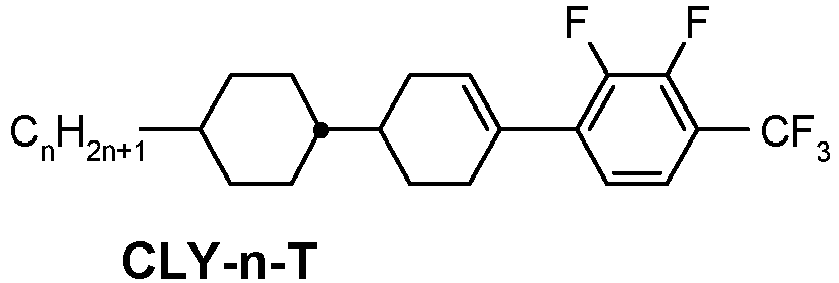

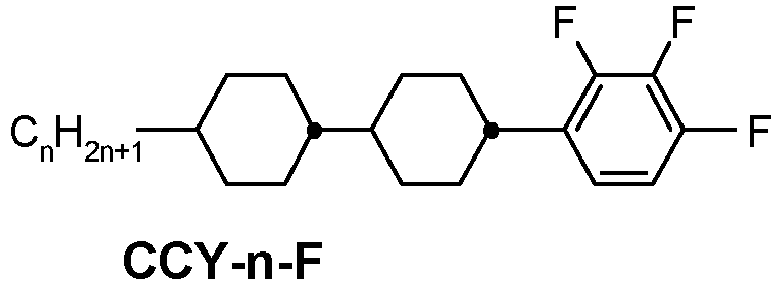

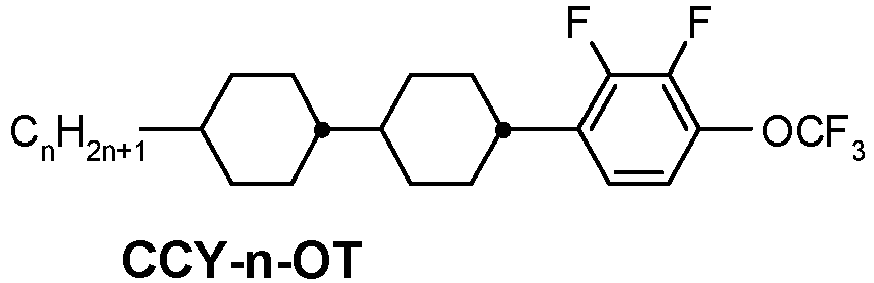
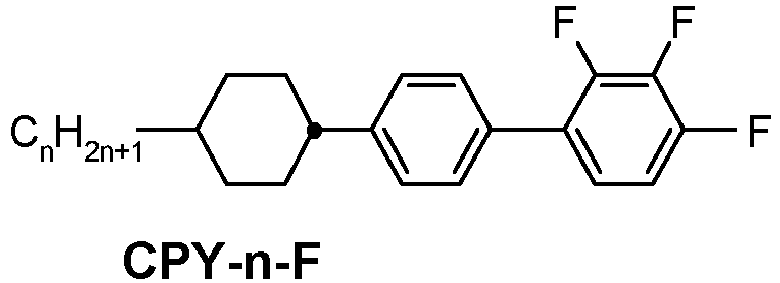


- Milieu cristallin liquide selon au moins l'une parmi les revendications 1 à 4, caractérisé en ce qu'il comprend un ou plusieurs composés choisis dans le groupe constitué par les formules IV et V :

 R41 et R42, indépendamment l'un de l'autre, revêtent la signification indiquée selon la revendication 4 pour R2 dans la formule II,




 Z41 et Z42, indépendamment l'un de l'autre et, si Z41 est présent deux fois, de même ceux-ci indépendamment l'un de l'autre, désignent -CH2CH2-, -COO-, trans-CH=CH-, trans-CF=CF-, -CH2O-, -CF2O-, -C≡C- ou une liaison simple,p désigne 0, 1 ou 2,R51 et R52, indépendamment l'un de l'autre, revêtent l'une des significations données selon la revendication 4 pour R41 et R42,


 Z51 à Z53 chacun, indépendamment les uns des autres, désignent -CH2-CH2-, -CH2-O-, -CH=CH-, -C≡C-, -COO- ou une liaison simple, eti et j chacun, indépendamment l'un de l'autre, désignent 0 ou 1.
 - Milieu cristallin liquide selon la revendication 5, caractérisé en ce qu'il comprend un ou plusieurs composés choisis dans le groupe constitué par les formules VI à IX :


 R61 désigne un radical alkyle non substitué ayant de 1 à 7 atomes de C, un radical alcényle non substitué ayant de 2 à 7 atomes de C, un radical alcoxy non substitué ayant de 1 à 6 atomes de C ou un radical alcényloxy non substitué ayant de 2 à 6 atomes de C,R62 désigne un radical alkyle non substitué ayant de 1 à 7 atomes de C, un radical alcoxy non substitué ayant de 1 à 6 atomes de C ou un radical alcényloxy non substitué ayant de 2 à 6 atomes de C, etI désigne 0 ou 1,R71 désigne un radical alkyle non substitué ayant de 1 à 7 atomes de C, ou un radical alcényle non substitué ayant de 2 à 7 atomes de C,R72 désigne un radical alkyle non substitué ayant de 1 à 7 atomes de C, un radical alcoxy non substitué ayant de 1 à 6 atomes de C ou un radical alcényloxy non substitué ayant de 2 à 6 atomes de C,
 R81 désigne un radical alkyle non substitué ayant de 1 à 7 atomes de C, ou un radical alcényle non substitué ayant de 2 à 7 atomes de C,R82 désigne un radical alkyle non substitué ayant de 1 à 7 atomes de C, un radical alcoxy non substitué ayant de 1 à 6 atomes de C ou un radical alcényloxy non substitué ayant de 2 à 6 atomes de C, ayant de préférence 2, 3 ou 4 atomes de C,
 Z8 désigne -(C=O)-O-, -CH2-O-, -CF2-O- ou -CH2-CH2-,o désigne 0 ou 1,R91 et R92 indépendamment l'un de l'autre, revêtent la signification donnée pour R72 ci-dessus,
 p et q indépendamment l'un de l'autre, désignent 0 ou 1.
 - Milieu selon au moins l'une parmi les revendications 1 à 6, caractérisé en ce qu'il comprend un ou plusieurs composés de formule I


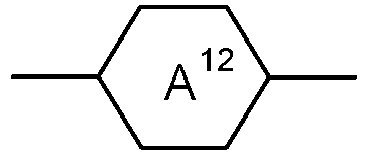

 n désigne 0 ou 1,R11 et R12 indépendamment l'un de l'autre, désignent alkyle, alcoxy, alkyle fluoré ou alcoxy fluoré, préférablement ayant de 1 à 7 atomes de C, alcényle, alcényloxy, alcoxyalkyle, ou alcényle fluoré ayant de 2 à 7 atomes de C et R11 de manière alternative désigne R1 et R12 de manière alternative désigne X1,R1 désigne alkyle, alcoxy, alkyle fluoré ou alcoxy fluoré, alcényle, alcényloxy, alcoxyalkyle, ou alcényle fluoré ayant de 2 à 7 atomes de C, etX1 désigne F, CI, alkyle fluoré, alcényle fluoré, alcoxy fluoré ou alcényloxy fluoré.
 - Milieu selon la revendication 7, caractérisé en ce que la concentration totale en composés de formule YX dans le milieu dans son ensemble va de 1% ou plus à 100% ou moins.
- Milieu selon au moins l'une parmi les revendications 1 à 8, caractérisé en ce qu'il comprend en outre un ou plusieurs composés chiraux.
- Affichage électro-optique ou composant électro-optique, caractérisé en ce qu'il comprend un milieu cristallin liquide selon au moins l'une parmi les revendications 1 à 9.
- Affichage selon la revendication 10, caractérisé en ce qu'il est basé sur le mode IPS ou FFS.
- Affichage selon la revendication 10 ou 11, caractérisé en ce qu'il contient un dispositif d'adressage à matrice active.
- Utilisation d'un milieu selon au moins l'une parmi les revendications 1 à 9, dans un affichage électro-optique ou dans un composant électro-optique.
- Affichage selon au moins l'une parmi les revendications 9 à 12, caractérisé en ce qu'il s'agit d'un affichage mobile.
- Procédé de préparation d'un milieu cristallin liquide selon l'une ou plusieurs parmi les revendications 1 à 9, caractérisé en ce qu'un ou plusieurs composés de formule YX sont mélangés avec un ou plusieurs composés mésogènes supplémentaires.
- Composé de formule YX

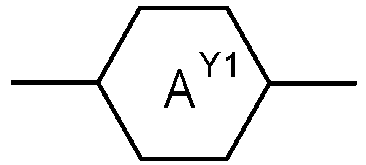

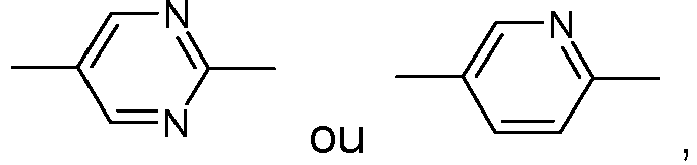


 n désigne 1,RY désigne alkyle, alcoxy, alkyle fluoré ou alcoxy fluoré ayant de 1 à 7 atomes de C, alcényle, alcényloxy, alcoxyalkyle, ou alcényle fluoré ayant de 2 à 7 atomes de C,XY désigne F, Cl, CN, CF3 ou OCF3, etZY désigne une liaison simple, -CH=CH-, -C≡C-, -CH2-CH2-, -CF2-O-, CH2-O- ou -CO-O-,sauf que les composés dans lesquelsZY désigne une liaison simple,
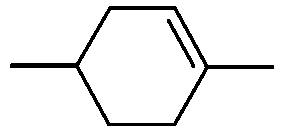

 XY désigne F,sont exclus.
 - Composé de formule YX selon la revendication 16, le composé étant choisi dans le groupe constitué par :
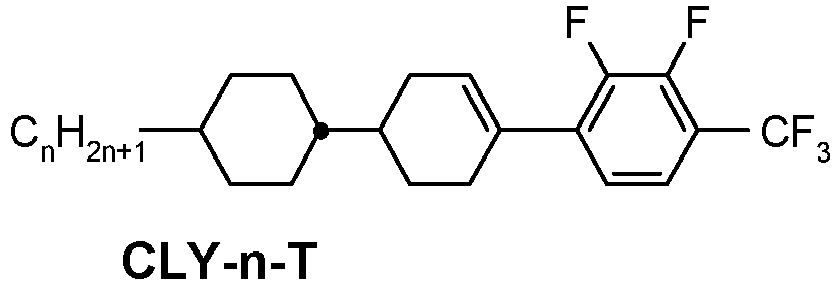
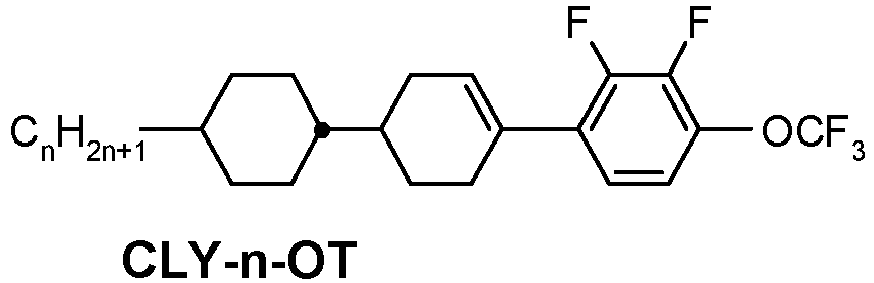
- Procédé de préparation d'un composé de formule YX selon la revendication 16 ou 17, caractérisé en ce qu'il est mis en oeuvre via l'addition nucléophile d'un dérivé aryle métallaté tel qu'un réactif de Grignard à une bicyclohexyl-cétone conduisant à l'alcool tertiaire correspondant, suivie d'une déshydratation pour conduire au composé de cyclohexylène-cyclohexénylène-phénylène et d'une hydrogénation en composé de bicyclohexylène-phénylène respectif.
Applications Claiming Priority (2)
| Application Number | Priority Date | Filing Date | Title |
|---|---|---|---|
| EP17190212 | 2017-09-08 | ||
| PCT/EP2018/073795 WO2019048444A1 (fr) | 2017-09-08 | 2018-09-05 | Milieu cristallin liquide et écran à cristaux liquides comportant ledit milieu |
Publications (2)
| Publication Number | Publication Date |
|---|---|
| EP3679111A1 EP3679111A1 (fr) | 2020-07-15 |
| EP3679111B1 true EP3679111B1 (fr) | 2023-11-01 |
Family
ID=59829304
Family Applications (1)
| Application Number | Title | Priority Date | Filing Date |
|---|---|---|---|
| EP18765116.1A Active EP3679111B1 (fr) | 2017-09-08 | 2018-09-05 | Milieu cristallin liquide et écran à cristaux liquides comportant ledit milieu |
Country Status (6)
| Country | Link |
|---|---|
| US (2) | US11326102B2 (fr) |
| EP (1) | EP3679111B1 (fr) |
| KR (1) | KR102788755B1 (fr) |
| CN (1) | CN111094512B (fr) |
| TW (1) | TWI797155B (fr) |
| WO (1) | WO2019048444A1 (fr) |
Families Citing this family (18)
| Publication number | Priority date | Publication date | Assignee | Title |
|---|---|---|---|---|
| US11326102B2 (en) * | 2017-09-08 | 2022-05-10 | Merck Patent Gmbh | Liquid-crystalline medium and liquid-crystal display comprising the same |
| IL263276B2 (en) | 2018-11-25 | 2024-07-01 | Vigdu V Tech Ltd | An optimizer for solar string power generation systems and a method thereof |
| CN111778040B (zh) * | 2019-04-03 | 2022-03-22 | 北京八亿时空液晶科技股份有限公司 | 一种液晶化合物及其制备方法与应用 |
| KR102878260B1 (ko) * | 2019-04-26 | 2025-10-29 | 메르크 파텐트 게엠베하 | 액정 매질 |
| CN119120038A (zh) | 2019-07-05 | 2024-12-13 | 默克专利股份有限公司 | 液晶介质及含有其的液晶显示器及化合物 |
| KR102911561B1 (ko) * | 2019-12-19 | 2026-01-13 | 메르크 파텐트 게엠베하 | 액정 매질, 상기 액정 매질을 포함하는 액정 디스플레이 및 화합물 |
| EP4015599A1 (fr) * | 2019-12-20 | 2022-06-22 | Merck Patent GmbH | Milieu à cristaux liquides et affichage à cristaux liquides le comprenant |
| CN112920811B (zh) * | 2019-12-30 | 2023-04-07 | 石家庄诚志永华显示材料有限公司 | 液晶组合物、液晶显示元件、液晶显示器 |
| CN113072959A (zh) * | 2020-01-03 | 2021-07-06 | 北京八亿时空液晶科技股份有限公司 | 一种含有三联苯结构的大弹性常数液晶组合物及其应用 |
| CN113072957A (zh) * | 2020-01-03 | 2021-07-06 | 北京八亿时空液晶科技股份有限公司 | 一种具有高对比度的正性液晶组合物 |
| KR20210125922A (ko) * | 2020-04-09 | 2021-10-19 | 메르크 파텐트 게엠베하 | 액정 매질 |
| CN114196419B (zh) * | 2020-09-17 | 2024-08-16 | 江苏和成显示科技有限公司 | 液晶组合物及其液晶显示器件 |
| EP4247914B1 (fr) * | 2020-11-19 | 2025-04-30 | Merck Patent GmbH | Milieu à cristaux liquides |
| CN114517097B (zh) * | 2020-11-20 | 2024-01-09 | 北京八亿时空液晶科技股份有限公司 | 一种含环己烯结构的液晶化合物及其制备方法与应用 |
| CN114265245B (zh) * | 2021-11-18 | 2024-04-02 | 浙江晨泰科技股份有限公司 | 一种智能电表显示装置 |
| CN114317008B (zh) * | 2021-11-18 | 2024-07-23 | 浙江晨泰科技股份有限公司 | 一种用于智能电表显示装置的显示介质 |
| CN114292653B (zh) * | 2021-11-18 | 2024-07-23 | 浙江晨泰科技股份有限公司 | 一种显示介质以及使用其的智能电表显示装置 |
| TW202411405A (zh) | 2022-09-05 | 2024-03-16 | 日商捷恩智股份有限公司 | 液晶組成物、液晶顯示元件及其用途 |
Citations (6)
| Publication number | Priority date | Publication date | Assignee | Title |
|---|---|---|---|---|
| DE3906051A1 (de) * | 1988-03-10 | 1989-09-21 | Merck Patent Gmbh | Difluorbenzonitrilderivate |
| DE4234585C1 (de) * | 1992-10-14 | 1994-08-25 | Merck Patent Gmbh | Fluorierte Trifluormethoxybenzole |
| WO1995010496A1 (fr) * | 1993-10-08 | 1995-04-20 | Merck Patent Gmbh | 2,3,4-trifluorobenzenes et leur utilisation dans des melanges a cristaux liquides |
| EP2982730A1 (fr) * | 2014-08-08 | 2016-02-10 | Merck Patent GmbH | Milieu à cristaux liquides et composants haute fréquence comprenant celui-ci |
| EP3081620A2 (fr) * | 2015-04-13 | 2016-10-19 | Merck Patent GmbH | Milieu à cristaux liquides et affichage à cristaux liquides comprenant celui-ci |
| WO2016188622A1 (fr) * | 2015-05-23 | 2016-12-01 | Merck Patent Gmbh | Milieu cristallin liquide et composants haute fréquence le comprenant |
Family Cites Families (21)
| Publication number | Priority date | Publication date | Assignee | Title |
|---|---|---|---|---|
| JPS59155485A (ja) * | 1983-02-22 | 1984-09-04 | Canon Inc | 液晶組成物 |
| FR2595157B1 (fr) | 1986-02-28 | 1988-04-29 | Commissariat Energie Atomique | Cellule a double couche de cristal liquide, utilisant l'effet de birefringence controlee electriquement et procede de fabrication d'un milieu uniaxe d'anisotropie optique negative utilisable dans cette cellule |
| US5211878A (en) * | 1988-03-10 | 1993-05-18 | Merck Patent Gesellschaft Mit Beschrankter Haftung | Difluorobenzonitrile derivatives |
| CN1273428C (zh) * | 2003-05-27 | 2006-09-06 | 石家庄永生华清液晶有限公司 | 一种烯类化合物、其制备方法及其用途 |
| ATE478933T1 (de) | 2003-06-30 | 2010-09-15 | Dainippon Ink & Chemicals | Chromanderivat und es enthaltende flüssigkristalline zusammensetzung |
| ATE480608T1 (de) * | 2004-07-02 | 2010-09-15 | Merck Patent Gmbh | Flüssigkristallines medium |
| JP5678798B2 (ja) | 2011-05-20 | 2015-03-04 | Dic株式会社 | 重合性化合物含有液晶組成物及びそれを使用した液晶表示素子 |
| GB201301786D0 (en) | 2012-02-15 | 2013-03-20 | Merck Patent Gmbh | Liquid-crystalline medium |
| TWI631207B (zh) | 2013-05-28 | 2018-08-01 | 日商捷恩智股份有限公司 | 液晶組成物與其用途及液晶顯示元件 |
| CN104293357B (zh) | 2013-07-16 | 2016-06-29 | 江苏和成显示科技股份有限公司 | 具有高透过率的液晶组合物及其显示器件 |
| WO2015041006A1 (fr) * | 2013-09-19 | 2015-03-26 | Jnc株式会社 | Composé de cristaux liquides ayant un squelette tétrafluorocyclohexadiène et présentant une anisotropie diélectrique négative, composition de cristaux liquides, et élément d'affichage à cristaux liquides |
| CN104232105A (zh) | 2014-08-18 | 2014-12-24 | 京东方科技集团股份有限公司 | 一种液晶混合物、液晶显示面板、液晶显示装置 |
| EP3085753B1 (fr) | 2015-04-13 | 2019-04-24 | Merck Patent GmbH | Derives de dibenzothiophenes et dibenzofuranes fluores |
| EP3095834B9 (fr) | 2015-05-21 | 2019-09-04 | Merck Patent GmbH | Milieu à base de cristaux liquides et affichage à base de cristaux liquides comprenant celui-ci |
| EP3103855A1 (fr) * | 2015-06-11 | 2016-12-14 | Merck Patent GmbH | Support à cristaux liquides |
| EP3112440B1 (fr) * | 2015-07-02 | 2019-07-24 | Merck Patent GmbH | Milieu cristallin liquide |
| DE102016011899A1 (de) * | 2015-10-27 | 2017-04-27 | Merck Patent Gmbh | Flüssigkristallines Medium |
| EP3299438B1 (fr) * | 2016-09-23 | 2020-01-15 | Merck Patent GmbH | Milieu à base de cristaux liquides et dispositif d'affichage à base de cristaux liquides le comprenant |
| CN107880900B (zh) * | 2016-09-29 | 2021-01-15 | 石家庄诚志永华显示材料有限公司 | 含有2,3,4-三取代苯的液晶化合物及其组合物 |
| US11326102B2 (en) * | 2017-09-08 | 2022-05-10 | Merck Patent Gmbh | Liquid-crystalline medium and liquid-crystal display comprising the same |
| CN110484279B (zh) * | 2018-05-14 | 2022-08-09 | 石家庄诚志永华显示材料有限公司 | 液晶组合物及液晶显示元件、液晶显示器 |
-
2018
- 2018-09-05 US US16/644,757 patent/US11326102B2/en active Active
- 2018-09-05 WO PCT/EP2018/073795 patent/WO2019048444A1/fr not_active Ceased
- 2018-09-05 CN CN201880057845.0A patent/CN111094512B/zh active Active
- 2018-09-05 EP EP18765116.1A patent/EP3679111B1/fr active Active
- 2018-09-05 KR KR1020207010020A patent/KR102788755B1/ko active Active
- 2018-09-07 TW TW107131406A patent/TWI797155B/zh active
-
2022
- 2022-03-28 US US17/705,618 patent/US20220228065A1/en not_active Abandoned
Patent Citations (6)
| Publication number | Priority date | Publication date | Assignee | Title |
|---|---|---|---|---|
| DE3906051A1 (de) * | 1988-03-10 | 1989-09-21 | Merck Patent Gmbh | Difluorbenzonitrilderivate |
| DE4234585C1 (de) * | 1992-10-14 | 1994-08-25 | Merck Patent Gmbh | Fluorierte Trifluormethoxybenzole |
| WO1995010496A1 (fr) * | 1993-10-08 | 1995-04-20 | Merck Patent Gmbh | 2,3,4-trifluorobenzenes et leur utilisation dans des melanges a cristaux liquides |
| EP2982730A1 (fr) * | 2014-08-08 | 2016-02-10 | Merck Patent GmbH | Milieu à cristaux liquides et composants haute fréquence comprenant celui-ci |
| EP3081620A2 (fr) * | 2015-04-13 | 2016-10-19 | Merck Patent GmbH | Milieu à cristaux liquides et affichage à cristaux liquides comprenant celui-ci |
| WO2016188622A1 (fr) * | 2015-05-23 | 2016-12-01 | Merck Patent Gmbh | Milieu cristallin liquide et composants haute fréquence le comprenant |
Also Published As
| Publication number | Publication date |
|---|---|
| EP3679111A1 (fr) | 2020-07-15 |
| TW201920617A (zh) | 2019-06-01 |
| CN111094512B (zh) | 2024-01-09 |
| KR102788755B1 (ko) | 2025-04-01 |
| US20200385636A1 (en) | 2020-12-10 |
| CN111094512A (zh) | 2020-05-01 |
| TWI797155B (zh) | 2023-04-01 |
| US20220228065A1 (en) | 2022-07-21 |
| KR20200051741A (ko) | 2020-05-13 |
| WO2019048444A1 (fr) | 2019-03-14 |
| US11326102B2 (en) | 2022-05-10 |
Similar Documents
| Publication | Publication Date | Title |
|---|---|---|
| EP3679111B1 (fr) | Milieu cristallin liquide et écran à cristaux liquides comportant ledit milieu | |
| EP3763802B1 (fr) | Composé thiophène, milieu à cristaux liquides et affichage à cristaux liquides le comprenant | |
| EP3228681B1 (fr) | Milieu à base de cristaux liquides et dispositif d'affichage à base de cristaux liquides le comprenant | |
| EP3421570B1 (fr) | Milieu à base de cristaux liquides et affichage à base de cristaux liquides le comprenant | |
| EP3299438B1 (fr) | Milieu à base de cristaux liquides et dispositif d'affichage à base de cristaux liquides le comprenant | |
| EP3541892B1 (fr) | Milieu cristallin liquide et affichage à cristaux liquides comportant un tel milieu | |
| EP3460025B1 (fr) | Milieu à cristaux liquides et affichage à cristaux liquides le comprenant | |
| CN112334565B (zh) | 噻吩化合物、液晶介质和包含其的液晶显示器 | |
| TW201928024A (zh) | 液晶介質及含彼之液晶顯示器 | |
| EP3526308B1 (fr) | Milieu liquide cristallin, composé liquide cristallin et dispositif d'affichage à base de cristaux liquides contenant la composition | |
| EP3877484B1 (fr) | Milieu cristallin liquide et écran à cristaux liquides comprenant celui-ci |
Legal Events
| Date | Code | Title | Description |
|---|---|---|---|
| STAA | Information on the status of an ep patent application or granted ep patent |
Free format text: STATUS: UNKNOWN |
|
| STAA | Information on the status of an ep patent application or granted ep patent |
Free format text: STATUS: THE INTERNATIONAL PUBLICATION HAS BEEN MADE |
|
| PUAI | Public reference made under article 153(3) epc to a published international application that has entered the european phase |
Free format text: ORIGINAL CODE: 0009012 |
|
| STAA | Information on the status of an ep patent application or granted ep patent |
Free format text: STATUS: REQUEST FOR EXAMINATION WAS MADE |
|
| 17P | Request for examination filed |
Effective date: 20200226 |
|
| AK | Designated contracting states |
Kind code of ref document: A1 Designated state(s): AL AT BE BG CH CY CZ DE DK EE ES FI FR GB GR HR HU IE IS IT LI LT LU LV MC MK MT NL NO PL PT RO RS SE SI SK SM TR |
|
| AX | Request for extension of the european patent |
Extension state: BA ME |
|
| DAV | Request for validation of the european patent (deleted) | ||
| DAX | Request for extension of the european patent (deleted) | ||
| STAA | Information on the status of an ep patent application or granted ep patent |
Free format text: STATUS: EXAMINATION IS IN PROGRESS |
|
| 17Q | First examination report despatched |
Effective date: 20210329 |
|
| RAP3 | Party data changed (applicant data changed or rights of an application transferred) |
Owner name: MERCK PATENT GMBH |
|
| GRAP | Despatch of communication of intention to grant a patent |
Free format text: ORIGINAL CODE: EPIDOSNIGR1 |
|
| STAA | Information on the status of an ep patent application or granted ep patent |
Free format text: STATUS: GRANT OF PATENT IS INTENDED |
|
| INTG | Intention to grant announced |
Effective date: 20230605 |
|
| P01 | Opt-out of the competence of the unified patent court (upc) registered |
Effective date: 20230519 |
|
| GRAS | Grant fee paid |
Free format text: ORIGINAL CODE: EPIDOSNIGR3 |
|
| GRAA | (expected) grant |
Free format text: ORIGINAL CODE: 0009210 |
|
| STAA | Information on the status of an ep patent application or granted ep patent |
Free format text: STATUS: THE PATENT HAS BEEN GRANTED |
|
| AK | Designated contracting states |
Kind code of ref document: B1 Designated state(s): AL AT BE BG CH CY CZ DE DK EE ES FI FR GB GR HR HU IE IS IT LI LT LU LV MC MK MT NL NO PL PT RO RS SE SI SK SM TR |
|
| REG | Reference to a national code |
Ref country code: GB Ref legal event code: FG4D |
|
| REG | Reference to a national code |
Ref country code: CH Ref legal event code: EP |
|
| REG | Reference to a national code |
Ref country code: DE Ref legal event code: R096 Ref document number: 602018060413 Country of ref document: DE |
|
| REG | Reference to a national code |
Ref country code: IE Ref legal event code: FG4D |
|
| REG | Reference to a national code |
Ref country code: LT Ref legal event code: MG9D |
|
| REG | Reference to a national code |
Ref country code: NL Ref legal event code: MP Effective date: 20231101 |
|
| PG25 | Lapsed in a contracting state [announced via postgrant information from national office to epo] |
Ref country code: GR Free format text: LAPSE BECAUSE OF FAILURE TO SUBMIT A TRANSLATION OF THE DESCRIPTION OR TO PAY THE FEE WITHIN THE PRESCRIBED TIME-LIMIT Effective date: 20240202 |
|
| PG25 | Lapsed in a contracting state [announced via postgrant information from national office to epo] |
Ref country code: IS Free format text: LAPSE BECAUSE OF FAILURE TO SUBMIT A TRANSLATION OF THE DESCRIPTION OR TO PAY THE FEE WITHIN THE PRESCRIBED TIME-LIMIT Effective date: 20240301 |
|
| PG25 | Lapsed in a contracting state [announced via postgrant information from national office to epo] |
Ref country code: LT Free format text: LAPSE BECAUSE OF FAILURE TO SUBMIT A TRANSLATION OF THE DESCRIPTION OR TO PAY THE FEE WITHIN THE PRESCRIBED TIME-LIMIT Effective date: 20231101 |
|
| REG | Reference to a national code |
Ref country code: AT Ref legal event code: MK05 Ref document number: 1627223 Country of ref document: AT Kind code of ref document: T Effective date: 20231101 |
|
| PG25 | Lapsed in a contracting state [announced via postgrant information from national office to epo] |
Ref country code: NL Free format text: LAPSE BECAUSE OF FAILURE TO SUBMIT A TRANSLATION OF THE DESCRIPTION OR TO PAY THE FEE WITHIN THE PRESCRIBED TIME-LIMIT Effective date: 20231101 |
|
| PG25 | Lapsed in a contracting state [announced via postgrant information from national office to epo] |
Ref country code: AT Free format text: LAPSE BECAUSE OF FAILURE TO SUBMIT A TRANSLATION OF THE DESCRIPTION OR TO PAY THE FEE WITHIN THE PRESCRIBED TIME-LIMIT Effective date: 20231101 |
|
| PG25 | Lapsed in a contracting state [announced via postgrant information from national office to epo] |
Ref country code: ES Free format text: LAPSE BECAUSE OF FAILURE TO SUBMIT A TRANSLATION OF THE DESCRIPTION OR TO PAY THE FEE WITHIN THE PRESCRIBED TIME-LIMIT Effective date: 20231101 |
|
| PG25 | Lapsed in a contracting state [announced via postgrant information from national office to epo] |
Ref country code: NL Free format text: LAPSE BECAUSE OF FAILURE TO SUBMIT A TRANSLATION OF THE DESCRIPTION OR TO PAY THE FEE WITHIN THE PRESCRIBED TIME-LIMIT Effective date: 20231101 Ref country code: LT Free format text: LAPSE BECAUSE OF FAILURE TO SUBMIT A TRANSLATION OF THE DESCRIPTION OR TO PAY THE FEE WITHIN THE PRESCRIBED TIME-LIMIT Effective date: 20231101 Ref country code: IS Free format text: LAPSE BECAUSE OF FAILURE TO SUBMIT A TRANSLATION OF THE DESCRIPTION OR TO PAY THE FEE WITHIN THE PRESCRIBED TIME-LIMIT Effective date: 20240301 Ref country code: GR Free format text: LAPSE BECAUSE OF FAILURE TO SUBMIT A TRANSLATION OF THE DESCRIPTION OR TO PAY THE FEE WITHIN THE PRESCRIBED TIME-LIMIT Effective date: 20240202 Ref country code: ES Free format text: LAPSE BECAUSE OF FAILURE TO SUBMIT A TRANSLATION OF THE DESCRIPTION OR TO PAY THE FEE WITHIN THE PRESCRIBED TIME-LIMIT Effective date: 20231101 Ref country code: BG Free format text: LAPSE BECAUSE OF FAILURE TO SUBMIT A TRANSLATION OF THE DESCRIPTION OR TO PAY THE FEE WITHIN THE PRESCRIBED TIME-LIMIT Effective date: 20240201 Ref country code: AT Free format text: LAPSE BECAUSE OF FAILURE TO SUBMIT A TRANSLATION OF THE DESCRIPTION OR TO PAY THE FEE WITHIN THE PRESCRIBED TIME-LIMIT Effective date: 20231101 Ref country code: PT Free format text: LAPSE BECAUSE OF FAILURE TO SUBMIT A TRANSLATION OF THE DESCRIPTION OR TO PAY THE FEE WITHIN THE PRESCRIBED TIME-LIMIT Effective date: 20240301 |
|
| PG25 | Lapsed in a contracting state [announced via postgrant information from national office to epo] |
Ref country code: SE Free format text: LAPSE BECAUSE OF FAILURE TO SUBMIT A TRANSLATION OF THE DESCRIPTION OR TO PAY THE FEE WITHIN THE PRESCRIBED TIME-LIMIT Effective date: 20231101 Ref country code: RS Free format text: LAPSE BECAUSE OF FAILURE TO SUBMIT A TRANSLATION OF THE DESCRIPTION OR TO PAY THE FEE WITHIN THE PRESCRIBED TIME-LIMIT Effective date: 20231101 Ref country code: PL Free format text: LAPSE BECAUSE OF FAILURE TO SUBMIT A TRANSLATION OF THE DESCRIPTION OR TO PAY THE FEE WITHIN THE PRESCRIBED TIME-LIMIT Effective date: 20231101 Ref country code: NO Free format text: LAPSE BECAUSE OF FAILURE TO SUBMIT A TRANSLATION OF THE DESCRIPTION OR TO PAY THE FEE WITHIN THE PRESCRIBED TIME-LIMIT Effective date: 20240201 Ref country code: LV Free format text: LAPSE BECAUSE OF FAILURE TO SUBMIT A TRANSLATION OF THE DESCRIPTION OR TO PAY THE FEE WITHIN THE PRESCRIBED TIME-LIMIT Effective date: 20231101 Ref country code: HR Free format text: LAPSE BECAUSE OF FAILURE TO SUBMIT A TRANSLATION OF THE DESCRIPTION OR TO PAY THE FEE WITHIN THE PRESCRIBED TIME-LIMIT Effective date: 20231101 |
|
| PG25 | Lapsed in a contracting state [announced via postgrant information from national office to epo] |
Ref country code: DK Free format text: LAPSE BECAUSE OF FAILURE TO SUBMIT A TRANSLATION OF THE DESCRIPTION OR TO PAY THE FEE WITHIN THE PRESCRIBED TIME-LIMIT Effective date: 20231101 |
|
| PG25 | Lapsed in a contracting state [announced via postgrant information from national office to epo] |
Ref country code: CZ Free format text: LAPSE BECAUSE OF FAILURE TO SUBMIT A TRANSLATION OF THE DESCRIPTION OR TO PAY THE FEE WITHIN THE PRESCRIBED TIME-LIMIT Effective date: 20231101 |
|
| PG25 | Lapsed in a contracting state [announced via postgrant information from national office to epo] |
Ref country code: SK Free format text: LAPSE BECAUSE OF FAILURE TO SUBMIT A TRANSLATION OF THE DESCRIPTION OR TO PAY THE FEE WITHIN THE PRESCRIBED TIME-LIMIT Effective date: 20231101 |
|
| PG25 | Lapsed in a contracting state [announced via postgrant information from national office to epo] |
Ref country code: SM Free format text: LAPSE BECAUSE OF FAILURE TO SUBMIT A TRANSLATION OF THE DESCRIPTION OR TO PAY THE FEE WITHIN THE PRESCRIBED TIME-LIMIT Effective date: 20231101 Ref country code: SK Free format text: LAPSE BECAUSE OF FAILURE TO SUBMIT A TRANSLATION OF THE DESCRIPTION OR TO PAY THE FEE WITHIN THE PRESCRIBED TIME-LIMIT Effective date: 20231101 Ref country code: IT Free format text: LAPSE BECAUSE OF FAILURE TO SUBMIT A TRANSLATION OF THE DESCRIPTION OR TO PAY THE FEE WITHIN THE PRESCRIBED TIME-LIMIT Effective date: 20231101 Ref country code: EE Free format text: LAPSE BECAUSE OF FAILURE TO SUBMIT A TRANSLATION OF THE DESCRIPTION OR TO PAY THE FEE WITHIN THE PRESCRIBED TIME-LIMIT Effective date: 20231101 Ref country code: DK Free format text: LAPSE BECAUSE OF FAILURE TO SUBMIT A TRANSLATION OF THE DESCRIPTION OR TO PAY THE FEE WITHIN THE PRESCRIBED TIME-LIMIT Effective date: 20231101 Ref country code: CZ Free format text: LAPSE BECAUSE OF FAILURE TO SUBMIT A TRANSLATION OF THE DESCRIPTION OR TO PAY THE FEE WITHIN THE PRESCRIBED TIME-LIMIT Effective date: 20231101 |
|
| REG | Reference to a national code |
Ref country code: DE Ref legal event code: R097 Ref document number: 602018060413 Country of ref document: DE |
|
| PLBE | No opposition filed within time limit |
Free format text: ORIGINAL CODE: 0009261 |
|
| STAA | Information on the status of an ep patent application or granted ep patent |
Free format text: STATUS: NO OPPOSITION FILED WITHIN TIME LIMIT |
|
| 26N | No opposition filed |
Effective date: 20240802 |
|
| PG25 | Lapsed in a contracting state [announced via postgrant information from national office to epo] |
Ref country code: SI Free format text: LAPSE BECAUSE OF FAILURE TO SUBMIT A TRANSLATION OF THE DESCRIPTION OR TO PAY THE FEE WITHIN THE PRESCRIBED TIME-LIMIT Effective date: 20231101 |
|
| PG25 | Lapsed in a contracting state [announced via postgrant information from national office to epo] |
Ref country code: SI Free format text: LAPSE BECAUSE OF FAILURE TO SUBMIT A TRANSLATION OF THE DESCRIPTION OR TO PAY THE FEE WITHIN THE PRESCRIBED TIME-LIMIT Effective date: 20231101 |
|
| PG25 | Lapsed in a contracting state [announced via postgrant information from national office to epo] |
Ref country code: MC Free format text: LAPSE BECAUSE OF FAILURE TO SUBMIT A TRANSLATION OF THE DESCRIPTION OR TO PAY THE FEE WITHIN THE PRESCRIBED TIME-LIMIT Effective date: 20231101 |
|
| REG | Reference to a national code |
Ref country code: CH Ref legal event code: PL |
|
| PG25 | Lapsed in a contracting state [announced via postgrant information from national office to epo] |
Ref country code: LU Free format text: LAPSE BECAUSE OF NON-PAYMENT OF DUE FEES Effective date: 20240905 |
|
| GBPC | Gb: european patent ceased through non-payment of renewal fee |
Effective date: 20240905 |
|
| PG25 | Lapsed in a contracting state [announced via postgrant information from national office to epo] |
Ref country code: GB Free format text: LAPSE BECAUSE OF NON-PAYMENT OF DUE FEES Effective date: 20240905 |
|
| REG | Reference to a national code |
Ref country code: BE Ref legal event code: MM Effective date: 20240930 |
|
| PG25 | Lapsed in a contracting state [announced via postgrant information from national office to epo] |
Ref country code: BE Free format text: LAPSE BECAUSE OF NON-PAYMENT OF DUE FEES Effective date: 20240930 |
|
| PG25 | Lapsed in a contracting state [announced via postgrant information from national office to epo] |
Ref country code: FR Free format text: LAPSE BECAUSE OF NON-PAYMENT OF DUE FEES Effective date: 20240930 |
|
| PG25 | Lapsed in a contracting state [announced via postgrant information from national office to epo] |
Ref country code: CH Free format text: LAPSE BECAUSE OF NON-PAYMENT OF DUE FEES Effective date: 20240930 |
|
| PG25 | Lapsed in a contracting state [announced via postgrant information from national office to epo] |
Ref country code: IE Free format text: LAPSE BECAUSE OF NON-PAYMENT OF DUE FEES Effective date: 20240905 |
|
| PG25 | Lapsed in a contracting state [announced via postgrant information from national office to epo] |
Ref country code: FI Free format text: LAPSE BECAUSE OF FAILURE TO SUBMIT A TRANSLATION OF THE DESCRIPTION OR TO PAY THE FEE WITHIN THE PRESCRIBED TIME-LIMIT Effective date: 20231101 |
|
| PGFP | Annual fee paid to national office [announced via postgrant information from national office to epo] |
Ref country code: DE Payment date: 20250820 Year of fee payment: 8 |
|
| PG25 | Lapsed in a contracting state [announced via postgrant information from national office to epo] |
Ref country code: RO Free format text: LAPSE BECAUSE OF FAILURE TO SUBMIT A TRANSLATION OF THE DESCRIPTION OR TO PAY THE FEE WITHIN THE PRESCRIBED TIME-LIMIT Effective date: 20231101 |
|
| PG25 | Lapsed in a contracting state [announced via postgrant information from national office to epo] |
Ref country code: CY Free format text: LAPSE BECAUSE OF FAILURE TO SUBMIT A TRANSLATION OF THE DESCRIPTION OR TO PAY THE FEE WITHIN THE PRESCRIBED TIME-LIMIT; INVALID AB INITIO Effective date: 20180905 |
|
| PG25 | Lapsed in a contracting state [announced via postgrant information from national office to epo] |
Ref country code: HU Free format text: LAPSE BECAUSE OF FAILURE TO SUBMIT A TRANSLATION OF THE DESCRIPTION OR TO PAY THE FEE WITHIN THE PRESCRIBED TIME-LIMIT; INVALID AB INITIO Effective date: 20180905 |