EP3680066A1 - Dispositif de serrage de moyeu - Google Patents
Dispositif de serrage de moyeu Download PDFInfo
- Publication number
- EP3680066A1 EP3680066A1 EP18854814.3A EP18854814A EP3680066A1 EP 3680066 A1 EP3680066 A1 EP 3680066A1 EP 18854814 A EP18854814 A EP 18854814A EP 3680066 A1 EP3680066 A1 EP 3680066A1
- Authority
- EP
- European Patent Office
- Prior art keywords
- threaded portion
- nut
- holding apparatus
- receiving cavity
- hub holding
- Prior art date
- Legal status (The legal status is an assumption and is not a legal conclusion. Google has not performed a legal analysis and makes no representation as to the accuracy of the status listed.)
- Withdrawn
Links
Images

Classifications
-
- B—PERFORMING OPERATIONS; TRANSPORTING
- B25—HAND TOOLS; PORTABLE POWER-DRIVEN TOOLS; MANIPULATORS
- B25B—TOOLS OR BENCH DEVICES NOT OTHERWISE PROVIDED FOR, FOR FASTENING, CONNECTING, DISENGAGING, OR HOLDING
- B25B27/00—Hand tools, specially adapted for fitting together or separating parts or objects whether or not involving some deformation, not otherwise provided for
- B25B27/0035—Hand tools, specially adapted for fitting together or separating parts or objects whether or not involving some deformation, not otherwise provided for for motor-vehicles
-
- B—PERFORMING OPERATIONS; TRANSPORTING
- B25—HAND TOOLS; PORTABLE POWER-DRIVEN TOOLS; MANIPULATORS
- B25B—TOOLS OR BENCH DEVICES NOT OTHERWISE PROVIDED FOR, FOR FASTENING, CONNECTING, DISENGAGING, OR HOLDING
- B25B1/00—Vices
- B25B1/06—Arrangements for positively actuating jaws
- B25B1/10—Arrangements for positively actuating jaws using screws
- B25B1/103—Arrangements for positively actuating jaws using screws with one screw perpendicular to the jaw faces, e.g. a differential or telescopic screw
-
- B—PERFORMING OPERATIONS; TRANSPORTING
- B25—HAND TOOLS; PORTABLE POWER-DRIVEN TOOLS; MANIPULATORS
- B25B—TOOLS OR BENCH DEVICES NOT OTHERWISE PROVIDED FOR, FOR FASTENING, CONNECTING, DISENGAGING, OR HOLDING
- B25B11/00—Work holders not covered by any preceding group in the subclass, e.g. magnetic work holders, vacuum work holders
-
- B—PERFORMING OPERATIONS; TRANSPORTING
- B25—HAND TOOLS; PORTABLE POWER-DRIVEN TOOLS; MANIPULATORS
- B25B—TOOLS OR BENCH DEVICES NOT OTHERWISE PROVIDED FOR, FOR FASTENING, CONNECTING, DISENGAGING, OR HOLDING
- B25B3/00—Hand vices, i.e. vices intended to be held by hand; Pin vices
-
- F—MECHANICAL ENGINEERING; LIGHTING; HEATING; WEAPONS; BLASTING
- F16—ENGINEERING ELEMENTS AND UNITS; GENERAL MEASURES FOR PRODUCING AND MAINTAINING EFFECTIVE FUNCTIONING OF MACHINES OR INSTALLATIONS; THERMAL INSULATION IN GENERAL
- F16B—DEVICES FOR FASTENING OR SECURING CONSTRUCTIONAL ELEMENTS OR MACHINE PARTS TOGETHER, e.g. NAILS, BOLTS, CIRCLIPS, CLAMPS, CLIPS OR WEDGES; JOINTS OR JOINTING
- F16B35/00—Screw-bolts; Stay-bolts; Screw-threaded studs; Screws; Set screws
-
- F—MECHANICAL ENGINEERING; LIGHTING; HEATING; WEAPONS; BLASTING
- F16—ENGINEERING ELEMENTS AND UNITS; GENERAL MEASURES FOR PRODUCING AND MAINTAINING EFFECTIVE FUNCTIONING OF MACHINES OR INSTALLATIONS; THERMAL INSULATION IN GENERAL
- F16B—DEVICES FOR FASTENING OR SECURING CONSTRUCTIONAL ELEMENTS OR MACHINE PARTS TOGETHER, e.g. NAILS, BOLTS, CIRCLIPS, CLAMPS, CLIPS OR WEDGES; JOINTS OR JOINTING
- F16B35/00—Screw-bolts; Stay-bolts; Screw-threaded studs; Screws; Set screws
- F16B35/04—Screw-bolts; Stay-bolts; Screw-threaded studs; Screws; Set screws with specially-shaped head or shaft in order to fix the bolt on or in an object
- F16B35/06—Specially-shaped heads
-
- F—MECHANICAL ENGINEERING; LIGHTING; HEATING; WEAPONS; BLASTING
- F16—ENGINEERING ELEMENTS AND UNITS; GENERAL MEASURES FOR PRODUCING AND MAINTAINING EFFECTIVE FUNCTIONING OF MACHINES OR INSTALLATIONS; THERMAL INSULATION IN GENERAL
- F16B—DEVICES FOR FASTENING OR SECURING CONSTRUCTIONAL ELEMENTS OR MACHINE PARTS TOGETHER, e.g. NAILS, BOLTS, CIRCLIPS, CLAMPS, CLIPS OR WEDGES; JOINTS OR JOINTING
- F16B37/00—Nuts or like thread-engaging members
Definitions
- the present application relates to the technical field of automobiles, and in particular, to a hub holding apparatus.
- An existing holding manner adopted for a hub holding apparatus is a single nut locking manner.
- the screw is rotated forward to drive the nut to move, so that the single nut actively moves to hold the auxiliary device.
- the screw is rotated backward, so that a spring located between the nut and the screw separates the screw and nut apart to achieve active release.
- the inventor finds at least the following problems in the prior art: in the current single nut locking manner, it is difficult to mount the auxiliary device at the hub holding apparatus and remove the auxiliary device from the hub holding apparatus.
- an uneven force is imposed on the nut as a result of a spring. Therefore, a holding center and a center hole of the hub holding apparatus are not on a reference plane, impeding insertion of the auxiliary device into the center hole of the hub holding apparatus.
- two sides are pushed away by different distances, resulting in great difficulty in removing the auxiliary device mounted at the center hole.
- embodiments of the present application provide a hub holding apparatus facilitating both mounting and removal of an auxiliary device.
- a hub holding apparatus including: a base on which a mounting hole and a receiving cavity are disposed, a center line of the mounting hole being perpendicular to a center line of the receiving cavity, and the mounting hole being in communication with the receiving cavity; a screw rotatable relative to the base, the screw including a first threaded portion and a second threaded portion, one end of the first threaded portion being fixedly connected to one end of the second threaded portion, and both the first threaded portion and the second threaded portion being received in the receiving cavity, a thread of the first threaded portion being disposed along a first rotation direction, and a thread of the second threaded portion being disposed along a second rotation direction, the first rotation direction and the second rotation direction being opposite to each other; a first nut sleeved on the first threaded portion and received in the receiving cavity; and a second nut sleeved on the second thread
- a thread pitch of the thread of the first threaded portion is equal to a thread pitch of the thread of the second threaded portion.
- the first nut has a first thread disposed along the first rotation direction
- the second nut has a second thread disposed along the second rotation direction
- the screw further includes a connecting portion and a handle, another end of the second threaded portion being fixedly connected to one end of the connecting portion, and the handle being fixed to another end of the connecting portion.
- the hub holding apparatus further includes a first baffle plate and a second baffle plate, the first baffle plate being disposed at another end of the first threaded portion, and the second baffle plate being disposed at the another end of the second threaded portion.
- a limiting block is disposed on each of the first nut and the second nut, and a limiting groove is disposed on an inner side surface of the receiving cavity, a center line of the limiting groove being parallel to a center line of the receiving cavity; and the limiting block of the first nut and the limiting block of the second nut are both embedded in the limiting groove and are slidable in the limiting groove.
- the first nut and the second nut are both hexagon nuts, and a cross-sectional shape of the receiving cavity is a hexagon.
- the hub holding apparatus further includes a bracket, where the base is fixed to the bracket, and the bracket may be mounted at a hub.
- the bracket includes a first mounting portion, a second mounting portion, a connecting rod, and a threaded rod; where there are two connecting rods, one end of one of the connecting rods being fixedly connected to one end of the other of the connecting rods, and another end of one of the connecting rods being fixedly connected to another end of the other of the connecting rods; the first mounting portion is sleeved on one end of each of the two connecting rods respectively and may slide on the two connecting rods; the second mounting portion is sleeved on the another end of each of the two connecting rods respectively and may slide on the two connecting rods; and the threaded rod is rotatably connected to the first mounting portion and the second mounting portion.
- a rotational handle is disposed on one end of the threaded rod, where rotating the rotational handle may drive the threaded rod to rotate, and during the rotation, the first mounting portion and the second mounting portion approach to or move away from each other along the two connecting rods.
- the hub holding apparatus in the embodiments of the present application, two nuts are sleeved on a screw, and when the screw is rotated, the two nuts approach to or move away from each other along the screw.
- the auxiliary device is quickly and conveniently mounted at the hub holding apparatus, and the auxiliary device can be easily removed from the hub holding apparatus.
- orientation or position relationships indicated by the terms such as “upper”, “lower”, “inside”, “outside” and “bottom” are based on orientation or position relationships shown in the accompanying drawings, and are used only for ease and brevity of illustration and description, rather than indicating or implying that the mentioned apparatus or component needs to have a particular orientation or needs to be constructed and operated in a particular orientation. Therefore, such terms should not be construed as limiting of this application.
- the terms such as “first”, “second”, and “third” are used only for the purpose of description, and should not be understood as indicating or implying relative importance.
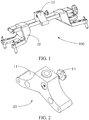
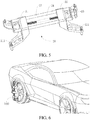
- an embodiment of the present application provides a hub holding apparatus 100, including a mounting assembly 10 and a bracket 20.
- the mounting assembly 10 is mounted at the bracket 20 and is configured to mount an auxiliary device.
- the mounting assembly 10 includes a base 11, a first nut 12, a second nut 13 and a screw 14.
- a mounting hole 111 and a receiving cavity 112 are disposed on the base 11.
- the mounting hole 111 and the receiving cavity 112 are both cylindrical.
- a center line of the mounting hole 111 is perpendicular to a center line of the receiving cavity 112, and the mounting hole 111 is in communication with the receiving cavity 112.
- the first nut 12 and the second nut 13 are sleeved on the screw 14, and one end of each of the first nut 12, the second nut 13 and the screw 14 is received in the receiving cavity 112.
- the screw 14 is rotatable relative to the base 11.
- the mounting hole 111 is disposed on a mounting surface of the base 11 for mounting an auxiliary device.
- the receiving cavity 112 is disposed on the base 11 and penetrates from one side to the other side of the base 11 (that is, the receiving cavity 112 is a through hole).
- the mounting hole 111 and the receiving cavity 112 are both cylindrical.
- a center line of the mounting hole 111 is perpendicular to a center line of the receiving cavity 112, and the mounting hole 111 is in communication with the receiving cavity 112.
- a fixing hole 113 is further disposed on the base 11. The fixing hole 113 penetrates from one side of the base 11 to the other side (that is, the fixing hole 113 is a through hole).
- the first nut 12 has a first thread disposed along a first rotation direction
- the second nut 13 has a second thread disposed along a second rotation direction.
- the first rotation direction and the second rotation direction are opposite to each other.
- a thread pitch of the first thread is equal to a thread pitch of the second thread.
- first rotation direction is a clockwise direction
- second rotation direction is a counterclockwise direction
- first rotation direction is a counterclockwise direction
- second rotation direction is a clockwise direction
- first nut 12 and the second nut 13 may be of a same type, which may be mounted at the screw 14 in opposite directions.
- the screw 14 includes a first threaded portion 141, a second threaded portion 142, a connecting portion 143, and a handle 144.
- One end of the first threaded portion 141 is fixedly connected to one end of the second threaded portion 142
- another end of the second threaded portion 142 is fixedly connected to one end of the connecting portion 143
- the handle 144 is fixed to another end of the connecting portion 143.
- the first threaded portion 141 and the second threaded portion 142 are both cylindrical, and both the first threaded portion 141 and the second threaded portion 142 have a thread on outer surfaces thereof.
- the thread of the first threaded portion 141 is disposed along a first rotation direction
- the thread of the second threaded portion 142 is disposed along a second rotation direction.
- the first rotation direction and the second rotation direction are opposite to each other.
- a thread pitch of the thread of the first threaded portion 141 is equal to a thread pitch of the thread and the second threaded portion 142.
- the first nut 12 is sleeved on the first threaded portion 141 of the screw 14.
- the second nut 13 is sleeved on the second threaded portion 142 of the screw 14.
- the second nut 13 may be rotated relative to the screw 14, and during the rotation, the second nut 13 moves along the axial direction of the screw 14. Because the threads of the first threaded portion 141 and the second threaded portion 142 rotate in opposite directions and have a same thread pitch, during the rotation of the screw 14, the first nut 12 and the second nut 13 approach to or move away from each other.
- the auxiliary device when the screw 14 is rotated along the first rotation direction, the first nut 12 and the second nut 13 approach to each other; or when the screw 14 is rotated in the second rotation direction, the first nut 12 and the second nut 13 move away from each other.
- a mounting shaft of the auxiliary device is first inserted into the mounting hole 111, and then the screw 14 is rotated in the first rotation direction.
- the thread of the first threaded portion 141 and the thread of the second threaded portion 142 have an equal thread pitch, the first nut 12 and the second nut 13 move in opposite directions by an equal movement distance, so that a pressing force is generated from both the first nut 12 and the second nut 13 for locking and fixing the mounting shaft of the auxiliary device.
- the screw 14 is rotated along the second rotation direction, so that the first nut 12 and the second nut 13 move away from each other. Because the thread of the first threaded portion 141 and the thread of the second threaded portion 142 have an equal thread pitch, the first nut 12 and the second nut 13 move in opposite directions by an equal movement distance. When the first nut 12 and the second nut 13 move to a specific position, the pressing force of the first nut 12 and the second nut 13 on the mounting shaft of the auxiliary device disappears. In this case, the mounting shaft of the auxiliary device may be pulled out from the mounting hole 111 to complete removal.
- the mounting assembly 10 further includes a first baffle plate 15 and a second baffle plate 16, the first baffle plate 15 being disposed at another end of the first threaded portion 141, and the second baffle plate 16 being disposed at the another end of the second threaded portion 142.
- the first baffle plate 15 and the second baffle plate 16 are both used for limiting, and are configured to prevent the first nut 12 and the second nut 13 from being separated from the screw 14 during the rotation of the screw 14.
- a limiting block (not shown) is disposed on each of the first nut 12 and the second nut 13, and a limiting groove (not shown) is disposed on an inner inside surface of the receiving cavity 112.
- the limiting groove is parallel to the center line of the receiving cavity 112.
- the limiting block of the first nut 12 and the limiting block of the second nut 13 are both embedded in the limiting groove and may slide in the limiting groove.
- the structure is designed to prevent the first nut 12 and the second nut 13 from rotating with the screw 14 (that is, when the screw 14 is rotated relative to the base 11, the first nut 12 and the second nut 13 do not rotate, but move along the axial direction of the screw 14).
- the limiting block may be a bolt or a screw.
- a threaded hole is disposed on a side surface of each of the first nut 12 and the second nut 13.
- One end of the bolt or the screw is screwed into the threaded hole, and another end protrudes from each of the first nut 12 and the second nut 13 for limiting.
- first nut 12 and the second nut 13 may both be hexagon nuts, and a cross-sectional shape of the receiving cavity 112 is a hexagon to prevent the first nut 12 and the second nut 13 from rotating relative to the base 11 (that is, there is a limiting structure among the first nut 12, the second nut 13 and the receiving cavity 112 for preventing the first nut 12 and the second nut 13 from rotating relative to the base 11).
- the bracket 20 includes a first mounting portion 21, a second mounting portion 22, a connecting rod 23, a threaded rod 24, and a rotatable handle 25.
- the two connecting rods 23 are parallel to each other.
- the first mounting portion 21 is sleeved on one end of each of the two connecting rods 23 respectively and is slidable on the two connecting rods 23; and the second mounting portion 22 is sleeved on another end of each of the two connecting rods 23 respectively and is slidable on the two connecting rods 23.
- a first threaded hole (not shown) is disposed on the first mounting portion 21, and a second threaded hole (not shown) is disposed on the second mounting portion 22.
- the threaded rod 24 passes through the first threaded hole and second threaded hole respectively.
- the rotatable handle 25 is fixed to one end of the threaded rod 24, and rotating the rotating handle 25 may drive the threaded rod 24 to rotate.
- the first mounting portion 21 and the second mounting portion 22 approach to or move away from each other along the two connecting rods 23.
- a first engaging post 211 for engaging a hub is disposed on the first mounting portion 21, and there are two first engaging posts 211 in total.
- a second engaging post 221 for engaging a hub is disposed on the second mounting portion 22, and there are two second engaging posts 221 in total.
- rotating the threaded rod 24 may drive the first mounting portion 21 and the second mounting portion 22 to approach to each other, so that the first engaging post 211 and the second engaging post 221 both hold the hub, thereby fixedly connecting the bracket 20 to the hub.
- the auxiliary device is quickly and conveniently mounted at the hub holding apparatus 100, and the auxiliary device is extremely easily removed from the hub holding apparatus 100.
Landscapes
- Engineering & Computer Science (AREA)
- Mechanical Engineering (AREA)
- General Engineering & Computer Science (AREA)
- Automatic Assembly (AREA)
- Connection Of Plates (AREA)
- Clamps And Clips (AREA)
- Transmission Devices (AREA)
Applications Claiming Priority (2)
| Application Number | Priority Date | Filing Date | Title |
|---|---|---|---|
| CN201721154833.9U CN207256067U (zh) | 2017-09-08 | 2017-09-08 | 轮毂夹持装置 |
| PCT/CN2018/104217 WO2019047864A1 (fr) | 2017-09-08 | 2018-09-05 | Dispositif de serrage de moyeu |
Publications (2)
| Publication Number | Publication Date |
|---|---|
| EP3680066A1 true EP3680066A1 (fr) | 2020-07-15 |
| EP3680066A4 EP3680066A4 (fr) | 2021-06-02 |
Family
ID=61920374
Family Applications (1)
| Application Number | Title | Priority Date | Filing Date |
|---|---|---|---|
| EP18854814.3A Withdrawn EP3680066A4 (fr) | 2017-09-08 | 2018-09-05 | Dispositif de serrage de moyeu |
Country Status (5)
| Country | Link |
|---|---|
| US (1) | US11279010B2 (fr) |
| EP (1) | EP3680066A4 (fr) |
| CN (1) | CN207256067U (fr) |
| DE (1) | DE212018000310U1 (fr) |
| WO (1) | WO2019047864A1 (fr) |
Families Citing this family (3)
| Publication number | Priority date | Publication date | Assignee | Title |
|---|---|---|---|---|
| CN111174066B (zh) * | 2020-01-21 | 2025-01-07 | 深圳市道通科技股份有限公司 | 车轮夹持装置 |
| CN111571494A (zh) * | 2020-06-17 | 2020-08-25 | 深圳市道通科技股份有限公司 | 一种轮毂夹持装置 |
| CN116000854B (zh) * | 2022-12-26 | 2025-12-05 | 江西洪都航空工业股份有限公司 | 托板螺母装持器 |
Family Cites Families (12)
| Publication number | Priority date | Publication date | Assignee | Title |
|---|---|---|---|---|
| US3990666A (en) * | 1975-08-25 | 1976-11-09 | Ammco Tools, Inc. | Wheel clamp |
| US5024001A (en) * | 1988-10-07 | 1991-06-18 | Balco, Incorporated | Wheel alignment rim clamp claw |
| DE8814598U1 (de) * | 1988-11-23 | 1989-02-09 | Groß, Johannes, 8503 Altdorf | Schraubstück mit Gewindestück |
| JP3630261B2 (ja) * | 1997-04-17 | 2005-03-16 | 三菱電機株式会社 | 検出器の取付構造 |
| JPH1137747A (ja) * | 1997-07-15 | 1999-02-12 | Alps Electric Co Ltd | 多回転体の回転検出装置 |
| ITRE20010016U1 (it) * | 2001-05-15 | 2002-11-15 | Corghi Spa | Dispositivo autocentrante per il sostegno di testine di controllo dell'assetto delle ruote di automezzi in genere. |
| DE10135281A1 (de) * | 2001-07-19 | 2003-02-06 | David Fischer | Spannelement zum positionsflexiblen Spannen von Werkstücken |
| US7150105B1 (en) * | 2005-01-12 | 2006-12-19 | Honda Motor Co., Ltd. | Adaptor for use in vehicle wheel alignment |
| CN203190961U (zh) * | 2012-12-25 | 2013-09-11 | 东风本田汽车有限公司 | 便携式电子车轮外倾角测量仪 |
| CN103063186B (zh) * | 2012-12-25 | 2016-06-08 | 东风本田汽车有限公司 | 便携式电子车轮外倾角测量仪 |
| CN203178081U (zh) * | 2013-04-21 | 2013-09-04 | 吉林大学 | 分体拆装式汽车四轮定位仪检定装置 |
| CN104226688B (zh) * | 2014-09-09 | 2017-01-18 | 北京京诚之星科技开发有限公司 | 转盘角度调整及锁紧装置 |
-
2017
- 2017-09-08 CN CN201721154833.9U patent/CN207256067U/zh active Active
-
2018
- 2018-09-05 DE DE212018000310.6U patent/DE212018000310U1/de active Active
- 2018-09-05 EP EP18854814.3A patent/EP3680066A4/fr not_active Withdrawn
- 2018-09-05 WO PCT/CN2018/104217 patent/WO2019047864A1/fr not_active Ceased
-
2020
- 2020-03-09 US US16/812,793 patent/US11279010B2/en active Active
Also Published As
| Publication number | Publication date |
|---|---|
| DE212018000310U1 (de) | 2020-05-15 |
| EP3680066A4 (fr) | 2021-06-02 |
| US11279010B2 (en) | 2022-03-22 |
| US20200346329A1 (en) | 2020-11-05 |
| WO2019047864A1 (fr) | 2019-03-14 |
| CN207256067U (zh) | 2018-04-20 |
Similar Documents
| Publication | Publication Date | Title |
|---|---|---|
| US11279010B2 (en) | Hub holding apparatus | |
| EP3552855B1 (fr) | Mécanisme de verrouillage circonférentiel, dispositif de verrouillage de batterie, bloc-batterie d'alimentation et véhicule | |
| US10871704B2 (en) | Gimbal | |
| EP3637394B1 (fr) | Structure de connexion de module et écran d'affichage à del | |
| US11884147B2 (en) | Circumferential locking mechanism and battery locking device comprising same, power battery pack, and vehicle | |
| US10724671B2 (en) | Quick release connection structures, support structures, and remote controllers | |
| CN204361400U (zh) | 一种可制锁的插座 | |
| EP3168521A1 (fr) | Dispositif de limitation et aéronef utilisant celui-ci | |
| EP3610189B1 (fr) | Support pour appareils plats approximativement rectangulaires, tels que tablettes numériques ou smartphones | |
| EP3171041A1 (fr) | Dispositif de sortie | |
| JP5193282B2 (ja) | 回り止め機構付きのボルトとナット | |
| JP2022508170A (ja) | 表示スクリーンスタンド及びマウントシステム | |
| US20140020848A1 (en) | Extendable handle for a tire spoon and method of operation | |
| CN106796768B (zh) | Led显示屏 | |
| CN109398246A (zh) | 车载显示屏及汽车 | |
| EP3532343B1 (fr) | Élément de retenue de registre de ventilation pour terminal mobile | |
| CN206617391U (zh) | 周向锁止机构、电池锁定装置、动力电池包及车辆 | |
| CN213871789U (zh) | 一种显示模组连接结构及显示屏 | |
| CN206536403U (zh) | 专用型压圈扳手 | |
| CN106272250B (zh) | 螺杆旋拧装置 | |
| CN206159192U (zh) | 可拆卸金属方管圆锥连接装置 | |
| WO2020177270A1 (fr) | Structure de base anti-démontage et anti-desserrage d'un terminal de communication sur bateau | |
| CN224049539U (zh) | 一种锁销结构及具有锁销结构的分力板 | |
| EP2416023A2 (fr) | Ensemble formant traversée réglable et verrouillable et ensemble de montage de composant doté de celui-ci | |
| US9261082B2 (en) | Device for shifting one structure with respect to another |
Legal Events
| Date | Code | Title | Description |
|---|---|---|---|
| STAA | Information on the status of an ep patent application or granted ep patent |
Free format text: STATUS: THE INTERNATIONAL PUBLICATION HAS BEEN MADE |
|
| PUAI | Public reference made under article 153(3) epc to a published international application that has entered the european phase |
Free format text: ORIGINAL CODE: 0009012 |
|
| STAA | Information on the status of an ep patent application or granted ep patent |
Free format text: STATUS: REQUEST FOR EXAMINATION WAS MADE |
|
| 17P | Request for examination filed |
Effective date: 20200323 |
|
| AK | Designated contracting states |
Kind code of ref document: A1 Designated state(s): AL AT BE BG CH CY CZ DE DK EE ES FI FR GB GR HR HU IE IS IT LI LT LU LV MC MK MT NL NO PL PT RO RS SE SI SK SM TR |
|
| AX | Request for extension of the european patent |
Extension state: BA ME |
|
| DAV | Request for validation of the european patent (deleted) | ||
| DAX | Request for extension of the european patent (deleted) | ||
| A4 | Supplementary search report drawn up and despatched |
Effective date: 20210504 |
|
| RIC1 | Information provided on ipc code assigned before grant |
Ipc: B25B 11/00 20060101AFI20210428BHEP Ipc: B25B 1/10 20060101ALI20210428BHEP |
|
| STAA | Information on the status of an ep patent application or granted ep patent |
Free format text: STATUS: THE APPLICATION HAS BEEN WITHDRAWN |
|
| 18W | Application withdrawn |
Effective date: 20211108 |