EP3680081A1 - Vorrichtung und verfahren zum imprägnieren eines filaments - Google Patents
Vorrichtung und verfahren zum imprägnieren eines filaments Download PDFInfo
- Publication number
- EP3680081A1 EP3680081A1 EP20151311.6A EP20151311A EP3680081A1 EP 3680081 A1 EP3680081 A1 EP 3680081A1 EP 20151311 A EP20151311 A EP 20151311A EP 3680081 A1 EP3680081 A1 EP 3680081A1
- Authority
- EP
- European Patent Office
- Prior art keywords
- sponge
- filament
- drum
- previous
- impregnation material
- Prior art date
- Legal status (The legal status is an assumption and is not a legal conclusion. Google has not performed a legal analysis and makes no representation as to the accuracy of the status listed.)
- Withdrawn
Links
- 238000000034 method Methods 0.000 title claims abstract description 31
- 238000005470 impregnation Methods 0.000 claims abstract description 47
- 239000000463 material Substances 0.000 claims abstract description 29
- 239000000835 fiber Substances 0.000 claims abstract description 24
- 239000002131 composite material Substances 0.000 claims abstract description 13
- 239000000758 substrate Substances 0.000 claims abstract description 5
- 238000010438 heat treatment Methods 0.000 claims description 2
- 239000011347 resin Substances 0.000 description 53
- 229920005989 resin Polymers 0.000 description 53
- 238000009730 filament winding Methods 0.000 description 16
- 230000008569 process Effects 0.000 description 15
- 238000004519 manufacturing process Methods 0.000 description 7
- 238000009736 wetting Methods 0.000 description 7
- 238000005516 engineering process Methods 0.000 description 6
- 230000002787 reinforcement Effects 0.000 description 6
- 239000007788 liquid Substances 0.000 description 5
- 230000003014 reinforcing effect Effects 0.000 description 5
- 239000002699 waste material Substances 0.000 description 5
- 238000004804 winding Methods 0.000 description 5
- 238000002347 injection Methods 0.000 description 4
- 239000007924 injection Substances 0.000 description 4
- 229920001187 thermosetting polymer Polymers 0.000 description 4
- 239000012855 volatile organic compound Substances 0.000 description 4
- 239000003822 epoxy resin Substances 0.000 description 3
- 229920000647 polyepoxide Polymers 0.000 description 3
- 239000004848 polyfunctional curative Substances 0.000 description 3
- 238000012545 processing Methods 0.000 description 3
- 238000007596 consolidation process Methods 0.000 description 2
- 230000007246 mechanism Effects 0.000 description 2
- 230000009467 reduction Effects 0.000 description 2
- 239000002904 solvent Substances 0.000 description 2
- 229920006305 unsaturated polyester Polymers 0.000 description 2
- 229920002430 Fibre-reinforced plastic Polymers 0.000 description 1
- 239000000853 adhesive Substances 0.000 description 1
- 230000001070 adhesive effect Effects 0.000 description 1
- 239000003054 catalyst Substances 0.000 description 1
- 238000004140 cleaning Methods 0.000 description 1
- 238000013461 design Methods 0.000 description 1
- 230000000694 effects Effects 0.000 description 1
- 239000011151 fibre-reinforced plastic Substances 0.000 description 1
- 239000012467 final product Substances 0.000 description 1
- 239000003999 initiator Substances 0.000 description 1
- 238000003475 lamination Methods 0.000 description 1
- 239000000155 melt Substances 0.000 description 1
- 239000002184 metal Substances 0.000 description 1
- 238000012986 modification Methods 0.000 description 1
- 230000004048 modification Effects 0.000 description 1
- 238000000465 moulding Methods 0.000 description 1
- 230000000704 physical effect Effects 0.000 description 1
- 239000000047 product Substances 0.000 description 1
- 230000001105 regulatory effect Effects 0.000 description 1
- 238000007493 shaping process Methods 0.000 description 1
- 239000007787 solid Substances 0.000 description 1
- 238000003892 spreading Methods 0.000 description 1
- 230000007480 spreading Effects 0.000 description 1
- 230000003068 static effect Effects 0.000 description 1
- 239000004634 thermosetting polymer Substances 0.000 description 1
- 238000009827 uniform distribution Methods 0.000 description 1
- 239000011800 void material Substances 0.000 description 1
Images


Classifications
-
- B—PERFORMING OPERATIONS; TRANSPORTING
- B29—WORKING OF PLASTICS; WORKING OF SUBSTANCES IN A PLASTIC STATE IN GENERAL
- B29B—PREPARATION OR PRETREATMENT OF THE MATERIAL TO BE SHAPED; MAKING GRANULES OR PREFORMS; RECOVERY OF PLASTICS OR OTHER CONSTITUENTS OF WASTE MATERIAL CONTAINING PLASTICS
- B29B15/00—Pretreatment of the material to be shaped, not covered by groups B29B7/00 - B29B13/00
- B29B15/08—Pretreatment of the material to be shaped, not covered by groups B29B7/00 - B29B13/00 of reinforcements or fillers
- B29B15/10—Coating or impregnating independently of the moulding or shaping step
- B29B15/12—Coating or impregnating independently of the moulding or shaping step of reinforcements of indefinite length
- B29B15/122—Coating or impregnating independently of the moulding or shaping step of reinforcements of indefinite length with a matrix in liquid form, e.g. as melt, solution or latex
-
- B—PERFORMING OPERATIONS; TRANSPORTING
- B29—WORKING OF PLASTICS; WORKING OF SUBSTANCES IN A PLASTIC STATE IN GENERAL
- B29B—PREPARATION OR PRETREATMENT OF THE MATERIAL TO BE SHAPED; MAKING GRANULES OR PREFORMS; RECOVERY OF PLASTICS OR OTHER CONSTITUENTS OF WASTE MATERIAL CONTAINING PLASTICS
- B29B15/00—Pretreatment of the material to be shaped, not covered by groups B29B7/00 - B29B13/00
- B29B15/08—Pretreatment of the material to be shaped, not covered by groups B29B7/00 - B29B13/00 of reinforcements or fillers
- B29B15/10—Coating or impregnating independently of the moulding or shaping step
- B29B15/12—Coating or impregnating independently of the moulding or shaping step of reinforcements of indefinite length
- B29B15/14—Coating or impregnating independently of the moulding or shaping step of reinforcements of indefinite length of filaments or wires
Definitions
- the present disclosure relates to resin impregnation using a sponge.
- a purpose of this disclosure is the efficiency of the impregnation and the savings of the resin.
- Filament winding is one of the most widely used processing routines for continuous fibre reinforced polymer components with thermosetting resins. Fibre tows pass through a resin bath before winding onto a mandrel. There is a variety of orientations controlled by the fibre feeding mechanism and the rate of rotation of the mandrel, Figure 1 . The number of axes used has grown over the past years. At the beginning, two axes (mandrel rotation and winding head) were sufficient for a winding process.
- the rather simple technology and fast winding speeds allow for a high degree of productivity.
- the focus lies on the fabrication of axially symmetrical components, such as pressure vessels, tanks and piping.
- Wet pultrusion is the most common process to produce composite profiles.
- the fibre tows pass through a resin bath before and are guided into a heated die to be cured at the required temperature. Then, they are consolidated to the required size in its first zone and, after cooled down in order to solidify. The pultruded material is then cut into specified lengths.
- the fibres are impregnated with a liquid resin, such as unsaturated polyester or an epoxy resin, via an impregnation bath or a roll applicator, Figure 1 or 2 .
- a liquid resin such as unsaturated polyester or an epoxy resin
- the fibres are wetted before they are wound onto the mandrel or before they enter in the die.
- the fibres are typically drawn through an impregnation bath or passed over an applicator roll. Wetting and fill impregnation are difficult to achieve with these traditional methods. Further, these methods often result in air being trapped in the wetted reinforcement bundle. Even at slow speeds, these conventional wetting processes are only capable of wetting, impregnation and air removal of a limited number of strands.
- filament wound parts or pultruded profiles are relatively limited. Further, filament wound parts or pultruded profiles are made at relatively low production rates due to the slow rate of wetting, making such parts expensive.
- the processing speed is a very important factor for all production routines.
- the mechanical properties remained almost unchanged up to a processing speed of 15 m/min.
- increasing the speed reduces the time available for both fibre bundle impregnation and part consolidation, while there is a linear rise in the required force to pull the fibre bundle off the impregnation device.
- the degree of impregnation is still acceptable up to a speed of 15 m/min.
- breakage of single filaments could be observed, which was attributed to the excessive pulling forces.
- Document KR20110083315A discloses a filament winding device wherein a reinforcing fibre supply member is supplied fibre through a plurality of bobbins; a resin impregnation member comprising a resin impregnation tank containing a liquid resin to impregnate the reinforcing fibres; a mandrel to which reinforcing fibres impregnated in the liquid resin are wound; and a resin removing member positioned between the resin impregnating tank and the mandrel, the one side facing the mandrel having a resin removing unit configured to selectively adhere to the mandrel.
- the filament winding device has the effect of maintaining a uniform distribution of the resin impregnation of the reinforcing fibres wound on the mandrel to produce a molding having a uniform physical properties and strength at any position.
- Fibre impregnation in a filament winding and pultrusion is always an issue, despite much work has been done related with it.
- the purpose of this disclosure is to develop an innovative experimental set up adapted to a filament winding or pultrusion resin impregnation system.
- This new wet-filament winding technology and wet-pultrusion process offer a clean and efficient method of production for high-performance composites.
- Unique design components in this new wet-filament winding and wet-pultrusion technology include a custom-built modular fibre bundle spreading station and a mixed resin fibre impregnation unit, which together provide effective fibre wetting. Waste and solvent usage is also significantly reduced compared with traditional wet bath filament winding production and wet-pultrusion; up to 80% less cleaning solvent consumption has been achieved, along with an equivalent reduction of mixed resin waste.
- thermosets including faster curing resins, have been successfully trialled with this new clean filament winding technology, which can be retrofitted and adapted for other manufacturing processes, such as prepreg and pultrusion.
- the conventional wet resin bath is replaced by the modular mixed resin fibre impregnation unit, typically mounted on the traverse-arm of the filament winding machine, close to the mandrel or in a new designed support before the post impregnation guidance.
- a feedback control system between the rotating mandrel and the resin-dispensing unit (or between the die and the resin-dispensing unit) is used to control the relative throughput of the resin and hardener.
- the final product may have the following advantages in comparison with other methods of impregnation:
- a device for impregnating a filament comprising:
- a cylindrical surface can be defined as a surface consisting of all the points on all the lines which are parallel to a given line and which pass through a fixed plane curve in a plane not parallel to the given line; these cylindrical surfaces can be referred to as generalized cylinders. If the plane and the given line are perpendicular, the cylindrical surface can be said to be a right cylindrical surface.
- a cylindrical surface having a cross section that is an ellipse, parabola, or hyperbola can then be called an elliptic cylinder, parabolic cylinder or hyperbolic cylinder, respectively. If the curve is a part of a circumference, then the cylindrical surface will be the lateral surface of a horizontal cylindrical segment.
- the device is arranged to impregnate a filament or a plurality of filaments in parallel, by having the drum is arranged to contact with the sponge at a contact area through which the filament or the plurality of filaments passes, with the filaments not touching each other, at an angle that is substantially perpendicular to the cylindrical surface longitudinal axis.
- the pressure means comprises a perforated plate for pushing the sponge and for dispensing impregnation material to the sponge through said perforated plate.
- the cylindrical surface is the lateral surface of a horizontal cylindrical segment.
- said cylinder lateral surface drum comprises at least two longitudinal grooves for draining excess impregnation material.
- the grooves are each arranged on one side of the drum in respect to said contact area.
- the pressure means is a hydraulic cylinder or a mechanical spring.
- the impregnation material is a resin, adhesive material, among others.
- the sponge is shaped like cube, cylinder, and a parallelepiped, among others.
- the sponge is exchangeable inside the sponge compartment.
- the article comprises a substrate and wherein the substrate is a composite comprising said fibre.
- figure 1 shows a schematic representation of an embodiment of a process of winding fibre material and resin around a shape, known as a mandrel, to create a composite product.
- the filament winding process can use many different fibres and resins to achieve the desired characteristics for the finished component.
- the final result is an extremely efficient process to create low cost, lightweight, and strong composite materials.
- the fibres are impregnated with a liquid resin, such as unsaturated polyester or an epoxy resin, via an impregnation bath or a roll applicator.
- a liquid resin such as unsaturated polyester or an epoxy resin
- the fibres are wetted before they are wound onto the mandrel or pass through a die.
- the fibres are typically drawn through an impregnation bath or passed over an applicator roll.
- resin baths are open or partially open to the atmosphere resulting in significant emissions into the atmosphere of environmentally unfriendly volatile organic compounds or VOC's. Further, significant resin waste commonly occurs with the use of open bath wet-out methods. Voids are commonly found in filament wound parts or pultruded profiles that are caused by air becoming entrapped in the resin loaded onto the fibres as they pass through a resin bath or engage a roll applicator.
- continuous lamination process to produce linear profiles of constant transversal sections, in which the roving is impregnated with the resin, being the result composite tensioned by a system. Then, using a metal heaten mould or die the final form is achieved.
- the pultrusion of thermosets, the reinforcing fibres may be impregnated by passing them through a resin bath.
- the resin-impregnated fibre strand is then brought to the near net shape at a number of preform stations and shaped and cured in a heated mould.
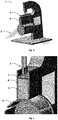
- figure 5 shows a schematic representation of an embodiment of the device where the drum is hollow and has two grooves on the face, one on each side and above the symmetry axis. This way it is possible to collect for the drum the resin that possibly drain for his faces.
- the drum is also attached to the resin's tank, located on the machine's column. The resin still passes through a filter before returning to the tank, increasing the reuse of it.
Landscapes
- Engineering & Computer Science (AREA)
- Mechanical Engineering (AREA)
- Moulding By Coating Moulds (AREA)
Applications Claiming Priority (1)
| Application Number | Priority Date | Filing Date | Title |
|---|---|---|---|
| PT11525519 | 2019-01-10 |
Publications (1)
| Publication Number | Publication Date |
|---|---|
| EP3680081A1 true EP3680081A1 (de) | 2020-07-15 |
Family
ID=69159590
Family Applications (1)
| Application Number | Title | Priority Date | Filing Date |
|---|---|---|---|
| EP20151311.6A Withdrawn EP3680081A1 (de) | 2019-01-10 | 2020-01-10 | Vorrichtung und verfahren zum imprägnieren eines filaments |
Country Status (1)
| Country | Link |
|---|---|
| EP (1) | EP3680081A1 (de) |
Citations (5)
| Publication number | Priority date | Publication date | Assignee | Title |
|---|---|---|---|---|
| US2366198A (en) * | 1941-04-08 | 1945-01-02 | Herbert E Kresse | Apparatus for treating yarn |
| GB651207A (en) * | 1947-01-18 | 1951-03-14 | Dayton Rubber Company | A method of and device for impregnating textile materials with liquids |
| FR2709697A1 (fr) * | 1991-09-25 | 1995-03-17 | Hexcel Corp | Procédé et appareil pour imprégner des fibres avec des matières à viscosité élevée, et article correspondant. |
| KR20110083315A (ko) | 2010-01-14 | 2011-07-20 | 태진기연 주식회사 | 필라멘트 와인딩 장치 |
| CN109355829A (zh) * | 2018-12-03 | 2019-02-19 | 修佳伟 | 一种用于纺织布料的上浆装置 |
-
2020
- 2020-01-10 EP EP20151311.6A patent/EP3680081A1/de not_active Withdrawn
Patent Citations (5)
| Publication number | Priority date | Publication date | Assignee | Title |
|---|---|---|---|---|
| US2366198A (en) * | 1941-04-08 | 1945-01-02 | Herbert E Kresse | Apparatus for treating yarn |
| GB651207A (en) * | 1947-01-18 | 1951-03-14 | Dayton Rubber Company | A method of and device for impregnating textile materials with liquids |
| FR2709697A1 (fr) * | 1991-09-25 | 1995-03-17 | Hexcel Corp | Procédé et appareil pour imprégner des fibres avec des matières à viscosité élevée, et article correspondant. |
| KR20110083315A (ko) | 2010-01-14 | 2011-07-20 | 태진기연 주식회사 | 필라멘트 와인딩 장치 |
| CN109355829A (zh) * | 2018-12-03 | 2019-02-19 | 修佳伟 | 一种用于纺织布料的上浆装置 |
Similar Documents
| Publication | Publication Date | Title |
|---|---|---|
| EP2301045B1 (de) | Strangziehverfahren zur herstellung von faserverstärkten verbundstoffen | |
| RU2632298C2 (ru) | Способ изготовления волокнистых заготовок | |
| US5114633A (en) | Method for the resin-impregnation of fibers | |
| CN106273554B (zh) | 用于制造复合增强构件的装置和方法 | |
| EP4234218A2 (de) | Verbundfasern und verfahren zur herstellung von fasern | |
| CN112157926A (zh) | 一种纤维增强复合材料缠绕成型设备及其缠绕成型工艺 | |
| KR102339289B1 (ko) | 파우더 스캐터링을 이용하는 탄소섬유 ud 테이프 제조장치 및 제조방법 | |
| KR102344943B1 (ko) | 연속섬유 복합재 제조장치 | |
| CN107249838A (zh) | 用于生产纤维复合材料的方法和设备 | |
| CN1080628C (zh) | 配送树脂浸渍增强纤维的方法 | |
| JPH0232133B2 (de) | ||
| US5112206A (en) | Apparatus for the resin-impregnation of fibers | |
| EP0123225A1 (de) | Verfahren und Vorrichtung zum Herstellen von Verbundkonstruktionen | |
| CN110640937A (zh) | 缠绕成型工艺制备热塑性预浸料的方法及装置 | |
| EP3680081A1 (de) | Vorrichtung und verfahren zum imprägnieren eines filaments | |
| CN216914916U (zh) | 一种拉挤制件生产设备及拉挤制件 | |
| US10780656B2 (en) | Device for impregnation and curing of continuous fibers with resin | |
| KR101619258B1 (ko) | 에프알피 매트 성형장치와 이를 이용한 정화조의 제조방법 | |
| KR102032819B1 (ko) | 토우 프리프레그 제조장치 및 제조방법 | |
| EP4196329B1 (de) | System und verfahren zur herstellung von vorimprägnierten endlosfaserbändern und -filamenten | |
| KR102851085B1 (ko) | 섬유강화복합성형물 제조용 인발성형장치 | |
| CN116133824A (zh) | 用于生产包括至少一个缠绕纤维增强聚合物层的复合部件的装置和方法 | |
| KR102470252B1 (ko) | 섬유 강화 인발 성형 시스템 | |
| EP2899396B1 (de) | Verfahren zur herstellung eines windradflügels | |
| KR102217071B1 (ko) | 비함침 타입의 연속섬유 복합재 제조장치 |
Legal Events
| Date | Code | Title | Description |
|---|---|---|---|
| PUAI | Public reference made under article 153(3) epc to a published international application that has entered the european phase |
Free format text: ORIGINAL CODE: 0009012 |
|
| STAA | Information on the status of an ep patent application or granted ep patent |
Free format text: STATUS: THE APPLICATION HAS BEEN PUBLISHED |
|
| AK | Designated contracting states |
Kind code of ref document: A1 Designated state(s): AL AT BE BG CH CY CZ DE DK EE ES FI FR GB GR HR HU IE IS IT LI LT LU LV MC MK MT NL NO PL PT RO RS SE SI SK SM TR |
|
| AX | Request for extension of the european patent |
Extension state: BA ME |
|
| STAA | Information on the status of an ep patent application or granted ep patent |
Free format text: STATUS: REQUEST FOR EXAMINATION WAS MADE |
|
| 17P | Request for examination filed |
Effective date: 20201210 |
|
| RBV | Designated contracting states (corrected) |
Designated state(s): AL AT BE BG CH CY CZ DE DK EE ES FI FR GB GR HR HU IE IS IT LI LT LU LV MC MK MT NL NO PL PT RO RS SE SI SK SM TR |
|
| GRAP | Despatch of communication of intention to grant a patent |
Free format text: ORIGINAL CODE: EPIDOSNIGR1 |
|
| STAA | Information on the status of an ep patent application or granted ep patent |
Free format text: STATUS: GRANT OF PATENT IS INTENDED |
|
| INTG | Intention to grant announced |
Effective date: 20220207 |
|
| STAA | Information on the status of an ep patent application or granted ep patent |
Free format text: STATUS: THE APPLICATION IS DEEMED TO BE WITHDRAWN |
|
| 18D | Application deemed to be withdrawn |
Effective date: 20220618 |