EP3680226B1 - Verfahren zur zersetzung eines nebenprodukts eines phenolproduktionsprozesses - Google Patents
Verfahren zur zersetzung eines nebenprodukts eines phenolproduktionsprozesses Download PDFInfo
- Publication number
- EP3680226B1 EP3680226B1 EP18878724.6A EP18878724A EP3680226B1 EP 3680226 B1 EP3680226 B1 EP 3680226B1 EP 18878724 A EP18878724 A EP 18878724A EP 3680226 B1 EP3680226 B1 EP 3680226B1
- Authority
- EP
- European Patent Office
- Prior art keywords
- tar
- distillation column
- acetophenone
- phenol
- reactive distillation
- Prior art date
- Legal status (The legal status is an assumption and is not a legal conclusion. Google has not performed a legal analysis and makes no representation as to the accuracy of the status listed.)
- Active
Links
Images

Classifications
-
- C—CHEMISTRY; METALLURGY
- C07—ORGANIC CHEMISTRY
- C07C—ACYCLIC OR CARBOCYCLIC COMPOUNDS
- C07C1/00—Preparation of hydrocarbons from one or more compounds, none of them being a hydrocarbon
- C07C1/20—Preparation of hydrocarbons from one or more compounds, none of them being a hydrocarbon starting from organic compounds containing only oxygen atoms as heteroatoms
-
- C—CHEMISTRY; METALLURGY
- C07—ORGANIC CHEMISTRY
- C07C—ACYCLIC OR CARBOCYCLIC COMPOUNDS
- C07C37/00—Preparation of compounds having hydroxy or O-metal groups bound to a carbon atom of a six-membered aromatic ring
- C07C37/50—Preparation of compounds having hydroxy or O-metal groups bound to a carbon atom of a six-membered aromatic ring by reactions decreasing the number of carbon atoms
- C07C37/52—Preparation of compounds having hydroxy or O-metal groups bound to a carbon atom of a six-membered aromatic ring by reactions decreasing the number of carbon atoms by splitting polyaromatic compounds, e.g. polyphenolalkanes
-
- C—CHEMISTRY; METALLURGY
- C07—ORGANIC CHEMISTRY
- C07C—ACYCLIC OR CARBOCYCLIC COMPOUNDS
- C07C45/00—Preparation of compounds having >C = O groups bound only to carbon or hydrogen atoms; Preparation of chelates of such compounds
- C07C45/78—Separation; Purification; Stabilisation; Use of additives
- C07C45/81—Separation; Purification; Stabilisation; Use of additives by change in the physical state, e.g. crystallisation
- C07C45/82—Separation; Purification; Stabilisation; Use of additives by change in the physical state, e.g. crystallisation by distillation
Definitions
- the present disclosure relates to a method for decomposing byproducts generated in a phenol production process, and more particularly, to a method for decomposing byproducts to improve thermal efficiency in terms of process and recovery of an active ingredient in a phenol production process.
- the 3-step Hock process comprises (1) alkylating benzene with propylene to form cumene, (2) bonding cumene with oxygen to oxidize cumene to cumene hydroperoxide (CHP), (3) and decomposing CHIP into phenol and acetone under the presence of a sulfuric acid catalyst.
- CHP cumene hydroperoxide
- acetophenone AP
- dimethylbenzyl alcohol DMBA
- dicumylperoxide DCP
- DC dicumylum
- HA hydroxyacetone
- 2-methylbenzofuran 2MBF
- alpha-methylstyrene AMS
- mesityl oxide MO
- alpha-methylstyrene dimer AMS dimmer
- cumylphenol CP
- EP 0 168 358 A1 relates to a method for the pyrolysis of phenolic pitch coming from plants for the production of phenol from cumene.
- An object of the present disclosure is to provide a method for decomposing byproducts in a phenol production process to improve recovery of an active ingredient contained in byproducts in a phenol production process and lower energy required for a decomposition reaction of the byproducts.
- Another object of the present disclosure is to provide a byproduct decomposition apparatus capable of effectively decomposing byproducts in a phenol production process.
- a method for decomposing phenol byproducts produced in a phenol production process includes: supplying the phenol byproducts to a reactive distillation column; recovering tar from a lower part of the reactive distillation column; recovering acetophenone from the middle of the reactive distillation column; and recovering an active ingredient from an upper part of the reactive distillation column.
- the reactive distillation column may be operated under the condition of 0.5 to 3 bar.
- the method further includes: mixing the recovered acetophenone with the tar.
- the method further includes: exchanging heat between the mixed stream of the tar and the acetophenone and the phenol byproducts supplied to the distillation column to heat the phenol byproducts.
- the active ingredient includes phenol, alpha methyl styrene, and cumene.
- the acetophenone separated from a side part in the middle of the reactive distillation column may be 90 wt% or more of the acetophenone contained in the phenol byproducts, and the content of acetophenone contained in the active ingredient recovered from the upper part of the reactive distillation column may be 1 wt% or less of the content of the entire recovered active ingredient.
- the percentage may refer to wt%, unless otherwise mentioned.
- an apparatus for decomposing phenol byproducts includes: a phenol byproduct supply part for supplying byproducts of a phenol production process to a reactive distillation column; a tar recovery part provided at a lower part of the reactive distillation column; a tar transfer line transferring tar recovered from the tar recovery part; an acetophenone recovery part provided at a middle part of the side of the reactive distillation column; an acetophenone transfer line connected to the tar transfer line to mix the acetophenone recovered from the acetophenone recovery part with the recovered tar; and an active ingredient recovery part provided at an upper part of the reactive distillation column.
- the acetophenone recovery line may be provided at a position of 25 to 90% of a total number of stages of the reactive distillation column.
- the decomposition apparatus further includes: a heat-exchanger exchanging heat between a mixed stream of the recovered tar and acetophenone and the phenol byproducts.
- acetophenone contained in the phenol byproducts is separated at normal pressure and mixed with tar recovered to the lower part of the reactive distillation column and transferred, whereby viscosity of the tar may be lowered so that the tar may be transferred at room temperature, and since acetophenone is separated at normal pressure, operation energy of the distillation column may be lowered as compared with a pressurizing process. Also, since the acetophenone recovery part is separately provided at the position of 25 to 90% of the total number of stages of the distillation column, acetophenone may be effectively separated from the active ingredient.
- the phenol byproducts are introduced into a reactor and a distillation column, and an active ingredient (alpha methyl styrene, phenol, cumene, etc.), acetophenone (AP), and tar are separately recovered.
- an active ingredient alpha methyl styrene, phenol, cumene, etc.
- AP acetophenone
- tar is primarily recovered to a lower part of the reactor, and the component containing the active ingredient and AP (acetophenone) are recovered to an upper part of the reactor and subsequently pass through the distillation column so as to be separated as the active ingredient and AP.
- AP acetophenone
- a method of recovering tar from the lower part of the reactive distillation column, increasing a boiling point of AP by applying pressure to the inside of the reactive distillation column, and subsequently separately recovering the active ingredient and AP may increase and the dimerized and polymerized AMS may be discharged in a state of being included in the tar due to a high boiling point.
- AMS alpha methyl styrene
- the present disclosure provides a method for decomposing phenol byproducts, including: supplying the phenol byproducts to a reactive distillation column; recovering tar from a lower part of the reactive distillation column; recovering acetophenone from a middle part of the side of the reactive distillation column; and recovering an active ingredient from an upper part of the reactive distillation column, in a process of decomposing the phenol byproducts produced in a phenol production process.
- the method further includes: mixing the recovered acetophenone with the tar.
- the "reactive distillation column” refers to a distillation column in which a reactor and a distiller are integrated.
- phenol byproducts refers to byproducts produced in the phenol production process.
- the tar may further contain other byproducts excluding a component separated from the active ingredient recovery part after the reaction, and the active ingredient recovered from the upper part may include phenol, AMS, and cumene among products obtained as the phenol byproducts are decomposed.
- a first method is increasing a boiling point of acetophenone by pressurization and condensing acetophenone at a specific temperature to discharge acetophenone to a lower part together with tar ( FIG. 2 ).
- the boiling point of acetophenone may be increased so as to be separated together with tar, without using a separate separation line of acetophenone, but since an operational temperature in the column is increased, a large amount of heat duty is consumed, and the possibility of dimerization of AMS may be relatively increased.
- phenol forms azeotrope with acetophenone, phenol may be significantly lost when acetophenone is separated, lowering active ingredient recovery.
- the problem in the pressurization method may be solved by separating acetophenone under the condition of normal pressure like the separation type.
- an acetophenone separation line is separately provided at the side of a position of a middle part of the reactive distillation column to effectively separate acetophenone from the active ingredient under the condition of normal pressure.
- the reactive distillation column may be operated at 0.5 to 3 bar, preferably, at 0.5 to 2 bar, more preferably, at 0.5 to 1.5 bar, and most preferably, at normal pressure.
- the operating temperature of the reactive distillation column is lowered as compared with pressurized operation, and thus, dimerization and polymerization of AMS may be suppressed.
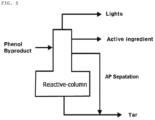
- the present disclosure provides a decomposition apparatus as illustrated in FIG. 3 in order to more efficiently perform the phenol byproduct decomposition process.
- a decomposition apparatus including a phenol byproduct supply part for supplying byproducts of a phenol production process to a reactive distillation column; a tar recovery part provided at a lower part of the reactive distillation column; a tar transfer line transferring tar recovered from the tar recovery part; an acetophenone recovery line provided at a side of the middle part of the reactive distillation column; an acetophenone transfer line connected to the tar transfer line to mix the acetophenone recovered from the acetophenone recovery line with the recovered tar; and an active ingredient recovery part provided at an upper part of the reactive distillation column.
- the acetophenone recovery line is provided at a position of 25 to 90% of the total number of stages in the reactive distillation column, preferably, 45 to 90%, and more preferably, 50 to 90% of the total number of stages in the reactive distillation column.
- the total number of stages refers to a position from the top of the reactive distillation column.
- the present disclosure includes exchanging heat between the mixed stream of the tar and the acetophenone and the phenol byproducts supplied to the distillation column to preheat the phenol byproducts before being supplied to the distillation column.
- the decomposition apparatus further includes a heat exchanger between the phenol byproduct supply part and the recovered tar and acetophenone transfer line to cause heat-exchange between the mixture of the tar and the acetophenone and the phenol byproducts.
- the tar mixed with acetophenone may be transferred even at room temperature, thermal energy supplied from the tar recovered to the lower part of the reactor may be transferred by heat exchange with the phenol byproducts supplied to the reactive distillation column, and thus, cost for operating the heater for the reaction may be significantly reduced.
- At least 90 wt% or more of acetophenone contained in the phenol byproducts may be separated from the middle part (25 to 90% of the total number of stages) of the side of the reactive distillation column, and when the separated acetophenone is mixed with tar, viscosity of the tar may be significantly lowered so that tar may be transferred and stored at room temperature.
- the related art process for separating phenol byproducts has a problem in that when a temperature of the tar separated to the lower part of the reactor is lowered, viscosity thereof is significantly increased, which makes it difficult for the tar to be smoothly transferred and stored.
- viscosity of a fluid flowable in a transfer pipe may be about 60 Pa.s at 80°C, and viscosity of the tar at room temperature may be about 1000 Pa.s. Therefore, in order to transfer the tar using the transfer pipe used in the general process, the viscosity of the tar must be lowered to 60 Pa.s or less. Generally, in order to transfer tar, it is necessary to increase the temperature of the tar or to mix the tar with a specific material.
- acetophenone due to the characteristic that the phenol contained in the active ingredient forms azeotrope with acetophenone, it is difficult to separate 100 wt% of acetophenone from the active ingredient, and thus a small amount of acetophenone may be contained in the active ingredient recovery part, but in the process of decomposing the phenol byproducts using the reactive distillation column in which the reactor and the distillation column are integrated, acetophenone may be separated from the middle part of the side of the reactive distillation column and mixed together with the tar recovered from the lower part of the distillation column and transferred, whereby viscosity of the tar may be significantly lowered to be transferred at room temperature.
- acetophenone is separable at normal pressure, recovery of the active ingredient may be significantly improved as compared with the existing method of recovering acetophenone under a pressurized condition, and since an operating temperature of the reactive distillation column is low, energy required for the process may be significantly reduced.
- the mixed stream of tar and acetophenone may maintain viscosity allowing smooth transfer at a temperature of 25°C or more, and the viscosity may be gradually reduced as the temperature increases.
- Viscosity of the mixed stream of tar and acetophenone may be 30 Pa.s or less at 25°C., preferably, 20 Pa.s or less, and more preferably, 10 Pa.s or less.
- the viscosity may be 1 Pa.s or less or 0.5 Pa.s or less depending on a mixing ratio of the tar and acetophenone and an operating temperature and may be significantly lowered to 0.3 Pa.s or less. Therefore, in the present disclosure, by mixing the tar and acetophenone to transfer the tar, the tar may be smoothly transferred even at a temperature condition of room temperature without raising the temperature. Also, the viscosity may be reduced by 10 times or more as the temperature rises.
- a mixing ratio of the tar and acetophenone may be arbitrarily selected and may be varied depending on a composition of the phenol byproducts (AP content in the existing phenol byproducts) or the degree of AP separation from the active ingredient in the distillation column.
- the tar and acetophenone may be mixed in a weight ratio of 10:1 to 1:10, and the viscosity of the mixed stream may be reduced as the mixing ratio of acetophenone increases, and in order to exhibit sufficient fluidity at room temperature, the mixing ratio of the tar and acetophenone may be 1:0.3 or greater or 1:0.4 or greater by weight ratio, and preferably, 1:0.9 or less, or 1:0.8 or less.
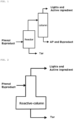
- Phenol byproducts were decomposed using a decomposition apparatus (see FIG. 1 ) in which a reactor for thermal decomposition and a distillation column were separated.
- Phenol byproducts were decomposed using a decomposition apparatus (see FIG. 2 ) in which a reactor and a distillation column were integrated.
- Phenol byproducts were decomposed using a decomposition apparatus (see FIG. 3 ) in which an acetophenone recovery line connected to a tar transfer line at a lower part of a reactive distillation column in which a reactor and a distillation column were integrated is provided at a middle part of the side of the reactive distillation column (50% of the total number of stages).
- Phenol byproducts were decomposed in a mode (see FIG. 5 ) in which an acetophenone recovery line connected to a tar transfer line at a lower part of a reactive distillation column in which a reactor and a distillation column were integrated is provided at a middle part of the side of the reactive distillation column (50% of the total number of stages) and an active ingredient was separately separated from the side (20% of the total number of stages) of the reactive distillation column.
- Comparative Example 1 In the case of Comparative Example 1, a space problem arises due to separate installation of the reactor and the distillation column and addition of the heater results in measurement of the highest heat duty. In the case of Comparative Example 2, a high heat duty was measured due to enhancement of the operating temperature of the reactor in accordance with the pressurization condition.
- Example 2 the heat duty was minimized by providing the heat exchanger between the phenol byproducts and the tar transfer line. Based on these results, it is possible to provide a decomposition apparatus capable of further reducing heater operation cost.
Landscapes
- Chemical & Material Sciences (AREA)
- Organic Chemistry (AREA)
- Crystallography & Structural Chemistry (AREA)
- Chemical Kinetics & Catalysis (AREA)
- Organic Low-Molecular-Weight Compounds And Preparation Thereof (AREA)
- Engineering & Computer Science (AREA)
- Analytical Chemistry (AREA)
- Oil, Petroleum & Natural Gas (AREA)
- Water Supply & Treatment (AREA)
Claims (4)
- Verfahren zum Zersetzen von Phenol-Nebenprodukten, hergestellt in einem Phenol-Herstellungsprozess, wobei das Verfahren umfasst:Zuführen der Phenol-Nebenprodukte zu einer Reaktivdestillationssäule, um eine Zersetzungsreaktion durchzuführen;Rückgewinnen von Teer aus einem unteren Teil der Reaktivdestillationssäule;Rückgewinnen von Acetophenon aus einem mittleren Abschnitt eines Seitenteils der Reaktivdestillationssäule;Rückgewinnen eines Wirkstoffs aus einem oberen Teil der Reaktivdestillationssäule;Mischen des zurückgewonnenen Acetophenons mit dem zurückgewonnenen Teer; undAustauschen von Wärme zwischen den Phenol-Nebenprodukten, die der Reaktivdestillationssäule zugeführt werden, und einem gemischten Strom aus dem zurückgewonnenen Teer und dem zurückgewonnenen Acetophenon, um die Phenol-Nebenprodukte zu erhitzen;wobei der Wirkstoff Phenol, alpha-Methylstyrol und Cumol umfasst.
- Verfahren nach Anspruch 1, wobei die Reaktivdestillationssäule bei 0,5 bis 3 bar betrieben wird.
- Vorrichtung zum Zersetzen von Phenol-Nebenprodukten, wobei die Vorrichtung umfasst:einen Phenol-Nebenprodukt-Zuführungsteil zum Zuführen von Phenol-Nebenprodukten eines Phenol-Herstellungsprozesses zu einer Reaktivdestillationssäule;einen Teerrückgewinnungsteil, der an einem unteren Teil der Reaktivdestillationssäule bereitgestellt ist, um Teer zurückzugewinnen;eine Teertransferleitung, um aus dem Teerrückgewinnungsteil zurückgewonnenen Teer zu transferieren;eine Acetophenon-Rückgewinnungsleitung, bereitgestellt in einem mittleren Teil einer Seite der Reaktivdestillationssäule;eine Acetophenon-Transferleitung, die mit der TeerTransferleitung verbunden ist, um das aus der Acetophenon-Rückgewinnungsleitung zurückgewonnene Acetophenon mit dem zurückgewonnenen Teer zu mischen;ein Wirkstoffrückgewinnungsteil, das an einem oberen Teil der Reaktivdestillationssäule bereitgestellt ist; undeinen Wärmetauscher zum Austauschen von Wärme zwischen einem gemischten Strom aus dem zurückgewonnenen Teer und Acetophenon und den Phenol-Nebenprodukten.
- Vorrichtung nach Anspruch 3, wobei die Acetophenon-Rückgewinnungsleitung bei 25 bis 90 % einer Gesamtzahl von Stufen der Reaktivdestillationssäule positioniert ist.
Applications Claiming Priority (2)
| Application Number | Priority Date | Filing Date | Title |
|---|---|---|---|
| KR20170154969 | 2017-11-20 | ||
| PCT/KR2018/009459 WO2019098501A1 (ko) | 2017-11-20 | 2018-08-17 | 페놀 제조 공정에서의 부산물 분해방법 |
Publications (3)
| Publication Number | Publication Date |
|---|---|
| EP3680226A1 EP3680226A1 (de) | 2020-07-15 |
| EP3680226A4 EP3680226A4 (de) | 2020-12-23 |
| EP3680226B1 true EP3680226B1 (de) | 2023-10-25 |
Family
ID=66540278
Family Applications (1)
| Application Number | Title | Priority Date | Filing Date |
|---|---|---|---|
| EP18878724.6A Active EP3680226B1 (de) | 2017-11-20 | 2018-08-17 | Verfahren zur zersetzung eines nebenprodukts eines phenolproduktionsprozesses |
Country Status (6)
| Country | Link |
|---|---|
| US (1) | US11407694B2 (de) |
| EP (1) | EP3680226B1 (de) |
| JP (1) | JP7104707B2 (de) |
| KR (1) | KR102457801B1 (de) |
| CN (1) | CN110461806A (de) |
| WO (1) | WO2019098501A1 (de) |
Families Citing this family (7)
| Publication number | Priority date | Publication date | Assignee | Title |
|---|---|---|---|---|
| KR102337898B1 (ko) * | 2017-11-20 | 2021-12-09 | 주식회사 엘지화학 | 페놀 제조 공정에서의 부산물 분해방법 |
| KR102441561B1 (ko) * | 2018-12-20 | 2022-09-06 | 주식회사 엘지화학 | 페놀계 부산물의 분해 방법 및 이의 분해 장치 |
| KR102489404B1 (ko) * | 2019-09-16 | 2023-01-16 | 주식회사 엘지화학 | 페놀계 부산물 분해 방법 |
| KR102489410B1 (ko) * | 2019-09-16 | 2023-01-16 | 주식회사 엘지화학 | 페놀계 부산물 분해 방법 |
| KR102860383B1 (ko) | 2020-06-23 | 2025-09-15 | 주식회사 엘지화학 | 페놀계 부산물 분해방법 |
| KR102861475B1 (ko) | 2020-07-10 | 2025-09-17 | 주식회사 엘지화학 | 페놀계 부산물 분해방법 |
| KR102755582B1 (ko) | 2020-07-17 | 2025-01-14 | 주식회사 엘지화학 | 페놀계 부산물 분해방법 |
Family Cites Families (19)
| Publication number | Priority date | Publication date | Assignee | Title |
|---|---|---|---|---|
| NL127228C (de) * | 1959-07-15 | |||
| US3850996A (en) * | 1970-10-08 | 1974-11-26 | Hercules Inc | Treatment of the heavy ends fraction of cumene hydroperoxide cleavage reaction mixture |
| GB1574420A (en) | 1976-12-18 | 1980-09-03 | Bp Chem Int Ltd | Process for recovering crude phenol from catalyst-free cumene hydroperoxide cleavage reaction products |
| EP0008869B1 (de) * | 1978-08-18 | 1983-03-02 | BP Chemicals Limited | Verfahren zur Herstellung eines Phenols und einer Carbonyl-Verbindung durch katalysierten Abbau eines aromatischen Hydroperoxids |
| JPS60123434A (ja) * | 1983-12-06 | 1985-07-02 | Mitsui Toatsu Chem Inc | クメン法フェノ−ル蒸留残渣の処理方法 |
| IT1181903B (it) * | 1984-06-15 | 1987-09-30 | Anic Spa | Procedimento per la pirolisi di peci fenoliche |
| AU645264B2 (en) | 1990-08-07 | 1994-01-13 | Dow Chemical Company, The | Method for making biocomponent fibers |
| US5240568A (en) | 1991-08-29 | 1993-08-31 | Allied-Signal Inc. | Removal of acetophenone from phenol purification residues |
| RU2032656C1 (ru) | 1992-04-23 | 1995-04-10 | Дыкман Аркадий Самуилович | Способ выделения фенола из фенольной смолы производства фенола и ацетона кумольным методом |
| US5457244A (en) | 1994-10-04 | 1995-10-10 | General Electric Company | Phenol tar waste reduction process |
| RU2120433C1 (ru) | 1997-02-28 | 1998-10-20 | Дыкман Аркадий Самуилович | Способ переработки фенольной смолы, полученной в производстве фенола и ацетона кумольным методом |
| EP0863195B1 (de) | 1997-02-28 | 2010-11-24 | SABIC Innovative Plastics IP B.V. | Verfahren zum Kracken von Phenolteer |
| US6965056B1 (en) | 1999-05-03 | 2005-11-15 | Shell Oil Company | Removal of salts in the manufacture of phenolic compound |
| KR100321518B1 (ko) | 1999-05-07 | 2002-01-24 | 서곤 | 페놀 제조공정 부산물로부터 페놀, 큐멘, α-메틸스티렌의 회수방법 및 그의 장치 |
| CN101835732B (zh) | 2007-10-26 | 2014-05-07 | 国际壳牌研究有限公司 | 在生产苯酚期间回收苯乙酮 |
| WO2009080338A1 (en) | 2007-12-20 | 2009-07-02 | Borealis Technology Oy | Purification of phenol |
| KR101378274B1 (ko) | 2010-06-08 | 2014-04-01 | 주식회사 엘지화학 | 페놀 불순물 제거 방법 |
| CN105121399B (zh) * | 2013-04-25 | 2017-03-29 | 乐天化学株式会社 | 苯乙酮的合成方法 |
| KR102337898B1 (ko) * | 2017-11-20 | 2021-12-09 | 주식회사 엘지화학 | 페놀 제조 공정에서의 부산물 분해방법 |
-
2018
- 2018-08-17 EP EP18878724.6A patent/EP3680226B1/de active Active
- 2018-08-17 WO PCT/KR2018/009459 patent/WO2019098501A1/ko not_active Ceased
- 2018-08-17 US US16/478,802 patent/US11407694B2/en active Active
- 2018-08-17 CN CN201880006831.6A patent/CN110461806A/zh active Pending
- 2018-08-17 JP JP2019536539A patent/JP7104707B2/ja active Active
- 2018-08-17 KR KR1020180096150A patent/KR102457801B1/ko active Active
Also Published As
| Publication number | Publication date |
|---|---|
| US20210130256A1 (en) | 2021-05-06 |
| JP2021503436A (ja) | 2021-02-12 |
| WO2019098501A1 (ko) | 2019-05-23 |
| WO2019098501A8 (ko) | 2019-09-12 |
| KR102457801B1 (ko) | 2022-10-21 |
| JP7104707B2 (ja) | 2022-07-21 |
| CN110461806A (zh) | 2019-11-15 |
| US11407694B2 (en) | 2022-08-09 |
| KR20190058273A (ko) | 2019-05-29 |
| EP3680226A1 (de) | 2020-07-15 |
| EP3680226A4 (de) | 2020-12-23 |
Similar Documents
| Publication | Publication Date | Title |
|---|---|---|
| US11407694B2 (en) | Method for decomposing byproducts in phenol production process | |
| US11547951B2 (en) | Method of decomposing by-product in phenol preparation process | |
| EP3715338B1 (de) | Verfahren zur zersetzung eines phenolischen nebenprodukts | |
| EP3995476B1 (de) | Verfahren zur zersetzung eines phenolischen nebenprodukts | |
| EP3971159B1 (de) | Verfahren zur zersetzung eines phenolbasierten nebenprodukts | |
| EP3988535A1 (de) | Verfahren zur zersetzung von phenolischen nebenprodukten | |
| KR102860383B1 (ko) | 페놀계 부산물 분해방법 | |
| JP4996861B2 (ja) | 回収フェノール類の精製方法 | |
| KR20220007369A (ko) | 페놀계 부산물 분해방법 | |
| KR20210155571A (ko) | 페놀계 부산물 분해방법 |
Legal Events
| Date | Code | Title | Description |
|---|---|---|---|
| STAA | Information on the status of an ep patent application or granted ep patent |
Free format text: STATUS: THE INTERNATIONAL PUBLICATION HAS BEEN MADE |
|
| PUAI | Public reference made under article 153(3) epc to a published international application that has entered the european phase |
Free format text: ORIGINAL CODE: 0009012 |
|
| STAA | Information on the status of an ep patent application or granted ep patent |
Free format text: STATUS: REQUEST FOR EXAMINATION WAS MADE |
|
| 17P | Request for examination filed |
Effective date: 20190711 |
|
| AK | Designated contracting states |
Kind code of ref document: A1 Designated state(s): AL AT BE BG CH CY CZ DE DK EE ES FI FR GB GR HR HU IE IS IT LI LT LU LV MC MK MT NL NO PL PT RO RS SE SI SK SM TR |
|
| AX | Request for extension of the european patent |
Extension state: BA ME |
|
| REG | Reference to a national code |
Ref country code: DE Ipc: C07C0037520000 Ref country code: DE Ref legal event code: R079 Ref document number: 602018060153 Country of ref document: DE Free format text: PREVIOUS MAIN CLASS: C07C0037740000 Ipc: C07C0037520000 |
|
| A4 | Supplementary search report drawn up and despatched |
Effective date: 20201120 |
|
| RIC1 | Information provided on ipc code assigned before grant |
Ipc: C07C 15/44 20060101ALI20201116BHEP Ipc: C07C 1/20 20060101ALI20201116BHEP Ipc: C07C 37/52 20060101AFI20201116BHEP Ipc: C07C 15/085 20060101ALI20201116BHEP Ipc: C07C 49/78 20060101ALI20201116BHEP Ipc: C07C 39/04 20060101ALI20201116BHEP Ipc: C07C 45/82 20060101ALI20201116BHEP |
|
| DAV | Request for validation of the european patent (deleted) | ||
| DAX | Request for extension of the european patent (deleted) | ||
| GRAP | Despatch of communication of intention to grant a patent |
Free format text: ORIGINAL CODE: EPIDOSNIGR1 |
|
| STAA | Information on the status of an ep patent application or granted ep patent |
Free format text: STATUS: GRANT OF PATENT IS INTENDED |
|
| INTG | Intention to grant announced |
Effective date: 20230809 |
|
| GRAS | Grant fee paid |
Free format text: ORIGINAL CODE: EPIDOSNIGR3 |
|
| GRAA | (expected) grant |
Free format text: ORIGINAL CODE: 0009210 |
|
| STAA | Information on the status of an ep patent application or granted ep patent |
Free format text: STATUS: THE PATENT HAS BEEN GRANTED |
|
| AK | Designated contracting states |
Kind code of ref document: B1 Designated state(s): AL AT BE BG CH CY CZ DE DK EE ES FI FR GB GR HR HU IE IS IT LI LT LU LV MC MK MT NL NO PL PT RO RS SE SI SK SM TR |
|
| REG | Reference to a national code |
Ref country code: GB Ref legal event code: FG4D |
|
| REG | Reference to a national code |
Ref country code: CH Ref legal event code: EP |
|
| REG | Reference to a national code |
Ref country code: DE Ref legal event code: R096 Ref document number: 602018060153 Country of ref document: DE |
|
| REG | Reference to a national code |
Ref country code: IE Ref legal event code: FG4D |
|
| REG | Reference to a national code |
Ref country code: LT Ref legal event code: MG9D |
|
| REG | Reference to a national code |
Ref country code: NL Ref legal event code: MP Effective date: 20231025 |
|
| REG | Reference to a national code |
Ref country code: AT Ref legal event code: MK05 Ref document number: 1624522 Country of ref document: AT Kind code of ref document: T Effective date: 20231025 |
|
| PG25 | Lapsed in a contracting state [announced via postgrant information from national office to epo] |
Ref country code: NL Free format text: LAPSE BECAUSE OF FAILURE TO SUBMIT A TRANSLATION OF THE DESCRIPTION OR TO PAY THE FEE WITHIN THE PRESCRIBED TIME-LIMIT Effective date: 20231025 |
|
| PG25 | Lapsed in a contracting state [announced via postgrant information from national office to epo] |
Ref country code: GR Free format text: LAPSE BECAUSE OF FAILURE TO SUBMIT A TRANSLATION OF THE DESCRIPTION OR TO PAY THE FEE WITHIN THE PRESCRIBED TIME-LIMIT Effective date: 20240126 |
|
| PG25 | Lapsed in a contracting state [announced via postgrant information from national office to epo] |
Ref country code: IS Free format text: LAPSE BECAUSE OF FAILURE TO SUBMIT A TRANSLATION OF THE DESCRIPTION OR TO PAY THE FEE WITHIN THE PRESCRIBED TIME-LIMIT Effective date: 20240225 |
|
| PG25 | Lapsed in a contracting state [announced via postgrant information from national office to epo] |
Ref country code: LT Free format text: LAPSE BECAUSE OF FAILURE TO SUBMIT A TRANSLATION OF THE DESCRIPTION OR TO PAY THE FEE WITHIN THE PRESCRIBED TIME-LIMIT Effective date: 20231025 |
|
| PG25 | Lapsed in a contracting state [announced via postgrant information from national office to epo] |
Ref country code: AT Free format text: LAPSE BECAUSE OF FAILURE TO SUBMIT A TRANSLATION OF THE DESCRIPTION OR TO PAY THE FEE WITHIN THE PRESCRIBED TIME-LIMIT Effective date: 20231025 |
|
| PG25 | Lapsed in a contracting state [announced via postgrant information from national office to epo] |
Ref country code: ES Free format text: LAPSE BECAUSE OF FAILURE TO SUBMIT A TRANSLATION OF THE DESCRIPTION OR TO PAY THE FEE WITHIN THE PRESCRIBED TIME-LIMIT Effective date: 20231025 |
|
| PG25 | Lapsed in a contracting state [announced via postgrant information from national office to epo] |
Ref country code: LT Free format text: LAPSE BECAUSE OF FAILURE TO SUBMIT A TRANSLATION OF THE DESCRIPTION OR TO PAY THE FEE WITHIN THE PRESCRIBED TIME-LIMIT Effective date: 20231025 Ref country code: IS Free format text: LAPSE BECAUSE OF FAILURE TO SUBMIT A TRANSLATION OF THE DESCRIPTION OR TO PAY THE FEE WITHIN THE PRESCRIBED TIME-LIMIT Effective date: 20240225 Ref country code: GR Free format text: LAPSE BECAUSE OF FAILURE TO SUBMIT A TRANSLATION OF THE DESCRIPTION OR TO PAY THE FEE WITHIN THE PRESCRIBED TIME-LIMIT Effective date: 20240126 Ref country code: ES Free format text: LAPSE BECAUSE OF FAILURE TO SUBMIT A TRANSLATION OF THE DESCRIPTION OR TO PAY THE FEE WITHIN THE PRESCRIBED TIME-LIMIT Effective date: 20231025 Ref country code: BG Free format text: LAPSE BECAUSE OF FAILURE TO SUBMIT A TRANSLATION OF THE DESCRIPTION OR TO PAY THE FEE WITHIN THE PRESCRIBED TIME-LIMIT Effective date: 20240125 Ref country code: AT Free format text: LAPSE BECAUSE OF FAILURE TO SUBMIT A TRANSLATION OF THE DESCRIPTION OR TO PAY THE FEE WITHIN THE PRESCRIBED TIME-LIMIT Effective date: 20231025 Ref country code: PT Free format text: LAPSE BECAUSE OF FAILURE TO SUBMIT A TRANSLATION OF THE DESCRIPTION OR TO PAY THE FEE WITHIN THE PRESCRIBED TIME-LIMIT Effective date: 20240226 |
|
| PG25 | Lapsed in a contracting state [announced via postgrant information from national office to epo] |
Ref country code: SE Free format text: LAPSE BECAUSE OF FAILURE TO SUBMIT A TRANSLATION OF THE DESCRIPTION OR TO PAY THE FEE WITHIN THE PRESCRIBED TIME-LIMIT Effective date: 20231025 Ref country code: RS Free format text: LAPSE BECAUSE OF FAILURE TO SUBMIT A TRANSLATION OF THE DESCRIPTION OR TO PAY THE FEE WITHIN THE PRESCRIBED TIME-LIMIT Effective date: 20231025 Ref country code: PL Free format text: LAPSE BECAUSE OF FAILURE TO SUBMIT A TRANSLATION OF THE DESCRIPTION OR TO PAY THE FEE WITHIN THE PRESCRIBED TIME-LIMIT Effective date: 20231025 Ref country code: NO Free format text: LAPSE BECAUSE OF FAILURE TO SUBMIT A TRANSLATION OF THE DESCRIPTION OR TO PAY THE FEE WITHIN THE PRESCRIBED TIME-LIMIT Effective date: 20240125 Ref country code: LV Free format text: LAPSE BECAUSE OF FAILURE TO SUBMIT A TRANSLATION OF THE DESCRIPTION OR TO PAY THE FEE WITHIN THE PRESCRIBED TIME-LIMIT Effective date: 20231025 Ref country code: HR Free format text: LAPSE BECAUSE OF FAILURE TO SUBMIT A TRANSLATION OF THE DESCRIPTION OR TO PAY THE FEE WITHIN THE PRESCRIBED TIME-LIMIT Effective date: 20231025 |
|
| PG25 | Lapsed in a contracting state [announced via postgrant information from national office to epo] |
Ref country code: DK Free format text: LAPSE BECAUSE OF FAILURE TO SUBMIT A TRANSLATION OF THE DESCRIPTION OR TO PAY THE FEE WITHIN THE PRESCRIBED TIME-LIMIT Effective date: 20231025 |
|
| PG25 | Lapsed in a contracting state [announced via postgrant information from national office to epo] |
Ref country code: CZ Free format text: LAPSE BECAUSE OF FAILURE TO SUBMIT A TRANSLATION OF THE DESCRIPTION OR TO PAY THE FEE WITHIN THE PRESCRIBED TIME-LIMIT Effective date: 20231025 |
|
| REG | Reference to a national code |
Ref country code: DE Ref legal event code: R097 Ref document number: 602018060153 Country of ref document: DE |
|
| PG25 | Lapsed in a contracting state [announced via postgrant information from national office to epo] |
Ref country code: SK Free format text: LAPSE BECAUSE OF FAILURE TO SUBMIT A TRANSLATION OF THE DESCRIPTION OR TO PAY THE FEE WITHIN THE PRESCRIBED TIME-LIMIT Effective date: 20231025 |
|
| PG25 | Lapsed in a contracting state [announced via postgrant information from national office to epo] |
Ref country code: SM Free format text: LAPSE BECAUSE OF FAILURE TO SUBMIT A TRANSLATION OF THE DESCRIPTION OR TO PAY THE FEE WITHIN THE PRESCRIBED TIME-LIMIT Effective date: 20231025 Ref country code: SK Free format text: LAPSE BECAUSE OF FAILURE TO SUBMIT A TRANSLATION OF THE DESCRIPTION OR TO PAY THE FEE WITHIN THE PRESCRIBED TIME-LIMIT Effective date: 20231025 Ref country code: RO Free format text: LAPSE BECAUSE OF FAILURE TO SUBMIT A TRANSLATION OF THE DESCRIPTION OR TO PAY THE FEE WITHIN THE PRESCRIBED TIME-LIMIT Effective date: 20231025 Ref country code: IT Free format text: LAPSE BECAUSE OF FAILURE TO SUBMIT A TRANSLATION OF THE DESCRIPTION OR TO PAY THE FEE WITHIN THE PRESCRIBED TIME-LIMIT Effective date: 20231025 Ref country code: EE Free format text: LAPSE BECAUSE OF FAILURE TO SUBMIT A TRANSLATION OF THE DESCRIPTION OR TO PAY THE FEE WITHIN THE PRESCRIBED TIME-LIMIT Effective date: 20231025 Ref country code: DK Free format text: LAPSE BECAUSE OF FAILURE TO SUBMIT A TRANSLATION OF THE DESCRIPTION OR TO PAY THE FEE WITHIN THE PRESCRIBED TIME-LIMIT Effective date: 20231025 Ref country code: CZ Free format text: LAPSE BECAUSE OF FAILURE TO SUBMIT A TRANSLATION OF THE DESCRIPTION OR TO PAY THE FEE WITHIN THE PRESCRIBED TIME-LIMIT Effective date: 20231025 |
|
| PLBE | No opposition filed within time limit |
Free format text: ORIGINAL CODE: 0009261 |
|
| STAA | Information on the status of an ep patent application or granted ep patent |
Free format text: STATUS: NO OPPOSITION FILED WITHIN TIME LIMIT |
|
| 26N | No opposition filed |
Effective date: 20240726 |
|
| PG25 | Lapsed in a contracting state [announced via postgrant information from national office to epo] |
Ref country code: SI Free format text: LAPSE BECAUSE OF FAILURE TO SUBMIT A TRANSLATION OF THE DESCRIPTION OR TO PAY THE FEE WITHIN THE PRESCRIBED TIME-LIMIT Effective date: 20231025 |
|
| PG25 | Lapsed in a contracting state [announced via postgrant information from national office to epo] |
Ref country code: SI Free format text: LAPSE BECAUSE OF FAILURE TO SUBMIT A TRANSLATION OF THE DESCRIPTION OR TO PAY THE FEE WITHIN THE PRESCRIBED TIME-LIMIT Effective date: 20231025 |
|
| REG | Reference to a national code |
Ref country code: CH Ref legal event code: PL |
|
| PG25 | Lapsed in a contracting state [announced via postgrant information from national office to epo] |
Ref country code: LU Free format text: LAPSE BECAUSE OF NON-PAYMENT OF DUE FEES Effective date: 20240817 |
|
| PG25 | Lapsed in a contracting state [announced via postgrant information from national office to epo] |
Ref country code: MC Free format text: LAPSE BECAUSE OF FAILURE TO SUBMIT A TRANSLATION OF THE DESCRIPTION OR TO PAY THE FEE WITHIN THE PRESCRIBED TIME-LIMIT Effective date: 20231025 Ref country code: CH Free format text: LAPSE BECAUSE OF NON-PAYMENT OF DUE FEES Effective date: 20240831 |
|
| REG | Reference to a national code |
Ref country code: BE Ref legal event code: MM Effective date: 20240831 |
|
| PG25 | Lapsed in a contracting state [announced via postgrant information from national office to epo] |
Ref country code: BE Free format text: LAPSE BECAUSE OF NON-PAYMENT OF DUE FEES Effective date: 20240831 |
|
| PG25 | Lapsed in a contracting state [announced via postgrant information from national office to epo] |
Ref country code: IE Free format text: LAPSE BECAUSE OF NON-PAYMENT OF DUE FEES Effective date: 20240817 |
|
| PG25 | Lapsed in a contracting state [announced via postgrant information from national office to epo] |
Ref country code: FI Free format text: LAPSE BECAUSE OF FAILURE TO SUBMIT A TRANSLATION OF THE DESCRIPTION OR TO PAY THE FEE WITHIN THE PRESCRIBED TIME-LIMIT Effective date: 20231025 |
|
| PGFP | Annual fee paid to national office [announced via postgrant information from national office to epo] |
Ref country code: DE Payment date: 20250721 Year of fee payment: 8 |
|
| PGFP | Annual fee paid to national office [announced via postgrant information from national office to epo] |
Ref country code: GB Payment date: 20250722 Year of fee payment: 8 |
|
| PGFP | Annual fee paid to national office [announced via postgrant information from national office to epo] |
Ref country code: FR Payment date: 20250725 Year of fee payment: 8 |
|
| PG25 | Lapsed in a contracting state [announced via postgrant information from national office to epo] |
Ref country code: CY Free format text: LAPSE BECAUSE OF FAILURE TO SUBMIT A TRANSLATION OF THE DESCRIPTION OR TO PAY THE FEE WITHIN THE PRESCRIBED TIME-LIMIT; INVALID AB INITIO Effective date: 20180817 |
|
| PG25 | Lapsed in a contracting state [announced via postgrant information from national office to epo] |
Ref country code: HU Free format text: LAPSE BECAUSE OF FAILURE TO SUBMIT A TRANSLATION OF THE DESCRIPTION OR TO PAY THE FEE WITHIN THE PRESCRIBED TIME-LIMIT; INVALID AB INITIO Effective date: 20180817 |