EP3680304B1 - Procédé et dispositif de fabrication d'une bande d'étanchéité et bande d'étanchéité - Google Patents
Procédé et dispositif de fabrication d'une bande d'étanchéité et bande d'étanchéité Download PDFInfo
- Publication number
- EP3680304B1 EP3680304B1 EP20151526.9A EP20151526A EP3680304B1 EP 3680304 B1 EP3680304 B1 EP 3680304B1 EP 20151526 A EP20151526 A EP 20151526A EP 3680304 B1 EP3680304 B1 EP 3680304B1
- Authority
- EP
- European Patent Office
- Prior art keywords
- sealing tape
- cut
- foam
- longitudinal direction
- sealing
- Prior art date
- Legal status (The legal status is an assumption and is not a legal conclusion. Google has not performed a legal analysis and makes no representation as to the accuracy of the status listed.)
- Active
Links
Images


Classifications
-
- C—CHEMISTRY; METALLURGY
- C09—DYES; PAINTS; POLISHES; NATURAL RESINS; ADHESIVES; COMPOSITIONS NOT OTHERWISE PROVIDED FOR; APPLICATIONS OF MATERIALS NOT OTHERWISE PROVIDED FOR
- C09J—ADHESIVES; NON-MECHANICAL ASPECTS OF ADHESIVE PROCESSES IN GENERAL; ADHESIVE PROCESSES NOT PROVIDED FOR ELSEWHERE; USE OF MATERIALS AS ADHESIVES
- C09J7/00—Adhesives in the form of films or foils
- C09J7/20—Adhesives in the form of films or foils characterised by their carriers
- C09J7/22—Plastics; Metallised plastics
- C09J7/26—Porous or cellular plastics
-
- C—CHEMISTRY; METALLURGY
- C09—DYES; PAINTS; POLISHES; NATURAL RESINS; ADHESIVES; COMPOSITIONS NOT OTHERWISE PROVIDED FOR; APPLICATIONS OF MATERIALS NOT OTHERWISE PROVIDED FOR
- C09J—ADHESIVES; NON-MECHANICAL ASPECTS OF ADHESIVE PROCESSES IN GENERAL; ADHESIVE PROCESSES NOT PROVIDED FOR ELSEWHERE; USE OF MATERIALS AS ADHESIVES
- C09J7/00—Adhesives in the form of films or foils
- C09J7/20—Adhesives in the form of films or foils characterised by their carriers
- C09J7/29—Laminated material
-
- E—FIXED CONSTRUCTIONS
- E06—DOORS, WINDOWS, SHUTTERS, OR ROLLER BLINDS IN GENERAL; LADDERS
- E06B—FIXED OR MOVABLE CLOSURES FOR OPENINGS IN BUILDINGS, VEHICLES, FENCES OR LIKE ENCLOSURES IN GENERAL, e.g. DOORS, WINDOWS, BLINDS, GATES
- E06B1/00—Border constructions of openings in walls, floors, or ceilings; Frames to be rigidly mounted in such openings
- E06B1/62—Tightening or covering joints between the border of openings and the frame or between contiguous frames
-
- E—FIXED CONSTRUCTIONS
- E04—BUILDING
- E04B—GENERAL BUILDING CONSTRUCTIONS; WALLS, e.g. PARTITIONS; ROOFS; FLOORS; CEILINGS; INSULATION OR OTHER PROTECTION OF BUILDINGS
- E04B1/00—Constructions in general; Structures which are not restricted either to walls, e.g. partitions, or floors or ceilings or roofs
- E04B1/62—Insulation or other protection; Elements or use of specified material therefor
- E04B1/66—Sealings
- E04B1/68—Sealings of joints, e.g. expansion joints
- E04B1/6812—Compressable seals of solid form
-
- E—FIXED CONSTRUCTIONS
- E06—DOORS, WINDOWS, SHUTTERS, OR ROLLER BLINDS IN GENERAL; LADDERS
- E06B—FIXED OR MOVABLE CLOSURES FOR OPENINGS IN BUILDINGS, VEHICLES, FENCES OR LIKE ENCLOSURES IN GENERAL, e.g. DOORS, WINDOWS, BLINDS, GATES
- E06B1/00—Border constructions of openings in walls, floors, or ceilings; Frames to be rigidly mounted in such openings
- E06B1/62—Tightening or covering joints between the border of openings and the frame or between contiguous frames
- E06B2001/626—Tightening or covering joints between the border of openings and the frame or between contiguous frames comprising expanding foam strips
Definitions
- the present invention relates to a method for producing a sealing tape and a sealing tape.
- a sealing tape is described which can be used in the construction sector, for example for sealing window frames against masonry or door frames against masonry and the like.
- Such sealing tapes have long been known from the prior art. In some cases, there is the problem that air and steam and the like can pass through the sealing tape. For this reason, sealing tapes are known from the prior art which have a layer on the edge or in their interior, such as a film, which can prevent the passage of air and also steam. Many methods are known from the prior art for producing such sealing tapes. For example, it is possible to first cut a foam carrier into several strips and then attach a sealing film to these strips.
- Patent document 1 ( EP2990551A1 ) and Patent Specification 2 ( EP2990553A1 ) both relate to a process for producing sealing tape rolls with an inner, radially extending barrier layer made of flexible, compressed foam, which is easy and reliable to handle and with which sealing tape rolls can also be produced in greater lengths.
- the present invention is therefore based on the object of providing a method that enables simpler production of such sealing tapes that have a sealing layer.
- the term "functional layer” can also be used in general.
- a sealing tape wound onto a roll core extending in a predetermined longitudinal direction is first provided, which runs in several turns around the longitudinal direction of the roll core, wherein the sealing tape has at least one foam carrier.
- At least one first cut is made through several turns of the sealing tape, which runs all the way around in the longitudinal direction.
- a flowable medium and in particular an adhesive or sealing compound is introduced, for example filled, into this circumferential cut.
- the separating layer is not created before the tape is wound onto a roll core, but rather during and/or after, and especially after, the sealing tape has been wound. In this way, it is possible to create cuts through all the foam layers and to apply the subsequent sealing layer in these cuts.
- a sealing tape wound on a roll core extending in a predetermined longitudinal direction is first provided, which runs in several turns around the longitudinal direction of the roll core, wherein the sealing tape has at least one foam carrier.
- At least one first cut is made in the longitudinal direction through several turns of the sealing tape, whereby the sealing tape and the roll core are separated into two parts by this cut.
- the sealing tape or the foam carrier is preferably separated into two foam carrier parts.
- a coating is applied to an outer surface of at least one of the two parts.
- another sealing tape wound onto a roll core is attached and in particular glued to the outer surface provided with the coating.
- the wound sealing tape is cut completely, in particular including the roll core. This preferably results in a complete separation of the wound sealing tape into at least two, preferably two and/or more parts.
- This coating then leads to the intermediate layer which in particular prevents diffusion.
- this sealing tape or a sealing tape could be provided with an adhesive layer on at least one side and preferably on both sides in order to adhere to the walls that form the gap created by the cut. The applicant reserves the right to claim protection for such a procedure.
- the above-mentioned cut is first made in the sealing tape roll with a cutting movement, and the flowable medium or sealant is introduced into the cut while a cutting device is being pulled back.
- the tool that is used for cutting is also used to introduce the sealant or flowable medium.
- the tool in question can also have outlet openings which serve to introduce the sealant into the cut.
- the cut is made in the sealing tape roll by means of a first movement of the tool, for example a forward movement, and the sealant is introduced by means of a second movement, for example an opposite backward movement.
- the movement which produces the cut may be a movement in the direction of the roll core and the movement during which the sealant is at least temporarily introduced may be a movement away from the roll core of the sealing tape roll.
- the tape wound onto the roll core is rotated with respect to the longitudinal axis. It is possible that the cut is particularly preferably made using a knife. This knife can be arranged essentially stationary or can be moved in a straight line, in particular towards the roll core, in order to produce the cut in the roll tape.
- the substance or adhesive (or in another embodiment, the sealing film) is evenly applied in the circumferential direction and/or in the radial direction of the sealing tape roll. In this way, an even distribution of the sealing layer is later achieved.
- the adhesive is applied to both sides of the side walls of the roll created by the cut. It is possible, as described in more detail below, for the knife to have outlet openings through which the adhesive can be applied to the cuts or the wall sections.
- the roll core is made of a paper material, for example cardboard.
- a plastic core would also be conceivable.
- a cutting plane produced by the first cut is perpendicular to the longitudinal axis of the sealing tape roll and/or perpendicular to the axis of rotation of the sealing tape roll.
- the sealant is a pasty sealant.
- the sealant is advantageously selected from a group of sealants which contains acrylic sealants, silicone sealants, polyurethane sealants, silane-terminated polymers, rubber compound, butyl, PU and acrylic dispersions, combinations thereof and/or paint-like modifications of such materials.
- these substances referred to here as sealants can also be used in a harder version, as adhesives.
- the sealant is tempered and in particular heated before being introduced into the cut.
- the flowable medium or sealant has a viscosity that depends on its temperature, in particular a viscosity that decreases as the temperature increases.
- the flowable medium is preferably a medium that hardens when heated.
- hot melt adhesives and/or hot melt sealants could be used.
- the sealant is provided by means of a pump device.
- a reservoir can be provided which contains the said sealant or adhesive mass and a pump device which conveys the adhesive to the gap.
- the knife or cutting device with which the cut is made can have openings through which the adhesive can escape.
- a covering layer such as in particular but not exclusively a so-called liner, is applied to the sealing tape, in particular before it is applied to the sealing tape roll.
- the at least one cut (or the at least one cut per subsequent roll) is widened in the longitudinal direction or the direction of rotation of the sealing tape roll. This means that not only is one cut created, but the walls of the sealing tape roll adjacent to this cut are spaced apart or pushed apart from one another.
- a knife can be used which widens against the cutting direction, so that not only the cut is generated, but also the sealing tape roll or the foam is expanded accordingly.
- the sealant can be inserted into this expanded area.
- this expansion can be achieved by the cutting medium or its shape.
- the cutting blade it is possible for the cutting blade to be somewhat wider than the usual parting blades. It would also be possible for the cutting blade to be at an angle, particularly at an angle to the cutting direction, thus achieving the expansion of the cut.
- the flowable medium (or if necessary the sealing film, or a carrier - self-adhesive and/or a film coated with adhesive on both sides) is introduced into the cut immediately after it has been made.
- a sealing film it would be possible for a dispensing device for dispensing a sealing film to be arranged on the cutting element.
- the cut is narrowed again after the introduction of the flowable medium and/or the film or the walls delimiting the cut are forced towards each other again.
- a second cut is made in the sealing tape, which is offset in the longitudinal direction from the first cut, wherein the second cut also cuts the roll core.
- the second cut is preferably made using the cutting process known from the prior art, with which a large number of individual sealing tape rolls are cut or cut off from a long roll.
- the first cut does not cut the roll core. This means that the first cut essentially only cuts through the foam body, but this still remains on the roll core. In this way, the foam body is also stabilized by the roll core.
- the first cut preferably has a smaller radial depth than the second cut.
- the second cut is preferably used, as mentioned above, for cutting off individual rolls. As mentioned above, several first cuts can also be made between two second cuts.
- the rolls are preferably cut using cuts that extend to the machine axis.
- the first cut mentioned above is only made as far as the cardboard core (or plastic core). It is also possible that the individual roll parts are pushed back together after the adhesive has been applied.
- a plurality of first cuts and a plurality of second cuts are made, the first cuts and the second cuts being arranged adjacent to one another in the longitudinal direction.
- a first cut is followed by a second cut and this is in turn followed by a first cut (viewed in the longitudinal direction).
- a plurality of first cuts are made essentially simultaneously, followed by a plurality of second cuts.
- first and second cuts it would also be conceivable for the first and second cuts to be made essentially simultaneously, but for the second cuts to be made subsequently, in order to cut off the individual rolls after the adhesive has been inserted.
- the said first and second cuts it is also possible and preferred for the said first and second cuts to be made one after the other. For example, only one cutting knife could be used to make the second cuts, cutting off individual rolls one after the other.
- the individual cuts can be made essentially equidistantly.
- the sealing layer is located essentially in the middle of the respective roll, viewed in a width direction of the roll.
- the first cuts are made equidistantly from one another in the longitudinal direction and/or the second cuts are made equidistantly from one another in the longitudinal direction.
- rolls are produced or cut which have a roll width of more than 10 mm, preferably more than 20 mm and preferably more than 25 mm.
- rolls are cut which have a width of less than 600 mm, preferably less than 500 mm, preferably less than 400 mm, preferably less than 300 mm and particularly preferably less than 200 mm.
- the rolls containing the adhesive or sealant are tempered and in particular heated.
- the sealant or adhesive can harden.
- a foam carrier is transported along a predetermined transport direction and wound onto the roll core before the method steps described above.
- the foam carrier advantageously extends in a transport direction which simultaneously represents a longitudinal direction and in a width direction perpendicular thereto.
- the foam carrier also extends in a thickness direction, which, however, is preferably significantly smaller than the length direction and also significantly smaller than the width direction.
- the foam carrier is compressed.
- the compression can be carried out by winding it onto the roll core, but it would also be conceivable and preferred for the foam carrier to be compressed before it is rolled up.
- the rolled-up sealing tape is kept in a compressed state. It is possible for another tape to be wound around the foam carrier, which maintains the compressed state. This additional tape can also be cut through with the first and/or second cut.
- the foam carrier is impregnated.
- the foam carrier is compressed to less than 40%, preferably less than 30%, and most preferably less than 20% of its original thickness.
- the foam carrier is compressed to more than 5%, preferably to more than 7% and particularly preferably to more than 10% of its original thickness.
- an adhesive layer is applied to the carrier and in particular to a surface of the carrier.
- this adhesive layer is applied in particular to a top or bottom side, i.e. to a side that extends in the longitudinal direction and also in the width direction.
- this adhesive layer is applied over the entire surface. This can in particular, but not exclusively, be an adhesive film, in particular, but not exclusively a double-sided adhesive film.
- this adhesive film or an adhesive layer in general to also act as an airtight layer.
- a further airtight layer on the foam carrier on only one side or one side and for an adhesive layer to take over this function on the other side.
- this further airtight layer preferably faces a structure which is located at the bottom in Fig.8 is provided with the reference number 52.
- a further adhesive layer to be applied, for example on a surface of the foam carrier which extends in the longitudinal direction and in the thickness direction.
- a cover layer is also attached to the foam carrier.
- This can be attached in particular, but not exclusively, to a surface already provided with the adhesive layer.
- this cover layer or liner is a silicone paper.
- a further layer, and in particular a foam layer is applied to at least one surface of the foam carrier.
- this is a surface that extends in the longitudinal direction and the width direction of the foam carrier.
- this is an airtight foam.
- This additional foam layer can be less thick than the foam carrier itself. Particularly preferably, such an additional layer can also be applied to both surfaces of the foam carrier. Particularly preferably, a closed-cell foam is used for application. In addition, it would also be conceivable to use a substantially airtight or very fine-cell or almost airtight foam.
- one of these further layers could be arranged on a top side of the foam carrier, i.e. on a surface formed by the longitudinal direction and the width direction of the foam carrier.
- the other of the two layers could be arranged on the bottom side of the foam carrier.
- the foam carrier is preferably arranged between these two further layers.
- the sealing tape is thermally treated after the sealant or adhesive has penetrated. This thermal treatment can also be carried out after the individual sealing tape rolls have been cut off.
- this foam or foam sheet is an impregnated foam. It is possible and preferred that this foam is impregnated before the adhesive layers are applied.
- At least one cut is made in a predetermined area, for example in the middle of a multifunctional tape roll, which is then "inoculated" with an adhesive compound.
- the cut surfaces are particularly preferably coated or wetted with a pasty sealant.
- the sealing tape roll is particularly preferably manufactured as a "dock". It is conceivable that an impregnated foam, in particular a PU foam, is compressed to 10 - 20%, for example to approx. 15% of its initial thickness and rolled up onto a cardboard core (or plastic core).
- the dock or roll is wrapped with a tape, particularly a self-adhesive tape, and thus held in compression.
- the actual finished sealing tape is preferably "cut off" to a predetermined width using a knife and particularly by machine.
- the liquid or gel-like adhesive is provided via a pump and particularly preferably fills a hollow knife, which in turn has openings at the back and/or on the side that guide the adhesive to the cutting edge.
- the two parts i.e. the previously separated parts
- a separation between the two parts is preferably first effected, i.e. these two parts are separated. Then, after the coating has been applied, the same parts are joined together again.
- the coating can also be applied in another way, for example by spraying, by painting, or if necessary by placing a container containing the coating.
- the two parts are spaced apart from one another and in particular spaced apart from one another in the longitudinal direction of the roll core.
- the coating can be applied after this spacing.
- the parts are brought together again after being spaced apart.
- the two parts it would also be possible for the two parts not to be spaced apart in the longitudinal direction of the roll core, but rather perpendicular to this, for example to be moved against each other. In this way, the outer surfaces of the separated roll parts are also accessible.
- a rotational position of the first part with respect to a longitudinal direction of the roll core and a rotational position of the further part with respect to the longitudinal direction are compared and/or adjusted.
- this ensures that a rotational position of the two roll parts is not changed before and after the separation or before and after the cut. In this way, precise rejoining or re-joining is possible. It is possible to glue the separated parts together. This also allows the layers of the individual turns to be glued together precisely.
- markings can be applied to one part and the other part or even beforehand to the roll core itself, for example on an outer surface.
- markings can be applied to a peripheral surface of the wound roll, which particularly preferably also extend over the cut to be made. These two markings can be aligned again when the rotational position is adjusted so that a continuous marking is again created after the parts have been joined together.
- the attachment of a further sealing tape wound on a roll core to the outer surface provided with the coating is carried out by gluing it on.
- the coating is preferably an adhesive layer.
- a second cut is made in the sealing tape or the wound sealing tape, which is offset in the longitudinal direction from the first cut, whereby the second cut also cuts the roll core.
- a plurality of first and second cuts are made, whereby the individual sealing tape rolls are separated from one another by the second cut.
- the present invention further relates to a device for producing a sealing tape and in particular a sealing tape of the type described above, this device having a shaft which can be rotated about a predetermined axis of rotation and which is suitable and intended for receiving a roll core and a foam carrier wound around this roll core in several turns.
- This device has at least one first cutting device which is suitable and intended for making at least one cut in the foam carrier and preferably also the roll core, this cut separating the sealing tape and the roll core into two parts, and an application device which is suitable and intended for applying a coating to an outer surface of at least one of the two parts.
- this is an outer surface which is perpendicular to a longitudinal direction or to an extension direction of the roll core.
- this is a side surface of the cut roll.
- the device has a second cutting device which is suitable and intended to make a second cut in the foam carrier and the roll core, wherein the first cutting device and the second cutting device are offset with respect to one another and in particular are offset with respect to one another in the longitudinal direction of the roll core.
- roller including the roller core can be displaced relative to the rotatable shaft in the longitudinal direction of the shaft.
- a pressing device can be provided which spaced the two parts apart. In this way, coating of the respective side surfaces can be carried out more easily.
- the present invention is further directed to a sealing tape wound on a roll core extending in a predetermined longitudinal direction, which runs in several turns around the longitudinal direction of the roll core, wherein the sealing tape has a first foam carrier and a second foam carrier, which are arranged next to one another in this longitudinal direction and which are glued to one another by an adhesive layer, wherein the sealing tape is resilient after being unwound from the roll core.
- the sealing tape is designed in such a way that it recovers in a region spaced apart from the adhesive layer in the longitudinal direction in a different way than in the region of the adhesive layer. Recovery is understood to mean that the sealing tape, in a manner known per se, assumes a larger width or thickness of the foam after being unrolled from a roll core.
- This sealing tape can be impregnated for delayed recovery.
- the area in which the adhesive layer is arranged is understood to mean in particular an area which is arranged, for example, to the left and right of the adhesive layer in the longitudinal direction and also contains the adhesive layer itself. It is intended that the adhesive layer itself is less resilient than the foams surrounding it.
- a region spaced from the adhesive layer is preferably understood to mean a first and third third of the foams in the longitudinal direction (of the roll core).
- these are the first two fifths and the last two fifths, preferably the first three sevenths and the last three sevenths in relation to the width direction of the sealing tape.
- the first foam carrier and the second foam carrier are foam carriers made of the same material.
- the sealing tape is provided at an interface of the foam carrier, i.e. at a point where the foam carrier was previously cut.
- the adhesive layer has a thickness (viewed in a direction which is perpendicular to a plane of the adhesive layer) which is greater than 0.02 mm, preferably greater than 0.04 mm, preferably greater than 0.08 mm, preferably greater than 0.1 mm, preferably greater than 0.2 mm, preferably greater than 0.3 mm, preferably greater than 0.4 mm, preferably greater than 0.5 mm.
- the adhesive layer has a thickness which is less than 5 mm, preferably less than 3 mm, preferably less than 2 mm, preferably less than 1.5 mm, preferably less than 1 mm, preferably less than 0.9 mm, preferably less than 0.8 mm.
- the adhesive layer has a predetermined elasticity, but in particular an elasticity which is lower than that of the adjacent foams.
- the sealing tape has a further adhesive layer on one of its outer surfaces and in particular on a surface which is perpendicular to a plane in which the adhesive layer extends.
- This adhesive layer can preferably be covered with another element, such as a liner.
- the adhesive tape has a further foam element, which is particularly preferably arranged on a surface, for example glued to it. This surface is preferably perpendicular to the plane in which the adhesive layer extends.
- the sealing tape comprises a further foam which is arranged on a further corresponding surface which is perpendicular to a plane of the adhesive layer.
- the adhesive layer of the first two foam carriers is sandwiched between the two further foam carriers mentioned.
- these further foam carriers are thinner in a thickness direction of the foam than the first-mentioned foam carriers, which are glued to one another by means of the adhesive layer.
- the sealing tape in an unwound and returned state has a smaller thickness in an area of the adhesive layer than in an area spaced apart from the adhesive layer.
- the width direction of the tape is understood to be a direction which corresponds to the longitudinal direction of the above-mentioned roll core.
- the thickness or a thickness direction runs in particular in the extension direction of the adhesive layer.
- the present invention is further directed to a sealing tape which extends in a longitudinal direction, a width direction perpendicular to the longitudinal direction and a thickness direction perpendicular to the longitudinal direction and the width direction, wherein the sealing tape has a first foam part and a second foam part which extend next to one another in the longitudinal direction and which are glued to one another by means of an adhesive layer, wherein the first foam part and the second foam part are each resilient foam parts and wherein the sealing tape has a first section and a second section, which are each spaced from the adhesive layer, and a third section which contains the adhesive layer, wherein these sections extend next to one another in the width direction or are arranged next to one another.
- the sealing strip in the third section has, at least in sections, a lower height than in the first or second section.
- the height When viewed in the longitudinal direction of the sealing tape and in the width direction of the sealing tape, the height decreases in the direction of the adhesive layer and then gradually increases again (i.e. after passing the adhesive layer). In particular at the edges of the sealing tape, the height is therefore determined more or less exclusively by the foam or its recovery behavior.
- this sealing tape is an intermediate product and is further processed, for example, equipped with additional foam elements or foam carriers.
- This reduction in height in the direction of the adhesive layer is advantageously continuous or essentially continuous. Furthermore, this sealing tape preferably has different recovery behavior in its different regions extending in the longitudinal direction.
- a height of the sealing tape in the area of the adhesive layer is greater than 5% of the height of the sealing tape in the edge areas, preferably greater than 10%. This height is considered based on a completely retracted sealing tape.
- the height of the sealing tape in the region of the adhesive layer is less than 90%, preferably less than 70%, preferably less than 50%, preferably less than 30%, preferably less than 20% based on the height in the edge regions of the sealing tape.
- the sealing tape has a further foam carrier or a foam element on at least one surface. This further foam element can be glued to this surface.
- the sealing tape has a further foam carrier which is adhered to a further surface of the foams, wherein this surface also extends perpendicular to the plane of the adhesive layer.
- the first two foam carriers are sandwiched between the other two foam carriers.
- the adhesive layer is also sandwiched between these two further foam carriers and in this way extends from one foam carrier to the second foam carrier.
- said adhesive layer also acts as a barrier layer which hinders or prevents diffusion of air or vapor (also air flow) through the sealing tape.
- the present invention is further directed to a device for producing a sealing tape and in particular a sealing tape of the type described above.
- This device has a shaft which can be rotated with respect to a predetermined axis of rotation D and which is suitable and intended for receiving a roll core and a foam carrier wound around this roll core in several turns and at least one first cutting device which is suitable for making a first cut in the foam carrier and a second cutting device which is suitable and intended for making a second cut in the foam carrier and the roll core, wherein the first cutting device and the second cutting device are offset relative to one another along the axis of rotation.
- the axis of rotation is in particular an essentially horizontally arranged axis.
- the device has an introduction device which is suitable and intended to introduce a sealing agent and in particular a flowable sealing agent into the first cut.
- sealing tape roll is rotated. However, it would also be possible, alternatively or additionally, for the sealing tape roll to remain stationary and for the cutting means to rotate around it.
- a device which serves to make at least two cuts in a foam body made up as a roll, wherein preferably the first cut serves to introduce a sealant and the second cut serves to separate or slit off rolls of sealing tape.
- the device preferably has a plurality of first cutting devices and second cutting devices. These cutting devices are preferably arranged alternately in the direction of the axis of rotation. It would also be conceivable for only a single knife to be provided.
- the device has expansion means for expanding the first cut produced by the cutting device.
- the cutting devices in particular those which make the first cut or cuts
- the cutting devices can also have introduction elements for introducing the flowable agent.
- the devices have feed devices and/or drives which feed the cutting devices onto the rollers, in particular in the direction of the axis of rotation.
- the device has a feed device and in particular a pump device which feeds the flowable medium to the first cuts produced.
- the device preferably has a reservoir for storing the flowable medium.
- the device has tempering devices and in particular heating devices which temper and in particular heat the roll, in particular in a region of the first cuts.
- the device preferably has a control device which controls a movement of at least one second cutting device with respect to at least one first cutting device.
- the movements of a plurality of first cutting devices are synchronized with one another. In this way, a plurality of first cuts can be made into the roll essentially simultaneously. However, only one cutting device can also be provided.
- the invention relates to a sealing tape which is produced according to the method described above.
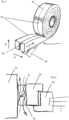
- Figure 1 shows a representation of a sealing tape roll 10 to illustrate a method according to the invention.
- the reference number 14 refers to an axis or shaft of a machine on which the sealing tape roll is arranged.
- the sealing tape roll 10 has a roll core 20 on which a plurality of foam windings (not shown in detail) are rolled up.
- the reference number P1 indicates the direction of rotation the roll. In the circumferential direction, the sealing tape roll can be surrounded by a film or adhesive strip that keeps the sealing tape roll in a compressed state.
- the reference number 4 designates a cutting device such as a cutting knife, which can be fed onto the sealing tape roll 10, as shown by the arrow, in order to produce a first cut S1.
- a cutting plane of this cut runs perpendicular to a rotation axis D of the sealing tape roll 10. This rotation axis therefore also determines the longitudinal direction of the roll core 20.
- This cut cuts the individual turns of the foam, but not the roll core 20.
- An adhesive compound can be inserted or filled into this cut, as explained in more detail below.
- Figure 2 shows the sealing tape roll from Figure 1 , whereby a large number of cuts can be seen.
- a large number of first cuts S1 such as the one in Figure 1 shown, as well as a plurality of cuts S2.
- These cuts S2 also cut the carrier 20 and thus serve for the so-called slitting, i.e. for separating the individual sealing tape rolls.
- the cuts S1 and S2 are arranged alternately in the longitudinal direction or along the axis of rotation of the sealing tape roll. More precisely, the cuts S1 are arranged centrally between two cuts S2. This means that a cut sealing tape roll has a first cut S1 essentially in its middle.
- FIG. 3 shows a representation to illustrate a cutting element 4 within a cut. It can be seen that this cutting element has a cross-section that widens in the longitudinal direction or along the axis of rotation of the sealing tape roll, in order to be able to widen the cut S1 in this area. An adhesive compound can be inserted into the cut in this area.
- Figure 4 shows a schematic representation of a cutting device 4. This has a cutting edge 44, which makes the actual cut in the foam. Next to it, a cavity 42 is provided, into which an adhesive compound can be inserted.
- the cutting device 4 can be heated in its entirety, for example to facilitate cutting or to be able to introduce the adhesive mass into the cut more easily.
- This heating can be carried out by supplying electrical energy, but also by a tempering medium or by the adhesive mass or the flowable medium itself.
- a cavity 42 is also provided, but at a different location, as well as lateral openings through which the adhesive can exit from the cutting blade or the cutting device.
- the arrows P2 in Figure 4 and the arrows P3 in Figure 5 mark the exit of the sealant.
- Figure 6 shows a representation of a device 50 according to the invention for producing a sealing tape.
- the rotatable axis 14 is provided, on which a sealing tape roll with a roll core 20 is arranged.
- the reference symbols S1 and S2 again indicate cuts which are made by the cutting blade 4 and a further cutting blade 5.
- the reference numeral 24 designates a pumping device which pumps an adhesive mass from a reservoir 22 into the cut produced by the cutting device 4.
- the machine can also have tempering devices which temper the sealing tape roll, particularly in the area of the cuts produced.
- lateral feed means which compress the sealing tape roll along its longitudinal direction or along its axis of rotation D, so that the cuts produced are pressed together again.
- Figure 7 shows a sealing tape 1 produced by the method according to the invention.
- the foam carrier 34 is provided, in the middle of which the cut and also the adhesive mass are arranged in the width direction B. It can be seen that this cut and also the adhesive mass extend essentially completely along the thickness direction Di.
- the sealing tape roll also has a cover film 36 or a liner, which is arranged here on the underside of the sealing tape.
- An adhesive layer can preferably also be arranged on this underside in order to attach the product, for example, in an area of a building.
- a further strip or layer can be arranged on the top and/or bottom of the foam, and in particular an air-impermeable layer.
- Figure 8 shows a sealing tape 1 according to the invention in an assembled state between two structures 52 and 54.
- the reference number 56 designates another structure, such as a window sash.
- the foam carrier 34 and the sealing layer 32 can be seen.
- the sealing layer 32 can create a depression through which air can still pass. To prevent this, as mentioned above, additional strips or layers, and in particular air-impermeable layers, can be applied to the side surfaces of the sealing tape roll.
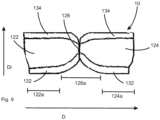
- Fig.9 shows a representation of an unwound and reset sealing tape according to the invention.
- the reference number 122 refers to a first part or a first foam carrier part and the reference number 124 refers to a second part or a second foam carrier part.
- the foam carrier was cut into these two parts 122 and 124.
- the reference numeral 126 designates the adhesive layer by means of which the two parts 122 and 124 are glued together.
- the reference numerals 122a and 124a each designate sections defined in the thickness direction D of the sealing tape, which are each spaced apart from the adhesive layer, the reference numeral 126a designates a section within which the adhesive layer 126 is arranged.
- thickness Di in section 126a and in particular at the adhesive layer 126 is less than in sections 122a and 124a. This is because the foam can recover essentially unhindered in the areas 122a and 124a, while it is prevented from doing so in section 126a.
- the thickness Di in the sections 122a and 124a continuously transitions into the thickness Di in the region 126.
- a further foam carrier 134 is arranged and in particular glued to the upper side of the parts 122 and 124 and a further foam carrier 132 is arranged to the lower side of the parts 122 and 124.
- an adhesive layer is preferably arranged on an outer surface of the foam carrier in order to be able to adhere the sealing tape to an area of a building.
Landscapes
- Chemical & Material Sciences (AREA)
- Organic Chemistry (AREA)
- Engineering & Computer Science (AREA)
- Civil Engineering (AREA)
- Structural Engineering (AREA)
- Adhesive Tapes (AREA)
Claims (15)
- Procédé de fabrication d'une bande d'étanchéité (1), en particulier pour étanchéifier des bâtiments, avec les étapes de procédé :- de fourniture d'une bande d'étanchéité (10) enroulée sur un noyau de rouleau (20) s'étendant dans une direction longitudinale (D) prédéfinie, laquelle s'étend en périphérie autour de la direction longitudinale (D) du noyau de rouleau (20) en plusieurs spires, dans lequel la bande d'étanchéité (10) présente au moins un support en mousse,- de réalisation d'au moins une première découpe (S1) périphérique par rapport à la direction longitudinale (D) par plusieurs spires de la bande d'étanchéité ;- de réalisation d'une masse d'étanchéité et/ou d'une couche d'étanchéité dans la découpe périphérique.
- Procédé selon la revendication 1,
caractérisé en ce que
la découpe (S1) réalisée est élargie dans la direction longitudinale (D). - Procédé selon au moins l'une quelconque des revendications précédentes,
caractérisé en ce que
est réalisée dans la bande d'étanchéité une deuxième découpe (S2), qui est décalée par rapport à la première découpe (S1) dans la direction longitudinale (D), dans lequel la deuxième découpe (S2) croise également le noyau de rouleau (20). - Procédé selon au moins l'une quelconque des revendications précédentes,
caractérisé en ce que
la première découpe (S1) ne croise pas le noyau de rouleau (20). - Procédé selon au moins l'une quelconque des revendications 1 - 3,
caractérisé en ce que
la bande d'étanchéité (10) et le noyau de rouleau (20) sont séparés par la première découpe en deux parties, et le procédé comprend par ailleurs les étapes :- d'application d'un revêtement sur une surface extérieure d'au moins une des deux parties (122, 124) ;- de raccordement d'une autre bande d'étanchéité (10) enroulée sur un noyau de rouleau (10) à la surface extérieure pourvue du revêtement. - Procédé selon au moins l'une quelconque des revendications précédentes,
caractérisé en ce que
une pluralité de premières découpes (S1) et une pluralité de deuxièmes découpes (S2) sont réalisées, dans lequel les premières découpes (S1) et les deuxièmes découpes (S2) sont disposées respectivement de manière adjacente les unes par rapport aux autres dans la direction longitudinale (D). - Procédé selon au moins l'une quelconque des revendications précédentes,
caractérisé en ce que
un support en mousse est transporté le long d'une direction de transport prédéfinie et est enroulé sur le noyau de rouleau. - Procédé selon au moins l'une quelconque des revendications précédentes,
caractérisé en ce que
la bande d'étanchéité enroulée est maintenue dans un état comprimé. - Procédé selon au moins l'une quelconque des revendications précédentes 7 - 8,
caractérisé en ce que
une couche de colle est appliquée sur le support. - Procédé selon au moins l'une quelconque des revendications précédentes 7 - 9,
caractérisé en ce que
une autre mousse est appliquée sur au moins une surface du support en mousse. - Procédé selon la revendication 10,
caractérisé en ce que
une mousse étanche à l'air est appliquée en tant qu'autre mousse. - Procédé selon au moins l'une quelconque des revendications précédentes 7 - 11,
caractérisé en ce que
la bande d'étanchéité est traitée thermiquement après la réalisation du moyen d'étanchéité, de la couche d'étanchéité et/ou de la colle. - Procédé de fabrication d'une bande d'étanchéité et en particulier d'une bande d'étanchéité selon au moins l'une quelconque des revendications précédentes avec un arbre pouvant tourner par rapport à un axe de rotation D prédéfini, lequel est adapté pour et se destine à recevoir un noyau de rouleau (20) ainsi qu'un support en mousse enroulé autour dudit noyau de rouleau en plusieurs spires, avec au moins un premier système de découpe (4), lequel est adapté pour réaliser dans le support en mousse au moins une première découpe (S1), et avec un deuxième système de découpe (5), lequel est adapté pour et se destine à réaliser une deuxième découpe (S2) dans le support en mousse ainsi que dans le noyau de rouleau, dans lequel le premier système de découpe (4) et le deuxième système de découpe (5) sont décalés l'un par rapport à l'autre,
caractérisé en ce que
le dispositif présente un système de réalisation, lequel est adapté pour et se destine à réaliser un moyen d'étanchéité dans la première découpe (S1). - Bande d'étanchéité (10) enroulée sur un noyau de rouleau (20) s'étendant dans une direction longitudinale (D) prédéfinie, laquelle s'étendant en périphérie autour de la direction longitudinale (D) du noyau de rouleau (20) en plusieurs spires, dans laquelle la bande d'étanchéité (10) présente un premier support en mousse (122) et un deuxième support en mousse (124), lesquels sont disposés côte à côte dans la direction longitudinale (D) et lesquels sont collés les uns aux autres par une couche de colle (126), dans laquelle la bande d'étanchéité est repositionnable après avoir été déroulée du noyau de rouleau,
caractérisée en ce que
la bande d'étanchéité se repositionne dans une zone (122a, 124a) tenue à distance de la couche de colle (126) dans la direction longitudinale (D) autrement que dans la zone (126a) de la couche de colle, dans laquelle la bande d'étanchéité présente, dans un état déroulé et repositionné, dans une zone (126a) de la couche de colle, une épaisseur inférieure à celle dans une zone (122a, 124a) tenue à distance de la couche de colle. - Bande d'étanchéité (10), laquelle s'étend dans une direction longitudinale (L), une direction en largeur (D) perpendiculaire à la direction longitudinale, et une direction dans l'épaisseur (Di) perpendiculaire à la direction longitudinale (L) et à la direction en largeur (B), dans laquelle la bande d'étanchéité (10) présente une première partie en mousse (122) et une large partie en mousse (124), lesquelles s'étendent côte à côte dans la direction longitudinale (L) et lesquelles sont collées l'une à l'autre au moyen d'une couche de colle (126), dans laquelle la première partie en mousse (122) et la partie en mousse (124) sont des parties en mousse (122, 124) respectivement repositionnables et dans laquelle la bande d'étanchéité présente une première section (122a) ainsi qu'une deuxième section (124a), lesquelles sont tenues à distance respectivement de la couche de colle (126a), ainsi qu'une troisième section (126a), laquelle contient la couche de colle (26), lesdites sections (122a, 126, 124a) sont disposées côte à côte dans la direction en largeur (B), dans laquelle la bande d'étanchéité présente dans la troisième section (126a) au moins par endroits une hauteur inférieure à celle dans la première section (122a) et/ou la deuxième section (124a).
Priority Applications (1)
| Application Number | Priority Date | Filing Date | Title |
|---|---|---|---|
| EP24193033.8A EP4497796A1 (fr) | 2019-01-11 | 2020-01-13 | Procédé et dispositif de fabrication d'une bande d'étanchéité et bande d'étanchéité |
Applications Claiming Priority (2)
| Application Number | Priority Date | Filing Date | Title |
|---|---|---|---|
| DE102019100686.4A DE102019100686B4 (de) | 2019-01-11 | 2019-01-11 | Verfahren und Vorrichtung zur Herstellung eines Dichtbandes |
| DE102020100140.1A DE102020100140A1 (de) | 2020-01-07 | 2020-01-07 | Verfahren und Vorrichtung zur Herstellung eines Dichtbandes und Dichtband |
Related Child Applications (1)
| Application Number | Title | Priority Date | Filing Date |
|---|---|---|---|
| EP24193033.8A Division EP4497796A1 (fr) | 2019-01-11 | 2020-01-13 | Procédé et dispositif de fabrication d'une bande d'étanchéité et bande d'étanchéité |
Publications (2)
| Publication Number | Publication Date |
|---|---|
| EP3680304A1 EP3680304A1 (fr) | 2020-07-15 |
| EP3680304B1 true EP3680304B1 (fr) | 2024-08-07 |
Family
ID=69176967
Family Applications (2)
| Application Number | Title | Priority Date | Filing Date |
|---|---|---|---|
| EP24193033.8A Withdrawn EP4497796A1 (fr) | 2019-01-11 | 2020-01-13 | Procédé et dispositif de fabrication d'une bande d'étanchéité et bande d'étanchéité |
| EP20151526.9A Active EP3680304B1 (fr) | 2019-01-11 | 2020-01-13 | Procédé et dispositif de fabrication d'une bande d'étanchéité et bande d'étanchéité |
Family Applications Before (1)
| Application Number | Title | Priority Date | Filing Date |
|---|---|---|---|
| EP24193033.8A Withdrawn EP4497796A1 (fr) | 2019-01-11 | 2020-01-13 | Procédé et dispositif de fabrication d'une bande d'étanchéité et bande d'étanchéité |
Country Status (2)
| Country | Link |
|---|---|
| EP (2) | EP4497796A1 (fr) |
| PL (1) | PL3680304T3 (fr) |
Families Citing this family (4)
| Publication number | Priority date | Publication date | Assignee | Title |
|---|---|---|---|---|
| DE102020100140A1 (de) * | 2020-01-07 | 2021-07-08 | Tremco CPG Germany GmbH | Verfahren und Vorrichtung zur Herstellung eines Dichtbandes und Dichtband |
| EP3825483B1 (fr) | 2019-11-22 | 2024-01-03 | ISO-Chemie GmbH | Bande d'étanchéité |
| EP3825482B1 (fr) | 2019-11-22 | 2025-04-09 | ISO-Chemie GmbH | Bande d'étanchéité |
| EP3825501B1 (fr) | 2019-11-22 | 2023-06-07 | ISO-Chemie GmbH | Bande d'étanchéité |
Family Cites Families (3)
| Publication number | Priority date | Publication date | Assignee | Title |
|---|---|---|---|---|
| DE102008049210A1 (de) * | 2007-11-27 | 2009-05-28 | Tremco Illbruck Produktion Gmbh | Schaumstoff-Dichtstreifen |
| EP2990553B1 (fr) * | 2014-08-26 | 2020-01-22 | ISO-Chemie GmbH | Procédé de fabrication d'un rouleau de ruban étanche |
| EP2990551B1 (fr) * | 2014-08-26 | 2019-05-08 | ISO-Chemie GmbH | Procédé de fabrication d'un rouleau de ruban étanche |
-
2020
- 2020-01-13 EP EP24193033.8A patent/EP4497796A1/fr not_active Withdrawn
- 2020-01-13 EP EP20151526.9A patent/EP3680304B1/fr active Active
- 2020-01-13 PL PL20151526.9T patent/PL3680304T3/pl unknown
Also Published As
| Publication number | Publication date |
|---|---|
| EP4497796A1 (fr) | 2025-01-29 |
| EP3680304A1 (fr) | 2020-07-15 |
| PL3680304T3 (pl) | 2024-11-25 |
Similar Documents
| Publication | Publication Date | Title |
|---|---|---|
| EP3513954B1 (fr) | Bande d'étanchéité | |
| EP4497796A1 (fr) | Procédé et dispositif de fabrication d'une bande d'étanchéité et bande d'étanchéité | |
| EP3278967B1 (fr) | Procédé et dispositif de fabrication d'une bande d'étanchéité | |
| EP2990551B1 (fr) | Procédé de fabrication d'un rouleau de ruban étanche | |
| DE102008052318A1 (de) | Hohlprofil, insbesondere Abstandhalterrohr für eine Isolierverglasung, sowie Vorrichtung und Verfahren zur Herstellung des Hohlprofils | |
| EP2054577B1 (fr) | Procédé pour la manufacture des vitrages isolants ansi q'un dispositif pour appliquer une pièce d'ecartement sur une vitre | |
| EP3628807B1 (fr) | Procédé de fabrication d'une bande d'étanchéité en mousse et bande d'étanchéité en mousse | |
| EP3404156B1 (fr) | Procédé de fabrication pour une bande d'étanchéité | |
| EP3848427A1 (fr) | Procédé et dispositif de fabrication d'une bande d'étanchéité et bande d'étanchéité | |
| EP3453806B1 (fr) | Élément d'étanchéité | |
| EP3567176B1 (fr) | Procédé de fabrication de rouleaux de bandes d'étanchéité | |
| DE102019100686B4 (de) | Verfahren und Vorrichtung zur Herstellung eines Dichtbandes | |
| EP3608482B1 (fr) | Procédé de fabrication d'un rouleau de ruban d'étanchéité | |
| EP3603941B1 (fr) | Procédé de fabrication pour une bande d'étanchéité et bande d'étanchéité | |
| DE102019009088A1 (de) | Verfahren und Vorrichtung zur Herstellung eines Dichtbandes und Dichtband | |
| WO2021073906A1 (fr) | Bande d'étanchéité pour étanchéifier des joints de structure | |
| EP3650608A1 (fr) | Procédé de fabrication d'un rouleau de bande d'étanchéité et de bande d'étanchéité | |
| EP3702427A1 (fr) | Feuilles revêtues d'adhésif sur deux côtés | |
| DE102021101899A1 (de) | Dichtband zum Abdichten von Bauwerksfugen | |
| EP4530519A1 (fr) | Tuyau flexible de relineing, procédé de revêtement d'un canal de canal de fente avec un tuyau de relineing et dispositif de fabrication d'un tuyau flexible de relineing | |
| EP0628295A1 (fr) | Dispositif de remplissage pour ciment à os | |
| EP3342945A1 (fr) | Bande d'étanchéité, en particulier permettant d'étancheifier les joints et son procédé de fabrication |
Legal Events
| Date | Code | Title | Description |
|---|---|---|---|
| PUAI | Public reference made under article 153(3) epc to a published international application that has entered the european phase |
Free format text: ORIGINAL CODE: 0009012 |
|
| STAA | Information on the status of an ep patent application or granted ep patent |
Free format text: STATUS: THE APPLICATION HAS BEEN PUBLISHED |
|
| AK | Designated contracting states |
Kind code of ref document: A1 Designated state(s): AL AT BE BG CH CY CZ DE DK EE ES FI FR GB GR HR HU IE IS IT LI LT LU LV MC MK MT NL NO PL PT RO RS SE SI SK SM TR |
|
| AX | Request for extension of the european patent |
Extension state: BA ME |
|
| RAP1 | Party data changed (applicant data changed or rights of an application transferred) |
Owner name: TREMCO CPG GERMANY GMBH |
|
| STAA | Information on the status of an ep patent application or granted ep patent |
Free format text: STATUS: REQUEST FOR EXAMINATION WAS MADE |
|
| 17P | Request for examination filed |
Effective date: 20210108 |
|
| RBV | Designated contracting states (corrected) |
Designated state(s): AL AT BE BG CH CY CZ DE DK EE ES FI FR GB GR HR HU IE IS IT LI LT LU LV MC MK MT NL NO PL PT RO RS SE SI SK SM TR |
|
| STAA | Information on the status of an ep patent application or granted ep patent |
Free format text: STATUS: EXAMINATION IS IN PROGRESS |
|
| 17Q | First examination report despatched |
Effective date: 20230321 |
|
| P01 | Opt-out of the competence of the unified patent court (upc) registered |
Effective date: 20230529 |
|
| REG | Reference to a national code |
Free format text: PREVIOUS MAIN CLASS: C09J0007260000 Ref country code: DE Ref legal event code: R079 Ref document number: 502020008772 Country of ref document: DE Free format text: PREVIOUS MAIN CLASS: C09J0007260000 Ipc: E06B0001620000 |
|
| GRAP | Despatch of communication of intention to grant a patent |
Free format text: ORIGINAL CODE: EPIDOSNIGR1 |
|
| STAA | Information on the status of an ep patent application or granted ep patent |
Free format text: STATUS: GRANT OF PATENT IS INTENDED |
|
| RIC1 | Information provided on ipc code assigned before grant |
Ipc: C09J 7/29 20180101ALI20240216BHEP Ipc: E04B 1/68 20060101ALI20240216BHEP Ipc: C09J 7/26 20180101ALI20240216BHEP Ipc: E06B 1/62 20060101AFI20240216BHEP |
|
| INTG | Intention to grant announced |
Effective date: 20240304 |
|
| GRAS | Grant fee paid |
Free format text: ORIGINAL CODE: EPIDOSNIGR3 |
|
| GRAA | (expected) grant |
Free format text: ORIGINAL CODE: 0009210 |
|
| STAA | Information on the status of an ep patent application or granted ep patent |
Free format text: STATUS: THE PATENT HAS BEEN GRANTED |
|
| AK | Designated contracting states |
Kind code of ref document: B1 Designated state(s): AL AT BE BG CH CY CZ DE DK EE ES FI FR GB GR HR HU IE IS IT LI LT LU LV MC MK MT NL NO PL PT RO RS SE SI SK SM TR |
|
| REG | Reference to a national code |
Ref country code: GB Ref legal event code: FG4D Free format text: NOT ENGLISH |
|
| REG | Reference to a national code |
Ref country code: CH Ref legal event code: EP |
|
| REG | Reference to a national code |
Ref country code: DE Ref legal event code: R096 Ref document number: 502020008772 Country of ref document: DE |
|
| REG | Reference to a national code |
Ref country code: IE Ref legal event code: FG4D Free format text: LANGUAGE OF EP DOCUMENT: GERMAN |
|
| REG | Reference to a national code |
Ref country code: NL Ref legal event code: FP |
|
| REG | Reference to a national code |
Ref country code: SE Ref legal event code: TRGR |
|
| REG | Reference to a national code |
Ref country code: LT Ref legal event code: MG9D |
|
| PG25 | Lapsed in a contracting state [announced via postgrant information from national office to epo] |
Ref country code: NO Free format text: LAPSE BECAUSE OF FAILURE TO SUBMIT A TRANSLATION OF THE DESCRIPTION OR TO PAY THE FEE WITHIN THE PRESCRIBED TIME-LIMIT Effective date: 20241107 |
|
| PG25 | Lapsed in a contracting state [announced via postgrant information from national office to epo] |
Ref country code: FI Free format text: LAPSE BECAUSE OF FAILURE TO SUBMIT A TRANSLATION OF THE DESCRIPTION OR TO PAY THE FEE WITHIN THE PRESCRIBED TIME-LIMIT Effective date: 20240807 Ref country code: GR Free format text: LAPSE BECAUSE OF FAILURE TO SUBMIT A TRANSLATION OF THE DESCRIPTION OR TO PAY THE FEE WITHIN THE PRESCRIBED TIME-LIMIT Effective date: 20241108 Ref country code: PT Free format text: LAPSE BECAUSE OF FAILURE TO SUBMIT A TRANSLATION OF THE DESCRIPTION OR TO PAY THE FEE WITHIN THE PRESCRIBED TIME-LIMIT Effective date: 20241209 |
|
| PG25 | Lapsed in a contracting state [announced via postgrant information from national office to epo] |
Ref country code: BG Free format text: LAPSE BECAUSE OF FAILURE TO SUBMIT A TRANSLATION OF THE DESCRIPTION OR TO PAY THE FEE WITHIN THE PRESCRIBED TIME-LIMIT Effective date: 20240807 |
|
| PG25 | Lapsed in a contracting state [announced via postgrant information from national office to epo] |
Ref country code: LV Free format text: LAPSE BECAUSE OF FAILURE TO SUBMIT A TRANSLATION OF THE DESCRIPTION OR TO PAY THE FEE WITHIN THE PRESCRIBED TIME-LIMIT Effective date: 20240807 |
|
| PG25 | Lapsed in a contracting state [announced via postgrant information from national office to epo] |
Ref country code: IS Free format text: LAPSE BECAUSE OF FAILURE TO SUBMIT A TRANSLATION OF THE DESCRIPTION OR TO PAY THE FEE WITHIN THE PRESCRIBED TIME-LIMIT Effective date: 20241207 |
|
| PG25 | Lapsed in a contracting state [announced via postgrant information from national office to epo] |
Ref country code: HR Free format text: LAPSE BECAUSE OF FAILURE TO SUBMIT A TRANSLATION OF THE DESCRIPTION OR TO PAY THE FEE WITHIN THE PRESCRIBED TIME-LIMIT Effective date: 20240807 |
|
| PG25 | Lapsed in a contracting state [announced via postgrant information from national office to epo] |
Ref country code: ES Free format text: LAPSE BECAUSE OF FAILURE TO SUBMIT A TRANSLATION OF THE DESCRIPTION OR TO PAY THE FEE WITHIN THE PRESCRIBED TIME-LIMIT Effective date: 20240807 Ref country code: RS Free format text: LAPSE BECAUSE OF FAILURE TO SUBMIT A TRANSLATION OF THE DESCRIPTION OR TO PAY THE FEE WITHIN THE PRESCRIBED TIME-LIMIT Effective date: 20241107 |
|
| PG25 | Lapsed in a contracting state [announced via postgrant information from national office to epo] |
Ref country code: RS Free format text: LAPSE BECAUSE OF FAILURE TO SUBMIT A TRANSLATION OF THE DESCRIPTION OR TO PAY THE FEE WITHIN THE PRESCRIBED TIME-LIMIT Effective date: 20241107 Ref country code: PT Free format text: LAPSE BECAUSE OF FAILURE TO SUBMIT A TRANSLATION OF THE DESCRIPTION OR TO PAY THE FEE WITHIN THE PRESCRIBED TIME-LIMIT Effective date: 20241209 Ref country code: NO Free format text: LAPSE BECAUSE OF FAILURE TO SUBMIT A TRANSLATION OF THE DESCRIPTION OR TO PAY THE FEE WITHIN THE PRESCRIBED TIME-LIMIT Effective date: 20241107 Ref country code: LV Free format text: LAPSE BECAUSE OF FAILURE TO SUBMIT A TRANSLATION OF THE DESCRIPTION OR TO PAY THE FEE WITHIN THE PRESCRIBED TIME-LIMIT Effective date: 20240807 Ref country code: IS Free format text: LAPSE BECAUSE OF FAILURE TO SUBMIT A TRANSLATION OF THE DESCRIPTION OR TO PAY THE FEE WITHIN THE PRESCRIBED TIME-LIMIT Effective date: 20241207 Ref country code: HR Free format text: LAPSE BECAUSE OF FAILURE TO SUBMIT A TRANSLATION OF THE DESCRIPTION OR TO PAY THE FEE WITHIN THE PRESCRIBED TIME-LIMIT Effective date: 20240807 Ref country code: GR Free format text: LAPSE BECAUSE OF FAILURE TO SUBMIT A TRANSLATION OF THE DESCRIPTION OR TO PAY THE FEE WITHIN THE PRESCRIBED TIME-LIMIT Effective date: 20241108 Ref country code: FI Free format text: LAPSE BECAUSE OF FAILURE TO SUBMIT A TRANSLATION OF THE DESCRIPTION OR TO PAY THE FEE WITHIN THE PRESCRIBED TIME-LIMIT Effective date: 20240807 Ref country code: ES Free format text: LAPSE BECAUSE OF FAILURE TO SUBMIT A TRANSLATION OF THE DESCRIPTION OR TO PAY THE FEE WITHIN THE PRESCRIBED TIME-LIMIT Effective date: 20240807 Ref country code: BG Free format text: LAPSE BECAUSE OF FAILURE TO SUBMIT A TRANSLATION OF THE DESCRIPTION OR TO PAY THE FEE WITHIN THE PRESCRIBED TIME-LIMIT Effective date: 20240807 |
|
| PG25 | Lapsed in a contracting state [announced via postgrant information from national office to epo] |
Ref country code: DK Free format text: LAPSE BECAUSE OF FAILURE TO SUBMIT A TRANSLATION OF THE DESCRIPTION OR TO PAY THE FEE WITHIN THE PRESCRIBED TIME-LIMIT Effective date: 20240807 Ref country code: SM Free format text: LAPSE BECAUSE OF FAILURE TO SUBMIT A TRANSLATION OF THE DESCRIPTION OR TO PAY THE FEE WITHIN THE PRESCRIBED TIME-LIMIT Effective date: 20240807 |
|
| PG25 | Lapsed in a contracting state [announced via postgrant information from national office to epo] |
Ref country code: EE Free format text: LAPSE BECAUSE OF FAILURE TO SUBMIT A TRANSLATION OF THE DESCRIPTION OR TO PAY THE FEE WITHIN THE PRESCRIBED TIME-LIMIT Effective date: 20240807 |
|
| PG25 | Lapsed in a contracting state [announced via postgrant information from national office to epo] |
Ref country code: SK Free format text: LAPSE BECAUSE OF FAILURE TO SUBMIT A TRANSLATION OF THE DESCRIPTION OR TO PAY THE FEE WITHIN THE PRESCRIBED TIME-LIMIT Effective date: 20240807 |
|
| REG | Reference to a national code |
Ref country code: DE Ref legal event code: R097 Ref document number: 502020008772 Country of ref document: DE |
|
| PLBE | No opposition filed within time limit |
Free format text: ORIGINAL CODE: 0009261 |
|
| STAA | Information on the status of an ep patent application or granted ep patent |
Free format text: STATUS: NO OPPOSITION FILED WITHIN TIME LIMIT |
|
| 26N | No opposition filed |
Effective date: 20250508 |
|
| PG25 | Lapsed in a contracting state [announced via postgrant information from national office to epo] |
Ref country code: MC Free format text: LAPSE BECAUSE OF FAILURE TO SUBMIT A TRANSLATION OF THE DESCRIPTION OR TO PAY THE FEE WITHIN THE PRESCRIBED TIME-LIMIT Effective date: 20240807 Ref country code: LU Free format text: LAPSE BECAUSE OF NON-PAYMENT OF DUE FEES Effective date: 20250113 |
|
| PG25 | Lapsed in a contracting state [announced via postgrant information from national office to epo] |
Ref country code: BE Free format text: LAPSE BECAUSE OF NON-PAYMENT OF DUE FEES Effective date: 20250131 |
|
| REG | Reference to a national code |
Ref country code: BE Ref legal event code: MM Effective date: 20250131 |
|
| PG25 | Lapsed in a contracting state [announced via postgrant information from national office to epo] |
Ref country code: IE Free format text: LAPSE BECAUSE OF NON-PAYMENT OF DUE FEES Effective date: 20250113 |
|
| PG25 | Lapsed in a contracting state [announced via postgrant information from national office to epo] |
Ref country code: IT Free format text: LAPSE BECAUSE OF FAILURE TO SUBMIT A TRANSLATION OF THE DESCRIPTION OR TO PAY THE FEE WITHIN THE PRESCRIBED TIME-LIMIT Effective date: 20240807 |
|
| REG | Reference to a national code |
Ref country code: CH Ref legal event code: U11 Free format text: ST27 STATUS EVENT CODE: U-0-0-U10-U11 (AS PROVIDED BY THE NATIONAL OFFICE) Effective date: 20260201 |
|
| PGFP | Annual fee paid to national office [announced via postgrant information from national office to epo] |
Ref country code: NL Payment date: 20260121 Year of fee payment: 7 |
|
| PGFP | Annual fee paid to national office [announced via postgrant information from national office to epo] |
Ref country code: SE Payment date: 20260121 Year of fee payment: 7 |
|
| PGFP | Annual fee paid to national office [announced via postgrant information from national office to epo] |
Ref country code: GB Payment date: 20260122 Year of fee payment: 7 |
|
| REG | Reference to a national code |
Ref country code: CH Ref legal event code: R17 Free format text: ST27 STATUS EVENT CODE: U-0-0-R10-R17 (AS PROVIDED BY THE NATIONAL OFFICE) Effective date: 20260410 |
|
| PGFP | Annual fee paid to national office [announced via postgrant information from national office to epo] |
Ref country code: DE Payment date: 20260123 Year of fee payment: 7 |
|
| PGFP | Annual fee paid to national office [announced via postgrant information from national office to epo] |
Ref country code: AT Payment date: 20260119 Year of fee payment: 7 |
|
| PG25 | Lapsed in a contracting state [announced via postgrant information from national office to epo] |
Ref country code: RO Free format text: LAPSE BECAUSE OF FAILURE TO SUBMIT A TRANSLATION OF THE DESCRIPTION OR TO PAY THE FEE WITHIN THE PRESCRIBED TIME-LIMIT Effective date: 20240807 |
|
| PGFP | Annual fee paid to national office [announced via postgrant information from national office to epo] |
Ref country code: FR Payment date: 20260121 Year of fee payment: 7 |
|
| PGFP | Annual fee paid to national office [announced via postgrant information from national office to epo] |
Ref country code: CH Payment date: 20260201 Year of fee payment: 7 Ref country code: CZ Payment date: 20260102 Year of fee payment: 7 |
|
| PGFP | Annual fee paid to national office [announced via postgrant information from national office to epo] |
Ref country code: PL Payment date: 20260107 Year of fee payment: 7 |