EP3680377A1 - Procédé de fabrication d'un article chaussant ainsi qu'article chaussant - Google Patents
Procédé de fabrication d'un article chaussant ainsi qu'article chaussant Download PDFInfo
- Publication number
- EP3680377A1 EP3680377A1 EP19218011.5A EP19218011A EP3680377A1 EP 3680377 A1 EP3680377 A1 EP 3680377A1 EP 19218011 A EP19218011 A EP 19218011A EP 3680377 A1 EP3680377 A1 EP 3680377A1
- Authority
- EP
- European Patent Office
- Prior art keywords
- stitch
- row
- section
- knitted
- stitches
- Prior art date
- Legal status (The legal status is an assumption and is not a legal conclusion. Google has not performed a legal analysis and makes no representation as to the accuracy of the status listed.)
- Granted
Links
Images

Classifications
-
- D—TEXTILES; PAPER
- D04—BRAIDING; LACE-MAKING; KNITTING; TRIMMINGS; NON-WOVEN FABRICS
- D04B—KNITTING
- D04B1/00—Weft knitting processes for the production of fabrics or articles not dependent on the use of particular machines; Fabrics or articles defined by such processes
- D04B1/22—Weft knitting processes for the production of fabrics or articles not dependent on the use of particular machines; Fabrics or articles defined by such processes specially adapted for knitting goods of particular configuration
- D04B1/24—Weft knitting processes for the production of fabrics or articles not dependent on the use of particular machines; Fabrics or articles defined by such processes specially adapted for knitting goods of particular configuration wearing apparel
- D04B1/26—Weft knitting processes for the production of fabrics or articles not dependent on the use of particular machines; Fabrics or articles defined by such processes specially adapted for knitting goods of particular configuration wearing apparel stockings
-
- D—TEXTILES; PAPER
- D04—BRAIDING; LACE-MAKING; KNITTING; TRIMMINGS; NON-WOVEN FABRICS
- D04B—KNITTING
- D04B1/00—Weft knitting processes for the production of fabrics or articles not dependent on the use of particular machines; Fabrics or articles defined by such processes
- D04B1/10—Patterned fabrics or articles
- D04B1/102—Patterned fabrics or articles with stitch pattern
-
- D—TEXTILES; PAPER
- D04—BRAIDING; LACE-MAKING; KNITTING; TRIMMINGS; NON-WOVEN FABRICS
- D04B—KNITTING
- D04B1/00—Weft knitting processes for the production of fabrics or articles not dependent on the use of particular machines; Fabrics or articles defined by such processes
- D04B1/10—Patterned fabrics or articles
- D04B1/12—Patterned fabrics or articles characterised by thread material
-
- D—TEXTILES; PAPER
- D04—BRAIDING; LACE-MAKING; KNITTING; TRIMMINGS; NON-WOVEN FABRICS
- D04B—KNITTING
- D04B3/00—Hand tools or implements
- D04B3/02—Needles
-
- D—TEXTILES; PAPER
- D10—INDEXING SCHEME ASSOCIATED WITH SUBLASSES OF SECTION D, RELATING TO TEXTILES
- D10B—INDEXING SCHEME ASSOCIATED WITH SUBLASSES OF SECTION D, RELATING TO TEXTILES
- D10B2201/00—Cellulose-based fibres, e.g. vegetable fibres
- D10B2201/01—Natural vegetable fibres
-
- D—TEXTILES; PAPER
- D10—INDEXING SCHEME ASSOCIATED WITH SUBLASSES OF SECTION D, RELATING TO TEXTILES
- D10B—INDEXING SCHEME ASSOCIATED WITH SUBLASSES OF SECTION D, RELATING TO TEXTILES
- D10B2501/00—Wearing apparel
- D10B2501/02—Underwear
- D10B2501/021—Hosiery; Panti-hose
Definitions
- the invention relates to a method for producing a piece of footwear, for example a sock, and to such a piece of footwear.
- Socks made of an at least partially synthetic material are well known. Socks of this type have the disadvantage that synthetic fibers absorb little or no moisture compared to natural fibers, so that the foot tends to sweat, since the moisture released by the foot cannot be removed.
- Socks made from natural fiber yarn are also known.
- a major disadvantage with such socks is that natural fiber yarns have a lower abrasion resistance than yarns made of at least partially synthetic material and therefore, with socks made of natural fiber yarn, signs of wear, in particular holes, can form after a short wearing time, in particular in the area of the heel section and the toe section.
- the invention relates to a method for producing an article of footwear.
- the technical advantage of the method according to the invention is that by changing the stitches in a row and the transverse offset by one stitch between two successive rows, a very narrow mesh structure is achieved, which is similar to a woven structure and thereby significantly increases the abrasion resistance of the footwear item .
- the section of the footwear item is manufactured in rounds.
- a row runs around the respective manufactured section.
- the basic stitch pattern can advantageously be achieved by alternately using the first and second stitch.
- the stitches are at least temporarily strung on four needles to produce the section of the footwear item.
- the section of the footwear item can also be produced with necessary decreases in the number of stitches and tapering, tapering sections.
- a decrease in stitches at a transition between a first needle and a second needle either two left stitches are lifted off the first needle and the thread is placed in front of the work and two right stitches are knitted together on the second needle, or on the On the first needle, two right stitches are knitted together, on the second needle, two left stitches are lifted off and the thread is placed in front of the work.
- the successive basic pattern stitch sequence consisting of the right stitch and the stitch raised on the left is retained.
- the stitch offset by one stitch between two successive rows or rounds can always be maintained despite the decrease in stitch.
- a row or round with acceptance and a row or round without acceptance are alternately produced after the start of acceptance. In other words, every other row or round is decreased.
- an advantageous shape can be achieved in the area of the heel section and / or the toe section of the piece of footwear.
- the knitted fabric is turned to the left and cast off.
- the number of needles can be reduced before chaining off, the stitches of a needle to be removed being distributed over one or more of the remaining needles.
- the section of the footwear item is a heel section, a sole section and / or a toe section of a stocking which encloses the toes.
- the use of the method for these sections has the advantage that the strongest friction effects typically occur there and therefore the durability of the footwear item can be significantly increased.
- two needles which are used to produce a stocking height of the stocking, are shut down and stitches are cast on two further needles, in order to subsequently manufacture the heel section.
- a stitch part that is not initially produced using the knitting method according to the invention can be shut down, and the heel section can nevertheless be made in rounds by adding two new needles.
- a one-sided removal is first carried out to produce the toe section. This allows the toe section to taper on one side.
- the stitches are distributed between the needles during manufacture of the toe section after reaching a lower stitch threshold value and decreases are carried out on both sides of the toe section.
- the stitch threshold is in the range between 20% and 30% of the number of stitches originally on the needles. An advantageous shape of the toe section can thereby be achieved.
- the decreases are carried out in every second row or lap both during the production of the heel section and during the production of the toe section.
- a tapering of the respective section in the mesh basic pattern used can be achieved which is adapted to the shape of the human foot.
- the sole section is produced at least in sections by alternately producing a first and a second stitch in a first row, the first stitch is a knitted stitch and the second stitch is made by lifting an immediately following stitch on the left and placing the thread in front of the stitch and shifting the stitch pattern by one stitch in a second row immediately following the first row, and in such a way that in the first Row of right knit stitch is lifted to the left and the thread is put in front of the work and the stitch left of the first row is knitted as right stitch, and that the ankle section of the midfoot area of the footwear is made in a different knitting process.
- a sole section with high durability can be achieved.
- compensation rows are inserted in the sole section for height compensation, whereby compensation rows are inserted in such a way that the knitted fabric is turned through 180 °, a back row is produced by knitting the slipped stitch of the previous row on the left and the knitted stitch of the previous row on the left is lifted off and the thread is put behind the work and after reaching the end of the back row, the knitted fabric is turned back by 180 ° and another compensating row is made by knitting the slipped stitch in the back row on the right and lifting off the stitch in the back row on the left, and the thread is put in front of the work.
- compensating rows By inserting compensating rows, a height offset that results from the different knitting processes in the manufacture of the sole section and the ankle section can be compensated for.
- the footwear is made from a natural fiber yarn without a synthetic component.
- Footwear made according to the invention from a natural fiber yarn has a high durability since the knitting process achieves a narrow mesh structure which prevents the footwear from quickly being worn through in the area of the heel or toe area.
- “Footwear” in the sense of the present invention means in particular socks, stockings or tights.
- the terms “approximately”, “essentially” or “approximately” mean deviations from the respectively exact value by +/- 10%, preferably by +/- 5% and / or deviations in the form of changes which are insignificant for the function .
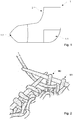
- Figure 1 shows an article of footwear 1 in a schematic side view.
- the footwear 1 is, for example, a stocking, also called a sock.
- the footwear item 1 is, for example, a knitted stocking which is manufactured in at least one first area using a first method and in a different section of the footwear item 1 using a second method.
- the heel section 1.1 and the toe section 1.2 are manufactured using a method which gives the knitted fabric a high abrasion resistance. As a result, undesired chafing can be delayed and the useful life of the footwear item 1 can be increased.
- the upper 2 is first manufactured. This is done, for example, by knitting in rounds until a desired shaft height has been reached.
- Four needles (first to fourth needles) are preferably used here, namely the first to fourth needles, seen from the rear center in clockwise direction, plus an additional needle as a working needle.
- stitches are cast on two new needles in order to be able to knit the heel section 1.1 in rounds using four needles (plus another working needle). These new needles are the fifth and sixth needles.
- the stitches are cast on the new needles preferably in the cross stitch. The same number of stitches that were present on each of the two disused needles is preferably cast on the new needles.
- a round of right stitches is knitted based on the first, fifth, sixth and fourth needle (order indicates the position of the needles clockwise).
- one stitch is preferably twisted from the crosswire to the right in order to obtain an odd number of stitches in the round.
- the heel section is then produced in a basic mesh pattern, which is described in more detail below.
- the basic stitch pattern consists of a stitch knitted on the right, hereinafter called the first stitch M1, and a stitch raised on the left, in which the thread is placed before the work, hereinafter called the second stitch M2.
- first stitch M1 a stitch knitted on the right
- second stitch M2 a stitch raised on the left, in which the thread is placed before the work
- Fig. 2 an alternating sequence of first and second stitches M1, M2 is shown on the needles.
- a round is knitted, the round comprising, as previously described, the first, fifth, sixth and fourth needles.
- the stitch pattern is shifted by one stitch.
- the stitch knitted on the right in the previous round is lifted off to the left and the thread is placed in front of the work, while the stitch that is left on the previous round is knitted as a right stitch. This results in a transverse offset by one stitch between immediately successive rounds.
- the stitches are decreased in more detail in such a way that in the event that the third last stitch on the respective needle is a right stitch, the last two stitches are lifted off to the left and the thread is placed in front of the work. In the other case, i.e. if the third to last stitch on the respective needle is a stitch that is lifted to the left, the last two stitches are knitted together as right stitches.
- the first two stitches lined up on the next needle are inversely knitted together, i.e. for example during the transition from the first to the fifth needle, when the last two stitches of the first needle are on the left have been lifted off and the thread laid before work, the first two stitches of the fifth needle are knitted together as right stitches. Conversely, if, for example, during the transition from the first to the fifth needle, the last two stitches of the first needle were knitted together as right stitches, the first two stitches of the fifth needle are knitted together as stitches lifted off to the left and the thread is placed before work.
- the number of needles used is preferably reduced, i.e. the remaining stitches are distributed over two needles.
- the knitted fabric is then turned inside out and cast off.
- the midfoot area of the footwear item 1 is then manufactured between the heel section 1.1 and the toe section 1.2.
- the second and third needles for the manufacture of the heel section 1.1 were shut down. These are now being reused.
- the first and fourth needles are subsequently struck on the heel section 1.1 in order to be able to manufacture the midfoot area between the heel section 1.1 and the toe section 1.2 with at least four needles (plus a further working needle).
- the stitches are cast on in such a way that the number of stitches originally used for the first and fourth needles are picked up from the end region of the heel section 1.1 from the rear center.
- the midfoot area between heel section 1.1 and toe section 1.2 is then produced in the desired length. Again, this is preferably done in rounds.
- a stitch is increased again, i.e. one stitch is knitted out of the cross thread to get an odd number of stitches.
- the increase in stitch can, for example, already take place in a round which was produced in the previously described basic stitch pattern (change from right stitch and stitch lifted to the left with thread lying before work).
- the stitch is decreased analogously to the heel, but initially only on one side, for example between the first and second needles in a left footwear item 1.
- the stitches are decreased in more detail in such a way that in the event that, for example, the third to last stitch on the first needle is a right stitch, the last two stitches are lifted off to the left and the thread is placed in front of the work.
- the last two stitches are knitted together as right stitches.
- the first two stitches are inversely knitted together, i.e. if the last two stitches of the first needle are lifted off and the thread has been placed before work, the first two stitches become second needle knitted together as right stitches.
- the rounds are made continuously in the basic stitch pattern, with every second round taking a stitch decrease.
- the stitches are preferably divided such that the same or essentially the same number of stitches is located on each needle.
- the knitting is continued in the basic stitch pattern, the stitch decrease now taking place symmetrically, i.e. not only between a pair of needles (e.g. between the first and second needles), but between the two pairs of needles (i.e. between the first and second needles and between the third and fourth needles).
- the type of stitch decrease is carried out in the same way as previously described in connection with the heel section 1.1.
- the sole section 1.3 of the footwear item 1 between the heel section 1.1 and the toe section 1.2 or only certain, heavily loaded areas of this sole section (e.g. the outer edge of the foot, the ball of the foot, etc.), as in Fig. 3 shown to manufacture in the narrow-mesh structure according to the invention.
- the back section of the footwear 1 which extends over the back of the foot ie the region which lies opposite the sole section 1.3) can be produced in a different knitting method, since there are no high loads which lead to greater abrasion.
- the midfoot area is again made in rounds.
- the beginning of the round is preferably relocated to manufacture the midfoot area.
- the start of the round for example, is no longer between the first and fourth needles, as when the shaft is manufactured, but between the first and second needles. It is thereby achieved that the beginning of the round is not in the area of the close-meshed mesh structure according to the invention.
- first, several rounds are knitted all round, with on at least one needle of the double-pointed needles, preferably on two needles of the double-pointed needles, the close-knit stitch structure by alternately knitting a first stitch as a knitted stitch and a second, immediately following stitch by lifting and laying the thread on the left in front of the stitch and an offset in the next row by one stitch, so that the stitch knitted in the first row on the right is lifted off and the thread is placed in front of the work and the stitch lifted in the first row on the left is knitted as a right stitch becomes.
- Four rounds of this type are preferably worked all round.
- the height of a row in the area of the sole section 1.3 is lower than in the area of the back section. This difference in height would add up with an increasing number of laps, so that the length of the sole section 1.3 lags behind the length of the ankle section.
- the compensation rows are inserted by turning the work 180 ° after reaching the start of the round after N rounds.
- the work is turned in such a way that the view is not on the work from the outside, but on the inside of the work and the thread is opposite, that is, protrudes to the rear.
- the back row is worked in reverse after turning, so that - from the original perspective - the stitch pattern is retained.
- the work After working the back row, for example across two needles, the work is turned back to the original knitting position and - in the original direction - worked again at the beginning of the round, again alternating a first stitch as right stitch and a second stitch immediately
- the following stitch is made by lifting and placing the thread in front of the stitch on the left, where the stitch knitted in the back row on the left is lifted off and the thread is placed in front of the work and the stitch lifted on the left in the back row is knitted as right stitch.
- N rounds are made again without inserting compensation rows.
- compensation series are inserted again. These processes are carried out until the desired foot length is reached.
- the toe section 1.2 is manufactured as described above, preferably in the previously described close-meshed basic stitch pattern with alternation of right stitch and stitch lifted to the left with thread lying before work.
- a continuous sole section can be achieved in the close-meshed basic mesh pattern.
Landscapes
- Engineering & Computer Science (AREA)
- Textile Engineering (AREA)
- Knitting Of Fabric (AREA)
- Footwear And Its Accessory, Manufacturing Method And Apparatuses (AREA)
- Socks And Pantyhose (AREA)
Applications Claiming Priority (1)
| Application Number | Priority Date | Filing Date | Title |
|---|---|---|---|
| DE102019100744.5A DE102019100744B4 (de) | 2019-01-14 | 2019-01-14 | Verfahren zur Herstellung eines Fußbekleidungsstücks sowie Fußbekleidungsstück |
Publications (3)
| Publication Number | Publication Date |
|---|---|
| EP3680377A1 true EP3680377A1 (fr) | 2020-07-15 |
| EP3680377C0 EP3680377C0 (fr) | 2024-04-03 |
| EP3680377B1 EP3680377B1 (fr) | 2024-04-03 |
Family
ID=69005210
Family Applications (1)
| Application Number | Title | Priority Date | Filing Date |
|---|---|---|---|
| EP19218011.5A Active EP3680377B1 (fr) | 2019-01-14 | 2019-12-19 | Procédé de fabrication d'un article chaussant ainsi qu'article chaussant |
Country Status (2)
| Country | Link |
|---|---|
| EP (1) | EP3680377B1 (fr) |
| DE (1) | DE102019100744B4 (fr) |
Citations (4)
| Publication number | Priority date | Publication date | Assignee | Title |
|---|---|---|---|---|
| US3685321A (en) * | 1968-08-15 | 1972-08-22 | Scott & Williams Inc | Circular knitting machine |
| DE29800791U1 (de) * | 1998-01-20 | 1999-05-20 | Franz Falke-Rohen Strumpffabriken Zweigniederlassung der Franz Falke-Rohen, 57392 Schmallenberg | Socke mit asymmetrischer Spitze |
| DE10326890A1 (de) * | 2003-06-14 | 2004-12-30 | Falke Kg | Beinbekleidungsstück |
| JP2006257563A (ja) * | 2005-03-15 | 2006-09-28 | Shima Seiki Mfg Ltd | 部分的に厚みのある編地の形成方法および編み製品 |
Family Cites Families (1)
| Publication number | Priority date | Publication date | Assignee | Title |
|---|---|---|---|---|
| DE102011012767A1 (de) * | 2010-09-18 | 2012-03-22 | H. Stoll Gmbh & Co. Kg | Verfahren zur Herstellung eines Schlauchgestricks |
-
2019
- 2019-01-14 DE DE102019100744.5A patent/DE102019100744B4/de active Active
- 2019-12-19 EP EP19218011.5A patent/EP3680377B1/fr active Active
Patent Citations (4)
| Publication number | Priority date | Publication date | Assignee | Title |
|---|---|---|---|---|
| US3685321A (en) * | 1968-08-15 | 1972-08-22 | Scott & Williams Inc | Circular knitting machine |
| DE29800791U1 (de) * | 1998-01-20 | 1999-05-20 | Franz Falke-Rohen Strumpffabriken Zweigniederlassung der Franz Falke-Rohen, 57392 Schmallenberg | Socke mit asymmetrischer Spitze |
| DE10326890A1 (de) * | 2003-06-14 | 2004-12-30 | Falke Kg | Beinbekleidungsstück |
| JP2006257563A (ja) * | 2005-03-15 | 2006-09-28 | Shima Seiki Mfg Ltd | 部分的に厚みのある編地の形成方法および編み製品 |
Non-Patent Citations (1)
| Title |
|---|
| HANDARBEITSZIRKEL: "Abheben von Maschen", 10 January 2015 (2015-01-10), XP055699198, Retrieved from the Internet <URL:https://www.handarbeitszirkel.de/abheben-von-maschen> [retrieved on 20200528] * |
Also Published As
| Publication number | Publication date |
|---|---|
| EP3680377C0 (fr) | 2024-04-03 |
| EP3680377B1 (fr) | 2024-04-03 |
| DE102019100744B4 (de) | 2021-08-12 |
| DE102019100744A1 (de) | 2020-07-16 |
Similar Documents
| Publication | Publication Date | Title |
|---|---|---|
| EP2952616B1 (fr) | Procédé de fabrication d'un tricot plat ou tridimensionnel | |
| DE1585117A1 (de) | Aus Maschenware bestehendes Kleidungsstueck und Verfahren zu seiner Herstellung | |
| DE1217018B (de) | Verfahren zur Herstellung eines rundgestrickten Damenstrumpfes | |
| DE102008059241A1 (de) | Strickerzeugnis und Verfahren zum Herstellen eines Strickerzeugnisses | |
| EP3680377B1 (fr) | Procédé de fabrication d'un article chaussant ainsi qu'article chaussant | |
| DE951032C (de) | Verfahren zum Herstellen des Randes einer glattgestrickten Ware | |
| DE102011108702B4 (de) | Verfahren zur Herstellung eines Gestricks mit Zierstichen sowie Gestrick | |
| DE627711C (de) | Laufmaschensichere Strickware mit Riegelmaschen sowie Verfahren und Strickmaschine zu ihrer Herstellung | |
| DE832930C (de) | Rundgestrickte Strumpfware und Verfahren zu ihrer Herstellung | |
| DE1228366B (de) | Verfahren und Rundstrickmaschine zur Herstellung eines rundgestrickten Strumpfes bzw. Strumpfteiles | |
| EP2199445B1 (fr) | Habillement de jambe tricoté et son procédé de fabrication | |
| DE1144432B (de) | Verfahren zum Herstellen von Schlauchware mit farbigen Flaechenmustern im Pendelstricken auf Rundstrickmaschinen | |
| DE533508C (de) | Strickware und Verfahren zu ihrer Herstellung | |
| DE1101681B (de) | Rundgestrickter Strumpf sowie Verfahren und Rundstrickmaschine zu seiner Herstellung | |
| DE915488C (de) | Auf der flachen Kulierwirkmaschine hergestellter Strumpf sowie Verfahren und flache Kulierwirkmaschine zur Herstellung eines solchen Strumpfes | |
| DE829927C (de) | Strickware mit Splitnaht | |
| DE2417902A1 (de) | Verfahren zur herstellung eines schlauchfoermig gestrickten warenstuecks mit einer oeffnung zur bildung eines elastischen randes auf einer rundstrickmaschine | |
| DE892495C (de) | Verfahren zur Herstellung eines Strumpfwarenstueckes mit regulaeren Kanten, nach diesem Verfahren erzeugtes Strumpfwarenstueck und flache Kulierwirkmaschine zur Ausfuehrung des Verfahrens | |
| DE911168C (de) | In einem Arbeitsgang flachgewirkter Strumpf sowie Verfahren, Decknadelhalter und flache Kulierwirkmaschine zur Herstellung eines solchen Strumpfes | |
| DE817631C (de) | Strickware und Verfahren zu ihrer Herstellung | |
| DE1585258C (de) | Verfahren und Rundstrickmaschine zum Herstellen von maschensicherer Strumpfwa re auf Rundstrickmaschinen | |
| AT167035B (de) | Strumpf, Halbstrumpf, Socken od. dgl. und Verfahren zur Herstellung derselben | |
| AT156832B (de) | Formgerecht gearbeiteter Strumpf und Verfahren zu seiner Herstellung. | |
| DE915487C (de) | Formgerecht gearbeitete Wirkware und Verfahren sowie flache Kulierwirkmaschine zur Herstellung einer solchen Ware | |
| DE374314C (de) | Rundstrickmaschine mit Einrichtung zur Herstellung eines Doppelrandes an Struempfen |
Legal Events
| Date | Code | Title | Description |
|---|---|---|---|
| PUAI | Public reference made under article 153(3) epc to a published international application that has entered the european phase |
Free format text: ORIGINAL CODE: 0009012 |
|
| STAA | Information on the status of an ep patent application or granted ep patent |
Free format text: STATUS: THE APPLICATION HAS BEEN PUBLISHED |
|
| AK | Designated contracting states |
Kind code of ref document: A1 Designated state(s): AL AT BE BG CH CY CZ DE DK EE ES FI FR GB GR HR HU IE IS IT LI LT LU LV MC MK MT NL NO PL PT RO RS SE SI SK SM TR |
|
| AX | Request for extension of the european patent |
Extension state: BA ME |
|
| STAA | Information on the status of an ep patent application or granted ep patent |
Free format text: STATUS: REQUEST FOR EXAMINATION WAS MADE |
|
| 17P | Request for examination filed |
Effective date: 20200907 |
|
| RBV | Designated contracting states (corrected) |
Designated state(s): AL AT BE BG CH CY CZ DE DK EE ES FI FR GB GR HR HU IE IS IT LI LT LU LV MC MK MT NL NO PL PT RO RS SE SI SK SM TR |
|
| STAA | Information on the status of an ep patent application or granted ep patent |
Free format text: STATUS: EXAMINATION IS IN PROGRESS |
|
| 17Q | First examination report despatched |
Effective date: 20210422 |
|
| RIC1 | Information provided on ipc code assigned before grant |
Ipc: D04B 3/02 20060101ALN20230803BHEP Ipc: D04B 1/26 20060101ALI20230803BHEP Ipc: D04B 1/12 20060101ALI20230803BHEP Ipc: D04B 1/10 20060101AFI20230803BHEP |
|
| GRAP | Despatch of communication of intention to grant a patent |
Free format text: ORIGINAL CODE: EPIDOSNIGR1 |
|
| STAA | Information on the status of an ep patent application or granted ep patent |
Free format text: STATUS: GRANT OF PATENT IS INTENDED |
|
| INTG | Intention to grant announced |
Effective date: 20231114 |
|
| GRAS | Grant fee paid |
Free format text: ORIGINAL CODE: EPIDOSNIGR3 |
|
| GRAA | (expected) grant |
Free format text: ORIGINAL CODE: 0009210 |
|
| STAA | Information on the status of an ep patent application or granted ep patent |
Free format text: STATUS: THE PATENT HAS BEEN GRANTED |
|
| AK | Designated contracting states |
Kind code of ref document: B1 Designated state(s): AL AT BE BG CH CY CZ DE DK EE ES FI FR GB GR HR HU IE IS IT LI LT LU LV MC MK MT NL NO PL PT RO RS SE SI SK SM TR |
|
| REG | Reference to a national code |
Ref country code: CH Ref legal event code: EP |
|
| REG | Reference to a national code |
Ref country code: IE Ref legal event code: FG4D Free format text: LANGUAGE OF EP DOCUMENT: GERMAN |
|
| REG | Reference to a national code |
Ref country code: DE Ref legal event code: R096 Ref document number: 502019010956 Country of ref document: DE |
|
| U01 | Request for unitary effect filed |
Effective date: 20240415 |
|
| U07 | Unitary effect registered |
Designated state(s): AT BE BG DE DK EE FI FR IT LT LU LV MT NL PT SE SI Effective date: 20240422 |
|
| PG25 | Lapsed in a contracting state [announced via postgrant information from national office to epo] |
Ref country code: HR Free format text: LAPSE BECAUSE OF FAILURE TO SUBMIT A TRANSLATION OF THE DESCRIPTION OR TO PAY THE FEE WITHIN THE PRESCRIBED TIME-LIMIT Effective date: 20240403 |
|
| PG25 | Lapsed in a contracting state [announced via postgrant information from national office to epo] |
Ref country code: GR Free format text: LAPSE BECAUSE OF FAILURE TO SUBMIT A TRANSLATION OF THE DESCRIPTION OR TO PAY THE FEE WITHIN THE PRESCRIBED TIME-LIMIT Effective date: 20240704 |
|
| PG25 | Lapsed in a contracting state [announced via postgrant information from national office to epo] |
Ref country code: ES Free format text: LAPSE BECAUSE OF FAILURE TO SUBMIT A TRANSLATION OF THE DESCRIPTION OR TO PAY THE FEE WITHIN THE PRESCRIBED TIME-LIMIT Effective date: 20240403 |
|
| PG25 | Lapsed in a contracting state [announced via postgrant information from national office to epo] |
Ref country code: PL Free format text: LAPSE BECAUSE OF FAILURE TO SUBMIT A TRANSLATION OF THE DESCRIPTION OR TO PAY THE FEE WITHIN THE PRESCRIBED TIME-LIMIT Effective date: 20240403 |
|
| PG25 | Lapsed in a contracting state [announced via postgrant information from national office to epo] |
Ref country code: PL Free format text: LAPSE BECAUSE OF FAILURE TO SUBMIT A TRANSLATION OF THE DESCRIPTION OR TO PAY THE FEE WITHIN THE PRESCRIBED TIME-LIMIT Effective date: 20240403 Ref country code: HR Free format text: LAPSE BECAUSE OF FAILURE TO SUBMIT A TRANSLATION OF THE DESCRIPTION OR TO PAY THE FEE WITHIN THE PRESCRIBED TIME-LIMIT Effective date: 20240403 Ref country code: GR Free format text: LAPSE BECAUSE OF FAILURE TO SUBMIT A TRANSLATION OF THE DESCRIPTION OR TO PAY THE FEE WITHIN THE PRESCRIBED TIME-LIMIT Effective date: 20240704 Ref country code: ES Free format text: LAPSE BECAUSE OF FAILURE TO SUBMIT A TRANSLATION OF THE DESCRIPTION OR TO PAY THE FEE WITHIN THE PRESCRIBED TIME-LIMIT Effective date: 20240403 Ref country code: RS Free format text: LAPSE BECAUSE OF FAILURE TO SUBMIT A TRANSLATION OF THE DESCRIPTION OR TO PAY THE FEE WITHIN THE PRESCRIBED TIME-LIMIT Effective date: 20240703 |
|
| U20 | Renewal fee for the european patent with unitary effect paid |
Year of fee payment: 6 Effective date: 20241011 |
|
| REG | Reference to a national code |
Ref country code: DE Ref legal event code: R097 Ref document number: 502019010956 Country of ref document: DE |
|
| PGFP | Annual fee paid to national office [announced via postgrant information from national office to epo] |
Ref country code: NO Payment date: 20241216 Year of fee payment: 6 |
|
| PGFP | Annual fee paid to national office [announced via postgrant information from national office to epo] |
Ref country code: GB Payment date: 20241218 Year of fee payment: 6 |
|
| PGFP | Annual fee paid to national office [announced via postgrant information from national office to epo] |
Ref country code: IS Payment date: 20241213 Year of fee payment: 6 |
|
| PGFP | Annual fee paid to national office [announced via postgrant information from national office to epo] |
Ref country code: IE Payment date: 20241212 Year of fee payment: 6 |
|
| PG25 | Lapsed in a contracting state [announced via postgrant information from national office to epo] |
Ref country code: SK Free format text: LAPSE BECAUSE OF FAILURE TO SUBMIT A TRANSLATION OF THE DESCRIPTION OR TO PAY THE FEE WITHIN THE PRESCRIBED TIME-LIMIT Effective date: 20240403 Ref country code: RO Free format text: LAPSE BECAUSE OF FAILURE TO SUBMIT A TRANSLATION OF THE DESCRIPTION OR TO PAY THE FEE WITHIN THE PRESCRIBED TIME-LIMIT Effective date: 20240403 |
|
| PG25 | Lapsed in a contracting state [announced via postgrant information from national office to epo] |
Ref country code: SM Free format text: LAPSE BECAUSE OF FAILURE TO SUBMIT A TRANSLATION OF THE DESCRIPTION OR TO PAY THE FEE WITHIN THE PRESCRIBED TIME-LIMIT Effective date: 20240403 |
|
| PG25 | Lapsed in a contracting state [announced via postgrant information from national office to epo] |
Ref country code: SM Free format text: LAPSE BECAUSE OF FAILURE TO SUBMIT A TRANSLATION OF THE DESCRIPTION OR TO PAY THE FEE WITHIN THE PRESCRIBED TIME-LIMIT Effective date: 20240403 Ref country code: SK Free format text: LAPSE BECAUSE OF FAILURE TO SUBMIT A TRANSLATION OF THE DESCRIPTION OR TO PAY THE FEE WITHIN THE PRESCRIBED TIME-LIMIT Effective date: 20240403 Ref country code: RO Free format text: LAPSE BECAUSE OF FAILURE TO SUBMIT A TRANSLATION OF THE DESCRIPTION OR TO PAY THE FEE WITHIN THE PRESCRIBED TIME-LIMIT Effective date: 20240403 |
|
| PLBE | No opposition filed within time limit |
Free format text: ORIGINAL CODE: 0009261 |
|
| STAA | Information on the status of an ep patent application or granted ep patent |
Free format text: STATUS: NO OPPOSITION FILED WITHIN TIME LIMIT |
|
| 26N | No opposition filed |
Effective date: 20250106 |
|
| PG25 | Lapsed in a contracting state [announced via postgrant information from national office to epo] |
Ref country code: MC Free format text: LAPSE BECAUSE OF FAILURE TO SUBMIT A TRANSLATION OF THE DESCRIPTION OR TO PAY THE FEE WITHIN THE PRESCRIBED TIME-LIMIT Effective date: 20240403 |
|
| REG | Reference to a national code |
Ref country code: CH Ref legal event code: PL |
|
| PG25 | Lapsed in a contracting state [announced via postgrant information from national office to epo] |
Ref country code: CH Free format text: LAPSE BECAUSE OF NON-PAYMENT OF DUE FEES Effective date: 20241231 |
|
| U20 | Renewal fee for the european patent with unitary effect paid |
Year of fee payment: 7 Effective date: 20251124 |
|
| PGFP | Annual fee paid to national office [announced via postgrant information from national office to epo] |
Ref country code: CZ Payment date: 20251209 Year of fee payment: 7 |