EP3680667A1 - Capteur d'ions cu2+ hautement sélectif et ultrasensible - Google Patents
Capteur d'ions cu2+ hautement sélectif et ultrasensible Download PDFInfo
- Publication number
- EP3680667A1 EP3680667A1 EP19151227.6A EP19151227A EP3680667A1 EP 3680667 A1 EP3680667 A1 EP 3680667A1 EP 19151227 A EP19151227 A EP 19151227A EP 3680667 A1 EP3680667 A1 EP 3680667A1
- Authority
- EP
- European Patent Office
- Prior art keywords
- ions
- sensor
- copper
- sensor according
- ion
- Prior art date
- Legal status (The legal status is an assumption and is not a legal conclusion. Google has not performed a legal analysis and makes no representation as to the accuracy of the status listed.)
- Withdrawn
Links
Images




Classifications
-
- G—PHYSICS
- G01—MEASURING; TESTING
- G01N—INVESTIGATING OR ANALYSING MATERIALS BY DETERMINING THEIR CHEMICAL OR PHYSICAL PROPERTIES
- G01N33/00—Investigating or analysing materials by specific methods not covered by groups G01N1/00 - G01N31/00
- G01N33/48—Biological material, e.g. blood, urine; Haemocytometers
- G01N33/50—Chemical analysis of biological material, e.g. blood, urine; Testing involving biospecific ligand binding methods; Immunological testing
- G01N33/68—Chemical analysis of biological material, e.g. blood, urine; Testing involving biospecific ligand binding methods; Immunological testing involving proteins, peptides or amino acids
-
- G—PHYSICS
- G01—MEASURING; TESTING
- G01N—INVESTIGATING OR ANALYSING MATERIALS BY DETERMINING THEIR CHEMICAL OR PHYSICAL PROPERTIES
- G01N15/00—Investigating characteristics of particles; Investigating permeability, pore-volume or surface-area of porous materials
- G01N15/06—Investigating concentration of particle suspensions
-
- C—CHEMISTRY; METALLURGY
- C07—ORGANIC CHEMISTRY
- C07K—PEPTIDES
- C07K5/00—Peptides containing up to four amino acids in a fully defined sequence; Derivatives thereof
- C07K5/02—Peptides containing up to four amino acids in a fully defined sequence; Derivatives thereof containing at least one abnormal peptide link
- C07K5/0202—Peptides containing up to four amino acids in a fully defined sequence; Derivatives thereof containing at least one abnormal peptide link containing the structure -NH-X-X-C(=0)-, X being an optionally substituted carbon atom or a heteroatom, e.g. beta-amino acids
-
- G—PHYSICS
- G01—MEASURING; TESTING
- G01N—INVESTIGATING OR ANALYSING MATERIALS BY DETERMINING THEIR CHEMICAL OR PHYSICAL PROPERTIES
- G01N33/00—Investigating or analysing materials by specific methods not covered by groups G01N1/00 - G01N31/00
- G01N33/48—Biological material, e.g. blood, urine; Haemocytometers
- G01N33/50—Chemical analysis of biological material, e.g. blood, urine; Testing involving biospecific ligand binding methods; Immunological testing
-
- G—PHYSICS
- G01—MEASURING; TESTING
- G01N—INVESTIGATING OR ANALYSING MATERIALS BY DETERMINING THEIR CHEMICAL OR PHYSICAL PROPERTIES
- G01N15/00—Investigating characteristics of particles; Investigating permeability, pore-volume or surface-area of porous materials
- G01N15/06—Investigating concentration of particle suspensions
- G01N15/075—Investigating concentration of particle suspensions by optical means
-
- G—PHYSICS
- G01—MEASURING; TESTING
- G01N—INVESTIGATING OR ANALYSING MATERIALS BY DETERMINING THEIR CHEMICAL OR PHYSICAL PROPERTIES
- G01N15/00—Investigating characteristics of particles; Investigating permeability, pore-volume or surface-area of porous materials
- G01N15/06—Investigating concentration of particle suspensions
- G01N2015/0687—Investigating concentration of particle suspensions in solutions, e.g. non volatile residue
Definitions
- the present application is directed to the use of a copper-binding motif for binding Cu 2+ ions in a fluid, a sensor for detection of Cu 2+ ions in a fluid, the use of the sensor in the diagnosis and monitoring of diseases and a method for qualitative and quantitative detection of Cu 2+ ions in a fluid sample.
- Copper is an essential trace element that is inevitable in biological systems and can be found in many enzymes such as amine oxidases and ferroxidases but is also required for infant growth, the ion metabolism and brain development in human organisms ( Nat Chem Biol 2008, 4, 176-185 ; J Toxicol Environ Health B Crit Rev 2001, 4, 341-394 ). Copper is also widely used in agricultural systems and therefore belongs to a major metal pollutant in our environment ( Rev Environ Health 1999, 14, 231-238 ). The contamination of ecosystems such as rivers, lakes, soil and groundwater with copper causes increased accumulation ( Chem Soc Rev 2017, 46, 7105-7123 ).
- AD ⁇ -amyloid peptide
- APP amyloid precursor protein
- CuBD binding domain
- peptides in proteins can display extraordinary and ultrasensitive key-lock behavior towards targets. Copper-binding peptides in nature are albumin (bovine serum albumin (BSA), human serum albumin (HSA), rabbit serum albumin (RSA)), neuromedin C and K, human sperm protamine P2a and histidines ( Accounts of Chemical Research 1997, 30, 123-130 ). Imperiali et al. (J Am Chem Soc 1998, 120, 609-610 ) reported polypeptide motifs for the design of selective Cu(ll) ion chemosensors. Papp et al.
- this problem has been solved by providing a sensor for detection of Cu 2+ ions in a fluid comprising a copper-binding motif 2,3-diaminopropionic acid(DAP)- ⁇ Ala-X, wherein X is an amino acid or a modified amino acid, in particular wherein X is histidine (His), alanine (Ala) or aspartic acid (Asp).
- the sensor according to the present application can be used for fast, highly selective and ultrasensitive detection of Cu 2+ ions in a fluid. With said sensor a qualitative and/or quantitative detection of Cu 2+ ions can be obtained, for example by measuring the change in fluorescence intensity, by measuring the change in the current-voltage characteristics and/or by subjecting the sensor to mass spectrometry.
- the detection method of the present invention does not require an extensive experimental set-up.
- detection of Cu 2+ ions is possible on-site and in real time.
- simply a test strip comprising the sensor having the particular copper-binding motif and a fluorescence-light source may be required.
- the qualitative and quantitative detection of Cu 2+ ions may also be performed by observing a change in the current-voltage characteristics, which even allows the detection of Cu 2+ ion concentrations in a fluid in the femtomolar range, i.e. as low as 1 fM.
- M refers to the molar concentration mol per liter (mol/L)
- sensors are devices for detecting particular analytes, in this case the analyte are Cu 2+ ions.
- the sensor provides the information regarding the analyte usually in the form of a measurable physical signal correlated with the presence and/or concentration of the analyte.
- the sensor of the present application comprises a copper-binding motif having at least two non-proteinogenic amino acids, namely 2,3-diaminopropionic acid (DAP) and ⁇ -alanine ( ⁇ Ala).
- the copper-binding motif further comprises an amino acid or modified amino acid X.
- the copper-binding motif corresponds to a peptide compound and therefore the copper-binding motif is sometimes termed peptide copper-binding motif.
- the amino acid X may be selected from the group consisting of standard amino acids, unusual amino acids or non-proteinogenic amino acids.
- L-amino acids examples include glycine (Gly), alanine (Ala), valine (Val), leucine (Leu), methionine (Met), isoleucine (Ile), serine (Ser), threonine (Thr), cysteine (Cys), proline (Pro), asparagine (Asn), glutamine (Gin), phenylalanine (Phe), tyrosine (Tyr), tryptophan (Trp), lysine (Lys), arginine (Arg), histidine (His), aspartic acid (Asp) and glutamate (Glu).
- Preferred standard amino acids according to the present invention are histidine (His), alanine (Ala) or aspartic acid (Asp).
- Examples for unusual amino acids are 4-hydroxyproline, 5-hydroxylysine, 6-N-methyllysine, ⁇ -carboxyglutamate, desmosine, selenocysteine, ornithine and citroline.
- Non-proteinogenic amino acids are amino acids which are not incorporated in proteins during translation.
- Non-proteinogenic amino acids according to the present application are for example 2,3-diaminopropionic acid (DAP) and ⁇ -alanine.
- DAP 2,3-diaminopropionic acid
- 2,3-diaminopropionic acid may be L-2,3-diaminopropionic acid, D-2,3-diaminopropionic acid or a mixtures of L- and D-DAP.
- L-2,3-diaminopropionic acid is preferred.
- a modified amino acid comprises standard or unusual amino acids, which may be for example methylated, acetylated or its diastereomeric D, cis/trans and isosteric form.
- X is preferably a standard amino acid, more preferably histidine (His), alanine (Ala) or aspartic acid (Asp).
- the senor of the present application comprises the copper-binding motif DAP- ⁇ Ala-His or DAP- ⁇ Ala-Asp.
- the sensor according to the present application may comprise means for detection.
- means for detection are not mandatory since some detection methods such as mass spectrometry do not require such means for detection.
- Detection means or means for detection are able to produce a measurable, physical signal.
- the detection means according to the present application may be commercially available fluorophores such as 5(6)-carboxyfluorescein, DyLight Fluor, Alexa Fluor or cyanine dyes.
- a preferred fluorophore of the sensor of the present application is 5(6)-carboxyfluorescein.
- the fluorophore may be attached to the copper-binding motif via the N-terminus of the DAP. The quenching or amount of quenching of the fluorescence intensity indicates the presence of Cu 2+ ions in the fluid, i.e.
- the senor comprises 5(6)-carboxyfluorescein-DAP- ⁇ Ala-His or 5(6)-carboxyfluorescein-DAP- ⁇ Ala-Asp.
- the detection means may also comprise a polymer membrane, foil or sheet including nanopores, preferably a functionalized polymer membrane, foil or sheet with nanopores, in particular an ion-track etched polymer membrane, foil or sheet with nanopores, even more preferably an ion-track etched polyethylene terephthalate (PET)-membrane, foil or sheet with nanopores.
- the nanopores may have a conical shape, preferably with small openings of about 30 ⁇ 5 nm and big openings of 500 ⁇ 10 nm in diameter.
- the polymer membrane, foil or sheet preferably contains about 10 4 nanopores per cm 2 .
- Ion-track etched polymer membranes, foils or sheets with conical nanopores can be obtained by the known procedure of asymmetric chemical etching of the latent ion track as described in Nucl Instrum Methods Phys Res, Sect. B 2001, 184, 337-346 .
- carboxylic acid groups are generated on the surface of the polymer membrane, foil or sheet, in particular on the nanopore surface of the ion-track etched polymer membrane, foil or sheet, which can be used for covalent attachment of functional molecules containing for example a primary amine.
- the senor of the present application comprises a fluorophore and a polymer membrane with nanopores as detection means.
- the sensor according to the present application may further comprise a linker moiety, which is preferably attached to the C-terminus of the amino acid or modified amino acid X.
- the linker moiety is for ensuring a spatial separation of the functional groups of the copper-binding motif and the fluorophore to the polymer membrane, foil or sheet as detection means, in particular ion-track etched PET-membrane having conical nanopores.
- the linker may also function to attach the sensor comprising the copper-binding motif with or without the fluorophore to a solid support, while ensuring a spatial separation of the functional groups of the copper-binding motif and the fluorophore to the surface of the solid support.
- the linker moiety comprises polyethylene glycol (PEG) units, in particular 4 PEG units.
- R 1 -[CH 2 CH 2 O] a -R 2 a may be 2 to 8, 2 to 6, 2 to 4, 4 to 10, 4 to 8 or 4 to 6, more preferably a is 3, 4, 5 or 6 and most preferable a is 4.
- the linker has the structure -HN-[CH 2 CH 2 O] 4 -CH 2 CH 2 COOH ( Figure 2(c) ) referred to as linkerPEG 4 in the present invention.
- the carboxy group of the linker may be coupled to an amino functional group on the surface of a polymer membrane or solid support via standard peptide coupling chemistry.
- the amino group R 1 allows coupling to the C-terminus of the amino acid or modified amino acid X, also by means of standard peptide coupling chemistry.
- the copper-binding motif with or without a fluorophore may be attached by means of the linker moiety to the surface of the polymer membrane with nanopores, in particular to the ion-track etched polymer membrane, foil or sheet, in particular to the surface of the nanopores. Binding of Cu 2+ ions to the copper-binding motif of the sensor changes the current-voltage characteristics of the polymer membrane, foil or sheet with the nanopores which can then be used for qualitative and quantitative detection of Cu 2+ ions in the fluid.
- the senor according to the present application comprises the copper-binding motif, detection means and a linker, wherein the detection means is a fluorophore, in particular 5(6)-carboxyfluorescein and/or a polymer membrane with nanopores, preferably an ion-track etched PET-membrane, foil or sheet with nanopores.
- the fluorophore is attached to the N-terminus of the DAP and the linker moiety is attached to the C-terminus of the amino acid or modified amino acid X.
- the copper-binding motif may be attached via the linker moiety to the surface of the polymer membrane, foil or sheet, in particular to the surface of the nanopores of the ion-track etched PET-membrane.
- the sensor according to the present application may further comprise a solid support.
- the sensor comprises the copper-binding motif, a fluorophore as detection means and a solid support.
- the copper-binding motif bound to the fluorophore may be immobilized on the solid support, which can be with or without the linker moiety, wherein immobilization or attachment by means of the linker moiety is preferred.
- the linker moiety is employed, a spatial separation of the functional groups of the copper-binding motif and of the fluorophore to the surface of the solid support is achieved whereby an undesired interaction between the functional groups on the surface of the solid support and the copper-binding motif and fluorophore can be avoided.
- the linker moiety may be attached to the copper-binding motif via the C-terminus of the amino acid or modified amino acid X to ensure a spatial separation of the functional groups of the fluorophore-copper-binding motif to the functional groups on the surface of the solid support.
- the sensor for detection of Cu 2+ ions in a fluid comprises fluorophore-DAP- ⁇ Ala-X-linkerPEG 4 attached to or immobilized on a solid support, wherein the fluorophore is preferably 5(6)-carboxyfluorescein and X is histidine, alanine or aspartic acid.
- the solid support may be for example a polymer, a resin, a glass substrate, a core-shell particle or cellulose.
- the solid support may be in the form of a membrane, foil, sheet, strip or particle.
- the sensor according to the present application may be used for detecting Cu 2+ ions in a fluid, which fluid can be obtained from any source.
- the fluid may comprise a liquid, preferably an aqueous or water-based liquid, for example from environmental sources.
- a liquid according to the present invention are drinking water and body fluids such as urine, whole blood, plasma, serum, extracellular interstitial fluid, lymph, bile, cerebrospinal liquid as well as gland secretion such as saliva or sweat, wherein urine is preferred.
- the aqueous or water-based liquid further may originate from water streams, puddles, lakes and seas.
- the sensor according to the present application is able to selectively detect Cu 2+ ions in a fluid in the presence of Ni 2+ ions and/or Zn 2+ ions.
- Selective detection of Cu 2+ ions according to the present application means that in case no Cu 2+ ions are present in the fluid, but Ni 2+ ions and/or Zn 2+ ions are, no signal indicating the presence of the desired analyte Cu 2+ ions is generated by the detection means. For example, when using 5(6)-carboxyfluorescein as fluorophore, no quenching in fluorescence intensity would be observed.
- Ni 2+ ions and/or Zn 2+ ions in addition to a particular concentration of Cu 2+ ions in the fluid does not change the signal of the detection means by more than ⁇ 5%, i.e. almost identical results are obtained for the Cu 2+ ion concentration in a solution containing Ni 2+ ions and/or Zn 2+ ions as for a solution containing Cu 2+ ions, but no Ni 2+ ions and/or Zn 2+ ions.
- the senor according to the present application is for use in the diagnosis and/or monitoring of diseases, preferably of diseases linked to abnormal Cu 2+ ion (copper) concentrations and/or dysregulated Cu 2+ ion (copper) metabolism such as Alzheimer's disease, Wilson's disease and Menke's disease.
- Cu 2+ ion concentrations in terms of diagnosis and/or monitoring of diseases, in particular when determining the Cu 2+ ion concentration in urine refer to copper, i.e. Cu 2+ ions that is not bound to ceruloplasmin (non-CP Cu). Such copper may also be termed "free Cu 2+ ions" or "free Cu 2+ ions in solution”.
- abnormal in relation to Cu 2+ ion (copper) concentration according to the present application means that the Cu 2+ ion concentration in a body fluid is higher or lower compared to healthy individuals.
- Higher Cu 2+ ion concentration in a body fluid, for example urine, is observed in individuals having a particular disease such as Alzheimer's disease or Wilsons's disease.
- Lower Cu 2+ ion concentration in a body fluid is observed in individuals having a disorder correlated to copper deficiency such as Menke's disease.
- the concentration of non-ceruloplasmin-bound Cu 2+ (non-CP Cu) in urine is in a range of 40 to 50 nM calculated based on a Cu 2+ ion amount of about 4.82 ⁇ g/day in 1.5 to 2.0 L urine ( J Trace Elem Met Biol 2018, 45, 181-188 ).
- a Cu 2+ ion concentration in urine above 40-50 nM for example at least twice as high than in healthy individuals, i.e. above 80 or 90 nM, in particular in a range of 100 to 130 nM as is often the case for AD patients is considered an abnormal copper or Cu 2+ ion concentration.
- the senor according to the present application is for use in the diagnosis and/or monitoring of Alzheimer's disease (AD), Wilson's disease and Menke's disease.
- the sensor according to the present application is for use in determining Cu 2+ ion concentration in the urine of individuals to diagnose and/or monitor diseases linked to abnormal Cu 2+ ion (copper) concentrations and/or dysregulated Cu 2+ ion (copper) metabolism, in particular Alzheimer's disease, Wilson's disease and Menke's disease.
- the use of the sensor of the present application is in particular for an ex vivo determination of Cu 2+ ion concentration in body fluids, preferably in the urine of individuals.
- the senor according to the present application may be for use in detecting Cu 2+ ions and/or determining Cu 2+ ion concentration in food products or fluids such as aqueous or water-based liquids, in particular in food/water control and/or environmental samples.
- the senor according to the present application may be used for multiple measurements, i.e. the sensor allows a repeated measurement of Cu 2+ ions or Cu 2+ ion concentration.
- the present application further discloses a method for the qualitative and quantitative detection of Cu 2+ ions in a fluid.
- the method comprises the steps of adjusting the pH of a fluid sample to be analyzed to 5.0 to 8.5, preferably to a pH of 5.5. to 8.0, 6.0 to 7.3, 6.3 to 8.0 or 6.5 to 7.5 and most preferably to a pH of 6.5 to 7.0.
- the selectivity of the sensor according to the present application towards Cu 2+ ions is ensured, in particular selectivity towards Cu 2+ ions over Ni 2+ and Zn 2+ ions. Setting the pH of the fluid sample to the claimed range, i.e.
- the sensor is brought into contact with the fluid sample. This may be done for example by immersing a test strip with the immobilized sensor in the fluid sample or by mixing a solution of the sensor of the present application with the fluid sample.
- detection of Cu 2+ ions and/or determining the Cu 2+ ion concentration of the sample takes place.
- different parameters are used as basis for qualitative and/or quantitative detection of Cu 2+ ions in the fluid sample.
- a sensor comprising a fluorophore as detection means in particular 5(6)-carboxyfluorescein is used
- quenching of the fluorescence intensity upon contact of the sensor with the analyte Cu 2+ ions is observed.
- a linear decrease of fluorescence intensity of the sensor upon addition of Cu 2+ ions in water can be clearly observed showing more and more quenching of the fluorescence intensity with increasing Cu 2+ ion concentrations.
- the change in the fluorescence intensity is measured.
- the fluorescence intensity may be reduced, i.e. quenched.
- Cu 2+ ion concentrations in the fluid sample with the sensor according to the present invention can be quantitatively detected in a range from 1 nM to 30 mM, 5 nM to 20 mM, 10 nM to 10 mM, 12 nM to 5 mM, in particular in a range from 1 nM to 60 ⁇ M, 5 nM to 40 ⁇ M, 10 nM to 10 ⁇ M, 12 nM to 5 ⁇ M, 1 nM to 500 nM, 1 nM to 200 nM or 12 nM to 150 nM.
- the quantitative detection of Cu 2+ ion concentrations in a fluid sample as low as about 1 nM is very important for application of the sensor in the detection of trace amounts of copper ions in food/water samples or for detection of copper ions in the early diagnosis of AD in urine.
- the sensor according to the present application can be used to measure the copper (Cu 2+ ) ion concentration directly from the urine sample in a simple two-step procedure, for example by immersing a test strip with the immobilized sensor in the urine sample or by mixing a solution of the sensor of the present application with the urine sample and then subjecting the sample to a fluorescence light source.
- concentration of free Cu 2+ ions in urine Cu 2+ ions not bound to ceruloplasmin (non-CP Cu)
- the Cu 2+ ion or copper concentration varies between 40 to 50 nM. All Cu 2+ ion or copper values for healthy individuals and patients of AD and Wilson's disease are within the range of detection of the sensor according to the present application.
- the qualitative and quantitative detection of Cu 2+ ions in the fluid sample may be achieved by monitoring the change in the current-voltage ( I-V ) characteristics of the sensor comprising at least a copper-binding motif, a polymer membrane, foil or sheet with nanopores as detection means, a linker moiety wherein the copper-binding motif is attached via the linker moiety to the surface of the polymer membrane, foil or sheet with nanopores and optionally a fluorophore.
- the polymer membrane, foil or sheet with nanopores is a PET membrane, foil or sheet with nanopores and even more preferably, the polymer membrane, foil or sheet with nanopores is an ion-track etched PET-membrane, foil or sheet with nanopores.
- the ion-track etched PET-membrane, foil or sheet has conical nanopores with a tip opening of 30 ⁇ 5 nm and a big opening of 500 ⁇ 10 nm in diameter.
- the polymer membrane, foil or sheet preferably contains about 10 4 nanopores per cm 2 .
- the sensor may also include a fluorophore as detection means. By measuring the changes in the current-voltage ( I-V ) characteristics of the sensor, a quantitative and qualitative detection of Cu 2+ ions in a fluid sample is feasible.
- the detection of Cu 2+ ion concentrations in a fluid sample with Cu 2+ ion concentrations as low as 1 fM can be done, in particular in a range from 1 fM to 30 mM, 1 fM to 20 mM, 1 nM to 10 mM, 1 nM to 5 mM, in particular in a range from 1 fM to 60 ⁇ M, 5 nM to 40 ⁇ M, 10 nM to 10 ⁇ M, 12 nM to 5 ⁇ M, 1nM to 500 nM, 1 nM to 200 nM or 12 nM to 150 nM.
- a qualitative and/or quantitative detection of Cu 2+ ions in a fluid sample may also be performed with mass spectrometry analysis.
- a sensor according to the present application may then comprise only the copper-binding motif and no further detection means are necessary.
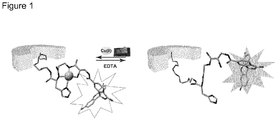
- the sensor according to the present application may be regenerated to be applicable for further detection cycles. Regeneration is conducted by subjecting the sensor to a complexing agent.
- the complexing agent can be, for example, ethylene diamine tetraacetic acid (EDTA).
- EDTA ethylene diamine tetraacetic acid
- the sensor according to the present application can be regenerated at least 6 times.
- the sensor of the present application may be manufactured as follows.
- the copper-binding motif DAP- ⁇ Ala-X may be synthesized following the standard solid phase peptide synthesis (SPPS).
- SPPS solid phase peptide synthesis
- the fluorophore may also be attached via standard peptide coupling chemistry to the N-terminus of the DAP.
- the sensor comprises a linker moiety said linker moiety may also be attached via standard peptide coupling chemistry to the C-terminus of amino acid or modified amino acid X.
- the copper-binding motif may be attached via the linker moiety to the surface of the polymer membrane with nanopores.
- the sensor according to the present application can also be used in combination with a test strip for the detection of Cu 2+ ions in a fluid sample.
- the test strip may comprise the sensor according to the present application immobilized via the linker moiety to a solid support, for example a polymer foil or sheet.
- the sensor immobilized on the solid support may be applied to a carrier material.
- the solid support and/or the carrier material may have at least two slots or indentions into which a fluid sample may be applied. In one of the slots/indentions the fluid sample to be analyzed for the qualitative and/or quantitative detection of Cu 2+ ions can be applied. In the further slot/indention a control solution may be applied.
- the senor used in combination with a test strip comprises the copper-binding motif, a fluorophore as detection means, a linker moiety and a solid support.
- the calibration solution is for calibration of the fluorescence intensity.
- the copper-binding motif 2,3-diaminopropionic acid(DAP)- ⁇ Ala-X may be used for binding of Cu 2+ ions in a fluid, wherein X is an amino acid or a modified amino acid, in particular wherein X is histidine (His), alanine (Ala) or aspartic acid (Asp).
- the copper-binding motif comprises in particular DAP- ⁇ Ala-His or DAP- ⁇ Ala-Asp.
- Sensor ( 2 ) was acetylated at the N-terminus with acetic anhydride.
- the final cleavage of sensors ( 1 ) and ( 2 ) from the resin was carried out in 2/2/48/48 triisopropylsilane(TIPS)/water/trifluoroacetic acid(TFA)/DCM and agitated for 1 h at room temperature.
- RP-HPLC purification was performed on a C18 column (MultoKrom 100-5. 250 x 20 mm, 100 ⁇ pore diameter, 5.0 ⁇ m particle size) using a linear gradient of 5 % to 40 % of eluent B (eluent A: water (0.1 % TFA) and eluent B: acetonitrile (0.1 % TFA)) in 60 min.
- Sensor (2) was purified following an isocratic method of 5 % eluent B for 12 minutes followed by a linear gradient to 30 % eluent B within a total of 60 minutes.
- PET-membranes with conical nanopores were fabricated through asymmetric chemical etching of latent ion tracks as has been described in Nucl Instrum Methods Phys Res, Sect B 2001, 184, 337-346 .
- PET foils or membranes were first irradiated with single swift heavy ions (Au) of kinetic energy 11.4 MeV/nucleon at the linear accelerator UNILAC (GSI Helmholtz Centre for Heavy Ion Research, Darmstadt, Germany). Then, the latent ion tracks in the polymer foils or membranes were sensitized with soft UV light. The chemical track-etching process was performed in a conductivity cell.
- the ion tracked foils or membranes were fixed in between two chambers of the cell.
- An etching solution (9 M NaOH) was filled in one chamber and a stopping solution (1 M KCI + 1 M HCOOH) was filled in the other chamber.
- the etching process was carried out at room temperature.
- the etching process was monitored by applying a potential of -1 V across the foil or membrane.
- the etching process was stopped when the current reached a certain defined value after the breakthrough point. Then, the etched foil or membrane was washed with stopping solution and dipped in deionized water overnight to remove residual salts.
- the carboxylic acid groups on the polymer foil or membrane surface, in particular on the surface of the nanopores originated from the chemical etching. These groups were first activated through standard carbodiimide coupling chemistry.
- the track-etched foil or membrane was exposed to an ethanol solution containing 1-ethyl-3-(3-dimethylaminopropyl)carbodiimide (EDC) (100 mM) and pentafluorophenyl (PFP) (200 mM) at room temperature for 1 h. After washing with ethanol several times, the activated polymer foil or membrane was treated with ethylenediamine (EDA, 50 mM) solution overnight.
- EDC 1-ethyl-3-(3-dimethylaminopropyl)carbodiimide
- PFP pentafluorophenyl
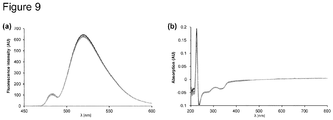
- the fluorescence spectrum in Figure 3(a) shows the decrease of fluorescence intensity of the sensor comprising 5(6)-carboxyfluorescein-DAP- ⁇ Ala-His-linkerPEG 4 (1) (1 ⁇ M, MES buffer, pH 6.50) upon addition of CuSO 4 from 0 to 25 ⁇ M. Emission (A) was determined to be 518 nm. Fluorescence titration upon addition of 20 equivalents of Cu 2+ at pH 6.50 showed quenching of the fluorescence intensity to 88% (12% remaining fluorescence intensity) ( Figure 3(b) ).
- the binding constants for Cu 2+ and Ni 2+ to the copper-binding motif of the sensor of the present application were determined by UV-Vis spectroscopy at pH 6.50 using the Benesi-Hildebrand method. The obtained binding constants were similar to the binding constants determined with fluorescence spectroscopy using the Stern-Volmer plot at pH 6.50.
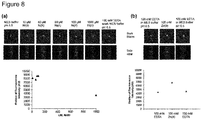
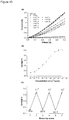
- 5(6)-carboxyfluorescein-DAP- ⁇ Ala-His-linkerPEG 4 (1) is almost exclusively present on the surface of the nanopores of the ion-track etched PET-membrane or foil as can be seen in Figure 10(a) and displays a green color when excited by the laser at 488 nm in the CLSM image ( Figure 10(b)).
- Figure 10(d) shows a titration experiment showing the dependency of decrease in fluorescence with the increase in Cu 2+ ion concentration as well as the re-usability of the sensor of the present application.
- CuSO 4 was added in concentrations from 0 to 100 ⁇ M in MES buffer solution, pH 6.50.
- the limit of detection (LOD) for Cu 2+ ions using the fluorescence signal was determined.
- the limit of detection of the sensor comprising 5(6)-carboxyfluorescein-DAP- ⁇ Ala-His-linkerPEG 4 (1) towards Cu 2+ ions in solution from fluorescence intensity titration studies is defined to be 12 nM. This value is extremely important for application of the sensor according to the present invention for detection of trace amounts of copper ions in food/water control or detection of copper ions for the early diagnosis of Alzheimer's disease in urine.
- the sensor comprises the copper-binding motif, a fluorophore and a linker moiety, i.e. 5(6)-carboxyfluorescein-DAP- ⁇ Ala-His-linkerPEG 4 whereby the copper-binding motif with the fluorophore is attached to the ion-track etched PET-membrane with nanopores by means of the linker.
- the PET-membrane with nanopores behaves as an ohmic resistor before Cu 2+ complexation meaning that the net surface charge on the nanopore surface is zero and no flux from the narrow cone opening to the wide opening takes place.
- the ion-track etched PET-membrane with conical nanopores having carboxyl groups on the surface with no immobilized copper-binding motif shows a flux from the narrow cone opening to the wide opening because of the negative carboxyl groups ( Figure 12 ).
- EDA ethylene diamine
- Immobilization of the copper-binding motif with the fluorophore via the linker to the surface of the nanopores of the ion-track etched PET-membrane results in change of the nanopore transport behavior from a rectifying to a non-rectifying due to the loss of nanopore surface charges.
- the PET-membrane with the immobilized copper-binding motif behaves as an ohmic resistor, i.e. the net surface charge on the nanopore walls is zero.
- the sensor according to the present application is able to recognize Cu 2+ ions even at concentrations as low as 1 fM and this recognition process can be transduced in an electronic signal originating from the transport behavior of the nanopore. From the data given in Figure 13 it can be seen that the sensor exhibits a remarkable interaction ability towards Cu 2+ due to the particular copper-binding motif used in the sensor according to the present application.
- the present application further relates to the following items.
Landscapes
- Life Sciences & Earth Sciences (AREA)
- Chemical & Material Sciences (AREA)
- Health & Medical Sciences (AREA)
- Engineering & Computer Science (AREA)
- Immunology (AREA)
- Molecular Biology (AREA)
- Biochemistry (AREA)
- General Health & Medical Sciences (AREA)
- Hematology (AREA)
- Urology & Nephrology (AREA)
- Biomedical Technology (AREA)
- Analytical Chemistry (AREA)
- General Physics & Mathematics (AREA)
- Pathology (AREA)
- Physics & Mathematics (AREA)
- Medicinal Chemistry (AREA)
- Cell Biology (AREA)
- Microbiology (AREA)
- Biotechnology (AREA)
- Proteomics, Peptides & Aminoacids (AREA)
- Food Science & Technology (AREA)
- Organic Chemistry (AREA)
- Dispersion Chemistry (AREA)
- Crystallography & Structural Chemistry (AREA)
- Biophysics (AREA)
- Genetics & Genomics (AREA)
- Investigating Or Analysing Materials By The Use Of Chemical Reactions (AREA)
- Pharmaceuticals Containing Other Organic And Inorganic Compounds (AREA)
Priority Applications (5)
| Application Number | Priority Date | Filing Date | Title |
|---|---|---|---|
| EP19151227.6A EP3680667A1 (fr) | 2019-01-10 | 2019-01-10 | Capteur d'ions cu2+ hautement sélectif et ultrasensible |
| PCT/EP2020/050461 WO2020144294A1 (fr) | 2019-01-10 | 2020-01-09 | Capteur d'ions métalliques hautement sélectif et ultrasensible |
| US17/421,837 US11977016B2 (en) | 2019-01-10 | 2020-01-09 | Highly selective and ultrasensitive metal ion sensor |
| EP20700084.5A EP3908840B1 (fr) | 2019-01-10 | 2020-01-09 | Capteur d'ions cu2+ hautement sélectif et ultrasensible |
| EA202191917A EA202191917A1 (ru) | 2019-01-10 | 2020-01-09 | Высокоселективный и сверхчувствительный сенсор ионов металлов |
Applications Claiming Priority (1)
| Application Number | Priority Date | Filing Date | Title |
|---|---|---|---|
| EP19151227.6A EP3680667A1 (fr) | 2019-01-10 | 2019-01-10 | Capteur d'ions cu2+ hautement sélectif et ultrasensible |
Publications (1)
| Publication Number | Publication Date |
|---|---|
| EP3680667A1 true EP3680667A1 (fr) | 2020-07-15 |
Family
ID=65241109
Family Applications (2)
| Application Number | Title | Priority Date | Filing Date |
|---|---|---|---|
| EP19151227.6A Withdrawn EP3680667A1 (fr) | 2019-01-10 | 2019-01-10 | Capteur d'ions cu2+ hautement sélectif et ultrasensible |
| EP20700084.5A Active EP3908840B1 (fr) | 2019-01-10 | 2020-01-09 | Capteur d'ions cu2+ hautement sélectif et ultrasensible |
Family Applications After (1)
| Application Number | Title | Priority Date | Filing Date |
|---|---|---|---|
| EP20700084.5A Active EP3908840B1 (fr) | 2019-01-10 | 2020-01-09 | Capteur d'ions cu2+ hautement sélectif et ultrasensible |
Country Status (4)
| Country | Link |
|---|---|
| US (1) | US11977016B2 (fr) |
| EP (2) | EP3680667A1 (fr) |
| EA (1) | EA202191917A1 (fr) |
| WO (1) | WO2020144294A1 (fr) |
Families Citing this family (2)
| Publication number | Priority date | Publication date | Assignee | Title |
|---|---|---|---|---|
| EP3680667A1 (fr) * | 2019-01-10 | 2020-07-15 | Tietze, Alesia | Capteur d'ions cu2+ hautement sélectif et ultrasensible |
| AU2023422141A1 (en) * | 2023-01-03 | 2025-07-17 | Smartwash Solutions, Llc | Process control of silver-ion-based food wash processes |
Family Cites Families (3)
| Publication number | Priority date | Publication date | Assignee | Title |
|---|---|---|---|---|
| US6821952B1 (en) * | 1995-07-20 | 2004-11-23 | Perkinelmer Las, Inc. | Fluorescent vasoactive intestinal peptide (VIP) |
| EP2674759B1 (fr) * | 2011-02-04 | 2016-01-06 | Council of Scientific & Industrial Research | Capteurs d'acide aminé aqueux à base de film polymère conducteur à empreinte moléculaire |
| EP3680667A1 (fr) * | 2019-01-10 | 2020-07-15 | Tietze, Alesia | Capteur d'ions cu2+ hautement sélectif et ultrasensible |
-
2019
- 2019-01-10 EP EP19151227.6A patent/EP3680667A1/fr not_active Withdrawn
-
2020
- 2020-01-09 WO PCT/EP2020/050461 patent/WO2020144294A1/fr not_active Ceased
- 2020-01-09 EP EP20700084.5A patent/EP3908840B1/fr active Active
- 2020-01-09 US US17/421,837 patent/US11977016B2/en active Active
- 2020-01-09 EA EA202191917A patent/EA202191917A1/ru unknown
Non-Patent Citations (24)
| Title |
|---|
| ACCOUNTS OF CHEMICAL RESEARCH, vol. 30, 1997, pages 123 - 130 |
| ALICIA TORRADO ET AL: "Exploiting Polypeptide Motifs for the Design of Selective Cu(II) Ion Chemosensors", JOURNAL OF THE AMERICAN CHEMICAL SOCIETY, vol. 120, no. 3, 1998, pages 609 - 610, XP055572649, ISSN: 0002-7863, DOI: 10.1021/ja973357k * |
| C. WENDE ET AL: "Fluorophore ATCUN complexes: combining agent and probe for oxidative DNA cleavage", CHEMICAL COMMUNICATIONS, vol. 51, no. 62, 22 June 2015 (2015-06-22), pages 12395 - 12398, XP055572647, ISSN: 1359-7345, DOI: 10.1039/C5CC04508H * |
| CHEM SOC REV, vol. 46, 2017, pages 7105 - 7123 |
| CHRISTIAN WENDE ET AL: "Copper Complexes of N-Donor Ligands as Artificial Nucleases : Copper Complexes of N-Donor Ligands as Artificial Nucleases", EUROPEAN JOURNAL OF INORGANIC CHEMISTRY - CHEMISCHE BERICHTE, vol. 2014, no. 16, 1 June 2014 (2014-06-01), DE, pages 2597 - 2612, XP055573437, ISSN: 1434-1948, DOI: 10.1002/ejic.201400032 * |
| DALTON TRANS, 2004, pages 1907 - 1917 |
| DING ET AL., JOURNAL OF MATERIALS CHEMISTRY, vol. 21, 2011, pages 13345 - 13353 |
| EUR J BIOCHEM, vol. 269, 2002, pages 1323 - 1331 |
| HIRAYAMA ET AL., PROC NAT ACAD SCI USA, vol. 109, 2012, pages 2228 - 2233 |
| IMPERIALI ET AL., J AM CHEM SOC, vol. 120, 1998, pages 609 - 610 |
| J TOXICOL ENVIRON HEALTH B CRIT REV, vol. 4, 2001, pages 341 - 394 |
| J TRACE BERN MET BIOL, vol. 45, 2018, pages 181 - 188 |
| J TRACE ELEM MET BIOL, vol. 45, 2018, pages 181 - 188 |
| NAT CHEM BIOL, vol. 4, 2008, pages 176 - 185 |
| NEURON, vol. 30, 2001, pages 665 - 676 |
| NUCL INSTRUM METHODS PHYS RES, vol. 184, 2001, pages 337 - 346 |
| PAPP ET AL., ANGEWANDTE CHEM INT ED ENGL, vol. 57, 2018, pages 4752 - 4755 |
| PAULINA GONZALEZ ET AL: "N-Terminal Cu-Binding Motifs (Xxx-Zzz-His, Xxx-His) and Their Derivatives: Chemistry, Biology and Medicinal Applications", CHEMISTRY - A EUROPEAN JOURNAL, vol. 24, no. 32, 24 March 2018 (2018-03-24), DE, pages 8029 - 8041, XP055572644, ISSN: 0947-6539, DOI: 10.1002/chem.201705398 * |
| REV ENVIRON HEALTH, vol. 14, 1999, pages 231 - 238 |
| SCHREURS ET AL., PROC NATL ACAD SCI USA, vol. 100, 2003, pages 11065 - 11069 |
| SITU ET AL., SENSORS AND ACTUATORS Β-CHEMICAL, vol. 240, 2017, pages 560 - 565 |
| SQUITTI ET AL., J ALZHEIMERS DIS, vol. 38, 2014, pages 809 - 822 |
| SQUITTI ET AL., J TRACE ELEM MED BIOL, vol. 45, 2018, pages 181 - 188 |
| WATER, AIR AND SOIL POLLUTION, vol. 108, 1998, pages 457 - 471 |
Also Published As
| Publication number | Publication date |
|---|---|
| EA202191917A1 (ru) | 2021-11-17 |
| EP3908840A1 (fr) | 2021-11-17 |
| US20220099548A1 (en) | 2022-03-31 |
| WO2020144294A1 (fr) | 2020-07-16 |
| EP3908840B1 (fr) | 2026-03-04 |
| US11977016B2 (en) | 2024-05-07 |
Similar Documents
| Publication | Publication Date | Title |
|---|---|---|
| Niu et al. | Fluorescence switch of gold nanoclusters stabilized with bovine serum albumin for efficient and sensitive detection of cysteine and copper ion in mice with Alzheimer's disease | |
| Shiu et al. | A highly selective FRET-based fluorescent probe for detection of cysteine and homocysteine. | |
| Stewart et al. | Surface-enhanced Raman spectroscopy of peptides and proteins adsorbed on an electrochemically prepared silver surface | |
| Chow et al. | Peptide modified electrodes as electrochemical metal ion sensors | |
| Verma et al. | Detection and identification of amino acids and proteins using their intrinsic fluorescence in the visible light spectrum | |
| Martins et al. | based (bio) sensor for label-free detection of 3-nitrotyrosine in human urine samples using molecular imprinted polymer | |
| Bian et al. | Doped zinc sulfide quantum dots based phosphorescence turn-off/on probe for detecting histidine in biological fluid | |
| Müller et al. | Ultrasensitive and selective copper (ii) detection: Introducing a bioinspired and robust sensor | |
| Mazur et al. | Core-satellite gold nanoparticle biosensors for monitoring cobalt ions in biological samples | |
| Chen et al. | Sensitive detection of copper (II) ions based on the conformational change of peptides by surface plasmon resonance spectroscopy | |
| US11977016B2 (en) | Highly selective and ultrasensitive metal ion sensor | |
| Wang et al. | Molecularly imprinted polymer thin film based surface plasmon resonance sensor to detect hemoglobin | |
| da Fonseca Alves et al. | A novel peptide-based electrochemical biosensor for breast cancer characterization over a poly 3-(3-aminophenyl) propionic acid matrix | |
| Zhu et al. | Turn-on fluorescent assay for antioxidants based on their inhibiting polymerization of dopamine on graphene quantum dots | |
| CN107936035A (zh) | 一种半胱氨酸改性的石墨烯量子点gqcy及制备方法与制备多巴胺荧光检测试剂上的应用 | |
| Cinti et al. | based electrochemical device for early detection of integrin αvβ6 expressing tumors | |
| Zhang et al. | How an ACE2 mimicking epitope-MIP nanofilm recognizes template-related peptides and the receptor binding domain of SARS-CoV-2 | |
| CN108645826A (zh) | 一种快速检测抗坏血酸的新方法 | |
| Kim et al. | Al3+ ion sensing at attomole level via surface-potential mapping of gold nanoparticle complexes | |
| Zhang et al. | Ratiometric fluorescent and visual detection of arginine with a dual-ligand MOF–based sensing platform | |
| Shin et al. | A superior anti-fouling electrode sensing layer based on a tannic acid–polyethyleneimine–graphene oxide nanocomposite for thrombin detection in complex biological fluids | |
| Kurzątkowska et al. | Voltammetric detection of the S100B protein using his-tagged RAGE domain immobilized onto a gold electrode modified with a dipyrromethene–cu (II) complex and different diluents | |
| CN115974966B (zh) | 靶向神经丝轻链蛋白的多肽及其应用 | |
| CN103163107B (zh) | 一种检测三价金离子的方法 | |
| Magarelli et al. | A voltammetric peptide biosensor for Cu2+ metal ion quantification in coffee seeds |
Legal Events
| Date | Code | Title | Description |
|---|---|---|---|
| PUAI | Public reference made under article 153(3) epc to a published international application that has entered the european phase |
Free format text: ORIGINAL CODE: 0009012 |
|
| STAA | Information on the status of an ep patent application or granted ep patent |
Free format text: STATUS: THE APPLICATION HAS BEEN PUBLISHED |
|
| AK | Designated contracting states |
Kind code of ref document: A1 Designated state(s): AL AT BE BG CH CY CZ DE DK EE ES FI FR GB GR HR HU IE IS IT LI LT LU LV MC MK MT NL NO PL PT RO RS SE SI SK SM TR |
|
| AX | Request for extension of the european patent |
Extension state: BA ME |
|
| STAA | Information on the status of an ep patent application or granted ep patent |
Free format text: STATUS: THE APPLICATION IS DEEMED TO BE WITHDRAWN |
|
| 18D | Application deemed to be withdrawn |
Effective date: 20210116 |