EP3680748A1 - Boîtier de smartphone doté d'un clavier - Google Patents
Boîtier de smartphone doté d'un clavier Download PDFInfo
- Publication number
- EP3680748A1 EP3680748A1 EP19151329.0A EP19151329A EP3680748A1 EP 3680748 A1 EP3680748 A1 EP 3680748A1 EP 19151329 A EP19151329 A EP 19151329A EP 3680748 A1 EP3680748 A1 EP 3680748A1
- Authority
- EP
- European Patent Office
- Prior art keywords
- touchscreen display
- case cover
- mobile equipment
- front side
- user equipment
- Prior art date
- Legal status (The legal status is an assumption and is not a legal conclusion. Google has not performed a legal analysis and makes no representation as to the accuracy of the status listed.)
- Withdrawn
Links
Images

Classifications
-
- G—PHYSICS
- G06—COMPUTING OR CALCULATING; COUNTING
- G06F—ELECTRIC DIGITAL DATA PROCESSING
- G06F1/00—Details not covered by groups G06F3/00 - G06F13/00 and G06F21/00
- G06F1/16—Constructional details or arrangements
- G06F1/1613—Constructional details or arrangements for portable computers
- G06F1/1633—Constructional details or arrangements of portable computers not specific to the type of enclosures covered by groups G06F1/1615 - G06F1/1626
- G06F1/1637—Details related to the display arrangement, including those related to the mounting of the display in the housing
- G06F1/1647—Details related to the display arrangement, including those related to the mounting of the display in the housing including at least an additional display
-
- G—PHYSICS
- G06—COMPUTING OR CALCULATING; COUNTING
- G06F—ELECTRIC DIGITAL DATA PROCESSING
- G06F1/00—Details not covered by groups G06F3/00 - G06F13/00 and G06F21/00
- G06F1/16—Constructional details or arrangements
- G06F1/1613—Constructional details or arrangements for portable computers
- G06F1/1633—Constructional details or arrangements of portable computers not specific to the type of enclosures covered by groups G06F1/1615 - G06F1/1626
- G06F1/1637—Details related to the display arrangement, including those related to the mounting of the display in the housing
- G06F1/1643—Details related to the display arrangement, including those related to the mounting of the display in the housing the display being associated to a digitizer, e.g. laptops that can be used as penpads
-
- G—PHYSICS
- G06—COMPUTING OR CALCULATING; COUNTING
- G06F—ELECTRIC DIGITAL DATA PROCESSING
- G06F2200/00—Indexing scheme relating to G06F1/04 - G06F1/32
- G06F2200/16—Indexing scheme relating to G06F1/16 - G06F1/18
- G06F2200/163—Indexing scheme relating to constructional details of the computer
- G06F2200/1633—Protecting arrangement for the entire housing of the computer
-
- G—PHYSICS
- G06—COMPUTING OR CALCULATING; COUNTING
- G06F—ELECTRIC DIGITAL DATA PROCESSING
- G06F2203/00—Indexing scheme relating to G06F3/00 - G06F3/048
- G06F2203/048—Indexing scheme relating to G06F3/048
- G06F2203/04809—Textured surface identifying touch areas, e.g. overlay structure for a virtual keyboard
Definitions
- the invention relates to a system 10 comprising a mobile equipment 1 comprising a first touchscreen display 3 and a second touchscreen display 4 separated from the first touchscreen display 3 on a front side of the mobile equipment 1; and a mobile equipment 1 case cover 5 with keypad 11 for operating the mobile equipment 1.
- Modern user equipment like smartphones offer basic functions like telephoning or short message service which had been in use since almost the beginning of mobile communication systems.
- modern user equipments offer more advanced and resource consuming applications which had been previously only used on personal computers like office related applications, games, health related applications, sport or activity related applications.
- These more advanced applications also interact with various sensors of a smartphone like a camera, GPS, gyroscope, light sensors etc. which were not contained in the user equipment of the first generations.
- this group of people still wants to use the more advance applications and functions of a smartphone which the interaction with or display via the large screen of a smartphone integrated into the front side of a smartphone.
- DE 10 2015 100 344 A1 discloses a cover for a smartphone which provides on one side a traditional keypad providing only a limited number of keys (less than 20) and on the backside an execution side capable of interacting with the capacitive touch screen of the smartphone.
- the keypad is not covering the entire display of the smartphone and the area not covered can be used as a display when the cover is attached to the display of the smartphone.
- a system 10 comprising
- This system 10 has the advantage that one of the touchscreen displays can be deactivated because the two touchscreen displays are separated from each other and thus can be operated superlatively.
- the first touchscreen display 3 and the second touchscreen display 4 can be separately powered. In this way, the operation of the two touchscreen displays 3, 4 can be provided with electric energy only when the respective display is used. Accordingly, electric energy can be saved.
- the ratio of the surface area of the second touchscreen display 4 to the surface are of first touchscreen display 3 is 50:50, at least 55:45,60:40, at least 70:30, at least 80:20, or at least 90:10.
- the first touchscreen display 3 may have a small size thereby further reducing the consumption of electric energy.
- the first touchscreen display 3 and the second touchscreen display 4 may comprise liquid crystal displays.
- Liquid crystal displays consume a relatively high amount of electric energy and thus the disclosed system 10 is especially useful for liquid crystal displays.
- the keypad 11 may comprise push-buttons which provide the advantage that some users prefer the haptic experience of those buttons.
- the mobile equipment 1 case cover 5 may be operatively coupled to the equipment 1 case cover 5 by a wired or wireless connection. This provides the advantage that first touchscreen displayed can be completely disconnected from the electric source if required.
- the mobile equipment 1 case cover 5 may comprise a first portion covering the front side of the mobile equipment 1, the first portion comprising a first subsection of the first portion comprising a recess 6 and a second subsection of the first portion comprising the keyboard and the first subsection is configured to cover the first touchscreen display 3 and the second subsection is configured to cover the second touchscreen display 4.
- the recess 6 may comprise a transparent material or no material.
- the mobile equipment case cover 5 may further comprise a second portion for covering a back side of the mobile equipment 1 and the first portion and the second portion are connected by flexible hinge region 12. This provides the advantage that the case cover can cover the user equipment in a flip flap manner.
- the System 10 may further comprise a processor configured to determine by a sensor whether the mobile equipment case cover 5 is attached to the front side of the mobile equipment 1. In this way, it can be automatically determined whether the case cover is attached to the front side of the mobile equipment 1.
- the sensor may be a Hall Sensor.
- the processor may be configured to, when the case cover 5 is attached to the front side of the mobile equipment 1, deactivate the functional elements configured to sense a touch of the first touchscreen display 3, activate or keep activated functional elements configured to provide the actual visual display of the first touchscreen display 3, to restrict the communication functions of the user equipment 1 to calling and SMS functions, deactivate at least one of a multiplicity of processors cores, and/or reduce a processing rate of the processor.
- the processor may be configured to, when the case cover 5 is attached to the front side of the mobile equipment 1, to increase the font size of characters displayed in the first touchscreen display 3.
- the processor may be configured to, when the case cover 5 is not or not attached to the front side of the mobile equipment 1, to activate the first touchscreen display 3 and the second touchscreen display 4, increase the processing rate of the processor; activate a multiplicity of processors cores and/or activate all available communication functions of the user equipment 1.
- the user equipment can provide or restore the normal function of the user equipment automatically. Again, this may be achieved by the use of a proximity sensor, e.g., a Hall sensor.
- a proximity sensor e.g., a Hall sensor.
- the processor may be configured to, when the case cover 5 is not or not attached to the front side of the mobile equipment 1, use the activated first touchscreen display 3 and the second touchscreen display 4 operatively as a single display.
- the user equipment can provide or restore the normal function of the user equipment automatically, in particular, the provision of a large screen for display.
- a system 10 comprising a mobile equipment 1 comprising a first touchscreen display 3 and a second touchscreen display 4 separated from the first touchscreen display 3 on a front side of the mobile user equipment 2; and a mobile equipment case cover 5 with keypad 11 for operating the mobile equipment 1.
- the mobile equipment 1 and the case cover 5 can also be provided independently. In the following the mobile equipment 1 and the case cover 5 as well their modes of interaction will be described in more detail.
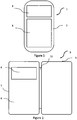
- a mobile user equipment 1 as illustrated in figure 1 comprising a first and second touchscreen display 3, 4.
- the mobile user equipment 1 includes but is not limited to a smart phone, a touch screen communication device, a touch screen information processing system, a touch screen enabled portable communication devices and similar devices.
- the mobile user equipment 1 may also comprise the usual elements of a user equipment 1, for example, one or more processors (e.g. at least one multiple core processor with 2, 4, 6, 8, 16 or more cores), a memory, a bus system 10, sensors, antennas, communication interfaces for wireless or wired data transfer and a battery.
- processors e.g. at least one multiple core processor with 2, 4, 6, 8, 16 or more cores
- a memory e.g. at least one multiple core processor with 2, 4, 6, 8, 16 or more cores
- sensors e.g. at least one multiple core processor with 2, 4, 6, 8, 16 or more cores
- communication interfaces for wireless or wired data transfer and a battery.
- a mobile user equipment 1 comprises a front side 2 and a back side connected by lateral sides (not shown in the figures).
- the first and second touchscreen display 3, 4 are positioned on one side of the mobile user equipment 1, i.e. usually the front side.
- the first and second touchscreen display 3, 4 are separated from each other which means that they can be operated independent from each other. In particular, they can be disconnected from or connected to a power source independently from each other, i.e. separately powered.
- the first and second touchscreen display 3, 4 on the front side 2 in combination may occupy 70%, 80%, 90%, 100% of the area of the front side 2 of the mobile user equipment 1.
- the first and second touchscreen display 3, 4 may also cover a part of or entirely the lateral sides or/and part or the back side of the mobile user equipment 1.
- the ratio of the surface area of the second touchscreen display 4 to the surface are of first touchscreen display 3 may be 50:50, at least 55:45, at least 60:40, at least 70:30, 80:20, or at least 90:10. A smaller first touchscreen display 3 will result in higher energy savings when operating the case cover 5 with only the first touchscreen display 3.
- the first and second touchscreen display 4 may be separated by a gap occupying less than 30%, 20%, 10%, 5% of the area of the front side of the mobile user equipment 1, or preferably not containing any gap visible to the human eye.
- Touchscreens like those disclosed herein usually consist of two functional elements.
- the first functional element provides the actual visual display, e.g. liquid crystal display, LCD, or organic light-emitting diode, OLED, display.
- the second functional element provides elements for sensing a touch. It is contemplated that in the second touchscreen display 4 only the elements for providing the actual visual display are deactivated or both the elements for providing the actual visual display and for sensing a touch are deactivated.
- the input via the keypad 11 is to be forwarded to the mobile user equipment 1 not via the second touchscreen display 4. Instead, the input from the keypad 11 is communicated via a different communication interface of the case cover 5, i.e. wirelessly or by a wire (or cable) to a communication interface of the mobile user equipment 1 (not shown in the figures).
- the first and second touchscreen display 4 comprise an LCD display.
- second functional elements configured to sense a touch are deactivated in first touchscreen display 3 when the cover is closed and the first and second functional elements are provided in the second touchscreen display 4. It is also contemplated that second functional elements configured to sense a touch are not provided in the first touchscreen display 3 and the first and second functional elements are provided in the second touchscreen display 4.
- the first and second touchscreen display 3, 4 can independently comprise a resistive, surface acoustic wave, capacitive, optical imaging, acoustic recognition touchscreen display, preferably a capacitive touchscreen display.
- the mobile user equipment 1 can also comprise as one of its sensors a proximity sensor, e.g. a Hall sensor, configured to determine whether a case cover 5 is attached to its front side or not, or any other sensor suitable for that purpose.
- a proximity sensor e.g. a Hall sensor
- Figures 2 and 3 illustrate a case cover 5 which is shown in an opened and a closed state.
- the case cover 5 is provided to cover the mobile device.
- the case cover 5 comprises a keypad 11.
- the case cover 5 may comprise an interface for communication with the mobile user equipment 1 or/and a build-in power source like a battery (rechargeable or not rechargeable) or be configured to draw electric power from the mobile user equipment 1 in a wireless (e.g. inductive transfer of electric current) or wired manner.
- a build-in power source like a battery (rechargeable or not rechargeable) or be configured to draw electric power from the mobile user equipment 1 in a wireless (e.g. inductive transfer of electric current) or wired manner.
- the case cover 5 comprises at least a first portion and covers the front side of the mobile equipment 1.
- the first portion comprises a front side and a back side.
- the first portion comprises a first subsection of the first portion comprising a recess 6 and a second subsection of the first portion comprising the keyboard on the front side and the first subsection is configured to cover the first touchscreen display 3 and the second subsection is configured to cover the second touchscreen display 4, i.e. the first and second subsection corresponding in size and shape to the first and second touchscreen display.
- Figure 2 shows an example where the case cover 5 covers the mobile device in a flip flap manner, i.e. consists of two portions, a first portion of the case cover 5 comprising the keypad 11 and a second portion of the case cover 5 section for receiving the user equipment 1, wherein the first and the second portion are connected by a flexible hinge region 12.
- a first portion of the case cover 5 comprising the keypad 11
- a second portion of the case cover 5 section for receiving the user equipment 1
- the first and the second portion are connected by a flexible hinge region 12.
- other configurations are contemplated, like a sleeve or a case cover 5 that is solely attached to the front side of the mobile user equipment 1.
- the flexible hinge region or any region connecting the first and second portion may comprise wire or cables for connection the case cover 5 and the user equipment 3.
- the recess 6 may comprise a transparent material or no material and is configured to allow to view the first touchscreen display 3 through the recess 6.
- the first subsection of the first portion of the case cover 5 comprising the recess 6 may also comprise a frame at its edges between which the transparent material is positioned.
- the second subsection of the first portion of the case cover 5 and comprising the keypad 11 on the front side has a corresponding region of the backside of the first portion.
- This region may comprise electric elements which can interact with the second touchscreen display 4 as an interface for communicating with the user equipment 1.
- electric elements are known in the art, for example, the execution side described in DE 10 2015 100 344 A1 .
- this region on the backside of the second subsection of the first portion of the case cover 5 comprises no electric elements which can interact with the second touchscreen display 4 as an interface for communicating with the user equipment 1.
- interaction with the user equipment 1 is provided the communication interface for wireless or wired communication.
- the communication interface provides a connection by cable with the user equipment 1 using any suitable communication standard compatible with the respective user equipment 1 (e.g. USB, UART, serial interface, e.g. RS232).
- the communication interface provides wireless communication, by a communication module for Wi-Fi or another wireless standard, like Bluetooth.
- the keypad 11 can provide the appearance and functionality of a keypad 11 as used on user equipment lacking a touchscreen.
- the keypad 11 may comprise 30, 25, or 20 or less keys.
- the keys may be push-buttons.
- Push-buttons are buttons which comprise a flexible structure like a spring which bias the button after pushing the button back into its original position.
- keys are also touch-sensitive, for example, capacitive keys without any mechanical system for returning a key into a biased position.
- Figure 4 illustrates the case cover 5 attached to the mobile user equipment 1.
- the case cover 5 envelopes the mobile user equipment 1 when the case cover 5 is in a closed state and the keypad 11 covers the second touchscreen display 4 and allows a free view on the first touchscreen display 3.
- the user equipment 1 is configured to determine, for example, by its processor and a sensor of the user equipment 1 whether the case cover 5 is attached to the front side of the user equipment 1.
- a sensor of the user equipment 1 determines whether the case cover 5 is attached to the front side of the user equipment 1.
- the sensor can be a proximity sensor, for example, a Hall sensor.
- the user equipment 1 When is determined that the case cover 5 is attached to the front side of the mobile equipment 1, the user equipment 1 is configured to deactivate the second touchscreen display 4, to restrict the communication functions of the user equipment 1 to calling (telephone) and SMS functions, deactivate at least one of a multiplicity of processors cores, deactivate at least one sensor (preferably with the exception of the proximity sensor for detecting whether the case cover 5 is attached to the user equipment 3), and/or reduce a processing rate of the processor. This provides the advantage that the consumption of electric energy is reduced.
- Each of the actions that occurs in response to the determination that the case cover 5 is attached to the front side of the mobile equipment 1, or not, may be defined in predefined settings of the user equipment 1.
- the user can modify the settings which can be stored in the memory of the user equipment 1.
- the user equipment 1 may be further configured to adapt the predefined settings stored in the memory and used for displaying on the first touchscreen display 3.
- the setting may be adapted in a way that the information displayed in the first touchscreen display 3 is changed and only information to incoming calls or SMS is displayed or in response to an input of the user on the keyboard of the case cover 5 only those characters are displayed which correspond to the keys touched by the user.
- the user equipment 1 may be further configured to increase the font size of the characters (e.g. by 10%, 20%, 30%, 40%, 50%, 100% or 200%) displayed in the first touchscreen display 3 compared to the condition where the case cover 5 is not attached to the front side of the user equipment 1. Again, the font size for the first touchscreen display 3 may be defined by the user in the settings of the user equipment 1.
- Deactivation of the second touchscreen means that at least those functions of the touchscreen display for visual display are deactivated and no longer require electric energy. Deactivation of the second touchscreen can also comprise deactivating those functions of the second touchscreen relating to sensing of a touch. In this way, the energy efficiency is further increased.
- the communication of the keypad 11 with the user equipment 1 is provided by a wireless communication of the keypad 11, for example, via a build in processor and wireless communication interface for WIFI, Bluetooth, or any successors of these standards.
- the communication of the keypad 11 with the user equipment 1 is provided by a wired communication interface which is connected by cable with the user equipment 1 using any suitable communication standard compatible with the respective user equipment 1 (e.g. USB, UART, serial interface, e.g. RS232).
- any suitable communication standard compatible with the respective user equipment 1 e.g. USB, UART, serial interface, e.g. RS232.
- the user equipment 1 is configured to determine, for example, by its processor and a sensor of the user equipment 1 whether the case cover 5 is not or no longer attached to the front side of the user equipment 1.
- a sensor of the user equipment 1 determines that the case cover 5 is open or has been opened.
- the sensor can be a proximity sensor, for example, a Hall sensor.
- the user equipment 1 When is determined that the case cover 5 is attached to the front side of the mobile equipment 1, the user equipment 1 is configured to activate the second touchscreen display 4, to provide all communication functions of the user equipment 1, (re)activate more than one of a multiplicity of processors cores, and/or increase a processing rate of the processor.
- the processor may be further configured to, when the case cover 5 is not or not attached to the front side of the mobile equipment 1, use the activated first touchscreen display 3 and the second touchscreen display 4 operatively as a single display. This means displayed items are not mirrored between the two displays, but presented distributed over the two displays (which may be called an extension mode).
- the features described above provide the advantage that the functions of the user equipment 1 are restored to their full functionality automatically when the case cover 5 is detached from the user equipment 1.
- any of the possible activation and deactivation measures in response to an attachment or removal of the case cover 5 from the user equipment 1 may be preconfigured in the user equipment 1 by a user by amending the settings stored in the memory of the user equipment 1.
- a system that allows to reduce energy consumption of a user equipment 1, especially, a smartphone while improving the user experience.
- a system 10 comprising a mobile equipment 1 comprising a first touchscreen display 3 and a second touchscreen display 4 separated from the first touchscreen display 3 on a front side of the mobile equipment 1; and a mobile equipment case cover 5 with keypad 11 for operating the mobile equipment 1 is disclosed.
Landscapes
- Engineering & Computer Science (AREA)
- Computer Hardware Design (AREA)
- Theoretical Computer Science (AREA)
- Human Computer Interaction (AREA)
- Physics & Mathematics (AREA)
- General Engineering & Computer Science (AREA)
- General Physics & Mathematics (AREA)
- Telephone Set Structure (AREA)
- Telephone Function (AREA)
Priority Applications (1)
| Application Number | Priority Date | Filing Date | Title |
|---|---|---|---|
| EP19151329.0A EP3680748A1 (fr) | 2019-01-11 | 2019-01-11 | Boîtier de smartphone doté d'un clavier |
Applications Claiming Priority (1)
| Application Number | Priority Date | Filing Date | Title |
|---|---|---|---|
| EP19151329.0A EP3680748A1 (fr) | 2019-01-11 | 2019-01-11 | Boîtier de smartphone doté d'un clavier |
Publications (1)
| Publication Number | Publication Date |
|---|---|
| EP3680748A1 true EP3680748A1 (fr) | 2020-07-15 |
Family
ID=65019348
Family Applications (1)
| Application Number | Title | Priority Date | Filing Date |
|---|---|---|---|
| EP19151329.0A Withdrawn EP3680748A1 (fr) | 2019-01-11 | 2019-01-11 | Boîtier de smartphone doté d'un clavier |
Country Status (1)
| Country | Link |
|---|---|
| EP (1) | EP3680748A1 (fr) |
Citations (2)
| Publication number | Priority date | Publication date | Assignee | Title |
|---|---|---|---|---|
| US20030224832A1 (en) * | 2002-05-31 | 2003-12-04 | Lavaflow, Llp | Foldable cellular telephone |
| DE102015100344A1 (de) | 2015-01-12 | 2016-07-14 | Emporia Telecom Gmbh & Co Kg | Tastatur, Hülle und mobiles Endgerät mit einer solchen Tastatur sowie Ladestation für ein mobiles Endgerät |
-
2019
- 2019-01-11 EP EP19151329.0A patent/EP3680748A1/fr not_active Withdrawn
Patent Citations (2)
| Publication number | Priority date | Publication date | Assignee | Title |
|---|---|---|---|---|
| US20030224832A1 (en) * | 2002-05-31 | 2003-12-04 | Lavaflow, Llp | Foldable cellular telephone |
| DE102015100344A1 (de) | 2015-01-12 | 2016-07-14 | Emporia Telecom Gmbh & Co Kg | Tastatur, Hülle und mobiles Endgerät mit einer solchen Tastatur sowie Ladestation für ein mobiles Endgerät |
Similar Documents
| Publication | Publication Date | Title |
|---|---|---|
| US11169703B2 (en) | Method for displaying graphical user interface and mobile terminal | |
| US11567637B2 (en) | Display control method and device | |
| AU2016224248B2 (en) | Electronic device and method of reducing power consumption thereof | |
| US9874994B2 (en) | Device, method and program for icon and/or folder management | |
| EP2804070B1 (fr) | Dispositif terminal portable ayant une pochette de protection | |
| US20150084885A1 (en) | Portable electronic device with display modes for one-handed operation | |
| US20140333542A1 (en) | Carrying case used with a portable electronic device | |
| EP3110115B1 (fr) | Couverture extérieure | |
| US20140141838A1 (en) | Mobile device case with interchangeable display | |
| US20100214227A1 (en) | Dual screen portable electronic device | |
| CN112445407B (zh) | 显示方法和电子设备 | |
| CN103488253A (zh) | 智能保护盖窥视 | |
| US20170017391A1 (en) | Electronic device having cover and method for controlling display thereof | |
| CN103747123A (zh) | 双屏手机 | |
| US9473605B2 (en) | Apparatus, method and computer readable recording medium for displaying status of electronic device | |
| WO2018006930A1 (fr) | Dispositif électronique portable | |
| EP3204844B1 (fr) | Dispositif actionne a travers un couvercle opaque et systeme | |
| CN105815896A (zh) | 一种智能手环、移动终端及其控制方法 | |
| US20200059259A1 (en) | Protective display device | |
| WO2014034172A1 (fr) | Dispositif de traitement d'informations, et procédé de commande de celui-ci | |
| EP3680748A1 (fr) | Boîtier de smartphone doté d'un clavier | |
| JP5542975B2 (ja) | 電子機器 | |
| KR101463804B1 (ko) | 이동통신단말기 및 그의 디스플레이 제어 방법 | |
| EP3544270A1 (fr) | Dispositif electronique et procédé de commande associé | |
| TR201900385A2 (tr) | Tuş takimi olan akilli telefon kilifi |
Legal Events
| Date | Code | Title | Description |
|---|---|---|---|
| PUAI | Public reference made under article 153(3) epc to a published international application that has entered the european phase |
Free format text: ORIGINAL CODE: 0009012 |
|
| STAA | Information on the status of an ep patent application or granted ep patent |
Free format text: STATUS: THE APPLICATION HAS BEEN PUBLISHED |
|
| AK | Designated contracting states |
Kind code of ref document: A1 Designated state(s): AL AT BE BG CH CY CZ DE DK EE ES FI FR GB GR HR HU IE IS IT LI LT LU LV MC MK MT NL NO PL PT RO RS SE SI SK SM TR |
|
| AX | Request for extension of the european patent |
Extension state: BA ME |
|
| STAA | Information on the status of an ep patent application or granted ep patent |
Free format text: STATUS: THE APPLICATION IS DEEMED TO BE WITHDRAWN |
|
| 18D | Application deemed to be withdrawn |
Effective date: 20210116 |