EP3681214A1 - Procédés et appareil pour la configuration d'un bloc de signal de synchronisation de découverte et de mesure intern de noeuds dans un accès et un réseau de collecte intégrés - Google Patents
Procédés et appareil pour la configuration d'un bloc de signal de synchronisation de découverte et de mesure intern de noeuds dans un accès et un réseau de collecte intégrés Download PDFInfo
- Publication number
- EP3681214A1 EP3681214A1 EP20151484.1A EP20151484A EP3681214A1 EP 3681214 A1 EP3681214 A1 EP 3681214A1 EP 20151484 A EP20151484 A EP 20151484A EP 3681214 A1 EP3681214 A1 EP 3681214A1
- Authority
- EP
- European Patent Office
- Prior art keywords
- node
- ssb
- iab
- transmissions
- selectively
- Prior art date
- Legal status (The legal status is an assumption and is not a legal conclusion. Google has not performed a legal analysis and makes no representation as to the accuracy of the status listed.)
- Withdrawn
Links
Images


Classifications
-
- H—ELECTRICITY
- H04—ELECTRIC COMMUNICATION TECHNIQUE
- H04W—WIRELESS COMMUNICATION NETWORKS
- H04W56/00—Synchronisation arrangements
- H04W56/001—Synchronization between nodes
- H04W56/0015—Synchronization between nodes one node acting as a reference for the others
-
- H—ELECTRICITY
- H04—ELECTRIC COMMUNICATION TECHNIQUE
- H04W—WIRELESS COMMUNICATION NETWORKS
- H04W56/00—Synchronisation arrangements
- H04W56/001—Synchronization between nodes
-
- H—ELECTRICITY
- H04—ELECTRIC COMMUNICATION TECHNIQUE
- H04W—WIRELESS COMMUNICATION NETWORKS
- H04W92/00—Interfaces specially adapted for wireless communication networks
- H04W92/16—Interfaces between hierarchically similar devices
- H04W92/20—Interfaces between hierarchically similar devices between access points
-
- H—ELECTRICITY
- H04—ELECTRIC COMMUNICATION TECHNIQUE
- H04J—MULTIPLEX COMMUNICATION
- H04J11/00—Orthogonal multiplex systems, e.g. using WALSH codes
- H04J11/0069—Cell search, i.e. determining cell identity [cell-ID]
-
- H—ELECTRICITY
- H04—ELECTRIC COMMUNICATION TECHNIQUE
- H04L—TRANSMISSION OF DIGITAL INFORMATION, e.g. TELEGRAPHIC COMMUNICATION
- H04L5/00—Arrangements affording multiple use of the transmission path
- H04L5/003—Arrangements for allocating sub-channels of the transmission path
- H04L5/0048—Allocation of pilot signals, i.e. of signals known to the receiver
- H04L5/005—Allocation of pilot signals, i.e. of signals known to the receiver of common pilots, i.e. pilots destined for multiple users or terminals
-
- H—ELECTRICITY
- H04—ELECTRIC COMMUNICATION TECHNIQUE
- H04W—WIRELESS COMMUNICATION NETWORKS
- H04W24/00—Supervisory, monitoring or testing arrangements
- H04W24/10—Scheduling measurement reports ; Arrangements for measurement reports
-
- H—ELECTRICITY
- H04—ELECTRIC COMMUNICATION TECHNIQUE
- H04W—WIRELESS COMMUNICATION NETWORKS
- H04W72/00—Local resource management
- H04W72/04—Wireless resource allocation
- H04W72/044—Wireless resource allocation based on the type of the allocated resource
- H04W72/0446—Resources in time domain, e.g. slots or frames
-
- H—ELECTRICITY
- H04—ELECTRIC COMMUNICATION TECHNIQUE
- H04W—WIRELESS COMMUNICATION NETWORKS
- H04W72/00—Local resource management
- H04W72/20—Control channels or signalling for resource management
- H04W72/23—Control channels or signalling for resource management in the downlink direction of a wireless link, i.e. towards a terminal
-
- H—ELECTRICITY
- H04—ELECTRIC COMMUNICATION TECHNIQUE
- H04W—WIRELESS COMMUNICATION NETWORKS
- H04W72/00—Local resource management
- H04W72/30—Resource management for broadcast services
-
- H—ELECTRICITY
- H04—ELECTRIC COMMUNICATION TECHNIQUE
- H04W—WIRELESS COMMUNICATION NETWORKS
- H04W72/00—Local resource management
- H04W72/50—Allocation or scheduling criteria for wireless resources
- H04W72/53—Allocation or scheduling criteria for wireless resources based on regulatory allocation policies
-
- H—ELECTRICITY
- H04—ELECTRIC COMMUNICATION TECHNIQUE
- H04W—WIRELESS COMMUNICATION NETWORKS
- H04W72/00—Local resource management
- H04W72/50—Allocation or scheduling criteria for wireless resources
- H04W72/54—Allocation or scheduling criteria for wireless resources based on quality criteria
- H04W72/542—Allocation or scheduling criteria for wireless resources based on quality criteria using measured or perceived quality
-
- H—ELECTRICITY
- H04—ELECTRIC COMMUNICATION TECHNIQUE
- H04W—WIRELESS COMMUNICATION NETWORKS
- H04W76/00—Connection management
- H04W76/20—Manipulation of established connections
- H04W76/27—Transitions between radio resource control [RRC] states
-
- H—ELECTRICITY
- H04—ELECTRIC COMMUNICATION TECHNIQUE
- H04W—WIRELESS COMMUNICATION NETWORKS
- H04W80/00—Wireless network protocols or protocol adaptations to wireless operation
- H04W80/08—Upper layer protocols
-
- H—ELECTRICITY
- H04—ELECTRIC COMMUNICATION TECHNIQUE
- H04W—WIRELESS COMMUNICATION NETWORKS
- H04W84/00—Network topologies
- H04W84/02—Hierarchically pre-organised networks, e.g. paging networks, cellular networks, WLAN [Wireless Local Area Network] or WLL [Wireless Local Loop]
- H04W84/04—Large scale networks; Deep hierarchical networks
- H04W84/042—Public Land Mobile systems, e.g. cellular systems
- H04W84/047—Public Land Mobile systems, e.g. cellular systems using dedicated repeater stations
-
- H—ELECTRICITY
- H04—ELECTRIC COMMUNICATION TECHNIQUE
- H04W—WIRELESS COMMUNICATION NETWORKS
- H04W88/00—Devices specially adapted for wireless communication networks, e.g. terminals, base stations or access point devices
- H04W88/14—Backbone network devices
-
- H—ELECTRICITY
- H04—ELECTRIC COMMUNICATION TECHNIQUE
- H04L—TRANSMISSION OF DIGITAL INFORMATION, e.g. TELEGRAPHIC COMMUNICATION
- H04L5/00—Arrangements affording multiple use of the transmission path
- H04L5/003—Arrangements for allocating sub-channels of the transmission path
- H04L5/0058—Allocation criteria
- H04L5/0073—Allocation arrangements that take into account other cell interferences
-
- H—ELECTRICITY
- H04—ELECTRIC COMMUNICATION TECHNIQUE
- H04W—WIRELESS COMMUNICATION NETWORKS
- H04W16/00—Network planning, e.g. coverage or traffic planning tools; Network deployment, e.g. resource partitioning or cells structures
- H04W16/24—Cell structures
- H04W16/26—Cell enhancers or enhancement, e.g. for tunnels, building shadow
-
- H—ELECTRICITY
- H04—ELECTRIC COMMUNICATION TECHNIQUE
- H04W—WIRELESS COMMUNICATION NETWORKS
- H04W72/00—Local resource management
- H04W72/20—Control channels or signalling for resource management
- H04W72/27—Control channels or signalling for resource management between access points
Definitions
- the disclosure relates to improvements in relation to the configuration and operation of Integrated Access and Backhaul (IAB) capabilities in a telecommunication network. More particularly, the disclosure relates to New Radio (NR) or Fifth Generation (5G) systems.
- IAB Integrated Access and Backhaul
- NR New Radio
- 5G Fifth Generation
- the 5G or pre-5G communication system is also called a 'Beyond 4G Network' or a 'Post Long Term Evolution (LTE) System'.
- the 5G communication system is considered to be implemented in higher frequency (mmWave) bands, e.g., 60GHz bands, so as to accomplish higher data rates.
- mmWave e.g., 60GHz bands
- MIMO massive multiple-input multiple-output
- FD-MIMO Full Dimensional MIMO
- array antenna an analog beam forming, large scale antenna techniques are discussed in 5G communication systems.
- RANs Cloud Radio Access Networks
- D2D device-to-device
- wireless backhaul moving network
- cooperative communication Coordinated Multi-Points (CoMP), reception-end interference cancellation and the like.
- CoMP Coordinated Multi-Points
- FSK Hybrid frequency shift keying
- FQAM quadrature amplitude modulation
- SWSC sliding window superposition coding
- ACM advanced coding modulation
- FBMC filter bank multi carrier
- NOMA non-orthogonal multiple access
- SCMA sparse code multiple access
- an aspect of the disclosure is to provide a method and apparatus for selectively muting one or more synchronization signal block (SSB) transmissions in a node.
- SSB synchronization signal block
- a method performed by a node in a telecommunication network includes selectively muting one or more synchronization signal block (SSB), transmissions; and monitoring an SSB transmission from another node.
- SSB synchronization signal block
- an apparatus of a node in a telecommunication network includes at least one processor configured to selectively mute one or more synchronization signal block (SSB), transmissions, and monitor an SSB transmission from another node.
- SSB synchronization signal block
- IAB is a feature whereby the air interface between nodes or base stations is used to provide backhaul connectivity as well as access to User Equipment (UE).
- UE User Equipment
- RAN1-led, RAN2, RAN3, RAN4 Specification of Synchronization Signal Block (SSB)/ Remaining Minimum System Information (RMSI) periodicity for NR initial access assumed by an IAB-node.
- SSB Synchronization Signal Block
- RMSI Remaining Minimum System Information
- RACH Random Access Channel
- BH Backhaul
- Solution 1-B means SSB, that may get muted, for inter-IAB cell search and measurement in stage 2 is not on the currently defined sync raster for a SA frequency layer, while for a Non-standalone (NSA) frequency layer the SSBs are transmitted outside of the SMTC configured for access UEs
- NSA Non-standalone
- Solution 1-A means SSB for inter-IAB cell search in stage 2 is on the currently defined sync raster for a SA frequency layer, while for an NSA frequency layer the SSBs are transmitted inside of the SMTC configured for access UEs
- An IAB node should not mute SSB transmissions targeting UE cell search and measurement when doing inter-IAB cell search in stage 2
- SA Standalone
- SSBs transmitted on the currently defined sync raster follows the currently defined periodicity for initial access Means that Solution 1-B implies SSB, that may get muted, for inter-IAB stage 2 cell search is at least TDM with SSB used for UE cell search and measurements
- Solution 1-A and Solution 1-B are both supported Enhancements for off-raster SSB, e.g. new periodicities and time-domain mapping can be considered
- RA Resource Allocation
- Embodiments of the disclosure aim to address problems identified in the prior art, whether mentioned herein or not.
- embodiments of the disclosure aim to provide inter-node discovery and measurement techniques for IAB nodes subject to half-duplex constraint.
- a method of configuring a node in a telecommunication network wherein the node is operable to perform Integrated Access and Backhaul (IAB), the method comprising selectively muting one or more synchronization signal block (SSB), transmissions, and during the muting, monitoring an SSB transmission from another node.
- IAB Integrated Access and Backhaul
- one or more SSB transmissions are selectively muted on at least one of an individual SSB basis or a burst set basis.
- the one or more SSB transmissions are selectively muted in a complementary manner between the node and another node.
- the node and one or more neighboring nodes of the telecommunication network exchange SSB configuration information and adjust their SSB configurations accordingly.
- a donor or parent node of the telecommunication network provides an SSB configuration for all child nodes of the donor or parent node or for all next-level child nodes of the donor or parent node.
- the one or more SSB transmissions are selectively muted in the node in a collaborative manner between the node and any connected nodes.
- the one or more SSB transmissions are selectively muted in the node in a collaborative manner only between the node and other nodes in a same hop as the node.
- the one or more SSB transmissions are selectively muted based on a node topology and can be configured or reconfigured in a semi-persistent manner by upper layer signaling or in a dynamic manner.
- an SSB-based radio resource management (RRM) measurement timing configuration (SMTC) orthogonal to an access User Equipment SMTC (UE SMTC) is provided to allow the node to measure an SSB transmission of a neighboring node such that an additional SMTC is configured in both Radio Resource Control (RRC)-connected and RRC idle states.
- RRM radio resource management
- PBCH Physical Broadcast Channel
- the node assumes an SSB configuration and an SSB measurement periodicity different from those assumed when accessing the network for a first time.
- the node is operable to perform the IAB with a state indicator to differentiate an IAB mobile terminal from an access user equipment (UE).
- UE access user equipment
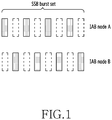
- FIG. 1 shows coordinated SSBs within one SSB burst set for inter-node discovery, according to an embodiment of the disclosure.
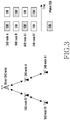
- FIG. 2 shows a muting scheme (across all IAB nodes), according to an embodiment of the disclosure.
- FIG. 3 shows a muting scheme based on hop order, according to an embodiment of the disclosure.
- FIG. 4 shows a further a muting scheme based on hop order, according to an embodiment of the disclosure.
- Embodiments of the disclosure provide several means by which the problems identified in the prior art may be addressed. Details of these follow. In the following, reference is made to solutions 1-A and 1-B to conform to the terminology used in the standardization process.
- solution 1-A the same set of SSBs will be used for both access UEs and inter IAB node discovery.
- a mechanism is needed to make sure that one IAB node can hear from another IAB node subject to half-duplex constraint.
- a muting pattern or scheme is needed and the following two alternatives may be used.
- each SSB burst set there are multiple positions to transmit SSBs.
- the SSB positions are only possible positions. In other words, it is not mandated that an SSB should be transmitted in all the possible locations. Anything from a single SSB up to maximum number of SSBs within one SSB burst set is possible depending on beam sweeping requirements.
- one IAB node A can transmit on one subset of all possible positions and another IAB node B can transmit on another subset, not overlapping with subset of IAB node A as shown in Figure 1 .
- the dashed boxes indicate the muted SSB transmission positions without actual SSB transmission. Both IAB node A and B can use these muted SSBs to listen to each other. This can be done via ssb-PositionsInBurst in SIB1. Different SSB subsets might need to be chosen for different SSB burst set to measure all possible beam directions.
- the scheme shown in Figure 1 where node A transmits on odd positions and node B transmits on even positions, is only exemplary and other muting schemes can be used as required.
- each IAB node needs to choose a subset within one SSB burst set and this can be done either in semi-persistent (via RRC) or dynamic (via download control information (DCI)) manner.
- RRC radio resource control
- DCI download control information
- SSBs which are orthogonal (TDM and/or FDM) with SSBs for access UEs are used for inter IAB node discovery so that there is no impact on access UE.
- each IAB node might need to mute some of its own SSBs to listen to SSBs from other IAB nodes.
- Orthogonal resources for backhaul and access link detection and measurement can be achieved via SSB muting across IAB nodes. During those muted SSBs, IAB nodes can listen to SSBs from other IAB nodes to detect potential candidate backhaul links.
- the first solution is illustrated in Figure 2 (tree and muting).
- the muting is across all IAB nodes no matter which hop they belong to.
- the benefit of such configuration is that one IAB node can always measure all possible backhaul links including both primary and backup ones and it is independent of topology change.
- the scalability of such configuration may be limited since it requires higher signaling overhead, scaling with total number of IAB nodes involved in inter IAB node SSB measurement.
- One IAB node can measure all backup backhaul links via SSBs, irrelevant of hop order. Such a configuration can reduce the signaling overhead since the required number of SSBs is equal to the total number of IAB nodes involved in inter IAB node SSB measurement with in each hop. Therefore, the scalability of this approach is improved compared with the first solution.
- One IAB node might not be able to measure the SSBs from other IAB nodes belonging to a different hop.
- a measurement is not necessarily based on SSBs only but may use other reference signals, e.g., CSI-RS/ ZP CSI-RS, since half-duplex constraint does not limit IAB nodes with hop order N and N+1. Allowing non-overlapping SSBs between different hops as shown in Figure 4 may improve resource allocation flexibility and thus achieve higher resource usage efficiency.
- the configuration of SSBs depends on topology and any topology change might incur re-configuration of SSBs as discussed in the following.
- the configuration of SSBs e.g., number of SSBs within one measurement cycle, depends on the total number of IAB nodes involved in inter-IAB node discovery and measurement. Any topology change does not have an impact on this number.
- the total number of SSBs within one measurement cycle is equal to the maximum number of IAB nodes involved in inter-IAB node discovery and measurement belonging to the same hop so any topology change here has an impact on the configuration of SSBs.
- at least semi-persistent configuration/reconfiguration of SSBs, e.g., via RRC, for inter-IAB node discovery and measurement is supported and dynamic configuration may also be considered, as required.
- the orthogonality can be achieved as follows: TDM only: in such a case, access UE might detect inter-node discovery SSB, which might not include SIB1 information since only signal strength measurement is needed.
- Altl Same SSB transmission timing across all IAB nodes which leads to the same SSB configuration for all IAB nodes without flexibility
- Alt2 Different SSB transmission timing across different IAB nodes so that different configurations can be applied to different IAB nodes but a common SMTC can be configured.
- SSB offset can be defined based on hop order, which can be implicitly derived by IAB nodes.
- TDM + FDM in such a case, access UE does not detect inter-node discovery.
- Embodiments of the disclosure provide different SMTC configuration in certain circumstances.
- a different SMTC orthogonal to access UE SMTC may be configured for IAB nodes to measure the SSBs.
- two SMTCs can be configured and the second one has a different periodicity only.
- this additional SMTC for IAB inter-node discovery, based on the current agreements, the following alternatives can be considered:
- SMTC For idle state, only one SMTC should be configured. However, for inter-node discovery, at least two SMTCs should be configured for both connected and idle state. In this regard, it is necessary to allow two SMTCs to be configured in idle state.
- the SMTC configuration should take the SSB configurations mentioned previously into consideration to enable semi-persistent and dynamic measurement supporting dynamic topology change.
- SMTC configuration needs to support both semi-persistent and dynamic configuration.
- RSRP/RSSI/SINR/RSRQ can be used and reported. Two alternatives can be considered for reporting measurement results:
- the composition of inter IAB node discovery SSB may require modification.
- PBCH Physical Broadcast Channel
- MIB Master Information Block
- PBCH Physical Broadcast Channel
- MIB Master Information Block
- Some of this information might not be needed since discovery SSB is mainly used to measure backup link quality, which can be based on signal strength measurement in terms of RSRP, and there is no need to actually know any further details. Therefore, the size of PBCH within an inter IAB node discovery SSB can be made smaller to reduce signaling overhead.
- the following alternatives can be considered:
- the length of PSS and SSS can be increased so that a lower SINR can be achieved for initial access, which is needed since the distance between IAB nodes is normally larger than that between an IAB node and a UE.
- OOS Out of Synchronization
- the IAB node needs to do synchronization again as if it is accessing the network for the first time, i.e., it follows the stage 1 procedure.
- the SSBs discussed above are for inter-node discovery and measurement. In the following, SSB configuration for IAB node MT initial access is described.
- IAB node MT since IAB node MT has already synchronized with donor 5G base station (gNB) on a LTE carrier via an LTE Primary Cell (PCell) and the NR frequency carrier can be further added via the EN-DC procedure, a longer periodicity for IAB node MT initial access can be assumed to reduce power consumption as well as the signaling overhead and such periodicity can be signaled via the established link on a LTE carrier using e.g., RRC.
- gNB donor 5G base station
- PCell LTE Primary Cell
- RRC Radio Resource Control
- the IAB node MT needs to perform initial access on a NR carrier without any previously established LTE links so that periodicity signaling as in case 1 is impossible, i.e., no assumptions at the network side can be made.
- the IAB node MT needs to assume SSB periodicity for initial access.
- the IAB node MT In order to support Alt2 and Alt3, the IAB node MT needs to know it is IAB node but not a normal access UE. Such information needs to be configured to the IAB nodes even before it is activated and made available once the IAB node is activated. It can be a Boolean indicator with two initial configuration states e.g.: "0" means the current device is access UE device and "1" means the current device is IAB node. With such information, the IAB node MT knows it should assume a different SSB periodicity.
- an access UE assumes the original periodicity, e.g., 20 ms.
- At least some of the example embodiments described herein may be constructed, partially or wholly, using dedicated special-purpose hardware.
- Terms such as 'component', 'module' or 'unit' used herein may include, but are not limited to, a hardware device, such as circuitry in the form of discrete or integrated components, a Field Programmable Gate Array (FPGA) or Application Specific Integrated Circuit (ASIC), which performs certain tasks or provides the associated functionality.
- FPGA Field Programmable Gate Array
- ASIC Application Specific Integrated Circuit
- the described elements may be configured to reside on a tangible, persistent, addressable storage medium and may be configured to execute on one or more processors.
- These functional elements may in some embodiments include, by way of example, components, such as software components, object-oriented software components, class components and task components, processes, functions, attributes, procedures, subroutines, segments of program code, drivers, firmware, microcode, circuitry, data, databases, data structures, tables, arrays, and variables.
- components such as software components, object-oriented software components, class components and task components, processes, functions, attributes, procedures, subroutines, segments of program code, drivers, firmware, microcode, circuitry, data, databases, data structures, tables, arrays, and variables.
- components such as software components, object-oriented software components, class components and task components, processes, functions, attributes, procedures, subroutines, segments of program code, drivers, firmware, microcode, circuitry, data, databases, data structures, tables, arrays, and variables.
Landscapes
- Engineering & Computer Science (AREA)
- Signal Processing (AREA)
- Computer Networks & Wireless Communication (AREA)
- Quality & Reliability (AREA)
- Databases & Information Systems (AREA)
- Mobile Radio Communication Systems (AREA)
Applications Claiming Priority (1)
| Application Number | Priority Date | Filing Date | Title |
|---|---|---|---|
| GB1900380.5A GB2580414A (en) | 2019-01-11 | 2019-01-11 | Improvements in and relating to integrated access and backhaul |
Publications (1)
| Publication Number | Publication Date |
|---|---|
| EP3681214A1 true EP3681214A1 (fr) | 2020-07-15 |
Family
ID=65528072
Family Applications (1)
| Application Number | Title | Priority Date | Filing Date |
|---|---|---|---|
| EP20151484.1A Withdrawn EP3681214A1 (fr) | 2019-01-11 | 2020-01-13 | Procédés et appareil pour la configuration d'un bloc de signal de synchronisation de découverte et de mesure intern de noeuds dans un accès et un réseau de collecte intégrés |
Country Status (6)
| Country | Link |
|---|---|
| US (1) | US20200229115A1 (fr) |
| EP (1) | EP3681214A1 (fr) |
| KR (1) | KR20210104921A (fr) |
| CN (1) | CN111436114A (fr) |
| GB (1) | GB2580414A (fr) |
| WO (1) | WO2020145777A1 (fr) |
Families Citing this family (12)
| Publication number | Priority date | Publication date | Assignee | Title |
|---|---|---|---|---|
| US11711721B2 (en) * | 2019-01-25 | 2023-07-25 | Asustek Computer Inc. | Method and apparatus for triggering uplink buffer status report in a wireless communication system |
| US11974213B2 (en) | 2019-03-11 | 2024-04-30 | Apple Inc. | Inter-relay node discovery and measurements |
| US11751158B2 (en) | 2019-03-26 | 2023-09-05 | Telefonaktiebolaget Lm Ericsson (Publ) | Integrated access backhaul (IAB) nodes with negative propagation delay indication |
| JP7387716B2 (ja) * | 2019-03-28 | 2023-11-28 | 株式会社Nttドコモ | Iabノード、及び、無線通信方法 |
| US12058633B2 (en) * | 2019-05-02 | 2024-08-06 | Sharp Kabushiki Kaisha | Muting of signaling for integrated access and backhaul networks |
| US11206640B2 (en) | 2019-05-22 | 2021-12-21 | At&T Intellectual Property I, L.P. | Private local network access, authentication, and association for 5G or other next generation network |
| WO2021031304A1 (fr) * | 2019-08-16 | 2021-02-25 | 华为技术有限公司 | Procédé et appareil de synchronisation temporelle |
| US11751224B2 (en) * | 2019-08-22 | 2023-09-05 | Qualcomm Incorporated | Synchronization signal block resource selection according to mobility state |
| WO2021151490A1 (fr) * | 2020-01-30 | 2021-08-05 | Nokia Technologies Oy | Système de communication |
| US12004131B2 (en) * | 2021-08-03 | 2024-06-04 | Qualcomm Incorporated | Extension of an evaluation period of integrated access backhaul mobile termination due to communication of the co-located integrated access backhaul distributed unit |
| EP4487636A4 (fr) * | 2022-03-02 | 2025-12-24 | Mediatek Inc | Procédé et appareil pour accéder à des cellules de longue périodicité pour une économie d'énergie de réseau |
| KR20230153614A (ko) * | 2022-04-29 | 2023-11-07 | 삼성전자주식회사 | 무선 통신 시스템의 에너지 세이빙을 위한 방법 및 장치 |
Citations (1)
| Publication number | Priority date | Publication date | Assignee | Title |
|---|---|---|---|---|
| WO2020129228A1 (fr) * | 2018-12-20 | 2020-06-25 | 株式会社Nttドコモ | Nœud sans fil et procédé de communication sans fil |
Family Cites Families (9)
| Publication number | Priority date | Publication date | Assignee | Title |
|---|---|---|---|---|
| KR102476909B1 (ko) * | 2014-11-06 | 2022-12-13 | 삼성전자주식회사 | 비면허 스펙트럼 상에서 lte 셀들의 효율적 동작 |
| US10257078B2 (en) * | 2016-04-01 | 2019-04-09 | Qualcomm Incorporated | Interworking with legacy radio access technologies for connectivity to next generation core network |
| US10206232B2 (en) * | 2016-09-29 | 2019-02-12 | At&T Intellectual Property I, L.P. | Initial access and radio resource management for integrated access and backhaul (IAB) wireless networks |
| US10708028B2 (en) * | 2017-03-08 | 2020-07-07 | Samsung Electronics Co., Ltd. | Method and apparatus for reference signals in wireless system |
| EP3583735B1 (fr) * | 2017-03-23 | 2022-04-27 | Samsung Electronics Co., Ltd. | Procédés et appareils pour la configuration de mesure de différents signaux de référence et mécanisme de rapport de mesure de cellule |
| EP3516905B1 (fr) * | 2017-03-24 | 2020-10-07 | Telefonaktiebolaget LM Ericsson (publ) | Fenêtre de mesure de resélection de cellules dans une nouvelle radio |
| US11122497B2 (en) * | 2017-05-04 | 2021-09-14 | Samsung Electronics Co., Ltd. | Method and apparatus for SS block index and timing indication in wireless systems |
| US11902924B2 (en) * | 2017-06-02 | 2024-02-13 | Qualcomm Incorporated | Methods and apparatus related to link establishment in a wireless backhaul network |
| US10827547B2 (en) * | 2018-05-11 | 2020-11-03 | At&T Intellectual Property I, L.P. | Radio resource configuration and measurements for integrated access backhaul for 5G or other next generation network |
-
2019
- 2019-01-11 GB GB1900380.5A patent/GB2580414A/en not_active Withdrawn
-
2020
- 2020-01-13 KR KR1020217025527A patent/KR20210104921A/ko active Pending
- 2020-01-13 US US16/741,013 patent/US20200229115A1/en not_active Abandoned
- 2020-01-13 EP EP20151484.1A patent/EP3681214A1/fr not_active Withdrawn
- 2020-01-13 CN CN202010033020.4A patent/CN111436114A/zh active Pending
- 2020-01-13 WO PCT/KR2020/000583 patent/WO2020145777A1/fr not_active Ceased
Patent Citations (1)
| Publication number | Priority date | Publication date | Assignee | Title |
|---|---|---|---|---|
| WO2020129228A1 (fr) * | 2018-12-20 | 2020-06-25 | 株式会社Nttドコモ | Nœud sans fil et procédé de communication sans fil |
Non-Patent Citations (2)
| Title |
|---|
| AT&T: "Summary of 7.2.3.1 Enhancements to support NR backhaul links", vol. RAN WG1, no. Spokane, USA; 20181112 - 20181116, 13 November 2018 (2018-11-13), XP051480164, Retrieved from the Internet <URL:http://www.3gpp.org/ftp/tsg%5Fran/WG1%5FRL1/TSGR1%5F95/Docs/R1%2D1813975%2Ezip> [retrieved on 20181113] * |
| SAMSUNG: "Necessary Enhancements for NR IAB", vol. RAN WG1, no. Spokane, USA; 20181112 - 20181116, 2 November 2018 (2018-11-02), XP051479245, Retrieved from the Internet <URL:http://www.3gpp.org/ftp/tsg%5Fran/WG1%5FRL1/TSGR1%5F95/Docs/R1%2D1812981%2Ezip> [retrieved on 20181102] * |
Also Published As
| Publication number | Publication date |
|---|---|
| US20200229115A1 (en) | 2020-07-16 |
| GB201900380D0 (en) | 2019-02-27 |
| KR20210104921A (ko) | 2021-08-25 |
| GB2580414A (en) | 2020-07-22 |
| CN111436114A (zh) | 2020-07-21 |
| WO2020145777A1 (fr) | 2020-07-16 |
Similar Documents
| Publication | Publication Date | Title |
|---|---|---|
| EP3681214A1 (fr) | Procédés et appareil pour la configuration d'un bloc de signal de synchronisation de découverte et de mesure intern de noeuds dans un accès et un réseau de collecte intégrés | |
| US12302363B2 (en) | Integrated access backhaul configuration | |
| US11177869B2 (en) | Method for performing measurement, user equipment and base station | |
| US10348431B2 (en) | Methods of discovery and measurements for small cells in OFDM/OFDMA systems | |
| US10306656B2 (en) | Resource management method and apparatus | |
| KR102688984B1 (ko) | 통신 네트워크에서의 루트 발견 및 그 개선 | |
| CN104365136B (zh) | 发送信道状态信息的方法和用户设备以及接收信道状态信息的方法和基站 | |
| WO2019149072A1 (fr) | Procédé et appareil de configuration de signal synchrone | |
| US11206115B2 (en) | Method and apparatus of managing backhaul(BH) links in integrated access and BH(IAB) | |
| CN103380638A (zh) | 无线小区中的点相关资源符号配置 | |
| CN114788391B (zh) | 不同无线电接入技术之中的物理随机信道资源的共享 | |
| CN110958697A (zh) | 帧结构的配置方法及装置、存储介质 | |
| US9001779B2 (en) | Method for transmitting pilot signal for machine to machine communication in wireless communication system and apparatus thereof | |
| US12284543B2 (en) | Method and device for measuring frequency in 5G communication system | |
| CN111357317B9 (zh) | 用于载波管理的技术和装置 | |
| WO2020143360A1 (fr) | Procédés et dispositifs d'envoi et de réception de signal de synchronisation | |
| US20250167834A1 (en) | Transmission method and apparatus, device, and readable storage medium | |
| US20120099508A1 (en) | Communication Method and System |
Legal Events
| Date | Code | Title | Description |
|---|---|---|---|
| PUAI | Public reference made under article 153(3) epc to a published international application that has entered the european phase |
Free format text: ORIGINAL CODE: 0009012 |
|
| STAA | Information on the status of an ep patent application or granted ep patent |
Free format text: STATUS: REQUEST FOR EXAMINATION WAS MADE |
|
| 17P | Request for examination filed |
Effective date: 20200113 |
|
| AK | Designated contracting states |
Kind code of ref document: A1 Designated state(s): AL AT BE BG CH CY CZ DE DK EE ES FI FR GB GR HR HU IE IS IT LI LT LU LV MC MK MT NL NO PL PT RO RS SE SI SK SM TR |
|
| AX | Request for extension of the european patent |
Extension state: BA ME |
|
| STAA | Information on the status of an ep patent application or granted ep patent |
Free format text: STATUS: EXAMINATION IS IN PROGRESS |
|
| 17Q | First examination report despatched |
Effective date: 20210414 |
|
| STAA | Information on the status of an ep patent application or granted ep patent |
Free format text: STATUS: THE APPLICATION IS DEEMED TO BE WITHDRAWN |
|
| 18D | Application deemed to be withdrawn |
Effective date: 20241213 |