EP3681877B1 - Composé dérivé de pyrazole et son utilisation - Google Patents
Composé dérivé de pyrazole et son utilisation Download PDFInfo
- Publication number
- EP3681877B1 EP3681877B1 EP18856659.0A EP18856659A EP3681877B1 EP 3681877 B1 EP3681877 B1 EP 3681877B1 EP 18856659 A EP18856659 A EP 18856659A EP 3681877 B1 EP3681877 B1 EP 3681877B1
- Authority
- EP
- European Patent Office
- Prior art keywords
- carbonyl
- pyrazole
- group
- aminopiperidine
- benzonitrile
- Prior art date
- Legal status (The legal status is an assumption and is not a legal conclusion. Google has not performed a legal analysis and makes no representation as to the accuracy of the status listed.)
- Active
Links
Classifications
-
- A—HUMAN NECESSITIES
- A61—MEDICAL OR VETERINARY SCIENCE; HYGIENE
- A61K—PREPARATIONS FOR MEDICAL, DENTAL OR TOILETRY PURPOSES
- A61K31/00—Medicinal preparations containing organic active ingredients
- A61K31/33—Heterocyclic compounds
- A61K31/395—Heterocyclic compounds having nitrogen as a ring hetero atom, e.g. guanethidine or rifamycins
- A61K31/435—Heterocyclic compounds having nitrogen as a ring hetero atom, e.g. guanethidine or rifamycins having six-membered rings with one nitrogen as the only ring hetero atom
- A61K31/44—Non condensed pyridines; Hydrogenated derivatives thereof
- A61K31/445—Non condensed piperidines, e.g. piperocaine
- A61K31/4523—Non condensed piperidines, e.g. piperocaine containing further heterocyclic ring systems
- A61K31/454—Non condensed piperidines, e.g. piperocaine containing further heterocyclic ring systems containing a five-membered ring with nitrogen as a ring hetero atom, e.g. pimozide, domperidone
-
- A—HUMAN NECESSITIES
- A61—MEDICAL OR VETERINARY SCIENCE; HYGIENE
- A61K—PREPARATIONS FOR MEDICAL, DENTAL OR TOILETRY PURPOSES
- A61K31/00—Medicinal preparations containing organic active ingredients
- A61K31/33—Heterocyclic compounds
- A61K31/395—Heterocyclic compounds having nitrogen as a ring hetero atom, e.g. guanethidine or rifamycins
- A61K31/435—Heterocyclic compounds having nitrogen as a ring hetero atom, e.g. guanethidine or rifamycins having six-membered rings with one nitrogen as the only ring hetero atom
- A61K31/44—Non condensed pyridines; Hydrogenated derivatives thereof
- A61K31/445—Non condensed piperidines, e.g. piperocaine
- A61K31/4523—Non condensed piperidines, e.g. piperocaine containing further heterocyclic ring systems
- A61K31/4545—Non condensed piperidines, e.g. piperocaine containing further heterocyclic ring systems containing a six-membered ring with nitrogen as a ring hetero atom, e.g. pipamperone, anabasine
-
- A—HUMAN NECESSITIES
- A61—MEDICAL OR VETERINARY SCIENCE; HYGIENE
- A61K—PREPARATIONS FOR MEDICAL, DENTAL OR TOILETRY PURPOSES
- A61K31/00—Medicinal preparations containing organic active ingredients
- A61K31/33—Heterocyclic compounds
- A61K31/395—Heterocyclic compounds having nitrogen as a ring hetero atom, e.g. guanethidine or rifamycins
- A61K31/435—Heterocyclic compounds having nitrogen as a ring hetero atom, e.g. guanethidine or rifamycins having six-membered rings with one nitrogen as the only ring hetero atom
- A61K31/46—8-Azabicyclo [3.2.1] octane; Derivatives thereof, e.g. atropine, cocaine
-
- A—HUMAN NECESSITIES
- A61—MEDICAL OR VETERINARY SCIENCE; HYGIENE
- A61K—PREPARATIONS FOR MEDICAL, DENTAL OR TOILETRY PURPOSES
- A61K9/00—Medicinal preparations characterised by special physical form
-
- C—CHEMISTRY; METALLURGY
- C07—ORGANIC CHEMISTRY
- C07D—HETEROCYCLIC COMPOUNDS
- C07D401/00—Heterocyclic compounds containing two or more hetero rings, having nitrogen atoms as the only ring hetero atoms, at least one ring being a six-membered ring with only one nitrogen atom
- C07D401/02—Heterocyclic compounds containing two or more hetero rings, having nitrogen atoms as the only ring hetero atoms, at least one ring being a six-membered ring with only one nitrogen atom containing two hetero rings
- C07D401/06—Heterocyclic compounds containing two or more hetero rings, having nitrogen atoms as the only ring hetero atoms, at least one ring being a six-membered ring with only one nitrogen atom containing two hetero rings linked by a carbon chain containing only aliphatic carbon atoms
-
- C—CHEMISTRY; METALLURGY
- C07—ORGANIC CHEMISTRY
- C07D—HETEROCYCLIC COMPOUNDS
- C07D401/00—Heterocyclic compounds containing two or more hetero rings, having nitrogen atoms as the only ring hetero atoms, at least one ring being a six-membered ring with only one nitrogen atom
- C07D401/02—Heterocyclic compounds containing two or more hetero rings, having nitrogen atoms as the only ring hetero atoms, at least one ring being a six-membered ring with only one nitrogen atom containing two hetero rings
- C07D401/12—Heterocyclic compounds containing two or more hetero rings, having nitrogen atoms as the only ring hetero atoms, at least one ring being a six-membered ring with only one nitrogen atom containing two hetero rings linked by a chain containing hetero atoms as chain links
-
- C—CHEMISTRY; METALLURGY
- C07—ORGANIC CHEMISTRY
- C07D—HETEROCYCLIC COMPOUNDS
- C07D401/00—Heterocyclic compounds containing two or more hetero rings, having nitrogen atoms as the only ring hetero atoms, at least one ring being a six-membered ring with only one nitrogen atom
- C07D401/14—Heterocyclic compounds containing two or more hetero rings, having nitrogen atoms as the only ring hetero atoms, at least one ring being a six-membered ring with only one nitrogen atom containing three or more hetero rings
-
- C—CHEMISTRY; METALLURGY
- C07—ORGANIC CHEMISTRY
- C07D—HETEROCYCLIC COMPOUNDS
- C07D403/00—Heterocyclic compounds containing two or more hetero rings, having nitrogen atoms as the only ring hetero atoms, not provided for by group C07D401/00
- C07D403/02—Heterocyclic compounds containing two or more hetero rings, having nitrogen atoms as the only ring hetero atoms, not provided for by group C07D401/00 containing two hetero rings
- C07D403/06—Heterocyclic compounds containing two or more hetero rings, having nitrogen atoms as the only ring hetero atoms, not provided for by group C07D401/00 containing two hetero rings linked by a carbon chain containing only aliphatic carbon atoms
-
- C—CHEMISTRY; METALLURGY
- C07—ORGANIC CHEMISTRY
- C07D—HETEROCYCLIC COMPOUNDS
- C07D403/00—Heterocyclic compounds containing two or more hetero rings, having nitrogen atoms as the only ring hetero atoms, not provided for by group C07D401/00
- C07D403/02—Heterocyclic compounds containing two or more hetero rings, having nitrogen atoms as the only ring hetero atoms, not provided for by group C07D401/00 containing two hetero rings
- C07D403/12—Heterocyclic compounds containing two or more hetero rings, having nitrogen atoms as the only ring hetero atoms, not provided for by group C07D401/00 containing two hetero rings linked by a chain containing hetero atoms as chain links
-
- C—CHEMISTRY; METALLURGY
- C07—ORGANIC CHEMISTRY
- C07D—HETEROCYCLIC COMPOUNDS
- C07D405/00—Heterocyclic compounds containing both one or more hetero rings having oxygen atoms as the only ring hetero atoms, and one or more rings having nitrogen as the only ring hetero atom
- C07D405/14—Heterocyclic compounds containing both one or more hetero rings having oxygen atoms as the only ring hetero atoms, and one or more rings having nitrogen as the only ring hetero atom containing three or more hetero rings
-
- C—CHEMISTRY; METALLURGY
- C07—ORGANIC CHEMISTRY
- C07D—HETEROCYCLIC COMPOUNDS
- C07D417/00—Heterocyclic compounds containing two or more hetero rings, at least one ring having nitrogen and sulfur atoms as the only ring hetero atoms, not provided for by group C07D415/00
- C07D417/14—Heterocyclic compounds containing two or more hetero rings, at least one ring having nitrogen and sulfur atoms as the only ring hetero atoms, not provided for by group C07D415/00 containing three or more hetero rings
-
- C—CHEMISTRY; METALLURGY
- C07—ORGANIC CHEMISTRY
- C07D—HETEROCYCLIC COMPOUNDS
- C07D471/00—Heterocyclic compounds containing nitrogen atoms as the only ring hetero atoms in the condensed system, at least one ring being a six-membered ring with one nitrogen atom, not provided for by groups C07D451/00 - C07D463/00
- C07D471/02—Heterocyclic compounds containing nitrogen atoms as the only ring hetero atoms in the condensed system, at least one ring being a six-membered ring with one nitrogen atom, not provided for by groups C07D451/00 - C07D463/00 in which the condensed system contains two hetero rings
- C07D471/04—Ortho-condensed systems
-
- C—CHEMISTRY; METALLURGY
- C07—ORGANIC CHEMISTRY
- C07D—HETEROCYCLIC COMPOUNDS
- C07D471/00—Heterocyclic compounds containing nitrogen atoms as the only ring hetero atoms in the condensed system, at least one ring being a six-membered ring with one nitrogen atom, not provided for by groups C07D451/00 - C07D463/00
- C07D471/02—Heterocyclic compounds containing nitrogen atoms as the only ring hetero atoms in the condensed system, at least one ring being a six-membered ring with one nitrogen atom, not provided for by groups C07D451/00 - C07D463/00 in which the condensed system contains two hetero rings
- C07D471/08—Bridged systems
-
- C—CHEMISTRY; METALLURGY
- C07—ORGANIC CHEMISTRY
- C07D—HETEROCYCLIC COMPOUNDS
- C07D471/00—Heterocyclic compounds containing nitrogen atoms as the only ring hetero atoms in the condensed system, at least one ring being a six-membered ring with one nitrogen atom, not provided for by groups C07D451/00 - C07D463/00
- C07D471/02—Heterocyclic compounds containing nitrogen atoms as the only ring hetero atoms in the condensed system, at least one ring being a six-membered ring with one nitrogen atom, not provided for by groups C07D451/00 - C07D463/00 in which the condensed system contains two hetero rings
- C07D471/10—Spiro-condensed systems
-
- A—HUMAN NECESSITIES
- A61—MEDICAL OR VETERINARY SCIENCE; HYGIENE
- A61K—PREPARATIONS FOR MEDICAL, DENTAL OR TOILETRY PURPOSES
- A61K45/00—Medicinal preparations containing active ingredients not provided for in groups A61K31/00 - A61K41/00
- A61K45/06—Mixtures of active ingredients without chemical characterisation, e.g. antiphlogistics and cardiaca
Definitions
- the present invention relates to a pyrazole derivative compound and a use thereof, and more particularly to a pyrazole derivative compound having an inhibitory activity on lysine-specific histone demethylase-1 (LSD1) and a pharmaceutical composition including the pyrazole derivative compound.
- LSD1 lysine-specific histone demethylase-1
- Cancer stem cells or cancer-initiating cells have some pluripotent stem cell characteristics that contribute to the heterogeneity of cancer cells. This characteristic can make cancer cells more resistant to traditional therapies, such as chemotherapy or radiation therapy, and then cause recurrence after treatment. Therefore, efforts to develop anticancer drugs that are more advanced than conventional chemotherapy or radiation therapy are continuing.
- Epigenetics is a study of a phenomenon that genetic expression pattern and activity are altered, and the genetic expression pattern and activity are succeeded to the next generation without altering the DNA sequence. These epigenetic studies are focused on mechanisms such as DNA methylation, histone modification, and chromatin remodeling. Epigenetic modification has been found to be a major cause of outbreaks of various diseases. It was found that the onset and maintenance of epigenetic modification involve DNA methylation, histone modification, and genetic modifications regarding non-coding RNA (ncRNA), and many epigenetic regulatory genes are often mutated, or the expression of the epigenetic regulatory genes is abnormal in many cancers.
- ncRNA non-coding RNA
- Lysine-specific histone demethylase-1 may remove a methyl group, thus regulating genetic expressions that are important in terms of development of cancer and cell proliferation ( Shi, Y., et al., Histone demethylation mediated by the nuclear amine oxidase homolog LSD1. Cell, 2004. 119(7): p. 941-53 ).
- LSD1 inhibitors studied so far do not exhibit sufficient selective inhibitory activity on LSD1 or have side effects such as showing resistance to drugs or showing toxicity to normal cells, and thus, they cannot be effectively used for the treatment of cancer and neoplastic diseases.
- Non-patent Document 1 Cell, 2004. 119(7): p. 941-53
- An aspect of the present invention provides a novel compound having a sufficient inhibitory activity on lysine-specific histone demethylase-1 (LSD1).
- Another aspect of the present invention provides a pharmaceutical composition for preventing or treating a disease caused by abnormal activation of LSD1, said composition comprising this novel compound.
- references in the description to methods of treatment refer to the compounds, pharmaceutical compositions and medicaments of the present invention for use in a method for treatment of the human (or animal) body by therapy (or for diagnosis).
- the present invention relates to a compound either selected from Compounds 1) to 4), 7), 14) to 57), 76), 77) and 85) to 112) disclosed hereafter or represented by Formula 4, an optical isomer, a solvate, or a tautomer, or a pharmaceutically acceptable salt thereof:
- the present invention also relates to a pharmaceutical composition for preventing or treating a disease caused by abnormal activation of lysine-specific demethylase-1 (LSD1), the pharmaceutical composition including: the compound mentioned above, an optical isomer, a solvate, a tautomer, or a pharmaceutically acceptable salt thereof as an active ingredient; and a pharmaceutically acceptable carrier.
- LSD1 lysine-specific demethylase-1
- the present invention still also relates to a method of treating a disease caused by abnormal activation of LSD1, the method including administering to a subject a therapeutically effective amount of the compound mentioned above, an optical isomer, a solvate, or a tautomer, or a pharmaceutically acceptable salt thereof.
- an optical isomer, a solvate, or a tautomer, or a pharmaceutically acceptable salt thereof may suppress activity of LSD1.
- alkyl refers to, for example, a straight-chained or branched hydrocarbon having 1 to 20 carbon atoms (C 1 -C 20 ). Examples of the alkyl include methyl, ethyl, n-propyl, i-propyl, n-butyl, i-butyl, and t-butyl, but embodiments are not limited thereto.
- alkoxy refers to -O-alkyl.
- alkylthio as used herein refers to -S- alkyl.
- alkenyl include vinyl, 2-propenyl, and 2-butenyl, but embodiments are not limited thereto.
- alkynyl include ethynyl, 2-propynyl, and 2-butynyl, but embodiments are not limited thereto.
- halogen refers to fluorine, chlorine, bromine, or iodine.
- alkylamino refers to amino bound to moiety of a mother molecule via alkyl.
- the alkylamino include groups of compounds in which nitrogen of -NH 2 is bound to at least one alkyl, e.g., a C 1 -C 15 alkyl having 1 to 15 carbon atoms.
- alkylamino include benzylamino, methylamino, ethylamino, and phenethylamino.
- dialkylamino refers to groups in which nitrogen of -NH 2 is bound to at least two additional alkyls. Examples of the dialkylamino include dimethylamino and diethylamino.
- C 1 -C 4 alkylhydroxy refers to C 1 to C 4 hydroxy alkyl.
- C 3 -C 30 carbocyclic group refers to a monocyclic group, a bicyclic group, or a polycyclic group having carbon atoms only as ring-forming atoms and 3 to 30 carbon atoms.
- the C 3 -C 30 carbocyclic group may be an aromatic carbocyclic group or a non-aromatic carbocyclic group.
- the C 3 -C 30 carbocyclic group may be a ring such as benzene, a monovalent group such as phenyl, or a divalent group such as phenylene.
- the C 3 -C 30 carbocyclic group may be a trivalent group or a quadrivalent group.
- the C 3 -C 20 carbocyclic group may be an aromatic or non-aromatic, saturated or unsaturated C 2 to C 20 hydrocarbon.
- carbocyclic group examples include cyclopropane, cyclobutane, cyclopentane, cyclopentene, cyclohexane, cyclohexene, bicyclo[2.1.1]hexane, bicyclo[2.2.1]heptane, bicyclo[2.2.1]heptene, bicyclo[3.1.1]heptane, bicyclo[3.1.1]heptyl, bicyclo[2.2.2]octane, adamantane, benzene, pyridine, pyridazine, pyrimidine, pyrazine, pyrrole, pyrazole, indole, pyrazolopyridine, pyrrolopyridine, benzimidazole, benzopyrazole, benzothiophene, quinoline, benzothiazole, indazole, benzofuran, benzodioxin, benzopyran, indane, naphthalene, and an
- heterocyclic group refers to a group having substantially the same structure as the C 3 -C 30 carbocyclic group, except that at least one heteroatom selected from N, O, P, and S is used as a ring-forming atom, in addition to carbon atoms (e.g., 1 to 30 carbon atoms).
- Examples thereof include pyridinyl, pyridazinyl, pyrimidinyl, pyrazinyl, pyrrolyl, pyrazolyl, indolyl, pyrazolopyridinyl, benzimidazolyl, benzopyrazolyl, benzothiophenyl, benzofuranyl, benzodioxinyl, benzopyranyl, pyrrolopyridinyl, quinolinyl, benzothiazolyl, and indazolyl.
- Examples of the monocyclic heterocyclic group include piperidinyl, pyrrolidinyl, piperazinyl, azepinyl, pyrrolyl, pyrazolyl, oxetanyl, pyrazolinyl, imidazolyl, imidazolinyl, imidazolidinyl, triazolyl, oxazolyl, oxazolidinyl, isoxazolinyl, isoxazolyl, thiazolyl, thiadiazolyl, thiazolidinyl, isothiazolyl, isothiazolidinyl, furyl, tetrahydrofuryl, thienyl, oxadiazolyl, 2-oxopiperazinyl, 2-oxopiperidinyl, 2-oxopyrrolodinyl, 2-oxoazepinyl, 4-piperidonyl, pyridyl, pyridyl N-oxide,
- bicyclic heterocyclic group examples include diazaspiro-nonanyl (e.g., diazaspiro[3.5]nonanyl), diazaspiro-decanyl) (e.g., diazaspiro[4.5]decanyl), azabicyclo-heptanyl, azabicyclo-octanyl, diazabicyclo-nonanyl (e.g., diazabicyclo[3.3.1]nonanyl), diazabicyclo-decanyl, octahydro-1 H pyrrolo[2,3-c]pyridinyl, indolyl, dihydroindolyl, benzothiazolyl, benzoxazinyl, benzoxazolyl, benzothienyl, benzothiazinyl, quinuclidinyl, quinolinyl, tetrahydroquinolinyl, decahydroquinolinyl, isoquinolinyl,
- tricyclic heterocyclic group examples include carbazolyl, dibenzoazepinyl, dithienoazepinyl, benzindolyl, phenanthrolinyl, acridinyl, phenanthridinyl, phenoxazinyl, phenothiazinyl, xanthenyl, and carbolynyl.
- cycloalkyl refers to a monovalent saturated hydrocarbon ring system having 3 to 20 carbon atoms (e.g., C 3 -C 12 ).
- cycloalkyl examples include cyclopropyl, cyclobutyl, cyclopentyl, cyclohexyl, cycloheptyl, and cyclooctyl.
- cycloalkoxy refers to -O-cycloalkyl.
- cycloalkenyl refers to a monovalent non-aromatic hydrocarbon ring system having 3 to 20 carbon atoms (for example, C 3 -C 12 ) and at least one double bond.
- the cycloalkenyl include cyclopentenyl, cyclohexenyl, and cycloheptenyl.
- heterocycloalkyl refers to a 3- to 20-membered monovalent unsaturated hydrocarbon ring system having at least one heteroatom (e.g., O, N, or S).
- the heterocycloalkyl may be a 5- to 8-membered monocyclic system, an 8- to 12-membered dicyclic system, or an 11- to 14-membered tricyclic system.
- heterocycloalkyl group include piperazinyl, a pyrrolidinyl, dioxanyl, morpholinyl, and tetrahydrofuranyl, but embodiments are not limited thereto.
- heterocycloalkenyl refers to a 3- to 20-membered monovalent unsaturated hydrocarbon ring system having at least one heteroatom (e.g., O, N, or S) and at least one double bond.
- the heterocycloalkenyl may be a non-aromatic 5- to 8-membered monocyclic system, a non-aromatic 8- to 12-membered dicyclic system, or a non-aromatic 11- to 14-membered tricyclic system.
- aryl refers to, for example, a C 6 -C 20 monovalent aromatic hydrocarbon having 6 to 20 carbon atoms derived by removing one hydrogen atom attached to one carbon atom in a mother aromatic ring system.
- the aryl may include a dicyclic radical including an aromatic ring fused with a partially unsaturated ring or saturated ring.
- examples of the aryl include a radical derived from benzene (phenyl), substituted benzene, naphthalene, anthracene, biphenyl, indenyl, indanyl, 1 ,2-dihydronaphthalene, and 1 ,2,3,4-tetrahydronaphthyl.
- aryloxy refers to -O- aryl.
- arylthio refers to -S- aryl.
- heteroaryl refers to, for example, a monovalent aromatic hydrocarbon having 5 to 30 atoms including at least one heteroatom selected from N, O, and S and at least one carbon atom (for example, C 1 -C 20 ).
- heteroaryloxy refers to -O-.
- heteroarylthio refers to S-heteroaryl.
- the heteroaryl may include a fused ring system of, e.g., 5-, 6-, or 7-membered ring (at least one of which is aromatic).
- heteroaryl examples include monocyclic or bicyclic aryl, e.g., pyrrolyl, pyrazolyl, imidazolyl, triazolyl, oxazolyl, isoxazolyl, thiazolyl, tetrazole, isothiazolyl, furyl, thienyl, 2-pyridyl, 3-pyridyl, 4-pyridyl, pyridyl N-oxide, pyrazinyl, pyrimidinyl, pyridazinyl, indolyl, benzothiazolyl, benzoxazolyl, benzothienyl, quinolinyl, isoquinolinyl, benzimidazolyl, and benzofuryl.
- pyrrolyl pyrazolyl
- imidazolyl triazolyl
- oxazolyl isoxazolyl
- thiazolyl tetrazole
- the "carbocyclic, heterocyclic, alkyl, alkoxy, alkenyl, alkynyl, cycloalkyl, cycloalkoxy, cycloalkenyl, heterocycloalkyl, heterocycloalkenyl, aryl, aryloxy, arylthio, heteroaryl, heteroaryloxy, heteroarylthio, and amine" may each independently substituted with at least one substituent described herein.
- A indicates the number of carbon atoms in a substituted or unsubstituted hydrocarbon or the number of carbon atoms of a substituent in a substituted hydrocarbon.
- the number of carbon atoms including the substituted substituents of the substituted C 3 -C 20 carbocyclic group, the substituted C 1 -C 20 heterocyclic group, the substituted C 1 -C 20 alkyl, the substituted C 1 -C 20 alkoxy, the substituted C 2 -C 20 alkenyl, substituted C 2 -C 20 alkynyl, the substituted C 3 -C 20 cycloalkyl, the substituted C 3 -C 20 cycloalkoxy, the substituted C 3 -C 20 cycloalkenyl, the substituted C 1 -C 20 heterocycloalkyl, the substituted C 1 -C 20 heterocycloalkenyl, the substituted C 6 -C 20 aryl, the substituted C
- the substituent may be selected from halogen, a cyano group, a hydroxyl group, a thiol group, a nitro group, an amino group, an oxo group, a substituted or unsubstituted C 1 -C 10 alkyl group, a substituted or unsubstituted C 2 -C 10 alkenyl group, a substituted or unsubstituted C 2 -C 10 alkynyl group, a substituted or unsubstituted C 3 -C 10 carbocyclic group, a substituted or unsubstituted C 1 -C 10 heterocyclic group, a substituted or unsubstituted C 1 -C 10 alkoxy group, a substituted or unsubstituted C 3 -C 10 cycloalkoxy group, a substituted or unsubstituted C 1 -C 10 alkylthio group, a substituted or unsubstituted C 6 -C 10
- a substituent of the substituted C 1 -C 10 alkyl group, the substituted C 2 -C 10 alkenyl group, the substituted C 2 -C 10 alkynyl group, the substituted C 3 -C 10 carbocyclic group, the substituted C 1 -C 10 heterocyclic group, the substituted C 1 -C 10 alkoxy group, the substituted C 3 -C 10 cycloalkoxy group, the substituted C 1 -C 10 alkylthio group, the substituted C 6 -C 10 aryloxy group, the substituted C 6 -C 10 arylthio group, the substituted C 1 -C 10 heteroaryloxy group, the substituted C 1 -C 10 heteroarylthio group, the substituted C 6 -C 10 aryl group, or the substituted C 1 -C 10 heteroaryl group may be at least one selected from:
- a substituent of the substituted C 1 -C 10 alkyl group, the substituted C 2 -C 10 alkenyl group, the substituted C 2 -C 10 alkynyl group, the substituted C 3 -C 10 carbocyclic group, the substituted C 1 -C 10 heterocyclic group, the substituted C 1 -C 10 alkoxy group, the substituted C 3 -C 10 cycloalkoxy group, the substituted C 1 -C 10 alkylthio group, the substituted C 6 -C 10 aryloxy group, the substituted C 6 -C 10 arylthio group, the substituted C 1 -C 10 heteroaryloxy group, the substituted C 1 -C 10 heteroarylthio group, the substituted C 1 -C 10 alkylamino group, the substituted C 1 -C 10 dialkylamino group, the substituted C 6 -C 10 aryl group, and the substituted C 1 -C 10 heteroaryl group may be at least one selected from
- the present inventors have made intensive efforts to develop a new anticancer drug by using lysine-specific demethylase-1 (LSD1) as a key target for cancer therapy.
- LSD1 lysine-specific demethylase-1
- In Formula 1, may be a C 3 -C 30 carbocyclic group or a C 1 -C 30 heterocyclic group.
- R 2 (s) may be one selected from hydrogen, halogen, a cyano group, a hydroxyl group, a thiol group, a nitro group, a substituted or unsubstituted C 1 -C 15 alkyl group, a substituted or unsubstituted C 2 -C 15 alkenyl group, a substituted or unsubstituted C 2 -C 15 alkynyl group, a substituted or unsubstituted C 3 -C 15 carbocyclic group, a substituted or unsubstituted C 1 -C 15 heterocyclic group, a substituted or unsubstituted C 1 -C 15 alkoxy group, a substituted or unsubstituted C 3 -C 15 cycloalkoxy group, a substituted or unsubstituted C 1 -C 15 alkylthio group, a substituted or unsubstituted C 6 -C 15 aryloxy group,
- R 3 and R 4 may each independently be one selected from hydrogen, halogen, a substituted or unsubstituted C 1 -C 15 alkyl group, a substituted or unsubstituted C 3 -C 15 carbocyclic group, a substituted or unsubstituted C 1 -C 15 heterocyclic group, a substituted or unsubstituted C 1 -C 15 alkoxy group, a substituted or unsubstituted C 3 -C 15 cycloalkoxy group, a substituted or unsubstituted C 1 -C 15 alkylthio group, a substituted or unsubstituted C 6 -C 15 aryloxy group, a substituted or unsubstituted C 6 -C 15 arylthio group, a substituted or unsubstituted C 1 -C 15 heteroaryloxy group, a substituted or unsubstituted C 1 -C 15 heteroarylthio group, a
- R 3 and R 4 may be bound to each other to form a substituted or unsubstituted C 1 -C 30 heterocyclic group with amide nitrogen of Formula 1, and for example, the substituted or unsubstituted C 1 -C 30 heterocyclic group may be one selected from a piperidinyl group, a pyrrolidinyl group, a piperazinyl group, an azepinyl group, a diazaspiro-nonanyl group, a diazaspiro-decanyl group, an azabicyclo-heptanyl group, an azabicyclo-octanyl group, a diazabicyclo-nonanyl group, and a diazabicyclo-decanyl group.
- At least one substituent of the substituted or unsubstituted C 1 -C 30 heterocyclic group formed by binding of R 3 and R 4 with the amide nitrogen of Formula 1 may be selected from:
- R 2 when is a phenyl group or a pyridinyl group, and m is an integer from 1 to 5, at least one selected from R 2 (s) may be selected from a hydroxyl group, a thiol group, a substituted or unsubstituted C 2 -C 10 alkenyl group, a substituted or unsubstituted C 2 -C 10 alkynyl group, a substituted or unsubstituted C 3 -C 10 carbocyclic group, a substituted or unsubstituted C 1 -C 10 heterocyclic group, a substituted or unsubstituted C 3 -C 10 cycloalkoxy group, a substituted or unsubstituted C 6 -C 10 aryloxy group, a substituted or unsubstituted C 6 -C 10 arylthio group, a substituted or unsubstituted C 1 -C 10 heteroaryloxy group, a substituted or un
- At least one substituent of the substituted C 2 -C 10 alkenyl group, the substituted C 2 -C 10 alkynyl group, the substituted C 3 -C 10 carbocyclic group, the substituted C 1 -C 10 heterocyclic group, the substituted C 3 -C 10 cycloalkoxy group, the substituted C 1 -C 10 alkylthio group, the substituted C 6 -C 10 aryloxy group, the substituted C 6 -C 10 arylthio group, the substituted C 1 -C 10 heteroaryloxy group, the substituted C 1 -C 10 heteroarylthio group, the substituted C 6 -C 10 aryl group, and the substituted C 1 -C 10 heteroaryl group may be selected from: a C 2 -C 10 alkenyl group, a C 2 -C 10 alkynyl group, a C 3 -C 10 cycloalkyl group, a C 1 -C 10 heterocycloalkyl
- In Formula 1, may be a phenyl group or a pyridinyl group
- R 2 (s) may each independently be selected from halogen, a C 1 -C 6 alkyl group, a C 1 -C 6 alkoxy group, a C 1 -C 6 alkylamino group, a C 1 -C 6 alkylthio group, a substituted or unsubstituted C 3 -C 6 cycloalkyl group, a substituted or unsubstituted N -linked pyrrolidinyl group, a substituted or unsubstituted N -linked piperidinyl group, and a substituted or unsubstituted N -linked azetidinyl group,
- R 3 and R 4 in the compound represented by Formula 1 may be bound to form a compound represented by Formula 2 (also not part of the present invention).
- Formula 2 may be a C 1 -C 30 heterocyclic group including a nitrogen atom
- the C 1 -C 30 heterocyclic group including a nitrogen atom may be one selected from a piperidinyl group, a pyrrolidinyl group, a piperazinyl group, an azepinyl group, diazaspiro-nonanyl group, a diazaspiro-decanyl group, an azabicyclo heptanyl group, an azabicyclo-octanyl group, a diazabicyclo-nonanyl group, and a diazabicyclo-decanyl group, each unsubstituted or substituted with at least one substituent described herein.
- R 1 , R 2 , k, and m may be defined the same as those in Formula 1.
- n may be an integer from 0 to 6; when n is 2 or greater, at least two R 6 (s) may be identical to or different from each other, and R 6 (s) may each independently be selected from hydrogen, halogen, a cyano group, a hydroxyl group, a thiol group, a nitro group, a substituted or unsubstituted C 1 -C 15 alkyl group, a substituted or unsubstituted C 2 -C 15 alkenyl group, a substituted or unsubstituted C 2 -C 15 alkynyl group, a substituted or unsubstituted C 3 -C 15 carbocyclic group, a substituted or unsubstituted C 1 -C 15 heterocyclic group, a substituted or unsubstituted C 1 -C 20 alkoxy group, a substituted or
- At least one substituent of the substituted C 1 -C 15 alkyl group, the substituted C 2 -C 15 alkenyl group, the substituted C 2 -C 15 alkynyl group, the substituted C 3 -C 15 cycloalkyl group, the substituted C 1 -C 15 heterocycloalkyl group, the substituted C 1 -C 15 alkoxy group, the substituted C 3 -C 15 cycloalkoxy group, the substituted C 1 -C 15 alkylthio group, the substituted C 6 -C 15 aryloxy group, and the substituted C 6 -C 15 arylthio group may be selected from halogen, a cyano group, a hydroxyl group, a thiol group, a nitro group, a C 1 -C 15 alkyl group, a C 2 -C 15 alkenyl group, a C 2 -C 15 alkynyl group, a C 3 -C 15 cycloalky
- R 1 , R 2 , k, and m may each be defined the same as those in Formula 1, and and n may each be defined the same as those in Formula 2.
- r may be an integer from 0 to 6; when r is 2 or greater, at least two R 6 '(s) may be identical to or different from each other, and R 6 '(s) may be defined the same as R 6 (s) in Formula 2.
- R 7 may each independently be selected from hydrogen, halogen, a hydroxyl group, a substituted or unsubstituted C 1 -C 15 alkyl group, a substituted or unsubstituted C 1 -C 15 alkoxy group, a substituted or unsubstituted C 3 -C 15 carbocyclic group, and a substituted or unsubstituted C 1 -C 15 heterocyclic group
- R 8 and R 9 may each independently be selected from hydrogen, halogen, a substituted or unsubstituted C 1 -C 15 alkyl group, a substituted or unsubstituted C 1 -C 15 alkoxy group, a substituted or unsubstituted C 3 -C 15 carbocyclic group, and a substituted or unsubstituted C 1 -C 15 heterocyclic group.
- X may be C(R 5 )
- R 5 may be selected from hydrogen, halogen, a hydroxyl group, a substituted or unsubstituted C 1 -C 4 alkyl group, and a substituted or unsubstituted C 1 -C 4 alkoxy group
- R 2 (s) may be one selected from hydrogen, halogen, a cyano group, a hydroxyl group, a thiol group, a nitro group, a substituted or unsubstituted C 1 -C 15 alkyl group, a substituted or unsubstituted C 2 -C 15 alkenyl group, a substituted or unsubstitute
- the present invention relates to a compound either selected from Compounds 1) to 4), 7), 14) to 57), 76), 77) and 85) to 112) disclosed hereafter or represented by Formula 4, an optical isomer, a solvate, or a tautomer, or a pharmaceutically acceptable salt thereof: wherein, in Formula 4,
- examples of the compound according to the invention are described below. Also, the scope of the present invention may include an optical isomer or a tautomer, a solvate, or a pharmaceutically acceptable salt of the following compounds:
- examples of the compound represented by Formula 4 include Compounds 5), 6), 8) to 13), 58) to 75), and 78) to 84) and an optical isomer, a solvate, a tautomer, or a pharmaceutically acceptable salt thereof.
- the present invention also relates to a pharmaceutical composition for preventing or treating a disease caused by abnormal activation of lysine-specific demethylase-1 (LSD1), the pharmaceutical composition including: the compounds according to the present invention and namely those represented by Formula 4, an optical isomer, a solvate, a tautomer, or a pharmaceutically acceptable salt thereof as an active ingredient; and a pharmaceutically acceptable carrier.
- LSD1 lysine-specific demethylase-1
- isomers refers to different compounds having the same molecular formula but differing in the arrangement and coordination of atoms and includes structural isomers and stereoisomers.
- structural isomer refers to a compound having the same molecular formula but having different arrangement order of atoms.
- tautomer is one of the structural isomers, which refers to a compound that interconverts both isomers and whose structure changes.
- stereoisomer refers to any of various stereoisomeric coordination which may exist for a compound of the present disclosure and includes geometric isomers and optical isomers.
- diastereomer as used to refer to stereoisomers that have at least two asymmetric atoms and are not mirror images of one another.
- geometric isomer refers to isomers in which a spatial position of an atom or a functional group linked to a carbon atom of a double bond in a planar structure having a double bond between carbon atoms is different.
- optical isomer refers to any of various stereoisomeric coordination which may exist for a compound of the present disclosure and includes geometric isomers. Since the compounds of Formulae 1 to 4 of the present disclosure may have an asymmetric carbon center (asymmetric carbon), they may be in form of an enantiomer (R or S isomer), racemate, diastereomer, or any mixture thereof. All these isomers of the compounds of the present invention and mixtures thereof are included within the scope of the present invention.
- enantiomer refers to a pair of stereoisomers that are mirror images of each other and non-superimposable. A pair of enantiomers at a mixing ratio of 1:1 is referred to as “racemic " mixture.
- solvate may include a molecular complex including the compound and at least one pharmaceutically acceptable solvent molecule, e.g., ethanol or water.
- salts refers to a salt that retains biological effectiveness and properties of the according to the present disclosure and is not biologically or otherwise undesirable.
- the salt may include non-toxic inorganic and organic base addition salt or acid addition salt, but embodiments are not limited thereto.
- the pharmaceutical composition may be used in combination with a pharmaceutically acceptable additional drug.
- the pharmaceutical composition formulated in a pharmaceutically acceptable form including a tablet, a pill, powder, a capsule, syrup, emulsion, and microemulsion.
- LSD1 which may be involved in histone modification that is important, is an enzyme that plays a key role from a viewpoint of epigenetics regarding transcription regulation mechanism.
- LSD1 includes an N-terminal SWIRM domain (Swi3p, Rsc8p, and Moira), two types of transcription variants of LSD1 may be present result from selective splicing, and LSD1 have the structural similarity and amino acids uniformity/homogeneity with polyamine oxidases and monoamine oxidase (MAO).
- LSD1 demethylates H3K4, suppress transcription, and demethylates H3K9 for activation of gene expression of a nuclear hormone receptor complex (e.g., androgen receptor) at the same time. This suggests that LSD1 may regulate alternative gene expression in a situation-dependent manner, as the substrate specificity of LSD1 is determined by related factors.
- a nuclear hormone receptor complex e.g., androgen receptor
- hypoxia induced factor-1 (HIF-1) protein which is known as promoting cancer occurrence metastasis in such a low oxygen environment, may be regulated depending on methylation by LSD1.
- LSD1 may also be involved in activation of some proteins such as E2F, STAT3, Tat, and myosin phosphatase target subset 1 (MYPT1), which are not histones, such as p53 and DNMT1, which play an important role in cancer. This suggests a tumorigenesis mechanism due to LSD1 problem in regulating chromatin remodeling.
- LSD1 may increase activity of another epigenetic regulator, e.g.
- LSD1 DNA methyltransferase 1 (DNMT1) and histone deacetylase (HDAC) complexes. LSD1 may also contribute to various biological processes, including cell proliferation, epithelial mesenchymal transition (EMT), and stem cell biology (embryonic stem and cancer stem cell) or self-renewal and somatic cell transformation.
- EMT epithelial mesenchymal transition
- stem cell biology embryonic stem and cancer stem cell
- LSD1 contributes to tumorigenesis by altering epigenetic markers on histone and non-histone proteins, abnormal activation of LSD1 may cause various cancers.
- LSD1 since LSD1 contributes to tumorigenesis by altering epigenetic markers on histone and non-histone proteins, LSD1 suppressing activity may normalize gene expression, thereby inducing differentiation program to become a mature cell type, reducing cell proliferation, and promoting apoptosis of cancer cells.
- the compounds of the present invention may be used in preventing or treating various diseases caused by abnormal activation of LSD1.
- the pharmaceutical composition includes a pharmaceutically acceptable carrier.
- the pharmaceutical composition of the present invention may be formulated according to a conventional method and may be formulated into various oral dosage forms such as a tablet, a pill, powder, a capsule, syrup, emulsion, and microemulsion; or parenteral dosage forms such as intramuscular, intravenous or subcutaneous administration.
- an additive or a carrier to be used examples include cellulose, calcium silicate, maize starch, lactose, sucrose, dextrose, calcium phosphate, stearic acid, magnesium stearate, gelatin, talc, a surfactant, a suspension, an emulsifier, and a diluent.
- examples of an additive or a carrier may include water, saline solution, aqueous glucose solution, pseudosaccharide solution, alcohol, glycol, ether (e.g., polyethylene glycol 400), oil, fatty acid, fatty acid ester, glyceride, a surfactant, a suspension, and an emulsifier.
- the dose of the pharmaceutical composition as an active ingredient is an effective amount for treating or preventing a subject or a patient.
- the compound may be administered orally or parenterally, as desired.
- the active ingredient may be administered in an amount in a range of 0.01 milligrams (mg) to 1,000 mg, more particularly, 0.1 mg to 300 mg, per kilogram (kg) of body weight per day.
- the active ingredient may be administered from one to several times in an amount in a range of 0.01 mg to 100 mg, more particularly, 0.1 mg to 50 mg, per kg of body weight per day.
- the dose for a particular subject or patient should be determined in light of the patient's weight, age, sex, health condition, diet, time of administration, method of administration, severity of disease, etc. It is to be understood that the dose may be appropriately adjusted by a practitioner. The dose is not intended to limit the scope of the present invention in any way.
- the present invention also relates to a method of treating a disease caused by abnormal activation of LSD1, the method including administering to a subject a pharmaceutical composition comprising a therapeutically effective amount of the compounds of the present invention, an optical isomer, a solvate, or a tautomer, or a pharmaceutically acceptable salt thereof.
- the dose used in the method of preventing or treating is an amount effective in treatment or prevention of a subject or a patient.
- the dose of the pharmaceutical composition may be applied without any change.
- treating refers to inhibiting a disease, for example, inhibiting a disease, condition, or disorder in a subject that has experienced or exhibited pathology or a symptom of the disease, condition, or disorder.
- the term “treating” or “treatment” refers to preventing additional occurrence of pathology and/or symptom or improving a disease, for example, improving a disease, condition, or disorder in a subject that has experienced or exhibited pathology or a symptom of the disease, condition, or disorder.
- the term “treating” or “treatment” refers to relieving pathology and/or symptom, e.g. reducing disease severity.
- preventing refers to prevention of a disease, for example, prevention of a disease, condition, or disorder in a subject that may be predisposed to the disease, condition, or disorder but has not yet experienced or exhibited pathology or a symptom of the disease.
- subject or “patient” as used herein refers to any animal, including mammals, for example, mice, rats, other rodents, rabbits, dogs, cats, pigs, cows, sheep, horses, or primates and humans.
- Synthesis of a pyrazole derivative according to the present disclosure may be performed using an intermediate prepared in Reaction Scheme 1 or Reaction Scheme 2 or using an intermediate commercially available in the market. Mass analysis of the obtained pyrazole derivative was performed by using MicroMass ZQ TM available from Waters.
- a pharmaceutical composition including as active ingredient the compounds represented by Formulae 1 to 4 synthesized according to the preparation method, an optical isomer, a solvate, a tautomer, or a pharmaceutically acceptable salt thereof may be used in prevention and treatment of a disease that may be treated by regulation of LSD1.
- a method of preparing the compounds represented by Formulae 1 to 4 may be shown as Reaction Schemes 1 and 2. wherein, in Reaction Scheme 1, R 1 , R 2 , k, and m may be the same as those defined in Formula 1.
- an amine-protecting group may be butoxycarbonyl (Boc), benzyloxycarbonyl (Cbz), 9-fluorenylmethoxycarbonyl (Fmoc), acetyl, benzoyl, or tosyl.
- the compounds represented by Formulae 1, 3, and 4 were also obtained in a similar manner as the preparation of the compound represented by Formula 2.
- the synthetic method of the compounds represented by Formulae 1 to 4 is not limited to the method described herein.
- One of ordinary skill in the art of organic chemistry may prepare these compounds using various methods known in the art.
- specific reaction conditions such as an amount of a reaction solvent, a base, and a reactant to be used, are not limited to those described in the present specification, and may not be construed as limiting the scope of the present invention.
- a desired compound was obtained in substantially the same manner as in Example 1, except that tert- butyl (R) -methyl(piperidine-3-yl)carbamate was used instead of tert -butyl (R) -piperidine-3-ylcarbamate in Step 3) of Example 1.
- a desired compound was obtained in substantially the same manner as in Example 1, except that (4-cyclopropyl-2-fluorophenyl)hydrazine hydrochloride was used instead of (4-cyclopropylphenyl)hydrazine hydrochloride in Step 1) of Example 1.
- a desired compound was obtained in substantially the same manner as in Example 1, except that (4-cyclopropyl-2-fluorophenyl)hydrazine hydrochloride was used instead of (4-cyclopropylphenyl)hydrazine hydrochloride in Step 1) of Example 1, and tert -butyl (R) -methyl(piperidine-3-yl)carbamate was used instead of tert -butyl (R) -piperidine-3-ylcarbamate in Step 3) of Example 1.
- a desired compound was obtained in substantially the same manner as in Example 1, except that ethyl (Z) -4-(4-cyano-3-fluorophenyl)-2-hydroxy-4-oxo-2-butenoate was used instead of ethyl (Z) -4-(4-cyanophenyl)-2-hydroxy-4-oxo-2-butenoate, and (4-cyclopropyl-2-fluorophenyl)hydrazine hydrochloride was used instead of (4-cyclopropylphenyl)hydrazine hydrochloride in Step 1) of Example 1.
- a desired compound was obtained in substantially the same manner as in Example 1, except that ethyl (Z) -4-(4-cyano-3-fluorophenyl)-2-hydroxy-4-oxobut-2-enolate was used instead of ethyl (Z) -4-(4-cyanophenyl)-2-hydroxy-4-oxobut-2-enolate, and (4-cyclopropyl-2-fluorophenyl)hydrazine hydrochloride was used instead of (4-cyclopropylphenyl)hydrazine hydrochloride in Step 1) of Example 1, and tert -butyl (R) -methyl(piperidine-3-yl)carbamate was used instead of tert-butyl (R)- piperidine-3-ylcarbamate in Step 3) of Example 1.
- a desired compound was obtained in substantially the same manner as in Example 1, except that tert -butyl (R) -azepane-3-ylcarbamate was used instead of tert -butyl (R) -piperidine-3-ylcarbamate in Step 3) of Example 1.
- a desired compound was obtained in substantially the same manner as in Example 1, except that ethyl ( Z )-4-(4-cyano-3-fluorophenyl)-2-hydroxy-4-oxobut-2-enolate was used instead of ethyl ( Z )-4-(4-cyanophenyl)-2-hydroxy-4-oxobut-2-enolate, and (4-cyclopropyl-2-fluorophenyl)hydrazine hydrochloride was used instead of 4-cyclopropylphenylhydrazine hydrochloride in Step 1) of Example 1, and tert -butyl (R) -azepane-3-yl carbamate was used instead of tert -butyl (R) -piperidine-3-ylcarbamate in Step 3) of Example 1.
- a desired compound was obtained in substantially the same manner as in Example 1, except that (4-cyclopropyl-2-fluorophenyl)hydrazine hydrochloride was used instead of (4-cyclopropylphenyl)hydrazine hydrochloride, and ethyl (Z) -4-(4-cyano-3-fluorophenyl)-2-hydroxy-4-oxobut-2-enolate was used instead of ethyl (Z)- 4-(4-cyanophenyl)-2-hydroxy-4-oxobut-2-enolate in Step 1) of Example 1, and tert- butyl ( (3R,5R )-5-methylpiperidine-3-yl)carbamate was used instead of tert -butyl (R)- piperidine-3-ylcarbamate in Step 3) of Example 1.
- a desired compound was obtained in substantially the same manner as in Example 1, except that (4-cyclopropyl-2,6-difluorophenyl)hydrazine hydrochloride was used instead of (4-cyclopropylphenyl)hydrazine hydrochloride, and ethyl (Z) -4-(4-cyano-3-fluorophenyl)-2-hydroxy-4-oxobut-2-enolate was used instead of ethyl (Z) -4-(4-cyanophenyl)-2-hydroxy-4-oxobut-2-enolate in Step 1) of Example 1.
- a desired compound was obtained in substantially the same manner as in Example 1, except that (4-cyclopropyl-2,6-difluorophenyl)hydrazine hydrochloride was used instead of (4-cyclopropylphenyl)hydrazine hydrochloride, and ethyl (Z) -4-(4-cyano-3-fluorophenyl)-2-hydroxy-4-oxobut-2-enolate was used instead of ethyl (Z) -4-(4-cyanophenyl)-2-hydroxy-4-oxobut-2-enolate in Step 1) of Example 1, and tert -butyl (R) -azepane-3-yl carbamate was used instead of tert -butyl (R) -piperidine-3-ylcarbamate in Step 3) of Example 1.
- a desired compound was obtained in substantially the same manner as in Example 1, except that (2-chloro-4-cyclopropylphenyl)hydrazine hydrochloride was used instead of (4-cyclopropylphenyl)hydrazine hydrochloride, and ethyl (Z) -4-(4-cyano-3-fluorophenyl)-2-hydroxy-4-oxobut-2-enolate was used instead of ethyl (Z)- 4-(4-cyanophenyl)-2-hydroxy-4-oxobut-2-enolate in Step 1) of Example 1.
- a desired compound was obtained in substantially the same manner as in Example 1, except that (2-chloro-4-cyclopropylphenyl)hydrazine hydrochloride was used instead of (4-cyclopropylphenyl)hydrazine hydrochloride, and ethyl (Z) -4-(4-cyano-3-fluorophenyl)-2-hydroxy-4-oxobut-2-enolate was used instead of ethyl (Z)- 4-(4-cyanophenyl)-2-hydroxy-4-oxobut-2-enolate in Step 1) of Example 1, and tert- butyl (R)- azepane-3-ylcarbamate was used instead of tert -butyl (R) -piperidine-3-ylcarbamate in Step 3) of Example 1.
- a desired compound was obtained in substantially the same manner as in Example 1, except that phenylhydrazine hydrochloride was used instead of (4-cyclopropylphenyl)hydrazine hydrochloride in Step 1) of Example 1.
- a desired compound was obtained in substantially the same manner as in Example 1, except that 2-hydrazinopyridine hydrochloride was used instead of (4-cyclopropylphenyl)hydrazine hydrochloride in Step 1) of Example 1.
- a desired compound was obtained in substantially the same manner as in Example 1, except that (4-fluorophenyl)hydrazine hydrochloride was used instead of (4-cyclopropylphenyl)hydrazine hydrochloride in Step 1) of Example 1.
- a desired compound was obtained in substantially the same manner as in Example 1, except that (4-chlorophenyl)hydrazine hydrochloride was used instead of (4-cyclopropylphenyl)hydrazine hydrochloride in Step 1) of Example 1.
- a desired compound was obtained in substantially the same manner as in Example 1, except that (4-chlorophenyl)hydrazine hydrochloride was used instead of 4-cyclopropylphenylhydrazine hydrochloride in Step 1) of Example 1, and tert- butyl (R) -methyl(piperidine-3-yl)carbamate was used instead of tert-butyl (R)- piperidine-3-ylcarbamate in Step 3) of Example 1.
- a desired compound was obtained in substantially the same manner as in Example 1, except that (3-chlorophenyl)hydrazine hydrochloride was used instead of (4-cyclopropylphenyl)hydrazine hydrochloride in Step 1) of Example 1.
- a desired compound was obtained in substantially the same manner as in Example 1, except that (4-bromophenyl)hydrazine hydrochloride was used instead of (4-cyclopropylphenyl)hydrazine hydrochloride in Step 1) of Example 1.
- a desired compound was obtained in substantially the same manner as in Example 1, except that (4-bromophenyl)hydrazine hydrochloride was used instead of (4-cyclopropylphenyl)hydrazine hydrochloride in Step 1) of Example 1, and tert- butyl (R) -methyl(piperidine-3-yl)carbamate was used instead of tert-butyl (R)- piperidine-3-ylcarbamate in Step 3) of Example 1.
- a desired compound was obtained in substantially the same manner as in Example 1, except that p-tolylhydrazine hydrochloride was used instead of (4-cyclopropylphenyl)hydrazine hydrochloride in Step 1) of Example 1, and tert -butyl (S) -pyrrolidine-3-ylcarbamate was used instead of tert -butyl (R) -piperidine-3-ylcarbamate in Step 3) of Example 1.
- a desired compound was obtained in substantially the same manner as in Example 1, except that p -tolylhydrazine hydrochloride was used instead of (4-cyclopropylphenyl)hydrazine hydrochloride in Step 1) of Example 1, and tert -butyl (S)-pyrrolidine-3-ylcarbamate was used instead of tert -butyl (R) -piperidine-3-ylcarbamate in Step 3) of Example 1.
- a desired compound was obtained in substantially the same manner as in Example 1, except that tert- butyl (S) -(1-(5-(4-cyanophenyl)-1-( p -tolyl)-1 H -pyrazole-3-carbonyl)pyrrolidine-3-yl)carbamate was used instead of tert -butyl (R) -(1-(5-(4-cyanophenyl)-1-(4-cyclopropylphenyl)-1 H -pyrazole-3-carbonyl)piperidine-3-yl)carbamate in Step 4) of Example 1.
- a desired compound was obtained in substantially the same manner as in Example 1, except that p -tolylhydrazine hydrochloride was used instead of (4-cyclopropylphenyl)hydrazine hydrochloride in Step 1) of Example 1, and (R)-N,N- dimethylpyrrolidine-3-amine was used instead of tert -butyl (R) -piperidine-3-ylcarbamate in Step 3) of Example 1.
- a desired compound was obtained in substantially the same manner as in Example 1, except that p -tolylhydrazine hydrochloride was used instead of (4-cyclopropylphenyl)hydrazine hydrochloride in Step 1) of Example 1, and tert -butyl (R) -methyl(pyrrolidine-3-yl)carbamate was used instead of tert -butyl (R) -piperidine-3-ylcarbamate in Step 3) of Example 1.
- a desired compound was obtained in substantially the same manner as in Example 1, except that p -tolylhydrazine hydrochloride was used instead of (4-cyclopropylphenyl)hydrazine hydrochloride in Step 1) of Example 1, and tert -butyl (R) -pyrrolidine-3-ylcarbamate was used instead of tert -butyl (R) -piperidine-3-ylcarbamate in Step 3) of Example 1.
- a desired compound was obtained in substantially the same manner as in Example 1, except that p -tolylhydrazine hydrochloride was used instead of (4-cyclopropylphenyl)hydrazine hydrochloride in Step 1) of Example 1.
- a desired compound was obtained in substantially the same manner as in Example 1, except that p -tolylhydrazine hydrochloride was used instead of (4-cyclopropylphenyl)hydrazine hydrochloride in Step 1) of Example 1, and tert- butyl( R )-methyl(piperidine-3-yl)carbamate was used instead of tert -butyl (R)- piperidine-3-ylcarbamate in Step 3) of Example 1.
- a desired compound was obtained in substantially the same manner as in Example 1, except that p -tolylhydrazine hydrochloride was used instead of (4-cyclopropylphenyl)hydrazine hydrochloride in Step 1) of Example 1, and N,N- dimethyl (R) -piperidine-3-ylcarbamate was used instead of tert -butyl (R)- piperidine-3-ylcarbamate in Step 3) of Example 1.
- a desired compound was obtained in substantially the same manner as in Example 1, except that m -tolylhydrazine hydrochloride was used instead of (4-cyclopropylphenyl)hydrazine hydrochloride in Step 1) of Example 1.
- a desired compound was obtained in substantially the same manner as in Example 1, except that o-tolylhydrazine hydrochloride was used instead of (4-cyclopropylphenyl)hydrazine hydrochloride in Step 1) of Example 1.
- a desired compound was obtained in substantially the same manner as in Example 1, except that (4-ethylphenyl)hydrazine hydrochloride was used instead of (4-cyclopropylphenyl)hydrazine hydrochloride in Step 1) of Example 1.
- a desired compound was obtained in substantially the same manner as in Example 1, except that (4-ethylphenyl)hydrazine hydrochloride was used instead of (4-cyclopropylphenyl)hydrazine hydrochloride in Step 1) of Example 1, and tert -butyl (R) -methyl(piperidine-3-yl)carbamate was used instead of tert -butyl (R) -piperidine-3-ylcarbamate in Step 3) of Example 1.
- a desired compound was obtained in substantially the same manner as in Example 1, except that (4-isopropylphenyl)hydrazine hydrochloride was used instead of (4-cyclopropylphenyl)hydrazine hydrochloride in Step 1) of Example 1.
- a desired compound was obtained in substantially the same manner as in Example 1, except that (4-isopropylphenyl)hydrazine hydrochloride was used instead of (4-cyclopropylphenyl)hydrazine hydrochloride in Step 1) of Example 1, and tert- butyl (R) -methyl(piperidine-3-yl)carbamate was used instead of tert -butyl (R) -piperidine-3-ylcarbamate in Step 3) of Example 1.
- a desired compound was obtained in substantially the same manner as in Example 1, except that (2-fluoro-4-isopropylphenyl)hydrazine hydrochloride was used instead of (4-cyclopropylphenyl)hydrazine hydrochloride in Step 1) of Example 1.
- a desired compound was obtained in substantially the same manner as in Example 1, except that (2-fluoro-4-isopropylphenyl)hydrazine hydrochloride was used instead of (4-cyclopropylphenyl)hydrazine hydrochloride, and (Z) -4-(4-cyano-3-fluorophenyl)-2-hydroxy-4-oxobut-2-enolate was used instead of ethyl (Z) -4-(4-cyanophenyl)-2-hydroxy-4-oxobut-2-enolate in Step 1) of Example 1.
- a desired compound was obtained in substantially the same manner as in Example 1, except that (2-fluoro-4-isopropylphenyl)hydrazine hydrochloride was used instead of (4-cyclopropylphenyl)hydrazine hydrochloride, and (Z) -4-(4-cyano-3-fluorophenyl)-2-hydroxy-4-oxobut-2-enolate was used instead of ethyl (Z) -4-(4-cyanophenyl)-2-hydroxy-4-oxobut-2-enolate in Step 1) of Example 1, and tert -butyl (R) -azepane-3-ylcarbamate was used instead of tert -butyl (R) -piperidine-3-ylcarbamate in Step 3) of Example 1.
- a desired compound was obtained in substantially the same manner as in Example 1, except that (4-( tert -butyl)phenyl)hydrazine hydrochloride was used instead of (4-cyclopropylphenyl)hydrazine hydrochloride in Step 1) of Example 1.
- a desired compound was obtained in substantially the same manner as in Example 1, except that (4-( tert -butyl)phenyl)hydrazine hydrochloride was used instead of 4-cyclopropylphenylhydrazine hydrochloride in Step 1) of Example 1, and tert- butyl (R) -methyl(piperidine-3-yl)carbamate was used instead of tert-butyl (R)- piperidine-3-ylcarbamate in Step 3) of Example 1.
- a desired compound was obtained in substantially the same manner as in Example 1, except that (4-( tert -butyl)-2-fluorophenyl)hydrazine hydrochloride was used instead of (4-cyclopropylphenyl)hydrazine hydrochloride in Step 1) of Example 1.
- a desired compound was obtained in substantially the same manner as in Example 1, except that (4-( tert -butyl-2-fluorophenyl)hydrazine hydrochloride was used instead of 4-cyclopropylphenylhydrazine hydrochloride, and ethyl ( Z )-4-(4-cyano-3-fluorophenyl)-2-hydroxy-4-oxobut-2-enolate was used instead of ethyl ( Z )-4-(4-cyanophenyl)-2-hydroxy-4-oxo-2-butenoate in Step 1) of Example 1.
- a desired compound was obtained in substantially the same manner as in Example 1, except that (4-( tert -butyl-2-fluorophenyl)hydrazine hydrochloride was used instead of 4-cyclopropylphenylhydrazine hydrochloride, and ethyl (Z) -4-(4-cyano-3-fluorophenyl)-2-hydroxy-4-oxobut-2-enolate was used instead of ethyl (Z)- 4-(4-cyanophenyl)-2-hydroxy-4-oxo-2-butenoate in Step 1) of Example 1, and tert- butyl (R) -azepane-3-yl carbamate was used instead of tert -butyl (R) -piperidine-3-ylcarbamate in Step 3) of Example 1.
- a desired compound was obtained in substantially the same manner as in Example 1, except that (4-(trifluoromethoxy)phenyl)hydrazine hydrochloride was used instead of (4-cyclopropylphenyl)hydrazine hydrochloride in Step 1) of Example 1.
- a desired compound was obtained in substantially the same manner as in Example 1, except that (4-(methylsulfonyl)phenyl)hydrazine hydrochloride was used instead of (4-cyclopropylphenyl)hydrazine hydrochloride in Step 1) of Example 1.
- a desired compound was obtained in substantially the same manner as in Example 1, except that (4-(trifluoromethyl)phenyl)hydrazine hydrochloride was used instead of (4-cyclopropylphenyl)hydrazine hydrochloride in Step 1) of Example 1.
- a desired compound was obtained in substantially the same manner as in Example 1, except that 2-fluoro4-methylphenyl)hydrazine hydrochloride was used instead of (4-cyclopropylphenyl)hydrazine hydrochloride in Step 1) of Example 1.
- a desired compound was obtained in substantially the same manner as in Example 1, except that (3-fluoro-4-methoxyphenyl)hydrazine hydrochloride was used instead of (4-cyclopropylphenyl)hydrazine hydrochloride in Step 1) of Example 1.
- a desired compound was obtained in substantially the same manner as in Example 1, except that (4-hydrazinylbenzonitrile)hydrazine hydrochloride was used instead of (4-cyclopropylphenyl)hydrazine hydrochloride in Step 1) of Example 1.
- a desired compound was obtained in substantially the same manner as in Step 1) of Example 1, except that 4-iodophenylhydrazine hydrochloride was used instead of (4-cyclopropylphenyl)hydrazine hydrochloride in Step 1) of Example 1.
- a desired compound was obtained in substantially the same manner as in Example 1, except that, using ethyl 5-(4-cyanophenyl)-1-(4-(dimethylamino)phenyl)- 1H -pyrazole-3-carboxylate prepared in Step 2), tert -butyl (R) -methyl(piperidine-3-yl)carbamate was used instead of tert -butyl (R) -piperidine-3-ylcarbamate in Step 3) of Example 1.
- a desired compound was obtained in substantially the same manner as in Example 51, except that N1,N1,N2 -trimethylethane-1,2-diamine was used instead of dimethylamine hydrochloride in Step 2) of Example 51, and tert- butyl (R)- piperidine-3-ylcarbamate was used instead of tert -butyl (R) -methyl(piperidine-3-yl)carbamate in Step 3) of Example 51.
- a desired compound was obtained in substantially the same manner as in Example 46, except that tert -butyl (R) -piperidine-3-ylcarbamate was used instead of tert -butyl (R) -methyl(piperidine-3-yl)carbamate in Step 3) of Example 51.
- a desired compound was obtained in substantially the same manner as in Example 51, except that (2-fluoro-4-iodophenyl)hydrazine hydrochloride was used instead of 4-iodophenylhydrazine hydrochloride in Step 1) of Example 51, and tert- butyl (R) -piperidine-3-ylcarbamate was used instead of tert -butyl (R)- methyl(piperidine-3-yl)carbamate in Step 3 of Example 51.
- a desired compound was obtained in substantially the same manner as in Example 51, except that (2-fluoro-4-iodophenyl)hydrazine hydrochloride was used instead of 4-iodophenylhydrazine hydrochloride in Step 1) of Example 51, diethylamine was used instead of dimethylamine hydrochloride in Step 2) of Example 51, and tert -butyl (R) -piperidine-3-ylcarbamate was used instead of tert- butyl (R) -methyl(piperidine-3-yl)carbamate in Step 3) of Example 51.
- a desired compound was obtained in substantially the same manner as in Example 51, except that (2-fluoro-4-iodophenyl)hydrazine hydrochloride was used instead of 4-iodophenylhydrazine hydrochloride in Step 1) of Example 51, azetidine was used instead of dimethylamine hydrochloride in Step 2) of Example 51, and tert -butyl (R) -piperidine-3-ylcarbamate was used instead of tert-butyl (R)- methyl(piperidine-3-yl)carbamate in Step 3) of Example 51.
- a desired compound was obtained in substantially the same manner as in Example 51, except that (2-fluoro-4-iodophenyl)hydrazine hydrochloride was used instead of 4-iodophenylhydrazine hydrochloride in Step 1) of Example 51, pyrrolidine was used instead of dimethylamine hydrochloride in Step 2) of Example 51, and tert -butyl (R) -piperidine-3-ylcarbamate was used instead of tert-butyl (R)- methyl(piperidine-3-yl)carbamate in Step 3) of Example 51.
- a desired compound was obtained in substantially the same manner as in Example 51, except that (2-fluoro-4-iodophenyl)hydrazine hydrochloride was used instead of 4-iodophenylhydrazine hydrochloride, and ethyl ( Z )-4-(4-cyano-3-fluorophenyl)-2-hydroxy-4-oxobut-2-enolate was used instead of ethyl (Z)- 4-(4-cyanophenyl)-2-hydroxy-4-oxobut-2-enolate in Step 1) of Example 51, pyrrolidine was used instead of dimethylamine hydrochloride in Step 2) of Example 51, and tert -butyl (R) -piperidine-3-ylcarbamate was used instead of tert -butyl (R)-methyl(piperidine-3-yl)carbamate in Step 3) of Example 51.
- a desired compound was obtained in substantially the same manner as in Example 51, except that (2-fluoro-4-iodophenyl)hydrazine hydrochloride was used instead of 4-iodophenylhydrazine hydrochloride, and ethyl (Z) -4-(4-cyano-3-fluorophenyl)-2-hydroxy-4-oxobut-2-enolate was used instead of ethyl (Z) -4-(4-cyanophenyl)-2-hydroxy-4-oxobut-2-enolate in Step 1) of Example 51, and pyrrolidine was used instead of dimethylamine hydrochloride in Step 2) of Example 51.
- a desired compound was obtained in substantially the same manner as in Example 51, except that (2-fluoro-4-iodophenyl)hydrazine hydrochloride was used instead of 4-iodophenylhydrazine hydrochloride, and ethyl (Z) -4-(4-cyano-3-fluorophenyl)-2-hydroxy-4-oxobut-2-enolate was used instead of ethyl (Z) -4-(4-cyanophenyl)-2-hydroxy-4-oxobut-2-enolate in Step 1) of Example 51, pyrrolidine was used instead of dimethylamine hydrochloride in Step 2) of Example 51, and tert -butyl (R) -azepane-3-ylcabamateyl was used instead of tert -butyl (R)-methyl(piperidine-3-yl)carbamate in Step 3) of Example 51.
- a desired compound was obtained in substantially the same manner as in Example 51, except that (2-fluoro-4-iodophenyl)hydrazine hydrochloride was used instead of 4-iodophenylhydrazine hydrochloride, and ethyl (Z)- 4-(4-cyano-3-fluorophenyl)-2-hydroxy-4-oxobut-2-enolate was used instead of ethyl (Z) -4-(4-cyanophenyl)-2-hydroxy-4-oxobut-2-enolate in Step 1) of Example 51, (R) -3-fluoropyrrolidine was used instead of dimethylamine hydrochloride in Step 2) of Example 51, and tert -butyl (R) -piperidine-3-ylcarbamate was used instead of tert- butyl (R )-methyl(piperidine-3-yl)carbamate in Step 3) of Example 51.
- a desired compound was obtained in substantially the same manner as in Example 51, except that (2-fluoro-4-iodophenyl)hydrazine hydrochloride was used instead of 4-iodophenylhydrazine hydrochloride, and ethyl (Z) -4-(4-cyano-3-fluorophenyl)-2-hydroxy-4-oxobut-2-enolate was used instead of ethyl (Z) -4-(4-cyanophenyl)-2-hydroxy-4-oxobut-2-enolate in Step 1) of Example 51, (S) -3-fluoropyrrolidine was used instead of dimethylamine hydrochloride in Step 2) of Example 51, and tert -butyl (R) -piperidine-3-ylcarbamate was used instead of tert- butyl (R) -methyl(piperidine-3-yl)carbamate in Step 3) of Example 51.
- a desired compound was obtained in substantially the same manner as in Example 51, except that (2-fluoro-4-iodophenyl)hydrazine hydrochloride was used instead of 4-iodophenylhydrazine hydrochloride, and ethyl (Z) -4-(4-cyano-3-fluorophenyl)-2-hydroxy-4-oxobut-2-enolate was used instead of ethyl (Z) -4-(4-cyanophenyl)-2-hydroxy-4-oxobut-2-enolate in Step 1) of Example 51, 3,3-difluoropyrrolidine hydrochloride was used instead of dimethylamine hydrochloride in Step 2) of Example 51, and tert -butyl (R) -piperidine-3-ylcarbamate was used instead of tert -butyl (R)-methyl(piperidine-3-yl)carbamate in Step 3) of Example 51.
- a desired compound was obtained in substantially the same manner as in Example 51, except that (2-fluoro-4-iodophenyl)hydrazine hydrochloride was used instead of 4-iodophenylhydrazine hydrochloride, and ethyl ( Z )-4-(4-cyano-3-fluorophenyl)-2-hydroxy-4-oxobut-2-enolate was used instead of ethyl (Z) -4-(4-cyanophenyl)-2-hydroxy-4-oxobut-2-enolate in Step 1) of Example 51, and 3,3,-difluoropyrrolidine was used instead of dimethylamine hydrochloride in Step 2) of Example 51.
- a desired compound was obtained in substantially the same manner as in Example 51, except that (2-fluoro-4-iodophenyl)hydrazine hydrochloride was used instead of 4-iodophenylhydrazine hydrochloride, and ethyl (Z) -4-(4-cyano-3-fluorophenyl)-2-hydroxy-4-oxobut-2-enolate was used instead of ethyl (Z) -4-(4-cyanophenyl)-2-hydroxy-4-oxobut-2-enolate in Step 1) of Example 51, methoxypyrrolidine was used instead of dimethylamine hydrochloride in Step 2) of Example 51, and tert -butyl (R) -piperidine-3-ylcarbamate was used instead of tert- butyl (R)-methyl(piperidine-3-yl)carbamate in Step 3) of Example 51.
- a desired compound was obtained in substantially the same manner as in Example 51, except that (2-fluoro-4-iodophenyl)hydrazine hydrochloride was used instead of 4-iodophenylhydrazine hydrochloride, and ethyl (Z) -4-(4-cyano-3-fluorophenyl)-2-hydroxy-4-oxobut-2-enolate was used instead of ethyl (Z) -4-(4-cyanophenyl)-2-hydroxy-4-oxobut-2-enolate in Step 1) of Example 51, and methoxypyrrolidine was used instead of dimethylamine hydrochloride in Step 2) of Example 51.
- a desired compound was obtained in substantially the same manner as in Example 51, except that (2-fluoro-4-iodophenyl)hydrazine hydrochloride was used instead of 4-iodophenylhydrazine hydrochloride, and ethyl (Z) -4-(4-cyano-3-fluorophenyl)-2-hydroxy-4-oxobut-2-enolate was used instead of ethyl (Z) -4-(4-cyanophenyl)-2-hydroxy-4-oxobut-2-enolate in Step 1) of Example 51, (S) -3-methoxypyrolidine hydrochloride was used instead of dimethylamine hydrochloride in Step 2) of Example 51, and tert -butyl (R) -piperidine-3-ylcarbamate was used instead of tert -butyl (R)-methyl(piperidine-3-yl)carbamate in Step 3) of Example 51.
- a desired compound was obtained in substantially the same manner as in Example 51, except that (2-fluoro-4-iodophenyl)hydrazine hydrochloride was used instead of 4-iodophenylhydrazine hydrochloride, and ethyl (Z) -4-(4-cyano-3-fluorophenyl)-2-hydroxy-4-oxobut-2-enolate was used instead of ethyl (Z) -4-(4-cyanophenyl)-2-hydroxy-4-oxobut-2-enolate in Step 1) of Example 51, and (S) -3-methoxypyrrolidine hydrochloride was used instead of dimethylamine hydrochloride in Step 2) of Example 51.
- a desired compound was obtained in substantially the same manner as in Example 51, except that (2-fluoro-4-iodophenyl)hydrazine hydrochloride was used instead of 4-iodophenylhydrazine hydrochloride, and ethyl (Z) -4-(4-cyano-3-fluorophenyl)-2-hydroxy-4-oxobut-2-enolate was used instead of ethyl (Z) -4-(4-cyanophenyl)-2-hydroxy-4-oxobut-2-enolate in Step 1) of Example 51, (R) -3-methoxypyrolidine hydrochloride was used instead of dimethylamine hydrochloride in Step 2) of Example 51, and tert -butyl (R) -piperidine-3-ylcarbamate was used instead of tert -butyl (R)-methyl(piperidine-3-yl)carbamate in Step 3) of Example 51.
- a desired compound was obtained in substantially the same manner as in Example 51, except that (2-fluoro-4-iodophenyl)hydrazine hydrochloride was used instead of 4-iodophenylhydrazine hydrochloride, and ethyl (Z) -4-(4-cyano-3-fluorophenyl)-2-hydroxy-4-oxobut-2-enolate was used instead of ethyl (Z) -4-(4-cyanophenyl)-2-hydroxy-4-oxobut-2-enolate in Step 1) of Example 51, and (R) -3-methoxypyrrolidine hydrochloride was used instead of dimethylamine hydrochloride in Step 2) of Example 51.
- a desired compound was obtained in substantially the same manner as in Example 51, except that (2-fluoro-4-iodophenyl)hydrazine hydrochloride was used instead of 4-iodophenylhydrazine hydrochloride, and ethyl (Z) -4-(4-cyano-3-fluorophenyl)-2-hydroxy-4-oxobut-2-enolate was used instead of ethyl (Z)- 4-(4-cyanophenyl)-2-hydroxy-4-oxobut-2-enolate in Step 1) of Example 51, and (S)-3-ethoxypyrrolidine hydrochloride was used instead of dimethylamine hydrochloride in Step 2) of Example 51.
- Example 72 Preparation of 4-(3-( (R) -3-aminopiperidine-1-carbonyl)-1-(2-fluoro-4-(3-hydroxypyrrolidine-1-yl)phenyl)-1 H -pyrazole-5-yl)-2-fluorobenzonitrile
- a desired compound was obtained in substantially the same manner as in Example 51, except that (2-fluoro-4-iodophenyl)hydrazine hydrochloride was used instead of 4-iodophenylhydrazine hydrochloride, ethyl (Z) -4-(4-cyano-3-fluorophenyl)-2-hydroxy-4-oxobut-2-enolate was used instead of ethyl (Z) -4-(4-cyanophenyl)-2-hydroxy-4-oxobut-2-enolate in Step 1) of Example 51, 3-hydroxypyrrolidine was used instead of dimethylamine hydrochloride in Step 2) of Example 51, and tert -butyl (R) -piperidine-3-ylcarbamate was used instead of tert- butyl (R) -methyl(piperidine-3-yl)carbamate in Step 3) of Example 51.
- a desired compound was obtained in substantially the same manner as in Example 51, except that (2-fluoro-4-iodophenyl)hydrazine hydrochloride was used instead of 4-iodophenylhydrazine hydrochloride, and ethyl (Z) -4-(4-cyano-3-fluorophenyl)-2-hydroxy-4-oxobut-2-enolate was used instead of ethyl (Z) -4-(4-cyanophenyl)-2-hydroxy-4-oxobut-2-enolate in Step 1) of Example 51, and (S) -3-chloropyrrolidine hydrochloride was used instead of dimethylamine hydrochloride in Step 2) of Example 51.
- a desired compound was obtained in substantially the same manner as in Example 51, except that (2,6-difluoro-4-iodophenyl)hydrazine hydrochloride was used instead of 4-iodophenylhydrazine hydrochloride, ethyl (Z) -4-(4-cyano-3-fluorophenyl)-2-hydroxy-4-oxobut-2-enolate was used instead of ethyl (Z) -4-(4-cyanophenyl)-2-hydroxy-4-oxobut-2-enolate in Step 1) of Example 51, pyrrolidine was used instead of dimethylamine hydrochloride in Step 2) of Example 51, and tert -butyl (R) -piperidine-3-ylcarbamate was used instead of tert-butyl (R)- methyl(piperidine-3-yl)carbamate in Step 3) of Example 51.
- a desired compound was obtained in substantially the same manner as in Example 51, except that (2-chloro-4-iodophenyl)hydrazine hydrochloride was used instead of 4-iodophenylhydrazine hydrochloride, and ethyl (Z) -4-(4-cyano-3-fluorophenyl)-2-hydroxy-4-oxobut-2-enolate was used instead of ethyl (Z) -4-(4-cyanophenyl)-2-hydroxy-4-oxobut-2-enolate in Step 1) of Example 51, pyrrolidine was used instead of dimethylamine hydrochloride in Step 2) of Example 51, and tert -butyl (R) -piperidine-3-ylcarbamate was used instead of tert -butyl (R)-methyl(piperidine-3-yl)carbamate in Step 3) of Example 51.
- a desired compound was obtained in substantially the same manner as in Example 51, except that (4-bromo-2-methoxyphenyl)hydrazine hydrochloride was used instead of 4-iodophenylhydrazine hydrochloride, ethyl (Z) -4-(4-cyano-3-fluorophenyl)-2-hydroxy-4-oxobut-2-enolate was used instead of ethyl (Z) -4-(4-cyanophenyl)-2-hydroxy-4-oxobut-2-enolate in Step 1) of Example 51, pyrrolidine was used instead of dimethylamine hydrochloride in Step 2) of Example 51, and tert -butyl (R)- piperidine-3-ylcarbamate was used instead of tert-butyl (R)- methyl(piperidine-3-yl)carbamate in Step 3) of Example 51.
- a desired compound was obtained in substantially the same manner as in Example 51, except that (2-fluoro-4-iodophenyl)hydrazine hydrochloride was used instead of 4-iodophenylhydrazine hydrochloride in Step 1) of Example 51, piperidine was used instead of dimethylamine hydrochloride in Step 2) of Example 51, and tert -butyl (R) -piperidine-3-ylcarbamate was used instead of tert- butyl (R)- methyl(piperidine-3-yl)carbamate in Step 3) of Example 51.
- a desired compound was obtained in substantially the same manner as in Example 51, except that (2-fluoro-4-iodophenyl)hydrazine hydrochloride was used instead of 4-iodophenylhydrazine hydrochloride, ethyl (Z) -4-(4-cyano-3-fluorophenyl)-2-hydroxy-4-oxobut-2-enolate was used instead of ethyl (Z) -4-(4-cyanophenyl)-2-hydroxy-4-oxobut-2-enolate in Step 1) of Example 51, piperidine was used instead of dimethylamine hydrochloride in Step 2) of Example 51, and tert -butyl (R) -piperidine-3-ylcarbamate was used instead of tert-butyl (R)- methyl(piperidine-3-yl)carbamate in Step 3) of Example 51.
- a desired compound was obtained in substantially the same manner as in Example 51, except that (2-fluoro-4-iodophenyl)hydrazine hydrochloride was used instead of 4-iodophenylhydrazine hydrochloride, and ethyl (Z) -4-(4-cyano-3-fluorophenyl)-2-hydroxy-4-oxobut-2-enolate was used instead of ethyl (Z) -4-(4-cyanophenyl)-2-hydroxy-4-oxobut-2-enolate in Step 1) of Example 51, and piperidine was used instead of dimethylamine hydrochloride in Step 2) of Example 51.
- Example 80 Preparation of 4-(3-( (R) -3-aminopiperidine-1-carbonyl)-1-(2-fluoro-4-(3-methylpiperidine-1-yl)phenyl)-1 H -pyrazole-5-yl)-2-fluorobenzonitrile
- a desired compound was obtained in substantially the same manner as in Example 51, except that (2-fluoro-4-iodophenyl)hydrazine hydrochloride was used instead of 4-iodophenylhydrazine hydrochloride, and ethyl ( Z )-4-(4-cyano-3-fluorophenyl)-2-hydroxy-4-oxobut-2-enolate was used instead of ethyl (Z) -4-(4-cyanophenyl)-2-hydroxy-4-oxobut-2-enolate in Step 1) of Example 51, and 3-methylpiperidine was used instead of dimethylamine hydrochloride in Step 2) of Example 51.
- a desired compound was obtained in substantially the same manner as in Example 51, except that (2-fluoro-4-iodophenyl)hydrazine hydrochloride was used instead of 4-iodophenylhydrazine hydrochloride, and ethyl (Z)- 4-(4-cyano-3-fluorophenyl)-2-hydroxy-4-oxobut-2-enolate was used instead of ethyl (Z) -4-(4-cyanophenyl)-2-hydroxy-4-oxobut-2-enolate in Step 1) of Example 51, and 4-methylpiperidine was used instead of dimethylamine hydrochloride in Step 2) of Example 51.
- Example 82 Preparation of 4-(3-( (R) -3-aminopiperidine-1-carbonyl)-1-(4-(3,5-dimethylpiperidine-1-yl)-2-fluorophenyl)-1 H -pyrazole-5-yl)-2-fluorobenzonitrile
- a desired compound was obtained in substantially the same manner as in Example 51, except that (2-fluoro-4-iodophenyl)hydrazine hydrochloride was used instead of 4-iodophenylhydrazine hydrochloride, and ethyl (Z) -4-(4-cyano-3-fluorophenyl)-2-hydroxy-4-oxobut-2-enolate was used instead of ethyl (Z)- 4-(4-cyanophenyl)-2-hydroxy-4-oxobut-2-enolate in Step 1) of Example 51, and 3,5-dimethylpiperidine was used instead of dimethylamine hydrochloride in Step 2) of Example 51.
- a desired compound was obtained in substantially the same manner as in Example 51, except that (2-fluoro-4-iodophenyl)hydrazine hydrochloride was used instead of 4-iodophenylhydrazine hydrochloride, and ethyl (Z) -4-(4-cyano-3-fluorophenyl)-2-hydroxy-4-oxobut-2-enolate was used instead of ethyl (Z) -4-(4-cyanophenyl)-2-hydroxy-4-oxobut-2-enolate in Step 1) of Example 51, and 1,4-bipiperidine was used instead of dimethylamine hydrochloride in Step 2) of Example 51.
- Example 84 Preparation of (R) -4-(3-(3-aminoazepane-1-carbonyl)-1-(2-fluoro-4-(piperidine-1-yl)phenyl)-1 H -pyrazole-5-yl)-2-fluorobenzonitrile
- a desired compound was obtained in substantially the same manner as in Example 51, except that (2-fluoro-4-iodophenyl)hydrazine hydrochloride was used instead of 4-iodophenylhydrazine hydrochloride, ethyl (Z) -4-(4-cyano-3-fluorophenyl)-2-hydroxy-4-oxobut-2-enolate was used instead of ethyl (Z) -4-(4-cyanophenyl)-2-hydroxy-4-oxobut-2-enolate in Step 1) of Example 51, piperidine was used instead of dimethylamine hydrochloride in Step 2) of Example 51, and tert -butyl (R) -azepane-3-ylcarbamate was used instead of tert -butyl (R)- methyl(piperidine-3-yl)carbamate in Step 3) of Example 51.
- a desired compound was obtained in substantially the same manner as in Example 1, except that 6-hydrazinyl-1-methyl-1 H -indazole hydrochloride was used instead of (4-cyclopropylphenyl)hydrazine hydrochloride in Step 1) of Example 1.
- a desired compound was obtained in substantially the same manner as in Example 1, except that 5-hydrazinyl-2-methylbenzo [d] thiazole hydrochloride was used instead of (4-cyclopropylphenyl)hydrazine hydrochloride in Step 1) of Example 1.
- a desired compound was obtained in substantially the same manner as in Example 1, except that (2,3,-dihydro-1 H -indane-5-yl)hydrazine hydrochloride was used instead of (4-cyclopropylphenyl)hydrazine hydrochloride in Step 1) of Example 1.
- a desired compound was obtained in substantially the same manner as in Example 1, except that (2,3-dihydro- 1H -inden-5-yl)hydrazine hydrochloride was used instead of (4-cyclopropylphenyl)hydrazine hydrochloride, and ethyl (Z) -4-(4-cyano-3-fluorophenyl)-2-hydroxy-4-oxobut-2-enolate was used instead of ethyl (Z)- 4-(4-cyanophenyl)-2-hydroxy-4-oxobut-2-enolate in Step 1) of Example 1.
- a desired compound was obtained in substantially the same manner as in Example 1, except that (2,3-dihydro-1 H -inden-5-yl)hydrazine hydrochloride was used instead of (4-cyclopropylphenyl)hydrazine hydrochloride in Step 1) of Example 1, and tert -butyl (R)-methyl(piperidine-3-yl)carbamate was used instead of tert -butyl (R) -piperidine-3-ylcarbamate in Step 3) of Example 1.
- a desired compound was obtained in substantially the same manner as in Example 1, except that (2,3-dihydrobenzo [b] [1,4]dioxin-6-yl)hydrazine hydrochloride was used instead of (4-cyclopropylphenyl)hydrazine hydrochloride in Step 1) of Example 1.
- a desired compound was obtained in substantially the same manner as in Example 1, except that 6-hydrazinylquinoline hydrochloride was used instead of in Step 1) of Example 1 (4-cyclopropylphenyl)hydrazine hydrochloride.
- a desired compound was obtained in substantially the same manner as in Example 1, except that 3-hydrazinylquinoline hydrochloride was used instead of in Step 1) of Example 1 (4-cyclopropylphenyl)hydrazine hydrochloride.
- a desired compound was obtained in substantially the same manner as in Example 1, except that 5-hydrazinyl-1-methyl-1 H -pyrrolo[2,3-b]pyridine hydrochloride was used instead of (4-cyclopropylphenyl)hydrazine hydrochloride in Step 1) of Example 1.
- a desired compound was obtained in substantially the same manner as in Example 1, except that 1-(3-fluoro-4-hydrazinylphenyl)-2-methylpropane-2-ol hydrochloride was used instead of (4-cyclopropylphenyl)hydrazine hydrochloride, and ethyl (Z) -4-(4-cyano-3-fluorophenyl)-2-hydroxy-4-oxobut-2-enolate was used instead of ethyl (Z) -4-(4-cyanophenyl)-2-hydroxy-4-oxobut-2-enolate in Step 1) of Example 1.
- a desired compound was obtained in substantially the same manner as in Example 1, except that (4-methylphenyl)hydrazine hydrochloride was used instead of (4-cyclopropylphenyl)hydrazine hydrochloride in Step 1) of Example 1, and tert- butyl piperazine-1-carboxylate was used instead of (R) -piperidine-3-ylcarbamate in Step 3) of Example 1.
- a desired compound was obtained in substantially the same manner as in Example 1, except that (4-methylphenyl)hydrazine hydrochloride was used instead of (4-cyclopropylphenyl)hydrazine hydrochloride in Step 1) of Example 1, and tert- butyl (a piperidine-3-ylmethyl)carbamate was used instead of (R) -piperidine-3-ylcarbamate in Step 3) of Example 1.
- a desired compound was obtained in substantially the same manner as in Example 1, except that (S) -1-(methylsulfonyl)piperidine-3-amine was used instead of tert -butyl (R) -piperidine-3-ylcarbamate in Step 3) of Example 1.
- a desired compound was obtained in substantially the same manner as in Example 1, except that tert -butyl 2,7-diazaspiro[3.5]nonane-2-carboxylate was used instead of tert -butyl (R) -piperidine-3-ylcarbamate in Step 3) of Example 1.
- a desired compound was obtained in substantially the same manner as in Example 1, except that tert -butyl 2,8-diazaspiro[4.5]decane-2-carboxylate was used instead of tert -butyl (R) -piperidine-3-ylcarbamate in Step 3) of Example 1.
- Example 100 Preparation of 4-(3-(octahydro-1 H -pyrrolo[2,3-c]pyridine-6-carbonyl)-1-( p -tolyl)-1 H -pyrazole-5-yl)benzonitrile
- a desired compound was obtained in substantially the same manner as in Example 1, except that tert -butyl octahydro-1 H -pyrrolo[2,3-c]pyridine-1-carboxylate was used instead of tert -butyl (R) -piperidine-3-ylcarbamate in Step 3) of Example 1.
- a desired compound was obtained in substantially the same manner as in Example 1, except that (2-fluoro-4-isopropylphenyl)hydrazine hydrochloride was used instead of (4-cyclopropylphenyl)hydrazine hydrochloride, and ethyl (Z) -4-(4-cyano-3-fluorophenyl)-2-hydroxy-4-oxobut-2-enolate was used instead of ethyl (Z)- 4-(4-cyanophenyl)-2-hydroxy-4-oxobut-2-enolate in Step 1) of Example 1, and tert- butyl 3,7-diazabicyclo[3.3.1]nonane-3-carboxylate was used instead of tert -butyl (R) -piperidine-3-ylcarbamate in Step 3) of Example 1.
- Example 102 Preparation of 4-(3-(3-amino-8-azabicyclo[3.2.1]octane-8-carbonyl)-1-(2-fluoro-4-isopropylphenyl)-1 H -pyrazole-5-yl)-2-fluorobenzonitrile
- a desired compound was obtained in substantially the same manner as in Example 1, except that (2-fluoro-4-isopropylphenyl)hydrazine hydrochloride was used instead of (4-cyclopropylphenyl)hydrazine hydrochloride, and ethyl (Z) -4-(4-cyano-3-fluorophenyl)-2-hydroxy-4-oxobut-2-enolate was used instead of ethyl (Z)- 4-(4-cyanophenyl)-2-hydroxy-4-oxobut-2-enolate in Step 1) of Example 1, and tert- butyl(8-azabicyclo[3.2.1]octane-3-yl)carbamate was used instead of tert -butyl (R)- piperidine-3-ylcarbamate in Step 3) of Example 1.
- Example 103 Preparation of 4-(3-(3-amino-8-azabicyclo[3.2.1]octane-8-carbonyl)-1-(2-fluoro-4-pyrrolidine-1-yl)phenyl)-1 H -pyrazole-5-yl)-2-fluorobenzonitrile
- a desired compound was obtained in substantially the same manner as in Example 1, except that (2-fluoro-4-iodophenyl)hydrazine hydrochloride was used instead of 4-iodophenylhydrazine hydrochloride, and ethyl ( Z )-4-(4-cyano-3-fluorophenyl)-2-hydroxy-4-oxobut-2-enolate was used instead of ethyl (Z) -4-(4-cyanophenyl)-2-hydroxy-4-oxobut-2-enolate in Step 1) of Example 51, pyrrolidine was used instead of dimethylamine hydrochloride in Step 2) of Example 1, and tert- butyl(8-azabicyclo[3.2.1]octane-3-yl)carbamate was used instead of tert -butyl (R)- piperidine-3-ylcarbamate in Step 3) of Example 1.
- Example 104 Preparation of 4-(3-(3,7-diazabicyclo[3.3.1]nonane-3-carbonyl)-1-( p -tolyl)-1 H -pyrazole-5-yl) benzonitrile
- a desired compound was obtained in substantially the same manner as in Example 1, except that tert -butylcyclo[3.3.1]nonane-3-diazabi-carboxylate was used instead of tert -butyl (R) -piperidine-3-ylcarbamate in Step 3) of Example 1.
- a desired compound was obtained in substantially the same manner as in Example 1, except that p -tolylhydrazine hydrochloride was used instead of (4-cyclopropylphenyl)hydrazine hydrochloride in Step 1) of Example 1, and tert -butyl 4-aminopiperidine-1-carboxylate was used instead of tert -butyl (R) -piperidine-3-ylcarbamate in Step 3) of Example 1.
- a desired compound was obtained in substantially the same manner as in Example 1, except that p -tolylhydrazine hydrochloride was used instead of (4-cyclopropylphenyl)hydrazine hydrochloride in Step 1) of Example 1, and 1-methylpiperidine-4-amine was used instead of tert -butyl (R) -piperidine-3-ylcarbamate in Step 3) of Example 1.
- a desired compound was obtained in substantially the same manner as in Example 1, except that p -tolylhydrazine hydrochloride was used instead of (4-cyclopropylphenyl)hydrazine hydrochloride in Step 1) of Example 1, and (R) -1-methylpiperidine-3-amine was used instead of tert -butyl (R) -piperidine-3-ylcarbamate in Step 3) of Example 1.
- a desired compound was obtained in substantially the same manner as in Example 1, except that p -tolylhydrazine hydrochloride was used instead of (4-cyclopropylphenyl)hydrazine hydrochloride in Step 1) of Example 1, and (S) -1-methylpiperidine-3-amine was used instead of tert -butyl (R) -piperidine-3-ylcarbamate in Step 3) of Example 1.
- a desired compound was obtained in substantially the same manner as in Example 1, except that p -tolylhydrazine hydrochloride was used instead of (4-cyclopropylphenyl)hydrazine hydrochloride in Step 1) of Example 1, and (R) -1-methylpyrolidine-3-amine was used instead of tert -butyl (R) -piperidine-3-ylcarbamate in Step 3) of Example 1.
- a desired compound was obtained in substantially the same manner as in Example 1, except that (2-fluoro-4-iodophenyl)hydrazine hydrochloride was used instead of 4-iodophenylhydrazine hydrochloride, and ethyl ( Z )-4-(4-cyano-3-fluorophenyl)-2-hydroxy-4-oxobut-2-enolate was used instead of ethyl ( Z )-4-(4-cyanophenyl)-2-hydroxy-4-oxobut-2-enolate in Step 1) of Example 51, pyrrolidine was used instead of dimethylamine hydrochloride in Step 2) of Example 51, and tert-butyl 3-(methylamino)piperidine-1-carboxylate was used instead of tert -butyl (R) -piperidine-3-ylcarbamate in Step 3) of Example 51.
- a desired compound was obtained in substantially the same manner as in Example 1, except that (2-fluoro-4-iodophenyl)hydrazine hydrochloride was used instead of 4-iodophenylhydrazine hydrochloride, and ethyl ( Z )-4-(4-cyano-3-fluorophenyl)-2-hydroxy-4-oxobut-2-enolate was used instead of ethyl ( Z )-4-(4-cyanophenyl)-2-hydroxy-4-oxobut-2-enolate in Step 1) of Example 51, pyrrolidine was used instead of dimethylamine hydrochloride in Step 2) of Example 51, and tert -butyl (S) -3-(methylamino)piperidine-1-carboxylate was used instead of tert -butyl (R) -piperidine-3-ylcarbamate in Step 3) of Example 51.
- a desired compound was obtained in substantially the same manner as in Example 1, except that (2-fluoro-4-iodophenyl)hydrazine hydrochloride was used instead of 4-iodophenylhydrazine hydrochloride, and ethyl ( Z )-4-(4-cyano-3-fluorophenyl)-2-hydroxy-4-oxobut-2-enolate was used instead of ethyl ( Z )-4-(4-cyanophenyl)-2-hydroxy-4-oxobut-2-enolate in Step 1) of Example 51, pyrrolidine was used instead of dimethylamine hydrochloride in Step 2) of Example 51, and tert -butyl (R) -3-(methylamino)piperidine-1-carboxylate was used instead of tert- butyl (R) -piperidine-3-ylcarbamate in Step 3) of Example 51.
- a desired compound was obtained in substantially the same manner as in Example 1, except that (4-cyclo-2-fluorophenyl)hydrazine hydrochloride was used instead of 4-cyclopropylphenylhydrazine hydrochloride, and ethyl (Z) -4-(4-cyanophenyl)-2-hydroxy-3-methyl-4-oxobut-2-enolate was used instead of ethyl (Z)- 4-(4-cyanophenyl)-2-hydroxy-4-oxobut-2-enolate in Step 1) of Example 1.
- the biochemical inhibition activity of the synthesized compounds on LSD1 was measured.
- the activity measurement was performed using LSD1 fluorescence analysis kit (available from BPS Bioscience Co., Ltd., Catalog No: 50106). This analysis kit is designed to measure activity of LSD1 enzyme. H 2 O 2 generated upon demethylation of Lys4 moiety of histone H3 by LSD1 is reacted with HRP/Amplex Red reagent to form fluorescent Resorufin, which is measured by this kit, thereby confirming demethylation.
- Example LSD1 IC 50 (nM) Example LSD1 IC 50 (nM)
- Example LSD1 IC 50 (nM) Control 311 39 33 65 53 1 57 40 36 66 34 2 29 41 34 67 41 3 46 42 36 68 22 4 38 43 21 69 26 5 21 44 23 70 28 6 21 45 162 74 48 7 49 47 229 77 20 8 28 48 149 78 26 9 234 49 364 79 38 10 34 50 379 84 30 12 70 51 35 85 125 17 248 52 231 86 222 18 231 53 44 87 46 20 195 54 42 89 28 21 100 55 56 90 164 22 952 56 40 91 568 30 374 57 21 93 376 32 710 58 28 96 531 33 46 59 56 98 163 34 47 60 46 99 4
- Example NCl-H1417 Gl 50 (nM) Example NCl-H1417 Gl 50 (nM)
- Example NCl-H1417 Gl 50 (nM) Control 591 42 226 69 38 1 94 43 69 70 18 2 120 44 133 71 10 3 49 53 102 72 38 4 24 54 84 73 39 5 48 57 45 74 8.8 6 48 58 24 75 52 8 101 59 9.7 76 43 10 108 60 53 77 67 35 145 61 82 78 34 36 91 63 33 82 119 37 215 64 19 83 71 38 79 65 58 84 84 39 139 66 16 87 142 40 226 67 30 88 173 41 126 68 6.8 89 71
Landscapes
- Chemical & Material Sciences (AREA)
- Organic Chemistry (AREA)
- Health & Medical Sciences (AREA)
- Public Health (AREA)
- Medicinal Chemistry (AREA)
- Life Sciences & Earth Sciences (AREA)
- Animal Behavior & Ethology (AREA)
- General Health & Medical Sciences (AREA)
- Pharmacology & Pharmacy (AREA)
- Veterinary Medicine (AREA)
- Epidemiology (AREA)
- Emergency Medicine (AREA)
- Pharmaceuticals Containing Other Organic And Inorganic Compounds (AREA)
- Plural Heterocyclic Compounds (AREA)
- Nitrogen Condensed Heterocyclic Rings (AREA)
- Medicinal Preparation (AREA)
- Medicines That Contain Protein Lipid Enzymes And Other Medicines (AREA)
Claims (8)
- Composé représenté par la Formule 4, un isomère optique, un solvate ou un tautomère ou un sel pharmaceutiquement acceptable de celui-ci :
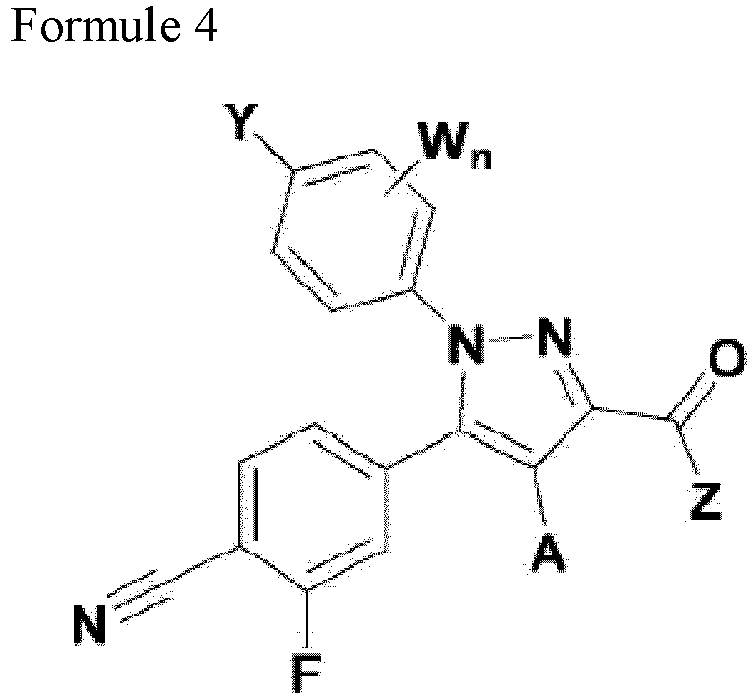 A est un hydrogène ou un groupe C1-C4 alkyle,les W sont chacun indépendamment un halogène,n est un entier naturel de 1 à 4,Y est un groupe C3-C6 cycloalkyle substitué ou non substitué, un groupe pyrrolidinyle N-lié substitué ou non substitué ou un groupe pipéridinyle N-lié substitué ou non substitué, dans lequel le groupe C3-C6 cycloalkyle substitué est un groupe C3-C6 cycloalkyle dans lequel au moins un hydrogène est substitué par un groupe fonctionnel chacun indépendamment choisi parmi un halogène et un groupe hydroxy, et le groupe pyrrolidinyle N-lié substitué et le groupe pipéridinyle N-lié substitué sont chacun un groupe pyrrolidinyle N-lié et un groupe pipéridinyle N-lié, respectivement, dans lesquels au moins un atome d'hydrogène de cycle est substitué par un groupe fonctionnel chacun indépendamment choisi parmi un groupe C1-C4 alkyle, un halogène, un groupe C1-C4 alcoxy, un groupe hydroxy et un groupe C1-C10 hétérocyclique, etZ est un groupe pyrrolidinyle N-lié substitué ou non substitué, un groupe pipéridinyle N-lié substitué ou non substitué ou un groupe azépanyle N-lié substitué ou non substitué, dans lequel au moins un substituant du groupe pyrrolidinyle N-lié substitué, du groupe pipéridinyle N-lié substitué ou du groupe azépanyle N-lié substitué est choisi parmi un groupe amino, un groupe C1-C4 alkylamino, un groupe C1-C4 alkyle, un halogène, un groupe C1-C4 alcoxy et un groupe C1-C10 hétérocyclique, ou choisi parmi les Composés 1) à 4), 7), 14) à 57), 76), 77) et 85) à 112) suivants :1) (R)-4-(3-(3-aminopipéridine-1-carbonyl)-1-(4-cyclopropylphényl)-1H-pyrazole-5-yl)benzonitrile2) (R)-4-(1-(4-cyclopropylphényl)-3-(3-méthylaminopipéridine-1-carbonyl)-1H-pyrazole-5-yl)benzonitrile3) (R)-4-(3-(3-aminopipéridine-1-carbonyl)-1-(4-cyclopropyl-2-fluorophényl)-1H-pyrazole-5-yl)benzonitrile4) (R)-4-(1-(4-cyclopropyl-2-fluorophényl)-3-(3-(méthylamino)pipéridine-1-carbonyl)-1H-pyrazole-5-yl)benzonitrile7) (R)-4-(3-(3-aminoazépane-1-carbonyl)-1-(4-(cyclopropylphényl)-1H-pyrazole-5-yl)benzonitrile14) (R)-4-(3-(3-aminopipéridine-1-carbonyl)-1-phényl-1H-pyrazole-5-yl)benzonitrile15) (R)-4-(3-(3-aminopipéridine-1-carbonyl)-1-(pyridine-2-yl)-1H-pyrazole-5-yl)benzonitrile16) (R)-4-(3-(3-aminopipéridine-1-carbonyl)-1-(4-fluorophényl)-1H-pyrazole-5-yl)benzonitrile17) (R)-4-(3-(3-aminopipéridine-1-carbonyl)-1-(4-chlorophényl)-1H-pyrazole-5-yl)benzonitrile18) (R)-4-(1-(4-chlorophényl)-3-(3-(méthylamino)pipéridine-1-carbonyl)-1H-pyrazole-5-yl)benzonitrile19) (R)-4-(3-(3-aminopipéridine-1-carbonyl)-1-(3-chlorophényl)-1H-pyrazole-5-yl)benzonitrile20) (R)-4-(3-(3-aminopipéridine-1-carbonyl)-1-(4-bromophényl)-1H-pyrazole-5-yl)benzonitrile21) (R)-4-(1-(4-bromophényl)-3-(3-(méthylamino)pipéridine-1-carbonyl)-1H-pyrazole-5-yl)benzonitrile22) (S)-4-(3-(3-aminopyrrolidine-1-carbonyl)-1-(p-tolyl)-1H-pyrazole-5-yl)benzonitrile23) (S)-4-(3-(3-(méthylamino)pyrrolidine-1-carbonyl)-1-(p-tolyl)-1H-pyrazole-5-yl)benzonitrile24) (S)-4-(3-(3-(diméthylamino)pyrrolidine-1-carbonyl)-1-(p-tolyl)-1H-pyrazole-5-yl)benzonitrile25) (R)-4-(3-(3-(diméthylamino)pyrrolidine-1-carbonyl)-1-(p-tolyl)-1H-pyrazole-5-yl)benzonitrile26) (R)-4-(3-(3-(méthylamino)pyrrolidine-1-carbonyl)-1-(p-tolyl)-1H-pyrazole-5-yl)benzonitrile27) (R)-4-(3-(3-aminopyrrolidine-1-carbonyl)-1-(p-tolyl)-1H-pyrazole-5-yl)benzonitrile28) (R)-4-(3-(3-aminopipéridine-1-carbonyl)-1-(p-tolyl)-1H-pyrazole-5-yl)benzonitrile29) (R)-4-(3-(3-(méthylamino)pipéridine-1-carbonyl)-1-(p-tolyl)-1H-pyrazole-5-yl)benzonitrile30) (R)-4-(3-(3-(diméthylamino)pipéridine-1-carbonyl)-1-(p-tolyl)-1H-pyrazole-5-yl)benzonitrile31) (R)-4-(3-(3-aminopipéridine-1-carbonyl)-1-(m-tolyl)-1H-pyrazole-5-yl)benzonitrile32) (R)-4-(3-(3-aminopipéridine-1-carbonyl)-1-(o-tolyl)-1H-pyrazole-5-yl)benzonitrile33) (R)-4-(3-(3-aminopipéridine-1-carbonyl)-1-(4-éthylphényl)-1H-pyrazole-5-yl)benzonitrile34) (R)-4-(1-(4-éthylphényl)-3-(3-(méthylamino)pipéridine-1-carbonyl)-1H-pyrazole-5-yl)benzonitrile35) (R)-4-(3-(3-aminopipéridine-1-carbonyl)-1-(4-isopropylphényl)-1H-pyrazole-5-yl)benzonitrile36) (R)-4-(1-(4-isopropylphényl)-3-(3-(méthylamino)pipéridine-1-carbonyl)-1H-pyrazole-5-yl)benzonitrile37) (R)-4-(3-(3-aminopipéridine-1-carbonyl)-1-(2-fluoro-4-isopropylphényl)-1H-pyrazole-5-yl)benzonitrile38) (R)-4-(3-(3-aminopipéridine-1-carbonyl)-1-(2-fluoro-4-isopropylphényl)-1H-pyrazole-5-yl)-2-fluorobenzonitrile39) (R)-4-(3-(3-aminoazépane-1-carbonyl)-1-(2-fluoro-4-isopropylphényl)-1H-pyrazole-5-yl)-2-fluorobenzonitrile40) (R)-4-(3-(3-aminopipéridine-1-carbonyl)-1-(4-(tert-butyl)phényl)-1H-pyrazole-5-yl)benzonitrile41) (R)-4-(1-(4-(tert-butyl)phényl-3-(3-méthylaminopipéridine-1-carbonyl)-1H-pyrazole-5-yl)benzonitrile42) (R)-4-(3-(3-aminopipéridine-1-carbonyl)-1-(4-(tert-butyl)-2-fluorophényl)-1H-pyrazole-5-yl)benzonitrile43) (R)-4-(3-(3-aminopipéridine-1-carbonyl)-1-(4-(tert-butyl-2-fluorophényl)-1H-pyrazole-5-yl)-2-fluorobenzonitrile44) (R)-4-(3-(3-aminoazépane-1-carbonyl)-1-(4-(tert-butyl-2-fluorophényl)-1H-pyrazole-5-yl)-2-fluorobenzonitrile45) (R)-4-(3-(3-aminopipéridine-1-carbonyl)-1-(4-(trifluorométhoxy)phényl)-1H-pyrazole-5-yl)benzonitrile46) (R)-4-(3-(3-aminopipéridine-1-carbonyl)-1-(4-(méthylsulfonyl)phényl)-1H-pyrazole-5-yl)benzonitrile47) (R)-4-(3-(3-aminopipéridine-1-carbonyl)-1-(4-(trifluorométhyl)phényl)-1H-pyrazole-5-yl)benzonitrile48) (R)-4-(3-(3-aminopipéridine-1-carbonyl)-1-(2-fluoro-4-méthylphényl)-1H-pyrazole-5-yl)benzonitrile49) (R)-4-(3-(3-aminopipéridine-1-carbonyl)-1-(3-fluoro-4-méthoxyphényl)-1H-pyrazole-5-yl)benzonitrile50) (R)-4,4'-(3-(3-aminopipéridine-1-carbonyl)-1H-pyrazole-1,5-diyl)dibenzonitrile51) (R)-4-(1-(4-(diméthylamino)phényl)-3-(3-(méthylamino)pipéridine-1-carbonyl)-1H-pyrazole-5-yl)benzonitrile52) (R)-4-(3-(3-aminopipéridine-1-carbonyl)-1-(4-((2-(diméthylamino)éthyl)(méthyl)amino)phényl)-1H-pyrazole-5-yl)benzonitrile53) ((R)-4-(3-(3-aminopipéridine-1-carbonyl)-1-(4-(diméthylamino)phényl)-1H-pyrazole-5-yl)benzonitrile54) (R)-4-(3-(3 -aminopipéridine-1-carbonyl)-1-(4-(diméthylamino)-2-fluorophényl)-1H-pyrazole-5-yl)benzonitrile55) (R)-4-(3-(3 -aminopipéridine-1-carbonyl)-1-(4-(diéthylamino)-2-fluorophényl)-1 H-pyrazole-5-yl)benzonitrile56) (R)-4-(3-(3-aminopipéridine-1-carbonyl)-1-(4-(azétidine-1-yl)-2-fluorophényl)-1H-pyrazole-5-yl)benzonitrile57) (R)-4-(3-(3-aminopipéridine-1-carbonyl)-1-(2-fluoro-4-(pyrrolidine-1-yl)phényl)-1H-pyrazole-5-yl)benzonitrile76) (R)-4-(3-(3-aminopipéridine-1-carbonyl)-1-(2-méthoxy-4-(pyrrolidine-1-yl)phényl)-1H-pyrazole-5-yl)-2-fluorobenzonitrile77) (R)-4-(3-(3-aminopipéridine-1-carbonyl)-1-(2-fluoro-4-(pipéridine-1-yl)phényl)-1H-pyrazole-5-yl)benzonitrile85) (R)-4-(3-(3-aminopipéridine-1-carbonyl)-1-(1-méthyl-1H-indazole-6-yl)-1H-pyrazole-5-yl)benzonitrile86) (R)-4-(3-(3-aminopipéridine-1-carbonyl)-1-(2-méthylbenzo[d]thiazole-5-yl)-1H-pyrazole-5-yl)benzonitrile87) (R)-4-(3-(3-aminopipéridine-1-carbonyl)-1-(2,3-dihydro-1H-indane-5-yl)-1H-pyrazole-5-yl)benzonitrile88) (R)-4-(3-(3-aminopipéridine-1-carbonyl)-1-(2,3-dihydro-1H-indén-5-yl)-1H-pyrazole-5-yl)-2-fluorobenzonitrile89) (R)-4-(1-(2,3-dihydro-1H-indén-5-yl)-3-(3-(méthylamino)pipéridine-1-carbonyl)-1H-pyrazole-5-yl)benzonitrile90) (R)-4-(3-(3-aminopipéridine-1-carbonyl)-1-(2,3-dihydrobenzo[b][1,4]dioxin-6-yl)-1H-pyrazole-5-yl)benzonitrile91) (R)-4-(3-(3-aminopipéridine-1-carbonyl)-1-(quinoléine-6-yl)-1H-pyrazole-5-yl)benzonitrile92) (R)-4-(3-(3-aminopipéridine-1-carbonyl)-1-(quinoléine-3-yl)-1H-pyrazole-5-yl)benzonitrile93) (R)-4-(3-(3-aminopipéridine-1-carbonyl)-1-(1-méthyl-1H-pyrrolo[2,3-b]pyridine-5-yl)-1H-pyrazole-5-yl)benzonitrile94) (R)-4-(3-(3-aminopipéridine-1-carbonyl)-1-(2-fluoro-4-(2-hydroxy-2-méthylpropyl)phényl)-1H-pyrazole-5-yl)-2-fluorobenzonitrile95) 4-(3-(pipérazine-1-carbonyl)-1-(p-tolyl)-1H-pyrazole-5-yl)benzonitrile96) 4-(3-(3-(aminométhyl)pipérazine-1-carbonyl)-1-(p-tolyl)-1H-pyrazole-5-yl)benzonitrile97) (S)-5-(4-cyanophényl)-N-(1-(méthylsulfonyl)pipéridine-3-yl)-1-(p-tolyl)-1H-pyrazole-3-carboxamide98) 4-(3-(2,7-diazaspiro[3.5]nonane-7-carbonyl)-1-(p-tolyl)-1H-pyrazole-5-yl)benzonitrile99) 4-(3-(2,8-diazaspiro[4.5]décane-8-carbonyl)-1-(p-tolyl)-1H-pyrazole-5-yl)benzonitrile100) 4-(3-(octahydro-1H-pyrrolo[2,3-c]pyridine-6-carbonyl)-1-(p-tolyl)-1H-pyrazole-5-yl)benzonitrile101) 4-(3-(3,7-diazabicyclo[3.3.1]nonane-3-carbonyl)-1-(2-fluoro-4-isopropylphényl)-1H-pyrazole-5-yl)-2-fluorobenzonitrile102) 4-(3-(3-amino-8-azabicyclo[3.2.1]octane-8-carbonyl)-1-(2-fluoro-4-isopropylphényl)-1H-pyrazole-5-yl)-2-fluorobenzonitrile103) 4-(3-(3-amino-8-azabicyclo[3.2.1]octane-8-carbonyl)-1-(2-fluoro-4-pyrrolidine-1 - yl)phényl)-1H-pyrazole-5-yl)-2-fluorobenzonitrile104) 4-(3-(3,7-diazabicyclo[3.3.1]nonane-3-carbonyl)-1-(p-tolyl)-1H-pyrazole-5-yl)benzonitrile105) 5-(4-cyanophényl)-N-(pipéridine-4-yl)-1-(p-tolyl)-1H-pyrazole-3-carboximide106) 5-(4-cyanophényl)-N-(1-méthylpipéridine-4-yl)-1-(p-tolyl)-1H-pyrazole-3 - carboximide107) (R)-5-(4-cyanophényl)-N-(1-méthylpipéridine-3-yl)-1-(p-tolyl)-1H-pyrazole-3-carboximide108) (S)-5-(4-cyanophényl)-N-(1-méthylpipéridine-3-yl)-1-(p-tolyl)-1H-pyrazole-3-carboximide109) (R)-5-(4-cyanophényl)-N-(1-méthylpyrrolidine-3-yl)-1-(p-tolyl)-1H-pyrazole-3-carboximide110) 5-(4-cyano-3 -fluorophényl)-1 -(2-fluoro-4-(pyrrolidine-1 -yl)phényl)-N-méthyl-N-(pipéridine-3-yl)-1H-pyrazole-3-carboximide111) (S)-5-(4-cyano-3-fluorophényl)-1-(2-fluoro-4-(pyrrolidine-1-yl)phényl)-N-méthyl-N-(pipéridine-3-yl)-1H-pyrazole-3-carboximide112) (R)-5-(4-cyano-3-fluorophényl)-1-(2-fluoro-4-(pyrrolidine-1 -yl)phényl)-N-méthyl-N-(pipéridine-3-yl)-1H-pyrazole-3-carboximide.
 - Composé selon la revendication 1, dans lequel :A est un hydrogène,les W sont des fluors,n est un entier naturel de 1,Y est un groupe pyrrolidinyle N-lié substitué ou non substitué ou un groupe pipéridinyle N-lié substitué ou non substitué, dans lequel le groupe pyrrolidinyle N-lié substitué et le groupe pipéridinyle N-lié substitué sont chacun un groupe pyrrolidinyle N-lié et un groupe pipéridinyle N-lié, respectivement, dans lesquels au moins un atome d'hydrogène de cycle est substitué par un groupe fonctionnel chacun indépendamment choisi parmi un groupe C1-C4 alkyle, un halogène, un groupe C1-C4 alcoxy et un groupe hydroxy, etZ est un groupe pipéridinyle N-lié substitué ou un groupe pipéridinyle non substitué dans lequel au moins un substituant est substitué par un groupe fonctionnel choisi parmi un groupe amino, un groupe C1-C4 alkylamino, un groupe C1-C4 alkyle, un halogène et un groupe C1-C4 alcoxy.
- Composé selon la revendication 1, qui est choisi parmi les Composés 5), 6), 8) à 13), 58) à 75), 78) à 84) et 113), un isomère optique, un solvate, un tautomère ou un sel pharmaceutiquement acceptable de ceux-ci :5) (R)-4-(3-(3-aminopipéridine-1-carbonyl)-1-(4-cyclopropyl-2-fluorophényl)-1H-pyrazole-5-yl)-2-fluorobenzonitrile6) (R)-4-(1-(4-cyclopropyl-2-fluorophényl)-3-(3-(méthylamino)pipéridine-1-carbonyl)-1H-pyrazole-5-yl)-2-fluorobenzonitrile8) (R)-4-(3-(3-aminoazépane-1-carbonyl)-1-(4-cyclopropyl-2-fluorophényl)-1H-pyrazole-5-yl)-2-fluorobenzonitrile9) 4-(3-((3R,5R)-3-amino-5-méthylpipéridine-1-carbonyl)-1-(4-cyclopropyl-2-fluorophényl)-1H-pyrazole-5-yl)-2-fluorobenzonitrile10) (R)-4-(3-(3-aminopipéridine-1-carbonyl)-1-(4-cyclopropyl-2,6-difluorophényl)-1H-pyrazole-5-yl)-2-fluorobenzonitrile11) (R)-4-(3-(3-aminoazépane-1-carbonyl)-1-(4-cyclopropyl-2,6-difluorophényl)-1H-pyrazole-5-yl)-2-fluorobenzonitrile12) (R)-4-(3-(3-aminopipéridine-1-carbonyl)-1-(2-chloro-4-cyclopropylphényl)-1H-pyrazole-5-yl)-2-fluorobenzonitrile13) (R)-4-(3-(3-aminoazépane-1-carbonyl)-1-(2-chloro-4-cyclopropylphényl)-1H-pyrazole-5-yl)-2-fluorobenzonitrile58) (R)-4-(3-(3-aminopipéridine-1-carbonyl)-1-(2-fluoro-4-(pyrrolidine-1-yl)phényl)-1H-pyrazole-5-yl)-2-fluorobenzonitrile59) (R)-2-fluoro-4-(1-(2-fluoro-4-(pyrrolidine-1-yl)phényl)-3-(3- (méthylamino)pipéridine-1-carbonyl)-1H-pyrazole-5-yl)benzonitrile60) (R)-4-(3-(3-aminoazépane-1-carbonyl)-1-(2-fluoro-4-(pyrrolidine-1-yl)phényl)-1H-pyrazole-5-yl)-2-fluorobenzonitrile61) 4-(3-((R)-3-aminopipéridine-1-carbonyl)-1-(2-fluoro-4-((R)-3-fluoropyrrolidine-1-yl)phényl)-1H-pyrazole-5-yl)-2-fluorobenzonitrile62) 4-(3-((R)-3-aminopipéridine-1-carbonyl)-1-(2-fluoro-4-((S)-3-fluoropyrrolidine-1-yl)phényl)-1H-pyrazole-5-yl)-2-fluorobenzonitrile63) (R)-4-(3-(3-aminopipéridine-1-carbonyl)-1-(4-(3,3-difluoropyrrolidine-1-yl)-2-fluorophényl)-1H-pyrazole-5-yl)-2-fluorobenzonitrile64) (R)-4-(1-(4-(3,3-difluoropyrrolidine-1-yl)-2-fluorophényl)-3-(3- (méthylamino)pipéridine-1-carbonyl)-1H-pyrazole-5-yl)-2-fluorobenzonitrile65) 4-(3-((R)-3-aminopipéridine-1-carbonyl)-1-(2-fluoro-4-(3-méthoxypyrrolidin-1-yl)phényl)-1H-pyrazol-5-yl)-2-fluorobenzonitrile66) 2-fluoro-4-(1-(2-fluoro-4-(3-méthoxypyrrolidine-1-yl)phényl)-3-((R)-3 - (méthylamino)pipéridine-1-carbonyl)-1H-pyrazole-5-yl)benzonitrile67) 4-(3-((R)-3-aminopipéridine-1-carbonyl)-1-(2-fluoro-4-((S)-3 - méthoxypyrrolidine-1-yl)phényl)-1H-pyrazole-5-yl)-2-fluorobenzonitrile68) 2-fluoro-4-(1-(2-fluoro-4-((S)-3-méthoxypyrrolidine-1-yl)phényl)-3-((R)-3- (méthylamino)pipéridine-1-carbonyl)-1H-pyrazole-5-yl)benzonitrile69) 4-(3-((R)-3-aminopipéridine-1-carbonyl)-1-(2-fluoro-4-((R)-3- méthoxypyrrolidine-1-yl)phényl)-1H-pyrazole-5-yl)-2-fluorobenzonitrile70) 2-fluoro-4-(1-(2-fluoro-4-((R)-3 -méthoxypyrrolidine-1-yl)phényl)-3-((R)-3 - (méthylamino)pipéridine-1-carbonyl)-1H-pyrazole-5-yl)benzonitrile71) 2-fluoro-4-(1-(2-fluoro-4-((S)-3-éthoxypyrrolidine-1-yl)phényl)-3-((R)-3-(méthylamino)pipéridine-1-carbonyl)-1H-pyrazole-5-yl)benzonitrile72) 4-(3 -((R)-3 -aminopipéridine-1-carbonyl)-1-(2-fluoro-4-(3-hydroxypyrrolidine-1-yl)phényl)-1H-pyrazole-5-yl)-2-fluorobenzonitrile73) 2-fluoro-4-(1-(2-fluoro-4-((S)-3-chloropyrrolidine-1-yl)phényl)-3-((R)-3 - (méthylamino)pipéridine-1-carbonyl)-1H-pyrazole-5-yl)benzonitrile74) (R)-4-(3-(3-aminopipéridine-1-carbonyl)-1-(2,6-difluoro-4-(pyrrolidine-1-yl)phényl)-1H-pyrazole-5-yl)-2-fluorobenzonitrile75) (R)-4-(3-(3-aminopipéridine-1-carbonyl)-1-(2-chloro-4-(pyrrolidine-1-yl)phényl)-1H-pyrazole-5-yl)-2-fluorobenzonitrile78) (R)-4-(3-(3-aminopipéridine-1-carbonyl)-1-(2-fluoro-4-(pipéridine-1-yl)phényl)-1H-pyrazole-5-yl)-2-fluorobenzonitrile79) (R)-2-fluoro-4-(1 -(2-fluoro-4-(pipéridine-1 -yl)phényl)-3 -(3 - (méthylamino)pipéridine-1-carbonyl)-1H-pyrazole-5-yl)benzonitrile80) 4-(3-((R)-3-aminopipéridine-1-carbonyl)-1-(2-fluoro-4-(3-méthylpipéridine-1-yl)phényl)-1H-pyrazole-5-yl)-2-fluorobenzonitrile81) (R)-4-(3-(3-aminopipéridine-1-carbonyl)-1-(2-fluoro-4-(4-méthylpipéridine-1-yl)phényl)-1H-pyrazole-5-yl)-2-fluorobenzonitrile82) 4-(3-((R)-3-aminopipéridine-1-carbonyl)-1-(4-(3,5-diméthylpipéridine-1-yl)-2-fluorophényl)-1H-pyrazole-5-yl)-2-fluorobenzonitrile83) (R)-4-(1-(4-([1,4'-bipipéridine]-1'-yl)-2-fluorophényl)-3-(3-aminopipéridine-1-carbonyl)-1H-pyrazole-5-yl)-2-fluorobenzonitrile84) (R)-4-(3-(3-aminoazépane-1-carbonyl)-1-(2-fluoro-4-(pipéridine-1-yl)phényl)-1H-pyrazole-5-yl)-2-fluorobenzonitrile113) (R)-4-(3-(3-aminopipéridine-1-carbonyl)-1-(4-cyclopropyl-2-fluorophényl)-4-méthyl-1H-pyrazole-5-yl)benzonitrile.
- Composé selon la revendication 3, qui est choisi parmi les Composés 5), 6), 8) à 13), 58) à 75) et 78) à 84), un isomère optique, un solvate, un tautomère ou un sel pharmaceutiquement acceptable de ceux-ci.
- Composition pharmaceutique pour la prévention ou le traitement d'une maladie entraînée par une activation anormale d'une déméthylase spécifique à la lysine 1 (LSD1), la composition pharmaceutique comprenant : le composé selon l'une quelconque des revendications 1 à 4, un isomère optique, un solvate, un tautomère ou un sel pharmaceutiquement acceptable de celui-ci en tant qu'ingrédient actif ; et un véhicule pharmaceutiquement acceptable.
- Composition pharmaceutique selon la revendication 5, où la maladie entraînée par une activation anormale de LSD1 est un cancer ou une maladie néoplasique.
- Composition pharmaceutique selon la revendication 5 qui est utilisée en combinaison avec un médicament supplémentaire pharmaceutiquement acceptable pour la prévention ou le traitement d'une maladie entraînée par une activation anormale de LSD1.
- Composition pharmaceutique selon la revendication 5 formulée sous une forme pharmaceutiquement acceptable comprenant un cachet, une pilule, une poudre, une capsule, un sirop, une émulsion et une microémulsion.
Applications Claiming Priority (2)
| Application Number | Priority Date | Filing Date | Title |
|---|---|---|---|
| KR20170117226 | 2017-09-13 | ||
| PCT/KR2018/010741 WO2019054766A1 (fr) | 2017-09-13 | 2018-09-13 | Composé dérivé de pyrazole et son utilisation |
Publications (4)
| Publication Number | Publication Date |
|---|---|
| EP3681877A1 EP3681877A1 (fr) | 2020-07-22 |
| EP3681877A4 EP3681877A4 (fr) | 2021-02-24 |
| EP3681877B1 true EP3681877B1 (fr) | 2024-10-16 |
| EP3681877C0 EP3681877C0 (fr) | 2024-10-16 |
Family
ID=65723753
Family Applications (1)
| Application Number | Title | Priority Date | Filing Date |
|---|---|---|---|
| EP18856659.0A Active EP3681877B1 (fr) | 2017-09-13 | 2018-09-13 | Composé dérivé de pyrazole et son utilisation |
Country Status (8)
| Country | Link |
|---|---|
| US (1) | US11254676B2 (fr) |
| EP (1) | EP3681877B1 (fr) |
| JP (1) | JP7181287B2 (fr) |
| KR (1) | KR102284205B1 (fr) |
| CN (1) | CN111094265B (fr) |
| AR (1) | AR112900A1 (fr) |
| TW (1) | TWI794294B (fr) |
| WO (1) | WO2019054766A1 (fr) |
Families Citing this family (8)
| Publication number | Priority date | Publication date | Assignee | Title |
|---|---|---|---|---|
| CN114105950B (zh) * | 2020-08-31 | 2022-09-06 | 南京明德新药研发有限公司 | 吡唑类化合物及其应用 |
| US20250073232A1 (en) | 2021-04-08 | 2025-03-06 | Oryzon Genomics, S.A. | Combinations of lsd1 inhibitors for treating myeloid cancers |
| WO2023069884A1 (fr) * | 2021-10-18 | 2023-04-27 | Imago Biosciences, Inc. | Inhibiteurs de kdm1a pour le traitement d'une maladie |
| CN116768797A (zh) * | 2022-03-16 | 2023-09-19 | 成都苑东生物制药股份有限公司 | 一种吡唑类衍生物、其制备方法及用途 |
| US20250295660A1 (en) | 2022-05-09 | 2025-09-25 | Oryzon Genomics, S.A. | Methods of treating nf1-mutant tumors using lsd1 inhibitors |
| EP4522136A1 (fr) | 2022-05-09 | 2025-03-19 | Oryzon Genomics, S.A. | Méthodes de traitement d'une tumeur maligne des gaines des nerfs périphériques (tmgnp) à l'aide d'inhibiteurs de lsd1 |
| CN120529900A (zh) | 2022-11-24 | 2025-08-22 | 奥莱松基因组股份有限公司 | 用于治疗癌症的LSD1抑制剂和Menin抑制剂的组合 |
| US20260085082A1 (en) * | 2022-12-23 | 2026-03-26 | Imago Biosciences, Inc. | Kdm1a inhibitors for the treatment of disease |
Family Cites Families (14)
| Publication number | Priority date | Publication date | Assignee | Title |
|---|---|---|---|---|
| PH27357A (en) * | 1989-09-22 | 1993-06-21 | Fujisawa Pharmaceutical Co | Pyrazole derivatives and pharmaceutical compositions comprising the same |
| US7393842B2 (en) | 2001-08-31 | 2008-07-01 | University Of Connecticut | Pyrazole analogs acting on cannabinoid receptors |
| US8084467B2 (en) * | 1999-10-18 | 2011-12-27 | University Of Connecticut | Pyrazole derivatives as cannabinoid receptor antagonists |
| AU2004200420A1 (en) | 2003-03-11 | 2004-09-30 | Astellas Pharma Inc. | Inhibitor of cyclooxygenase |
| TW200526641A (en) * | 2003-12-26 | 2005-08-16 | Daiichi Seiyaku Co | Amidopyrazole derivatives |
| EP1928859A1 (fr) * | 2005-06-17 | 2008-06-11 | Carex SA | Derives de pyrazole utilises comme modulateurs du recepteur cannabinoide |
| EP1951678A1 (fr) * | 2005-10-21 | 2008-08-06 | Mitsubishi Tanabe Pharma Corporation | Composes pyrazole presentant une activite antagoniste du recepteur cannabinoide (cb1) |
| PH12013501871A1 (en) | 2011-03-25 | 2019-06-03 | Glaxosmithkline Ip No 2 Ltd | Cyclopropylamines as lsd1 inhibitors |
| WO2012174362A1 (fr) * | 2011-06-17 | 2012-12-20 | Research Triangle Institute | Dérivés de pyrazole utilisés en tant qu'antagonistes du récepteur de type 1 des cannabinoïdes |
| CA3161836A1 (fr) * | 2013-12-11 | 2015-06-18 | Celgene Quanticel Research, Inc. | Inhibiteur de la demethylase-1 specifique de la lysine |
| JP6525422B2 (ja) | 2014-07-03 | 2019-06-05 | セルジーン クオンティセル リサーチ,インク. | リジン特異的なデメチラーゼ−1の阻害剤 |
| US9695167B2 (en) | 2014-07-10 | 2017-07-04 | Incyte Corporation | Substituted triazolo[1,5-a]pyridines and triazolo[1,5-a]pyrazines as LSD1 inhibitors |
| US9695180B2 (en) | 2014-07-10 | 2017-07-04 | Incyte Corporation | Substituted imidazo[1,2-a]pyrazines as LSD1 inhibitors |
| EP3381896B1 (fr) | 2015-11-27 | 2023-01-18 | Taiho Pharmaceutical Co., Ltd. | Composé de biphényle ou un sel de celui-ci |
-
2018
- 2018-09-12 AR ARP180102593A patent/AR112900A1/es active IP Right Grant
- 2018-09-12 TW TW107132109A patent/TWI794294B/zh active
- 2018-09-13 KR KR1020180109856A patent/KR102284205B1/ko active Active
- 2018-09-13 CN CN201880059878.9A patent/CN111094265B/zh active Active
- 2018-09-13 US US16/646,883 patent/US11254676B2/en active Active
- 2018-09-13 EP EP18856659.0A patent/EP3681877B1/fr active Active
- 2018-09-13 JP JP2020515066A patent/JP7181287B2/ja active Active
- 2018-09-13 WO PCT/KR2018/010741 patent/WO2019054766A1/fr not_active Ceased
Also Published As
| Publication number | Publication date |
|---|---|
| KR20190030192A (ko) | 2019-03-21 |
| CN111094265B (zh) | 2023-07-25 |
| TWI794294B (zh) | 2023-03-01 |
| WO2019054766A1 (fr) | 2019-03-21 |
| EP3681877A4 (fr) | 2021-02-24 |
| JP2020533372A (ja) | 2020-11-19 |
| TW201920135A (zh) | 2019-06-01 |
| US11254676B2 (en) | 2022-02-22 |
| JP7181287B2 (ja) | 2022-11-30 |
| AR112900A1 (es) | 2019-12-26 |
| KR102284205B1 (ko) | 2021-08-02 |
| EP3681877A1 (fr) | 2020-07-22 |
| US20210009591A1 (en) | 2021-01-14 |
| CN111094265A (zh) | 2020-05-01 |
| EP3681877C0 (fr) | 2024-10-16 |
Similar Documents
| Publication | Publication Date | Title |
|---|---|---|
| EP3681877B1 (fr) | Composé dérivé de pyrazole et son utilisation | |
| US20230303489A1 (en) | Compounds, compositions and methods of use | |
| EP2964223B1 (fr) | Composés inhibant l'activité enzymatique de la kinase à motifs répétés riches en leucine | |
| KR102204804B1 (ko) | 디히드로피라졸 gpr40 조절제 | |
| TWI785770B (zh) | 作為組蛋白去乙醯酶6抑制劑之新穎化合物及包含其之醫藥組合物 | |
| CN104837820A (zh) | 咪唑衍生物 | |
| EP3328853A1 (fr) | Dérivés d'amide substitués ayant une activité multimodale contre la douleur | |
| KR20120099139A (ko) | α4β2 신경 니코틴성 아세틸콜린 수용체 리간드 | |
| JP2017516817A (ja) | 疼痛に対する多様な活性を有する1−オキサ−4,9−ジアザスピロウンデカン化合物のアミド誘導体 | |
| KR20190040783A (ko) | 라이신 특이적 데메틸라제-1 억제제로서의 피라졸 유도체 | |
| WO2012133509A1 (fr) | Dérivé inédit de benzimidazole | |
| KR20190040763A (ko) | 피라졸로피리딘 유도체 화합물 및 이의 용도 | |
| US8735423B2 (en) | Bicyclic compounds as α4β2 nicotinic acetylcholine receptor ligands | |
| CN110054622A (zh) | 噁二唑类衍生物、其制备方法及其在医药上的应用 | |
| JP2014073982A (ja) | 新規ベンズイミダゾール誘導体からなる医薬 | |
| JP2015199722A (ja) | イミダゾール誘導体からなる医薬 | |
| JP2005506335A (ja) | 神経栄養剤としてのn−ヘテロシクリルヒドラジド | |
| WO2018193297A1 (fr) | Nouveaux composés utilisés en tant que modulateurs de ror-gamma | |
| WO2014038623A1 (fr) | Dérivé 3-(4-pipéridyl)-indazole | |
| WO2015152253A1 (fr) | Dérivé 4-aryl imidazole | |
| CN121219294A (zh) | 作为irk4的配体定向降解剂的杂芳基化合物 |
Legal Events
| Date | Code | Title | Description |
|---|---|---|---|
| STAA | Information on the status of an ep patent application or granted ep patent |
Free format text: STATUS: THE INTERNATIONAL PUBLICATION HAS BEEN MADE |
|
| PUAI | Public reference made under article 153(3) epc to a published international application that has entered the european phase |
Free format text: ORIGINAL CODE: 0009012 |
|
| STAA | Information on the status of an ep patent application or granted ep patent |
Free format text: STATUS: REQUEST FOR EXAMINATION WAS MADE |
|
| 17P | Request for examination filed |
Effective date: 20200313 |
|
| AK | Designated contracting states |
Kind code of ref document: A1 Designated state(s): AL AT BE BG CH CY CZ DE DK EE ES FI FR GB GR HR HU IE IS IT LI LT LU LV MC MK MT NL NO PL PT RO RS SE SI SK SM TR |
|
| AX | Request for extension of the european patent |
Extension state: BA ME |
|
| DAV | Request for validation of the european patent (deleted) | ||
| DAX | Request for extension of the european patent (deleted) | ||
| A4 | Supplementary search report drawn up and despatched |
Effective date: 20210122 |
|
| RIC1 | Information provided on ipc code assigned before grant |
Ipc: A61K 9/00 20060101ALI20210118BHEP Ipc: C07D 401/06 20060101AFI20210118BHEP Ipc: A61K 31/454 20060101ALI20210118BHEP |
|
| STAA | Information on the status of an ep patent application or granted ep patent |
Free format text: STATUS: EXAMINATION IS IN PROGRESS |
|
| 17Q | First examination report despatched |
Effective date: 20221005 |
|
| GRAP | Despatch of communication of intention to grant a patent |
Free format text: ORIGINAL CODE: EPIDOSNIGR1 |
|
| STAA | Information on the status of an ep patent application or granted ep patent |
Free format text: STATUS: GRANT OF PATENT IS INTENDED |
|
| INTG | Intention to grant announced |
Effective date: 20240313 |
|
| GRAS | Grant fee paid |
Free format text: ORIGINAL CODE: EPIDOSNIGR3 |
|
| GRAA | (expected) grant |
Free format text: ORIGINAL CODE: 0009210 |
|
| STAA | Information on the status of an ep patent application or granted ep patent |
Free format text: STATUS: THE PATENT HAS BEEN GRANTED |
|
| AK | Designated contracting states |
Kind code of ref document: B1 Designated state(s): AL AT BE BG CH CY CZ DE DK EE ES FI FR GB GR HR HU IE IS IT LI LT LU LV MC MK MT NL NO PL PT RO RS SE SI SK SM TR |
|
| REG | Reference to a national code |
Ref country code: GB Ref legal event code: FG4D |
|
| REG | Reference to a national code |
Ref country code: CH Ref legal event code: EP Ref country code: DE Ref legal event code: R096 Ref document number: 602018075602 Country of ref document: DE |
|
| REG | Reference to a national code |
Ref country code: IE Ref legal event code: FG4D |
|
| U01 | Request for unitary effect filed |
Effective date: 20241105 |
|
| U07 | Unitary effect registered |
Designated state(s): AT BE BG DE DK EE FI FR IT LT LU LV MT NL PT RO SE SI Effective date: 20241114 |
|
| PG25 | Lapsed in a contracting state [announced via postgrant information from national office to epo] |
Ref country code: HR Free format text: LAPSE BECAUSE OF FAILURE TO SUBMIT A TRANSLATION OF THE DESCRIPTION OR TO PAY THE FEE WITHIN THE PRESCRIBED TIME-LIMIT Effective date: 20241016 Ref country code: IS Free format text: LAPSE BECAUSE OF FAILURE TO SUBMIT A TRANSLATION OF THE DESCRIPTION OR TO PAY THE FEE WITHIN THE PRESCRIBED TIME-LIMIT Effective date: 20250216 |
|
| PG25 | Lapsed in a contracting state [announced via postgrant information from national office to epo] |
Ref country code: ES Free format text: LAPSE BECAUSE OF FAILURE TO SUBMIT A TRANSLATION OF THE DESCRIPTION OR TO PAY THE FEE WITHIN THE PRESCRIBED TIME-LIMIT Effective date: 20241016 |
|
| PG25 | Lapsed in a contracting state [announced via postgrant information from national office to epo] |
Ref country code: NO Free format text: LAPSE BECAUSE OF FAILURE TO SUBMIT A TRANSLATION OF THE DESCRIPTION OR TO PAY THE FEE WITHIN THE PRESCRIBED TIME-LIMIT Effective date: 20250116 |
|
| PG25 | Lapsed in a contracting state [announced via postgrant information from national office to epo] |
Ref country code: GR Free format text: LAPSE BECAUSE OF FAILURE TO SUBMIT A TRANSLATION OF THE DESCRIPTION OR TO PAY THE FEE WITHIN THE PRESCRIBED TIME-LIMIT Effective date: 20250117 |
|
| PG25 | Lapsed in a contracting state [announced via postgrant information from national office to epo] |
Ref country code: PL Free format text: LAPSE BECAUSE OF FAILURE TO SUBMIT A TRANSLATION OF THE DESCRIPTION OR TO PAY THE FEE WITHIN THE PRESCRIBED TIME-LIMIT Effective date: 20241016 |
|
| PG25 | Lapsed in a contracting state [announced via postgrant information from national office to epo] |
Ref country code: RS Free format text: LAPSE BECAUSE OF FAILURE TO SUBMIT A TRANSLATION OF THE DESCRIPTION OR TO PAY THE FEE WITHIN THE PRESCRIBED TIME-LIMIT Effective date: 20250116 |
|
| PG25 | Lapsed in a contracting state [announced via postgrant information from national office to epo] |
Ref country code: SM Free format text: LAPSE BECAUSE OF FAILURE TO SUBMIT A TRANSLATION OF THE DESCRIPTION OR TO PAY THE FEE WITHIN THE PRESCRIBED TIME-LIMIT Effective date: 20241016 |
|
| PG25 | Lapsed in a contracting state [announced via postgrant information from national office to epo] |
Ref country code: SK Free format text: LAPSE BECAUSE OF FAILURE TO SUBMIT A TRANSLATION OF THE DESCRIPTION OR TO PAY THE FEE WITHIN THE PRESCRIBED TIME-LIMIT Effective date: 20241016 |
|
| PG25 | Lapsed in a contracting state [announced via postgrant information from national office to epo] |
Ref country code: CZ Free format text: LAPSE BECAUSE OF FAILURE TO SUBMIT A TRANSLATION OF THE DESCRIPTION OR TO PAY THE FEE WITHIN THE PRESCRIBED TIME-LIMIT Effective date: 20241016 |
|
| PLBE | No opposition filed within time limit |
Free format text: ORIGINAL CODE: 0009261 |
|
| STAA | Information on the status of an ep patent application or granted ep patent |
Free format text: STATUS: NO OPPOSITION FILED WITHIN TIME LIMIT |
|
| 26N | No opposition filed |
Effective date: 20250717 |
|
| U20 | Renewal fee for the european patent with unitary effect paid |
Year of fee payment: 8 Effective date: 20250924 |
|
| REG | Reference to a national code |
Ref country code: CH Ref legal event code: H13 Free format text: ST27 STATUS EVENT CODE: U-0-0-H10-H13 (AS PROVIDED BY THE NATIONAL OFFICE) Effective date: 20260425 |
|
| U1N | Appointed representative for the unitary patent procedure changed after the registration of the unitary effect |
Representative=s name: MARKS & CLERK LLP; GB |