EP3682596B1 - Serverlose kernnetzwerk-architektur - Google Patents
Serverlose kernnetzwerk-architektur Download PDFInfo
- Publication number
- EP3682596B1 EP3682596B1 EP18789691.5A EP18789691A EP3682596B1 EP 3682596 B1 EP3682596 B1 EP 3682596B1 EP 18789691 A EP18789691 A EP 18789691A EP 3682596 B1 EP3682596 B1 EP 3682596B1
- Authority
- EP
- European Patent Office
- Prior art keywords
- network
- service
- services
- software
- home
- Prior art date
- Legal status (The legal status is an assumption and is not a legal conclusion. Google has not performed a legal analysis and makes no representation as to the accuracy of the status listed.)
- Active
Links
Images




Classifications
-
- H—ELECTRICITY
- H04—ELECTRIC COMMUNICATION TECHNIQUE
- H04L—TRANSMISSION OF DIGITAL INFORMATION, e.g. TELEGRAPHIC COMMUNICATION
- H04L67/00—Network arrangements or protocols for supporting network services or applications
- H04L67/34—Network arrangements or protocols for supporting network services or applications involving the movement of software or configuration parameters
-
- H—ELECTRICITY
- H04—ELECTRIC COMMUNICATION TECHNIQUE
- H04W—WIRELESS COMMUNICATION NETWORKS
- H04W8/00—Network data management
- H04W8/02—Processing of mobility data, e.g. registration information at HLR [Home Location Register] or VLR [Visitor Location Register]; Transfer of mobility data, e.g. between HLR, VLR or external networks
-
- H—ELECTRICITY
- H04—ELECTRIC COMMUNICATION TECHNIQUE
- H04L—TRANSMISSION OF DIGITAL INFORMATION, e.g. TELEGRAPHIC COMMUNICATION
- H04L41/00—Arrangements for maintenance, administration or management of data switching networks, e.g. of packet switching networks
- H04L41/50—Network service management, e.g. ensuring proper service fulfilment according to agreements
- H04L41/5041—Network service management, e.g. ensuring proper service fulfilment according to agreements characterised by the time relationship between creation and deployment of a service
- H04L41/5054—Automatic deployment of services triggered by the service manager, e.g. service implementation by automatic configuration of network components
-
- H—ELECTRICITY
- H04—ELECTRIC COMMUNICATION TECHNIQUE
- H04L—TRANSMISSION OF DIGITAL INFORMATION, e.g. TELEGRAPHIC COMMUNICATION
- H04L67/00—Network arrangements or protocols for supporting network services or applications
- H04L67/50—Network services
- H04L67/51—Discovery or management thereof, e.g. service location protocol [SLP] or web services
Definitions
- This specification relates to service distribution more particularly to service distribution in the Service-Based Architecture (SBA) such as the SBA used in Fifth Generation (5G), core network.
- SBA Service-Based Architecture
- 5G Fifth Generation
- 3GPP Third Generation Partnership Project
- 3GPP SA2 group in the 5G core network architecture document 23.501, see overall 5G SBA architecture in Figure 1A and Figure 1B (prior art) illustrating the local breakout and the home routing roaming architectures as specified in 3GPP Technical Specification (TS) 23.501 V1.3.0: 3rd Generation Partnership Project; Technical Specification Group Services and System Aspects; System Architecture for the 5G System; Stage 2 (Release 15) and overall 5G procedures: 3GPP TS 23.502 V0.4.0: 3rd Generation Partnership Project; Technical Specification Group Services and System Aspects; Procedures for the 5G System; Stage 2 (Release 15)).
- SBA Session Mobility Function
- the 5G networks are also expected to run over cloud and virtualization frameworks such as Network Functions Virtualization, NFV.
- NFV Network Functions Virtualization
- One definition of NFV is provided by the Open Platform for NFV, OPNFV:
- NFV enables complex network functions to be performed on compute nodes in data centers.
- a network function performed on a compute node is called a Virtualized Network Function (VNF). So that VNFs can behave as a network, NFV also adds the mechanisms to determine how they can be chained together to provide control over traffic within a network.”
- VNF Virtualized Network Function
- NFV neurotrophic virus
- OpenStack ® is open source software for managing telecommunications infrastructure for NFV, 5G, loT and business applications.
- containers allow processes to be isolated from each other and from the underlying framework.
- OPNFV Open Network Function Virtualization Forum
- Containers virtualize the operating system as opposed to the entire machine. As a result, containers are much lighter than virtual machines, but suffer from isolation and security issues by virtue of sharing a common kernel. As an aside, for this reason many users run containers inside virtual machines. Given their small footprint, containers are popular in cloud native micro-services-based software architectures.
- Serverless computing can be described as a cloud computing execution model in which the cloud provider such as Amazon Web Services, AWS, dynamically manages the allocation of machine resources. Serverless computing allows to build and run applications and services without thinking about provisioning, scaling, and managing any servers.
- Serverless computing still requires servers.
- the name “serverless computing” is used because the server management and capacity planning decisions are completely hidden from the developer or operator.
- Serverless code can be used in conjunction with code deployed in traditional styles, such as microservices.
- serverless computing involves services that are not running permanently, but rather are started on demand when some action is required. Once the action completed, the service is stopped, and memory or other resources dedicated to it are returned to the operating system. For some services, if state information is needed, the state is written to either stable storage or stored in a common database service.
- Document EP 3 082 295 A1 may be construed to disclose a network function virtualization NFV fault management apparatus, device, and method.
- the apparatus includes: a first receiving unit, configured to receive a fault subscription message sent by at least one subscription node in an NFV system, where the fault subscription message includes: a node identifier of the at least one subscription node and fault information to which a subscription is requested; a second receiving unit, configured to receive a fault publish message sent by at least one fault publish node in the NFV system; a matching unit, configured to perform matching between the fault information to which a subscription is requested and the fault publish message, and generate a fault notification message; and a notification unit, configured to notify the fault notification message to a corresponding subscription node associated with the node identifier of the at least one subscription node.
- a first receiving unit configured to receive a fault subscription message sent by at least one subscription node in an NFV system, where the fault subscription message includes: a node identifier of the at least one
- Document US 2017/141973 A1 may be construed to disclose a method of generating a network slice.
- the method comprises a network slice orchestrator (NWSO) receiving from a network slice manager (NWSM) a request for a new network slice, the NWSO adding a new service to the new network slice, the NWSO determining a network slice descriptor (NWSD) for the new network slice, the NWSO transmitting to a resource orchestrator (RO) a request for an instantiation of the network slice using enhanced network function virtualization management and orchestration (E-MANO).
- NWSO network slice orchestrator
- RO resource orchestrator
- the method comprises a NWSO receiving from a NWSM a request to add a new service to a network slice, the NWSO adding a new service to the network slice, the NWSO determining a NWSD for the network slice with the added service, and the NWSO transmitting to a RO a request for an instantiation of the added service on the network slice using E-MANO.
- a method of terminating a network slice is also provided. The method comprises a NWSO receiving from a NWSM a request to terminate a network slice, the NWSO determining the subnetworks to terminate, and the NWSO transmitting to a RO a request for a termination of the slice specific network functions (NFs).
- NFs slice specific network functions
- Embodiments described herein describe a serverless Core network that can be applied in the fifth Generation Service Based Architecture or in any environment using Service Based Architecture such as One M2M.
- the solution can be applied between networks or between a network and a radio access network.
- the embodiments presented herein share the following elements of the solution:
- a method for provisioning a service in a first network such as a home network or serving network
- the method comprises the steps of maintaining in a software repository, one or more software images (I1, I2, ...Ii) of corresponding one or more services and where each service is identified by a service identifier (Si) and storing configuration information related to the one or more services in a database repository of the first network.
- the method further comprises the step of publishing to a second network a list of the one or more services.
- the first network may share roaming agreement with the second network.
- the second network may be a radio access network, such as 5G RAN, interworking with the serving network.
- the list of the one or more services comprises associated service description for each service, and the associated service description comprises information related to associated software image and information related to associated service trigger.
- the method further comprises maintaining identical software images between the first network and the second network and may also include the step of providing the configuration information related to the one or more services upon request from the second network.
- a method for providing a service by an entity in a serving network comprises receiving and storing one or more software images (I1, I2, ...) for one or more services of a first network and where each service is identified by a service identifier (Si) and upon detecting a trigger indicating a request for a service of the one or more services, instantiating the software image of the service in the serving network.
- the method further comprises receiving a list of the one or more service identifiers of home services as published by the first network wherein the list of the one or more services may comprise associated service description for each service, and where the associated service description comprises information related to associated software image and information related to associated service trigger.
- storing the one or more software images may further comprise applying local modifications to the one or more software images and storing the one or more software images as modified in a local repository.
- the local modifications comprise adaptation to a special hardware used in the serving network.
- the method comprises retrieving from the first network up-to-date configuration data for the instantiated software image of the service and may also comprise removing the software instance for the service once the service as requested is provided.
- receiving the one or more software images is in response to sending a request to a software repository wherein the request is sent to an address provided in the information related to the associated software image published by the first network.
- an apparatus for performing the embodiments of the method in the first network.
- an apparatus for performing embodiments of the method in the second network.
- references in the specification to "one embodiment,” “an embodiment,” “an example embodiment,” etc., indicate that the embodiment described may include a particular feature, structure, or characteristic, but every embodiment may not necessarily include the particular feature, structure, or characteristic. Moreover, such phrases are not necessarily referring to the same embodiment. Further, when a particular feature, structure, or characteristic is described in connection with an embodiment, it is submitted that it is within the knowledge of one skilled in the art to implement such feature, structure, or characteristic in connection with other embodiments whether or not explicitly described.
- Embodiments in this disclosure relate to 5G core networks but, is also applicable in a more general case of any networks consisting of a "visited” network and a "home” network, also referred to a visited public Land Mobile Network, VPLMN and a home, HPLMN.
- the term "serving" network is used to refer to the network where the UE is connected and where the service is provided to the UE.
- the serving network may be a visited network or a home network depending on whether the UE is roaming or not.
- the service provided to the UE in the serving network may be a home service instantiated at the serving network when the serving network is a visited network.
- the networks may also consist of a "Network Access Server” and a "central control point.”, or a "client” and a "server”. The central idea of this disclosure also extends beyond the core network, into various control aspects in the Radio Access Network (RAN).
- RAN Radio Access Network
- 3GPP Evolved Packet Core used with 4G radio access network and specified in 3GPP TS 23.401 operate largely based on continuously running services on servers, e.g., Authentication, Authorization and Accounting, AAA servers, proxy servers, Mobility management servers, address assignment servers such as DHCP and routing nodes such as Serving gateway, SGW, Packet gateway nodes, PGW, etc. This may usually consume more resources than is necessary. Similar services are also required in the new Service based architecture, SBA, of the 5G core network specified in 3GPP TS 23.501 and illustrated in Figure 1 for the roaming SBA architecture.
- SBA Service based architecture
- This specification describes embodiments of using serverless style implementation of some of these Core network services more specifically 5G Core network services by pre-distributing software images of the services to the roaming partners and instantiating the service in the roaming/visited network on a need basis.
- unnecessary resource usage should be eliminated, idle capacity should be reduced if not eliminated, services scale more efficiently and service fulfillment would be allowed to happen closer to the actual end user, e.g., in the visited network.
- services can execute close to the user's actual location, and provide quick round-trip times and responsiveness.
- the services are defined by the home operator, and when instantiated at the visited (or roaming) network, the software is run for the home operator. Additionally, pre-distribution of software images for the services to the roaming network enables quick launch of services compared to downloading them dynamically during the start of a session.
- Database entries for the optional state information associated to the service allow the minimal amount of data necessary to be shared between networks or operator's networks. Additionally, changes to the database entries are handled efficiently as needed.
- Embodiments of this specification relate to roaming situations where the same user roams into many different visited networks over time.
- Embodiments also apply to a more general case of any access networks consisting of a “visited” network and a “home network", or even a “Network Access Server” and a “central control point”.
- Embodiments described herein may also be applicable in various control aspects in the Radio Access Network, RAN.
- the embodiments herein are described for UEs roaming a "visited network” and the need to access services of the "home network”.
- a system method where serverless computing is used to instantiate services (home services) on a need basis in a roaming network (visited network), the method comprises the following components:
- the services could also be instantiated in a radio access network by the core network, in which case the method comprises the following components:
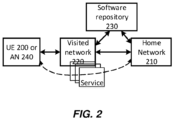
- Figure 2 illustrates the components of a serverless service based architecture that can apply to a 3GPP 5G Core network or to other SBA networks in a roaming use case (visited network and home network) in accordance with one embodiment.
- Services running using serverless computing consist of a software image of the service and an associated optional database for storage of any data that might be needed to store state or configuration information for the service.
- the software images can be standardized software image formats for a given platform, e.g., containers are one way to represent the software.
- Figure 2 further illustrates distribution of at least one software image from a home operator network 210 to its roaming partners, i.e., visited network 220. Only one visited network 220 is illustrated in figure 2 , but the home network can distribute to multiple visited networks 220 at a time. Each roaming/visited network 220 can maintain a directory of these images and can acquire updates in some fashion.
- a file synchronization method such as well-known remote synchronization (rsync), but obviously more advanced methods, such as Docker Hub, can also be used.
- the service consists of a software image and an optional database.
- the software image further consists of a base (shared by all/most users of the system, i.e., all networks including home and visited networks) and optional operator specific layers.
- the operator specific layers can contain extensions or modifications to the executable code that provides the service.
- base image could be a minimalistic HTTP server and operator specific addition would consist of the Python runtime and audio processing codec.
- the base image would be pre-provisioned in all visited operators network 220. Additional layers would be applied as a need for them is detected (e.g., a roaming agreement is established).
- the visited network 220 would be able to access the relevant database entries from the home network 210.
- Various well-known methods could be used to allow the visited network 220 to access the database in the home network 210. Some of those methods include but are not limited to:
- the necessary keys and information needed to access the database can be directly embedded in the software images, for example as part of the operator specific layers.
- the visited network 220 can launch services as needed in serverless fashion, i.e., by launching the software image as a new container when a predefined event happens.
- the service runs in the visited network 220 as if it was executing in the home network 210. For instance, if the service is about IP address management, the arrival of a DHCP packet may trigger the starting of the IP address management service.
- the DHCP server instance can then contact anything else that is needed for its execution, e.g., reach out to its corresponding database in the home network 210 as needed.
- Figure 3 illustrates a message flow for service provisioning from the home network 210 to the serving network 220 and service instantiation and execution in the visited network 220 in accordance with an embodiment.
- Example of services are described above. Referring to Figure 3 , the service provisioning and the service instantiation occur at different times independently of each other. Service provisioning may of course be performed when the service is triggered by the serving network, but that might introduce delays in execution and delivery of the service. In the embodiment illustrated in Figure 3 for a roaming scenario, provisioning is performed independently of the service instantiation.
- the home operator network 210 and roaming operator network 220 first establish roaming agreement shown at step 300.
- Roaming agreements enable the home network 210 to publish services to a visited network 220. If the home network 210 and the visited network 220 are 5G core network, see above for a possible list of services published by the home network 210.
- the home network 210 stores software images that are used by the services to a software repository 230.
- the repository 230 stores the images and associated service identifiers (Si).
- the software repository 230 can be operator specific or shared by a set of operators in which case the repository 230 may be maintained outside the home operator 210.
- the home operator network 210 publishes a set of services to the visited network 220 and may include the service description.
- the service description consists of information of the associated software image (li) and service trigger (Ti).
- the visited network 220 retrieves the software images from the software repository 230.
- the visited network 220 may already have some of the software images (li) due to earlier installations of the services.
- the service identifiers (Si) are globally unique but re-usable (e.g., same version of DHCP server can be identified with same identifier Si across operators). If the visited network 220 requires local modifications to the software images (Ii) (e.g., adaptation to specific hardware) these are applied in the optional step 360.
- the software images (li) and the associated triggers (Ti) are stored in the visited network 220 at step 370.
- the services provided by the network to which the user is directly connected may be instantiated on a need basis within that network.
- the software images of the services will already be stored in the same network where the service is instantiated and the service provisioning steps 300 and 320 of Figure 3 from the home network 210 to the visited network 220 will be omitted.
- the visited network 220 launches the associated service as shown in step 390 using the associated software image.
- the service can potentially retrieve from home network (database) up-to-date.
- the trigger may be initiated by an access network 240 (e.g., a base station) a UE 200 or and/or a network entity in the visited network 220.
- the access network 240 and/or UE 200 can interact with the service instantiated in the visited network 220 and can interact with the home network 220 using the service.
- the service is stopped at step 395 and the resources are released.
- the events triggering the instantiation of the service may be detected through IP packet inspection or through explicit messages received from the UE 200, or messages received at the access network 240 or at a network entity in the visited network 220.
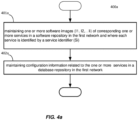
- Figure 4a is a flow chart illustrating a method 400a of provisioning of a software image of a service from a home service to a visited network as executed by the home network in accordance with one embodiment.
- This method may be executed by one or more entities in the home network.
- the steps presented herein may be executed by different entities of the home network or by one entity comprising various functions.
- An example of an entity may be a Network function repository function, NRF, as specified in 5G Core network of 3GPP but enhanced to support the embodiments herein. Other entities may also be used.
- the method 400a comprises the step 401a of maintaining in a software repository one or more software images (I1, I2, ...Ii) of corresponding one or more services and where each service is identified by a service identifier (Si).
- the software images consist of two parts: the base (shared by all/most users of the system) and optional operator specific layers.
- the operator specific layers can contain extensions or modifications to the executable code that provides the service.
- base image could be a minimalistic HTTP server and operator specific addition would add their Python runtime and audio processing codec.
- the base images would be pre-provisioned to all operators using this system and additional layers would be applied when need for them is detected (e.g., a roaming agreement is established).
- the software repository may be maintained by the home network or may be maintained externally in which case it may be shared by many operator's networks.
- the entity in the home network executes the step of storing the data required to configure a software image of a service in a separate database in the home network.
- the home network maintains roaming agreements with one or more visited networks.
- a list of services available or provided by the home network for its users may be published.
- a service description associated with a published service may be included in the publishing step if executed.
- the service description for each service comprises information of associated software image such as the address of the Software repository where the software image is stored, and information related to associated service trigger.
- the software repository may receive a request from a visited network for one or more software images for one or more services identified by the service identifier S1, S2, ...Si.
- the home network provides the requested one or more software images (I1, I2, ...Ii) to the visited network, in particular to the requesting entity in the visited network.
- an entity in the home network provides the configuration information related to the one or more services upon request from the visited network. This would be the case if a particular service is instantiated at the visited network.
- Figure 4b is a flow chart illustrating a method 400b of instantiating a home service in a visited network in accordance with one embodiment.
- This method may be executed by one or more entities in the visited network.
- the following steps may be executed by different entities of the visited network or by one entity comprising various functions.
- An example of an entity may be a Network function repository function, NRF, as specified in 5G Core network of 3GPP but enhanced to support the embodiments herein. Other entities may also be used.
- the method 400b comprises the step 401b of receiving and storing one or more software images (I1, I2, ...) for one or more services of a first network and where each service is identified by a service identifier (Si).
- the one or more software images are received in response to sending a request to the software repository.
- the address of the software repository may be configured in the visited network entity or received by the home network. If the visited network entity received a published list of the one or more service identifiers identifying the home services that can be provided to a user roaming in that visited network, the received service publication may include the associated service description for each service.
- the service description may comprise information related to the associated software image and information related to associated service triggers.
- the address information of the software repository from where to retrieve the software images of the home network may be included in the associated service description information. The retrieval of the software images can be triggered by establishment of the roaming agreements or upon receiving the service publication by the home network.
- the entity in the visited network may execute the step of applying local modifications to the received software images such as adaptation to specific hardware adaptation and store the modified software images I'1, I'2 ... to a local software repository. If no local modification is required, it stores the software images I1, I2, ... as received from the home network.
- the service triggers for instantiating the software image of the service are also stored locally.
- step 402b upon detecting by an entity in the visited network a trigger indicating a request for a service in the home network but for which a software image is available, instantiating the software image of the service in the visited network.
- the entity may execute the step of retrieving from the home network up-to-date configuration data for the instantiated software image of the service.
- the software image of the service Once the software image of the service is configured, it provides the service as if it was provided by the home network. Once the service is provided, the instantiation is removed, hence preventing the associated resources from idling.
- FIG. 5 is a schematic block diagram of a network entity 500 in a first network or second network or serving network according to some embodiments of the present disclosure.
- the network entity 500 includes one or more processors 520 (e.g., Central Processing Units (CPUs), Application Specific Integrated Circuits (ASICs), Digital Signal Processors (DSPs), Field Programmable Gate Arrays (FPGAs), and/or the like), memory 522, and a network interface(s) 524.
- processors 520 e.g., Central Processing Units (CPUs), Application Specific Integrated Circuits (ASICs), Digital Signal Processors (DSPs), Field Programmable Gate Arrays (FPGAs), and/or the like
- memory 522 e.g., RAM, RAM, and/or the like
- FPGAs Field Programmable Gate Arrays
- the functionality of the network node 500 described above may be fully or partially implemented in software that is, e.g., stored in the memory 522 and executed by the processor(s)
- FIG. 6 is a schematic block diagram that illustrates a virtualized embodiment of the network entity 500 according to some embodiments of the present disclosure.
- a "virtualized" network entity 500 is a network entity 500 in which at least a portion of the functionality of the network entity 500 is implemented as a virtual component (e.g., via a virtual machine(s) executing on a physical processing node(s) in a network(s)).
- the network entity 500 includes one or more processing nodes 526 coupled to or included as part of a network(s) 528.
- Each processing node 526 includes one or more processors 530 (e.g., CPUs, ASICs, DSPs, FPGAs, and/or the like), memory 532, and a network interface 534.
- processors 530 e.g., CPUs, ASICs, DSPs, FPGAs, and/or the like
- functions 536 of the network entity 500 whether it is the network entity in the first network or in the second network described herein are implemented at the one or more processing nodes 526 (e.g., distributed across multiple processing nodes 526) in any desired manner.
- some or all of the functions 536 of the network entity 500 described herein are implemented as virtual components executed by one or more virtual machines implemented in a virtual environment(s) hosted by the processing node(s) 526.
- a computer program including instructions which, when executed by the at least one processor 520, 530 causes the at least one processor 520, 530 to carry out the functionality of the network entity 500 or a processing node 526 according to any of the embodiments described herein is provided.
- a carrier containing the aforementioned computer program product is provided.
- the carrier is one of an electronic signal, an optical signal, a radio signal, or a computer readable storage medium (e.g., a non-transitory computer readable medium such as the memory 522, 532).
- FIG. 7 is a schematic block diagram of the network entity 500 according to some other embodiments of the present disclosure.
- the network entity 500 includes one or more modules 538, each of which is implemented in software.
- the module(s) 538 provide the functionality of the network entity 500 described herein in the first network or home network and the network entity 500 in a second network, a serving network or a visited network.
- 3GPP Third Generation Partnership Project • 5G Fifth Generation • AAA Authentication, Authorization, and Accounting • AMF Authentication Management Function • AN Access Network • AUSF Authentication Server Function • COAP Constrained Application Protocol • CPU Central Processing Unit • DHCP Dynamic Host Control Protocol • DSP Digital Signal Processor • IP Internet Protocol • MME Mobility Management Entity • PCF Policy Control function • QoS Quality of Service • RAN Radio Access Network • RFC Request for Comments • SBA Service-Based Architecture • SMF Session Management Function • TS Technical Specification • UE User Equipment
Landscapes
- Engineering & Computer Science (AREA)
- Computer Networks & Wireless Communication (AREA)
- Signal Processing (AREA)
- Databases & Information Systems (AREA)
- Mobile Radio Communication Systems (AREA)
Claims (11)
- Verfahren (400a) zum Bereitstellen eines Softwarebildes (I1, I2, ..., Ii) eines Dienstes von einem Heimdienst an ein Fremdnetz (220), wie durch ein Heimnetz (210) ausgeführt, wobei das Verfahren Folgendes umfasst:- Bewahren (401a), in einem Software-Repository (230), eines oder mehrerer Softwarebilder von einem oder mehreren entsprechenden Diensten, und wobei jeder Dienst durch eine Dienstkennung (Si) identifiziert ist, wobei die Softwarebilder Container gemäß dem Open Network Function Virtualization Forum, OPNFV, sind;- Speichern (402a) von Konfigurationsinformationen, die sich auf den einen oder die mehreren Dienste beziehen, in einem Datenbank-Repository des Heimnetzes; und- Veröffentlichen, an das Fremdnetz, einer Liste des einen oder der mehreren Dienste; und- Bewahren identischer Softwarebilder zwischen dem Heimnetz und dem Fremdnetz.
- Verfahren nach Anspruch 1, wobei die Liste des einen oder der mehreren Dienste eine zugehörige Dienstbeschreibung für jeden Dienst umfasst und die zugehörige Dienstbeschreibung Informationen, die sich auf ein zugehöriges Softwarebild beziehen, und Informationen, die sich auf einen zugehörigen Dienstauslöser (380) beziehen, umfasst.
- Verfahren nach den Ansprüchen 1 und 2, wobei:- das Heimnetz und das Fremdnetz Roaming-Vereinbarungen (300) miteinander aufweisen; oder- das Heimnetz und das Fremdnetz dasselbe sind.
- Verfahren nach Anspruch 1, ferner umfassend Bereitstellen der Konfigurationsinformationen, die sich auf den einen oder die mehreren Dienste beziehen, auf Anforderung von dem Fremdnetz.
- Verfahren (400b) zum Instanziieren eines Heimdienstes in einem Fremdnetz (220), wobei das Verfahren Folgendes umfasst:- Empfangen und Speichern (401b) eines oder mehrerer Softwarebilder (11, I2, ...) für einen oder mehrere Dienste eines Heimnetzes (210), und wobei jeder Dienst durch eine Dienstkennung (Si) identifiziert ist, wobei die Softwarebilder Container gemäß dem Open Network Function Virtualization Forum, OPNFV, sind;- bei Erkennen eines Auslösers, der eine Anforderung eines Dienstes von dem einen oder den mehreren Diensten angibt, Instanziieren (402b) des Softwarebildes des Dienstes in dem Fremdnetz;- Empfangen einer Liste der einen oder mehreren Dienstkennungen von Heimdiensten, wie durch das Heimnetz veröffentlicht; und- Bewahren identischer Softwarebilder zwischen dem Heimnetz und dem Fremdnetz.
- Verfahren nach Anspruch 5, wobei die Liste des einen oder der mehreren Dienste eine zugehörige Dienstbeschreibung für jeden Dienst umfasst und wobei die zugehörige Dienstbeschreibung Informationen, die sich auf ein zugehörigen Softwarebild beziehen, und Informationen, die sich auf einen zugehörigen Dienstauslöser beziehen, umfassen.
- Verfahren nach Anspruch 5 und 6, wobei das Empfangen des einen oder der mehreren Softwarebilder als Reaktion auf Senden (340) einer Anforderung an ein Software-Repository (230) erfolgt, wobei die Anforderung an eine Adresse gesendet wird, die in den durch das Heimnetz veröffentlichten Informationen bereitgestellt ist, die sich auf das zugehörige Softwarebild beziehen.
- Träger, der ein Computerprogramm enthält, umfassend Anweisungen, die bei Ausführung auf mindestens einem Prozessor den mindestens einen Prozessor dazu veranlassen, das Verfahren nach einem der Ansprüche 1 bis 7 auszuführen, wobei der Träger eines von einem elektronischen Signal, einem optischen Signal, einem Funksignal oder einem computerlesbaren Speichermedium ist.
- Entität (500) in einem Heimnetz (210), umfassend:eine Netzschnittstelle (524);einen oder mehrere Prozessoren (520); undeinen Speicher (522), umfassend Anweisungen, die durch den einen oder die mehreren Prozessoren ausführbar sind, wodurch die Entität betreibbar ist, um das Verfahren nach einem der Ansprüche 1 bis 4 durchzuführen.
- Entität (500) eines Fremdnetzes (220), umfassend:eine Netzschnittstelle (524);einen oder mehrere Prozessoren (520); undeinen Speicher (522), der Anweisungen umfasst, die durch den einen oder die mehreren Prozessoren ausführbar sind, wodurch die Entität betreibbar ist, um das Verfahren nach einem der Ansprüche 6 bis 7 durchzuführen.
- Entität nach Anspruch 9 oder 10, wobei die Entität ein Knoten ist, der eine Netz-Repository-Funktions-Entität, NRF, umsetzt.
Applications Claiming Priority (2)
| Application Number | Priority Date | Filing Date | Title |
|---|---|---|---|
| US201762559000P | 2017-09-15 | 2017-09-15 | |
| PCT/IB2018/057124 WO2019053682A1 (en) | 2017-09-15 | 2018-09-17 | CENTRAL NETWORK ARCHITECTURE WITHOUT SERVER |
Publications (2)
| Publication Number | Publication Date |
|---|---|
| EP3682596A1 EP3682596A1 (de) | 2020-07-22 |
| EP3682596B1 true EP3682596B1 (de) | 2024-11-06 |
Family
ID=63915315
Family Applications (1)
| Application Number | Title | Priority Date | Filing Date |
|---|---|---|---|
| EP18789691.5A Active EP3682596B1 (de) | 2017-09-15 | 2018-09-17 | Serverlose kernnetzwerk-architektur |
Country Status (3)
| Country | Link |
|---|---|
| US (1) | US11323868B2 (de) |
| EP (1) | EP3682596B1 (de) |
| WO (1) | WO2019053682A1 (de) |
Families Citing this family (3)
| Publication number | Priority date | Publication date | Assignee | Title |
|---|---|---|---|---|
| WO2020192871A1 (en) * | 2019-03-22 | 2020-10-01 | Telefonaktiebolaget Lm Ericsson (Publ) | Network slice configuration |
| US11736578B2 (en) * | 2021-04-12 | 2023-08-22 | Rakuten Mobile, Inc. | Managing a software application |
| US20250085954A1 (en) * | 2023-09-11 | 2025-03-13 | International Business Machines Corporation | Serverless infrastructure |
Family Cites Families (8)
| Publication number | Priority date | Publication date | Assignee | Title |
|---|---|---|---|---|
| US7778638B2 (en) * | 2006-02-28 | 2010-08-17 | Lg Electronics Inc. | Method of roaming in broadcast service and system and terminal thereof |
| US20100100439A1 (en) * | 2008-06-12 | 2010-04-22 | Dawn Jutla | Multi-platform system apparatus for interoperable, multimedia-accessible and convertible structured and unstructured wikis, wiki user networks, and other user-generated content repositories |
| US9667509B1 (en) * | 2015-01-26 | 2017-05-30 | Amdocs Software Systems Limited | System, method, and computer program for secluding a service in a network based on network function virtualization (NFV) |
| CN104885407A (zh) * | 2013-12-31 | 2015-09-02 | 华为技术有限公司 | 一种网络功能虚拟化nfv故障管理装置、设备及方法 |
| US9565025B2 (en) * | 2014-12-31 | 2017-02-07 | Sap Se | Mediation for provider-specific implementations of roaming protocols for mobile networks |
| US10129108B2 (en) * | 2015-11-13 | 2018-11-13 | Huawei Technologies Co., Ltd. | System and methods for network management and orchestration for network slicing |
| FR3051094A1 (fr) * | 2016-05-04 | 2017-11-10 | Orange | Systeme d'orientation du trafic d'un utilisateur en situation d'itinerance, procedes, entite et plateforme mis en oeuvre dans ce systeme |
| US11153744B2 (en) * | 2016-05-16 | 2021-10-19 | Samsung Electronics Co., Ltd. | Roaming support for next generation slice architecture |
-
2018
- 2018-09-17 US US16/647,346 patent/US11323868B2/en active Active
- 2018-09-17 EP EP18789691.5A patent/EP3682596B1/de active Active
- 2018-09-17 WO PCT/IB2018/057124 patent/WO2019053682A1/en not_active Ceased
Also Published As
| Publication number | Publication date |
|---|---|
| WO2019053682A1 (en) | 2019-03-21 |
| EP3682596A1 (de) | 2020-07-22 |
| US11323868B2 (en) | 2022-05-03 |
| US20210409931A1 (en) | 2021-12-30 |
Similar Documents
| Publication | Publication Date | Title |
|---|---|---|
| US12034611B2 (en) | NF service consumer restart detection using direct signaling between NFs | |
| US11258822B2 (en) | Network function service discovery method and device | |
| US10708376B2 (en) | Message bus service directory | |
| CN104919758B (zh) | 一种由驻留在业务域中的网络设备实施的方法和网络设备 | |
| JP2023535562A (ja) | ネットワーク機能発見サービス向上を提供するための方法、システムおよびコンピュータ読取可能媒体 | |
| US11032685B2 (en) | Service layer mobility management of applications | |
| EP3741085B1 (de) | Netzwerksegmentnutzung | |
| CN114631085B (zh) | 在mpeg nbmp中处理媒体内容的方法、装置及存储介质 | |
| EP3881518A1 (de) | Dienstinstanzanzeige für ressourcenerzeugung | |
| US20210329098A1 (en) | Methods of operating service instance sets and/or set restoration storage resources and related network nodes | |
| CN112262613A (zh) | 用于在基于服务的电信系统中操作网络网关服务的方法和设备 | |
| EP3682596B1 (de) | Serverlose kernnetzwerk-architektur | |
| US20250227461A1 (en) | Base station device and method for operating base station device | |
| WO2023056784A1 (zh) | 数据收集方法、通信装置及通信系统 | |
| US20250193769A1 (en) | Systems and methods for supporting localized services using a multi-operator user equipment route selection policy | |
| US12407610B1 (en) | Routing protocol processing intermediaries for cloud computing environments |
Legal Events
| Date | Code | Title | Description |
|---|---|---|---|
| STAA | Information on the status of an ep patent application or granted ep patent |
Free format text: STATUS: UNKNOWN |
|
| STAA | Information on the status of an ep patent application or granted ep patent |
Free format text: STATUS: THE INTERNATIONAL PUBLICATION HAS BEEN MADE |
|
| PUAI | Public reference made under article 153(3) epc to a published international application that has entered the european phase |
Free format text: ORIGINAL CODE: 0009012 |
|
| STAA | Information on the status of an ep patent application or granted ep patent |
Free format text: STATUS: REQUEST FOR EXAMINATION WAS MADE |
|
| 17P | Request for examination filed |
Effective date: 20200407 |
|
| AK | Designated contracting states |
Kind code of ref document: A1 Designated state(s): AL AT BE BG CH CY CZ DE DK EE ES FI FR GB GR HR HU IE IS IT LI LT LU LV MC MK MT NL NO PL PT RO RS SE SI SK SM TR |
|
| AX | Request for extension of the european patent |
Extension state: BA ME |
|
| DAV | Request for validation of the european patent (deleted) | ||
| DAX | Request for extension of the european patent (deleted) | ||
| STAA | Information on the status of an ep patent application or granted ep patent |
Free format text: STATUS: EXAMINATION IS IN PROGRESS |
|
| 17Q | First examination report despatched |
Effective date: 20210322 |
|
| REG | Reference to a national code |
Ref country code: DE Ref legal event code: R079 Free format text: PREVIOUS MAIN CLASS: H04L0012240000 Ipc: H04L0041505400 Ref document number: 602018076314 Country of ref document: DE |
|
| GRAP | Despatch of communication of intention to grant a patent |
Free format text: ORIGINAL CODE: EPIDOSNIGR1 |
|
| STAA | Information on the status of an ep patent application or granted ep patent |
Free format text: STATUS: GRANT OF PATENT IS INTENDED |
|
| RIC1 | Information provided on ipc code assigned before grant |
Ipc: H04L 41/5054 20220101AFI20240308BHEP |
|
| INTG | Intention to grant announced |
Effective date: 20240409 |
|
| RIN1 | Information on inventor provided before grant (corrected) |
Inventor name: KERAENEN, ARI Inventor name: ARKKO, JARI |
|
| GRAS | Grant fee paid |
Free format text: ORIGINAL CODE: EPIDOSNIGR3 |
|
| GRAA | (expected) grant |
Free format text: ORIGINAL CODE: 0009210 |
|
| STAA | Information on the status of an ep patent application or granted ep patent |
Free format text: STATUS: THE PATENT HAS BEEN GRANTED |
|
| AK | Designated contracting states |
Kind code of ref document: B1 Designated state(s): AL AT BE BG CH CY CZ DE DK EE ES FI FR GB GR HR HU IE IS IT LI LT LU LV MC MK MT NL NO PL PT RO RS SE SI SK SM TR |
|
| REG | Reference to a national code |
Ref country code: GB Ref legal event code: FG4D |
|
| REG | Reference to a national code |
Ref country code: CH Ref legal event code: EP |
|
| REG | Reference to a national code |
Ref country code: DE Ref legal event code: R096 Ref document number: 602018076314 Country of ref document: DE |
|
| REG | Reference to a national code |
Ref country code: IE Ref legal event code: FG4D |
|
| REG | Reference to a national code |
Ref country code: LT Ref legal event code: MG9D |
|
| REG | Reference to a national code |
Ref country code: NL Ref legal event code: MP Effective date: 20241106 |
|
| PG25 | Lapsed in a contracting state [announced via postgrant information from national office to epo] |
Ref country code: PT Free format text: LAPSE BECAUSE OF FAILURE TO SUBMIT A TRANSLATION OF THE DESCRIPTION OR TO PAY THE FEE WITHIN THE PRESCRIBED TIME-LIMIT Effective date: 20250306 Ref country code: IS Free format text: LAPSE BECAUSE OF FAILURE TO SUBMIT A TRANSLATION OF THE DESCRIPTION OR TO PAY THE FEE WITHIN THE PRESCRIBED TIME-LIMIT Effective date: 20250306 Ref country code: HR Free format text: LAPSE BECAUSE OF FAILURE TO SUBMIT A TRANSLATION OF THE DESCRIPTION OR TO PAY THE FEE WITHIN THE PRESCRIBED TIME-LIMIT Effective date: 20241106 |
|
| PG25 | Lapsed in a contracting state [announced via postgrant information from national office to epo] |
Ref country code: FI Free format text: LAPSE BECAUSE OF FAILURE TO SUBMIT A TRANSLATION OF THE DESCRIPTION OR TO PAY THE FEE WITHIN THE PRESCRIBED TIME-LIMIT Effective date: 20241106 Ref country code: NL Free format text: LAPSE BECAUSE OF FAILURE TO SUBMIT A TRANSLATION OF THE DESCRIPTION OR TO PAY THE FEE WITHIN THE PRESCRIBED TIME-LIMIT Effective date: 20241106 |
|
| REG | Reference to a national code |
Ref country code: AT Ref legal event code: MK05 Ref document number: 1740620 Country of ref document: AT Kind code of ref document: T Effective date: 20241106 |
|
| PG25 | Lapsed in a contracting state [announced via postgrant information from national office to epo] |
Ref country code: BG Free format text: LAPSE BECAUSE OF FAILURE TO SUBMIT A TRANSLATION OF THE DESCRIPTION OR TO PAY THE FEE WITHIN THE PRESCRIBED TIME-LIMIT Effective date: 20241106 |
|
| PG25 | Lapsed in a contracting state [announced via postgrant information from national office to epo] |
Ref country code: ES Free format text: LAPSE BECAUSE OF FAILURE TO SUBMIT A TRANSLATION OF THE DESCRIPTION OR TO PAY THE FEE WITHIN THE PRESCRIBED TIME-LIMIT Effective date: 20241106 |
|
| PG25 | Lapsed in a contracting state [announced via postgrant information from national office to epo] |
Ref country code: NO Free format text: LAPSE BECAUSE OF FAILURE TO SUBMIT A TRANSLATION OF THE DESCRIPTION OR TO PAY THE FEE WITHIN THE PRESCRIBED TIME-LIMIT Effective date: 20250206 |
|
| PG25 | Lapsed in a contracting state [announced via postgrant information from national office to epo] |
Ref country code: LV Free format text: LAPSE BECAUSE OF FAILURE TO SUBMIT A TRANSLATION OF THE DESCRIPTION OR TO PAY THE FEE WITHIN THE PRESCRIBED TIME-LIMIT Effective date: 20241106 Ref country code: GR Free format text: LAPSE BECAUSE OF FAILURE TO SUBMIT A TRANSLATION OF THE DESCRIPTION OR TO PAY THE FEE WITHIN THE PRESCRIBED TIME-LIMIT Effective date: 20250207 Ref country code: AT Free format text: LAPSE BECAUSE OF FAILURE TO SUBMIT A TRANSLATION OF THE DESCRIPTION OR TO PAY THE FEE WITHIN THE PRESCRIBED TIME-LIMIT Effective date: 20241106 |
|
| PG25 | Lapsed in a contracting state [announced via postgrant information from national office to epo] |
Ref country code: PL Free format text: LAPSE BECAUSE OF FAILURE TO SUBMIT A TRANSLATION OF THE DESCRIPTION OR TO PAY THE FEE WITHIN THE PRESCRIBED TIME-LIMIT Effective date: 20241106 |
|
| PG25 | Lapsed in a contracting state [announced via postgrant information from national office to epo] |
Ref country code: RS Free format text: LAPSE BECAUSE OF FAILURE TO SUBMIT A TRANSLATION OF THE DESCRIPTION OR TO PAY THE FEE WITHIN THE PRESCRIBED TIME-LIMIT Effective date: 20250206 |
|
| PG25 | Lapsed in a contracting state [announced via postgrant information from national office to epo] |
Ref country code: SM Free format text: LAPSE BECAUSE OF FAILURE TO SUBMIT A TRANSLATION OF THE DESCRIPTION OR TO PAY THE FEE WITHIN THE PRESCRIBED TIME-LIMIT Effective date: 20241106 |
|
| PG25 | Lapsed in a contracting state [announced via postgrant information from national office to epo] |
Ref country code: DK Free format text: LAPSE BECAUSE OF FAILURE TO SUBMIT A TRANSLATION OF THE DESCRIPTION OR TO PAY THE FEE WITHIN THE PRESCRIBED TIME-LIMIT Effective date: 20241106 |
|
| PG25 | Lapsed in a contracting state [announced via postgrant information from national office to epo] |
Ref country code: EE Free format text: LAPSE BECAUSE OF FAILURE TO SUBMIT A TRANSLATION OF THE DESCRIPTION OR TO PAY THE FEE WITHIN THE PRESCRIBED TIME-LIMIT Effective date: 20241106 |
|
| PG25 | Lapsed in a contracting state [announced via postgrant information from national office to epo] |
Ref country code: RO Free format text: LAPSE BECAUSE OF FAILURE TO SUBMIT A TRANSLATION OF THE DESCRIPTION OR TO PAY THE FEE WITHIN THE PRESCRIBED TIME-LIMIT Effective date: 20241106 |
|
| PG25 | Lapsed in a contracting state [announced via postgrant information from national office to epo] |
Ref country code: SK Free format text: LAPSE BECAUSE OF FAILURE TO SUBMIT A TRANSLATION OF THE DESCRIPTION OR TO PAY THE FEE WITHIN THE PRESCRIBED TIME-LIMIT Effective date: 20241106 |
|
| PG25 | Lapsed in a contracting state [announced via postgrant information from national office to epo] |
Ref country code: CZ Free format text: LAPSE BECAUSE OF FAILURE TO SUBMIT A TRANSLATION OF THE DESCRIPTION OR TO PAY THE FEE WITHIN THE PRESCRIBED TIME-LIMIT Effective date: 20241106 |
|
| PG25 | Lapsed in a contracting state [announced via postgrant information from national office to epo] |
Ref country code: IT Free format text: LAPSE BECAUSE OF FAILURE TO SUBMIT A TRANSLATION OF THE DESCRIPTION OR TO PAY THE FEE WITHIN THE PRESCRIBED TIME-LIMIT Effective date: 20241106 |
|
| REG | Reference to a national code |
Ref country code: DE Ref legal event code: R097 Ref document number: 602018076314 Country of ref document: DE |
|
| PG25 | Lapsed in a contracting state [announced via postgrant information from national office to epo] |
Ref country code: SE Free format text: LAPSE BECAUSE OF FAILURE TO SUBMIT A TRANSLATION OF THE DESCRIPTION OR TO PAY THE FEE WITHIN THE PRESCRIBED TIME-LIMIT Effective date: 20241106 |
|
| PLBE | No opposition filed within time limit |
Free format text: ORIGINAL CODE: 0009261 |
|
| STAA | Information on the status of an ep patent application or granted ep patent |
Free format text: STATUS: NO OPPOSITION FILED WITHIN TIME LIMIT |
|
| PGFP | Annual fee paid to national office [announced via postgrant information from national office to epo] |
Ref country code: DE Payment date: 20250929 Year of fee payment: 8 |
|
| 26N | No opposition filed |
Effective date: 20250807 |
|
| PGFP | Annual fee paid to national office [announced via postgrant information from national office to epo] |
Ref country code: GB Payment date: 20250929 Year of fee payment: 8 |