EP3682612B1 - Exploitation de déductions d'environnement réseau et de point d'extrémité pour une classification de trafic de logiciel malveillant - Google Patents
Exploitation de déductions d'environnement réseau et de point d'extrémité pour une classification de trafic de logiciel malveillant Download PDFInfo
- Publication number
- EP3682612B1 EP3682612B1 EP18833352.0A EP18833352A EP3682612B1 EP 3682612 B1 EP3682612 B1 EP 3682612B1 EP 18833352 A EP18833352 A EP 18833352A EP 3682612 B1 EP3682612 B1 EP 3682612B1
- Authority
- EP
- European Patent Office
- Prior art keywords
- data
- environment
- traffic
- malware
- network
- Prior art date
- Legal status (The legal status is an assumption and is not a legal conclusion. Google has not performed a legal analysis and makes no representation as to the accuracy of the status listed.)
- Active
Links
Images



Classifications
-
- H—ELECTRICITY
- H04—ELECTRIC COMMUNICATION TECHNIQUE
- H04L—TRANSMISSION OF DIGITAL INFORMATION, e.g. TELEGRAPHIC COMMUNICATION
- H04L63/00—Network architectures or network communication protocols for network security
- H04L63/14—Network architectures or network communication protocols for network security for detecting or protecting against malicious traffic
- H04L63/1408—Network architectures or network communication protocols for network security for detecting or protecting against malicious traffic by monitoring network traffic
- H04L63/1416—Event detection, e.g. attack signature detection
-
- G—PHYSICS
- G06—COMPUTING OR CALCULATING; COUNTING
- G06F—ELECTRIC DIGITAL DATA PROCESSING
- G06F21/00—Security arrangements for protecting computers, components thereof, programs or data against unauthorised activity
- G06F21/50—Monitoring users, programs or devices to maintain the integrity of platforms, e.g. of processors, firmware or operating systems
- G06F21/52—Monitoring users, programs or devices to maintain the integrity of platforms, e.g. of processors, firmware or operating systems during program execution, e.g. stack integrity ; Preventing unwanted data erasure; Buffer overflow
- G06F21/53—Monitoring users, programs or devices to maintain the integrity of platforms, e.g. of processors, firmware or operating systems during program execution, e.g. stack integrity ; Preventing unwanted data erasure; Buffer overflow by executing in a restricted environment, e.g. sandbox or secure virtual machine
-
- G—PHYSICS
- G06—COMPUTING OR CALCULATING; COUNTING
- G06N—COMPUTING ARRANGEMENTS BASED ON SPECIFIC COMPUTATIONAL MODELS
- G06N20/00—Machine learning
-
- H—ELECTRICITY
- H04—ELECTRIC COMMUNICATION TECHNIQUE
- H04L—TRANSMISSION OF DIGITAL INFORMATION, e.g. TELEGRAPHIC COMMUNICATION
- H04L41/00—Arrangements for maintenance, administration or management of data switching networks, e.g. of packet switching networks
- H04L41/14—Network analysis or design
- H04L41/145—Network analysis or design involving simulating, designing, planning or modelling of a network
-
- H—ELECTRICITY
- H04—ELECTRIC COMMUNICATION TECHNIQUE
- H04L—TRANSMISSION OF DIGITAL INFORMATION, e.g. TELEGRAPHIC COMMUNICATION
- H04L63/00—Network architectures or network communication protocols for network security
- H04L63/04—Network architectures or network communication protocols for network security for providing a confidential data exchange among entities communicating through data packet networks
- H04L63/0428—Network architectures or network communication protocols for network security for providing a confidential data exchange among entities communicating through data packet networks wherein the data content is protected, e.g. by encrypting or encapsulating the payload
-
- H—ELECTRICITY
- H04—ELECTRIC COMMUNICATION TECHNIQUE
- H04L—TRANSMISSION OF DIGITAL INFORMATION, e.g. TELEGRAPHIC COMMUNICATION
- H04L63/00—Network architectures or network communication protocols for network security
- H04L63/14—Network architectures or network communication protocols for network security for detecting or protecting against malicious traffic
- H04L63/1408—Network architectures or network communication protocols for network security for detecting or protecting against malicious traffic by monitoring network traffic
- H04L63/1425—Traffic logging, e.g. anomaly detection
-
- H—ELECTRICITY
- H04—ELECTRIC COMMUNICATION TECHNIQUE
- H04L—TRANSMISSION OF DIGITAL INFORMATION, e.g. TELEGRAPHIC COMMUNICATION
- H04L63/00—Network architectures or network communication protocols for network security
- H04L63/14—Network architectures or network communication protocols for network security for detecting or protecting against malicious traffic
- H04L63/1441—Countermeasures against malicious traffic
- H04L63/1458—Denial of Service
-
- G—PHYSICS
- G06—COMPUTING OR CALCULATING; COUNTING
- G06F—ELECTRIC DIGITAL DATA PROCESSING
- G06F21/00—Security arrangements for protecting computers, components thereof, programs or data against unauthorised activity
- G06F21/60—Protecting data
- G06F21/62—Protecting access to data via a platform, e.g. using keys or access control rules
- G06F21/6218—Protecting access to data via a platform, e.g. using keys or access control rules to a system of files or objects, e.g. local or distributed file system or database
- G06F21/6245—Protecting personal data, e.g. for financial or medical purposes
-
- H—ELECTRICITY
- H04—ELECTRIC COMMUNICATION TECHNIQUE
- H04L—TRANSMISSION OF DIGITAL INFORMATION, e.g. TELEGRAPHIC COMMUNICATION
- H04L63/00—Network architectures or network communication protocols for network security
- H04L63/16—Implementing security features at a particular protocol layer
- H04L63/166—Implementing security features at a particular protocol layer at the transport layer
-
- H—ELECTRICITY
- H04—ELECTRIC COMMUNICATION TECHNIQUE
- H04L—TRANSMISSION OF DIGITAL INFORMATION, e.g. TELEGRAPHIC COMMUNICATION
- H04L67/00—Network arrangements or protocols for supporting network services or applications
- H04L67/01—Protocols
- H04L67/02—Protocols based on web technology, e.g. hypertext transfer protocol [HTTP]
-
- H—ELECTRICITY
- H04—ELECTRIC COMMUNICATION TECHNIQUE
- H04L—TRANSMISSION OF DIGITAL INFORMATION, e.g. TELEGRAPHIC COMMUNICATION
- H04L67/00—Network arrangements or protocols for supporting network services or applications
- H04L67/50—Network services
- H04L67/56—Provisioning of proxy services
-
- H—ELECTRICITY
- H04—ELECTRIC COMMUNICATION TECHNIQUE
- H04L—TRANSMISSION OF DIGITAL INFORMATION, e.g. TELEGRAPHIC COMMUNICATION
- H04L69/00—Network arrangements, protocols or services independent of the application payload and not provided for in the other groups of this subclass
- H04L69/30—Definitions, standards or architectural aspects of layered protocol stacks
- H04L69/32—Architecture of open systems interconnection [OSI] 7-layer type protocol stacks, e.g. the interfaces between the data link level and the physical level
- H04L69/322—Intralayer communication protocols among peer entities or protocol data unit [PDU] definitions
- H04L69/325—Intralayer communication protocols among peer entities or protocol data unit [PDU] definitions in the network layer [OSI layer 3], e.g. X.25
Definitions
- the present disclosure relates generally to computer networks, and, more particularly, to leveraging endpoint and network environment inferences for malware traffic classification.
- Enterprise networks are carrying a very fast growing volume of both business and non-business critical traffic.
- business applications such as video collaboration, cloud applications, etc.
- HTTP hypertext transfer protocol
- HTTPS HTTP secure
- Some network traffic may also be malicious. For example, some traffic may seek to overwhelm a service by sending a large number of requests to the service. Such attacks are also sometimes known as denial of service (DoS) attacks. Other forms of malicious traffic may seek to exfiltrate sensitive information from a network, such as credit card numbers, trade secrets, and the like. Typically, such traffic is generated by a client that has been infected with malware. Thus, further types of malicious network traffic include network traffic that propagate the malware itself and network traffic that passes control commands to already infected devices. However, many instances of malware now use encryption, to conceal their network activity from detection.
- DoS denial of service
- TLS transport layer security
- a device obtains simulation environment data regarding traffic generated within a simulation environment in which malware is executed.
- the device trains a malware detector using the simulation environment data.
- the device obtains deployment environment characteristics of a network to which the malware detector is to be deployed.
- the device configures the malware detector to ignore data in the simulation environment data that is associated with one or more environment characteristics that are not present in the deployment environment characteristics.
- a computer network is a geographically distributed collection of nodes interconnected by communication links and segments for transporting data between end nodes, such as personal computers and workstations, or other devices, such as sensors, etc.
- end nodes such as personal computers and workstations, or other devices, such as sensors, etc.
- LANs local area networks
- WANs wide area networks
- LANs typically connect the nodes over dedicated private communications links located in the same general physical location, such as a building or campus.
- WANs typically connect geographically dispersed nodes over long-distance communications links, such as common carrier telephone lines, optical lightpaths, synchronous optical networks (SONET), or synchronous digital hierarchy (SDH) links, or Powerline Communications (PLC) such as IEEE 61334, IEEE P1901.2, and others.
- PLC Powerline Communications
- the Internet is an example of a WAN that connects disparate networks throughout the world, providing global communication between nodes on various networks.
- the nodes typically communicate over the network by exchanging discrete frames or packets of data according to predefined protocols, such as the Transmission Control Protocol/Internet Protocol (TCP/IP).
- TCP/IP Transmission Control Protocol/Internet Protocol
- a protocol consists of a set of rules defining how the nodes interact with each other.
- Computer networks may further be interconnected by an intermediate network node, such as a router, to extend the effective "size" of each network.
- Smart object networks such as sensor networks, in particular, are a specific type of network having spatially distributed autonomous devices such as sensors, actuators, etc., that cooperatively monitor physical or environmental conditions at different locations, such as, e.g., energy/power consumption, resource consumption (e.g., water/gas/etc. for advanced metering infrastructure or "AMI" applications) temperature, pressure, vibration, sound, radiation, motion, pollutants, etc.
- Other types of smart objects include actuators, e.g., responsible for turning on/off an engine or perform any other actions.
- Sensor networks a type of smart object network, are typically shared-media networks, such as wireless networks.
- each sensor device (node) in a sensor network may generally be equipped with a radio transceiver or other communication port, a microcontroller, and an energy source, such as a battery.
- smart object networks are considered field area networks (FANs), neighborhood area networks (NANs), personal area networks (PANs), etc.
- FANs field area networks
- NANs neighborhood area networks
- PANs personal area networks
- size and cost constraints on smart object nodes result in corresponding constraints on resources such as energy, memory, computational speed and bandwidth.
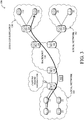
- FIG. 1A is a schematic block diagram of an example computer network 100 illustratively comprising nodes/devices, such as a plurality of routers/devices interconnected by links or networks, as shown.
- customer edge (CE) routers 110 may be interconnected with provider edge (PE) routers 120 (e.g., PE-1, PE-2, and PE-3) in order to communicate across a core network, such as an illustrative network backbone 130.
- PE provider edge
- routers 110, 120 may be interconnected by the public Internet, a multiprotocol label switching (MPLS) virtual private network (VPN), or the like.
- MPLS multiprotocol label switching
- VPN virtual private network
- Data packets 140 may be exchanged among the nodes/devices of the computer network 100 over links using predefined network communication protocols such as the Transmission Control Protocol/Internet Protocol (TCP/IP), User Datagram Protocol (UDP), Asynchronous Transfer Mode (ATM) protocol, Frame Relay protocol, or any other suitable protocol.
- TCP/IP Transmission Control Protocol/Internet Protocol
- UDP User Datagram Protocol
- ATM Asynchronous Transfer Mode
- Frame Relay protocol or any other suitable protocol.
- a router or a set of routers may be connected to a private network (e.g., dedicated leased lines, an optical network, etc.) or a virtual private network (VPN), such as an MPLS VPN, thanks to a carrier network, via one or more links exhibiting very different network and service level agreement characteristics.
- a private network e.g., dedicated leased lines, an optical network, etc.
- VPN virtual private network
- MPLS VPN MPLS VPN
- FIG. 1B illustrates an example of network 100 in greater detail, according to various embodiments.
- network backbone 130 may provide connectivity between devices located in different geographical areas and/or different types of local networks.
- network 100 may comprise local networks 160, 162 that include devices/nodes 10-16 and devices/nodes 18-20, respectively, as well as a data center/cloud environment 150 that includes servers 152-154.
- local networks 160-162 and data center/cloud environment 150 may be located in different geographic locations.
- Servers 152-154 may include, in various embodiments, a network management server (NMS), a dynamic host configuration protocol (DHCP) server, a constrained application protocol (CoAP) server, an outage management system (OMS), an application policy infrastructure controller (APIC), an application server, etc.
- NMS network management server
- DHCP dynamic host configuration protocol
- CoAP constrained application protocol
- OMS outage management system
- APIC application policy infrastructure controller
- network 100 may include any number of local networks, data centers, cloud environments, devices/nodes, servers, etc.
- network 100 may include one or more mesh networks, such as an Internet of Things network.
- Internet of Things or “IoT” refers to uniquely identifiable objects/things and their virtual representations in a network-based architecture.
- IoT Internet of Things
- the next frontier in the evolution of the Internet is the ability to connect more than just computers and communications devices, but rather the ability to connect "objects” in general, such as lights, appliances, vehicles, heating, ventilating, and air-conditioning (HVAC), windows and window shades and blinds, doors, locks, etc.
- HVAC heating, ventilating, and air-conditioning
- the "Internet of Things” thus generally refers to the interconnection of objects (e.g., smart objects), such as sensors and actuators, over a computer network (e.g., via IP), which may be the public Internet or a private network.
- LLCs Low-Power and Lossy Networks
- shared-media mesh networks such as wireless networks, etc.
- LLNs Low-Power and Lossy Networks
- LLN routers typically operate with highly constrained resources, e.g., processing power, memory, and/or energy (battery), and their interconnections are characterized by, illustratively, high loss rates, low data rates, and/or instability.
- LLNs are comprised of anything from a few dozen to thousands or even millions of LLN routers, and support point-to-point traffic (e.g., between devices inside the LLN), point-to-multipoint traffic (e.g., from a central control point such at the root node to a subset of devices inside the LLN), and multipoint-to-point traffic (e.g., from devices inside the LLN towards a central control point).
- an IoT network is implemented with an LLN-like architecture.
- local network 160 may be an LLN in which CE-2 operates as a root node for nodes/devices 10-16 in the local mesh, in some embodiments.
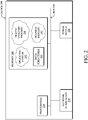
- FIG. 2 is a schematic block diagram of an example node/device 200 that may be used with one or more embodiments described herein, e.g., as any of the computing devices shown in FIGS. 1A-1B , particularly the PE routers 120, CE routers 110, nodes/device 10-20, servers 152-154 (e.g., a network controller located in a data center, etc.), any other computing device that supports the operations of network 100 (e.g., switches, etc.), or any of the other devices referenced below.
- the device 200 may also be any other suitable type of device depending upon the type of network architecture in place, such as IoT nodes, etc.
- Device 200 comprises one or more network interfaces 210, one or more processors 220, and a memory 240 interconnected by a system bus 250, and is powered by a power supply 260.
- the network interfaces 210 include the mechanical, electrical, and signaling circuitry for communicating data over physical links coupled to the network 100.
- the network interfaces may be configured to transmit and/or receive data using a variety of different communication protocols.
- a physical network interface 210 may also be used to implement one or more virtual network interfaces, such as for virtual private network (VPN) access, known to those skilled in the art.
- VPN virtual private network
- the memory 240 comprises a plurality of storage locations that are addressable by the processor(s) 220 and the network interfaces 210 for storing software programs and data structures associated with the embodiments described herein.
- the processor 220 may comprise necessary elements or logic adapted to execute the software programs and manipulate the data structures 245.
- An operating system 242 e.g., the Internetworking Operating System, or IOS®, of Cisco Systems, Inc., another operating system, etc.
- portions of which are typically resident in memory 240 and executed by the processor(s) functionally organizes the node by, inter alia, invoking network operations in support of software processors and/or services executing on the device.
- These software processors and/or services may comprise a traffic analysis process 248 and/or a training process 249.
- processor and memory types including various computer-readable media, may be used to store and execute program instructions pertaining to the techniques described herein.
- description illustrates various processes, it is expressly contemplated that various processes may be embodied as modules configured to operate in accordance with the techniques herein (e.g., according to the functionality of a similar process). Further, while processes may be shown and/or described separately, those skilled in the art will appreciate that processes may be routines or modules within other processes.
- traffic analysis process 248 may execute one or more machine learning-based classifiers to classify encrypted traffic in the network (and its originating application) for any number of purposes.
- traffic analysis process 248 may assess captured telemetry data regarding one or more traffic flows, to determine whether a given traffic flow or set of flows are caused by malware in the network, such as a particular family of malware applications.
- Example forms of traffic that can be caused by malware may include, but are not limited to, traffic flows reporting exfiltrated data to a remote entity, spyware or ransomware-related flows, command and control (C2) traffic that oversees the operation of the deployed malware, traffic that is part of a network attack, such as a zero day attack or denial of service (DoS) attack, combinations thereof, or the like.
- C2 command and control
- traffic analysis process 248 may classify the gathered telemetry data to detect other anomalous behaviors (e.g., malfunctioning devices, misconfigured devices, etc.), traffic pattern changes (e.g., a group of hosts begin sending significantly more or less traffic), or the like.
- anomalous behaviors e.g., malfunctioning devices, misconfigured devices, etc.
- traffic pattern changes e.g., a group of hosts begin sending significantly more or less traffic
- Traffic analysis process 248 may employ any number of machine learning techniques, to classify the gathered telemetry data.
- machine learning is concerned with the design and the development of techniques that receive empirical data as input (e.g., telemetry data regarding traffic in the network) and recognize complex patterns in the input data.
- some machine learning techniques use an underlying model M, whose parameters are optimized for minimizing the cost function associated to M, given the input data.
- the learning process then operates by adjusting the parameters a,b,c such that the number of misclassified points is minimal.
- traffic analysis 248 can use the model M to classify new data points, such as information regarding new traffic flows in the network.
- M is a statistical model, and the cost function is inversely proportional to the likelihood of M, given the input data.
- traffic analysis process 248 may employ one or more supervised, unsupervised, or semi-supervised machine learning models.
- supervised learning entails the use of a training set of data, as noted above, that is used to train the model to apply labels to the input data.
- the training data may include sample telemetry data that is "normal,” or "malware-generated.”
- unsupervised techniques that do not require a training set of labels.
- a supervised learning model may look for previously seen attack patterns that have been labeled as such, an unsupervised model may instead look to whether there are sudden changes in the behavior of the network traffic.
- Semi-supervised learning models take a middle ground approach that uses a greatly reduced set of labeled training data.
- Example machine learning techniques that traffic analysis process 248 can employ may include, but are not limited to, nearest neighbor (NN) techniques (e.g., k-NN models, replicator NN models, etc.), statistical techniques (e.g., Bayesian networks, etc.), clustering techniques (e.g., k-means, mean-shift, etc.), neural networks (e.g., reservoir networks, artificial neural networks, etc.), support vector machines (SVMs), logistic or other regression, Markov models or chains, principal component analysis (PCA) (e.g., for linear models), multi-layer perceptron (MLP) ANNs (e.g., for non-linear models), replicating reservoir networks (e.g., for non-linear models, typically for time series), random forest classification, or the like.
- PCA principal component analysis
- MLP multi-layer perceptron
- ANNs e.g., for non-linear models
- replicating reservoir networks e.g., for non-linear models, typically for
- the performance of a machine learning model can be evaluated in a number of ways based on the number of true positives, false positives, true negatives, and/or false negatives of the model.
- the false positives of the model may refer to the number of traffic flows that are incorrectly classified as malware-generated, anomalous, etc.
- the false negatives of the model may refer to the number of traffic flows that the model incorrectly classifies as normal, when actually malware-generated, anomalous, etc.
- True negatives and positives may refer to the number of traffic flows that the model correctly classifies as normal or malware-generated, etc., respectively.
- recall refers to the ratio of true positives to the sum of true positives and false negatives, which quantifies the sensitivity of the model.
- precision refers to the ratio of true positives the sum of true and false positives.
- traffic analysis process 248 may assess the captured telemetry data on a per-flow basis. In other embodiments, traffic analysis 248 may assess telemetry data for a plurality of traffic flows based on any number of different conditions. For example, traffic flows may be grouped based on their sources, destinations, temporal characteristics (e.g., flows that occur around the same time, etc.), combinations thereof, or based on any other set of flow characteristics.
- various mechanisms can be leveraged to capture information about traffic in a network, such as telemetry data regarding a traffic flow.
- client node 10 initiates a traffic flow with remote server 154 that includes any number of packets 302.
- Any number of networking devices along the path of the flow may analyze and assess packet 302, to capture telemetry data regarding the traffic flow.
- edge router CE-2 through which the traffic between node 10 and server 154 flows.
- a networking device may analyze packet headers, to capture feature information about the traffic flow.
- router CE-2 may capture the source address and/or port of host node 10, the destination address and/or port of server 154, the protocol(s) used by packet 302, or other header information by analyzing the header of a packet 302.
- Example captured features may include, but are not limited to, Transport Layer Security (TLS) information (e.g., from a TLS handshake), such as the ciphersuite offered, user agent, TLS extensions, etc., HTTP information (e.g., URI, etc.), Domain Name System (DNS) information, or any other data features that can be extracted from the observed traffic flow(s).
- TLS Transport Layer Security
- DNS Domain Name System
- the device may also assess the payload of the packet to capture information about the traffic flow.
- router CE-2 or another device may perform deep packet inspection (DPI) on one or more of packets 302, to assess the contents of the packet. Doing so may, for example, yield additional information that can be used to determine the application associated with the traffic flow (e.g., packets 302 were sent by a web browser of node 10, packets 302 were sent by a videoconferencing application, etc.).
- DPI deep packet inspection
- a traffic flow may also be encrypted, thus preventing the device from assessing the actual payload of the packet.
- the networking device that captures the flow telemetry data may also compute any number of statistics or metrics regarding the traffic flow. For example, CE-2 may determine the start time, end time, duration, packet size(s), the distribution of bytes within a flow, etc., associated with the traffic flow by observing packets 302.
- the capturing device may capture sequence of packet lengths and time (SPLT) data regarding the traffic flow, sequence of application lengths and time (SALT) data regarding the traffic flow, or byte distribution (BD) data regarding the traffic flow.
- SPLT packet lengths and time
- SALT application lengths and time
- BD byte distribution
- a malware detector can be trained to detect the presence of malware in a network through analysis of the traffic in the network.
- a trained classifier can implicitly infer and generalize many of the idiosyncrasies found in general network traffic.
- this assumption also fails to take into account that any or all of the following environment characteristics can affect the network traffic itself: the endpoint operating system, TLS library in use, recently seen TLS libraries on a given endpoint, application layer protocol, User-Agent in the case of HTTP, current flow and congestion control parameters, round trip time, proxies in place, information about the collection environment, and/or any other environment conditions that may affect the network traffic.
- differences in these characteristics from the simulation environment used to gather training data and the deployment environment may affect the performance of the resulting malware detector.
- the techniques herein represent a paradigm shift whereby underlying assumptions about the characteristics of the environment are made explicit during generation of the malware detector. Said differently, the techniques herein allow artifacts of the sandbox or other simulation environment to be removed when training a malware detector.
- a device obtains simulation environment data regarding traffic generated within a simulation environment in which malware is executed.
- the device trains a malware detector using the simulation environment data.
- the device obtains deployment environment characteristics of a network to which the malware detector is to be deployed.
- the device configures the malware detector to ignore data in the simulation environment data that is associated with one or more environment characteristics that are not present in the deployment environment characteristics.
- the techniques described herein may be performed by hardware, software, and/or firmware, such as in accordance with the training process 249, which may include computer executable instructions executed by the processor 220 (or independent processor of interfaces 210) to perform functions relating to the techniques described herein, such as in conjunction with the traffic analysis process 248.
- certain factors can affect network traffic such as, but not limited to, the endpoint operating system, TLS library, recently seen TLS libraries on a given endpoint, application layer protocol, User-Agent in the case of HTTP, current flow and congestion control parameters, round trip time, proxies in place, and information about the collection environment.
- the proposed techniques make the underlying assumptions about these features explicit in the malware models.
- FIG. 4 illustrates an example architecture 500 for training a malware detector, according to various embodiments.
- Training process 249 may include any number of sub-processes and/or may access any number of memory locations, such as the components 410-418 shown. As would be appreciated, these sub-processes and/or memory locations may be located on the same device or implemented in a distributed manner across multiple devices, the combination of which may be viewed as a single system/device that executes training process 249. Further, while certain functionalities are described with respect to the sub-processes and memory locations, these functions can be added, removed, or combined as desire, in other implementations.
- training data for training a malware detector that assesses network traffic may be obtained by executing one or more malware samples and capturing information about the resulting traffic flows.
- a malware sample 404 may be executed in a simulation environment 402.
- simulation environment 402 may be any form of contained or restricted environment, such as a sandbox network.
- malware sample 404 may be executed within a virtual machine (VM), so as not to generate malicious traffic in a user network.
- VM virtual machine
- simulation environment data 406 may be captured and provided to training process 249.
- simulation environment data 406 may comprise any or all of the following:
- environment data analyzer 410 may extract out the indicated environment characteristics from simulation environment data 406 and store them in an environment characteristics database 412. In addition, environment data analyzer 410 may extract out the traffic data from simulation environment data 406 for inclusion in training data 414.
- training data 414 may also be labeled, accordingly, based on whether the corresponding traffic is benign or malicious. For example, some or all of the traffic generated by malware sample 404 may be labeled as malware-generated, for purposes of constructing the set of training data 414. In more complex cases, the type of malware used for malware sample 404 may also be included as a label in training data 414.
- Such information can be used to construct a malware detector 418 that is able to not only distinguish between benign and malicious traffic, but also assess the specific type of malware that generated the malicious traffic.
- Training engine 416 may use training data 414 to train one or more traffic classifiers for use in malware detector 418.
- malware detector 418 may comprise one or more machine learning-based classifiers that may assess one or more features of an observed traffic flow or set of traffic flows, to discern whether the traffic is indicative of a malware infection. For example, in the case of an encrypted traffic flow, features such as SPLT information can be used to detect flows that are associated with malware.
- training process 249 can then deploy malware detector 418 to the deployment environment by either executing malware detector 418 on the local device of training process 249 or by sending malware detector 418 to a hosting device in the deployment network.
- training process 249 may also be configured to remove artifacts that were present in simulation environment 402 that are not present in the target environment/network to which malware detector 418 is to be deployed. Said differently, training process 249 may configure malware detector 418 to ignore data in simulation environment data 406 that is associated with one or more environment characteristics that are not present in the deployment environment characteristics. Accordingly, training process 249 may obtain deployment environment data 408 from the target environment (e.g., by requesting such data or receiving it on a push basis).
- deployment environment data 408 may include any or all of the types of information highlighted above with respect to simulation environment data 406.
- deployment environment data 408 may indicate the operating systems, libraries, or the like, in use by the endpoint devices in the target network to which malware detector 418 is to be deployed.
- environment data analyzer 410 may analyze the deployment environment data 408, extract out the environment characteristics included therein, and use these characteristics to populate environment characteristics database 412.
- malware detector 418 includes a proxy that modifies the HTTP headers of traffic in the network.
- training malware detector 418 using training data 414 from simulation environment 402 to assess HTTP header information may not result in an optimal malware detector for the deployment environment.
- training engine 416 may configure the traffic classifier(s) of malware detector 418 to ignore these features during execution in the deployment environment.
- deployment environment data 408 indicates the various characteristics of the endpoint devices in the network to which malware detector 418 is to be deployed.
- training engine 416 may use the training data 414 having associated characteristics in database 412 that match those of the deployment environment. For example, training engine 416 may train one or more traffic classifiers in malware detector 418 for each endpoint device/host type in the deployment network.
- a set of classifiers and/or rules may be used to first identify the environment characteristics.
- the outputs of such an assessment may be used to normalize the observed flow features or may be used as input to the other classifiers in malware detector 418.
- training engine 416 trains a number of classifiers or establishes a number of rules to distinguish between different libraries, operating systems, or other environment characteristics found in simulation environment 402.
- These classifiers and/or rules can then be deployed to the target environment, to identify the environment characteristics of the deployment environment (e.g., which libraries are used by the hosts in the target network, etc.).
- training engine 416 may configure malware detector 418 to ignore any differences in the libraries, operating systems, or the like, between the deployment environment and simulation environment 402.
- Training engine 416 may take any number of steps, to configure malware detector 418 to ignore any differences between the characteristics of the deployment environment and of simulation environment 402. For example, training engine 416 may modify training data 414 to remove the differences and train malware detector 418, accordingly. In another example, training engine 416 may select a combination of libraries from simulation environment 402 that would work in the deployment environment and select the appropriate training data 414 with which to train malware detector 418. In yet another case, training engine 416 may simply prevent any classifiers from inclusion in malware detector 418 that were trained based on the libraries, operating systems, etc., that are not in the deployment environment.
- training engine 416 may use transfer learning, to train malware detector 418 to ignore artifacts from simulation environment 402.
- transfer learning is a branch of machine learning that entails using knowledge obtained when solving one problem to solve a related problem. For example, a model pre-trained to address one classification problem can be used as the basis for another model that seeks to address a related classification problem.
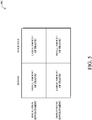
- FIG. 5 illustrates an example of traffic volume breakdowns, in various embodiments.
- traffic volume breakdowns there are a number of observations that can be made, when assessing the traffic data captured from a simulation environment and from a deployment environment.
- a large amount of malicious traffic will be observed.
- a small amount of benign traffic may also be observed.
- some malware may attempt to conceal its activities by also generating benign traffic.
- there is a large amount of benign traffic with possibly a much smaller amount of malicious traffic.
- transfer learning can be used to train a malware detector by first training two different classifiers: 1.) A classifier that distinguishes between benign and malicious traffic, and 2.) a classifier that distinguishes between traffic in the simulation environment and traffic in the deployment environment.
- transfer learning can be applied to improve one of these classifiers by leveraging the other classifier.
- this classifier can be used to improve the benign vs. malicious traffic classifier, in accordance with one or more suitable objective functions.
- Such an objective function may, e.g., represent an optimization problem that seeks to maximize a convex combination of the accuracies of the two classifiers.
- training engine 416 shown in FIG. 4 can train malware detector 418 using the environment data 406 and 408 from both the simulation and deployment environments.
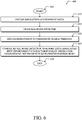
- FIG. 6 illustrates an example simplified procedure for training a malware detector in a network in accordance with one or more embodiments described herein.
- a non-generic, specifically configured device e.g., device 200
- the procedure 600 may start at step 605, and continues to step 610, where, as described in greater detail above, the device may obtain simulation environment data regarding traffic generated within a simulation environment in which malware is executed.
- one or more malware samples may be executed in a simulation environment, such as one or more virtual machines, and the resulting traffic data collected.
- the simulation environment data may indicate the environment characteristics of the simulation environment such as, but not limited to, the operating system(s) that were used, the (TLS) libraries that were used, application layer protocol(s) used, HTTP user agent information, flow and congestion control parameters, round trip time, proxies in place, and/or any other information about the collection environment. Note that some or all of this information may be inferred directly from the captured traffic information or indicated separately.
- the device may train a malware detector using the simulation environment data.
- the simulation environment data may be labeled as benign or malicious and the device may train one or more machine learning-based traffic classifiers, to distinguish between malicious and benign traffic.
- the device may obtain deployment environment characteristics of a network to which the malware detector is to be deployed, as described in greater detail above. These environment characteristics may be the same type of characteristics obtained in step 610, such as the operating systems, libraries, etc., that are in use in the deployment environment/network. In some embodiments, the obtained deployment environment characteristics may be inferred from traffic data captured in the deployment environment.
- the device may configure the malware detector to ignore data in the simulation environment data that is associated with one or more environment characteristics that are not present in the deployment environment characteristics.
- the device may configure the malware detector to ignore those environment characteristics/artifacts from the sandbox environment that are not actually found in the deployment environment.
- the detector may ignore the data associated with the simulation environment by filtering out statistical patterns or artifacts that are generated by the simulated environment and not by the malware.
- the device may exclude such data from inclusion in the training data with which the malware detector is trained, tailor the malware detector to the specific combination of characteristics for the hosts in the deployment network, or the like.
- Procedure 600 then ends at step 630.
- procedure 600 may be optional as described above, the steps shown in FIG. 6 are merely examples for illustration, and certain other steps may be included or excluded as desired. Further, while a particular order of the steps is shown, this ordering is merely illustrative, and any suitable arrangement of the steps may be utilized without departing from the scope of the embodiments herein.
- the techniques described herein therefore, allow for the training of a more accurate malware detector by removing artifacts from the simulation environment from consideration by the malware detector during deployment.
Landscapes
- Engineering & Computer Science (AREA)
- Computer Security & Cryptography (AREA)
- General Engineering & Computer Science (AREA)
- Computer Networks & Wireless Communication (AREA)
- Signal Processing (AREA)
- Computer Hardware Design (AREA)
- Computing Systems (AREA)
- Software Systems (AREA)
- Theoretical Computer Science (AREA)
- Physics & Mathematics (AREA)
- General Physics & Mathematics (AREA)
- Computer Vision & Pattern Recognition (AREA)
- Data Mining & Analysis (AREA)
- Evolutionary Computation (AREA)
- Medical Informatics (AREA)
- Artificial Intelligence (AREA)
- Mathematical Physics (AREA)
- Data Exchanges In Wide-Area Networks (AREA)
Claims (11)
- Procédé consistant à :obtenir, par un dispositif, des données d'environnement de simulation (406) concernant un trafic généré dans un environnement de simulation (402) où un logiciel malveillant est exécuté ;entraîner, par le dispositif, un détecteur de logiciel malveillant (418) au moyen des données d'environnement de simulation (406) ;obtenir (408), par le dispositif, des caractéristiques d'environnement de déploiement (412) d'un réseau sur lequel le détecteur de logiciel malveillant (418) doit être déployé ; etconfigurer, par le dispositif, le détecteur de logiciel malveillant (418) pour ignorer, parmi les données d'environnement de simulation (406), des données qui sont associées à une ou plusieurs caractéristiques d'environnement (412) qui ne sont pas présentes parmi les caractéristiques d'environnement de déploiement.
- Procédé selon la revendication 1, dans lequel la ou les caractéristiques d'environnement (412) comprennent au moins une des caractéristiques suivantes : un système d'exploitation de terminal, une bibliothèque de sécurité de couche transport (TLS) et un agent d'utilisateur sur protocole de transfert hypertexte (HTTP).
- Procédé selon la revendication 1 ou 2, dans lequel la ou les caractéristiques d'environnement (412) comprennent au moins une des caractéristiques suivantes : un protocole de couche application, un paramètre de contrôle de flux ou de congestion et un serveur mandataire de réseau.
- Procédé selon l'une quelconque des revendications 1 à 3, dans lequel le trafic généré dans un environnement de simulation (402) comprend un trafic crypté.
- Procédé selon l'une quelconque des revendications 1 à 4, dans lequel la configuration du détecteur de logiciel malveillant (418) pour ignorer, parmi les données d'environnement de simulation (406), des données qui sont associées à la ou aux caractéristiques d'environnement qui ne sont pas présentes parmi les caractéristiques d'environnement de déploiement (412) consiste à :entraîner, par le dispositif, un premier classificateur pour faire la distinction entre un trafic malveillant et un trafic bénin, au moyen des données d'environnement de simulation (406) et des données d'environnement de déploiement (408) concernant un trafic généré dans le réseau sur lequel le détecteur de logiciel malveillant doit être déployé ;entraîner, par le dispositif, un second classificateur pour faire la distinction entre un trafic d'environnement de simulation et un trafic d'environnement de déploiement, au moyen des données d'environnement de simulation et des données d'environnement de déploiement ; etutiliser, par le dispositif, un apprentissage de transfert pour entraîner le détecteur de logiciel malveillant sur la base des premier et second classificateurs.
- Procédé selon l'une quelconque des revendications 1 à 5, dans lequel l'entraînement du détecteur de logiciel malveillant (418) au moyen des données d'environnement de simulation consiste à :entraîner, par le dispositif, une pluralité de classificateurs de trafic pour différentes combinaisons de caractéristiques d'environnement de l'environnement de simulation (402) ; etdans lequel la configuration du détecteur de logiciel malveillant (418) pour ignorer, parmi les données d'environnement de simulation (406), des données qui sont associées à la ou aux caractéristiques d'environnement (412) qui ne sont pas présentes parmi les caractéristiques d'environnement de déploiement consiste à :utiliser, par le dispositif, les classificateurs de trafic pour identifier une partie des données d'environnement de simulation et empêcher qu'elle ne soit utilisée comme données d'entraînement pour le détecteur de logiciel malveillant.
- Procédé selon l'une quelconque des revendications 1 à 6, dans lequel la configuration du détecteur de logiciel malveillant (418) pour ignorer, parmi les données d'environnement de simulation (406), des données qui sont associées à une ou plusieurs caractéristiques d'environnement (412) qui ne sont pas présentes parmi les caractéristiques d'environnement de déploiement consiste à :
configurer, par le dispositif, le détecteur de logiciel malveillant (418) pour identifier la ou les caractéristiques d'environnement au moyen d'une ou plusieurs règles ou d'un ou plusieurs classificateurs de trafic. - Procédé selon l'une quelconque des revendications 1 à 7, dans lequel le détecteur de logiciel malveillant (418) ignore les données associées à l'environnement de simulation (402) en filtrant des modèles ou des artéfacts statistiques qui sont générés par l'environnement simulé et pas par le logiciel malveillant.
- Appareil, comprenant :un moyen permettant d'obtenir, par un dispositif, des données d'environnement de simulation (406) concernant un trafic généré dans un environnement de simulation (402) où un logiciel malveillant est exécuté ;un moyen permettant d'entraîner, par le dispositif, un détecteur de logiciel malveillant (418) au moyen des données d'environnement de simulation (406) ;un moyen permettant d'obtenir (408), par le dispositif, des caractéristiques d'environnement de déploiement (412) d'un réseau sur lequel le détecteur de logiciel malveillant (418) doit être déployé ; etun moyen permettant de configurer, par le dispositif, le détecteur de logiciel malveillant (418) pour ignorer, parmi les données d'environnement de simulation (406), des données qui sont associées à une ou plusieurs caractéristiques d'environnement (412) qui ne sont pas présentes parmi les caractéristiques d'environnement de déploiement.
- Appareil selon la revendication 9, comprenant en outre un moyen permettant de mettre en œuvre le procédé selon l'une quelconque des revendications 2 à 8.
- Programme informatique, produit de programme informatique ou support lisible par ordinateur comprenant des instructions qui, lorsqu'elles sont exécutées par un ordinateur, amènent l'ordinateur à réaliser les étapes du procédé selon l'une quelconque des revendications 1 à 8.
Applications Claiming Priority (2)
| Application Number | Priority Date | Filing Date | Title |
|---|---|---|---|
| US15/851,918 US10855698B2 (en) | 2017-12-22 | 2017-12-22 | Leveraging endpoint and network environment inferences for malware traffic classification |
| PCT/US2018/064688 WO2019125799A1 (fr) | 2017-12-22 | 2018-12-10 | Exploitation de déductions d'environnement réseau et de point d'extrémité pour une classification de trafic de logiciel malveillant |
Publications (2)
| Publication Number | Publication Date |
|---|---|
| EP3682612A1 EP3682612A1 (fr) | 2020-07-22 |
| EP3682612B1 true EP3682612B1 (fr) | 2021-02-17 |
Family
ID=65012078
Family Applications (1)
| Application Number | Title | Priority Date | Filing Date |
|---|---|---|---|
| EP18833352.0A Active EP3682612B1 (fr) | 2017-12-22 | 2018-12-10 | Exploitation de déductions d'environnement réseau et de point d'extrémité pour une classification de trafic de logiciel malveillant |
Country Status (3)
| Country | Link |
|---|---|
| US (1) | US10855698B2 (fr) |
| EP (1) | EP3682612B1 (fr) |
| WO (1) | WO2019125799A1 (fr) |
Families Citing this family (20)
| Publication number | Priority date | Publication date | Assignee | Title |
|---|---|---|---|---|
| US11271833B2 (en) * | 2017-10-23 | 2022-03-08 | Cisco Technology, Inc. | Training a network traffic classifier using training data enriched with contextual bag information |
| US20190362075A1 (en) * | 2018-05-22 | 2019-11-28 | Fortinet, Inc. | Preventing users from accessing infected files by using multiple file storage repositories and a secure data transfer agent logically interposed therebetween |
| US10855702B2 (en) | 2018-06-06 | 2020-12-01 | Reliaquest Holdings, Llc | Threat mitigation system and method |
| US11709946B2 (en) * | 2018-06-06 | 2023-07-25 | Reliaquest Holdings, Llc | Threat mitigation system and method |
| US11036856B2 (en) | 2018-09-16 | 2021-06-15 | Fortinet, Inc. | Natively mounting storage for inspection and sandboxing in the cloud |
| USD926810S1 (en) | 2019-06-05 | 2021-08-03 | Reliaquest Holdings, Llc | Display screen or portion thereof with a graphical user interface |
| USD926809S1 (en) | 2019-06-05 | 2021-08-03 | Reliaquest Holdings, Llc | Display screen or portion thereof with a graphical user interface |
| USD926782S1 (en) | 2019-06-06 | 2021-08-03 | Reliaquest Holdings, Llc | Display screen or portion thereof with a graphical user interface |
| USD926200S1 (en) | 2019-06-06 | 2021-07-27 | Reliaquest Holdings, Llc | Display screen or portion thereof with a graphical user interface |
| USD926811S1 (en) | 2019-06-06 | 2021-08-03 | Reliaquest Holdings, Llc | Display screen or portion thereof with a graphical user interface |
| CN112235230B (zh) * | 2019-07-15 | 2023-05-02 | 北京观成科技有限公司 | 一种恶意流量识别方法及系统 |
| US20210037040A1 (en) * | 2019-07-29 | 2021-02-04 | The Toronto-Dominion Bank | Intelligent security automation and continuous verification and response platform |
| US11477164B2 (en) | 2019-12-12 | 2022-10-18 | Visa International Service Association | Method, system, and computer program product for preventing transmission of malicious data |
| US11665180B2 (en) | 2020-02-28 | 2023-05-30 | International Business Machines Corporation | Artificially intelligent security incident and event management |
| US11632393B2 (en) * | 2020-10-16 | 2023-04-18 | International Business Machines Corporation | Detecting and mitigating malware by evaluating HTTP errors |
| US11689510B2 (en) * | 2020-12-08 | 2023-06-27 | TrustFour Technologies, Inc. | Cryptographic platform system and method |
| CN114070625A (zh) * | 2021-11-16 | 2022-02-18 | 北京华云安信息技术有限公司 | 模拟流量产生方法、装置、设备和存储介质 |
| CN115150181B (zh) * | 2022-07-20 | 2025-02-11 | 杭州电子科技大学 | 基于精细化统计特征分析的伪造恶意加密流量检测方法 |
| CN115277587B (zh) * | 2022-07-29 | 2023-10-31 | 中国电信股份有限公司 | 网络流量识别方法、装置、设备及介质 |
| CN115632875B (zh) * | 2022-11-29 | 2023-04-07 | 湖北省楚天云有限公司 | 一种多特征融合实时分析的恶意流量检测方法及系统 |
Family Cites Families (7)
| Publication number | Priority date | Publication date | Assignee | Title |
|---|---|---|---|---|
| US9021589B2 (en) | 2012-06-05 | 2015-04-28 | Los Alamos National Security, Llc | Integrating multiple data sources for malware classification |
| CN105247532B (zh) * | 2013-03-18 | 2019-05-31 | 纽约市哥伦比亚大学理事会 | 使用硬件特征的对异常进程的无监督的检测 |
| US9489514B2 (en) | 2013-10-11 | 2016-11-08 | Verisign, Inc. | Classifying malware by order of network behavior artifacts |
| US9769189B2 (en) | 2014-02-21 | 2017-09-19 | Verisign, Inc. | Systems and methods for behavior-based automated malware analysis and classification |
| US9516054B2 (en) * | 2014-04-14 | 2016-12-06 | Trap Data Security Ltd. | System and method for cyber threats detection |
| US10320813B1 (en) * | 2015-04-30 | 2019-06-11 | Amazon Technologies, Inc. | Threat detection and mitigation in a virtualized computing environment |
| US10187401B2 (en) | 2015-11-06 | 2019-01-22 | Cisco Technology, Inc. | Hierarchical feature extraction for malware classification in network traffic |
-
2017
- 2017-12-22 US US15/851,918 patent/US10855698B2/en active Active
-
2018
- 2018-12-10 WO PCT/US2018/064688 patent/WO2019125799A1/fr not_active Ceased
- 2018-12-10 EP EP18833352.0A patent/EP3682612B1/fr active Active
Non-Patent Citations (1)
| Title |
|---|
| None * |
Also Published As
| Publication number | Publication date |
|---|---|
| US20190199739A1 (en) | 2019-06-27 |
| EP3682612A1 (fr) | 2020-07-22 |
| WO2019125799A1 (fr) | 2019-06-27 |
| US10855698B2 (en) | 2020-12-01 |
Similar Documents
| Publication | Publication Date | Title |
|---|---|---|
| EP3682612B1 (fr) | Exploitation de déductions d'environnement réseau et de point d'extrémité pour une classification de trafic de logiciel malveillant | |
| EP3331214B1 (fr) | Utilisation de données de trafic synthétiques pour l'entraînement de classificateurs de trafic | |
| EP3679505B1 (fr) | Cadre de sondage semi-actif pour recevoir une intelligence de menace pour un trafic crypte et apprendre sur les dispositifs | |
| US12438892B2 (en) | Correlating endpoint and network views to identify evasive applications | |
| US11201877B2 (en) | Detecting encrypted malware with SPLT-based deep networks | |
| US10785247B2 (en) | Service usage model for traffic analysis | |
| US20200236131A1 (en) | Protecting endpoints with patterns from encrypted traffic analytics | |
| EP3346667A1 (fr) | Formation d'un analyseur de la circulation de réseau basée sur l'apprentissage par machine à l'aide d'un ensemble de données de prototype | |
| US10897474B2 (en) | Adapting classifier parameters for improved network traffic classification using distinct private training data sets | |
| US11310205B2 (en) | Detecting evasive network behaviors using machine learning | |
| US12531790B2 (en) | Automatically detecting authorized remote administration sessions in a network monitoring system |
Legal Events
| Date | Code | Title | Description |
|---|---|---|---|
| STAA | Information on the status of an ep patent application or granted ep patent |
Free format text: STATUS: UNKNOWN |
|
| STAA | Information on the status of an ep patent application or granted ep patent |
Free format text: STATUS: THE INTERNATIONAL PUBLICATION HAS BEEN MADE |
|
| PUAI | Public reference made under article 153(3) epc to a published international application that has entered the european phase |
Free format text: ORIGINAL CODE: 0009012 |
|
| STAA | Information on the status of an ep patent application or granted ep patent |
Free format text: STATUS: REQUEST FOR EXAMINATION WAS MADE |
|
| 17P | Request for examination filed |
Effective date: 20200414 |
|
| AK | Designated contracting states |
Kind code of ref document: A1 Designated state(s): AL AT BE BG CH CY CZ DE DK EE ES FI FR GB GR HR HU IE IS IT LI LT LU LV MC MK MT NL NO PL PT RO RS SE SI SK SM TR |
|
| AX | Request for extension of the european patent |
Extension state: BA ME |
|
| GRAP | Despatch of communication of intention to grant a patent |
Free format text: ORIGINAL CODE: EPIDOSNIGR1 |
|
| STAA | Information on the status of an ep patent application or granted ep patent |
Free format text: STATUS: GRANT OF PATENT IS INTENDED |
|
| DAV | Request for validation of the european patent (deleted) | ||
| DAX | Request for extension of the european patent (deleted) | ||
| INTG | Intention to grant announced |
Effective date: 20200827 |
|
| GRAS | Grant fee paid |
Free format text: ORIGINAL CODE: EPIDOSNIGR3 |
|
| GRAA | (expected) grant |
Free format text: ORIGINAL CODE: 0009210 |
|
| STAA | Information on the status of an ep patent application or granted ep patent |
Free format text: STATUS: THE PATENT HAS BEEN GRANTED |
|
| AK | Designated contracting states |
Kind code of ref document: B1 Designated state(s): AL AT BE BG CH CY CZ DE DK EE ES FI FR GB GR HR HU IE IS IT LI LT LU LV MC MK MT NL NO PL PT RO RS SE SI SK SM TR |
|
| REG | Reference to a national code |
Ref country code: GB Ref legal event code: FG4D |
|
| REG | Reference to a national code |
Ref country code: CH Ref legal event code: EP |
|
| REG | Reference to a national code |
Ref country code: DE Ref legal event code: R096 Ref document number: 602018012803 Country of ref document: DE |
|
| REG | Reference to a national code |
Ref country code: AT Ref legal event code: REF Ref document number: 1362993 Country of ref document: AT Kind code of ref document: T Effective date: 20210315 |
|
| REG | Reference to a national code |
Ref country code: IE Ref legal event code: FG4D |
|
| REG | Reference to a national code |
Ref country code: LT Ref legal event code: MG9D |
|
| REG | Reference to a national code |
Ref country code: NL Ref legal event code: MP Effective date: 20210217 |
|
| PG25 | Lapsed in a contracting state [announced via postgrant information from national office to epo] |
Ref country code: BG Free format text: LAPSE BECAUSE OF FAILURE TO SUBMIT A TRANSLATION OF THE DESCRIPTION OR TO PAY THE FEE WITHIN THE PRESCRIBED TIME-LIMIT Effective date: 20210517 Ref country code: FI Free format text: LAPSE BECAUSE OF FAILURE TO SUBMIT A TRANSLATION OF THE DESCRIPTION OR TO PAY THE FEE WITHIN THE PRESCRIBED TIME-LIMIT Effective date: 20210217 Ref country code: GR Free format text: LAPSE BECAUSE OF FAILURE TO SUBMIT A TRANSLATION OF THE DESCRIPTION OR TO PAY THE FEE WITHIN THE PRESCRIBED TIME-LIMIT Effective date: 20210518 Ref country code: HR Free format text: LAPSE BECAUSE OF FAILURE TO SUBMIT A TRANSLATION OF THE DESCRIPTION OR TO PAY THE FEE WITHIN THE PRESCRIBED TIME-LIMIT Effective date: 20210217 Ref country code: LT Free format text: LAPSE BECAUSE OF FAILURE TO SUBMIT A TRANSLATION OF THE DESCRIPTION OR TO PAY THE FEE WITHIN THE PRESCRIBED TIME-LIMIT Effective date: 20210217 Ref country code: PT Free format text: LAPSE BECAUSE OF FAILURE TO SUBMIT A TRANSLATION OF THE DESCRIPTION OR TO PAY THE FEE WITHIN THE PRESCRIBED TIME-LIMIT Effective date: 20210617 Ref country code: NO Free format text: LAPSE BECAUSE OF FAILURE TO SUBMIT A TRANSLATION OF THE DESCRIPTION OR TO PAY THE FEE WITHIN THE PRESCRIBED TIME-LIMIT Effective date: 20210517 |
|
| REG | Reference to a national code |
Ref country code: AT Ref legal event code: MK05 Ref document number: 1362993 Country of ref document: AT Kind code of ref document: T Effective date: 20210217 |
|
| PG25 | Lapsed in a contracting state [announced via postgrant information from national office to epo] |
Ref country code: SE Free format text: LAPSE BECAUSE OF FAILURE TO SUBMIT A TRANSLATION OF THE DESCRIPTION OR TO PAY THE FEE WITHIN THE PRESCRIBED TIME-LIMIT Effective date: 20210217 Ref country code: NL Free format text: LAPSE BECAUSE OF FAILURE TO SUBMIT A TRANSLATION OF THE DESCRIPTION OR TO PAY THE FEE WITHIN THE PRESCRIBED TIME-LIMIT Effective date: 20210217 Ref country code: RS Free format text: LAPSE BECAUSE OF FAILURE TO SUBMIT A TRANSLATION OF THE DESCRIPTION OR TO PAY THE FEE WITHIN THE PRESCRIBED TIME-LIMIT Effective date: 20210217 Ref country code: LV Free format text: LAPSE BECAUSE OF FAILURE TO SUBMIT A TRANSLATION OF THE DESCRIPTION OR TO PAY THE FEE WITHIN THE PRESCRIBED TIME-LIMIT Effective date: 20210217 Ref country code: PL Free format text: LAPSE BECAUSE OF FAILURE TO SUBMIT A TRANSLATION OF THE DESCRIPTION OR TO PAY THE FEE WITHIN THE PRESCRIBED TIME-LIMIT Effective date: 20210217 |
|
| PG25 | Lapsed in a contracting state [announced via postgrant information from national office to epo] |
Ref country code: IS Free format text: LAPSE BECAUSE OF FAILURE TO SUBMIT A TRANSLATION OF THE DESCRIPTION OR TO PAY THE FEE WITHIN THE PRESCRIBED TIME-LIMIT Effective date: 20210617 |
|
| PG25 | Lapsed in a contracting state [announced via postgrant information from national office to epo] |
Ref country code: CZ Free format text: LAPSE BECAUSE OF FAILURE TO SUBMIT A TRANSLATION OF THE DESCRIPTION OR TO PAY THE FEE WITHIN THE PRESCRIBED TIME-LIMIT Effective date: 20210217 Ref country code: EE Free format text: LAPSE BECAUSE OF FAILURE TO SUBMIT A TRANSLATION OF THE DESCRIPTION OR TO PAY THE FEE WITHIN THE PRESCRIBED TIME-LIMIT Effective date: 20210217 Ref country code: SM Free format text: LAPSE BECAUSE OF FAILURE TO SUBMIT A TRANSLATION OF THE DESCRIPTION OR TO PAY THE FEE WITHIN THE PRESCRIBED TIME-LIMIT Effective date: 20210217 Ref country code: AT Free format text: LAPSE BECAUSE OF FAILURE TO SUBMIT A TRANSLATION OF THE DESCRIPTION OR TO PAY THE FEE WITHIN THE PRESCRIBED TIME-LIMIT Effective date: 20210217 |
|
| REG | Reference to a national code |
Ref country code: DE Ref legal event code: R097 Ref document number: 602018012803 Country of ref document: DE |
|
| REG | Reference to a national code |
Ref country code: DE Ref legal event code: R079 Ref document number: 602018012803 Country of ref document: DE Free format text: PREVIOUS MAIN CLASS: H04L0029060000 Ipc: H04L0065000000 |
|
| PG25 | Lapsed in a contracting state [announced via postgrant information from national office to epo] |
Ref country code: DK Free format text: LAPSE BECAUSE OF FAILURE TO SUBMIT A TRANSLATION OF THE DESCRIPTION OR TO PAY THE FEE WITHIN THE PRESCRIBED TIME-LIMIT Effective date: 20210217 Ref country code: SK Free format text: LAPSE BECAUSE OF FAILURE TO SUBMIT A TRANSLATION OF THE DESCRIPTION OR TO PAY THE FEE WITHIN THE PRESCRIBED TIME-LIMIT Effective date: 20210217 Ref country code: RO Free format text: LAPSE BECAUSE OF FAILURE TO SUBMIT A TRANSLATION OF THE DESCRIPTION OR TO PAY THE FEE WITHIN THE PRESCRIBED TIME-LIMIT Effective date: 20210217 |
|
| PLBE | No opposition filed within time limit |
Free format text: ORIGINAL CODE: 0009261 |
|
| STAA | Information on the status of an ep patent application or granted ep patent |
Free format text: STATUS: NO OPPOSITION FILED WITHIN TIME LIMIT |
|
| 26N | No opposition filed |
Effective date: 20211118 |
|
| PG25 | Lapsed in a contracting state [announced via postgrant information from national office to epo] |
Ref country code: ES Free format text: LAPSE BECAUSE OF FAILURE TO SUBMIT A TRANSLATION OF THE DESCRIPTION OR TO PAY THE FEE WITHIN THE PRESCRIBED TIME-LIMIT Effective date: 20210217 Ref country code: AL Free format text: LAPSE BECAUSE OF FAILURE TO SUBMIT A TRANSLATION OF THE DESCRIPTION OR TO PAY THE FEE WITHIN THE PRESCRIBED TIME-LIMIT Effective date: 20210217 |
|
| PG25 | Lapsed in a contracting state [announced via postgrant information from national office to epo] |
Ref country code: IT Free format text: LAPSE BECAUSE OF FAILURE TO SUBMIT A TRANSLATION OF THE DESCRIPTION OR TO PAY THE FEE WITHIN THE PRESCRIBED TIME-LIMIT Effective date: 20210217 |
|
| PG25 | Lapsed in a contracting state [announced via postgrant information from national office to epo] |
Ref country code: IS Free format text: LAPSE BECAUSE OF FAILURE TO SUBMIT A TRANSLATION OF THE DESCRIPTION OR TO PAY THE FEE WITHIN THE PRESCRIBED TIME-LIMIT Effective date: 20210617 |
|
| PG25 | Lapsed in a contracting state [announced via postgrant information from national office to epo] |
Ref country code: MC Free format text: LAPSE BECAUSE OF FAILURE TO SUBMIT A TRANSLATION OF THE DESCRIPTION OR TO PAY THE FEE WITHIN THE PRESCRIBED TIME-LIMIT Effective date: 20210217 |
|
| REG | Reference to a national code |
Ref country code: CH Ref legal event code: PL |
|
| REG | Reference to a national code |
Ref country code: BE Ref legal event code: MM Effective date: 20211231 |
|
| PG25 | Lapsed in a contracting state [announced via postgrant information from national office to epo] |
Ref country code: LU Free format text: LAPSE BECAUSE OF NON-PAYMENT OF DUE FEES Effective date: 20211210 Ref country code: IE Free format text: LAPSE BECAUSE OF NON-PAYMENT OF DUE FEES Effective date: 20211210 |
|
| PG25 | Lapsed in a contracting state [announced via postgrant information from national office to epo] |
Ref country code: FR Free format text: LAPSE BECAUSE OF NON-PAYMENT OF DUE FEES Effective date: 20211231 Ref country code: BE Free format text: LAPSE BECAUSE OF NON-PAYMENT OF DUE FEES Effective date: 20211231 |
|
| PG25 | Lapsed in a contracting state [announced via postgrant information from national office to epo] |
Ref country code: LI Free format text: LAPSE BECAUSE OF NON-PAYMENT OF DUE FEES Effective date: 20211231 Ref country code: CH Free format text: LAPSE BECAUSE OF NON-PAYMENT OF DUE FEES Effective date: 20211231 |
|
| PG25 | Lapsed in a contracting state [announced via postgrant information from national office to epo] |
Ref country code: CY Free format text: LAPSE BECAUSE OF FAILURE TO SUBMIT A TRANSLATION OF THE DESCRIPTION OR TO PAY THE FEE WITHIN THE PRESCRIBED TIME-LIMIT Effective date: 20210217 |
|
| P01 | Opt-out of the competence of the unified patent court (upc) registered |
Effective date: 20230525 |
|
| PG25 | Lapsed in a contracting state [announced via postgrant information from national office to epo] |
Ref country code: HU Free format text: LAPSE BECAUSE OF FAILURE TO SUBMIT A TRANSLATION OF THE DESCRIPTION OR TO PAY THE FEE WITHIN THE PRESCRIBED TIME-LIMIT; INVALID AB INITIO Effective date: 20181210 |
|
| PG25 | Lapsed in a contracting state [announced via postgrant information from national office to epo] |
Ref country code: SI Free format text: LAPSE BECAUSE OF FAILURE TO SUBMIT A TRANSLATION OF THE DESCRIPTION OR TO PAY THE FEE WITHIN THE PRESCRIBED TIME-LIMIT Effective date: 20210217 |
|
| PG25 | Lapsed in a contracting state [announced via postgrant information from national office to epo] |
Ref country code: MK Free format text: LAPSE BECAUSE OF FAILURE TO SUBMIT A TRANSLATION OF THE DESCRIPTION OR TO PAY THE FEE WITHIN THE PRESCRIBED TIME-LIMIT Effective date: 20210217 |
|
| PG25 | Lapsed in a contracting state [announced via postgrant information from national office to epo] |
Ref country code: TR Free format text: LAPSE BECAUSE OF FAILURE TO SUBMIT A TRANSLATION OF THE DESCRIPTION OR TO PAY THE FEE WITHIN THE PRESCRIBED TIME-LIMIT Effective date: 20210217 |
|
| PG25 | Lapsed in a contracting state [announced via postgrant information from national office to epo] |
Ref country code: MT Free format text: LAPSE BECAUSE OF FAILURE TO SUBMIT A TRANSLATION OF THE DESCRIPTION OR TO PAY THE FEE WITHIN THE PRESCRIBED TIME-LIMIT Effective date: 20210217 |
|
| PGFP | Annual fee paid to national office [announced via postgrant information from national office to epo] |
Ref country code: DE Payment date: 20251113 Year of fee payment: 8 |
|
| PGFP | Annual fee paid to national office [announced via postgrant information from national office to epo] |
Ref country code: GB Payment date: 20251215 Year of fee payment: 8 |