EP3682931A1 - Cathéter thoracique - Google Patents
Cathéter thoracique Download PDFInfo
- Publication number
- EP3682931A1 EP3682931A1 EP19152858.7A EP19152858A EP3682931A1 EP 3682931 A1 EP3682931 A1 EP 3682931A1 EP 19152858 A EP19152858 A EP 19152858A EP 3682931 A1 EP3682931 A1 EP 3682931A1
- Authority
- EP
- European Patent Office
- Prior art keywords
- thoracic catheter
- active layer
- capillary
- catheter
- tube
- Prior art date
- Legal status (The legal status is an assumption and is not a legal conclusion. Google has not performed a legal analysis and makes no representation as to the accuracy of the status listed.)
- Withdrawn
Links
Images

Classifications
-
- A—HUMAN NECESSITIES
- A61—MEDICAL OR VETERINARY SCIENCE; HYGIENE
- A61M—DEVICES FOR INTRODUCING MEDIA INTO, OR ONTO, THE BODY; DEVICES FOR TRANSDUCING BODY MEDIA OR FOR TAKING MEDIA FROM THE BODY; DEVICES FOR PRODUCING OR ENDING SLEEP OR STUPOR
- A61M25/00—Catheters; Hollow probes
- A61M25/0043—Catheters; Hollow probes characterised by structural features
-
- A—HUMAN NECESSITIES
- A61—MEDICAL OR VETERINARY SCIENCE; HYGIENE
- A61M—DEVICES FOR INTRODUCING MEDIA INTO, OR ONTO, THE BODY; DEVICES FOR TRANSDUCING BODY MEDIA OR FOR TAKING MEDIA FROM THE BODY; DEVICES FOR PRODUCING OR ENDING SLEEP OR STUPOR
- A61M25/00—Catheters; Hollow probes
- A61M25/0043—Catheters; Hollow probes characterised by structural features
- A61M2025/0057—Catheters delivering medicament other than through a conventional lumen, e.g. porous walls or hydrogel coatings
-
- A—HUMAN NECESSITIES
- A61—MEDICAL OR VETERINARY SCIENCE; HYGIENE
- A61M—DEVICES FOR INTRODUCING MEDIA INTO, OR ONTO, THE BODY; DEVICES FOR TRANSDUCING BODY MEDIA OR FOR TAKING MEDIA FROM THE BODY; DEVICES FOR PRODUCING OR ENDING SLEEP OR STUPOR
- A61M2205/00—General characteristics of the apparatus
- A61M2205/02—General characteristics of the apparatus characterised by a particular materials
Definitions
- the invention relates to a thoracic catheter.
- Postoperative pain is one of the reasons leading to discomfort and prolonged convalescence times in patients.
- Thoracotomy a frequent surgical procedure for gaining access into the pleural space of the chest, involves thoracic drainage systems causing high levels of pain in patients due to its positioning in the intercostal space.
- the treatment of patients with painkillers, especially using a peridural catheter (PDC), numbing the nerves near the spine significantly improves recovery.
- a PDC can not be applied to all patients, e.g. in case of an emergency procedure or in case of coagulation disorders.
- US 5810786 B1 and US 6461644 B1 describe intubation devices, such as chest drainage tubes, that have a local anesthetizing effect.
- a local anesthetic is dissolved in a thermoplastic resin, for example polyvinyl chloride, forming the tube wall or outer layer of the tube. While in place within the body passage the anesthetic diffuses to the surface of the body tissue touched by the tube.
- WO 2005/062886 A2 describes a catheter with an exterior layer of a pain reliever.
- Kang et al. 2014 describe the application of a jelly of the local anesthetic Lidocaine to chest tubes for pain reduction ( Kang H, Chung YS, Choe JW, Woo YC, Kim SW, Park SJ, Hong J, 2014, Application of Lidocaine Jelly on Chest Tubes to Reduce Pain Caused by Drainage Catheter after Coronary Artery Bypass Surgery, Journal of Korean Medical Science, 29(10), 1398-1403. http://doi.org/10.3346/jkms.2014.29.10.1398 ).
- CN 203001642 U relates to a branched catheter having three branches disposed on a main catheter, each branch having a plurality of micropores through which an analgesic can be introduced into the body in order to simultaneously anesthetize severeal intercostal nerves during thoracotomy.
- the invention provides a thoracic catheter having a distal end, a proximal end and an intercostal region in between, wherein the thoracic catheter is covered on its outer surface in the intercostal region with a capillary active layer, which is fluidically connectable to a distal source of an anesthetic agent, and which, when arranged in the body of a patient, is capable of releasing the anesthetic agent into the intercostal space.
- thoracic catheter relates to usually flexible tube-like, i.e. generally hollow-cylindrically formed medical instruments used to remove air, blood or other body fluids from the intrathoracic space, for example the pleural cavities.
- Thoracic catheters are frequently made of a suitable plastic material, for example polyvinyl chloride or silicone.
- chest tube chest drain
- intercostal drain intercostal catheter
- Boau drain are also used synonymously.
- intercostal space (ICS, lat.maschinem intercostale) relates to the space between two ribs.
- pleural cavity or "pleural space” (lat. cavitas pleuralis or cavum pleurae) relate to the space between the two pleurae (visceral and parietal) of the lung, which is normally comparatively small and contains pleural fluid.
- the outer pleura (parietal pleura, lat. pleura parietalis) is attached to the chest wall while the inner pleura (visceral pleura, lat. pleura visceralis) covers the lungs.
- the parietal pleurae are highly sensitive to pain (see, for example, Charalampidis C. et al, 2015, Pleura space anatomy, J Thorac Dis. 7(Suppl 1): 27-S32, doi: 10.3978/j.issn.2072-1439.2015.01.48 ).
- thoracotomy relates to a surgical procedure to gain access into the pleural space of the chest.
- intercostal region in relation to the thoracic catheter of the invention relates to the region of the thoracic catheter, which, when in place, i.e. inserted in the chest of a patient, is arranged in the intercostal space.
- distal as used herein has the usual meaning and relates to a position or direction away or more remote from the centre of the body, in particular the insertion point of the thoracic catheter in the chest.
- proximal has the usual meaning and relates to a position or direction nearer to the centre of the body, in particular the insertion point of the thoracic catheter in the chest.
- capillary active layer as used herein relates to a layer having a capillary activity. Having “capillary activity” means that the material has the property to distribute a liquid by means of capillary forces within itself.
- capillary net may also be synonymously be used herein in relation to capillary active layer.
- an “anesthetic agent” as used herein relates to any compound or composition inducing insensitivity to pain or acting to relief pain, preferably locally.
- the terms “analgesic” or “painkiller” may also be used synonymously.
- the expression according to which the thoracic catheter "is covered on its outer surface in the intercostal region with a capillary active layer” means that at least a partial areas of the outer surface of the thoracic catheter in the intercostal region has a capillary active layer.
- the expression includes that the capillary active layer may be present over the whole outer surface in the intercostal region, i.e. encases the catheter in that region.
- the invention provides a means for efficiently avoiding or reliefing pain associated with thoracotomy.
- the thoracic catheter of the invention features a layer of capillary active material in a region of the thoracic catheter, which will come to lie in the intercostal space when inserted in the chest of a patient.
- the layer is fluidically connected, e.g. via a tube, to a source of an anesthetic agent, such that the anesthetic agent can be fed to the capillary active material.
- the anesthetic agent is distributed by means of capillary forces in the capillary active layer and is released from the capillary active layer into the environment, i.e. into the intercostal space in order to numb the nerves there.
- the amount of anesthetic agent released into the environment can easily be controlled.
- the active agent can, for example, be passively fed to the layer of capillary active material and released into the intercostal space, e.g. via capillary action and diffusion, and/or actively via a syringe, pump or other dosage device.
- the anesthetic agent may be a local anesthetic agent, e.g. procaine, lidocaine or bupivacaine, which lasts for up to 12 hours.
- the "anesthetic agent” is in liquid form.
- the capillary active layer may comprise or consist of a fabric made of a biocompatible material, e.g. silicone.
- the capillary active layer may also comprise or consist of a spongy or net-like structure made of a suitable plastic material, e.g. silicone, of e.g. silicone fibers or filaments spirally wound around the respective surface area of the thoracic catheter, of hollow fibers or filaments having pores through which the anesthetic agent can be released, or combinations thereof.
- the thoracic catheter comprises a tube, preferably a capillary tube, i.e. a tube of a small inner diameter, which is fluidically connected to the capillary active layer and is fluidically connectable to the distal source of an anesthetic agent.
- the tube is directly or indirectly connected to the source of the anesthetic agent.
- the tube may be of any suitable biocompatible material, and can, for example, be a metal capillary or a silicone tube.
- the thoracic catheter may be of any suitable biocompatible material, preferably of a flexible biocompatible plastic material, preferably of silicone.
- the capillary active layer does not essentially enlarge the cross-section of the catheter, such that the incision for introducing the catheter into the body can be kept small and the intercostal muscles are not unnessarily streched.
- the capillary active layer is thus preferably as thin as possible.
- the capillary active layer can be arranged in a recess of the wall of the thoracic catheter. In this manner, an enlargement of the cross-section of the catheter can be avoided and the capillary active layer can be thicker. It is preferred that in an embodiment where the capillary active layer is arranged in a recess of the wall of the thoracic catheter, the outer surface of the capillary active layer is flush with the surface of the adjacent parts of the thoracic catheter.
- the invention also relates to a thoracotomy kit comprising a thoracic catheter of the invention.
- the kit may, for example, comprise
- the tube is fluidically connected to the capillary active layer.
- the tube which preferably is a capillary tube, is already fluidically connected to the capillary active layer.
- the thoracotomy kit additionally comprises a container containing an anesthetic agent, preferably in liquid form.
- the container may be a bottle or a syringe containing the anesthetic agent.
- a syringe for application of an anesthetic agent may be prefilled with "single shot" anesthetic agent.
- an application two- to three times per day should be effective.
- the thoracotomy kit comprises a syringe fluidically connectable to the tube.
- the syringe may be empty or already filled with the anesthetic agent.
- the capillary tube may be equipped with a suitable connector in order to be connectable to a pump providing the anesthetic agent continuously.
- the pump can be controlled by the medical staff as well as by the patient.
- kits are presterilizied and sterile packed.
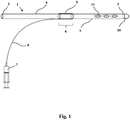
- FIG. 1 shows an embodiment of a thoracic catheter 1 of the invention.
- the hollow-cylindrical thoracic catheter 1 has a distal end 2 and a proximal end 3.
- the thoracic catheter 1 will be inserted in the chest of a patient with the proximal end 3, while the distal end 2 remains outside the body.
- a capillary active layer 5 is arranged on the surface 6 of the thoracic catheter 1 in its intercostal region 4, i.e. the region that will come to lie in the intercostal space 21 (see also Figure 2 ).
- the capillary active layer 5 could also be arranged in a recess in the wall 9 of the thoracic catheter 1.
- the proximal end 3 has an atraumatic tip 10, i.e. a tapered tip, in order to facilitate the introduction of the thoracic catheter 1 into the body.
- the thoracic catheter 1 Near the proximal end 3 the thoracic catheter 1 has six openings 11 in its wall 9 for the discharge or suction of air and/or body fluid.
- the capillary active layer 5 is connected via a tube 8, here a capillary tube, with an external source 7 (here contained in a syringe) of an anesthetic agent.
- the anesthetic agent is preferably provided in the form of a fluid which can passively, e.g. via diffusion, or actively be fed to the capillary active layer 5, and to the intercostal space 21.
- the anesthetic agent is preferably distributed throughout the capillary active layer 5 by capillary forces and released from the capillary active layer 5 into the intercostal space 21.
- the thoracic catheter 1 of Figure 1 is shown in place, i.e. introduced into the pleural space 25 between the parietal pleura 22 and the visceral pleura 23 through the intercostal space 21 between two ribs 20 of a patient and the parietal pleura 22.
- the capillary active layer 5 is arranged in the intercostal space 21 and connected via a capillary tube 8 with the source 7 of an anesthetic agent, here contained in a syringe.
- the anesthetic agent can be fed to the capillary active layer 5 via the capillary tube 8 and to the intercostal nerves 24 in the intercostal space 21 in order to relief the pain induced by the surgical intervention.
Landscapes
- Health & Medical Sciences (AREA)
- Life Sciences & Earth Sciences (AREA)
- Biophysics (AREA)
- Pulmonology (AREA)
- Engineering & Computer Science (AREA)
- Anesthesiology (AREA)
- Biomedical Technology (AREA)
- Heart & Thoracic Surgery (AREA)
- Hematology (AREA)
- Animal Behavior & Ethology (AREA)
- General Health & Medical Sciences (AREA)
- Public Health (AREA)
- Veterinary Medicine (AREA)
- External Artificial Organs (AREA)
Priority Applications (5)
| Application Number | Priority Date | Filing Date | Title |
|---|---|---|---|
| EP19152858.7A EP3682931A1 (fr) | 2019-01-21 | 2019-01-21 | Cathéter thoracique |
| PCT/EP2020/051215 WO2020152071A1 (fr) | 2019-01-21 | 2020-01-20 | Cathéter thoracique |
| US17/422,498 US12239795B2 (en) | 2019-01-21 | 2020-01-20 | Thoracic catheter |
| EP20701044.8A EP3914328A1 (fr) | 2019-01-21 | 2020-01-20 | Cathéter thoracique |
| US19/048,188 US20250177690A1 (en) | 2019-01-21 | 2025-02-07 | Thoracic catheter |
Applications Claiming Priority (1)
| Application Number | Priority Date | Filing Date | Title |
|---|---|---|---|
| EP19152858.7A EP3682931A1 (fr) | 2019-01-21 | 2019-01-21 | Cathéter thoracique |
Publications (1)
| Publication Number | Publication Date |
|---|---|
| EP3682931A1 true EP3682931A1 (fr) | 2020-07-22 |
Family
ID=65138922
Family Applications (2)
| Application Number | Title | Priority Date | Filing Date |
|---|---|---|---|
| EP19152858.7A Withdrawn EP3682931A1 (fr) | 2019-01-21 | 2019-01-21 | Cathéter thoracique |
| EP20701044.8A Pending EP3914328A1 (fr) | 2019-01-21 | 2020-01-20 | Cathéter thoracique |
Family Applications After (1)
| Application Number | Title | Priority Date | Filing Date |
|---|---|---|---|
| EP20701044.8A Pending EP3914328A1 (fr) | 2019-01-21 | 2020-01-20 | Cathéter thoracique |
Country Status (3)
| Country | Link |
|---|---|
| US (2) | US12239795B2 (fr) |
| EP (2) | EP3682931A1 (fr) |
| WO (1) | WO2020152071A1 (fr) |
Citations (9)
| Publication number | Priority date | Publication date | Assignee | Title |
|---|---|---|---|---|
| WO1998039042A1 (fr) * | 1997-03-07 | 1998-09-11 | Jackson Richard R | Matiere plastique pour materiel d'anesthesie ou d'administration de medicaments, produits, systemes et procedes medicaux associes |
| US5810786A (en) | 1993-09-24 | 1998-09-22 | Richard R. Jackson | Tissue-numbing anesthetic articles |
| US6461644B1 (en) | 1996-03-25 | 2002-10-08 | Richard R. Jackson | Anesthetizing plastics, drug delivery plastics, and related medical products, systems and methods |
| WO2004043518A2 (fr) * | 2002-11-07 | 2004-05-27 | Axiom Medical Inc. | Sonde cardiaque epicardique, drain thoracique avec sonde cardiaque epicardique et procede d'utilisation |
| WO2005062886A2 (fr) | 2003-12-24 | 2005-07-14 | Hualin Usa | Catheter comprenant une couche d'analgesique |
| US20100179513A1 (en) * | 2009-01-13 | 2010-07-15 | Hebeler Jr Robert F | Apparatus, System, and Method for Providing a Catheter |
| CN203001642U (zh) | 2012-12-24 | 2013-06-19 | 苏州大学附属第一医院 | 一种肋间神经阻滞用导流管 |
| CN204972656U (zh) * | 2015-08-31 | 2016-01-20 | 南京医科大学第一附属医院 | 一种医用无痛胸腔引流管 |
| WO2018144898A1 (fr) * | 2017-02-02 | 2018-08-09 | Precision Thoracic, Llc | Procédés et appareil minimalement invasifs pour excision de tissu cible |
Family Cites Families (4)
| Publication number | Priority date | Publication date | Assignee | Title |
|---|---|---|---|---|
| GB1581955A (en) * | 1977-08-25 | 1980-12-31 | Matburn Holdings Ltd | Catheter |
| ATE303169T1 (de) * | 2001-11-19 | 2005-09-15 | Scil Technology Gmbh | Homogen beschichtete vorrichtung mit osteoinduktiven und osteokonduktiven eigenschaften |
| EP2173412A4 (fr) * | 2007-07-06 | 2011-07-27 | Allievion Medical Inc | Dispositif d'administration de fluide contrôlée |
| EP2805515B1 (fr) * | 2012-01-17 | 2022-10-05 | Lumen Biomedical, Inc. | Système de filtration de la crosse aortique pour la protection de l'artère carotide |
-
2019
- 2019-01-21 EP EP19152858.7A patent/EP3682931A1/fr not_active Withdrawn
-
2020
- 2020-01-20 EP EP20701044.8A patent/EP3914328A1/fr active Pending
- 2020-01-20 US US17/422,498 patent/US12239795B2/en active Active
- 2020-01-20 WO PCT/EP2020/051215 patent/WO2020152071A1/fr not_active Ceased
-
2025
- 2025-02-07 US US19/048,188 patent/US20250177690A1/en active Pending
Patent Citations (9)
| Publication number | Priority date | Publication date | Assignee | Title |
|---|---|---|---|---|
| US5810786A (en) | 1993-09-24 | 1998-09-22 | Richard R. Jackson | Tissue-numbing anesthetic articles |
| US6461644B1 (en) | 1996-03-25 | 2002-10-08 | Richard R. Jackson | Anesthetizing plastics, drug delivery plastics, and related medical products, systems and methods |
| WO1998039042A1 (fr) * | 1997-03-07 | 1998-09-11 | Jackson Richard R | Matiere plastique pour materiel d'anesthesie ou d'administration de medicaments, produits, systemes et procedes medicaux associes |
| WO2004043518A2 (fr) * | 2002-11-07 | 2004-05-27 | Axiom Medical Inc. | Sonde cardiaque epicardique, drain thoracique avec sonde cardiaque epicardique et procede d'utilisation |
| WO2005062886A2 (fr) | 2003-12-24 | 2005-07-14 | Hualin Usa | Catheter comprenant une couche d'analgesique |
| US20100179513A1 (en) * | 2009-01-13 | 2010-07-15 | Hebeler Jr Robert F | Apparatus, System, and Method for Providing a Catheter |
| CN203001642U (zh) | 2012-12-24 | 2013-06-19 | 苏州大学附属第一医院 | 一种肋间神经阻滞用导流管 |
| CN204972656U (zh) * | 2015-08-31 | 2016-01-20 | 南京医科大学第一附属医院 | 一种医用无痛胸腔引流管 |
| WO2018144898A1 (fr) * | 2017-02-02 | 2018-08-09 | Precision Thoracic, Llc | Procédés et appareil minimalement invasifs pour excision de tissu cible |
Non-Patent Citations (3)
| Title |
|---|
| CHARALAMPIDIS C. ET AL.: "Pleura space anatomy", J THORAC DIS., vol. 7, no. 1, 2015, pages 27 - S32 |
| G. MAY: "The use of intrapleural anaesthetic to reduce the pain of chest drain insertion", EMERG. MED. J., vol. 24, no. 4, 2007, pages 300 - 301 |
| KANG H; CHUNG YS; CHOE JW; WOO YC; KIM SW; PARK SJ; HONG J: "Application of Lidocaine Jelly on Chest Tubes to Reduce Pain Caused by Drainage Catheter after Coronary Artery Bypass Surgery", JOURNAL OF KOREAN MEDICAL SCIENCE, vol. 29, no. 10, 2014, pages 1398 - 1403 |
Also Published As
| Publication number | Publication date |
|---|---|
| WO2020152071A1 (fr) | 2020-07-30 |
| US20250177690A1 (en) | 2025-06-05 |
| EP3914328A1 (fr) | 2021-12-01 |
| US20220062583A1 (en) | 2022-03-03 |
| US12239795B2 (en) | 2025-03-04 |
Similar Documents
| Publication | Publication Date | Title |
|---|---|---|
| US11744994B2 (en) | Devices and method for maxillary sinus lavage | |
| US5318517A (en) | Multiple lumen thoracostomy catheter and method for administering anesthesia | |
| CN100586502C (zh) | 医疗器械及其使用方法 | |
| US8251955B2 (en) | Catheter stylet with catheter accommodating lumen | |
| US8403913B2 (en) | Variable diameter surgical drains and sheaths | |
| JP2004358247A (ja) | 経皮的アクセス器具およびカテーテルキット | |
| BR112019016172A2 (pt) | Sistema de cateter urinário, e método para limpeza do espaço periuretral | |
| JP7313698B2 (ja) | 穿刺システム | |
| CN107106813A (zh) | 自锚固式导管及使用方法 | |
| JP5318925B2 (ja) | 尿道カテーテル | |
| US20260069825A1 (en) | Catheter and tube assembly and method of making | |
| US20100179513A1 (en) | Apparatus, System, and Method for Providing a Catheter | |
| US20250177690A1 (en) | Thoracic catheter | |
| KR102248722B1 (ko) | 나사산을 이용한 체결 구조를 가진 뇌실 내 약물 주입 장치 | |
| EP3175878A1 (fr) | Système distributeur de fluide | |
| US12138407B1 (en) | Short length flexible catheter with hollow guide wire | |
| US10391285B2 (en) | Motion-assisted systems, devices and methods for minimizing obstruction of medical devices | |
| US20110017218A1 (en) | Treatment system | |
| CN209630432U (zh) | 一种皮下植入式给药装置 | |
| US20260076712A1 (en) | Medical Procedure Kit and Methods for Draining Fluid from an Organ | |
| US20260069824A1 (en) | Catheter and tube assembly and method of use | |
| US20160158505A1 (en) | Applicator for antiseptic or medications | |
| US20170080179A1 (en) | Bilateral Frontal Sinus Device | |
| BR112020015371B1 (pt) | Sistema de punção | |
| US20180361123A1 (en) | Catheter guide tube device |
Legal Events
| Date | Code | Title | Description |
|---|---|---|---|
| PUAI | Public reference made under article 153(3) epc to a published international application that has entered the european phase |
Free format text: ORIGINAL CODE: 0009012 |
|
| STAA | Information on the status of an ep patent application or granted ep patent |
Free format text: STATUS: THE APPLICATION HAS BEEN PUBLISHED |
|
| AK | Designated contracting states |
Kind code of ref document: A1 Designated state(s): AL AT BE BG CH CY CZ DE DK EE ES FI FR GB GR HR HU IE IS IT LI LT LU LV MC MK MT NL NO PL PT RO RS SE SI SK SM TR |
|
| AX | Request for extension of the european patent |
Extension state: BA ME |
|
| STAA | Information on the status of an ep patent application or granted ep patent |
Free format text: STATUS: THE APPLICATION IS DEEMED TO BE WITHDRAWN |
|
| 18D | Application deemed to be withdrawn |
Effective date: 20210123 |