EP3683392B1 - Verfahren zum montieren eines türantriebs und türantrieb - Google Patents
Verfahren zum montieren eines türantriebs und türantrieb Download PDFInfo
- Publication number
- EP3683392B1 EP3683392B1 EP19152192.1A EP19152192A EP3683392B1 EP 3683392 B1 EP3683392 B1 EP 3683392B1 EP 19152192 A EP19152192 A EP 19152192A EP 3683392 B1 EP3683392 B1 EP 3683392B1
- Authority
- EP
- European Patent Office
- Prior art keywords
- door
- lever
- axle
- unit
- axle device
- Prior art date
- Legal status (The legal status is an assumption and is not a legal conclusion. Google has not performed a legal analysis and makes no representation as to the accuracy of the status listed.)
- Active
Links
Images


Classifications
-
- E—FIXED CONSTRUCTIONS
- E05—LOCKS; KEYS; WINDOW OR DOOR FITTINGS; SAFES
- E05F—DEVICES FOR MOVING WINGS INTO OPEN OR CLOSED POSITION; CHECKS FOR WINGS; WING FITTINGS NOT OTHERWISE PROVIDED FOR, CONCERNED WITH THE FUNCTIONING OF THE WING
- E05F15/00—Power-operated mechanisms for wings
- E05F15/60—Power-operated mechanisms for wings using electrical actuators
- E05F15/603—Power-operated mechanisms for wings using electrical actuators using rotary electromotors
- E05F15/611—Power-operated mechanisms for wings using electrical actuators using rotary electromotors for swinging wings
- E05F15/63—Power-operated mechanisms for wings using electrical actuators using rotary electromotors for swinging wings operated by swinging arms
-
- E—FIXED CONSTRUCTIONS
- E05—LOCKS; KEYS; WINDOW OR DOOR FITTINGS; SAFES
- E05F—DEVICES FOR MOVING WINGS INTO OPEN OR CLOSED POSITION; CHECKS FOR WINGS; WING FITTINGS NOT OTHERWISE PROVIDED FOR, CONCERNED WITH THE FUNCTIONING OF THE WING
- E05F15/00—Power-operated mechanisms for wings
- E05F15/60—Power-operated mechanisms for wings using electrical actuators
-
- E—FIXED CONSTRUCTIONS
- E05—LOCKS; KEYS; WINDOW OR DOOR FITTINGS; SAFES
- E05F—DEVICES FOR MOVING WINGS INTO OPEN OR CLOSED POSITION; CHECKS FOR WINGS; WING FITTINGS NOT OTHERWISE PROVIDED FOR, CONCERNED WITH THE FUNCTIONING OF THE WING
- E05F1/00—Closers or openers for wings, not otherwise provided for in this subclass
- E05F1/08—Closers or openers for wings, not otherwise provided for in this subclass spring-actuated, e.g. for horizontally sliding wings
-
- E—FIXED CONSTRUCTIONS
- E05—LOCKS; KEYS; WINDOW OR DOOR FITTINGS; SAFES
- E05F—DEVICES FOR MOVING WINGS INTO OPEN OR CLOSED POSITION; CHECKS FOR WINGS; WING FITTINGS NOT OTHERWISE PROVIDED FOR, CONCERNED WITH THE FUNCTIONING OF THE WING
- E05F1/00—Closers or openers for wings, not otherwise provided for in this subclass
- E05F1/08—Closers or openers for wings, not otherwise provided for in this subclass spring-actuated, e.g. for horizontally sliding wings
- E05F1/10—Closers or openers for wings, not otherwise provided for in this subclass spring-actuated, e.g. for horizontally sliding wings for swinging wings, e.g. counterbalance
-
- E—FIXED CONSTRUCTIONS
- E05—LOCKS; KEYS; WINDOW OR DOOR FITTINGS; SAFES
- E05F—DEVICES FOR MOVING WINGS INTO OPEN OR CLOSED POSITION; CHECKS FOR WINGS; WING FITTINGS NOT OTHERWISE PROVIDED FOR, CONCERNED WITH THE FUNCTIONING OF THE WING
- E05F15/00—Power-operated mechanisms for wings
- E05F15/50—Power-operated mechanisms for wings using fluid-pressure actuators
-
- E—FIXED CONSTRUCTIONS
- E05—LOCKS; KEYS; WINDOW OR DOOR FITTINGS; SAFES
- E05F—DEVICES FOR MOVING WINGS INTO OPEN OR CLOSED POSITION; CHECKS FOR WINGS; WING FITTINGS NOT OTHERWISE PROVIDED FOR, CONCERNED WITH THE FUNCTIONING OF THE WING
- E05F3/00—Closers or openers with braking devices, e.g. checks; Construction of pneumatic or liquid braking devices
- E05F3/04—Closers or openers with braking devices, e.g. checks; Construction of pneumatic or liquid braking devices with liquid piston brakes
- E05F3/10—Closers or openers with braking devices, e.g. checks; Construction of pneumatic or liquid braking devices with liquid piston brakes with a spring, other than a torsion spring, and a piston, the axes of which are the same or lie in the same direction
-
- E—FIXED CONSTRUCTIONS
- E05—LOCKS; KEYS; WINDOW OR DOOR FITTINGS; SAFES
- E05F—DEVICES FOR MOVING WINGS INTO OPEN OR CLOSED POSITION; CHECKS FOR WINGS; WING FITTINGS NOT OTHERWISE PROVIDED FOR, CONCERNED WITH THE FUNCTIONING OF THE WING
- E05F3/00—Closers or openers with braking devices, e.g. checks; Construction of pneumatic or liquid braking devices
- E05F3/22—Additional arrangements for closers, e.g. for holding the wing in opened or other position
- E05F3/227—Additional arrangements for closers, e.g. for holding the wing in opened or other position mounted at the top of wings, e.g. details related to closer housings, covers, end caps or rails therefor
-
- E—FIXED CONSTRUCTIONS
- E05—LOCKS; KEYS; WINDOW OR DOOR FITTINGS; SAFES
- E05Y—INDEXING SCHEME ASSOCIATED WITH SUBCLASSES E05D AND E05F, RELATING TO CONSTRUCTION ELEMENTS, ELECTRIC CONTROL, POWER SUPPLY, POWER SIGNAL OR TRANSMISSION, USER INTERFACES, MOUNTING OR COUPLING, DETAILS, ACCESSORIES, AUXILIARY OPERATIONS NOT OTHERWISE PROVIDED FOR, APPLICATION THEREOF
- E05Y2600/00—Mounting or coupling arrangements for elements provided for in this subclass
- E05Y2600/50—Mounting methods; Positioning
-
- E—FIXED CONSTRUCTIONS
- E05—LOCKS; KEYS; WINDOW OR DOOR FITTINGS; SAFES
- E05Y—INDEXING SCHEME ASSOCIATED WITH SUBCLASSES E05D AND E05F, RELATING TO CONSTRUCTION ELEMENTS, ELECTRIC CONTROL, POWER SUPPLY, POWER SIGNAL OR TRANSMISSION, USER INTERFACES, MOUNTING OR COUPLING, DETAILS, ACCESSORIES, AUXILIARY OPERATIONS NOT OTHERWISE PROVIDED FOR, APPLICATION THEREOF
- E05Y2600/00—Mounting or coupling arrangements for elements provided for in this subclass
- E05Y2600/50—Mounting methods; Positioning
- E05Y2600/56—Positioning, e.g. re-positioning, or pre-mounting
-
- E—FIXED CONSTRUCTIONS
- E05—LOCKS; KEYS; WINDOW OR DOOR FITTINGS; SAFES
- E05Y—INDEXING SCHEME ASSOCIATED WITH SUBCLASSES E05D AND E05F, RELATING TO CONSTRUCTION ELEMENTS, ELECTRIC CONTROL, POWER SUPPLY, POWER SIGNAL OR TRANSMISSION, USER INTERFACES, MOUNTING OR COUPLING, DETAILS, ACCESSORIES, AUXILIARY OPERATIONS NOT OTHERWISE PROVIDED FOR, APPLICATION THEREOF
- E05Y2800/00—Details, accessories and auxiliary operations not otherwise provided for
- E05Y2800/15—Applicability
- E05Y2800/17—Universally applicable
- E05Y2800/172—Universally applicable on different wing or frame locations
-
- E—FIXED CONSTRUCTIONS
- E05—LOCKS; KEYS; WINDOW OR DOOR FITTINGS; SAFES
- E05Y—INDEXING SCHEME ASSOCIATED WITH SUBCLASSES E05D AND E05F, RELATING TO CONSTRUCTION ELEMENTS, ELECTRIC CONTROL, POWER SUPPLY, POWER SIGNAL OR TRANSMISSION, USER INTERFACES, MOUNTING OR COUPLING, DETAILS, ACCESSORIES, AUXILIARY OPERATIONS NOT OTHERWISE PROVIDED FOR, APPLICATION THEREOF
- E05Y2800/00—Details, accessories and auxiliary operations not otherwise provided for
- E05Y2800/74—Specific positions
- E05Y2800/742—Specific positions abnormal
-
- E—FIXED CONSTRUCTIONS
- E05—LOCKS; KEYS; WINDOW OR DOOR FITTINGS; SAFES
- E05Y—INDEXING SCHEME ASSOCIATED WITH SUBCLASSES E05D AND E05F, RELATING TO CONSTRUCTION ELEMENTS, ELECTRIC CONTROL, POWER SUPPLY, POWER SIGNAL OR TRANSMISSION, USER INTERFACES, MOUNTING OR COUPLING, DETAILS, ACCESSORIES, AUXILIARY OPERATIONS NOT OTHERWISE PROVIDED FOR, APPLICATION THEREOF
- E05Y2900/00—Application of doors, windows, wings or fittings thereof
- E05Y2900/10—Application of doors, windows, wings or fittings thereof for buildings or parts thereof
- E05Y2900/13—Type of wing
- E05Y2900/132—Doors
Definitions
- the present invention relates to a method for installing a door drive having a door operator, a fastening device and a lever mechanism for movably mounting the door operator on the fastening device between a closed position and an open position.
- An operating unit of the door operator is designed to move an axle device of the door operator.
- the invention also relates to a door drive.
- DE 10 2014 115 189 A1 shows a swing leaf drive for driving a swing leaf of a swing door that can rotate about a vertical axis, with a mounting type input device that is designed to input or detect a swing door drive mounting type of the swing door drive.
- a door drive is used, for example, for assisted opening and/or closing of a door and expands the range of functions of the door, preferably with a lockable opening position.
- Door drives usually consist of a device on the frame of the door, a device on the door leaf and a lever mechanism for the movable mounting and connection of the device on the door frame with the device on the door leaf.
- Such a door drive uses an actuating unit to support the movement of the door, which applies a force to the door.
- spring force devices and motor devices are known for this purpose, for example, spring force devices and motor devices.
- Door drives are also known which can be used for doors with different hinge positions, for example on the right or left on the lateral sections of a door.
- the lever mechanism When installing door drives both with an operating unit and when installing door drives without an operating unit, the lever mechanism must be connected and fastened to the devices on the door frame and/or on the door leaf.
- the movable, mostly rotatable or arranged in rails elements of the devices on the door frame and/or on the door leaf must be arranged and/or rotated accordingly in order to enable a connection and fastening with the lever mechanism.
- Such a positioning of the elements is error-prone and can lead to incorrect assembly and thus to costly rework.
- the pamphlet EP 3 309 339 A1 discloses a solution to the issues described above with a drive for a wing of a door or a window with an exclusively mechanical securing of the movable elements by locking with a bolt for improved assembly of the lever mechanism. It is the object of the invention to at least partially eliminate the disadvantages of door drives described above. In particular, the object of the invention is to provide a method for assembling a door drive and a door drive in which the susceptibility to errors in assembly and the time required for assembly are reduced in a particularly simple and cost-effective manner.
- a mounting portion of a door operator is for mounting on a counter-mounting portion of a door.
- a fastening section is used for fastening to a counter-fastening section on a door. Both the assembly section and the fastening section can each be arranged and fastened on the door leaf or the door frame.
- a door operator is a device for applying force in at least one range of motion or partial range of motion of the door.
- the door operator of the door drive has an axle device.
- the axle device is movably, preferably rotatably mounted.
- the axis device can also be designed as a rail construction for movement along an axis, or substantially along an axis. Substantially along one axis means that small lateral deviations of the movement from the axis are also permissible within the scope of the invention.
- the movement of the axle device allows a movement of the door leaf between at least one open position and at least one closed position of the door by fastening the lever mechanism with a first end of the lever mechanism on the fastening device and with a second end of the lever mechanism on the axle device of the door operator.
- the attachment of the lever mechanism to the attachment device and the axle device can be designed to be non-rotatable, at least in sections, and/or can be mounted so that it can be rotated and/or movably, at least in sections.
- the operating unit can apply the force to move the axle device directly to the axle device apply or at a distance from this, for example on the fastening device and/or the lever mechanism.
- a method designed in this way enables a door drive to be installed in which the susceptibility to errors in the installation and the time required for the installation are reduced in a particularly simple and cost-effective manner.
- the actuation unit is designed as a motor unit and the movement of the axis device of the door operator is carried out by the motor unit.
- a motor unit for moving the axle device of the door operator is advantageous because a motor unit has a constant, in particular continuous, application of force for moving the door leaf between at least one open position and at least one closed position.
- a motor unit can also be extensively controlled and stopped in a defined manner at any time or in any area of the movement. The speed of the movement can be influenced and controlled in a defined manner by a motor unit, so that an accelerated movement of the axle device and a slower movement of the axle device is made possible by a motor unit.
- the actuating unit can also be designed as a clamping force unit and the movement of the axis device of the door operator can be carried out by the clamping force unit.
- a clamping force unit enables a particularly cost-effective solution for the application of force for the movement of the axle device.
- a clamping force unit applies a force for the movement of a door between an open position and a closed position in a particularly advantageous manner, since, for example, a decrease in the force is made possible with increasing relaxation of the clamping force unit and consequently the door is less strongly involved towards the end of a movement between an open position and a closed position a force is applied and thus a loud closing or jerky
- the clamping force curve of a clamping force unit can be influenced with simple design means and thus the opening or closing movement of a door and/or a window can be advantageously influenced.
- a clamping force of a clamping force unit can be applied in addition to the force of the motor unit for the movement of the axle device.
- the actuation unit moves the axle device of the door operator into a first lever assembly position when a first axle lever of the axle device is arranged and fixed, and the actuation unit moves the axle device of the door operator into a second lever assembly position when a second axle lever the axle device is arranged and fixed.
- the opening or closing movement can be determined by the positioning of the joints.
- a right-opening door for example, essentially represents a reflection on a vertical plane of a left-opening door.
- the door drive must be coordinated with the movement of the door.
- a first axle lever and a second axle lever can be designed differently or identically.
- the first axle lever and the second axle lever can be a constructive component of the axle device or the lever mechanism.
- the lever mounting positions of the axle device can be arranged between 0° and 180°, particularly advantageously at 0°, 90° and/or 115°, particularly in the case of a rotatable axle device.
- the lever mounting positions can be advantageous for low-cost production and simple, low-error-prone assembly lie, so be spaced by 180 °.
- a method according to the invention makes it possible to mount two identical door drives for two different door movements of two doors, in that a first axle lever is arranged and fixed, for example, on the axle device in a first lever assembly position and a second axle lever is arranged and fixed, for example on the other axle device in a second lever assembly position becomes.
- a method according to the invention can also be further developed in such a way that the actuating unit moves the axle device of the door operator into a first lever assembly position or a second lever assembly position, based on a detection of the first axle lever or the second axle lever by a detection unit of the door drive.
- a method according to the invention is particularly advantageous if the lever mounting position is selected directly on the basis of a recognized axle lever. This further reduces the susceptibility to errors during assembly and advantageously accelerates assembly.
- a detection can be at least partially automated and/or at least partially manual by a detection unit.
- the actuation unit moves the axis device of the door operator into a first lever assembly position or a second lever assembly position, based on a switch position of a switch of the door drive.
- a switch for setting or selecting the lever mounting position is a cost-effective way of reducing the risk of error when assembling a door operator.
- a switch is in particular a manual switch which can be actuated by a user.
- a switch is particularly advantageous in the form of a rotary switch with angle information. With such a switch, a user can select the desired position of the axle device in a lever mounting position and an operating unit moves the axle device accordingly into the selected lever mounting position. a faulty one Positioning of the axle device during assembly of the door drive is consequently avoided.
- a method according to the invention can preferably be further developed such that the door drive has a building power connection and/or an energy store for the power supply of the door operator, in particular the motor unit of the door operator.
- a door drive in particular a door drive with a motor, may require a power supply to perform movement, for lighting devices and/or for other devices of the door drive.
- it is advantageously provided to enable the energy supply by means of an energy store and/or by means of a building power connection.
- the door drive has a computer unit with a memory unit for controlling the actuating unit, the memory unit being designed for storing at least one lever mounting position.
- a computer unit can advantageously and extensively control an actuating unit.
- a computer unit advantageously expands the range of functions of a door drive and can be controlled and operated with a cable and/or wirelessly.
- the computer unit is connected to the actuation unit, preferably by cable, and can move the axle device into the various lever assembly positions via the actuation unit.
- the method according to the invention enables the movement of the axle device to be controlled by a computer unit. For example, a large number of door drives can be prepared for their installation purpose with simple means and little time, in that the axle devices are already moved into the correct lever installation position. Remote adjustment of the lever mounting positions is also possible.
- a memory unit advantageously expands the range of functions of the computer unit and enables at least one to be stored Lever assembly position that can be approached by the computer unit or by the axis device.
- a door drive comprising a door operator with a mounting section for attachment to a counter-mounting section of a door, a fastening device for attachment to a counter-mounting section of the door and a lever mechanism, with a first end and a second end, for movably mounting the door operator on the fastening device between a closed position and an open position, the fastening device being arranged on the first end of the lever mechanism and an axle device of the door operator being arranged on a second end of the lever mechanism, and an actuating unit for moving the axle device.
- a door operator according to the second aspect is adapted for use in the method according to the first aspect, a door operator according to the second aspect of the invention has the same advantages as have been described in detail in relation to the method according to the first aspect of the invention and vice versa .
- the actuating unit is designed as a motor unit and optionally also as a clamping force unit.
- a motor unit for moving the axis device of the door operator is advantageous because a motor unit has a constant, in particular continuous, application of force for moving the door frame between at least one open position and at least one closed position.
- a motor unit can also be extensively controlled and stopped in a defined manner at any time or in any area of the movement. The speed of the movement can be influenced and controlled in a defined manner by a motor unit, so that an accelerated movement of the axle device and a slower movement of the axle device made possible by a motor unit.
- the axle device can be moved at least from a closed position via at least one lever assembly position to an open position.
- An axle device can be moved between an open position and a closed position by a rotational movement and/or a movement along an axis and/or by another movement.
- at least one lever mounting position is arranged between the closed position and the open position.
- at least two lever mounting positions are located between the closed position and the open position.
- the door operator has at least one stop for the movement of the axle device and/or the lever mechanism in at least one of the closed position, the lever assembly position and/or the open position.
- the movement of the axle device can also be influenced by at least one stop.
- a stop limits or stops the movement of the axle assembly at least at one point in the movement. Stopping the sequence of movements can be temporary or permanent, i.e. the movement can briefly stop at the point at which the stop stops the movement in order to continue in the same direction, for example after overcoming a resistance of the stop. Overcoming the resistance may require user interaction or be performed automatically by the door operator. In the context of the invention, briefly means a few seconds to half a minute.
- At least one stop is an advantageous further development of the door drive according to the invention, since the at least one stop represents a cost-effective way of influencing the movement of the door drive.
- a door drive according to the invention can also be further developed in such a way that the axis device of the door operator can be moved by the operating unit at least into a first lever mounting position and at least a second lever mounting position.
- a door drive according to the invention makes it possible to mount two identical door drives for two different door movements of two doors, in that a first axle lever is arranged and fixed, for example, on the axle device in a first lever installation position and a second axle lever is arranged and fixed, for example on the other axle device in a second lever installation position .
- a door drive it can also be provided that the axle device of the door operator can be moved by the actuating unit into a first lever assembly position or a second lever assembly position, based on a detection of the first axle lever or the second axle lever by a detection unit of the door drive.
- a door drive according to the invention is particularly advantageous if the lever mounting position is selected directly on the basis of a recognized axle lever. This further reduces the susceptibility to errors during assembly and advantageously accelerates assembly.
- a detection can be at least partially automated and/or at least partially manual by a detection unit.
- a door drive according to the invention can preferably be further developed such that the axis device of the door operator can be moved by the actuating unit into a first lever mounting position or a second lever mounting position, based on a switch position of a manual switch of the door drive.
- a switch to set or select the lever mounting position is a cost effective option Reduce susceptibility to errors when installing a door operator.
- a switch is in particular a manual switch which can be actuated by a user.
- a switch is particularly advantageous in the form of a rotary switch with angle information. With such a switch, a user can select the desired position of the axle device in a lever mounting position and an operating unit moves the axle device accordingly into the selected lever mounting position. Incorrect positioning of the axle device during assembly of the door drive is consequently avoided.
- a computer unit of the door drive is designed with a memory unit for controlling the actuating unit, the memory unit being designed for storing lever assembly positions.
- a computer unit advantageously expands the range of functions of a door drive and can be controlled and operated with a cable and/or wirelessly.
- the computer unit is connected to the actuation unit, preferably by cable, and can move the axle device into the various lever assembly positions via the actuation unit.
- Such a further developed door drive enables the movement of the axle device to be controlled by a computer unit.
- a large number of door drives can be prepared for their installation purpose with simple means and little time, in that the axle devices are already moved into the correct lever installation position. Remote adjustment of the lever mounting positions is also possible.
- a memory unit advantageously expands the range of functions of the computer unit and enables storage of at least one lever mounting position that can be approached by the computer unit or by the axle device.
- FIG. 1 shows a side view and a front view of a door operator 1 with a door operator 10, a fastening device 14 and a lever mechanism 16 for movably mounting the door operator 10 on the fastening device 14 between a closed position SP (not shown) and an open position OP (not shown).
- the fastening device 14 is fastened to a counter-fastening section 104 of the frame of a door 100 .
- the door operator 10 has a mounting portion 12 which attaches to a counter-mounting portion 102 attached to the leaf of the door.
- a first end 18 of the lever mechanism 16 is arranged and fixed on the fastening device 14 .
- a second end 20 of the lever mechanism 16 is arranged and fixed on the axle device 22 of the door operator 10 .
- the door 100 has at least one door hinge 106 on the right side and is therefore a right-opening door 100 within the meaning of the invention.
- a first axle lever 24 of the lever mechanism 16 has been assembled to the axle assembly 22 in a first lever assembly position 30 (not shown).
- the fastening device 14 is designed as a rail with lateral extension in the front view.
- a door drive 1 configured in this way makes it possible to reduce the susceptibility to errors in assembly and the time required for assembly in a particularly simple and cost-effective manner.
- FIG. 2 shows a side view and a front view of a door operator 1 with a door operator 10, a fastening device 14 and a lever mechanism 16 for movably mounting the door operator 10 on the fastening device 14 between a closed position SP (not shown) and an open position OP (not shown).
- the fastener 14 is attached to the panel of a door 100 at a mating attachment portion 104 .
- the door operator 10 has a mounting portion 12 which is attached to a counter-mounting portion 102 of the frame of the door.
- a first end 18 of the lever mechanism 16 is arranged on the fastening device 14 and fixed or mounted.
- a second end 20 of the lever mechanism 16 is arranged and fixed or mounted on the axle device 22 of the door operator 10 .
- the door 100 has at least one door hinge 106 on the left side and is therefore a left-opening door 100 within the meaning of the invention.
- a second axle lever 26 of the lever mechanism 16 has been assembled to the axle assembly 22 in a second lever assembly position 32 (not shown).
- a door drive 1 configured in this way makes it possible to reduce the susceptibility to errors in assembly and the time required for assembly in a particularly simple and cost-effective manner.
- the figs 1 and 2 clearly show how two identical door operators 1 of the invention for two different door movements can be utilized by two doors 100 by mounting a first axle lever 24, for example, to the axle device 22 in a first lever mounting position 30 (not shown) (see FIG Fig.1 ) and a second axle lever 26 is mounted, for example, to the other axle device 22 in a second lever mounting position 32 (not shown) (see Fig.2 ). Also show the figs 1 and 2 that the fastening unit 14 and the door operator 10 can each be mounted both on the leaf of the door 100 and on the frame of the door 100 or on an adjacent wall and/or ceiling.
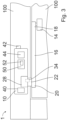
- FIG. 3 shows a front view of a door drive 1 with a door operator 10, a fastening device 14 and a lever mechanism 16 for movably mounting the door operator 10 on the fastening device 14 between a closed position SP (not shown) and an open position OP (not shown).
- the door operator 10 has an operating unit 28 , a recognition unit 40 , a switch 42 , a computer unit 50 with a memory unit 52 and an energy store 44 .
- the movement of the axle device 22 of the door operator 10 is limited and/or influenced by a stop 34 .
- the operating unit 28 applies the power to move the axle device 22 of the door operator 10 by a motor. In the embodiment of the invention shown, the actuating unit 28 applies the force for moving the axle device 22 directly to the axle device 22 .
- the fastening device 14 is in this embodiment as a bracket with significantly less lateral extent in the front view compared to the figs 1 and 2 executed.
- a door drive 1 configured in this way enables the door drive 1 to be installed in a particularly simple and cost-effective manner with a low susceptibility to errors during installation and less time required for installation.
Landscapes
- Power-Operated Mechanisms For Wings (AREA)
Description
- Die vorliegende Erfindung betrifft ein Verfahren zum Montieren eines Türantriebs aufweisend einen Türbetätiger, eine Befestigungsvorrichtung und eine Hebelmechanik zur bewegbaren Lagerung des Türbetätigers an der Befestigungsvorrichtung zwischen einer Schließposition und einer Öffnungsposition. Eine Betätigungseinheit des Türbetätigers ist zur Bewegung einer Achsvorrichtung des Türbetätigers ausgebildet. Ferner betrifft die Erfindung einen Türantrieb.
-
DE 10 2014 115 189 A1 zeigt einen Drehflügelantrieb zum Antreiben eines um eine Hochachse drehbaren Drehflügels einer Drehflügeltür mit einer Montageart-Eingabeeinrichtung, die zum Eingeben oder Erfassen einer Drehflügeltür-Antriebsmontageart des Drehflügeltürantriebs ausgebildet ist. -
US 5 687 507 A undDE 10 2013 021 132 A1 zeigen weitere automatische Türantriebe für Drehflügeltüren. - Zur Bewegung, zur Unterstützung einer Bewegung und/oder zur Funktionserweiterung einer Tür, eines Fensters und/oder einer anderen bewegbaren Öffnungsverschließung sind Antriebe und Betätiger bekannt. In einer einfachen Ausführung dient ein Türantrieb beispielsweise einer unterstützten Öffnung und/oder Schließung einer Tür und erweitert den Funktionsumfang der Tür vorzugsweise mit einer feststellbaren Öffnungsposition. Türantriebe bestehen für gewöhnlich aus einer Vorrichtung an der Zarge der Tür, einer Vorrichtung an dem Türblatt und einer Hebelmechanik zur beweglichen Lagerung und Verbindung der Vorrichtung an der Türzarge mit der Vorrichtung an dem Türblatt. Ein derartiger Türantrieb bedient sich zur Bewegungsunterstützung der Tür einer Betätigungseinheit, welche die Tür mit einer Kraft beaufschlagt. Aus dem Stand der Technik sind zu diesem Zweck beispielsweise Federkraftvorrichtungen und Motorvorrichtungen bekannt. Ebenfalls sind Türantriebe bekannt, welche für Türen mit unterschiedlichen Scharnierpositionen, beispielsweise rechts oder links an den seitlichen Abschnitten einer Tür, nutzbar sind. Bei der Montage von Türantrieben sowohl mit einer Betätigungseinheit, als auch bei der Montage von Türantrieben ohne Betätigungseinheit muss die Hebelmechanik mit den Vorrichtungen an der Türzarge und/oder an dem Türblatt verbunden und befestigt werden. Dafür müssen die beweglichen, zumeist drehbaren oder in Schienen angeordneten Elemente der Vorrichtungen an der Türzarge und/oder an dem Türblatt entsprechend angeordnet und/oder gedreht werden, um eine Verbindung und Befestigung mit der Hebelmechanik zu ermöglichen. Eine derartige Positionierung der Elemente ist fehleranfällig und kann zu Fehlmontagen und damit zu kostenintensiven Nacharbeiten führen. Ebenfalls ist aus dem Stand der Technik Spezialwerkzeug zur Ausrichtung von beispielsweise vorgespannten Türantrieben bekannt, welches bei der Montage eines entsprechenden Türantriebs notwendig ist, um eine Montage zu ermöglichen. Die Druckschrift
EP 3 309 339 A1 offenbart einen Lösungsansatz für die vorab beschriebenen Themen mit einem Antrieb für einen Flügel einer Tür oder eines Fensters mit einer ausschließlich mechanischen Sicherung der beweglichen Elemente durch Arretierung mit einem Bolzen zur verbesserten Montage der Hebelmechanik. Es ist die Aufgabe der Erfindung, die oben beschriebenen Nachteile von Türantrieben zumindest teilweise zu beheben. Insbesondere ist Aufgabe der Erfindung ein Verfahren zum Montieren eines Türantriebs und einen Türantrieb bereitzustellen, bei denen auf besonders einfache und kostengünstige Art und Weise eine Fehleranfälligkeit der Montage und die benötigte Zeit für die Montage verringert werden. - Diese Aufgabe wird gelöst durch ein Verfahren zum Montieren eines Türantriebs mit den Merkmalen des unabhängigen Anspruchs 1 sowie durch einen Türantrieb mit den Merkmalen des nebengeordneten Anspruchs 7. Dabei gelten Merkmale und Details, die im Zusammenhang mit dem erfindungsgemäßen Verfahren beschrieben sind, selbst verständlich auch in Verbindung mit dem erfindungsgemäßen Türantrieb und jeweils umgekehrt, sodass bezüglich der Offenbarung zu den einzelnen Erfindungsaspekten stets wechselseitig Bezug genommen wird bzw. werden kann.
- In einem ersten Aspekt der Erfindung wird die Aufgabe gelöst durch ein Verfahren zum Montieren eines Türantriebs gemäß Anspruch 1, aufweisend einen Türbetätiger mit einem Montageabschnitt zur Befestigung an einem Gegenmontageabschnitt einer Tür, eine Befestigungsvorrichtung zur Befestigung an einem Gegenbefestigungsabschnitt der Tür und eine Hebelmechanik, mit einem ersten Ende und einem zweiten Ende, zur bewegbaren Lagerung des Türbetätigers an der Befestigungsvorrichtung zwischen einer Schließposition und einer Öffnungsposition, wobei die Befestigungsvorrichtung an dem ersten Ende der Hebelmechanik und eine Achsvorrichtung des Türbetätigers an einem zweiten Ende der Hebelmechanik angeordnet ist, und einer Betätigungseinheit des Türbetätigers zur Bewegung der Achsvorrichtung des Türbetätigers, wobei das Verfahren durch nachfolgende Schritte gekennzeichnet ist:
- Befestigung der Befestigungsvorrichtung an einem Gegenbefestigungsabschnitt der Tür,
- Montieren des Montageabschnitts des Türbetätigers an einem Gegenmontageabschnitt der Tür,
- Bewegen der Achsvorrichtung des Türbetätigers in wenigstens eine erste Hebelmontageposition durch die Betätigungseinheit,
- Anordnung und Fixierung des ersten Endes der Hebelmechanik an der Befestigungsvorrichtung,
- Anordnung und Fixierung des zweiten Endes der Hebelmechanik an der Achsvorrichtung des Türbetätigers.
- Ein Montageabschnitt eines Türbetätigers dient der Montage an einem Gegenmontageabschnitt einer Tür. Ein Befestigungsabschnitt dient der Befestigung an einem Gegenbefestigungsabschnitt an einer Tür. Sowohl der Montageabschnitt als auch der Befestigungsabschnitt können jeweils an dem Türblatt oder der Türzarge angeordnet und befestigt werden.
- Alternativ ist ebenfalls eine Montage des Montageabschnitts oder des Befestigungsabschnitts an einer Wand, einer Decke und/oder einem konstruktiven Element, welches nicht zu der Tür gehört, anstatt an der Türzarge im Rahmen der Erfindung denkbar und möglich. Dafür sind der Montageabschnitt und der Befestigungsabschnitt mit beispielsweise Löchern für Befestigungsmittel wie Schrauben versehen. Der Montageabschnitt und der Befestigungsabschnitt können ebenfalls magnetisch an den Gegenmontageabschnitt bzw. Gegenbefestigungsabschnitt angebracht werden oder mit diesem verklebt werden. Klemmverbindungen und weitere Befestigungsmöglichkeiten sind ebenfalls zwischen dem Montageabschnitt und dem Befestigungsabschnitt zu dem jeweiligen Gegenabschnitt der Tür bzw. der Wand denkbar und möglich. Ein Türbetätiger ist im Rahmen der Erfindung eine Vorrichtung zur Kraftaufbringung in wenigstens einem Bewegungsbereich oder Teilbewegungsbereich der Tür. Dazu weist der Türbetätiger des Türantriebs eine Achsvorrichtung auf. Die Achsvorrichtung ist beweglich, vorzugsweise drehbar gelagert. Die Achsvorrichtung kann ebenfalls als Schienenkonstruktion zur Bewegung entlang einer Achse, oder im Wesentlichen entlang einer Achse, ausgebildet sein. Im Wesentlichen entlang einer Achse bedeutet, dass geringe seitliche Abweichungen der Bewegung von der Achse ebenfalls im Rahmen der Erfindung zulässig sind. Die Bewegung der Achsvorrichtung ermöglicht, durch eine Befestigung der Hebelmechanik mit einem ersten Ende der Hebelmechanik an der Befestigungsvorrichtung und mit einem zweiten Ende der Hebelmechanik an der Achsvorrichtung des Türbetätiger, eine Bewegung des Türblatts zwischen wenigstens einer Öffnungsposition und wenigstens einer Schließposition der Tür. Die Befestigung der Hebelmechanik an der Befestigungsvorrichtung und der Achsvorrichtung kann wenigstens abschnittsweise verdrehsicher ausgebildet sein und/oder wenigstens abschnittsweise verdrehbar und/oder beweglich gelagert sein. Die Betätigungseinheit kann die Kraft zur Bewegung der Achsvorrichtung direkt an der Achsvorrichtung aufbringen oder von dieser distanziert, beispielsweise an der Befestigungsvorrichtung und/oder der Hebelmechanik, aufbringen. Ein derart ausgestaltetes Verfahren ermöglicht ein Montieren eines Türantriebs, bei dem auf besonders einfache und kostengünstige Art und Weise eine Fehleranfälligkeit der Montage und die benötigte Zeit für die Montage verringert wird.
- Es ist bei dem erfindungsgemäßen Verfahren vorgesehen, dass die Betätigungseinheit als Motoreinheit ausgebildet ist und die Bewegung der Achsvorrichtung des Türbetätigers durch die Motoreinheit ausgeführt wird. Eine Motoreinheit zur Bewegung der Achsvorrichtung des Türbetätigers ist vorteilhaft, da eine Motoreinheit eine gleichbleibende, insbesondere kontinuierliche, Kraftaufbringung für die Bewegung des Türblatts zwischen wenigstens einer Öffnungsposition und wenigstens einer Schließposition aufweist. Eine Motoreinheit kann weiter umfangreich gesteuert werden und zu jedem Zeitpunkt bzw. in jedem Bereich der Bewegung definiert gestoppt werden. Die Geschwindigkeit der Bewegung kann durch eine Motoreinheit definiert beeinflusst und gesteuert werden, sodass eine beschleunigte Bewegung der Achsvorrichtung und eine verlangsamte Bewegung der Achsvorrichtung durch eine Motoreinheit ermöglicht wird.
- Darüber hinaus kann zusätzlich die Betätigungseinheit als Spannkrafteinheit ausgebildet sein und die Bewegung der Achsvorrichtung des Türbetätigers durch die Spannkrafteinheit ausgeführt werden.
- Eine Spannkrafteinheit ermöglicht eine besonders kostengünstige Lösung der Kraftaufbringung für die Bewegung der Achsvorrichtung. Eine Spannkrafteinheit bringt eine Kraft für die Bewegung einer Tür zwischen einer Öffnungsposition und einer Schließposition besonders vorteilhaft auf, da beispielsweise eine Abnahme der Kraft mit zunehmender Entspannung der Spannkrafteinheit ermöglicht wird und folglich die Tür gegen Ende einer Bewegung zwischen einer Öffnungsposition und einer Schließposition weniger stark mit einer Kraft beaufschlagt wird und somit ein lautes Schließen oder ruckartiges
- Öffnen der Tür und/oder des Fensters vermieden wird. Ebenfalls kann die Spannkraftkurve einer Spannkrafteinheit mit einfachen konstruktiven Mitteln beeinflusst werden und somit die Öffnungs- bzw. Schließbewegung einer Tür und/oder eines Fensters vorteilhaft beeinflusst werden. Eine Spannkraft einer Spannkrafteinheit kann zusätzlich zu der Kraft der Motoreinheit für die Bewegung der Achsvorrichtung aufgebracht werden.
- Besonders bevorzugt kann bei einem erfindungsgemäßen Verfahren vorgesehen sein, dass die Betätigungseinheit die Achsvorrichtung des Türbetätigers in eine erste Hebelmontageposition bewegt, wenn ein erster Achshebel der Achsvorrichtung angeordnet und fixiert wird und die Betätigungseinheit die Achsvorrichtung des Türbetätigers in eine zweite Hebelmontageposition bewegt, wenn ein zweiter Achshebel der Achsvorrichtung angeordnet und fixiert wird. Bei Türen, Fenstern und weiteren bewegbaren Öffnungsverschließungen kann beispielsweise durch die Positionierung der Gelenke die Öffnungs- bzw. Schließbewegung bestimmt werden. Eine rechts-öffnende Tür stellt beispielsweise im Wesentlichen eine Spiegelung an einer vertikalen Ebene einer links-öffnenden Tür dar. Der Türantrieb muss auf die Bewegung der Tür abgestimmt sein. Zur Kostenreduzierung und zur Produktionsoptimierung sind Türantriebe zumeist ausgebildet beispielsweise sowohl rechts-öffnende Türen, als auch links-öffnende Türen anzutreiben. Für die unterschiedlichen Bewegungen werden jedoch unterschiedliche Achshebel und/oder eine unterschiedliche Befestigung der Achshebel an der Achsvorrichtung benötigt. Daher können ein erster Achshebel und ein zweiter Achshebel unterschiedlich oder gleich ausgebildet sein. Der erste Achshebel und der zweite Achshebel können konstruktiver Bestandteil der Achsvorrichtung oder der Hebelmechanik sein. Die Hebelmontagepositionen der Achsvorrichtung können insbesondere bei einer drehbaren Achsvorrichtung zwischen 0° und 180°, besonders vorteilhaft bei 0°, 90° und/oder 115° angeordnet sein. Die Hebelmontagepositionen können sich für eine kostengünstige Produktion und eine einfache, wenig fehleranfällig Montage, vorteilhaft gegenüber liegen, also um 180° beabstandet sein. Folglich ermöglicht ein erfindungsgemäßes Verfahren zwei baugleiche Türantriebe für zwei unterschiedliche Türbewegungen von zwei Türen zu montieren, indem ein erster Achshebel beispielsweise an der Achsvorrichtung in einer ersten Hebelmontageposition angeordnet und fixiert wird und ein zweiter Achshebel beispielsweise an der anderen Achsvorrichtung in einer zweiten Hebelmontageposition angeordnet und fixiert wird.
- Auch kann ein erfindungsgemäßes Verfahren dahingehend weiterentwickelt sein, dass die Betätigungseinheit die Achsvorrichtung des Türbetätigers in eine erste Hebelmontageposition oder eine zweite Hebelmontageposition bewegt, auf Basis einer Erkennung des ersten Achshebels oder des zweiten Achshebels durch eine Erkennungseinheit des Türantriebs. Besonders vorteilhaft ist ein erfindungsgemäßes Verfahren, wenn die Wahl der Hebelmontageposition direkt auf Basis eines erkannten Achshebels geschieht. Dadurch wird die Fehleranfälligkeit bei der Montage weiter reduziert und die Montage vorteilhaft beschleunigt. Eine Erkennung kann durch eine Erkennungseinheit zumindest teilweise automatisiert und/oder zumindest teilweise manuell erfolgen.
- Gemäß einer Weiterentwicklung eines erfindungsgemäßen Verfahrens kann ferner vorgesehen sein, dass die Betätigungseinheit die Achsvorrichtung des Türbetätigers in eine erste Hebelmontageposition oder eine zweite Hebelmontageposition bewegt, auf Basis einer Schalterstellung eines Schalters des Türantriebs. Ein Schalter zur Einstellung bzw. Wahl der Hebelmontageposition stellt eine kostengünstige Möglichkeit dar, die Fehleranfälligkeit bei der Montage eines Türantriebs zu reduzieren. Ein Schalter ist insbesondere ein manueller Schalter, welcher durch einen Anwender betätigt werden kann. Besonders vorteilhaft ist ein Schalter als Drehschalter mit Winkelangaben ausgestaltet. Mit einem derartigen Schalter kann ein Anwender die gewünschte Position der Achsvorrichtung in einer Hebelmontageposition auswählen und eine Betätigungseinheit bewegt die Achsvorrichtung entsprechend in die gewählte Hebelmontageposition. Eine fehlerhafte Positionierung der Achsvorrichtung bei der Montage des Türantriebs wird folglich vermieden.
- Darüber hinaus kann bevorzugt ein erfindungsgemäßes Verfahren dahingehend weiterentwickelt sein, dass der Türantrieb für die Stromversorgung des Türbetätigers, insbesondere der Motoreinheit des Türbetätigers, einen Gebäudestromanschluss und/oder einen Energiespeicher aufweist. Ein Türantrieb, insbesondere ein Türantrieb mit Motor, kann eine Stromversorgung zur Bewegungsausführung, für Beleuchtungsvorrichtung und/oder für weitere Vorrichtungen des Türantriebs benötigen. Dafür ist es vorteilhaft vorgesehen durch einen Energiespeicher und/oder durch einen Gebäudestromanschluss die Energieversorgung zu ermöglichen.
- Erfindungsgemäß weist der Türantrieb eine Rechnereinheit mit einer Speichereinheit zur Steuerung der Betätigungseinheit auf, wobei die Speichereinheit zur Speicherung von wenigstens einer Hebelmontageposition ausgebildet ist. Eine Rechnereinheit kann vorteilhaft und umfangreich eine Betätigungseinheit steuern. Eine Rechnereinheit erweitert den Funktionsumfang eines Türantriebs vorteilhaft und kann kabelgebunden und/oder kabellos angesteuert und bedient werden. Die Rechnereinheit ist mit der Betätigungseinheit bevorzugt kabelgebunden verbunden und kann über die Betätigungseinheit die Achsvorrichtung in die verschiedenen Hebelmontagepositionen bewegen. Das erfindungsgemäße Verfahren ermöglicht eine Steuerung der Bewegung der Achsvorrichtung durch eine Rechnereinheit. Beispielsweise können so mit einfachen Mitteln und geringem Zeitaufwand eine Vielzahl an Türantrieben für ihren Montagezweck vorbereitet werden, indem die Achsvorrichtungen bereits in die richtige Hebelmontageposition gefahren werden. Ebenfalls wird eine Einstellung der Hebelmontagepositionen aus der Distanz möglich. Eine Speichereinheit erweitert den Funktionsumfang der Rechnereinheit vorteilhaft und ermöglicht eine Speicherung von wenigstens einer Hebelmontageposition, die durch die Rechnereinheit bzw. durch die Achsvorrichtung angefahren werden können.
- Gemäß einem zweiten Aspekt der Erfindung wird die Aufgabe gelöst durch einen Türantrieb gemäß Anspruch 7, aufweisend einen Türbetätiger mit einem Montageabschnitt zur Befestigung an einem Gegenmontageabschnitt einer Tür, eine Befestigungsvorrichtung zur Befestigung an einem Gegenbefestigungsabschnitt der Tür und eine Hebelmechanik, mit einem ersten Ende und einem zweiten Ende, zur bewegbaren Lagerung des Türbetätigers an der Befestigungsvorrichtung zwischen einer Schließposition und einer Öffnungsposition, wobei die Befestigungsvorrichtung an dem ersten Ende der Hebelmechanik und eine Achsvorrichtung des Türbetätigers an einem zweiten Ende der Hebelmechanik angeordnet ist, und einer Betätigungseinheit zur Bewegung der Achsvorrichtung. Da ein Türantrieb gemäß dem zweiten Aspekt zur Verwendung in dem Verfahren nach dem ersten Aspekt ausgebildet ist, weist ein Türantrieb gemäß dem zweiten Aspekt der Erfindung dieselben Vorteile auf, wie sie ausführlich in Bezug auf das Verfahren gemäß dem ersten Aspekt Erfindung beschrieben worden sind und umgekehrt. Bei einem erfindungsgemäßen Türantrieb ist ebenfalls vorgesehen, dass die Betätigungseinheit als Motoreinheit und optional zusätzlich als Spannkrafteinheit ausgebildet ist. Eine Motoreinheit zur Bewegung der Achsvorrichtung des Türbetätigers ist vorteilhaft, da eine Motoreinheit eine gleichbleibende, insbesondere kontinuierliche, Kraftaufbringung für die Bewegung der Türzarge zwischen wenigstens einer Öffnungsposition und wenigstens einer Schließposition aufweist. Eine Motoreinheit kann weiter umfangreich gesteuert werden und zu jedem Zeitpunkt bzw. in jedem Bereich der Bewegung definiert gestoppt werden. Die Geschwindigkeit der Bewegung kann durch eine Motoreinheit definiert beeinflusst und gesteuert werden, sodass eine beschleunigte Bewegung der Achsvorrichtung und eine verlangsamte Bewegung der Achsvorrichtung durch eine Motoreinheit ermöglicht wird.
- Bevorzugt kann dabei bei einem erfindungsgemäßen Türantrieb vorgesehen sein, dass die Achsvorrichtung wenigstens von einer Schließposition über wenigstens eine Hebelmontageposition zu einer Öffnungsposition beweglich ist. Eine Achsvorrichtung kann durch eine Drehbewegung und/oder eine Bewegung entlang einer Achse und/oder durch eine andere Bewegung zwischen einer Öffnungsposition und einer Schließposition bewegt werden. Zwischen der Schließposition und der Öffnungsposition ist gemäß der Weiterentwicklung des erfindungsgemäßen Türantriebs wenigstens eine Hebelmontageposition angeordnet. Bevorzugt sind wenigstens zwei Hebelmontagepositionen zwischen der Schließposition und der Öffnungsposition angeordnet.
- Gemäß einer Weiterentwicklung eines erfindungsgemäßen Türantriebs kann ferner vorgesehen sein, dass der Türbetätiger wenigstens einen Anschlag für die Bewegung der Achsvorrichtung und/oder der Hebelmechanik an wenigstens einer der Schließposition, der Hebelmontageposition und/oder der Öffnungsposition aufweist. Über die Bewegungsablaufbeeinflussung durch die Betätigungseinheit hinaus, kann zusätzlich eine Beeinflussung der Bewegung der Achsvorrichtung durch wenigstens einen Anschlag vorgenommen werden. Ein Anschlag begrenzt oder stoppt die Bewegung der Achsvorrichtung an wenigstens einem Punkt des Bewegungsablaufs. Ein Stoppen des Bewegungsablaufs kann vorübergehend oder dauerhaft sein, sprich die Bewegung kann an dem Punkt an dem der Anschlag die Bewegung stoppt kurzzeitig aussetzen um, beispielsweise nach Überwindung eines Widerstands des Anschlags, in die gleiche Richtung fortgesetzt zu werden. Ein Überwinden des Widerstands kann eine Benutzereinwirkung erfordern oder automatisch von dem Türbetätiger durchgeführt werden. Kurzzeitig bedeutet im Rahmen der Erfindung wenige Sekunden bis eine halbe Minute. Wenigstens ein Anschlag ist eine vorteilhafte Weiterentwicklung des erfindungsgemäßen Türantriebs, da der wenigstens eine Anschlag eine kostengünstige Möglichkeit zur Beeinflussung des Bewegungsablaufs des Türantriebs darstellt.
- Auch kann ein erfindungsgemäßer Türantrieb dahingehend weiterentwickelt sein, dass die Achsvorrichtung des Türbetätigers durch die Betätigungseinheit wenigstens in eine erste Hebelmontageposition und wenigstens eine zweite Hebelmontageposition bewegbar ist. Ein erfindungsgemäßer Türantrieb ermöglicht zwei baugleiche Türantriebe für zwei unterschiedliche Türbewegungen von zwei Türen zu montieren, indem ein erster Achshebel beispielsweise an der Achsvorrichtung in einer ersten Hebelmontageposition angeordnet und fixiert wird und ein zweiter Achshebel beispielsweise an der anderen Achsvorrichtung in einer zweiten Hebelmontageposition angeordnet und fixiert wird.
- Gemäß einer Weiterentwicklung eines erfindungsgemäßen Türantriebs kann ferner vorgesehen sein, dass die Achsvorrichtung des Türbetätigers durch die Betätigungseinheit in eine erste Hebelmontageposition oder eine zweite Hebelmontageposition bewegbar ist, auf Basis einer Erkennung des ersten Achshebels oder des zweiten Achshebels durch eine Erkennungseinheit des Türantriebs. Besonders vorteilhaft ist ein erfindungsgemäßer Türantrieb, wenn die Wahl der Hebelmontageposition direkt auf Basis eines erkannten Achshebels geschieht. Dadurch wird die Fehleranfälligkeit bei der Montage weiter reduziert und die Montage vorteilhaft beschleunigt. Eine Erkennung kann durch eine Erkennungseinheit zumindest teilweise automatisiert und/oder zumindest teilweise manuell erfolgen.
- Darüber hinaus kann bevorzugt ein erfindungsgemäßer Türantrieb dahingehend weiterentwickelt sein, dass die Achsvorrichtung des Türbetätigers durch die Betätigungseinheit in eine erste Hebelmontageposition oder eine zweite Hebelmontageposition bewegbar ist, auf Basis einer Schalterstellung eines manuellen Schalters des Türantriebs. Ein Schalter zur Einstellung bzw. Wahl der Hebelmontageposition stellt eine kostengünstige Möglichkeit dar, die Fehleranfälligkeit bei der Montage eines Türantriebs zu reduzieren. Ein Schalter ist insbesondere ein manueller Schalter, welcher durch einen Anwender betätigt werden kann. Besonders vorteilhaft ist ein Schalter als Drehschalter mit Winkelangaben ausgestaltet. Mit einem derartigen Schalter kann ein Anwender die gewünschte Position der Achsvorrichtung in einer Hebelmontageposition auswählen und eine Betätigungseinheit bewegt die Achsvorrichtung entsprechend in die gewählte Hebelmontageposition. Eine fehlerhafte Positionierung der Achsvorrichtung bei der Montage des Türantriebs wird folglich vermieden.
- Bei dem erfindungsgemäßen Türantrieb ist eine Rechnereinheit des Türantriebs mit einer Speichereinheit zur Steuerung der Betätigungseinheit ausgebildet, wobei die Speichereinheit zur Speicherung von Hebelmontagepositionen ausgebildet ist. Eine Rechnereinheit erweitert den Funktionsumfang eines Türantriebs vorteilhaft und kann kabelgebunden und/oder kabellos angesteuert und bedient werden. Die Rechnereinheit ist mit der Betätigungseinheit bevorzugt kabelgebunden verbunden und kann über die Betätigungseinheit die Achsvorrichtung in die verschiedenen Hebelmontagepositionen bewegen. Ein derart weiterentwickelter Türantrieb ermöglicht eine Steuerung der Bewegung der Achsvorrichtung durch eine Rechnereinheit. Beispielsweise können so mit einfachen Mitteln und geringem Zeitaufwand eine Vielzahl an Türantrieben für ihren Montagezweck vorbereitet werden, indem die Achsvorrichtungen bereits in die richtige Hebelmontageposition gefahren werden. Ebenfalls wird eine Einstellung der Hebelmontagepositionen aus der Distanz möglich. Eine Speichereinheit erweitert den Funktionsumfang der Rechnereinheit vorteilhaft und ermöglicht eine Speicherung von wenigstens einer Hebelmontageposition, die durch die Rechnereinheit bzw. durch die Achsvorrichtung angefahren werden können.
- Ein erfindungsgemäßes Verfahren sowie ein erfindungsgemäßer Türantrieb sowie deren weiterbildenden Vorteile werden nachfolgend anhand von Zeichnungen näher erläutert. Elemente mit gleicher Funktion und Wirkungsweise sind in den
Fig. 1 bis 3 jeweils mit denselben Bezugszeichen versehen. Es zeigen schematisch: - Fig. 1
- eine Seitenansicht und eine Frontansicht eines Türantriebs mit einem Türbetätiger mit einem Montageabschnitt an einem Gegenmontageabschnitt an einem Blatt einer Tür, einer Befestigungsvorrichtung an einem Gegenbefestigungsabschnitt an einer Zarge der Tür und einer Hebelmechanik zur bewegbaren Lagerung des Türbetätigers an der Befestigungsvorrichtung zwischen einer Schließposition und einer Öffnungsposition,
- Fig. 2
- eine Seitenansicht und eine Frontansicht eines Türantriebs mit einem Türbetätiger mit einem Montageabschnitt an einem Gegenmontageabschnitt an einer Zarge einer Tür, einer Befestigungsvorrichtung an einem Gegenbefestigungsabschnitt an einem Blatt der Tür und einer Hebelmechanik zur bewegbaren Lagerung des Türbetätigers an der Befestigungsvorrichtung zwischen einer Schließposition und einer Öffnungsposition,
- Fig. 3
- eine Frontansicht eines Türantriebs mit einem Türbetätiger mit einer Erkennungseinheit, mit einem Schalter, mit einer Rechnereinheit, mit einer Speichereinheit und mit einem Energiespeicher, einer Befestigungsvorrichtung und einer Hebelmechanik zur bewegbaren Lagerung des Türbetätigers an der Befestigungsvorrichtung zwischen einer Schließposition und einer Öffnungsposition.
-
Fig. 1 zeigt eine Seitenansicht und eine Frontansicht eines Türantriebs 1 mit einem Türbetätiger 10 einer Befestigungsvorrichtung 14 und einer Hebelmechanik 16 zur bewegbaren Lagerung des Türbetätigers 10 an der Befestigungsvorrichtung 14 zwischen einer Schließposition SP (nicht gezeigt) und einer Öffnungsposition OP (nicht gezeigt). Die Befestigungsvorrichtung 14 ist an einem Gegenbefestigungsabschnitt 104 der Zarge einer Tür 100 befestigt. Der Türbetätiger 10 weist einen Montageabschnitt 12 auf, der an einem Gegenmontageabschnitt 102 an dem Blatt der Tür befestigt ist. Ein erstes Ende 18 der Hebelmechanik 16 ist an der Befestigungsvorrichtung 14 angeordnet und fixiert. Ein zweites Ende 20 der Hebelmechanik 16 ist an der Achsvorrichtung 22 des Türbetätigers 10 angeordnet und fixiert. Die Tür 100 weist zumindest ein Türscharnier 106 an der rechten Seite auf und ist folglich eine rechts-öffnende Tür 100 im Sinne der Erfindung. Ein erster Achshebel 24 der Hebelmechanik 16 ist an der Achsvorrichtung 22 in einer ersten Hebelmontageposition 30 (nicht gezeigt) montiert worden. Die Befestigungsvorrichtung 14 ist in dieser Ausführungsform als eine Schiene mit seitlicher Erstreckung in der Frontansicht ausgeführt. Ein derart ausgestalteter Türantrieb 1 ermöglicht auf besonders einfache und kostengünstige Art und Weise eine Fehleranfälligkeit der Montage und die benötigte Zeit für die Montage zu verringern. -
Fig. 2 zeigt eine Seitenansicht und eine Frontansicht eines Türantriebs 1 mit einem Türbetätiger 10 einer Befestigungsvorrichtung 14 und einer Hebelmechanik 16 zur bewegbaren Lagerung des Türbetätigers 10 an der Befestigungsvorrichtung 14 zwischen einer Schließposition SP (nicht gezeigt) und einer Öffnungsposition OP (nicht gezeigt). Die Befestigungsvorrichtung 14 ist an einem Gegenbefestigungsabschnitt 104 an dem Blatt einer Tür 100 befestigt. Der Türbetätiger 10 weist einen Montageabschnitt 12 auf, der an einem Gegenmontageabschnitt 102 der Zarge der Tür befestigt ist. Ein erstes Ende 18 der Hebelmechanik 16 ist an der Befestigungsvorrichtung 14 angeordnet und fixiert bzw. montiert. Ein zweites Ende 20 der Hebelmechanik 16 ist an der Achsvorrichtung 22 des Türbetätigers 10 angeordnet und fixiert bzw. montiert. Die Tür 100 weist zumindest ein Türscharnier 106 an der linken Seite auf und ist folglich eine links-öffnende Tür 100 im Sinne der Erfindung. Ein zweiter Achshebel 26 der Hebelmechanik 16 ist an der Achsvorrichtung 22 in einer zweiten Hebelmontageposition 32 (nicht gezeigt) montiert worden. Ein derart ausgestalteter Türantrieb 1 ermöglicht auf besonders einfache und kostengünstige Art und Weise eine Fehleranfälligkeit der Montage und die benötigte Zeit für die Montage zu verringern. DieFigs. 1 und2 zeigen deutlich wie zwei baugleiche Türantriebe 1 der Erfindung für zwei unterschiedliche Türbewegungen von zwei Türen 100 genutzt werden können, indem ein erster Achshebel 24 beispielsweise an der Achsvorrichtung 22 in einer ersten Hebelmontageposition 30 (nicht gezeigt) montiert wird (sieheFig.1 ) und ein zweiter Achshebel 26 beispielsweise an der anderen Achsvorrichtung 22 in einer zweiten Hebelmontageposition 32 (nicht gezeigt) montiert wird (sieheFig.2 ). Ebenfalls zeigen dieFigs. 1 und2 , dass die Befestigungseinheit 14 und der Türbetätiger 10 jeweils sowohl an dem Blatt der Tür 100, als auch an der Zarge der Tür 100 bzw. an einer angrenzenden Wand und/oder Decke montiert werden können. -
Fig. 3 zeigt eine Frontansicht eines Türantriebs 1 mit einem Türbetätiger 10 einer Befestigungsvorrichtung 14 und einer Hebelmechanik 16 zur bewegbaren Lagerung des Türbetätigers 10 an der Befestigungsvorrichtung 14 zwischen einer Schließposition SP (nicht gezeigt) und einer Öffnungsposition OP (nicht gezeigt). Der Türbetätiger 10 weist eine Betätigungseinheit 28, eine Erkennungseinheit 40, einen Schalter 42, eine Rechnereinheit 50 mit einer Speichereinheit 52 und einen Energiespeicher 44 auf. Die Bewegung der Achsvorrichtung 22 des Türbetätigers 10 ist durch einen Anschlag 34 begrenzt und/oder beeinflusst. Die Betätigungseinheit 28 bringt die Kraft zur Bewegung der Achsvorrichtung 22 des Türbetätigers 10 durch einen Motor auf. Die Betätigungseinheit 28 bringt in der gezeigten Ausgestaltungsform der Erfindung die Kraft zur Bewegung der Achsvorrichtung 22 direkt an der Achsvorrichtung 22 auf. Die Befestigungsvorrichtung 14 ist in dieser Ausführungsform als eine Halterung mit deutlich geringerer seitlicher Erstreckung in der Frontansicht in dem Vergleich zu denFigs. 1 und2 ausgeführt. Ein derart ausgestalteter Türantrieb 1 ermöglicht ein Montieren des Türantriebs 1 auf besonders einfache und kostengünstige Art und Weise mit geringer Fehleranfälligkeit der Montage und geringer benötigter Zeit für die Montage. -
- 1
- Türantrieb
- 10
- Türbetätiger
- 12
- Montageabschnitt
- 14
- Befestigungsvorrichtung
- 16
- Hebelmechanik
- 18
- erste Ende der Hebelmechanik
- 20
- zweites Ende der Hebelmechanik
- 22
- Achsvorrichtung
- 24
- erster Achshebel
- 26
- zweiter Achshebel
- 28
- Betätigungseinheit
- 30
- erste Hebelmontageposition
- 32
- zweite Hebelmontageposition
- 34
- Anschlag
- 40
- Erkennungseinheit
- 42
- Schalter
- 44
- Energiespeicher
- 50
- Rechnereinheit
- 52
- Speichereinheit
- 100
- Tür
- 102
- Gegenmontageabschnitt
- 104
- Gegenbefestigungsabschnitt
- 106
- Türscharnier
- SP
- Schließposition
- OP
- Öffnungsposition
Claims (13)
- Verfahren zum Montieren eines Türantriebs (1) aufweisend einen Türbetätiger (10) mit einem Montageabschnitt (12) zur Befestigung an einem Gegenmontageabschnitt (102) einer Tür (100), eine Befestigungsvorrichtung (14) zur Befestigung an einem Gegenbefestigungsabschnitt (104) der Tür (100) und eine Hebelmechanik (16), mit einem ersten Ende (18) und einem zweiten Ende (20), zur bewegbaren Lagerung des Türbetätigers (10) an der Befestigungsvorrichtung (14) zwischen einer Schließposition (SP) und einer Öffnungsposition (OP), wobei die Befestigungsvorrichtung (14) an dem ersten Ende (18) der Hebelmechanik (16) und eine Achsvorrichtung (22) des Türbetätigers (10) an einem zweiten Ende (20) der Hebelmechanik (16) angeordnet ist, und einer Betätigungseinheit (28) des Türbetätigers (10) zur Bewegung der Achsvorrichtung (22) des Türbetätigers (10), wobei das Verfahren durch nachfolgende Schritte gekennzeichnet ist:- Befestigung der Befestigungsvorrichtung (14) an einem Gegenbefestigungsabschnitt (104) der Tür (100),- Montieren des Montageabschnitts (12) des Türbetätigers (10) an einem Gegenmontageabschnitt (102) der Tür (100),- Bewegen der Achsvorrichtung (22) des Türbetätigers (10) in wenigstens eine erste Hebelmontageposition (30) durch die Betätigungseinheit (28),- Anordnung und Fixierung des ersten Endes (18) der Hebelmechanik (16) an der Befestigungsvorrichtung (14),- Anordnung und Fixierung des zweiten Endes (20) der Hebelmechanik (16) an der Achsvorrichtung (22) des Türbetätigers (10),- wobei die Betätigungseinheit (28) als Motoreinheit ausgebildet ist und die Bewegung der Achsvorrichtung (22) des Türbetätigers (10) durch die Motoreinheit ausgeführt wird, und- wobei der Türantrieb (1) eine Rechnereinheit (50) mit einer Speichereinheit (52) zur Steuerung der Betätigungseinheit (28) aufweist, wobei die Speichereinheit (52) zur Speicherung von wenigstens der einen ersten Hebelmontageposition (30, 32) ausgebildet ist.
- Verfahren nach Anspruch 1, dadurch gekennzeichnet, dass die Betätigungseinheit (28) die Achsvorrichtung (22) des Türbetätigers (10) in die eine erste Hebelmontageposition (30) bewegt, wenn ein erster Achshebel (24) als konstruktiver Bestandteil der Hebelmechanik (16) oder der Achsvorrichtung (22) angeordnet und fixiert wird und
die Betätigungseinheit (28) die Achsvorrichtung (22) des Türbetätigers (10) in eine zweite Hebelmontageposition (32) bewegt, wenn ein zweiter Achshebel (26) als konstruktiver Bestandteil der Hebelmechanik (16) oder der Achsvorrichtung (22) angeordnet und fixiert wird. - Verfahren nach Anspruch 2, dadurch gekennzeichnet, dass die Betätigungseinheit (28) die Achsvorrichtung (22) des Türbetätigers (10) in eine erste Hebelmontageposition (30) oder eine zweite Hebelmontageposition (32) bewegt, auf Basis einer Erkennung des ersten Achshebels (24) oder des zweiten Achshebels (26) durch eine Erkennungseinheit (40) des Türantriebs (1).
- Verfahren nach einem der vorangegangenen Ansprüche, dadurch gekennzeichnet, dass die Betätigungseinheit (28) die Achsvorrichtung (22) des Türbetätigers (10) in eine erste Hebelmontageposition (30) oder eine zweite Hebelmontageposition (32) bewegt, auf Basis einer Schalterstellung eines Schalters (42) des Türantriebs (1).
- Verfahren nach einem der vorangegangenen Ansprüche, dadurch gekennzeichnet, dass der Türantrieb (1) für die Stromversorgung des Türbetätigers (10) einen Gebäudestromanschluss und/oder einen Energiespeicher (44) aufweist.
- Verfahren nach einem der vorangegangenen Ansprüche, dadurch gekennzeichnet, dass eine Spannkraft einer Spannkrafteinheit zusätzlich zu einer Kraft der Motoreinheit für die Bewegung der Achsvorrichtung aufgebracht wird.
- Türantrieb (1), eingerichtet und ausgebildet, um das Verfahren nach einem der Ansprüche 1 bis 6 durchzuführen, aufweisend einen Türbetätiger (10) mit einem Montageabschnitt (12) zur Befestigung an einem Gegenmontageabschnitt (102) einer Tür (100), eine Befestigungsvorrichtung (14) zur Befestigung an einem Gegenbefestigungsabschnitt (104) der Tür (100) und eine Hebelmechanik (16), mit einem ersten Ende (18) und einem zweiten Ende (20), zur bewegbaren Lagerung des Türbetätigers (10) an der Befestigungsvorrichtung (14) zwischen einer Schließposition (SP) und einer Öffnungsposition (OP), wobei die Befestigungsvorrichtung (14) an dem ersten Ende (18) der Hebelmechanik (16) und eine Achsvorrichtung (22) des Türbetätigers (10) an einem zweiten Ende (20) der Hebelmechanik (16) angeordnet ist, und einer Betätigungseinheit (28) zur Bewegung der Achsvorrichtung (22),- wobei die Betätigungseinheit (28) als Motoreinheit ausgebildet ist und die Bewegung der Achsvorrichtung (22) des Türbetätigers (10) durch die Motoreinheit ausgeführt wird, und- wobei eine Rechnereinheit (50) des Türantriebs (1) mit einer Speichereinheit (52) zur Steuerung der Betätigungseinheit (28) ausgebildet ist, wobei die Speichereinheit (52) zur Speicherung von Hebelmontagepositionen (30, 32) ausgebildet ist.
- Türantrieb (1) nach Anspruch 7, dadurch gekennzeichnet, dass die Achsvorrichtung (22) wenigstens von einer Schließposition (SP) über wenigstens eine Hebelmontageposition (30, 32) zu einer Öffnungsposition (OP) beweglich ist.
- Türantrieb (1) nach einem der Ansprüche 7 oder 8, dadurch gekennzeichnet, dass der Türbetätiger (10) wenigstens einen Anschlag (34) für die Bewegung der Achsvorrichtung (22) und/oder der Hebelmechanik (16) an wenigstens einer der Schließposition (SP), der Hebelmontageposition (30, 32) und/oder der Öffnungsposition (OP) aufweist.
- Türantrieb (1) nach einem der Ansprüche 7 bis 9, dadurch gekennzeichnet, dass die Achsvorrichtung (22) des Türbetätigers (10) durch die Betätigungseinheit (28) wenigstens in eine erste Hebelmontageposition (30) und wenigstens eine zweite Hebelmontageposition (32) bewegbar ist.
- Türantrieb (1) nach einem der Ansprüche 7 bis 10, dadurch gekennzeichnet, dass die Achsvorrichtung (22) des Türbetätigers (10) durch die Betätigungseinheit (28) in eine erste Hebelmontageposition (30) oder eine zweite Hebelmontageposition (32) bewegbar ist, auf Basis einer Erkennung des ersten Achshebels (24) oder des zweiten Achshebels (26) als konstruktive Bestandteile der Achsvorrichtung (22) oder der Hebelmechanik (16) durch eine Erkennungseinheit (40) des Türantriebs (1).
- Türantrieb (1) nach einem der Ansprüche 7 bis 11, dadurch gekennzeichnet, dass die Achsvorrichtung (22) des Türbetätigers (1) durch die Betätigungseinheit (28) in eine erste Hebelmontageposition (30) oder eine zweite Hebelmontageposition (32) bewegbar ist, auf Basis einer Schalterstellung eines manuellen Schalters (42) des Türantriebs (1).
- Türantrieb (1) nach einem der Ansprüche 7 bis 12, dadurch gekennzeichnet, dass die Betätigungseinheit als die Motoreinheit und als Spannkrafteinheit ausgebildet ist.
Priority Applications (3)
| Application Number | Priority Date | Filing Date | Title |
|---|---|---|---|
| EP19152192.1A EP3683392B1 (de) | 2019-01-16 | 2019-01-16 | Verfahren zum montieren eines türantriebs und türantrieb |
| US16/669,476 US11603695B2 (en) | 2019-01-16 | 2019-10-30 | Method for mounting a door drive and door drive |
| CN201911071129.0A CN111441684B (zh) | 2019-01-16 | 2019-11-05 | 用于安装门驱动装置的方法以及门驱动装置 |
Applications Claiming Priority (1)
| Application Number | Priority Date | Filing Date | Title |
|---|---|---|---|
| EP19152192.1A EP3683392B1 (de) | 2019-01-16 | 2019-01-16 | Verfahren zum montieren eines türantriebs und türantrieb |
Publications (3)
| Publication Number | Publication Date |
|---|---|
| EP3683392A1 EP3683392A1 (de) | 2020-07-22 |
| EP3683392B1 true EP3683392B1 (de) | 2023-07-12 |
| EP3683392C0 EP3683392C0 (de) | 2023-07-12 |
Family
ID=65036620
Family Applications (1)
| Application Number | Title | Priority Date | Filing Date |
|---|---|---|---|
| EP19152192.1A Active EP3683392B1 (de) | 2019-01-16 | 2019-01-16 | Verfahren zum montieren eines türantriebs und türantrieb |
Country Status (3)
| Country | Link |
|---|---|
| US (1) | US11603695B2 (de) |
| EP (1) | EP3683392B1 (de) |
| CN (1) | CN111441684B (de) |
Families Citing this family (3)
| Publication number | Priority date | Publication date | Assignee | Title |
|---|---|---|---|---|
| AU2018258954B2 (en) * | 2017-04-24 | 2024-06-13 | Assa Abloy Entrance Systems Ab | Swing door operator |
| EP3683392B1 (de) | 2019-01-16 | 2023-07-12 | dormakaba Deutschland GmbH | Verfahren zum montieren eines türantriebs und türantrieb |
| CN116677273B (zh) * | 2023-05-24 | 2025-11-25 | 一汽解放汽车有限公司 | 车辆的车门控制方法、装置、电子设备和存储介质 |
Family Cites Families (18)
| Publication number | Priority date | Publication date | Assignee | Title |
|---|---|---|---|---|
| CA2124403C (en) * | 1993-07-19 | 2001-12-18 | Mark A. Beran | Apparatus and method for selective alteration of operating parameters of a door |
| US6067753A (en) * | 1997-06-02 | 2000-05-30 | Hebda; Thomas J. | Remote control door operating device |
| US7316096B2 (en) * | 2004-06-30 | 2008-01-08 | Yale Security Inc. | Door operator |
| CA2543592C (en) * | 2005-04-13 | 2013-06-25 | Brian Hass | Door operator assembly |
| US20070261309A1 (en) * | 2006-05-10 | 2007-11-15 | The Stanley Works | Automatic door assembly with telescoping door arm |
| US20120023824A1 (en) * | 2010-07-29 | 2012-02-02 | Rubbermaid Commercial Products, Llc | Automatic door opener |
| DE102012210591B3 (de) * | 2012-06-22 | 2013-05-02 | Geze Gmbh | Antrieb zum Öffnen und/oder Schließen eines beweglichen Flügels einer Tür oder eines Fensters |
| DE102013021132A1 (de) * | 2013-12-13 | 2015-06-18 | Franz Kraft | Drehflügeltürantrieb |
| CN103912178B (zh) * | 2014-04-15 | 2016-04-20 | 江苏绿建节能科技有限公司 | 一种自动开门闭门装置 |
| EP2933414A1 (de) * | 2014-04-15 | 2015-10-21 | GEZE GmbH | Türantrieb |
| US20160060941A1 (en) * | 2014-09-03 | 2016-03-03 | Wesley G. Ingham | Coaxially Extending Arm for Door Closing Operator |
| DE102014115189A1 (de) * | 2014-10-13 | 2016-04-14 | Hörmann KG Antriebstechnik | Drehflügeltürantrieb, Drehflügeltür und Steuervorrichtung |
| CN105220983B (zh) * | 2015-11-02 | 2017-11-17 | 深圳市北鼎科技有限公司 | 家用电烤箱的开关门结构及带有该结构的家用电烤箱 |
| DE102016200632A1 (de) * | 2016-01-19 | 2017-07-20 | Geze Gmbh | Elektromotorischer Antrieb |
| EP3309339B1 (de) | 2016-10-14 | 2019-08-14 | GU Automatic GmbH | Antrieb für einen flügel einer tür oder eines fensters |
| CN207776664U (zh) * | 2017-11-10 | 2018-08-28 | 成都朗驷汽车电子有限公司 | 一种行星减速机控制的开关门 |
| CN107956360A (zh) * | 2017-12-14 | 2018-04-24 | 厦门施米德智能科技有限公司 | 一种电动和手动的窗户控制器 |
| EP3683392B1 (de) | 2019-01-16 | 2023-07-12 | dormakaba Deutschland GmbH | Verfahren zum montieren eines türantriebs und türantrieb |
-
2019
- 2019-01-16 EP EP19152192.1A patent/EP3683392B1/de active Active
- 2019-10-30 US US16/669,476 patent/US11603695B2/en active Active
- 2019-11-05 CN CN201911071129.0A patent/CN111441684B/zh active Active
Also Published As
| Publication number | Publication date |
|---|---|
| US20200224479A1 (en) | 2020-07-16 |
| CN111441684A (zh) | 2020-07-24 |
| EP3683392C0 (de) | 2023-07-12 |
| CN111441684B (zh) | 2023-08-29 |
| EP3683392A1 (de) | 2020-07-22 |
| US11603695B2 (en) | 2023-03-14 |
Similar Documents
| Publication | Publication Date | Title |
|---|---|---|
| WO2002086271A1 (de) | Fenster-oder türaufbau | |
| EP0119433B2 (de) | Beschlag für einen zumindest kippbaren und parallelabstellbaren Flügel eines Fensters, einer Tür od. dgl. | |
| EP3580411B1 (de) | Beschlagsystem | |
| WO2009132644A1 (de) | Türantrieb | |
| EP3683392A1 (de) | Verfahren zum montieren eines türantriebs und türantrieb | |
| WO2008083864A1 (de) | Verdeckt liegender beschlag für ein fenster oder eine tür | |
| EP2265786A1 (de) | Beschlag für horizontal-schiebefenster, schiebetüren | |
| DE102008036868A1 (de) | Befestigungseinrichtung für Scharniere einer Kraftfahrzeugtür | |
| EP2071114A2 (de) | Türanordnung mit einem integrierten Türantrieb | |
| EP2431558A2 (de) | Ver- und Entriegelungssystem | |
| EP2206862A2 (de) | Zungengetriebe zum Verriegeln oder Entriegeln eines Schiebeflügels | |
| EP2388424A2 (de) | Torantriebsvorrichtung sowie damit versehene Toranlage | |
| WO2003046324A1 (de) | Verschiebbares und verschwenkbares türflügelelement | |
| WO2004018818A1 (de) | Kraftfahrzeug mit einer vorrichtung zur steuerung der verstellbewegung eines schliessteiles | |
| CH686840A5 (de) | Verfahren zur Steuerung eines motorischen Antriebs einer Tuer oder dergleichen. | |
| DE102005033098B4 (de) | Heckklappe für ein Kraftfahrzeug | |
| DE102006030238A1 (de) | Mitnehmer für eine Fensterheberanordnung | |
| EP1489250B1 (de) | Tor mit Halteeinrichtung | |
| DE10222290A1 (de) | Antrieb | |
| DE202008015539U1 (de) | Beschlag zur Anlenkung eines Torantriebs an einem Drehtor | |
| EP0844356B1 (de) | Vorrichtung zur Betätigung eines Fensters | |
| EP3483374B1 (de) | Führungsschiene zum führen eines türflügels zwischen einer offenposition und einer schliessposition | |
| EP3260638A1 (de) | Faltladenvorrichtung zum abdecken einer fassade | |
| EP4363681B1 (de) | Stangenverschluss | |
| DE10257033A1 (de) | Kraftfahrzeug mit einer Vorrichtung zur Steuerung der Verstellbewegung eines Schließteiles |
Legal Events
| Date | Code | Title | Description |
|---|---|---|---|
| PUAI | Public reference made under article 153(3) epc to a published international application that has entered the european phase |
Free format text: ORIGINAL CODE: 0009012 |
|
| STAA | Information on the status of an ep patent application or granted ep patent |
Free format text: STATUS: THE APPLICATION HAS BEEN PUBLISHED |
|
| AK | Designated contracting states |
Kind code of ref document: A1 Designated state(s): AL AT BE BG CH CY CZ DE DK EE ES FI FR GB GR HR HU IE IS IT LI LT LU LV MC MK MT NL NO PL PT RO RS SE SI SK SM TR |
|
| AX | Request for extension of the european patent |
Extension state: BA ME |
|
| STAA | Information on the status of an ep patent application or granted ep patent |
Free format text: STATUS: REQUEST FOR EXAMINATION WAS MADE |
|
| 17P | Request for examination filed |
Effective date: 20210121 |
|
| RBV | Designated contracting states (corrected) |
Designated state(s): AL AT BE BG CH CY CZ DE DK EE ES FI FR GB GR HR HU IE IS IT LI LT LU LV MC MK MT NL NO PL PT RO RS SE SI SK SM TR |
|
| STAA | Information on the status of an ep patent application or granted ep patent |
Free format text: STATUS: EXAMINATION IS IN PROGRESS |
|
| 17Q | First examination report despatched |
Effective date: 20210618 |
|
| GRAP | Despatch of communication of intention to grant a patent |
Free format text: ORIGINAL CODE: EPIDOSNIGR1 |
|
| STAA | Information on the status of an ep patent application or granted ep patent |
Free format text: STATUS: GRANT OF PATENT IS INTENDED |
|
| INTG | Intention to grant announced |
Effective date: 20230223 |
|
| GRAS | Grant fee paid |
Free format text: ORIGINAL CODE: EPIDOSNIGR3 |
|
| GRAA | (expected) grant |
Free format text: ORIGINAL CODE: 0009210 |
|
| STAA | Information on the status of an ep patent application or granted ep patent |
Free format text: STATUS: THE PATENT HAS BEEN GRANTED |
|
| AK | Designated contracting states |
Kind code of ref document: B1 Designated state(s): AL AT BE BG CH CY CZ DE DK EE ES FI FR GB GR HR HU IE IS IT LI LT LU LV MC MK MT NL NO PL PT RO RS SE SI SK SM TR |
|
| REG | Reference to a national code |
Ref country code: CH Ref legal event code: EP |
|
| REG | Reference to a national code |
Ref country code: IE Ref legal event code: FG4D Free format text: LANGUAGE OF EP DOCUMENT: GERMAN |
|
| REG | Reference to a national code |
Ref country code: DE Ref legal event code: R096 Ref document number: 502019008443 Country of ref document: DE |
|
| U01 | Request for unitary effect filed |
Effective date: 20230731 |
|
| U07 | Unitary effect registered |
Designated state(s): AT BE BG DE DK EE FI FR IT LT LU LV MT NL PT SE SI Effective date: 20230803 |
|
| REG | Reference to a national code |
Ref country code: LT Ref legal event code: MG9D |
|
| PG25 | Lapsed in a contracting state [announced via postgrant information from national office to epo] |
Ref country code: GR Free format text: LAPSE BECAUSE OF FAILURE TO SUBMIT A TRANSLATION OF THE DESCRIPTION OR TO PAY THE FEE WITHIN THE PRESCRIBED TIME-LIMIT Effective date: 20231013 |
|
| PG25 | Lapsed in a contracting state [announced via postgrant information from national office to epo] |
Ref country code: ES Free format text: LAPSE BECAUSE OF FAILURE TO SUBMIT A TRANSLATION OF THE DESCRIPTION OR TO PAY THE FEE WITHIN THE PRESCRIBED TIME-LIMIT Effective date: 20230712 |
|
| PG25 | Lapsed in a contracting state [announced via postgrant information from national office to epo] |
Ref country code: IS Free format text: LAPSE BECAUSE OF FAILURE TO SUBMIT A TRANSLATION OF THE DESCRIPTION OR TO PAY THE FEE WITHIN THE PRESCRIBED TIME-LIMIT Effective date: 20231112 |
|
| PG25 | Lapsed in a contracting state [announced via postgrant information from national office to epo] |
Ref country code: RS Free format text: LAPSE BECAUSE OF FAILURE TO SUBMIT A TRANSLATION OF THE DESCRIPTION OR TO PAY THE FEE WITHIN THE PRESCRIBED TIME-LIMIT Effective date: 20230712 Ref country code: NO Free format text: LAPSE BECAUSE OF FAILURE TO SUBMIT A TRANSLATION OF THE DESCRIPTION OR TO PAY THE FEE WITHIN THE PRESCRIBED TIME-LIMIT Effective date: 20231012 Ref country code: IS Free format text: LAPSE BECAUSE OF FAILURE TO SUBMIT A TRANSLATION OF THE DESCRIPTION OR TO PAY THE FEE WITHIN THE PRESCRIBED TIME-LIMIT Effective date: 20231112 Ref country code: HR Free format text: LAPSE BECAUSE OF FAILURE TO SUBMIT A TRANSLATION OF THE DESCRIPTION OR TO PAY THE FEE WITHIN THE PRESCRIBED TIME-LIMIT Effective date: 20230712 Ref country code: GR Free format text: LAPSE BECAUSE OF FAILURE TO SUBMIT A TRANSLATION OF THE DESCRIPTION OR TO PAY THE FEE WITHIN THE PRESCRIBED TIME-LIMIT Effective date: 20231013 Ref country code: ES Free format text: LAPSE BECAUSE OF FAILURE TO SUBMIT A TRANSLATION OF THE DESCRIPTION OR TO PAY THE FEE WITHIN THE PRESCRIBED TIME-LIMIT Effective date: 20230712 |
|
| U20 | Renewal fee for the european patent with unitary effect paid |
Year of fee payment: 6 Effective date: 20240124 |
|
| PG25 | Lapsed in a contracting state [announced via postgrant information from national office to epo] |
Ref country code: PL Free format text: LAPSE BECAUSE OF FAILURE TO SUBMIT A TRANSLATION OF THE DESCRIPTION OR TO PAY THE FEE WITHIN THE PRESCRIBED TIME-LIMIT Effective date: 20230712 |
|
| REG | Reference to a national code |
Ref country code: DE Ref legal event code: R097 Ref document number: 502019008443 Country of ref document: DE |
|
| PG25 | Lapsed in a contracting state [announced via postgrant information from national office to epo] |
Ref country code: SM Free format text: LAPSE BECAUSE OF FAILURE TO SUBMIT A TRANSLATION OF THE DESCRIPTION OR TO PAY THE FEE WITHIN THE PRESCRIBED TIME-LIMIT Effective date: 20230712 Ref country code: RO Free format text: LAPSE BECAUSE OF FAILURE TO SUBMIT A TRANSLATION OF THE DESCRIPTION OR TO PAY THE FEE WITHIN THE PRESCRIBED TIME-LIMIT Effective date: 20230712 Ref country code: CZ Free format text: LAPSE BECAUSE OF FAILURE TO SUBMIT A TRANSLATION OF THE DESCRIPTION OR TO PAY THE FEE WITHIN THE PRESCRIBED TIME-LIMIT Effective date: 20230712 Ref country code: SK Free format text: LAPSE BECAUSE OF FAILURE TO SUBMIT A TRANSLATION OF THE DESCRIPTION OR TO PAY THE FEE WITHIN THE PRESCRIBED TIME-LIMIT Effective date: 20230712 |
|
| PLBE | No opposition filed within time limit |
Free format text: ORIGINAL CODE: 0009261 |
|
| STAA | Information on the status of an ep patent application or granted ep patent |
Free format text: STATUS: NO OPPOSITION FILED WITHIN TIME LIMIT |
|
| 26N | No opposition filed |
Effective date: 20240415 |
|
| PG25 | Lapsed in a contracting state [announced via postgrant information from national office to epo] |
Ref country code: MC Free format text: LAPSE BECAUSE OF FAILURE TO SUBMIT A TRANSLATION OF THE DESCRIPTION OR TO PAY THE FEE WITHIN THE PRESCRIBED TIME-LIMIT Effective date: 20230712 |
|
| PG25 | Lapsed in a contracting state [announced via postgrant information from national office to epo] |
Ref country code: MC Free format text: LAPSE BECAUSE OF FAILURE TO SUBMIT A TRANSLATION OF THE DESCRIPTION OR TO PAY THE FEE WITHIN THE PRESCRIBED TIME-LIMIT Effective date: 20230712 |
|
| REG | Reference to a national code |
Ref country code: CH Ref legal event code: PL |
|
| GBPC | Gb: european patent ceased through non-payment of renewal fee |
Effective date: 20240116 |
|
| PG25 | Lapsed in a contracting state [announced via postgrant information from national office to epo] |
Ref country code: GB Free format text: LAPSE BECAUSE OF NON-PAYMENT OF DUE FEES Effective date: 20240116 |
|
| PG25 | Lapsed in a contracting state [announced via postgrant information from national office to epo] |
Ref country code: CH Free format text: LAPSE BECAUSE OF NON-PAYMENT OF DUE FEES Effective date: 20240131 |
|
| PG25 | Lapsed in a contracting state [announced via postgrant information from national office to epo] |
Ref country code: GB Free format text: LAPSE BECAUSE OF NON-PAYMENT OF DUE FEES Effective date: 20240116 Ref country code: CH Free format text: LAPSE BECAUSE OF NON-PAYMENT OF DUE FEES Effective date: 20240131 |
|
| PG25 | Lapsed in a contracting state [announced via postgrant information from national office to epo] |
Ref country code: IE Free format text: LAPSE BECAUSE OF NON-PAYMENT OF DUE FEES Effective date: 20240116 |
|
| PG25 | Lapsed in a contracting state [announced via postgrant information from national office to epo] |
Ref country code: IE Free format text: LAPSE BECAUSE OF NON-PAYMENT OF DUE FEES Effective date: 20240116 |
|
| U20 | Renewal fee for the european patent with unitary effect paid |
Year of fee payment: 7 Effective date: 20250128 |
|
| PG25 | Lapsed in a contracting state [announced via postgrant information from national office to epo] |
Ref country code: CY Free format text: LAPSE BECAUSE OF FAILURE TO SUBMIT A TRANSLATION OF THE DESCRIPTION OR TO PAY THE FEE WITHIN THE PRESCRIBED TIME-LIMIT; INVALID AB INITIO Effective date: 20190116 |
|
| PG25 | Lapsed in a contracting state [announced via postgrant information from national office to epo] |
Ref country code: HU Free format text: LAPSE BECAUSE OF FAILURE TO SUBMIT A TRANSLATION OF THE DESCRIPTION OR TO PAY THE FEE WITHIN THE PRESCRIBED TIME-LIMIT; INVALID AB INITIO Effective date: 20190116 |
|
| PG25 | Lapsed in a contracting state [announced via postgrant information from national office to epo] |
Ref country code: TR Free format text: LAPSE BECAUSE OF FAILURE TO SUBMIT A TRANSLATION OF THE DESCRIPTION OR TO PAY THE FEE WITHIN THE PRESCRIBED TIME-LIMIT Effective date: 20230712 |
|
| U20 | Renewal fee for the european patent with unitary effect paid |
Year of fee payment: 8 Effective date: 20260129 |