EP3683768B1 - Procédé et système d'initialisation de modèles de déplacement d'objets - Google Patents
Procédé et système d'initialisation de modèles de déplacement d'objets Download PDFInfo
- Publication number
- EP3683768B1 EP3683768B1 EP20163233.8A EP20163233A EP3683768B1 EP 3683768 B1 EP3683768 B1 EP 3683768B1 EP 20163233 A EP20163233 A EP 20163233A EP 3683768 B1 EP3683768 B1 EP 3683768B1
- Authority
- EP
- European Patent Office
- Prior art keywords
- template
- images
- blocks
- sequence
- computer
- Prior art date
- Legal status (The legal status is an assumption and is not a legal conclusion. Google has not performed a legal analysis and makes no representation as to the accuracy of the status listed.)
- Ceased
Links
Images


Classifications
-
- G—PHYSICS
- G06—COMPUTING OR CALCULATING; COUNTING
- G06T—IMAGE DATA PROCESSING OR GENERATION, IN GENERAL
- G06T7/00—Image analysis
- G06T7/20—Analysis of motion
- G06T7/246—Analysis of motion using feature-based methods, e.g. the tracking of corners or segments
- G06T7/248—Analysis of motion using feature-based methods, e.g. the tracking of corners or segments involving reference images or patches
-
- G—PHYSICS
- G06—COMPUTING OR CALCULATING; COUNTING
- G06T—IMAGE DATA PROCESSING OR GENERATION, IN GENERAL
- G06T7/00—Image analysis
- G06T7/20—Analysis of motion
- G06T7/215—Motion-based segmentation
-
- G—PHYSICS
- G06—COMPUTING OR CALCULATING; COUNTING
- G06T—IMAGE DATA PROCESSING OR GENERATION, IN GENERAL
- G06T2207/00—Indexing scheme for image analysis or image enhancement
- G06T2207/20—Special algorithmic details
- G06T2207/20021—Dividing image into blocks, subimages or windows
-
- G—PHYSICS
- G06—COMPUTING OR CALCULATING; COUNTING
- G06T—IMAGE DATA PROCESSING OR GENERATION, IN GENERAL
- G06T2207/00—Indexing scheme for image analysis or image enhancement
- G06T2207/30—Subject of image; Context of image processing
- G06T2207/30248—Vehicle exterior or interior
Definitions
- the invention relates to a method and a system for initializing templates of moving objects and a corresponding computer program product.
- template tracking is used e.g. for tracking of faces in videos, or for satellite surveillance. Also in front view cameras in automotive applications template tracking is used for tracking movements of vehicles in front of an own vehicle.
- the templates are usually initialized manually or by classification, which is possible, since the perspective does not change in front view applications. However, in side-view applications or blind spot monitoring for vehicles, the perspective changes and commonly used classification cannot be performed.
- Document US 2004/0054473 A1 describes a vehicle tracking system that tracks a remote vehicle by template matching between a reference image and an input image obtained by a camera mounted on the vehicle.
- a vehicle detection section detects the remote vehicle in an input image. To this purpose, the vehicle detection section uses a histogram of edges to detect a pair of upper and lower horizontal edges and a pair of left and right vertical edges of the vehicle in the input image.
- Document WO 2004/013810 A1 refers to a video image segmentation method.
- a first image feature in a first video image is segmented from an adjacent second image feature in the first video image on the basis of a grouping of motion vectors and on the basis of image properties like color and/or luminance.
- the object is achieved by a computer-implemented method according to claim 1 and by a computer program product according to claim 10.
- each of the images of a sequence are partitioned into blocks.
- Each block might comprise 8 x 8 or 16 x 16 pixels, but not only square blocks but blocks of other shapes or with another number of pixels are also possible. Images might be referred to also by "frames" or "fields”.
- the images are taken, e.g. by a digital video camera and are stored pixel-wise in a memory.
- step S102 blocks which have been moved between consecutive images of said sequence are identified.
- Such movement of block might be detected by calculating an error criterion for possible block displacements.
- the sum of absolute differences, the correlation product or other methods can be used as match criteria, for instance.
- a distance and a direction of the movement is determined, e.g. by comparing the position of the moving blocks in consecutive images.
- the movement in a "similar” direction by a “similar” distance might also be determined by calculating a motion vector between blocks of consecutive images and comparing said motion vector.
- step S104 adjacent blocks, for which directions within a predetermined direction interval and distances within a predetermined distance interval have been determined are grouped in a first group.
- the predetermined direction interval and the predetermined distance interval are used to detect a movement in basically the same direction by basically a same distance.
- the predetermined intervals might be fixed or might be adaptive, e.g. to the actual directions or distances of said moving blocks.
- moving blocks which basically move in the same direction by a same distance are grouped together.
- corresponding further groups might be generated by grouping corresponding further blocks with movements in basically the same direction and basically the same distance as described above.
- a block might be considered to be adjacent to a further block if the block is at least one of four (or eight) direct neighboring blocks of the further block.
- step S106 an initial template for said moving object is initialized with said first group of blocks. Since this first group of blocks moves "together" such group of blocks is considered to belong to one moving object. So this one moving object is defined by this first group and a corresponding initial template for this moving object is build by using this group of blocks.
- the pixel values of said group of blocks describe an outer appearance of this moving object.
- a step S108 is performed, wherein said initial template is tracked in said sequence of images, by evaluating cross-correlation or sum of absolute differences (SAD), for instance.
- SAD sum of absolute differences
- the proposed method in automotive computer vision, obstacles (cars, truck, etc.) can be detected and tracked afterwards. No classification is needed.
- the proposed method improves the performance of motion estimation based video processing applications such as frame rate conversion or temporal noise reduction.
- said sequence is extended with further images.
- moving blocks which have performed a movement between at least a part of said further images of said sequence are identified, a direction and a distance of said movement of said moving blocks are determined, and adjacent moving blocks, for which directions within a predetermined direction interval and distances within a predetermined distance interval have been determined are grouped into a second group of blocks.
- blocks, which have moved within at least a part of said further images in a "similar" direction by a "similar distance”, e.g. detected by evaluating corresponding motion vectors of blocks are grouped into the second group of blocks.
- the template is updated for said moving object with said second group of blocks. For instance, after a predetermined number of frames the initial template might be updated by a current match, i.e. the second group of blocks.
- the proposed method for updating the template can easily cope with scale changes of objects, which occur, when the object is approaching or moving away, with shape changes, which happens, when an object is deformed, with rotation, which occurs in an object as rotating in any direction and with occlusion, which is happening when new pixels are obscured behind a moving object or revealed in front of a moving object. With the proposed method no errors are added up over time, which otherwise would result in a template drifting away from the tracked object until the tracking looses the object.
- said template is tracked based on a sum of absolute differences and/or a cross correlation between said template and parts of the images, in which the template should be tracked.
- a search range is set around an area, where the object is expected in a subsequent image of said sequence according to its motion behavior in previous images of said sequence; and said step of tracking is performed in said search range in said subsequent image.
- a correlation between the template and parts of said images of said sequence is calculated and a failure of said step of tracking is detected, if said correlation is below a predetermined correlation threshold.
- an update of the template might be started after such a failure of tracking the correct template within said sequence.
- the template might be updated continuously, based on e.g. predetermined time intervals which have passed or based on measurement values, which indicate that a further update might be performed, because e.g. the correlation between the used template and the images of said sequence is decreasing.
- an average motion vector is determined for coherent blocks of said images (representing a moving object of car) and a template motion vector for said template in subsequent images is determined as well.
- the template motion vector is compared to said average motion vector and said template is rejected, in case of a mismatch between said average motion vector and said template motion vector.
- template tracking can be used for cross verification. False alarms which occur with motion estimation can be reduced by comparing the motion estimation results with the template tracking results. If these results match well, the template can be updated according to the motion estimation segmentation results. Otherwise, this mismatch indicates problems and may result in rejecting the template.
- said images of said sequence are pre-processed with a global motion estimation and global motion compensation.
- a global motion estimation and global motion compensation effects are considered, which influence all pixels of an image, e.g. due to a pan of a video camera etc.
- This method is suitable in particular for consumer electronics applications as frame rate conversion, temporal noise reduction, de-interlacing, etc.
- the global motion estimation and compensation is used to segment all locally moving objects.
- said method is used for detecting moving objects in a blind spot region of a vehicle, wherein said moving objects are moving backwards in said blind spot region with respect to a movement of said vehicle. Since motion estimation methods do not perform well to detect backwards moving obstacles, the proposed method is used to initialize the template of slowing down vehicles. Slowing down means here that a vehicle has a faster relative velocity at the beginning and is then slowing down to a negative relative velocity._Therewith, automotive safety applications like blind spot region detection can be improved.
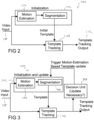
- FIG. 2 a block diagram of a further embodiment of the invention is depicted.
- the depicted system 200 for tracking templates of a moving object comprise an initialization unit 202 which includes a local motion estimation unit 204 and a segmentation unit 206.
- a video input 208 which consists of a sequence of images is inputted into the initialization unit 202 and the local motion estimation unit 204 partitions each of said images of said sequence into blocks and identifies moving blocks which have moved between consecutive images of said sequence.
- the segmentation unit 206 initializes a template for said moving objects by grouping adjacent moving blocks, for which directions within a predetermined direction interval and distances within a predetermined distance interval have been determined as it has been described before.
- the initialized template is used by a tracking unit 210, which is configured to track said template in said sequence of images delivered by the video input 208. In case such a template is tracked it is output to a template tracking output 212.
- a decision unit 300 is connected to the output of the tracking unit 210.
- the decision unit decides whether an update of said template should be performed. For example after a predetermined time or after an evaluated low correlation between the template and the images of the sequence the decision unit might trigger a motion based template update from the initialization unit 202.
- the initialization unit 202 performs the motion estimation and groups adjacent blocks which moved for a predetermined time into a "similar” direction for a "similar” distance into a second group, as it has been described above.
- This second group represents the "new” or “updated” version of the initial template, and thus, the second group is used to update the template which is used afterwards by the tracking unit 210.
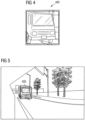
- Fig. 4 an example of an initialized template 400 is depicted, which shows the front side of the van, which has been initialized by the proposed method, while taking images with a camera mounted on a rear view mirror of a vehicle, thereby detecting moving objects on an adjacent lane.
- Fig. 5 a whole image, which is taken by the camera is depicted, wherein the tracked template 400 is marked with a white square.
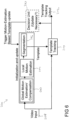
- a global motion estimation/compensation unit is used to pre-process the sequence of images delivered by the video input 208.
- This global motion estimation/compensation unit 600 is used to compensate the movement, which took place for the whole image, for example due to a movement of the camera, which took the images of the sequence. With this global motion estimation/compensation unit 600 the system 200 can segment all locally moving objects within the segmentation unit 206.
- the decision unit 300 might be used as it is described with respect to Fig. 3 , but this decision unit 300 is only optional, which is depicted in Fig. 6 with a dotted line.
- FIG. 7 an example of an extracted template 700 of a consumer electronics sequence, depicted in Fig. 8 , is depicted.
- Motion estimation usually has problems with such kind of movements, because the moving objects obscure other moving objects in the background.
- the object is well segmented and the other parts of the image are not considered in the correlation or filled with zeros or equally distributed noise.
- a computer program product which comprises a computer program code which when loaded into a processor performs the proposed method for tracking the moving object.
- backward moving objects in blind spot detection devices can be detected in automotive security application, what is desired by automotive manufacturers.
- the proposed method and system use motion estimation based segmentation results in order to initialize and/or update template tracking of moving objects.
- the method and system can be used even in cases where motion estimation based approaches completely fail, e.g. for backward moving objects in a blind spot region detection.
- the template of a forward and backward moving vehicle can be tracked well over many frames using cross correlation or sum of absolute differences (SAD) as soon as the initial template is found.
- SAD sum of absolute differences
- Template tracking works well but the problem is finding the first initial obstacle template.
- the proposed method and system uses motion estimation based segmentation results as the initial template.
- the template is updated from time to time by replacing the previous template by a template of the same size where it was detected.
- the template varies in size, depending on a distance to a vanishing point in blind spot detection applications. For convenience and better memory allocation, the template can be scaled to a fixed size.
- the search range of the cross correlation/sum of absolute differences is limited to a plausible range around the last detection and can include prediction.
- the proposed updating process reduces the "drifting" problem ("template update problem").
- template tracking can furthermore augment or replace permanent motion estimation.
- a template that is once detected can be tracked well by template tracking; and motion estimation is only used if the tracking fails.
- the failure of the tracking can be detected if the correlation peak is below a certain (fixed or adaptive) threshold or if the template location jumps to other local maxima.
- template tracking can be used for cross verification. Comparing the motion estimation results with the template tracking results can reduce false alarms that occur during motion estimation. If these results match well, the template can be updated according to the motion estimation segmentation results. Otherwise a mismatch indicates problems and might result in rejecting the template.
Landscapes
- Engineering & Computer Science (AREA)
- Multimedia (AREA)
- Computer Vision & Pattern Recognition (AREA)
- Physics & Mathematics (AREA)
- General Physics & Mathematics (AREA)
- Theoretical Computer Science (AREA)
- Image Analysis (AREA)
Claims (10)
- Procédé mis en oeuvre par ordinateur pour initialiser un modèle de déplacement d'objet dans une séquence d'images, comprenant les étapes consistant à :partager (S100) chacune desdites images de ladite séquence en blocs ;identifier (S102) les blocs mobiles qui ont effectué un mouvement entre les images consécutives de ladite séquence ;déterminer (S103) une direction et une distance dudit mouvement desdits blocs mobiles ;grouper (S104) dans un premier groupe de blocs les blocs mobiles adjacents, pour lesquels les directions situées dans un intervalle de directions prédéterminé et les distances situées dans un intervalle de distances prédéterminé ont été déterminées, l'intervalle de distances prédéterminé et l'intervalle de directions prédéterminé définissant un mouvement se produisant fondamentalement dans une même direction et correspondant fondamentalement à une même distance ;initialiser (S106) un modèle pour ledit objet mobile avec ledit premier groupe de blocs, le modèle comprenant des pixels attribués au premier groupe de blocs ;déterminer s'il convient d'effectuer une mise à jour dudit modèle ; etsuivre (S108) ledit modèle dans ladite séquence d'images.
- Procédé mis en oeuvre par ordinateur selon la revendication précédente, dans lequel la détermination de la nécessité d'effectuer une mise à jour dudit modèle comprend l'étape consistant à :
calculer une corrélation entre ledit modèle et des parties desdites images de ladite séquence et décider d'effectuer une mise à jour dudit modèle si ladite corrélation est inférieure à un seuil de corrélation prédéterminé. - Procédé mis en oeuvre par ordinateur selon l'une quelconque des revendications précédentes, dans lequel la détermination de la nécessité d'effectuer une mise à jour dudit modèle comprend les étapes consistant à :déterminer un vecteur de mouvement moyen pour un groupe cohérent de blocs desdites images ;déterminer vecteur de mouvement de modèle pour ledit modèle dans les images qui suivent ;comparer ledit vecteur de mouvement moyen audit vecteur de mouvement de modèle ; etrejeter ledit modèle en cas de disparité entre ledit vecteur de mouvement moyen et ledit vecteur de mouvement de modèle.
- Procédé mis en oeuvre par ordinateur selon l'une quelconque des revendications précédentes, comprenant également l'étape consistant à :
mettre à jour ledit modèle après qu'il est décidé d'effectuer une mise à jour dudit modèle. - Procédé mis en oeuvre par ordinateur selon la revendication 4, dans lequel la mise à jour dudit modèle comprend les étapes consistant à :étendre ladite séquence avec d'autres images ;identifier les blocs mobiles qui ont effectué un mouvement entre au moins une partie desdites autres images de ladite séquence ;déterminer une direction et une distance dudit mouvement desdits blocs mobiles ;grouper dans un deuxième groupe de blocs les blocs mobiles adjacents pour lesquels les directions situées dans un intervalle de directions prédéterminé et les distances situées dans un intervalle de distances prédéterminé ont été déterminées ; etmettre à jour ledit modèle pour ledit objet mobile avec ledit deuxième groupe de blocs.
- Procédé mis en oeuvre par ordinateur selon l'une quelconque des revendications précédentes, dans lequel
ledit suivi dudit modèle dans ladite séquence est basé sur un critère d'erreur entre ledit modèle et des parties desdites images. - Procédé mis en oeuvre par ordinateur selon l'une quelconque des revendications précédentes, comprenant également les étapes consistant à :définir une plage de recherche autour d'une zone dans laquelle l'objet est supposé se trouver dans une image ultérieure de ladite séquence en fonction de son comportement de déplacement dans les images précédentes de ladite séquence ; eteffectuer ladite étape de suivi dans ladite plage de recherche de ladite image ultérieure.
- Procédé mis en oeuvre par ordinateur selon l'une quelconque des revendications précédentes, comprenant également l'étape consistant à :
effectuer un traitement préalable desdites images de ladite séquence avec une estimation de mouvement globale et une compensation de mouvement globale. - Procédé mis en oeuvre par ordinateur pour détecter des objets mobiles dans une région d'angle mort d'un véhicule, lesdits objets mobiles se déplaçant en reculant dans ladite région d'angle mort par rapport à un mouvement dudit véhicule, comprenant l'exécution d'un procédé selon l'une quelconque des revendications précédentes.
- Produit programme informatique, comprenant
un code de programme informatique qui, lorsqu'il est chargé dans un processeur, effectue le procédé mis en oeuvre par ordinateur selon l'une quelconque des revendications précédentes.
Priority Applications (1)
| Application Number | Priority Date | Filing Date | Title |
|---|---|---|---|
| EP20163233.8A EP3683768B1 (fr) | 2007-05-03 | 2007-05-03 | Procédé et système d'initialisation de modèles de déplacement d'objets |
Applications Claiming Priority (2)
| Application Number | Priority Date | Filing Date | Title |
|---|---|---|---|
| EP20163233.8A EP3683768B1 (fr) | 2007-05-03 | 2007-05-03 | Procédé et système d'initialisation de modèles de déplacement d'objets |
| EP07008960.2A EP1988505B1 (fr) | 2007-05-03 | 2007-05-03 | Procédé et système d'initialisation de modèles de déplacement d'objets |
Related Parent Applications (2)
| Application Number | Title | Priority Date | Filing Date |
|---|---|---|---|
| EP07008960.2A Division EP1988505B1 (fr) | 2007-05-03 | 2007-05-03 | Procédé et système d'initialisation de modèles de déplacement d'objets |
| EP07008960.2A Division-Into EP1988505B1 (fr) | 2007-05-03 | 2007-05-03 | Procédé et système d'initialisation de modèles de déplacement d'objets |
Publications (2)
| Publication Number | Publication Date |
|---|---|
| EP3683768A1 EP3683768A1 (fr) | 2020-07-22 |
| EP3683768B1 true EP3683768B1 (fr) | 2023-06-28 |
Family
ID=38720678
Family Applications (2)
| Application Number | Title | Priority Date | Filing Date |
|---|---|---|---|
| EP20163233.8A Ceased EP3683768B1 (fr) | 2007-05-03 | 2007-05-03 | Procédé et système d'initialisation de modèles de déplacement d'objets |
| EP07008960.2A Ceased EP1988505B1 (fr) | 2007-05-03 | 2007-05-03 | Procédé et système d'initialisation de modèles de déplacement d'objets |
Family Applications After (1)
| Application Number | Title | Priority Date | Filing Date |
|---|---|---|---|
| EP07008960.2A Ceased EP1988505B1 (fr) | 2007-05-03 | 2007-05-03 | Procédé et système d'initialisation de modèles de déplacement d'objets |
Country Status (3)
| Country | Link |
|---|---|
| US (1) | US8045812B2 (fr) |
| EP (2) | EP3683768B1 (fr) |
| CN (1) | CN101299272B (fr) |
Families Citing this family (18)
| Publication number | Priority date | Publication date | Assignee | Title |
|---|---|---|---|---|
| AU2003201136A1 (en) * | 2002-02-06 | 2003-09-02 | Koninklijke Philips Electronics N.V. | Unit for and method of segmentation |
| JP4760918B2 (ja) * | 2009-01-23 | 2011-08-31 | カシオ計算機株式会社 | 撮像装置、被写体追従方法、及びプログラム |
| EP2246806B1 (fr) * | 2009-04-29 | 2014-04-02 | Autoliv Development AB | Procédé de vision et système de détection automatique d'objets en face d'un véhicule à moteur |
| CN101814187B (zh) * | 2009-12-29 | 2012-07-18 | 天津市亚安科技股份有限公司 | 基于多级特征的视频跟踪方法 |
| US8406472B2 (en) | 2010-03-16 | 2013-03-26 | Sony Corporation | Method and system for processing image data |
| US20120162449A1 (en) * | 2010-12-23 | 2012-06-28 | Matthias Braun | Digital image stabilization device and method |
| US8971573B2 (en) * | 2012-09-12 | 2015-03-03 | Xerox Corporation | Video-tracking for video-based speed enforcement |
| EP3055709B1 (fr) | 2013-10-07 | 2018-12-26 | Acist Medical Systems, Inc. | Traitement de signal pour imagerie intravasculaire |
| US20170287505A1 (en) * | 2014-09-03 | 2017-10-05 | Samsung Electronics Co., Ltd. | Method and apparatus for learning and recognizing audio signal |
| US10653393B2 (en) | 2015-10-08 | 2020-05-19 | Acist Medical Systems, Inc. | Intravascular ultrasound imaging with frequency selective imaging methods and systems |
| US10909661B2 (en) | 2015-10-08 | 2021-02-02 | Acist Medical Systems, Inc. | Systems and methods to reduce near-field artifacts |
| US11369337B2 (en) | 2015-12-11 | 2022-06-28 | Acist Medical Systems, Inc. | Detection of disturbed blood flow |
| WO2017117389A1 (fr) | 2015-12-31 | 2017-07-06 | Acist Medical Systems, Inc. | Système et procédé de segmentation d'image semi-automatisée |
| US9865062B2 (en) * | 2016-02-12 | 2018-01-09 | Qualcomm Incorporated | Systems and methods for determining a region in an image |
| EP3459048B1 (fr) * | 2016-05-16 | 2023-05-03 | Acist Medical Systems, Inc. | Systèmes et procédés de segmentation d'images basés sur le mouvement |
| US11315256B2 (en) * | 2018-12-06 | 2022-04-26 | Microsoft Technology Licensing, Llc | Detecting motion in video using motion vectors |
| CN110264492B (zh) * | 2019-06-03 | 2021-03-23 | 浙江大学 | 一种高效的卫星图像自纠正多目标跟踪方法 |
| US11024034B2 (en) | 2019-07-02 | 2021-06-01 | Acist Medical Systems, Inc. | Image segmentation confidence determination |
Family Cites Families (8)
| Publication number | Priority date | Publication date | Assignee | Title |
|---|---|---|---|---|
| EP0385009A1 (fr) * | 1989-03-03 | 1990-09-05 | Hewlett-Packard Limited | Appareil et méthode pour utilisation dans le traitement d'image |
| US6055025A (en) * | 1993-12-21 | 2000-04-25 | Lucent Technologies, Inc. | Method and apparatus for detecting abrupt and gradual scene changes in image sequences |
| US6847680B2 (en) * | 2001-12-17 | 2005-01-25 | Mitsubishi Electric Research Laboratories, Inc. | Method for detecting talking heads in a compressed video |
| AU2002318859B2 (en) | 2001-12-19 | 2004-11-25 | Canon Kabushiki Kaisha | A Method for Video Object Detection and Tracking Based on 3D Segment Displacement |
| CN1311409C (zh) * | 2002-07-31 | 2007-04-18 | 皇家飞利浦电子股份有限公司 | 用于分割的系统和方法 |
| JP3861781B2 (ja) * | 2002-09-17 | 2006-12-20 | 日産自動車株式会社 | 前方車両追跡システムおよび前方車両追跡方法 |
| US7447337B2 (en) | 2004-10-25 | 2008-11-04 | Hewlett-Packard Development Company, L.P. | Video content understanding through real time video motion analysis |
| JP4345722B2 (ja) * | 2005-07-15 | 2009-10-14 | ソニー株式会社 | 動体追跡制御装置、動体追跡システム、動体追跡制御方法及びプログラム |
-
2007
- 2007-05-03 EP EP20163233.8A patent/EP3683768B1/fr not_active Ceased
- 2007-05-03 EP EP07008960.2A patent/EP1988505B1/fr not_active Ceased
-
2008
- 2008-04-07 US US12/098,640 patent/US8045812B2/en active Active
- 2008-05-04 CN CN200810092819XA patent/CN101299272B/zh not_active Expired - Fee Related
Also Published As
| Publication number | Publication date |
|---|---|
| EP3683768A1 (fr) | 2020-07-22 |
| EP1988505A1 (fr) | 2008-11-05 |
| US8045812B2 (en) | 2011-10-25 |
| EP1988505B1 (fr) | 2020-05-06 |
| CN101299272A (zh) | 2008-11-05 |
| CN101299272B (zh) | 2012-11-28 |
| US20080273806A1 (en) | 2008-11-06 |
Similar Documents
| Publication | Publication Date | Title |
|---|---|---|
| EP3683768B1 (fr) | Procédé et système d'initialisation de modèles de déplacement d'objets | |
| Hu et al. | Moving object detection and tracking from video captured by moving camera | |
| Mukojima et al. | Moving camera background-subtraction for obstacle detection on railway tracks | |
| Gandhi et al. | Pedestrian collision avoidance systems: A survey of computer vision based recent studies | |
| Zhong | Segmenting foreground objects from a dynamic textured background via a robust kalman filter | |
| Kim | Real time object tracking based on dynamic feature grouping with background subtraction | |
| Kundu et al. | Moving object detection by multi-view geometric techniques from a single camera mounted robot | |
| Babu et al. | Robust tracking with motion estimation and local kernel-based color modeling | |
| Zhou et al. | Modified GMM background modeling and optical flow for detection of moving objects | |
| US8331617B2 (en) | Robot vision system and detection method | |
| Chen et al. | An enhanced segmentation on vision-based shadow removal for vehicle detection | |
| US11593949B2 (en) | Method of detecting moving objects via a moving camera, and related processing system, device and computer-program product | |
| Šilar et al. | The obstacle detection on the railway crossing based on optical flow and clustering | |
| CN108280444B (zh) | 一种基于车辆环视图的快速运动物体检测方法 | |
| Aytekin et al. | Increasing driving safety with a multiple vehicle detection and tracking system using ongoing vehicle shadow information | |
| Baris et al. | Classification and tracking of traffic scene objects with hybrid camera systems | |
| You et al. | Moving object tracking in H. 264/AVC bitstream | |
| Al-Berry et al. | Spatio-temporal motion detection for intelligent surveillance applications | |
| Balisavira et al. | Real-time object detection by road plane segmentation technique for ADAS | |
| Ma et al. | A real time object detection approach applied to reliable pedestrian detection | |
| Vijverberg et al. | High-level traffic-violation detection for embedded traffic analysis | |
| Wong et al. | Shared-use motion vector algorithm for moving objects detection for automobiles | |
| Suresh et al. | Determination of Moving Vehicle Speed using Image Processing | |
| Giralt et al. | Lane mark segmentation and identification using statistical criteria on compressed video | |
| Meuel et al. | Moving object tracking for aerial video coding using linear motion prediction and block matching |
Legal Events
| Date | Code | Title | Description |
|---|---|---|---|
| PUAI | Public reference made under article 153(3) epc to a published international application that has entered the european phase |
Free format text: ORIGINAL CODE: 0009012 |
|
| STAA | Information on the status of an ep patent application or granted ep patent |
Free format text: STATUS: REQUEST FOR EXAMINATION WAS MADE |
|
| 17P | Request for examination filed |
Effective date: 20200316 |
|
| AC | Divisional application: reference to earlier application |
Ref document number: 1988505 Country of ref document: EP Kind code of ref document: P |
|
| AK | Designated contracting states |
Kind code of ref document: A1 Designated state(s): DE FR GB |
|
| RAP1 | Party data changed (applicant data changed or rights of an application transferred) |
Owner name: SONY CORPORATION |
|
| RAP3 | Party data changed (applicant data changed or rights of an application transferred) |
Owner name: SONY GROUP CORPORATION |
|
| GRAP | Despatch of communication of intention to grant a patent |
Free format text: ORIGINAL CODE: EPIDOSNIGR1 |
|
| STAA | Information on the status of an ep patent application or granted ep patent |
Free format text: STATUS: GRANT OF PATENT IS INTENDED |
|
| INTG | Intention to grant announced |
Effective date: 20221221 |
|
| GRAS | Grant fee paid |
Free format text: ORIGINAL CODE: EPIDOSNIGR3 |
|
| GRAA | (expected) grant |
Free format text: ORIGINAL CODE: 0009210 |
|
| STAA | Information on the status of an ep patent application or granted ep patent |
Free format text: STATUS: THE PATENT HAS BEEN GRANTED |
|
| AC | Divisional application: reference to earlier application |
Ref document number: 1988505 Country of ref document: EP Kind code of ref document: P |
|
| AK | Designated contracting states |
Kind code of ref document: B1 Designated state(s): DE FR GB |
|
| REG | Reference to a national code |
Ref country code: DE Ref legal event code: R096 Ref document number: 602007061700 Country of ref document: DE |
|
| REG | Reference to a national code |
Ref country code: DE Ref legal event code: R097 Ref document number: 602007061700 Country of ref document: DE |
|
| PLBE | No opposition filed within time limit |
Free format text: ORIGINAL CODE: 0009261 |
|
| STAA | Information on the status of an ep patent application or granted ep patent |
Free format text: STATUS: NO OPPOSITION FILED WITHIN TIME LIMIT |
|
| 26N | No opposition filed |
Effective date: 20240402 |
|
| REG | Reference to a national code |
Ref country code: DE Ref legal event code: R119 Ref document number: 602007061700 Country of ref document: DE |
|
| GBPC | Gb: european patent ceased through non-payment of renewal fee |
Effective date: 20240503 |
|
| PG25 | Lapsed in a contracting state [announced via postgrant information from national office to epo] |
Ref country code: DE Free format text: LAPSE BECAUSE OF NON-PAYMENT OF DUE FEES Effective date: 20241203 |
|
| PG25 | Lapsed in a contracting state [announced via postgrant information from national office to epo] |
Ref country code: FR Free format text: LAPSE BECAUSE OF NON-PAYMENT OF DUE FEES Effective date: 20240531 |
|
| PG25 | Lapsed in a contracting state [announced via postgrant information from national office to epo] |
Ref country code: GB Free format text: LAPSE BECAUSE OF NON-PAYMENT OF DUE FEES Effective date: 20240503 |