EP3684848B1 - Procédé de fabrication de particules de polycarbonate ignifuges et particules de polycarbonate ignifuges ainsi préparées - Google Patents
Procédé de fabrication de particules de polycarbonate ignifuges et particules de polycarbonate ignifuges ainsi préparées Download PDFInfo
- Publication number
- EP3684848B1 EP3684848B1 EP18779134.8A EP18779134A EP3684848B1 EP 3684848 B1 EP3684848 B1 EP 3684848B1 EP 18779134 A EP18779134 A EP 18779134A EP 3684848 B1 EP3684848 B1 EP 3684848B1
- Authority
- EP
- European Patent Office
- Prior art keywords
- micrometers
- polycarbonate
- particles
- phosphorus
- flame retardant
- Prior art date
- Legal status (The legal status is an assumption and is not a legal conclusion. Google has not performed a legal analysis and makes no representation as to the accuracy of the status listed.)
- Active
Links
Images


Classifications
-
- C—CHEMISTRY; METALLURGY
- C08—ORGANIC MACROMOLECULAR COMPOUNDS; THEIR PREPARATION OR CHEMICAL WORKING-UP; COMPOSITIONS BASED THEREON
- C08J—WORKING-UP; GENERAL PROCESSES OF COMPOUNDING; AFTER-TREATMENT NOT COVERED BY SUBCLASSES C08B, C08C, C08F, C08G or C08H
- C08J3/00—Processes of treating or compounding macromolecular substances
- C08J3/12—Powdering or granulating
- C08J3/14—Powdering or granulating by precipitation from solutions
-
- C—CHEMISTRY; METALLURGY
- C08—ORGANIC MACROMOLECULAR COMPOUNDS; THEIR PREPARATION OR CHEMICAL WORKING-UP; COMPOSITIONS BASED THEREON
- C08J—WORKING-UP; GENERAL PROCESSES OF COMPOUNDING; AFTER-TREATMENT NOT COVERED BY SUBCLASSES C08B, C08C, C08F, C08G or C08H
- C08J3/00—Processes of treating or compounding macromolecular substances
- C08J3/12—Powdering or granulating
-
- C—CHEMISTRY; METALLURGY
- C08—ORGANIC MACROMOLECULAR COMPOUNDS; THEIR PREPARATION OR CHEMICAL WORKING-UP; COMPOSITIONS BASED THEREON
- C08J—WORKING-UP; GENERAL PROCESSES OF COMPOUNDING; AFTER-TREATMENT NOT COVERED BY SUBCLASSES C08B, C08C, C08F, C08G or C08H
- C08J3/00—Processes of treating or compounding macromolecular substances
- C08J3/20—Compounding polymers with additives, e.g. colouring
- C08J3/203—Solid polymers with solid and/or liquid additives
-
- C—CHEMISTRY; METALLURGY
- C08—ORGANIC MACROMOLECULAR COMPOUNDS; THEIR PREPARATION OR CHEMICAL WORKING-UP; COMPOSITIONS BASED THEREON
- C08J—WORKING-UP; GENERAL PROCESSES OF COMPOUNDING; AFTER-TREATMENT NOT COVERED BY SUBCLASSES C08B, C08C, C08F, C08G or C08H
- C08J3/00—Processes of treating or compounding macromolecular substances
- C08J3/20—Compounding polymers with additives, e.g. colouring
- C08J3/205—Compounding polymers with additives, e.g. colouring in the presence of a continuous liquid phase
- C08J3/21—Compounding polymers with additives, e.g. colouring in the presence of a continuous liquid phase the polymer being premixed with a liquid phase
-
- C—CHEMISTRY; METALLURGY
- C08—ORGANIC MACROMOLECULAR COMPOUNDS; THEIR PREPARATION OR CHEMICAL WORKING-UP; COMPOSITIONS BASED THEREON
- C08K—Use of inorganic or non-macromolecular organic substances as compounding ingredients
- C08K5/00—Use of organic ingredients
- C08K5/49—Phosphorus-containing compounds
- C08K5/51—Phosphorus bound to oxygen
- C08K5/53—Phosphorus bound to oxygen bound to oxygen and to carbon only
- C08K5/5317—Phosphonic compounds, e.g. R—P(:O)(OR')2
- C08K5/5333—Esters of phosphonic acids
-
- C—CHEMISTRY; METALLURGY
- C08—ORGANIC MACROMOLECULAR COMPOUNDS; THEIR PREPARATION OR CHEMICAL WORKING-UP; COMPOSITIONS BASED THEREON
- C08K—Use of inorganic or non-macromolecular organic substances as compounding ingredients
- C08K5/00—Use of organic ingredients
- C08K5/49—Phosphorus-containing compounds
- C08K5/5399—Phosphorus bound to nitrogen
-
- C—CHEMISTRY; METALLURGY
- C08—ORGANIC MACROMOLECULAR COMPOUNDS; THEIR PREPARATION OR CHEMICAL WORKING-UP; COMPOSITIONS BASED THEREON
- C08J—WORKING-UP; GENERAL PROCESSES OF COMPOUNDING; AFTER-TREATMENT NOT COVERED BY SUBCLASSES C08B, C08C, C08F, C08G or C08H
- C08J2369/00—Characterised by the use of polycarbonates; Derivatives of polycarbonates
Definitions
- High performance polymers such as polycarbonate can be made into ultra-fine powders, for example, powders comprising particles having a diameter of less than or equal to 100 micrometers ( ⁇ m), by emulsifying the polymer in an organic solvent and water, and further removing the organic solvent from the emulsion, for example, through distillation.
- particles made by such a process can result in poor yield of the particles.
- achieving particles having an average size of less than 100 ⁇ m and narrow particle distributions remains a challenge using known techniques.
- a process for the manufacture of polycarbonate particles comprises combining a first solution comprising (i) a polycarbonate and a phosphorus-containing flame retardant, and (ii) an organic solvent with a second solution comprising (i) a surfactant and (ii) an aqueous solvent immiscible with the organic solvent, under conditions of shear and temperature effective to provide an emulsion; and removing at least a portion of the organic solvent to provide an aqueous slurry comprising a plurality of particles comprising the polycarbonate and the phosphorus-containing flame retardant.
- Polycarbonate particles comprising a phosphorus-containing flame retardant and articles comprising the particles are also described.
- a process for the manufacture of flame retardant polycarbonate particles relies on the formation of an aqueous polymer dispersion from an emulsion.
- flame retardant polycarbonate particles having an average size (by volume) of 5 to 60 micrometers can be obtained in high yields (e.g., greater than 75%) and with a high degree of flame retardant retention within the particles (e.g., 90% or greater).
- the present inventors have discovered that varying process parameters including amount of the flame retardant component can impact the resulting polycarbonate particle size and distribution, as well as the overall yield of the process. Accordingly, the present inventors have identified an optimized process for the preparation of flame retardant polycarbonate particles.
- an aspect of the present disclosure is a process for the manufacture of polycarbonate particles.
- the process can advantageously provide polycarbonate particles in high yield, and having a particular average size, size distribution, phosphorus content, and residual surfactant content.
- the flame retardant polycarbonate particles can have a glass transition temperature of less than or equal to 140°C, which can facilitate further processing of the particles.
- the process includes combining a first solution comprising a polycarbonate and a phosphorus-containing flame retardant and an organic solvent with a second solution comprising an aqueous solvent that is substantially immiscible with the organic solvent and a surfactant to provide an emulsion.
- the first solution can be prepared by dissolving a polycarbonate and the phosphorus-containing flame retardant in an organic solvent to form the first solution.
- polycarbonate includes homopolycarbonates, copolycarbonates, polycarbonate copolymers, and combinations comprising at least one of the foregoing.
- Polycarbonates include repeating structural carbonate units of the formula (1) wherein at least 60 percent of the total number of R 1 groups are aromatic, or each R 1 contains at least one C 6-30 aromatic group.
- each R 1 can be derived from a dihydroxy compound such as an aromatic dihydroxy compound of formula (2) or a bisphenol of formula (3).
- each R h is independently a halogen atom, for example bromine, a C 1-10 hydrocarbyl group such as a C 1-10 alkyl, a halogen-substituted C 1-10 alkyl, a C 6-10 aryl, or a halogen-substituted C 6-10 aryl, and n is 0 to 4.
- R a and R b are each independently a halogen, C 1-12 alkoxy, or C 1-12 alkyl, and p and q are each independently integers of 0 to 4, such that when p or q is less than 4, the valence of each carbon of the ring is filled by hydrogen.
- p and q is each 0, or p and q is each 1
- R a and R b are each a C 1-3 alkyl group, specifically methyl, disposed meta to the hydroxy group on each arylene group.
- X a is a bridging group connecting the two hydroxy-substituted aromatic groups, where the bridging group and the hydroxy substituent of each C 6 arylene group are disposed ortho, meta, or para (specifically para) to each other on the C 6 arylene group, for example, a single bond, -O-, -S-, -S(O)-, -S(O) 2 -, -C(O)-, or a C 1-18 organic group, which can be cyclic or acyclic, aromatic or non-aromatic, and can further comprise heteroatoms such as halogens, oxygen, nitrogen, sulfur, silicon, or phosphorous.
- X a can be a substituted C 3-18 cycloalkylidene of formula (4) wherein R r , R p , R q , and R t are each independently hydrogen, halogen, oxygen, or C 1-12 hydrocarbon groups; Q is a direct bond, a carbon, or a divalent oxygen, sulfur, or -N(Z)- where Z is hydrogen, halogen, hydroxy, C 1-12 alkyl, C 1-12 alkoxy, C 6-12 aryl, or C 1-12 acyl; r is 0 to 2, t is 1 or 2, q is 0 or 1, and k is 0 to 3, with the proviso that at least two of R r , R p , R q , and R t taken together are a fused cycloaliphatic, aromatic, or heteroaromatic ring.
- the ring as shown in formula (4) will have an unsaturated carbon-carbon linkage where the ring is fused.
- the ring as shown in formula (4) contains 4 carbon atoms
- the ring as shown in formula (4) contains 5 carbon atoms
- the ring contains 6 carbon atoms.
- two adjacent groups e.g., R q and R t taken together
- R q and R t taken together form one aromatic group
- R r and R p taken together form a second aromatic group.
- R p can be a double-bonded oxygen atom, i.e., a ketone, or Q can be -N(Z)-wherein Z is phenyl.
- Bisphenols wherein X a is a cycloalkylidene of formula (4) can be used in the manufacture of polycarbonates containing phthalimidine carbonate units of formula (1a) wherein R a , R b , p, and q are as in formula (3), R 3 is each independently a C 1-6 alkyl, j is 0 to 4, and R 4 is hydrogen, C 1-6 alkyl, or a substituted or unsubstituted phenyl, for example a phenyl substituted with up to five C 1-6 alkyls.
- the phthalimidine carbonate units are of formula (1b) wherein R 5 is hydrogen, phenyl optionally substituted with up to five 5 C 1-6 alkyls, or C 1-4 alkyl.
- R 5 is hydrogen, methyl, or phenyl, specifically phenyl.
- Carbonate units (1b) wherein R 5 is phenyl can be derived from 2-phenyl-3,3'-bis(4-hydroxy phenyl)phthalimidine (also known as 3,3-bis(4-hydroxyphenyl)-2-phenylisoindolin-1-one, or N-phenyl phenolphthalein bisphenol (“PPPBP”)).
- dihydroxy compounds that can be used are described, for example, in WO 2013/175448 A1 , US 2014/0295363 , and WO 2014/072923 .
- Exemplary dihydroxy compounds include resorcinol, 2,2-bis(4-hydroxyphenyl) propane (“bisphenol A” or "BPA”), 3,3-bis(4-hydroxyphenyl) phthalimidine, 2-phenyl-3,3'-bis(4-hydroxyphenyl) phthalimidine (also known as N-phenyl phenolphthalein bisphenol, "PPPBP", or 3,3-bis(4-hydroxyphenyl)-2-phenylisoindolin-1 -one), 1,1 -bis(4-hydroxy-3-methylphenyl)cyclohexane, and 1,1-bis(4-hydroxy-3-methylphenyl)-3,3,5-trimethylcyclohexane (isophorone bisphenol).
- Copolycarbonates have at least two different types of carbonate units, for example B
- Polycarbonate as used herein also includes copolymers, for example, including carbonate units and ester units ("poly(ester-carbonate)s", also known as polyester-polycarbonates).
- Poly(ester-carbonate)s further contain, in addition to recurring carbonate chain units of formula (1), repeating ester units of formula (5) wherein J is a divalent group derived from a dihydroxy compound (which includes a reactive derivative thereof), and can be, for example, a C 2-10 alkylene, a C 6-20 cycloalkylene a C 6-20 arylene, or a polyoxyalkylene group in which the alkylene groups contain 2 to 6 carbon atoms, specifically, 2, 3, or 4 carbon atoms; and T is a divalent group derived from a dicarboxylic acid (which includes a reactive derivative thereof), and can be, for example, a C 2-20 alkylene, a C 6-20 cycloalkylene, or a C 6-20 arylene.
- Specific dihydroxy compounds include aromatic dihydroxy compounds of formula (2) (e.g., resorcinol), bisphenols of formula (3) (e.g., bisphenol A), a C 1-8 aliphatic diol such as ethane diol, n-propane diol, i-propane diol, 1,4-butane diol, 1,6-cyclohexane diol, 1,6-hydroxymethylcyclohexane, or a combination comprising at least one of the foregoing dihydroxy compounds.
- aromatic dihydroxy compounds of formula (2) e.g., resorcinol
- bisphenols of formula (3) e.g., bisphenol A
- a C 1-8 aliphatic diol such as ethane diol, n-propane diol, i-propane diol, 1,4-butane diol, 1,6-cyclohexane diol, 1,6-hydroxymethylcyclohexane,
- Aliphatic dicarboxylic acids that can be used include C 6-20 aliphatic dicarboxylic acids (which includes the terminal carboxyl groups), specifically linear C 8-12 aliphatic dicarboxylic acid such as decanedioic acid (sebacic acid); and alpha, omega-C 12 dicarboxylic acids such as dodecanedioic acid (DDDA).
- Aromatic dicarboxylic acids that can be used include terephthalic acid, isophthalic acid, naphthalene dicarboxylic acid, 1,6-cyclohexane dicarboxylic acid, or a combination comprising at least one of the foregoing acids.
- a combination of isophthalic acid and terephthalic acid wherein the weight ratio of isophthalic acid to terephthalic acid is 91:9 to 2:98 can be used.
- ester units include ethylene terephthalate units, n-proplyene terephthalate units, n-butylene terephthalate units, ester units derived from isophthalic acid, terephthalic acid, and resorcinol (ITR ester units), and ester units derived from sebacic acid and bisphenol A.
- the molar ratio of ester units to carbonate units in the poly(ester-carbonate)s can vary broadly, for example 1:99 to 99:1. Within this range, the molar ratio of ester units to carbonate units can be 10:90 to 90:10, or 25:75 to 75:25, or 2:98 to 15:85.
- the molar ratio of ester units to carbonate units in the poly(ester-carbonate)s can vary from 1:99 to 30:70, or from 2:98 to 25:75, or from 3:97 to 20:80, or from 5:95 to 15:85.
- the polycarbonate is a bisphenol A homopolycarbonate, poly(carbonate-siloxane), poly(aromatic ester-carbonate), poly(aliphatic ester-carbonate), poly(aromatic ester-carbonate-siloxane), poly(bisphenol A-2-phenyl-3,3'-bis(4-hydroxyphenyl) phthalimidine carbonate), poly(bisphenol A-1,1-bis(4-hydroxy-3-methylphenyl)cyclohexane carbonate), or a combination comprising at least one of the foregoing.
- the polycarbonate is a linear homopolymer containing bisphenol A carbonate units (BPA-PC), commercially available under the trade name LEXAN from SABIC; or a branched, cyanophenol end-capped bisphenol A homopolycarbonate produced via interfacial polymerization, containing 3 mol% 1,1,1-tris(4-hydroxyphenyl)ethane (THPE) branching agent, commercially available under the trade name LEXAN CFR from SABIC.
- the polycarbonate can include a combination of more than one polycarbonate, for example, more than one homopolycarbonate. A combination of a linear polycarbonate and a branched polycarbonate can be used.
- Polycarbonate copolymers can include copolycarbonates comprising two or more different types of carbonate units, for example units derived from BPA and PPPBP (commercially available under the trade name LEXAN XHT from SABIC); BPA and DMBPC (commercially available under the trade name DMX from SABIC); or BPA and isophorone bisphenol (commercially available under the trade name APEC from Bayer).
- BPA and PPPBP commercially available under the trade name LEXAN XHT from SABIC
- BPA and DMBPC commercially available under the trade name DMX from SABIC
- BPA and isophorone bisphenol commercially available under the trade name APEC from Bayer.
- a particular copolycarbonate includes bisphenol A and bulky bisphenol carbonate units, i.e., derived from bisphenols containing at least 12 carbon atoms, for example 12 to 60 carbon atoms or 20 to 40 carbon atoms.
- Examples of such copolycarbonates include copolycarbonates comprising bisphenol A carbonate units and 2-phenyl-3,3'-bis(4-hydroxyphenyl) phthalimidine carbonate units (a BPA-PPPBP copolymer, commercially available under the trade name XHT from SABIC).
- Polycarbonates can be manufactured by processes such as interfacial polymerization and melt polymerization, which are known, and are described, for example, in WO 2013/175448 A1 and WO 2014/072923 A1 .
- An end-capping agent also referred to as a chain stopper agent or chain terminating agent
- can be included during polymerization to provide end groups for example monocyclic phenols such as phenol, p-cyanophenol, and C 1 -C 22 alkyl-substituted phenols such as p-cumyl-phenol, resorcinol monobenzoate, and p-and tertiary-butyl phenol, monoethers of diphenols, such as p-methoxyphenol, monoesters of diphenols such as resorcinol monobenzoate, functionalized chlorides of aliphatic monocarboxylic acids such as acryloyl chloride and methacryoyl chloride, and mono-chloroformates
- Branched polycarbonate blocks can be prepared by adding a branching agent during polymerization, for example trimellitic acid, trimellitic anhydride, trimellitic trichloride, tris-p-hydroxyphenylethane, isatin-bis-phenol, tris-phenol TC (1,3,5-tris((p-hydroxyphenyl)isopropyl)benzene), tris-phenol PA (4(4(1,1-bis(p-hydroxyphenyl)-ethyl) alpha, alpha-dimethyl benzyl)phenol), 4-chloroformyl phthalic anhydride, trimesic acid, and benzophenone tetracarboxylic acid.
- the branching agents can be added at a level of 0.05 to 2.0 wt. %. Combinations comprising linear polycarbonates and branched polycarbonates can be used.
- a phosphorus-containing flame retardant is also included.
- the phosphorus-containing flame retardant can include an aromatic group, a phosphorus-nitrogen bond, or a combination comprising at least one of the foregoing.
- the phosphorus-containing flame retardant can be an organic phosphate or an organic compound containing phosphorus-nitrogen bonds.
- the phosphorus-containing flame retardant is an aryl phosphate having a molecular weight of about 350 to 1000 grams per mole.
- aromatic phosphates can be, for example, phenyl bis(dodecyl)phosphate, phenyl bis(neopentyl)phosphate, phenyl bis(3,5,5'-trimethylhexyl)phosphate, ethyl diphenyl phosphate, 2-ethylhexyl di(p- tolyl)phosphate, bis(2-ethylhexyl)p-tolyl phosphate, tritolyl phosphate, bis(2- ethylhexyl)phenyl phosphate, tri(nonylphenyl)phosphate, bis(dodecyl)p-tolyl phosphate, dibutyl phenyl phosphate, p-tolyl bis(2,5,5'-trimethylhexyl)phosphate, 2-ethylhexyl diphenyl phosphate, or the like.
- a specific aromatic phosphate is one in which each G is aromatic, for example, trip
- Di- or polyfunctional aromatic phosphorus-containing compounds can be useful, for example, compounds of the following formulas or wherein R 1 , R 3 and R 5 are, independently, hydrocarbon; R 2 , R 4 , R 6 and R 7 are, independently, hydrocarbon or hydrocarbonoxy; X 1 , X 2 and X 3 are halogen; m and r are 0 or integers from 1 to 4, and n and p are from 1 to 30.
- Suitable di- or polyfunctional aromatic phosphorus-containing compounds include resorcinol tetraphenyl diphosphate (RDP, also known as resorcinol bis (diphenyl phosphate)), the bis(diphenyl)phosphate of hydroquinone and the bis(diphenyl)phosphate of bisphenol-A (BPA-DP), respectively, their oligomeric and polymeric counterparts, and the like.
- RDP resorcinol tetraphenyl diphosphate
- BPA-DP bis(diphenyl)phosphate of hydroquinone
- BPA-DP bis(diphenyl)phosphate of bisphenol-A
- the phosphorus-containing flame retardant can be an organic compound containing a phosphorus-nitrogen bond, for example, phosphazenes, phosphonitrilic chloride, phosphorus ester amides, phosphoric acid amides, phosphonic acid amides, phosphinic acid amides, tris(aziridinyl) phosphine oxide, or tetrakis(hydroxymethyl) phosphonium chloride.
- phosphazenes for example, phosphazenes, phosphonitrilic chloride, phosphorus ester amides, phosphoric acid amides, phosphonic acid amides, phosphinic acid amides, tris(aziridinyl) phosphine oxide, or tetrakis(hydroxymethyl) phosphonium chloride.
- phosphazenes for example, phosphazenes, phosphonitrilic chloride, phosphorus ester amides,
- the phosphorus-containing flame retardant can be a polyphosphonate or a copolyphosphonate.
- the polyphosphonate can generally be a polyphosphonate that is known in the art, including, but not limited to those described in U.S. Patent No. 6,861,499 and 7,816,486 .
- Polyphosphonates can exhibit at least one of a broad molecular weight distribution with polydispersities of 3.2 or greater, 2.5 or greater, and 2.3 or greater, an M w of greater than 10,000 grams per mole using polystyrene standards, and a Tg of at least 100°C.
- the polyphosphonates can have a Tg of 25 to 140° C, or 50 to 135°C, or 75 to 130°C.
- the polyphosphonates can be prepared from an aryl phosphonic acid ester and bisphenol A or a mixture of bisphenol A and other bisphenols and a phosphonium catalyst or an alkyl metal catalyst such as a sodium catalyst, and can have a relative viscosity of at least 1.1, transparency, and improved hydrolytic stability.
- Such polyphosphates may be branched polyphosphonates or linear or cyclic.
- Exemplary copolyphosphonates can include poly(phosphonate-co-carbonate), and can include block or random copolyphosphonates.
- the constituent components of such copolyphosphonates can include any type of phosphonate and carbonate components.
- the phosphonate and carbonate content of the copolyphosphonates can vary among embodiments, and embodiments are not limited by the phosphonate or carbonate content or range of phosphonate or carbonate content.
- the copolyphosphonates can have a phosphorus content of 1 to 15% by weight of the total copolyphosphonate, for example 1 to 12 wt%, or 2 to 10 wt%
- the phosphorus-containing flame retardant includes a monomeric or polymeric phosphate, phosphite, phosphonate, phosphinate, phosphine oxide, or phosphine, each containing a C 3-30 aromatic group optionally comprising up to three heteroatoms in an aromatic ring, a phosphazene, phosphorus ester amide, phosphoric acid amide, phosphonic acid amide, phosphinic acid amide, tris(aziridinyl) phosphine oxide, or a combination comprising at least one of the foregoing.
- the phosphorus-containing flame retardant can preferably be a polyphosphonate-co-carbonate, phosphorus-containing homopolymer, resorcinol diphosphate, bisphenol A bis(diphenyl phosphate), triphenyl phosphate, resorcinol bis(diphenyl phosphate), tricresyl phosphate, a phenol/bi-phenol polyphosphate, phenoxyphosphazene, or a combination comprising at least one of the foregoing.
- the polycarbonate particles prepared according to the method described herein can retain greater than 90% of the phosphorus-containing flame retardant, relative to the amount of phosphorus-containing flame retardant present in the first solution prior to formation of the particles.
- the amount of phosphorus-containing flame retardant additive can be determined, for example, using inductively coupled plasma-atomic emission spectroscopy or inductively coupled plasma-mass spectrometry, as described in the working examples below.
- the first solution can further include an additive in addition to the polycarbonate and the phosphorus-containing flame retardant.
- additives can include an antioxidant, a stabilizer, an anti-drip agent (e.g., a PTFE-encapsulated styrene-acrylonitrile copolymer (TSAN)), a colorant (e.g., a dye or pigment), and a mold release agent.
- Additives can include aqueous polymer dispersions or emulsions comprising polymers that are different from the polycarbonate discussed above. Examples include poly(tetrafluoroethylene) (PTFE) emulsions, (meth)acrylic emulsions, and the like.
- an additive or combination of additives can be included in amounts that are generally known to be effective.
- the polycarbonate, the phosphorus-containing flame retardant, and the one or more additives can be added individually to the first solution.
- the polycarbonate, the phosphorus-containing flame retardant, and the one or more additives can be premixed and compounded prior to dissolution in the solvent to provide the first solution.
- the one or more additives incorporated into the first solution can be incorporated into the resulting polycarbonate particles.
- the polycarbonate particles can comprise an additive in an amount of 0.001 to 25.0 wt%, or 0.01 to 10 wt%, based on the weight of the polycarbonate particles.
- the polycarbonate particles can comprise a dye or pigment in an amount of 0.001 to 25.0 wt%, or 0.01 to 10 wt%, based on the weight of the polycarbonate particles.
- flame retardants other than the phosphorus-containing flame retardant described above can be excluded from the process of making the polycarbonate particles disclosed herein.
- halogenated flame retardants can be excluded from the polycarbonate particles.
- the polycarbonate particles can be essentially free of chlorine and bromine. "Essentially free of chlorine and bromine” is defined as having a bromine or chlorine content of less than or equal to 100 parts per million by weight (ppm), less than or equal to 75 ppm, or less than or equal to 50 ppm, based on the total parts by weight of the particles, excluding any filler.
- the polycarbonate and the phosphorus-containing flame retardant can be present in a weight ratio of 99:1 to 50:50, for example 98:2 to 75:25, or 97:3 to 67:33.
- the phosphorus-containing flame retardant can be present in the first solution in an amount effective to provide 0.05 to 5 weight percent of phosphorus, or 0.1 to 4.0 weight percent, or 0.2 to 3.0 weight percent, or 0.2 to 1.2 weight percent, or 0.2 to 1.0 weight percent, or 0.2 to 0.9 weight percent of phosphorus, based on the combined weight of the polycarbonate and the phosphorus-containing flame retardant.
- any polymer other than the polycarbonate and any polymeric phosphorus-containing flame retardant can be excluded from the process, and by extension, from the resulting polycarbonate particles.
- Organic solvents suitable for use with the process disclosed herein can have the combination of the following features: the polycarbonate is soluble in the organic solvent, the solvent has a boiling point that is less than 100°C, and the organic solvent is substantially immiscible with water.
- “Substantially immiscible with water” as used herein means that the organic solvent is soluble to an extent of less than 10% by weight, or less than 5% by weight, or less than 1% by weight in water, or that water is soluble to the extent of less than 10%, or less than 5%, or less than 1 % by weight in the organic solvent.
- the organic solvent is immiscible with water.
- the organic solvent can include combinations comprising at least two organic solvents.
- the organic solvent can be methylene chloride, chloroform, dichloroethane, or a combination comprising at least one of the foregoing.
- the organic solvent is methylene chloride.
- the first solution includes the polycarbonate in an amount of 10 to 30 weight percent based on the total weight of the polycarbonate and the organic solvent.
- the first solution can include the polycarbonate or the flame retardant polycarbonate in an amount of 15 to 25 wt%, or 17 to 25 wt%, or 19 to 25 wt%, based on the total weight of the polycarbonate and the organic solvent.
- the first solution is combined with the second solution comprising an aqueous solvent and a surfactant, and optionally agitated to form the emulsion.
- the aqueous solvent can be water, preferably deionized water or Milli-QTM water, or an aqueous buffered solution.
- the first solution and the second solution are combined under conditions effective to provide an emulsion.
- the aqueous solvent can have a pH of 1 to 12, preferably 4 to 8.
- the water can be maintained at a temperature of 5 to 70°C, or 10 to 60°C, or 15 to 60°C, or 20 to 60°C, or 25 to 60°C.
- Combining the first and second solutions can include agitating the mixture, for example using a high shear mixer, at a speed of greater than 1,000 rotations per minute (rpm), for example, 2,500 to 25,000 rpm, or 3,000 to 20,000 rpm, or 4,000 to 10,000 rpm.
- agitation can be by shaking the sample, for example by hand shaking or using a shaker table resulting in a more mild agitation.
- the surfactant can be anionic, cationic, or nonionic, or a combination thereof, preferably anionic.
- Suitable anionic surfactants can include a (C 8-36 alkyl)benzene sulfonate, (C 8-36 alkyl) sulfonate, mono- or di(C 8-36 alkyl) sulfosuccinate, (C 8-36 alkyl ether) sulfate, (C 8-36 )alkyl ether sulfonate, perfluoro(C 2-12 alkyl) sulfate, or perfluoro(C 2-12 carboxylate).
- Exemplary anionic surfactants can include sodium dodecyl sulfate, sodium dodecyl benzene sulfonate, sodium lauryl sulfate, sodium laureth sulfate, sodium dioctyl sulfosuccinate, sodium dihexyl sulfosuccinate, perfluorooctane sulfonate, or perfluorooctanoic acid, or a combination comprising at least one of the foregoing.
- cationic surfactants can include benzalkonium chloride, benzethonium chloride, 5-bromo-5-nitro-1,3-dioxane, cetrimonium bromide (cetyl trimethylammonium bromide), cetyl trimethylammonium chloride, dimethyldioctadecylammonium chloride, lauryl methyl gluceth-10 hydroxypropyl dimonium chloride, and tetramethylammonium hydroxide.
- cetrimonium bromide cetyl trimethylammonium bromide
- cetyl trimethylammonium chloride dimethyldioctadecylammonium chloride
- lauryl methyl gluceth-10 hydroxypropyl dimonium chloride and tetramethylammonium hydroxide.
- Exemplary nonionic surfactants can include a C 8-22 aliphatic alcohol ethoxylate having about 1 to about 25 mol of ethylene oxide and having have a narrow homolog distribution of the ethylene oxide ("narrow range ethoxylates") or a broad homolog distribution of the ethylene oxide (“broad range ethoxylates”); and preferably C 10-20 aliphatic alcohol ethoxylates having about 2 to about 18 mol of ethylene oxide.
- nonionic surfactants of this type are Tergitol 15-S-9 (a condensation product of C 11-15 linear secondary alcohol with 9 moles ethylene oxide), Tergitol 24-L-NMW (a condensation product of C 12-14 linear primary alcohol with 6 moles of ethylene oxide) with a narrow molecular weight distribution from Dow Chemical Company.
- This class of product also includes the GENAPOL brands of Clariant GmbH.
- nonionic surfactants that can be used include polyethylene, polypropylene, and polybutylene oxide condensates of C 6-12 alkyl phenols, for example compounds having 4 to 25 moles of ethylene oxide per mole of C 6-12 alkylphenol, preferably 5 to 18 moles of ethylene oxide per mole of C 6-12 alkylphenol.
- surfactants of this type include Igepal CO-630, Triton X-45, X-114, X-100 and X102, Tergitol TMN-10, Tergitol TMN-100X, and Tergitol TMN-6 (all polyethoxylated 2,6,8-trimethyl-nonylphenols or mixtures thereof) from Dow Chemical Corporation, and the Arkopal-N products from Hoechst AG.
- Still others include the addition products of ethylene oxide with a hydrophobic base formed by the condensation of propylene oxide with propylene glycol.
- the hydrophobic portion of these compounds preferably has a molecular weight between about 1500 and about 1800 Daltons.
- Commercially available examples of this class of product are the Pluronic brands from BASF and the Genapol PF trademarks of Hoechst AG.
- the addition products of ethylene oxide with a reaction product of propylene oxide and ethylenediamine can be used.
- the hydrophobic moiety of these compounds consists of the reaction product of ethylenediamine and excess propylene oxide, and generally has a molecular weight of about 2500 to about 3000 Daltons. This hydrophobic moiety of ethylene oxide is added until the product contains from about 40 to about 80 wt% of polyoxyethylene and has a molecular weight of about 5,000 to about 11,000 Daltons.
- Commercially available examples of this compound class are the Tetronic brands from BASF and the Genapol PN trademarks of Hoechst AG.
- the nonionic surfactant is a C 6-12 alkyl phenol having 4 to 25 moles of ethylene oxide per mole of C 6-12 alkylphenol, preferably 5 to 18 moles of ethylene oxide per mole of C 6-12 alkylphenol.
- the surfactant comprises a biopolymer, for example, gelatin, carrageenan, pectin, soy protein, lecithin, casein, collagen, albumin, gum arabic, agar, protein, cellulose and derivatives thereof, a polysaccharide and derivatives thereof, starch and derivatives thereof, or the like, or a combination comprising at least one of the foregoing, preferably gelatin.
- a biopolymer for example, gelatin, carrageenan, pectin, soy protein, lecithin, casein, collagen, albumin, gum arabic, agar, protein, cellulose and derivatives thereof, a polysaccharide and derivatives thereof, starch and derivatives thereof, or the like, or a combination comprising at least one of the foregoing, preferably gelatin.
- Gelatin is a product obtained by the partial hydrolysis of collagen derived from the skin, white connective tissue, and bones of animals. It is a derived protein comprising various amino acids linked between adjacent amino
- the amino acid combinations in gelatin provide amphoteric properties, which are responsible for varying isoelectric values, depending somewhat upon the methods of processing. Important physical properties of gelatin such as solubility, swelling, and viscosity show minimum values at the isoelectric point.
- the gelatin can be a recombinant gelatin or a plant-based gelatin.
- the gelatin surfactant can comprise type A gelatin, type B gelatin, or a combination comprising at least one of the foregoing.
- Type A gelatin results from acid pretreatment (swelling of the raw material in the presence of acid) and is generally made from frozen pork skins treated in dilute acid (HCl, H 2 SO 3 , H 3 PO 4 , or H 2 SO 4 ) at a pH of 1 to 2 for 10 to 30 hours, after which it is water washed to remove excess acid, followed by extraction and drying in the conventional manner.
- Type B gelatin results from alkali pretreatment (swelling of the raw material in the presence of an alkali) and is generally made from ossein or hide stock which is treated in saturated lime water for 3 to 12 weeks, after which the lime is washed out and neutralized with acid. The adjusted stock is then hot water extracted and dried as with type A. Dry bone is cleaned, crushed, and treated for 10 to 14 days with 4 to 7% HCl to remove the minerals (principally tricalcium phosphate) and other impurities before reaching the stage known as ossein. Dry bone is 13 to 17% gelatin whereas dry ossein is 63 to 70% gelatin.
- Type A gelatin is characterized by an isoelectric zone between pH 7 and 9, whereas type B gelatin has an isoelectric zone between pH 4.7 and 5.0.
- the ionic character of the gelatin when used as a surfactant can be selected based on the pH of the second solution. Relative to each other, type A gelatin has less color, better clarity, more brittleness in film form and is faster drying than type B. In some embodiments, the gelatin is type B gelatin.
- Combinations of any of the foregoing surfactants can be included in the second solution.
- a surfactant can be included in the second solution in an amount of 0.1 to 10 weight percent, based on the total weight of the second solution.
- the emulsion can include the surfactant in a surfactant to polycarbonate weight ratio of 0.008:1 to 0.04:1.
- the emulsion can include water in a water to organic solvent weight ratio of greater than or equal to 0.4:1 to 1.25:1, or 0.4:1 to 1:2, or 0.5:1 to 1:1.5, or 0.6:1 to 1:1, or 0.8:1 to 1:1, or 0.8 to 1.25:1.
- At least a portion of the organic solvent is removed from the emulsion to provide an aqueous slurry comprising a plurality of particles comprising the polycarbonate and the phosphorus-containing flame retardant.
- Removing at least a portion of the organic solvent can include exposing the emulsion to heat by adding the emulsion into a receiving water.
- the receiving water can be deionized water, an aqueous buffered solution, or water having a pH of 1 to 12.
- the receiving water can optionally include a surfactant.
- the surfactant present in the receiving water can be the same or different as the surfactant of the second solution.
- the surfactant present in the receiving water can be sodium dodecyl benzene sulfonate, sodium lauryl sulfate, or a combination comprising at least one of the foregoing, preferably sodium dodecyl benzene sulfonate.
- the surfactant in the receiving water can be in an amount of 0.01 to 3 wt% based on the total weight of the receiving water. Within this range, the surfactant can be present in the receiving water in an amount of 0.01 to 1 wt%, or 0.1 to 0.5 wt% based on the total weight of the receiving water.
- the receiving water is maintained at a temperature of greater than or equal to 25°C, for example 25 to 100°C, or 25 to 90°C, or 40 to 80°C, or 40 to 70°C to remove the organic solvent and form an aqueous dispersion including a plurality of polycarbonate polymer particles dispersed in water.
- the emulsion can be transferred to the receiving water in a dropwise manner, or by spraying through a nozzle.
- the transfer of the emulsion to the receiving water can occur above the surface of the receiving water, at the surface of the receiving water, or below the surface of the receiving water.
- the emulsion can be heated up to, below, or above the boiling point of the emulsion prior to transferring to the receiving water.
- the organic solvent can be removed (e.g., by distillation) to form an aqueous polymer dispersion.
- exposing the emulsion to heat can include heating the emulsion directly to a temperature of 25 to 90°C, for example 40 to 80°C, or 40 to 70°C to provide the slurry.
- the direct heating of the emulsion can be conducted until 70 to 90% of the organic solvent is removed.
- the method can then further comprise agitating the slurry without heating, further heating the resultant slurry at a reduced temperature of 26 to 45°C, or both, to remove the remaining organic solvent.
- this method of direct heating to provide the slurry can reduce or eliminate undesirable aggregation of the polycarbonate, which can lead to large particle size and low yield.
- removing at least a portion of the organic solvent can optionally be under reduced pressure, for example less than 1000 millibar (mbar), or less than 900 mbar, or less than or equal to 800 mbar.
- reduced pressure of 800 to 1000 mbar can be used.
- a variable reduced pressure can be used, for example decreasing from 1000 mbar to 800 mbar.
- Removing at least a portion of the organic solvent can be conducted in the absence of heat, for example by purging the emulsion with air, nitrogen, argon, or a combination comprising at least one of the foregoing.
- vacuum can be used in removing the organic solvent.
- Removing at least a portion of the organic solvent can also include other methods that are generally known for removing organic solvents, for example, by thin film evaporation, wiped film evaporation, rotary evaporation, freeze drying, spray drying, ultrasonic evaporation, and the like.
- removing at least a portion of the organic solvent can be by rotary evaporation, which can include exposing the emulsion to heat (i.e., include heating the emulsion directly to a temperature of 25 to 90°C), preferably under reduced pressure (i.e., less than 1000 millibar).
- the process can optionally further include recovering the polycarbonate particles.
- Recovering can be by filtering the slurry.
- Filtering can include one or more steps, each step independently using a filter having a desired pore size.
- recovering the particles can include filtering the slurry through a filter having an average pore size of 150 ⁇ m or 75 ⁇ m to remove large particles (e.g., particles having a diameter greater than 150 ⁇ m or 75 ⁇ m, respectively).
- the filtrate, including particles having a diameter of less than 150 ⁇ m or 75 ⁇ m, respectively, can subsequently be filtered, for example using a filter having an average pore size of 1 ⁇ m to provide a wet cake comprising the thermoplastic polymer particles.
- the wet cake can be washed one or more times with water, for example the wet cake can be washed with deionized water at a temperature of 25 to 100°C.
- Recovered polycarbonate particles can be easily redispersible in water, optionally in the presence of a surfactant, for example an ionic or nonionic surfactant described above.
- a surfactant for example an ionic or nonionic surfactant described above.
- the polycarbonate particles can have a residual gelatin content of less than 1000 parts per million, preferably of less than 500 parts per millions, more preferably of less than 250 parts per million, even more preferably of less than 150 parts per million. Residual gelatin content can be determined, for example, using a colorimetric protein assay, as described in the working examples below.
- the polycarbonate particles prepared according to the method described herein have at least one of a Dv90 of 5 to 140 micrometers, or 10 to 80 micrometers, or 20 to 60 micrometers, or 5 to 60 micrometers, a Dv50 of 3 to 60 micrometers, or 5 to 40 micrometers, or 8 to 25 micrometers, or 3 to 25 micrometers, a DvlO of 0.1 to 20 micrometers, or 2 to 15 micrometers, or 3 to 10 micrometers, or 0.1 to 10 micrometers, or a particle size distribution span of 1.05 to 3.5, or of 1.1 to 3.1, or of 1.15 to 2.5.
- Particle size and size distribution can be determined using known techniques, for example laser diffraction as described in the working examples below.
- the volume-based particle sizes "Dv90”, “Dv50”, and “Dv10” are defined as follows: “Dv50” corresponds to 50% of the particles (based on volume) below a certain diameter. Dv50 is considered the mean particle size for a volume distribution. “Dv90” and “Dv10” correspond to 90% and 10%, respectively, of the particles (based on volume) below a certain diameter.
- the polycarbonate particles can be recovered in a yield greater than 25%, preferably greater than 50%, more preferably greater than 75%, even more preferably greater than 90%.
- the recovered polycarbonate particles can have a glass transition temperature of less than or equal to 140°C, or less than or equal to 130°C, or less than or equal to 120°C, or 100 to 110°C.
- the polycarbonate particles can have a percent crystallinity of less than 10%, or less than 5%, or less than 2%, or less than 1%.
- the crystallinity of the particles can be determined, for example, using differential scanning calorimetry (DSC), as described in the working examples below.
- Polycarbonate particles represent another aspect of the present disclosure.
- the polycarbonate particles can be prepared according to the above-described method. Polycarbonate particles independent of their method of preparation are also disclosed.
- the polycarbonate particles comprise a polycarbonate and a phosphorus-containing flame retardant.
- the polycarbonate particles have at least one of a Dv90 of 5 to 140 micrometers, or 10 to 80 micrometers, or 20 to 60 micrometers, a Dv50 of 3 to 60 micrometers, or 5 to 40 micrometers, or 8 to 25 micrometers, a DvlO of 0.1 to 20 micrometers, or 2 to 15 micrometers, or 3 to 10 micrometers, and a particle size distribution span of 1.05 to 3.5, or of 1.1 to 3.1, or of 1.15 to 2.5.
- the polycarbonate particles can further have a glass transition temperature of less than or equal to 140°C, or less than or equal to 130°C, or less than or equal to 120°C, or 100 to 110°C.
- the polycarbonate particles can have a residual gelatin content of less than 1000 ppm, for example less than 500 ppm, or less than 250 ppm, or less than 150 ppm.
- the polycarbonate particles can have a percent crystallinity of less than 10%, or less than 5%, or less than 2%, or less than 1%.
- the particles can have a phosphorus content of, for example, 0.1 to 2 weight percent, or 0.2 to 1.5 weight percent, or 0.2 to 1.2 weight percent.
- the polycarbonate particles can be used in many applications where particulate, high performance polymers are used, for example in thermoplastic and thermoset composites, unidirectional tapes, laminate applications, coating applications, sintering applications and additive manufacturing. Therefore, an article prepared from the polycarbonate particles represents another aspect of the present disclosure.
- the polycarbonate particles described herein can be used for the manufacture of articles including molded articles, extruded articles, powder bed fused articles, coatings, coated articles, films, and the like.
- the polycarbonate particles described herein can advantageously be more easily processed due to the lower Tg.
- Table 1 Abbreviation Description
- Source BPA-PC-1 Bisphenol A homopolycarbonate, Mw 20,000 to 30,000 g/mol (determined via GPC using bisphenol A polycarbonate standards), manufactured by interfacial polymerization; obtained as LexanTM C017 SABIC BPA-PC-2 Bisphenol A homopolycarbonate, manufactured by interfacial polymerization, having a melt volume-flow of 10 cm 3 per 10 minutes, according to ISO 1133; obtained as LexanTM OQ1022 SABIC BPA-PC-3 High flow bisphenol A homopolycarbonate, average Mw of about 22,000 g/mol (determined via GPC using bisphenol A polycarbonate standards), manufactured by interfacial polymerization, having a melt volume-flow rate of 26 cm 3 /10 minutes, according to ISO 1133; obtained as LexanTM HF1110 from SABIC SABIC PPPBP-PC N-phenylphenolphthaleinylbisphenol, 2,2-bis(4-hydro))-bis
- % of phosphorus available under the designation Nofia HM1100 FRX Polymers FR-PC Flame retardant polycarbonate composition including bisphenol A polycarbonate having a Mw of 15,000 to 20,000 g/mol, bisphenol A polycarbonate having a Mw of 18,000 to 25,000 g/mol, bisphenol A polycarbonate having a Mw of 25,000 to 35,000 g/mol, mold release agent, antioxidant, stabilizer, TSAN anti-drip agent, and 10 wt% resorcinol di(phenylphosphate), obtained as Thermocomp KIPCE16001 SABIC PhPhN Phenoxyphosphazene (FR additive) available under the designation Rabitle FP-100 (FR additive) RDP Resorcinol bis (diphenyl phosphate); CAS.
- the aqueous polymer particle slurry passed through the sieve was used for particle size measurement.
- the volume-based particle size distribution was measured using laser diffraction technology on a Mastersizer 3000 from Malvern with a Hydro MV dispersion unit. "Dv50" corresponds to 50% of the particles (based on volume) below a certain diameter.
- Emulsion Preparation The polymer or combination of polymer and additive, selected from the materials listed in Table 1 were dissolved in dichloromethane (DCM). The amount (weight percent, based on total weight of the compositions) of the polymers and FR additives used in each of Examples 1-11 and Comparative Example A are listed in Table 2 and described further below.
- Emulsions were prepared by mixing the two phases with a high degree of shear force using an IKA high shear mixer (IKA T25 ULTRA Turrax with S25N-25F tool) to produce a stable emulsion.
- IKA high shear mixer IKA T25 ULTRA Turrax with S25N-25F tool
- the rotor and stator diameters were 18 mm and 25 mm, respectively.
- the gap between the rotor and the stator was 0.5 mm.
- the minimum and maximum rotations per minute (RPM) settings available for high shear mixer were 2,800 and 22,000 RPM, respectively.
- Example 1 Example 1, which are applicable to Comparative Example A and Examples 1-11.
- BPA-PC-1 and RDP were provided at relative concentrations of 97.3 weight % and 2.7 weight %, respectively, the weight percent being based on the total weight of the dry polymer and phosphorus-containing flame retardant.
- Particle formation was achieved through precipitation with hot water.
- 800 grams of the 0.2 weight % SDBS solution was placed in a separate tank equipped with an agitator, baffles, and a heating jacket.
- the water was heated to the precipitation temperature listed in Table 2 ("Pptn. temp.") for each of Comparative Example A and Examples 1-11.
- the tank was agitated at approximately 150 to 160 RPMs.
- Each emulsion was added to the receiving water in a dropwise manner at a rate of about 7 grams per minute, while the temperature was maintained. Due to the DCM evaporation, precipitation of polymer particles occurred. To control the foam build-up on top of the hot water surface as well as to constantly sweep off the methylene chloride vapor from the headspace, one or more nitrogen sweeps was employed when needed. The resulting aqueous polymer slurry was filtered through a 150 ⁇ m sieve to remove coarse particles, and the DV10, DV50, DV90, and span were determined as described above.
- Examples 1-6 which used either RDP or BPA-DP as the flame retardant, the phosphorus content varied from 0.2 to 1.1 weight %. Lower yields were generally observed as the phosphorus content increased. Examples 7 and 8, which included PPC (a polyphosphonate-co-carbonate) showed high yields for 1% phosphorus loading.
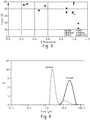
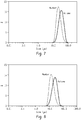
- Figures 1 and 2 show the effect of phosphorus loading on the Dv10 and Dv50, respectively, of the polymer particles of Examples 1-11. From Figures 1 and 2 , it can be seen that the Dv10 and Dv50 are similar for the different Examples. However, as shown in Figure 3 , the Dv90 increased for RDP- and BPADP-containing formulations. Figure 4 shows the span data for these examples, where an increase in span with an increase in phosphorus content was generally observed, with the highest spans observed for RDP and BPADP formulations. The yield of the Examples is shown in Figure 5 . Thus, the data provided herein shows that different types of flame retardant additives can have a different effect on the surface properties that determine particle agglomeration, especially at relatively high phosphorus content.
- Examples 12-14 demonstrate a method of making micronized particles using a direct volatilization method to remove the organic solvent, as opposed to the method using precipitation in hot water described above for examples 1-11.
- Emulsion Preparation In Examples 12-14, three polymer powders were produced from FR-PC, a flame-retardant polycarbonate composition, by dissolving 200 grams of FR-PC pellets in 1,133 grams of DCM, corresponding to a total of 1,333 grams of 15 weight % FR-PC solution.
- a SDBS solution in deionized water was prepared separately by combining 1,326.3 grams of water and 6.7 grams of SDBS to form a 0.5 weight % SDBS solution.
- 1,333 grams of the SDBS solution was added to 1,333 grams of the FR-PC solution corresponding to an aqueous solution to organic solution weight ratio of 1:1. This mixture was placed in a 4-liter beaker and emulsified using a homogenizer running at the RPMs indicated for each example in Table 3 below for 15 minutes.
- Particle formation was achieved using direct volatilization.
- the beaker with the emulsion was placed in a hot oil bath. Two temperature readouts were available: one in the hot oil (equipped with a controller) and one in the emulsion.
- the beaker was also equipped with an impeller set at 120 to 180 RPM. To control the foam build-up on top of the hot water surface as well as to constantly sweep off the methylene chloride vapor from the headspace, one or more nitrogen sweeps were used when needed.
- the slurry that was formed was then passed through a 150-micrometer sieve to remove coarse particles, and a sample was removed to determine particle size. Due to the tendency of the particles to agglomerate, polymer particle washing was performed by settling, followed by decanting the top layer, and adding water to the settled particles. Typically settling time was approximately 12 to 24 hours and two to three washes were needed to remove the SDBS.
- Results for the FR-PC polymer particles are shown in Table 3, where each of the emulsions of Examples 12 to 14 was prepared at a different RPM.
- Table 3 Ex. No. Homogenizer RPM in emulsification DvlO ( ⁇ m) Dv50 ( ⁇ m) Dv90 ( ⁇ m) Span % Yield 12 10,000 20.2 60.0 125.0 1.75 ⁇ 10% 13 12,500 16.3 41.9 79.7 1.51 ⁇ 10% 14 22,000 0.8 1.8 3.2 1.29 >60%
- example 12 using a homogenization speed of 10,000 RPM resulted in a span of 1.75
- example 14 using a homogenization speed of 22,000 RPM resulted in a span of 1.29.
- the larger droplets and particles were observed to be more prone to agglomeration, which is believed to have led to lower yields ( ⁇ 10%) for examples 12 and 13.
- Example 14 temperature data collected during the process of particle formation is shown in Table 4. It was determined that for the present process conditions (bath temperature, ratio of aqueous to organic, etc.), the final temperature for heating the emulsion should be 42 ⁇ 0.5°C. Determining the temperature of the emulsion (and not only the temperature of the heating bath) allows for insight into the extent of solvent evaporation during the direct volatilization process. Furthermore, tracking the final emulsion temperature can avoid unnecessary extra heating, which can lead to undesirable agglomeration.
- the polymer particles are used in the form of a slurry (i.e., redispersed in a surfactant solution in water).
- a surfactant solution in water i.e., redispersed in a surfactant solution in water.
- T-10 surfactant was provided in a 0.5 weight % concentration in water.
- approximately 2.5 liters of the T-10 solution in water was placed in a 4-liter beaker equipped with impeller.
- the water was heated to 55°C.
- the polymer particles were added to the water at the rate of approximately 2 grams/minute with the impeller mixing the slurry until a final concentration of approximately 3 to 5 weight % of polymer in the slurry was obtained.
- SDBS sodium dodecyl benzene sulfonate
- gelatin B type B gelatin
- Emulsions for these examples were generally prepared by first compounding the solid components (i.e., the polycarbonate and the flame retardant) using a twin screw extruder to obtain flame retardant polycarbonate pellets. The pellets were dissolved in methylene chloride using a shaker table to provide a polymer solution not having any visibly suspended particles. Deionized water and surfactant were added to the polymer solution, and emulsification was carried out with an IKA homogenizer operating at 4,000 to 20,000 RPM, resulting in a stable emulsion. An aqueous polymer slurry was prepared using the precipitation method, as described above. The emulsion was slowly transferred to a vessel containing the receiving water at greater than 60°C.
- the aqueous dispersion was held at greater than 70°C for another ten minutes to remove most of the organic solvent.
- the aqueous dispersion thus obtained was passed through a 75 micrometer sieve. Particles having a diameter greater than 75 micrometers were washed well with deionized water multiple times, isolated, and dried in a vacuum oven at 80°C for two days. Based on the total polymer content in the emulsion, the yield of polymer particles less than 75 micrometers was calculated and is given in Table 5.
- the aqueous polymer dispersion which passed through the 75 micrometer sieve was measured for particle size distribution and the mean particle size (Dn50 and Dv50) results are also given in Table 5.
- Homogenization using a shaker table at low speed can be represented by a slow agitation using a mixing blade. Using this method, expenses relating to installation of a homogenizer can be avoided, which can be desirable. As shown in Table 5, samples homogenized using a shaker table (examples 20 and 21) also provide average particle size of 5 to 50 micrometers with a process yield of greater than 80%.
- the aqueous dispersion was held at temperature for another ten minutes to remove substantially all of the organic solvent.
- the aqueous dispersion thus obtained was passed through a 75 micrometer sieve.
- the particles having an average size of greater than 75 micrometers were washed well with deionized water multiple times, isolated, and dried in a vacuum oven at 80°C for two days. Based on the total polymer content in the emulsion, the yield of polymer particles having an average size of less than 75 micrometers was calculated and is shown in Table 6 for each formulation.
- the aqueous polymer dispersion which passed through the 75 micrometer sieve was measured for particle size distribution in Malvern 3000 and the mean particle size (Dn50 and Dv50) results are also given in Table 6.
- the average particle size by volume (Dv50) between 5 and 50 micrometers can be made having a process yield of greater than 80% using a homogenizer with Gelatin as a surfactant (see, e.g., example 35), or using a combination of Gelatin and SDBS as the surfactant (see, e.g., example 47), and using a shaker table with a combination of Gelatin and SDBS (see, e.g., example 49), or using SDBS as the surfactant (see, e.g., examples 38 and 53).
- ICP-AES inductively coupled plasma-atomic emission spectroscopy
- the mixture was made up to 50 milliliters by adding deionized water such that the final concentration of the acids matched the matrix of calibration standards.
- the final solution contained approximately 16% nitric acid and 6% sulfuric acid.
- Microwave assisted acid digestion was carried out for all polymer samples and phosphorus determination was performed by ICP-AES. Based on the detected phosphorus content, the concentration of the phosphorus-containing flame retardant (e.g., RDP) in the final powder was calculated.
- the concentration of the phosphorus-containing flame retardant e.g., RDP
- the flame retardant polycarbonate pellets prepared by compounding BPA-PC-1 with 10% RDP also exhibited a glass transition temperature (Tg) of 105°C using Differential Scanning Calorimetry (DSC).
- Tg glass transition temperature
- DSC Differential Scanning Calorimetry
- the corresponding micronized powders (e.g., example 26) exhibited a Tg of 103°C.
- Redispersability of the dried micronized flame retardant polycarbonate powders was also evaluated according to the following procedure.
- the filtered and washed powder sample of example 26 (before drying in an oven) was analyzed for particle size distribution characteristics as already described above in Table 6.
- the example 26 powder was then dried in an oven at 80°C for two days under vacuum to obtain the dry powder.
- the dry powder was then redispersed in water using 0.2% of Tergitol TMN-10 surfactant and the particle size distribution was again analyzed.
- a comparison of the pre- and post-drying particle size distributions is provided in Table 7, which shows that the drying process did not significantly change the particle size distribution of the powder.
- Residual gelatin amounts were quantified according to the following method. Trace amounts of gelatin can be detected spectrophometrically using a UV/Vis spectrometer and a Protein Assay color reagent, obtained as Pierce 660 nm Protein Assay color reagent from Thermo Scientific.
- the protein assay reagent is based on the binding of a dye-metal complex in an acidic buffer to proteins that causes a shift in the dye's absorption maximum at 660 nanometers. A calibration curve was generated using this color reagent for gelatin concentrations ranging from 25 to 200 parts per million of gelatin. Since the presence of SDBS was found to interfere with the gelatin determination, two different sample preparation methods were used based on the process used to make the powder.
- samples were prepared by weighing 2 grams of the sample into a 50 milliliter vial. Higher amount of sample increased the sensitivity of measurement. To this, 20 milliliters of methylene chloride was added. The mixture was shaken in a wrist shaker until the resin completely dissolved. To this solution, 10 milliliters of deionized water was added and the vial was shaken again for 15 minutes. The gelatin in the sample (which has a preference for water) is extracted into the aqueous layer. After phase separation, 1 milliliter of the aqueous extract was taken into a 20 milliliter vial, and 2 milliliters of the color reagent was added and mixed well. After stirring for 5 minutes, absorbance was measured at 660 nanometers, and the calibration curve was used to determine gelatin concentration in the sample. A second extraction was performed to confirm that all the gelatin had been extracted out of the sample with the first extraction.
- samples were prepared by weighing 2 grams of the sample into a 50 milliliter vial. To this, 20 milliliters of methylene chloride was added. The mixture was shaken in a wrist shaker until the resin completely dissolved. To this solution, 15 milliliters of methanol was added drop wise with stirring. Addition of methanol precipitates gelatin along with polycarbonate. The solution vial is centrifuged to separate the precipitate from the methanol and methylene chloride mixture. The precipitate (which is free from the residual SDBS), was redissolved in 20 milliliters of methylene chloride. The mixture was shaken in a wrist shaker until the precipitate completely dissolved.
- Comparative Examples B-E are illustrative of flame retardant polycarbonate particles and aqueous dispersions prepared therefrom prepared according to the following process.
- a mixture containing 10wt% RDP was prepared by combining 33.75 grams of polycarbonate BPA-PC-3 and 3.75 grams of RDP in a 500 milliliter glass bottle. The mixture was dissolved in 212.5 grams DCM on a shaker overnight at room temperature to end up with a 15 wt% RDP-PC solution. Subsequently, 250 grams MEK was rapidly added to the solution in one portion while mixing with an IKA T25 Ultra Turrax homogenizer at 20,000 rpm for 10 minutes.
- the precipitated RDP-containing PC powder was isolated by vacuum filtration using Whatman paper filter (ashless) with 8 ⁇ m pore size. The residue was washed with MEK and dried in the vacuum oven at a pressure of 50 mbar overnight at 100°C. Subsequently, the powder was mechanically ground (18,000 rpm) with a Retsch Ultra Centrifugal Mill ZM200 to reverse agglomeration/fusion from the filtering and drying step.
- An aqueous dispersion was prepared by adding the fine RDP-containing PC powder to a 250 milliliter glass bottle containing a mixture of Milli-Q water and SDBS while mixing with an IKA T25 Ultra Turrax homogenizer at 8,000rpm for 5 minutes. The resulting white dispersion consisted of 5wt% micronized RDP-containing PC, 0.25wt% SDBS and 94.75 wt% Milli-Q water.
- Examples 55 and 56 are representative dispersions prepared according to the process of the present disclosure.
- the same procedure as described above for Comparative Examples B-E was used, except that 250 grams of water with SDBS was added to the DCM solution of BPA-PC-3 and RDP instead of MEK. Otherwise, the same conditions were used.
- the water/SDBS mixture used for these examples included 0.625 grams SDBS and 249.375 grams of Milli-Q water (i.e., a SDBS concentration of 0.25 wt%).
- the resulting emulsion was transferred to a round bottom flask, and rotary evaporation was used to remove the DCM at a temperature of 40°C.
- the pressure was reduced in a stepwise fashion to 800 mbar, and was held at this pressure for an additional 60 minutes to remove the DCM and form the aqueous dispersion.
- a small quantity of the dispersion was filtered by vacuum filtration using Whatman filter paper (ashless) with an 8 ⁇ m pore size. Measurements were performed on the powder after washing with water and drying at 50 mbar and 100°C overnight.
- DSC Differential scanning calorimetry
- Approximately 200 mg of the dried FR-PC powder was digested in 6 ml of concentrated nitric acid (trace metal grade) by microwave assisted acid digestion using an Anton Paar Multiwave 3000 equipped with closed high pressure Quartz digestion vessels. After the microwave digestion run, the acid was analytically transferred into a pre-cleaned plastic centrifuge tube containing 1ml of internal standard solution and was diluted with Milli-Q water up to the 50ml mark. Each sample is diluted another 20, 50 or 100 times in order to maintain the measured concentration of Phosphorous within the calibration range.
- the phosphorous concentration (%P) in the diluted sample solutions was quantified using a multi-element calibration standard set from Inorganic Ventures using an Agilent 7500cx ICP-MS system and converted to RDP concentration (%RDP) based on a 10.9wt% phosphorous content of RDP.
- the results of Comparative Examples B-E and Examples 55-56 are provided in Table 9 below.
- RDP Besides being a FR additive, RDP also has a strong value proposition due to its ability to reduce Tg of PC resin. In certain applications, such as those in the consumer electronics, it is highly desirable to have a PC resin with suppressed Tg to enable low temperature processing and fast throughput rates for manufacturing operations. As shown in Table 9, from DSC and ICP-MS it can be concluded that the precipitated RDP-containing PC powder of Comparative Examples B-E contains an average of 3.7wt% RDP, resulting in an average Tg of 127.8°C. The low Tg nicely meets the expectation, since RDP is known to reduce the Tg of PC (147°C) with ⁇ 4°C/wt%.
- the amount of incorporated RDP is low compared to the 10wt% RDP in the FR-PC starting mixture.
- the majority of the RDP (-60%) is lost during the process, primarily through the filtering due to its solubility in the MEK/DCM solution.
- the comparative process is an inefficient multi-step process for making aqueous dispersions of micronized flame retardant PC particles in which the majority of RDP (-60%) is lost through the solvent-anti-solvent (DCM/MEK) filtrate and the particle size is increased throughout the process.
- the process of the present disclosure is a more efficient process for preparing aqueous dispersions of micronized flame retardant PC particles.
- the inventive process results in a much higher amount of RDP to be retained in the FR-PC powder, and avoids an undesirable increase in particle size, as can be seen from Examples 55 and 56 in Table 9.
- Table 9 it can be seen that after forming the emulsion, similar particle size is obtained as in the Comparative DCM/MEK suspensions.
- the process of the present disclosure only includes removal of the DCM by evaporation (e.g., using a rotavapor) with an opposite effect on the particle size.
- compositions, methods, and articles can alternatively comprise, consist of, or consist essentially of, any appropriate components or steps herein disclosed.
- the compositions, methods, and articles can additionally, or alternatively, be formulated so as to be devoid, or substantially free, of any steps, components, materials, ingredients, adjuvants, or species that are otherwise not necessary to the achievement of the function or objectives of the compositions, methods, and articles. All ranges disclosed herein are inclusive of the endpoints, and the endpoints are independently combinable with each other.
- “Combinations” is inclusive of blends, mixtures, alloys, reaction products, and the like. The terms “first,” “second,” and the like, do not denote any order, quantity, or importance, but rather are used to distinguish one element from another.
- alkyl means a branched or straight chain, unsaturated aliphatic hydrocarbon group, e.g., methyl, ethyl, n-propyl, i-propyl, n-butyl, s-butyl, t-butyl, n-pentyl, s-pentyl, and n- and s-hexyl.
- Alkoxy means an alkyl group that is linked via an oxygen (i.e., alkyl-O-), for example methoxy, ethoxy, and sec-butyloxy groups.
- Alkylene means a straight or branched chain, saturated, divalent aliphatic hydrocarbon group (e.g., methylene (-CH 2 -) or, propylene (-(CH 2 ) 3 -)).
- Cycloalkylene means a divalent cyclic alkylene group, -C n H 2n-x , wherein x is the number of hydrogens replaced by cyclization(s).
- Cycloalkenyl means a monovalent group having one or more rings and one or more carbon-carbon double bonds in the ring, wherein all ring members are carbon (e.g., cyclopentyl and cyclohexyl).
- Aryl means an aromatic hydrocarbon group containing the specified number of carbon atoms, such as phenyl, tropone, indanyl, or naphthyl.
- halo means a group or compound including one more of a fluoro, chloro, bromo, or iodo substituent. A combination of different halo groups (e.g., bromo and fluoro), or only chloro groups can be present.
- hetero means that the compound or group includes at least one ring member that is a heteroatom (e.g., 1, 2, or 3 heteroatom(s)), wherein the heteroatom(s) is each independently N, O, S, Si, or P.
Landscapes
- Chemical & Material Sciences (AREA)
- Health & Medical Sciences (AREA)
- Chemical Kinetics & Catalysis (AREA)
- Medicinal Chemistry (AREA)
- Polymers & Plastics (AREA)
- Organic Chemistry (AREA)
- Compositions Of Macromolecular Compounds (AREA)
- Processes Of Treating Macromolecular Substances (AREA)
Claims (15)
- Procédé pour la fabrication de particules de polycarbonate, le procédé comprenant :la combinaison d'une première solution comprenant(i) un polycarbonate et un retardateur de flamme contenant du phosphore, et(ii) un solvant organique,avec une deuxième solution comprenant(i) un tensioactif et(ii) un solvant aqueux sensiblement non miscible avec le solvant organique,dans des conditions de cisaillement et de température efficaces pour former une émulsion ; etl'élimination d'au moins une partie du solvant organique pour former une suspension aqueuse comprenant une pluralité de particules comprenant le polycarbonate et le retardateur de flamme contenant du phosphore.
- Procédé selon la revendication 1, dans lequel le polycarbonate est un homopolycarbonate, un copolycarbonate, un copolymère de polycarbonate, ou une combinaison comprenant au moins l'un des précédents, de préférence dans lequel le polycarbonate est un homopolycarbonate de bisphénol A, poly(carbonate-siloxane), poly(ester-carbonate aromatique), poly(ester-carbonate aliphatique), poly(ester-carbonate-siloxane aromatique), poly(bisphénol A-carbonate de 2-phényl-3,3'-bis(4-hydroxyphényl)phtalimidine), poly(bisphénol A-carbonate de 1,1-bis(4-hydroxy-3-méthylphényl)cyclohexane), ou une combinaison comprenant au moins l'un des précédents.
- Procédé selon la revendication 1 ou la revendication 2, dans lequel la première solution comprend 10 à 30 % en poids, ou 15 à 25 % en poids, ou 17 à 25 % en poids, ou 19 à 25 % en poids du polycarbonate, chaque étant basé sur le poids total du polycarbonate et du solvant organique.
- Procédé selon l'une quelconque ou plusieurs des revendications 1 à 3,dans lequel le retardateur de flamme contenant du phosphore comprend un groupe aromatique, une liaison phosphore-azote, ou une combinaison comprenant au moins l'un des précédents,de préférence dans lequel le retardateur de flamme contenant du phosphore comprend un monomère ou polymère de phosphate, phosphite, phosphonate, phosphinate, oxyde de phosphine, ou phosphine, contenant chacun un groupe aromatique en C3 à C30, comprenant à titre facultatif jusqu'à trois hétéroatomes dans un cycle aromatique, un phosphazène, ester-amide de phosphore, amide d'acide phosphorique, amide d'acide phosphonique, amide d'acide phosphinique, oxyde de tris(aziridinyl)phosphine, ou une combinaison comprenant au moins l'un des précédents,plus préférablement dans lequel le retardateur de flamme contenant du phosphore comprend un polyphosphonate-co-carbonate, homopolymère contenant du phosphore, diphosphate de résorcinol, bis(diphénylphosphate) de bisphénol A, phosphate de triphényle, bis(diphénylphosphate) de résorcinol, phosphate de tricrésyle, un polyphosphate phénolique/biphénolique, phénoxyphosphazène, ou une combinaison comprenant au moins l'un des précédents ; etdans lequel le tensioactif comprend un tensioactif anionique, un tensioactif biopolymère, ou une combinaison comprenant au moins l'un des précédents,dans lequel le tensioactif anionique est de préférence un (alkyle en C8 à C36)benzènesulfonate, (alkyle en C8 à C36)sulfonate, mono- ou di(alkyle en C8 à C36)sulfosuccinate, (alkyléther en C8 à C36)sulfate, (alkyléther en C8 à C36)éthersulfonate, perfluoro(alkyle en C2 à C12)sulfate, ou perfluoro(carboxylate en C2 à C12), plus préférablement dans lequel le tensioactif anionique est le dodécylsulfate de sodium, dodécylbenzènesulfonate de sodium, laurylsulfate de sodium, laureth-sulfate de sodium, dioctylsulfosuccinate de sodium, dihexylsulfosuccinate de sodium, sulfonate de perfluorooctane, ou acide perfluorooctanoïque ; etdans lequel le biopolymère est de préférence la gélatine, plus préférablement dans lequel la gélatine est une gélatine de type A, une gélatine de type B, ou une combinaison comprenant au moins l'une des précédentes, encore plus préférablement dans lequel la gélatine est une gélatine de type B.
- Procédé selon l'une quelconque ou plusieurs des revendications 1 à 4, dans lequel le retardateur de flamme contenant du phosphore est présent dans la première solution en une quantité efficace pour apporter 0,05 à 5 % en poids de phosphore, ou 0,1 à 4,0 % en poids, ou 0,2 à 3,0 % en poids de phosphore, par rapport au poids total du polycarbonate et du retardateur de flamme contenant du phosphore.
- Procédé selon l'une quelconque ou plusieurs des revendications 1 à 5, dans lequel le point d'ébullition du solvant organique est inférieur à 100°C, et dans lequel le solvant organique est sensiblement non miscible avec l'eau, de préférence dans lequel le solvant organique comprend du chlorure de méthylène, du chloroforme, du dichlorure d'éthylène, ou une combinaison comprenant au moins l'un des précédents, de préférence du chlorure de méthylène.
- Procédé selon l'une quelconque ou plusieurs des revendications 1 à 6, dans lequelun rapport pondéral du polycarbonate au retardateur de flamme contenant du phosphore est de 99:1 à 50:50, ou de 98:2 à 75:25, ou de 97:3 à 67:33 ;l'émulsion comprend de l'eau dans un rapport pondéral eau/ solvant organique supérieur ou égal à 0,4:1 à 1,25:1, ou de 0,5:1 à 1:1,5, ou de 0,6:1 à 1/1, ou de 0,8:1 à 1/1 ; etl'émulsion comprend le tensioactif dans un rapport pondéral tensioactif /polycarbonate de 0,008:1 à 0,04:1.
- Procédé selon l'une quelconque ou plusieurs des revendications 1 à 7, dans lequel l'élimination d'au moins une partie du solvant organique comprend l'exposition de l'émulsion à la chaleur en ajoutant l'émulsion dans une eau de réception, dans lequel l'eau de réception est à une température de 25 à 90°C, ou de 40 à 70°C, ou de 40 à 60°C ; oudans lequel l'élimination d'au moins une partie du solvant organique comprend l'exposition de l'émulsion à la chaleur en chauffant l'émulsion à une température de 25 à 90°C, ou de 40 à 80°C, ou de 40 à 70°C pour former la suspension ; oudans lequel l'élimination d'au moins une partie du solvant organique comprend la purge de l'émulsion avec de l'air, de l'azote, de l'argon, ou une combinaison comprenant au moins l'un des précédents, en l'absence de chaleur.
- Procédé selon l'une quelconque ou plusieurs des revendications 1 à 8, comprenant en outre le passage de la suspension aqueuse comprenant la pluralité de particules à travers un filtre, pour obtenir des particules micronisées ayant au moins l'un parmi :un Dv90 de 5 à 140 micromètres, ou de 10 à 80 micromètres, ou de 20 à 60 micromètres ;un Dv50 de 3 à 60 micromètres, ou de 5 à 40 micromètres, ou de 8 à 25 micromètres ;un Dv10 de 0,1 à 20 micromètres, ou de 2 à 15 micromètres, ou de 3 à 10 micromètres ; ouun intervalle de distribution granulométrique de 1,05 à 3,5, ou de 1,1 à 3,1, ou de 1,15 à 2,5 ;dans lequel le Dv90, le Dv50, le Dv10 et l'intervalle de distribution granulométrique sont déterminés par diffraction laser.
- Procédé selon l'une quelconque ou plusieurs des revendications 1 à 9, dans lequel les particules de polycarbonate sont récupérées avec un rendement supérieur à 25 %, ou supérieur à 50 %, ou supérieur à 75 %, ou supérieur à 90 %.
- Procédé selon l'une quelconque ou plusieurs des revendications 1 à 10, dans lequel les particules de polycarbonate ont une température de transition vitreuse inférieure ou égale à 140°C, ou inférieure ou égale à 130°C, ou inférieure ou égale à 120°C, ou de 100 à 110°C, déterminée par calorimétrie à balayage différentiel ; ou
dans lequel les particules de polycarbonate conservent plus de 90 % du retardateur de flamme contenant du phosphore présent dans la première solution. - Procédé selon la revendication 4, dans lequel les particules de polycarbonate ont une teneur en gélatine résiduelle inférieure à 1000 parties par million, ou inférieure à 500 parties par million, ou inférieure à 250 parties par million, ou inférieure à 150 parties par million.
- Particules de polycarbonate comprenant un retardateur de flamme contenant du phosphore, produites par le procédé de l'une quelconque des revendications 1 à 12, lesquelles particules de polycarbonate ont au moins l'un parmi :un Dv90 de 5 à 140 micromètres, ou de 10 à 80 micromètres, ou de 20 à 60 micromètres ;un Dv50 de 3 à 60 micromètres, ou de 5 à 40 micromètres, ou de 8 à 25 micromètres ;un DvlO de 0,1 à 20 micromètres, ou de 2 à 15 micromètres, ou de 3 à 10 micromètres ; ouun intervalle de distribution granulométrique de 1,05 à 3,5, ou de 1,1 à 3,1, ou de 1,15 à 2,5 ; etdans lesquelles le Dv90, le Dv50, le Dv10 et l'intervalle de distribution granulométrique sont déterminés par diffraction laser.
- Particules de polycarbonate comprenant :un polycarbonate et du bis(diphénylphosphate) de résorcinol ;lesquelles particules de polycarbonate ont au moins l'un parmi :un Dv90 de 5 à 140 micromètres, ou de 10 à 80 micromètres, ou de 20 à 60 micromètres ;un Dv50 de 3 à 60 micromètres, ou de 5 à 40 micromètres, ou de 8 à 25 micromètres ;une Dv10 de 0,1 à 20 micromètres, ou de 2 à 15 micromètres, ou de 3 à 10 micromètres ; ouun intervalle de distribution granulométrique de 1,05 à 3,5, ou de 1,1 à 3,1, ou de 1,15 à 2,5 ;dans lesquelles le Dv90, le Dv50, le Dv10 et l'intervalle de distribution granulométrique sont déterminés par diffraction laser ;lesquelles particules de polycarbonate ont une température de transition vitreuse inférieure ou égale à 140°C, ou inférieure ou égale à 130°C, ou inférieure ou égale à 120°C, ou de 100 à 110°C, déterminée par calorimétrie à balayage différentiel ; etlesquelles particules de polycarbonate ont une teneur en gélatine résiduelle inférieure à 1000 parties par million, ou inférieure à 500 parties par million, ou inférieure à 250 parties par million, ou inférieure à 150 parties par million.
- Article comprenant les particules de polycarbonate de la revendication 13 ou 14.
Applications Claiming Priority (2)
| Application Number | Priority Date | Filing Date | Title |
|---|---|---|---|
| US201762561803P | 2017-09-22 | 2017-09-22 | |
| PCT/US2018/049897 WO2019060146A1 (fr) | 2017-09-22 | 2018-09-07 | Procédé de fabrication de particules de polycarbonate ignifuges et particules de polycarbonate ignifuges ainsi préparées |
Publications (2)
| Publication Number | Publication Date |
|---|---|
| EP3684848A1 EP3684848A1 (fr) | 2020-07-29 |
| EP3684848B1 true EP3684848B1 (fr) | 2021-10-27 |
Family
ID=63686115
Family Applications (1)
| Application Number | Title | Priority Date | Filing Date |
|---|---|---|---|
| EP18779134.8A Active EP3684848B1 (fr) | 2017-09-22 | 2018-09-07 | Procédé de fabrication de particules de polycarbonate ignifuges et particules de polycarbonate ignifuges ainsi préparées |
Country Status (4)
| Country | Link |
|---|---|
| US (1) | US10913827B2 (fr) |
| EP (1) | EP3684848B1 (fr) |
| CN (1) | CN111133036B (fr) |
| WO (1) | WO2019060146A1 (fr) |
Families Citing this family (2)
| Publication number | Priority date | Publication date | Assignee | Title |
|---|---|---|---|---|
| WO2025030031A2 (fr) * | 2023-08-03 | 2025-02-06 | Applegate Greenfiber Acquisition, LLC | Compositions ignifuges et matériaux d'isolation et procédé de fabrication |
| CN119125390B (zh) * | 2024-11-13 | 2025-02-18 | 浙江省质量科学研究院 | 化妆海绵中20种有机磷阻燃剂皮肤迁移量测试方法及应用 |
Family Cites Families (32)
| Publication number | Priority date | Publication date | Assignee | Title |
|---|---|---|---|---|
| US3929908A (en) | 1971-08-05 | 1975-12-30 | Gen Electric | Brominated biphenols |
| US3954713A (en) | 1971-10-02 | 1976-05-04 | Bayer Aktiengesellschaft | Polycarbonate powder |
| US4170711A (en) | 1974-03-12 | 1979-10-09 | General Electric Company | Brominated biphenol derivatives |
| US4154775A (en) | 1977-09-06 | 1979-05-15 | General Electric Company | Flame retardant composition of polyphenylene ether, styrene resin and cyclic phosphate |
| US4923933A (en) | 1989-01-06 | 1990-05-08 | General Electric Company | Polycarbonate/polyphthalate carbonate blends exhibiting good flame resistance |
| KR960000571B1 (ko) | 1991-01-24 | 1996-01-09 | 미쓰이 도오아쓰 가가쿠 가부시키가이샤 | 폴리카보네이트 및 그 조성물의 입상체의 제조법 |
| US6489372B1 (en) | 1999-12-23 | 2002-12-03 | General Electric Company | Polycarbonate isolation through homogenization devolatization |
| US6528611B2 (en) | 2000-10-13 | 2003-03-04 | Arova Schaffhausen Ag | Method for forming a finely divided polymerizate |
| JP4080851B2 (ja) * | 2002-11-21 | 2008-04-23 | 帝人化成株式会社 | 難燃性樹脂組成物 |
| US6861499B2 (en) | 2003-02-24 | 2005-03-01 | Triton Systems, Inc. | Branched polyphosphonates that exhibit an advantageous combination of properties, and methods related thereto |
| JP4194883B2 (ja) * | 2003-05-27 | 2008-12-10 | 帝人化成株式会社 | 難燃性芳香族ポリカーボネート樹脂組成物 |
| DE102004001324A1 (de) | 2003-07-25 | 2005-02-10 | Degussa Ag | Pulverförmige Komposition von Polymer und ammoniumpolyphosphathaltigem Flammschutzmittel, Verfahren zu dessen Herstellung und Formkörper, hergestellt aus diesem Pulver |
| DE10334497A1 (de) | 2003-07-29 | 2005-02-24 | Degussa Ag | Polymerpulver mit phosphonatbasierendem Flammschutzmittel, Verfahren zu dessen Herstellung und Formkörper, hergestellt aus diesem Polymerpulver |
| US7297736B2 (en) * | 2004-10-28 | 2007-11-20 | Eastman Chemical Company | Neopentyl glycol containing polyesters blended with polycarbonates |
| WO2007065867A1 (fr) | 2005-12-05 | 2007-06-14 | Solvay (Societe Anonyme) | Composition de polymère de sulfone aromatique comprenant des particules de polymère de tétrafluoroéthylène |
| CN101935444A (zh) * | 2010-09-07 | 2011-01-05 | 苏州奥美材料科技有限公司 | 一种高耐温无卤磷系阻燃聚碳酸酯薄膜及其制备方法 |
| WO2013049967A1 (fr) | 2011-10-08 | 2013-04-11 | Sabic Innovative Plastics Ip B.V. | Enceinte de flamme en plastique et son procédé de fabrication |
| CN104080839B (zh) | 2012-01-30 | 2017-11-21 | 东丽株式会社 | 聚碳酸酯类树脂微粒的制造方法以及聚碳酸酯类树脂微粒 |
| US20130317142A1 (en) | 2012-05-24 | 2013-11-28 | Sabic Innovative Plastics Ip B.V. | Flame retardant thermoplastic compositions, methods of manufacture thereof and articles comprising the same |
| EP2730618B1 (fr) | 2012-11-07 | 2016-10-12 | SABIC Global Technologies B.V. | Procédé de production de compositions de polycarbonate |
| US20140272430A1 (en) | 2013-03-15 | 2014-09-18 | Sabic Innovative Plastics Ip B.V. | Process of making dispersed polyetherimide micronized particles and process of coating and further forming of these particles products made therefrom |
| US9181395B2 (en) | 2013-03-15 | 2015-11-10 | Sabic Global Technologies B.V. | Optimized emulsion drying process for making micronized polyetherimide polymers |
| US11053358B2 (en) | 2015-02-20 | 2021-07-06 | Shpp Global Technologies B.V. | Emulsion method for the manufacture of ultra-fine spherical polymer particles |
| CN107405798B (zh) | 2015-04-02 | 2022-05-13 | 赢创运营有限公司 | 用于制备纤维复合材料的方法和设备 |
| CN105440624B (zh) * | 2015-05-27 | 2019-05-07 | 金发科技股份有限公司 | 一种聚碳酸酯组合物及其制备方法 |
| CN107922652A (zh) | 2015-06-30 | 2018-04-17 | 沙特基础工业全球技术有限公司 | 由聚酰亚胺颗粒制造预浸料和复合材料的方法及由其制备的制品 |
| CN107922626A (zh) | 2015-06-30 | 2018-04-17 | 沙特基础工业全球技术有限公司 | 制备聚酰亚胺微粉化颗粒的方法、由其形成的颗粒和由其制作的制品 |
| CN107849257B (zh) | 2015-06-30 | 2021-06-08 | 沙特基础工业全球技术有限公司 | 制备聚合物分散体的方法以及由此制备的聚合物分散体 |
| US10597498B2 (en) | 2015-08-26 | 2020-03-24 | Sabic Global Technologies B.V. | Method of producing crystalline polycarbonate powders |
| EP3344686B1 (fr) | 2015-09-04 | 2020-10-21 | SABIC Global Technologies B.V. | Procédé de fabrication de particules polymères thermoplastiques à rendement de procédé amélioré |
| WO2018106525A1 (fr) * | 2016-12-06 | 2018-06-14 | Sabic Global Technologies B.V. | Procédé de fabrication de particules de polymère thermoplastique, particules de polymère thermoplastique ainsi fabriquées et articles fabriqués à partir de celles-ci |
| EP3568427A1 (fr) | 2017-01-13 | 2019-11-20 | SABIC Global Technologies B.V. | Compositions de polyéthérimide haute fluidité et articles fabriqués à partir de telles compositions |
-
2018
- 2018-09-07 WO PCT/US2018/049897 patent/WO2019060146A1/fr not_active Ceased
- 2018-09-07 CN CN201880061464.XA patent/CN111133036B/zh active Active
- 2018-09-07 EP EP18779134.8A patent/EP3684848B1/fr active Active
- 2018-09-07 US US16/629,115 patent/US10913827B2/en active Active
Also Published As
| Publication number | Publication date |
|---|---|
| US10913827B2 (en) | 2021-02-09 |
| WO2019060146A1 (fr) | 2019-03-28 |
| EP3684848A1 (fr) | 2020-07-29 |
| CN111133036A (zh) | 2020-05-08 |
| US20200223989A1 (en) | 2020-07-16 |
| CN111133036B (zh) | 2021-07-06 |
Similar Documents
| Publication | Publication Date | Title |
|---|---|---|
| CN107257819B (zh) | 用于制造超细球形聚合物颗粒的乳液方法 | |
| JP6634514B2 (ja) | 収率が向上した熱可塑性ポリマー粒子の製造方法 | |
| US8207250B2 (en) | Polycarbonate resin composition and process for producing the same | |
| EP2810973B1 (fr) | Procédé de fabrication de microparticule de résine à base de polycarbonate et microparticule de résine à base de polycarbonate | |
| CN101688053B (zh) | 聚酯聚碳酸酯组合物、其制备方法以及由其形成的制品 | |
| EP3684848B1 (fr) | Procédé de fabrication de particules de polycarbonate ignifuges et particules de polycarbonate ignifuges ainsi préparées | |
| TW201245293A (en) | Fibrous resin reinforcing agent and production method of thereof, and resin composition by use of it | |
| CN101688056A (zh) | 聚酯聚碳酸酯组合物、其制备方法以及由其形成的制品 | |
| JPH08188653A (ja) | 固体の添加剤をポリマー中に分散させる方法およびそれによって得られる製品 | |
| WO2008016157A1 (fr) | Composition de résine | |
| US11613610B2 (en) | Process for the manufacture of thermoplastic polymer particles, thermoplastic polymer particles prepared thereby, and articles prepared therefrom | |
| KR20200063239A (ko) | 포스포네이트 올리고머 및 중합체와 폴리에스테르의 블렌드 | |
| US8859643B2 (en) | Encapsulated flame retardants for polymers | |
| KR20130090773A (ko) | 중합체용 캡슐화 난연제 | |
| JP4235049B2 (ja) | 12−ヒドロキシステアリン酸又はその塩で表面処理した無機フィラー、その製造方法及び該無機フィラーを含有する樹脂組成物 | |
| JP7337832B2 (ja) | ポリエチレンテレフタラートまたはポリブチレンテレフタラートの、またはpetおよび/またはpbtを含むコポリマーの粒子の集団を生産するための方法。 | |
| CN109705398B (zh) | 一种聚烯烃薄膜用非迁移性亲水防雾母料及其制备 | |
| US20240199875A1 (en) | Compositions and processes for the production of sub-micron polymer particles | |
| Wang et al. | Synthesis of biodegradable poly (butylene terephthalate)/poly (ethylene glycol)(PBT/PEG) multiblock copolymers and preparation of indirubin loaded microspheres | |
| Reinišová et al. | Nanoparticles based on poly (trimethylene carbonate) triblock copolymers with post-crystallization ability and their degradation in vitro | |
| CN118696093A (zh) | 阻燃聚碳酸酯组合物 | |
| JP2002037999A (ja) | 難燃性ポリカーボネート系樹脂組成物 | |
| CN120665408A (zh) | 一种pc组合物及其制备方法与应用 | |
| KR20170080170A (ko) | 응집형 실리콘 입자, 이의 제조방법 및 이를 포함하는 열가소성 수지 조성물 | |
| JP2004300377A (ja) | ポリトリメチレンテレフタレート樹脂組成物 |
Legal Events
| Date | Code | Title | Description |
|---|---|---|---|
| STAA | Information on the status of an ep patent application or granted ep patent |
Free format text: STATUS: UNKNOWN |
|
| STAA | Information on the status of an ep patent application or granted ep patent |
Free format text: STATUS: THE INTERNATIONAL PUBLICATION HAS BEEN MADE |
|
| PUAI | Public reference made under article 153(3) epc to a published international application that has entered the european phase |
Free format text: ORIGINAL CODE: 0009012 |
|
| STAA | Information on the status of an ep patent application or granted ep patent |
Free format text: STATUS: REQUEST FOR EXAMINATION WAS MADE |
|
| 17P | Request for examination filed |
Effective date: 20200330 |
|
| AK | Designated contracting states |
Kind code of ref document: A1 Designated state(s): AL AT BE BG CH CY CZ DE DK EE ES FI FR GB GR HR HU IE IS IT LI LT LU LV MC MK MT NL NO PL PT RO RS SE SI SK SM TR |
|
| AX | Request for extension of the european patent |
Extension state: BA ME |
|
| DAV | Request for validation of the european patent (deleted) | ||
| DAX | Request for extension of the european patent (deleted) | ||
| RAP1 | Party data changed (applicant data changed or rights of an application transferred) |
Owner name: SHPP GLOBAL TECHNOLOGIES B.V. |
|
| GRAP | Despatch of communication of intention to grant a patent |
Free format text: ORIGINAL CODE: EPIDOSNIGR1 |
|
| STAA | Information on the status of an ep patent application or granted ep patent |
Free format text: STATUS: GRANT OF PATENT IS INTENDED |
|
| INTG | Intention to grant announced |
Effective date: 20210419 |
|
| GRAS | Grant fee paid |
Free format text: ORIGINAL CODE: EPIDOSNIGR3 |
|
| GRAA | (expected) grant |
Free format text: ORIGINAL CODE: 0009210 |
|
| STAA | Information on the status of an ep patent application or granted ep patent |
Free format text: STATUS: THE PATENT HAS BEEN GRANTED |
|
| AK | Designated contracting states |
Kind code of ref document: B1 Designated state(s): AL AT BE BG CH CY CZ DE DK EE ES FI FR GB GR HR HU IE IS IT LI LT LU LV MC MK MT NL NO PL PT RO RS SE SI SK SM TR |
|
| REG | Reference to a national code |
Ref country code: GB Ref legal event code: FG4D |
|
| REG | Reference to a national code |
Ref country code: CH Ref legal event code: EP |
|
| REG | Reference to a national code |
Ref country code: AT Ref legal event code: REF Ref document number: 1441761 Country of ref document: AT Kind code of ref document: T Effective date: 20211115 |
|
| REG | Reference to a national code |
Ref country code: DE Ref legal event code: R096 Ref document number: 602018025775 Country of ref document: DE |
|
| REG | Reference to a national code |
Ref country code: IE Ref legal event code: FG4D |
|
| REG | Reference to a national code |
Ref country code: LT Ref legal event code: MG9D |
|
| REG | Reference to a national code |
Ref country code: NL Ref legal event code: MP Effective date: 20211027 |
|
| REG | Reference to a national code |
Ref country code: AT Ref legal event code: MK05 Ref document number: 1441761 Country of ref document: AT Kind code of ref document: T Effective date: 20211027 |
|
| PG25 | Lapsed in a contracting state [announced via postgrant information from national office to epo] |
Ref country code: RS Free format text: LAPSE BECAUSE OF FAILURE TO SUBMIT A TRANSLATION OF THE DESCRIPTION OR TO PAY THE FEE WITHIN THE PRESCRIBED TIME-LIMIT Effective date: 20211027 Ref country code: LT Free format text: LAPSE BECAUSE OF FAILURE TO SUBMIT A TRANSLATION OF THE DESCRIPTION OR TO PAY THE FEE WITHIN THE PRESCRIBED TIME-LIMIT Effective date: 20211027 Ref country code: FI Free format text: LAPSE BECAUSE OF FAILURE TO SUBMIT A TRANSLATION OF THE DESCRIPTION OR TO PAY THE FEE WITHIN THE PRESCRIBED TIME-LIMIT Effective date: 20211027 Ref country code: BG Free format text: LAPSE BECAUSE OF FAILURE TO SUBMIT A TRANSLATION OF THE DESCRIPTION OR TO PAY THE FEE WITHIN THE PRESCRIBED TIME-LIMIT Effective date: 20220127 Ref country code: AT Free format text: LAPSE BECAUSE OF FAILURE TO SUBMIT A TRANSLATION OF THE DESCRIPTION OR TO PAY THE FEE WITHIN THE PRESCRIBED TIME-LIMIT Effective date: 20211027 |
|
| PG25 | Lapsed in a contracting state [announced via postgrant information from national office to epo] |
Ref country code: IS Free format text: LAPSE BECAUSE OF FAILURE TO SUBMIT A TRANSLATION OF THE DESCRIPTION OR TO PAY THE FEE WITHIN THE PRESCRIBED TIME-LIMIT Effective date: 20220227 Ref country code: SE Free format text: LAPSE BECAUSE OF FAILURE TO SUBMIT A TRANSLATION OF THE DESCRIPTION OR TO PAY THE FEE WITHIN THE PRESCRIBED TIME-LIMIT Effective date: 20211027 Ref country code: PT Free format text: LAPSE BECAUSE OF FAILURE TO SUBMIT A TRANSLATION OF THE DESCRIPTION OR TO PAY THE FEE WITHIN THE PRESCRIBED TIME-LIMIT Effective date: 20220228 Ref country code: PL Free format text: LAPSE BECAUSE OF FAILURE TO SUBMIT A TRANSLATION OF THE DESCRIPTION OR TO PAY THE FEE WITHIN THE PRESCRIBED TIME-LIMIT Effective date: 20211027 Ref country code: NO Free format text: LAPSE BECAUSE OF FAILURE TO SUBMIT A TRANSLATION OF THE DESCRIPTION OR TO PAY THE FEE WITHIN THE PRESCRIBED TIME-LIMIT Effective date: 20220127 Ref country code: NL Free format text: LAPSE BECAUSE OF FAILURE TO SUBMIT A TRANSLATION OF THE DESCRIPTION OR TO PAY THE FEE WITHIN THE PRESCRIBED TIME-LIMIT Effective date: 20211027 Ref country code: LV Free format text: LAPSE BECAUSE OF FAILURE TO SUBMIT A TRANSLATION OF THE DESCRIPTION OR TO PAY THE FEE WITHIN THE PRESCRIBED TIME-LIMIT Effective date: 20211027 Ref country code: HR Free format text: LAPSE BECAUSE OF FAILURE TO SUBMIT A TRANSLATION OF THE DESCRIPTION OR TO PAY THE FEE WITHIN THE PRESCRIBED TIME-LIMIT Effective date: 20211027 Ref country code: GR Free format text: LAPSE BECAUSE OF FAILURE TO SUBMIT A TRANSLATION OF THE DESCRIPTION OR TO PAY THE FEE WITHIN THE PRESCRIBED TIME-LIMIT Effective date: 20220128 Ref country code: ES Free format text: LAPSE BECAUSE OF FAILURE TO SUBMIT A TRANSLATION OF THE DESCRIPTION OR TO PAY THE FEE WITHIN THE PRESCRIBED TIME-LIMIT Effective date: 20211027 |
|
| REG | Reference to a national code |
Ref country code: DE Ref legal event code: R097 Ref document number: 602018025775 Country of ref document: DE |
|
| PG25 | Lapsed in a contracting state [announced via postgrant information from national office to epo] |
Ref country code: SM Free format text: LAPSE BECAUSE OF FAILURE TO SUBMIT A TRANSLATION OF THE DESCRIPTION OR TO PAY THE FEE WITHIN THE PRESCRIBED TIME-LIMIT Effective date: 20211027 Ref country code: SK Free format text: LAPSE BECAUSE OF FAILURE TO SUBMIT A TRANSLATION OF THE DESCRIPTION OR TO PAY THE FEE WITHIN THE PRESCRIBED TIME-LIMIT Effective date: 20211027 Ref country code: RO Free format text: LAPSE BECAUSE OF FAILURE TO SUBMIT A TRANSLATION OF THE DESCRIPTION OR TO PAY THE FEE WITHIN THE PRESCRIBED TIME-LIMIT Effective date: 20211027 Ref country code: EE Free format text: LAPSE BECAUSE OF FAILURE TO SUBMIT A TRANSLATION OF THE DESCRIPTION OR TO PAY THE FEE WITHIN THE PRESCRIBED TIME-LIMIT Effective date: 20211027 Ref country code: DK Free format text: LAPSE BECAUSE OF FAILURE TO SUBMIT A TRANSLATION OF THE DESCRIPTION OR TO PAY THE FEE WITHIN THE PRESCRIBED TIME-LIMIT Effective date: 20211027 Ref country code: CZ Free format text: LAPSE BECAUSE OF FAILURE TO SUBMIT A TRANSLATION OF THE DESCRIPTION OR TO PAY THE FEE WITHIN THE PRESCRIBED TIME-LIMIT Effective date: 20211027 |
|
| PLBE | No opposition filed within time limit |
Free format text: ORIGINAL CODE: 0009261 |
|
| STAA | Information on the status of an ep patent application or granted ep patent |
Free format text: STATUS: NO OPPOSITION FILED WITHIN TIME LIMIT |
|
| 26N | No opposition filed |
Effective date: 20220728 |
|
| PG25 | Lapsed in a contracting state [announced via postgrant information from national office to epo] |
Ref country code: AL Free format text: LAPSE BECAUSE OF FAILURE TO SUBMIT A TRANSLATION OF THE DESCRIPTION OR TO PAY THE FEE WITHIN THE PRESCRIBED TIME-LIMIT Effective date: 20211027 |
|
| PG25 | Lapsed in a contracting state [announced via postgrant information from national office to epo] |
Ref country code: SI Free format text: LAPSE BECAUSE OF FAILURE TO SUBMIT A TRANSLATION OF THE DESCRIPTION OR TO PAY THE FEE WITHIN THE PRESCRIBED TIME-LIMIT Effective date: 20211027 |
|
| PG25 | Lapsed in a contracting state [announced via postgrant information from national office to epo] |
Ref country code: MC Free format text: LAPSE BECAUSE OF FAILURE TO SUBMIT A TRANSLATION OF THE DESCRIPTION OR TO PAY THE FEE WITHIN THE PRESCRIBED TIME-LIMIT Effective date: 20211027 |
|
| REG | Reference to a national code |
Ref country code: CH Ref legal event code: PL |
|
| GBPC | Gb: european patent ceased through non-payment of renewal fee |
Effective date: 20220907 |
|
| REG | Reference to a national code |
Ref country code: BE Ref legal event code: MM Effective date: 20220930 |
|
| PG25 | Lapsed in a contracting state [announced via postgrant information from national office to epo] |
Ref country code: IT Free format text: LAPSE BECAUSE OF FAILURE TO SUBMIT A TRANSLATION OF THE DESCRIPTION OR TO PAY THE FEE WITHIN THE PRESCRIBED TIME-LIMIT Effective date: 20211027 |
|
| PG25 | Lapsed in a contracting state [announced via postgrant information from national office to epo] |
Ref country code: LU Free format text: LAPSE BECAUSE OF NON-PAYMENT OF DUE FEES Effective date: 20220907 |
|
| P01 | Opt-out of the competence of the unified patent court (upc) registered |
Effective date: 20230530 |
|
| PG25 | Lapsed in a contracting state [announced via postgrant information from national office to epo] |
Ref country code: LI Free format text: LAPSE BECAUSE OF NON-PAYMENT OF DUE FEES Effective date: 20220930 Ref country code: IE Free format text: LAPSE BECAUSE OF NON-PAYMENT OF DUE FEES Effective date: 20220907 Ref country code: FR Free format text: LAPSE BECAUSE OF NON-PAYMENT OF DUE FEES Effective date: 20220930 Ref country code: CH Free format text: LAPSE BECAUSE OF NON-PAYMENT OF DUE FEES Effective date: 20220930 |
|
| PG25 | Lapsed in a contracting state [announced via postgrant information from national office to epo] |
Ref country code: BE Free format text: LAPSE BECAUSE OF NON-PAYMENT OF DUE FEES Effective date: 20220930 |
|
| PG25 | Lapsed in a contracting state [announced via postgrant information from national office to epo] |
Ref country code: GB Free format text: LAPSE BECAUSE OF NON-PAYMENT OF DUE FEES Effective date: 20220907 |
|
| PG25 | Lapsed in a contracting state [announced via postgrant information from national office to epo] |
Ref country code: CY Free format text: LAPSE BECAUSE OF FAILURE TO SUBMIT A TRANSLATION OF THE DESCRIPTION OR TO PAY THE FEE WITHIN THE PRESCRIBED TIME-LIMIT Effective date: 20211027 |
|
| PG25 | Lapsed in a contracting state [announced via postgrant information from national office to epo] |
Ref country code: MK Free format text: LAPSE BECAUSE OF FAILURE TO SUBMIT A TRANSLATION OF THE DESCRIPTION OR TO PAY THE FEE WITHIN THE PRESCRIBED TIME-LIMIT Effective date: 20211027 Ref country code: HU Free format text: LAPSE BECAUSE OF FAILURE TO SUBMIT A TRANSLATION OF THE DESCRIPTION OR TO PAY THE FEE WITHIN THE PRESCRIBED TIME-LIMIT; INVALID AB INITIO Effective date: 20180907 |
|
| PG25 | Lapsed in a contracting state [announced via postgrant information from national office to epo] |
Ref country code: MT Free format text: LAPSE BECAUSE OF FAILURE TO SUBMIT A TRANSLATION OF THE DESCRIPTION OR TO PAY THE FEE WITHIN THE PRESCRIBED TIME-LIMIT Effective date: 20211027 |
|
| PGFP | Annual fee paid to national office [announced via postgrant information from national office to epo] |
Ref country code: DE Payment date: 20240702 Year of fee payment: 7 |
|
| PG25 | Lapsed in a contracting state [announced via postgrant information from national office to epo] |
Ref country code: TR Free format text: LAPSE BECAUSE OF FAILURE TO SUBMIT A TRANSLATION OF THE DESCRIPTION OR TO PAY THE FEE WITHIN THE PRESCRIBED TIME-LIMIT Effective date: 20211027 |