EP3685245B1 - Verfahren, vorrichtung und computerlesbare medien zur semantischen anmerkung und analytik von kundeninteraktion - Google Patents
Verfahren, vorrichtung und computerlesbare medien zur semantischen anmerkung und analytik von kundeninteraktion Download PDFInfo
- Publication number
- EP3685245B1 EP3685245B1 EP18857676.3A EP18857676A EP3685245B1 EP 3685245 B1 EP3685245 B1 EP 3685245B1 EP 18857676 A EP18857676 A EP 18857676A EP 3685245 B1 EP3685245 B1 EP 3685245B1
- Authority
- EP
- European Patent Office
- Prior art keywords
- interaction
- agent
- annotation
- strategy
- customer
- Prior art date
- Legal status (The legal status is an assumption and is not a legal conclusion. Google has not performed a legal analysis and makes no representation as to the accuracy of the status listed.)
- Active
Links
Images




Classifications
-
- G—PHYSICS
- G06—COMPUTING OR CALCULATING; COUNTING
- G06Q—INFORMATION AND COMMUNICATION TECHNOLOGY [ICT] SPECIALLY ADAPTED FOR ADMINISTRATIVE, COMMERCIAL, FINANCIAL, MANAGERIAL OR SUPERVISORY PURPOSES; SYSTEMS OR METHODS SPECIALLY ADAPTED FOR ADMINISTRATIVE, COMMERCIAL, FINANCIAL, MANAGERIAL OR SUPERVISORY PURPOSES, NOT OTHERWISE PROVIDED FOR
- G06Q30/00—Commerce
- G06Q30/01—Customer relationship services
- G06Q30/015—Providing customer assistance, e.g. assisting a customer within a business location or via helpdesk
-
- G—PHYSICS
- G06—COMPUTING OR CALCULATING; COUNTING
- G06Q—INFORMATION AND COMMUNICATION TECHNOLOGY [ICT] SPECIALLY ADAPTED FOR ADMINISTRATIVE, COMMERCIAL, FINANCIAL, MANAGERIAL OR SUPERVISORY PURPOSES; SYSTEMS OR METHODS SPECIALLY ADAPTED FOR ADMINISTRATIVE, COMMERCIAL, FINANCIAL, MANAGERIAL OR SUPERVISORY PURPOSES, NOT OTHERWISE PROVIDED FOR
- G06Q10/00—Administration; Management
- G06Q10/06—Resources, workflows, human or project management; Enterprise or organisation planning; Enterprise or organisation modelling
- G06Q10/063—Operations research, analysis or management
- G06Q10/0631—Resource planning, allocation, distributing or scheduling for enterprises or organisations
- G06Q10/06311—Scheduling, planning or task assignment for a person or group
- G06Q10/063114—Status monitoring or status determination for a person or group
-
- G—PHYSICS
- G06—COMPUTING OR CALCULATING; COUNTING
- G06Q—INFORMATION AND COMMUNICATION TECHNOLOGY [ICT] SPECIALLY ADAPTED FOR ADMINISTRATIVE, COMMERCIAL, FINANCIAL, MANAGERIAL OR SUPERVISORY PURPOSES; SYSTEMS OR METHODS SPECIALLY ADAPTED FOR ADMINISTRATIVE, COMMERCIAL, FINANCIAL, MANAGERIAL OR SUPERVISORY PURPOSES, NOT OTHERWISE PROVIDED FOR
- G06Q10/00—Administration; Management
- G06Q10/06—Resources, workflows, human or project management; Enterprise or organisation planning; Enterprise or organisation modelling
- G06Q10/063—Operations research, analysis or management
- G06Q10/0631—Resource planning, allocation, distributing or scheduling for enterprises or organisations
- G06Q10/06316—Sequencing of tasks or work
Definitions
- the present invention relates to customer relation management (CRM) and more particularly is a computer-implemented method and apparatus for customer interaction management (CIM).
- CRM customer relation management
- CIM customer interaction management
- An important need for any organization is managing and directing/managing the inbound and outbound interactions with customers, and often with real time requirements.
- Many organizations have multiple channels: customers can visit/search the organization website, make a call to a call center, chat through web chat, visit a branch office, communicate via email, or correspond through the postal service.
- customers can visit/search the organization website, make a call to a call center, chat through web chat, visit a branch office, communicate via email, or correspond through the postal service.
- a customer also engage economically with the organization by paying for goods/services and/or receiving goods/services from the company.
- In order to sell more and market goods/services considerable effort has been expended to direct customer interactions in order to better meet customer needs. Due to the multi-channel nature of customer interactions, many different individuals within the organization will often interact with each customer, and there is a significant need for coordinating, across these different channels, and across time within the same channel.
- each interaction is complex and it would be useful to define precisely the strategies that are employed by the organization so that experiments and statistical inference may be used to continuously improve interactions with customers.
- certain strategies including discussing particular stories, introducing well-matched groups of items to purchase, etc. based on customer profiles
- Organizations are dynamic and are continually releasing new products and services requiring new strategies to be developed and implemented. There may be significant costs in retraining company representatives to use these new strategies and to coordinate across different channels and different interaction sessions.
- Agent work may include work using a computer with real time network communications and an interactions server with an occasionally-connected augmented visible dashboard.
- agent work may include work using a computer with real time network communications and an interactions server with an occasionally-connected augmented visible dashboard.
- an agent communicates with a customer via chat, voice, email, web site, and/or post, for business development purposes.
- the IM is designed for gathering information associated with customer interactions that occur within interaction sessions, as well as other inbound/outbound communications and behaviors.
- the IM also provides an augmented computer display dashboard for enriching agent work with offers or recommendations based upon the comprehensive real-time view of customer information, augmented by business rules and/or data mining.
- a typical IM may provide real time offers and/or suggestions for agents using an augmented dashboard, it is not designed to manage the information-state of the customer or to adapt and personalize the interaction to each unique customer.
- Typical IM systems for instance, do not perform adaptive natural language generation for agents nor do they provide continuous feedback to agents on the quality of their interaction with the customer.
- typical IM systems do not adaptively create new concepts to understand customer segments and goals.
- Typical IM systems have only very limited knowledge about how customers make decisions Typical IM systems, for instance, do not perform adaptive natural language generation for agents nor do they provide continuous feedback to agents on the quality of their interaction with the customer. Furthermore, typical IM systems do not adaptively create new concepts to understand customer segments and goals.
- the invention relates to consistently enhancing the customer interaction experience across all the channels through which a customer interacts with a company. It includes the methods, systems, and computer programs needed to enhance customer experiences by defining a set of adaptive strategies during customer interactions across the variety of customer interaction channels. It includes the methods, systems, and computer programs preferably used to: (1) share information across interaction sessions and across channels about customer information states, customer characteristics, and customer intentions, in order to choose and to adapt strategies; (2) report analytics about these systems and relate these events to sales outcomes; (3) design experiments to increase sales through alteration of customer interaction strategies.
- the present invention overcomes the problems with the known art, at least in part, by providing an unconventional approach to organizing and structuring customer interaction data; namely the idea of customer interaction semantics (CIS).
- CIS customer interaction semantics
- the interaction data is semantically annotated so that segments of the data are associated with a "semantic space", allowing users of the system to incorporate "meaning-based” analytics and inference.
- Such a system will provide "meaning-based” search of interaction data, and be able to compare customer interaction data in the semantic space so that the invention captures "semantic similarity”.
- the invention preferably provides a semantic annotation interface so that semantic annotation can be performed in an automatic or semiautomatic fashion, preferably combining manual agent work and automated inference.
- the invention accumulates knowledge of customer interactions, connections between customer interactions, and meta-knowledge annotations which may include any of, but is not limited to, knowledge utility, knowledge confidence/certainty level, agent reputations, additional descriptive content, and commentary.
- the present invention therefore, provides the IM system with a semantics engine in order to better manage customer interactions.
- the IM system is available through a network (e.g., the Internet, Ethernet, and/or phone systems) to a desktop augmented dashboard display which enables organization agents to receive feedback and suggestions in real time for guiding customer interactions.
- Said augmented dashboard preferably connects with the semantics engine and the customer data collected across all available channels.
- the augmented dashboard also preferably enables the agent to perform semantic annotation of a current interaction as they are performing agent work in real time including typing text for websites, typing text for online chat, or speaking over the phone. Further annotations may also be applied offline such as for building responsive websites.
- Said interaction is preferably stored with the said semantic annotation provided by the agent and stored with the IM system semantics database.
- the invention is a preferably composed of a method and a computer system that enable: (1) annotating, storing, and searching a customer interaction; (2) using said annotations to evaluate an interaction strategy; (3) enable rapid design of new interaction strategies; (4) semantics-based monitoring of agent work and customer behavior; (5) development of adaptive interaction strategies based on customer information state and goals; and (6) quantitative validation of customer segments through information and goals processing.
- a computer system connected through the network to the IM system a business-user can analyze the strategies being used and recommended through the IM system and visualize their relationship to outcomes.
- the business user may write a description of a strategy that is included within the IM system database and describes the strategy to be implemented.
- the business user may also write descriptions of sample interactions.
- the IM system preferably includes a strategy experiments manager (SEM), which allows the business user to design experiments based on the strategy and to perform analytics.
- SEM strategy experiments manager
- the annotation engine available through the augmented dashboard informs an agent which strategy they are to use and also enables the agent to report how closely they followed the strategy and what elements of the strategy were used to guide their interaction.
- the semantics engine preferably uses these to learn strategy semantics and enable the business user to search by strategy and to see how the strategy impacted agent work.
- the business user can use that feedback to further refine the strategy, and in some embodiments an automated strategy engine implemented in a computer system can generate descriptions of new strategies and augment descriptions of existing strategies.
- the present invention preferably performs the annotation using terms in a stored lexicon and stores relationships between terms in the lexicon using concepts which are also contained in the lexicon. Preferred embodiments use co-occurrence statistics and machine learning methods to infer relationships between terms detected.
- Term discovery and clustering is performed using the annotation interface available to the user as well as through automated parsing with natural language processing algorithms. Terms may be associated with any segment of an interaction where they will often correspond to words and phrases for text interactions such as the text typed into a web chat window, the text typed by a user into a form on a website, or the words spoken by the user over a voice messaging system.
- a “device” in this specification may include, but is not limited to, one or more of, or any combination of processing device(s) such as, a cell phone, a Personal Digital Assistant, a smart watch or other body-borne device (e.g., glasses, pendants, rings, etc.), a personal computer, a laptop, a pad, a cloud-access device, and/or any device capable of sending/receiving messages to/from a local area network or a wide area network (e.g., the Internet), such as devices embedded in cars, trucks, aircraft, household appliances (refrigerators, stoves, thermostats, lights, electrical control circuits, the Internet of Things, etc.).
- processing device(s) such as, a cell phone, a Personal Digital Assistant, a smart watch or other body-borne device (e.g., glasses, pendants, rings, etc.), a personal computer, a laptop, a pad, a cloud-access device, and/or any device capable of sending/receiving messages to/from
- An "engine” is preferably a program that performs a core or essential function for other programs.
- An engine can be a central or focal program in an operating system, subsystem, or application program that coordinates the overall operation of other programs. It is also used to describe a special-purpose program containing an algorithm that can sometimes be changed.
- the best-known usage is the term search engine which uses an algorithm to search an index of topics given a search argument.
- An engine is preferably designed so that its approach to searching an index, for example, can be changed to reflect new rules for finding and prioritizing matches in the index.
- the program that uses rules of logic to derive output from a knowledge base is called an inference engine.
- a “server” may comprise one or more processors, one or more Random Access Memories (RAM), one or more Read Only Memories (ROM), one or more user interfaces, such as display(s), keyboard(s), mouse/mice, etc.
- a server is preferably apparatus that provides functionality for other computer programs or devices, called “clients.” This architecture is called the client-server model, and a single overall computation is typically distributed across multiple processes or devices. Servers can provide various functionalities, often called “services”, such as sharing data or resources among multiple clients, or performing computation for a client.
- a single server can serve multiple clients, and a single client can use multiple servers.
- a client process may run on the same device or may connect over a network to a server on a different device.
- Typical servers are database servers, file servers, mail servers, print servers, web servers, game servers, application servers, and chat servers.
- the servers discussed in this specification may include one or more of the above, sharing functionality as appropriate.
- Client-server systems are most frequently implemented by (and often identified with) the request-response model: a client sends a request to the server, which performs some action and sends a response back to the client, typically with a result or acknowledgement.
- Designating a computer as "server-class hardware" implies that it is specialized for running servers on it. This often implies that it is more powerful and reliable than standard personal computers, but alternatively, large computing clusters may be composed of many relatively simple, replaceable server components.
- the servers and devices in this specification typically use the one or more processors to run one or more stored "computer programs” and/or non-transitory "computer-readable media” to cause the device and/or server(s) to perform the functions recited herein.
- the media may include Compact Discs, DVDs, ROM, RAM, solid-state memory, or any other storage device capable of storing the one or more computer programs.
- the present invention provides an "agent interaction application” which is preferably implemented in desktop application, web application, mobile application, embedded hardware application, and/or other portal, to connect to a "customer interaction server" when an agent performs "interaction agent work", which is agent work where the agent directly interacts with a customer.
- the agent interaction application is preferably implemented on an agent device 100 in FIG. 1 .
- the interaction agent application features an augmented dashboard display that preferably includes: (i) a feedback dashboard 101 which contains dynamic feedback generated for the agent, (ii) an annotation dashboard 102 that enables the agent to provide annotations of the interaction, and (iii) a direction dashboard 103 provides instruction to the agent about the tactics and strategies to employ within the current system.
- these dashboards may be visible simultaneously, be location configurable, and/or support resizing/temporary hiding to reduce the visual clutter for the agent when working with the dashboard.
- the user device is also connected to the medium of interaction such as in the case of web chat, web site editing, and/or voice conversation.
- data collected from the medium of interaction is preferably routed through the interaction manager 230 ( FIG. 2 ), shared with the interaction server 200, and then passed to the agent device 210 in a processed form to display in the agent dashboard.
- the organization of different units is shown in FIG. 2 .
- the communications described in FIG. 2 may take place through networks 288 and/or 289. Preferably, these networks are the Internet.
- the agent device 210 is preferably connected to the interaction server 200 through the network 288, and the interaction server 200 simultaneously manages several agent devices 210 for different, plural agents.
- the interaction server 200 preferably has (i) a strategy manager 220 that organizes the information to be displayed to the agent on the agent device 210, (ii) an interaction manager 230 to collect and organize the information being received from the agent device 210, and (iii) a semantic interaction database (one or more memories) 240 for storing the information collected from the interactions with semantic annotations.
- the interaction manager 230 is also connected to other devices that serve as the medium of interaction so that interaction records may be stored in the database 240.
- the interaction manager also is preferably connected to other databases 291, 292 storing customer records so that contextual information about the customer can be made available to the strategy manager and better direction is provided to the agent through the dashboards on the agent device 210.
- the semantics interaction database 240 preferably contains a lexicon which has a set of terms that describe a semantic space known to the present invention. Terms are associated with entities and concepts which are stored as relationships between entities.
- the semantics interaction database 240 comprises a hypergraph database to enable many entities to share a relationship. Each relationship is itself stored in the database.
- Each entity has meta-data to assist in understanding the entity which includes: words/phrases that refer to the entity, links to interactions where the entity is mentioned, description of the entity in natural language, picture of the entity, etc. Relationship concepts also have words/phrases that identify them and they should be stored with links to locations where they occur.
- the hypergraph edges storing a specific relationship being associated with a set of entities is called a "relationship instance" and also includes metadata such as a confidence level in the relationship instance.
- New entities and relationships preferably can augment the database either through a manual process (through annotation) and/or by automatic discovery (using machine learning algorithms provided over interaction records or other data available to the organization).
- Common approaches include using co-occurrence statistics of particular entities and words potentially related to relationships.
- Some of the entities stored have entity-specific information: e.g. each customer is an entity and customers also have a purchase history which may be stored as a time series that is associated with a particular user.
- “Interaction segments” are all the events measured regarding an interaction that fall within a time interval having well-defined start and end times are also stored in the semantic interaction database 240 and will be associated with specific customers, specific agents, and other entities that are referred to within the interaction.
- Some entities stored in the semantic interaction database 240 will preferably include the items that are for sale and general entities that may be discussed in conversation, such as through web chat or on the organization web site.
- Other entities can be abstract concepts corresponding to discourse semantics such as the presence of a question, request, statement, etc. within a web chat with the agent. These entities will generally be manually entered through an annotation system.
- a business user may also design strategies, organize which agents are using which strategies, and perform diagnostics over the strategies being employed by agents.
- the business user in these cases preferably uses the business device 250 which preferably has (i) an analytics display 252 for summary data of the strategies being used and (ii) a strategy builder 254 where the business user can construct new strategies and organize their deployment among the agents.
- the strategy information is shared through the network 289 with the interaction server where the strategy information is used by the strategy manager to inform the feedback engine 222, direction engine 224, and annotation engine 226.
- the strategy builder 254 tool allows the business user to enter a description of the strategy.
- the strategy description is augmented with a semi-automated process to enable richer instructions to the strategy manager.
- the description of the strategy is preferably parsed into terms and relationships offering the business user an annotation menu to assist the automatic process.
- the terms and relationships are preferably used to search the semantic interaction database 240 for segments of interactions that match the description, and the business user can determine whether the segments match the strategy being suggested and suggest changes in the agent messages that more closely mirror the desired strategy.
- These annotations are then preferably stored along with the strategy inside the semantic interaction database 240 and are provided to the strategy manager.
- the business user may review previous interactions and judge whether those interactions correctly followed the strategy and provide feedback on that basis.
- the strategy information may be augmented by the business user with optimal responses that may be accessed through a menu on an agent medium of interaction such as particular phrases or messages that are available on a web chat or other natural language generation tools for editing websites.
- the strategy analytics module 252 of the business device 250 uses customer outcome data available through the semantic interaction database 240 to compare the outcomes to the interactions and the strategies employed in those interactions.
- the strategy builder module 344 in various embodiments, will support the design of experimental work so that a causal inference can be applied to the effectiveness of various strategies, which may then be displayed within the strategy analytics module 342.
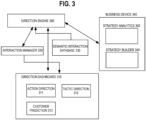
- the direction engine 300 (FIG. #) preferably uses the strategy or strategies (as determined by the strategy manager 220 ) to be used in a given interaction to determine the tactics and actions that the agent should use in an interaction and provide the information for a display on the direction dashboard 103.
- the direction provided in the direction dashboard 310 in FIG. 3 (belonging to the agent device, not shown in FIG. 3 ) is preferably displayed through instructions for actions to take in the action direction module 311, which (i) for web chat, will preferably include suggested responses, (ii) for websites will preferably include suggested text to save, and (iii) for floor sales may include locations to direct the customer, etc.
- tactic direction module 312 where the system provides high-level information to the agent about structuring the interaction properly such as suggestions about language to use when talking with the specific customer based on an analysis of the customer segment (using information from the semantic interactions database), information about the length of messages to send in a web chat, themes of stories to tell, topics of questions to ask, etc.
- the tactic information is preferably related to the high-level strategy but is preferably tied to a particular time within the interaction rather than a strategy which is a high-level description of how to conduct an entire interaction.
- the direction dashboard 310 preferably contains a customer prediction module 313 which provides specific predictions about customer behavior during the interaction and what the customer will do, such as the likelihood of a sale at one or more particular points in a web chat conversation, and also potential issues that the customer might bring up.
- the customer prediction module 313 provides the agent with a means to understand the likely context in which they will deploy the tactics and actions suggested by the tactic direction module 312 and the action direction module 311, respectively.
- the direction module preferably uses the semantic interaction database 330 in order to generate the descriptions of agent work suggested by the action direction module 311. These modules may have automated responses set through the business user in the business device 340 through the strategy builder 344, or they may be generated automatically using machine learning algorithms over data stored in the semantic interaction database 330.
- the data is preferably stored in the semantic information database 330 and will be marked as related to particular strategies so that the strategy engine can find the relevant instructions within the database.
- These modules may be visible simultaneously on the direction dashboard, or only some subset will be visible.
- the agent or other user preferably will be able to determine the precise layout of the dashboard and, in some embodiments, it may be configurable to optimize the presentation of information.
- a reinforcement learning machine learning algorithm (available in the direction engine 300 ) will use the agent-identifier coupled with the interaction state to make a prediction on the optimal layout of information for the agent, based on the product of key outcomes, as measured through customer behavior.
- the agent device 210 in the present invention also preferably includes an annotation dashboard 410 ( FIG. 4 ) that provides feedback to the agent in real-time, as they are conducting the interaction.
- an annotation dashboard 410 FIG. 4
- the interaction manager 420 preferably uses the interaction history up until that feedback point and informs the strategy manager 400 of that current state.
- the interaction is compared with the strategy or strategies being implemented by the strategy manager 400, as well as compared against several predetermined standards (preferably using natural language processing by the feedback engine 401 ) to generate text feedback and analytical feedback on the current performance of the agent within the interaction.
- the feedback is preferably presented in the feedback dashboard 410 through: (i) the action feedback module 411 which preferably displays feedback on specific actions taken, such as a general score for the action quality, examples of good actions, examples of bad actions, etc.; and (ii) the tactic feedback module 412 which preferably provides scores for how closely the interaction mirrors the tactics suggested by the tactic direction module 312 earlier in the interaction.
- These modules may be visible simultaneously on the direction dashboard 310, or only some subset(s) may be visible.
- the agent or other user will be able to determine the precise layout of the dashboard, and in some embodiments it may be configurable to optimize the presentation of information.
- a reinforcement learning machine learning algorithm available in the feedback engine 401 ) will use the agent-identifier coupled with the interaction state to make a prediction on the optimal layout of information for the agent, based on the product of key outcomes as measured through customer behavior.
- the agent device 100 in the present invention preferably includes an annotation dashboard 510 (as shown in FIG. 5 ) which displays tools for the agent to annotate the interaction with semantic information and other meta-data in the semantic interaction database 530.
- the annotations are preferably constructed in a semi-automated process that includes automatic annotation with human input.
- the interaction manager sends information about the interaction to the strategy manager and it is processed by the annotation engine: e.g. for web chat, each message sent through the web chat instant messaging system will be passed to the annotation engine 501.
- the annotation engine preferably performs several fully automatic annotations which may be ranked and given a predetermined confidence factor.
- annotations are preferably performed by associating (i) a term, a relationship, a term with a relationship, several terms with several relations drawn from the semantics interaction database 530 with (ii) a "segment" of the interaction where a segment preferably corresponds to the interaction events falling within periodic time intervals having a well-defined start times and end times; although the segments may be based on events rather than time.
- the automated segmentations are preferably made visible in the segmentation module 512, in the annotation dashboard 510, to present the agent with automated segmentations as well as several actions to either accept a given segmentation or to suggest new segmentations.
- New segmentations can be provided by selecting segments from an interaction summary that concisely presents the information from the interaction in a time-line form.
- the boundaries of a segmentation can also be modified within the segmentation module.
- These segmentations will preferably have an available menu of term-based annotations which may use a term, a relationship, a term with a relationship, several terms with several relationships stored in the semantics interaction database that are associated that can be selected from in the annotation menu 513.
- annotation form 514 that allows the agent to augment the database with new term-based annotations and potentially new terms to provide novel annotations.
- the annotation menu 513 may also present the user with a sequence of decisions to narrow the set of possible segmentations.
- the annotation form 514 may also present a natural language interface to give the segmentation engine hints as to how to segment the interaction. These modules may be visible simultaneously on the direction dashboard, or only some subset may be visible. The agent or other user will thus be able to determine the precise layout of the dashboard, and in some embodiments, it may be configurable to optimize the presentation of information.
- a reinforcement learning machine learning algorithm (available in the annotation engine 501 ) will preferably use the agent-identifier coupled with the interaction state to make a prediction on the optimal layout of information for the agent, based on the product of key outcomes as measured through customer behavior.
- the annotation dashboard 510 also enables annotation of the feedback dashboard 410 outputs at various points in the interaction, and the direction of dashboard 310 outputs at various points in the interaction.
- the annotation dashboard 510 is preferably be accessible after the interaction has finished and can be used to provide feedback to the automated outputs in the other dashboards.
- These annotations are preferably sent through the network, to be stored in the semantic interaction database 530, to provide further information to better train the direction engine 300 and the feedback engine 401.
- the direction engine 300 and the feedback engine 401 are retrained on the annotated data to produce better outcomes based on the annotations, interaction data, and interaction outcomes.
Landscapes
- Business, Economics & Management (AREA)
- Human Resources & Organizations (AREA)
- Engineering & Computer Science (AREA)
- Strategic Management (AREA)
- Economics (AREA)
- Entrepreneurship & Innovation (AREA)
- Marketing (AREA)
- Development Economics (AREA)
- General Business, Economics & Management (AREA)
- General Physics & Mathematics (AREA)
- Physics & Mathematics (AREA)
- Theoretical Computer Science (AREA)
- Operations Research (AREA)
- Educational Administration (AREA)
- Game Theory and Decision Science (AREA)
- Quality & Reliability (AREA)
- Tourism & Hospitality (AREA)
- Accounting & Taxation (AREA)
- Finance (AREA)
- Information Retrieval, Db Structures And Fs Structures Therefor (AREA)
Claims (9)
- Computerimplementiertes Verfahren zum Anleiten von Agenten, um Kundenerfahrungen zu optimieren, wobei das Verfahren umfasst:unter Steuerung einer Agentenvorrichtung, Anzeigen, für den Agenten auf einer Agentenvorrichtungsanzeige, von Informationen, die Folgendem entsprechen: (i) einer Vielzahl von Anweisungen zum Implementieren einer Kundeninteraktionsstrategie unter Verwendung einer Vorschlags-Engine; (ii) einer Vielzahl von Feedbacks für den Agenten in Abhängigkeit von der Interaktionshistorie, dem Interaktionskontext, unter Verwendung einer auf maschinellem Lernen basierenden Feedback-Engine; (iii) einer Vielzahl von Anmerkungsaktionen, die durch die Interaktionshistorie, den Interaktionszustand, eine dem Kunden zugeordnete Kundenkennung, eine dem Agenten zugeordnete Agentenkennung bestimmt werden;in Reaktion auf eine Agentenauswahl-Anmerkungsaktion, die auf der Agentenvorrichtung durchgeführt wird, Verwenden, durch einen Anmerkungssystem-Server, einer Anmerkungs-Engine, um eine Anmerkung zu einer Anmerkungsdatenbank hinzuzufügen, auf die als Teil des Anmerkungssystems über ein Netzwerk zugegriffen wird;Verwenden eines Interaktionsmanagers, der Interaktionsdaten aus Messungen der Agenteninteraktion mit Kunden in Echtzeit, einschließlich der bereitgestellten Anmerkungen, sammelt und einen aktuellen Zustand der Interaktion, einschließlich der Interaktionshistorie, des Interaktionskontexts und der Interaktionsergebnisse, verfolgt und die Interaktionsdaten in einer semantischen Interaktionsdatenbank speichert; wobei die Interaktionsergebnisse Kundenverhalten und Agentenverhalten einschließen;Verwenden eines Strategiemanagers, der die aktuelle Strategie für den Agenten, die implementiert werden soll, unter Verwendung der Interaktionshistorie, der dem Agenten zugeordneten Agentenkennung, der dem Besucher zugeordneten Besucherkennung und Beschreibungen von Strategien, die dem Strategiemanager zur Verfügung stehen, bestimmt;Verwenden einer auf maschinellem Lernen basierenden Anleitungs-Engine, die eine dynamische oder statische Anzeige in der Agentenvorrichtung erzeugt zum Bereitstellen von Text, Diagrammen, Ton und/oder Bildern für den Agenten zum Unterstützen des Agenten dabei, Gelegenheiten zu identifizieren, um spezifische Interaktionstaktiken einzusetzen, die der aktuellen Strategie zugeordnet sind, und Vorschlagen von spezifischen Agentenaktionen, die den spezifischen Interaktionstaktiken zugeordnet sind,unter Verwendung der Informationen, die vom Interaktionsmanager über den Interaktionszustand bereitgestellt werden;Verwenden der auf maschinellem Lernen basierenden Feedback-Engine, die die Interaktionsstrategie vom Strategiemanager, die Interaktionstaktiken und von der Anleitungs-Engine erzeugte Agentenaktionen verfolgt; und die Interaktionsstrategie, Interaktionstaktiken und Agentenaktionen mit der Interaktionshistorie und Interaktionskontext vergleicht, um dem Agenten Feedback darüber bereitzustellen, welche Interaktionsstrategien, Interaktionstaktiken und Agentenaktionen ergriffen wurden, ob sie Ergebnisse produzieren, die für das Unternehmen nützlich sind, und wie sie mit der Implementierung der ausgewählten Strategie in Beziehung stehen;Verwenden einer Anmerkungs-Engine, die statisch oder dynamisch einen Satz von Anmerkungsaktionen konstruiert, die in einem ersten Menü auf der Agentenvorrichtung angezeigt werden, sodass die Anmerkungen vom Agenten in Echtzeit während der Interaktion aufgezeichnet und die Anmerkungen in der semantischen Interaktionsdatenbank gespeichert werden können; wobei die Anmerkungsaktionen ein Formular zum Angeben einer Segmentierung der Interaktion in semantisch sinnvolle Segmente sowie ein Lexikon von Anmerkungsbegriffen beinhalten, die einem gegebenen Segment zugeordnet werden können; wobei die Anmerkungsbegriffe aus Entitäten gezogen werden, die in der semantischen Anmerkungsdatenbank gespeichert sind, wobei ein Teilsatz vorausgefüllter Begriffe von der Anmerkungs-Engine ausgewählt wird, sowie ein zweites Menü, in das andere Begriffe oder neue Begriffe eingegeben werden können;wobei die semantische Interaktionsdatenbank die Echtzeit-Anmerkungen und andere Metadaten speichert, einschließlich (i) des Interaktionskontexts, (ii) der von der Anleitungs-Engine vorgeschlagenen Strategie, Taktiken, Aktionen, (iii) des von den Anmerkungen bereitgestellten Feedbacks; wobei ein Suchmechanismus, der mit der Datenbank bereitgestellt wird zum Zugreifen auf semantisch ähnliche Interaktionen ein semantisches Distanzmaß verwendet, alle Anmerkungen einer gegebenen Interaktion findet, Konzepte, die sich auf die semantischen Anmerkungen und die Interaktionen beziehen, zu einem Lexikon organisiert und Beziehungen zwischen den darin enthaltenen Konzepten und Interaktionen speichert; wobei das Lexikon aus den Konzepten in der Datenbank, den Begriffen zum Durchführen der Anmerkung besteht;Verwenden einer Entitäts-Engine zum Verfeinern des Lexikons und Konstruieren neuer Entitäten; wobei das Verfeinern und Konstruieren durchgeführt werden, wenn der Agent neue Begriffe in die Anmerkungs-Engine eingibt; wobei das Lexikon eine probabilistische Zuordnung von Wörtern und Phrasen und Kontexten zu Begriffen im Lexikon einschließt, die automatische Anmerkung ermöglicht;erneutes Trainieren der Anleitungs-Engine und der Feedback-Engine, nachdem eine vorbestimmte Anzahl von Anmerkungen aufgezeichnet wurden.
- Verfahren nach Anspruch 1, weiter umfassend:Verwenden einer Strategiemanager-Schnittstelle für einen Geschäftsbenutzer des Strategiemanagers, die dem Geschäftsbenutzer über eine Geschäftsbenutzervorrichtung zur Verfügung steht; wobei die Strategiemanager-Schnittstelle sich über das Netzwerk mit der Interaktionsdatenbank und der semantischen Datenbank verbindet, um dem Geschäftsbenutzer Anzeigen, Beispiele und Statistiken aus den Datenbanken über die Strategien, die eingesetzt werden, und ihre Effektivität bereitzustellen durch Kombinieren von Ergebnisinformationen aus der semantischen Interaktionsdatenbank mit der Strategie, den Taktiken und Aktionen, die vom Anleitungsmanager während des Chats vorgeschlagen werden;automatisches Identifizieren der semantisch sinnvollen Kundensegmente unter Verwendung der semantischen Interaktionsdatenbank;wobei der Strategiemanager eine Schnittstelle für den Geschäftsbenutzer bereitstellt, um eine Strategie zu konstruieren, die unter Verwendung einer Beschreibung in natürlicher Sprache implementiert wird, die Agenten über die Agentenvorrichtung zur Verfügung steht; wobei die Konstruktion der Strategie auch automatisch Anleitungen für Taktiken und Aktionen unter Verwendung der semantischen Datenbank erzeugt.
- Verfahren nach Anspruch 1, wobei die Interaktion Web-Chat umfasst und die Interaktionsdaten einen Textdialog zwischen einem Kunden und einem Agenten umfassen.
- Verfahren nach Anspruch 1, wobei die Interaktion Sprache an einem Telefon oder Sprache über das Netzwerk umfasst, wobei die Interaktionsdaten Audioaufzeichnungen sind.
- Verfahren nach Anspruch 1, wobei die Entitäts-Engine halbautomatisch neue Entitäten ableitet und die semantische Interaktionsdatenbank damit erweitert;wobei die Ableitung unter Verwendung von Interaktionsdaten, Agentenanmerkungen und alternativen Datenquellen wie etwa einer Website oder interner Dokumentation durchgeführt wird;wobei die Ableitung einen automatischen Abschnitt einschließt zum Bestimmen von in Frage kommenden neuen Begriffen aus Wörtern oder Phrasen, die in den Interaktionsdaten verwendet werden oder auf die von alternativen Datenquellen verwiesen wird, durch Vergleichen von Wörtern oder Phrasen mit denen, die bereits im System enthalten sind;wobei die Anmerkungs-Engine auch eine manuelle Schnittstelle für den Agenten einschließt, um in Frage kommende Entitäten, die sich auf ein Interaktionssegment beziehen, manuell zu identifizieren und zu entdeckende neue Entitäten vorzuschlagen; wobei das Lexikon auch Beziehungskonzepte einschließt, die Entitäten verbinden; wobei der Ableitungsprozess auch Clustering-Algorithmen enthält, um gemeinsame, gemeinsam auftretende Entitäten zu identifizieren, um automatisches Hinzufügen neuer Beziehungen zum Lexikon zu ermöglichen.
- Verfahren nach Anspruch 1, das an Textinteraktionsdaten implementiert wird, das ein automatisiertes Anmerkungsmodul einschließt, das Interaktionsdaten automatisch segmentiert und die kleinsten Segmente unter Verwendung einer probabilistischen Zuordnung zwischen Wörtern, Phrasen und Kontexten mit Begriffen in der semantischen Interaktionsdatenbank verbindet; wobei die automatischen Anmerkungen unter Verwendung von Informationen durchgeführt werden, die über mehrere Interaktionsdatensegmente hinweg enthalten sind, die verwandte Entitäten und Konzepte über mehrere Kanäle hinweg enthalten.
- Verfahren nach Anspruch 1, wobei die Anmerkungsschnittstelle zur Verfügung steht, nachdem die Interaktion abgeschlossen ist und der Agent oder ein anderer Agent über die semantische Interaktionsdatenbank auf die Interaktionsdaten zugreifen und weitere Anmerkungen zur semantischen Interaktionsdatenbank beitragen kann.
- Verfahren nach Anspruch 6, wobei die Interaktion ein persönliches Gespräch zwischen dem Agenten und dem Kunden ist, wobei die Interaktionsdaten Notizen einschließen können, die vom Agenten nach dem Verkauf produziert wurden.
- Verfahren nach Anspruch 6, wobei es sich bei der Interaktion um einen Kunden handelt, der eine Unternehmens-Website besucht, und die Interaktionsdaten die Kundenaktionen auf der Website und das Browserverhalten auf der Kundenvorrichtung, wie von der Website angeleitet, sind; wobei die Anmerkungs-Engine das Hinzufügen von weiterem Inhalt zur Website ermöglicht.
Applications Claiming Priority (2)
| Application Number | Priority Date | Filing Date | Title |
|---|---|---|---|
| US15/710,170 US10586237B2 (en) | 2017-09-20 | 2017-09-20 | Method, apparatus, and computer-readable media for customer interaction semantic annotation and analytics |
| PCT/US2018/051903 WO2019060520A1 (en) | 2017-09-20 | 2018-09-20 | METHOD, APPARATUS AND COMPUTER-READABLE MEDIA FOR SEMANTIC ANALYSIS AND ANNOTATION OF CLIENT INTERACTIONS |
Publications (4)
| Publication Number | Publication Date |
|---|---|
| EP3685245A1 EP3685245A1 (de) | 2020-07-29 |
| EP3685245A4 EP3685245A4 (de) | 2021-06-02 |
| EP3685245B1 true EP3685245B1 (de) | 2024-02-07 |
| EP3685245C0 EP3685245C0 (de) | 2024-02-07 |
Family
ID=65720470
Family Applications (1)
| Application Number | Title | Priority Date | Filing Date |
|---|---|---|---|
| EP18857676.3A Active EP3685245B1 (de) | 2017-09-20 | 2018-09-20 | Verfahren, vorrichtung und computerlesbare medien zur semantischen anmerkung und analytik von kundeninteraktion |
Country Status (3)
| Country | Link |
|---|---|
| US (1) | US10586237B2 (de) |
| EP (1) | EP3685245B1 (de) |
| WO (1) | WO2019060520A1 (de) |
Families Citing this family (11)
| Publication number | Priority date | Publication date | Assignee | Title |
|---|---|---|---|---|
| US10909422B1 (en) | 2017-08-22 | 2021-02-02 | United Services Automobile Association (Usaa) | Customer service learning machine |
| US10965811B1 (en) | 2020-03-31 | 2021-03-30 | Cresta Intelligence Inc. | Systems and methods for identifying a behavioral target during a conversation |
| US11120812B1 (en) | 2020-07-31 | 2021-09-14 | Cresta Intelligence Inc. | Application of machine learning techniques to select voice transformations |
| US10970485B1 (en) | 2020-07-31 | 2021-04-06 | Cresta Intelligence Inc. | Systems and methods for selecting effective phrases to be presented during a conversation |
| DE112020000274T5 (de) * | 2020-08-18 | 2022-05-19 | Google Llc | Systeme und verfahren zur identifizierung von ereignissen, die eine eigenschaft teilen |
| US11049497B1 (en) | 2020-10-26 | 2021-06-29 | Cresta Intelligence Inc. | Contemporaneous machine-learning analysis of audio streams |
| CN113761127B (zh) * | 2021-05-27 | 2025-07-22 | 腾讯科技(深圳)有限公司 | 一种任务处理方法、装置、电子设备和存储介质 |
| US11417337B1 (en) | 2021-08-12 | 2022-08-16 | Cresta Intelligence Inc. | Initiating conversation monitoring system action based on conversational content |
| US20240386894A1 (en) * | 2021-10-11 | 2024-11-21 | Ntt Technocross Corporation | Information processing apparatus, information processing method, and program |
| US20240420391A1 (en) * | 2023-06-16 | 2024-12-19 | The Toronto-Dominion Bank | Intelligent dashboard search engine |
| CN119312833B (zh) * | 2024-12-11 | 2025-07-22 | 北京清创智科科技有限公司 | 一种基于离线学习的多样化交互智能体构建系统 |
Family Cites Families (34)
| Publication number | Priority date | Publication date | Assignee | Title |
|---|---|---|---|---|
| US6519628B1 (en) | 1999-03-24 | 2003-02-11 | Live Person, Inc. | Method and system for customer service using a packet switched network |
| US8868448B2 (en) | 2000-10-26 | 2014-10-21 | Liveperson, Inc. | Systems and methods to facilitate selling of products and services |
| US20030065524A1 (en) | 2001-10-01 | 2003-04-03 | Daniela Giacchetti | Virtual beauty consultant |
| EP1632083A4 (de) * | 2003-11-05 | 2007-05-02 | Nice Systems Ltd | Vorrichtung und verfahren zur ereignisgesteuerter inhaltsanalyse |
| US7734799B1 (en) | 2004-11-15 | 2010-06-08 | LogMeln, Inc. | Method and system for performing a server-assisted file transfer |
| US7558862B1 (en) | 2004-12-09 | 2009-07-07 | LogMeln, Inc. | Method and apparatus for remotely controlling a computer with peer-to-peer command and data transfer |
| US7778398B2 (en) * | 2004-12-14 | 2010-08-17 | At&T Intellectual Property I, L.P. | Communication center application |
| US8738732B2 (en) | 2005-09-14 | 2014-05-27 | Liveperson, Inc. | System and method for performing follow up based on user interactions |
| US8296437B2 (en) | 2005-12-29 | 2012-10-23 | Logmein, Inc. | Server-mediated setup and maintenance of peer-to-peer client computer communications |
| US7996251B2 (en) | 2006-02-22 | 2011-08-09 | 24/7 Customer, Inc. | System and method for customer requests and contact management |
| US8396741B2 (en) * | 2006-02-22 | 2013-03-12 | 24/7 Customer, Inc. | Mining interactions to manage customer experience throughout a customer service lifecycle |
| US7761321B2 (en) | 2006-02-22 | 2010-07-20 | 24/7 Customer, Inc. | System and method for customer requests and contact management |
| US8423478B2 (en) | 2008-04-24 | 2013-04-16 | International Business Machines Corporation | Preferred customer service representative presentation to virtual universe clients |
| US8799200B2 (en) | 2008-07-25 | 2014-08-05 | Liveperson, Inc. | Method and system for creating a predictive model for targeting webpage to a surfer |
| US8762313B2 (en) | 2008-07-25 | 2014-06-24 | Liveperson, Inc. | Method and system for creating a predictive model for targeting web-page to a surfer |
| US8805844B2 (en) | 2008-08-04 | 2014-08-12 | Liveperson, Inc. | Expert search |
| US9443216B2 (en) | 2009-06-19 | 2016-09-13 | Verizon Patent And Licensing Inc. | System and method for providing managed instant communication (or chat)-based helpdesk services |
| US8565411B2 (en) | 2009-12-23 | 2013-10-22 | 24/7 Customer, Inc. | Method and apparatus for optimizing customer service across multiple channels |
| US8935619B2 (en) | 2010-07-22 | 2015-01-13 | 24/7 Customer, Inc. | Slider and history field for smart chat sessions |
| US8539028B2 (en) | 2010-11-05 | 2013-09-17 | Logmein, Inc. | Network-based quick connect meeting service |
| US8918465B2 (en) | 2010-12-14 | 2014-12-23 | Liveperson, Inc. | Authentication of service requests initiated from a social networking site |
| US8737599B2 (en) | 2011-11-23 | 2014-05-27 | 24/7 Customer, Inc. | Interaction management |
| US8929546B2 (en) | 2011-12-24 | 2015-01-06 | Logmein, Inc. | Motion-based authentication for a gesture-based computing device |
| US8943002B2 (en) | 2012-02-10 | 2015-01-27 | Liveperson, Inc. | Analytics driven engagement |
| US8805941B2 (en) | 2012-03-06 | 2014-08-12 | Liveperson, Inc. | Occasionally-connected computing interface |
| US8661049B2 (en) | 2012-07-09 | 2014-02-25 | ZenDesk, Inc. | Weight-based stemming for improving search quality |
| DE102012214902A1 (de) | 2012-08-22 | 2014-02-27 | LivePoint GmbH | Verfahren und System zur Live-Video-Beratung |
| US20170006161A9 (en) * | 2013-03-15 | 2017-01-05 | Genesys Telecommunications Laboratories, Inc. | Intelligent automated agent for a contact center |
| US9426289B2 (en) * | 2013-09-12 | 2016-08-23 | Avaya Inc. | Techniques for topical customer service menu reconfiguration based on social media |
| WO2015105994A1 (en) * | 2014-01-08 | 2015-07-16 | Callminer, Inc. | Real-time conversational analytics facility |
| US20160140588A1 (en) * | 2014-11-17 | 2016-05-19 | David Brian Bracewell | Perception analysis |
| US9118763B1 (en) * | 2014-12-09 | 2015-08-25 | Five9, Inc. | Real time feedback proxy |
| US20160189558A1 (en) * | 2014-12-31 | 2016-06-30 | Genesys Telecommunications Laboratories, Inc. | Learning Based on Simulations of Interactions of a Customer Contact Center |
| US20160219149A1 (en) | 2015-01-22 | 2016-07-28 | Avaya Inc. | Using simultaneous multi-channel for continuous and timely feedback about agent performance during a customer interaction |
-
2017
- 2017-09-20 US US15/710,170 patent/US10586237B2/en active Active
-
2018
- 2018-09-20 WO PCT/US2018/051903 patent/WO2019060520A1/en not_active Ceased
- 2018-09-20 EP EP18857676.3A patent/EP3685245B1/de active Active
Also Published As
| Publication number | Publication date |
|---|---|
| EP3685245A1 (de) | 2020-07-29 |
| EP3685245A4 (de) | 2021-06-02 |
| US10586237B2 (en) | 2020-03-10 |
| US20190087828A1 (en) | 2019-03-21 |
| WO2019060520A1 (en) | 2019-03-28 |
| EP3685245C0 (de) | 2024-02-07 |
Similar Documents
| Publication | Publication Date | Title |
|---|---|---|
| EP3685245B1 (de) | Verfahren, vorrichtung und computerlesbare medien zur semantischen anmerkung und analytik von kundeninteraktion | |
| US11847422B2 (en) | System and method for estimation of interlocutor intents and goals in turn-based electronic conversational flow | |
| US11710136B2 (en) | Multi-client service system platform | |
| US10896670B2 (en) | System and method for a computer user interface for exploring conversational flow with selectable details | |
| US20240144916A1 (en) | Machine learning enabled category creation | |
| US8892539B2 (en) | Building, reusing and managing authored content for incident management | |
| US8538955B2 (en) | Ranking expert responses and finding experts based on rank | |
| US20250103620A1 (en) | Transition-driven transcript search | |
| EP4375912A1 (de) | Systeme und verfahren zur verbesserten analyse von benutzererfahrungsergebnissen | |
| US20140255895A1 (en) | System and method for training agents of a contact center | |
| EP2717201A1 (de) | Natürliche sprachmetrische Zustandswarnungsorchestrierungen | |
| US20230237276A1 (en) | System and Method for Incremental Estimation of Interlocutor Intents and Goals in Turn-Based Electronic Conversational Flow | |
| US11232134B2 (en) | Customized visualization based intelligence augmentation | |
| US11080356B1 (en) | Enhancing online remote meeting/training experience using machine learning | |
| US11468449B2 (en) | Method and system for dynamic visualization of a user journey for customer support | |
| US20160196265A1 (en) | Tailoring Question Answer Results to Personality Traits | |
| US20220318681A1 (en) | System and method for scalable, interactive, collaborative topic identification and tracking | |
| US12124411B2 (en) | Systems for cluster analysis of interactive content | |
| CN107368506B (zh) | 非结构化数据分析系统和方法 | |
| CN118260484A (zh) | 推荐问题的获取方法、装置、电子设备和介质 | |
| WO2026040472A1 (zh) | 应用配置方法、信息处理方法、装置、设备和存储介质 | |
| KR101791086B1 (ko) | 관점 데이터 간의 링크를 이용한 마인드 마이닝 분석 방법 | |
| US20260010734A1 (en) | Method for generating corpus data based on large models | |
| US20250278697A1 (en) | Generating ai-based collaboration method and system | |
| Keeley Crockett et al. | Bullying and debt: Developing novel applications of dialogue systems |
Legal Events
| Date | Code | Title | Description |
|---|---|---|---|
| STAA | Information on the status of an ep patent application or granted ep patent |
Free format text: STATUS: THE INTERNATIONAL PUBLICATION HAS BEEN MADE |
|
| PUAI | Public reference made under article 153(3) epc to a published international application that has entered the european phase |
Free format text: ORIGINAL CODE: 0009012 |
|
| STAA | Information on the status of an ep patent application or granted ep patent |
Free format text: STATUS: REQUEST FOR EXAMINATION WAS MADE |
|
| 17P | Request for examination filed |
Effective date: 20200417 |
|
| AK | Designated contracting states |
Kind code of ref document: A1 Designated state(s): AL AT BE BG CH CY CZ DE DK EE ES FI FR GB GR HR HU IE IS IT LI LT LU LV MC MK MT NL NO PL PT RO RS SE SI SK SM TR |
|
| AX | Request for extension of the european patent |
Extension state: BA ME |
|
| DAV | Request for validation of the european patent (deleted) | ||
| DAX | Request for extension of the european patent (deleted) | ||
| REG | Reference to a national code |
Ref country code: DE Ref legal event code: R079 Free format text: PREVIOUS MAIN CLASS: G06F0003000000 Ref country code: DE Ref legal event code: R079 Ref document number: 602018065020 Country of ref document: DE Free format text: PREVIOUS MAIN CLASS: G06F0003000000 Ipc: G06Q0030000000 |
|
| A4 | Supplementary search report drawn up and despatched |
Effective date: 20210430 |
|
| RIC1 | Information provided on ipc code assigned before grant |
Ipc: G06Q 30/00 20120101AFI20210423BHEP Ipc: G06Q 10/06 20120101ALI20210423BHEP |
|
| GRAP | Despatch of communication of intention to grant a patent |
Free format text: ORIGINAL CODE: EPIDOSNIGR1 |
|
| STAA | Information on the status of an ep patent application or granted ep patent |
Free format text: STATUS: GRANT OF PATENT IS INTENDED |
|
| INTG | Intention to grant announced |
Effective date: 20230914 |
|
| GRAS | Grant fee paid |
Free format text: ORIGINAL CODE: EPIDOSNIGR3 |
|
| GRAA | (expected) grant |
Free format text: ORIGINAL CODE: 0009210 |
|
| STAA | Information on the status of an ep patent application or granted ep patent |
Free format text: STATUS: THE PATENT HAS BEEN GRANTED |
|
| AK | Designated contracting states |
Kind code of ref document: B1 Designated state(s): AL AT BE BG CH CY CZ DE DK EE ES FI FR GB GR HR HU IE IS IT LI LT LU LV MC MK MT NL NO PL PT RO RS SE SI SK SM TR |
|
| REG | Reference to a national code |
Ref country code: GB Ref legal event code: FG4D |
|
| REG | Reference to a national code |
Ref country code: CH Ref legal event code: EP |
|
| REG | Reference to a national code |
Ref country code: IE Ref legal event code: FG4D |
|
| REG | Reference to a national code |
Ref country code: DE Ref legal event code: R096 Ref document number: 602018065020 Country of ref document: DE |
|
| U01 | Request for unitary effect filed |
Effective date: 20240301 |
|
| U07 | Unitary effect registered |
Designated state(s): AT BE BG DE DK EE FI FR IT LT LU LV MT NL PT SE SI Effective date: 20240311 |
|
| PG25 | Lapsed in a contracting state [announced via postgrant information from national office to epo] |
Ref country code: IS Free format text: LAPSE BECAUSE OF FAILURE TO SUBMIT A TRANSLATION OF THE DESCRIPTION OR TO PAY THE FEE WITHIN THE PRESCRIBED TIME-LIMIT Effective date: 20240607 |
|
| PG25 | Lapsed in a contracting state [announced via postgrant information from national office to epo] |
Ref country code: GR Free format text: LAPSE BECAUSE OF FAILURE TO SUBMIT A TRANSLATION OF THE DESCRIPTION OR TO PAY THE FEE WITHIN THE PRESCRIBED TIME-LIMIT Effective date: 20240508 |
|
| PG25 | Lapsed in a contracting state [announced via postgrant information from national office to epo] |
Ref country code: HR Free format text: LAPSE BECAUSE OF FAILURE TO SUBMIT A TRANSLATION OF THE DESCRIPTION OR TO PAY THE FEE WITHIN THE PRESCRIBED TIME-LIMIT Effective date: 20240207 Ref country code: RS Free format text: LAPSE BECAUSE OF FAILURE TO SUBMIT A TRANSLATION OF THE DESCRIPTION OR TO PAY THE FEE WITHIN THE PRESCRIBED TIME-LIMIT Effective date: 20240507 |
|
| PG25 | Lapsed in a contracting state [announced via postgrant information from national office to epo] |
Ref country code: ES Free format text: LAPSE BECAUSE OF FAILURE TO SUBMIT A TRANSLATION OF THE DESCRIPTION OR TO PAY THE FEE WITHIN THE PRESCRIBED TIME-LIMIT Effective date: 20240207 |
|
| PG25 | Lapsed in a contracting state [announced via postgrant information from national office to epo] |
Ref country code: RS Free format text: LAPSE BECAUSE OF FAILURE TO SUBMIT A TRANSLATION OF THE DESCRIPTION OR TO PAY THE FEE WITHIN THE PRESCRIBED TIME-LIMIT Effective date: 20240507 Ref country code: NO Free format text: LAPSE BECAUSE OF FAILURE TO SUBMIT A TRANSLATION OF THE DESCRIPTION OR TO PAY THE FEE WITHIN THE PRESCRIBED TIME-LIMIT Effective date: 20240507 Ref country code: IS Free format text: LAPSE BECAUSE OF FAILURE TO SUBMIT A TRANSLATION OF THE DESCRIPTION OR TO PAY THE FEE WITHIN THE PRESCRIBED TIME-LIMIT Effective date: 20240607 Ref country code: HR Free format text: LAPSE BECAUSE OF FAILURE TO SUBMIT A TRANSLATION OF THE DESCRIPTION OR TO PAY THE FEE WITHIN THE PRESCRIBED TIME-LIMIT Effective date: 20240207 Ref country code: GR Free format text: LAPSE BECAUSE OF FAILURE TO SUBMIT A TRANSLATION OF THE DESCRIPTION OR TO PAY THE FEE WITHIN THE PRESCRIBED TIME-LIMIT Effective date: 20240508 Ref country code: ES Free format text: LAPSE BECAUSE OF FAILURE TO SUBMIT A TRANSLATION OF THE DESCRIPTION OR TO PAY THE FEE WITHIN THE PRESCRIBED TIME-LIMIT Effective date: 20240207 |
|
| PG25 | Lapsed in a contracting state [announced via postgrant information from national office to epo] |
Ref country code: PL Free format text: LAPSE BECAUSE OF FAILURE TO SUBMIT A TRANSLATION OF THE DESCRIPTION OR TO PAY THE FEE WITHIN THE PRESCRIBED TIME-LIMIT Effective date: 20240207 |
|
| PG25 | Lapsed in a contracting state [announced via postgrant information from national office to epo] |
Ref country code: PL Free format text: LAPSE BECAUSE OF FAILURE TO SUBMIT A TRANSLATION OF THE DESCRIPTION OR TO PAY THE FEE WITHIN THE PRESCRIBED TIME-LIMIT Effective date: 20240207 |
|
| PG25 | Lapsed in a contracting state [announced via postgrant information from national office to epo] |
Ref country code: SM Free format text: LAPSE BECAUSE OF FAILURE TO SUBMIT A TRANSLATION OF THE DESCRIPTION OR TO PAY THE FEE WITHIN THE PRESCRIBED TIME-LIMIT Effective date: 20240207 |
|
| PGFP | Annual fee paid to national office [announced via postgrant information from national office to epo] |
Ref country code: GB Payment date: 20240927 Year of fee payment: 7 |
|
| PG25 | Lapsed in a contracting state [announced via postgrant information from national office to epo] |
Ref country code: CZ Free format text: LAPSE BECAUSE OF FAILURE TO SUBMIT A TRANSLATION OF THE DESCRIPTION OR TO PAY THE FEE WITHIN THE PRESCRIBED TIME-LIMIT Effective date: 20240207 |
|
| PG25 | Lapsed in a contracting state [announced via postgrant information from national office to epo] |
Ref country code: SK Free format text: LAPSE BECAUSE OF FAILURE TO SUBMIT A TRANSLATION OF THE DESCRIPTION OR TO PAY THE FEE WITHIN THE PRESCRIBED TIME-LIMIT Effective date: 20240207 |
|
| PG25 | Lapsed in a contracting state [announced via postgrant information from national office to epo] |
Ref country code: SM Free format text: LAPSE BECAUSE OF FAILURE TO SUBMIT A TRANSLATION OF THE DESCRIPTION OR TO PAY THE FEE WITHIN THE PRESCRIBED TIME-LIMIT Effective date: 20240207 Ref country code: SK Free format text: LAPSE BECAUSE OF FAILURE TO SUBMIT A TRANSLATION OF THE DESCRIPTION OR TO PAY THE FEE WITHIN THE PRESCRIBED TIME-LIMIT Effective date: 20240207 Ref country code: RO Free format text: LAPSE BECAUSE OF FAILURE TO SUBMIT A TRANSLATION OF THE DESCRIPTION OR TO PAY THE FEE WITHIN THE PRESCRIBED TIME-LIMIT Effective date: 20240207 Ref country code: CZ Free format text: LAPSE BECAUSE OF FAILURE TO SUBMIT A TRANSLATION OF THE DESCRIPTION OR TO PAY THE FEE WITHIN THE PRESCRIBED TIME-LIMIT Effective date: 20240207 |
|
| U20 | Renewal fee for the european patent with unitary effect paid |
Year of fee payment: 7 Effective date: 20240927 |
|
| REG | Reference to a national code |
Ref country code: DE Ref legal event code: R097 Ref document number: 602018065020 Country of ref document: DE |
|
| PLBE | No opposition filed within time limit |
Free format text: ORIGINAL CODE: 0009261 |
|
| STAA | Information on the status of an ep patent application or granted ep patent |
Free format text: STATUS: NO OPPOSITION FILED WITHIN TIME LIMIT |
|
| 26N | No opposition filed |
Effective date: 20241108 |
|
| PG25 | Lapsed in a contracting state [announced via postgrant information from national office to epo] |
Ref country code: MC Free format text: LAPSE BECAUSE OF FAILURE TO SUBMIT A TRANSLATION OF THE DESCRIPTION OR TO PAY THE FEE WITHIN THE PRESCRIBED TIME-LIMIT Effective date: 20240207 |
|
| REG | Reference to a national code |
Ref country code: CH Ref legal event code: PL |
|
| PG25 | Lapsed in a contracting state [announced via postgrant information from national office to epo] |
Ref country code: CH Free format text: LAPSE BECAUSE OF NON-PAYMENT OF DUE FEES Effective date: 20240930 |
|
| PG25 | Lapsed in a contracting state [announced via postgrant information from national office to epo] |
Ref country code: IE Free format text: LAPSE BECAUSE OF NON-PAYMENT OF DUE FEES Effective date: 20240920 |
|
| PG25 | Lapsed in a contracting state [announced via postgrant information from national office to epo] |
Ref country code: CY Free format text: LAPSE BECAUSE OF FAILURE TO SUBMIT A TRANSLATION OF THE DESCRIPTION OR TO PAY THE FEE WITHIN THE PRESCRIBED TIME-LIMIT; INVALID AB INITIO Effective date: 20180920 |
|
| PG25 | Lapsed in a contracting state [announced via postgrant information from national office to epo] |
Ref country code: HU Free format text: LAPSE BECAUSE OF FAILURE TO SUBMIT A TRANSLATION OF THE DESCRIPTION OR TO PAY THE FEE WITHIN THE PRESCRIBED TIME-LIMIT; INVALID AB INITIO Effective date: 20180920 |