EP3685801A1 - Akkommodative intraokularlinse - Google Patents
Akkommodative intraokularlinse Download PDFInfo
- Publication number
- EP3685801A1 EP3685801A1 EP20163160.3A EP20163160A EP3685801A1 EP 3685801 A1 EP3685801 A1 EP 3685801A1 EP 20163160 A EP20163160 A EP 20163160A EP 3685801 A1 EP3685801 A1 EP 3685801A1
- Authority
- EP
- European Patent Office
- Prior art keywords
- lens
- optical element
- ciliary
- change
- force
- Prior art date
- Legal status (The legal status is an assumption and is not a legal conclusion. Google has not performed a legal analysis and makes no representation as to the accuracy of the status listed.)
- Granted
Links
Images




Classifications
-
- A—HUMAN NECESSITIES
- A61—MEDICAL OR VETERINARY SCIENCE; HYGIENE
- A61F—FILTERS IMPLANTABLE INTO BLOOD VESSELS; PROSTHESES; DEVICES PROVIDING PATENCY TO, OR PREVENTING COLLAPSING OF, TUBULAR STRUCTURES OF THE BODY, e.g. STENTS; ORTHOPAEDIC, NURSING OR CONTRACEPTIVE DEVICES; FOMENTATION; TREATMENT OR PROTECTION OF EYES OR EARS; BANDAGES, DRESSINGS OR ABSORBENT PADS; FIRST-AID KITS
- A61F2/00—Filters implantable into blood vessels; Prostheses, i.e. artificial substitutes or replacements for parts of the body; Appliances for connecting them with the body; Devices providing patency to, or preventing collapsing of, tubular structures of the body, e.g. stents
- A61F2/02—Prostheses implantable into the body
- A61F2/14—Eye parts, e.g. lenses or corneal implants; Artificial eyes
- A61F2/16—Intraocular lenses
- A61F2/1613—Intraocular lenses having special lens configurations, e.g. multipart lenses; having particular optical properties, e.g. pseudo-accommodative lenses, lenses having aberration corrections, diffractive lenses, lenses for variably absorbing electromagnetic radiation, lenses having variable focus
- A61F2/1624—Intraocular lenses having special lens configurations, e.g. multipart lenses; having particular optical properties, e.g. pseudo-accommodative lenses, lenses having aberration corrections, diffractive lenses, lenses for variably absorbing electromagnetic radiation, lenses having variable focus having adjustable focus; power activated variable focus means, e.g. mechanically or electrically by the ciliary muscle or from the outside
-
- A—HUMAN NECESSITIES
- A61—MEDICAL OR VETERINARY SCIENCE; HYGIENE
- A61F—FILTERS IMPLANTABLE INTO BLOOD VESSELS; PROSTHESES; DEVICES PROVIDING PATENCY TO, OR PREVENTING COLLAPSING OF, TUBULAR STRUCTURES OF THE BODY, e.g. STENTS; ORTHOPAEDIC, NURSING OR CONTRACEPTIVE DEVICES; FOMENTATION; TREATMENT OR PROTECTION OF EYES OR EARS; BANDAGES, DRESSINGS OR ABSORBENT PADS; FIRST-AID KITS
- A61F2/00—Filters implantable into blood vessels; Prostheses, i.e. artificial substitutes or replacements for parts of the body; Appliances for connecting them with the body; Devices providing patency to, or preventing collapsing of, tubular structures of the body, e.g. stents
- A61F2/02—Prostheses implantable into the body
- A61F2/14—Eye parts, e.g. lenses or corneal implants; Artificial eyes
- A61F2/16—Intraocular lenses
- A61F2/1613—Intraocular lenses having special lens configurations, e.g. multipart lenses; having particular optical properties, e.g. pseudo-accommodative lenses, lenses having aberration corrections, diffractive lenses, lenses for variably absorbing electromagnetic radiation, lenses having variable focus
- A61F2/1624—Intraocular lenses having special lens configurations, e.g. multipart lenses; having particular optical properties, e.g. pseudo-accommodative lenses, lenses having aberration corrections, diffractive lenses, lenses for variably absorbing electromagnetic radiation, lenses having variable focus having adjustable focus; power activated variable focus means, e.g. mechanically or electrically by the ciliary muscle or from the outside
- A61F2/1635—Intraocular lenses having special lens configurations, e.g. multipart lenses; having particular optical properties, e.g. pseudo-accommodative lenses, lenses having aberration corrections, diffractive lenses, lenses for variably absorbing electromagnetic radiation, lenses having variable focus having adjustable focus; power activated variable focus means, e.g. mechanically or electrically by the ciliary muscle or from the outside for changing shape
-
- A—HUMAN NECESSITIES
- A61—MEDICAL OR VETERINARY SCIENCE; HYGIENE
- A61F—FILTERS IMPLANTABLE INTO BLOOD VESSELS; PROSTHESES; DEVICES PROVIDING PATENCY TO, OR PREVENTING COLLAPSING OF, TUBULAR STRUCTURES OF THE BODY, e.g. STENTS; ORTHOPAEDIC, NURSING OR CONTRACEPTIVE DEVICES; FOMENTATION; TREATMENT OR PROTECTION OF EYES OR EARS; BANDAGES, DRESSINGS OR ABSORBENT PADS; FIRST-AID KITS
- A61F2/00—Filters implantable into blood vessels; Prostheses, i.e. artificial substitutes or replacements for parts of the body; Appliances for connecting them with the body; Devices providing patency to, or preventing collapsing of, tubular structures of the body, e.g. stents
- A61F2/02—Prostheses implantable into the body
- A61F2/14—Eye parts, e.g. lenses or corneal implants; Artificial eyes
- A61F2/16—Intraocular lenses
- A61F2/1602—Corrective lenses for use in addition to the natural lenses of the eyes or for pseudo-phakic eyes
-
- A—HUMAN NECESSITIES
- A61—MEDICAL OR VETERINARY SCIENCE; HYGIENE
- A61F—FILTERS IMPLANTABLE INTO BLOOD VESSELS; PROSTHESES; DEVICES PROVIDING PATENCY TO, OR PREVENTING COLLAPSING OF, TUBULAR STRUCTURES OF THE BODY, e.g. STENTS; ORTHOPAEDIC, NURSING OR CONTRACEPTIVE DEVICES; FOMENTATION; TREATMENT OR PROTECTION OF EYES OR EARS; BANDAGES, DRESSINGS OR ABSORBENT PADS; FIRST-AID KITS
- A61F2/00—Filters implantable into blood vessels; Prostheses, i.e. artificial substitutes or replacements for parts of the body; Appliances for connecting them with the body; Devices providing patency to, or preventing collapsing of, tubular structures of the body, e.g. stents
- A61F2/02—Prostheses implantable into the body
- A61F2/14—Eye parts, e.g. lenses or corneal implants; Artificial eyes
- A61F2/16—Intraocular lenses
- A61F2/1613—Intraocular lenses having special lens configurations, e.g. multipart lenses; having particular optical properties, e.g. pseudo-accommodative lenses, lenses having aberration corrections, diffractive lenses, lenses for variably absorbing electromagnetic radiation, lenses having variable focus
- A61F2/1648—Multipart lenses
-
- A—HUMAN NECESSITIES
- A61—MEDICAL OR VETERINARY SCIENCE; HYGIENE
- A61F—FILTERS IMPLANTABLE INTO BLOOD VESSELS; PROSTHESES; DEVICES PROVIDING PATENCY TO, OR PREVENTING COLLAPSING OF, TUBULAR STRUCTURES OF THE BODY, e.g. STENTS; ORTHOPAEDIC, NURSING OR CONTRACEPTIVE DEVICES; FOMENTATION; TREATMENT OR PROTECTION OF EYES OR EARS; BANDAGES, DRESSINGS OR ABSORBENT PADS; FIRST-AID KITS
- A61F2/00—Filters implantable into blood vessels; Prostheses, i.e. artificial substitutes or replacements for parts of the body; Appliances for connecting them with the body; Devices providing patency to, or preventing collapsing of, tubular structures of the body, e.g. stents
- A61F2/02—Prostheses implantable into the body
- A61F2/14—Eye parts, e.g. lenses or corneal implants; Artificial eyes
- A61F2/16—Intraocular lenses
- A61F2002/1681—Intraocular lenses having supporting structure for lens, e.g. haptics
- A61F2002/1682—Intraocular lenses having supporting structure for lens, e.g. haptics having mechanical force transfer mechanism to the lens, e.g. for accommodating lenses
-
- A—HUMAN NECESSITIES
- A61—MEDICAL OR VETERINARY SCIENCE; HYGIENE
- A61F—FILTERS IMPLANTABLE INTO BLOOD VESSELS; PROSTHESES; DEVICES PROVIDING PATENCY TO, OR PREVENTING COLLAPSING OF, TUBULAR STRUCTURES OF THE BODY, e.g. STENTS; ORTHOPAEDIC, NURSING OR CONTRACEPTIVE DEVICES; FOMENTATION; TREATMENT OR PROTECTION OF EYES OR EARS; BANDAGES, DRESSINGS OR ABSORBENT PADS; FIRST-AID KITS
- A61F2250/00—Special features of prostheses classified in groups A61F2/00 - A61F2/26 or A61F2/82 or A61F9/00 or A61F11/00 or subgroups thereof
- A61F2250/0014—Special features of prostheses classified in groups A61F2/00 - A61F2/26 or A61F2/82 or A61F9/00 or A61F11/00 or subgroups thereof having different values of a given property or geometrical feature, e.g. mechanical property or material property, at different locations within the same prosthesis
- A61F2250/0018—Special features of prostheses classified in groups A61F2/00 - A61F2/26 or A61F2/82 or A61F9/00 or A61F11/00 or subgroups thereof having different values of a given property or geometrical feature, e.g. mechanical property or material property, at different locations within the same prosthesis differing in elasticity, stiffness or compressibility
-
- F—MECHANICAL ENGINEERING; LIGHTING; HEATING; WEAPONS; BLASTING
- F04—POSITIVE - DISPLACEMENT MACHINES FOR LIQUIDS; PUMPS FOR LIQUIDS OR ELASTIC FLUIDS
- F04C—ROTARY-PISTON, OR OSCILLATING-PISTON, POSITIVE-DISPLACEMENT MACHINES FOR LIQUIDS; ROTARY-PISTON, OR OSCILLATING-PISTON, POSITIVE-DISPLACEMENT PUMPS
- F04C2270/00—Control; Monitoring or safety arrangements
- F04C2270/04—Force
- F04C2270/041—Controlled or regulated
Definitions
- the present disclosure relates generally to the field of ophthalmics, more particularly to ophthalmic devices, including intraocular lenses (IOLs) such as accommodating intraocular lenses.
- IOLs intraocular lenses
- a healthy young human eye can focus an object in far or near distance, as required.
- Accommodation occurs when the ciliary muscle contracts to thereby release the resting zonular tension on the equatorial region of the capsular bag.
- the release of zonular tension allows the inherent elasticity of the lens capsule to alter to a more globular or spherical shape, with increased surface curvatures of both the anterior and posterior lenticular surfaces.
- the human lens can be afflicted with one or more disorders that degrade its functioning in the vision system.
- a common lens disorder is a cataract which is the opacification of the normally clear, natural crystalline lens matrix.
- the opacification can result from the aging process but can also be caused by heredity or diabetes.
- a cataract procedure the patient's opaque crystalline lens is replaced with a clear lens implant or IOL.
- the crystalline lens matrix is removed leaving intact the thin walls of the anterior and posterior capsules together with zonular ligament connections to the ciliary body and ciliary muscles.
- the crystalline lens core is removed by phacoemulsification through a curvilinear capsularhexis i.e., the removal of an anterior portion of the capsular sac.
- the capsular sac effectively shrink-wraps around the IOL due to the capsularhexis, the collapse of the walls of the sac and subsequent fibrosis.
- Cataract surgery as practiced today causes the irretrievable loss of most of the eye's natural structures that provide accommodation.
- the crystalline lens matrix is completely lost and the integrity of the capsular sac is reduced by the capsularhexis.
- the "shrink-wrap" of the capsular sac around the IOL can damage the zonule complex, and thereafter the ciliary muscles may atrophy.
- conventional IOL's even those that profess to be accommodative, may be unable to provide sufficient axial lens spatial displacement along the optical axis or lens shape change to provide an adequate amount of accommodation for near vision.
- an intraocular lens including a shape changing optical element; a force translation element having a first end region coupled to the optical element and a second end region extending towards a ciliary structure, and an attachment portion coupled to the second end region of the force translation element and configured to contact the ciliary structure.
- the force translation element is configured to functionally transmit movements of the ciliary structure into a force exerted upon the optical element to effect an accommodating and a disaccommodating change of the optical element.
- the force translation element can be customized for fit during implantation.
- the mechanism for customizing the fit can include sliding, twisting, turning, cutting, rolling, expanding, bending, and applying energy to the force translation element.
- the force translation element can be coated with an expandable material.
- At least one of the optical element, the force translation element, and the attachment portion can be coated with an agent having biological activity such as heparin, a steroid and rapamicin.
- the first end region of the force translation element can be coupled to an equator of the optical element.
- a plurality of force translation elements can be coupled near an equator of the optical element.
- the attachment portion can be configured to contact the ciliary structure.
- the attachment portion can be configured to abut and not penetrate the ciliary structure.
- the ciliary structure can be the ciliary muscle, the ciliary body, a ciliary process, and a zonule.
- the attachment portion can be formed of an elastic material.
- the attachment portion can include one or more rods.
- the one or more rods can be curved.
- the attachment portion can include a three dimensional element that fills a space adjacent the ciliary structure.
- the attachment portion can include a fillable element.
- the attachment portion can include a glue, hydrogel or fixation material.
- the attachment portion can elicit a healing response in the ciliary structure to induce soft tissue integration of the attachment portion.
- the optical element can have a power in the range of about ⁇ 3 diopters to about ⁇ 5 diopters.
- the accommodating change of the optical element can include a change from an ovoid shape to a more spherical shape.
- the accommodating change of the optical element can include a change in spatial configuration along the optical axis in an anterior direction.
- the force translation element can be formed of a material generally harder than a material of the optical element.
- the second lens can be positioned within the capsular bag of the eye.
- the optical element can be positioned anterior to the second lens.
- the optical element can be positioned within the capsular bag of the eye.
- the optical element can be positioned posterior to the iris.
- the optical element can be positioned anterior to the iris.
- the second lens can include an implanted intraocular lens.
- the lens can further include a haptic coupled to and extending outward from the optical element.
- the haptic can be positioned within a sulcus.
- the force translation element can be coupled to the haptic.
- the force translation element can be coupled to the ciliary body to push on the optical element.
- the force translation element can be coupled to the ciliary body to pull on the optical element.
- the accommodating and disaccommodating change can include a shape change effected over the entire surface of the optical element.
- the accommodating and disaccommodating change can include a shape change effected over a portion of the optical element.
- the portion can preferentially bulge upon an accommodating change.
- the shape change effected over a portion can be due to a difference in modulus of the portion of the optical element compared to the modulus of another portion of the optical element.
- a center region of the optical element can include a lower modulus material than an outer region of the optical element. The lower modulus material can give way causing a bulge and a change in dioptric effect.
- the intraocular lenses described herein can be switched back and forth repeatedly between accommodation to disaccommodation, just as in a young accommodative natural eye.
- shape changing optical element refers to an optical element that is made of material that enables the optical element to alter its shape, e.g., become one of more spherical in shape, thicker to focus on a closer object; or become more ovoid in shape, thinner to focus on a more distant and thus alter the optical element's respective optics (alter the dioptric power of the resulting optical element).
- the shape change can be effected over the entire surface of the optical element, or just over a portion of the optical element, such as by having a preferential change or "bulge" in a portion of the optical element. This can be achieved by varying the modulus of portions of the optical element.
- the center region may be a lower modulus material than the outer region of the optical element in which case when the ciliary body accommodates and the force will be translated to the center of the optical element preferentially to cause a "bulge" that will provide the desired dioptric effect.
- the optical element may be a dual optic that is designed to translate relative to each other to increase or decrease the dioptric power of the system.
- accommodating shape refers to the shape of the optical element when at least one of the contraction of the ciliary muscle of the mammalian eye, the lower tension of the zonules of the mammalian eye and a decrease in the vitreous pressure in the eye occur to effect a focusing upon a closer object.
- An accommodating shape is generally more spherical than the disaccommodating shape.
- disaccommodating shape refers to the shape of the optical element when at least one of the relaxation of the ciliary muscle of the mammalian eye, the higher tension of the zonules of the mammalian eye and an increase in the vitreous pressure in the eye occur to effect a focusing upon a more distant object.
- a disaccommodating shape is generally more ovoid than the accommodating shape.
- diopter refers to the reciprocal of the focal length of a lens in meters.
- a 10 D lens brings parallel rays of light to a focus at (1/10) meter.
- surgeons usually follow a formula based on their own personal preference to calculate a desirable diopter power (D) for the selection of an IOL for the patient to correct the patient's preoperational refractive error.
- D diopter power
- the lenses described herein can mechanically or functionally interact with eye tissues typically used by a natural lens during accommodation and disaccommodation such as the ciliary body, ciliary processes, and the zonules, to effect accommodation and disaccommodation of the implanted lens.
- eye tissues typically used by a natural lens during accommodation and disaccommodation such as the ciliary body, ciliary processes, and the zonules, to effect accommodation and disaccommodation of the implanted lens.
- the forces generated by these tissues are functionally translated to the optical element of the implanted lens causing a power change to allow a phakic or pseudophakic patient to more effectively accommodate.
- the intraocular lenses described herein can be implanted in the eye to replace a diseased, natural lens.
- the intraocular lenses described herein can also be implanted as a supplement of a natural lens (phakic patient) or an intraocular lens previously implanted within a patient's capsular bag (pseudophakic patient).
- the lenses described herein can be used in combination with intraocular lenses described in U.S. Patent Publication Nos. 2009/0234449 and 2009/0292355 , which are each incorporated by reference herein in their entirety.
- the lenses described herein can be used independently or as so-called "piggyback" lenses. Piggyback lenses can be used to correct residual refractive errors in phakic or pseudophakic eyes.
- the primary IOL used to replace the natural lens is generally thicker and has a power that can be in the range of ⁇ 20D.
- the thicker, larger power lenses generally have less accommodation.
- the supplemental lens need not possess a full range of diopters (D).
- the supplemental lens can be relatively thin compared to the primary IOL and can undergo more accommodation. Shape change and movement of the thinner lens is generally more easily accomplished relative to a thick primary lens. It should be appreciated, however, that the lenses described herein can be used independently and need not be used in combination as piggyback lenses with the natural lens or an implanted IOL.
- FIG. 1 depicts a cross-sectional view of an eye 5 including the cornea 10, iris 15, sulcus 20, ciliary body 25, ciliary processes 27, zonules 30 and the capsular bag 35 including an IOL 40 implanted in the capsular bag 35.
- a lens 100 is shown positioned within the sulcus 20 anterior to the IOL 40. It should be appreciated that although the lens 100 is shown positioned within the sulcus 20 and posterior to the iris 15 that it can also be positioned anterior to the iris 15 within the anterior chamber 45. The lens 100 can also be positioned within the capsular bag 35 just in front of the previously implanted IOL 40 or natural lens.
- the lens 100 can include a central optical element 105 and at least two force translation elements 110 extending outward from the optical element 105 (see FIG. 2 ).
- the optical element 105 can be an adjustable lens such that the optical properties can be manipulated after implantation, as will be described in more detail below.
- the force translation elements 110 can functionally couple with at least one of the ciliary structures such as the ciliary body 25, ciliary processes 27, and/or the zonules 30 such that movements of these tissues during accommodation and disaccommodation are translated to the optical element 105 via the force translation elements 110 to cause at least a change in shape or change in position of the optical element 105.
- the lens 100 can further include at least two haptics 115 coupled to and extending outward from the optical element 105.
- the haptics 115 can be positioned within the sulcus 20 to further aid in the anchoring of the lens in the eye.
- FIG. 2 depicts a cross-sectional, schematic view of the lens 100 during accommodation.
- the ciliary body 25 is a generally circular structure.
- the ciliary muscle is a sphincter shaped like a doughnut.
- the ciliary processes 27 pull on the zonules 30, which in turn pull on the lens capsule 35 around its equator. This causes a natural lens to flatten or to become less convex, which is called disaccommodation.
- the muscles of the ciliary body 25 contract and the inside diameter of the ciliary muscle gets smaller.
- the ciliary processes 27 release the tension on the zonules 30 and the lens takes on its natural, more convex shape such that the eye can focus at near distance.
- the force translation elements 110 are implanted such that they are in contact with at least one of the ciliary structures (i.e. zonules 30, ciliary processes 27 and/or ciliary body 25).
- the contraction of the ciliary muscle and inward movement of the tissues towards the optical axis O applies a force against the force translation elements 110 (see FIG. 2 ).
- the force translation elements 110 transfer the force to the optical element 105, which can take on a more spherical shape suitable for near vision.
- This contraction of the ciliary muscle and inward movement of the ciliary body 25 can also result in a change in the spatial configuration of the lens 100 such that it axially displaces along the optical axis O forwardly in an anterior direction (distance D) relative to the natural lens or a previously implanted IOL 40. Both the more spherical shape and the anterior movement away from IOL 40 can cause an increase in power needed for accommodation and near vision focus.
- the force translation elements 110 can be configured to cooperate with at least one of the ciliary body 25, ciliary processes 27, or the zonules 30 to change the shape of the optical element 105. It should be appreciated that the vitreous pressure in the eye can also be involved in the accommodating shape of the optical element 105. Further, if the lens 100 is implanted anterior to the iris 15, for example within the anterior chamber 45, the structures of the anterior chamber angle can also affect the accommodating shape change of the optical element 105.
- FIGs. 3A-3B depict an embodiment of an intraocular lens 100 having an optical element 105 and two force translation elements 110 extending outward from near the equator of optical element 105.
- the force translation elements 110 can also extend outward from other regions of the optical element 105.
- the force translation element 110 can be coupled nearer to one or more of the poles of the optical element 105.
- the force translation elements 110 can be coupled to the optical element 105 or the force translation elements 110 can be coupled to and extend from haptics 115, if present.
- the lens 100 can have more than two force translation elements 110 such as three, four, five or more force translation elements 110.
- the force translation elements 110 can extend from the optical element 105 on opposing sides of the optical axis O.
- an end of the force translation elements 110 can be positioned adjacent the ciliary body 25 on either side of the eye.
- the force translation elements 110 can be adapted to translate force applied by the adjacent tissues to the optical element 105 to cause a shape change or a relative spatial change or both.
- the force translation elements 110 can be generally formed of a harder material than that of the optical element 105.
- a change in hardness or durometer can be accomplished via a change in material.
- a higher durometer material can be used for the force translation elements 110 than the material used for the optical element 105.
- the force translation elements 110 can be made from silicone and the optical element 105 can be made from a softer hydrogel.
- the materials of the force translation elements 110 and the optical element 105 can be the same, but the hardness different. Hardness can be determined or quantized using the Shore A or Shore D scale. The various materials considered herein for forming the components of the lens 100 are discussed in more detail below.
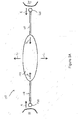
- the optical element 105 can change to a more spherical shape during accommodation upon narrowing of the inside diameter of the ciliary body 25 by mechanically and functionally connecting with the movement of one or more of the ciliary tissues. As shown in FIG. 3A , contraction of the muscles of the ciliary body 25 can create a force in the direction of arrows A, which is then applied to the force translation elements 110. The force translation elements 110 translate that force to the optical element 105 (arrows B). Depending on the design of the optical element 105, the optical element 105 can change shape, for example, along arrows C shown in FIGs. 3A and 3B into a more spherical, accommodated shape to view a near object.
- the optical element 105 can return to its resting, disaccommodating shape, which is more flat upon relaxation of the ciliary body 25 and return to its posterior-most resting configuration decreasing its effective power because the force translation elements 115 are no longer being urged inward by the surrounding tissues.
- the optical element 105 can be designed to include a variety of features that cause an accommodative change in power.
- the optical element 105 can include internal cleavage planes to cause bulging in the center of the optical element 105 when the ciliary body 25 and its associated tissues are in the accommodative position increasing the power in the center of the optical element 105 (as shown in FIG. 3B ).
- the optical element 105 can also be fluid-filled such that movement of the ciliary body 25 and its associated tissues can cause the fluid to move and bulge near the center of the optical element 105 increasing its power.
- the configuration of the optical element 105 can vary as is described in U.S. Patent Publication Nos. 2009/0234449 and 2009/0292355 , which are each incorporated by reference herein in their entirety.
- FIG. 3C illustrates an optical element 105 having an outer lens portion 305 and a core lens portion 307.
- the outer lens portion 305 can be structured to include a center section 320 that can have a reduced thickness or hardness.
- the center section 320 can surround the optical axis O of the optical element 105 and can be located on or near the anterior face 310 thereof.
- the lens 100, and in particular the optical element 105 is compressed, for example by an inward force at peripheral regions 325 and 330 applied by the force translation elements 110, the optical element 105 can be reshaped by an outward bowing of the anterior face 310.
- This inward force by the force translation elements 110 is due to the compressive force applied to the force translation elements 110 by at least one of the ciliary body 25, ciliary processes 27, or zonules 30 depending on how the lens 100 is implanted.
- the outward bowing or reshaping can be especially pronounced at region 335. This can be due to a reduced thickness of the outer lens portion 305 at center section 320.
- the reduced thickness can be relatively more prone to give way from the internal pressure of the core lens portion 307 upon inward force applied at the peripheral regions 325, 330.
- the core lens portion 307 can extend forward, as seen for example in the central region 335 in FIG. 3D .
- the center section 320 can also include a material of reduced hardness or increased elasticity to be more prone to give way from the internal pressure.
- the extended central region 335 of optical element 105 can provide near vision correction power.
- the remainder of the outer portion 305 outside the center section 320 can have a greater thickness that can be more resistant to reshaping under such compression at the peripheral regions 325, 330.
- the annular region 340 of optical element 105 extending radially outward of center section 335 can continue to provide distance vision correction power.
- the regions 335 and 340 of optical element 105, under compression, can provide both near and distance vision correction powers, respectively.
- the anterior surface 310 of optical element 105 can be a multifocal surface when the optical element 105 is under compression.
- the anterior surface 310 can be a monofocal surface.
- FIG. 3D illustrates an alternative embodiment of the lens 100, which is substantially the same as that shown in FIG. 3C , except for a different construction of the outer portion 305.
- the center section 320 can be made of a material that is relatively more susceptible to outward bowing than is the peripheral region surrounding it.
- the center section 320 can be injection molded in combination with the peripheral regions surrounding it to provide a relatively seamless and uninterrupted anterior face 310, at least in the rest position of the lens 100.
- the core lens portion 307 can be placed in compression thus forcing the center section 320 in the anterior direction as shown in the extended region 335.
- the material of the outer portion 305 can be generally consistent, though the center section 320 can have a different stiffness or elasticity that causes it to bow outward farther than the surrounding region.
- central region 335 extends forwardly, and therefore the magnitude of the near vision correction power obtainable by the optical element 105, can depend on a number of factors, such as the relative thickness, hardness, stiffness, elasticity etc. of center section 320, the overall structure of the outer portion 305 and/or the inner portion 307, the material of construction of the outer portion and/or the inner portion, the amount of force that the eye in which lens 100 is placed can exert on the lens 100 and the like factors.
- the amount or degree of near power correction obtainable from lens 100 can be controlled, or at least partially controlled, by varying one or more of these factors.
- optical element 105 has a resting configuration when no forces being applied that are lower power or more flat.
- the optical element 105 can take on a more spherical, higher power configuration. It should be appreciated, however, that the optical element 105 can also mimic more closely a natural lens.
- the optical element 105 is high power or more spherical at a resting configuration when no forces are being applied to it.
- the ciliary body relaxes during disaccommodation and applies tension to the force translation elements 110 which translate a force on the optical element 105 such that the optical element 105 flattens for low power and returns to the spherical configuration during accommodation with the ciliary body contracts.
- the force translation element 110 could incorporate a more robust mechanism of attachment to the tissues.
- the lenses described herein have the ability, in cooperation with the eye, to be reshaped to provide for both distance focus and near focus, and to be returned to its first configuration in which only distance focus is provided.
- the amount of force required to effect a shape change in the optical element 105 is generally less than that of moving the optical element 105 axially along the optical axis to achieve the desired change in diopter.
- the change in diopter achieved by a shape change is also generally larger than the change in diopter achieved by an axial displacement.
- the optical element 105 can have a power in the range of about ⁇ 1D to about ⁇ 4D or about ⁇ 5D or about ⁇ 6D.
- the underlying power of the lens can be within the range of about ⁇ 5D.
- the underlying power of the lens can be within the range of about ⁇ 3D. It should be appreciated that the optical element 105 can also have a larger power in the range of about ⁇ 20D.
- the force translation elements 1 10 contact the eye tissue by way of an attachment portion 120 (see FIG. 4 ).
- the mode of attachment provided by the attachment portion 120 can vary. Generally, the attachment portion 120 avoids piercing or causing trauma to the ciliary body 25. The attachment portion 120 can interfere with the tissues such that movement of the ciliary body 25, ciliary processes 27 or zonules 30 can be transferred through the force translation elements 110 to the optical element 105 without causing trauma to the tissues themselves.
- the attachment portion 120 can be formed of a material that is generally softer or more elastic than the force translation elements 110. This provides a more forgiving surface against which the tissues can abut such that piercing of the tissues and inadvertent trauma are avoided.
- attachment portion 120 also allows for the attachment portion 120 to provide a better fit in that there is some room for error in the overall length and size of the lens 100 and its components.
- the elasticity of the material can also for a one-size-fits-all approach such that even if the measurement was not exact, the length of the translation elements 110 and attachment portions 120 would be sufficient to effect shape change of the optical element 105 when needed while avoiding constant shape change or tissue damage.
- the attachment portion 120 can be a generally rigid, elongate rod or plurality of rods 125 (see FIG. 6A ) positioned between and interfering with one or more zonules 30 or ciliary processes 27.
- the rods 125 can be straight, curved, or have a bend at a particular angle relative to the longitudinal axis of the force translation element 110.
- the plurality of rods 125 can be curved such that they form a cup that can interdigitate between the ciliary processes 27 and/or zonules 30.
- the plurality of rods 125 can extend to the ciliary body 25 with or without making contact with the ciliary body 25.
- the attachment portion 120 can also have a three-dimensional shape that fills a space surrounding the zonules 30 or ciliary processes 27 or that fills the space above the ciliary body 25.
- the attachment portion 120 can have a wedge shape such that the force translation elements 110 extends between the ciliary processes 27 and the attachment portion 120 wedges up against the ciliary body 25.
- the attachment portion 120 can also include a three-dimensional expandable element 123 such as a bag, balloon or bulb coupled near an end of the force translation element 110.
- FIG. 6B illustrates an attachment portion 120 of an embodiment of a force translation element 110 having a plurality of rods 125.
- One or more of the plurality of rods 125 can include an expandable element 123 near a distal end region.
- a channel 127 can extend through an interior of the force translation element 110 into at least a portion of each of the plurality of rods 125 such that the channel 127 communicates with the expandable elements 123.
- a fluid (including a gas or liquid or gel) can be injected into a port or other structure positioned along the force translation element 110 and into the channel 127 such that the expandable element 123 expands outward into one or more directions.
- the position of the port can vary, but is generally located so that it does not interfere with the optical part of the device.
- the expandable elements 123 can expand three-dimensionally such that they fill the space between the ciliary processes 27 or around the ciliary body 25 or on top of the ciliary processes 27 and covering the ciliary body 25.
- the expandable elements 123 can be filled with a material to provide the desired three-dimensional shape, such as silicone oil, hydrogel, saline or other material.
- the attachment portion 120 can include a coating 129 made of a material such as glue, hydrogel or other flowable material (see FIGs. 7A-7B ).
- the coating 129 can fix the attachment portion 120 in place.
- the coating 129 can also act to fill a three-dimensional space surrounding a particular tissue site to help secure the lens 100.
- the coating 129 can be injected through a port and into a channel 127 extending through the interior of the force translation element 110 into the attachment portion 120.
- One or more openings 131 positioned near a distal end region of the attachment portion 120 can allow for the material to flow from the channel 127 to an external surface of the attachment portion 120 therein coating the external surface.
- Soft tissue integration of the attachment portion 120 can be achieved by positioning the attachment portion 120 in direct contact with one or more of the ciliary tissues such that a minimal level of tissue irritation is achieved to set off a healing response. Upon tissue irritation, a minor inflammatory response ensues that is enough to cause the attachment portion 120 to become incorporated into the ciliary processes 27 or ciliary body 25 without interfering with the physiological role of the tissues. Tissue growth into and/or around the attachment portion 120 and integration of the device into the tissue can be achieved without piercing or causing trauma to the tissue, for example affecting its ability to produce aqueous humor.
- one or more expandable elements 123 can be coupled to an end region of the attachment portion 120 that are also filled and coated with a material that provides fixing power such as glue or another flowable material.
- the expanded shape of the expandable element 123 can provide certain characteristics to the attachment portion 120.
- the expandable element 123 when filled can form a wedge shape such that it can be used as described above to wedge up against the ciliary body 25 or between the ciliary processes 27 when filled upon implantation.
- the expandable elements 123 can also provide a degree of customization to the attachment portion 120 such that the fit can be modified during implantation.
- the expandable element 123 can be positioned at a distal end region of the attachment portion 120 such that upon filling the expandable element 123 provides a customized size that provides the most beneficial fit to the device for a particular patient.
- the force translation elements 110 and/or the attachment portion 120 of the lens can be customized for length, angle and position relative to various structures of the eye.
- the angle at which the force translation elements 110 extend from the optical element 105 can play a role in the distance D away from the natural lens or previously implanted IOL that the lens 100 is implanted, which in turn can impact the focal power.
- the length of the force translation elements 110 can affect whether or not the force translation elements 110 physically contact the ciliary body or neighboring tissues. If the force translation elements 110 are too long and make contact with the ciliary body in a resting state it is possible that the tissue structures can be damaged or the optical element 105 can remain in a constant state of accommodation.
- the force translation elements 110 are too short it is possible that not enough shape change would be achieved upon ciliary muscle contraction to effect proper accommodation. It is desirable, therefore, to customize and adjust the length, angle, position or other characteristics of the force translation elements 110 and/or the attachment portion 120 upon implantation. It should be appreciated that the customization can take place prior to implantation if the appropriate measurements are known in advance of the procedure. Alternatively, customization can take place on-the-fly during implantation or after implantation of the lens 100.
- each force translation element 110 can be adjusted by a variety of mechanisms including sliding, twisting, turning, cutting, rolling, expanding, etc.
- the force translation element 110 can be unrolled upon implantation in an outward direction from the optical element 105 until the optimum length is achieved for proper accommodation to occur upon ciliary muscle contraction.
- the force translation element 110 can be twisted to reduce the overall length it extends outward from the optical element 105.
- the force translation element 110 can also be manually cut to an appropriate length.
- the force translation element 110 and/or the attachment mechanism 120 can be formed of a shape-memory material or other stimuli-responsive material that has the capability of changing shape under an external stimulus.
- the stimulus can be a temperature change or exertion of an external force (compression or stretching).
- the shape-memory material can be activated to extend to a pre-set length, shape or angle upon application of energy such as heat.
- the force translation element 110 and/or the attachment mechanism 120 can be formed of an elastic or super-elastic material such as Nitinol.
- the force translation element 110 and/or the attachment mechanism 120 can be formed of or coated with a material that expands upon implantation in the eye.
- the material can expand along a longitudinal axis of the structure or the material can expand in three-dimensionally so as to fill a void adjacent the component.
- the expanded material can fill a void adjacent the force translation element 110 and/or attachment mechanism 120 such as the region between the ciliary processes.
- Expandable materials can include, but is not limited to for example, hydrogel, foam, lyophilized collagen, swelling acrylic, or any material that gels, swells, or otherwise expands upon contact with body fluids.
- the expandable material can be positioned such that it causes the force translation element 110 to move from a retracted state to an expanded state such that it extends between or against an anatomical structure.
- the expandable material can also coat the attachment mechanisms 120 and aid in the attachment mechanism 120 taking on a preferred shape.
- the attachment mechanism 120 can be a plurality of rods coated by the expandable material such that upon implantation the rods are forced outward away from one another.
- the force translation element 110 can be coupled to a region of the haptic 115.
- the haptic 115 can be positioned within the sulcus and the force translation element 110 can be angled downward to reach the ciliary body.
- the force translation element 110 can be twisted around the haptic 115 to achieve a desired length.
- the force translation element 110 can be coupled to the haptic 115 in such a way that it can be manually moved along the length of the haptic 115 until the desired extension towards the ciliary body is achieved.
- the force translation elements 110 and haptics 115 are generally formed of a material having a harder durometer than the optical element 105 or the attachment mechanism 120 such that they can translate forces applied by the surrounding tissues to effect shape change and/or change in spatial configuration of the optical element 105.
- the force translation elements 110, attachment mechanism 120, haptics 115 (if present) and optical element 105 can each be the same material, but may have a hardness that differs to achieve the desired functional characteristics when implanted.
- Suitable materials for the preparation of the optical element 105 disclosed herein vary and include materials that are known in the art.
- materials can include, but are not limited to, acrylic polymers, silicone elastomers, hydrogels, composite materials, and combinations thereof. Materials considered herein for forming various components are described in U.S. Patent Publication Nos. 2009/0234449 and 2009/0292355 , which are each incorporated by reference herein in their entirety.
- the optical element 105 can also be formed from a photosensitive silicone to facilitate post-implantation power adjustment as taught in U.S. patent No. 6,450,642 , entitled LENSES CAPABLE OF POST-FABRICATION POWER MODIFICATION, the entire contents of which are hereby incorporated by reference herein.
- Suitable materials for the production of the subject force translation elements 110 include but are not limited to foldable or compressible materials or hard materials, such as silicone polymers, hydrocarbon and fluorocarbon polymers, hydrogels, soft acrylic polymers, polyesters, polyamides, polyimides, polyurethane, silicone polymers with hydrophilic monomer units, fluorine-containing polysiloxane elastomers and combinations thereof.
- a high refractive index is a desirable feature in the production of lenses to impart high optical power with a minimum of optic thickness.
- visual acuity deficiencies may be corrected using a thinner IOL.
- the optical element 105 can also be formed from layers of differing materials.
- the layers may be arranged in a simple sandwich fashion, or concentrically.
- the layers may include a series of polymer layers, a mix of polymer and metallic layers, or a mix of polymer and monomer layers.
- a Nitinol ribbon core with a surrounding silicone jacket may be used for any portion of the lens 100 except for the optics; an acrylic-over-silicone laminate may be employed for the optics.
- a layered construction may be obtained by pressing/bonding two or more layers together, or deposition or coating processes may be employed.
- various coatings are suitable for one or more components of the lens 100.
- a heparin coating may be applied to appropriate locations to prevent inflammatory cell attachment (ICA) and/or posterior capsule opacification (PCO); possible locations for such a coating include the optical element 105.
- Coatings can also be applied to the lens 100 to improve biocompatibility; such coatings include "active" coatings like P-15 peptides or RGD peptides, and “passive” coatings such as rapamicin, steroids, heparin, and other mucopolysaccharides, collagen, fibronectin and laminin.
- coatings including hirudin, Teflon, Teflon-like coatings, PVDF, fluorinated polymers, and other coatings which are inert may be employed to increase lubricity at locations on the lens system, or Hema or silicone can be used to impart hydrophilic or hydrophobic properties to portions of the lens 100.
- One or more of the lens components can also be coated with a therapeutic or other agent that ameliorates a symptom of a disease or disorder including, for example, steroids, small molecule drugs, proteins, nucleic acids, polysaccharides, and biologics or combination thereof.
- Therapeutic agent, therapeutic compound, therapeutic regimen, or chemotherapeutic include conventional drugs and drug therapies, including vaccines, which are known to those skilled in the art.
- Therapeutic agents include, but are not limited to, moieties that inhibit cell growth or promote cell death, that can be activated to inhibit cell growth or promote cell death, or that activate another agent to inhibit cell growth or promote cell death.
- the therapeutic agent can exhibit or manifest additional properties, such as, properties that permit its use as an imaging agent, as described elsewhere herein.
- Exemplary therapeutic agents include, for example, cytokines, growth factors, proteins, peptides or peptidomimetics, bioactive agents, photosensitizing agents, radionuclides, toxins, anti-metabolites, signaling modulators, anti-cancer antibiotics, anti-cancer antibodies, angiogenesis inhibitors, radiation therapy, chemotherapeutic compounds or a combination thereof.
- the drug may be any agent capable of providing a therapeutic benefit.
- the drug is a known drug, or drug combination, effective for treating diseases and disorders of the eye.
- the drug is an antiinfective agent (e.g., an antibiotic or antifungal agent), an anesthetic agent, an anti-VEGF agent, an anti-inflammatory agent, a biological agent (such as RNA), an intraocular pressure reducing agent (i.e., a glaucoma drug), or a combination thereof.
- an antiinfective agent e.g., an antibiotic or antifungal agent
- an anesthetic agent e.g., an anesthetic agent
- an anti-VEGF agent e.g., an anti-VEGF agent
- an anti-inflammatory agent e.g., a biological agent (such as RNA), an intraocular pressure reducing agent (i.e., a glaucoma drug), or a combination thereof.
- a biological agent such as RNA
- an intraocular pressure reducing agent i.e., a glaucoma drug
- the lens 100 and/or the mold surfaces are subjected to a surface passivation process to improve biocompatibility. This may be done via conventional techniques such as chemical etching or plasma treatment.
- the subject force translation elements 110 can be permanently attached to optical element 105 by numerous methods including but not limited to fastening within a pre-formed optic slot using glue, staking, plasma treatment, friction, or like means or combinations thereof.
- appropriate surfaces (such as the outer edges/surfaces of the contacting elements, accommodating elements, etc.) of the lens components can be textured or roughened to improve adhesion to the adjacent tissue surfaces. This can be accomplished by using conventional procedures such as plasma treatment, etching, dipping, vapor deposition, mold surface modification, etc.
- the selected material and lens configuration is able to withstand secondary operations after molding/casting such as polishing, cleaning and sterilization processes involving the use of an autoclave, or ethylene oxide or radiation.
- the lens can undergo deflashing, polishing and cleaning operations, which typically involve a chemical or mechanical process, or a combination thereof.
- Some suitable mechanical processes can include tumbling, shaking and vibration; a tumbling process may involve the use of a barrel with varying grades of glass beads, fluids such as alcohol or water and polishing compounds such as aluminum oxides. Process rates are material dependent; for example, a tumbling process for silicone can utilize a 6" diameter barrel moving at 30-100 RPM. It is contemplated that several different steps of polishing and cleaning may be employed before the final surface quality is achieved.
- a curing process may also be desirable in manufacturing the components of the lens 100. If the lens is produced from silicone entirely at room temperature, the curing time can be as long as several days. If the mold is maintained at about 50 °C., the curing time can be reduced to about 24 hours. If the mold is preheated to 100-200° C, the curing time can be as short as about 3-15 minutes. The time-temperature combinations vary for other materials.
- an IOL implantation is performed anterior to the natural crystalline lens or anterior to a previously-implanted IOL.
- the implantation procedure can vary, one procedure can be performed as follows.
- One or more clear corneal incisions can be formed.
- a first incision can be formed for IOL insertion and a second incision can be formed for manipulation and assistance of positioning the IOL.
- a viscoelastic substance can be inserted into the eye, such as to at least partially fill the anterior chamber and/or an area between the iris and the intra-capsular IOL.
- the IOL can be inserted into position in the eye and the force-translation elements inserted into a desired position and connected to the ciliary body.
- One or more IOL can be inserted into the ciliary sulcus and the viscoelastic substance washed out of the eye. A check may then be performed to verify that the corneal incisions are appropriately sealed. Any of a variety of instruments may be used in conjunction with the procedure. Moreover, it should be appreciated that the aforementioned steps may be performed in a different order than described above.
Landscapes
- Health & Medical Sciences (AREA)
- Ophthalmology & Optometry (AREA)
- Cardiology (AREA)
- Oral & Maxillofacial Surgery (AREA)
- Transplantation (AREA)
- Engineering & Computer Science (AREA)
- Biomedical Technology (AREA)
- Heart & Thoracic Surgery (AREA)
- Vascular Medicine (AREA)
- Life Sciences & Earth Sciences (AREA)
- Animal Behavior & Ethology (AREA)
- General Health & Medical Sciences (AREA)
- Public Health (AREA)
- Veterinary Medicine (AREA)
- Prostheses (AREA)
Applications Claiming Priority (3)
| Application Number | Priority Date | Filing Date | Title |
|---|---|---|---|
| US201161439767P | 2011-02-04 | 2011-02-04 | |
| PCT/US2012/023875 WO2012106673A1 (en) | 2011-02-04 | 2012-02-03 | Intraocular accommodating lens |
| EP12706147.1A EP2670347B1 (de) | 2011-02-04 | 2012-02-03 | Akkommodierende intraokularline |
Related Parent Applications (1)
| Application Number | Title | Priority Date | Filing Date |
|---|---|---|---|
| EP12706147.1A Division EP2670347B1 (de) | 2011-02-04 | 2012-02-03 | Akkommodierende intraokularline |
Publications (2)
| Publication Number | Publication Date |
|---|---|
| EP3685801A1 true EP3685801A1 (de) | 2020-07-29 |
| EP3685801B1 EP3685801B1 (de) | 2025-01-22 |
Family
ID=45768299
Family Applications (2)
| Application Number | Title | Priority Date | Filing Date |
|---|---|---|---|
| EP20163160.3A Active EP3685801B1 (de) | 2011-02-04 | 2012-02-03 | Akkommodative intraokularlinse |
| EP12706147.1A Active EP2670347B1 (de) | 2011-02-04 | 2012-02-03 | Akkommodierende intraokularline |
Family Applications After (1)
| Application Number | Title | Priority Date | Filing Date |
|---|---|---|---|
| EP12706147.1A Active EP2670347B1 (de) | 2011-02-04 | 2012-02-03 | Akkommodierende intraokularline |
Country Status (4)
| Country | Link |
|---|---|
| US (6) | US20120253459A1 (de) |
| EP (2) | EP3685801B1 (de) |
| JP (3) | JP6009463B2 (de) |
| WO (1) | WO2012106673A1 (de) |
Families Citing this family (58)
| Publication number | Priority date | Publication date | Assignee | Title |
|---|---|---|---|---|
| US10835373B2 (en) | 2002-12-12 | 2020-11-17 | Alcon Inc. | Accommodating intraocular lenses and methods of use |
| EP1890650A2 (de) | 2005-03-30 | 2008-02-27 | Nulens Ltd | Akkommodierende intraokularlinsen- (aiol) anordungen und diskrete komponenten dafür |
| US8968396B2 (en) | 2007-07-23 | 2015-03-03 | Powervision, Inc. | Intraocular lens delivery systems and methods of use |
| US8414646B2 (en) | 2007-12-27 | 2013-04-09 | Forsight Labs, Llc | Intraocular, accommodating lens and methods of use |
| US10299913B2 (en) | 2009-01-09 | 2019-05-28 | Powervision, Inc. | Accommodating intraocular lenses and methods of use |
| EP2437684B1 (de) | 2009-06-03 | 2022-06-15 | ForSight Vision5, Inc. | Wirkstofffreisetzung im vorderen augensegment |
| EP2473138A4 (de) | 2009-08-31 | 2017-08-16 | PowerVision, Inc. | Schätzung der linsenkapselgrösse |
| EP3263574B1 (de) | 2010-02-23 | 2019-04-03 | PowerVision, Inc. | Akkomodative intraokularlinse |
| WO2011137191A1 (en) | 2010-04-27 | 2011-11-03 | Ramgopal Rao | Accommodating intraocular lens device |
| US9220590B2 (en) | 2010-06-10 | 2015-12-29 | Z Lens, Llc | Accommodative intraocular lens and method of improving accommodation |
| WO2012006616A2 (en) | 2010-07-09 | 2012-01-12 | Powervision, Inc. | Intraocular lens delivery devices and methods of use |
| ES2704162T3 (es) * | 2010-09-30 | 2019-03-14 | Keramed Inc | Córnea artificial deformable reversible |
| US20120253459A1 (en) * | 2011-02-04 | 2012-10-04 | Cary Reich | Intraocular accommodating lens and methods of use |
| EP3928744A1 (de) | 2011-03-24 | 2021-12-29 | Alcon Inc. | Ladesysteme für kontaktlinsen und verwendungsverfahren dafür |
| US10433949B2 (en) | 2011-11-08 | 2019-10-08 | Powervision, Inc. | Accommodating intraocular lenses |
| US9364318B2 (en) | 2012-05-10 | 2016-06-14 | Z Lens, Llc | Accommodative-disaccommodative intraocular lens |
| RU2652063C2 (ru) | 2012-10-26 | 2018-04-24 | Форсайт Вижн5, Инк. | Офтальмологическая система для замедленного высвобождения лекарственного средства в глазу |
| SG2013091087A (en) | 2013-01-09 | 2014-08-28 | Johnson & Johnson Vision Care | Multi-piece insert device with glue seal for ophthalmic devices |
| CA2902075C (en) | 2013-02-28 | 2018-08-14 | Richard Honigsbaum | A tensioning ring for restoring the anterior capsule centripetal forces lost by capsulorhexis and exemplary capsules containing accomodative intraocular lenses and restored by same |
| EP2967842B1 (de) | 2013-03-15 | 2020-11-04 | Alcon Inc. | Verfahren zum rekonfigurieren einer intraokularlinse zur abgabe an eine abgabevorrichtung |
| EP3062741B1 (de) | 2013-11-01 | 2023-04-26 | Lensgen, Inc. | Akkommodative intraokularlinsenvorrichtung |
| CN109806027A (zh) | 2013-11-01 | 2019-05-28 | 雷恩斯根公司 | 双部件调节性人工晶状体设备 |
| JP6591525B2 (ja) * | 2014-03-28 | 2019-10-16 | フォーサイト・ラブス・リミテッド・ライアビリティ・カンパニーForSight Labs, LLC | 遠近調節型の眼内レンズ |
| US10004596B2 (en) | 2014-07-31 | 2018-06-26 | Lensgen, Inc. | Accommodating intraocular lens device |
| US10299910B2 (en) | 2014-09-22 | 2019-05-28 | Kevin J. Cady | Intraocular pseudophakic contact lens with mechanism for securing by anterior leaflet of capsular wall and related system and method |
| US11938018B2 (en) | 2014-09-22 | 2024-03-26 | Onpoint Vision, Inc. | Intraocular pseudophakic contact lens (IOPCL) for treating age-related macular degeneration (AMD) or other eye disorders |
| US11109957B2 (en) | 2014-09-22 | 2021-09-07 | Onpoint Vision, Inc. | Intraocular pseudophakic contact lens with mechanism for securing by anterior leaflet of capsular wall and related system and method |
| US10159562B2 (en) * | 2014-09-22 | 2018-12-25 | Kevin J. Cady | Intraocular pseudophakic contact lenses and related systems and methods |
| US10945832B2 (en) | 2014-09-22 | 2021-03-16 | Onpoint Vision, Inc. | Intraocular pseudophakic contact lens with mechanism for securing by anterior leaflet of capsular wall and related system and method |
| US12447007B2 (en) | 2014-09-22 | 2025-10-21 | Onpoint Vision, Inc. | Intraocular pseudophakic contact lens with mechanism for securing by anterior leaflet of capsular wall and related system and method |
| US10647831B2 (en) | 2014-09-23 | 2020-05-12 | LensGens, Inc. | Polymeric material for accommodating intraocular lenses |
| GB2532073A (en) * | 2014-11-07 | 2016-05-11 | Paine Timothy | Accommodating intraocular lens systems and intraocuolar lens focuser |
| US20160296532A1 (en) | 2015-04-13 | 2016-10-13 | Forsight Vision5, Inc. | Ocular Insert Composition of a Semi-Crystalline or Crystalline Pharmaceutically Active Agent |
| JP6839100B2 (ja) | 2015-06-10 | 2021-03-03 | アルコン インコーポレイティド | 眼内レンズ材料及び部材 |
| JP6023283B1 (ja) * | 2015-07-27 | 2016-11-09 | 株式会社中京メディカル | 眼内装着物及び眼内装着物の保持部材 |
| CA3001477A1 (en) | 2015-11-06 | 2017-05-11 | Alcon Inc. | Accommodating intraocular lenses and methods of manufacturing |
| CN113180886A (zh) | 2015-12-01 | 2021-07-30 | 雷恩斯根公司 | 调节性人工晶状体装置 |
| WO2017205811A1 (en) | 2016-05-27 | 2017-11-30 | Thomas Silvestrini | Lens oil having a narrow molecular weight distribution for intraocular lens devices |
| JP7074960B2 (ja) | 2016-08-24 | 2022-05-25 | カール ツァイス メディテック アーゲー | デュアルモード調節型-非調節型眼内レンズ |
| WO2018081595A1 (en) | 2016-10-28 | 2018-05-03 | Forsight Vision6, Inc. | Accommodating intraocular lens and methods of implantation |
| ES2986110T3 (es) * | 2017-06-13 | 2024-11-08 | Eyemed Tech Ltd | Sistema de lentes intraoculares |
| WO2018232338A1 (en) | 2017-06-16 | 2018-12-20 | AesculaTech, Inc. | Thermoresponsive polymers and uses thereof |
| WO2019113420A1 (en) * | 2017-12-07 | 2019-06-13 | Honigsbaum Richard F | Shrink-wrap anchored and shrink-wrapped actuated accommodative intraocular lenses and methods for implantation thereof |
| WO2019169084A1 (en) | 2018-03-01 | 2019-09-06 | Ellis Forrest J | Intraocular lens with centration lips |
| WO2020197386A1 (en) * | 2019-03-25 | 2020-10-01 | Akkolens International B.V. | Intraocular lens combination for restoration of refraction and accommodation |
| WO2020206343A1 (en) | 2019-04-05 | 2020-10-08 | Forsight Vision6, Inc. | Fluorosilicone copolymers |
| WO2020226711A1 (en) | 2019-05-03 | 2020-11-12 | JelliSee Ophthalmics Inc. | Intraocular lenses with shape-changing optics |
| CN114375185A (zh) * | 2019-08-19 | 2022-04-19 | 爱克透镜国际公司 | 具有独立固定和可变焦度晶状体部分的可调节人工晶状体组合 |
| CN120938665A (zh) * | 2019-10-04 | 2025-11-14 | 爱尔康公司 | 可调节眼内透镜及术后调节眼内透镜的方法 |
| KR102306886B1 (ko) * | 2019-10-18 | 2021-09-30 | 주식회사 로섹 | 안구내렌즈 |
| NL2027301B1 (en) * | 2020-01-13 | 2021-10-26 | Akkolens Int B V | Mechanical means for accommodative intraocular lens |
| WO2021257518A1 (en) | 2020-06-15 | 2021-12-23 | Forsight Vision6, Inc. | Fluorosilicone polymers, compositions, and uses thereof |
| US11864991B2 (en) | 2020-07-28 | 2024-01-09 | Onpoint Vision, Inc. | Intraocular pseudophakic contact lens (IOPCL)-based telescopic approach for treating age-related macular degeneration (AMD) or other eye disorders |
| WO2022154136A1 (ko) * | 2021-01-13 | 2022-07-21 | 김대윤 | 인공 수정체의 지지 구조물 |
| US12336903B2 (en) * | 2021-01-13 | 2025-06-24 | Forsight Vision6, Inc. | Variable thickness dynamic membrane for accommodating intraocular lenses |
| BR112023018612A2 (pt) | 2021-04-06 | 2023-10-24 | Alcon Inc | Aparelho, sistemas e métodos para avaliar objetivamente a acomodação em um olho |
| US20230129111A1 (en) | 2021-10-21 | 2023-04-27 | Forsight Vision6, Inc. | System and methods for filling accommodating intraocular lenses with liquid |
| WO2024044312A1 (en) | 2022-08-25 | 2024-02-29 | Forsight Vision6, Inc. | Intraocular lenses having reduced off-axis photic disturbances |
Citations (8)
| Publication number | Priority date | Publication date | Assignee | Title |
|---|---|---|---|---|
| EP0162573A2 (de) * | 1984-04-17 | 1985-11-27 | Sanford D. Hecht | Augenimplantat |
| WO1993003686A2 (en) * | 1991-08-12 | 1993-03-04 | Cumming J Stuart | Intraocular implants and methods |
| US6450642B1 (en) | 1999-01-12 | 2002-09-17 | California Institute Of Technology | Lenses capable of post-fabrication power modification |
| US20030149480A1 (en) * | 2002-02-02 | 2003-08-07 | Shadduck John H. | Intraocular implant devices |
| US20050256571A1 (en) * | 2004-05-17 | 2005-11-17 | Azar Dimitri T | Intraocular lens positioning |
| US20070129798A1 (en) * | 2003-08-19 | 2007-06-07 | Satish Chawdhary | Intraocular device |
| US20090234449A1 (en) | 2007-12-27 | 2009-09-17 | De Juan Jr Eugene | Intraocular, accommodating lens and methods of use |
| US20090292355A1 (en) | 2008-01-03 | 2009-11-26 | Stephen Boyd | Intraocular, accommodating lens and methods of use |
Family Cites Families (188)
| Publication number | Priority date | Publication date | Assignee | Title |
|---|---|---|---|---|
| US4159546A (en) | 1977-06-15 | 1979-07-03 | Shearing Steven P | Intraocular lens |
| US4485498A (en) | 1980-06-03 | 1984-12-04 | Gimbel Howard V | Intraocular lens system |
| US4373218A (en) | 1980-11-17 | 1983-02-15 | Schachar Ronald A | Variable power intraocular lens and method of implanting into the posterior chamber |
| USRE34424E (en) | 1981-09-28 | 1993-10-26 | Walman Gerald B | Intraocular lens |
| DE3431224A1 (de) | 1983-08-04 | 1986-03-06 | Steven B Siepser | Kuenstliche intraokulare linse |
| US4787903A (en) | 1985-07-24 | 1988-11-29 | Grendahl Dennis T | Intraocular lens |
| US4731078A (en) | 1985-08-21 | 1988-03-15 | Kingston Technologies Limited Partnership | Intraocular lens |
| US4685921A (en) | 1986-02-24 | 1987-08-11 | Peyman Gholam A | Variable refractive power, expandable intraocular lenses |
| US4842601A (en) | 1987-05-18 | 1989-06-27 | Smith S Gregory | Accommodating intraocular lens and method of implanting and using same |
| US4769035A (en) | 1987-06-02 | 1988-09-06 | Kelman Charles D | Artificial lens and the method for implanting such lens |
| US4816030A (en) | 1987-07-13 | 1989-03-28 | Robinson Paul J | Intraocular lens |
| US4782820A (en) | 1987-10-22 | 1988-11-08 | Woods Randall L | Iris retaining device |
| US4888012A (en) | 1988-01-14 | 1989-12-19 | Gerald Horn | Intraocular lens assemblies |
| US4816031A (en) | 1988-01-29 | 1989-03-28 | Pfoff David S | Intraocular lens system |
| US4888016A (en) | 1988-02-10 | 1989-12-19 | Langerman David W | "Spare parts" for use in ophthalmic surgical procedures |
| US4932966A (en) * | 1988-08-15 | 1990-06-12 | Storz Instrument Company | Accommodating intraocular lens |
| US4892543A (en) | 1989-02-02 | 1990-01-09 | Turley Dana F | Intraocular lens providing accomodation |
| US4957505A (en) | 1989-11-03 | 1990-09-18 | Mcdonald Henry H | Cannulated spring forceps for intra-ocular lens implantation method |
| US6197059B1 (en) * | 1990-04-27 | 2001-03-06 | Medevec Licensing, B.V. | Accomodating intraocular lens |
| US5171266A (en) | 1990-09-04 | 1992-12-15 | Wiley Robert G | Variable power intraocular lens with astigmatism correction |
| US5800806A (en) * | 1990-09-11 | 1998-09-01 | Yamamoto; Tohru | Deodorant porous polymer and a deodorant fibrous material using the same |
| US5066301A (en) | 1990-10-09 | 1991-11-19 | Wiley Robert G | Variable focus lens |
| JP2540879Y2 (ja) | 1990-11-30 | 1997-07-09 | 株式会社メニコン | 眼内レンズ |
| US5275623A (en) | 1991-11-18 | 1994-01-04 | Faezeh Sarfarazi | Elliptical accommodative intraocular lens for small incision surgery |
| US5476512A (en) * | 1991-11-18 | 1995-12-19 | Sarfarazi; Faezeh | Anterior capsular fixating lens for posterior capsular ruptures |
| US5288293A (en) | 1992-09-24 | 1994-02-22 | Donnell Jr Francis E O | In vivo modification of refractive power of an intraocular lens implant |
| US5443506A (en) | 1992-11-18 | 1995-08-22 | Garabet; Antoine L. | Lens with variable optical properties |
| US5489302A (en) * | 1994-05-24 | 1996-02-06 | Skottun; Bernt C. | Accommodating intraocular lens |
| US6013101A (en) * | 1994-11-21 | 2000-01-11 | Acuity (Israel) Limited | Accommodating intraocular lens implant |
| CA2212459C (en) | 1995-02-15 | 2006-05-16 | J. Stuart Cumming | Accommodating intraocular lens having t-shaped haptics |
| US5607472A (en) | 1995-05-09 | 1997-03-04 | Emory University | Intraocular lens for restoring accommodation and allows adjustment of optical power |
| US5774274A (en) * | 1995-05-12 | 1998-06-30 | Schachar; Ronald A. | Variable focus lens by small changes of the equatorial lens diameter |
| US5684637A (en) | 1995-07-19 | 1997-11-04 | Floyd; Johnnie E. | Fluid filled and pressurized lens with flexible optical boundary having variable focal length |
| US5800530A (en) | 1995-08-18 | 1998-09-01 | Rizzo, Iii; Joseph | Intra-ocular lens system including microelectric components |
| IL119813A (en) | 1996-06-13 | 2000-07-26 | One Way Ocular Technology Ltd | Surgical sealing sleeve |
| US5774273A (en) | 1996-08-23 | 1998-06-30 | Vari-Lite, Inc. | Variable-geometry liquid-filled lens apparatus and method for controlling the energy distribution of a light beam |
| US5766245A (en) | 1996-12-30 | 1998-06-16 | Staar Surgical, Ag | Intraocular lens for correcting moderate to severe hypermetropia |
| US5932205A (en) | 1997-07-24 | 1999-08-03 | Wang; Ming X. | Biochemical contact lens for treating photoablated corneal tissue |
| US6143315A (en) | 1997-07-24 | 2000-11-07 | Wang; Ming X. | Biochemical contact lens for treating injured corneal tissue |
| US6027531A (en) | 1997-10-14 | 2000-02-22 | Tassignon; Marie-Joseb. R. | Intraocular lens and method for preventing secondary opacification |
| US8663235B2 (en) | 1997-10-14 | 2014-03-04 | Marie-José B. Tassignon | Bag-in-the-lens intraocular lens with removable optic |
| US5843188A (en) | 1997-10-20 | 1998-12-01 | Henry H. McDonald | Accommodative lens implantation |
| FR2777091B1 (fr) | 1998-04-02 | 2003-04-11 | Bernard Feurer | Systeme optique, notamment lentille intraoculaire, lentille de contact |
| US6552860B1 (en) | 1998-05-01 | 2003-04-22 | Ray M. Alden | Variable Fresnel type structures and process |
| JP4078575B2 (ja) | 1998-06-26 | 2008-04-23 | 株式会社デンソー | 可変焦点レンズ装置 |
| US6228115B1 (en) | 1998-11-05 | 2001-05-08 | Bausch & Lomb Surgical, Inc. | Intraocular lenses with improved axial stability |
| US6117171A (en) | 1998-12-23 | 2000-09-12 | Skottun; Bernt Christian | Encapsulated accommodating intraocular lens |
| US7281795B2 (en) | 1999-01-12 | 2007-10-16 | Calhoun Vision, Inc. | Light adjustable multifocal lenses |
| US20060238702A1 (en) * | 1999-04-30 | 2006-10-26 | Advanced Medical Optics, Inc. | Ophthalmic lens combinations |
| US6261321B1 (en) | 1999-09-01 | 2001-07-17 | Robert E. Kellan | Phakic or aphakic intraocular lens assembly |
| US6299641B1 (en) | 1999-09-10 | 2001-10-09 | Randall Woods | Intraocular lens implant having eye accommodating capabilities |
| US6277146B1 (en) | 1999-09-16 | 2001-08-21 | Gholam A. Peyman | Glare-free intraocular lens and method for using the same |
| US6645246B1 (en) * | 1999-09-17 | 2003-11-11 | Advanced Medical Optics, Inc. | Intraocular lens with surrounded lens zone |
| US6599317B1 (en) | 1999-09-17 | 2003-07-29 | Advanced Medical Optics, Inc. | Intraocular lens with a translational zone |
| FR2804860B1 (fr) | 2000-02-16 | 2002-04-12 | Humanoptics Ag | Implant cristallinien accomodatif |
| US6730123B1 (en) | 2000-06-22 | 2004-05-04 | Proteus Vision, Llc | Adjustable intraocular lens |
| US6506212B2 (en) | 2000-07-07 | 2003-01-14 | Medennium, Inc. | Anatomically compatible posterior chamber phakic refractive lenses |
| AU2001280026A1 (en) | 2000-07-28 | 2002-02-13 | Kiyoshi Okada | Intraocular lenses with reduced complications |
| US7462194B1 (en) | 2000-08-04 | 2008-12-09 | Blake Larry W | Two part “L”-shaped phakic IOL |
| US7060094B2 (en) | 2000-08-07 | 2006-06-13 | Ophthalmotronics, Inc. | Accommodating zonular mini-bridge implants |
| US6592621B1 (en) | 2000-11-10 | 2003-07-15 | Rudolph S. Domino | Flexible intra-ocular lens of variable focus |
| US6558420B2 (en) | 2000-12-12 | 2003-05-06 | Bausch & Lomb Incorporated | Durable flexible attachment components for accommodating intraocular lens |
| US7226478B2 (en) | 2001-01-25 | 2007-06-05 | Visiogen, Inc. | Optic configuration for intraocular lens system |
| JP4184800B2 (ja) | 2001-01-25 | 2008-11-19 | ゴラン−レザ・ザドノ−アズィズィ | 遠近調節可能な眼内レンズシステム |
| US6827738B2 (en) | 2001-01-30 | 2004-12-07 | Timothy R. Willis | Refractive intraocular implant lens and method |
| US6818017B1 (en) | 2001-02-15 | 2004-11-16 | Stephen Shu | High gain wide range accommodating intraocular lens for implant into the capsular bag |
| US20040148023A1 (en) | 2001-02-15 | 2004-07-29 | Shu Stephen K. | High gain wide range accommodating intraocular lens for implant into the capsular bag |
| US6638305B2 (en) | 2001-05-15 | 2003-10-28 | Advanced Medical Optics, Inc. | Monofocal intraocular lens convertible to multifocal intraocular lens |
| US6524340B2 (en) | 2001-05-23 | 2003-02-25 | Henry M. Israel | Accommodating intraocular lens assembly |
| US6855164B2 (en) | 2001-06-11 | 2005-02-15 | Vision Solutions Technologies, Llc | Multi-focal intraocular lens, and methods for making and using same |
| EP1399097A4 (de) | 2001-06-22 | 2005-04-27 | David Miller | Verbesserte akkommodierende intraokularlinse |
| US7118597B2 (en) | 2001-06-22 | 2006-10-10 | David Miller | Accommodating intraocular lens |
| IL145015A0 (en) | 2001-08-21 | 2002-06-30 | Nun Yehoshua Ben | Accommodating lens |
| US6443985B1 (en) | 2001-08-27 | 2002-09-03 | Randall Woods | Intraocular lens implant having eye accommodating capabilities |
| US20030060878A1 (en) | 2001-08-31 | 2003-03-27 | Shadduck John H. | Intraocular lens system and method for power adjustment |
| WO2003017873A1 (en) * | 2001-08-31 | 2003-03-06 | Ehud Assia | Implantable intraocular accommodative addition |
| US20070123982A1 (en) | 2001-11-06 | 2007-05-31 | Judith Yablonski | Intra-ocular lens |
| AU2002351647A1 (en) | 2001-11-30 | 2003-06-10 | Medicel Ag | Kit for implanting an intra-ocular lens |
| US7097660B2 (en) | 2001-12-10 | 2006-08-29 | Valdemar Portney | Accommodating intraocular lens |
| US6851804B2 (en) | 2001-12-28 | 2005-02-08 | Jagdish M. Jethmalani | Readjustable optical elements |
| US7763069B2 (en) | 2002-01-14 | 2010-07-27 | Abbott Medical Optics Inc. | Accommodating intraocular lens with outer support structure |
| WO2003059208A2 (en) | 2002-01-14 | 2003-07-24 | Advanced Medical Optics, Inc. | Accommodating intraocular lens with integral capsular bag ring |
| FR2835424B1 (fr) | 2002-02-01 | 2004-11-26 | Khalil Hanna | Implant intracapsulaire accomodatif |
| US7261737B2 (en) * | 2002-12-12 | 2007-08-28 | Powervision, Inc. | Accommodating intraocular lens system and method |
| US6860601B2 (en) | 2002-02-06 | 2005-03-01 | John H. Shadduck | Adaptive optic lens system and method of use |
| US20030171809A1 (en) * | 2002-03-05 | 2003-09-11 | Phillips Andrew F. | Axial-displacement accommodating intraocular lens |
| US20030187504A1 (en) | 2002-04-01 | 2003-10-02 | Weinschenk Joseph I. | Adjustable intraocular lens |
| US20040006387A1 (en) * | 2002-07-03 | 2004-01-08 | Kelman Charles David | Intraocular lens |
| ATE550056T1 (de) | 2002-07-19 | 2012-04-15 | Univ Yale | Uvosklerale entwässerungsvorrichtung |
| CA2493673C (en) | 2002-07-25 | 2012-04-10 | Visiogen, Inc. | Method of preparing an intraocular lens for implantation |
| AU2003281766A1 (en) | 2002-07-29 | 2004-02-16 | Yosef Gross | Tensioning intraocular lens assembly |
| US6966649B2 (en) | 2002-08-12 | 2005-11-22 | John H Shadduck | Adaptive optic lens system and method of use |
| US20040034417A1 (en) | 2002-08-16 | 2004-02-19 | Heyman Thomas M. | Intraocular lens |
| US6972033B2 (en) * | 2002-08-26 | 2005-12-06 | Advanced Medical Optics, Inc. | Accommodating intraocular lens assembly with multi-functional capsular bag ring |
| US20040082995A1 (en) | 2002-10-25 | 2004-04-29 | Randall Woods | Telescopic intraocular lens implant for treating age-related macular degeneration |
| US20040082993A1 (en) * | 2002-10-25 | 2004-04-29 | Randall Woods | Capsular intraocular lens implant having a refractive liquid therein |
| US7381221B2 (en) | 2002-11-08 | 2008-06-03 | Advanced Medical Optics, Inc. | Multi-zonal monofocal intraocular lens for correcting optical aberrations |
| CA2506753A1 (en) | 2002-11-20 | 2004-06-03 | Victor Esch | Lens system and method for power adjustment |
| MXPA05006000A (es) | 2002-12-06 | 2005-08-18 | Visx Inc | Correccion de presbiopia utilizando datos del paciente. |
| US7320517B2 (en) | 2002-12-06 | 2008-01-22 | Visx, Incorporated | Compound modulation transfer function for laser surgery and other optical applications |
| US7637947B2 (en) | 2002-12-12 | 2009-12-29 | Powervision, Inc. | Accommodating intraocular lens system having spherical aberration compensation and method |
| US7217288B2 (en) | 2002-12-12 | 2007-05-15 | Powervision, Inc. | Accommodating intraocular lens having peripherally actuated deflectable surface and method |
| US7438723B2 (en) | 2002-12-12 | 2008-10-21 | Powervision, Inc. | Lens system and method for power adjustment using externally actuated micropumps |
| US7247168B2 (en) | 2002-12-12 | 2007-07-24 | Powervision, Inc. | Accommodating intraocular lens system and method |
| EP2559405A3 (de) | 2002-12-12 | 2013-06-26 | PowerVision, Inc. | Akkommodierendes Intraokularlinsensystem |
| US7238201B2 (en) * | 2003-02-13 | 2007-07-03 | Visiogen, Inc. | Accommodating intraocular lens system with enhanced range of motion |
| US7615056B2 (en) | 2003-02-14 | 2009-11-10 | Visiogen, Inc. | Method and device for compacting an intraocular lens |
| EP1599748A4 (de) | 2003-03-06 | 2007-10-24 | John H Shadduck | Adaptive optische linse und herstellungsverfahren |
| US7341599B1 (en) | 2003-04-09 | 2008-03-11 | Minu, Llc | Intraocular lens for correcting presbyopia |
| US20040237971A1 (en) | 2003-06-02 | 2004-12-02 | Hema Radhakrishnan | Methods and apparatuses for controlling optical aberrations to alter modulation transfer functions |
| US20050107873A1 (en) | 2003-11-18 | 2005-05-19 | Medennium, Inc. | Accommodative intraocular lens and method of implantation |
| CN101137338A (zh) | 2003-12-03 | 2008-03-05 | 眼睛光学技术公司 | 混合型可调节性人工晶状体 |
| US20050137703A1 (en) * | 2003-12-05 | 2005-06-23 | Vanderbilt University | Accommodative intraocular lens |
| EP1696831B1 (de) * | 2003-12-05 | 2014-01-15 | Innolene LLC | Verfahren zum herstellen einer refraktiven okularlinse |
| DE502004009370D1 (de) | 2004-02-27 | 2009-05-28 | Advanced Vision Science Inc | Linsenaufnahme für eine vorrichtung zum einsetzen verformbarer intraocularlinsen |
| NL1025622C2 (nl) * | 2004-03-03 | 2005-09-07 | Accolens Internat B V | Twee tezamen een lens vormende optische elementen met variabele optische sterkte voor gebruik als intra-oculaire lens. |
| AU2005267561A1 (en) | 2004-03-31 | 2006-02-02 | The Regents Of The University Of California | Fluidic adaptive lens |
| US20110118834A1 (en) | 2004-03-31 | 2011-05-19 | Yuhwa Lo | Fluidic intraocular lens systems and methods |
| US7453646B2 (en) | 2004-03-31 | 2008-11-18 | The Regents Of The University Of California | Fluidic adaptive lens systems and methods |
| US8018658B2 (en) | 2004-03-31 | 2011-09-13 | The Regents Of The Univeristy Of California | Fluidic adaptive lens systems and methods |
| DE502004011274D1 (de) | 2004-04-22 | 2010-07-22 | Advanced Vision Science Inc | Vorrichtung zum einsetzen verformbarer intraocularlinsen |
| IL161706A0 (en) | 2004-04-29 | 2004-09-27 | Nulens Ltd | Intraocular lens fixation device |
| US9005282B2 (en) | 2004-04-30 | 2015-04-14 | Calhoun Vision, Inc. | Intraocular lens system with injectable accommodation material |
| US7901077B2 (en) | 2007-05-24 | 2011-03-08 | Amo Development Llc. | Accommodation compensation systems and methods |
| US7806930B2 (en) * | 2004-08-27 | 2010-10-05 | Brown David C | Device for attachment to a capsule in an eye |
| US20060064162A1 (en) | 2004-09-17 | 2006-03-23 | Klima William L | 333Intraocular lens device |
| US9872763B2 (en) | 2004-10-22 | 2018-01-23 | Powervision, Inc. | Accommodating intraocular lenses |
| US9801709B2 (en) | 2004-11-02 | 2017-10-31 | E-Vision Smart Optics, Inc. | Electro-active intraocular lenses |
| SE0403093D0 (sv) | 2004-12-20 | 2004-12-20 | Amo Groningen Bv | New polysiloxanes; synthesis and use thereof |
| NL1029041C1 (nl) | 2005-03-09 | 2006-09-12 | Akkolens Int Bv | Verbeterde constructie van een intra-oculaire kunstlens. |
| EP1890650A2 (de) | 2005-03-30 | 2008-02-27 | Nulens Ltd | Akkommodierende intraokularlinsen- (aiol) anordungen und diskrete komponenten dafür |
| US20070010881A1 (en) | 2005-07-11 | 2007-01-11 | Alcon, Inc. | Intraocular lens system |
| US8038711B2 (en) | 2005-07-19 | 2011-10-18 | Clarke Gerald P | Accommodating intraocular lens and methods of use |
| US9629712B2 (en) | 2005-09-01 | 2017-04-25 | Donald C. Stenger | Accommodating intraocular lens |
| US7666510B2 (en) | 2005-09-07 | 2010-02-23 | Transitions Optical, Inc. | Optical elements that include curable film-forming compositions containing blocked isocyanate adhesion promoters |
| JP4927371B2 (ja) | 2005-09-28 | 2012-05-09 | 興和株式会社 | 眼内レンズ |
| US9636213B2 (en) * | 2005-09-30 | 2017-05-02 | Abbott Medical Optics Inc. | Deformable intraocular lenses and lens systems |
| US20070088433A1 (en) | 2005-10-17 | 2007-04-19 | Powervision | Accommodating intraocular lens system utilizing direct force transfer from zonules and method of use |
| US8241355B2 (en) * | 2005-10-28 | 2012-08-14 | Abbott Medical Optics Inc. | Haptic for accommodating intraocular lens |
| US20070129800A1 (en) | 2005-12-07 | 2007-06-07 | C&C Vision International Limited | Hydrolic accommodating intraocular lens |
| US7985253B2 (en) | 2005-12-07 | 2011-07-26 | C&C Vision International Limited | Hydrolic accommodating intraocular lens |
| US7981155B2 (en) | 2005-12-07 | 2011-07-19 | C&C Vision International Limited | Hydrolic accommodating intraocular lens |
| WO2007082342A1 (en) | 2006-01-17 | 2007-07-26 | Minas Theodore Coroneo | A capsular implant for maintaining the shape and/or position of an opening formed by capsulorhexis |
| EP2001427A4 (de) | 2006-04-03 | 2014-05-21 | Lipshitz Isaac | Intraokulares implantat |
| US8377125B2 (en) | 2006-04-05 | 2013-02-19 | Anew Optics, Inc. | Intraocular lens with accommodation |
| US7256943B1 (en) | 2006-08-24 | 2007-08-14 | Teledyne Licensing, Llc | Variable focus liquid-filled lens using polyphenyl ethers |
| GB0618262D0 (en) | 2006-09-16 | 2006-10-25 | Khoury Elie | Accommodative intra-ocular lens |
| US20080103592A1 (en) * | 2006-10-30 | 2008-05-01 | Calhoun Vision, Inc. | Piggyback lenses |
| EP1932492B1 (de) | 2006-12-13 | 2011-09-14 | Akkolens International B.V. | Akkommodierende Intraokularlinse mit variabler Korrektur |
| US7713299B2 (en) | 2006-12-29 | 2010-05-11 | Abbott Medical Optics Inc. | Haptic for accommodating intraocular lens |
| US8048156B2 (en) * | 2006-12-29 | 2011-11-01 | Abbott Medical Optics Inc. | Multifocal accommodating intraocular lens |
| US7369321B1 (en) | 2007-01-16 | 2008-05-06 | University Of Central Florida Research Foundation, Inc. | Variable-focus liquid lens |
| US8034106B2 (en) | 2007-02-02 | 2011-10-11 | Adoptics Ag | Interfacial refraction accommodating lens (IRAL) |
| EP2111188A4 (de) | 2007-02-02 | 2010-01-13 | Key Medical Technologies Inc | Schnittstellenbrechungs-anpassunglinse |
| US8158712B2 (en) | 2007-02-21 | 2012-04-17 | Powervision, Inc. | Polymeric materials suitable for ophthalmic devices and methods of manufacture |
| ATE483427T1 (de) * | 2007-03-05 | 2010-10-15 | Nulens Ltd | Einheitlich akkommodierende intraokularlinsen (aiols) und diskrete basiselemente zur verwendung damit |
| US7753953B1 (en) | 2007-03-30 | 2010-07-13 | Kingman Yee | Accommodating intraocular lens system |
| US20080288066A1 (en) | 2007-05-16 | 2008-11-20 | C&C Vision International Limited | Toric sulcus lens |
| US20090228101A1 (en) | 2007-07-05 | 2009-09-10 | Visiogen, Inc. | Intraocular lens with post-implantation adjustment capabilities |
| US8314927B2 (en) | 2007-07-23 | 2012-11-20 | Powervision, Inc. | Systems and methods for testing intraocular lenses |
| AU2008279167B2 (en) | 2007-07-23 | 2014-10-09 | Alcon Inc. | Post-implant lens power modification |
| EP2647353B1 (de) | 2007-07-23 | 2014-12-31 | PowerVision, Inc. | Linseneinführsystem |
| US8968396B2 (en) | 2007-07-23 | 2015-03-03 | Powervision, Inc. | Intraocular lens delivery systems and methods of use |
| US8974526B2 (en) | 2007-08-27 | 2015-03-10 | Amo Groningen B.V. | Multizonal lens with extended depth of focus |
| US8480734B2 (en) * | 2007-12-27 | 2013-07-09 | Anew Optics, Inc. | Intraocular lens with accommodation |
| US8398709B2 (en) | 2008-07-24 | 2013-03-19 | Nulens Ltd. | Accommodating intraocular lens (AIOL) capsules |
| US8043372B2 (en) * | 2008-10-14 | 2011-10-25 | Abbott Medical Optics Inc. | Intraocular lens and capsular ring |
| AU2010266022B2 (en) * | 2009-06-26 | 2015-04-23 | Johnson & Johnson Surgical Vision, Inc. | Accommodating intraocular lenses |
| US20110071628A1 (en) | 2009-09-24 | 2011-03-24 | Rainbow Medical Ltd. | Accommodative intraocular lens |
| US9114005B2 (en) | 2009-11-17 | 2015-08-25 | Akkolens International B.V. | Accommodative intraocular lens driven by ciliary mass |
| EP3263574B1 (de) | 2010-02-23 | 2019-04-03 | PowerVision, Inc. | Akkomodative intraokularlinse |
| WO2011138790A1 (en) | 2010-05-06 | 2011-11-10 | Nulens Ltd | Injector apparatus for injecting intraocular lens |
| WO2012006186A2 (en) | 2010-06-29 | 2012-01-12 | The Arizona Board Of Regents On Behalf Of The University Of Arizona | Accommodating intraocular lens with deformable material |
| WO2012006616A2 (en) | 2010-07-09 | 2012-01-12 | Powervision, Inc. | Intraocular lens delivery devices and methods of use |
| WO2012023133A1 (en) | 2010-08-15 | 2012-02-23 | Nulens Ltd | Discrete pre-assembled monolithic aiol assemblages and aiol assemblies including same |
| WO2012067994A2 (en) | 2010-11-15 | 2012-05-24 | Elenza, Inc. | Adaptive intraocular lens |
| US20120253459A1 (en) | 2011-02-04 | 2012-10-04 | Cary Reich | Intraocular accommodating lens and methods of use |
| US10251781B2 (en) | 2011-03-21 | 2019-04-09 | Adventus Technologies, Inc. | Restoration of accommodation by lens refilling |
| US8715345B2 (en) | 2011-05-23 | 2014-05-06 | California Institute Of Technology | Accommodating intraocular lens |
| WO2013016804A1 (en) | 2011-08-03 | 2013-02-07 | Webb Garth T | Negatively pressurized deformable lens |
| US8500806B1 (en) | 2012-01-31 | 2013-08-06 | Andrew F. Phillips | Accommodating intraocular lens |
| US9782291B2 (en) | 2012-06-08 | 2017-10-10 | Julian Douglas STEVENS | Intraocular implant and method for fixing same into an eye |
| US9681981B2 (en) | 2012-06-08 | 2017-06-20 | Julian Douglas STEVENS | Intraocular implant and method for fixing same into an eye |
| US10143590B2 (en) * | 2012-09-07 | 2018-12-04 | Optimedica Corporation | Methods and systems for performing a posterior capsulotomy and for laser eye surgery with a penetrated cornea |
| US20140121768A1 (en) | 2012-10-31 | 2014-05-01 | Novartis Ag | Accommodating intraocular lens with ciliary body activation |
| WO2015094485A1 (en) | 2013-12-20 | 2015-06-25 | Novartis Ag | Accommodating intraocular lens |
| GB2532073A (en) * | 2014-11-07 | 2016-05-11 | Paine Timothy | Accommodating intraocular lens systems and intraocuolar lens focuser |
| US9358103B1 (en) * | 2015-02-10 | 2016-06-07 | Omega Ophthalmics Llc | Prosthetic capsular devices, systems, and methods |
-
2012
- 2012-02-03 US US13/366,165 patent/US20120253459A1/en not_active Abandoned
- 2012-02-03 WO PCT/US2012/023875 patent/WO2012106673A1/en not_active Ceased
- 2012-02-03 JP JP2013552700A patent/JP6009463B2/ja active Active
- 2012-02-03 EP EP20163160.3A patent/EP3685801B1/de active Active
- 2012-02-03 EP EP12706147.1A patent/EP2670347B1/de active Active
-
2013
- 2013-10-30 US US14/067,839 patent/US9913712B2/en active Active
-
2016
- 2016-09-14 JP JP2016179550A patent/JP6334632B2/ja active Active
-
2018
- 2018-03-07 US US15/914,907 patent/US10639141B2/en active Active
- 2018-04-26 JP JP2018085553A patent/JP6587712B2/ja active Active
-
2020
- 2020-02-19 US US16/795,385 patent/US11076947B2/en active Active
-
2021
- 2021-06-30 US US17/364,202 patent/US11918458B2/en active Active
-
2024
- 2024-03-01 US US18/593,830 patent/US20240315832A1/en active Pending
Patent Citations (8)
| Publication number | Priority date | Publication date | Assignee | Title |
|---|---|---|---|---|
| EP0162573A2 (de) * | 1984-04-17 | 1985-11-27 | Sanford D. Hecht | Augenimplantat |
| WO1993003686A2 (en) * | 1991-08-12 | 1993-03-04 | Cumming J Stuart | Intraocular implants and methods |
| US6450642B1 (en) | 1999-01-12 | 2002-09-17 | California Institute Of Technology | Lenses capable of post-fabrication power modification |
| US20030149480A1 (en) * | 2002-02-02 | 2003-08-07 | Shadduck John H. | Intraocular implant devices |
| US20070129798A1 (en) * | 2003-08-19 | 2007-06-07 | Satish Chawdhary | Intraocular device |
| US20050256571A1 (en) * | 2004-05-17 | 2005-11-17 | Azar Dimitri T | Intraocular lens positioning |
| US20090234449A1 (en) | 2007-12-27 | 2009-09-17 | De Juan Jr Eugene | Intraocular, accommodating lens and methods of use |
| US20090292355A1 (en) | 2008-01-03 | 2009-11-26 | Stephen Boyd | Intraocular, accommodating lens and methods of use |
Also Published As
| Publication number | Publication date |
|---|---|
| EP2670347B1 (de) | 2020-04-08 |
| EP2670347A1 (de) | 2013-12-11 |
| JP6587712B2 (ja) | 2019-10-09 |
| US20220160495A1 (en) | 2022-05-26 |
| EP3685801B1 (de) | 2025-01-22 |
| US20140058507A1 (en) | 2014-02-27 |
| US10639141B2 (en) | 2020-05-05 |
| US20200188088A1 (en) | 2020-06-18 |
| JP6334632B2 (ja) | 2018-05-30 |
| US11918458B2 (en) | 2024-03-05 |
| JP2018158112A (ja) | 2018-10-11 |
| JP2014511224A (ja) | 2014-05-15 |
| WO2012106673A1 (en) | 2012-08-09 |
| US9913712B2 (en) | 2018-03-13 |
| JP6009463B2 (ja) | 2016-10-19 |
| JP2016203011A (ja) | 2016-12-08 |
| US11076947B2 (en) | 2021-08-03 |
| US20240315832A1 (en) | 2024-09-26 |
| US20120253459A1 (en) | 2012-10-04 |
| US20190038401A1 (en) | 2019-02-07 |
Similar Documents
| Publication | Publication Date | Title |
|---|---|---|
| US11918458B2 (en) | Intraocular accommodating lens and methods of use | |
| US12090044B2 (en) | Accommodating intraocular lens | |
| JP2014511224A5 (de) | ||
| US10772721B2 (en) | Accommodating intraocular lens | |
| CN105073066B (zh) | 可调节人工晶状体 | |
| JP7340450B2 (ja) | 調節性眼内レンズおよびインプラントの方法 | |
| EP2671541B1 (de) | Intraokulare Anpassungslinsen | |
| JP6564031B2 (ja) | 調節性曲率変化眼内レンズ | |
| EP3049023B1 (de) | Akkommodierende intraokularlinse | |
| US9872763B2 (en) | Accommodating intraocular lenses | |
| HK1235658B (zh) | 调节眼内晶状体装置 |
Legal Events
| Date | Code | Title | Description |
|---|---|---|---|
| PUAI | Public reference made under article 153(3) epc to a published international application that has entered the european phase |
Free format text: ORIGINAL CODE: 0009012 |
|
| STAA | Information on the status of an ep patent application or granted ep patent |
Free format text: STATUS: THE APPLICATION HAS BEEN PUBLISHED |
|
| AC | Divisional application: reference to earlier application |
Ref document number: 2670347 Country of ref document: EP Kind code of ref document: P |
|
| AK | Designated contracting states |
Kind code of ref document: A1 Designated state(s): AL AT BE BG CH CY CZ DE DK EE ES FI FR GB GR HR HU IE IS IT LI LT LU LV MC MK MT NL NO PL PT RO RS SE SI SK SM TR |
|
| STAA | Information on the status of an ep patent application or granted ep patent |
Free format text: STATUS: REQUEST FOR EXAMINATION WAS MADE |
|
| 17P | Request for examination filed |
Effective date: 20210127 |
|
| RBV | Designated contracting states (corrected) |
Designated state(s): AL AT BE BG CH CY CZ DE DK EE ES FI FR GB GR HR HU IE IS IT LI LT LU LV MC MK MT NL NO PL PT RO RS SE SI SK SM TR |
|
| STAA | Information on the status of an ep patent application or granted ep patent |
Free format text: STATUS: EXAMINATION IS IN PROGRESS |
|
| 17Q | First examination report despatched |
Effective date: 20221206 |
|
| RAP3 | Party data changed (applicant data changed or rights of an application transferred) |
Owner name: FORSIGHT VISION6, INC. |
|
| RIN1 | Information on inventor provided before grant (corrected) |
Inventor name: ALSTER, YAIR Inventor name: DE JUAN, EUGENE, JR. Inventor name: REICH, CARY |
|
| GRAP | Despatch of communication of intention to grant a patent |
Free format text: ORIGINAL CODE: EPIDOSNIGR1 |
|
| STAA | Information on the status of an ep patent application or granted ep patent |
Free format text: STATUS: GRANT OF PATENT IS INTENDED |
|
| INTG | Intention to grant announced |
Effective date: 20240227 |
|
| GRAJ | Information related to disapproval of communication of intention to grant by the applicant or resumption of examination proceedings by the epo deleted |
Free format text: ORIGINAL CODE: EPIDOSDIGR1 |
|
| STAA | Information on the status of an ep patent application or granted ep patent |
Free format text: STATUS: EXAMINATION IS IN PROGRESS |
|
| INTC | Intention to grant announced (deleted) | ||
| GRAP | Despatch of communication of intention to grant a patent |
Free format text: ORIGINAL CODE: EPIDOSNIGR1 |
|
| STAA | Information on the status of an ep patent application or granted ep patent |
Free format text: STATUS: GRANT OF PATENT IS INTENDED |
|
| INTG | Intention to grant announced |
Effective date: 20240819 |
|
| GRAS | Grant fee paid |
Free format text: ORIGINAL CODE: EPIDOSNIGR3 |
|
| P01 | Opt-out of the competence of the unified patent court (upc) registered |
Free format text: CASE NUMBER: APP_61018/2024 Effective date: 20241113 |
|
| GRAA | (expected) grant |
Free format text: ORIGINAL CODE: 0009210 |
|
| STAA | Information on the status of an ep patent application or granted ep patent |
Free format text: STATUS: THE PATENT HAS BEEN GRANTED |
|
| AC | Divisional application: reference to earlier application |
Ref document number: 2670347 Country of ref document: EP Kind code of ref document: P |
|
| AK | Designated contracting states |
Kind code of ref document: B1 Designated state(s): AL AT BE BG CH CY CZ DE DK EE ES FI FR GB GR HR HU IE IS IT LI LT LU LV MC MK MT NL NO PL PT RO RS SE SI SK SM TR |
|
| REG | Reference to a national code |
Ref country code: GB Ref legal event code: FG4D |
|
| REG | Reference to a national code |
Ref country code: CH Ref legal event code: EP |
|
| REG | Reference to a national code |
Ref country code: IE Ref legal event code: FG4D |
|
| REG | Reference to a national code |
Ref country code: DE Ref legal event code: R096 Ref document number: 602012081336 Country of ref document: DE |
|
| REG | Reference to a national code |
Ref country code: NL Ref legal event code: MP Effective date: 20250122 |
|
| PG25 | Lapsed in a contracting state [announced via postgrant information from national office to epo] |
Ref country code: NL Free format text: LAPSE BECAUSE OF FAILURE TO SUBMIT A TRANSLATION OF THE DESCRIPTION OR TO PAY THE FEE WITHIN THE PRESCRIBED TIME-LIMIT Effective date: 20250122 |
|
| PG25 | Lapsed in a contracting state [announced via postgrant information from national office to epo] |
Ref country code: RS Free format text: LAPSE BECAUSE OF FAILURE TO SUBMIT A TRANSLATION OF THE DESCRIPTION OR TO PAY THE FEE WITHIN THE PRESCRIBED TIME-LIMIT Effective date: 20250422 |
|
| PG25 | Lapsed in a contracting state [announced via postgrant information from national office to epo] |
Ref country code: FI Free format text: LAPSE BECAUSE OF FAILURE TO SUBMIT A TRANSLATION OF THE DESCRIPTION OR TO PAY THE FEE WITHIN THE PRESCRIBED TIME-LIMIT Effective date: 20250122 |
|
| PG25 | Lapsed in a contracting state [announced via postgrant information from national office to epo] |
Ref country code: PL Free format text: LAPSE BECAUSE OF FAILURE TO SUBMIT A TRANSLATION OF THE DESCRIPTION OR TO PAY THE FEE WITHIN THE PRESCRIBED TIME-LIMIT Effective date: 20250122 |
|
| PG25 | Lapsed in a contracting state [announced via postgrant information from national office to epo] |
Ref country code: ES Free format text: LAPSE BECAUSE OF FAILURE TO SUBMIT A TRANSLATION OF THE DESCRIPTION OR TO PAY THE FEE WITHIN THE PRESCRIBED TIME-LIMIT Effective date: 20250122 |
|
| REG | Reference to a national code |
Ref country code: LT Ref legal event code: MG9D |
|
| PG25 | Lapsed in a contracting state [announced via postgrant information from national office to epo] |
Ref country code: NO Free format text: LAPSE BECAUSE OF FAILURE TO SUBMIT A TRANSLATION OF THE DESCRIPTION OR TO PAY THE FEE WITHIN THE PRESCRIBED TIME-LIMIT Effective date: 20250422 Ref country code: IS Free format text: LAPSE BECAUSE OF FAILURE TO SUBMIT A TRANSLATION OF THE DESCRIPTION OR TO PAY THE FEE WITHIN THE PRESCRIBED TIME-LIMIT Effective date: 20250522 |
|
| REG | Reference to a national code |
Ref country code: AT Ref legal event code: MK05 Ref document number: 1760899 Country of ref document: AT Kind code of ref document: T Effective date: 20250122 |
|
| PG25 | Lapsed in a contracting state [announced via postgrant information from national office to epo] |
Ref country code: HR Free format text: LAPSE BECAUSE OF FAILURE TO SUBMIT A TRANSLATION OF THE DESCRIPTION OR TO PAY THE FEE WITHIN THE PRESCRIBED TIME-LIMIT Effective date: 20250122 |
|
| PG25 | Lapsed in a contracting state [announced via postgrant information from national office to epo] |
Ref country code: PT Free format text: LAPSE BECAUSE OF FAILURE TO SUBMIT A TRANSLATION OF THE DESCRIPTION OR TO PAY THE FEE WITHIN THE PRESCRIBED TIME-LIMIT Effective date: 20250522 Ref country code: LV Free format text: LAPSE BECAUSE OF FAILURE TO SUBMIT A TRANSLATION OF THE DESCRIPTION OR TO PAY THE FEE WITHIN THE PRESCRIBED TIME-LIMIT Effective date: 20250122 |
|
| PG25 | Lapsed in a contracting state [announced via postgrant information from national office to epo] |
Ref country code: BG Free format text: LAPSE BECAUSE OF FAILURE TO SUBMIT A TRANSLATION OF THE DESCRIPTION OR TO PAY THE FEE WITHIN THE PRESCRIBED TIME-LIMIT Effective date: 20250122 Ref country code: GR Free format text: LAPSE BECAUSE OF FAILURE TO SUBMIT A TRANSLATION OF THE DESCRIPTION OR TO PAY THE FEE WITHIN THE PRESCRIBED TIME-LIMIT Effective date: 20250423 |
|
| PG25 | Lapsed in a contracting state [announced via postgrant information from national office to epo] |
Ref country code: AT Free format text: LAPSE BECAUSE OF FAILURE TO SUBMIT A TRANSLATION OF THE DESCRIPTION OR TO PAY THE FEE WITHIN THE PRESCRIBED TIME-LIMIT Effective date: 20250122 |
|
| PG25 | Lapsed in a contracting state [announced via postgrant information from national office to epo] |
Ref country code: SE Free format text: LAPSE BECAUSE OF FAILURE TO SUBMIT A TRANSLATION OF THE DESCRIPTION OR TO PAY THE FEE WITHIN THE PRESCRIBED TIME-LIMIT Effective date: 20250122 |
|
| REG | Reference to a national code |
Ref country code: CH Ref legal event code: PL |
|
| PG25 | Lapsed in a contracting state [announced via postgrant information from national office to epo] |
Ref country code: SM Free format text: LAPSE BECAUSE OF FAILURE TO SUBMIT A TRANSLATION OF THE DESCRIPTION OR TO PAY THE FEE WITHIN THE PRESCRIBED TIME-LIMIT Effective date: 20250122 |
|
| PG25 | Lapsed in a contracting state [announced via postgrant information from national office to epo] |
Ref country code: DK Free format text: LAPSE BECAUSE OF FAILURE TO SUBMIT A TRANSLATION OF THE DESCRIPTION OR TO PAY THE FEE WITHIN THE PRESCRIBED TIME-LIMIT Effective date: 20250122 |
|
| PG25 | Lapsed in a contracting state [announced via postgrant information from national office to epo] |
Ref country code: MC Free format text: LAPSE BECAUSE OF FAILURE TO SUBMIT A TRANSLATION OF THE DESCRIPTION OR TO PAY THE FEE WITHIN THE PRESCRIBED TIME-LIMIT Effective date: 20250122 |
|
| PG25 | Lapsed in a contracting state [announced via postgrant information from national office to epo] |
Ref country code: IT Free format text: LAPSE BECAUSE OF FAILURE TO SUBMIT A TRANSLATION OF THE DESCRIPTION OR TO PAY THE FEE WITHIN THE PRESCRIBED TIME-LIMIT Effective date: 20250122 Ref country code: LU Free format text: LAPSE BECAUSE OF NON-PAYMENT OF DUE FEES Effective date: 20250203 |
|
| PG25 | Lapsed in a contracting state [announced via postgrant information from national office to epo] |
Ref country code: CH Free format text: LAPSE BECAUSE OF NON-PAYMENT OF DUE FEES Effective date: 20250228 |
|
| PG25 | Lapsed in a contracting state [announced via postgrant information from national office to epo] |
Ref country code: EE Free format text: LAPSE BECAUSE OF FAILURE TO SUBMIT A TRANSLATION OF THE DESCRIPTION OR TO PAY THE FEE WITHIN THE PRESCRIBED TIME-LIMIT Effective date: 20250122 Ref country code: CZ Free format text: LAPSE BECAUSE OF FAILURE TO SUBMIT A TRANSLATION OF THE DESCRIPTION OR TO PAY THE FEE WITHIN THE PRESCRIBED TIME-LIMIT Effective date: 20250122 |
|
| REG | Reference to a national code |
Ref country code: DE Ref legal event code: R097 Ref document number: 602012081336 Country of ref document: DE |
|
| PG25 | Lapsed in a contracting state [announced via postgrant information from national office to epo] |
Ref country code: RO Free format text: LAPSE BECAUSE OF FAILURE TO SUBMIT A TRANSLATION OF THE DESCRIPTION OR TO PAY THE FEE WITHIN THE PRESCRIBED TIME-LIMIT Effective date: 20250122 |
|
| PG25 | Lapsed in a contracting state [announced via postgrant information from national office to epo] |
Ref country code: SK Free format text: LAPSE BECAUSE OF FAILURE TO SUBMIT A TRANSLATION OF THE DESCRIPTION OR TO PAY THE FEE WITHIN THE PRESCRIBED TIME-LIMIT Effective date: 20250122 |
|
| PLBE | No opposition filed within time limit |
Free format text: ORIGINAL CODE: 0009261 |
|
| STAA | Information on the status of an ep patent application or granted ep patent |
Free format text: STATUS: NO OPPOSITION FILED WITHIN TIME LIMIT |
|
| REG | Reference to a national code |
Ref country code: BE Ref legal event code: MM Effective date: 20250228 |
|
| 26N | No opposition filed |
Effective date: 20251023 |
|
| PG25 | Lapsed in a contracting state [announced via postgrant information from national office to epo] |
Ref country code: BE Free format text: LAPSE BECAUSE OF NON-PAYMENT OF DUE FEES Effective date: 20250228 |
|
| PG25 | Lapsed in a contracting state [announced via postgrant information from national office to epo] |
Ref country code: IE Free format text: LAPSE BECAUSE OF NON-PAYMENT OF DUE FEES Effective date: 20250203 |
|
| PGFP | Annual fee paid to national office [announced via postgrant information from national office to epo] |
Ref country code: GB Payment date: 20260127 Year of fee payment: 15 |
|
| PGFP | Annual fee paid to national office [announced via postgrant information from national office to epo] |
Ref country code: DE Payment date: 20260123 Year of fee payment: 15 |
|
| PGFP | Annual fee paid to national office [announced via postgrant information from national office to epo] |
Ref country code: FR Payment date: 20260122 Year of fee payment: 15 |