EP3686110A2 - Machine d'emballage - Google Patents
Machine d'emballage Download PDFInfo
- Publication number
- EP3686110A2 EP3686110A2 EP20152642.3A EP20152642A EP3686110A2 EP 3686110 A2 EP3686110 A2 EP 3686110A2 EP 20152642 A EP20152642 A EP 20152642A EP 3686110 A2 EP3686110 A2 EP 3686110A2
- Authority
- EP
- European Patent Office
- Prior art keywords
- packaging
- station
- workstations
- machine
- film
- Prior art date
- Legal status (The legal status is an assumption and is not a legal conclusion. Google has not performed a legal analysis and makes no representation as to the accuracy of the status listed.)
- Pending
Links
Images



Classifications
-
- B—PERFORMING OPERATIONS; TRANSPORTING
- B65—CONVEYING; PACKING; STORING; HANDLING THIN OR FILAMENTARY MATERIAL
- B65B—MACHINES, APPARATUS OR DEVICES FOR, OR METHODS OF, PACKAGING ARTICLES OR MATERIALS; UNPACKING
- B65B25/00—Packaging other articles presenting special problems
- B65B25/06—Packaging slices or specially-shaped pieces of meat, cheese, or other plastic or tacky products
- B65B25/065—Packaging slices or specially-shaped pieces of meat, cheese, or other plastic or tacky products of meat
-
- B—PERFORMING OPERATIONS; TRANSPORTING
- B65—CONVEYING; PACKING; STORING; HANDLING THIN OR FILAMENTARY MATERIAL
- B65B—MACHINES, APPARATUS OR DEVICES FOR, OR METHODS OF, PACKAGING ARTICLES OR MATERIALS; UNPACKING
- B65B25/00—Packaging other articles presenting special problems
- B65B25/06—Packaging slices or specially-shaped pieces of meat, cheese, or other plastic or tacky products
- B65B25/068—Packaging slices or specially-shaped pieces of meat, cheese, or other plastic or tacky products of cheese
-
- B—PERFORMING OPERATIONS; TRANSPORTING
- B65—CONVEYING; PACKING; STORING; HANDLING THIN OR FILAMENTARY MATERIAL
- B65B—MACHINES, APPARATUS OR DEVICES FOR, OR METHODS OF, PACKAGING ARTICLES OR MATERIALS; UNPACKING
- B65B35/00—Supplying, feeding, arranging or orientating articles to be packaged
- B65B35/30—Arranging and feeding articles in groups
- B65B35/36—Arranging and feeding articles in groups by grippers
-
- B—PERFORMING OPERATIONS; TRANSPORTING
- B65—CONVEYING; PACKING; STORING; HANDLING THIN OR FILAMENTARY MATERIAL
- B65B—MACHINES, APPARATUS OR DEVICES FOR, OR METHODS OF, PACKAGING ARTICLES OR MATERIALS; UNPACKING
- B65B35/00—Supplying, feeding, arranging or orientating articles to be packaged
- B65B35/30—Arranging and feeding articles in groups
- B65B35/44—Arranging and feeding articles in groups by endless belts or chains
-
- B—PERFORMING OPERATIONS; TRANSPORTING
- B65—CONVEYING; PACKING; STORING; HANDLING THIN OR FILAMENTARY MATERIAL
- B65B—MACHINES, APPARATUS OR DEVICES FOR, OR METHODS OF, PACKAGING ARTICLES OR MATERIALS; UNPACKING
- B65B47/00—Apparatus or devices for forming pockets or receptacles in or from sheets, blanks, or webs, comprising essentially a die into which the material is pressed or a folding die through which the material is moved
- B65B47/02—Apparatus or devices for forming pockets or receptacles in or from sheets, blanks, or webs, comprising essentially a die into which the material is pressed or a folding die through which the material is moved with means for heating the material prior to forming
-
- B—PERFORMING OPERATIONS; TRANSPORTING
- B65—CONVEYING; PACKING; STORING; HANDLING THIN OR FILAMENTARY MATERIAL
- B65B—MACHINES, APPARATUS OR DEVICES FOR, OR METHODS OF, PACKAGING ARTICLES OR MATERIALS; UNPACKING
- B65B47/00—Apparatus or devices for forming pockets or receptacles in or from sheets, blanks, or webs, comprising essentially a die into which the material is pressed or a folding die through which the material is moved
- B65B47/08—Apparatus or devices for forming pockets or receptacles in or from sheets, blanks, or webs, comprising essentially a die into which the material is pressed or a folding die through which the material is moved by application of fluid pressure
- B65B47/10—Apparatus or devices for forming pockets or receptacles in or from sheets, blanks, or webs, comprising essentially a die into which the material is pressed or a folding die through which the material is moved by application of fluid pressure by vacuum
-
- B—PERFORMING OPERATIONS; TRANSPORTING
- B65—CONVEYING; PACKING; STORING; HANDLING THIN OR FILAMENTARY MATERIAL
- B65B—MACHINES, APPARATUS OR DEVICES FOR, OR METHODS OF, PACKAGING ARTICLES OR MATERIALS; UNPACKING
- B65B5/00—Packaging individual articles in containers or receptacles, e.g. bags, sacks, boxes, cartons, cans, jars
- B65B5/06—Packaging groups of articles, the groups being treated as single articles
- B65B5/068—Packaging groups of articles, the groups being treated as single articles in trays
-
- B—PERFORMING OPERATIONS; TRANSPORTING
- B65—CONVEYING; PACKING; STORING; HANDLING THIN OR FILAMENTARY MATERIAL
- B65B—MACHINES, APPARATUS OR DEVICES FOR, OR METHODS OF, PACKAGING ARTICLES OR MATERIALS; UNPACKING
- B65B57/00—Automatic control, checking, warning, or safety devices
- B65B57/02—Automatic control, checking, warning, or safety devices responsive to absence, presence, abnormal feed, or misplacement of binding or wrapping material, containers, or packages
- B65B57/08—Automatic control, checking, warning, or safety devices responsive to absence, presence, abnormal feed, or misplacement of binding or wrapping material, containers, or packages and operating to stop, or to control the speed of, the machine as a whole
-
- B—PERFORMING OPERATIONS; TRANSPORTING
- B65—CONVEYING; PACKING; STORING; HANDLING THIN OR FILAMENTARY MATERIAL
- B65B—MACHINES, APPARATUS OR DEVICES FOR, OR METHODS OF, PACKAGING ARTICLES OR MATERIALS; UNPACKING
- B65B59/00—Arrangements to enable machines to handle articles of different sizes, to produce packages of different sizes, to vary the contents of packages, to handle different types of packaging material, or to give access for cleaning or maintenance purposes
- B65B59/005—Adjustable conveying means
-
- B—PERFORMING OPERATIONS; TRANSPORTING
- B65—CONVEYING; PACKING; STORING; HANDLING THIN OR FILAMENTARY MATERIAL
- B65B—MACHINES, APPARATUS OR DEVICES FOR, OR METHODS OF, PACKAGING ARTICLES OR MATERIALS; UNPACKING
- B65B59/00—Arrangements to enable machines to handle articles of different sizes, to produce packages of different sizes, to vary the contents of packages, to handle different types of packaging material, or to give access for cleaning or maintenance purposes
- B65B59/02—Arrangements to enable adjustments to be made while the machine is running
-
- B—PERFORMING OPERATIONS; TRANSPORTING
- B65—CONVEYING; PACKING; STORING; HANDLING THIN OR FILAMENTARY MATERIAL
- B65B—MACHINES, APPARATUS OR DEVICES FOR, OR METHODS OF, PACKAGING ARTICLES OR MATERIALS; UNPACKING
- B65B61/00—Auxiliary devices, not otherwise provided for, for operating on sheets, blanks, webs, binding material, containers or packages
- B65B61/04—Auxiliary devices, not otherwise provided for, for operating on sheets, blanks, webs, binding material, containers or packages for severing webs, or for separating joined packages
- B65B61/06—Auxiliary devices, not otherwise provided for, for operating on sheets, blanks, webs, binding material, containers or packages for severing webs, or for separating joined packages by cutting
-
- B—PERFORMING OPERATIONS; TRANSPORTING
- B65—CONVEYING; PACKING; STORING; HANDLING THIN OR FILAMENTARY MATERIAL
- B65B—MACHINES, APPARATUS OR DEVICES FOR, OR METHODS OF, PACKAGING ARTICLES OR MATERIALS; UNPACKING
- B65B61/00—Auxiliary devices, not otherwise provided for, for operating on sheets, blanks, webs, binding material, containers or packages
- B65B61/26—Auxiliary devices, not otherwise provided for, for operating on sheets, blanks, webs, binding material, containers or packages for marking or coding completed packages
-
- B—PERFORMING OPERATIONS; TRANSPORTING
- B65—CONVEYING; PACKING; STORING; HANDLING THIN OR FILAMENTARY MATERIAL
- B65B—MACHINES, APPARATUS OR DEVICES FOR, OR METHODS OF, PACKAGING ARTICLES OR MATERIALS; UNPACKING
- B65B7/00—Closing containers or receptacles after filling
- B65B7/16—Closing semi-rigid or rigid containers or receptacles not deformed by, or not taking-up shape of, contents, e.g. boxes or cartons
- B65B7/162—Closing semi-rigid or rigid containers or receptacles not deformed by, or not taking-up shape of, contents, e.g. boxes or cartons by feeding web material to securing means
- B65B7/164—Securing by heat-sealing
-
- B—PERFORMING OPERATIONS; TRANSPORTING
- B65—CONVEYING; PACKING; STORING; HANDLING THIN OR FILAMENTARY MATERIAL
- B65B—MACHINES, APPARATUS OR DEVICES FOR, OR METHODS OF, PACKAGING ARTICLES OR MATERIALS; UNPACKING
- B65B9/00—Enclosing successive articles, or quantities of material, e.g. liquids or semiliquids, in flat, folded, or tubular webs of flexible sheet material; Subdividing filled flexible tubes to form packages
- B65B9/02—Enclosing successive articles, or quantities of material between opposed webs
- B65B9/04—Enclosing successive articles, or quantities of material between opposed webs one or both webs being formed with pockets for the reception of the articles, or of the quantities of material
-
- G—PHYSICS
- G05—CONTROLLING; REGULATING
- G05B—CONTROL OR REGULATING SYSTEMS IN GENERAL; FUNCTIONAL ELEMENTS OF SUCH SYSTEMS; MONITORING OR TESTING ARRANGEMENTS FOR SUCH SYSTEMS OR ELEMENTS
- G05B2219/00—Program-control systems
- G05B2219/30—Nc systems
- G05B2219/45—Nc applications
- G05B2219/45048—Packaging
Definitions
- the invention also relates to a method for operating a packaging machine, in particular a packaging machine of the type described herein.
- a work station can include one or more work tools.
- the alignment of a work station can consist in that only one or more work tools are adjusted, but the work station as a whole does not need to be moved.
- the pulling of the lower film is usually carried out in practice by so-called transport chains which are guided on both sides of the machine, spaced across the transport direction according to the width of the lower film and are driven synchronously.
- the transport chains are provided with clamping devices by means of which the transport chains hold the lateral edge areas of the lower film and thus move the lower film through the packaging machine in the transport direction, continuously or in cycles.
- the structure and mode of operation of such transport chains are fundamentally known to the person skilled in the art, which is why there is no need to go into this in detail.
- An ideal machine device which is characterized by an exact alignment of the workstations or work tools, is adversely affected in practice by various factors. These factors are, in particular, functional or alignment errors in the workstations, work tools or other machine components. These errors can lead to misalignments, i.e. deviations from the ideal alignment of the workstations or work tools, both in the transport direction and in the transverse direction. These machine errors result in packaging errors, which can lead to defective and therefore inferior or unsaleable packaging.
- a practice-relevant problem area relates, for example, to the depressions in the bottom film, which are also referred to as troughs, and which are formed in a work area located relatively far upstream of the packaging machine by a so-called forming station, which is also referred to as a deep-drawing or thermoformer.
- the positions of the depressions relative to work stations located downstream of the forming station can change comparatively slowly over time, even when the forming station is working properly, since the transport chains are subject to a process of elongation that is practically unavoidable in practice.
- the lengthening of the transport chains means that the work processes downstream of the forming station can no longer be carried out in the correct position. Incorrect setting parameters, for example at the forming station or tolerances in certain parameters of the film materials used, can also lead to incorrect positioning of the depressions with respect to subsequent machine components.
- the top film is usually provided with features such as printing. Consequently, if the top film is not moved synchronously with the bottom film, it can happen that a feature of the top film is not correctly aligned relative to a feature of the bottom film. For example, printing on the upper film is then not aligned in the predetermined manner with the depression formed in the lower film.
- Another potential problem area that can result in packaging errors are separation stations at which the packaging, which until then had been connected by the foils and led by the two transport chains, was separated from one another and thus ultimately separated.
- the packaging is separated in the longitudinal direction, that is to say in the transport direction of the packaging machine, on the one hand and in the transverse direction on the other hand, mostly by separate separating devices which follow one another in the transport direction.
- Cutting or punching tools are used in particular as cutting tools. If these tools are misaligned and / or misalignments and packaging errors have already occurred upstream of these workstations, the separation points are not correctly positioned relative to other features of the top film, bottom film or packaging. These errors can occur both in the transport direction and in the transverse direction.
- One or more labeling stations are often integrated into a packaging machine of the type described herein, in order to also label the manufactured packaging.
- a packaging machine can have one or more printing stations in order to print on the bottom film, the top film or the packaging. Malfunctions or misalignments of these stations can result in the labels or printings not being applied in the correct manner in the intended manner.
- the packs are preferably measured in relation to a position along the packaging machine after one or more downstream work stations, the operation of one or more upstream work stations being regulated in order to eliminate or reduce any packaging errors detected in the process.
- the regulation of the operation of a workstation includes, in particular, changing or setting one or more operating parameters of the workstation.
- the measuring device is arranged after a work station and the control device is configured to regulate the operation only at this work station.
- a measuring device assigned to this workstation is arranged after several, in particular after all, workstations and the control device is configured to regulate the operation of each workstation on the basis of the measurements of the respectively assigned measuring device.
- the measuring device is preferably designed for contactless measurement of the packaging.
- the measurement is preferably carried out optically.
- the measuring device can e.g. comprise a laser scanner.
- the measuring device can operate on the principle of triangulation. Optical methods or image processing can also be used.
- the reference image represents, in particular, a finished or nascent packaging, in which the feature or the respective features, the checking of which is at issue in the relevant measuring device, are designed or arranged without errors at least within the scope of a predetermined tolerance.
- the sealing seams running in the transverse direction are each within a tolerance range of the front or rear end of the depression formed in the bottom film in the transport direction and / or of one at the other Printing applied to the top film.
- a processing position of at least one work station and / or at least one work tool of at least one work station can be adjusted in the transport direction and / or perpendicular to the transport direction.
- the information about the adjustment can be, in particular, an actuating signal which the control device transmits to a device to be adjusted within the scope of the regulation, for example an actuator, by means of which a work station or a work tool of a work station is moved relative to a machine frame of the packaging machine.
- the information about the adjustment can be information that is aimed at an operator and is output or displayed, for example, in a manner that is readable by the operator.
- the information can include, for example, specifications for setting values, on the basis of which the operator can make changes to the settings of a work station or a work tool of a work station.
- the work station and / or the work tool can have a controllable actuator, the control device being configured to automatically adjust the work station and / or the work tool as a function of the information about the adjustment by means of the actuator.
- control device can be configured to output the information for the adjustment.
- the information can e.g. can be used in that an operating unit is provided, by means of which an operator can adjust the work station and / or the work tool depending on the information for the adjustment.
- this is not mandatory.
- the operator reads the information that is output, for example displayed on a monitor, and uses this information to carry out the adjustment himself, for example by manually adjusting the relevant workstation or the relevant work tool or by entering corresponding control values on the control unit or on another, e.g. only the control device assigned to the respective work station to be adjusted.
- control device is configured to adjust more than one work station and / or more than one work tool in order to minimize adjustment paths.
- the loading station may comprise one or more conveyors, e.g. conveyor belts, and e.g. be designed as a so-called insert known to those skilled in the art.
- the introduction station can comprise one or more robots, in particular delta robots or pick-and-place or picker robots (so-called “pickers”).
- the packaging machine can additionally have at least one labeling station for applying labels to the lower film and / or to the upper film.
- the finished packaging is measured after being separated. In this way, such packaging defects can also be detected which only arise at a separating station that separates the packaging.
- Packagings on which a packaging defect has been identified can be sorted out, for example.
- the method according to the invention not only serves to optimize the machine operation with the aim of eliminating or at least reducing packaging errors, but can also be used to simplify subsequent processes by recognizing and separating packaging that cannot be used.
- packaging with defects can also be classified, for example in the sense of a quality control in such a way that between (i) defect-free and thus high-quality packaging, (ii) small defects and thus inferior but still salable packaging, and ( iii) a distinction is made between packaging that cannot be sold due to major errors. An additional quality control can therefore be dispensed with.
- the operation of one or more workstations can be influenced while the packaging machine is in operation.
- this is not mandatory.
- the packaging machine can be temporarily stopped in order to carry out a corrective action at the at least one work station at which the packaging error has arisen.
- Such a procedure is also to be understood here under the term regulation.
- the term regulation also includes measures with manual intervention by an operator, for example the operator approving adjustments at the respective work station.
- this packaging is traced back in order to determine at which or which of the workstations the packaging error occurred.
- This can be done in particular by means of the control device by analyzing the packaging errors in knowledge of the work processes taking place at the individual work stations.
- AI Artificial Intelligence
- the operation is regulated only at the work station according to which the packaging is measured. This can be done (although this is not mandatory) on the assumption that the packaging error was caused by this workstation. Alternatively, operation at multiple workstations can be controlled based on an analysis of the packaging defect. As already mentioned above, software of the control device which learns and / or is previously taught in during operation can be used here.
- the analysis of the packaging error includes determining which work station has contributed to the packaging error and in what way. On this basis, the operation of the workstations concerned can then be influenced in a targeted manner.
- the operation at several workstations is regulated in such a way that adjustment paths at the workstations are minimized become.
- the minimization of adjustment paths enables particularly fast optimization of machine operation.
- the minimization may, but does not have to be the only or decisive objective within the framework of the regulation.
- the aim of minimizing the adjustment paths can be taken into account in the overall concept with a fixed or variable weighting in the control.
- the control includes, in particular, that the processing position of at least one work station and / or the processing position of at least one work tool of a work station is adjusted. It is therefore possible, but not mandatory, for a workstation as a whole to be adjusted in or across the transport direction. It may be sufficient to adjust only one or more work tools of the work station in question. With a separation station it can e.g. it is sufficient to adjust only one of the punching tools. With a deep-drawing or sealing station, it may be sufficient to only adjust the upper tool and the lower tool without having to move the entire deep-drawing or sealing station. It may also be sufficient to adjust only the upper tool or only the lower tool.
- the regulation of the operation of a work station is not limited to a position adjustment, that is to say an adjustment in the sense of moving the work station or a work tool of the work station for the purpose of changing a position of the work station or of the work tool.
- at least one operating parameter can be changed as part of the regulation.
- the operating parameter can be, for example, the length of a stroke of the entire work station or a work tool of the work station, for example an upper tool or lower tool of a forming station, a sealing station or a separating station.
- the operating parameter can be the heating time or the working temperature of the sealing station or another work station.
- the method can provide for a recorded actual image of the packaging to be compared with a reference image in order to recognize a packaging error.
- a measured actual value of the relative position of at least two features of the packaging can be compared with a reference value.
- the actual value of the relative position of the two features can be determined from a measured actual value of one feature and a measured actual value of the other feature.
- a feature of the lower film can be used as one of the features and a feature of the upper film can be used as another of the features.
- a common feature of the bottom film and the top film can also be used as at least one of the features, for example the packaging edge, the course of a sealing seam or the position of a print.
- trend monitoring is carried out for the packaging error and at least during operation one of the workstations only intervenes when the packaging error exceeds or falls below at least a predetermined or predeterminable threshold value.
- the threshold value can represent an absolute, relative or statistical limit value for the packaging error or for a rate of change of the packaging error per unit of time or per number of measured packages.
- the threshold value can lie within a tolerance band or limit a tolerance band upwards or downwards, the intervention in the operation of the workstation only taking place when the error value lies outside the tolerance band.
- provision can be made for the regulation to take place as a function of at least one packaging parameter.
- the packaging parameter can be selected from a group comprising the following packaging parameters: quality, thickness, type or material of the lower film or the upper film; Shape, width, height or depth of the depressions.
- the regulation takes place as a function of at least one operating parameter of the packaging machine.
- the operating parameter can be selected, for example, from a group comprising the following operating parameters: transport speed of the bottom film along the machine; Number of depressions per unit length in the direction of transport; Total operating hours of the transport device; Quality of transport chains; Period of use of the transport chains; Operating temperature of the packaging machine or a component of the packaging machine.
- the operating parameter can relate to a parameter of the actual machine operation, but also to another parameter, e.g. a parameter of the lower or upper film used.
- the regulation can take place as a function of at least one status or environmental parameter.
- the state or environmental parameter can be selected from a group comprising the following state or environmental parameters: ambient temperature; Ambient humidity.
- the regulation according to the invention can be based exclusively on the data recorded by means of the measuring device. However, this is not mandatory. Alternatively, the data from one or more further measuring, control or monitoring devices of the packaging machine can be included in the control. Such a device can be assigned, for example, to an introduction station for introducing the products into the depressions of the bottom film.
- the point in time of the regulation can in principle be chosen arbitrarily, in particular depending on the type or the size of a detected packaging defect or on the way in which a respective work station is influenced in the context of the regulation.
- the regulation can take place during the operation of the packaging machine or the respective work station.
- the regulation can take place before, during or after the lower film is pulled forward in a respective work cycle.
- the regulation takes place before, during or after an interruption in operation.
- a business interruption can be caused, for example, by a work break, for example a break in the workforce, by a roll change, in particular a change of a film roll, by a batch change, in particular a change in the type of products to be packaged or a change in a format set, or due to a delay in the supply of products to be packaged.
- the packaging machine shown which operates in a transport direction T, comprises a machine frame 47.
- the two transport chains 27 together form a transport device for a lower film 23 drawn off from a supply roll 23a.
- the machine comprises a plurality of work stations which follow one another in the transport direction T, namely a forming station 11, also referred to as a deep-drawing or thermoformer, an insertion station 13 for products 10 to be packaged, a feed station 14 for an upper film 25 drawn off from a supply roll 25a, a labeling station 16, a cross cutting station 17 and a longitudinal cutting station 19.
- the products 10 to be packaged are, for example, food products, here in the form of so-called portions, each comprising a number of slices, which have previously been removed from a loaf or bar-shaped food, such as, for example, by means of a food slicer (not shown). Sausage, cheese, ham or meat were separated.
- the operation of the packaging machine including the work stations mentioned is controlled by a central control device 41 which, as mentioned above, is also responsible for the regulation according to the invention, which will be discussed in more detail below.
- the packaging machine is provided with an operating device 45 which e.g. comprises a touch screen on which all the necessary information can be displayed to an operator and the operator can make all the necessary settings before and during operation of the machine.
- depressions 29, which are also referred to as troughs, are each formed in the lower film 23 in a deep-drawing process.
- the portions 10 mentioned are inserted into these recesses 29 at the insertion station 13.
- the insertion station 13 here comprises a so-called insert, of which two endless conveyor belts 13a, 13b are shown.
- the introduction station 13 can comprise a robot 50, also shown schematically here, for example in the form of a so-called “picker”, which can be designed as a delta robot with a gripper 49, which comprises two blades 10 each holding a portion 10 together.
- picker can be designed as a delta robot with a gripper 49, which comprises two blades 10 each holding a portion 10 together.
- Such robots and their use in the handling of food, in particular when inserting portions in the recesses of packaging are generally known to the person skilled in the art, which is why further explanations are not necessary here.
- sealing station 15 which comprises an upper tool 15a and a lower tool 15b.
- the upper film 25 and the lower film 23 are connected to one another by means of these tools 15a, 15b.
- the depressions 29 and thus the packaging 21 formed by the upper film 25 and lower film 23 are closed.
- sealing points 43 also referred to as sealing seams, which extend transversely to the transport direction T and are indicated schematically.
- the packages 21 are still connected by the top film 25 and the bottom film 23, so they still have to be separated.
- the packaging 21 is labeled with labels 51 at the labeling station 16 (see, for example, FIG Fig. 4 ) Mistake.
- one or more labeling stations 16 can be positioned downstream of the separation stations 17, 19.
- one or more workstations can be provided at which the packaging 21 has one or more prints 53 (cf. for example Fig. 4 ) are provided.
- Further work stations can be provided downstream of the separation stations 17, 19, for example a scale for checking the weight of the packaging 21.
- Fig. 1 shows a large number of locations at which the packaging machine can be provided with measuring devices 31, 33, 34, 35, 36, 37, 39 and 40 which are only shown schematically here.
- an upper and a lower measuring device 31 can be provided directly behind the forming station 11.
- An upper and a lower measuring device 33 can also be arranged in each case following the introduction station 13.
- Another measuring device 34 can be assigned to the feed station 14 for the upper film 25.
- An upper and a lower measuring device 35 are in turn arranged immediately behind the sealing station 15. Likewise, an upper and a lower measuring device 36 each connect to the labeling station 16.
- a measuring device 37 is arranged downstream of the cross-cutting station 17 and a further measuring device 39 is arranged downstream of the longitudinal cutting station 19.
- a last measuring device 40 in the transport direction T is not assigned to any of the workstations mentioned, but is additionally provided in order to carry out a measurement of the finished packaging 21 that is dependent on the respective application.
- a packaging machine can have a smaller or a larger number of measuring devices.
- one or more measuring devices are not present behind each work station, but only behind some of the work stations.
- only some of the measuring devices attached to a packaging machine are active, while the remaining measuring devices are not used for the current application.
- Applications can differ from one another, for example with regard to the type of products 10 to be packaged, the size of the depressions 29 in the longitudinal and / or transverse direction, or with regard to a format set.
- a format set here generally designates a group of items, here in particular both portions 10 and wells 29 or packaging 21, which are handled as a whole - that is to say in format sets - and differ in particular by the number and spacing of items in the longitudinal and transverse directions.
- a format set of 3 x 4 (3 in the transverse direction and 4 in the longitudinal direction) recesses 29 are formed in the molding station 11 per work cycle of the packaging machine, a format set of 3 x 4 correspondingly arranged products 10 is introduced into the respective format set of recesses 21 at the insertion station 13 are, and at the sealing station 15 a respective format set of 3 x 4 with products 10 filled wells 29 are closed.
- the operation of the packaging machine with regard to recording, analyzing and eliminating or reducing packaging errors can basically be carried out according to different concepts.
- only finished packs 21 are measured, for example by the last measuring device 40 in the direction of transport T.
- the fact can be taken into account that in principle each of the individual work stations comes into question as the cause of one or more packaging defects.
- the packaging 21 that is being created is measured immediately after each of the workstations.
- This concept can also be carried out only with a selection of workstations, ie it is not essential with this concept that the packaging 21 is measured after each workstation.
- the measurement results of the measuring device or measuring devices are fed to the control device 41.
- control device 41 for example on the operating device 45, can present information by means of which an operator himself can intervene in the operation of one or more respective work stations.
- the intervention in the operation of a workstation ie the regulation of the operation of a workstation, can in particular include a change in the position of the workstation or a work tool of the workstation, for example a change in position in the transport direction T.
- a change in the position of the workstation or a work tool of the workstation for example a change in position in the transport direction T.
- Fig. 1 for example at the molding station 11, the sealing station 15 and the cross-cutting station 19 each indicated by a double arrow.
- the workstations can be provided with an actuator 11c, 15c, 17a or 19a for such a change in position.
- This actuator can be controlled automatically by the control device 41 or can be operated or controlled manually by an operator.
- the type of packaging defects that occur during operation of the packaging machine and can be detected by means of the measuring devices and specific measures for eliminating detected packaging defects, reference is also made to the introductory part and to the explanations below.
- packaging defects which are recognized according to the invention can be, for example, and how the measuring devices provided for the detection of the packaging defects can be designed and arranged.
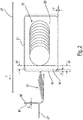
- Fig. 2 is shown by way of example of a package 21, which is moved in the transport direction T relative to the machine frame 47, for simplification only the depression 29, also referred to as a trough, in which a portion 10 to be packed is located.
- the representation is a top view, the smaller representation on the left in Fig. 2 is a side view.
- Fig. 2 Specified position M 'shown in dashed lines.
- This desired position of the packages 21 is expected from the downstream work stations so that they can work properly.
- the work stations arranged downstream are in particular the sealing station 15 and the separating stations 17, 19 which serve to separate the packs 21 (cf. Fig. 1 ).
- the position of the trough edge M is shifted relative to the desired position M ', namely by a path length U in the transport direction T and by a path length V transversely to the transport direction T.
- the front end of the portion 10 in the transport direction T is consequently located in a distance W from the trough edge M lying at the front in the transport direction T and at a distance W from the corresponding desired position of the trough edge M '.
- the packaging error therefore consists in incorrect positioning of the trough 29 both in the transport direction T and transversely to the transport direction T.
- This incorrect positioning can be corrected by a corresponding position correction of the upstream molding station 11 (cf. Fig. 1 ) or the tools 11a, 11b of the molding station 11, in that the actuator 11c of the molding station 11 is controlled accordingly by means of the control device 41 within the scope of the regulation according to the invention.
- Another packaging error can consist in the fact that the position of the portion 10 within the trough 29 does not correspond to a respective specification.
- the front end of the portion 10 in the transport direction T can consequently be too close to the front trough edge M or too far from this front trough edge M.
- the in Fig. 2 distance W shown can consequently be too small or too large. If it is assumed that the positions of the packaging 21 or the depressions 29 with respect to the machine frame 47 correspond to the specifications, ie are not incorrect, this packaging error can be corrected by an appropriate correction at the insertion station 13.
- the measuring devices 33 arranged downstream of the introduction station 13 are designed to measure the distances U and V or the distance W in order to detect an actual value in the context of the regulation according to the invention.
- the distances U, V can be determined if the measuring devices 33 are arranged fixed with respect to the machine frame 47, so that the control device 41 knows the positions of the measuring devices 33 relative to the machine frame 47 as reference or reference positions.
- the measuring devices 33 can also determine the position of the front end of the portion 10 in the transport direction T with respect to the machine frame 47, that is to say by means of an absolute measurement within the packaging machine.
- a relative measurement can be carried out in relation to the trough edge M which is at the front in the transport direction T.
- a packaging error can consist in the fact that the peripheral sealing point 43, also referred to as a sealing seam, does not have the correct distance from the packaging trough M, in deviation from a respective specification.
- the measuring devices 35 arranged downstream of the sealing station 15 can, for example - in each case based on the transport direction T - in Fig. 3 Measure the indicated distances b1 and b2 on the right edge of the packaging, the distances a1 and a2 on the front edge of the packaging and the distances c1 and c2 on the rear edge of the packaging.
- the distances b1, a1 and c1 each relate to the distance between the inner edge of the sealing seam 43 and the depression M, whereas the distances b2, a2 and c2 respectively denote the distance between the depression edge M and the outer edge of the sealing seam 43 .
- control device 41 can control the actuator 15c of the sealing station 15, for example, in order to move the sealing station 15 as a whole or its tools 15a, 15b relative to the machine frame 47.
- FIG. 4 Four further examples of packaging defects which can be identified and remedied according to the invention are shown schematically. These packaging errors can, for example, on the finished packaging 21, for example, with that in the embodiment of FIG Fig. 1 most downstream measuring device 40 can be recognized.
- a packaging error relates to the distance designated by the path length e between the cutting edge S at the front in the transport direction T and transverse to the transport direction T and the sealing seam 43.
- the path length e does not correspond of the respective specification, incorrect positioning of the separating station 17 responsible for the transverse direction or incorrect positioning at the sealing station 15 can be responsible for this.
- the cause of the error there is therefore a potentially ambiguous error situation insofar as a recognized packaging error can in principle have several causes.
- the cause of the error can nevertheless be clearly identified according to the invention, for example when the control device 41 knows the correct target position of the respective feature (for example the cutting edge S or the sealing seam 43) in relation to the machine frame 47 or, on the basis of further measuring devices, additional information can be included in the evaluation of the measured values carried out by the control device 41.
- the control device 41 knows the correct target position of the respective feature (for example the cutting edge S or the sealing seam 43) in relation to the machine frame 47 or, on the basis of further measuring devices, additional information can be included in the evaluation of the measured values carried out by the control device 41.
- the distance f denotes the distance, again measured in the transport direction T, between the above-mentioned front cutting edge S and the front trough edge M. If e.g. on the basis of other information available to the control device 41, it is certain that the separating station 17 responsible for the transverse direction is correctly positioned and is working properly, so that the correct position of the cutting edge S can be assumed, the reason for a deviation of the measured distance f is a respective specification consequently in an incorrect positioning of the recess 29. This can be remedied in the context of the regulation according to the invention, for example, by a position correction at the forming station 11.
- the packaging 21 shown is provided on the top film with printing 53 and with a label 51.
- the work stations responsible for this may be responsible for incorrect positioning of the prints 53 or labels 51.
- This can be recognized according to the invention in that the corresponding distances g (for printing 53) or h (for a label 51) do not correspond to the respective specifications. These distances are in Fig. 4 with respect to the front cutting edge S in the transport direction T.
- the positions of the prints 53 and labels 51 can also be measured with respect to the sealing seam 43 or the trough edge M.
- Marks are not shown in the figures, which are on the lower film 23 or on the upper film 25 (cf. Fig. 1 ) can be provided and which can either already be formed during the film production or can be formed in the respective film by appropriate devices of the packaging machine itself during operation.
- the use of foil markings on packaging machines is known in principle, for example for the time synchronization of workstations. According to the invention, markings of this type can provide the control device 41 with additional information in order to clearly identify the causes of packaging errors when evaluating measured values as part of the regulation according to the invention.
- Fig. 5 shows schematically in a side view how the upper measuring device 33 (cf. Fig. 1 ) can be designed and arranged, for example, to determine the position of a portion 10 relative to the trough edge M. This also applies to the corresponding Fig. 2 Referred.
- the measuring device 33 consequently determines the distance W from above, which deviates from the predetermined desired distance W, which is why there is a packaging error.
- the measuring device 33 comprises a light source 57 and a camera 55, which are arranged so as to be stationary with respect to the machine frame 47 of the packaging machine.
- the control device 41 not shown here (cf. Fig. 1 ), to which the measuring device 33 is connected, the position of the measuring device 33 in the reference system "machine frame 47" is consequently known.
- the control device 41 can consequently by evaluating the images recorded by the camera 55 determine whether the trough edge M lying in the detection area of the camera 55 is correctly positioned in the reference system "machine frame 47" or - as in the example of FIG Fig. 5 shown - does not have the correct position in the transport direction T.
- the light source 57 serves to illuminate the measuring range to be captured by the camera 55. Illumination by the light source 57 can take place over a wide area, it merely being ensured that the measurement area is sufficiently bright to be able to be captured by the camera 55 in the intended manner. Alternatively, patterns can be projected onto the measuring area with the light source 57, for example one or more lines or a line grid.
- the shape of the respective pattern on the packaging 21 is characteristic and can be captured by the camera 55 and recognized and evaluated by suitable image processing software in the control device 41. Packaging errors, such as incorrect positioning of the tray edge M according to Fig. 5 , result in a changed shape of the projected pattern on the package 21. As a result of this deviation between an actual image recorded during operation and a reference image, the presence and also the extent of a respective packaging error can be recognized or determined by the control device 41.
- the measurement range can be recorded with the packaging 21 at rest relative to the machine frame 47 and thus to the measuring device 33.
- the packaging 21 can be moved past the measuring device 33 during the measurement.
- Fig. 6 shows a possible arrangement of measuring devices 35 downstream of the sealing station 15 (cf. Fig. 1 ).
- a measuring device 35 is arranged above the packaging 21 and a further measuring device 35 below the packaging 21.
- Each measuring device 35 in turn comprises a light source 57 and a camera 55.
- the detection areas of the measuring devices 35 are each selected such that the distance measured in the transport direction T between the front sealing point 43 of the packaging 21 in the transport direction T and the trough edge M according to that described above Fig. 3 can be measured.
- Fig. 6 shows that in the lower film 23 the depression 29, also referred to as a trough, is formed, which defines the trough edge M lying at the front in the transport direction T.
- a portion 10 is located in the recess 29 of the packaging 21.
- the packaging 21 is closed by the top film 25, which is attached to a circumferential sealing seam 43 (cf. Fig. 3 ) is connected to the lower film 23 in order to close the recess 29 in a gas-tight manner. This is also referred to as sealing the top film 25 to the bottom film 23.
- the image processing software of the control device 41 can recognize the sealing seam 43 and the trough edge M and in each case determine their position relative to the machine frame 47 or their relative position to one another. Since the section of the packaging 21 comprising the sealing seam 43 and the trough edge M is detected both from above and from below, more information is available to the control device 41, as a result of which the respective features of the packaging 21 - here the sealing seam 43 and the trough edge M - can be recognized more reliably.
- an upper measuring device 37 and a lower measuring device 37 are again provided.
- These measuring devices 37 are, for example, downstream of the separation station 17 responsible for the transverse direction (cf. Fig. 1 ) arranged. Deviating from the embodiment of the Fig. 1 the measuring device 37 arranged below the packaging 21 is additionally provided here.
- the packages 21 are each provided with a label 51 and printing 53 on their upper side.
- a label 51 on the underside of the packaging 21.
- a labeling station that can apply labels to the undersides of the packaging 21 is Fig. 1 not shown, but can also be provided in this packaging machine.
- the detection areas of the measuring devices 37 are in each case not chosen to be so large that at the same time the front cutting edge S in the transport direction T, the sealing seam 43, the trough edge M and the front edge of the Printing 53 on the one hand and the front edge of the respective label 51 on the other hand can be detected.
- the inclusion of the detected position of the labels 51 takes place in that the packages are moved in the transport direction T and thus through the detection areas of the measuring devices 37. In this way, packaging errors can also be measured in the rear region of the packaging 21 in relation to the transport direction T.
Landscapes
- Engineering & Computer Science (AREA)
- Mechanical Engineering (AREA)
- Physics & Mathematics (AREA)
- Fluid Mechanics (AREA)
- Containers And Plastic Fillers For Packaging (AREA)
Applications Claiming Priority (1)
| Application Number | Priority Date | Filing Date | Title |
|---|---|---|---|
| DE102019101852.8A DE102019101852A1 (de) | 2019-01-25 | 2019-01-25 | Verpackungsmaschine |
Publications (2)
| Publication Number | Publication Date |
|---|---|
| EP3686110A2 true EP3686110A2 (fr) | 2020-07-29 |
| EP3686110A3 EP3686110A3 (fr) | 2020-08-12 |
Family
ID=69185383
Family Applications (1)
| Application Number | Title | Priority Date | Filing Date |
|---|---|---|---|
| EP20152642.3A Pending EP3686110A3 (fr) | 2019-01-25 | 2020-01-20 | Machine d'emballage |
Country Status (2)
| Country | Link |
|---|---|
| EP (1) | EP3686110A3 (fr) |
| DE (1) | DE102019101852A1 (fr) |
Cited By (5)
| Publication number | Priority date | Publication date | Assignee | Title |
|---|---|---|---|---|
| CN115042450A (zh) * | 2022-06-17 | 2022-09-13 | 山东森荣新材料股份有限公司 | 一种ip68级防水透声膜加工装置 |
| US20240228093A1 (en) * | 2021-05-03 | 2024-07-11 | G.D S.P.A. | Packaging apparatus and process for articles to be packaged |
| CN118342569A (zh) * | 2024-04-02 | 2024-07-16 | 淮安市文善电子有限公司 | 一种封带裁切机及其操作方法 |
| DE102023110816A1 (de) * | 2023-04-26 | 2024-10-31 | Weber Food Technology Gmbh | Verfahren zum Betreiben einer Produktionslinie |
| CN119218473A (zh) * | 2024-11-28 | 2024-12-31 | 唇动食品股份有限公司 | 一种食品生产用自动贴膜设备 |
Families Citing this family (9)
| Publication number | Priority date | Publication date | Assignee | Title |
|---|---|---|---|---|
| DE102021107944A1 (de) | 2021-03-30 | 2022-10-06 | Multivac Sepp Haggenmüller Se & Co. Kg | Verfahren zum Einlegen von Produkten in Trays und Beladestation |
| DE102021112484A1 (de) | 2021-05-12 | 2022-11-17 | Krones Aktiengesellschaft | Etikettiermaschine und Verfahren zum Konfigurieren einer Etikettiermaschine |
| DE102021120324A1 (de) | 2021-08-04 | 2023-02-09 | Krones Aktiengesellschaft | System und Verfahren zum automatisierten Generieren von Bewegungs- und Positionsparametern einer Pack- oder Palettiermaschine für Gebindeanordnungen |
| DE102022100537A1 (de) | 2021-10-11 | 2023-04-13 | Weber Maschinenbau Gmbh Breidenbach | Lebensmittelverarbeitungslinie und Verfahren zum Betreiben einer Lebensmittelverarbeitungslinie |
| DE102021128978A1 (de) | 2021-11-08 | 2023-05-11 | Krones Aktiengesellschaft | Verfahren und Messanordnung zur Qualitätsprüfung von Verpackungseinheiten |
| DE102023104814A1 (de) * | 2023-02-28 | 2024-08-29 | Multivac Sepp Haggenmüller Se & Co. Kg | Tiefziehverpackungsmaschine zum Verformen von Verpackungsmaterial |
| DE102023117964A1 (de) * | 2023-07-07 | 2025-01-09 | Multivac Sepp Haggenmüller Se & Co. Kg | Verfahren zum automatischen Einhalten einer vorgegebenen Portions-Anordnung in einer Tray-Mulde sowie hierfür geeignete Verpackungs-Vorrichtung |
| DE102023121433A1 (de) | 2023-08-10 | 2025-02-13 | Krones Aktiengesellschaft | Verfahren zum automatischen Kalibrieren einer Behälterbehandlungsanlage und Behälterbehandlungsanlage zum Durchführen des Verfahrens |
| DE102023123732A1 (de) * | 2023-09-04 | 2025-03-06 | Alyssa Hardjosoekatmo | Verfahren zur Identifikation und Inspektion von wiederverwendbaren Transportverpackungen für Waren in einem Logistikkreislauf |
Citations (4)
| Publication number | Priority date | Publication date | Assignee | Title |
|---|---|---|---|---|
| EP0798250A2 (fr) * | 1996-03-29 | 1997-10-01 | Ethicon, Inc. | Dispositif d'alimentation en film dans une ligne de fabrication d'emballages scellés et stériles |
| US20040030433A1 (en) * | 2002-08-07 | 2004-02-12 | Popp Robert L. | Manufacturing information and alarming system and method |
| US20150096263A1 (en) * | 2013-10-09 | 2015-04-09 | Multivac Sepp Haggenmüller Gmbh & Co. Kg | Thermo-forming packaging machine and method |
| US20150291300A1 (en) * | 2014-04-14 | 2015-10-15 | The Procter & Gamble Company | Apparatus for producing pouches |
Family Cites Families (5)
| Publication number | Priority date | Publication date | Assignee | Title |
|---|---|---|---|---|
| DE29907851U1 (de) * | 1999-05-04 | 1999-07-08 | Horn + Noack Geschäftsbereich der Romaco GmbH, 76229 Karlsruhe | Anlage zur Herstellung und Verpackung von Blistern |
| DE10065389A1 (de) * | 2000-11-24 | 2002-05-29 | Cfs Gmbh Kempten | Verfahren und Vorrichtung zum Positionieren von Folienbahnen einer Verpackungsvorrichtung |
| DE10249962B4 (de) * | 2002-10-26 | 2011-06-22 | Robert Bosch GmbH, 70469 | Vorrichtung und Verfahren zur berührungslosen Lageerkennung von Näpfen für Füllgut |
| US20080172986A1 (en) * | 2007-01-19 | 2008-07-24 | Fipco | Packing material production and bagging apparatus and methods for using same |
| ES2530969T3 (es) * | 2012-12-27 | 2015-03-09 | Multivac Sepp Haggenmüller Gmbh & Co Kg | Máquina de cierre de cubetas con dispositivo de supervisión y procedimiento |
-
2019
- 2019-01-25 DE DE102019101852.8A patent/DE102019101852A1/de active Pending
-
2020
- 2020-01-20 EP EP20152642.3A patent/EP3686110A3/fr active Pending
Patent Citations (4)
| Publication number | Priority date | Publication date | Assignee | Title |
|---|---|---|---|---|
| EP0798250A2 (fr) * | 1996-03-29 | 1997-10-01 | Ethicon, Inc. | Dispositif d'alimentation en film dans une ligne de fabrication d'emballages scellés et stériles |
| US20040030433A1 (en) * | 2002-08-07 | 2004-02-12 | Popp Robert L. | Manufacturing information and alarming system and method |
| US20150096263A1 (en) * | 2013-10-09 | 2015-04-09 | Multivac Sepp Haggenmüller Gmbh & Co. Kg | Thermo-forming packaging machine and method |
| US20150291300A1 (en) * | 2014-04-14 | 2015-10-15 | The Procter & Gamble Company | Apparatus for producing pouches |
Non-Patent Citations (1)
| Title |
|---|
| ENGILICO SEALSCOPE - 100% SEAL INSPECTION: "SealScope(TM) 100% inline seal inspection and process monitoring", 12 April 2017 (2017-04-12), XP055872175, Retrieved from the Internet <URL:https://www.youtube.com/watch?v=zlm4wcL0BSc> [retrieved on 20211210] * |
Cited By (6)
| Publication number | Priority date | Publication date | Assignee | Title |
|---|---|---|---|---|
| US20240228093A1 (en) * | 2021-05-03 | 2024-07-11 | G.D S.P.A. | Packaging apparatus and process for articles to be packaged |
| CN115042450A (zh) * | 2022-06-17 | 2022-09-13 | 山东森荣新材料股份有限公司 | 一种ip68级防水透声膜加工装置 |
| CN115042450B (zh) * | 2022-06-17 | 2024-03-29 | 山东森荣新材料股份有限公司 | 一种ip68级防水透声膜加工装置 |
| DE102023110816A1 (de) * | 2023-04-26 | 2024-10-31 | Weber Food Technology Gmbh | Verfahren zum Betreiben einer Produktionslinie |
| CN118342569A (zh) * | 2024-04-02 | 2024-07-16 | 淮安市文善电子有限公司 | 一种封带裁切机及其操作方法 |
| CN119218473A (zh) * | 2024-11-28 | 2024-12-31 | 唇动食品股份有限公司 | 一种食品生产用自动贴膜设备 |
Also Published As
| Publication number | Publication date |
|---|---|
| DE102019101852A1 (de) | 2020-07-30 |
| EP3686110A3 (fr) | 2020-08-12 |
Similar Documents
| Publication | Publication Date | Title |
|---|---|---|
| EP3686110A2 (fr) | Machine d'emballage | |
| EP3116672B1 (fr) | Procédé servant à faire fonctionner une installation d'usinage de panneaux | |
| EP3331767B2 (fr) | Machine d'emballage à fonction de démarrage précoce commandée par processus | |
| WO2023061840A1 (fr) | Ligne de transformation alimentaire et procédé pour faire fonctionner une ligne de transformation alimentaire | |
| EP3480123B1 (fr) | Dispositif de chargement pour une machine de decoupe et d'emballage pour la decoupe et l'emballage d'aliments, ainsi qu'une machine de decoupe et d'emballage avec ledit dispositif de chargement | |
| EP2956370B1 (fr) | Procédé permettant d'orienter une bande d'étiquettes | |
| DE102011115142B4 (de) | Verfahren zum Vereinzeln von Verpackungen | |
| DE102019127275A1 (de) | Verfahren und System zur Verarbeitung von Produkten | |
| DE102021116735A1 (de) | Verfahren zum Betreiben einer Produktionslinie | |
| EP2749500B1 (fr) | Machine de verrouillage de coques avec dispositif de surveillance et procédé | |
| DE102012221458B3 (de) | System zur automatischen Formatverstellung einer Anlage mit Automatik-unterstütztem Formatwechsel | |
| EP2965900A1 (fr) | Procédé et dispositif de fabrication d'ébauche d'emballage, notamment de sac d'emballage | |
| DE102016124384B4 (de) | Verfahren und Vorrichtung zum Fügen von Werkstücken | |
| DE102016105931A1 (de) | Applikationstechnik zum längenangepassten Anbringen eines flexiblen Profils an einem Werkstück | |
| WO2019081576A1 (fr) | Procédé et dispositif de découpe de plaques de tôle | |
| DE102019121010A1 (de) | Diagnoseverfahren und Arbeitsaggregat einer Produktionslinie für Rauchartikel | |
| DE102021110638A1 (de) | Verfahren zum Etikettieren und/oder Bedrucken einer Abfolge von hintereinander angeordneten Verpackungsformaten | |
| DE102023114662A1 (de) | Verfahren zur Steuerung einer Aufschneideeinheit und Verarbeitungslinie mit Aufschneideeinheit | |
| DE102016203816B4 (de) | Vorrichtung zum Transport von Packmittel, insbesondere von Flaschen oder Bechern | |
| DE102023133046A1 (de) | Transfer von Lebensmittelprodukten | |
| DE102016203814B4 (de) | Vorrichtung zum Transport von Packmittel, insbesondere von Flaschen oder Bechern | |
| DE102023135171A1 (de) | Anpassung eines Vorschubparameters in einer Tiefziehverpackungsmaschine | |
| DE102024110259B4 (de) | Verpackungsmaschine zum Verpacken von Produkten in Verpackungen | |
| DE102022130815A1 (de) | Verpackungsmaschine und Verfahren zum Verpacken von Lebensmittelprodukten | |
| EP3875262A2 (fr) | Installation de fabrication de boîtes pliables et procédés de fonctionnement de l'installation |
Legal Events
| Date | Code | Title | Description |
|---|---|---|---|
| PUAI | Public reference made under article 153(3) epc to a published international application that has entered the european phase |
Free format text: ORIGINAL CODE: 0009012 |
|
| STAA | Information on the status of an ep patent application or granted ep patent |
Free format text: STATUS: THE APPLICATION HAS BEEN PUBLISHED |
|
| PUAL | Search report despatched |
Free format text: ORIGINAL CODE: 0009013 |
|
| AK | Designated contracting states |
Kind code of ref document: A2 Designated state(s): AL AT BE BG CH CY CZ DE DK EE ES FI FR GB GR HR HU IE IS IT LI LT LU LV MC MK MT NL NO PL PT RO RS SE SI SK SM TR |
|
| AX | Request for extension of the european patent |
Extension state: BA ME |
|
| AK | Designated contracting states |
Kind code of ref document: A3 Designated state(s): AL AT BE BG CH CY CZ DE DK EE ES FI FR GB GR HR HU IE IS IT LI LT LU LV MC MK MT NL NO PL PT RO RS SE SI SK SM TR |
|
| AX | Request for extension of the european patent |
Extension state: BA ME |
|
| RIC1 | Information provided on ipc code assigned before grant |
Ipc: B65B 57/10 20060101ALI20200707BHEP Ipc: B65B 9/04 20060101AFI20200707BHEP |
|
| STAA | Information on the status of an ep patent application or granted ep patent |
Free format text: STATUS: REQUEST FOR EXAMINATION WAS MADE |
|
| 17P | Request for examination filed |
Effective date: 20201210 |
|
| RBV | Designated contracting states (corrected) |
Designated state(s): AL AT BE BG CH CY CZ DE DK EE ES FI FR GB GR HR HU IE IS IT LI LT LU LV MC MK MT NL NO PL PT RO RS SE SI SK SM TR |
|
| STAA | Information on the status of an ep patent application or granted ep patent |
Free format text: STATUS: EXAMINATION IS IN PROGRESS |
|
| 17Q | First examination report despatched |
Effective date: 20211217 |
|
| P01 | Opt-out of the competence of the unified patent court (upc) registered |
Effective date: 20230522 |
|
| RAP3 | Party data changed (applicant data changed or rights of an application transferred) |
Owner name: WEBER FOOD TECHNOLOGY GMBH |
|
| RAP1 | Party data changed (applicant data changed or rights of an application transferred) |
Owner name: WEBER FOOD TECHNOLOGY SE & CO. KG |