EP3686240B1 - Compositions contenant le polyéthylène téréphtalate (pet) stabilisé par hydrolyse - Google Patents
Compositions contenant le polyéthylène téréphtalate (pet) stabilisé par hydrolyse Download PDFInfo
- Publication number
- EP3686240B1 EP3686240B1 EP20152780.1A EP20152780A EP3686240B1 EP 3686240 B1 EP3686240 B1 EP 3686240B1 EP 20152780 A EP20152780 A EP 20152780A EP 3686240 B1 EP3686240 B1 EP 3686240B1
- Authority
- EP
- European Patent Office
- Prior art keywords
- pet
- formula
- carbodiimide
- alkyl
- polyethylene terephthalate
- Prior art date
- Legal status (The legal status is an assumption and is not a legal conclusion. Google has not performed a legal analysis and makes no representation as to the accuracy of the status listed.)
- Active
Links
- 0 *c(cc1*)cc(*)c1N=C=Nc1c(*)cc(*)cc1* Chemical compound *c(cc1*)cc(*)c1N=C=Nc1c(*)cc(*)cc1* 0.000 description 2
Classifications
-
- C—CHEMISTRY; METALLURGY
- C08—ORGANIC MACROMOLECULAR COMPOUNDS; THEIR PREPARATION OR CHEMICAL WORKING-UP; COMPOSITIONS BASED THEREON
- C08K—Use of inorganic or non-macromolecular organic substances as compounding ingredients
- C08K5/00—Use of organic ingredients
- C08K5/16—Nitrogen-containing compounds
- C08K5/29—Compounds containing one or more carbon-to-nitrogen double bonds
-
- C—CHEMISTRY; METALLURGY
- C08—ORGANIC MACROMOLECULAR COMPOUNDS; THEIR PREPARATION OR CHEMICAL WORKING-UP; COMPOSITIONS BASED THEREON
- C08J—WORKING-UP; GENERAL PROCESSES OF COMPOUNDING; AFTER-TREATMENT NOT COVERED BY SUBCLASSES C08B, C08C, C08F, C08G or C08H
- C08J3/00—Processes of treating or compounding macromolecular substances
- C08J3/20—Compounding polymers with additives, e.g. colouring
- C08J3/203—Solid polymers with solid and/or liquid additives
-
- C—CHEMISTRY; METALLURGY
- C08—ORGANIC MACROMOLECULAR COMPOUNDS; THEIR PREPARATION OR CHEMICAL WORKING-UP; COMPOSITIONS BASED THEREON
- C08J—WORKING-UP; GENERAL PROCESSES OF COMPOUNDING; AFTER-TREATMENT NOT COVERED BY SUBCLASSES C08B, C08C, C08F, C08G or C08H
- C08J2367/00—Characterised by the use of polyesters obtained by reactions forming a carboxylic ester link in the main chain; Derivatives of such polymers
- C08J2367/02—Polyesters derived from dicarboxylic acids and dihydroxy compounds
-
- C—CHEMISTRY; METALLURGY
- C08—ORGANIC MACROMOLECULAR COMPOUNDS; THEIR PREPARATION OR CHEMICAL WORKING-UP; COMPOSITIONS BASED THEREON
- C08K—Use of inorganic or non-macromolecular organic substances as compounding ingredients
- C08K2201/00—Specific properties of additives
- C08K2201/019—Specific properties of additives the composition being defined by the absence of a certain additive
Definitions
- the invention relates to hydrolysis-stabilized polyethylene terephthalate (PET) -containing compositions, processes for production and their use.
- PET polyethylene terephthalate
- PET Polyethylene terephthalate
- PET which is usually supplied in granulate form by the manufacturer for further processing, has a water content of the order of 0.2 to 0.4% (2000 to 4000 ppm), the moisture content and its distribution on the surface of the granulate and inside the granulate depend on the crystallinity of the PET in the granulate and its composition.
- PET is particularly sensitive to hydrolysis due to moisture in the melt at high temperatures. Finished articles made of solid, solidified PET, on the other hand, are hardly noticeably sensitive to moisture.
- a hydrolysis protective agent to PET in order to prevent the fiber quality from deteriorating during the useful life of the fabric made therefrom, which in particular contains carbodiimide groups and is generally polymeric in nature.
- the polycarbodiimide compound is homogeneously distributed in amounts of about 1 to 2.5% by weight in the finished PET fiber and binds traces of water which penetrate the fiber and which could lead to partial PET hydrolysis with gradual deterioration in quality .
- Such anti-hydrolysis agents serve exclusively to improve the long-term stability of the finished PET products.
- the polymeric carbodiimides have disadvantages compared to the monomeric carbodiimides, since they are less reactive at lower temperatures and are difficult to use Have special technical equipment dispersed in the polymer matrix under more stringent process conditions.
- Some monomeric carbodiimides have the disadvantage that many of them are themselves toxic and volatile at low temperatures. They are not thermally stable and lead to increased emissions of other volatile and toxic substances during processing, so that a specific selection must be made.
- EP-A 2671912 it is known to use monomeric aromatic carbodiimides in the hydrolysis stabilization of polymers, such as polyethylene terephthalate (PET), polybutylene terephthalate (PBT), polytrimethylene terephthalate (PTT), thermoplastic polyurethanes (TPU), copolyesters, thermoplastic polyester elastomers (TPE E), polylactic acid (PLA) ) and / or PLA derivatives or also in the case of polyhydroxyalkanoates (PHA).
- polymers such as polyethylene terephthalate (PET), polybutylene terephthalate (PBT), polytrimethylene terephthalate (PTT), thermoplastic polyurethanes (TPU), copolyesters, thermoplastic polyester elastomers (TPE E), polylactic acid (PLA) ) and / or PLA derivatives or also in the case of polyhydroxyalkanoates (PHA).
- PET in particular has proven to be the most difficult polymer to stabilize with regard to hydrolysis, so that even the EP-A 2671912 known carbodiimides are no longer sufficient and there was a need to further optimize the hydrolytic stability of PET.
- the object of the present invention was therefore to provide improved hydrolysis-stabilized polyethylene terephthalate (PET) compositions which do not have the aforementioned disadvantages, i.e., above all, are toxicologically harmless.
- PET polyethylene terephthalate
- this object could be achieved by using certain monomeric carbodiimides if their urea compound content is ⁇ 1000 ppm, preferably ⁇ 500 ppm, based on the carbodiimide.
- the carbodiimides used according to the invention have a proportion of urea compounds of the formulas (II) and (III) which is ⁇ 1000 ppm, preferably ⁇ 500 ppm, particularly preferably ⁇ 100 ppm, based on the carbodiimide.
- the C 3 -C 6 -alkyl radicals of the carbodiimides of the formula (I) used can be linear and / or branched. These are preferably branched.
- the radicals R 1 to R 6 are preferably identical.
- the radicals R 1 to R 6 correspond to isopropyl.
- the carbodiimides used preferably have an NCN content of 8 to 10% by weight, preferably 8 to 9% by weight.
- the trisubstituted benzene isocyanates are preferably 2,4,6-triisopropylphenyl isocyanate, 2,6-diisopropyl-4-ethylphenyl isocyanate and 2,6-diisopropyl-4-methylphenyl isocyanate.
- the trisubstituted benzene amines necessary for their preparation can - as known to the person skilled in the art - be prepared via Friedel-Crafts alkylation of aniline with the corresponding alkene, haloalkane, haloalkenbenzene and / or halocycloalkane.
- the carbodiimidization is preferably carried out according to the method in Angew. Chem. 93, pp. 855-866 (1981 ) or DE-A-11 30 594 or Tetrahedron Letters 48 (2007), pp. 6002-6004 described procedure.
- strong bases or phosphorus compounds are preferred as catalysts for the preparation of the compounds of the formula (I).
- Phospholene oxides, phospholidines or phospholine oxides and the corresponding sulfides are preferably used.
- tertiary amines, basic metal compounds, alkali metal oxides or alkaline earth metal oxides or hydroxides, alcoholates or phenolates, carboxylic acid metal salts and non-basic organometallic compounds can be used as catalysts.
- the carbodiimidization can be carried out either in bulk or in a solvent. It is also possible to start the carbodiimidization first in substance and then to complete it after adding a solvent. Gasoline, benzene and / or alkylbenzenes, for example, can be used as solvents.
- the carbodiimide is preferably dissolved in at least one solvent and stirred, preferably at temperatures of 40-80 ° C., particularly preferably at 50-60 ° C.
- the mixture is then preferably cooled to 10-25 ° C., particularly preferably to 15-20 ° C., with stirring.
- the crystals that form are then filtered off with suction or separated from the mother liquor. Filter presses, centrifuges, suction filters or pressure suction filters can be used for this become.
- the solid is then either dried in a dryer - such as preferably a paddle dryer, drying cabinet - preferably under reduced pressure and packaged as a solid or placed in a stirred tank, preferably freed from residual solvent by distillation at 50-100 ° C. and bottled as a liquid.
- Solids metering and mixing units in the context of the invention are: Single, twin and multi-screw extruders, continuously operating co-kneaders (Buss type) and discontinuously operating kneaders, e.g. Banbury type and other units customary in the polymer industry.
- the concentration of the carbodiimides of the formula (I) in polyethylene terephthalate (PET) is preferably 0.5-5% by weight, preferably 1.0-3% by weight, particularly preferably 1.5-2.5% by weight.
- the polyethylene terephthalate (PET) in the context of the invention is preferably all polyethylene terephthalates derived from terephthalic acid (or its reactive derivatives) and alkanediols based on ethylene glycol. This includes both polyethylene terephthalate alone or a mixture of two or more different polyethylene terephthalates.
- polyethylene terephthalates which have been produced solely from terephthalic acid and its reactive derivatives, such as, for example, its dialkyl esters, and ethylene glycol, preferably ethanediol.
- the present invention also relates to compositions containing polyethylene terephthalate and at least one monomeric carbodiimide of the formula (I), which is purified by means of recrystallization in solvent.
- the carbodiimide is preferably dissolved and stirred in at least one solvent, preferably at temperatures of 40-80 ° C., particularly preferably at 50-60 ° C.
- the mixture is then preferably cooled to 10-25 ° C., particularly preferably to 15-20 ° C., with stirring.
- the crystals that form are then suctioned off or removed from the mother liquor severed.
- filter presses, centrifuges, suction filters or pressure suction filters can be used for this.
- the solid is then either dried in a dryer - such as a paddle dryer, drying cabinet - preferably in vacuo and packaged as a solid or placed in a stirred tank, preferably freed from residual solvent by distillation at 50-100 ° C. and bottled as a liquid.
- Alcohols, ketones, nitriles, ethers or esters are preferably used as suitable solvents.
- Alcohols from the group of the aliphatic monoalcohols such as preferably methanol, ethanol or isopropanol, are particularly preferred.
- mixtures of different solvents are used, preferably alcohols.
- Mixtures of methanol with ethanol in a ratio of 1: 3 to 3: 1, preferably 1: 2 to 2: 1, particularly preferably 1: 1, are particularly preferably used here.
- Another object of the present invention is the use of the compositions according to the invention for hydrolysis-stabilized PET mono- and multifilaments, fibers, films or injection-molded parts.
- rod C was dissolved in a beaker with an ethanol and methanol in a ratio of 1: 1. The mixture was then stirred at 50 ° C. for 15 minutes. The mixture was then cooled to a temperature between 18-20 ° C., with constant stirring, and the mixture was stirred at 18-20 ° C. for another 15 minutes. The crystals which formed were then suctioned off through a suction filter and dried at 40 ° C. and 10 mbar in a vacuum drying cabinet for 8 hours until the mass was constant.
- the stabilizers used depending on the example were dispersed in the amounts listed in Table 1 using a laboratory twin-screw extruder ZSK 25 from Werner & Pfleiderer prior to the measurement described below.
- the F3 standard test specimens used for measuring the tear strength were then produced from the granules obtained on an Arburg Allrounder 320 S 150-500 injection molding machine.
- these F3 standard test specimens were stored in steam at a temperature of 110 ° C. and their relative tear strength was measured in%.
- rod C according to the invention shows very good hydrolytic stability compared to rod B.
- the direct comparison of bar C shows the importance of the low proportion of urea compounds of the formula (II) and formula (III).
Landscapes
- Chemical & Material Sciences (AREA)
- Health & Medical Sciences (AREA)
- Chemical Kinetics & Catalysis (AREA)
- Medicinal Chemistry (AREA)
- Polymers & Plastics (AREA)
- Organic Chemistry (AREA)
- Compositions Of Macromolecular Compounds (AREA)
- Processes Of Treating Macromolecular Substances (AREA)
- Injection Moulding Of Plastics Or The Like (AREA)
- Organic Low-Molecular-Weight Compounds And Preparation Thereof (AREA)
- Polyurethanes Or Polyureas (AREA)
Claims (10)
- Composition contenant du poly(éthylène téréphtalate) (PET) et au moins un carbodiimide monomère de formule (I)
 où R1, R2, R4 et R6 représentent, indépendamment les uns des autres, un groupe alkyle en C3-C6 etR3, R5 représentent, indépendamment l'un de l'autre, un groupe alkyle en C1-C3,qui présente une teneur en composés urée de formules (II) et (III)
 où n = 1-100 et R1, R2, R4 et R6 représentent, indépendamment les uns des autres, un groupe alkyle en C3-C6 etR3, R5 représentent, indépendamment l'un de l'autre, un groupe alkyle en C1-C3,inférieure à 1 000 ppm, de préférence inférieure à 500 ppm, par rapport au carbodiimide.
 - Composition selon la revendication 1, caractérisée en ce que les radicaux R1 à R6 sont des groupes isopropyle.
- Composition selon la revendication 1 ou 2, caractérisée en ce que la teneur en carbodiimide de formule (I) vaut de 0,5 à 5 % en poids, de préférence 1,5 - 2,5 % en poids.
- Composition selon l'une quelconque des revendications 1 à 3, caractérisée en ce que le carbodiimide de formule (I) a été purifié par recristallisation dans du solvant.
- Procédé pour la préparation d'une composition selon l'une quelconque des revendications 1 à 4, caractérisé en ce qu'on mélange dans une extrudeuse du poly(éthylène téréphtalate) (PET) et au moins un carbodiimide monomère de formule (I).
- Procédé selon la revendication 5, caractérisé en ce qu'on prépare le carbodiimide de formule (I) à partir d'isocyanatobenzènes trisubstitués de formule (IV)
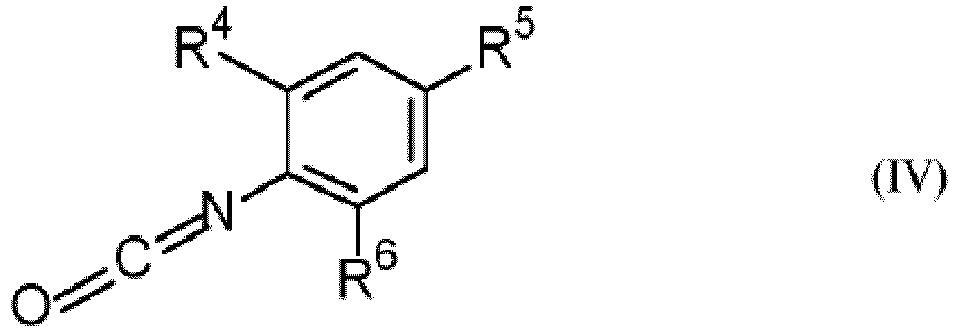
 formules dans lesquelles R1, R2, R4 et R6 représentent, indépendamment les uns des autres, un groupe alkyle en C3-C6et R3 et R5 représentent, indépendamment l'un de l'autre, un groupe alkyle en C1-C3,qui sont mis en réaction avec élimination de dioxyde de carbone à des températures de 40 °C à 200 °C en présence de catalyseurs et éventuellement de solvant, et ensuite recristallisés dans au moins un solvant.
 - Procédé selon la revendication 6, caractérisé en ce que le solvant est choisi dans le groupe des alcools, cétones, nitriles, éthers ou esters.
- Procédé selon la revendication 5 ou 7, caractérisé en ce qu'on effectue la recristallisation dans un mélange de solvants.
- Procédé selon l'une quelconque des revendications 5 à 8, caractérisé en ce qu'on effectue la recristallisation dans un mélange de méthanol/éthanol en un rapport de 1:3 à 3:1.
- Utilisation de la composition selon l'une quelconque des revendications 1 à 4 pour des mono- et multifilaments, des fibres, des pièces moulées par injection et des films.
Priority Applications (1)
| Application Number | Priority Date | Filing Date | Title |
|---|---|---|---|
| PL20152780T PL3686240T3 (pl) | 2019-01-23 | 2020-01-21 | Stabilizowane hydrolitycznie kompozycje zawierające poli(tereftalan etylenu) (PET) |
Applications Claiming Priority (1)
| Application Number | Priority Date | Filing Date | Title |
|---|---|---|---|
| EP19153199.5A EP3686239A1 (fr) | 2019-01-23 | 2019-01-23 | Compositions contenant du polyéthylène téréphtalate (pet) stabilisé à l'hydrolyse |
Publications (2)
| Publication Number | Publication Date |
|---|---|
| EP3686240A1 EP3686240A1 (fr) | 2020-07-29 |
| EP3686240B1 true EP3686240B1 (fr) | 2021-08-11 |
Family
ID=65433433
Family Applications (2)
| Application Number | Title | Priority Date | Filing Date |
|---|---|---|---|
| EP19153199.5A Withdrawn EP3686239A1 (fr) | 2019-01-23 | 2019-01-23 | Compositions contenant du polyéthylène téréphtalate (pet) stabilisé à l'hydrolyse |
| EP20152780.1A Active EP3686240B1 (fr) | 2019-01-23 | 2020-01-21 | Compositions contenant le polyéthylène téréphtalate (pet) stabilisé par hydrolyse |
Family Applications Before (1)
| Application Number | Title | Priority Date | Filing Date |
|---|---|---|---|
| EP19153199.5A Withdrawn EP3686239A1 (fr) | 2019-01-23 | 2019-01-23 | Compositions contenant du polyéthylène téréphtalate (pet) stabilisé à l'hydrolyse |
Country Status (8)
| Country | Link |
|---|---|
| US (2) | US20200231781A1 (fr) |
| EP (2) | EP3686239A1 (fr) |
| JP (1) | JP6905101B2 (fr) |
| CN (1) | CN111471282B (fr) |
| ES (1) | ES2892339T3 (fr) |
| HU (1) | HUE056266T2 (fr) |
| PL (1) | PL3686240T3 (fr) |
| PT (1) | PT3686240T (fr) |
Families Citing this family (1)
| Publication number | Priority date | Publication date | Assignee | Title |
|---|---|---|---|---|
| EP4361209A1 (fr) | 2022-10-27 | 2024-05-01 | LANXESS Deutschland GmbH | Compositions contenant du polyester stabilisé par hydrolyse |
Family Cites Families (14)
| Publication number | Priority date | Publication date | Assignee | Title |
|---|---|---|---|---|
| DE1130594B (de) | 1956-07-30 | 1962-05-30 | Du Pont | Verfahren zur Herstellung von gegebenenfalls modifizierten Polykondensationsprodukten mití¬N?C?N-Brueckengliedern |
| DE4238046A1 (de) | 1992-11-11 | 1994-05-19 | Basf Ag | Neue Bis-(4-substituierte-2,6-diisopropyl-phenyl)-carbodiimide, ein Verfahren zu ihrer Herstellung und ihre Verwendung sowie die zu ihrer Herstellung verwendbaren 4-substituierten 2,6-Diisopropyl-phenylisocyanate |
| JP3509084B2 (ja) * | 1995-02-17 | 2004-03-22 | 日本ポリウレタン工業株式会社 | 2,6−ジイソプロピルフェニルカルボジイミドの精製法 |
| JP4939097B2 (ja) * | 2006-04-04 | 2012-05-23 | 東レ株式会社 | ポリエステル組成物、モノフィラメントおよび工業用織物 |
| CN103025743B (zh) * | 2010-06-16 | 2015-09-09 | 川口化学工业株式会社 | 碳二酰亚胺化合物的制造方法 |
| BR102012005706A2 (pt) * | 2011-03-15 | 2013-07-23 | Rhein Chemie Rheinau Gmbh | mÉtodo para a estabilizaÇço de polÍmeros que contÊm grupos Éster |
| EP2520597A1 (fr) * | 2011-05-05 | 2012-11-07 | Rhein Chemie Rheinau GmbH | Carbodiimides constitués d'isocyanates aromatiques trisubstitués, leur procédé de fabrication et d'utilisation |
| US9603124B2 (en) * | 2012-04-24 | 2017-03-21 | Apple Inc. | Methods and apparatus for opportunistic radio resource allocation in multi-carrier communication systems |
| PT2671912E (pt) | 2012-06-05 | 2015-08-21 | Rhein Chemie Rheinau Gmbh | Método para a estabilização de polímeros que contêm grupos éster |
| JP6174687B2 (ja) * | 2012-06-05 | 2017-08-02 | ライン・ケミー・ライノー・ゲーエムベーハー | 新規なカルボジイミド含有組成物、その合成方法、及びその使用 |
| EP2803660A1 (fr) * | 2013-05-13 | 2014-11-19 | Rhein Chemie Rheinau GmbH | Nouveaux carbodiimides comprenant des groupes urée et/ou uréthane à terminaison, leur procédé de fabrication et leur utilisation |
| HUE040703T2 (hu) * | 2014-11-04 | 2019-03-28 | Lanxess Deutschland Gmbh | Új karbodiimidek, eljárás ezek elõállítására és ezek alkalmazása |
| CN105037242A (zh) * | 2015-06-19 | 2015-11-11 | 上海新亚药业有限公司 | 双氯芬酸衍生物的合成工艺 |
| CN108047153A (zh) * | 2017-12-20 | 2018-05-18 | 上海朗亿功能材料有限公司 | 一种低挥发环状碳化二亚胺类化合物及其制备方法 |
-
2019
- 2019-01-23 EP EP19153199.5A patent/EP3686239A1/fr not_active Withdrawn
-
2020
- 2020-01-16 CN CN202010057911.3A patent/CN111471282B/zh active Active
- 2020-01-20 JP JP2020006776A patent/JP6905101B2/ja active Active
- 2020-01-20 US US16/747,231 patent/US20200231781A1/en not_active Abandoned
- 2020-01-21 HU HUE20152780A patent/HUE056266T2/hu unknown
- 2020-01-21 PL PL20152780T patent/PL3686240T3/pl unknown
- 2020-01-21 ES ES20152780T patent/ES2892339T3/es active Active
- 2020-01-21 PT PT20152780T patent/PT3686240T/pt unknown
- 2020-01-21 EP EP20152780.1A patent/EP3686240B1/fr active Active
-
2022
- 2022-04-07 US US17/715,220 patent/US20220411605A1/en not_active Abandoned
Also Published As
| Publication number | Publication date |
|---|---|
| JP2020117698A (ja) | 2020-08-06 |
| ES2892339T3 (es) | 2022-02-03 |
| CN111471282B (zh) | 2023-03-24 |
| PT3686240T (pt) | 2021-10-04 |
| EP3686240A1 (fr) | 2020-07-29 |
| JP6905101B2 (ja) | 2021-07-21 |
| US20200231781A1 (en) | 2020-07-23 |
| US20220411605A1 (en) | 2022-12-29 |
| HUE056266T2 (hu) | 2022-02-28 |
| EP3686239A1 (fr) | 2020-07-29 |
| PL3686240T3 (pl) | 2022-01-10 |
| CN111471282A (zh) | 2020-07-31 |
Similar Documents
| Publication | Publication Date | Title |
|---|---|---|
| EP2997010B1 (fr) | Nouveaux carbodiimides comprenant des groupes urée et/ou uréthane à terminaison, leur procédé de fabrication et leur utilisation | |
| EP0460481B1 (fr) | Procédé de stabilisation de résines contenant des groupes ester | |
| DE19525235B4 (de) | Harnstoff-Modifiziertes Carbodiimid und Verfahren zur Herstellung desselben | |
| EP3215486A1 (fr) | Nouveaux carbodiimides, leur procédé de production et leur utilisation | |
| EP2418251A1 (fr) | Matières synthétiques bio à longue durée de vie à base de polyhydroxyalcanoate, leur procédé de fabrication et d'utilisation | |
| EP2952502B1 (fr) | Cyanamide bis[3 isopropenyl-alpha,alpha-diméthyl benzyle], procédé de fabrication et son utilisation | |
| EP2705063B1 (fr) | Carbodiimides obtenus à partir d'isocyanates aromatiques trisubstitués, leur procédé de production et leur utilisation | |
| EP1767572B1 (fr) | Formulation contenant des stabilisateurs à l'hydrolyse | |
| EP2705083A1 (fr) | Nouveaux plastiques biosourcés durables, stables à l'hydrolyse, à base de polyhydroxyalcanoate (pha), procédé pour la fabrication desdits plastiques et utilisation de ces derniers | |
| EP3686240B1 (fr) | Compositions contenant le polyéthylène téréphtalate (pet) stabilisé par hydrolyse | |
| EP2671912B1 (fr) | Procédé de stabilisation de polymères contenant des groupes d'esters | |
| EP2855573A1 (fr) | Nouvelles compositions contenant des carbodiimides, procédé de préparation et utilisation | |
| EP2418248B1 (fr) | Matières synthétiques bio à longue durée de vie, leur procédé de fabrication et d'utilisation | |
| EP4370500B1 (fr) | Nouveaux carbodiimides ayant des groupes finaux urée et/ou uréthane, leur procédé de production et leur utilisation | |
| EP4361209A1 (fr) | Compositions contenant du polyester stabilisé par hydrolyse | |
| EP0199194A2 (fr) | Fils élastan, leur préparation et produits intermédiaires nécessaires | |
| EP2520597A1 (fr) | Carbodiimides constitués d'isocyanates aromatiques trisubstitués, leur procédé de fabrication et d'utilisation | |
| EP0137251B1 (fr) | Bismorpholines, procédé pour leur préparation et leur utilisation comme agents antihydrolyses | |
| DE2523106A1 (de) | Gemische aus alpha,alpha'-bis-(2- hydroxy-3,5-dialkylphenyl)-p-diisopropylbenzolen und -m-diisopropylbenzole, verfahren zu ihrer herstellung und ihre verwendung als stabilisatoren | |
| WO2023083877A1 (fr) | Procédé de production de carbodiimides polymères aromatiques | |
| DE10351534A1 (de) | Verfahren zur Herstellung von Carbodiimiden | |
| DE2523107A1 (de) | Gegen verfaerbung und abbau stabilisierte synthetische polymermassen | |
| EP2520612A1 (fr) | Nouvelles matières synthétiques biologiques ayant une longue durée de vie et stables en hydrolyse à base de polyhydroxyalcanoate (PHA), leur procédé de fabrication et d'utilisation |
Legal Events
| Date | Code | Title | Description |
|---|---|---|---|
| PUAI | Public reference made under article 153(3) epc to a published international application that has entered the european phase |
Free format text: ORIGINAL CODE: 0009012 |
|
| STAA | Information on the status of an ep patent application or granted ep patent |
Free format text: STATUS: THE APPLICATION HAS BEEN PUBLISHED |
|
| AK | Designated contracting states |
Kind code of ref document: A1 Designated state(s): AL AT BE BG CH CY CZ DE DK EE ES FI FR GB GR HR HU IE IS IT LI LT LU LV MC MK MT NL NO PL PT RO RS SE SI SK SM TR |
|
| AX | Request for extension of the european patent |
Extension state: BA ME |
|
| RAP1 | Party data changed (applicant data changed or rights of an application transferred) |
Owner name: LANXESS DEUTSCHLAND GMBH |
|
| STAA | Information on the status of an ep patent application or granted ep patent |
Free format text: STATUS: REQUEST FOR EXAMINATION WAS MADE |
|
| 17P | Request for examination filed |
Effective date: 20210129 |
|
| RBV | Designated contracting states (corrected) |
Designated state(s): AL AT BE BG CH CY CZ DE DK EE ES FI FR GB GR HR HU IE IS IT LI LT LU LV MC MK MT NL NO PL PT RO RS SE SI SK SM TR |
|
| GRAP | Despatch of communication of intention to grant a patent |
Free format text: ORIGINAL CODE: EPIDOSNIGR1 |
|
| STAA | Information on the status of an ep patent application or granted ep patent |
Free format text: STATUS: GRANT OF PATENT IS INTENDED |
|
| INTG | Intention to grant announced |
Effective date: 20210325 |
|
| GRAS | Grant fee paid |
Free format text: ORIGINAL CODE: EPIDOSNIGR3 |
|
| GRAA | (expected) grant |
Free format text: ORIGINAL CODE: 0009210 |
|
| STAA | Information on the status of an ep patent application or granted ep patent |
Free format text: STATUS: THE PATENT HAS BEEN GRANTED |
|
| AK | Designated contracting states |
Kind code of ref document: B1 Designated state(s): AL AT BE BG CH CY CZ DE DK EE ES FI FR GB GR HR HU IE IS IT LI LT LU LV MC MK MT NL NO PL PT RO RS SE SI SK SM TR |
|
| REG | Reference to a national code |
Ref country code: CH Ref legal event code: EP |
|
| REG | Reference to a national code |
Ref country code: DE Ref legal event code: R096 Ref document number: 502020000119 Country of ref document: DE |
|
| REG | Reference to a national code |
Ref country code: IE Ref legal event code: FG4D Free format text: LANGUAGE OF EP DOCUMENT: GERMAN Ref country code: AT Ref legal event code: REF Ref document number: 1419341 Country of ref document: AT Kind code of ref document: T Effective date: 20210915 |
|
| REG | Reference to a national code |
Ref country code: PT Ref legal event code: SC4A Ref document number: 3686240 Country of ref document: PT Date of ref document: 20211004 Kind code of ref document: T Free format text: AVAILABILITY OF NATIONAL TRANSLATION Effective date: 20210928 |
|
| REG | Reference to a national code |
Ref country code: NL Ref legal event code: FP |
|
| REG | Reference to a national code |
Ref country code: LT Ref legal event code: MG9D |
|
| PG25 | Lapsed in a contracting state [announced via postgrant information from national office to epo] |
Ref country code: RS Free format text: LAPSE BECAUSE OF FAILURE TO SUBMIT A TRANSLATION OF THE DESCRIPTION OR TO PAY THE FEE WITHIN THE PRESCRIBED TIME-LIMIT Effective date: 20210811 Ref country code: SE Free format text: LAPSE BECAUSE OF FAILURE TO SUBMIT A TRANSLATION OF THE DESCRIPTION OR TO PAY THE FEE WITHIN THE PRESCRIBED TIME-LIMIT Effective date: 20210811 Ref country code: BG Free format text: LAPSE BECAUSE OF FAILURE TO SUBMIT A TRANSLATION OF THE DESCRIPTION OR TO PAY THE FEE WITHIN THE PRESCRIBED TIME-LIMIT Effective date: 20211111 Ref country code: LT Free format text: LAPSE BECAUSE OF FAILURE TO SUBMIT A TRANSLATION OF THE DESCRIPTION OR TO PAY THE FEE WITHIN THE PRESCRIBED TIME-LIMIT Effective date: 20210811 Ref country code: NO Free format text: LAPSE BECAUSE OF FAILURE TO SUBMIT A TRANSLATION OF THE DESCRIPTION OR TO PAY THE FEE WITHIN THE PRESCRIBED TIME-LIMIT Effective date: 20211111 Ref country code: FI Free format text: LAPSE BECAUSE OF FAILURE TO SUBMIT A TRANSLATION OF THE DESCRIPTION OR TO PAY THE FEE WITHIN THE PRESCRIBED TIME-LIMIT Effective date: 20210811 Ref country code: HR Free format text: LAPSE BECAUSE OF FAILURE TO SUBMIT A TRANSLATION OF THE DESCRIPTION OR TO PAY THE FEE WITHIN THE PRESCRIBED TIME-LIMIT Effective date: 20210811 |
|
| REG | Reference to a national code |
Ref country code: ES Ref legal event code: FG2A Ref document number: 2892339 Country of ref document: ES Kind code of ref document: T3 Effective date: 20220203 |
|
| PG25 | Lapsed in a contracting state [announced via postgrant information from national office to epo] |
Ref country code: LV Free format text: LAPSE BECAUSE OF FAILURE TO SUBMIT A TRANSLATION OF THE DESCRIPTION OR TO PAY THE FEE WITHIN THE PRESCRIBED TIME-LIMIT Effective date: 20210811 Ref country code: GR Free format text: LAPSE BECAUSE OF FAILURE TO SUBMIT A TRANSLATION OF THE DESCRIPTION OR TO PAY THE FEE WITHIN THE PRESCRIBED TIME-LIMIT Effective date: 20211112 |
|
| REG | Reference to a national code |
Ref country code: HU Ref legal event code: AG4A Ref document number: E056266 Country of ref document: HU |
|
| PG25 | Lapsed in a contracting state [announced via postgrant information from national office to epo] |
Ref country code: DK Free format text: LAPSE BECAUSE OF FAILURE TO SUBMIT A TRANSLATION OF THE DESCRIPTION OR TO PAY THE FEE WITHIN THE PRESCRIBED TIME-LIMIT Effective date: 20210811 |
|
| REG | Reference to a national code |
Ref country code: DE Ref legal event code: R097 Ref document number: 502020000119 Country of ref document: DE |
|
| PG25 | Lapsed in a contracting state [announced via postgrant information from national office to epo] |
Ref country code: SM Free format text: LAPSE BECAUSE OF FAILURE TO SUBMIT A TRANSLATION OF THE DESCRIPTION OR TO PAY THE FEE WITHIN THE PRESCRIBED TIME-LIMIT Effective date: 20210811 Ref country code: SK Free format text: LAPSE BECAUSE OF FAILURE TO SUBMIT A TRANSLATION OF THE DESCRIPTION OR TO PAY THE FEE WITHIN THE PRESCRIBED TIME-LIMIT Effective date: 20210811 Ref country code: EE Free format text: LAPSE BECAUSE OF FAILURE TO SUBMIT A TRANSLATION OF THE DESCRIPTION OR TO PAY THE FEE WITHIN THE PRESCRIBED TIME-LIMIT Effective date: 20210811 Ref country code: AL Free format text: LAPSE BECAUSE OF FAILURE TO SUBMIT A TRANSLATION OF THE DESCRIPTION OR TO PAY THE FEE WITHIN THE PRESCRIBED TIME-LIMIT Effective date: 20210811 |
|
| PLBE | No opposition filed within time limit |
Free format text: ORIGINAL CODE: 0009261 |
|
| STAA | Information on the status of an ep patent application or granted ep patent |
Free format text: STATUS: NO OPPOSITION FILED WITHIN TIME LIMIT |
|
| 26N | No opposition filed |
Effective date: 20220512 |
|
| PG25 | Lapsed in a contracting state [announced via postgrant information from national office to epo] |
Ref country code: SI Free format text: LAPSE BECAUSE OF FAILURE TO SUBMIT A TRANSLATION OF THE DESCRIPTION OR TO PAY THE FEE WITHIN THE PRESCRIBED TIME-LIMIT Effective date: 20210811 Ref country code: MC Free format text: LAPSE BECAUSE OF FAILURE TO SUBMIT A TRANSLATION OF THE DESCRIPTION OR TO PAY THE FEE WITHIN THE PRESCRIBED TIME-LIMIT Effective date: 20210811 |
|
| PG25 | Lapsed in a contracting state [announced via postgrant information from national office to epo] |
Ref country code: IE Free format text: LAPSE BECAUSE OF NON-PAYMENT OF DUE FEES Effective date: 20220121 |
|
| P01 | Opt-out of the competence of the unified patent court (upc) registered |
Effective date: 20230714 |
|
| PG25 | Lapsed in a contracting state [announced via postgrant information from national office to epo] |
Ref country code: MK Free format text: LAPSE BECAUSE OF FAILURE TO SUBMIT A TRANSLATION OF THE DESCRIPTION OR TO PAY THE FEE WITHIN THE PRESCRIBED TIME-LIMIT Effective date: 20210811 Ref country code: CY Free format text: LAPSE BECAUSE OF FAILURE TO SUBMIT A TRANSLATION OF THE DESCRIPTION OR TO PAY THE FEE WITHIN THE PRESCRIBED TIME-LIMIT Effective date: 20210811 |
|
| PG25 | Lapsed in a contracting state [announced via postgrant information from national office to epo] |
Ref country code: MT Free format text: LAPSE BECAUSE OF FAILURE TO SUBMIT A TRANSLATION OF THE DESCRIPTION OR TO PAY THE FEE WITHIN THE PRESCRIBED TIME-LIMIT Effective date: 20210811 |
|
| PGFP | Annual fee paid to national office [announced via postgrant information from national office to epo] |
Ref country code: GB Payment date: 20251204 Year of fee payment: 7 |
|
| PGFP | Annual fee paid to national office [announced via postgrant information from national office to epo] |
Ref country code: FR Payment date: 20251208 Year of fee payment: 7 Ref country code: NL Payment date: 20251215 Year of fee payment: 7 |
|
| PGFP | Annual fee paid to national office [announced via postgrant information from national office to epo] |
Ref country code: BE Payment date: 20251223 Year of fee payment: 7 |
|
| PGFP | Annual fee paid to national office [announced via postgrant information from national office to epo] |
Ref country code: PL Payment date: 20251212 Year of fee payment: 7 |
|
| PGFP | Annual fee paid to national office [announced via postgrant information from national office to epo] |
Ref country code: RO Payment date: 20251215 Year of fee payment: 7 |
|
| REG | Reference to a national code |
Ref country code: CH Ref legal event code: U11 Free format text: ST27 STATUS EVENT CODE: U-0-0-U10-U11 (AS PROVIDED BY THE NATIONAL OFFICE) Effective date: 20260201 |
|
| PGFP | Annual fee paid to national office [announced via postgrant information from national office to epo] |
Ref country code: LU Payment date: 20260116 Year of fee payment: 7 |
|
| PGFP | Annual fee paid to national office [announced via postgrant information from national office to epo] |
Ref country code: HU Payment date: 20260112 Year of fee payment: 7 |
|
| PGFP | Annual fee paid to national office [announced via postgrant information from national office to epo] |
Ref country code: ES Payment date: 20260213 Year of fee payment: 7 |
|
| PGFP | Annual fee paid to national office [announced via postgrant information from national office to epo] |
Ref country code: DE Payment date: 20251203 Year of fee payment: 7 |
|
| PGFP | Annual fee paid to national office [announced via postgrant information from national office to epo] |
Ref country code: AT Payment date: 20251230 Year of fee payment: 7 |
|
| PGFP | Annual fee paid to national office [announced via postgrant information from national office to epo] |
Ref country code: IT Payment date: 20251219 Year of fee payment: 7 |
|
| PGFP | Annual fee paid to national office [announced via postgrant information from national office to epo] |
Ref country code: TR Payment date: 20260120 Year of fee payment: 7 |
|
| PGFP | Annual fee paid to national office [announced via postgrant information from national office to epo] |
Ref country code: PT Payment date: 20260121 Year of fee payment: 7 Ref country code: CH Payment date: 20260201 Year of fee payment: 7 Ref country code: CZ Payment date: 20260109 Year of fee payment: 7 |