EP3686313A1 - Cible de pulvérisation en titane, son procédé de production et procédé de production de couche mince contenant du titane - Google Patents
Cible de pulvérisation en titane, son procédé de production et procédé de production de couche mince contenant du titane Download PDFInfo
- Publication number
- EP3686313A1 EP3686313A1 EP18859576.3A EP18859576A EP3686313A1 EP 3686313 A1 EP3686313 A1 EP 3686313A1 EP 18859576 A EP18859576 A EP 18859576A EP 3686313 A1 EP3686313 A1 EP 3686313A1
- Authority
- EP
- European Patent Office
- Prior art keywords
- titanium
- sputtering target
- crystal grain
- grain diameter
- producing
- Prior art date
- Legal status (The legal status is an assumption and is not a legal conclusion. Google has not performed a legal analysis and makes no representation as to the accuracy of the status listed.)
- Pending
Links
Images



Classifications
-
- C—CHEMISTRY; METALLURGY
- C22—METALLURGY; FERROUS OR NON-FERROUS ALLOYS; TREATMENT OF ALLOYS OR NON-FERROUS METALS
- C22F—CHANGING THE PHYSICAL STRUCTURE OF NON-FERROUS METALS AND NON-FERROUS ALLOYS
- C22F1/00—Changing the physical structure of non-ferrous metals or alloys by heat treatment or by hot or cold working
- C22F1/16—Changing the physical structure of non-ferrous metals or alloys by heat treatment or by hot or cold working of other metals or alloys based thereon
- C22F1/18—High-melting or refractory metals or alloys based thereon
- C22F1/183—High-melting or refractory metals or alloys based thereon of titanium or alloys based thereon
-
- C—CHEMISTRY; METALLURGY
- C22—METALLURGY; FERROUS OR NON-FERROUS ALLOYS; TREATMENT OF ALLOYS OR NON-FERROUS METALS
- C22C—ALLOYS
- C22C14/00—Alloys based on titanium
-
- C—CHEMISTRY; METALLURGY
- C23—COATING METALLIC MATERIAL; COATING MATERIAL WITH METALLIC MATERIAL; CHEMICAL SURFACE TREATMENT; DIFFUSION TREATMENT OF METALLIC MATERIAL; COATING BY VACUUM EVAPORATION, BY SPUTTERING, BY ION IMPLANTATION OR BY CHEMICAL VAPOUR DEPOSITION, IN GENERAL; INHIBITING CORROSION OF METALLIC MATERIAL OR INCRUSTATION IN GENERAL
- C23C—COATING METALLIC MATERIAL; COATING MATERIAL WITH METALLIC MATERIAL; SURFACE TREATMENT OF METALLIC MATERIAL BY DIFFUSION INTO THE SURFACE, BY CHEMICAL CONVERSION OR SUBSTITUTION; COATING BY VACUUM EVAPORATION, BY SPUTTERING, BY ION IMPLANTATION OR BY CHEMICAL VAPOUR DEPOSITION, IN GENERAL
- C23C14/00—Coating by vacuum evaporation, by sputtering or by ion implantation of the coating forming material
- C23C14/22—Coating by vacuum evaporation, by sputtering or by ion implantation of the coating forming material characterised by the process of coating
- C23C14/34—Sputtering
- C23C14/3407—Cathode assembly for sputtering apparatus, e.g. Target
- C23C14/3414—Metallurgical or chemical aspects of target preparation, e.g. casting, powder metallurgy
-
- H—ELECTRICITY
- H01—ELECTRIC ELEMENTS
- H01J—ELECTRIC DISCHARGE TUBES OR DISCHARGE LAMPS
- H01J37/00—Discharge tubes with provision for introducing objects or material to be exposed to the discharge, e.g. for the purpose of examination or processing thereof
- H01J37/32—Gas-filled discharge tubes
- H01J37/34—Gas-filled discharge tubes operating with cathodic sputtering
- H01J37/3411—Constructional aspects of the reactor
- H01J37/3414—Targets
- H01J37/3426—Material
Definitions
- An object of the present invention is to provide a titanium sputtering target which can suppress not only cracks or breakage during sputtering, but also can suppress generation of particles and nodules, and to provide a method for producing the same.
- the present inventors have found that the average crystal grain diameter of the recrystallized structure of the titanium sputtering target can be controlled to 1 ⁇ m or less by optimizing the production conditions.
- a Vickers hardness of the titanium target according to an embodiment of the present invention is not particularly limited. It may preferably be 140 Hv or more, and more preferably from 140 Hv to 250 Hv, and still more preferably from 150 Hv to 200 Hv.
- the "Vickers hardness of the titanium target” means a value obtained by a method based on a Vickers hardness test of JIS Z2244: 2009, on a surface of the titanium target (a sputtering surface).
- the average crystal grain diameter of the recrystallized structure is preferably 0.9 ⁇ m or less, and more preferably from 0.1 ⁇ m to 0.8 ⁇ m, and still more preferably from 0.2 ⁇ m to 0.7 ⁇ m.
- the titanium target according to an embodiment of the present invention having the features as described above can be produced by a method including a step of subjecting a cut titanium ingot to large strain processing to provide a processed sheet (which may be, hereinafter, abbreviated as a "large strain processing step"), a step of subjecting the processed sheet to cold rolling at a rolling ratio of 30% or more to provide a rolled sheet (which may be, hereinafter, abbreviated as a "rolling step”), and a step of subjecting the rolled sheet to a heat treatment at a temperature of 320 °C or less (which may be, hereinafter, abbreviated as a "heat treatment step”).
- Other steps are not particularly limited, and they may be carried out according to a known method.
- the crystal grain diameter of the recrystallized structure tends to be lower as a strain amount before recrystallization is higher. Therefore, in the forging step, the crystal grain diameter is reduced by carrying out the large strain processing (also referred to as a "huge strain processing step").
- the large strain processing is not particularly limited. Examples of the large strain processing include a multidirectional forging method, an ECAP method, an HPT method, and an ARB method. Among them, as the large strain processing, the multidirectional forging method is preferably used, in terms of a processing speed, uniformity of strain, variability in size, necessity of new equipment investment, costs and the like. Further, the multidirectional forging method is to carrying out forging in multiple axial directions and apply a large strain by increasing the number of cycles.
- the processing temperature in the large strain processing step is not particularly limited. It may preferably be 500 °C or less, and more preferably from room temperature to 450 °C, and even more preferably from 200 °C to 400 °C, in terms of stably accumulating the strain. If the processing temperature is too high, the strain is relaxed due to dynamic recrystallization during processing, and as a result, the average crystal grain diameter of the recrystallized structure after the heat treatment step tends to increase.
- the total strain amount of the processed sheet can be controlled by adjusting the number of cycles of the multidirectional forging and the strain amount per one press, for example when the large strain processing is the multidirectional forging. For example, by adjusting the strain amount per one press to 0.2 and the number of cycles to 15, the total strain amount of the forged sheet can be controlled to 9.
- the titanium ingot used in the large strain processing step is not particularly limited, and it can be produced using a method known in the art.
- a purity of the titanium ingot is preferably 4N (99.99% by mass) or more, and more preferably 4N5 (99.995% by mass) or more, and even more preferably 5N (99.999% by mass) or more, and most preferably 5N5 (99.9995% by mass) or more.
- the purity of the titanium ingot of 4N (99.99% by mass) or more means that the composition is analyzed by glow discharge mass spectrometry (GDMS), the total amount of elements other than titanium (e.g., Na, Al, Si, K, Cr, Mn, Fe, Co, Ni, Cu, Zn, Zr or the like) is less than 0.01% by mass (100 ppm by mass).
- GDMS glow discharge mass spectrometry
- the processed sheet obtained in the large strain processing step is subjected to cold rolling. It has been found through experiments that when the processed sheet is subjected to cold rolling, an excessively low rolling ratio tends to increase the average crystal grain diameter of the recrystallized structure after the heat treatment step. Therefore, in an embodiment of the present invention, the rolling ratio in the cold rolling is defined as 30% or more, in terms of controlling the average crystal grain diameter of the recrystallized structure to 1 ⁇ m or less. If the rolling ratio in the cold rolling is less than 30%, the average crystal grain diameter of the recrystallized structure will be more than 1 ⁇ m, so that the effect of the embodiment of the present invention cannot be obtained.
- the rolling ratio in the cold rolling is preferably 50% or more, and more preferably 60% or more, and even more preferably more than 70%, in terms of stably controlling the average crystal grain diameter of the recrystallized structure.
- an upper limit of the rolling ratio in the cold rolling is not particularly limited, it may preferably be 95%, and more preferably 90%.
- Various conditions (for example, the number of passes and a roll rate) during the cold rolling are not particularly limited as long as they are set as needed so as to obtain the predetermined rolling ratio depending on devices to be used.
- a temperature during the cold rolling is not particularly limited as long as it is within a general range, and is generally room temperature.
- a heat treatment time may be set as needed, depending on the size of the rolled sheet, and is not particularly limited. It may generally be from 20 minutes to 60 minutes, and preferably from 30 minutes to 50 minutes.
- the heat-treated sheet (titanium target) obtained in the heat treatment step is subjected to processing such as surface processing, and then diffusion-bonded to a backing plate and used.
- the titanium target produced as described above has a recrystallized structure having an average crystal grain diameter of 1 ⁇ m or less, so that, in addition to cracks or breakage during sputtering, the generation of particles and nodules can also be suppressed. Therefore, the titanium target is useful as a sputtering source for forming a titanium-containing thin film, and is particularly suitable for use in high-speed sputtering (high-power sputtering) under higher load conditions.
- a titanium ingot having a purity of 4N5 (99.995% by mass) was cut and subjected to large strain processing.
- large strain processing multidirectional forging was carried out at a forging temperature of 400 °C and with a cycle number of 15 cycles.
- the total strain amount ( ⁇ ) of the resulting forged sheet (processed sheet) was 9.
- the forged sheet was then subjected to cold rolling at room temperature at a rolling rate of 85% with the set number of passes of 16 and the set roll rate of 10 m/min to obtain a rolled sheet.
- the rolled sheet was then subjected to a heat treatment at 270 °C for 40 minutes to obtain a heat-treated sheet (a titanium target).
- a titanium target was obtained under the same conditions as those of Example 1, with the exception that the heat treatment temperature was changed to 300 °C.
- a titanium target was obtained under the same conditions as those of Example 1, with the exception that a titanium ingot having a purity of 3N5 (99.95% by mass) was used.
- a titanium target was obtained under the same conditions as those of Example 1, with the exception that a titanium ingot having a purity of 4N85 (99.9985% by mass) was used and the heat treatment temperature was changed to 320 °C.
- a titanium target was obtained under the same conditions as those of Example 1, with the exception that a titanium ingot having a purity of 5N5 (99.9995% by mass) was used.
- a titanium target was obtained under the same conditions as those of Example 1, with the exception that the heat treatment temperature was changed to 350 °C.
- a titanium target was obtained under the same conditions as those of Example 1, with the exception that the heat treatment temperature was changed to 400 °C.
- a titanium target was obtained under the same conditions as those of Example 1, with the exception that the heat treatment temperature was changed to 455 °C.
- a titanium target was obtained under the same conditions as those of Comparative Example 1, with the exception that the forged sheet was subjected to cold rolling at a rolling ratio of 70% at room temperature and with the set number of passes of 16 and the set roll rate of 10 m/min to obtain a rolled sheet.
- a titanium target was obtained under the same conditions as those of Comparative Example 2, with the exception that the rolled sheet was subjected to cold rolling at a rolling ratio of 70% at room temperature and with the set number of passes of 16 and the set roll rate of 10 m/min.
- a titanium ingot having a purity of 4N5 was cut, and multidirectional forging was carried out at a forging temperature of 600 °C and with the number of cycles of 15 cycles.
- the total strain amount of the resulting forged sheet was 9.
- the forged sheet was then subjected to a heat treatment at a temperature of 455 °C for 40 minutes to obtain a titanium target.
- a titanium target was obtained under the same conditions as those of Comparative Example 6, with the exception that a forged sheet having a total strain amount of 3 was produced by changing the forging temperature to 400 °C and the number of cycles to 5.
- a titanium target was obtained under the same conditions as those of Comparative Example 6, with the exception that the forging temperature was changed to 400 °C.
- a titanium target was obtained under the same conditions as those of Comparative Example 4, with the exception that the multidirectional forging was carried out at a forging temperature of 600 °C and with the number of cycles of 15 to obtain a forged sheet having a total strain amount of 9.
- a titanium target was obtained under the same conditions as those of Comparative Example 4, with the exception that the multidirectional forging was carried out at a forging temperature of 400 °C and with the number of cycles of 5 to obtain a forged sheet having a total strain amount of 3.
- the average crystal grain diameter of the recrystallized structure was determined according to the method as described above, and amounts of elements other than titanium were measured by glow discharge mass spectrometry (GDMS).
- Table 1 shows results of the average crystal grain diameter of the recrystallized structure together with the production conditions.
- Table 2 shows results of the glow discharge mass spectrometry.
- each of the titanium targets of Examples 1 to 5 produced by carrying out cold rolling at a rolling ratio of 30% or more in the rolling step and the heat treatment at a temperature of 320 °C or less in the heat treatment step after the large strain processing had an average crystal grain diameter of a recrystallized structure of 1 ⁇ m or less.
- the average crystal grain diameter of the recrystallized structure was more than 1 ⁇ m or the recrystallized structure was insufficient, because at least one of the conditions of the rolling step and the heat treatment step was not appropriate.
- each of the titanium targets of Examples 1 to 5 had higher Vickers hardness than that of each of the titanium targets of Comparative Examples 1 to 10. Furthermore, as shown in Table 2, it was confirmed that each of the titanium targets of Examples 1 to 5 had a total amount of elements other than titanium of less than 100 ppm by mass and a purity of 4N or more.
- FIG. 1 shows a view comparing optical micrographs (at magnifications of 500) of the titanium targets of Example 2 and Comparative Examples 1 to 3.
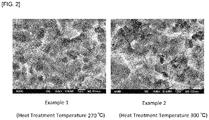
- FIG. 2 shows a view comparing SEM images (at magnifications of 10000) of the titanium targets of Examples 1 and 2.
- the upper right numeral is the average crystal grain diameter of the recrystallized structure.
- the crystal grain diameter of the recrystallized structure tended to decrease as the heat treatment temperature in the heat treatment step decreased.
- FIG. 3 is a view comparing optical microscope photographs (at magnification of 500) of the titanium targets of Comparative Examples 1, 2, 4 and 5.
- the crystal grain diameter of the recrystallized structure tended to decrease as the rolling ratio in the rolling step increased. Further, as the heat treatment temperature in the heat treatment step decreased, the crystal grain diameter of the recrystallized structure tended to decrease.
- FIG. 4 shows a view comparing optical micrographs (at magnification of 200) of the titanium targets of Comparative Examples 6 to 8.
- the recrystallized structure tended to become non-uniform and the crystal grain diameter of the recrystallized structure tended to increase as the total strain amount ( ⁇ ) of the forged sheet decreased in the large strain processing step. Also, as the forging temperature (processing temperature) increased in the large strain processing step, the crystal grain diameter of the recrystallized structure tended to increase.
- FIG. 5 is a view comparing optical micrographs (at magnification of 100) of the titanium targets of Comparative Examples 4, 9 and 10.
- FIG. 6 shows the resulting grain boundary images.
- EBSD electron back scattered diffraction pattern
- each of the titanium targets of Examples 1 and 2 had a recrystallized structure in which large-angle grain boundaries and small-angle grain boundaries coexisted.
- the large-angle grain boundary means a grain boundary having an orientation difference of 15° or more
- the small-angle grain boundary means a grain boundary having an orientation difference of less than 15°.
- the titanium sputtering target according to the embodiment of the present invention is used as a sputtering source for forming various thin films (for example, electrodes, gates, wirings, elements, insulating films, and protective films) in various electronic devices such as semiconductor devices, and is particularly suitable for use in high-speed sputtering (high-power sputtering) under higher load conditions.
- various thin films for example, electrodes, gates, wirings, elements, insulating films, and protective films
Landscapes
- Chemical & Material Sciences (AREA)
- Engineering & Computer Science (AREA)
- Mechanical Engineering (AREA)
- Organic Chemistry (AREA)
- Materials Engineering (AREA)
- Metallurgy (AREA)
- Physics & Mathematics (AREA)
- Chemical Kinetics & Catalysis (AREA)
- Thermal Sciences (AREA)
- Crystallography & Structural Chemistry (AREA)
- Plasma & Fusion (AREA)
- Analytical Chemistry (AREA)
- Physical Vapour Deposition (AREA)
Applications Claiming Priority (2)
| Application Number | Priority Date | Filing Date | Title |
|---|---|---|---|
| JP2017181694A JP7179450B2 (ja) | 2017-09-21 | 2017-09-21 | スパッタリング用チタンターゲット及びその製造方法、並びにチタン含有薄膜の製造方法 |
| PCT/JP2018/026595 WO2019058721A1 (fr) | 2017-09-21 | 2018-07-13 | Cible de pulvérisation en titane, son procédé de production et procédé de production de couche mince contenant du titane |
Publications (2)
| Publication Number | Publication Date |
|---|---|
| EP3686313A1 true EP3686313A1 (fr) | 2020-07-29 |
| EP3686313A4 EP3686313A4 (fr) | 2021-08-25 |
Family
ID=65809743
Family Applications (1)
| Application Number | Title | Priority Date | Filing Date |
|---|---|---|---|
| EP18859576.3A Pending EP3686313A4 (fr) | 2017-09-21 | 2018-07-13 | Cible de pulvérisation en titane, son procédé de production et procédé de production de couche mince contenant du titane |
Country Status (9)
| Country | Link |
|---|---|
| US (2) | US20200240005A1 (fr) |
| EP (1) | EP3686313A4 (fr) |
| JP (1) | JP7179450B2 (fr) |
| KR (4) | KR20220008380A (fr) |
| CN (2) | CN111108231A (fr) |
| MY (1) | MY199623A (fr) |
| SG (1) | SG11202002496PA (fr) |
| TW (1) | TWI695894B (fr) |
| WO (1) | WO2019058721A1 (fr) |
Families Citing this family (4)
| Publication number | Priority date | Publication date | Assignee | Title |
|---|---|---|---|---|
| JP7368798B2 (ja) * | 2019-12-25 | 2023-10-25 | 国立大学法人豊橋技術科学大学 | 純チタン金属材料の加工方法 |
| CN113652526B (zh) * | 2021-07-21 | 2023-02-17 | 先导薄膜材料有限公司 | 一种靶材的热处理淬火方法 |
| CN114717528B (zh) * | 2022-04-06 | 2023-09-08 | 宁波江丰电子材料股份有限公司 | 一种含钛靶材及其制备方法 |
| CN115896714A (zh) * | 2022-12-30 | 2023-04-04 | 宝鸡市飞腾金属材料股份有限公司 | 一种大晶圆用高性能超长大型旋转钛管靶材及制备工艺 |
Family Cites Families (22)
| Publication number | Priority date | Publication date | Assignee | Title |
|---|---|---|---|---|
| JPS6077102U (ja) | 1983-10-31 | 1985-05-29 | 三菱電機株式会社 | 平衡型マイクロストリツプ線路 |
| US5772860A (en) * | 1993-09-27 | 1998-06-30 | Japan Energy Corporation | High purity titanium sputtering targets |
| JP3413782B2 (ja) * | 1995-03-31 | 2003-06-09 | 日立金属株式会社 | スパッタリング用チタンタ−ゲットおよびその製造方法 |
| JP2706635B2 (ja) * | 1995-06-07 | 1998-01-28 | 真空冶金株式会社 | スパッタリング用高純度チタンターゲット及びその製造方法 |
| TW388069B (en) * | 1996-01-25 | 2000-04-21 | Sumitomo Sitix Corp | Titanium target for use in sputtering and manufacture thereof |
| US20030052000A1 (en) | 1997-07-11 | 2003-03-20 | Vladimir Segal | Fine grain size material, sputtering target, methods of forming, and micro-arc reduction method |
| JPH1150244A (ja) * | 1997-08-05 | 1999-02-23 | Riyouka Massey Kk | スパッタリングターゲット材およびその製造方法 |
| US6045634A (en) * | 1997-08-14 | 2000-04-04 | Praxair S. T. Technology, Inc. | High purity titanium sputtering target and method of making |
| US6423161B1 (en) * | 1999-10-15 | 2002-07-23 | Honeywell International Inc. | High purity aluminum materials |
| US6878250B1 (en) | 1999-12-16 | 2005-04-12 | Honeywell International Inc. | Sputtering targets formed from cast materials |
| JP2004527650A (ja) | 2000-10-12 | 2004-09-09 | ハネウェル・インターナショナル・インコーポレーテッド | スパッタリングターゲット材の製造方法 |
| RU2224046C1 (ru) * | 2002-06-05 | 2004-02-20 | Институт проблем сверхпластичности металлов РАН | Способ изготовления листовых полуфабрикатов из технического титана |
| US20070144623A1 (en) * | 2004-02-18 | 2007-06-28 | Wickersham Charles E Jr | Ultrasonic method for detecting banding in metals |
| JP4800930B2 (ja) | 2004-02-25 | 2011-10-26 | 有限会社リナシメタリ | 金属加工方法及び金属体 |
| WO2009078306A1 (fr) * | 2007-12-18 | 2009-06-25 | Nippon Mining & Metals Co., Ltd. | Film mince composé principalement d'oxyde de titane, cible de pulvérisation frittée appropriée pour la fabrication d'un film mince composé principalement d'oxyde de titane, et procédé de fabrication d'un film mince composé principalement d'oxyde de titane |
| CN102791905B (zh) * | 2010-03-11 | 2015-04-01 | 株式会社东芝 | 溅射靶及其制造方法、以及半导体元件的制造方法 |
| JP5420609B2 (ja) * | 2010-08-25 | 2014-02-19 | Jx日鉱日石金属株式会社 | スパッタリング用チタンターゲット |
| KR20130076863A (ko) | 2010-10-25 | 2013-07-08 | 제이엑스 닛코 닛세키 킨조쿠 가부시키가이샤 | 스퍼터링용 티탄 타깃 |
| JP5955969B2 (ja) * | 2012-09-04 | 2016-07-20 | 博己 三浦 | 部材の製造方法および生体材料 |
| JP6077102B2 (ja) | 2013-03-06 | 2017-02-08 | Jx金属株式会社 | スパッタリング用チタンターゲット及びその製造方法 |
| JP6595188B2 (ja) | 2015-02-06 | 2019-10-23 | 株式会社東芝 | スパッタリングターゲットの製造方法 |
| RU2622536C2 (ru) | 2015-11-03 | 2017-06-16 | Федеральное государственное бюджетное образовательное учреждение высшего образования "Санкт-Петербургский государственный университет" (СПбГУ) | Способ получения заготовок из технически чистого титана с размером зерна менее 0,4 мкм |
-
2017
- 2017-09-21 JP JP2017181694A patent/JP7179450B2/ja active Active
-
2018
- 2018-07-13 EP EP18859576.3A patent/EP3686313A4/fr active Pending
- 2018-07-13 US US16/648,042 patent/US20200240005A1/en not_active Abandoned
- 2018-07-13 KR KR1020227000320A patent/KR20220008380A/ko not_active Ceased
- 2018-07-13 KR KR1020207010779A patent/KR102365363B1/ko active Active
- 2018-07-13 SG SG11202002496PA patent/SG11202002496PA/en unknown
- 2018-07-13 MY MYPI2020001502A patent/MY199623A/en unknown
- 2018-07-13 CN CN201880060970.7A patent/CN111108231A/zh active Pending
- 2018-07-13 KR KR1020227033336A patent/KR20220137779A/ko not_active Ceased
- 2018-07-13 WO PCT/JP2018/026595 patent/WO2019058721A1/fr not_active Ceased
- 2018-07-13 KR KR1020257005789A patent/KR20250028536A/ko active Pending
- 2018-07-13 CN CN202511954280.4A patent/CN121826609A/zh active Pending
- 2018-09-21 TW TW107133495A patent/TWI695894B/zh active
-
2022
- 2022-02-08 US US17/666,703 patent/US12180577B2/en active Active
Also Published As
| Publication number | Publication date |
|---|---|
| KR20220008380A (ko) | 2022-01-20 |
| EP3686313A4 (fr) | 2021-08-25 |
| JP2019056151A (ja) | 2019-04-11 |
| JP7179450B2 (ja) | 2022-11-29 |
| KR20220137779A (ko) | 2022-10-12 |
| MY199623A (en) | 2023-11-10 |
| US20220162743A1 (en) | 2022-05-26 |
| KR20250028536A (ko) | 2025-02-28 |
| KR20200055038A (ko) | 2020-05-20 |
| WO2019058721A1 (fr) | 2019-03-28 |
| CN111108231A (zh) | 2020-05-05 |
| KR102365363B1 (ko) | 2022-02-23 |
| TWI695894B (zh) | 2020-06-11 |
| SG11202002496PA (en) | 2020-04-29 |
| US20200240005A1 (en) | 2020-07-30 |
| TW201915187A (zh) | 2019-04-16 |
| CN121826609A (zh) | 2026-04-10 |
| US12180577B2 (en) | 2024-12-31 |
Similar Documents
| Publication | Publication Date | Title |
|---|---|---|
| US12180577B2 (en) | Titanium sputtering target, production method therefor, and method for producing titanium-containing thin film | |
| EP2728038B1 (fr) | Cible de pulvérisation de tantale et procédé pour sa fabrication | |
| EP2913423A1 (fr) | Cible de pulvérisation cathodique de tantale et son procédé de fabrication | |
| US10490393B2 (en) | Tantalum sputtering target and method for producing same | |
| JP7121883B2 (ja) | スパッタリングターゲット材 | |
| CN104755651B (zh) | 钽溅射靶及其制造方法 | |
| EP2738285B1 (fr) | Cible pour pulvérisation cathodique en titane | |
| EP2634287A1 (fr) | Cible de titane pour pulvérisation | |
| JP6293929B2 (ja) | タンタルスパッタリングターゲット及びその製造方法 | |
| JP6293928B2 (ja) | タンタルスパッタリングターゲット及びその製造方法 |
Legal Events
| Date | Code | Title | Description |
|---|---|---|---|
| STAA | Information on the status of an ep patent application or granted ep patent |
Free format text: STATUS: THE INTERNATIONAL PUBLICATION HAS BEEN MADE |
|
| PUAI | Public reference made under article 153(3) epc to a published international application that has entered the european phase |
Free format text: ORIGINAL CODE: 0009012 |
|
| STAA | Information on the status of an ep patent application or granted ep patent |
Free format text: STATUS: REQUEST FOR EXAMINATION WAS MADE |
|
| 17P | Request for examination filed |
Effective date: 20200401 |
|
| AK | Designated contracting states |
Kind code of ref document: A1 Designated state(s): AL AT BE BG CH CY CZ DE DK EE ES FI FR GB GR HR HU IE IS IT LI LT LU LV MC MK MT NL NO PL PT RO RS SE SI SK SM TR |
|
| AX | Request for extension of the european patent |
Extension state: BA ME |
|
| DAV | Request for validation of the european patent (deleted) | ||
| DAX | Request for extension of the european patent (deleted) | ||
| A4 | Supplementary search report drawn up and despatched |
Effective date: 20210726 |
|
| RIC1 | Information provided on ipc code assigned before grant |
Ipc: C23C 14/34 20060101AFI20210720BHEP Ipc: C22F 1/18 20060101ALI20210720BHEP Ipc: C22C 14/00 20060101ALI20210720BHEP Ipc: H01J 37/34 20060101ALI20210720BHEP |
|
| RAP3 | Party data changed (applicant data changed or rights of an application transferred) |
Owner name: JX NIPPON MINING & METALS CORPORATION |
|
| STAA | Information on the status of an ep patent application or granted ep patent |
Free format text: STATUS: EXAMINATION IS IN PROGRESS |
|
| 17Q | First examination report despatched |
Effective date: 20240131 |