EP3686889A1 - Procédé de reconnaissance vocale et système de reconnaissance vocale - Google Patents
Procédé de reconnaissance vocale et système de reconnaissance vocale Download PDFInfo
- Publication number
- EP3686889A1 EP3686889A1 EP19153779.4A EP19153779A EP3686889A1 EP 3686889 A1 EP3686889 A1 EP 3686889A1 EP 19153779 A EP19153779 A EP 19153779A EP 3686889 A1 EP3686889 A1 EP 3686889A1
- Authority
- EP
- European Patent Office
- Prior art keywords
- signal
- speech
- control system
- noise
- technical device
- Prior art date
- Legal status (The legal status is an assumption and is not a legal conclusion. Google has not performed a legal analysis and makes no representation as to the accuracy of the status listed.)
- Withdrawn
Links
- 238000000034 method Methods 0.000 title claims abstract description 33
- 238000004088 simulation Methods 0.000 claims abstract description 23
- 230000002123 temporal effect Effects 0.000 claims abstract description 3
- 238000004519 manufacturing process Methods 0.000 claims description 9
- 238000001514 detection method Methods 0.000 claims description 3
- 238000005259 measurement Methods 0.000 claims description 2
- 230000015572 biosynthetic process Effects 0.000 claims 1
- 238000009776 industrial production Methods 0.000 description 2
- 230000003993 interaction Effects 0.000 description 2
- 101100186130 Arabidopsis thaliana NAC052 gene Proteins 0.000 description 1
- 101100301219 Arabidopsis thaliana RDR6 gene Proteins 0.000 description 1
- 101100529509 Arabidopsis thaliana RECQL4A gene Proteins 0.000 description 1
- 241000238558 Eucarida Species 0.000 description 1
- 101150056203 SGS3 gene Proteins 0.000 description 1
- 101100203168 Saccharomyces cerevisiae (strain ATCC 204508 / S288c) SGS1 gene Proteins 0.000 description 1
- 238000013473 artificial intelligence Methods 0.000 description 1
- 230000000712 assembly Effects 0.000 description 1
- 238000000429 assembly Methods 0.000 description 1
- 238000004364 calculation method Methods 0.000 description 1
- 238000005094 computer simulation Methods 0.000 description 1
- 230000001419 dependent effect Effects 0.000 description 1
- 238000012423 maintenance Methods 0.000 description 1
- 230000007257 malfunction Effects 0.000 description 1
- 238000005457 optimization Methods 0.000 description 1
Images

Classifications
-
- G—PHYSICS
- G10—MUSICAL INSTRUMENTS; ACOUSTICS
- G10L—SPEECH ANALYSIS TECHNIQUES OR SPEECH SYNTHESIS; SPEECH RECOGNITION; SPEECH OR VOICE PROCESSING TECHNIQUES; SPEECH OR AUDIO CODING OR DECODING
- G10L21/00—Speech or voice signal processing techniques to produce another audible or non-audible signal, e.g. visual or tactile, in order to modify its quality or its intelligibility
- G10L21/02—Speech enhancement, e.g. noise reduction or echo cancellation
- G10L21/0208—Noise filtering
- G10L21/0264—Noise filtering characterised by the type of parameter measurement, e.g. correlation techniques, zero crossing techniques or predictive techniques
-
- G—PHYSICS
- G10—MUSICAL INSTRUMENTS; ACOUSTICS
- G10L—SPEECH ANALYSIS TECHNIQUES OR SPEECH SYNTHESIS; SPEECH RECOGNITION; SPEECH OR VOICE PROCESSING TECHNIQUES; SPEECH OR AUDIO CODING OR DECODING
- G10L15/00—Speech recognition
- G10L15/22—Procedures used during a speech recognition process, e.g. man-machine dialogue
-
- G—PHYSICS
- G10—MUSICAL INSTRUMENTS; ACOUSTICS
- G10L—SPEECH ANALYSIS TECHNIQUES OR SPEECH SYNTHESIS; SPEECH RECOGNITION; SPEECH OR VOICE PROCESSING TECHNIQUES; SPEECH OR AUDIO CODING OR DECODING
- G10L21/00—Speech or voice signal processing techniques to produce another audible or non-audible signal, e.g. visual or tactile, in order to modify its quality or its intelligibility
- G10L21/02—Speech enhancement, e.g. noise reduction or echo cancellation
- G10L21/0208—Noise filtering
- G10L21/0216—Noise filtering characterised by the method used for estimating noise
Definitions
- the invention relates to a method for speech recognition, wherein the spoken speech is recognized from a speech signal and is automatically made available as speech data to a control system for controlling a technical device, and wherein the spoken speech is pronounced in an environment with ambient noise from interference signals and by means of of a recording device located in the vicinity is recorded as a recording signal, the recording signal having a superimposition of the speech signal and the interference signals.
- noises such as hum from vibrations of a drive motor, hissing of a pneumatic valve, clacking of vibratory bowl feeders, clinking of manufactured products such as pipes, noise from elevators, lifting platforms and hall cranes etc. can occur.
- the problem is solved for the above-mentioned method for speech recognition in that with a simulation of a digital twin of the control system for the technical device, the future interference signals of the ambient noise and their occurrence in time are predicted as a prediction signal, the prediction signal being inverted and added to the recording signal is, whereby the interference signals are largely extinguished and the speech data is now generated with a compensated speech signal. It is therefore considered essential for the invention to generate a prediction of the noise development of a machine on the basis of its digital twin (simulable computer model).
- a digital twin is understood to mean the following.
- a digital twin is a digital version of a machine or technical device. Once created, the digital twin can be used to represent the machine or its control system for controlling the machine or the technical device in a digital representation of a real system.
- the digital twin is created so that it is identical in form and behavior to the corresponding machine.
- the digital twin reflects the status of the machine or its control system in a larger network. For example, sensors can be placed on the machine to provide real-time (or near real-time) data from physical objects capture which are routed to a digital twin. The digital twin can then make any changes necessary to maintain a match with the physical twin.
- a digital twin represents a real object in the digital world, especially in the world of Industry 4.0. It can be material or immaterial objects.
- the digital twins are made up of data and algorithms and can be coupled to the real world via sensors.
- Digital twins already represent a crucial basis for the processes in Industry 4.0.
- the digital twin can be implemented along the entire value chain.
- an environment model is used in the method of the digital twin, and noise signatures of the technical device are stored in the environment model, the corresponding real states being assigned to the noise signatures on the basis of real operation of the control system and in the simulation of the digital twin of the control system for the technical device, on the basis of the simulated states of the control system obtained by the simulation, the stored noise signatures are used to form the prediction signal.
- the states are understood to mean a process image of inputs and outputs of the process variables.
- the simulated states are therefore the states of the process variables in the near future for the main scenarios of the machine. Accordingly, a method has now been created for predicting the noise development of a machine using a digital twin based on current process values and on the basis of simulated process values for the most likely scenarios of the system.
- the noise signatures are preferably determined experimentally by one-off calibration runs of the machine, the imitated sound of each component being recorded in different operating states using measurement microphones.
- the control program and its machine process variables must also be known to the environment model.
- AI assemblies artificial intelligence
- digital twin simulation software
- the operating status and wear status of all machine components can also be determined deterministically at any time in the environment model by the control programs and predictive maintenance parameters. This way, the method can be used to simulatively predict the state-dependent noise signatures within a very narrow time frame.
- This database can be saved and updated locally (on a PC in the control room) or remotely (in Edge or Cloud servers).
- This database can be used as a basis for other manufacturing industries and the relevant noise can be activated / deactivated (e.g. rattling of manufactured pipes is deselected for the process industry, the hum of a high-performance pump is activated). In this way, each industry can "generate" its own comparison simulation hall with a click.
- the speech recognition system has an environment model in which noise signatures of the technical device are stored, with the noise signatures being assigned corresponding real states on the basis of real operation of the control system, the environment model being further configured to the simulation of the digital twin of the control system for the technical device, on the basis of the simulated states of the control system obtained by the simulation, to provide the stored noise signatures for forming the prediction signal for the compensation unit.
- FIG 1 shows a technical device TV, which is controlled by a control system SA.
- the control system SA is connected to a control level 2 together with a speech recognition system 10.
- the technical device TV with a first component K1, a second component K2 and a third component K3 is connected to the control level 2 via a fieldbus.
- the components K1, K2, K3 generate corresponding interference signals SGS during operation of the technical device TV.
- the first component K1 imitates a first interference signal StS1, the second component K2 a second interference signal StS2 and the third component K3 a third interference signal StS3.
- the interference signals STS and other noises can be summarized as ambient noises UG.
- a recording device MIC for recording a recording signal AS is connected to the first component K1 and accordingly connected to the speech recognition system 10 via the control level 2.
- the recording signal AS is a superimposition of the voice signal SS of the operator 1 and the interference signals StS1, StS2, StS3.
- the voice recognition system 10 is designed to provide voice data SD for the control system SA for controlling the technical device TV.
- the speech recognition system 10 also has a recognition means EM, which generates the speech data SD from the speech signal SS.
- the speech recognition system 10 has a simulation platform SP with a digital twin DT of the control system SA for the technical device TV.
- a forecasting unit PE is used to predict future interference signals StS z and their temporal occurrence as a prediction signal VS.
- a compensation unit KE is designed to invert the prediction signal VS and add it to the recording signal AS, and thereby to provide a compensated speech signal SS '.
- the compensated speech signal SS ' is made available to the recognition means EM, the recognition means EM being designed to generate the speech data SD with the compensated speech signal SS'.
- the simulation platform SP is connected to the forecasting unit PE and is designed such that simulated states sPAE-PAA provided by the simulation are made available to the forecasting unit PE for the prediction.
- the speech recognition system 10 is configured in such a way that the digital twin DT uses an environment model UM.
- Noise signatures GS of the technical device TV are stored in this environment model UM.
- the noise signatures GS were recorded on the basis of real operation of the control system SA and correspond to real states r-PAE-PAA and are also assigned to these.
- the environment model UM is also designed to simulate the digital twin DT of the control system SA for the technical device TV based on the simulated states sPAE-PAA of the control system SA, the stored noise signatures GS to form the prediction signal VS for to provide the compensation unit KE.
- the environment model UM also knows a geometric structure of the technical device TV with its components K1, K2, K3 by means of position information X, Y with the aid of a coordinate system 3.
- the spoken language of the operator 1 will now hit the recording device MIC as a speech signal SS, but also the interference signals StS1, StS2, StS3 of the ambient noise UG will hit the recording device MIC, from which the recording signal AS then results.
- the spoken language is pronounced as in an environment with ambient noise UG and SGS from interference signals recorded as recording signal AS by means of the recording device MIC located in the vicinity.
- the recording signal AS is therefore a superimposition of the speech signal SS and the interference signals StS.
- future interference signals StS z of the ambient noise UG and their occurrence in time are predicted as the prediction signal VS.
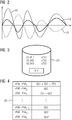
- FIG 2 shows a waveform of the recording signal AS, the prediction signal VS and the compensated speech signal SS '.
- noise signatures GS stored in the UM environment model with the correspondingly assigned real states rPAE-PAA are compared with the simulated states sPAE-PAA of the control system SA and the stored noise signatures GS are used to form the prediction signal VS.
- FIG 3 shows an example of the environment model UM in which the noise signatures GS (K1) of the corresponding components K1, K2, K3 are stored.
- the noise signatures GS (K1) of the corresponding components K1, K2, K3 are stored.
- specific noise signatures SGS1, SGS2, SGS3 are also stored in the environment model UM.
- the FIG 4 shows a possible example deposit of noise signatures GS to real process states rPAE-PAA.
- the noise signatures GS1, GS2, GS3 are assigned to the real first process state rPAE-PAA 1 .
- a noise signature GS2 is assigned to a next, second, real process state rPAE-PAA 2 only for this operation. If, however, the third real process state rPAE-PAA 3 now appeared in the model with the noise signatures GS as the simulation value sPAE-PAA 3 , the noise signatures would be in this process state, for example GS1 and GS3 can be heard.
- the table continues accordingly up to the nth noise signature rPAE-PAA n .
Landscapes
- Engineering & Computer Science (AREA)
- Computational Linguistics (AREA)
- Health & Medical Sciences (AREA)
- Audiology, Speech & Language Pathology (AREA)
- Human Computer Interaction (AREA)
- Physics & Mathematics (AREA)
- Acoustics & Sound (AREA)
- Multimedia (AREA)
- Quality & Reliability (AREA)
- Signal Processing (AREA)
- Soundproofing, Sound Blocking, And Sound Damping (AREA)
Priority Applications (1)
| Application Number | Priority Date | Filing Date | Title |
|---|---|---|---|
| EP19153779.4A EP3686889A1 (fr) | 2019-01-25 | 2019-01-25 | Procédé de reconnaissance vocale et système de reconnaissance vocale |
Applications Claiming Priority (1)
| Application Number | Priority Date | Filing Date | Title |
|---|---|---|---|
| EP19153779.4A EP3686889A1 (fr) | 2019-01-25 | 2019-01-25 | Procédé de reconnaissance vocale et système de reconnaissance vocale |
Publications (1)
| Publication Number | Publication Date |
|---|---|
| EP3686889A1 true EP3686889A1 (fr) | 2020-07-29 |
Family
ID=65236898
Family Applications (1)
| Application Number | Title | Priority Date | Filing Date |
|---|---|---|---|
| EP19153779.4A Withdrawn EP3686889A1 (fr) | 2019-01-25 | 2019-01-25 | Procédé de reconnaissance vocale et système de reconnaissance vocale |
Country Status (1)
| Country | Link |
|---|---|
| EP (1) | EP3686889A1 (fr) |
Cited By (3)
| Publication number | Priority date | Publication date | Assignee | Title |
|---|---|---|---|---|
| CN112382293A (zh) * | 2020-11-11 | 2021-02-19 | 广东电网有限责任公司 | 一种电力物联网的智能语音交互方法及系统 |
| CN114696940A (zh) * | 2022-03-09 | 2022-07-01 | 电子科技大学 | 一种会议室防录音方法 |
| CN115295015A (zh) * | 2022-07-27 | 2022-11-04 | 广州市迪声音响有限公司 | 一种噪声筛系统及方法 |
Citations (1)
| Publication number | Priority date | Publication date | Assignee | Title |
|---|---|---|---|---|
| US20040138882A1 (en) * | 2002-10-31 | 2004-07-15 | Seiko Epson Corporation | Acoustic model creating method, speech recognition apparatus, and vehicle having the speech recognition apparatus |
-
2019
- 2019-01-25 EP EP19153779.4A patent/EP3686889A1/fr not_active Withdrawn
Patent Citations (1)
| Publication number | Priority date | Publication date | Assignee | Title |
|---|---|---|---|---|
| US20040138882A1 (en) * | 2002-10-31 | 2004-07-15 | Seiko Epson Corporation | Acoustic model creating method, speech recognition apparatus, and vehicle having the speech recognition apparatus |
Non-Patent Citations (2)
| Title |
|---|
| BAN Y ET AL: "Synthesis of car noise based on a composition of engine noise and friction noise", 2002 IEEE INTERNATIONAL CONFERENCE ON ACOUSTICS, SPEECH, AND SIGNAL PROCESSING. PROCEEDINGS. (ICASSP). ORLANDO, FL, MAY 13 - 17, 2002; [IEEE INTERNATIONAL CONFERENCE ON ACOUSTICS, SPEECH, AND SIGNAL PROCESSING (ICASSP)], NEW YORK, NY : IEEE, US, vol. 2, 13 May 2002 (2002-05-13), pages II - 2105, XP010804317, ISBN: 978-0-7803-7402-7 * |
| GÃ KHAN INCE ET AL: "Ego noise cancellation of a robot using missing feature masks", APPLIED INTELLIGENCE ; THE INTERNATIONAL JOURNAL OF ARTIFICIALINTELLIGENCE, NEURAL NETWORKS, AND COMPLEX PROBLEM-SOLVING TE, KLUWER ACADEMIC PUBLISHERS, BO, vol. 34, no. 3, 29 March 2011 (2011-03-29), pages 360 - 371, XP019898422, ISSN: 1573-7497, DOI: 10.1007/S10489-011-0285-0 * |
Cited By (4)
| Publication number | Priority date | Publication date | Assignee | Title |
|---|---|---|---|---|
| CN112382293A (zh) * | 2020-11-11 | 2021-02-19 | 广东电网有限责任公司 | 一种电力物联网的智能语音交互方法及系统 |
| CN114696940A (zh) * | 2022-03-09 | 2022-07-01 | 电子科技大学 | 一种会议室防录音方法 |
| CN114696940B (zh) * | 2022-03-09 | 2023-08-25 | 电子科技大学 | 一种会议室防录音方法 |
| CN115295015A (zh) * | 2022-07-27 | 2022-11-04 | 广州市迪声音响有限公司 | 一种噪声筛系统及方法 |
Similar Documents
| Publication | Publication Date | Title |
|---|---|---|
| DE102013011065B4 (de) | Vibrationssteuerungsrobotersystem | |
| EP3686889A1 (fr) | Procédé de reconnaissance vocale et système de reconnaissance vocale | |
| AT521832B1 (de) | Testterminal zur Unterstützung einer ausführenden Person | |
| DE102015112072A1 (de) | Servomotorsteuerung mit Selbstmessfunktion und Selbstüberwachungsfunktion der mechanischen Steifigkeit | |
| DE102008021362B3 (de) | Verfahren und Vorrichtung zum Erkennen eines Zustandes einer zu untersuchenden geräuscherzeugenden Maschine | |
| DE102012211981A1 (de) | Verfahren und Vorrichtung zum Erstellen und Testen eines Steuergeräteprogramms | |
| EP2947035B1 (fr) | Procédé de détermination de la charge d'une machine de travail et machine de travail, en particulier une grue | |
| DE102018133533A1 (de) | Überprüfungssystem und Verfahren zum Überprüfen von Arbeitsabläufen | |
| DE102016125538A1 (de) | Verfahren zum Verifizieren von Aktuator-Steuerungsdaten | |
| EP3757795A1 (fr) | Procédé et dispositif destinés à la distribution optimale de cas d'essai sur différentes plateformes d'essai | |
| EP2866111A1 (fr) | Test d'un appareil de commande au moyen d'un environnement de test | |
| DE102017125103A1 (de) | Einstellvorrichtung und einstellsystem zum konfigurieren von einstellungen für eine mehrzahl von maschinen | |
| WO2004022406A1 (fr) | Procede et dispositif de controle de l'etat de mecanismes de deplacement de vehicules | |
| DE102019205081A1 (de) | Verfahren, Vorrichtung und Computerprogramm zum Betreiben eines tiefen neuronalen Netzes | |
| DE102021104739B4 (de) | Verfahren zum Betrieb eines Kraftfahrzeugs, System für ein Kraftfahrzeug und Kraftfahrzeug | |
| EP3754622B1 (fr) | Agencement et procédé de surveillance acoustique d'environnements | |
| EP3959498B1 (fr) | Analyse acoustique d'un état d'une machine | |
| DE112020006810T5 (de) | Betriebszustands-klassifikationssystem und betriebszustands-klassifikationsverfahren | |
| WO2017182511A2 (fr) | Commande orientée application d'un module de distributeur | |
| DE102019213818A1 (de) | Detektieren von akustischen Betriebsmitteln eines Bahnübergangs | |
| DE102022213123A1 (de) | Verfahren und Vorrichtung zur Zustandsermittlung einer zu überwachenden Komponente in einer Maschine mit einem rotierenden Maschinenelement | |
| WO2010094359A1 (fr) | Procédé et système de mise au point d'une automatisation d'au moins une partie d'une installation technique | |
| DE102019204198A1 (de) | Verfahren zum Überwachen einer Antriebseinheit zum Antreiben eines Kraftfahrzeugs, Computerprogrammprodukt und Kraftfahrzeug | |
| EP3553679A1 (fr) | Procédé de diagnostic de panne assisté par ordinateur pour un système technique | |
| DE102019219749A1 (de) | Beurteilen der Identifizierbarkeit eines Warnsignals in Mikrofondaten |
Legal Events
| Date | Code | Title | Description |
|---|---|---|---|
| PUAI | Public reference made under article 153(3) epc to a published international application that has entered the european phase |
Free format text: ORIGINAL CODE: 0009012 |
|
| STAA | Information on the status of an ep patent application or granted ep patent |
Free format text: STATUS: THE APPLICATION HAS BEEN PUBLISHED |
|
| AK | Designated contracting states |
Kind code of ref document: A1 Designated state(s): AL AT BE BG CH CY CZ DE DK EE ES FI FR GB GR HR HU IE IS IT LI LT LU LV MC MK MT NL NO PL PT RO RS SE SI SK SM TR |
|
| AX | Request for extension of the european patent |
Extension state: BA ME |
|
| STAA | Information on the status of an ep patent application or granted ep patent |
Free format text: STATUS: THE APPLICATION IS DEEMED TO BE WITHDRAWN |
|
| 18D | Application deemed to be withdrawn |
Effective date: 20210130 |