EP3687246B1 - Procédé et appareil de transmission de données dans de multiples porteuses - Google Patents
Procédé et appareil de transmission de données dans de multiples porteuses Download PDFInfo
- Publication number
- EP3687246B1 EP3687246B1 EP18869118.2A EP18869118A EP3687246B1 EP 3687246 B1 EP3687246 B1 EP 3687246B1 EP 18869118 A EP18869118 A EP 18869118A EP 3687246 B1 EP3687246 B1 EP 3687246B1
- Authority
- EP
- European Patent Office
- Prior art keywords
- carrier
- access
- candidate
- carriers
- terminal device
- Prior art date
- Legal status (The legal status is an assumption and is not a legal conclusion. Google has not performed a legal analysis and makes no representation as to the accuracy of the status listed.)
- Active
Links
Images
Classifications
-
- H—ELECTRICITY
- H04—ELECTRIC COMMUNICATION TECHNIQUE
- H04W—WIRELESS COMMUNICATION NETWORKS
- H04W72/00—Local resource management
- H04W72/02—Selection of wireless resources by user or terminal
-
- H—ELECTRICITY
- H04—ELECTRIC COMMUNICATION TECHNIQUE
- H04W—WIRELESS COMMUNICATION NETWORKS
- H04W72/00—Local resource management
- H04W72/04—Wireless resource allocation
- H04W72/044—Wireless resource allocation based on the type of the allocated resource
- H04W72/0453—Resources in frequency domain, e.g. a carrier in FDMA
-
- H—ELECTRICITY
- H04—ELECTRIC COMMUNICATION TECHNIQUE
- H04W—WIRELESS COMMUNICATION NETWORKS
- H04W72/00—Local resource management
- H04W72/20—Control channels or signalling for resource management
- H04W72/23—Control channels or signalling for resource management in the downlink direction of a wireless link, i.e. towards a terminal
-
- H—ELECTRICITY
- H04—ELECTRIC COMMUNICATION TECHNIQUE
- H04W—WIRELESS COMMUNICATION NETWORKS
- H04W72/00—Local resource management
- H04W72/50—Allocation or scheduling criteria for wireless resources
- H04W72/52—Allocation or scheduling criteria for wireless resources based on load
-
- H—ELECTRICITY
- H04—ELECTRIC COMMUNICATION TECHNIQUE
- H04W—WIRELESS COMMUNICATION NETWORKS
- H04W72/00—Local resource management
- H04W72/50—Allocation or scheduling criteria for wireless resources
- H04W72/53—Allocation or scheduling criteria for wireless resources based on regulatory allocation policies
-
- H—ELECTRICITY
- H04—ELECTRIC COMMUNICATION TECHNIQUE
- H04W—WIRELESS COMMUNICATION NETWORKS
- H04W72/00—Local resource management
- H04W72/50—Allocation or scheduling criteria for wireless resources
- H04W72/54—Allocation or scheduling criteria for wireless resources based on quality criteria
- H04W72/542—Allocation or scheduling criteria for wireless resources based on quality criteria using measured or perceived quality
Definitions
- This application relates to the communications field, and in particular, to a method and an apparatus for data transmission in multiple carriers.
- the narrow band internet of things is a feature in long term evolution (long term Evolution, LTE) release-13 (release-13).
- LTE long term Evolution
- a concept of a coverage level is introduced in the NB-IoT.
- RSRP reference signal received power
- a system message configured by an access network device broadcasts an uplink physical random access channel (physical random access channel, PRACH) resource corresponding to each coverage level and a quantity of times of preamble (preamble) repetitions on each carrier.
- PRACH physical random access channel
- the terminal device selects, based on the coverage level of the terminal device in the system message, a corresponding PRACH resource to perform access.
- the terminal device only determines, based on a downlink measurement result, the coverage level to adjust a PRACH resource of an uplink access carrier without considering a load problem between a plurality of uplink access carriers.
- the uplink access carriers cannot be dynamically adjusted.
- US 2012/0076042 A1 refers to a wireless communication system, and discloses a method and an apparatus for performing random access in a multi-carrier wireless communication system.
- the method in which a user equipment carries out a process for random access to a base station in a multi-carrier wireless communication system comprises: a step of measuring the channel qualities of one or more uplink component carriers, and determining the uplink component carrier having the highest channel quality; a step of selecting a physical random access channel (PRACH) resource on the uplink component carrier having the highest channel quality; and a step of transmitting a random access preamble to the base station using the selected PRACH resource.
- PRACH physical random access channel
- R2-167682 3GPP TSG RAN WG2 Meeting #96, Reno, USA, 14th - 18th November 2016 refers to remaining issues on multi-carrier PRACH in NB-IoT.
- Embodiments of this application provide a method and an apparatus for data transmission in multiple carriers, so that selection and access can be performed in uplink access carriers of different frequency bands based on an access control parameter, thereby implementing control of load between a plurality of uplink access carriers.
- an embodiment of this application provides a method for data transmission in multiple carriers, including: receiving, by a terminal device, at least one piece of indication information from an access network device, where the at least one piece of indication information is used to indicate at least one access control parameter; and selecting, by the terminal device, an access carrier from the at least two candidate carriers based on the at least one access control parameter, where the at least two candidate carriers are located in different frequency bands.
- the method according to this embodiment of this application may enable carriers to set different access parameters based on loading situations and a quantity of available resources that are of the carriers. Resources of carriers are used to the greatest extent, to balance network load and improve system capacity, so that a terminal device can access a network more rapidly and reduce an access delay.
- the at least two candidate carriers include a first candidate carrier and a second candidate carrier
- the at least one access control parameter includes a first threshold of downlink signal strength
- the selecting, by the terminal device, an access carrier from the at least two candidate carriers based on the at least one access control parameter includes: selecting, by the terminal device, the first candidate carrier as the access carrier when a downlink signal strength value of the first candidate carrier is greater than the first threshold; and selecting, by the terminal device, the second candidate carrier as the access carrier when the downlink signal strength value of the first candidate carrier is less than the first threshold.
- the at least two candidate carriers include a first candidate carrier and a second candidate carrier
- the at least one access control parameter includes a first access control factor
- the selecting, by the terminal device, an access carrier from the at least two candidate carriers based on the at least one access control parameter includes: selecting, by the terminal device, the first candidate carrier as the access carrier when a random number generated by the terminal device is greater than the first access control factor; and selecting, by the terminal device, the second candidate carrier as the access carrier when the random number generated by the terminal device is less than the first access control factor; or selecting, by the terminal device, the first candidate carrier as the access carrier when a random number generated by the terminal device is less than the first access control factor; and selecting, by the terminal device, the second candidate carrier as the access carrier when the random number generated by the terminal device is greater than the first access control factor.
- the at least two candidate carriers are N candidate carriers, N ⁇ 2, the at least one access control parameter includes N non-overlapping value ranges, and the N value ranges correspond to the N candidate carriers; and the selecting, by the terminal device, an access carrier from the at least two candidate carriers based on the at least one access control parameter includes: selecting, by the terminal device, a candidate carrier corresponding to a first value range as the access carrier when a random number generated by the terminal device is located in the first value range of the N value ranges.
- the at least two candidate carriers include at least one first candidate carrier and at least one second candidate carrier;
- the at least one access control parameter includes at least one first threshold of downlink signal strength, and the at least one first threshold corresponds to the at least one first candidate carrier;
- the selecting, by the terminal device, an access carrier from the at least two candidate carriers based on the at least one access control parameter includes: selecting, by the terminal device, from the at least one first candidate carrier, a candidate carrier in which a downlink signal strength is greater than a corresponding first threshold as the access carrier; and selecting the at least one second candidate carrier as the access carrier when a quantity of candidate carriers selected as the access carrier from the at least one first candidate carrier is less than a target quantity.
- a terminal device receives at least one piece of indication information from an access network device, wherein the at least one piece of indication information indicates at least one access control parameter; and selects at least one access carrier from at least two candidate carriers based on the at least one access control parameter, wherein the at least two candidate carriers are located in different frequency bands; wherein the at least two candidate carriers comprise at least one first candidate carrier and at least one second candidate carrier, and the at least one access control parameter comprises a threshold of a downlink signal strength, and the threshold corresponds to the at least one first candidate carrier, and the selecting the at least one access carrier from the at least two candidate carriers based on the at least one access control parameter comprises: selecting, from the at least one first candidate carrier, a quantity of those candidate carriers having a downlink signal strength greater than the threshold as the at least one access carrier; and, when the quantity of selected candidate carriers is less than a target quantity, selecting the at least one second candidate carrier as the at least one access carrier.
- the at least two candidate carriers are a part or all of a carrier set
- the carrier set includes at least two carriers
- the at least one access control parameter further includes at least one of a second threshold of a downlink signal strength value corresponding to each carrier in the carrier set, a second value range corresponding to each carrier, and an admission indication corresponding to each carrier
- the method further includes: determining, by the terminal device, a carrier that satisfies a first condition and that is in the at least two carriers as the candidate carrier, where the first condition includes at least one of the following: a downlink signal strength of a carrier is greater than the second threshold of the downlink signal strength value corresponding to the carrier; a random number generated for a carrier is in the second value range corresponding to the carrier; and the admission indication corresponding to a carrier indicates permission to access the carrier.
- an embodiment of this application provides a method for data transmission in multiple carriers, including: generating, by an access network device, at least one piece of indication information, where the at least one piece of indication information is used to indicate at least one access control parameter, the at least one access control parameter is used to select an access carrier from at least two candidate carriers, and the at least two candidate carriers are located in different frequency bands; and sending, by the access network device, the indication information to the terminal device.
- the at least two candidate carriers include a first candidate carrier and a second candidate carrier
- the at least one access control parameter includes a first threshold of downlink signal strength
- the first threshold is used to instruct the terminal device to select the first candidate carrier as the access carrier when a downlink signal strength value of the first candidate carrier is greater than the first threshold
- select the second candidate carrier as the access carrier when the downlink signal strength value of the first candidate carrier is less than the first threshold.
- the at least two candidate carriers include a first candidate carrier and a second candidate carrier
- the at least one access control parameter includes a first access control factor
- the first access control factor is used to indicate that the first candidate carrier is selected as the access carrier when a random number generated by the terminal device is greater than the first access control factor
- the second candidate carrier is selected as the access carrier when the random number generated by the terminal device is less than the first access control factor.
- the at least two candidate carriers include at least one first candidate carrier and at least one second candidate carrier;
- the at least one access control parameter includes at least one first threshold of downlink signal strength, and the at least one first threshold corresponds to the at least one first candidate carrier;
- the first threshold is used to instruct the terminal device to select, from the at least one first candidate carrier, a candidate carrier in which a downlink signal strength is greater than a corresponding first threshold as the access carrier; and select the at least one second candidate carrier as the access carrier when a quantity of candidate carriers selected from the at least one first candidate carrier as the access carrier is less than a target quantity.
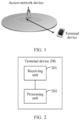
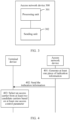
- the processing unit 202 of the terminal device 200 records information such as frequencies, bandwidths, and the like of candidate carriers in different frequency bands based on the indication information received by the receiving unit 201. For example, the example of the foregoing two uplink carriers continues to be used, the processing unit 202 may record, based on indication information including access control parameters of the uplink carrier of the 1.8G frequency band and the uplink carrier of the 3.5G frequency band, information such as frequencies, bandwidths, and the like of the uplink carrier of the 1.8G frequency band used in the LTE system and the uplink carrier of the 3.5G frequency band used in the 5G NR system.
- the candidate carriers are carriers of two frequency bands, and at least one access control parameter includes an access control factor. If a random number generated by the processing unit 202 of the terminal device 200 is greater than the access control factor, a first frequency band carrier is selected for access; and if the random number generated by the processing unit 202 is less than the access control factor, a second frequency band carrier is selected for access. Alternatively, if a random number generated by the processing unit 202 of the terminal device 200 is less than the access control factor, a first frequency band carrier is selected for access; and if the random number generated by the processing unit 202 is greater than the access control factor, a second frequency band carrier is selected for access.
- the candidate carriers are carriers of a plurality of frequency bands, for example, a quantity of the candidate carriers is N, N is a positive integer greater than and equal to two, at least one access control parameter includes N non-overlapping value ranges, where the N value ranges correspond to N candidate carriers.
- the processing unit 202 selects a candidate carrier corresponding to the value range as the access carrier.
- At least two candidate carriers are a part or all of a carrier set, and the carrier set includes at least two carriers.
- At least one access control parameter includes at least one of a second threshold of the downlink signal strength value corresponding to each carrier in the carrier set, a second value range corresponding to each carrier, and an admission indication corresponding to each carrier.
- the second threshold of the downlink signal strength value, the second value range corresponding to each carrier, and the admission indication corresponding to each carrier are used to determine a candidate carrier from the carrier set.
- admission indications included in at least one access control parameter are 0 and 1 that are of a Boolean type.
- an admission indication corresponding to a carrier is 0, it indicates permission to access the carrier; and when an admission indication corresponding to a carrier is 1, it indicates that the carrier cannot be accessed (similarly, when an admission indication corresponding to a carrier is 1, it indicates permission to access the carrier, and when an admission indication corresponding to a carrier is 0, it indicates that the carrier cannot be accessed).
- a final access carrier may be continuously selected based on any one or a combination of the foregoing listed implementations.
- the candidate carriers are carriers of a plurality of frequency bands, for example, a quantity of candidate carriers is Y, Y is a positive integer greater than and equal to two, at least one access control parameter includes M non-overlapping value ranges, M ⁇ Y, and M is a positive integer.
- the processing unit 202 selects a candidate carrier corresponding to the value
- the candidate carrier may continue to be selected based on an implementation similar to the foregoing implementation.
- the processing unit 202 of the terminal device 200 may select the candidate carrier based on at least one of the following conditions until the quantity of the final candidate carrier is one.
- the processing unit 202 of the terminal device 200 selects the first carrier as the access carrier if a downlink signal strength value (for example, a measurement value of the RSRP or the RSRQ) of a carrier is greater than a threshold (for example, T1) of the downlink signal strength value corresponding to the carrier; and selects the second carrier as the access carrier if a downlink signal strength value (for example, a measurement value of the RSRP or the RSRQ) of a carrier is less than a threshold (for example, T2) of the downlink signal strength value corresponding to the carrier.
- a downlink signal strength value for example, a measurement value of the RSRP or the RSRQ
- At least one access control parameter includes three non-overlapping value ranges, and the downlink signal strength value measured by or the random number generated by the processing unit 202 of the terminal device 200 is located in a value range of the three value ranges, the processing unit 202 selects a candidate carrier corresponding to the value range as the access carrier.
- At least one access control parameter includes at least one first threshold of the downlink signal strength, and the at least one first threshold corresponds, as claimed, to the at least one first candidate carrier; the processing unit 202 of the terminal device 200 selects, from the at least one first candidate carrier, a candidate carrier of which the downlink signal strength is greater than a corresponding first threshold as the access carrier; and selects at least one second candidate carrier as the access carrier when a quantity of candidate carriers selected as the access carrier from at least one first candidate carrier is less than a target quantity.
- the candidate carriers are carriers of three frequency bands: a first frequency band carrier, a second frequency band carrier, and a third frequency band carrier
- the access control parameter includes a threshold T3 of measured downlink signal strength RSRP or RSRQ. If the RSRP or RSRQ value of the first frequency band carrier measured by the processing unit 202 of the terminal device 200 is greater than the threshold T3, the first frequency band carrier is selected as the access carrier. If the RSRP or RSRQ value of the first frequency band carrier measured by the processing unit of the terminal device 200 is less than the threshold T3, and the target quantity of access carriers is two, the processing unit 202 selects the second frequency band carrier and the third frequency band carrier as carriers of the access carrier.
- the candidate carriers include two uplink carriers of the 1.8G frequency band using an FDD mode and the 3.5G frequency band using a TDD mode. Frequencies on the 1.8G frequency band are relatively low, and a coverage range is better than that of the 3.5G frequency band.
- the processing unit of the terminal device may select, based on the measurement result of the downlink RSRP/RSRQ or a random number, an uplink carrier that satisfies the condition for access.
- the method provided in this application may be used to select, based on the coverage range or a loading situation, uplink access carriers that are of different frequency bands and that have a relatively good coverage range or relatively light load for access.
- this application is not limited to application scenarios of the 1.8G frequency band and the 3.5G frequency band.
- the access behavior in this application includes behaviors such as sending a preamble (Preamble) to perform a random access behavior, sending uplink data or a physical signal, and the like.
- the uplink data includes but is not limited to an uplink media access control (media access control, MAC) protocol data unit (protocol data unit, PDU), an uplink MAC control element (control element, CE), an uplink radio link control (radio link control, RLC) PDU, an uplink packet data convergence protocol (packet data convergence protocol, PDCP) PDU, and the like; and the uplink physical signal includes but is not limited to, for example, a scheduling request (scheduling request, SR), an acknowledgment message ACK, a non-acknowledgment message NACK, an uplink reference signal, and uplink control information (uplink control information, UCI).
- a scheduling request scheduling request
- SR scheduling request
- acknowledgment message ACK acknowledgment message
- NACK non-acknowledgment message
- UCI uplink control information
- the uplink reference signal includes but is not limited to a sounding reference signal (Sounding reference signal, SRS), a demodulation reference signal (Demodulation reference signal, DMRS), a phase tracking reference signal (Phase tracking reference signal, PTRS), and the like.
- Sounding reference signal Sounding reference signal
- Demodulation reference signal Demodulation reference signal
- PTRS phase tracking reference signal
- the processing unit of the terminal device may further be configured to select a plurality of candidate carriers to perform carrier aggregation.
- At least one access control parameter includes at least one of a threshold of the downlink signal strength value corresponding to each carrier in the carrier set, a value range corresponding to each carrier, and an admission indication corresponding to each carrier.
- the processing unit of the terminal device selects, based on the at least one access control parameter, a required quantity of candidate carriers to perform the carrier aggregation.
- the processing unit of the terminal device may select the required quantity of candidate carriers by using one or a combination of a plurality of foregoing implementations to perform the carrier aggregation. Details are not described herein again.
- the processing unit of the terminal device may select from and access uplink access carriers of different frequency bands based on at least one access control parameter (for example, the measurement result and the random number that are of the RSRP/RSRQ, and the like).
- the access control parameter is related to the coverage range and the load
- the method provided in this application may be used to dynamically select a to-be-accessed carrier based on the coverage range or the load, and the access manner is relatively flexible.
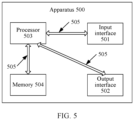
- FIG. 5 is another schematic diagram of a communication device 500 according to an embodiment of this application.
- the apparatus 500 may be the access network device in the foregoing embodiments, and includes: an input interface 501, an output interface 502, a processor 503, and a memory 504.
- the input interface 501, the output interface 502, the processor 503, and the memory 504 may be connected to each other through a bus system 505.
- the memory 504 is configured to store a program, an instruction, or code.
- the processor 503 is configured to perform the program, the instruction, or the code in the memory 504, to control the input interface 501 to receive a signal and control the output interface 502 to send the signal, and implement steps and functions implemented by the access network device in the implementation corresponding to the foregoing FIG. 3 . Details are not described herein again.
- the processor 503 may be a central processing unit (central processing unit, CPU), or may be another general purpose processor, a digital signal processor (DSP), an application-specific integrated circuit (ASIC), a field programmable gate array (FPGA), or another programmable logic device, discrete gate or transistor logic device, discrete hardware component, or the like.
- the general purpose processor may be a microprocessor, or the processor may be any conventional processor or the like.
- the memory 504 may include a read-only memory and a random access memory, and provide an instruction and data to the processor 503 separately. Some of the memory 504 may further include a non-volatile random access memory. For example, the memory 504 may further store information of a device type.
- the bus system 505 may further include a power bus, a control bus, a status signal bus, and the like, in addition to a data bus.
- a power bus a control bus
- a status signal bus a status signal bus
- various types of buses in the figure are marked as the bus system.
- steps of the method shown in FIG. 4 can be implemented by using an integrated logical circuit of hardware in the processor 503, or by using instructions in a software form.
- the steps of the method disclosed with reference to the embodiments of this application may be directly performed by a hardware processor, or may be performed by using a combination of hardware in the processor and a software unit.
- a software unit may be located in a mature storage medium in the art, such as a random memory, a flash memory, a read-only memory, a programmable read-only memory, an electrically erasable programmable memory, a register, or the like.
- the storage medium is separately located in the memory 504.
- the processor 503 reads information in the memory 504, and completes the steps of the method in FIG. 2 in combination with hardware of the processor 503. To avoid repetition, details are not described herein again.
- the processing unit in FIG. 3 may be implemented by using a processor similar to the processor 503 in FIG. 5 , the sending unit may be implemented by using a transmitter, and the receiving unit may be implemented by using a receiver.
- Examples of the present invention also provide an apparatus (for example, an integrated circuit, a wireless device, a circuit module, or the like), configured to implement the foregoing method.
- the apparatus of the power tracker and/or the power supply generator described in this specification may be a self-supporting device or a part of a relatively large device.
- the device may be (i) a self-supporting IC; (ii) a set having one or more ICs, and the set may include a memory IC configured to store data and/or an instruction; (iii) an RFIC, such as an RF receiver or an RF transmitter/receiver; (iv) an ASIC, such as a mobile station modem; (v) a module that can be embedded in another device; (vi) a receiver, a cellular phone, a wireless device, a handset, or a mobile unit; (vii) and the like.
- the method and apparatus provided in the embodiments of the present invention may be applied to the terminal device or the access network device (may be collectively referred to as the wireless device).
- the terminal device or the access network device or the wireless device may include a hardware layer, an operating system layer that runs on the hardware layer, and an application layer that runs on the operating system layer.
- the hardware layer includes hardware such as a central processing unit (central processing unit, CPU), a memory management unit (memory management unit, MMU), and a memory (also referred to as a main memory).
- the operating system may be any one or more computer operating systems such as a Linux operating system, a Unix operating system, an Android operating system, an iOS operating system, or a windows operating system that implement service processing by using a process (process).
- the application layer includes applications such as a browser, an address book, word processing software, and instant messaging software.
- a specific structure of an execution body of the method is not limited in the embodiments of the present invention, provided that communication can be performed based on the signal transmission method in the embodiments of the present invention by running a program of code recording the method in the embodiments of the present invention.
- the execution body of the wireless communication method in the embodiments of the present invention may be a terminal device or an access network device, or a functional module that is in a terminal device or an access network device and that can invoke a program and execute the program.
- aspects or features in the embodiments of the present invention may be implemented as a method, an apparatus or a product that uses standard programming and/or engineering technologies.
- product used in this application covers a computer program that can be accessed from any computer readable component, carrier or medium.
- sequence numbers of the foregoing processes do not mean execution sequences in various embodiments of the present invention.
- the execution sequences of the processes should be determined according to functions and internal logic of the processes, and should not be construed as any limitation on the implementation processes of the embodiments of the present invention.
- the disclosed system, apparatus, and method may be implemented in other manners.
- the described apparatus embodiment is merely an example.
- the unit division is merely logical function division and may be other division in actual implementation.
- a plurality of units or components may be combined or integrated into another system, or some features may be ignored or not performed.
- the displayed or discussed mutual couplings or direct couplings or communication connections may be implemented by using some interfaces.
- the indirect couplings or communication connections between the apparatuses or units may be implemented in electronic, mechanical, or other forms.
- the functions When the functions are implemented in the form of a software functional unit and sold or used as an independent product, the functions may be stored in a computer-readable storage medium. Based on such an understanding, the technical solutions of the embodiments of the present invention essentially, or the part contributing to the prior art, or some of the technical solutions may be implemented in a form of a software product.
- the software product is stored in a storage medium, and includes several instructions for instructing a computer device (which may be a personal computer, a server, or a network device) to perform all or some of the steps of the methods described in the embodiments of the present invention.
- the foregoing storage medium includes: any medium that can store program code, such as a USB flash drive, a removable hard disk, a read-only memory (ROM, Read-Only Memory), a random access memory (RAM, Random Access Memory), a magnetic disk, or an optical disc.
- program code such as a USB flash drive, a removable hard disk, a read-only memory (ROM, Read-Only Memory), a random access memory (RAM, Random Access Memory), a magnetic disk, or an optical disc.
Landscapes
- Engineering & Computer Science (AREA)
- Computer Networks & Wireless Communication (AREA)
- Signal Processing (AREA)
- Quality & Reliability (AREA)
- Mobile Radio Communication Systems (AREA)
Claims (3)
- Procédé de transmission de données dans de multiples porteuses exécuté par un dispositif terminal, le procédé comprenant :• la réception d'au moins un élément d'informations d'indication provenant d'un dispositif de réseau d'accès, dans lequel l'au moins un élément d'informations d'indication indique au moins un paramètre de contrôle d'accès ; et• la sélection d'au moins une porteuse d'accès parmi au moins deux porteuses candidates en fonction de l'au moins un paramètre de contrôle d'accès, dans lequel les au moins deux porteuses candidates sont situées dans des bandes de fréquences différentes (403), dans lequel les au moins deux porteuses candidates comprennent au moins une première porteuse candidate et au moins une seconde porteuse candidate, et l'au moins un paramètre de contrôle d'accès comprend un seuil d'intensité de signal de liaison descendante, et le seuil correspond à l'au moins une première porteuse candidate,et la sélection de l'au moins une porteuse d'accès parmi les au moins deux porteuses candidates en fonction de l'au moins un paramètre de contrôle d'accès comprend :
la sélection, parmi l'au moins une première porteuse candidate, d'une quantité de ces porteuses candidates ayant une intensité de signal de liaison descendante supérieure au seuil en tant que l'au moins une porteuse d'accès ; et, lorsque la quantité de porteuses candidates sélectionnées est inférieure à une quantité cible, la sélection de l'au moins une seconde porteuse candidate en tant que l'au moins une porteuse d'accès. - Dispositif terminal comprenant des unités configurées pour exécuter les étapes selon la revendication 1.
- Support de stockage lisible par ordinateur comprenant des instructions qui, lorsqu'elles sont exécutées par un ordinateur sur un dispositif terminal, amènent l'ordinateur à mettre en œuvre le procédé selon la revendication 1.
Applications Claiming Priority (2)
| Application Number | Priority Date | Filing Date | Title |
|---|---|---|---|
| CN201710960133.7A CN109673052B (zh) | 2017-10-16 | 2017-10-16 | 一种多载波中数据传输的方法及装置 |
| PCT/CN2018/109767 WO2019076226A1 (fr) | 2017-10-16 | 2018-10-11 | Procédé et appareil de transmission de données dans de multiples porteuses |
Publications (3)
| Publication Number | Publication Date |
|---|---|
| EP3687246A1 EP3687246A1 (fr) | 2020-07-29 |
| EP3687246A4 EP3687246A4 (fr) | 2020-09-16 |
| EP3687246B1 true EP3687246B1 (fr) | 2024-12-11 |
Family
ID=66139280
Family Applications (1)
| Application Number | Title | Priority Date | Filing Date |
|---|---|---|---|
| EP18869118.2A Active EP3687246B1 (fr) | 2017-10-16 | 2018-10-11 | Procédé et appareil de transmission de données dans de multiples porteuses |
Country Status (4)
| Country | Link |
|---|---|
| US (1) | US11395264B2 (fr) |
| EP (1) | EP3687246B1 (fr) |
| CN (1) | CN109673052B (fr) |
| WO (1) | WO2019076226A1 (fr) |
Families Citing this family (6)
| Publication number | Priority date | Publication date | Assignee | Title |
|---|---|---|---|---|
| WO2021097698A1 (fr) * | 2019-11-20 | 2021-05-27 | Oppo广东移动通信有限公司 | Procédé d'accès en liaison montante, dispositif électronique et support de stockage |
| CN113133118B (zh) * | 2020-01-15 | 2023-08-08 | 大唐移动通信设备有限公司 | 一种载波的确定方法、装置及可读存储介质 |
| CN111343723B (zh) * | 2020-03-04 | 2023-11-17 | 宇龙计算机通信科技(深圳)有限公司 | 数据传输方法及相关设备 |
| CN114071727B (zh) * | 2020-07-31 | 2025-07-18 | 华为技术有限公司 | 一种通信方法及装置 |
| CN117395798A (zh) * | 2022-06-29 | 2024-01-12 | 华为技术有限公司 | 通信方法和通信装置 |
| CN120730394A (zh) * | 2024-03-29 | 2025-09-30 | 华为技术有限公司 | 一种通信方法及装置 |
Family Cites Families (12)
| Publication number | Priority date | Publication date | Assignee | Title |
|---|---|---|---|---|
| SE522544C2 (sv) * | 2001-05-30 | 2004-02-17 | Ericsson Telefon Ab L M | Förfarande för val av bärvåg |
| CN100550704C (zh) * | 2005-01-19 | 2009-10-14 | 大唐移动通信设备有限公司 | 多载波通信系统中信道优先级排队方法 |
| US20070087757A1 (en) * | 2005-10-13 | 2007-04-19 | Core Ronald S | Method and system for balancing load in a multi-band system |
| US7668518B2 (en) * | 2006-03-16 | 2010-02-23 | Futurewei Technologies, Inc. | Priority and load combination based carrier assignment in a multi-carrier wireless communication system |
| CN101534235A (zh) * | 2008-03-12 | 2009-09-16 | 华为技术有限公司 | 一种多载波接入的方法、系统及设备 |
| KR101607336B1 (ko) * | 2009-06-07 | 2016-03-30 | 엘지전자 주식회사 | 무선 통신 시스템에서 rb 설정 방법 및 장치 |
| KR101946590B1 (ko) * | 2009-06-15 | 2019-02-11 | 광동 오포 모바일 텔레커뮤니케이션즈 코포레이션 리미티드 | 캐리어 집성을 위한 제어 채널 공유 시스템 및 방법 |
| KR101875255B1 (ko) * | 2014-08-07 | 2018-07-06 | 주식회사 케이티 | 캐리어 병합 구성 방법 및 그 장치 |
| US9693278B2 (en) * | 2014-08-11 | 2017-06-27 | Intel IP Corporation | Load balancing schemes for idle mode user equipment |
| CN105634699B (zh) * | 2014-11-07 | 2020-08-11 | 中兴通讯股份有限公司 | 载波选择方法及装置、接入点 |
| WO2017059920A1 (fr) * | 2015-10-09 | 2017-04-13 | Nokia Solutions And Networks Oy | Rapports de mesure permettant l'évaluation d'une ou de plusieurs cellules candidates |
| CN106686727B (zh) * | 2015-11-05 | 2022-04-29 | 中兴通讯股份有限公司 | 多载波的竞争接入方法、装置及系统 |
-
2017
- 2017-10-16 CN CN201710960133.7A patent/CN109673052B/zh active Active
-
2018
- 2018-10-11 WO PCT/CN2018/109767 patent/WO2019076226A1/fr not_active Ceased
- 2018-10-11 EP EP18869118.2A patent/EP3687246B1/fr active Active
-
2020
- 2020-04-14 US US16/847,905 patent/US11395264B2/en active Active
Also Published As
| Publication number | Publication date |
|---|---|
| CN109673052A (zh) | 2019-04-23 |
| US20200245294A1 (en) | 2020-07-30 |
| EP3687246A4 (fr) | 2020-09-16 |
| WO2019076226A1 (fr) | 2019-04-25 |
| EP3687246A1 (fr) | 2020-07-29 |
| CN109673052B (zh) | 2022-05-17 |
| US11395264B2 (en) | 2022-07-19 |
Similar Documents
| Publication | Publication Date | Title |
|---|---|---|
| EP3687246B1 (fr) | Procédé et appareil de transmission de données dans de multiples porteuses | |
| EP3668217B1 (fr) | Procédé de configuration de partie de bande passante, équipement de réseau et terminal | |
| EP3749013B1 (fr) | Procédé de transmission de données de signal de référence de sondage, dispositif terminal et dispositif de réseau | |
| US20230137334A1 (en) | Method and apparatus for determining sidelink assistance information, and electronic device | |
| WO2020135400A1 (fr) | Procédé de communication et appareil de communication | |
| US11832131B2 (en) | Bandwidth allocation method and apparatus | |
| US11758568B2 (en) | Method and device for transmitting physical downlink control channel based on configuration information | |
| WO2021027895A1 (fr) | Procédé et dispositif de détermination d'un sous-ensemble de livre de codes et équipement utilisateur | |
| US11451326B2 (en) | Method for determining transmission mode in sidelink, terminal apparatus, and network apparatus | |
| US11229044B2 (en) | Uplink transmission method, and terminal device | |
| US11653351B2 (en) | Wireless communication method and device | |
| EP3565150A1 (fr) | Procédé de transmission en liaison montante, terminal, et dispositif réseau | |
| RU2743102C1 (ru) | Способ передачи сигнала и терминальное устройство | |
| CN113660692A (zh) | 协议数据单元生成方法、配置方法、装置及电子设备 | |
| WO2019023851A1 (fr) | Procédé, dispositif et système de communication | |
| WO2020061961A1 (fr) | Appareil et procédé de mesure de qualité de canal | |
| US20210297291A1 (en) | Srs transmission method, access network device, and terminal device | |
| WO2017139969A1 (fr) | Procédé, dispositif de configuration de bande de fréquence et système de communication | |
| US11229043B2 (en) | Communication method and terminal device | |
| CN112512106B (zh) | 一种上行功率分配方法、装置、终端设备及存储介质 | |
| US11310696B2 (en) | Method for transmitting information by selecting target uplink carrier, terminal device, and network device | |
| EP3846567A1 (fr) | Procédé de communication, dispositif terminal, et dispositif de réseau | |
| WO2025111954A1 (fr) | Procédés et appareils pour une répétition de pusch msg5 | |
| CN120825788A (zh) | 一种通信方法和通信装置 | |
| CN115413422A (zh) | 选择性rach过载控制 |
Legal Events
| Date | Code | Title | Description |
|---|---|---|---|
| STAA | Information on the status of an ep patent application or granted ep patent |
Free format text: STATUS: THE INTERNATIONAL PUBLICATION HAS BEEN MADE |
|
| PUAI | Public reference made under article 153(3) epc to a published international application that has entered the european phase |
Free format text: ORIGINAL CODE: 0009012 |
|
| STAA | Information on the status of an ep patent application or granted ep patent |
Free format text: STATUS: REQUEST FOR EXAMINATION WAS MADE |
|
| 17P | Request for examination filed |
Effective date: 20200423 |
|
| AK | Designated contracting states |
Kind code of ref document: A1 Designated state(s): AL AT BE BG CH CY CZ DE DK EE ES FI FR GB GR HR HU IE IS IT LI LT LU LV MC MK MT NL NO PL PT RO RS SE SI SK SM TR |
|
| AX | Request for extension of the european patent |
Extension state: BA ME |
|
| A4 | Supplementary search report drawn up and despatched |
Effective date: 20200817 |
|
| RIC1 | Information provided on ipc code assigned before grant |
Ipc: H04W 72/04 20090101ALN20200811BHEP Ipc: H04W 72/02 20090101AFI20200811BHEP |
|
| DAV | Request for validation of the european patent (deleted) | ||
| DAX | Request for extension of the european patent (deleted) | ||
| STAA | Information on the status of an ep patent application or granted ep patent |
Free format text: STATUS: EXAMINATION IS IN PROGRESS |
|
| RIC1 | Information provided on ipc code assigned before grant |
Ipc: H04W 72/04 20090101ALN20220301BHEP Ipc: H04W 72/02 20090101AFI20220301BHEP |
|
| 17Q | First examination report despatched |
Effective date: 20220330 |
|
| REG | Reference to a national code |
Ref legal event code: R079 Ipc: H04W0072020000 Ref country code: DE Ref legal event code: R079 Ref document number: 602018077591 Country of ref document: DE Free format text: PREVIOUS MAIN CLASS: H04W0072040000 Ipc: H04W0072020000 |
|
| RIC1 | Information provided on ipc code assigned before grant |
Ipc: H04W 72/0453 20230101ALN20240422BHEP Ipc: H04W 72/02 20090101AFI20240422BHEP |
|
| GRAP | Despatch of communication of intention to grant a patent |
Free format text: ORIGINAL CODE: EPIDOSNIGR1 |
|
| STAA | Information on the status of an ep patent application or granted ep patent |
Free format text: STATUS: GRANT OF PATENT IS INTENDED |
|
| INTG | Intention to grant announced |
Effective date: 20240604 |
|
| GRAS | Grant fee paid |
Free format text: ORIGINAL CODE: EPIDOSNIGR3 |
|
| GRAA | (expected) grant |
Free format text: ORIGINAL CODE: 0009210 |
|
| STAA | Information on the status of an ep patent application or granted ep patent |
Free format text: STATUS: THE PATENT HAS BEEN GRANTED |
|
| AK | Designated contracting states |
Kind code of ref document: B1 Designated state(s): AL AT BE BG CH CY CZ DE DK EE ES FI FR GB GR HR HU IE IS IT LI LT LU LV MC MK MT NL NO PL PT RO RS SE SI SK SM TR |
|
| REG | Reference to a national code |
Ref country code: GB Ref legal event code: FG4D |
|
| REG | Reference to a national code |
Ref country code: CH Ref legal event code: EP |
|
| REG | Reference to a national code |
Ref country code: IE Ref legal event code: FG4D |
|
| REG | Reference to a national code |
Ref country code: DE Ref legal event code: R096 Ref document number: 602018077591 Country of ref document: DE |
|
| REG | Reference to a national code |
Ref country code: LT Ref legal event code: MG9D |
|
| PG25 | Lapsed in a contracting state [announced via postgrant information from national office to epo] |
Ref country code: HR Free format text: LAPSE BECAUSE OF FAILURE TO SUBMIT A TRANSLATION OF THE DESCRIPTION OR TO PAY THE FEE WITHIN THE PRESCRIBED TIME-LIMIT Effective date: 20241211 |
|
| PG25 | Lapsed in a contracting state [announced via postgrant information from national office to epo] |
Ref country code: FI Free format text: LAPSE BECAUSE OF FAILURE TO SUBMIT A TRANSLATION OF THE DESCRIPTION OR TO PAY THE FEE WITHIN THE PRESCRIBED TIME-LIMIT Effective date: 20241211 |
|
| PG25 | Lapsed in a contracting state [announced via postgrant information from national office to epo] |
Ref country code: BG Free format text: LAPSE BECAUSE OF FAILURE TO SUBMIT A TRANSLATION OF THE DESCRIPTION OR TO PAY THE FEE WITHIN THE PRESCRIBED TIME-LIMIT Effective date: 20241211 |
|
| REG | Reference to a national code |
Ref country code: NL Ref legal event code: MP Effective date: 20241211 |
|
| PG25 | Lapsed in a contracting state [announced via postgrant information from national office to epo] |
Ref country code: ES Free format text: LAPSE BECAUSE OF FAILURE TO SUBMIT A TRANSLATION OF THE DESCRIPTION OR TO PAY THE FEE WITHIN THE PRESCRIBED TIME-LIMIT Effective date: 20241211 |
|
| PG25 | Lapsed in a contracting state [announced via postgrant information from national office to epo] |
Ref country code: NO Free format text: LAPSE BECAUSE OF FAILURE TO SUBMIT A TRANSLATION OF THE DESCRIPTION OR TO PAY THE FEE WITHIN THE PRESCRIBED TIME-LIMIT Effective date: 20250311 |
|
| PG25 | Lapsed in a contracting state [announced via postgrant information from national office to epo] |
Ref country code: LV Free format text: LAPSE BECAUSE OF FAILURE TO SUBMIT A TRANSLATION OF THE DESCRIPTION OR TO PAY THE FEE WITHIN THE PRESCRIBED TIME-LIMIT Effective date: 20241211 Ref country code: GR Free format text: LAPSE BECAUSE OF FAILURE TO SUBMIT A TRANSLATION OF THE DESCRIPTION OR TO PAY THE FEE WITHIN THE PRESCRIBED TIME-LIMIT Effective date: 20250312 |
|
| PG25 | Lapsed in a contracting state [announced via postgrant information from national office to epo] |
Ref country code: RS Free format text: LAPSE BECAUSE OF FAILURE TO SUBMIT A TRANSLATION OF THE DESCRIPTION OR TO PAY THE FEE WITHIN THE PRESCRIBED TIME-LIMIT Effective date: 20250311 |
|
| PG25 | Lapsed in a contracting state [announced via postgrant information from national office to epo] |
Ref country code: NL Free format text: LAPSE BECAUSE OF FAILURE TO SUBMIT A TRANSLATION OF THE DESCRIPTION OR TO PAY THE FEE WITHIN THE PRESCRIBED TIME-LIMIT Effective date: 20241211 |
|
| REG | Reference to a national code |
Ref country code: AT Ref legal event code: MK05 Ref document number: 1751366 Country of ref document: AT Kind code of ref document: T Effective date: 20241211 |
|
| PG25 | Lapsed in a contracting state [announced via postgrant information from national office to epo] |
Ref country code: SM Free format text: LAPSE BECAUSE OF FAILURE TO SUBMIT A TRANSLATION OF THE DESCRIPTION OR TO PAY THE FEE WITHIN THE PRESCRIBED TIME-LIMIT Effective date: 20241211 |
|
| PG25 | Lapsed in a contracting state [announced via postgrant information from national office to epo] |
Ref country code: PL Free format text: LAPSE BECAUSE OF FAILURE TO SUBMIT A TRANSLATION OF THE DESCRIPTION OR TO PAY THE FEE WITHIN THE PRESCRIBED TIME-LIMIT Effective date: 20241211 |
|
| PG25 | Lapsed in a contracting state [announced via postgrant information from national office to epo] |
Ref country code: IS Free format text: LAPSE BECAUSE OF FAILURE TO SUBMIT A TRANSLATION OF THE DESCRIPTION OR TO PAY THE FEE WITHIN THE PRESCRIBED TIME-LIMIT Effective date: 20250411 |
|
| PG25 | Lapsed in a contracting state [announced via postgrant information from national office to epo] |
Ref country code: PT Free format text: LAPSE BECAUSE OF FAILURE TO SUBMIT A TRANSLATION OF THE DESCRIPTION OR TO PAY THE FEE WITHIN THE PRESCRIBED TIME-LIMIT Effective date: 20250411 |
|
| PG25 | Lapsed in a contracting state [announced via postgrant information from national office to epo] |
Ref country code: EE Free format text: LAPSE BECAUSE OF FAILURE TO SUBMIT A TRANSLATION OF THE DESCRIPTION OR TO PAY THE FEE WITHIN THE PRESCRIBED TIME-LIMIT Effective date: 20241211 |
|
| PG25 | Lapsed in a contracting state [announced via postgrant information from national office to epo] |
Ref country code: RO Free format text: LAPSE BECAUSE OF FAILURE TO SUBMIT A TRANSLATION OF THE DESCRIPTION OR TO PAY THE FEE WITHIN THE PRESCRIBED TIME-LIMIT Effective date: 20241211 Ref country code: AT Free format text: LAPSE BECAUSE OF FAILURE TO SUBMIT A TRANSLATION OF THE DESCRIPTION OR TO PAY THE FEE WITHIN THE PRESCRIBED TIME-LIMIT Effective date: 20241211 |
|
| PG25 | Lapsed in a contracting state [announced via postgrant information from national office to epo] |
Ref country code: SK Free format text: LAPSE BECAUSE OF FAILURE TO SUBMIT A TRANSLATION OF THE DESCRIPTION OR TO PAY THE FEE WITHIN THE PRESCRIBED TIME-LIMIT Effective date: 20241211 |
|
| PG25 | Lapsed in a contracting state [announced via postgrant information from national office to epo] |
Ref country code: CZ Free format text: LAPSE BECAUSE OF FAILURE TO SUBMIT A TRANSLATION OF THE DESCRIPTION OR TO PAY THE FEE WITHIN THE PRESCRIBED TIME-LIMIT Effective date: 20241211 |
|
| PG25 | Lapsed in a contracting state [announced via postgrant information from national office to epo] |
Ref country code: IT Free format text: LAPSE BECAUSE OF FAILURE TO SUBMIT A TRANSLATION OF THE DESCRIPTION OR TO PAY THE FEE WITHIN THE PRESCRIBED TIME-LIMIT Effective date: 20241211 |
|
| PG25 | Lapsed in a contracting state [announced via postgrant information from national office to epo] |
Ref country code: SE Free format text: LAPSE BECAUSE OF FAILURE TO SUBMIT A TRANSLATION OF THE DESCRIPTION OR TO PAY THE FEE WITHIN THE PRESCRIBED TIME-LIMIT Effective date: 20241211 |
|
| REG | Reference to a national code |
Ref country code: DE Ref legal event code: R097 Ref document number: 602018077591 Country of ref document: DE |
|
| PG25 | Lapsed in a contracting state [announced via postgrant information from national office to epo] |
Ref country code: DK Free format text: LAPSE BECAUSE OF FAILURE TO SUBMIT A TRANSLATION OF THE DESCRIPTION OR TO PAY THE FEE WITHIN THE PRESCRIBED TIME-LIMIT Effective date: 20241211 |
|
| PGFP | Annual fee paid to national office [announced via postgrant information from national office to epo] |
Ref country code: GB Payment date: 20250904 Year of fee payment: 8 |
|
| PLBE | No opposition filed within time limit |
Free format text: ORIGINAL CODE: 0009261 |
|
| STAA | Information on the status of an ep patent application or granted ep patent |
Free format text: STATUS: NO OPPOSITION FILED WITHIN TIME LIMIT |
|
| 26N | No opposition filed |
Effective date: 20250912 |