EP3687329B1 - Mehrschichtiges geflochtenes obermaterial - Google Patents
Mehrschichtiges geflochtenes obermaterial Download PDFInfo
- Publication number
- EP3687329B1 EP3687329B1 EP18836703.1A EP18836703A EP3687329B1 EP 3687329 B1 EP3687329 B1 EP 3687329B1 EP 18836703 A EP18836703 A EP 18836703A EP 3687329 B1 EP3687329 B1 EP 3687329B1
- Authority
- EP
- European Patent Office
- Prior art keywords
- footwear
- article
- booty
- inner booty
- outer braided
- Prior art date
- Legal status (The legal status is an assumption and is not a legal conclusion. Google has not performed a legal analysis and makes no representation as to the accuracy of the status listed.)
- Active
Links
Images



Classifications
-
- A—HUMAN NECESSITIES
- A43—FOOTWEAR
- A43B—CHARACTERISTIC FEATURES OF FOOTWEAR; PARTS OF FOOTWEAR
- A43B1/00—Footwear characterised by the material
- A43B1/02—Footwear characterised by the material made of fibres or fabrics made therefrom
- A43B1/04—Footwear characterised by the material made of fibres or fabrics made therefrom braided, knotted, knitted or crocheted
-
- A—HUMAN NECESSITIES
- A43—FOOTWEAR
- A43B—CHARACTERISTIC FEATURES OF FOOTWEAR; PARTS OF FOOTWEAR
- A43B23/00—Uppers; Boot legs; Stiffeners; Other single parts of footwear
- A43B23/02—Uppers; Boot legs
- A43B23/0205—Uppers; Boot legs characterised by the material
- A43B23/0215—Plastics or artificial leather
-
- A—HUMAN NECESSITIES
- A43—FOOTWEAR
- A43B—CHARACTERISTIC FEATURES OF FOOTWEAR; PARTS OF FOOTWEAR
- A43B23/00—Uppers; Boot legs; Stiffeners; Other single parts of footwear
- A43B23/02—Uppers; Boot legs
- A43B23/0205—Uppers; Boot legs characterised by the material
- A43B23/0235—Different layers of different material
-
- A—HUMAN NECESSITIES
- A43—FOOTWEAR
- A43B—CHARACTERISTIC FEATURES OF FOOTWEAR; PARTS OF FOOTWEAR
- A43B23/00—Uppers; Boot legs; Stiffeners; Other single parts of footwear
- A43B23/02—Uppers; Boot legs
- A43B23/0245—Uppers; Boot legs characterised by the constructive form
- A43B23/0255—Uppers; Boot legs characterised by the constructive form assembled by gluing or thermo bonding
-
- A—HUMAN NECESSITIES
- A43—FOOTWEAR
- A43B—CHARACTERISTIC FEATURES OF FOOTWEAR; PARTS OF FOOTWEAR
- A43B23/00—Uppers; Boot legs; Stiffeners; Other single parts of footwear
- A43B23/02—Uppers; Boot legs
- A43B23/0245—Uppers; Boot legs characterised by the constructive form
- A43B23/026—Laminated layers
-
- B—PERFORMING OPERATIONS; TRANSPORTING
- B29—WORKING OF PLASTICS; WORKING OF SUBSTANCES IN A PLASTIC STATE IN GENERAL
- B29D—PRODUCING PARTICULAR ARTICLES FROM PLASTICS OR FROM SUBSTANCES IN A PLASTIC STATE
- B29D35/00—Producing footwear
- B29D35/12—Producing parts thereof, e.g. soles, heels, uppers, by a moulding technique
- B29D35/126—Uppers
-
- B—PERFORMING OPERATIONS; TRANSPORTING
- B29—WORKING OF PLASTICS; WORKING OF SUBSTANCES IN A PLASTIC STATE IN GENERAL
- B29D—PRODUCING PARTICULAR ARTICLES FROM PLASTICS OR FROM SUBSTANCES IN A PLASTIC STATE
- B29D35/00—Producing footwear
- B29D35/12—Producing parts thereof, e.g. soles, heels, uppers, by a moulding technique
- B29D35/14—Multilayered parts
- B29D35/146—Uppers
-
- A—HUMAN NECESSITIES
- A43—FOOTWEAR
- A43B—CHARACTERISTIC FEATURES OF FOOTWEAR; PARTS OF FOOTWEAR
- A43B23/00—Uppers; Boot legs; Stiffeners; Other single parts of footwear
- A43B23/02—Uppers; Boot legs
- A43B23/0205—Uppers; Boot legs characterised by the material
- A43B23/024—Different layers of the same material
-
- A—HUMAN NECESSITIES
- A43—FOOTWEAR
- A43B—CHARACTERISTIC FEATURES OF FOOTWEAR; PARTS OF FOOTWEAR
- A43B23/00—Uppers; Boot legs; Stiffeners; Other single parts of footwear
- A43B23/02—Uppers; Boot legs
- A43B23/0245—Uppers; Boot legs characterised by the constructive form
- A43B23/0265—Uppers; Boot legs characterised by the constructive form having different properties in different directions
- A43B23/027—Uppers; Boot legs characterised by the constructive form having different properties in different directions with a part of the upper particularly flexible, e.g. permitting articulation or torsion
-
- A—HUMAN NECESSITIES
- A43—FOOTWEAR
- A43B—CHARACTERISTIC FEATURES OF FOOTWEAR; PARTS OF FOOTWEAR
- A43B5/00—Footwear for sporting purposes
- A43B5/02—Football boots or shoes, i.e. for soccer, football or rugby
- A43B5/025—Football boots or shoes, i.e. for soccer, football or rugby characterised by an element which improves the contact between the ball and the footwear
Definitions
- the claimed invention relates to an article of footwear having an upper comprising an inner booty, an outer braided shell and a layer coupling the outer braided shell to the inner booty in selected locations of the upper.
- Newer methods also now include forming footwear uppers from a knitted textile. Still newer methods involve braiding a material for use as the footwear upper. Aspects herein relate to braided structures for footwear that are selectively coated in some areas.
- Document US 2007/022627 describes an article of footwear including a textile upper member with an exterior constructed from knitted textile material, the exterior including a region with stability ribs and a second unribbed region.
- the region(s) having stability ribs may be located, for example: along a lateral midfoot side of the upper member; along a forefoot portion of the upper member; and/or along a medial midfoot side of the upper member.
- Other articles of footwear include an upper member having exterior and interior textile elements joined together in a stitchless manner at the foot-receiving opening of the upper member.
- the exterior surface of this upper member also may include one or more regions with stability structures.
- the stitchless textile engagement techniques can provide a smooth, non-bulky, and breathable joint that does not require thick layers of textile material in contact with or adjacent the wearer's foot.
- the upper has a medial side and a lateral side, and a toe end and a heel end.
- the upper has an inner booty, at least partially surrounded by an outer braided shell, made from a number of yarns that are braided together.
- a coating covers portions of the outer braided shell. In some aspects, this coating creates a textured surface. In some aspects this textured surface covers at least a portion of the bottom of the article of footwear.
- the upper has a medial side and a lateral side, and a toe end and a heel end.
- the upper has an inner knit booty, at least partially surrounded by an outer braided shell, made from a number of yarns that are braided together.
- the inner knit booty and the outer braided shell are coupled together with a thermoplastic material disposed over the outer braided shell.
- the inner booty and the outer braided shell are coupled together with a thermoplastic material disposed between the outer braided shell and the inner booty.
- a coating covers portions of the outer braided shell. In some aspects, this coating creates a textured surface. In some aspects this textured surface covers at least a portion of the bottom of the article of footwear.
- FIG. 1 An article of footwear 10 is shown in FIG. 1 with a multi-layer upper having an inner booty 12, and an outer braided shell 14.
- the inner booty 12 is knitted.
- the inner booty 12 is formed in a circular knitting process.
- An exemplary circular knitted upper can be formed as disclosed in U.S. Patent 6,931,762, issued on August 23, 2005 .
- Inner booty 12 is formed primarily from multiple yarns that are mechanically manipulated through an interlooping process to produce a unitary structure.
- Various interlooping techniques are available for mechanically manipulating yarn into inner booty 12. In general, however, interlooping involves the formation of a plurality of rows and columns of intermeshed loops, which are conventionally referred to as courses and wales.
- Knitting is generally recognized as being the most common method of interlooping.
- the configuration of inner booty 12 is selected to generally conform to the shape of the foot.
- the knitting process that produces inner booty 12 forms a plurality of sections, each section being specifically located, knit in a specific manner, and knit with a specific type of yarn to provide each section with different physical properties.
- the knit can be a warp knit, or a weft knit, in some aspect.
- a yarn that incorporates an elastane fiber may be utilized.
- Elastane fibers are available from E.I. duPont de Nemours Company under the LYCRA trademark. Such fibers may have the configuration of covered LYCRA, wherein the fiber includes a LYCRA core that is surrounded by a nylon sheath.
- Other fibers or filaments exhibiting elastic properties may also be utilized in inner booty 12.
- Yarn is defined as an assembly having a substantial length and relatively small cross-section that is formed of at least one filament or a plurality of fibers. Fibers have a relatively short length and require spinning or twisting processes to produce a yarn of suitable length for use in an interlooping process. Common examples of fibers are cotton and wool. Filaments, however, have an indefinite length and may merely be combined with other filaments to produce a yarn suitable for use in an interlooping process. Modern filaments include a plurality of synthetic materials such as rayon, nylon, polyester, and acrylic. Yarn may be formed of a single filament (conventionally referred to as a monofilament yarn) or a plurality of individual filaments.
- Yarn may also be formed of separate filaments formed of different materials, or the yarn may be formed of filaments that are each formed of two or more different materials. Similar concepts also apply to yarns formed from fibers. Accordingly, yarns may have a variety of configurations that generally conform to the definition provided above.
- the characteristics of the various yarns selected for inner booty 12 depend primarily upon the materials that form the various filaments and fibers. Cotton, for example, provides a soft hand, natural aesthetics, and biodegradability. Elastane fibers, as discussed above, provide substantial stretch and recoverability. Rayon provides high luster and moisture absorption. Wool also provides high moisture absorption, in addition to insulating properties.
- Polytetrafluoroethylene coatings may provide a low friction contact between the textile and the skin, thereby limiting the formation of blisters.
- Nylon is a durable and abrasion-resistant material with high strength.
- polyester is a hydrophobic material that also provides relatively high durability. Accordingly, the materials comprising the yarn may be selected to impart a variety of physical properties to inner booty 12. The physical properties may include, for example, strength, stretch, support, stiffness, recovery, fit, and form.
- a narrow-tube circular knitting machine may be utilized to manufacture inner booty 12.
- An example of a circular knitting machine that may be utilized to form inner booty 12 is discussed in earlier-referenced and incorporated U.S. Patent 6,931,762 .
- circular knitting machines form a tube-like structure.
- the knit booty 12 can be knitted to shape (somewhat tubular, corresponding to the shape of a foot), or can be cut-and-sewn from the circular knit.
- the knit booty 12 can be made of a flat knit, and again can either be knitted to shape or can be cut-and-sewn from a flat knit material.
- the booty 12 can be made from a warp knit, weft knit or circular knit material.
- outer braided shell 14 is disposed above, or on top of, the inner booty 12. As best seen in FIGS. 2 and 3 , outer braided shell 14 extends from under the inner booty 12, where it is sandwiched between the inner booty 12 and an outsole/midsole structure 16. In some aspects, outer braided shell 14 is also formed as a tube, and generally surrounds inner booty 12 (going completely under inner booty 12 from one side to the other, as viewed, for example in FIG. 3 ). Outer braided shell 14, in some aspects has an open throat area 18 ( FIG. 1 ), provided with laces 20. In addition, outer braided shell 14, has an open ankle area 22, corresponding to the opening in inner booty 12, used to allow a user's foot to access the footwear. In some aspects, the edges of the throat area 18 and ankle area 22 may be provided with a reinforcing band 24. Band 24 can be provided, for example, by a higher-density of braid, an overlay, or other reinforcing structure.
- the outer braided shell 14 is not coupled to inner booty 12, such as the area generally mid-foot indicated by arrow 30. In this area, the outer braided shell 14 can move independently of the inner booty 12. In this area, as shown in FIG. 3 , outer braided shell 14 is retained relative to inner booty 12 only at the lower edge, where it is sandwiched between the inner booty 12 and the outsole/midsole structure 16. Note that a separate midsole and outsole could be provided. For purposes of this disclosure, the nature of the outsole/midsole structure 16 can vary greatly, and so is shown somewhat schematically.
- toe box area 34 includes a layer of skin 36 that is disposed over the outer braided shell 14.
- the skin 36 is, a thermoplastic material, such as a thermoplastic polymeric composition.
- the thermoplastic polymeric composition can include one or more of polyurethanes (such as TPU), polyamides, polyolefins, or nylons that transition when thermoformed.
- thermoforming refers to a process for turning a thermoplastic composition from a solid state to a softened or liquid state when subjected to certain temperatures at or above its melting point and then transitions back to the solid state when cooled.
- the thermoplastic material in this portion of the toe box area 34 can provide additional stability and rigidity, as well as function as a moisture barrier.
- a similar skin 36 is disposed over the heel area 32 to couple the inner booty 12 to the outer braided shell 14 in selected portions of the heel area 32. When transformed by heat, the skin 36 penetrates through openings in the outer braided shell 14 and adheres to both the outer braided shell 14 and the portions of the inner booty 12, coupling the inner booty 12 to the outer braided shell 14.
- the skin 36 will have an outer texture formed by the braids in the outer braided shell 14.
- a layer 40 is disposed between outer braided shell 14 and inner booty 12 (as opposed to being disposed over the outer braided shell 14 as discussed above).
- the layer 40 in some aspects, can be formed of the same material as skin 36, or can be formed of a different hot-melt material.
- the melt temperature of both skin 36 and layer 38 is lower than the yarns used in inner booty 12 and outer braided shell 14. With layer 40 between the inner booty 12 and the outer layer 14, a different aesthetic is achieved, and performance characteristics may also be varied.
- the braiding for outer braided shell 14 is a process of interlacing or interweaving three or more yarns diagonally to a product axis in order to obtain a thicker, wider, or stronger product or in order to cover (overbraid) some profile.
- Interlacing diagonally means that the yarns make an angle with the product axis, which can be between 1° and 89° but is usually in the range of 30° - 80°. This angle is called the braiding angle.
- Braids can be linear products (ropes), hollow tubular shells, or solid structures (one, two, or three-dimensional textiles) with constant or variable cross-sections, and of closed or open appearance.
- the yarns used for braiding may be formed of different materials having different properties.
- the properties that a particular yarn will impart to an area of a braided component partially depend upon the materials that form the yarn.
- Cotton for example, provides a softer product, natural aesthetics, and biodegradability.
- Elastane and stretch polyester each provide substantial stretch and recovery, with stretch polyester also providing recyclability.
- Rayon provides high luster and moisture absorption.
- Wool also provides high moisture absorption, in addition to insulating properties and biodegradability.
- Nylon is a durable and abrasion-resistant material with relatively high strength.
- Polyester is a hydrophobic material that also provides relatively high durability.
- a yarn may be a monofilament or a multifilament.
- the yarn may also include separate filaments that are each formed of different materials.
- the yarn may include filaments that are each formed of two or more different materials, such as a bicomponent yarn with filaments having a sheath-core configuration or two halves formed of different materials.
- braided structures can be formed as tubular braids on a braiding machine, such as a radial, axial, or lace braiding machine.
- a braiding machine such as a radial, axial, or lace braiding machine.
- a lace braiding machine can be found in Ichikawa, EP 1 486 601, granted May 9, 2007 , entitled “Torchon Lace Machine,” and EP No. 2 657 384, published Oct. 30, 2013 , entitled “Torchon Lace Machine.”
- the upper portion of an exemplary braiding machine 100 is shown in FIG. 6 .
- Braiding machine 100 includes a plurality of spools 112. In some embodiments, the spools 112 carry the yarn 114 selected for braiding.
- the yarns 114 from individual spools are selectively interlaced or intertwined with one another by the braiding machine 100. This interlacing or intertwining of strands forms a braided structure 116, as further described below.
- Each of the spools 112 is supported and constrained by a track 118 about the circumference of the braiding machine 100.
- Each spool 112 has a tensioner 120 (shown schematically in FIG. 6 ) that operates, along with a roller 122, to maintain a desired tension in the yarns 114 and the braided structure 116. As the yarns 114 extend upwardly, they pass through a braid ring 124 that is generally considered the braiding point.
- the braiding point is defined as the point or area where yarns 114 consolidate to form braid structure 116. At or near ring 124, the distance between yarns 114 from different spools 112 diminishes. As the distance between yarns 114 is reduced, the yarns 114 intermesh or braid with one another in a tighter fashion and are pulled linearly by roller 122.
- each spool 112 is carried and supported by a carriage 126.
- Each spool 112 is movable about the circumference of the track 118 by rotor metals 128.
- each of the rotor metals 128 can be moved clockwise or counterclockwise.
- each rotor metal is not intermeshed with the adjacent rotor metal. Instead, each rotor metal 128 may be selectively independently movable. As can be seen by comparing FIG. 7 to FIG.
- the braiding machine 100 is programmable such that the individual rotor metals 128 rotate the carriages 126, and thus the spools 112, to move them about the circumference of the track 118.
- the yarns 114 carried on the spools 112 interweave to create a desired braid pattern.
- the movement of spools 112 may be preprogrammed to form particular shapes, designs, and thread densities of a braided component or portions of a braided component.
- Such an exemplary braiding machine may form intricate braid configurations including both jacquard and non-jacquard braid configurations or geometries. Such configurations and geometries offer design possibilities beyond those offered by other textiles, such as knitting.
- the size of braiding machine 100 may be varied. It should be understood that the braiding machine 100 shown and described is for illustrative purposes only. In some aspects, braiding machine 100 may be able to accept 144 carriages, although other sizes of braiding machines, carrying different numbers of carriages and spools, is possible and is within the scope of this disclosure. By varying the number of carriages and spools within a braiding machine, the density of the braided structure as well as the size of the braided component may be altered.
- a method 400 for manufacturing a multi-layer upper for an article of footwear is shown in FIG. 10 .
- the method includes knitting an inner booty, as shown at block 402.
- the inner booty of block 402 in some aspects has the characteristics described above with respect to inner booty 12.
- the method continues at block 404 by braiding an outer braided shell.
- the outer braded shell of block 404 in some aspects, has the characteristics described above with respect to outer braided shell 14.
- the method 400 continues at block 406 by placing a thermoplastic material over the outer braided shell in selected locations.
- the method 400 includes, as shown at block 408, placing a thermoplastic layer between the inner booty and the outer braided shell in selected locations.
- the method continues by heating the thermoplastic layers of blocks 406 and 408 to couple the inner booty and the outer braided shell together at these selected locations.
- a braided article of footwear 500 includes the inner booty 12, constructed as described above, along with the braided shell 14, also constructed as described above.
- the braided shell 14 is covered with a coating 502 in selected areas of the braided footwear upper 500.
- the coating 502 may be applied in the heel area 32 and the toe box area 34.
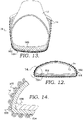
- the coating 502 covers at least part of the bottom 504, and in some aspects covers the entire bottom 504 (as best seen in FIG. 12 ).
- coating 502 is applied as a spray coating.
- the coating 502 can include one or more of polyurethanes (such as TPU), polyamides, polyolefins, or nylons. In such aspects, the coating 502 can provide additional stability and rigidity, as well as function as a moisture barrier. Further, the coating 502, in cooperation with the braided shell 14, provides a traction surface as the textured surface created by the braided shell 14 is preserved by the coating 502. In other words, in some aspects, coating 502 does not provide a smooth surface over braided shell 14 in at least some areas. Instead, the yarns of the braided shell 14 create a textured surface 506 as best seen in FIG. 14 . In some aspects, this textured surface 506 forms the outer surface of the braided article of footwear 500, such as at bottom 504.
- the coating 502 penetrates through openings in the outer braided shell 14 and adheres to both the outer braided shell 14 and the portions of the inner booty 12, coupling the inner booty 12 to the outer braided shell 14.
- the braided article of footwear also includes an insole 508 that may provide added cushioning and comfort.
- a method 600 for manufacturing a multi-layer upper for an article of footwear is shown in FIG. 15 .
- the method includes knitting an inner booty, as shown at block 602.
- the inner booty of block 602 in some aspects has the characteristics described above with respect to inner booty 12.
- the method continues at block 604 by braiding an outer braided shell.
- the outer braded shell of block 604 in some aspects, has the characteristics described above with respect to outer braided shell 14.
- the method 600 continues at block 606 by coating selected locations of the outer braided shell, to couple the outer braided shell to the inner booty at the selected locations (leaving other locations of the outer braided shell uncoated, and uncoupled to the inner booty).
- the coating is a spray coating such as coating 503 described above with reference to FIGS. 11-14 .
Landscapes
- Engineering & Computer Science (AREA)
- Chemical & Material Sciences (AREA)
- Materials Engineering (AREA)
- Mechanical Engineering (AREA)
- Footwear And Its Accessory, Manufacturing Method And Apparatuses (AREA)
- Braiding, Manufacturing Of Bobbin-Net Or Lace, And Manufacturing Of Nets By Knotting (AREA)
Claims (14)
- Ein Fußbekleidungsartikel (10) mit einem Oberteil, das ein Zehenende, ein Fersenende, eine mediale Seite und eine laterale Seite aufweist, wobei das Oberteil Folgendes umfasst: einen Innenschuh (inner booty) (12), der sich vom Fersenende zum Zehenende erstreckt und im getragenen Zustand eine Öffnung für einen Fuß aufweist; eine geflochtene Außenhülle (outer braided shell) (14), die sich zumindest teilweise um den Innenschuh herum erstreckt; und eine Schicht (36, 40), die die geflochtene Außenhülle mit dem Innenschuh an ausgewählten Stellen des Oberteils verbindet, wobei die Schicht (36) eine thermoplastische Schicht ist, die über der geflochtenen Außenhülle in einem ersten Abschnitt der ausgewählten Stellen angeordnet ist, und wobei die thermoplastische Schicht (40) zwischen der geflochtenen Außenhülle und dem Innenschuh in einem zweiten Abschnitt der ausgewählten Stellen angeordnet ist, wobei die geflochtene Außenhülle vom Innenschuh an anderen Stellen des Oberteils ungekoppelt bleibt.
- Der Fußbekleidungsartikel nach Anspruch 1, wobei der Innenschuh aus einem Kettenwirkmaterial hergestellt ist.
- Der Fußbekleidungsartikel nach Anspruch 1, wobei der Innenschuh aus einem Schusswirkmaterial hergestellt ist.
- Der Fußbekleidungsartikel nach Anspruch 3, wobei das Schusswirkmaterial eine Rundwirkware ist.
- Der Fußbekleidungsartikel nach Anspruch 4, wobei der Innenschuh in Form zugeschnitten und vernäht ist.
- Der Fußbekleidungsartikel nach Anspruch 4, wobei der Innenschuh in Form gestrickt ist.
- Der Fußbekleidungsartikel nach Anspruch 3, wobei es sich bei dem Schusswirkmaterial um ein Flachgestrick handelt.
- Der Fußbekleidungsartikel nach Anspruch 7, wobei der Innenschuh in Form zugeschnitten und vernäht ist.
- Der Fußbekleidungsartikel nach Anspruch 7, wobei der Innenschuh in Form gestrickt ist.
- Der Fußbekleidungsartikel nach Anspruch 1, wobei die Schicht im ersten Ausschnitt der ausgewählten Stellen eine Beschichtung ist, die den ersten Abschnitt der ausgewählten Stellen des Oberteils bedeckt.
- Der Fußbekleidungsartikel nach Anspruch 10, wobei die Beschichtung und die geflochtene Außenhülle eine texturierte Oberfläche am ersten Abschnitt der ausgewählten Stellen des Oberteils bilden.
- Der Fußbekleidungsartikel nach Anspruch 10, wobei der Fußbekleidungsartikel einen Boden bzw. eine Unterseite (bottom) aufweist, und wobei die Beschichtung mindestens einen Teil der Unterseite des Fußbekleidungsartikels bedeckt.
- Der Fußbekleidungsartikel nach Anspruch 12, wobei die Beschichtung die Gesamtheit der Unterseite des Fußbekleidungsartikels bedeckt.
- Ein Verfahren zur Herstellung eines Oberteils für einen Fußbekleidungsartikel, wobei das Oberteil ein Zehenende, ein Fersenende, eine mediale Seite und eine laterale Seite aufweist, wobei das Verfahren Folgendes umfasst: Stricken eines Innenschuhs (12), der sich vom Fersenende zum Zehenende erstreckt und der im getragenen Zustand eine Öffnung für einen Fuß aufweist; Flechten einer geflochtenen Außenhülle (outer braided shell) (14) mit einer Form, die sich zumindest teilweise um den Innenschuh herum erstreckt; Platzieren einer ersten thermoplastischen Schicht (36) über ersten ausgewählten Stellen der geflochtenen Außenhülle, wobei die anderen Stellen der geflochtenen Außenhülle ohne die thermoplastische Schicht belassen werden; Platzieren einer zweiten thermoplastischen Schicht (40) zwischen zweiten ausgewählten Stellen der geflochtenen Außenhülle und des Innenschuhs; und Erwärmen der ersten thermoplastischen Schicht, um die geflochtene Außenhülle mit dem Innenschuh an den ersten ausgewählten Stellen zu verbinden, und Erwärmen der zweiten thermoplastischen Schicht, um die geflochtene Außenhülle mit dem Innenschuh an den zweiten ausgewählten Stellen zu verbinden.
Priority Applications (1)
| Application Number | Priority Date | Filing Date | Title |
|---|---|---|---|
| EP22174209.1A EP4085780B1 (de) | 2017-11-20 | 2018-11-16 | Mehrschichtiges geflochtenes obermaterial |
Applications Claiming Priority (3)
| Application Number | Priority Date | Filing Date | Title |
|---|---|---|---|
| US201762588473P | 2017-11-20 | 2017-11-20 | |
| US16/192,129 US20190150552A1 (en) | 2017-11-20 | 2018-11-15 | Multi-layer braided upper |
| PCT/US2018/061502 WO2019099816A1 (en) | 2017-11-20 | 2018-11-16 | Multi-layer braided upper |
Related Child Applications (2)
| Application Number | Title | Priority Date | Filing Date |
|---|---|---|---|
| EP22174209.1A Division-Into EP4085780B1 (de) | 2017-11-20 | 2018-11-16 | Mehrschichtiges geflochtenes obermaterial |
| EP22174209.1A Division EP4085780B1 (de) | 2017-11-20 | 2018-11-16 | Mehrschichtiges geflochtenes obermaterial |
Publications (2)
| Publication Number | Publication Date |
|---|---|
| EP3687329A1 EP3687329A1 (de) | 2020-08-05 |
| EP3687329B1 true EP3687329B1 (de) | 2022-09-28 |
Family
ID=66534752
Family Applications (2)
| Application Number | Title | Priority Date | Filing Date |
|---|---|---|---|
| EP22174209.1A Active EP4085780B1 (de) | 2017-11-20 | 2018-11-16 | Mehrschichtiges geflochtenes obermaterial |
| EP18836703.1A Active EP3687329B1 (de) | 2017-11-20 | 2018-11-16 | Mehrschichtiges geflochtenes obermaterial |
Family Applications Before (1)
| Application Number | Title | Priority Date | Filing Date |
|---|---|---|---|
| EP22174209.1A Active EP4085780B1 (de) | 2017-11-20 | 2018-11-16 | Mehrschichtiges geflochtenes obermaterial |
Country Status (4)
| Country | Link |
|---|---|
| US (1) | US20190150552A1 (de) |
| EP (2) | EP4085780B1 (de) |
| CN (1) | CN111372483B (de) |
| WO (1) | WO2019099816A1 (de) |
Families Citing this family (14)
| Publication number | Priority date | Publication date | Assignee | Title |
|---|---|---|---|---|
| AU2014303042B2 (en) | 2013-06-25 | 2017-06-15 | Nike Innovate C.V. | Article of footwear with braided upper |
| US10863794B2 (en) * | 2013-06-25 | 2020-12-15 | Nike, Inc. | Article of footwear having multiple braided structures |
| US10674791B2 (en) | 2014-12-10 | 2020-06-09 | Nike, Inc. | Braided article with internal midsole structure |
| US9668544B2 (en) | 2014-12-10 | 2017-06-06 | Nike, Inc. | Last system for articles with braided components |
| US10555581B2 (en) | 2015-05-26 | 2020-02-11 | Nike, Inc. | Braided upper with multiple materials |
| US20160345675A1 (en) | 2015-05-26 | 2016-12-01 | Nike, Inc. | Hybrid Braided Article |
| US11103028B2 (en) | 2015-08-07 | 2021-08-31 | Nike, Inc. | Multi-layered braided article and method of making |
| US10952490B2 (en) * | 2017-05-30 | 2021-03-23 | Nike, Inc. | Mechanical lock sole structure for braided footwear |
| US11051573B2 (en) | 2017-05-31 | 2021-07-06 | Nike, Inc. | Braided articles and methods for their manufacture |
| US11202483B2 (en) | 2017-05-31 | 2021-12-21 | Nike, Inc. | Braided articles and methods for their manufacture |
| US10806210B2 (en) | 2017-05-31 | 2020-10-20 | Nike, Inc. | Braided articles and methods for their manufacture |
| USD918546S1 (en) * | 2019-08-16 | 2021-05-11 | Nike, Inc. | Shoe |
| CN113832593A (zh) * | 2021-07-19 | 2021-12-24 | 信泰(福建)科技有限公司 | 一种多层针织鞋面 |
| CN118139555A (zh) * | 2021-08-13 | 2024-06-04 | 彪马欧洲公司 | 用于制造鞋类物品的系统和方法 |
Family Cites Families (18)
| Publication number | Priority date | Publication date | Assignee | Title |
|---|---|---|---|---|
| US6931762B1 (en) | 2002-12-18 | 2005-08-23 | Nike, Inc. | Footwear with knit upper and method of manufacturing the footwear |
| JP4106308B2 (ja) | 2003-06-10 | 2008-06-25 | 株式会社市川鉄工 | トーションレース機 |
| US7793434B2 (en) * | 2004-09-03 | 2010-09-14 | Nike, Inc. | Article of footwear having an upper with a structured intermediate layer |
| US7637032B2 (en) * | 2005-07-29 | 2009-12-29 | Nike, Inc. | Footwear structure with textile upper member |
| DE102006010007A1 (de) * | 2006-03-03 | 2007-09-06 | W.L. Gore & Associates Gmbh | Schuhsohlenverbund und damit aufgebautes Schuhwerk |
| US8051585B2 (en) * | 2008-11-06 | 2011-11-08 | Nike, Inc. | Article of footwear comprising a plurality of strips |
| US8578632B2 (en) * | 2010-07-19 | 2013-11-12 | Nike, Inc. | Decoupled foot stabilizer system |
| JP5652821B2 (ja) | 2010-12-22 | 2015-01-14 | 株式会社市川鉄工 | トーションレース機 |
| US8839532B2 (en) * | 2011-03-15 | 2014-09-23 | Nike, Inc. | Article of footwear incorporating a knitted component |
| US9861160B2 (en) * | 2012-11-30 | 2018-01-09 | Nike, Inc. | Article of footwear incorporating a knitted component |
| US20140373389A1 (en) * | 2013-06-25 | 2014-12-25 | Nike, Inc. | Braided Upper With Overlays For Article Of Footwear |
| EP2839755B1 (de) * | 2013-08-23 | 2020-03-25 | Adidas AG | Schuhschaft und schuh umfassend einen solchen schuhschaft |
| US9872537B2 (en) * | 2014-04-08 | 2018-01-23 | Nike, Inc. | Components for articles of footwear including lightweight, selectively supported textile components |
| US9192204B1 (en) * | 2014-09-30 | 2015-11-24 | Nike, Inc. | Article of footwear upper incorporating a textile component with tensile elements |
| KR102038565B1 (ko) * | 2014-12-10 | 2019-10-30 | 나이키 이노베이트 씨.브이. | 다수의 편조된 구조체를 갖는 신발류 물품 |
| US11103028B2 (en) * | 2015-08-07 | 2021-08-31 | Nike, Inc. | Multi-layered braided article and method of making |
| US10716354B2 (en) * | 2017-07-13 | 2020-07-21 | Under Armour, Inc. | Braided article and method of making |
| EP3654796A1 (de) * | 2017-07-17 | 2020-05-27 | W.L. Gore & Associates GmbH | Schuhwerk |
-
2018
- 2018-11-15 US US16/192,129 patent/US20190150552A1/en not_active Abandoned
- 2018-11-16 CN CN201880075116.8A patent/CN111372483B/zh active Active
- 2018-11-16 WO PCT/US2018/061502 patent/WO2019099816A1/en not_active Ceased
- 2018-11-16 EP EP22174209.1A patent/EP4085780B1/de active Active
- 2018-11-16 EP EP18836703.1A patent/EP3687329B1/de active Active
Also Published As
| Publication number | Publication date |
|---|---|
| WO2019099816A4 (en) | 2019-07-11 |
| EP3687329A1 (de) | 2020-08-05 |
| EP4085780A1 (de) | 2022-11-09 |
| CN111372483B (zh) | 2021-10-22 |
| EP4085780B1 (de) | 2024-01-31 |
| WO2019099816A1 (en) | 2019-05-23 |
| CN111372483A (zh) | 2020-07-03 |
| US20190150552A1 (en) | 2019-05-23 |
Similar Documents
| Publication | Publication Date | Title |
|---|---|---|
| EP4085780B1 (de) | Mehrschichtiges geflochtenes obermaterial | |
| CN106418902B (zh) | 多层编织物品及制造方法 | |
| EP3665320B1 (de) | Viellagige gestricke mit einer mehrflächigen gestrickzone | |
| EP4008821B1 (de) | Flechtartikel eines schuhwerks mit flachgarn | |
| EP3003086B1 (de) | Verfahren zum stricken einer gestrickten komponente für schuhwerk | |
| EP3302119B1 (de) | Hybrider geflochtener artikel | |
| EP4050142B1 (de) | Geflochtene artikel und verfahren zu deren herstellung | |
| EP4019684B1 (de) | Verfahren zur herstellung eines schuhoberteils | |
| EP3303674B1 (de) | Verfahren zur herstellung eines geflochtenen schuhoberteils | |
| EP3631068B1 (de) | Geflochtene artikel und verfahren zu deren herstellung | |
| EP3631069B1 (de) | Geflochtene artikel und verfahren zu deren herstellung | |
| EP3810839B1 (de) | Geflochtenes schuhwerk mit integrierten schuhbändern und verfahren zu seiner herstellung | |
| HK1246114B (zh) | 混合编织物品 |
Legal Events
| Date | Code | Title | Description |
|---|---|---|---|
| STAA | Information on the status of an ep patent application or granted ep patent |
Free format text: STATUS: UNKNOWN |
|
| STAA | Information on the status of an ep patent application or granted ep patent |
Free format text: STATUS: THE INTERNATIONAL PUBLICATION HAS BEEN MADE |
|
| PUAI | Public reference made under article 153(3) epc to a published international application that has entered the european phase |
Free format text: ORIGINAL CODE: 0009012 |
|
| STAA | Information on the status of an ep patent application or granted ep patent |
Free format text: STATUS: REQUEST FOR EXAMINATION WAS MADE |
|
| 17P | Request for examination filed |
Effective date: 20200429 |
|
| AK | Designated contracting states |
Kind code of ref document: A1 Designated state(s): AL AT BE BG CH CY CZ DE DK EE ES FI FR GB GR HR HU IE IS IT LI LT LU LV MC MK MT NL NO PL PT RO RS SE SI SK SM TR |
|
| AX | Request for extension of the european patent |
Extension state: BA ME |
|
| DAV | Request for validation of the european patent (deleted) | ||
| DAX | Request for extension of the european patent (deleted) | ||
| GRAP | Despatch of communication of intention to grant a patent |
Free format text: ORIGINAL CODE: EPIDOSNIGR1 |
|
| STAA | Information on the status of an ep patent application or granted ep patent |
Free format text: STATUS: GRANT OF PATENT IS INTENDED |
|
| INTG | Intention to grant announced |
Effective date: 20220225 |
|
| GRAJ | Information related to disapproval of communication of intention to grant by the applicant or resumption of examination proceedings by the epo deleted |
Free format text: ORIGINAL CODE: EPIDOSDIGR1 |
|
| STAA | Information on the status of an ep patent application or granted ep patent |
Free format text: STATUS: REQUEST FOR EXAMINATION WAS MADE |
|
| GRAP | Despatch of communication of intention to grant a patent |
Free format text: ORIGINAL CODE: EPIDOSNIGR1 |
|
| STAA | Information on the status of an ep patent application or granted ep patent |
Free format text: STATUS: GRANT OF PATENT IS INTENDED |
|
| INTC | Intention to grant announced (deleted) | ||
| INTG | Intention to grant announced |
Effective date: 20220603 |
|
| GRAS | Grant fee paid |
Free format text: ORIGINAL CODE: EPIDOSNIGR3 |
|
| GRAA | (expected) grant |
Free format text: ORIGINAL CODE: 0009210 |
|
| STAA | Information on the status of an ep patent application or granted ep patent |
Free format text: STATUS: THE PATENT HAS BEEN GRANTED |
|
| AK | Designated contracting states |
Kind code of ref document: B1 Designated state(s): AL AT BE BG CH CY CZ DE DK EE ES FI FR GB GR HR HU IE IS IT LI LT LU LV MC MK MT NL NO PL PT RO RS SE SI SK SM TR |
|
| REG | Reference to a national code |
Ref country code: GB Ref legal event code: FG4D |
|
| REG | Reference to a national code |
Ref country code: CH Ref legal event code: EP |
|
| REG | Reference to a national code |
Ref country code: DE Ref legal event code: R096 Ref document number: 602018041226 Country of ref document: DE |
|
| REG | Reference to a national code |
Ref country code: AT Ref legal event code: REF Ref document number: 1520660 Country of ref document: AT Kind code of ref document: T Effective date: 20221015 |
|
| REG | Reference to a national code |
Ref country code: IE Ref legal event code: FG4D |
|
| REG | Reference to a national code |
Ref country code: LT Ref legal event code: MG9D |
|
| PG25 | Lapsed in a contracting state [announced via postgrant information from national office to epo] |
Ref country code: SE Free format text: LAPSE BECAUSE OF FAILURE TO SUBMIT A TRANSLATION OF THE DESCRIPTION OR TO PAY THE FEE WITHIN THE PRESCRIBED TIME-LIMIT Effective date: 20220928 Ref country code: RS Free format text: LAPSE BECAUSE OF FAILURE TO SUBMIT A TRANSLATION OF THE DESCRIPTION OR TO PAY THE FEE WITHIN THE PRESCRIBED TIME-LIMIT Effective date: 20220928 Ref country code: NO Free format text: LAPSE BECAUSE OF FAILURE TO SUBMIT A TRANSLATION OF THE DESCRIPTION OR TO PAY THE FEE WITHIN THE PRESCRIBED TIME-LIMIT Effective date: 20221228 Ref country code: LV Free format text: LAPSE BECAUSE OF FAILURE TO SUBMIT A TRANSLATION OF THE DESCRIPTION OR TO PAY THE FEE WITHIN THE PRESCRIBED TIME-LIMIT Effective date: 20220928 Ref country code: LT Free format text: LAPSE BECAUSE OF FAILURE TO SUBMIT A TRANSLATION OF THE DESCRIPTION OR TO PAY THE FEE WITHIN THE PRESCRIBED TIME-LIMIT Effective date: 20220928 Ref country code: FI Free format text: LAPSE BECAUSE OF FAILURE TO SUBMIT A TRANSLATION OF THE DESCRIPTION OR TO PAY THE FEE WITHIN THE PRESCRIBED TIME-LIMIT Effective date: 20220928 |
|
| REG | Reference to a national code |
Ref country code: NL Ref legal event code: MP Effective date: 20220928 |
|
| REG | Reference to a national code |
Ref country code: AT Ref legal event code: MK05 Ref document number: 1520660 Country of ref document: AT Kind code of ref document: T Effective date: 20220928 |
|
| PG25 | Lapsed in a contracting state [announced via postgrant information from national office to epo] |
Ref country code: HR Free format text: LAPSE BECAUSE OF FAILURE TO SUBMIT A TRANSLATION OF THE DESCRIPTION OR TO PAY THE FEE WITHIN THE PRESCRIBED TIME-LIMIT Effective date: 20220928 Ref country code: GR Free format text: LAPSE BECAUSE OF FAILURE TO SUBMIT A TRANSLATION OF THE DESCRIPTION OR TO PAY THE FEE WITHIN THE PRESCRIBED TIME-LIMIT Effective date: 20221229 |
|
| PG25 | Lapsed in a contracting state [announced via postgrant information from national office to epo] |
Ref country code: SM Free format text: LAPSE BECAUSE OF FAILURE TO SUBMIT A TRANSLATION OF THE DESCRIPTION OR TO PAY THE FEE WITHIN THE PRESCRIBED TIME-LIMIT Effective date: 20220928 Ref country code: RO Free format text: LAPSE BECAUSE OF FAILURE TO SUBMIT A TRANSLATION OF THE DESCRIPTION OR TO PAY THE FEE WITHIN THE PRESCRIBED TIME-LIMIT Effective date: 20220928 Ref country code: PT Free format text: LAPSE BECAUSE OF FAILURE TO SUBMIT A TRANSLATION OF THE DESCRIPTION OR TO PAY THE FEE WITHIN THE PRESCRIBED TIME-LIMIT Effective date: 20230130 Ref country code: ES Free format text: LAPSE BECAUSE OF FAILURE TO SUBMIT A TRANSLATION OF THE DESCRIPTION OR TO PAY THE FEE WITHIN THE PRESCRIBED TIME-LIMIT Effective date: 20220928 Ref country code: CZ Free format text: LAPSE BECAUSE OF FAILURE TO SUBMIT A TRANSLATION OF THE DESCRIPTION OR TO PAY THE FEE WITHIN THE PRESCRIBED TIME-LIMIT Effective date: 20220928 Ref country code: AT Free format text: LAPSE BECAUSE OF FAILURE TO SUBMIT A TRANSLATION OF THE DESCRIPTION OR TO PAY THE FEE WITHIN THE PRESCRIBED TIME-LIMIT Effective date: 20220928 |
|
| PG25 | Lapsed in a contracting state [announced via postgrant information from national office to epo] |
Ref country code: SK Free format text: LAPSE BECAUSE OF FAILURE TO SUBMIT A TRANSLATION OF THE DESCRIPTION OR TO PAY THE FEE WITHIN THE PRESCRIBED TIME-LIMIT Effective date: 20220928 Ref country code: PL Free format text: LAPSE BECAUSE OF FAILURE TO SUBMIT A TRANSLATION OF THE DESCRIPTION OR TO PAY THE FEE WITHIN THE PRESCRIBED TIME-LIMIT Effective date: 20220928 Ref country code: IS Free format text: LAPSE BECAUSE OF FAILURE TO SUBMIT A TRANSLATION OF THE DESCRIPTION OR TO PAY THE FEE WITHIN THE PRESCRIBED TIME-LIMIT Effective date: 20230128 Ref country code: EE Free format text: LAPSE BECAUSE OF FAILURE TO SUBMIT A TRANSLATION OF THE DESCRIPTION OR TO PAY THE FEE WITHIN THE PRESCRIBED TIME-LIMIT Effective date: 20220928 |
|
| P01 | Opt-out of the competence of the unified patent court (upc) registered |
Effective date: 20230515 |
|
| REG | Reference to a national code |
Ref country code: DE Ref legal event code: R097 Ref document number: 602018041226 Country of ref document: DE |
|
| PG25 | Lapsed in a contracting state [announced via postgrant information from national office to epo] |
Ref country code: NL Free format text: LAPSE BECAUSE OF FAILURE TO SUBMIT A TRANSLATION OF THE DESCRIPTION OR TO PAY THE FEE WITHIN THE PRESCRIBED TIME-LIMIT Effective date: 20220928 Ref country code: MC Free format text: LAPSE BECAUSE OF FAILURE TO SUBMIT A TRANSLATION OF THE DESCRIPTION OR TO PAY THE FEE WITHIN THE PRESCRIBED TIME-LIMIT Effective date: 20220928 Ref country code: AL Free format text: LAPSE BECAUSE OF FAILURE TO SUBMIT A TRANSLATION OF THE DESCRIPTION OR TO PAY THE FEE WITHIN THE PRESCRIBED TIME-LIMIT Effective date: 20220928 |
|
| REG | Reference to a national code |
Ref country code: CH Ref legal event code: PL |
|
| REG | Reference to a national code |
Ref country code: BE Ref legal event code: MM Effective date: 20221130 |
|
| PG25 | Lapsed in a contracting state [announced via postgrant information from national office to epo] |
Ref country code: LI Free format text: LAPSE BECAUSE OF NON-PAYMENT OF DUE FEES Effective date: 20221130 Ref country code: DK Free format text: LAPSE BECAUSE OF FAILURE TO SUBMIT A TRANSLATION OF THE DESCRIPTION OR TO PAY THE FEE WITHIN THE PRESCRIBED TIME-LIMIT Effective date: 20220928 Ref country code: CH Free format text: LAPSE BECAUSE OF NON-PAYMENT OF DUE FEES Effective date: 20221130 |
|
| PLBE | No opposition filed within time limit |
Free format text: ORIGINAL CODE: 0009261 |
|
| STAA | Information on the status of an ep patent application or granted ep patent |
Free format text: STATUS: NO OPPOSITION FILED WITHIN TIME LIMIT |
|
| PG25 | Lapsed in a contracting state [announced via postgrant information from national office to epo] |
Ref country code: LU Free format text: LAPSE BECAUSE OF NON-PAYMENT OF DUE FEES Effective date: 20221116 |
|
| 26N | No opposition filed |
Effective date: 20230629 |
|
| PG25 | Lapsed in a contracting state [announced via postgrant information from national office to epo] |
Ref country code: IE Free format text: LAPSE BECAUSE OF NON-PAYMENT OF DUE FEES Effective date: 20221116 |
|
| PG25 | Lapsed in a contracting state [announced via postgrant information from national office to epo] |
Ref country code: SI Free format text: LAPSE BECAUSE OF FAILURE TO SUBMIT A TRANSLATION OF THE DESCRIPTION OR TO PAY THE FEE WITHIN THE PRESCRIBED TIME-LIMIT Effective date: 20220928 Ref country code: BE Free format text: LAPSE BECAUSE OF NON-PAYMENT OF DUE FEES Effective date: 20221130 |
|
| PG25 | Lapsed in a contracting state [announced via postgrant information from national office to epo] |
Ref country code: HU Free format text: LAPSE BECAUSE OF FAILURE TO SUBMIT A TRANSLATION OF THE DESCRIPTION OR TO PAY THE FEE WITHIN THE PRESCRIBED TIME-LIMIT; INVALID AB INITIO Effective date: 20181116 |
|
| PG25 | Lapsed in a contracting state [announced via postgrant information from national office to epo] |
Ref country code: CY Free format text: LAPSE BECAUSE OF FAILURE TO SUBMIT A TRANSLATION OF THE DESCRIPTION OR TO PAY THE FEE WITHIN THE PRESCRIBED TIME-LIMIT Effective date: 20220928 |
|
| PG25 | Lapsed in a contracting state [announced via postgrant information from national office to epo] |
Ref country code: MK Free format text: LAPSE BECAUSE OF FAILURE TO SUBMIT A TRANSLATION OF THE DESCRIPTION OR TO PAY THE FEE WITHIN THE PRESCRIBED TIME-LIMIT Effective date: 20220928 Ref country code: IT Free format text: LAPSE BECAUSE OF FAILURE TO SUBMIT A TRANSLATION OF THE DESCRIPTION OR TO PAY THE FEE WITHIN THE PRESCRIBED TIME-LIMIT Effective date: 20220928 |
|
| PG25 | Lapsed in a contracting state [announced via postgrant information from national office to epo] |
Ref country code: TR Free format text: LAPSE BECAUSE OF FAILURE TO SUBMIT A TRANSLATION OF THE DESCRIPTION OR TO PAY THE FEE WITHIN THE PRESCRIBED TIME-LIMIT Effective date: 20220928 |
|
| PG25 | Lapsed in a contracting state [announced via postgrant information from national office to epo] |
Ref country code: BG Free format text: LAPSE BECAUSE OF FAILURE TO SUBMIT A TRANSLATION OF THE DESCRIPTION OR TO PAY THE FEE WITHIN THE PRESCRIBED TIME-LIMIT Effective date: 20220928 |
|
| PG25 | Lapsed in a contracting state [announced via postgrant information from national office to epo] |
Ref country code: MT Free format text: LAPSE BECAUSE OF FAILURE TO SUBMIT A TRANSLATION OF THE DESCRIPTION OR TO PAY THE FEE WITHIN THE PRESCRIBED TIME-LIMIT Effective date: 20220928 |
|
| PGFP | Annual fee paid to national office [announced via postgrant information from national office to epo] |
Ref country code: GB Payment date: 20250925 Year of fee payment: 8 |
|
| PGFP | Annual fee paid to national office [announced via postgrant information from national office to epo] |
Ref country code: FR Payment date: 20250908 Year of fee payment: 8 |
|
| PGFP | Annual fee paid to national office [announced via postgrant information from national office to epo] |
Ref country code: DE Payment date: 20250923 Year of fee payment: 8 |