EP3688054B1 - Réseaux de polythiouréthane injectable et leurs procédés de préparation - Google Patents
Réseaux de polythiouréthane injectable et leurs procédés de préparation Download PDFInfo
- Publication number
- EP3688054B1 EP3688054B1 EP18773481.9A EP18773481A EP3688054B1 EP 3688054 B1 EP3688054 B1 EP 3688054B1 EP 18773481 A EP18773481 A EP 18773481A EP 3688054 B1 EP3688054 B1 EP 3688054B1
- Authority
- EP
- European Patent Office
- Prior art keywords
- formula
- polymer
- compound
- isocyanate
- thiol
- Prior art date
- Legal status (The legal status is an assumption and is not a legal conclusion. Google has not performed a legal analysis and makes no representation as to the accuracy of the status listed.)
- Active
Links
- 0 C*C(CC1)CCC1C(*)(C(C)CCCC1)*1*(C)S*NPC(C)(C)C Chemical compound C*C(CC1)CCC1C(*)(C(C)CCCC1)*1*(C)S*NPC(C)(C)C 0.000 description 6
Images






Classifications
-
- C—CHEMISTRY; METALLURGY
- C08—ORGANIC MACROMOLECULAR COMPOUNDS; THEIR PREPARATION OR CHEMICAL WORKING-UP; COMPOSITIONS BASED THEREON
- C08G—MACROMOLECULAR COMPOUNDS OBTAINED OTHERWISE THAN BY REACTIONS ONLY INVOLVING UNSATURATED CARBON-TO-CARBON BONDS
- C08G18/00—Polymeric products of isocyanates or isothiocyanates
- C08G18/06—Polymeric products of isocyanates or isothiocyanates with compounds having active hydrogen
- C08G18/08—Processes
- C08G18/10—Prepolymer processes involving reaction of isocyanates or isothiocyanates with compounds having active hydrogen in a first reaction step
-
- C—CHEMISTRY; METALLURGY
- C08—ORGANIC MACROMOLECULAR COMPOUNDS; THEIR PREPARATION OR CHEMICAL WORKING-UP; COMPOSITIONS BASED THEREON
- C08G—MACROMOLECULAR COMPOUNDS OBTAINED OTHERWISE THAN BY REACTIONS ONLY INVOLVING UNSATURATED CARBON-TO-CARBON BONDS
- C08G18/00—Polymeric products of isocyanates or isothiocyanates
- C08G18/06—Polymeric products of isocyanates or isothiocyanates with compounds having active hydrogen
- C08G18/28—Polymeric products of isocyanates or isothiocyanates with compounds having active hydrogen characterised by the compounds used containing active hydrogen
- C08G18/30—Low-molecular-weight compounds
- C08G18/38—Low-molecular-weight compounds having heteroatoms other than oxygen
- C08G18/3855—Low-molecular-weight compounds having heteroatoms other than oxygen having sulfur
- C08G18/3857—Low-molecular-weight compounds having heteroatoms other than oxygen having sulfur having nitrogen in addition to sulfur
-
- C—CHEMISTRY; METALLURGY
- C08—ORGANIC MACROMOLECULAR COMPOUNDS; THEIR PREPARATION OR CHEMICAL WORKING-UP; COMPOSITIONS BASED THEREON
- C08G—MACROMOLECULAR COMPOUNDS OBTAINED OTHERWISE THAN BY REACTIONS ONLY INVOLVING UNSATURATED CARBON-TO-CARBON BONDS
- C08G18/00—Polymeric products of isocyanates or isothiocyanates
- C08G18/06—Polymeric products of isocyanates or isothiocyanates with compounds having active hydrogen
- C08G18/28—Polymeric products of isocyanates or isothiocyanates with compounds having active hydrogen characterised by the compounds used containing active hydrogen
- C08G18/30—Low-molecular-weight compounds
- C08G18/38—Low-molecular-weight compounds having heteroatoms other than oxygen
- C08G18/3855—Low-molecular-weight compounds having heteroatoms other than oxygen having sulfur
- C08G18/3876—Low-molecular-weight compounds having heteroatoms other than oxygen having sulfur containing mercapto groups
-
- C—CHEMISTRY; METALLURGY
- C08—ORGANIC MACROMOLECULAR COMPOUNDS; THEIR PREPARATION OR CHEMICAL WORKING-UP; COMPOSITIONS BASED THEREON
- C08G—MACROMOLECULAR COMPOUNDS OBTAINED OTHERWISE THAN BY REACTIONS ONLY INVOLVING UNSATURATED CARBON-TO-CARBON BONDS
- C08G18/00—Polymeric products of isocyanates or isothiocyanates
- C08G18/06—Polymeric products of isocyanates or isothiocyanates with compounds having active hydrogen
- C08G18/28—Polymeric products of isocyanates or isothiocyanates with compounds having active hydrogen characterised by the compounds used containing active hydrogen
- C08G18/40—High-molecular-weight compounds
- C08G18/48—Polyethers
- C08G18/4825—Polyethers containing two hydroxy groups
-
- C—CHEMISTRY; METALLURGY
- C08—ORGANIC MACROMOLECULAR COMPOUNDS; THEIR PREPARATION OR CHEMICAL WORKING-UP; COMPOSITIONS BASED THEREON
- C08G—MACROMOLECULAR COMPOUNDS OBTAINED OTHERWISE THAN BY REACTIONS ONLY INVOLVING UNSATURATED CARBON-TO-CARBON BONDS
- C08G18/00—Polymeric products of isocyanates or isothiocyanates
- C08G18/06—Polymeric products of isocyanates or isothiocyanates with compounds having active hydrogen
- C08G18/70—Polymeric products of isocyanates or isothiocyanates with compounds having active hydrogen characterised by the isocyanates or isothiocyanates used
- C08G18/72—Polyisocyanates or polyisothiocyanates
- C08G18/74—Polyisocyanates or polyisothiocyanates cyclic
- C08G18/75—Polyisocyanates or polyisothiocyanates cyclic cycloaliphatic
- C08G18/751—Polyisocyanates or polyisothiocyanates cyclic cycloaliphatic containing only one cycloaliphatic ring
- C08G18/752—Polyisocyanates or polyisothiocyanates cyclic cycloaliphatic containing only one cycloaliphatic ring containing at least one isocyanate or isothiocyanate group linked to the cycloaliphatic ring by means of an aliphatic group
- C08G18/753—Polyisocyanates or polyisothiocyanates cyclic cycloaliphatic containing only one cycloaliphatic ring containing at least one isocyanate or isothiocyanate group linked to the cycloaliphatic ring by means of an aliphatic group containing one isocyanate or isothiocyanate group linked to the cycloaliphatic ring by means of an aliphatic group having a primary carbon atom next to the isocyanate or isothiocyanate group
- C08G18/755—Polyisocyanates or polyisothiocyanates cyclic cycloaliphatic containing only one cycloaliphatic ring containing at least one isocyanate or isothiocyanate group linked to the cycloaliphatic ring by means of an aliphatic group containing one isocyanate or isothiocyanate group linked to the cycloaliphatic ring by means of an aliphatic group having a primary carbon atom next to the isocyanate or isothiocyanate group and at least one isocyanate or isothiocyanate group linked to a secondary carbon atom of the cycloaliphatic ring, e.g. isophorone diisocyanate
-
- C—CHEMISTRY; METALLURGY
- C08—ORGANIC MACROMOLECULAR COMPOUNDS; THEIR PREPARATION OR CHEMICAL WORKING-UP; COMPOSITIONS BASED THEREON
- C08G—MACROMOLECULAR COMPOUNDS OBTAINED OTHERWISE THAN BY REACTIONS ONLY INVOLVING UNSATURATED CARBON-TO-CARBON BONDS
- C08G2120/00—Compositions for reaction injection moulding processes
Definitions
- the present invention relates to the field of polymer chemistry, more particularly to injectable, reprocessable and recyclable materials.
- the invention relates to an injectable, reprocessable and recyclable crosslinked polythiourethane polymer and to processes for its preparation.
- the invention also relates to the use of this new polymer.
- Thermoset materials are those having a crosslinked network fixed by irreversible covalent bonds. These polymers exhibit excellent mechanical strength, solvent resistance and thermal stability.
- the above mentioned properties make thermoset materials suitable for numerous applications, such as, biomedical materials, adhesives, coatings and structural applications.
- the impossibility to be melted after their curing step has been carried out due to the irreversibility of the covalent bonds, is one of the major drawbacks of classical thermosets; which makes their reprocessing and recycling impossible.
- some recent work has led to the first examples of reprocessable/recyclable thermoset polymers based on dynamic covalent bonds.
- CANs Covalent Adaptable Networks
- the idea underneath is to introduce exchangeable bonds in a polymer network, which can rearrange thermally (or under another stimulus), while keeping the network integrity.
- CANs may be classified into two groups depending on their exchange mechanism. The first group of CANs makes use of a dissociative crosslink exchange mechanism. In this exchange, chemical bonds are first broken and then reformed at another place. The second group of CANs makes use of associative bond exchanges between polymer chains, in which the original crosslink is only broken when a new covalent bond to another position has been formed.
- the materials can achieve very fast topology rearrangements (stress relaxation and flow) because of a decrease in connectivity.
- This temporary loss of crosslinks typically results in a sudden viscosity drop, as is normally observed for thermoplastic materials.
- the crosslinks are formed again, usually to the same extent as in the starting material, thus preserving or re-installing the desirable thermosetting properties such as stiffness and insolubility. In principle, these materials would be injectable, but still solvent resistant at ambient temperatures.
- the present inventors have developed a polythiourethane network which is injectable, reprocessable and recyclable.
- the behaviour of the polythiourethane network of the invention is due to the thermoreversibility shown by the specific nature of the thiouretane group of the invention: thiourethane linkages are broken when the polymer is heated at a temperature above 130 °C, giving rise to the formation of thiol and isocyanate intermediate species which, at the same time, gives rise to the transition from a solid to liquid state of the polymer.
- thiourethane linkages are broken when the polymer is heated at a temperature above 130 °C, giving rise to the formation of thiol and isocyanate intermediate species which, at the same time, gives rise to the transition from a solid to liquid state of the polymer.
- the material in its liquid state has been used (p.e.
- the temperature can be decreased again to 100 °C, the thiourethane bonds being reestablished again due to the action of a catalyst included in the polythiourethane network of the invention, thus turning to the initial solid state and mantaining the same mechanical properties and chemical resistance than the material before this process.
- This surprising behaviour of the polythiourethane network of the invention provides the possibility to manufacture articles based in this material by conventional injection process starting from the crosslinked material in powder or pellets form.
- thermoreversibility is achieved in polythiourethane networks.
- the present invention provides an injectable, reprocessable and recyclable polymer network comprising
- the present invention further provides an injectable, reprocessable and recyclable polymer network comprising
- the present inventors have found that the aromatic nature of the thiol unit of formula (I) is crucial for the thermoreversibility of the polythiourethane polymer network and thus for its injectability and reprocessability: when an aliphatic thiol was used instead of an aromatic one, the resulting polythiourethane polymer, when heated, did not flow but degrade. That is, there was a loss of the injectability and reprocessability of the polythiourethane polymer as the heated material did not recover the initial solid state. What is even more remarkable is that this worsening in the injectability and reprocessability due to the aliphatic thiol was not overcome when a polymeric chain ("P") including aromatic rings was used. Therefore, it can be concluded that the aromatic character of the thiol of unit of formula (I) is determinant for the properties of the polymeric network of the invention.
- the present inventors have also found that the nature of the catalyst included in the network of the invention, affects to the reprocessability and injectability of the polymer.
- the catalyst must have a boiling temperature equal or higher than 100 °C to avoid its volatilization when the polymer is heated to make the transition solid-liquid.
- the polythiourethane obtained using triethylamine as catalyst which has a boiling point of 90 °C, did not return to the initial module.
- DMAP was used as catalyst (which has a boiling point of 162 °C)
- the polymer could be reprocessable 3 cycles.
- the polymer of the first aspect of the invention can be easily synthesized from inexpensive and readily available starting materials.
- the present invention provides a process for preparing an injectable, reprocessable and recyclable polymer as defined in the first aspect of the invention, the process comprising the reaction between (a) an isocyanate-functionalised compound selected from an isocyanate-funtionalised polymer having a functionality equal or higher than 2, and a polyisocyanate monomer having two or more isocyanate groups, and (b) an aromatic thiol-functionalised compound (also referred hereinafter as "aromatic thiol”) which is selected from:
- the present invention further provides a process for preparing an injectable, reprocessable and recyclable polymer as defined in the first aspect of the invention, the process comprising the reaction between (a) an isocyanate-functionalised compound selected from an isocyanate-functionalised polymer having a functionality equal or higher than 2, and a polyisocyanate monomer having two or more isocyanate groups, and (b) an aromatic thiol which is selected from a compound of formula (V), a polythiol monomer having two or more aromatic thiols of formula (V) and a polymer having two or more aromatic thiols of formula (V) wherein
- the present inventors have also found that the polymer network of the invention shows such reprocessability, recyclability and injectability due to the particular molar ratio between thiol and isocyanate groups.
- molar ratio isocyanate:thiol 1:0.8 it was found, measuring the storage modulus (G') and loss modulus (G") dependence with temperature, that it did not flow at high temperatures as the polymer network of the invention and that heating above 225°C the material got degraded. Consequently, it can be concluded that isocyanate cannot be in excess if a dynamic behavior of thiourethane bond can be achieved as reported in the present invention.
- the injectable, reprocessable and recyclable polymer of the invention can also be defined by its preparation process.
- the present invention provides an injectable, reprocessable and recyclable polymer obtainable by the process of the invention described above.
- the present invention provides a process for recycling an injectable, reprocessable and recyclable crosslinked polymer comprising units of formula (I) as defined in the first or third aspect of the invention, the process comprising the step of applying heat to the polymer.
- the present invention provides an article of manufacture made of the injectable, reprocessable and recyclable cross-linked polymer as defined in the first or third aspect of the invention.
- the present invention provides a method for the manufacture of an article as defined in the fifth aspect of the invention, which comprises subjecting the polymer as defined in the first or third aspect of the invention to reaction injection molded technique.
- any ranges given include both the lower and the upper end-points of the range. Ranges given, such as temperatures, times, and the like, should be considered approximate, unless specifically stated.
- the present invention provides an injectable, reprocessable and recyclable polymer network.
- polymer network refers to a polymer wherein different polymeric chains (such as oligomers), which can be linear or branched, are linked through at least covalent bonds. In one embodiment, all the chains forming the polymer are cross-linked. In another embodiment, about from 10 to 85% of the chains forming the polymer are cross-linked.
- polymeric chain refers to compounds formed by the joining of monomers linked by covalent bonds.
- the polymeric chain can be homopolymeric, if it is made of the same monomer, or copolymeric, when it is made from monomers of different chemical nature.
- Illustrative non-limitative examples or polymeric chains are alkyd resin, epoxy resin, phenolic resin, polyvinyl halides, polyacetal, polyacrylics, polyalkylenes, polyalkenylenes, polyalkynylenes, polyamic acids, polyamides, polyamines, polyanhydrides, polyarylenealkylenes, polyarylenes, polyazomethines, polybenzimidazoles, polybenzothiazoles, polybenzyls, polycarbodiimides, polycarbonates, polycarbones, polycarboranes, polycarbosilanes, polycyanurates, polydienes, polyester-polyurethanes, polyesters, polyetheretherketones, polyether-polyurethanes, polyethers, polyhydrazides, polyimidazoles, polyimides, polyisocyanurates, polyketones, polyolefines, polyoxyalkylenes, polyoxyphenylenes, polyphenyls, polyphosphazen
- P is a homopolymer or copolymer comprising a polymeric chain selected from the group consisting of: alkyd resin, epoxy resin, phenolic resin, polyvinyl halides, polyacetal, polyacrylics, polyalkylenes, polyalkenylenes, polyalkynylenes, polyamides, polyamines, polyanhydrides, polycarbonates, polyester-polyurethanes, polyesters, polyetheretherketones, polyether-polyurethanes, polyethers, polyimidazoles, polyimides, polyisocyanurates, polyketones, polyolefines, polyoxyalkylenes, polyoxyphenylenes, polypyrroles, polysiloxanes, polysulfides, polysulfonamides, polysulfones, polythiazoles, polythiomethylenes, polythiophenylenes, polyureas, polyurethanes, polyvinyl acetals, polyvinyl buty
- P is a polymeric chain selected from the group consisting of: epoxy resin, phenolic resin, polyvinyl halides, polyacetal, polyacrylics, polyamides, polyamines, polycarbonates, polyester-polyurethanes, polyesters, polyether-polyurethanes, polyethers, polyimides, polyketones, polyolefines, polyoxyalkylenes, polyoxyphenylenes, polysiloxanes, polysulfides, polysulfones, polythiomethylenes, polyureas, polyurethanes, polyvinyl acetals, and polyvinyl alkanoates, and natural polymers.
- P is a polyether chain.
- polyethers are: polyoxymethylene (POM), polyacetal, polyethylene oxide (PEO), polypropylene oxide (PPO), polytetrahydrofuran (PTHF).
- P is a polyethylene oxide.
- P is a polyurethane polymer.
- the term "monomer” means, as recognized by IUPAC, a molecule that has one or more polymerizable end-groups that can undergo polymerization thereby contributing constitutional units to the essential structure of a macromolecule ( PAC, 1996, 68, 2287 (Glossary of basic terms in polymer science (IUPAC Recommendations 1996)) on page 2289 ).
- the unit of formula (I) is considered, according to the present invention, as a monomer.
- curing refers to the toughening or hardening of a polymer material by cross-linking of polymer chains, brought about by cross-linker agents such as commercially available chemical additives, ultraviolet radiation, electron beam or heat.
- cross-linker agents such as commercially available chemical additives, ultraviolet radiation, electron beam or heat.
- the polymer viscosity drops initially upon the application of heat, passes through a region of maximum flow and begins to increase as the chemical reactions increase the average length and the degree of cross-linking between the constituent polymers. This process continues until a continuous 3-dimensional network of polymer chains is created - this stage is termed gelation.
- recyclable is to be understood as that the polymer can be grinded and remanufactured applying heat.
- the selection of specific heat conditions will depend on the specific nature of the material and shape of final part. Forms part of the routine tasks of the skilled person in the art the selection of appropriate pressure and heat conditions.
- injectable is to be understood as that the polymer network can be melted by heating and injected in a conventional injection molding machine.
- the ring system when the ring system is formed by "isolated" rings means that the ring system is formed by two, three or four rings and said rings are bound via a bond from the atom of one ring to the atom of the other ring.
- isolated also embraces the embodiment in which the ring system has only one ring.
- Illustrative non-limitative examples of known ring systems consisting of one ring are those derived from: cyclopropyl, cyclobutyl, cyclopentyl, cyclohexyl, cycloheptyl, cyclopropenyl, cyclobutenyl, cyclopentenyl, phenyl, and cycloheptenyl.
- the ring system when the ring system has rings "totally fused", means that the ring system is formed by two, three or four rings in which two or more atoms are common to two adjoining rings.
- Illustrative non-limitative examples are 1,2,3,4-tetrahydronaphthyl, 1-naphthyl, 2-naphthyl, anthryl, or phenanthryl.
- the ring system when the ring system is "partially fused" it means that the ring system is formed by three or four rings, being at least two of said rings totally fused (i.e. two or more atoms being common to the two adjoining rings) and the remaining ring(s) being bound via a bond from the atom of one ring to the atom of one of the fused rings.
- alkyl refers to a saturated linear or branched hydrocarbon chain containing the number of carbon atoms indicated in the claims and in the description.
- alkyl groups include, but are not limited to: methyl, ethyl, propyl, iso-propyl, butyl, isobutyl, tert-butyl, pentyl, hexyl, heptyl, octyl, nonanyl and decanyl, among others.
- (C 1 -C 6 )alkoxy means "-O-(C 1 -C 6 )alkyl", in which the term “alkyl” has the previously given definition.
- alkoxy group include, but are not limited to, methoxy, ethoxy, "n"-propoxy, isopropoxy, "n"-butoxy, isobutoxy, sec-butoxy and tert-butoxy.
- (C 1 -C 6 )haloalkyl refers to a saturated linear or branched hydrocarbon chain containing from 1 to 6 carbon atom members, wherein at least one hydrogen is replaced by a halogen.
- halo and halogen are used interchangeably and refer to a halogen group selected from chloro, fluoro, bromo and iodo.
- the catalyst compound included in the polymeric network is one (a) with the ability of leading to the formation of a thiourethane bond, between an isocyanate radical and a thiol radical, and (b) has a boiling temperature equal or higher than 100 °C.
- boiling temperature is to be understood as the temperature at which the vapor pressure of the liquid equals the pressure surrounding the liquid and the liquid changes into a vapor.
- the boiling point of a liquid varies depending upon the surrounding environmental pressure. A liquid in a partial vacuum has a lower boiling point than when that liquid is at atmospheric pressure.
- the catalyst referred in any of the aspects of the present invention is one which the catalyst has a boiling temperature comprised from 100 to 250 °C.
- the catalyst is a metal catalyst, such as tin, bismuth, zinc, stannous, zirconium, aluminium or iron catalysts or a combination thereof; a nitrogen-containing catalyst (such as an amine catalyst); or any combination thereof.
- the catalyst is a nitrogen-containing catalyst or a metal catalyst.
- the catalyst is a nitrogen-containing catalyst.
- the catalyst is an amine-containing catalyst.
- the "amine" can be selected from the group consisting of a tertiary amine, an amine initiated polypropylene glycol, an aliphatic amine, and amine-containing ring systems.
- the catalyst can be a polyether amine; alternatively, a polyalkylene amine; or alternatively, a tertiary amine polyol.
- the amine catalyst can be a polyamine comprising at least two amine groups.
- the catalyst comprises an amine radical of formula NR 22 R 23 R 24 , wherein R 22 , R 23 and R 24 are independently selected from -H; (C 1 -C 10 )alkyl; (C 1 -C 10 )alkyl substituted by one or more radicals selected from -OH, -NH 2 , nitro and halogen; (C 1 -C 10 )alkenyl; (C 1 -C 10 )alkenyl substituted by one or more radicals selected from -OH, -NH 2 , nitro and halogen; (C 1 -C 10 )alkinyl; (C 1 -C 10 )alkinyl substituted by one or more radicals selected from -OH, -NH 2 , nitro and halogen; and a ring comprising from 5 to 6 members selected from ⁇ CH 2 , CH, and C, "N", NH, O, S, and SH; provided that at least one of R 22 , R 23 and R 24 is
- the catalyst comprises a known ring system comprising from 1 to 3 rings each ring comprising from 5 to 7 members which are selected from ⁇ CH 2 , CH, and C, "N", NH, O, S, and SH, provided that at least one of the members is "N" or NH; the rings being saturated, partially unsaturated, or aromatic; and being fused, partially fused or isolated; and the ring system being optionally substituted by one or more radicals independently selected from the group consisting of (C 1 -C 6 )alkyl, (C 1 -C 6 )haloalkyl, (C 1 -C 6 )alkoxy, nitro, cyano, and halogen.
- Suitable nitrogen-containing catalysts will be apparent to those of skill in the art and are to be considered within the scope of the present invention. Illustrative non-limitative examples are: 2,4,6-Tris(Dimethylaminomethyl)phenol, N,N,N,N-Tetramethyl-1,3-butanediamine, N,N-Dimethylcyclohexylamine, N,N-Diethylethanolamine, N-Ethylmorpholine, 1-azabicyclo[2.2.2]octane, triethanolamine, N,N-Dimethylpiperazine, Dimethylethanolamine, N-Methylmorpholine, N,N-Dimethylaminopropylamine, N,N,N,N-Tetramethylethylenediamine, 1,3-bis(Dimethylamino)propane, N,N,N,N-Tetramethyl-Hexamethylenediamine, Diethanolamine, N,N-dimethylhexadecylamine, N,N-D
- the catalyst is a metal catalyst.
- metal catalyst embraces both the embodiment wherein the compound comprises a metal atom as well as the one wherein the compound consists of a metal atom.
- metal catalyst examples include dioctyltindilaurate (DOTL), dibutyltin dilaurate (DBTDL), dibutyltin diacetate (DBTDA), bismuth carboxylates such as bismuth octoate (Bi-OC) and bismuth neodecanoate (Bi-NDE), zinc carboxylates, stannous octoate, stannous oleate and chelates of zirkonium and aluminium.
- the catalyst is a tin compound.
- the metal catalyst is dibutyl tin dilaurate.
- the process of the second aspect of the invention is performed with an aromatic thiol at a molar ratio from 1.1 to 1.8, the aromatic thiol being selected from: a compound of formula (V), or a monomer or polymer comprising two or more thiols which are the same and correspond to one of formula (V), the resulting polymer network comprises units of formula (I), as defined above, but also units of formula (IV): wherein
- the aromatic thiol is a compound of formula (Vbis) or a monomer or polymer comprising two or more thiol groups which are the same and are of formula (Vbis)
- the resulting polymer network comprises units of formula (I) but also units of formula (IV) as defined above as well as units of formula (IVbis): wherein R 1 , R 2 , "v", “z” and R 18 are as defined above, the molar ratio between the units of formula (I) and the number of moles of units of formula (IV) and (IVbis) being in the range from 1.0:0.01 to 1.0:0.8.
- the aromatic thiol is a thiol monomer or polymer comprising two or more thiol groups which are different between them and are of formula (V) and (Vbis)
- the resulting polymer network comprises units of formula (I), but also units of formula (IV) as well as of formula (IVbis), as defined above; the molar ratio between the number of moles of units of formula (I) and the total number of moles of units of formula (IV) and (IVbis) being in the range from 1.0:0.01 to 1.0:0.8.
- the molar ratio between the units of formula (I) and (IV), or alternatively the molar ratio between the units of formula (I) and the total number of moles of units of formula (IV) and (IVbis) is comprised from 1.0:0.01 to 1.0:0.5.
- the molar ratio between the units of formula (I) and (IV), or alternatively between the units of formula (I) and the total number of moles of units of formula (IV) and (IVbis) is selected from 1.0:0.1, 1.0:0.2, 1.0:0.3, 1.0:0.4, and 1.0:0.5.
- the molar ratio between the units of formula (I) and (IV), or alternatively the molar ratio between the units of formula (I) and the total number of moles of units of formula (IV) and (IVbis) is selected from 1.0:0.01, 1.0:0.02, 1.0:0.03, 1.0:0.04, 1.0:0.05, 1.0:0.06, 1.0:0.07, 1.0:0.08, and 1.0:0.09.
- the molar ratio between the units of formula (I) and (IV), or alternatively between the units of formula (I) and the total number of units of formula (IV) and (IVbis) is 1.0:0.05.
- R 1 and R 1 ' are selected from: -H, (C 1 -C 5 )alkyl, -NO 2 , and halogen.
- R 1 and R 1 ' are -H.
- R 1 ' is selected from: -H, (C 1 -C 5 )alkyl, -NO 2 , and halogen, and X is selected from the group consisting of: - O-, -S-, and -S(O 2 )-.
- R 1 ' is -H
- X is selected from the group consisting of: -O-, -S-, and -S(O 2 )-.
- R 1 ' is -H
- X is -S-.
- R 2 is a radical of formula (II). In another embodiment of the first aspect of the invention, optionally in combination with any of the embodiments provided above or below, R 2 is a radical of formula (II) and Z means -S-. In an alternative embodiment, optionally in combination with any of the embodiments provided above or below, R 2 is a radical of formula (II) and Z is ⁇ -NR 17 -. In another embodiment of the first aspect of the invention, optionally in combination with any of the embodiments provided above or below, R 2 is a radical of formula (II) and Z means -NH-.
- R 2 is a radical of formula (II) and "n" is 1.
- R 2 is a radical of formula (II)
- Z means -S-
- n is 1.
- R 2 is a radical of formula (II)
- Z is ⁇ -NR 17 -
- "n" is 1.
- R 2 is a radical of formula (II)
- Z means -NH- and "n" is 1.
- R 1 and R 1 ' are selected from -H, (C 1 -C 5 )alkyl, -NO 2 , and halogen; "m", and “t” are 4; and the catalyst compound is one having a boiling temperature in the range from 100 to 250°C.
- R 1 and R 1 ' are selected from -H, (C 1 -C 5 )alkyl, -NO 2 , and halogen; "m", and “t” are 4; and the catalyst compound is one having a boiling temperature in the range from 100 to 200°C.
- R 1 and R 1 ' are -H; "m”, and “t” are 4; and the catalyst is a metal catalyst or a nitrogen-containing catalyst.
- R 1 and R 1 ' are -H; "m", and “t” are 4; and the catalyst has a boiling temperature in the range from 100 to 250°C..
- R 1 and R 1 ' are -H; "m", and “t” are 4; and the catalyst has a boiling temperature in the range from 100 to 200°C.
- R 1 and R 1 ' are -H; "m", and “t” are 4; and the catalyst is a metal catalyst or a nitrogen-containing catalyst.
- the present invention provides a process for the preparation of the polymer network as defined in the first aspect of the invention.
- aromatic reactive groups when the aromatic thiol-functionalized compound is a monomer or polymer, refers to aromatic moieties with the ability of reacting with an isocyanate group.
- aromatic reactive groups are aromatic thiols.
- the thiol compound is a thiol of formula (V) or (Vbis).
- the thiol compound is a monomer or polymer having two or more aromatic thiols of formula (V). In another embodiment of the second aspect of the invention, optionally in combination with any of the embodiments provided above or below, the thiol compound is a polymer having two or more aromatic thiols of formula (V).
- the term "monomer or polymer having two or more aromatic thiols of formula (V)” refers to any monomer or polymer which comprises, as substituents, two or more thiols of formula (V).
- the monomer or polymer has two aromatic thiols of formula (V).
- the monomer or polymer comprises as unique aromatic reactive groups thiols of formula (V).
- the monomer or polymer comprises thiols of formula (Vbis) as unique aromatic reactive groups.
- the monomer or polymer comprises thiols of formula (V) and of formula (Vbis) as unique aromatic reactive groups.
- isocyanate-functionalised polymer and "polymer having two or more aromatic thiols of formula (V)” also encompasses pre-polymers, which are polymers wherein there are reactive groups that can be submitted to further polymerization reactions.
- the term "functionality equal or higher than 2" means that the polymer comprises at least two isocyanate groups.
- the isocyanate-functionalised compound is a polymer comprising from 2 to 50 isocyanate groups.
- the isocyanate-functionalised compound is a polymer comprising from 2 to 20 isocyanate groups.
- the isocyanate-functionalised compound is a polymer comprising from 2 to 10 isocyanate groups.
- the isocyanate-functionalised compound is a polymer comprising from 2 to 3 isocyanate groups. In another embodiment, optionally in combination with any of the embodiments provided above or below, the isocyanate-functionalised compound is an isocyanate-functionalized pre-polymer comprising from 2 to 20 isocyanate groups. In another embodiment, optionally in combination with any of the embodiments provided above or below, the isocyanate-functionalised compound is an isocyanate-functionalized pre-polymer comprising from 2 to 3 isocyanate groups.
- total number of moles of reactive groups has a particular meaning depending on the starting aromatic thiol.
- the aromatic thiol is the compound of formula (V), or a monomer or polymer wherein the two or more reactive groups are the same and are of formula (V)
- the expression “total number of moles of reactive groups” refers to the total number of thiol groups.
- the aromatic thiol is the compound of formula (Vbis), or a monomer or polymer wherein one or more of the reactive groups is of formula (Vbis) or, alternatively, comprises groups of formula (V)+(Vbis)
- the expression “total number of moles of reactive groups” refers to the total number of thiol+amine groups.
- the molar ratio between isocyanate: thiol, or between isocyanate: thiol+NHR 18 is comprised from 1.00:1.00 to 1.00:1.80.
- the molar ratio isocyanate:thiol, or alternatively between isocyanate:thiol+NHR 18 is selected from 1.00:1.00, 1.00:1.10, 1.00:1.20, 1.00:1.30, 1.00:1.40, 1.00:1.50, 1.00:1.60, 1.00:1.70, and 1.00:1.80.
- the molar ratio between isocyanate:thiol, or alternatively between isocyanate:thiol+NHR 18 is selected from 1.00:1.01, 1.00:1.02, 1.00:1.03, 1.00:1.04, 1.00:1.05, 1.00:1.06, 1.00:1.07, 1.00:1.08, and 1.00:1.09.
- the molar ratio between isocyanate:thiol, or alternatively between isocyanate:thiol+NHR 18 is 1.00:1.05.
- the process comprises the reaction between:
- the process comprises the reaction between (a) an isocyanate-functionalised compound selected from an isocyanate-functionalised polymer having a functionality equal or higher than 2, and a polyisocyanate monomer having two or more isocyanate groups, and (b) an aromatic thiol which is selected from a compound of formula (V), a compound of formula (Vbis), a polythiol monomer having two or more aromatic thiols of formula (V) and a polymer having two or more aromatic thiols of formula (V), as defined above.
- the process comprises the reaction between (i) the isocyanate-functionalised polymer with functionality equal or higher than 2 and (ii) the aromatic compound of formula (V) or of formula (Vbis).
- the process comprises the reaction between (i) an isocyanate-functionalised pre-polymer with functionality equal or higher than 2, and (ii) the aromatic compound of formula (V) or of formula (Vbis).
- the isocyanate-functionalised polymer is an isocyanate-functionalised polyurethane with a % NCO content from 1 to 15% (percentage by weight).
- percentage (%) by weight refers to the percentage of NCO in relation to the total weight of the polymer.
- isocyanate terminated polymers can be any commercially available or can be synthesized following well-known methods (E. Delebecq, J. P. et al., 2013; and US3905944 ).
- precursors which can be used for the preparation of isocyanate-terminated polymers include, but are not limited to:
- the precursor giving rise to the isocyanate-terminated polymer chain is selected from the group consisting of calcium polycarbophil (a copolymer of acrylic acid and divinyl glycol), chitosan, sodium carboxymethylcellulose, calcium carboxymethylcellulose, sodium alginate, condroitin sulphate, sodium hydroxypropylcellulose, hyaluronic acid, pectin, poly(acrylic acid), poly(methacrylic acid), polyacrylamide, deacetylated gellan gum, polyethylene glycol, polypropylene glycol (PPG), polyester polyol, acrylates, methacrylates, castor oil, soybean oil, polyvinyl alcohol, polycaprolactone polyol, and mixtures thereof.
- calcium polycarbophil a copolymer of acrylic acid and divinyl glycol
- chitosan a copolymer of acrylic acid and divinyl glycol
- sodium carboxymethylcellulose calcium carboxymethylcellulose, sodium alginate, condroitin sulphate, sodium hydroxy
- the precursor giving rise to the isocyanate-terminated polymer chain is a non-water-soluble polymer whose Tg (glass transition temperature) is below room-temperature, such as PPG, castor oil, polycaprolactone polyols or polyesters, among others.
- the precursor of the OH-terminated polymer is a tris-OH terminated PPG.
- the tris-OH terminated PPG has a number average molecular weight from 150 to 20000 g/mol, from 400 to 10000 g/mol, from 1000 to 6000 g/mol, from 1500 to 5000 g/mol. In one embodiment, the tris-OH terminated PPG has a number average molecular weight of 4000 g/mol.
- the term "number average molecular weight” means the total weight of all the polymer molecules in a sample, divided by the total number of polymer molecules in a sample (Mn).
- the PPG reacts with an isocyanate compound in order to obtain an isocyanate terminated polymer.
- the tris-OH terminated PPG reacts with an isocyanate compound in order to obtain a tris-isocyanate terminated polymer.
- the bis-OH terminated PPG reacts with an isocyanate compound in order to obtain a bis-isocyanate terminated polymer.
- the isocyanate compound is a diisocyanate selected from isophorone diisocyanate (IPDI), 4,4'-methylene diphenyl diisocyanate (MDI), toluene 2,4-diisocyanate (TDI), 1,4-tetramethylenediisocyanate, 1,6-hexamethylenediisocyanate (HDI), 1,1, o-decamethylenediisocyanate, 1,5-naphthalenediisocyanate, curnene2, 4-diisocyanate, 4-methoxy- 1,3-phenylenediisocyanate; 4-chloro 1,3-phenylenediisocyanate, 4-bromo 1,3 phenylenediisocyanate, 4-ethoxy 1 ,3-phenylenediisocyanate, 2,4-diisocyanatodiphenylether, 5, 6-dimethyl 1, 3-phenylenediisocyanate, 2,4-dimethyl 1 ,
- the isocyanate compound is isophorone diisocyanate (IPDI) or the tri-isocyanate terminated polymer (Voramer MR1101).
- the tris-OH terminated PPG reacts with IPDI in order to obtain a tris-isocyanate terminated polymer.
- the bis-OH terminated PPG reacts with IPDI in order to obtain a bis-isocyanate terminated polymer.
- the tris-OH terminated PPG having a number average molecular weight comprised from 150 to 6000 g/mol reacts with IPDI in order to obtain a tris-isocyanate terminated polymer.
- the tris-OH terminated PPG having a number average molecular weight from about 400 to 4000 g/mol reacts with IPDI in order to obtain a tris-isocyanate terminated polymer.
- R 1 and R 1 ' are selected from: -H, (C 1 -C 5 )alkyl, -NO 2 , and halogen.
- R 1 and R 1 ' are -H.
- the aromatic compound of formula (V) is one wherein “a” is 1 (and therefore “m” is 4).
- the aromatic compound of formula (Vbis) is one wherein “a” is 1 (and therefore "m” is 4).
- the process comprises the reaction between the isocyanate-functionalised polymer with functionality equal or higher than 2 with an aromatic compound of formula (V) or of formula (Vbis), wherein “a” is 1 (and therefore “m” is 4).
- the process comprises the reaction between the isocyanate-functionalised polymer comprising from 2 to 20 isocyanate with an aromatic compound of formula (V) or of formula (Vbis), wherein “a” is 1 (and therefore “m” is 4).
- the process comprises the reaction between the isocyanate-functionalised polymer comprising from 2 to 10 isocyanate with an aromatic compound of formula (V) or of formula (Vbis), wherein “a” is 1(and therefore "m” is 4).
- the process comprises the reaction between the isocyanate-functionalised polymer comprising from 2 to 3 isocyanate with an aromatic compound of formula (V) or of formula (Vbis), wherein "a” is 1 (and therefore "m” is 4).
- the process comprises the reaction between the isocyanate-functionalised polymer with functionality equal or higher than 2 with an aromatic compound of formula (V) or of formula (Vbis), wherein "a” is 1 (and therefore “m” is 4) and R 1 and R' 1 are -H.
- the process comprises the reaction between the isocyanate-functionalised polymer comprising from 2 to 20 isocyanate with an aromatic compound of formula (V) or of formula (Vbis), wherein "a” is 1 (and therefore "m” is 4) and R 1 and R 1 ' are -H.
- the process comprises the reaction between the isocyanate-functionalised polymer comprising from 2 to 10 isocyanate with an aromatic compound of formula (V) or of formula (Vbis), wherein "a” is 1 (and therefore “m” is 4) and R 1 and R 1 ' are -H.
- the process comprises the reaction between the isocyanate-functionalised polymer comprising from 2 to 3 isocyanate with an aromatic compound of formula (V) or of formula (Vbis), wherein "a” is 1 (and therefore "m” is 4) and R 1 and R 1 ' are -H.
- the process comprises the reaction between the isocyanate-functionalised polymer with functionality equal or higher than 2 with an aromatic compound of formula (V), wherein "a” is 1 (and therefore “m” is 4), R 1 and R' 1 are -H, and R 15 is -SH.
- the process comprises the reaction between the isocyanate-functionalised polymer comprising from 2 to 20 isocyanate with an aromatic compound of formula (V), wherein "a” is 1 (and therefore "m” is 4), R 1 and R' 1 are -H, and R 15 is -SH.
- the process comprises the reaction between the isocyanate-functionalised polymer comprising from 2 to 10 isocyanate with an aromatic compound of formula (V), wherein "a” is 1 (and therefore “m” is 4), R 1 and R' 1 are -H, and R 15 is -SH.
- the process comprises the reaction between the isocyanate-functionalised polymer comprising from 2 to 3 isocyanate with an aromatic compound of formula (V), wherein "a” is 1 (and therefore "m” is 4), R 1 and R' 1 are -H, and R 15 is -SH.
- the process comprises the reaction between the isocyanate-functionalised polymer with functionality equal or higher than 2 with an aromatic compound of formula (Vbis), wherein "a” is 1 (and therefore “m” is 4), R 1 and R 1 ' are -H, and R' 15 is ⁇ NH 2 .
- the process comprises the reaction between the isocyanate-functionalised polymer comprising from 2 to 20 isocyanate with an aromatic compound of formula (Vbis), wherein "a” is 1 (and therefore "m” is 4), R 1 and R 1 ' are -H, R' 15 is ⁇ NH 2 .
- the process comprises the reaction between the isocyanate-functionalised polymer comprising from 2 to 10 isocyanate with an aromatic compound of formula (Vbis), wherein "a” is are 1 (and therefore “m” is 4), R 1 and R 1 ' are -H, and R' 15 is ⁇ NH 2 .
- the process comprises the reaction between the isocyanate-functionalised polymer comprising from 2 to 3 isocyanate with an aromatic compound of formula (Vbis), wherein "a” is 1 (and therefore "m” is 4), R 1 and R 1 ' are -H, and R' 15 is -NH 2 .
- Aromatic thiol terminated monomers and polymers are commercially available such as 4,4'-dimercaptostilbene, benzene-1,3-dithiol, 4,4'-thiobisbenzenethiol, toluene-3,4-dithiol, 2-aminothiophenol, 3-aminothiophenol and 4 aminothiophenol.
- the temperature is comprised from -30 to 200 °C. In another embodiment of the process of the second aspect of the invention, optionally in combination with any of the embodiments provided above or below, the temperature is comprised from 20 to 120 °C. In another embodiment of the process of the second aspect of the invention, optionally in combination with any of the embodiments provided above or below, the temperature is selected from 20, 25, 30, 40, 50, 60 70, and 75 °C. In another embodiment of the process of the second aspect of the invention, optionally in combination with any of the embodiments provided above or below, the temperature is 70 °C.
- the catalyst is a metal catalyst, such as tin catalyst, bismuth catalyst or iron catalyst; a; a nitrogen-containing catalyst (such as an amine catalyst or imidazole catalyst); or any combination thereof.
- the catalyst is a nitrogen-containing catalyst or a metal catalyst.
- the catalyst is a nitrogen-containing catalyst. In one embodiment of the process of the second aspect of the invention, optionally in combination with any of the embodiments provided above or below, the catalyst is an amine-containing catalyst. In one embodiment of the process of the second aspect of the invention, optionally in combination with any of the embodiments provided above or below, the "amine" can be selected from the group consisting of a tertiary amine, an amine initiated polypropylene glycol, an aliphatic amine, and amine-containing ring systems.
- the catalyst can be a polyether amine; alternatively, a polyalkylene amine; or alternatively, a tertiary amine polyol.
- the amine catalyst can be a polyamine comprising at least two amine groups.
- the catalyst comprises an amine radical of formula NR 22 R 23 R 24 , wherein R 22 , R 23 and R 24 are as defined above.
- the process of the second aspect of the invention also comprises, in one embodiment, the addition of solvents, plasticizers, pigments, organic or inorganic fillers, adhesion promoter, UV-stabilizers, rheology modifiers, and/or flame-retardant additives, which are those used in the polymer manufacturing and are well-known for those skilled in the art.
- solvents plasticizers, pigments, organic or inorganic fillers, adhesion promoter, UV-stabilizers, rheology modifiers, and/or flame-retardant additives, which are those used in the polymer manufacturing and are well-known for those skilled in the art.
- solvents for instance, to Harper C. A., “Modern Plastics Handbook", Chapter 4, 1999, pages 4.1-5.0 ; G. Wypych, "Handbook of Plasticizers", Ed.: ChemTec Publishing, Chapter 11, 2004, pages 273-379 ; and Bolgar “M”. et al. "Handbook for the chemical analysis of plastics and polymer additives",
- the present invention provides an injectable, reprocessable and recyclable polymer network obtainable by the process as defined in the second aspect of the invention.
- the present invention provides a process for recycling the injectable, reprocessable and recyclable crosslinked polymer as defined in the first and third aspects of the invention.
- the polymer network is grinded previous to the step of recycling.
- the material can be milled in a cutting mill (Pulverisette) after being freezed in liquid nitrogen.
- the grinded material is then reprocessed by conventional injection molding technology.
- the material can be recycled by hot pressing from a component of a given geometry to a different geometry and shape.
- the temperature is comprised from 140 to 250 °C. In another embodiment the temperature is 160 °C.
- the present invention provides an article of manufacture made of the injectable, reprocessable and recyclable cross-linked polymer as defined in the first and third aspects of the invention.
- the polymer of the invention can be used for the manufacturing of: (a) lens; (b) optical fibers; (c) coatings and (d) fiber reinforced polymer composites.
- the present invention provides a method for the manufacture of an article as defined in the fifth aspect of the invention.
- the article is prepared following the RIM technique. "R.I.”M”. (Reaction Injection Molding) is a technique to produce plastic parts by low-pressure injection of resins in molds. Different types of molds are applicable, among which resin molds are the most frequently used. Different molds can be used, depending on trade off series, size of the part and speed.
- the article is prepared formulating the polymer as a two-component reactive system wherein one of the components is based on an isocyanate- or aromatic thiol-functionalised polymer and the second component is a crosslinker based on an aromatic thiol or isocyanate compound, respectively.
- the components and catalyst Prior to application, the components and catalyst have to be mixed and well homogenized, and then the mixture is injected in the RIM process.
- the order in which the two components and the catalyst are mixed is not critical for obtaining the polythiourethane of the invention.
- the catalyst can be firstly mixed with the aromatic thiol and then the resulting mixture is mixed with the isocyanate compound; or, alternatively, all three components, the catalyst, the aromatic thiol compound and the isocyanate compound, are mixed together. After the application, the system must be allowed to cure in order to obtain a solid material.
- PPG Trifunctional poly(propylene glycol)
- Trifunctional aromatic isocyanate terminated prepolymer Voramer MR1101 was purchased from Dow Chemical.
- the aliphatic thiol Glykol Di(3-mercaptopropionate) Thiocure was purchased from PPG Industries.
- IPDI Isophorone diisocyanate
- DMAE dimethylethanolamine
- DABCO 1,4-diazabiciclo[2.2.2]octane
- DBTDL dibutyltin dilaurate
- 1,3-benzenedithiol 1,4-diazabiciclo[2.2.2]octane
- DBTDL dibutyltin dilaurate
- 1,3-benzenedithiol 1,3-benzenedithiol
- 4,4'-thiobisbenzenethiol 1,3-benzenedithiol
- 2-aminothiophenol triethylamine
- 4-(Dimethylamino)pyridine (DMAP) and tetrahydrofurane (THF) were purchased from Sigma-Aldrich and were used without further purification.
- Oscillatory temperature ramp experiments were carried out in a TA instrument AR2000ex rheometer using a 25 mm plate-plate geometry on polythiourethane elastomer samples with thicknesses of 1 mm. A 1% strain step at a constant gap, 1 Hz frequency and normal force of 2 "N" was applied. Prior to the experiments, it was checked that 10 % deformation was within the linear range using strain sweep experiments.
- FTIR Fourier transform infrared
- Synthesis of a tris-isocyanate terminated prepolymer was carried out by feeding trifunctional PPG (Mn 4000, 100 g, 16.67 mmol) and IPDI (11.65 g, 52.48 mmol) into a 1 L glass reactor equipped with a mechanical stirrer and a vacuum inlet. The reaction was catalyzed with 100 ppm of DBTDL and evolved at 70 °C for 30 minutes under vacuum and high shear mechanical stirring. The reaction was monitored by FTIR spectroscopy (isocyanate peak at 2264 cm -1 ).
- the resulting tris-isocyanate terminated prepolymer was obtained in the form of a colourless liquid and stored in a tightly closed glass bottle.
- the NCO content of the obtained prepolymer was determined by FT-IR monitored titration with "n"-butylamine, following the disappearance of the NCO signal at 2264 cm -1 .
- the determined NCO content (2.75%) was in accordance with the theoretical estimation (1.89%).
- the tris-isocyanate terminated prepolymer 25 g was degassed under vacuum. Then, the benzene-1,3-dithiol (1.22 g) and DMAP catalyst (100 ppm) were added. The isocyanate/thiol ratio was 1:1.05.
- the obtained mixture was placed in a mould in the form of a 1 mm film; the curing was allowed to proceed for 16h at 60°C and was monitored by FTIR spectroscopy following the disappearance of the NCO signal at 2264 cm-1.
- the resulting polythiourethane (PTU1a) was obtained as a transparent elastomeric material.
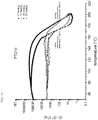
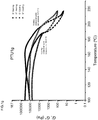
- Fig. 1a-1g show the behavior of the storage modulus (G') and loss modulus (G") as a function of temperature for PTU1a-g (polymer networks of the invention). Values were provided by TA instrument AR2000ex rheometer. G' and G" values decreased with increasing the temperature because of the breakage of thiourethane bonds. It can also be observed that the material flows (injectable) at high temperatures because G" value exceeds G' value. The material recovers its initial modulus after cooling it, demonstrating reprocessability. In addition, the same test was repeated 3 cycles with the same PTU1a sample to ensure the repeatability, and therefore the multiple reprocessability of the material.
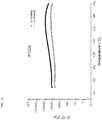
- Fig. 2b shows the storage modulus (G') and loss modulus (G") dependence with temperature for PTU2b material. It can be observed that it does not flow at high temperatures (G' is higher than G") as it does the PTU1a reference material and heating above 225°C the material gets degraded. Consequently, it can be concluded that a small excess of thiol is needed to achieve the dynamic behavior, and therefore, its reprocessability and injectability.
Landscapes
- Chemical & Material Sciences (AREA)
- Health & Medical Sciences (AREA)
- Chemical Kinetics & Catalysis (AREA)
- Medicinal Chemistry (AREA)
- Polymers & Plastics (AREA)
- Organic Chemistry (AREA)
- Polyurethanes Or Polyureas (AREA)
Claims (15)
- Un réseau polymère injectable, retraitable et recyclable comprenanta) des motifs de formule (I)
 R2 est un radical choisi dans le groupe constitué de radicaux de formule (II), et (III) :
*—Z-CO-NH-P (II)
 R1 et R1' sont des radicaux indépendamment choisis dans le groupe constitué de : -H, alkyle en (C1-C20), aryle en (C5-C14), -OR3, -(CO)R4, -O(CO)R5, -(SO)R6, -NH-CO-R7, -COOR8, -S-CO-NH-R9, -NR10R11, -NO2, -SH et halogène ;P est une chaîne polymère,* désigne la position par laquelle R2 se lie au cycle phényle du motif de formule (I),X est un biradical choisi dans le groupe constitué de : -CH2-, -CH=CH-, -O-, -S-, -CO-, -S(O2)-, -Si(R12R13)-, et -NH-;Z est un radical choisi parmi -S- et -NR17- ;R3 à R11 sont des radicaux indépendamment choisis dans le groupe constitué de : alkyle en (C1-C20), et aryle en (C5-C14) ;R12 et R13 sont des radicaux indépendamment choisis dans le groupe constitué d'alkyle en (C1-C5) et aryle en (C5-C14) ;R17 est choisi dans le groupe constitué de -H, alkyle en (C1-C20) et aryle en (C5-C14) ;aryle en (C5-C14) représente un système cyclique avec 1 à 3 cycles qui comprend de 5 à 14 atomes de carbone, les cycles étant saturés, partiellement insaturés ou aromatiques; et étant fusionnés, partiellement fusionnés ou isolés ; étant au moins l'un des cycles un cycle aromatique ; et le système cyclique étant facultativement substitué par un ou plusieurs radicaux choisis indépendamment dans le groupe constitué d'alkyle en (C1-C6), haloalkyle en (C1-C6), alcoxy en (C1-C6), nitro, cyano et halogène ;« m » est un nombre entier choisi parmi 3 et 4;
« n » est un nombre entier choisi parmi 1 et 2; à condition que « n » + « m » soit 5 ;
« t » est un nombre entier choisi parmi 3 et 4; et
« s » est un nombre entier choisi parmi 1 et 2; à condition que « t » + « s » soit 5 ; etb) un composé catalyseur conduisant à la formation d'une liaison thiouréthane, le composé catalyseur étant choisi parmi un catalyseur métallique et un composé catalyseur ayant une température d'ébullition égale ou supérieure à 100 °C lorsqu'elle est mesurée à pression atmosphérique. - Le réseau polymère injectable, retraitable et recyclable selon la revendication 1, dans lequel Z est -S-.
- Le réseau polymère injectable, retraitable et recyclable selon l'une quelconque des revendications 1 à 2, qui comprend en outre des motifs de formule (IV) ou, alternativement, des motifs de formule (IV) et (IVbis) :
 R1 et R2 sont tels que définis dans la revendication 1;R18 est un radical choisi parmi H, alkyle en (C1-C20) et aryle en (C5-C14) ;« v » est un nombre entier choisi parmi 1 et 2;« z » est un nombre entier choisi parmi 3 et 4; à condition que « v »+ « z » soit 5 ;le rapport molaire entre les motifs de formule (I) et les motifs de formule (IV) ou, en variante, le rapport molaire entre les motifs de formule (I) et les motifs de formule (IV) et (IVbis) sont compris de 1,00 : 0,01 à 1,00 : 0,80.
 - Le polymère de l'une quelconque des revendications précédentes, dans lequel R1 and R1' sont choisis parmi : -H, alkyle en (C1-C5), -NO2, et halogène.
- Le polymère injectable, retraitable et recyclable de l'une quelconque des revendications précédentes, dans lequel R1 et R1' sont -H.
- Le polymère injectable, retraitable et recyclable de l'une quelconque des revendications précédentes, dans lequel « m » et « t » sont 4.
- Le polymère injectable, retraitable et recyclable de l'une quelconque des revendications précédentes, dans lequel le catalyseur est un catalyseur contenant de l'azote ou un catalyseur métallique.
- Le polymère injectable, retraitable et recyclable de l'une quelconque des revendications précédentes, dans lequel le catalyseur est choisi parmi la 4-diméthylaminopyridine (DMAP), la diméthyléthanolamine (DMAE), le 1-méthylimidazole, le 1,4-diazabiciclo[2.2.2]octane (DABCO) et le dilaurate de dibutylétain (DBTDL).
- Un procédé de préparation d'un polymère injectable, retraitable et recyclable tel que défini dans l'une quelconque des revendications précédentes, le procédé comprenant la réaction entre (a) un composé à fonction isocyanate choisi parmi un polymère à fonction isocyanate ayant une fonctionnalité égale ou supérieure à 2, et un monomère polyisocyanate ayant deux groupes isocyanate ou plus, et (b) un composé à fonction thiol aromatique qui est choisi parmi :- un composé thiol de formule (V) ou (Vbis) :
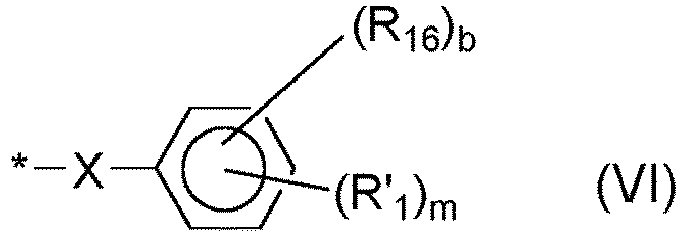
 - un monomère thiol ayant deux ou plusieurs groupes réactifs aromatiques, identiques ou différents, choisis parmi un composé thiol de formule (V) et un composé thiol de formule (Vbis) ; ou un mélange de monomères thiol, chacun d'eux ayant deux ou plusieurs composés thiol, identiques ou différents, choisis parmi un thiol de formule (V) et un de formule (Vbis) ; et- un polymère ayant deux ou plusieurs groupes réactifs aromatiques choisis parmi un thiol de formule (V) et un thiol de formule (Vbis),oùR15 est choisi parmi -SH, et un radical de formule (VI)
 R15' est -NHR18;R18 est un radical choisi parmi H, alkyle en (C1-C20) et aryle en (C5-C14) ;R1, R1', X, « m » sont tels que définis dans la revendication 1,« a » est un nombre entier choisi parmi 1 et 2; à condition que « m » + « a » soit 5 ;« b » est un nombre entier choisi parmi 1 et 2; à condition que « m » + « b » soit 5, etR14 et R16 représente -SH,à condition qu'au moins l'un du composé à fonction isocyanate et du thiol aromatique soit un polymère,la réaction étant effectuée :- à une température comprise de -30 à 200 °C,- en présence d'un composé catalyseur conduisant à la formation d'une liaison thiouréthane entre le groupe isocyanate du composé à fonction isocyanate de fonctionnalité égale ou supérieure à 2, et le groupe thiol du composé aromatique de formule (V), le composé catalyseur étant choisi parmi un catalyseur métallique et un composé ayant une température d'ébullition égale ou supérieure à 100°C à pression atmosphérique, en particulier le catalyseur étant un catalyseur contenant de l'azote ou un catalyseur métallique ; et- le rapport molaire du nombre de moles de groupes isocyanate au nombre total de moles de groupes réactifs du composé aromatique à fonction thiol est de 1,0 à 1,80, en particulier de 1,0 à 1,5.
 - Le procédé de la revendication 9, dans lequel le thiol aromatique est choisi parmi un composé de formule (V), un monomère polythiol ayant deux ou plusieurs thiols aromatiques de formule (V) et un polymère ayant deux ou plusieurs thiols aromatiques de formule (V).
- Le procédé de la revendication 9, qui comprend la réaction entre un polymère à fonction isocyanate ayant une fonctionnalité égale ou supérieure à 2 et un composé thiol de formule (V) ou (Vbis).
- Le procédé de l'une quelconque des revendications 9 à 11, qui comprend la réaction entre un polymère à fonction isocyanate qui comprend de 2 à 50 groupes isocyanate, avec un composé aromatique de formule (V) ou (Vbis).
- Le procédé de l'une quelconque des revendications 9 à 12, dans lequel la température est comprise de 20 à 120 °C.
- Un procédé de recyclage d'un polymère réticulé injectable, retraitable et recyclable comprenant des motifs de formule (I) tel que défini dans l'une quelconque des revendications 1 à 8, le procédé comprenant l'étape d'application de pression et de chaleur au polymère.
- Un article manufacturé constitué du polymère réticulé injectable, retraitable et recyclable tel que défini dans l'une quelconque des revendications 1 à 8.
Applications Claiming Priority (2)
| Application Number | Priority Date | Filing Date | Title |
|---|---|---|---|
| EP17382650 | 2017-09-29 | ||
| PCT/EP2018/076451 WO2019063787A1 (fr) | 2017-09-29 | 2018-09-28 | Polythio-uréthanes réticulés retravaillables dotés d'une aptitude intrinsèque à l'injection, à la réparation et au recyclage |
Publications (2)
| Publication Number | Publication Date |
|---|---|
| EP3688054A1 EP3688054A1 (fr) | 2020-08-05 |
| EP3688054B1 true EP3688054B1 (fr) | 2021-11-10 |
Family
ID=60164630
Family Applications (1)
| Application Number | Title | Priority Date | Filing Date |
|---|---|---|---|
| EP18773481.9A Active EP3688054B1 (fr) | 2017-09-29 | 2018-09-28 | Réseaux de polythiouréthane injectable et leurs procédés de préparation |
Country Status (3)
| Country | Link |
|---|---|
| EP (1) | EP3688054B1 (fr) |
| ES (1) | ES2905949T3 (fr) |
| WO (1) | WO2019063787A1 (fr) |
Families Citing this family (5)
| Publication number | Priority date | Publication date | Assignee | Title |
|---|---|---|---|---|
| US11702501B2 (en) | 2019-06-27 | 2023-07-18 | Northwestern University | Methods for making recyclable and depolymerizable polymer network materials via thiourethane dynamic chemistry |
| CN112500549B (zh) * | 2019-09-16 | 2021-12-28 | 西安交通大学 | 一种可回收形状记忆热固性树脂的合成及回收再加工方法 |
| CN110563908A (zh) * | 2019-09-23 | 2019-12-13 | 西北工业大学 | 一种可再加工、自修复硫代聚氨酯材料及制备方法 |
| CN113307945B (zh) * | 2021-06-01 | 2021-12-14 | 西南石油大学 | 一种紫外光自愈合聚脲材料及其制备方法 |
| KR20240021779A (ko) | 2021-06-08 | 2024-02-19 | 데이진 아라미드 비.브이. | 개질된 아라미드 펄프, 및 개질된 아라미드 펄프를 포함하는 마찰재 |
Family Cites Families (3)
| Publication number | Priority date | Publication date | Assignee | Title |
|---|---|---|---|---|
| US3905944A (en) | 1973-05-21 | 1975-09-16 | Goodyear Tire & Rubber | Polyurethane prepared with 4,4{40 -diamino diphenyl disulfide |
| US9778397B2 (en) * | 2012-11-16 | 2017-10-03 | Mitsui Chemicals, Inc. | Polymerizable composition, optical material, and manufacturing method of the same |
| EP3103824B1 (fr) * | 2014-02-06 | 2020-03-25 | Mitsui Chemicals, Inc. | Composition polymérisable pour matériau optique et matériau optique associé |
-
2018
- 2018-09-28 ES ES18773481T patent/ES2905949T3/es active Active
- 2018-09-28 EP EP18773481.9A patent/EP3688054B1/fr active Active
- 2018-09-28 WO PCT/EP2018/076451 patent/WO2019063787A1/fr not_active Ceased
Also Published As
| Publication number | Publication date |
|---|---|
| EP3688054A1 (fr) | 2020-08-05 |
| WO2019063787A1 (fr) | 2019-04-04 |
| ES2905949T3 (es) | 2022-04-12 |
Similar Documents
| Publication | Publication Date | Title |
|---|---|---|
| EP3688054B1 (fr) | Réseaux de polythiouréthane injectable et leurs procédés de préparation | |
| US20170008999A1 (en) | Self-healing elastomer and process for its preparation | |
| Shin et al. | Segmented polythiourethane elastomers through sequential thiol− ene and thiol− isocyanate reactions | |
| Jiang et al. | Sustainable thermosetting polyurea vitrimers based on a catalyst-free process with reprocessability, permanent shape reconfiguration and self-healing performance | |
| Liu et al. | Dynamic covalent polymers enabled by reversible isocyanate chemistry | |
| US20170291982A1 (en) | A self-healing, reprocessable and recyclable crosslinked polymer and process for its preparation | |
| GB2046281A (en) | Process for producing polyurethane elastomer | |
| CN115612054A (zh) | 一种动态交联聚氨酯材料及其合成方法 | |
| CN116003730B (zh) | 一种自修复聚氨酯材料 | |
| CN108003313A (zh) | 一种嵌段型聚碳化二亚胺水性交联剂及其制备方法 | |
| CN102093528B (zh) | 一种混合型聚醚-聚酯聚氨酯/环氧阻尼复合材料制备方法 | |
| US20060149017A1 (en) | Novel thermoplastic hydrogel polymer cmpositions for use in producing contact lenses and methods of proucing said compositions | |
| US3480591A (en) | Polymers containing n-alkoxymethyl groups | |
| Ding et al. | Design of isocyanate-free biobased polyurea vitrimers with dynamic hydrogen and imine bonds, offering ambient self-healing, reprocessing, and recycling properties | |
| KR101957181B1 (ko) | 아크릴 변성 폴리우레탄 접착제의 제조방법 및 이에 의해 제조된 아크릴 변성 폴리우레탄 접착제 | |
| Szyszkowska et al. | Linear polyurethanes with imidazoquinazoline rings: preparation and properties evaluation | |
| GB851936A (en) | Improvements in or relating to polymeric products | |
| EP3031597B1 (fr) | Matériaux à mémoire de forme de polyuréthane | |
| CN117924649A (zh) | 一种氢键锁定含硼超分子聚脲弹性体的制备方法 | |
| US3535274A (en) | High molecular weight polyurethanes prepared from (a) a polyisocyanate,(b) a monofunctional tertiary amino compound,and (c) a monofunctional compound containing halogen atoms or sulfuric acid ester groups | |
| CN115894841B (zh) | 一种化学交联型聚脲及其制备方法 | |
| Jana et al. | Synthesis and characterization of polyurethanes using 4-bromo-1H-pyrazole as a blocking agent | |
| Frisch et al. | Isocyanurate-containing polyurethanes | |
| Li et al. | Thermoplastic and Reprocessable Polyureas Synthesized from CO2-Based Oligourea | |
| CN115417969A (zh) | 一种分子结构中同时含有羧酸阴离子基团和季铵阳离子基团的亲水性聚氨酯及其水凝胶 |
Legal Events
| Date | Code | Title | Description |
|---|---|---|---|
| STAA | Information on the status of an ep patent application or granted ep patent |
Free format text: STATUS: UNKNOWN |
|
| STAA | Information on the status of an ep patent application or granted ep patent |
Free format text: STATUS: THE INTERNATIONAL PUBLICATION HAS BEEN MADE |
|
| PUAI | Public reference made under article 153(3) epc to a published international application that has entered the european phase |
Free format text: ORIGINAL CODE: 0009012 |
|
| STAA | Information on the status of an ep patent application or granted ep patent |
Free format text: STATUS: REQUEST FOR EXAMINATION WAS MADE |
|
| 17P | Request for examination filed |
Effective date: 20200331 |
|
| AK | Designated contracting states |
Kind code of ref document: A1 Designated state(s): AL AT BE BG CH CY CZ DE DK EE ES FI FR GB GR HR HU IE IS IT LI LT LU LV MC MK MT NL NO PL PT RO RS SE SI SK SM TR |
|
| AX | Request for extension of the european patent |
Extension state: BA ME |
|
| DAV | Request for validation of the european patent (deleted) | ||
| DAX | Request for extension of the european patent (deleted) | ||
| GRAP | Despatch of communication of intention to grant a patent |
Free format text: ORIGINAL CODE: EPIDOSNIGR1 |
|
| STAA | Information on the status of an ep patent application or granted ep patent |
Free format text: STATUS: GRANT OF PATENT IS INTENDED |
|
| INTG | Intention to grant announced |
Effective date: 20210420 |
|
| RIN1 | Information on inventor provided before grant (corrected) |
Inventor name: ERICE CASATORRE, AINARA Inventor name: RUIZ DE LUZURIAGA MARTINEZ, ALAITZ Inventor name: REKONDO GARIN, ALAITZ Inventor name: GENUA FERRERAS, ARATZ Inventor name: AZCUNE TOLOSA, ITXASO Inventor name: GRANDE, HANS-JUERGEN Inventor name: FERNANDEZ SAN MARTIN, MERCEDES Inventor name: APARICIO, XABIER |
|
| GRAS | Grant fee paid |
Free format text: ORIGINAL CODE: EPIDOSNIGR3 |
|
| GRAA | (expected) grant |
Free format text: ORIGINAL CODE: 0009210 |
|
| STAA | Information on the status of an ep patent application or granted ep patent |
Free format text: STATUS: THE PATENT HAS BEEN GRANTED |
|
| AK | Designated contracting states |
Kind code of ref document: B1 Designated state(s): AL AT BE BG CH CY CZ DE DK EE ES FI FR GB GR HR HU IE IS IT LI LT LU LV MC MK MT NL NO PL PT RO RS SE SI SK SM TR |
|
| REG | Reference to a national code |
Ref country code: GB Ref legal event code: FG4D |
|
| REG | Reference to a national code |
Ref country code: AT Ref legal event code: REF Ref document number: 1446038 Country of ref document: AT Kind code of ref document: T Effective date: 20211115 Ref country code: CH Ref legal event code: EP |
|
| REG | Reference to a national code |
Ref country code: DE Ref legal event code: R096 Ref document number: 602018026544 Country of ref document: DE |
|
| REG | Reference to a national code |
Ref country code: IE Ref legal event code: FG4D |
|
| REG | Reference to a national code |
Ref country code: NL Ref legal event code: FP |
|
| REG | Reference to a national code |
Ref country code: LT Ref legal event code: MG9D |
|
| REG | Reference to a national code |
Ref country code: ES Ref legal event code: FG2A Ref document number: 2905949 Country of ref document: ES Kind code of ref document: T3 Effective date: 20220412 |
|
| REG | Reference to a national code |
Ref country code: AT Ref legal event code: MK05 Ref document number: 1446038 Country of ref document: AT Kind code of ref document: T Effective date: 20211110 |
|
| PG25 | Lapsed in a contracting state [announced via postgrant information from national office to epo] |
Ref country code: RS Free format text: LAPSE BECAUSE OF FAILURE TO SUBMIT A TRANSLATION OF THE DESCRIPTION OR TO PAY THE FEE WITHIN THE PRESCRIBED TIME-LIMIT Effective date: 20211110 Ref country code: LT Free format text: LAPSE BECAUSE OF FAILURE TO SUBMIT A TRANSLATION OF THE DESCRIPTION OR TO PAY THE FEE WITHIN THE PRESCRIBED TIME-LIMIT Effective date: 20211110 Ref country code: FI Free format text: LAPSE BECAUSE OF FAILURE TO SUBMIT A TRANSLATION OF THE DESCRIPTION OR TO PAY THE FEE WITHIN THE PRESCRIBED TIME-LIMIT Effective date: 20211110 Ref country code: BG Free format text: LAPSE BECAUSE OF FAILURE TO SUBMIT A TRANSLATION OF THE DESCRIPTION OR TO PAY THE FEE WITHIN THE PRESCRIBED TIME-LIMIT Effective date: 20220210 Ref country code: AT Free format text: LAPSE BECAUSE OF FAILURE TO SUBMIT A TRANSLATION OF THE DESCRIPTION OR TO PAY THE FEE WITHIN THE PRESCRIBED TIME-LIMIT Effective date: 20211110 |
|
| PG25 | Lapsed in a contracting state [announced via postgrant information from national office to epo] |
Ref country code: IS Free format text: LAPSE BECAUSE OF FAILURE TO SUBMIT A TRANSLATION OF THE DESCRIPTION OR TO PAY THE FEE WITHIN THE PRESCRIBED TIME-LIMIT Effective date: 20220310 Ref country code: SE Free format text: LAPSE BECAUSE OF FAILURE TO SUBMIT A TRANSLATION OF THE DESCRIPTION OR TO PAY THE FEE WITHIN THE PRESCRIBED TIME-LIMIT Effective date: 20211110 Ref country code: PT Free format text: LAPSE BECAUSE OF FAILURE TO SUBMIT A TRANSLATION OF THE DESCRIPTION OR TO PAY THE FEE WITHIN THE PRESCRIBED TIME-LIMIT Effective date: 20220310 Ref country code: PL Free format text: LAPSE BECAUSE OF FAILURE TO SUBMIT A TRANSLATION OF THE DESCRIPTION OR TO PAY THE FEE WITHIN THE PRESCRIBED TIME-LIMIT Effective date: 20211110 Ref country code: NO Free format text: LAPSE BECAUSE OF FAILURE TO SUBMIT A TRANSLATION OF THE DESCRIPTION OR TO PAY THE FEE WITHIN THE PRESCRIBED TIME-LIMIT Effective date: 20220210 Ref country code: LV Free format text: LAPSE BECAUSE OF FAILURE TO SUBMIT A TRANSLATION OF THE DESCRIPTION OR TO PAY THE FEE WITHIN THE PRESCRIBED TIME-LIMIT Effective date: 20211110 Ref country code: HR Free format text: LAPSE BECAUSE OF FAILURE TO SUBMIT A TRANSLATION OF THE DESCRIPTION OR TO PAY THE FEE WITHIN THE PRESCRIBED TIME-LIMIT Effective date: 20211110 Ref country code: GR Free format text: LAPSE BECAUSE OF FAILURE TO SUBMIT A TRANSLATION OF THE DESCRIPTION OR TO PAY THE FEE WITHIN THE PRESCRIBED TIME-LIMIT Effective date: 20220211 |
|
| PG25 | Lapsed in a contracting state [announced via postgrant information from national office to epo] |
Ref country code: SM Free format text: LAPSE BECAUSE OF FAILURE TO SUBMIT A TRANSLATION OF THE DESCRIPTION OR TO PAY THE FEE WITHIN THE PRESCRIBED TIME-LIMIT Effective date: 20211110 Ref country code: SK Free format text: LAPSE BECAUSE OF FAILURE TO SUBMIT A TRANSLATION OF THE DESCRIPTION OR TO PAY THE FEE WITHIN THE PRESCRIBED TIME-LIMIT Effective date: 20211110 Ref country code: RO Free format text: LAPSE BECAUSE OF FAILURE TO SUBMIT A TRANSLATION OF THE DESCRIPTION OR TO PAY THE FEE WITHIN THE PRESCRIBED TIME-LIMIT Effective date: 20211110 Ref country code: EE Free format text: LAPSE BECAUSE OF FAILURE TO SUBMIT A TRANSLATION OF THE DESCRIPTION OR TO PAY THE FEE WITHIN THE PRESCRIBED TIME-LIMIT Effective date: 20211110 Ref country code: DK Free format text: LAPSE BECAUSE OF FAILURE TO SUBMIT A TRANSLATION OF THE DESCRIPTION OR TO PAY THE FEE WITHIN THE PRESCRIBED TIME-LIMIT Effective date: 20211110 Ref country code: CZ Free format text: LAPSE BECAUSE OF FAILURE TO SUBMIT A TRANSLATION OF THE DESCRIPTION OR TO PAY THE FEE WITHIN THE PRESCRIBED TIME-LIMIT Effective date: 20211110 |
|
| REG | Reference to a national code |
Ref country code: DE Ref legal event code: R097 Ref document number: 602018026544 Country of ref document: DE |
|
| PLBE | No opposition filed within time limit |
Free format text: ORIGINAL CODE: 0009261 |
|
| STAA | Information on the status of an ep patent application or granted ep patent |
Free format text: STATUS: NO OPPOSITION FILED WITHIN TIME LIMIT |
|
| 26N | No opposition filed |
Effective date: 20220811 |
|
| PG25 | Lapsed in a contracting state [announced via postgrant information from national office to epo] |
Ref country code: AL Free format text: LAPSE BECAUSE OF FAILURE TO SUBMIT A TRANSLATION OF THE DESCRIPTION OR TO PAY THE FEE WITHIN THE PRESCRIBED TIME-LIMIT Effective date: 20211110 |
|
| PG25 | Lapsed in a contracting state [announced via postgrant information from national office to epo] |
Ref country code: SI Free format text: LAPSE BECAUSE OF FAILURE TO SUBMIT A TRANSLATION OF THE DESCRIPTION OR TO PAY THE FEE WITHIN THE PRESCRIBED TIME-LIMIT Effective date: 20211110 |
|
| PG25 | Lapsed in a contracting state [announced via postgrant information from national office to epo] |
Ref country code: MC Free format text: LAPSE BECAUSE OF FAILURE TO SUBMIT A TRANSLATION OF THE DESCRIPTION OR TO PAY THE FEE WITHIN THE PRESCRIBED TIME-LIMIT Effective date: 20211110 |
|
| P01 | Opt-out of the competence of the unified patent court (upc) registered |
Effective date: 20230522 |
|
| PG25 | Lapsed in a contracting state [announced via postgrant information from national office to epo] |
Ref country code: IE Free format text: LAPSE BECAUSE OF NON-PAYMENT OF DUE FEES Effective date: 20220928 |
|
| PG25 | Lapsed in a contracting state [announced via postgrant information from national office to epo] |
Ref country code: CY Free format text: LAPSE BECAUSE OF FAILURE TO SUBMIT A TRANSLATION OF THE DESCRIPTION OR TO PAY THE FEE WITHIN THE PRESCRIBED TIME-LIMIT Effective date: 20211110 |
|
| PG25 | Lapsed in a contracting state [announced via postgrant information from national office to epo] |
Ref country code: MK Free format text: LAPSE BECAUSE OF FAILURE TO SUBMIT A TRANSLATION OF THE DESCRIPTION OR TO PAY THE FEE WITHIN THE PRESCRIBED TIME-LIMIT Effective date: 20211110 Ref country code: HU Free format text: LAPSE BECAUSE OF FAILURE TO SUBMIT A TRANSLATION OF THE DESCRIPTION OR TO PAY THE FEE WITHIN THE PRESCRIBED TIME-LIMIT; INVALID AB INITIO Effective date: 20180928 |
|
| PG25 | Lapsed in a contracting state [announced via postgrant information from national office to epo] |
Ref country code: MT Free format text: LAPSE BECAUSE OF FAILURE TO SUBMIT A TRANSLATION OF THE DESCRIPTION OR TO PAY THE FEE WITHIN THE PRESCRIBED TIME-LIMIT Effective date: 20211110 |
|
| PGFP | Annual fee paid to national office [announced via postgrant information from national office to epo] |
Ref country code: DE Payment date: 20240927 Year of fee payment: 7 |
|
| PGFP | Annual fee paid to national office [announced via postgrant information from national office to epo] |
Ref country code: GB Payment date: 20240927 Year of fee payment: 7 |
|
| PGFP | Annual fee paid to national office [announced via postgrant information from national office to epo] |
Ref country code: BE Payment date: 20240927 Year of fee payment: 7 |
|
| PGFP | Annual fee paid to national office [announced via postgrant information from national office to epo] |
Ref country code: FR Payment date: 20240925 Year of fee payment: 7 |
|
| PGFP | Annual fee paid to national office [announced via postgrant information from national office to epo] |
Ref country code: NL Payment date: 20240926 Year of fee payment: 7 |
|
| PGFP | Annual fee paid to national office [announced via postgrant information from national office to epo] |
Ref country code: IT Payment date: 20240919 Year of fee payment: 7 |
|
| PGFP | Annual fee paid to national office [announced via postgrant information from national office to epo] |
Ref country code: LU Payment date: 20240927 Year of fee payment: 7 |
|
| PGFP | Annual fee paid to national office [announced via postgrant information from national office to epo] |
Ref country code: ES Payment date: 20241001 Year of fee payment: 7 |
|
| PGFP | Annual fee paid to national office [announced via postgrant information from national office to epo] |
Ref country code: CH Payment date: 20241002 Year of fee payment: 7 |
|
| PG25 | Lapsed in a contracting state [announced via postgrant information from national office to epo] |
Ref country code: TR Free format text: LAPSE BECAUSE OF FAILURE TO SUBMIT A TRANSLATION OF THE DESCRIPTION OR TO PAY THE FEE WITHIN THE PRESCRIBED TIME-LIMIT Effective date: 20211110 |