EP3688457B1 - Nachweis von kohlenwasserstoffverunreinigung im boden und wasser - Google Patents
Nachweis von kohlenwasserstoffverunreinigung im boden und wasser Download PDFInfo
- Publication number
- EP3688457B1 EP3688457B1 EP17780067.9A EP17780067A EP3688457B1 EP 3688457 B1 EP3688457 B1 EP 3688457B1 EP 17780067 A EP17780067 A EP 17780067A EP 3688457 B1 EP3688457 B1 EP 3688457B1
- Authority
- EP
- European Patent Office
- Prior art keywords
- molecular probe
- photoluminescence
- sample
- test strip
- alkyl
- Prior art date
- Legal status (The legal status is an assumption and is not a legal conclusion. Google has not performed a legal analysis and makes no representation as to the accuracy of the status listed.)
- Active
Links
Images


Classifications
-
- G—PHYSICS
- G01—MEASURING; TESTING
- G01N—INVESTIGATING OR ANALYSING MATERIALS BY DETERMINING THEIR CHEMICAL OR PHYSICAL PROPERTIES
- G01N21/00—Investigating or analysing materials by the use of optical means, i.e. using sub-millimetre waves, infrared, visible or ultraviolet light
- G01N21/62—Systems in which the material investigated is excited whereby it emits light or causes a change in wavelength of the incident light
- G01N21/63—Systems in which the material investigated is excited whereby it emits light or causes a change in wavelength of the incident light optically excited
- G01N21/64—Fluorescence; Phosphorescence
-
- G—PHYSICS
- G01—MEASURING; TESTING
- G01N—INVESTIGATING OR ANALYSING MATERIALS BY DETERMINING THEIR CHEMICAL OR PHYSICAL PROPERTIES
- G01N21/00—Investigating or analysing materials by the use of optical means, i.e. using sub-millimetre waves, infrared, visible or ultraviolet light
- G01N21/62—Systems in which the material investigated is excited whereby it emits light or causes a change in wavelength of the incident light
- G01N21/63—Systems in which the material investigated is excited whereby it emits light or causes a change in wavelength of the incident light optically excited
-
- G—PHYSICS
- G01—MEASURING; TESTING
- G01N—INVESTIGATING OR ANALYSING MATERIALS BY DETERMINING THEIR CHEMICAL OR PHYSICAL PROPERTIES
- G01N21/00—Investigating or analysing materials by the use of optical means, i.e. using sub-millimetre waves, infrared, visible or ultraviolet light
- G01N21/75—Systems in which material is subjected to a chemical reaction, the progress or the result of the reaction being investigated
- G01N21/76—Chemiluminescence; Bioluminescence
-
- G—PHYSICS
- G01—MEASURING; TESTING
- G01N—INVESTIGATING OR ANALYSING MATERIALS BY DETERMINING THEIR CHEMICAL OR PHYSICAL PROPERTIES
- G01N31/00—Investigating or analysing non-biological materials by the use of the chemical methods specified in the subgroup; Apparatus specially adapted for such methods
- G01N31/22—Investigating or analysing non-biological materials by the use of the chemical methods specified in the subgroup; Apparatus specially adapted for such methods using chemical indicators
-
- G—PHYSICS
- G01—MEASURING; TESTING
- G01N—INVESTIGATING OR ANALYSING MATERIALS BY DETERMINING THEIR CHEMICAL OR PHYSICAL PROPERTIES
- G01N33/00—Investigating or analysing materials by specific methods not covered by groups G01N1/00 - G01N31/00
- G01N33/18—Water
- G01N33/1826—Organic contamination in water
-
- G—PHYSICS
- G01—MEASURING; TESTING
- G01N—INVESTIGATING OR ANALYSING MATERIALS BY DETERMINING THEIR CHEMICAL OR PHYSICAL PROPERTIES
- G01N33/00—Investigating or analysing materials by specific methods not covered by groups G01N1/00 - G01N31/00
- G01N33/18—Water
- G01N33/1826—Organic contamination in water
- G01N33/1833—Oil in water
-
- G—PHYSICS
- G01—MEASURING; TESTING
- G01N—INVESTIGATING OR ANALYSING MATERIALS BY DETERMINING THEIR CHEMICAL OR PHYSICAL PROPERTIES
- G01N33/00—Investigating or analysing materials by specific methods not covered by groups G01N1/00 - G01N31/00
- G01N33/24—Earth materials
- G01N33/241—Earth materials for hydrocarbon content
Definitions
- the present disclosure is in regard to the detection of hydrocarbon contamination in a sample such as soil or water.
- Contamination of oceans, rivers and lakes with hydrocarbons such as oil and greases is a common problem around the world. Contaminated waters lead to environmental degradation and strong risks in human and aquatic health. Regulatory agencies may have limits for total oil and greases (TOG) or total petroleum hydrocarbon (TPH) in water, implying strong interests for industries to be able to determine TOG and TPH in water to be sure they meet the limits.
- TOG total oil and greases
- TPH total petroleum hydrocarbon
- the TOG content in water is determined by extraction from water into a non-polar solvent, concentration, and posterior analysis using different methods.
- gravimetric analysis EPA 1664
- gas chromatography-flame ionization detection ISO 9377-2
- UV-fluorescence ISO 9377-2
- QCL-IR quantum Cascade laser infrared spectrometry
- non-dispersive/fixed filter IR analyzer Unfortunately, these methods have some drawbacks such as high costs, requiring instrumentation that is difficult to transport, and needing highly trained personal.
- cyclic hydrocarbons escape detection and/or the method is sensitive only to polycyclic aromatic hydrocarbons.
- Some methods use atmospheric ozone depleting chemicals, many now banned by the Montreal Protocol.
- test strip according to claim 9 which can be, for example, immersed in water and/or dragged over soil and read out with a hand-held reader (e.g. a mobile communication device or smartphone or tablet), which then can possibly output a determination of whether the sample is contaminated with hydrocarbon(s).
- a hand-held reader e.g. a mobile communication device or smartphone or tablet
- Disclosed herein is a method for detection of hydrocarbon contamination in a sample according to claim 1, making use of a molecular probe which has an environmentally sensitive photoluminescence.
- the probe is immobilized to a test strip. Further configurations, details, and features of the present invention are also described herein.
- the disclosed method can provide a rapid, portable, and inexpensive analysis that does not require extensive training to perform.
- Concentration of hydrocarbon such as oil and grease in water may be determined quickly in the field, with the use of inexpensive technology (e.g. fluorescence or smartphone reader, or tablet reader) in both a qualitative (e.g. quickly dipping a test strip in water and measuring it afterwards, without oil and grease extraction) and/or quantitative fashion (assisted with solvents).
- inexpensive technology e.g. fluorescence or smartphone reader, or tablet reader
- a method for the detection of hydrocarbon contamination in a sample comprising: contacting a sample with a molecular probe, the molecular probe having a photoluminescence which is environmentally sensitive; collecting the photoluminescence from the molecular probe; and determining whether the photoluminescence is indicative of a hydrocarbon contaminated sample.
- the molecular probe is environmentally sensitive to viscosity and/or polarity.
- a molecular probe that is particularly sensitive to viscosity and/or polarity is advantageous because the presence of hydrocarbons can significantly impact viscosity and polarity.
- the molecular probe has a twisted intramolecular charge transfer state, the twisted intramolecular charge transfer state inducing less photoluminescence than another state, such as a planar state.
- the twisted intramolecular charge transfer state may be variably accessible.
- the reduced photoluminescence may translate as being less luminescent, having a shorter lifetime, having a lower photoluminescence quantum yield, etc.
- the twisted intramolecular charge transfer state may be variably accessible, such as being dependent on environmental conditions such as viscosity and/or polarity.
- a probe with a twisted intramolecular charge transfer state can be advantageous because such states can be variably accessible depending on the environment of the molecular probe, and/or such states can undergo environmentally sensitive processes.
- the environmental sensitivity of the molecular probe can affect the photoluminescence of the molecular probe, so that the photoluminescence can be used to determine if the sample is indicative of hydrocarbon contaminated water.
- a charge transfer state can be particularly sensitive to environmental polarity.
- the molecular probe is a molecular rotor.
- a molecular probe which is a molecular rotor can be particularly environmentally sensitive, such as to viscosity of the sample.
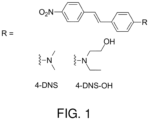
- the molecular probe comprises a 4-nitrostilbene moiety, such as according to the formula wherein R is selected from referred to as 4-DNS, referred to as 4-DNS-OH, and an -N-R'R" moiety functionalized with a member selected from the group of: an alkyl, an alkenyl, an alkynyl, an alkyl halides, a thioalkyl, a hydroxyalkyl, an alkyl phosphate, an alkyl phosphoric, an alkyl boronate, an alkyl boronic, a carboxylic acid, a carboxylate, a sulfonic acid, a sulfonate, a silano, and combinations thereof.
- Using a 4-nitrostilbene moiety can be advantageous because they can provide an environmentally sensitive photoluminescence.
- the 4-nitrostilbene based species can be used for the detection of hydrocarbons in a sample.
- the molecular probe is solvatochromic and/or solvatokinetic.
- a solvatochromic and/or solvatokinetic molecular probe can be particularly sensitive to the environment so as to change photoluminescent properties upon exposure to hydrocarbons.
- the molecular probe is immobilized on a hydrophobic substrate, such as a polyvinylidene fluoride substrate.
- a hydrophobic substrate such as a polyvinylidene fluoride substrate.
- An immobilized form of the molecular probe is useful to provide for a portable format for performing the method which does not require much user training.
- Polyvinylidene fluoride can possibly aid in maintaining the molecular probe's environmental sensitivity to a liquid sample.
- the sample is water, soil, or an extract thereof. It is desirable to detect the contamination of water and soil with hydrocarbons.
- the method includes estimating a hydrocarbon content of the sample based on the photoluminescence. Such estimation can provide a user with more specific information to determine whether the sample is suitable for certain purposes such as drinking, cooking, and bathing.
- the sample is contacted to the molecular probe by dipping the substrate into the sample or dropping the sample onto the substrate or spraying the substrate with the sample. Wiping and swabbing are also possible. Dipping, dropping, wiping, swabbing, or spraying can be advantageous in that they lead to adequate contact of the molecular probe and the sample, and can be performed by users without extensive training.
- the molecular probe can be contacted to the sample by floating a substrate including the immobilized molecular probe on a sample, such floating possibly providing contact between the molecular probe and an extracted hydrocarbon contaminant in an extract/solvent layer at the top of an aqueous sample.
- the method includes determining a signal, a brightness, a brightness ratio (such as taken at two wavelengths), a luminance, a photoluminescence quantum yield, a spectrum, and/or a photoluminescence kinetics such as a lifetime of the photoluminescence; the determination being of the molecular probe in contact or after contact with the sample.
- a brightness ratio such as taken at two wavelengths
- a luminance such as taken at two wavelengths
- a photoluminescence quantum yield such as a spectrum
- a photoluminescence kinetics such as a lifetime of the photoluminescence
- a portable device such as a smartphone, digital camera, tablet, or mobile communication and computing device, collects the photoluminescence and determines whether the photoluminescence is indicative of the hydrocarbon contamination; the portable device comprising optionally a lens and/or a fiberoptic for collecting the photoluminescence.
- the use of a portable device can advantageous for allowing the method to be performed in remote areas.
- a lens and/or fiberoptic can be advantageous for conveniently allowing the photoluminescence to be collected.
- the method also includes exciting the molecular probe with an ultraviolet or visible light source such as a camera flash, a LED, a laser, or an incandescent light.
- an ultraviolet or visible light source such as a camera flash, a LED, a laser, or an incandescent light. Exciting the molecular probe with such means is advantageous in that it provides a way to generate the photoluminescence.
- the method also includes comparing the photoluminescence to a calibration; such as comparing a signal, such as the luminescence, to a reference (a reference being for example stored data or a reference spot on the test strip). It can be advantageous to have a comparison so as to account for and possibly correct molecular probe photoluminescence variation that may not be directly caused by hydrocarbons.
- test strip in accordance with independent claim 9 for the detection of hydrocarbon contamination in a sample, including a molecular probe embedded in a substrate and/or immobilized to the substrate, the molecular probe having a photoluminescence which is environmentally sensitive to hydrocarbon contaminated sample.
- the test strip can be advantageous for being portable, inexpensive, and easily used.
- the molecular probe is environmentally sensitive to viscosity and/or polarity.
- a molecular probe that is particularly sensitive to viscosity and/or polarity is advantageous because these properties can be impacted by the presence of hydrocarbons.
- the molecular probe has an accessible twisted intramolecular charge transfer state, the twisted intramolecular charge transfer state inducing less photoluminescence than another state, such as a planar state.
- a probe with a twisted intramolecular charge transfer state can be advantageous because such states can be variably accessible depending on the environment of the molecular probe, and/or such states can undergo environmentally sensitive processes.
- the environmental sensitivity of the molecular probe can affect the photoluminescence of the molecular probe, so that the photoluminescence can be used to determine if the sample is indicative of hydrocarbons.
- the molecular probe is a molecular rotor.
- a molecular probe which is a molecular rotor can be particularly environmentally sensitive, such as to viscosity of the sample.
- the molecular probe comprises a 4-nitrostilbene moiety, such as according to the formula wherein R is selected from referred to as 4-DNS, referred to as 4-DNS-OH, and an -N-R'R" moiety functionalized with a member selected from the group of: an alkyl, an alkenyl, an alkynyl, an alkyl halides, a thioalkyl, a hydroxyalkyl, an alkyl phosphate, an alkyl phosphoric, an alkyl boronate, an alkyl boronic, a carboxylic acid, a carboxylate, a sulfonic acid, a sulfonate, a silano, and combinations thereof.
- Using a 4-nitrostilbene moiety can be advantageous because they can provide an environmentally sensitive photoluminescence.
- the 4-nitrostilbene based species can be used for the detection of hydrocarbons in a sample.
- the molecular probe is solvatochromic and/or solvatokinetic.
- a solvatochromic and/or solvatokinetic molecular probe can be particularly sensitive to the environment so as to change photoluminescent properties upon exposure to hydrocarbons.
- the molecular probe is immobilized on a hydrophobic substrate, such as a polyvinylidene fluoride substrate; and/or the molecular probe is embedded in a hydrophobic matrix, such as a polyvinylidene fluoride matrix, on the substrate.
- a hydrophobic substrate such as a polyvinylidene fluoride substrate
- the molecular probe is embedded in a hydrophobic matrix, such as a polyvinylidene fluoride matrix, on the substrate.
- An immobilized form of the molecular probe is useful to provide for a portable format for performing the method which does not require much user training.
- Polyvinylidene fluoride can possibly minimally reduce the molecular probe's environmental sensitivity to a liquid sample.
- the test strip also includes a reference photoluminescent species for comparison to the photoluminescence of the molecular probe; the photoluminescence of the reference species being optionally relatively environmentally insensitive.
- a reference can provide more information to determine whether the sample is contaminated with hydrocarbons, and may allow for correction of other effects that may influence the photoluminescence.
- the test strip comprises multiple spots and/or lines of photoluminescent species including the molecular probe. Multiple spots can provide for collection of more photoluminescence, possibly allowing for comparison of results, acquisition of more data, and the like, for more robust sampling and more reliable results.
- the molecular probe is immobilized to a fairly large area of the substrate, such as at least 1 cm 2 , at least 2 cm 2 , or at least 4 cm 2 , and/or more than 90% of the area of the test strip, and/or the entire surface of the substrate and/or test strip. This can be advantageous for providing greater sensitivity, such as an elevated (e.g. brighter) signal, particularly in the presence of a hydrocarbon.
- the test strip is for testing water and/or soil, such as for directly testing a liquid extract thereof.
- Such detection is advantageous in that it does not require extensive user training or sample work-up.
- microenvironment and “environment” may be used interchangeably in certain contexts, particularly when referring to the "environment” of a molecular probe.
- the terms “dye,” and “indicator” may be used, in context, synonymously with “molecular probe” particularly when referring to a nonpolymeric species that has environmentally sensitive photoluminescence.
- a molecular probe which is grafted to a substrate, as described herein, is to be regarded as a molecular probe.
- Molecular probes may be grafted, embedded, and/or adsorbed, for example, to polymeric substrates.
- DNS may be used, in context, synonymously, for 4-DNS.
- DNS-OH may be used, in context, synonymously, for 4-DNS-OH.
- photoluminescence is used as a general term as understood by a skilled person to include fluorescence.
- the photoluminescence mechanism is a fluorescence mechanism.
- TPH herein may refer to total petroleum hydrocarbon; herein the term “PAH” can refer to polycyclic aromatic hydrocarbons; “PH” can refer to petroleum hydrocarbons; “FOG” can refer to fats, oil and grease.
- hydrocarbons can refer to relatively viscous hydrocarbons such as those (including mixtures) having a viscosity approximately at least similar to or greater than liquid kerosene at a similar temperature, particularly around room temperature, e.g. room temperature ⁇ 10 °C.
- Fig. 7(A) shows the photoluminescence of test strips exposed to 0 ppm, 5 ppm, and 50 ppm total petroleum hydrocarbon (TPH) in water, according to embodiments described herein.
- a test strip that includes an immobilized photoluminescent molecular probe on a substrate can become more luminescent upon exposure to a sample of hydrocarbon contaminated water.
- Fig. 7(B) illustrates, according to embodiments described herein, photoluminescence collected from sample(s).
- Fig. 7(B) can illustrate a luminescence ratio versus TPH.
- To contact the sample with the molecular probe one can immerse the test strip in the sample (e.g.
- test strip can be paper-dried, and the photoluminescence collected. It is also possible to extract the hydrocarbons using a volatile solvent, and contacting the extraction to the test strip.
- Fig. 5(B) illustrates, according to embodiments described herein, a photoluminescence collected from molecular probe(s) that have been in contact with sample(s).
- a calibration can be used, such as one obtained by exposing the test strip to known concentrations of hydrocarbons, and collecting photoluminescence.
- the calibration can be in tabular and/or functional form, for example.
- an extraction of a water sample can be done and the extraction can be contacted to the molecular probe.
- the extraction solvent can be a light hydrocarbon such as cyclohexane and/or pentane, or the like.
- the volumes of the water sample and extraction solvent can be optionally predetermined/known. It can be possible to determine the hydrocarbon content in the water sample when the hydrocarbon content of the extract (which may be reduced in volume by evaporation or the like) is determined. It is possible to dilute samples, such as highly contaminated samples, or extracts of high hydrocarbon content, such as before contacting them with the molecular probe, which may increase accuracy.
- Fig. 1 shows molecular probes, according to embodiments described herein.
- the photoluminescence properties of a molecular rotors DNS and DNS-OH (4-DNS-OH or 2-[ethyl[4-[2-(4-nitrophenyl)ethenyl]phenyl]amino]ethanol) can be particularly useful for detecting hydrocarbons in water.
- DNS and 4-DNS-OH can be regarded as a push-pull based stilbene exhibiting strong fluorescence emissions on highly viscous microenvironments. If viscosity decreases, molecular twisting in the excited state can allow access to a TICT (twisted intramolecular charge transfer) state, from which the molecular probe can deactivate via radiationless pathways.
- TICT twisted intramolecular charge transfer
- the molecular probe when the 4-DNS-OH is in a free state, such as in a low viscosity environment, including possibly immobilized on a substrate without analyte, the molecular probe may have relatively low photoluminescence possibly due to the high degree of freedom. In the presence of PH, relatively high viscosity may hinder the molecular twisting, thus increasing photoluminescence.
- the TICT state can be variably accessible, such as variably accessible depending on the presence of hydrocarbons. Viscous nonpolar hydrocarbons may particularly hinder the accessibility of a TICT state.
- Fig. 3 shows, according to embodiments described herein, (normalized) photoluminescence of a molecular probe, such as, particularly, 4-DNS-OH test strips after dipping in various liquids, as a means to contact sample with the molecular probe.
- Photoluminescence of 4-DNS-OH may be increased in viscous nonpolar hydrocarbons.
- Other family members of DNS based molecular probes may display similar trends and also be suitable in the disclosed invention, which may exploit environmentally sensitive photoluminescence.
- Other molecular probes that have a variably accessible TICT state may also be suitable.
- hydrogen bonding interaction of polar solvents with the free electron pair of the amino group of 4-DNS-OH may favor a radiationless intramolecular charge transfer that inhibits the photoluminescence.
- hydrogen bonding at the amino group can weaken the electron donating strength of that functional group, and may slow down the intramolecular charge transfer. This can weaken the fluorescence.
- Strong hydrogen bonds of N and/or O atoms of the molecular probe can also dissipate excitation energy via non-fluorescent vibrational pathways, thus possibly depriving the system of a possibility to relax by emission of a photon. Large amounts of water may inhibit fluorescence even if there is a large amount of oil analyte that is present.
- the molecular probe can be embedded in a substrate and/or immobilized to a substrate, such as a hydrophobic polymer.
- a substrate such as a hydrophobic polymer.
- This may protect the molecular probe from polar solvent (e.g. water) interactions. It can also allow for the hydrocarbon of the sample to contact the molecular probe, such as by diffusion.
- the use of a substrate can confer the system a solid support to work with as a convenient test-strip.
- PVDF polyvinylidene fluoride
- a porous PVDF substrate is particularly contemplated, e.g. to allow oil adsorption while having negligible interaction with water.
- Table 1 shows maximum emission wavelengths and FEF (fluorescence enhancement factor) of 4-DNS-OH in solution when excited at 400 nm, according to embodiments described herein.
- Fig. 2 shows normalized fluorescence emission of 4-DNS-OH PVDF polymer, wetted with different solvents, according to embodiments described herein.
- Films of PVDF were dip coated with a toluene solution of 4-DNS-OH. After toluene evaporation, the films showed background fluorescence band at 657 nm. Different hydrocarbon aliquots were then added to this film and the emission spectra were recorded. As expected, the different hydrocarbons showed enhancements of the fluorescence bands as well as some bathochromic shifts, while other low weight hydrocarbons showed small signals, and polar liquids showed negligible changes.
- 40 ⁇ 40 mm polivynilidene fluoride films (Amersham Hybond P0.2 PVDF) can be dip coated for 5 seconds in 4 mL 4-DNS-OH solution (e.g. 1 ⁇ 10 -3 M toluene) on a Petri dish. After taking the strip out of the solution, the excess of liquid can be absorbed in a paper from one of the film borders, and the toluene was allowed to evaporate while the film is suspended horizontally from its four corners.
- 4-DNS-OH solution e.g. 1 ⁇ 10 -3 M toluene
- Fig. 4(B) is representative of photoluminescence from 4-DNS and/or 4-DNS-OH immobilized on PVDF, in the absence and presence of hydrocarbons, according to embodiments described herein. Under these immobilized conditions, the compound 4-DNS has an emission maximum at about 646 nm, and the emission from 4-DNS-OH has a maximum at 657 nm. It is possible to prepare the test strips by exposing the substrates for 3 seconds in 1 mM molecular probe solution in toluene, and allowing them to subsequently dry for 5 minutes, for example.
- Fig. 4(A) shows, according to embodiments described herein, a way that the sample can be contacted with an immobilized molecular probe.
- the substrate can be floated on a sample, such as to absorb a hydrocarbon layer present at the air/liquid interface; the hydrocarbon layer can be an extraction of a mostly aqueous sample, for example.
- a portion of light hydrocarbon, such as cyclohexane, can be added to a sample, such as a water based sample; the mixture can be agitated, and allowed to settle; a substrate that includes the immobilized molecular probe can be floated on the surface of the mixture, removed, optionally dried, and the photoluminescence collected from the molecular probe immobilized/embedded on the substrate. By floating the substrate, the molecular probe can be contacted by the hydrocarbons extracted from an aqueous sample or the like.
- Fig. 4(B) illustrates, according to embodiments described herein, immobilized photoluminescent molecular probes on substrates that have been exposed to varying concentrations of diesel fuel in water. Contact with greater concentration of diesel fuel can result in an increase of photoluminescence (e.g. left to right of Fig. 4(B) ).
- Figs. 5(A) and 5(B) illustrates, according to embodiments described herein, a photoluminescence collected from molecular probes that have been in contact with sample(s).
- Figs. 5(A) and 5(B) can illustrate, according to embodiments described herein, a photoluminescence that can be collected from immobilized molecular probes that have been contacted with varying levels of hydrocarbon contaminated sample, particularly diesel in water.
- Figs. 4(A), 4(B) , 5(A), and 5(B) support that it is possible to have a limit of detection of approximately 0.6% diesel in cyclohexane when using 365 nm excitation with 4-DNS immobilized on PVDF.
- the examples also support using a "floating substrate" to contact the sample with the molecular probe.
- Fig. 8(A) illustrates, according to embodiments described herein, immobilized photoluminescent molecular probes on substrates for the detection of diesel.
- Fig. 8(A) shows an increase in luminance upon contact of the molecular probe with diesel, which can be diesel extracted from an aqueous sample.
- Figs. 5(A) and 5(B) illustrate, according to embodiments described herein, a photoluminescence collected from molecular probes that have been in contact with sample(s).
- Figs 5(A) and 5(B) can illustrate, according to embodiments described herein, an immobilized molecular probe used to detect diesel in water after extraction of the diesel by use of light hydrocarbons such as pentane and/or cyclohexane. It can be convenient to utilize extraction and to contact the extraction with the molecular probe rather than have a contaminated water sample directly contact the molecular probe. Such extractions can aid in quantitative determination of water contamination.
- 5(A) and 5(B) illustrate, according to an embodiment, the photoluminescence signal of 4-DNS-OH immobilized to a substrate, with excitation at 460 nm using a 10 mW LED and 480 nm low pass filter (after exposure to various concentrations of diesel in cyclohexane).
- the photoluminescence can be collected through a 525/50 nm bandpass. From Figs. 13 and 14, it is seen that low concentrations (e.g. 0-5%) of hydrocarbons may provide lower error, e.g. 0.2%, than higher concentration ( e.g. 5- 50%) which may provide higher error, e.g. 2.7%.
- samples may be diluted so as to increase accuracy of a quantitative determination of hydrocarbon contamination.
- Figs. 5(A) and 5(B) illustrate, according to embodiments described herein, that the method can be performed on liquid extractions of samples, such as extraction from water or soil.
- a reference such as a calibration curve can be generated, such as one illustrated by Figs. 5(A) and 5(B) (B), for a hydrocarbon extracted from an aqueous sample, such as an extraction using a light hydrocarbon such as pentane and/or cyclohexane.
- a sample may be a soil sample.
- a molecular probe may be contacted with the sample by using a molecular probe immobilized on a substrate, and directly contacting a soil sample with the substrate.
- a test strip may be dragged, wiped, or swabbed across a soil sample.
- Fig. 10(B) illustrates, according to embodiments described herein, photoluminescence collected from molecular probes exposed to samples.
- Fig. 10(B) can illustrate the photoluminescence from test strips of immobilized molecular probes which have been in contact with samples prepared by pentane and/or cyclohexane extraction of hydrocarbon contaminated soil.
- Fig. 10(A) illustrates, according to embodiments described herein, photoluminescence collected from molecular probes that have been in contact with samples.
- Fig. 10(A) can depict the photoluminescence from test strips of immobilized molecular probes which have been in contact with soil samples, such as direct contact.
- the test strip can be dragged, wiped, or swabbed across a soil sample and subsequently rinsed.
- the test strip can be in direct contact with the soil sample for 30-60 seconds and subsequently rinsed with water, such as to ensure soil particles are significantly removed the surface of the test strip.
- the photoluminescence can be a qualitative test for the presence of hydrocarbon contamination.
- Fig. 6 illustrates, according to embodiments described herein, a photoluminescence of a molecular probe after contact with a sample(s).
- the sample can be a cyclohexane extraction of lubricating oil from a soil or water sample, which is contacted with a test strip.
- Fig. 6 can be representative of a reference such as a calibration.
- Fig. 5(A) illustrates, according to embodiments described herein, a photoluminescence of a molecular probe after contact with a sample(s).
- Fig. 5(A) can be representative of a reference such as a calibration of a test strip.
- the test strip can have a dynamic range up to a concentration of hydrocarbon (e.g. lubricating oil) at which the immobilized molecular probe is saturated, such as up to 3%.
- the saturation concentration can depend, for example, on the time of contact of the test strip with the molecular probe, the size of the test strip, the test strip's capacity for adsorbing liquid, and the volume of sample.
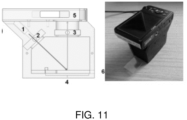
- Fig. 11 illustrates, according to embodiments described herein, a portable electronic device for the detection of hydrocarbon contamination in a sample.
- a dark chamber can be used for reducing background signal.
- the device can include light source 1 such as an LED, a filter 2 such as a diffuser and/or short pass filter, such as a 460 nm short pass, for filtering the excitation light, a filter 3 for filtering the collected photoluminescence such as a 550 nm band pass filter, a test strip 4, and a portable device (such as a smartphone, tablet, digital camera, and/or mobile communication and computing device).
- the portable device can include a lens and camera, for example.
- the portable device can include a processor and memory for logic and data processing, such as for determining whether the photoluminescence is indicative of a hydrocarbon contaminated sample.
- Kerosene was commercially available at Sigma Aldrich. Gasoline (E5 grade) and diesel were obtained from a HEM gas station (Berlin-Adlershof, January 2016). Biodiesel was obtained from the Center of Documentation, Research and Experimentation on Accidental Water Pollution (Cedre, Brest, France, June 2016).
- test strips 40 ⁇ 40 mm polyvinylidene fluoride films (Amersham Hybond P0.2 PVDF) were dip coated during 5 seconds in 4 mL 4-DNS-OH solution (1 ⁇ 10 -3 M toluene) on a Petri dish. After taking the strip out of the solution, the excess of liquid was absorbed in a paper from one of the film borders, and the toluene was allowed to evaporate while the film was suspended horizontally from its four corners. For characterization purposes, several strips (400 mg in total) were washed 3 times with 3 mL of dichlorometane to extract all 4-DNS-OH. After measuring the absorbance of the resulting solution, the amount of molecular probe was determined to be of 1.2 mg ⁇ cm 2 .
- the method can exploit advantageously the capacity of the test strip to adsorb hydrocarbons without interacting with more polar substances, such as possibly utilizing a hydrophobic substrate to keep water from the environment of the molecular probe immobilized on /embedded in the substrate.
- hydrocarbons Once hydrocarbons are adsorbed, such as to the substrate and/or in a porous substrate, they can possibly interact as freedom constrainers with the molecular probe.
- the adsorbed hydrocarbon can hinder the molecular probe from accessing the twisted intramolecular charge transfer state.
- Fig. 7(A) is representative of a result, the test strip being illuminated with UV light in a UV cabinet.
- Figure 1 can be illustrative of 4-DNS-OH test strips: (left) blank; (middle and right) after dipping test strips into drinking water contaminated with 5 ppm TPH and 50 ppm of TPH.
- Fig. 7(B) is representative of a plot of measured luminance ( Y s ) vs concentration of TPH in drinking water.
- a sample strip can be added to a water sample (e.g. 250 mL with 5 to 50 ppm of PH). The sample was shaken vigorously for one minute and then, after paper-drying the strip, the photoluminescence collected. Additionally/alternatively, the extraction using volatile solvents is an option, particularly for precise results.
- a water sample e.g. 250 mL with 5 to 50 ppm of PH.
- Fig. 5(B) is illustrative of a calibration curve.
- a test strip of a molecular probe immobilized on a PVDF film can become inhomogeneously transparent due to the excess of analyte, which can possibly reduce the light absorption efficiency. It is therefore sometimes beneficial to dilute the sample to get more precise readings.
- 1/10 or 1/100 v/v cyclohexane dilutions are particularly contemplated.
- the test-strip may be washed with water and gently rubbed with absorbing paper to eliminate soil particles prior to the measurement.
- the molecular probe immobilized test strips can overcome many technical problems, allowing concentration of TPH in water to be quickly determined on-field, with the use of inexpensive technology (e.g. smartphone or tablet or digital camera) in both a qualitative (quickly dipping the strip in water and measuring it afterwards, without TPH extraction) and quantitative fashion (assisted with environmentally friendly solvents like cyclohexane).
- inexpensive technology e.g. smartphone or tablet or digital camera
- a polymeric strip containing a 4-DNS-OH molecular probe that becomes fluorescent in the presence of TPH is disclosed. This fluorescence is proportional to the amount of TPH in the sample.
- a disclosed system is a test strip based system which simplifies the problem of detection TPH, TOG and FOG in water, making it possible to do on-field analysis of waters in oceans, lakes, rivers and water streams coming in and out of industries, as well as soil. Other laboratory based methods may require sampling, shipment to the laboratory and subsequent analysis. Thus, the disclosed invention saves time and cost.
Landscapes
- Life Sciences & Earth Sciences (AREA)
- Health & Medical Sciences (AREA)
- Chemical & Material Sciences (AREA)
- Physics & Mathematics (AREA)
- Biochemistry (AREA)
- Analytical Chemistry (AREA)
- Pathology (AREA)
- Immunology (AREA)
- General Physics & Mathematics (AREA)
- General Health & Medical Sciences (AREA)
- Engineering & Computer Science (AREA)
- Medicinal Chemistry (AREA)
- Food Science & Technology (AREA)
- Environmental & Geological Engineering (AREA)
- Remote Sensing (AREA)
- General Life Sciences & Earth Sciences (AREA)
- Geology (AREA)
- Nuclear Medicine, Radiotherapy & Molecular Imaging (AREA)
- Biophysics (AREA)
- Molecular Biology (AREA)
- Chemical Kinetics & Catalysis (AREA)
- Plasma & Fusion (AREA)
- Investigating, Analyzing Materials By Fluorescence Or Luminescence (AREA)
- Investigating Or Analysing Materials By The Use Of Chemical Reactions (AREA)
Claims (16)
- Verfahren zum Nachweis der Gesamtverunreinigung durch Erdölkohlenwasserstoffe (TPH) in einer Probe von Wasser oder Boden oder in einem Extrakt davon, wobei das Verfahren Folgendes aufweist:Inkontaktbringen einer Probe mit einer molekularen Sonde, wobei die molekulare Sonde eine Photolumineszenz aufweist, die für eine Viskosität und/oder eine Polarität der Probe empfindlich ist;Aufnehmen der Photolumineszenz der molekularen Sonde;Bestimmen, ob die Photolumineszenz auf eine mit Kohlenwasserstoffen kontaminierte Probe hinweist;
dadurch gekennzeichnet, dassdie molekulare Sonde eine 4-Nitrostilbeneinheit aufweist gemäß der Formel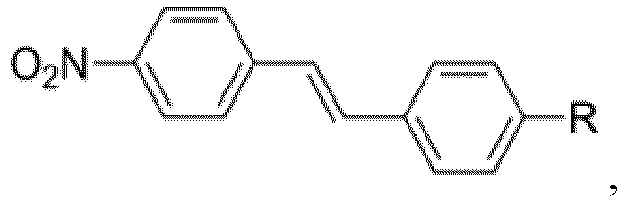 wobei R ausgewählt ist aus
 bezeichnet als 4-DNS-OH, undeine -N-R'R"-Einheit, die mit einem Element funktionalisiert ist, das ausgewählt ist aus der Gruppe: einem Alkyl, einem Alkenyl, einem Alkinyl, einem Alkylhalogenid, einem Thioalkyl, einem Hydroxyalkyl, einem Alkylphosphat, einer Alkylphosphorsäure, einem Alkylboronat, einer Alkylboronsäure, einer Carbonsäure, einem Carboxylat, einer Sulfonsäure, einem Sulfonat, einem Silano und Kombinationen davon.
 - Verfahren nach Anspruch 1, wobei
die molekulare Sonde einen verdrehten intramolekularen Ladungstransferzustand aufweist, wobei der verdrehte intramolekulare Ladungstransferzustand weniger Photolumineszenz als ein anderer Zustand, wie beispielsweise ein planarer Zustand, induziert. - Verfahren nach einem der vorhergehenden Ansprüche, wobei die molekulare Sonde ein molekularer Rotor ist.
- Verfahren nach einem der vorhergehenden Ansprüche, wobei
die molekulare Sonde solvatochrom und/oder solvatokinetisch ist. - Verfahren nach einem der vorhergehenden Ansprüche, wobei
die molekulare Sonde auf einem hydrophoben Substrat immobilisiert ist, gegebenenfalls einem hydrophoben Substrat, das zur Adsorption von 4-DNS-OH geeignet ist. - Verfahren nach einem der vorhergehenden Ansprüche, das weiterhin Folgendes aufweist Schätzen des Kohlenwasserstoffgehalts der Probe, basierend auf der Photolumineszenz.
- Verfahren nach einem der vorhergehenden Ansprüche, das weiterhin Folgendes aufweist
Bestimmen eines Signals, einer Helligkeit, eines Helligkeitsverhältnisses, einer Leuchtdichte, einer Photolumineszenz-Quantenausbeute, eines Spektrums und/oder einer Photolumineszenz-Kinetik, wie z.B. einer Lebensdauer der Photolumineszenz; wobei das Bestimmen in Kontakt oder nach Kontakt der molekularen Sonde mit der Probe erfolgt. - Verfahren nach einem der vorhergehenden Ansprüche, wobeieine tragbare Vorrichtung, wie z. B. eine Digitalkamera, ein Smartphone, ein Tablet oder eine mobile Kommunikations- und Computervorrichtung, die Photolumineszenz aufnimmt und bestimmt, ob die Photolumineszenz auf die Kohlenwasserstoffverunreinigung hinweist; wobei die tragbare Vorrichtung optional eine Linse und/oder eine Faseroptik zum Aufnehmen der Photolumineszenz aufweist,wobei das Verfahren Folgendes aufweistAnregen der molekularen Sonde mit einer ultravioletten oder sichtbaren Lichtquelle wie einem Kamerablitz, einer LED, einem Laser oder einer Glühlampe;
undVergleichen der Photolumineszenz mit einer Kalibrierung, z. B. Vergleichen eines Signals, wie der Lumineszenz, mit einer Referenz. - Teststreifen zum Nachweis einer Gesamtverunreinigung durch Petroleumkohlenwasserstoffe (TPH) in einer Probe von Wasser oder Boden oder in einem Extrakt davon, der Folgendes aufweisteine molekulare Sonde, die in ein Substrat des Teststreifens eingebettet und/oder auf dem Substrat des Teststreifens immobilisiert ist, wobei die molekulare Sonde eine Photolumineszenz aufweist, die gegenüber einer mit Kohlenwasserstoff verunreinigten Probe umgebungsempfindlich ist;
dadurch gekennzeichnet, dassdie molekulare Sonde eine 4-Nitrostilbeneinheit aufweist gemäß der
Formel wobei R ausgewählt ist aus
 eine -N-R'R"-Einheit, die mit einem Element funktionalisiert ist, das ausgewählt ist aus der Gruppe: einem Alkyl, einem Alkenyl, einem Alkinyl, einem Alkylhalogenid, einem Thioalkyl, einem Hydroxyalkyl, einem Alkylphosphat, einer Alkylphosphorsäure, einem Alkylboronat, einer Alkylboronsäure, einer Carbonsäure, einem Carboxylat, einer Sulfonsäure, einem Sulfonat, einem Silano und Kombinationen davon; undwobei die molekulare Sonde umgebungsempfindlich gegenüber der Viskosität und/oder der Polarität der Probe ist.
 - Teststreifen nach Anspruch 9, wobei
die molekulare Sonde einen zugänglichen verdrehten intramolekularen Ladungstransferzustand aufweist, wobei der verdrehte intramolekulare Ladungstransferzustand weniger Photolumineszenz als ein anderer Zustand, wie beispielsweise ein planarer Zustand, induziert. - Teststreifen nach einem der Ansprüche 9 oder 10,
wobei die molekulare Sonde ein molekularer Rotor ist. - Teststreifen nach einem der Ansprüche 9-11,
wobei
die molekulare Sonde solvatochrom und/oder solvatokinetisch ist. - Teststreifen nach einem der Ansprüche 9-12, wobei
die molekulare Sonde auf einem hydrophoben Substrat, wie einem Polyvinylidenfluorid-Substrat, immobilisiert ist; und/oder die molekulare Sonde in eine hydrophobe Matrix, wie eine Polyvinylidenfluorid-Matrix, auf dem Substrat eingebettet ist. - Teststreifen nach einem der Ansprüche 9-13,
ferner aufweisend
eine photolumineszierende Referenzspezies zum Vergleich mit der Photolumineszenz der molekularen Sonde; wobei die photolumineszierende Referenzspezies gegebenenfalls relativ umgebungsunempfindlich ist. - Teststreifen nach einem der Ansprüche 9-14,
wobei
der Teststreifen mehrere Flecken und/oder Linien von photolumineszenten Spezies aufweist, einschließlich der molekularen Sonde. - Teststreifen nach einem der Ansprüche 9-15,
wobei
der Teststreifen zur direkten Untersuchung eines Flüssigextrakts aus einer Wasser- oder Bodenprobe dient.
Applications Claiming Priority (1)
| Application Number | Priority Date | Filing Date | Title |
|---|---|---|---|
| PCT/EP2017/074876 WO2019063100A1 (en) | 2017-09-29 | 2017-09-29 | DETECTION OF CONTAMINATION BY HYDROCARBONS IN SOIL AND WATER |
Publications (2)
| Publication Number | Publication Date |
|---|---|
| EP3688457A1 EP3688457A1 (de) | 2020-08-05 |
| EP3688457B1 true EP3688457B1 (de) | 2025-01-08 |
Family
ID=60019888
Family Applications (1)
| Application Number | Title | Priority Date | Filing Date |
|---|---|---|---|
| EP17780067.9A Active EP3688457B1 (de) | 2017-09-29 | 2017-09-29 | Nachweis von kohlenwasserstoffverunreinigung im boden und wasser |
Country Status (5)
| Country | Link |
|---|---|
| US (1) | US11561175B2 (de) |
| EP (1) | EP3688457B1 (de) |
| CN (1) | CN111492241B (de) |
| CA (1) | CA3074622C (de) |
| WO (1) | WO2019063100A1 (de) |
Families Citing this family (10)
| Publication number | Priority date | Publication date | Assignee | Title |
|---|---|---|---|---|
| US20210208070A1 (en) * | 2017-09-29 | 2021-07-08 | Bundesrepublik Deutschland, vertreten durch die Bundesministerin für Wirtschaft und Energie | Determination of adulterated diesel fuel using an environmentally sensitive photoluminescent molecular probe |
| CA3074622C (en) | 2017-09-29 | 2024-01-02 | Raul Gotor | Detection of hydrocarbon contamination in soil and water |
| WO2021011755A1 (en) * | 2019-07-16 | 2021-01-21 | Saudi Arabian Oil Company | Multipurpose microfluidics devices for rapid on-site optical chemical analysis |
| US11773715B2 (en) | 2020-09-03 | 2023-10-03 | Saudi Arabian Oil Company | Injecting multiple tracer tag fluids into a wellbore |
| CN112710638B (zh) * | 2020-12-19 | 2022-05-13 | 华中科技大学 | 基于光致发光光谱全面解析的煤质快速检测方法 |
| US11660595B2 (en) | 2021-01-04 | 2023-05-30 | Saudi Arabian Oil Company | Microfluidic chip with multiple porosity regions for reservoir modeling |
| US11534759B2 (en) | 2021-01-22 | 2022-12-27 | Saudi Arabian Oil Company | Microfluidic chip with mixed porosities for reservoir modeling |
| US12253467B2 (en) | 2021-12-13 | 2025-03-18 | Saudi Arabian Oil Company | Determining partition coefficients of tracer analytes |
| US12000278B2 (en) | 2021-12-16 | 2024-06-04 | Saudi Arabian Oil Company | Determining oil and water production rates in multiple production zones from a single production well |
| CN118534141B (zh) * | 2024-05-21 | 2024-12-06 | 广东景和检测有限公司 | 一种土壤和水质污染物检测装置 |
Family Cites Families (19)
| Publication number | Priority date | Publication date | Assignee | Title |
|---|---|---|---|---|
| US3130218A (en) * | 1961-10-10 | 1964-04-21 | Gen Aniline & Film Corp | Process for the preparation of 4-nitrostilbene carbonitriles |
| WO1988009798A1 (en) | 1987-06-09 | 1988-12-15 | Peck Dana P | Immunoassay for aromatic ring containing compounds |
| CA2029410A1 (en) * | 1990-11-06 | 1992-05-07 | Irwin Ray Supernaw | Method for determining the producibility of a hydrocarbon formation |
| DE69332084T2 (de) | 1992-12-01 | 2003-10-09 | Ensys Environmental Products, Inc. | Eine petroleum immuntestmethode und ihre komponenten |
| DE4314198C2 (de) | 1993-04-30 | 1996-02-22 | Kurt Dipl Ing Liebke | Vorrichtung zur Überwachung der Oberfläche eines Gewässers auf Luminophore enthaltende Verschmutzungen |
| DE19619226A1 (de) | 1996-05-13 | 1997-11-20 | Hoechst Ag | Sensorelement und Sensor zur Bestimmung von Ozonkonzentrationen |
| JPH1038878A (ja) * | 1996-07-30 | 1998-02-13 | Zenkoku Sekiyu Kyokai | 軽油中の周辺油種の定量試験法 |
| JP2005504320A (ja) | 2001-09-25 | 2005-02-10 | プリオニクス アーゲー | プリオンタンパク質の検出のための試験ストリップ |
| US8129190B2 (en) * | 2006-11-17 | 2012-03-06 | Applied Nanotech Holdings, Inc. | Tagged petroleum products and methods of detecting same |
| CA2687375C (en) * | 2007-05-18 | 2017-08-29 | The Government Of The United States Of America As Represented By The Secretary Of The Department Of Health And Human Services, Centers For Disease Control And Prevention | Primers and probes for the detection of streptococcus pneumoniae |
| US8081313B2 (en) * | 2007-05-24 | 2011-12-20 | Airbus Operations Limited | Method and apparatus for monitoring gas concentration in a fluid |
| GB0813277D0 (en) * | 2008-07-18 | 2008-08-27 | Lux Innovate Ltd | Method to assess multiphase fluid compositions |
| US9802183B2 (en) * | 2012-01-18 | 2017-10-31 | Charles D. FATOR | Diffusion/chemical reaction/spectrometric device for the analysis of petroleum hydrocarbons in environmental and geological formation samples |
| WO2014069897A1 (ko) | 2012-11-01 | 2014-05-08 | 한양대학교 산학협력단 | 탄화수소 식별 센서, 그 제조방법 및 용도 |
| RU2015120176A (ru) * | 2012-12-11 | 2017-01-19 | Клариент Дайагностик Сервисез, Инк. | Фотоактивированное химическое обесцвечивание красителей |
| GB2529719A (en) | 2014-09-01 | 2016-03-02 | Lancaster University Business Entpr Ltd Lubel | Tracer |
| WO2016064343A1 (en) * | 2014-10-21 | 2016-04-28 | Nanyang Technological University | Membrane protease detection conjugates and their use |
| WO2017019337A1 (en) * | 2015-07-24 | 2017-02-02 | Authentix, Inc. | Determining the quantity of a taggant in a liquid sample |
| CA3074622C (en) | 2017-09-29 | 2024-01-02 | Raul Gotor | Detection of hydrocarbon contamination in soil and water |
-
2017
- 2017-09-29 CA CA3074622A patent/CA3074622C/en active Active
- 2017-09-29 CN CN201780095367.8A patent/CN111492241B/zh active Active
- 2017-09-29 US US16/650,426 patent/US11561175B2/en active Active
- 2017-09-29 EP EP17780067.9A patent/EP3688457B1/de active Active
- 2017-09-29 WO PCT/EP2017/074876 patent/WO2019063100A1/en not_active Ceased
Non-Patent Citations (3)
| Title |
|---|
| CASTRO ANA M. ET AL: "Hydrocarbon in water sensing with PTFE membranes doped with a luminescent Ru(ii) poly(pyridyl) complex", JOURNAL OF MATERIALS CHEMISTRY, vol. 15, no. 27-28, 1 January 2005 (2005-01-01), GB, pages 2952, XP055945499, ISSN: 0959-9428, Retrieved from the Internet <URL:https://pubs.rsc.org/En/content/articlepdf/2005/jm/b501785h> DOI: 10.1039/b501785h * |
| G. CORRADINI MARIA ET AL: "Identifying and selecting edible luminescent probes as sensors of food quality", AIMS BIOPHYSICS, vol. 3, no. 2, 1 January 2016 (2016-01-01), pages 319 - 339, XP055945456, ISSN: 2377-9098, DOI: 10.3934/biophy.2016.2.319 * |
| IBAÑEZ GABRIELA A. ET AL: "Luminescence Sensors Applied to Water Analysis of Organic Pollutants-An Update", SENSORS, vol. 11, no. 12, 1 January 2011 (2011-01-01), pages 11081 - 11102, XP055945459, Retrieved from the Internet <URL:https://www.ncbi.nlm.nih.gov/pmc/articles/PMC3251971/pdf/sensors-11-11081.pdf> DOI: 10.3390/s111211081 * |
Also Published As
| Publication number | Publication date |
|---|---|
| CN111492241B (zh) | 2023-04-18 |
| CA3074622A1 (en) | 2019-04-04 |
| EP3688457A1 (de) | 2020-08-05 |
| CN111492241A (zh) | 2020-08-04 |
| WO2019063100A1 (en) | 2019-04-04 |
| US11561175B2 (en) | 2023-01-24 |
| BR112020005018A2 (pt) | 2020-09-15 |
| CA3074622C (en) | 2024-01-02 |
| US20200232918A1 (en) | 2020-07-23 |
Similar Documents
| Publication | Publication Date | Title |
|---|---|---|
| EP3688457B1 (de) | Nachweis von kohlenwasserstoffverunreinigung im boden und wasser | |
| Danchuk et al. | Optical sensors for determination of biogenic amines in food | |
| Ali et al. | Optical sensing scheme for carbon dioxide using a solvatochromic probe | |
| Schmidt et al. | Detection of PAHs in seawater using surface-enhanced Raman scattering (SERS) | |
| Mohr et al. | Application of chromogenic and fluorogenic reactands in the optical sensing of dissolved aliphatic amines | |
| US9005988B2 (en) | Method to assess multiphase fluid compositions | |
| CN102980852A (zh) | 重金属离子检测片、检测重金属离子的方法、试剂盒和传感器 | |
| WO2018154078A1 (en) | An analytical test substrate as fluorescent probe for performing a detection of an analyte, a portable device for performing such detection and a system thereof | |
| He et al. | Ratiometric Fluorescent Paper‐Based Sensor Based on CdTe Quantum Dots and Graphite Carbon Nitride Hybrid for Visual and Rapid Determination of Cu2+ in Drinks | |
| Kong et al. | In situ detection of thiram in fruits and vegetables by colorimetry/surface-enhanced Raman spectroscopy | |
| Hassoon et al. | In situ fluorimetric determination of pesticides on vegetables | |
| CN115420720B (zh) | 一种基于香豆素型离子液体的纸基传感器及其制备方法与应用 | |
| CN115975641A (zh) | Tb/CdTe比率荧光探针及制备方法与其在诺氟沙星检测中的应用 | |
| Khalid et al. | SMARTPHONES APP AS PORTABLE COLORIMETRIC SENSOR FOR LOW-COST QUANTIFICATION OF SAFRANIN DYE IN AQUEOUS SOLUTIONS. | |
| CN109540852B (zh) | 荧光检测试纸及其制备方法和应用、劣质油脂鉴定方法 | |
| US20210208070A1 (en) | Determination of adulterated diesel fuel using an environmentally sensitive photoluminescent molecular probe | |
| Climent et al. | Mix‐&‐read determination of Mercury (II) at trace levels with hybrid mesoporous silica materials incorporating fluorescent probes by a simple mix‐&‐load technique | |
| CN109900692A (zh) | 绿色高效检测汞离子的凝胶的制备方法及该凝胶的应用 | |
| EP3688460A1 (de) | Nachweis von verfälschtem benzin unter verwendung einer umweltsensiblen photolumineszenten molekularsonde | |
| Zhang et al. | A Novel Red Fluorescent Probe for the “Off‐On‐Off” Detection of Al3+ and F− in Samples of Drinking Water and Toothpaste | |
| BR112020005018B1 (pt) | Fita de teste e método de detecção de contaminação por hidrocarboneto em solo e água | |
| Shen et al. | Multimode Immunochromatography Assay Based on Portable Instruments for Sensitive and Rapid Detection of Carbendazim in Real Samples | |
| CN117761045B (zh) | 一种甲醛显色试纸、其制备方法与应用 | |
| Mansurova et al. | Fluorescent Hydrophobic Test Strips with Sterically Integrated Molecular Rotors for the Detection of Hydrocarbons in Water and Soil with an Embedded Optical Read-Out | |
| US20060144720A1 (en) | Chemical sensors |
Legal Events
| Date | Code | Title | Description |
|---|---|---|---|
| STAA | Information on the status of an ep patent application or granted ep patent |
Free format text: STATUS: UNKNOWN |
|
| STAA | Information on the status of an ep patent application or granted ep patent |
Free format text: STATUS: THE INTERNATIONAL PUBLICATION HAS BEEN MADE |
|
| PUAI | Public reference made under article 153(3) epc to a published international application that has entered the european phase |
Free format text: ORIGINAL CODE: 0009012 |
|
| STAA | Information on the status of an ep patent application or granted ep patent |
Free format text: STATUS: REQUEST FOR EXAMINATION WAS MADE |
|
| 17P | Request for examination filed |
Effective date: 20200224 |
|
| AK | Designated contracting states |
Kind code of ref document: A1 Designated state(s): AL AT BE BG CH CY CZ DE DK EE ES FI FR GB GR HR HU IE IS IT LI LT LU LV MC MK MT NL NO PL PT RO RS SE SI SK SM TR |
|
| AX | Request for extension of the european patent |
Extension state: BA ME |
|
| DAV | Request for validation of the european patent (deleted) | ||
| DAX | Request for extension of the european patent (deleted) | ||
| STAA | Information on the status of an ep patent application or granted ep patent |
Free format text: STATUS: EXAMINATION IS IN PROGRESS |
|
| 17Q | First examination report despatched |
Effective date: 20220728 |
|
| GRAP | Despatch of communication of intention to grant a patent |
Free format text: ORIGINAL CODE: EPIDOSNIGR1 |
|
| STAA | Information on the status of an ep patent application or granted ep patent |
Free format text: STATUS: GRANT OF PATENT IS INTENDED |
|
| INTG | Intention to grant announced |
Effective date: 20240319 |
|
| GRAJ | Information related to disapproval of communication of intention to grant by the applicant or resumption of examination proceedings by the epo deleted |
Free format text: ORIGINAL CODE: EPIDOSDIGR1 |
|
| STAA | Information on the status of an ep patent application or granted ep patent |
Free format text: STATUS: EXAMINATION IS IN PROGRESS |
|
| INTC | Intention to grant announced (deleted) | ||
| GRAP | Despatch of communication of intention to grant a patent |
Free format text: ORIGINAL CODE: EPIDOSNIGR1 |
|
| STAA | Information on the status of an ep patent application or granted ep patent |
Free format text: STATUS: GRANT OF PATENT IS INTENDED |
|
| INTG | Intention to grant announced |
Effective date: 20240829 |
|
| RAP3 | Party data changed (applicant data changed or rights of an application transferred) |
Owner name: BUNDESREPUBLIK DEUTSCHLAND, VERTRETEN DURCH DIEBUNDSMINISTERIN FUER WIRTSCHAFT UND ENERGIE, DIESEVERTRETEN DURCH DEN PRAESIDENTEN DER BUNDES- |
|
| GRAS | Grant fee paid |
Free format text: ORIGINAL CODE: EPIDOSNIGR3 |
|
| GRAA | (expected) grant |
Free format text: ORIGINAL CODE: 0009210 |
|
| STAA | Information on the status of an ep patent application or granted ep patent |
Free format text: STATUS: THE PATENT HAS BEEN GRANTED |
|
| AK | Designated contracting states |
Kind code of ref document: B1 Designated state(s): AL AT BE BG CH CY CZ DE DK EE ES FI FR GB GR HR HU IE IS IT LI LT LU LV MC MK MT NL NO PL PT RO RS SE SI SK SM TR |
|
| REG | Reference to a national code |
Ref country code: GB Ref legal event code: FG4D |
|
| REG | Reference to a national code |
Ref country code: CH Ref legal event code: EP |
|
| REG | Reference to a national code |
Ref country code: DE Ref legal event code: R096 Ref document number: 602017087246 Country of ref document: DE |
|
| REG | Reference to a national code |
Ref country code: IE Ref legal event code: FG4D |
|
| REG | Reference to a national code |
Ref country code: NL Ref legal event code: FP |
|
| REG | Reference to a national code |
Ref country code: LT Ref legal event code: MG9D |
|
| REG | Reference to a national code |
Ref country code: AT Ref legal event code: MK05 Ref document number: 1758633 Country of ref document: AT Kind code of ref document: T Effective date: 20250108 |
|
| PG25 | Lapsed in a contracting state [announced via postgrant information from national office to epo] |
Ref country code: RS Free format text: LAPSE BECAUSE OF FAILURE TO SUBMIT A TRANSLATION OF THE DESCRIPTION OR TO PAY THE FEE WITHIN THE PRESCRIBED TIME-LIMIT Effective date: 20250408 |
|
| PG25 | Lapsed in a contracting state [announced via postgrant information from national office to epo] |
Ref country code: FI Free format text: LAPSE BECAUSE OF FAILURE TO SUBMIT A TRANSLATION OF THE DESCRIPTION OR TO PAY THE FEE WITHIN THE PRESCRIBED TIME-LIMIT Effective date: 20250108 |
|
| PG25 | Lapsed in a contracting state [announced via postgrant information from national office to epo] |
Ref country code: PL Free format text: LAPSE BECAUSE OF FAILURE TO SUBMIT A TRANSLATION OF THE DESCRIPTION OR TO PAY THE FEE WITHIN THE PRESCRIBED TIME-LIMIT Effective date: 20250108 |
|
| PG25 | Lapsed in a contracting state [announced via postgrant information from national office to epo] |
Ref country code: ES Free format text: LAPSE BECAUSE OF FAILURE TO SUBMIT A TRANSLATION OF THE DESCRIPTION OR TO PAY THE FEE WITHIN THE PRESCRIBED TIME-LIMIT Effective date: 20250108 |
|
| PG25 | Lapsed in a contracting state [announced via postgrant information from national office to epo] |
Ref country code: IS Free format text: LAPSE BECAUSE OF FAILURE TO SUBMIT A TRANSLATION OF THE DESCRIPTION OR TO PAY THE FEE WITHIN THE PRESCRIBED TIME-LIMIT Effective date: 20250508 Ref country code: NO Free format text: LAPSE BECAUSE OF FAILURE TO SUBMIT A TRANSLATION OF THE DESCRIPTION OR TO PAY THE FEE WITHIN THE PRESCRIBED TIME-LIMIT Effective date: 20250408 |
|
| PG25 | Lapsed in a contracting state [announced via postgrant information from national office to epo] |
Ref country code: HR Free format text: LAPSE BECAUSE OF FAILURE TO SUBMIT A TRANSLATION OF THE DESCRIPTION OR TO PAY THE FEE WITHIN THE PRESCRIBED TIME-LIMIT Effective date: 20250108 |
|
| PG25 | Lapsed in a contracting state [announced via postgrant information from national office to epo] |
Ref country code: LV Free format text: LAPSE BECAUSE OF FAILURE TO SUBMIT A TRANSLATION OF THE DESCRIPTION OR TO PAY THE FEE WITHIN THE PRESCRIBED TIME-LIMIT Effective date: 20250108 Ref country code: PT Free format text: LAPSE BECAUSE OF FAILURE TO SUBMIT A TRANSLATION OF THE DESCRIPTION OR TO PAY THE FEE WITHIN THE PRESCRIBED TIME-LIMIT Effective date: 20250508 |
|
| PG25 | Lapsed in a contracting state [announced via postgrant information from national office to epo] |
Ref country code: GR Free format text: LAPSE BECAUSE OF FAILURE TO SUBMIT A TRANSLATION OF THE DESCRIPTION OR TO PAY THE FEE WITHIN THE PRESCRIBED TIME-LIMIT Effective date: 20250409 Ref country code: BG Free format text: LAPSE BECAUSE OF FAILURE TO SUBMIT A TRANSLATION OF THE DESCRIPTION OR TO PAY THE FEE WITHIN THE PRESCRIBED TIME-LIMIT Effective date: 20250108 |
|
| PG25 | Lapsed in a contracting state [announced via postgrant information from national office to epo] |
Ref country code: AT Free format text: LAPSE BECAUSE OF FAILURE TO SUBMIT A TRANSLATION OF THE DESCRIPTION OR TO PAY THE FEE WITHIN THE PRESCRIBED TIME-LIMIT Effective date: 20250108 |
|
| PG25 | Lapsed in a contracting state [announced via postgrant information from national office to epo] |
Ref country code: SE Free format text: LAPSE BECAUSE OF FAILURE TO SUBMIT A TRANSLATION OF THE DESCRIPTION OR TO PAY THE FEE WITHIN THE PRESCRIBED TIME-LIMIT Effective date: 20250108 |
|
| PG25 | Lapsed in a contracting state [announced via postgrant information from national office to epo] |
Ref country code: SM Free format text: LAPSE BECAUSE OF FAILURE TO SUBMIT A TRANSLATION OF THE DESCRIPTION OR TO PAY THE FEE WITHIN THE PRESCRIBED TIME-LIMIT Effective date: 20250108 |
|
| REG | Reference to a national code |
Ref country code: DE Ref legal event code: R097 Ref document number: 602017087246 Country of ref document: DE |
|
| PG25 | Lapsed in a contracting state [announced via postgrant information from national office to epo] |
Ref country code: DK Free format text: LAPSE BECAUSE OF FAILURE TO SUBMIT A TRANSLATION OF THE DESCRIPTION OR TO PAY THE FEE WITHIN THE PRESCRIBED TIME-LIMIT Effective date: 20250108 |
|
| PGFP | Annual fee paid to national office [announced via postgrant information from national office to epo] |
Ref country code: DE Payment date: 20250923 Year of fee payment: 9 |
|
| PGFP | Annual fee paid to national office [announced via postgrant information from national office to epo] |
Ref country code: NL Payment date: 20250918 Year of fee payment: 9 |
|
| PGFP | Annual fee paid to national office [announced via postgrant information from national office to epo] |
Ref country code: GB Payment date: 20250919 Year of fee payment: 9 |
|
| PGFP | Annual fee paid to national office [announced via postgrant information from national office to epo] |
Ref country code: FR Payment date: 20250922 Year of fee payment: 9 |
|
| PG25 | Lapsed in a contracting state [announced via postgrant information from national office to epo] |
Ref country code: EE Free format text: LAPSE BECAUSE OF FAILURE TO SUBMIT A TRANSLATION OF THE DESCRIPTION OR TO PAY THE FEE WITHIN THE PRESCRIBED TIME-LIMIT Effective date: 20250108 Ref country code: CZ Free format text: LAPSE BECAUSE OF FAILURE TO SUBMIT A TRANSLATION OF THE DESCRIPTION OR TO PAY THE FEE WITHIN THE PRESCRIBED TIME-LIMIT Effective date: 20250108 |
|
| PG25 | Lapsed in a contracting state [announced via postgrant information from national office to epo] |
Ref country code: RO Free format text: LAPSE BECAUSE OF FAILURE TO SUBMIT A TRANSLATION OF THE DESCRIPTION OR TO PAY THE FEE WITHIN THE PRESCRIBED TIME-LIMIT Effective date: 20250108 |
|
| PG25 | Lapsed in a contracting state [announced via postgrant information from national office to epo] |
Ref country code: SK Free format text: LAPSE BECAUSE OF FAILURE TO SUBMIT A TRANSLATION OF THE DESCRIPTION OR TO PAY THE FEE WITHIN THE PRESCRIBED TIME-LIMIT Effective date: 20250108 |
|
| PLBE | No opposition filed within time limit |
Free format text: ORIGINAL CODE: 0009261 |
|
| STAA | Information on the status of an ep patent application or granted ep patent |
Free format text: STATUS: NO OPPOSITION FILED WITHIN TIME LIMIT |
|
| REG | Reference to a national code |
Ref country code: CH Ref legal event code: L10 Free format text: ST27 STATUS EVENT CODE: U-0-0-L10-L00 (AS PROVIDED BY THE NATIONAL OFFICE) Effective date: 20251119 |
|
| 26N | No opposition filed |
Effective date: 20251009 |
|
| PG25 | Lapsed in a contracting state [announced via postgrant information from national office to epo] |
Ref country code: IT Free format text: LAPSE BECAUSE OF FAILURE TO SUBMIT A TRANSLATION OF THE DESCRIPTION OR TO PAY THE FEE WITHIN THE PRESCRIBED TIME-LIMIT Effective date: 20250108 |
|
| REG | Reference to a national code |
Ref country code: CH Ref legal event code: H13 Free format text: ST27 STATUS EVENT CODE: U-0-0-H10-H13 (AS PROVIDED BY THE NATIONAL OFFICE) Effective date: 20260425 |