EP3689888B1 - Organometallische verbindung und organische lichtemittierende vorrichtung damit - Google Patents
Organometallische verbindung und organische lichtemittierende vorrichtung damit Download PDFInfo
- Publication number
- EP3689888B1 EP3689888B1 EP20153874.1A EP20153874A EP3689888B1 EP 3689888 B1 EP3689888 B1 EP 3689888B1 EP 20153874 A EP20153874 A EP 20153874A EP 3689888 B1 EP3689888 B1 EP 3689888B1
- Authority
- EP
- European Patent Office
- Prior art keywords
- group
- substituted
- alkyl
- unsubstituted
- salt
- Prior art date
- Legal status (The legal status is an assumption and is not a legal conclusion. Google has not performed a legal analysis and makes no representation as to the accuracy of the status listed.)
- Active
Links
- 0 CC(CCC1C)C2C1N(C)**2 Chemical compound CC(CCC1C)C2C1N(C)**2 0.000 description 77
- PPEOTVLPNDLRLV-UHFFFAOYSA-N C1C=Cc2c(-c3cc4ccccc4cc3)c(cccc3)c3c(-c(cc3)ccc3-c3nc(cccc4)c4[n]3-c3ccccc3)c2C1 Chemical compound C1C=Cc2c(-c3cc4ccccc4cc3)c(cccc3)c3c(-c(cc3)ccc3-c3nc(cccc4)c4[n]3-c3ccccc3)c2C1 PPEOTVLPNDLRLV-UHFFFAOYSA-N 0.000 description 1
- OBLRVQJFKIZECG-UHFFFAOYSA-N CC12c(ccc(N)c3)c3SC1C=CC=C2 Chemical compound CC12c(ccc(N)c3)c3SC1C=CC=C2 OBLRVQJFKIZECG-UHFFFAOYSA-N 0.000 description 1
- VHUXLBLPAMBOJS-UHFFFAOYSA-N Cc(cc1)cc2c1[s]c1ccccc21 Chemical compound Cc(cc1)cc2c1[s]c1ccccc21 VHUXLBLPAMBOJS-UHFFFAOYSA-N 0.000 description 1
- OCMAPWGOHHLRAC-UHFFFAOYSA-N N#CC(CC1)=Cc2c1[n](C1C3=CC3C([n]3c4ccccc4c4c3cccc4)=CC=C1)c(cc1)c2cc1C#N Chemical compound N#CC(CC1)=Cc2c1[n](C1C3=CC3C([n]3c4ccccc4c4c3cccc4)=CC=C1)c(cc1)c2cc1C#N OCMAPWGOHHLRAC-UHFFFAOYSA-N 0.000 description 1
- JIGOHKABACJGLE-UHFFFAOYSA-N Nc1cccc2c1[s]c1c2cccc1 Chemical compound Nc1cccc2c1[s]c1c2cccc1 JIGOHKABACJGLE-UHFFFAOYSA-N 0.000 description 1
Images
Classifications
-
- C—CHEMISTRY; METALLURGY
- C07—ORGANIC CHEMISTRY
- C07F—ACYCLIC, CARBOCYCLIC OR HETEROCYCLIC COMPOUNDS CONTAINING ELEMENTS OTHER THAN CARBON, HYDROGEN, HALOGEN, OXYGEN, NITROGEN, SULFUR, SELENIUM OR TELLURIUM
- C07F15/00—Compounds containing elements of Groups 8, 9, 10 or 18 of the Periodic Table
- C07F15/0006—Compounds containing elements of Groups 8, 9, 10 or 18 of the Periodic Table compounds of the platinum group
- C07F15/0086—Platinum compounds
-
- C—CHEMISTRY; METALLURGY
- C09—DYES; PAINTS; POLISHES; NATURAL RESINS; ADHESIVES; COMPOSITIONS NOT OTHERWISE PROVIDED FOR; APPLICATIONS OF MATERIALS NOT OTHERWISE PROVIDED FOR
- C09K—MATERIALS FOR MISCELLANEOUS APPLICATIONS, NOT PROVIDED FOR ELSEWHERE
- C09K11/00—Luminescent materials, e.g. electroluminescent or chemiluminescent
- C09K11/06—Luminescent materials, e.g. electroluminescent or chemiluminescent containing organic luminescent materials
-
- H—ELECTRICITY
- H10—SEMICONDUCTOR DEVICES; ELECTRIC SOLID-STATE DEVICES NOT OTHERWISE PROVIDED FOR
- H10K—ORGANIC ELECTRIC SOLID-STATE DEVICES
- H10K50/00—Organic light-emitting devices
- H10K50/10—OLEDs or polymer light-emitting diodes [PLED]
- H10K50/14—Carrier transporting layers
- H10K50/15—Hole transporting layers
-
- H—ELECTRICITY
- H10—SEMICONDUCTOR DEVICES; ELECTRIC SOLID-STATE DEVICES NOT OTHERWISE PROVIDED FOR
- H10K—ORGANIC ELECTRIC SOLID-STATE DEVICES
- H10K50/00—Organic light-emitting devices
- H10K50/10—OLEDs or polymer light-emitting diodes [PLED]
- H10K50/17—Carrier injection layers
-
- H—ELECTRICITY
- H10—SEMICONDUCTOR DEVICES; ELECTRIC SOLID-STATE DEVICES NOT OTHERWISE PROVIDED FOR
- H10K—ORGANIC ELECTRIC SOLID-STATE DEVICES
- H10K50/00—Organic light-emitting devices
- H10K50/10—OLEDs or polymer light-emitting diodes [PLED]
- H10K50/18—Carrier blocking layers
-
- H—ELECTRICITY
- H10—SEMICONDUCTOR DEVICES; ELECTRIC SOLID-STATE DEVICES NOT OTHERWISE PROVIDED FOR
- H10K—ORGANIC ELECTRIC SOLID-STATE DEVICES
- H10K85/00—Organic materials used in the body or electrodes of devices covered by this subclass
- H10K85/30—Coordination compounds
- H10K85/341—Transition metal complexes, e.g. Ru(II)polypyridine complexes
- H10K85/346—Transition metal complexes, e.g. Ru(II)polypyridine complexes comprising platinum
-
- C—CHEMISTRY; METALLURGY
- C09—DYES; PAINTS; POLISHES; NATURAL RESINS; ADHESIVES; COMPOSITIONS NOT OTHERWISE PROVIDED FOR; APPLICATIONS OF MATERIALS NOT OTHERWISE PROVIDED FOR
- C09K—MATERIALS FOR MISCELLANEOUS APPLICATIONS, NOT PROVIDED FOR ELSEWHERE
- C09K2211/00—Chemical nature of organic luminescent or tenebrescent compounds
- C09K2211/10—Non-macromolecular compounds
- C09K2211/1018—Heterocyclic compounds
- C09K2211/1025—Heterocyclic compounds characterised by ligands
- C09K2211/1029—Heterocyclic compounds characterised by ligands containing one nitrogen atom as the heteroatom
-
- C—CHEMISTRY; METALLURGY
- C09—DYES; PAINTS; POLISHES; NATURAL RESINS; ADHESIVES; COMPOSITIONS NOT OTHERWISE PROVIDED FOR; APPLICATIONS OF MATERIALS NOT OTHERWISE PROVIDED FOR
- C09K—MATERIALS FOR MISCELLANEOUS APPLICATIONS, NOT PROVIDED FOR ELSEWHERE
- C09K2211/00—Chemical nature of organic luminescent or tenebrescent compounds
- C09K2211/10—Non-macromolecular compounds
- C09K2211/1018—Heterocyclic compounds
- C09K2211/1025—Heterocyclic compounds characterised by ligands
- C09K2211/1044—Heterocyclic compounds characterised by ligands containing two nitrogen atoms as heteroatoms
-
- C—CHEMISTRY; METALLURGY
- C09—DYES; PAINTS; POLISHES; NATURAL RESINS; ADHESIVES; COMPOSITIONS NOT OTHERWISE PROVIDED FOR; APPLICATIONS OF MATERIALS NOT OTHERWISE PROVIDED FOR
- C09K—MATERIALS FOR MISCELLANEOUS APPLICATIONS, NOT PROVIDED FOR ELSEWHERE
- C09K2211/00—Chemical nature of organic luminescent or tenebrescent compounds
- C09K2211/18—Metal complexes
- C09K2211/185—Metal complexes of the platinum group, i.e. Os, Ir, Pt, Ru, Rh or Pd
-
- H—ELECTRICITY
- H10—SEMICONDUCTOR DEVICES; ELECTRIC SOLID-STATE DEVICES NOT OTHERWISE PROVIDED FOR
- H10K—ORGANIC ELECTRIC SOLID-STATE DEVICES
- H10K2101/00—Properties of the organic materials covered by group H10K85/00
- H10K2101/10—Triplet emission
-
- H—ELECTRICITY
- H10—SEMICONDUCTOR DEVICES; ELECTRIC SOLID-STATE DEVICES NOT OTHERWISE PROVIDED FOR
- H10K—ORGANIC ELECTRIC SOLID-STATE DEVICES
- H10K50/00—Organic light-emitting devices
- H10K50/10—OLEDs or polymer light-emitting diodes [PLED]
- H10K50/11—OLEDs or polymer light-emitting diodes [PLED] characterised by the electroluminescent [EL] layers
Definitions
- the present disclosure relates to an organometallic compound and an organic light-emitting device including the same.
- Organic light-emitting devices are self-emission devices, which have improved characteristics in terms of viewing angles, response time, brightness, driving voltage, and response speed, and produce full-color images.
- an organic light-emitting device includes an anode, a cathode, and an organic layer between the anode and the cathode, wherein the organic layer includes an emission layer.
- a hole transport region may be between the anode and the emission layer, and an electron transport region may be between the emission layer and the cathode.
- Holes provided from the anode may move toward the emission layer through the hole transport region, and electrons provided from the cathode may move toward the emission layer through the electron transport region.
- the holes and the electrons recombine in the emission layer to produce excitons. These excitons transit from an excited state to a ground state, thereby generating light.
- US2018182981 describes similar benzimidazole-containing organometallics with an unsubstituted benzene ring for the same use.
- novel organometallic compounds and organic light-emitting devices using the same.
- an organometallic compound represented by Formula 1 is provided: wherein, in Formula 1,
- an organic light-emitting device including a first electrode; a second electrode; and an organic layer disposed between the first electrode and the second electrode and including an emission layer, wherein the organic layer includes at least one of the organometallic compound.
- the organometallic compound in the emission layer of the organic layer may function as a dopant.
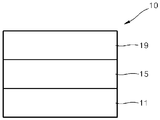
- FIGURE shows a schematic cross-sectional view of an organic light-emitting device according to an embodiment.
- An organometallic compound according to an embodiment of the present disclosure may be represented by Formula 1 below:
- M in Formula 1 may be a transition metal.
- M may be a first-row transition metal of the Periodic Table of Elements, a second-row transition metal of the Periodic Table of Elements, or a third-row transition metal of the Periodic Table of Elements.
- M may be Pt, Pd, Au, or Cu.
- X 1 may be C, and X 2 to X 4 may each independently be C or N.
- X 2 and X 3 may each be C, and X 4 may be N.
- a bond between X 1 and M in Formula 1 may be a coordinate bond.
- one of a bond between X 2 and M, a bond between X 3 and M, and a bond between X 4 and M may be a coordinate bond, and the other two bonds may be covalent bonds.
- the organometallic compound represented by Formula 1 may be electrically neutral.
- a bond between X 2 and M and a bond between X 3 and M may be a covalent bond, and a bond between X 4 and M may be a coordinate bond.
- X 11 in Formula 1 may be O, S, or N(R 1a ).
- X 11 may be N(R 1a ).
- Ring CY 2 to ring CY 4 in Formula 1 may each independently be a C 5 -C 30 carbocyclic group or a C 1 -C 30 heterocyclic group.
- ring CY 2 to ring CY 4 may each independently be i) a first ring, ii) a second ring, iii) a condensed ring in which two or more first rings are condensed with each other, iv) a condensed ring in which two or more second rings are condensed with each other, or v) a condensed ring in which one or more first rings and one or more second rings are condensed with each other, the first ring is a cyclopentane group, a cyclopentadiene group, a furan group, a thiophene group, a pyrrole group, a silole group, an indene group, an oxazole group, an isoxazole group, an oxadiazole group, an isoxadiazole group, an oxatriazole group, an isoxatriazole group, a thiazole group, an isothiazole group,
- ring CY 2 to ring CY 4 in Formula 1 may each independently be a benzene group, a naphthalene group, an anthracene group, a phenanthrene group, a triphenylene group, a pyrene group, a chrysene group, a cyclopentadiene group, a 1,2,3,4-tetrahydronaphthalene group, a thiophene group, a furan group, an indole group, a benzoborole group, a benzophosphole group, an indene group, a benzosilole group, a benzogermole group, a benzothiophene group, a benzoselenophene group, a benzofuran group, a carbazole group, a dibenzoborole group, a dibenzophosphole group, a fluorene group, a dibenzosilole group, a dibenzoger
- ring CY 2 may be a benzene group or a pyridine group
- ring CY 3 may be a carbazole group
- ring CY 4 may be a pyridine group, a pyrimidine group, a pyrazine group, a pyridazine group, or a triazine group.
- T 2 may be a single bond, *-N(R 7 )-*', *-C(R 7 )(R 8 )-*', *-S-*', or *-O-*'.
- R 1a and R 1 to R 8 in Formula 1 may each independently be hydrogen, deuterium, -F, -CI, -Br, -I, -SF 5 , a hydroxyl group, a cyano group, a nitro group, an amidino group, a hydrazine group, a hydrazone group, a carboxylic acid group or a salt thereof, a sulfonic acid group or a salt thereof, a phosphoric acid group or a salt thereof, a substituted or unsubstituted C 1 -C 60 alkyl group, a substituted or unsubstituted C 2 -C 60 alkenyl group, a substituted or unsubstituted C 2 -C 60 alkynyl group, a substituted or unsubstituted C 1 -C 60 alkoxy group, a substituted or unsubstituted C 1 -C 60 alkylthio group, a substituted or unsubstitute
- R 1a and R 1 to R 8 in Formula 1 may each independently be:
- At least one of R 1 in the number of a1 in Formula 1 may each independently be an unsubstituted or substituted C 1 -C 60 alkyl group or an unsubstituted or substituted C 3 -C 10 cycloalkyl group.
- R 1 (s) in the number of a1 in Formula 1 may each independently be a C 1 -C 20 alkyl group or a C 3 -C 10 cycloalkyl group, each unsubstituted or substituted with deuterium, -F, -CI, -Br, -I, -CD 3 , -CD 2 H, -CDH 2 , -CF 3 , -CF 2 H, -CFH 2 , a hydroxyl group, a cyano group, a nitro group, an amino group, an amidino group, a hydrazine group, a hydrazone group, a carboxylic acid group or a salt thereof, a sulfonic acid group or a salt thereof, a phosphoric acid group or a salt thereof, a C 1 -C 10 alkyl group, a cyclopentyl group, a cyclohexyl group, a cyclohept
- At least one of R 1 (s) in the number of a1 in Formula 1 may each independently a methyl group, an ethyl group, an n-propyl group, an isopropyl group, an n-butyl group, a sec-butyl group, an isobutyl group, a tert-butyl group, an n-pentyl group, a tert-pentyl group, a neopentyl group, an isopentyl group, a sec-pentyl group, 3-pentyl group, a sec-isopentyl group, an n-hexyl group, an isohexyl group, a sec-hexyl group, a tert-hexyl group, an n-heptyl group, an isoheptyl group, a sec-heptyl group, a tert-heptyl group, an n-oct
- R 1a and R 1 to R 8 in Formula 1 may each independently be hydrogen, deuterium, -F, -CH 3 , -CD 3 , -CD 2 H, -CDH 2 , -CF 3 , -CF 2 H, -CFH 2 , a C 2 -C 10 alkenyl group, a C 1 -C 10 alkoxy group, a C 1 -C 10 alkylthio group, a group represented by one of Formulae 9-1 to 9-39, a group represented by one of Formulae 9-1 to 9-39 in which at least one hydrogen is substituted with deuterium, a group represented by one of Formulae 9-201 to 9-237, a group represented by one of Formulae 9-201 to 9-237 in which at least one hydrogen is substituted with deuterium, a group represented by one of Formulae 10-1 to 10-129, a group represented by one of Formulae 10-1 to 10-129 in which at least one hydrogen is substituted with deuterium,
- At least one of R 1 (s) in the number of a1 may each independently be -CH 3 , -CD 3 , -CD 2 H, -CDH 2 , -CF 3 , -CF 2 H, -CFH 2 , a group represented by one of Formulae 9-1 to 9-39, a group represented by one of Formulae 9-1 to 9-39 in which at least one hydrogen is substituted with deuterium, a group represented by one of Formulae 9-201 to 9-227, a group represented by one of Formulae 9-201 to 9-227 in which at least one hydrogen is substituted with deuterium, a group represented by one of Formulae 10-1 to 10-9, or a group represented by one of Formulae 10-1 to 10-9 in which at least one hydrogen is substituted with deuterium: * in Formulae 9-1 to 9-39, 9-201 to 9-237, 10-1 to 10-129 and 10-201 to 10-350 indicates a binding site to a neighboring atom, Ph is a
- a group represented by one of Formulae 9-1 to 9-39 in which at least one hydrogen is substituted with deuterium and "a group represented by one of Formulae 9-201 to 9-237 in which at least one hydrogen is substituted with deuterium” may be, for example, a group represented by one of Formulae 9-501 to 9-514 and 9-601 to 9-636:
- a group represented by one of Formulae 10-1 to 10-129 in which at least one hydrogen is substituted with deuterium and "a group represented by one of Formulae 10-201 to 10-350 in which at least one hydrogen is substituted with deuterium” may be, for example, a group represented by one of Formulae 10-501 to 10-553:
- At least one of R 2 (s) in the number of a2, at least one of R 4 (s) in the number of a4, or any combination thereof may each independently be an unsubstituted or substituted C 1 -C 60 alkyl group or an unsubstituted or substituted C 3 -C 10 cycloalkyl group.
- At least one of R 2 (s) in the number of a2 may each independently be an unsubstituted or substituted C 1 -C 60 alkyl group or an unsubstituted or substituted C 3 -C 10 cycloalkyl group.
- At least one of R 4 (s) in the number of a4 may each independently be an unsubstituted or substituted C 1 -C 60 alkyl group or an unsubstituted or substituted C 3 -C 10 cycloalkyl group.
- At least one of R 2 (s) in the number of a2 and at least one of R 4 (s) in the number of a4 may each independently be an unsubstituted or substituted C 1 -C 60 alkyl group or an unsubstituted or substituted C 3 -C 10 cycloalkyl group.
- the organometallic compound represented by Formula 1 may satisfy one of ⁇ Condition 1> to ⁇ Condition 3> and/or, one of ⁇ Condition 4> to ⁇ Condition 6>:
- T 1 may be neither a single bond nor a double bond, a group represented by may be a group represented by Formula A2-1, and a group represented may be a group represented by Formula A3-1 or A3-2.
- T 1 may be a single bond or a double bond
- a group represented by may be a group represented by Formula A2-2
- a group represented by may be a group represented by one of Formulae A3-1 or A3-2.
- T 1 may be a single bond or a double bond, a group represented by may be a group represented by Formula A2-1, and a group represented by may be a group represented by Formula A3-3.
- T 2 may be a single bond or a double bond
- a group represented by may be a group represented by Formula A3-2
- a group represented by may be a group represented by Formula A4-1.
- T 2 may be a single bond or a double bond
- a group represented by may be a group represented by Formulae A3-1 or A3-3
- a group represented by may be a group represented by Formula A4-2.
- T 2 may be neither a single bond nor a double bond, a group represented by may be a group represented by Formulae A3-1 or A3-3, and a group represented by may be a group represented by Formula A4-1.
- a group represented by in Formula 1 may be a group represented by one of Formulae A2-1(1) to A2-1(17): wherein, in Formulae A2-1(1) to A2-1(17),
- a group represented by in Formula 1 may be a group represented by one of Formulae A3-1(1) to A3-1(17) and A3-2(1) to A3-2(7): wherein, in Formulae A3-1(1) to A3-1(17) and A3-2(1) to A3-2(7),
- a group represented by in Formula 1 may be a group represented by one of Formulae A4-1(1) to A4-1 (26) and A4-2(1) to A4-2(8): wherein, in Formulae A4-1 (1) to A4-1 (26) and A4-2(1) to A4-2(8),
- the organometallic compound may be represented by one of Formulae 1A to 1C: wherein, in Formulae 1A to 1C,
- R 11 to R 14 of Formula CY1-1 to CY1-15 and at least one of R 11 to R 14 of Formulae 1A to 1C may each independently be a C 1 -C 20 alkyl group or a C 3 -C 10 cycloalkyl group, each unsubstituted or substituted with deuterium, -F, -CI, -Br, -I, -CD 3 , -CD 2 H, -CDH 2 , -CF 3 , -CF 2 H, -CFH 2 , a hydroxyl group, a cyano group, a nitro group, an amino group, an amidino group, a hydrazine group, a hydrazone group, a carboxylic acid group or a salt thereof, a sulfonic acid group or a salt thereof, a phosphoric acid group or a salt thereof, a C 1 -C 10 alkyl group, a cyclopentyl group,
- R 11 to R 14 of Formula CY1-1 to CY1-15 and at least one of R 11 to R 14 of Formulae 1A to 1C may each independently be a methyl group, an ethyl group, an n-propyl group, an isopropyl group, an n-butyl group, a sec-butyl group, an isobutyl group, a tert-butyl group, an n-pentyl group, a tert-pentyl group, a neopentyl group, an isopentyl group, a sec-pentyl group, 3-pentyl group, a sec-isopentyl group, an n-hexyl group, an isohexyl group, a sec-hexyl group, a tert-hexyl group, an n-heptyl group, an isoheptyl group, a sec-heptyl group, a
- R 11 to R 14 of Formulae CY1-1 to CY1-15 and at least one of R 11 to R 14 of Formulae 1A to 1C may each independently be -CH 3 , -CD 3 , -CD 2 H, - CDH 2 , -CF 3 , -CF 2 H, -CFH 2 , a group represented by one of Formulae 9-1 to 9-39, a group represented by one of Formulae 9-1 to 9-39 in which at least one hydrogen is substituted with deuterium, a group represented by one of Formulae 9-201 to 9-227, a group represented by one of Formulae 9-201 to 9-227 in which at least one hydrogen is substituted with deuterium, a group represented by one of Formulae 10-1 to 10-9, or a group represented by one of Formulae 10-1 to 10-9 in which at least one hydrogen is substituted with deuterium.
- Y 21 may be C(R 21 ), Y 22 may be C(R 22 ), Y 23 may be C(R 23 ), Y 41 may be C(R 41 ), Y 42 may be C(R 42 ), Y 43 may be C(R 43 ), Y 44 may be C(R 44 ), and at least one of R 21 to R 23 , at least one of R 41 to R 44 , or any combination thereof may each be an unsubstituted or substituted C 1 -C 60 alkyl group or an unsubstituted or substituted C 3 -C 10 cycloalkyl group.
- Y 21 may be C(R 21 ), Y 22 may be C(R 22 ), Y 23 may be C(R 23 ), and at least one of R 21 to R 23 may each independently be an unsubstituted or substituted C 1 -C 60 alkyl group or an unsubstituted or substituted C 3 -C 10 cycloalkyl group.
- Y 41 may be C(R 41 ), Y 42 may be C(R 42 ), Y 43 may be C(R 43 ), Y 44 may be C(R 44 ), at least one of R 41 to R 44 may each independently be an unsubstituted or substituted C 1 -C 60 alkyl group, or an unsubstituted or substituted C 3 -C 10 cycloalkyl group.
- Y 21 may be C(R 21 ), Y 22 may be C(R 22 ), Y 23 may be C(R 23 ), Y 41 may be C(R 41 ), Y 42 may be C(R 42 ), Y 43 may be C(R 43 ), Y 44 may be C(R 44 ), and at least one of R 21 to R 23 and at least one of R 41 to R 44 may each be an unsubstituted or substituted C 1 -C 60 alkyl group or an unsubstituted or substituted C 3 -C 10 cycloalkyl group.
- Y 41 may be C(R 41 ), Y 42 may be C(R 42 ), Y 43 may be C(R 43 ), Y 44 may be C(R 44 ), Y 45 may be C(R 45 ), Y 46 may be C(R 46 ), Y 47 may be C(R 47 ), and at least one of R 41 to R 47 may each independently be an unsubstituted or substituted C 1 -C 60 alkyl group or an unsubstituted or substituted C 3 -C 10 cycloalkyl group.
- two or more of a plurality of R 1 (s) may optionally be linked to form a C 5 -C 30 carbocyclic group unsubstituted or substituted with at least one R 10a or a C 1 -C 30 heterocyclic group unsubstituted or substituted with at least one R 10a
- two or more of a plurality of R 2 (s) may optionally be linked to form a C 5 -C 30 carbocyclic group unsubstituted or substituted with at least one R 10a or a C 1 -C 30 heterocyclic group unsubstituted or substituted with at least one R 10a
- iii) two or more of a plurality of R 3 (s) may optionally be linked to form a C 5 -C 30 carbocyclic group unsubstituted or substituted with at least one R 10a or a C 1 -C 30 heterocyclic group unsubstituted or substituted with at least one R 10a
- the organometallic compound may be one of Compounds 1 to 120:
- X 1 in Formula 1 may be C, and a bond between X 1 and M may be a coordinate bond. That is, X 1 in Formula 1 may be carbon of a carbene moiety. Since the metal-ligand bonding force in Formula 1 is enhanced due to the carbene moiety, which is a strong sigma-donating group, even when the organometallic compound represented by Formula 1 is in an excited state, the decomposition of the metal-ligand bond may be suppressed and thus, the organometallic compound represented by Formula 1 may have excellent durability.
- Ring CY 1 in Formula 1 may be a condensed cyclic group (see Formula 1') in which a benzene ring is condensed with a X 1 -containing 5-membered ring. Accordingly, the organometallic compound represented by Formula 1 may have a relatively high triplet energy level, and thus, an electronic device including the organometallic compound represented by Formula 1, for example, an organic light-emitting device including the organometallic compound represented by Formula 1 may emit blue light and, at the same time, may have high luminescent efficiency and/or a long lifespan.
- a1 in Formula 1 may be an integer from 1 to 4, and at least one of R 1 (s) in the number of a1 may each independently be an unsubstituted or substituted C 1 -C 60 alkyl group or an unsubstituted or substituted C 3 -C 10 cycloalkyl group. Accordingly, the organometallic compound represented by Formula 1 may have a high optiocal orientation, and thus, for example, may emit blue light and at the same time, may have high luminescent efficiency.
- the HOMO, LUMO, and T 1 energy level of some of the compounds are structure-optimized at the (B3LYP, 6-31G(d,p)) level by using the DFT method of the Gaussian program and evaluated. Results thereof are shown in Table 1 below. [Table 1] Compound No.
- the organometallic compound represented by Formula 1 has such electric characteristics that are suitable for use as a dopant for an electronic device, for example, an organic light -emitting device.
- the organometallic compound represented by Formula 1 may emit blue light.
- the organometallic compound represented by Formula 1 may emit blue light having a maximum emission range of about 450 nm to about 470 nm, for example, about 457 nm to about 465 nm. Above maximum emission range may be confirmed by a photoluminescent (PL) spectrum and/or an electroluminescent (EL) spectrum for the organometallic compound represented by Formula 1.
- PL photoluminescent
- EL electroluminescent
- the triplet (T 1 ) energy level of the organometallic compound represented by Formula 1 may be 2.6 eV or more, or may have the range of about 2.6 eV to about 3.5 eV.
- the T 1 energy level is a result obtained by using a DFT method of Gaussian program (structure-optimized at the level of B3LYP, 6-31G(d,p)).
- the full width at half maximum (FWHM) of a main peak having a maximum intensity in the photoluminescent (PL) spectrum and/or an electroluminescent (EL) spectrum for the organometallic compound represented by Formula 1 may be 50 nm or less, in the range of about 10 nm to about 50 nm, in the range of about 15 nm to about 30 nm, or in the range of about 20 nm to about 30 nm.
- Synthesis methods of the organometallic compound represented by Formula 1 may be understood by one of ordinary skill in the art by referring to Synthesis Examples provided below.
- the organometallic compound represented by Formula 1 is suitable for use in an organic layer of an organic light-emitting device, for example, for use as a dopant in an emission layer of the organic layer.
- an organic light-emitting device that includes: a first electrode; a second electrode; and an organic layer disposed between the first electrode and the second electrode and including an emission layer, wherein the organic layer includes at least one organometallic compound represented by Formula 1.
- the organic light-emitting device may have improved driving voltage and improved external quantum efficiency.
- the organometallic compound of Formula 1 may be used between a pair of electrodes of an organic light-emitting device.
- the organometallic compound represented by Formula 1 may be included in the emission layer.
- the organometallic compound may act as a dopant, and the emission layer may further include a host (that is, an amount of the organometallic compound represented by Formula 1 is smaller than an amount of the host).
- the emission layer may emit red light, green light, or blue light.
- the organometallic compound may emit blue light.
- the emission layer may have a structure according to a first embodiment or a second embodiment:
- the emission layer may include the organometallic compound represented by Formula 1, and the organometallic compound may act as an emitter, for example, a phosphorescent emitter.
- the ratio of the luminescent component emitted from the organometallic compound with respect to all luminescent components of the emission layer may be 80% or more, 85% or more, 90% or more, or 95% or more.
- Light emitted from the organometallic compound may be blue light.
- the emission layer may further include, in addition to the organometallic compound represented by Formula 1, a phosphorescent dopant, a fluorescent dopant, or any combination thereof, each of which is different from the organometallic compound.
- the organometallic compound may act as, not a phosphorescent emitter, a sensitizer or an auxiliary dopant.
- the emission layer further includes a fluorescent dopant, the fluorescent dopant is different from the organometallic compound, and the ratio of the luminescent component emitted from the fluorescent dopant with respect to all luminescent components of the emission layer may be 80% or more, 85% or more, 90% or more, or 95% or more.
- the amount of fluorescent dopant in the second embodiment may be, based on 100 parts by weight of the organometallic compound represented by Formula 1, in the range of about 1 part by weight to about 100 parts by weight, about 5 parts by weight to about 50 parts by weight, or about 10 parts by weight to about 20 parts by weight.
- the total amount of the organometallic compound represented by Formula 1 and the fluorescent dopant in the second embodiment may be, based on 100 parts by weight of the emission layer, about 1 part by weight to about 30 parts by weight, about 3 parts by weight to about 20 parts by weight, or about 5 parts by weight to about 15 parts by weight.
- the fluorescent dopant used in the second embodiment may not include a transition metal.
- the fluorescent dopant used in the second embodiment may be a fluorescence emission material that does not include a cyano group (-CN) and a fluoro group (-F).
- the fluorescent dopant used in the second embodiment may be a condensed cyclic group-containing compound, an amino group-containing compound, a styryl-containing compound, or a boron-containing compound.
- the fluorescent dopant used in the second embodiment may include an amino group-containing compound.
- the fluorescent dopant used in the second embodiment may include a naphthalene group, a fluorene group, a spiro-bifluorene group, a benzofluorene group, a dibenzofluorene group, a phenanthrene group, an anthracene group, a fluoranthene group, a triphenylene group, a pyrene group, a chrysene group, a naphthacene group (a tetracene group), a picene group, a perylene group, a pentaphene group, an indenoanthracene group, a group represented by one of Formulae 501-1 to 501-21, or any combination thereof:
- a fluorescent dopant used in the second embodiment may include a compound represented by Formula 501A or 501B: wherein, in Formulae 501A and 501B,
- the fluorescent dopant may include a compound represented by Formula 501A or 501B, and xd4 in Formula 501A may be 1, 2, 3, 4, 5, or 6, and xd4 in Formula 501B may be 2, 3, or 4.
- the fluorescent dopant may include one of Compounds FD(1) to FD(16), one of FD1 to FD15, or any combination thereof:
- organometallic compounds used herein may include a case in which "(an organic layer) includes identical organometallic compounds represented by Formula 1" and a case in which "(an organic layer) includes two or more different organometallic compounds represented by Formula 1.”
- the organic layer may include, as the organometallic compound, only Compound 1.
- Compound 1 may exist only in the emission layer of the organic light-emitting device.
- the organic layer may include, as the organometallic compound, Compound 1 and Compound 2.
- Compound 1 and Compound 2 may exist in an identical layer (for example, Compound 1 and Compound 2 all may exist in an emission layer).
- the first electrode may be an anode, which is a hole injection electrode, and the second electrode may be a cathode, which is an electron injection electrode; or the first electrode may be a cathode, which is an electron injection electrode, and the second electrode may be an anode, which is a hole injection electrode.
- the first electrode is an anode
- the second electrode is a cathode
- the organic layer further includes a hole transport region disposed between the first electrode and the emission layer and an electron transport region disposed between the emission layer and the second electrode
- the hole transport region includes a hole injection layer, a hole transport layer, an electron blocking layer, or any combination thereof
- the electron transport region includes a hole blocking layer, an electron transport layer, an electron injection layer, or any combination thereof.
- organic layer refers to a single layer and/or a plurality of layers between the first electrode and the second electrode of the organic light-emitting device.
- the “organic layer” may include, in addition to an organic compound, an organometallic complex including metal.
- FIGURE is a schematic cross-sectional view of an organic light-emitting device 10 according to an embodiment.
- the organic light-emitting device 10 includes a first electrode 11, an organic layer 15, and a second electrode 19, which are sequentially stacked.
- a substrate may be additionally located under the first electrode 11 or above the second electrode 19.
- the substrate any substrate that is used in general organic light-emitting devices may be used, and the substrate may be a glass substrate or a transparent plastic substrate, each having excellent mechanical strength, thermal stability, transparency, surface smoothness, ease of handling, and water resistance.
- the first electrode 11 may be formed by depositing or sputtering a material for forming the first electrode11 on the substrate.
- the first electrode 11 may be an anode.
- the material for forming the first electrode 11 may be selected from materials with a high work function to facilitate hole injection.
- the first electrode 11 may be a reflective electrode, a semi-transmissive electrode, or a transmissive electrode.
- the material for forming the first electrode 11 may be indium tin oxide (ITO), indium zinc oxide (IZO), tin oxide (SnO 2 ), or zinc oxide (ZnO).
- the material for forming the first electrode 11 may be metal, such as magnesium (Mg), aluminum (Al), aluminum-lithium (Al-Li), calcium (Ca), magnesium-indium (Mg-In), or magnesium-silver (Mg-Ag).
- metal such as magnesium (Mg), aluminum (Al), aluminum-lithium (Al-Li), calcium (Ca), magnesium-indium (Mg-In), or magnesium-silver (Mg-Ag).
- the first electrode 11 may have a single-layered structure or a multi-layered structure including two or more layers.
- the first electrode 11 may have a three-layered structure of ITO/Ag/ITO, but the structure of the first electrode 11 is not limited thereto.
- the organic layer 15 is located on the first electrode 11.
- the organic layer 15 may include a hole transport region, an emission layer, and an electron transport region.
- the hole transport region may be between the first electrode 11 and the emission layer.
- the hole transport region may include a hole injection layer, a hole transport layer, an electron blocking layer, a buffer layer, or any combination thereof.
- the hole transport region may include only either a hole injection layer or a hole transport layer.
- the hole transport region may have a hole injection layer/hole transport layer structure, a hole injection layer/hole transport layer/electron blocking layer structure, or a first hole injection layer/second hole injection layer/electron blocking layer structure, which, for each structure, are sequentially stacked in this stated order from the first electrode 11.
- the hole injection layer may be formed on the first electrode 11 by using one or more suitable methods, for example, vacuum deposition, spin coating, casting, and/or Langmuir-Blodgett (LB) deposition.
- suitable methods for example, vacuum deposition, spin coating, casting, and/or Langmuir-Blodgett (LB) deposition.
- the deposition conditions may vary according to a material that is used to form the hole injection layer, and the structure and thermal characteristics of the hole injection layer.
- the deposition conditions may include a deposition temperature of about 100 to about 500°C, a vacuum pressure of about 10 -8 torr to about 10 -3 torr, and a deposition rate of about 0.01 ⁇ /sec to about 100 ⁇ /sec.
- the deposition conditions are not limited thereto.
- coating conditions may vary according to the material used to form the hole injection layer, and the structure and thermal properties of the hole injection layer.
- a coating speed may be from about 2,000 rpm to about 5,000 rpm, and a temperature at which a heat treatment is performed to remove a solvent after coating may be from about 80°C to about 200°C.
- the coating conditions are not limited thereto.
- Conditions for forming a hole transport layer and an electron blocking layer may be understood by referring to conditions for forming the hole injection layer.
- the hole transport region may include m-MTDATA, TDATA, 2-TNATA, NPB, ⁇ -NPB, TPD, Spiro-TPD, Spiro-NPB, methylated-NPB, TAPC, HMTPD, 4,4',4"-tris(N-carbazolyl)triphenylamine (TCTA), polyaniline/dodecylbenzenesulfonic acid (PANI/DBSA), poly(3,4-ethylenedioxythiophene)/poly(4-styrenesulfonate) (PEDOT/PSS), polyaniline/camphor sulfonicacid (PANI/CSA), polyaniline/poly(4-styrenesulfonate) (PANI/PSS), a compound represented by Formula 201 below, a compound represented by Formula 202, or any combination thereof:
- Ar 101 and Ar 102 in Formula 201 may each independently be a phenylene group, a pentalenylene group, an indenylene group, a naphthylene group, an azulenylene group, a heptalenylene group, an acenaphthylene group, a fluorenylene group, a phenalenylene group, a phenanthrenylene group, an anthracenylene group, a fluoranthenylene group, a triphenylenylene group, a pyrenylene group, a chrysenylenylene group, a naphthacenylene group, a picenylene group, a perylenylene group or a pentacenylene group, each unsubstituted or substituted with deuterium, -F, -CI, -Br, -I, a hydroxyl group, a cyano group, a nitro group, an amino
- xa and xb in Formula 201 may each independently be an integer from 0 to 5, or 0, 1 or 2.
- xa may be 1, and xb may be 0.
- R 101 to R 108 , R 111 to R 119 and R 121 to R 124 in Formulae 201 and 202 may each independently be:
- a compound represented by Formula 201 may be represented by Formula 201A: R 101 , R 111 , R 112 , and R 109 in Formula 201A may be understood by referring to the description provided herein.
- the hole transport region may include one of compounds HT1 to HT20 or any combination thereof:
- a thickness of the hole transport region may be from about 100 ⁇ to about 10,000 ⁇ , for example, about 100 ⁇ to about 3,000 ⁇ .
- a thickness of the hole injection layer may be in a range of about 100 ⁇ to about 10,000 ⁇ , for example, about 100 ⁇ to about 1,000 ⁇ , and a thickness of the hole transport layer may be in a range of about 50 ⁇ to about 2,000 ⁇ , for example, about 100 ⁇ to about 1,500 ⁇ .
- the thicknesses of the hole transport region, the hole injection layer, and the hole transport layer are within these ranges, satisfactory hole transporting characteristics may be obtained without a substantial increase in driving voltage.
- the hole transport region may further include, in addition to these materials, a charge-generation material for the improvement of conductive properties.
- the charge-generation material may be homogeneously or non-homogeneously dispersed in the hole transport region.
- the charge-generation material may be, for example, a p-dopant.
- the p-dopant may be a quinone derivative, a metal oxide, a cyano group-containing compound, or any combination thereof, but embodiments of the present disclosure are not limited thereto.
- the p-dopant may be a quinone derivative, such as tetracyanoquinonedimethane (TCNQ) or 2,3,5,6-tetrafluoro-tetracyano-1,4-benzoquinonedimethane (F4-TCNQ), or F6-TCNNQ; a metal oxide, such as a tungsten oxide or a molybdenium oxide; a cyano group-containing compound, such as Compound HT-D1 below, or any combination thereof.
- a quinone derivative such as tetracyanoquinonedimethane (TCNQ) or 2,3,5,6-tetrafluoro-tetracyano-1,4-benzoquinonedimethane (F4-TCNQ), or F6-TCNNQ
- a metal oxide such as a tungsten oxide or a molybdenium oxide
- a cyano group-containing compound such as Compound HT-D1 below, or any
- the hole transport region may include a buffer layer.
- the buffer layer may compensate for an optical resonance distance according to a wavelength of light emitted from the emission layer, and thus, efficiency of a formed organic light-emitting device may be improved.
- a material for the electron blocking layer may be selected from materials for the hole transport region described above and materials for a host to be explained later.
- the material for the electron blocking layer is not limited thereto.
- a material for the electron blocking layer may be mCP, which will be explained later.
- an emission layer may be formed on the hole transport region by vacuum deposition, spin coating, casting, LB deposition, or the like.
- the deposition or coating conditions may be similar to those applied in forming the hole injection layer although the deposition or coating conditions may vary according to a material that is used to form the emission layer.
- the emission layer may include a host and a dopant, and the dopant may include the organometallic compound represented by Formula 1 described in the present specification.
- the host may include TPBi, TBADN, ADN (also referred to as "DNA”), CBP, CDBP, TCP, mCP, Compound H50, Compound H51, Compound H52, or any combination thereof:
- the emission layer may be patterned into a red emission layer, a green emission layer, and/or a blue emission layer.
- the emission layer may emit white light.
- an amount of the dopant may be in a range of about 0.01 parts by weight to about 15 parts by weight based on 100 parts by weight of the host, but embodiments of the present disclosure are not limited thereto.
- a thickness of the emission layer may be in a range of about 100 ⁇ to about 1,000 ⁇ , for example, about 200 ⁇ to about 600 ⁇ . When the thickness of the emission layer is within this range, excellent light-emission characteristics may be obtained without a substantial increase in driving voltage.
- an electron transport region may be located on the emission layer.
- the electron transport region may include a hole blocking layer, an electron transport layer, an electron injection layer, or any combination thereof.
- the electron transport region may have a hole blocking layer/electron transport layer/electron injection layer structure or an electron transport layer/electron injection layer structure, but the structure of the electron transport region is not limited thereto.
- the electron transport layer may have a single-layered structure or a multi-layered structure including two or more different materials.
- Conditions for forming the hole blocking layer, the electron transport layer, and the electron injection layer which constitute the electron transport region may be understood by referring to the conditions for forming the hole injection layer.
- the hole blocking layer may include, for example, at least one of BCP, Bphen, and BAIq.
- the hole blocking layer may include the host, a material for an electron transport layer, a material for an electron injection layer, or any combination thereof, which will be described in detail.
- a thickness of the hole blocking layer may be in a range of about 20 ⁇ to about 1,000 ⁇ , for example, about 30 ⁇ to about 600 ⁇ . When the thickness of the hole blocking layer is within these ranges, the hole blocking layer may have excellent hole blocking characteristics without a substantial increase in driving voltage.
- the electron transport layer may include BCP, Bphen, TPBi, Alq 3 , BAlq, TAZ, NTAZ, or any combination thereof:
- the electron transport layer may include at least one of ET1 to ET25:
- a thickness of the electron transport layer may be from about 100 ⁇ to about 1,000 ⁇ , for example, about 150 ⁇ to about 500 ⁇ . When the thickness of the electron transport layer is within the range described above, the electron transport layer may have satisfactory electron transport characteristics without a substantial increase in driving voltage.
- the electron transport layer may further include, in addition to the materials described above, a metal-containing material.
- the metal-containing material may include a Li complex.
- the Li complex may include, for example, Compound ET-D1 (LiQ) or ET-D2:
- the electron transport region may include an electron injection layer (EIL) that promotes flow of electrons from the second electrode 19 thereinto.
- EIL electron injection layer
- the electron injection layer may include LiF, a naCI, CsF, Li 2 O, BaO, or any combination thereof.
- a thickness of the electron injection layer may be in a range of about 1 ⁇ to about 100 ⁇ , and, for example, about 3 ⁇ to about 90 ⁇ . When a thickness of the electron injection layer is within these ranges, satisfactory electron injection characteristics may be obtained without substantial increase in driving voltage.
- the second electrode 19 is located on the organic layer 15.
- the second electrode 19 may be a cathode.
- a material for forming the second electrode 19 may be metal, an alloy, an electrically conductive compound, or a combination thereof, which have a relatively low work function.
- lithium (Li), magnesium (Mg), aluminum (Al), aluminum-lithium (Al-Li), calcium (Ca), magnesium-indium (Mg-In), or magnesium-silver (Mg-Ag) may be formed as the material for forming the second electrode 19.
- a transmissive electrode formed using ITO or IZO may be used as the second electrode 19.
- Another aspect provides a diagnostic composition including at least one organometallic compound represented by Formula 1.
- the organometallic compound represented by Formula 1 provides high luminescent efficiency. Accordingly, a diagnostic composition including the organometallic compound may have high diagnostic efficiency.
- the diagnostic composition may be used in various applications including a diagnosis kit, a diagnosis reagent, a biosensor, and a biomarker.
- C 1 -C 60 alkyl group refers to a linear or branched saturated aliphatic hydrocarbon monovalent group having 1 to 60 carbon atoms, and examples thereof include a methyl group, an ethyl group, a propyl group, an isobutyl group, a sec-butyl group, a tert-butyl group, a pentyl group, an isoamyl group, and a hexyl group.
- C 1 -C 60 alkylene group refers to a divalent group having the same structure as the C 1 -C 60 alkyl group.
- Examples of the C 1 -C 60 alkyl group, the C 1 -C 20 alkyl group, and/or the C 1 -C 10 alkyl group are a methyl group, an ethyl group, an n-propyl group, an isopropyl group, an n-butyl group, a sec-butyl group, an isobutyl group, a tert-butyl group, an n-pentyl group, a tert-pentyl group, a neopentyl group, an isopentyl group, a sec-pentyl group, 3-pentyl group, a sec-isopentyl group, an n-hexyl group, an isohexyl group, a sec-hexyl group, a tert-hexyl group, an n-heptyl group, an isoheptyl group, a sec-heptyl group, a tert-
- C 1 -C 60 alkoxy group refers to a monovalent group represented by -OA 101 (wherein A 101 is the C 1 -C 60 alkyl group), and examples thereof include a methoxy group, an ethoxy group, and an isopropyloxy group.
- Examples of "a C 1 -C 60 alkoxy group, a C 1 -C 20 alkoxy group, or a C 1 -C 10 alkoxy group” are a methoxy group, an ethoxy group, a propoxy group, a butoxy group, and a pentoxy group.
- C 1 -C 60 alkylthio group refers to a monovalent group represented by -SA 101 (wherein A 101 is the C 1 -C 60 alkyl group).
- C 2 -C 60 alkenyl group refers to a hydrocarbon group formed by substituting at least one carbon-carbon double bond in the middle or at the terminus of the C 2 -C 60 alkyl group, and examples thereof include an ethenyl group, a propenyl group, and a butenyl group.
- C 2 -C 60 alkenylene group refers to a divalent group having the same structure as the C 2 -C 60 alkenyl group.
- C 2 -C 60 alkynyl group refers to a hydrocarbon group formed by substituting at least one carbon-carbon triple bond in the middle or at the terminus of the C 2 -C 60 alkyl group, and examples thereof include an ethynyl group, and a propynyl group.
- C 2 -C 60 alkynylene group refers to a divalent group having the same structure as the C 2 -C 60 alkynyl group.
- C 3 -C 10 cycloalkyl group refers to a monovalent saturated hydrocarbon monocyclic group having 3 to 10 carbon atoms, and examples thereof include a cyclopropyl group, a cyclobutyl group, a cyclopentyl group, a cyclohexyl group, and a cycloheptyl group.
- C 3 -C 10 cycloalkylene group refers to a divalent group having the same structure as the C 3 -C 10 cycloalkyl group.
- C 3 -C 10 cycloalkyl group may include a cyclopropyl group, a cyclobutyl group, a cyclopentyl group, a cyclohexyl group, a cycloheptyl group, a cyclooctyl group, an adamantanyl group, a bicyclo[1.1.1]pentyl group(bicyclo[1.1.1]pentyl), a bicyclo[2.1.1]hexyl group(bicyclo[2.1.1]hexyl), a bicyclo[2.2.1]heptyl group(bicyclo[2.2.1]heptyl) (norbornanyl group), a bicyclo[2.2.2]octyl group, etc.
- C 1 -C 10 heterocycloalkyl group refers to a monovalent saturated monocyclic group having at least one heteroatom selected from N, O, P, Si, and S as a ring-forming atom and 1 to 10 carbon atoms, and examples thereof include a tetrahydrofuranyl group, and a tetrahydrothiophenyl group.
- C 1 -C 10 heterocycloalkylene group refers to a divalent group having the same structure as the C 1 -C 10 heterocycloalkyl group.
- C 1 -C 10 heterocycloalkyl group examples are a silolanyl group, a silinanyl group, a tetrahydrofuranyl group group, a tetrahydro-2H-pyranyl group, and a tetrahydrothiophenyl group.
- C 3 -C 10 cycloalkenyl group refers to a monovalent monocyclic group that has 3 to 10 carbon atoms and at least one carbon-carbon double bond in the ring thereof and no aromaticity, and examples thereof include a cyclopentenyl group, a cyclohexenyl group, and a cycloheptenyl group.
- C 3 -C 10 cycloalkenylene group refers to a divalent group having the same structure as the C 3 -C 10 cycloalkenyl group.
- C 1 -C 10 heterocycloalkenyl group refers to a monovalent monocyclic group that has at least one heteroatom selected from N, O, P, Si, and S as a ring-forming atom, 1 to 10 carbon atoms, and at least one double bond in its ring.
- Examples of the C 1 -C 10 heterocycloalkenyl group are a 2,3-dihydrofuranyl group, and a 2,3-dihydrothiophenyl group.
- C 1 -C 10 heterocycloalkenylene group refers to a divalent group having the same structure as the C 1 -C 10 heterocycloalkenyl group.
- C 6 -C 60 aryl group refers to a monovalent group having a carbocyclic aromatic system having 6 to 60 carbon atoms
- C 6 -C 60 arylene group refers to a divalent group having a carbocyclic aromatic system having 6 to 60 carbon atoms.
- Examples of the C 6 -C 60 aryl group include a phenyl group, a naphthyl group, an anthracenyl group, a phenanthrenyl group, a pyrenyl group, and a chrysenyl group.
- the C 6 -C 60 aryl group and the C 6 -C 60 arylene group each include two or more rings, the rings may be fused to each other.
- the C 7 -C 60 alkylaryl group used herein refers to a C 6 -C 60 aryl group substituted with at least one C 1 -C 60 alkyl group.
- C 1 -C 60 heteroaryl group refers to a monovalent group having a cyclic aromatic system that has at least one heteroatom selected from N, O, P, Si, and S as a ring-forming atom, and 1 to 60 carbon atoms.
- C 1 -C 60 heteroarylene group refers to a divalent group having a cyclic aromatic system that has at least one heteroatom selected from N, O, P, Si and S as a ring-forming atom, and 1 to 60 carbon atoms.
- Examples of the C 1 -C 60 heteroaryl group include a pyridinyl group, a pyrimidinyl group, a pyrazinyl group, a pyridazinyl group, a triazinyl group, a quinolinyl group, and an isoquinolinyl group.
- the C 6 -C 60 heteroaryl group and the C 6 -C 60 heteroarylene group each include two or more rings, the rings may be fused to each other.
- the C 2 -C 60 alkylheteroaryl group used herein refers to a C 1 -C 60 heteroaryl group substituted with at least one C 1 -C 60 alkyl group.
- C 6 -C 60 aryloxy group refers to -OA 102 (herein, A 102 is the C 6 -C 60 aryl group), the term “C 6 -C 60 arylthio group as used herein refers to -SA 103 (herein, A 103 is the C 6 -C 60 aryl group), and the term “C 1 -C 60 alkylthio group” as used herein refers to -SA 104 (herein, A 104 is the C 1 -C 60 alkyl group).
- monovalent non-aromatic condensed polycyclic group refers to a monovalent group (for example, having 8 to 60 carbon atoms) having two or more rings condensed to each other, only carbon atoms as ring-forming atoms, and no aromaticity in its entire molecular structure.
- monovalent non-aromatic condensed polycyclic group include a fluorenyl group.
- divalent non-aromatic condensed polycyclic group refers to a divalent group having the same structure as that of the monovalent non-aromatic condensed polycyclic group.
- the term "monovalent non-aromatic condensed heteropolycyclic group” as used herein refers to a monovalent group (for example, having 2 to 60 carbon atoms) having two or more rings condensed to each other, a heteroatom selected from N, O, P, Si, Se, Ge, B and S, other than carbon atoms, as a ring-forming atom, and no aromaticity in its entire molecular structure.
- Examples of the monovalent non-aromatic condensed heteropolycyclic group include a carbazolyl group.
- divalent non-aromatic condensed heteropolycyclic group refers to a divalent group having the same structure as that of the monovalent non-aromatic condensed heteropolycyclic group.
- C 5 -C 30 carbocyclic group refers to a saturated or unsaturated cyclic group having, as a ring-forming atom, 5 to 30 carbon atoms only.
- the C 5 -C 30 carbocyclic group may be a monocyclic group or a polycyclic group.
- C 5 -C 30 carbocyclic group (unsubstituted or substituted with at least one R 10a ) " used herein may include, for example, an adamantane group, a norbornene group, a bicyclo[1.1.1]pentane group, a bicyclo[2.1.1]hexane group, a bicyclo[2.2.1]heptane group(norbornane group), a bicyclo[2.2.2]octane group, a cyclopentane group, a cyclohexane group, a cyclohexene group, a benzene group, a naphthalene group, an anthracene group, a phenanthrene group, a triphenylene group, a pyrene group, a chrysene group, a 1,2,3,4-tetrahydronaphthalene group, a cyclopentadiene group, a silo
- C 1 -C 30 heterocyclic group refers to a saturated or unsaturated cyclic group having, as a ring-forming atom, at least one heteroatom selected from N, O, Si, P, Se, Ge, B and S other than 1 to 30 carbon atoms.
- the C 1 -C 30 heterocyclic group may be a monocyclic group or a polycyclic group.
- C 1 -C 30 heterocyclic group that is unsubstituted or substituted with at least one R 10a may include, for example, a thiophene group, a furan group, a pyrrole group, a silole group, borole group, a phosphole group, a selenophene group, a germole group, a benzothiophene group, a benzofuran group, an indole group, an indene group, a benzosilole group, a benzoborole group, a benzophosphole group, a benzoselenophene group, a benzogermole group, a dibenzothiophene group, a dibenzofuran group, a carbazole group, a dibenzosilole group, a dibenzoborole group, a dibenzophosphole group, a dibenzoselenophene group, a dibenzogermole group,
- fluorinated C 1 -C 60 alkyl group (or, a fluorinated C 1 -C 20 alkyl group or the like)," "fluorinated C 3 -C 10 cycloalkyl group,” “fluorinated C 1 -C 10 heterocycloalkyl group” and “fluorinated phenyl group” respectively refer to a C 1 -C 60 alkyl group (or a C 1 -C 20 alkyl group or the like), a C 3 -C 10 cycloalkyl group, a C 1 -C 10 heterocycloalkyl group, and a phenyl group, each being substituted with at least one a fluoro group (-F).
- fluorinated C 1 alkyl group (that is, a fluorinated methyl group)” may include -CF 3 , -CF 2 H, and -CFH 2 .
- the "fluorinated C 1 -C 60 alkyl group (or a fluorinated C 1 -C 20 alkyl group or the like)," the "fluorinated C 3 -C 10 cycloalkyl group,” or the “fluorinated C 1 -C 10 heterocycloalkyl group” may be i) the case in which all hydrogen included in each group is substituted with a fluoro group, including a fully fluorinated C 1 -C 60 alkyl group (or, a fully fluorinated C 1 -C 20 alkyl group or the like), a fully fluorinated C 3 -C 10 cycloalkyl group, or a fully fluorinated C 1 -C 10 heterocycloalkyl group, or ii) the case in which all hydrogen
- the "deuterated C 1 -C 60 alkyl group (or a deuterated C 1 -C 20 alkyl group or the like),” the “deuterated C 3 -C 10 cycloalkyl group,” the “deuterated C 1 -C 10 heterocycloalkyl group,” and the “deuterated a phenyl group” may respectively be a C 1 -C 60 alkyl group (or a C 1 -C 20 alkyl group or the like), a C 3 -C 10 cycloalkyl group, a C 1 -C 10 heterocycloalkyl group, and a phenyl group, each substituted with at least one deuterium.
- the "deuterated C 1 alkyl group (that is, the deuterated a methyl group)" may include -CD 3 , -CD 2 H, and -CDH 2 , and examples of the “deuterated C 3 -C 10 cycloalkyl group” may be understood by referring to Formula 10-501.
- the "deuterated C 1 -C 60 alkyl group (or the deuterated C 1 -C 20 alkyl group, or the like),” the “deuterated C 3 -C 10 cycloalkyl group,” or the “deuterated C 1 -C 10 heterocycloalkyl group” may be i) the case in which all hydrogen included in each group is substituted with deuterium, including a fully deuterated C 1 -C 60 alkyl group (or a fully deuterated C 1 -C 20 alkyl group, or the like), a fully deuterated C 3 -C 10 cycloalkyl group, or a fully deuterated C 1 -C 10 heterocycloalkyl group, or ii) the case in which all hydrogen included in each group is substituted with deuterium, including a partially deuterated C 1 -C 60 alkyl group (or a partially deuterated C 1 -C 20 alkyl group, or the like), a partially deuterated C 3 -C
- (C 1 -C 20 alkyl) 'X' group refers to a 'X' group substituted with at least one C 1 -C 20 alkyl group.
- the term "(C 1 -C 20 alkyl)C 3 -C 10 cycloalkyl group” refers to a C 3 -C 10 cycloalkyl group substituted with at least one C 1 -C 20 alkyl group
- the term "(C 1 -C 20 alkyl)phenyl group” refers to a phenyl group substituted with at least one C 1 -C 20 alkyl group.
- An example of the (C 1 alkyl)phenyl group is a toluyl group.
- ITO indium tin oxide
- Compound HT3 was vacuum-deposited on the ITO electrode of the glass substrate to form a first hole injection layer having a thickness of 3500 ⁇
- Compound HT-D1 was vacuum-deposited on the first hole injection layer to form a second hole injection layer having a thickness of 300 ⁇
- TAPC was vacuum-deposited on the second hole injection layer to form an electron blocking layer having a thickness of 100 ⁇ , thereby forming a hole transport region.
- Compound H52 and Compound 2 were co-deposited on the hole transport region to form an emission layer having a thickness of 300 ⁇ .
- Compound ET3 was vacuum deposited on the emission layer to form an electron transport layer having a thickness of 250 ⁇ , ET-D1 (Liq) was deposited on the electron transport layer to form an electron injection layer having a thickness of 5 ⁇ , and an Al second electrode (cathode) having a thickness of 1000 ⁇ was formed on the electron injection layer, thereby completing the manufacture of an organic light-emitting device.
- Organic light-emitting devices were manufactured in the same manner as in Example 1, except that in forming an emission layer, for use as a dopant, corresponding compounds shown in Table 3 were used instead of Compound 2.
- the maximum emission wavelength (nm) and FWHM of the EL spectrum, driving voltage(V), and external quantum efficiency (%) were evaluated. Results thereof are shown in Table 3.
- the maximum emission wavelength and FWHM of the EL spectrum was evaluated from an EL spectrum (at 500 cd/m 2 ) measured using a luminance meter (Minolta Cs-1000A).
- the driving voltage and the external quantum efficiency were evaluated by using a current-voltage meter (Keithley 2400) and a luminance meter (Minolta Cs-1000A), respectively.
- the organometallic compound according to embodiments has excellent electric characteristics and thermal stability. Accordingly, an organic light-emitting device including the organometallic compound may have better characteristics in terms of a driving voltage and external quantum efficiency.
Landscapes
- Chemical & Material Sciences (AREA)
- Organic Chemistry (AREA)
- Engineering & Computer Science (AREA)
- Materials Engineering (AREA)
- Crystallography & Structural Chemistry (AREA)
- Inorganic Chemistry (AREA)
- Physics & Mathematics (AREA)
- Optics & Photonics (AREA)
- Electroluminescent Light Sources (AREA)
Claims (15)
- Organometallische Verbindung, dargestellt durch Formel 1:
 M ist ein Übergangsmetall,X1 ist C und X2 bis X4 sind jeweils unabhängig C oder N,eine Bindung zwischen X1 und M ist eine koordinative Bindung,eine von einer Bindung zwischen X2 und M, einer Bindung zwischen X3 und M und einer Bindung zwischen X4 und M ist eine koordinative Bindung, und die anderen zwei Bindungen sind kovalente Bindungen,X11 ist O, S oder N(R1a),Ring CY2 bis Ring CY4 sind jeweils unabhängig eine C5-C30-carbocyclische Gruppe oder eine C1-C30-heterocyclische Gruppe,T1 ist eine Einfachbindung, eine Doppelbindung, *-N(R5)-*', *-B(R5)-*', *-P(R5)-*', *-C(R5)(R6)-*', *-Si(R5)(R6)-*', *-Ge(R5)(R6)-*', *-S-*', *-Se-*', *-O-*', *-C(=O)-*', *-S(=O)-*', *-S(=O)2-*', *-C(R5)=*', *=C(R5)-*', *-C(R5)=C(R6)-*', *-C(=S)-*' oder *-C≡C-*',T2 ist eine Einfachbindung, eine Doppelbindung, *-N(R7)-*', *-B(R7)-*', *-P(R7)-*', *-C(R7)(R8)-*', *-Si(R7)(R8)-*', *-Ge(R7)(R8)-*', *-S-*', *-Se-*', *-O-*', *-C(=O)-*', *-S(=O)-*', *-S(=O)2-*', *-C(R7)=*', *=C(R7)-*', *-C(R7)=C(R8)-*', *-C(=S)-*' oder *-C≡C-*',R1a und R1 bis R8 sind jeweils unabhängig Wasserstoff, Deuterium, -F, -Cl, -Br, -I, -SF5, eine Hydroxylgruppe, eine Cyanogruppe, eine Nitrogruppe, eine Amidinogruppe, eine Hydrazingruppe, eine Hydrazongruppe, eine Carboxylsäuregruppe oder ein Salz davon, eine Sulfonsäuregruppe oder ein Salz davon, eine Phosphorsäuregruppe oder ein Salz davon, eine substituierte oder unsubstituierte C1-C60-Alkylgruppe, eine substituierte oder unsubstituierte C2-C60-Alkenylgruppe, eine substituierte oder unsubstituierte C2-C60-Alkynylgruppe, eine substituierte oder unsubstituierte C1-C60-Alkoxygruppe, eine substituierte oder unsubstituierte C1-C60-Alkylthiogruppe, eine substituierte oder unsubstituierte C3-C10-Cycloalkylgruppe, eine substituierte oder unsubstituierte C1-C10-Heterocycloalkylgruppe, eine substituierte oder unsubstituierte C3-C10-Cycloalkenylgruppe, eine substituierte oder unsubstituierte C1-C10-Heterocycloalkenylgruppe, eine substituierte oder unsubstituierte C6-C60-Arylgruppe, eine substituierte oder unsubstituierte C7-C60-Alkylarylgruppe, eine substituierte oder unsubstituierte C6-C60-Aryloxygruppe, eine substituierte oder unsubstituierte C6-C60-Arylthiogruppe, eine substituierte oder unsubstituierte C1-C60-Heteroarylgruppe, eine substituierte oder unsubstituierte C2-C60-Alkylheteroarylgruppe, eine substituierte oder unsubstituierte monovalente nicht-aromatische kondensierte polycyclische Gruppe, eine substituierte oder unsubstituierte monovalente nicht-aromatische kondensierte heteropolycyclische Gruppe, -N(Q1)(Q2), -Si(Q3)(Q4)(Q5), -Ge(Q3)(Q4)(Q5), -B(Q6)(Q7), -P(=O)(Q8)(Q9) oder -P(Q8)(Q9),a1 ist eine ganze Zahl von 1 bis 4,a2 bis a4 sind jeweils unabhängig eine ganze Zahl von 0 bis 20,mindestens eine von R1 in der Zahl von a1 ist jeweils unabhängig eine unsubstituierte oder substituierte C1-C60-Alkylgruppe oder eine unsubstituierte oder substituierte C3-C10-Cycloalkylgruppe,zwei oder mehr einer Mehrzahl von R1(s) sind optional miteinander verknüpft, um eine C5-C30-carbocyclische Gruppe unsubstituiert oder substituiert mit mindestens einer R10a oder eine C1-C30-heterocyclische Gruppe unsubstituiert oder substituiert mit mindestens einer R10a zu bilden,zwei oder mehr einer Mehrzahl von R2(s) sind optional miteinander verknüpft, um eine C5-C30-carbocyclische Gruppe unsubstituiert oder substituiert mit mindestens einer R10a oder eine C1-C30-heterocyclische Gruppe unsubstituiert oder substituiert mit mindestens einer R10a zu bilden,zwei oder mehr einer Mehrzahl von R3(s) sind optional miteinander verknüpft, um eine C5-C30-carbocyclische Gruppe unsubstituiert oder substituiert mit mindestens einer R10a oder eine C1-C30-heterocyclische Gruppe unsubstituiert oder substituiert mit mindestens einer R10a zu bilden,zwei oder mehr einer Mehrzahl von R4(s) sind optional miteinander verknüpft, um eine C5-C30-carbocyclische Gruppe unsubstituiert oder substituiert mit mindestens einer R10a oder eine C1-C30 heterocyclische Gruppe unsubstituiert oder substituiert mit mindestens einer R10a zu bilden,zwei oder mehr von R1a und R1 bis R8 sind optional miteinander verknüpft, um eine C5-C30-carbocyclische Gruppe unsubstituiert oder substituiert mit mindestens einer R10a oder eine C1-C30 heterocyclische Gruppe unsubstituiert oder substituiert mit mindestens einer R10a zu bilden,R10a ist dieselbe wie in Verbindung mit R2 beschrieben,* und *' zeigen jeweils eine Bindungsstelle an ein benachbartes Atom,ein Substituent der substituierten C1-C60-Alkylgruppe, der substituierten C2-C60-Alkenylgruppe, der substituierten C2-C60-Alkynylgruppe, der substituierten C1-C60-Alkoxygruppe, der substituierten C1-C60-Alkylthiogruppe, der substituierten C3-C10-Cycloalkylgruppe, der substituierten C1-C10-Heterocycloalkylgruppe, der substituierten C3-C10-Cycloalkenylgruppe, der substituierten C1-C10-Heterocycloalkenylgruppe, der substituierten C6-C60-Arylgruppe, der substitutierten, einer C7-C60-Alkylarylgruppe, der substituierten C6-C60-Aryloxygruppe, der substituierten C6-C60-Arylthiogruppe, der substituierten C1-C60-Heteroarylgruppe, der substituierten C2-C60-Alkylheteroarylgruppe, der substituierten monovalenten nicht-aromatischen kondensierten polycyclischen Gruppe und der substituierten monovalenten nicht-aromatischen kondensierten heteropolycyclischen Gruppe ist:Deuterium, -F, -Cl, -Br, -I, -CD3, -CD2H, -CDH2, -CF3, -CF2H, -CFH2, eine Hydroxylgruppe, eine Cyanogruppe, eine Nitrogruppe, eine Aminogruppe, eine Amidinogruppe, eine Hydrazingruppe, eine Hydrazongruppe, eine Carboxylsäuregruppe oder ein Salz davon, eine Sulfonsäuregruppe oder ein Salz davon, eine Phosphorsäuregruppe oder ein Salz davon, eine C1-C60-Alkylgruppe, eine C2-C60-Alkenylgruppe, eine C2-C60-Alkynylgruppe oder eine C1-C60-Alkoxygruppe;eine C1-C60-Alkylgruppe, eine C2-C60-Alkenylgruppe, eine C2-C60-Alkynylgruppe oder eine C1-C60-Alkoxygruppe, jeweils substituiert mit Deuterium, -F, -Cl, -Br, -I, -CD3, -CD2H, -CDH2, -CF3, -CF2H, -CFH2, einer Hydroxylgruppe, einer Cyanogruppe, einer Nitrogruppe, einer Aminogruppe, einer Amidinogruppe, einer Hydrazingruppe, einer Hydrazongruppe, einer Carboxylsäuregruppe oder einem Salz davon, einer Sulfonsäuregruppe oder einem Salz davon, einer Phosphorsäuregruppe oder einem Salz davon, einer C3-C10-Cycloalkylgruppe, einer C1-C10-Heterocycloalkylgruppe, einer C3-C10-Cycloalkenylgruppe, einer C1-C10-Heterocycloalkenylgruppe, einer C6-C60-Arylgruppe, einer C6-C60-Aryloxygruppe, einer C6-C60-Arylthiogruppe, einer C1-C60-Heteroarylgruppe, einer monovalenten nicht-aromatischen kondensierten polycyclischen Gruppe, einer monovalenten nicht-aromatischen kondensierten heteropolycyclischen Gruppe, -N(Q11)(Q12),-Si(Q13)(Q14)(Q15), -Ge(Q13)(Q14)(Q15), -B(Q16)(Q17), -P(=O)(Q18)(Q19), -P(Q18)(Q19) oder einer beliebigen Kombination davon;eine C3-C10-Cycloalkylgruppe, eine C1-C10-Heterocycloalkylgruppe, eine C3-C10-Cycloalkenylgruppe, eine C1-C10-Heterocycloalkenylgruppe, eine C6-C60-Arylgruppe, eine C6-C60-Aryloxygruppe, eine C6-C60-Arylthiogruppe, eine C1-C60-Heteroarylgruppe, eine monovalente nicht-aromatische kondensierte polycyclische Gruppe oder eine monovalente nicht-aromatische kondensierte heteropolycyclische Gruppe, jeweils unsubstituiert oder substituiert mit Deuterium, -F, -Cl, -Br, -I, -CD3, -CD2H, -CDH2, -CF3, -CF2H, -CFH2, einer Hydroxylgruppe, einer Cyanogruppe, einer Nitrogruppe, einer Aminogruppe, einer Amidinogruppe, einer Hydrazingruppe, einer Hydrazongruppe, einer Carboxylsäuregruppe oder einem Salz davon, einer Sulfonsäuregruppe oder einem Salz davon, einer Phosphorsäuregruppe oder einem Salz davon, einer C1-C60-Alkylgruppe, einer C2-C60-Alkenylgruppe, einer C2-C60-Alkynylgruppe, einer C1-C60-Alkoxygruppe, einer C3-C10-Cycloalkylgruppe, einer C1-C10-Heterocycloalkylgruppe, einer C3-C10-Cycloalkenylgruppe, einer C1-C10-Heterocycloalkenylgruppe, einer C6-C60-Arylgruppe, einer C6-C60-Aryloxygruppe, einer C6-C60-Arylthiogruppe, einer C1-C60-Heteroarylgruppe, einer monovalenten nicht-aromatischen kondensierten polycyclischen Gruppe, einer monovalenten nicht-aromatischen kondensierten heteropolycyclischen Gruppe, -N(Q21)(Q22),-Si(Q23)(Q24)(Q25), -Ge(Q23)(Q24)(Q25), -B(Q26)(Q27), -P(=O)(Q28)(Q29), -P(Q28)(Q29) oder einer beliebigen Kombination davon;-N(Q31)(Q32), -Si(Q33)(Q34)(Q35), -Ge(Q33)(Q34)(Q35), -B(Q36)(Q37), -P(=O)(Q38)(Q39) oder -P(Q38)(Q39); odereiner beliebigen Kombination davon,wobei Q1 bis Q9, Q11 bis Q19, Q21 bis Q29 und Q31 bis Q39 jeweils unabhängig Wasserstoff; Deuterium; -F; -Cl; -Br; -I; eine Hydroxylgruppe; eine Cyanogruppe; eine Nitrogruppe; eine Amidinogruppe; eine Hydrazingruppe; eine Hydrazongruppe; eine Carboxylsäuregruppe oder ein Salz davon; eine Sulfonsäuregruppe oder ein Salz davon; eine Phosphorsäuregruppe oder ein Salz davon; eine C1-C60-Alkylgruppe, die unsubstituiert oder substituiert mit Deuterium ist, eine C1-C60-Alkylgruppe, eine C6-C60-Arylgruppe oder eine beliebige Kombination davon; eine C2-C60-Alkenylgruppe; eine C2-C60-Alkynylgruppe, eine C1-C60-Alkoxygruppe, eine C3-C10-Cycloalkylgruppe; eine C1-C10-Heterocycloalkylgruppe; eine C3-C10-Cycloalkenylgruppe; eine C1-C10-Heterocycloalkenylgruppe; eine C6-C60-Arylgruppe, die unsubstituiert oder substituiert ist mit Deuterium, eine C1-C60-Alkylgruppe, eine C6-C60-Arylgruppe oder eine beliebige Kombination davon; eine C6-C60-Aryloxygruppe, eine C6-C60-Arylthiogruppe, eine C1-C60-Heteroarylgruppe; eine monovalente nicht-aromatische kondensierte polycyclische Gruppe; oder eine monovalente nicht-aromatische kondensierte heteropolycyclische Gruppe sind.
 - Organometallische Verbindung nach Anspruch 1, wobei M Pt, Pd oder Au ist.
- Organometallische Verbindung nach Anspruch 1 oder 2, wobei gilt X2 und X3 sind jeweils C,X4 ist N,eine Bindung zwischen X2 und M und eine Bindung zwischen X3 und M sind jeweils eine kovalente Bindung, undeine Bindung zwischen X4 und M ist eine koordinative Bindung.
- Organometallische Verbindung nach einem der Ansprüche 1-3, wobei giltRing CY2 bis Ring CY4 sind jeweils unabhängig i) ein erster Ring, ii) ein zweiter Ring, iii) ein kondensierter Ring, in dem zwei oder mehr erste Ringe miteinander kondensiert sind, iv) ein kondensierter Ring, in dem zwei oder mehr zweite Ringe miteinander kondensiert sind, oder v) ein kondensierter Ring, in dem ein oder mehr erste Ringe und ein oder mehr zweite Ringe miteinander kondensiert sind,der erste Ring ist eine Cyclopentangruppe, eine Cyclopentadiengruppe, eine Furangruppe, eine Thiophengruppe, eine Pyrrolgruppe, eine Silolgruppe, eine Oxazolgruppe, eine Isoxazolgruppe, eine Oxadiazolgruppe, eine Isoxadiazolgruppe, eine Oxatriazolgruppe, eine Isoxatriazolgruppe, eine Thiazolgruppe, eine Isothiazolgruppe, eine Thiadiazolgruppe, eine Isothiadiazolgruppe, eine Thiatriazolgruppe, eine Isothiatriazolgruppe, eine Pyrazolgruppe, eine Imidazolgruppe, eine Triazolgruppe, eine Tetrazolgruppe, eine Azasilolgruppe, eine Diazasilolgruppe oder eine Triazasilolgruppe, undder zweite Ring ist eine Adamantangruppe, eine Norbornangruppe, eine Norbornengruppe, eine Cyclohexangruppe, eine Cyclohexengruppe, eine Benzolgruppe, eine Pyridingruppe, eine Pyrimidingruppe, eine Pyrazingruppe, eine Pyridazingruppe, eine Triazingruppe, eine Oxazingruppe, eine Thiazingruppe, eine Dihydropyrazingruppe, eine Dihydropyridingruppe oder eine Dihydroazasilolgruppe; und/oder wobei giltT1 ist *-N(R5)-*', *-C(R5)(R6)-*', *-S-*, *-O-*' oder *-S(=O)2-*', undT2 ist eine Einfachbindung, *-N(R7)-*', *-C(R7)(R8)-*', *-S-*' oder *-O-*'.
- Organometallische Verbindung nach einem der Ansprüche 1-4, wobei gilt R1a und R1 bis R8 sind jeweils unabhängig:Wasserstoff, Deuterium, -F, -Cl, -Br, -I, eine Hydroxylgruppe, eine Cyanogruppe, eine Nitrogruppe, eine Aminogruppe, eine Amidinogruppe, eine Hydrazingruppe, eine Hydrazongruppe, eine Carboxylsäuregruppe oder ein Salz davon, eine Sulfonsäuregruppe oder ein Salz davon, eine Phosphorsäuregruppe oder ein Salz davon, -SF5, C1-C20-Alkylgruppe, eine C2-C20-Alkenylgruppe, eine C1-C20-Alkoxygruppe oder eine C1-C20-Alkylthiogruppe;eine C1-C20-Alkylgruppe, eine C2-C20-Alkenylgruppe, eine C1-C20-Alkoxygruppe oder eine C1-C20-Alkylthiogruppe, jeweils unsubstituiert oder substituiert mit Deuterium, -F, -Cl, -Br, -I, -CD3, -CD2H, -CDH2, -CF3, -CF2H, -CFH2, einer Hydroxylgruppe, einer Cyanogruppe, einer Nitrogruppe, einer Aminogruppe, einer Amidinogruppe, einer Hydrazingruppe, einer Hydrazongruppe, einer Carboxylsäuregruppe oder einem Salz davon, einer Sulfonsäuregruppe oder einem Salz davon, einer Phosphorsäuregruppe oder einem Salz davon, einer C1-C10-Alkylgruppe, einer Cyclopentylgruppe, einer Cyclohexylgruppe, einer Cycloheptylgruppe, einer Cyclooctylgruppe, einer Adamantanylgruppe, einer Norbornanylgruppe, einer Norbornenylgruppe, einer Cyclopentenylgruppe, einer Cyclohexenylgruppe, einer Cycloheptenylgruppe, einer Bicyclo[1.1.1]pentylgruppe, einer Bicyclo[2.1.1]hexylgruppe, einer Bicyclo[2.2.2]octylgruppe, einer (C1-C20-Alkyl)cyclopentylgruppe, einer (C1-C20-Alkyl)cyclohexylgruppe, einer (C1-C20-Alkyl)cycloheptylgruppe, einer (C1-C20-Alkyl)cyclooctylgruppe, einer (C1-C20-Alkyl)adamantanylgruppe, einer (C1-C20-Alkyl)norbornanylgruppe, einer (C1-C20-Alkyl)norbomenylgruppe, einer (C1-C20-Alkyl)cyclopentenylgruppe, einer (C1-C20-Alkyl)cyclohexenylgruppe, einer (C1-C20-Alkyl)cycloheptenylgruppe, einer (C1-C20-Alkyl)bicyclo[1.1.1]pentylgruppe, einer (C1-C20-Alkyl)bicyclo[2.1.1]hexylgruppe, einer (C1-C20-Alkyl)bicyclo[2.2.2]octylgruppe, einer Phenylgruppe, einer (C1-C20-Alkyl)phenylgruppe, einer Biphenylgruppe, einer Terphenylgruppe, einer Naphthylgruppe, einer Pyridinylgruppe, einer Pyrimidinylgruppe oder einer beliebigen Kombination davon;eine Cyclopentylgruppe, eine Cyclohexylgruppe, eine Cycloheptylgruppe, eine Cyclooctylgruppe, eine Adamantanylgruppe, eine Norbornanylgruppe, eine Norbornenylgruppe, eine Cyclopentenylgruppe, eine Cyclohexenylgruppe, eine Cycloheptenylgruppe, eine Bicyclo[1.1.1]pentylgruppe, eine Bicyclo[2.1.1]hexylgruppe, eine Bicyclo[2.2.2]octylgruppe, eine Phenylgruppe, eine (C1-C20-Alkyl)phenylgruppe, eine Biphenylgruppe, eine Terphenylgruppe, eine Naphthylgruppe, eine Fluorenylgruppe, eine Phenanthrenylgruppe, eine Anthracenylgruppe, eine Fluoranthenylgruppe, eine Triphenylenylgruppe, eine Pyrenylgruppe, eine Chrysenylgruppe, eine Pyrrolylgruppe, eine Thiophenylgruppe, eine Furanylgruppe, eine Imidazolylgruppe, eine Pyrazolylgruppe, eine Thiazolylgruppe, eine Isothiazolylgruppe, eine Oxazolylgruppe, eine Isoxazolylgruppe, eine Pyridinylgruppe, eine Pyrazinylgruppe, eine Pyrimidinylgruppe, eine Pyridazinylgruppe, eine Isoindolylgruppe, eine Indolylgruppe, eine Indazolylgruppe, eine Purinylgruppe, eine Quinolinylgruppe, eine Isoquinolinylgruppe, eine Benzoquinolinylgruppe, eine Quinoxalinylgruppe, eine Quinazolinylgruppe, eine Cinnolinylgruppe, eine Carbazolylgruppe, eine Phenanthrolinylgruppe, eine Benzimidazolylgruppe, eine Benzofuranylgruppe, eine Benzothiophenylgruppe, eine Isobenzothiazolylgruppe, eine Benzoxazolylgruppe, eine Isobenzoxazolylgruppe, eine Triazolylgruppe, eine Tetrazolylgruppe, eine Oxadiazolylgruppe, eine Triazinylgruppe, eine Dibenzofuranylgruppe, eine Dibenzothiophenylgruppe, eine Benzocarbazolylgruppe, eine Dibenzocarbazolylgruppe, eine Imidazopyridinylgruppe, eine Imidazopyrimidinylgruppe, eine Azacarbazolylgruppe, eine Azadibenzofuranylgruppe oder eine Azadibenzothiophenylgruppe, jeweils unsubstituiert oder substituiert mit Deuterium, -F, -Cl, -Br, -I, -CD3, -CD2H, -CDH2, -CF3, -CF2H, -CFH2, einer Hydroxylgruppe, einer Cyanogruppe, einer Nitrogruppe, einer Aminogruppe, einer Amidinogruppe, einer Hydrazingruppe, einer Hydrazongruppe, einer Carboxylsäuregruppe oder einem Salz davon, einer Sulfonsäuregruppe oder einem Salz davon, einer Phosphorsäuregruppe oder einem Salz davon, einer C1-C20-Alkylgruppe, deuterierten C2-C20-Alkylgruppe, einer C1-C20-Alkoxygruppe, einer Cyclopentylgruppe, einer Cyclohexylgruppe, einer Cycloheptylgruppe, einer Cyclooctylgruppe, einer Adamantanylgruppe, einer Norbornanylgruppe, einer Norbornenylgruppe, einer Cyclopentenylgruppe, einer Cyclohexenylgruppe, einer Cycloheptenylgruppe, einer Bicyclo[1.1.1]pentylgruppe, einer Bicyclo[2.1.1]hexylgruppe, einer Bicyclo[2.2.2]octylgruppe, einer (C1-C20-Alkyl)cyclopentylgruppe, einer (C1-C20-Alkyl)cyclohexylgruppe, einer (C1-C20-Alkyl)cycloheptylgruppe, einer (C1-C20-Alkyl)cyclooctylgruppe, einer (C1-C20-Alkyl)adamantanylgruppe, einer (C1-C20-Alkyl)norbornanylgruppe, einer (C1-C20-Alkyl)norbornenylgruppe, einer (C1-C20-Alkyl)cyclopentenylgruppe, einer (C1-C20-Alkyl)cyclohexenylgruppe, einer (C1-C20-Alkyl)cycloheptenylgruppe, einer (C1-C20-Alkyl)bicyclo[1.1.1]pentylgruppe, einer (C1-C20-Alkyl)bicyclo[2.1.1]hexylgruppe, einer (C1-C20-Alkyl)bicyclo[2.2.2]octylgruppe, einer Phenylgruppe, einer (C1-C20-Alkyl)phenylgruppe, einer Biphenylgruppe, einer Terphenylgruppe, einer Naphthylgruppe, einer Fluorenylgruppe, einer Phenanthrenylgruppe, einer Anthracenylgruppe, einer Fluoranthenylgruppe, einer Triphenylenylgruppe, einer Pyrenylgruppe, einer Chrysenylgruppe, einer Pyrrolylgruppe, einer Thiophenylgruppe, einer Furanylgruppe, einer Imidazolylgruppe, einer Pyrazolylgruppe, einer Thiazolylgruppe, einer Isothiazolylgruppe, einer Oxazolylgruppe, einer Isoxazolylgruppe, einer Pyridinylgruppe, einer Pyrazinylgruppe, einer Pyrimidinylgruppe, einer Pyridazinylgruppe, einer Isoindolylgruppe, einer Indolylgruppe, einer Indazolylgruppe, einer Purinylgruppe, einer Quinolinylgruppe, einer Isoquinolinylgruppe, einer Benzoquinolinylgruppe, einer Quinoxalinylgruppe, einer Quinazolinylgruppe, einer Cinnolinylgruppe, einer Carbazolylgruppe, einer Phenanthrolinylgruppe, einer Benzimidazolylgruppe, einer Benzofuranylgruppe, einer Benzothiophenylgruppe, einer Isobenzothiazolylgruppe, einer Benzoxazolylgruppe, einer Isobenzoxazolylgruppe, einer Triazolylgruppe, einer Tetrazolylgruppe, einer Oxadiazolylgruppe, einer Triazinylgruppe, einer Dibenzofuranylgruppe, einer Dibenzothiophenylgruppe, einer Benzocarbazolylgruppe, einer Dibenzocarbazolylgruppe, einer Imidazopyridinylgruppe, einer Imidazopyrimidinylgruppe, einer Azacarbazolylgruppe, einer Azadibenzofuranylgruppe, einer Azadibenzothiophenylgruppe oder einer beliebigen Kombination davon; oder-N(Q1)(Q2), -Si(Q3)(Q4)(Q5), -Ge(Q3)(Q4)(Q5), -B(Q6)(Q7), -P(=O)(Q8)(Q9) oder-P(Q8)(Q9), undQ1 bis Q9 sind jeweils unabhängig:Deuterium, -F, -CH3, -CD3, -CD2H, -CDH2, -CH2CH3, -CH2CD3, -CH2CD2H, - CH2CDH2, -CHDCH3, -CHDCD2H, -CHDCDH2, -CHDCD3, -CD2CD3, -CD2CD2H, -CD2CDH2, -CF3,-CF2H, -CFH2, -CH2CF3, -CH2CF2H, -CH2CFH2, -CHFCH3, -CHFCF2H, -CHFCFH2, - CHFCF3,-CF2CF3, -CF2CF2H oder -CF2CFH2; odereine n-Propylgruppe, eine Isopropylgruppe, eine n-Butylgruppe, eine sec-Butylgruppe, eine Isobutylgruppe, eine tert-Butylgruppe, eine n-Pentylgruppe, eine tert-Pentylgruppe, eine Neopentylgruppe, eine Isopentylgruppe, eine sec-Pentylgruppe, 3-Pentylgruppe, eine sec-Isopentylgruppe, eine Phenylgruppe, eine Biphenylgruppe oder eine Naphthylgruppe, jeweils unsubstituiert oder substituiert mit Deuterium, -F, einer C1-C10-Alkylgruppe, einer Phenylgruppe oder einer beliebigen Kombination davon; und/oder wobei a1 1 oder 2 ist.
- Organometallische Verbindung nach einem der Ansprüche 1-5, wobei giltmindestens eine von R1(s) in der Zahl von a1 ist jeweils unabhängig eine C1-C20-Alkylgruppe oder eine C3-C10-Cycloalkylgruppe, jeweils unsubstituiert oder substituiert mit Deuterium, -F, -Cl, -Br, -I, -CD3, -CD2H, -CDH2, -CF3, -CF2H, -CFH2, einer Hydroxylgruppe, einer Cyanogruppe, einer Nitrogruppe, einer Aminogruppe, einer Amidinogruppe, einer Hydrazingruppe, einer Hydrazongruppe, einer Carboxylsäuregruppe oder einem Salz davon, einer Sulfonsäuregruppe oder einem Salz davon, einer Phosphorsäuregruppe oder einem Salz davon, einer C1-C10-Alkylgruppe, einer Cyclopentylgruppe, einer Cyclohexylgruppe, einer Cycloheptylgruppe, einer Cyclooctylgruppe, einer Adamantanylgruppe, einer Norbornanylgruppe, einer Norbornenylgruppe, einer Cyclopentenylgruppe, einer Cyclohexenylgruppe, einer Cycloheptenylgruppe, einer Bicyclo[1.1.1]pentylgruppe, einer Bicyclo[2.1.1]hexylgruppe, einer Bicyclo[2.2.2]octylgruppe, einer (C1-C20-Alkyl)cyclopentylgruppe, einer (C1-C20-Alkyl)cyclohexylgruppe, einer (C1-C20-Alkyl)cycloheptylgruppe, einer (C1-C20-Alkyl)cyclooctylgruppe, einer (C1-C20-Alkyl)adamantanylgruppe, einer (C1-C20-Alkyl)norbornanylgruppe, einer (C1-C20-Alkyl)norbornenylgruppe, einer (C1-C20-Alkyl)cyclopentenylgruppe, einer (C1-C20-Alkyl)cyclohexenylgruppe, einer (C1-C20-Alkyl)cycloheptenylgruppe, einer (C1-C20-Alkyl)bicyclo[1.1.1]pentylgruppe, einer (C1-C20-Alkyl)bicyclo[2.1.1]hexylgruppe, einer (C1-C20-Alkyl)bicyclo[2.2.2]octylgruppe oder einer beliebigen Kombination davon; und/oderwobei mindestens eine von R2(s) in der Zahl von a2, mindestens eine von R4(s) in der Zahl von a4 oder eine beliebige Kombination davon jeweils unabhängig eine unsubstituierte oder substituierte C1-C60-Alkylgruppe oder eine unsubstituierte oder substituierte C3-C10-Cycloalkylgruppe ist.
- Organometallische Verbindung nach einem der Ansprüche 1-6, wobei
eine Gruppe, dargestellt durch


 X2 und R2 sind jeweils dieselben wie in Anspruch 1 beschrieben,X21 ist eine Einfachbindung, O, S, N(R21), C(R21)(R22) oder Si(R21)(R22), und X22 ist eine Einfachbindung, O, S, N(R23), C(R23)(R24) oder Si(R23)(R24), wobei mindestens eine von X21 und X22 keine Einfachbindung ist,R21 bis R28 sind dieselben wie in Verbindung mit R2 in Anspruch 1 beschrieben,a25 ist eine ganze Zahl von 0 bis 5,a24 ist eine ganze Zahl von 0 bis 4,a23 ist eine ganze Zahl von 0 bis 3,a22 ist eine ganze Zahl von 0 bis 2,* zeigt eine Bindungsstelle an M in Formel 1,*' zeigt eine Bindungsstelle an ein benachbartes Stickstoffatom in Formel 1, und*" zeigt eine Bindungsstelle an T1 in Formel 1.
 - Organometallische Verbindung nach einem der Ansprüche 1-7, wobei
eine Gruppe, dargestellt durch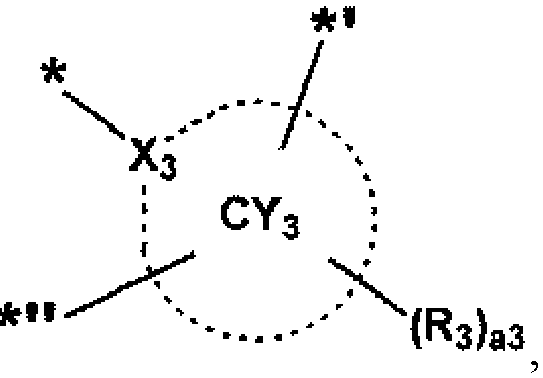

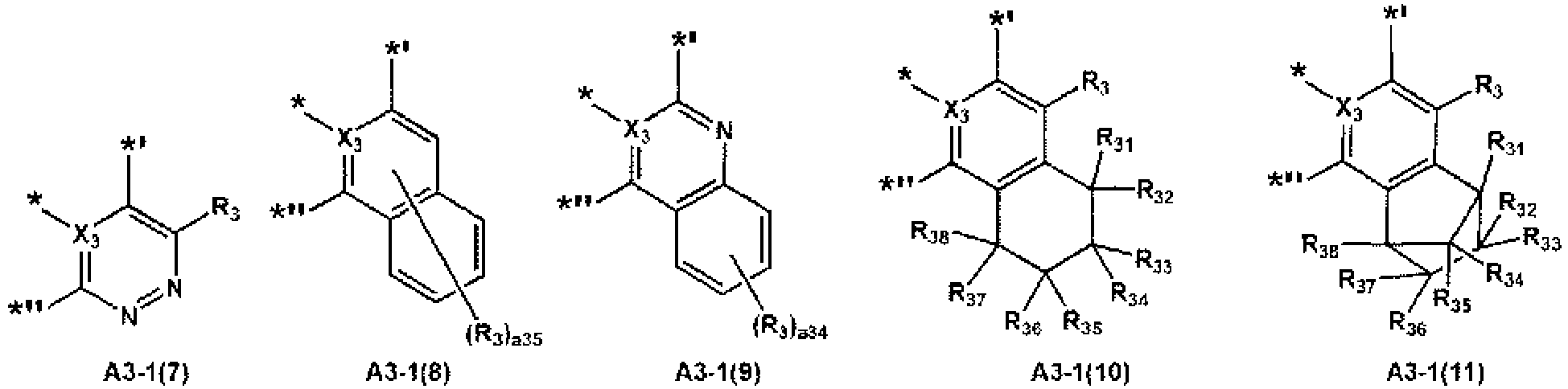


 X3 und R3 sind dieselben wie in Anspruch 1 beschrieben,X31 ist eine Einfachbindung, O, S, N(R31), C(R31)(R32) oder Si(R31)(R32), X32 ist eine Einfachbindung, O, S, N(R33), C(R33)(R34) oder Si(R33)(R34), und mindestens eine von X31 und X32 von Formeln A3-1(16) und A3-1(17) ist keine Einfachbindung,R31 bis R38 sind dieselben wie in Verbindung mit R3 in Anspruch 1 beschrieben,a36 ist eine ganze Zahl von 0 bis 6,a35 ist eine ganze Zahl von 0 bis 5,a34 ist eine ganze Zahl von 0 bis 4,a33 ist eine ganze Zahl von 0 bis 3,a32 ist eine ganze Zahl von 0 bis 2,* zeigt eine Bindungsstelle an M in Formel 1,*' zeigt eine Bindungsstelle an T2 in Formel 1, und*" zeigt eine Bindungsstelle an T1 in Formel 1.
 - Organometallische Verbindung nach einem der Ansprüche 1-8, wobei
eine Gruppe, dargestellt durch


 X4 und R4 sind jeweils dieselben wie in Anspruch 1 beschrieben,X41 ist eine Einfachbindung, O, S, N(R41), C(R41)(R42) oder Si(R41)(R42), X42 ist eine Einfachbindung, O, S, N(R43), C(R43)(R44) oder Si(R43)(R44), und mindestens eine von X41 und X42 von Formeln A4-1(24) bis A4-1(26) ist keine Einfachbindung,R41 bis R48 sind dieselben wie in Verbindung mit R4 in Anspruch 1 beschrieben,a46 ist eine ganze Zahl von 0 bis 6,a45 ist eine ganze Zahl von 0 bis 5,a44 ist eine ganze Zahl von 0 bis 4,a43 ist eine ganze Zahl von 0 bis 3,a42 ist eine ganze Zahl von 0 bis 2,* zeigt eine Bindungsstelle an M in Formel 1, und*' zeigt eine Bindungsstelle an T2 in Formel 1.
 - Organometallische Verbindung nach einem der Ansprüche 1-9, wobeieine Gruppe, dargestellt durch
 eine Gruppe, dargestellt durch
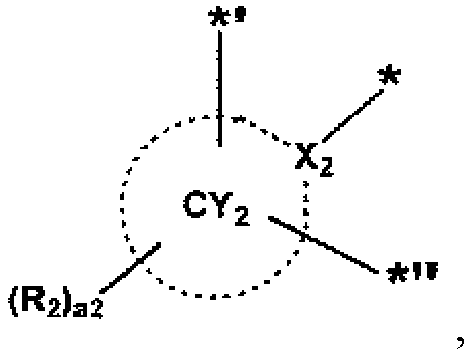 eine Gruppe, dargestellt durch
 eine Gruppe, dargestellt durch



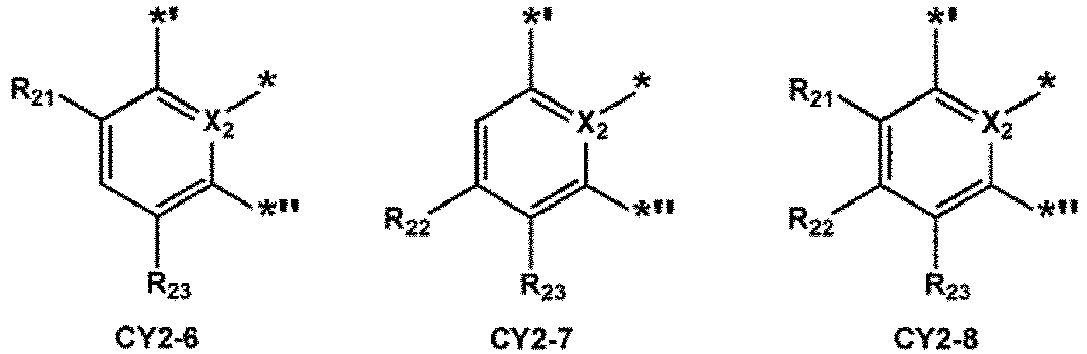


 X1 bis X4, X11 und R1 bis R4 sind jeweils dieselben wie in Anspruch 1 beschrieben,X31 ist eine Einfachbindung, O, S, N(R31), C(R31)(R32) oder Si(R31)(R32),X41 ist eine Einfachbindung, O, S, N(R41), C(R41)(R42) oder Si(R41)(R42),R11 bis R14 sind jeweils unabhängig eine unsubstituierte oder substituierte C1-C60-Alkylgruppe oder eine unsubstituierte oder substituierte C3-C10-Cycloalkylgruppe,R21 bis R23 sind dieselben wie in Verbindung mit R2 in Anspruch 1 beschrieben, R31 bis R36 sind dieselben wie in Verbindung mit R3 in Anspruch 1 beschrieben, R41 bis R44 sind dieselben wie in Verbindung mit R4 in Anspruch 1 beschrieben und jede von R21 bis R23, R31 bis R36 und R41 bis R44 ist nicht Wasserstoff,in Formeln CY1-1 bis CY1-15 zeigt * eine Bindungsstelle an M in Formel 1 und zeigt *' eine Bindungsstelle an Ring CY2 in Formel 1,in Formeln CY2-1 bis CY2-8 zeigt * eine Bindungsstelle an M in Formel 1, zeigt *' eine Bindungsstelle an ein benachbartes Stickstoffatom in Formel 1 und zeigt *" eine Bindungsstelle an T1 in Formel 1,in Formeln CY3-1 bis CY3-16 zeigt * eine Bindungsstelle an M in Formel 1, zeigt *" eine Bindungsstelle an T1 in Formel 1 und zeigt *' eine Bindungsstelle an T2 in Formel 1, undin Formeln CY4-1 bis CY4-24 zeigt * eine Bindungsstelle an M in Formel 1 und zeigt *' eine Bindungsstelle an T2 in Formel 1.
 - Organometallische Verbindung nach einem der Ansprüche 1-10, wobei die organometallische Verbindung dargestellt ist durch eine der Formeln 1A bis 1C:


 M, X1 bis X4, X11, T1 und T2 sind dieselben in Anspruch 1 beschrieben, und T2 in Formel 1C ist keine Einfachbindung,Y21 ist C(R21) oder N, Y22 ist C(R22) oder N, Y23 ist C(R23) oder N, Y31 ist C(R31) oder N, Y32 ist C(R32) oder N, Y33 ist C(R33) oder N, Y34 ist C(R34) oder N, Y35 ist C(R35) oder N, Y36 ist C(R36) oder N, Y41 ist C(R41) oder N, Y42 ist C(R42) oder N, Y43 ist C(R43) oder N, Y44 ist C(R44) oder N, Y45 ist C(R45) oder N, Y46 ist C(R46) oder N, Y47 ist C(R47) oder N,X33 ist eine Einfachbindung, O, S, N(R3a), C(R3a)(R3b) oder Si(R3a)(R3b),X43 ist eine Einfachbindung, O, S, N(R4a), C(R4a)(R4b) oder Si(R4a)(R4b),R11 bis R14 sind dieselben wie in Verbindung mit R1 in Anspruch 1 beschrieben, und mindestens eine von R11 bis R14 ist jeweils unabhängig eine unsubstituierte oder substituierte Ci-C60-Alkylgruppe oder eine unsubstituierte oder substituierte C3-C10-Cycloalkylgruppe,R21 bis R23 sind dieselben wie in Verbindung mit R2 in Anspruch 1 beschrieben, und zwei oder mehr von R21 bis R23 sind optional verknüpft, um eine C5-C30-carbocyclische Gruppe unsubstituiert oder substituiert mit mindestens einer R10a oder eine C1-C30-heterocyclische Gruppe unsubstituiert oder substituiert mit mindestens einer R10a zu bilden,R31 bis R36, R3a und R3b sind dieselben wie in Verbindung mit R3 in Anspruch 1 beschrieben, und zwei oder mehr von R31 bis R36 sind optional verknüpft, um eine C5-C30-carbocyclische Gruppe unsubstituiert oder substituiert mit mindestens einer R10a oder eine C1-C30-heterocyclische Gruppe unsubstituiert oder substituiert mit mindestens einer R10a zu bilden,R41 bis R47, R4a und R4b sind dieselben wie in Verbindung mit R4 in Anspruch 1 beschrieben, und zwei oder mehr von R41 bis R47 sind optional verknüpft, um eine C5-C30-carbocyclische Gruppe unsubstituiert oder substituiert mit mindestens einer R10a oder eine C1-C30-heterocyclische Gruppe unsubstituiert oder substituiert mit mindestens einer R10a zu bilden, undRioa ist dieselbe wie in Verbindung mit R2 in Anspruch 1 beschrieben; und/oderwobei die organometallische Verbindung blaues Licht emittiert.
 - Organometallische Verbindung nach einem der Ansprüche 1-11, wobei die organometallische Verbindung eine von Verbindungen 1 bis 120 ist:





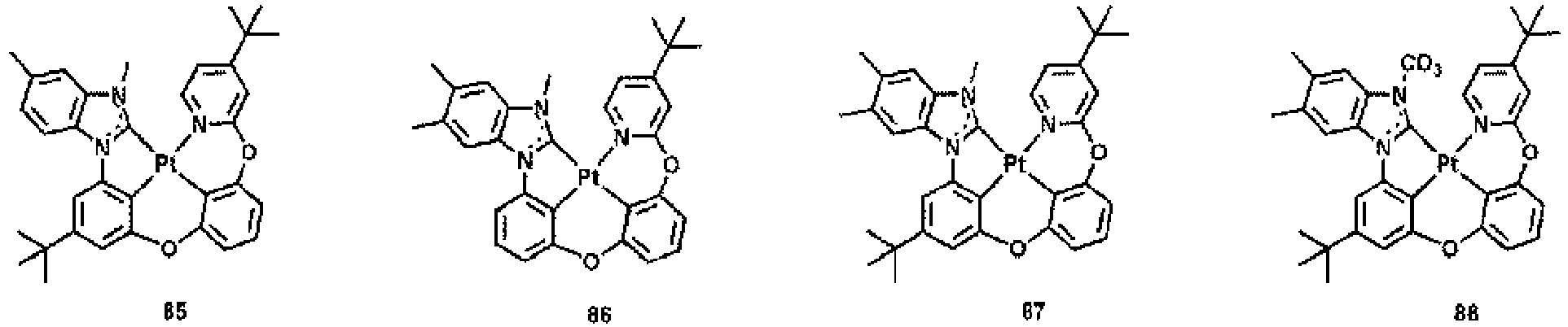


- Organische lichtemittierende Vorrichtung, umfassend:eine erste Elektrode;eine zweite Elektrode; undeine organische Schicht, die zwischen der ersten Elektrode und der zweiten Elektrode angeordnet ist,wobei die organische Schicht mindestens eine organometallische Verbindung nach einem der Ansprüche 1-12 umfasst.
- Organische lichtemittierende Vorrichtung nach Anspruch 13, wobeidie erste Elektrode eine Anode ist,die zweite Elektrode eine Kathode ist,die organische Schicht einen Lochtransportbereich, der zwischen der ersten Elektrode und der Emissionsschicht angeordnet ist, und einen Elektronentransportbereich, der zwischen der Emissionsschicht und der zweiten Elektrode angeordnet ist, umfasst,der Lochtransportbereich eine Lochinjektionsschicht, eine Lochtransportschicht, eine Elektronenblockierschicht oder eine beliebige Kombination davon umfasst, undder Elektronentransportbereich eine Lochblockierschicht, eine Elektronentransportschicht, eine Elektroneninjektionsschicht oder eine beliebige Kombination davon umfasst.
- Organische lichtemittierende Vorrichtung nach Anspruch 13 oder 14, wobeidie organometallische Verbindung in der Emissionsschicht inbegriffen ist;bevorzugt, wobei die Emissionsschicht blaues Licht emittiert.
Applications Claiming Priority (2)
| Application Number | Priority Date | Filing Date | Title |
|---|---|---|---|
| KR20190012817 | 2019-01-31 | ||
| KR1020200008761A KR102896847B1 (ko) | 2019-01-31 | 2020-01-22 | 유기금속 화합물 및 이를 포함한 유기 발광 소자 |
Publications (2)
| Publication Number | Publication Date |
|---|---|
| EP3689888A1 EP3689888A1 (de) | 2020-08-05 |
| EP3689888B1 true EP3689888B1 (de) | 2021-09-22 |
Family
ID=69326424
Family Applications (1)
| Application Number | Title | Priority Date | Filing Date |
|---|---|---|---|
| EP20153874.1A Active EP3689888B1 (de) | 2019-01-31 | 2020-01-27 | Organometallische verbindung und organische lichtemittierende vorrichtung damit |
Country Status (3)
| Country | Link |
|---|---|
| US (1) | US12232412B2 (de) |
| EP (1) | EP3689888B1 (de) |
| CN (1) | CN111499665A (de) |
Families Citing this family (4)
| Publication number | Priority date | Publication date | Assignee | Title |
|---|---|---|---|---|
| KR102784238B1 (ko) * | 2019-08-02 | 2025-03-24 | 삼성디스플레이 주식회사 | 유기 전계 발광 소자 및 유기 전계 발광 소자용 유기 금속 착체 |
| CN112500436B (zh) * | 2020-12-15 | 2022-10-18 | 浙江工业大学 | 一种铂卡宾磷光材料金属化的合成方法 |
| CN112920209B (zh) * | 2021-01-29 | 2025-05-30 | 上海弗屈尔光电科技有限公司 | 一种有机金属配合物及含有该化合物的有机光电元件 |
| CN112940049A (zh) * | 2021-02-25 | 2021-06-11 | 上海蓝骋光电科技有限公司 | 一种有机金属配合物和含有其的有机光电元件及应用 |
Family Cites Families (35)
| Publication number | Priority date | Publication date | Assignee | Title |
|---|---|---|---|---|
| US6939624B2 (en) | 2000-08-11 | 2005-09-06 | Universal Display Corporation | Organometallic compounds and emission-shifting organic electrophosphorescence |
| EP1325671B1 (de) | 2000-08-11 | 2012-10-24 | The Trustees Of Princeton University | Organometallische verbdindungen und emissionsverschobene organische elektrolumineszens |
| DE10338550A1 (de) | 2003-08-19 | 2005-03-31 | Basf Ag | Übergangsmetallkomplexe mit Carbenliganden als Emitter für organische Licht-emittierende Dioden (OLEDs) |
| US7279704B2 (en) | 2004-05-18 | 2007-10-09 | The University Of Southern California | Complexes with tridentate ligands |
| WO2005123873A1 (ja) | 2004-06-17 | 2005-12-29 | Konica Minolta Holdings, Inc. | 有機エレクトロルミネッセンス素子材料、有機エレクトロルミネッセンス素子、表示装置及び照明装置 |
| TWI482756B (zh) | 2008-09-16 | 2015-05-01 | 環球展覽公司 | 磷光物質 |
| WO2010079051A1 (de) | 2009-01-07 | 2010-07-15 | Basf Se | Silyl- und heteroatom-substituierte verbindungen ausgewählt aus carbazolen, dibenzofuranen, dibenzothiophenen und dibenzophospholen und ihre anwendung in der organischen elektronik |
| JP5650932B2 (ja) | 2010-01-28 | 2015-01-07 | ユー・ディー・シー アイルランド リミテッド | 有機電界発光素子及び電荷輸送材料 |
| KR101867115B1 (ko) | 2010-12-28 | 2018-07-19 | 이데미쓰 고산 가부시키가이샤 | 유기 전기발광 소자용 재료 및 그것을 이용한 유기 전기발광 소자 |
| US9493698B2 (en) | 2011-08-31 | 2016-11-15 | Universal Display Corporation | Organic electroluminescent materials and devices |
| CN104272487B (zh) | 2012-02-27 | 2017-09-01 | 李坚 | 运用窄带磷光发射材料于拥有微腔式结构的有机发光二极管 |
| EP2878046B1 (de) * | 2012-07-27 | 2022-03-09 | Thorlabs, Inc. | Einstellbarer laser mit kurzem resonator für einen quantenschacht |
| US9882150B2 (en) | 2012-09-24 | 2018-01-30 | Arizona Board Of Regents For And On Behalf Of Arizona State University | Metal compounds, methods, and uses thereof |
| KR101593182B1 (ko) | 2012-12-12 | 2016-02-19 | 삼성전자 주식회사 | 유기광전자소자용 화합물, 이를 포함하는 유기발광소자 및 상기 유기발광소자를 포함하는 표시장치 |
| CN104232076B (zh) | 2013-06-10 | 2019-01-15 | 代表亚利桑那大学的亚利桑那校董会 | 具有改进的发射光谱的磷光四齿金属络合物 |
| JP6804823B2 (ja) * | 2013-10-14 | 2020-12-23 | アリゾナ・ボード・オブ・リージェンツ・オン・ビハーフ・オブ・アリゾナ・ステイト・ユニバーシティーArizona Board of Regents on behalf of Arizona State University | 白金錯体およびデバイス |
| KR102153039B1 (ko) | 2013-11-28 | 2020-09-07 | 삼성전자주식회사 | 카바졸계 화합물 및 이를 포함한 유기 발광 소자 |
| US10020455B2 (en) | 2014-01-07 | 2018-07-10 | Arizona Board Of Regents On Behalf Of Arizona State University | Tetradentate platinum and palladium complex emitters containing phenyl-pyrazole and its analogues |
| US9941479B2 (en) | 2014-06-02 | 2018-04-10 | Arizona Board Of Regents On Behalf Of Arizona State University | Tetradentate cyclometalated platinum complexes containing 9,10-dihydroacridine and its analogues |
| US20160013423A1 (en) | 2014-07-09 | 2016-01-14 | Samsung Electronics Co., Ltd. | Condensed cyclic compound and organic light-emitting device including the same |
| KR20160006629A (ko) | 2014-07-09 | 2016-01-19 | 삼성전자주식회사 | 축합환 화합물 및 이를 포함한 유기 발광 소자 |
| US10326086B2 (en) | 2015-02-06 | 2019-06-18 | Samsung Electronics Co., Ltd. | Organometallic compound, composition containing the organometallic compound, and organic light-emitting device including the organometallic compound or composition |
| US9879039B2 (en) | 2015-06-03 | 2018-01-30 | Arizona Board Of Regents On Behalf Of Arizona State University | Tetradentate and octahedral metal complexes containing naphthyridinocarbazole and its analogues |
| KR102486381B1 (ko) | 2015-08-13 | 2023-01-09 | 삼성전자주식회사 | 축합환 화합물 및 이를 포함한 유기 발광 소자 |
| US10177323B2 (en) * | 2016-08-22 | 2019-01-08 | Arizona Board Of Regents On Behalf Of Arizona State University | Tetradentate platinum (II) and palladium (II) complexes and octahedral iridium complexes employing azepine functional groups and their analogues |
| US11152579B2 (en) * | 2016-12-28 | 2021-10-19 | Universal Display Corporation | Organic electroluminescent materials and devices |
| EP3372611B1 (de) | 2017-03-08 | 2020-06-24 | Samsung Electronics Co., Ltd. | Organometallische verbindung, zusammensetzung mit der organometallischen verbindung und organische lichtemittierende vorrichtung mit der organometallischen verbindung |
| US11101435B2 (en) * | 2017-05-19 | 2021-08-24 | Arizona Board Of Regents On Behalf Of Arizona State University | Tetradentate platinum and palladium complexes based on biscarbazole and analogues |
| US11552261B2 (en) * | 2017-06-23 | 2023-01-10 | Universal Display Corporation | Organic electroluminescent materials and devices |
| US11802136B2 (en) | 2017-06-23 | 2023-10-31 | Universal Display Corporation | Organic electroluminescent materials and devices |
| KR102474204B1 (ko) * | 2017-07-21 | 2022-12-06 | 삼성디스플레이 주식회사 | 유기금속 화합물 및 이를 포함하는 유기 발광 소자 |
| KR102637103B1 (ko) | 2018-01-23 | 2024-02-20 | 삼성전자주식회사 | 유기금속 화합물, 이를 포함한 유기 발광 소자 및 이를 포함한 진단용 조성물 |
| CN109748938B (zh) * | 2019-02-01 | 2021-08-03 | 南京工业大学 | 二价铂配合物、其应用及有机光电装置 |
| US11858949B2 (en) * | 2019-06-13 | 2024-01-02 | Samsung Electronics Co., Ltd. | Organometallic compound, organic light-emitting device including the same, and diagnostic composition including the organometallic compound |
| US11778899B2 (en) * | 2019-06-13 | 2023-10-03 | Samsung Electronics Co., Ltd. | Organometallic compound, organic light-emitting device including the same, and diagnostic composition including the organometallic compound |
-
2020
- 2020-01-27 EP EP20153874.1A patent/EP3689888B1/de active Active
- 2020-02-03 CN CN202010078240.9A patent/CN111499665A/zh active Pending
-
2023
- 2023-10-30 US US18/497,143 patent/US12232412B2/en active Active
Also Published As
| Publication number | Publication date |
|---|---|
| EP3689888A1 (de) | 2020-08-05 |
| CN111499665A (zh) | 2020-08-07 |
| US12232412B2 (en) | 2025-02-18 |
| US20240107875A1 (en) | 2024-03-28 |
Similar Documents
| Publication | Publication Date | Title |
|---|---|---|
| EP3798225B1 (de) | Organometallische verbindung, organische lichtemittierende vorrichtung damit und elektronische vorrichtung mit der organischen lichtemittierenden vorrichtung | |
| EP3705483B1 (de) | Organometallische verbindung, organische lichtemittierende vorrichtung damit und elektronische vorrichtung mit der organischen lichtemittierenden vorrichtung | |
| KR102896847B1 (ko) | 유기금속 화합물 및 이를 포함한 유기 발광 소자 | |
| EP3859812B1 (de) | Organische lichtemittierende vorrichtung | |
| JP7740874B2 (ja) | 有機金属化合物とそれを含む有機発光素子及び有機発光素子を含む電子装置 | |
| EP3689888B1 (de) | Organometallische verbindung und organische lichtemittierende vorrichtung damit | |
| EP4119633B1 (de) | Organometallische verbindung und organische lichtemittierende vorrichtung mit der organometallischen verbindung | |
| EP3988557B1 (de) | Organometallische verbindung, organische lichtemittierende vorrichtung damit und diagnosezusammensetzung mit der organometallischen verbindung | |
| EP3750899A1 (de) | Organometallische verbindung, organische lichtemittierende vorrichtung damit und diagnosezusammensetzung mit der organometallischen verbindung | |
| EP4086265B1 (de) | Organometallische verbindung, organische lichtemittierende vorrichtung damit und elektronisches gerät mit der organischen lichtemittierenden vorrichtung | |
| EP3828190A1 (de) | Organometallische verbindung, organische lichtemittierende vorrichtung mit der organometallischen verbindung und elektronische vorrichtung mit der organischen lichtemittierenden vorrichtung | |
| EP3715352A1 (de) | Organometallische verbindung, organische lichtemittierende vorrichtung damit und elektronische vorrichtung mit der organischen lichtemittierenden vorrichtung | |
| EP3909964B1 (de) | Organometallische verbindung, organische lichtemittierende vorrichtung damit und elektronisches gerät mit der organischen lichtemittierenden vorrichtung | |
| EP3992199A1 (de) | Organometallische verbindung, organische lichtemittierende vorrichtung damit und elektronische einrichtung mit der organischen lichtemittierenden vorrichtung | |
| KR20250106681A (ko) | 헤테로시클릭 화합물, 이를 포함한 유기 발광 소자 및 전자 장치 | |
| EP4123000B1 (de) | Organometallische verbindung und organische lichtemittierende vorrichtung damit | |
| EP4186913B1 (de) | Organometallische verbindung und organische lichtemittierende vorrichtung damit | |
| EP4389852B1 (de) | Organometallische verbindung, organische lichtemittierende vorrichtung damit und elektronische vorrichtung mit der organischen lichtemittierenden vorrichtung | |
| EP4299692B1 (de) | Organometallische verbindung, organische lichtemittierende vorrichtung damit und elektronische vorrichtung mit der organischen lichtemittierenden vorrichtung | |
| EP4527845A1 (de) | Organometallische verbindung, organische lichtemittierende vorrichtung damit und elektronische vorrichtung mit der organischen lichtemittierenden vorrichtung | |
| EP4692099A2 (de) | Organometallische verbindung, organische lichtemittierende vorrichtung mit der organometallischen verbindung und elektronische vorrichtung mit der organischen lichtemittierenden vorrichtung | |
| EP4311850A1 (de) | Organometallische verbindung, organische lichtemittierende vorrichtung damit und elektronische vorrichtung mit der organischen lichtemittierenden vorrichtung | |
| EP3992200A1 (de) | Organometallische verbindung, organische lichtemittierende vorrichtung mit der organometallischen verbindung und diagnostische zusammensetzung mit der organometallischen verbindung | |
| KR20240143610A (ko) | 유기금속 금 착화합물을 포함하는 유기발광소자 | |
| KR20260025012A (ko) | 유기금속 화합물, 이를 포함한 유기 발광 소자 및 유기 발광 소자를 포함한 전자 장치 |
Legal Events
| Date | Code | Title | Description |
|---|---|---|---|
| PUAI | Public reference made under article 153(3) epc to a published international application that has entered the european phase |
Free format text: ORIGINAL CODE: 0009012 |
|
| STAA | Information on the status of an ep patent application or granted ep patent |
Free format text: STATUS: THE APPLICATION HAS BEEN PUBLISHED |
|
| AK | Designated contracting states |
Kind code of ref document: A1 Designated state(s): AL AT BE BG CH CY CZ DE DK EE ES FI FR GB GR HR HU IE IS IT LI LT LU LV MC MK MT NL NO PL PT RO RS SE SI SK SM TR |
|
| AX | Request for extension of the european patent |
Extension state: BA ME |
|
| STAA | Information on the status of an ep patent application or granted ep patent |
Free format text: STATUS: REQUEST FOR EXAMINATION WAS MADE |
|
| 17P | Request for examination filed |
Effective date: 20210203 |
|
| RBV | Designated contracting states (corrected) |
Designated state(s): AL AT BE BG CH CY CZ DE DK EE ES FI FR GB GR HR HU IE IS IT LI LT LU LV MC MK MT NL NO PL PT RO RS SE SI SK SM TR |
|
| GRAP | Despatch of communication of intention to grant a patent |
Free format text: ORIGINAL CODE: EPIDOSNIGR1 |
|
| STAA | Information on the status of an ep patent application or granted ep patent |
Free format text: STATUS: GRANT OF PATENT IS INTENDED |
|
| INTG | Intention to grant announced |
Effective date: 20210413 |
|
| GRAS | Grant fee paid |
Free format text: ORIGINAL CODE: EPIDOSNIGR3 |
|
| GRAA | (expected) grant |
Free format text: ORIGINAL CODE: 0009210 |
|
| STAA | Information on the status of an ep patent application or granted ep patent |
Free format text: STATUS: THE PATENT HAS BEEN GRANTED |
|
| AK | Designated contracting states |
Kind code of ref document: B1 Designated state(s): AL AT BE BG CH CY CZ DE DK EE ES FI FR GB GR HR HU IE IS IT LI LT LU LV MC MK MT NL NO PL PT RO RS SE SI SK SM TR |
|
| REG | Reference to a national code |
Ref country code: GB Ref legal event code: FG4D |
|
| REG | Reference to a national code |
Ref country code: IE Ref legal event code: FG4D |
|
| REG | Reference to a national code |
Ref country code: DE Ref legal event code: R096 Ref document number: 602020000563 Country of ref document: DE |
|
| REG | Reference to a national code |
Ref country code: CH Ref legal event code: EP Ref country code: AT Ref legal event code: REF Ref document number: 1432275 Country of ref document: AT Kind code of ref document: T Effective date: 20211015 |
|
| REG | Reference to a national code |
Ref country code: LT Ref legal event code: MG9D |
|
| REG | Reference to a national code |
Ref country code: NL Ref legal event code: MP Effective date: 20210922 |
|
| PG25 | Lapsed in a contracting state [announced via postgrant information from national office to epo] |
Ref country code: RS Free format text: LAPSE BECAUSE OF FAILURE TO SUBMIT A TRANSLATION OF THE DESCRIPTION OR TO PAY THE FEE WITHIN THE PRESCRIBED TIME-LIMIT Effective date: 20210922 Ref country code: SE Free format text: LAPSE BECAUSE OF FAILURE TO SUBMIT A TRANSLATION OF THE DESCRIPTION OR TO PAY THE FEE WITHIN THE PRESCRIBED TIME-LIMIT Effective date: 20210922 Ref country code: FI Free format text: LAPSE BECAUSE OF FAILURE TO SUBMIT A TRANSLATION OF THE DESCRIPTION OR TO PAY THE FEE WITHIN THE PRESCRIBED TIME-LIMIT Effective date: 20210922 Ref country code: HR Free format text: LAPSE BECAUSE OF FAILURE TO SUBMIT A TRANSLATION OF THE DESCRIPTION OR TO PAY THE FEE WITHIN THE PRESCRIBED TIME-LIMIT Effective date: 20210922 Ref country code: NO Free format text: LAPSE BECAUSE OF FAILURE TO SUBMIT A TRANSLATION OF THE DESCRIPTION OR TO PAY THE FEE WITHIN THE PRESCRIBED TIME-LIMIT Effective date: 20211222 Ref country code: BG Free format text: LAPSE BECAUSE OF FAILURE TO SUBMIT A TRANSLATION OF THE DESCRIPTION OR TO PAY THE FEE WITHIN THE PRESCRIBED TIME-LIMIT Effective date: 20211222 Ref country code: LT Free format text: LAPSE BECAUSE OF FAILURE TO SUBMIT A TRANSLATION OF THE DESCRIPTION OR TO PAY THE FEE WITHIN THE PRESCRIBED TIME-LIMIT Effective date: 20210922 |
|
| REG | Reference to a national code |
Ref country code: AT Ref legal event code: MK05 Ref document number: 1432275 Country of ref document: AT Kind code of ref document: T Effective date: 20210922 |
|
| PG25 | Lapsed in a contracting state [announced via postgrant information from national office to epo] |
Ref country code: LV Free format text: LAPSE BECAUSE OF FAILURE TO SUBMIT A TRANSLATION OF THE DESCRIPTION OR TO PAY THE FEE WITHIN THE PRESCRIBED TIME-LIMIT Effective date: 20210922 Ref country code: GR Free format text: LAPSE BECAUSE OF FAILURE TO SUBMIT A TRANSLATION OF THE DESCRIPTION OR TO PAY THE FEE WITHIN THE PRESCRIBED TIME-LIMIT Effective date: 20211223 |
|
| PG25 | Lapsed in a contracting state [announced via postgrant information from national office to epo] |
Ref country code: AT Free format text: LAPSE BECAUSE OF FAILURE TO SUBMIT A TRANSLATION OF THE DESCRIPTION OR TO PAY THE FEE WITHIN THE PRESCRIBED TIME-LIMIT Effective date: 20210922 |
|
| PG25 | Lapsed in a contracting state [announced via postgrant information from national office to epo] |
Ref country code: IS Free format text: LAPSE BECAUSE OF FAILURE TO SUBMIT A TRANSLATION OF THE DESCRIPTION OR TO PAY THE FEE WITHIN THE PRESCRIBED TIME-LIMIT Effective date: 20220122 Ref country code: SK Free format text: LAPSE BECAUSE OF FAILURE TO SUBMIT A TRANSLATION OF THE DESCRIPTION OR TO PAY THE FEE WITHIN THE PRESCRIBED TIME-LIMIT Effective date: 20210922 Ref country code: RO Free format text: LAPSE BECAUSE OF FAILURE TO SUBMIT A TRANSLATION OF THE DESCRIPTION OR TO PAY THE FEE WITHIN THE PRESCRIBED TIME-LIMIT Effective date: 20210922 Ref country code: PT Free format text: LAPSE BECAUSE OF FAILURE TO SUBMIT A TRANSLATION OF THE DESCRIPTION OR TO PAY THE FEE WITHIN THE PRESCRIBED TIME-LIMIT Effective date: 20220124 Ref country code: PL Free format text: LAPSE BECAUSE OF FAILURE TO SUBMIT A TRANSLATION OF THE DESCRIPTION OR TO PAY THE FEE WITHIN THE PRESCRIBED TIME-LIMIT Effective date: 20210922 Ref country code: NL Free format text: LAPSE BECAUSE OF FAILURE TO SUBMIT A TRANSLATION OF THE DESCRIPTION OR TO PAY THE FEE WITHIN THE PRESCRIBED TIME-LIMIT Effective date: 20210922 Ref country code: ES Free format text: LAPSE BECAUSE OF FAILURE TO SUBMIT A TRANSLATION OF THE DESCRIPTION OR TO PAY THE FEE WITHIN THE PRESCRIBED TIME-LIMIT Effective date: 20210922 Ref country code: EE Free format text: LAPSE BECAUSE OF FAILURE TO SUBMIT A TRANSLATION OF THE DESCRIPTION OR TO PAY THE FEE WITHIN THE PRESCRIBED TIME-LIMIT Effective date: 20210922 Ref country code: CZ Free format text: LAPSE BECAUSE OF FAILURE TO SUBMIT A TRANSLATION OF THE DESCRIPTION OR TO PAY THE FEE WITHIN THE PRESCRIBED TIME-LIMIT Effective date: 20210922 Ref country code: AL Free format text: LAPSE BECAUSE OF FAILURE TO SUBMIT A TRANSLATION OF THE DESCRIPTION OR TO PAY THE FEE WITHIN THE PRESCRIBED TIME-LIMIT Effective date: 20210922 |
|
| REG | Reference to a national code |
Ref country code: DE Ref legal event code: R097 Ref document number: 602020000563 Country of ref document: DE |
|
| PG25 | Lapsed in a contracting state [announced via postgrant information from national office to epo] |
Ref country code: DK Free format text: LAPSE BECAUSE OF FAILURE TO SUBMIT A TRANSLATION OF THE DESCRIPTION OR TO PAY THE FEE WITHIN THE PRESCRIBED TIME-LIMIT Effective date: 20210922 |
|
| PLBE | No opposition filed within time limit |
Free format text: ORIGINAL CODE: 0009261 |
|
| STAA | Information on the status of an ep patent application or granted ep patent |
Free format text: STATUS: NO OPPOSITION FILED WITHIN TIME LIMIT |
|
| 26N | No opposition filed |
Effective date: 20220623 |
|
| PG25 | Lapsed in a contracting state [announced via postgrant information from national office to epo] |
Ref country code: MC Free format text: LAPSE BECAUSE OF FAILURE TO SUBMIT A TRANSLATION OF THE DESCRIPTION OR TO PAY THE FEE WITHIN THE PRESCRIBED TIME-LIMIT Effective date: 20210922 |
|
| REG | Reference to a national code |
Ref country code: BE Ref legal event code: MM Effective date: 20220131 |
|
| PG25 | Lapsed in a contracting state [announced via postgrant information from national office to epo] |
Ref country code: LU Free format text: LAPSE BECAUSE OF NON-PAYMENT OF DUE FEES Effective date: 20220127 |
|
| PG25 | Lapsed in a contracting state [announced via postgrant information from national office to epo] |
Ref country code: SI Free format text: LAPSE BECAUSE OF FAILURE TO SUBMIT A TRANSLATION OF THE DESCRIPTION OR TO PAY THE FEE WITHIN THE PRESCRIBED TIME-LIMIT Effective date: 20210922 Ref country code: BE Free format text: LAPSE BECAUSE OF NON-PAYMENT OF DUE FEES Effective date: 20220131 |
|
| PG25 | Lapsed in a contracting state [announced via postgrant information from national office to epo] |
Ref country code: IT Free format text: LAPSE BECAUSE OF FAILURE TO SUBMIT A TRANSLATION OF THE DESCRIPTION OR TO PAY THE FEE WITHIN THE PRESCRIBED TIME-LIMIT Effective date: 20210922 Ref country code: IE Free format text: LAPSE BECAUSE OF NON-PAYMENT OF DUE FEES Effective date: 20220127 |
|
| P01 | Opt-out of the competence of the unified patent court (upc) registered |
Effective date: 20230530 |
|
| REG | Reference to a national code |
Ref country code: CH Ref legal event code: PL |
|
| PG25 | Lapsed in a contracting state [announced via postgrant information from national office to epo] |
Ref country code: LI Free format text: LAPSE BECAUSE OF NON-PAYMENT OF DUE FEES Effective date: 20230131 Ref country code: CH Free format text: LAPSE BECAUSE OF NON-PAYMENT OF DUE FEES Effective date: 20230131 |
|
| PG25 | Lapsed in a contracting state [announced via postgrant information from national office to epo] |
Ref country code: SM Free format text: LAPSE BECAUSE OF FAILURE TO SUBMIT A TRANSLATION OF THE DESCRIPTION OR TO PAY THE FEE WITHIN THE PRESCRIBED TIME-LIMIT Effective date: 20210922 Ref country code: MK Free format text: LAPSE BECAUSE OF FAILURE TO SUBMIT A TRANSLATION OF THE DESCRIPTION OR TO PAY THE FEE WITHIN THE PRESCRIBED TIME-LIMIT Effective date: 20210922 Ref country code: CY Free format text: LAPSE BECAUSE OF FAILURE TO SUBMIT A TRANSLATION OF THE DESCRIPTION OR TO PAY THE FEE WITHIN THE PRESCRIBED TIME-LIMIT Effective date: 20210922 |
|
| PG25 | Lapsed in a contracting state [announced via postgrant information from national office to epo] |
Ref country code: HU Free format text: LAPSE BECAUSE OF FAILURE TO SUBMIT A TRANSLATION OF THE DESCRIPTION OR TO PAY THE FEE WITHIN THE PRESCRIBED TIME-LIMIT; INVALID AB INITIO Effective date: 20200127 |
|
| PG25 | Lapsed in a contracting state [announced via postgrant information from national office to epo] |
Ref country code: TR Free format text: LAPSE BECAUSE OF FAILURE TO SUBMIT A TRANSLATION OF THE DESCRIPTION OR TO PAY THE FEE WITHIN THE PRESCRIBED TIME-LIMIT Effective date: 20210922 |
|
| PG25 | Lapsed in a contracting state [announced via postgrant information from national office to epo] |
Ref country code: MT Free format text: LAPSE BECAUSE OF FAILURE TO SUBMIT A TRANSLATION OF THE DESCRIPTION OR TO PAY THE FEE WITHIN THE PRESCRIBED TIME-LIMIT Effective date: 20210922 |
|
| PGFP | Annual fee paid to national office [announced via postgrant information from national office to epo] |
Ref country code: GB Payment date: 20251211 Year of fee payment: 7 |
|
| PGFP | Annual fee paid to national office [announced via postgrant information from national office to epo] |
Ref country code: FR Payment date: 20251222 Year of fee payment: 7 |
|
| PGFP | Annual fee paid to national office [announced via postgrant information from national office to epo] |
Ref country code: DE Payment date: 20251216 Year of fee payment: 7 |