EP3689960A2 - Kautschukzusammensetzung - Google Patents
Kautschukzusammensetzung Download PDFInfo
- Publication number
- EP3689960A2 EP3689960A2 EP18862150.2A EP18862150A EP3689960A2 EP 3689960 A2 EP3689960 A2 EP 3689960A2 EP 18862150 A EP18862150 A EP 18862150A EP 3689960 A2 EP3689960 A2 EP 3689960A2
- Authority
- EP
- European Patent Office
- Prior art keywords
- rubber composition
- polymer
- solvent
- solution
- conjugated diene
- Prior art date
- Legal status (The legal status is an assumption and is not a legal conclusion. Google has not performed a legal analysis and makes no representation as to the accuracy of the status listed.)
- Granted
Links
Images
Classifications
-
- C—CHEMISTRY; METALLURGY
- C08—ORGANIC MACROMOLECULAR COMPOUNDS; THEIR PREPARATION OR CHEMICAL WORKING-UP; COMPOSITIONS BASED THEREON
- C08L—COMPOSITIONS OF MACROMOLECULAR COMPOUNDS
- C08L9/00—Compositions of homopolymers or copolymers of conjugated diene hydrocarbons
-
- C—CHEMISTRY; METALLURGY
- C08—ORGANIC MACROMOLECULAR COMPOUNDS; THEIR PREPARATION OR CHEMICAL WORKING-UP; COMPOSITIONS BASED THEREON
- C08C—TREATMENT OR CHEMICAL MODIFICATION OF RUBBERS
- C08C19/00—Chemical modification of rubber
- C08C19/25—Incorporating silicon atoms into the molecule
-
- C—CHEMISTRY; METALLURGY
- C08—ORGANIC MACROMOLECULAR COMPOUNDS; THEIR PREPARATION OR CHEMICAL WORKING-UP; COMPOSITIONS BASED THEREON
- C08C—TREATMENT OR CHEMICAL MODIFICATION OF RUBBERS
- C08C19/00—Chemical modification of rubber
- C08C19/20—Incorporating sulfur atoms into the molecule
-
- C—CHEMISTRY; METALLURGY
- C08—ORGANIC MACROMOLECULAR COMPOUNDS; THEIR PREPARATION OR CHEMICAL WORKING-UP; COMPOSITIONS BASED THEREON
- C08C—TREATMENT OR CHEMICAL MODIFICATION OF RUBBERS
- C08C19/00—Chemical modification of rubber
- C08C19/22—Incorporating nitrogen atoms into the molecule
-
- C—CHEMISTRY; METALLURGY
- C08—ORGANIC MACROMOLECULAR COMPOUNDS; THEIR PREPARATION OR CHEMICAL WORKING-UP; COMPOSITIONS BASED THEREON
- C08F—MACROMOLECULAR COMPOUNDS OBTAINED BY REACTIONS ONLY INVOLVING CARBON-TO-CARBON UNSATURATED BONDS
- C08F2/00—Processes of polymerisation
- C08F2/38—Polymerisation using regulators, e.g. chain terminating agents, e.g. telomerisation
-
- C—CHEMISTRY; METALLURGY
- C08—ORGANIC MACROMOLECULAR COMPOUNDS; THEIR PREPARATION OR CHEMICAL WORKING-UP; COMPOSITIONS BASED THEREON
- C08F—MACROMOLECULAR COMPOUNDS OBTAINED BY REACTIONS ONLY INVOLVING CARBON-TO-CARBON UNSATURATED BONDS
- C08F4/00—Polymerisation catalysts
- C08F4/42—Metals; Metal hydrides; Metallo-organic compounds; Use thereof as catalyst precursors
- C08F4/44—Metals; Metal hydrides; Metallo-organic compounds; Use thereof as catalyst precursors selected from light metals, zinc, cadmium, mercury, copper, silver, gold, boron, gallium, indium, thallium, rare earths or actinides
- C08F4/52—Metals; Metal hydrides; Metallo-organic compounds; Use thereof as catalyst precursors selected from light metals, zinc, cadmium, mercury, copper, silver, gold, boron, gallium, indium, thallium, rare earths or actinides selected from boron, aluminium, gallium, indium, thallium or rare earths
-
- C—CHEMISTRY; METALLURGY
- C08—ORGANIC MACROMOLECULAR COMPOUNDS; THEIR PREPARATION OR CHEMICAL WORKING-UP; COMPOSITIONS BASED THEREON
- C08L—COMPOSITIONS OF MACROMOLECULAR COMPOUNDS
- C08L15/00—Compositions of rubber derivatives
-
- Y—GENERAL TAGGING OF NEW TECHNOLOGICAL DEVELOPMENTS; GENERAL TAGGING OF CROSS-SECTIONAL TECHNOLOGIES SPANNING OVER SEVERAL SECTIONS OF THE IPC; TECHNICAL SUBJECTS COVERED BY FORMER USPC CROSS-REFERENCE ART COLLECTIONS [XRACs] AND DIGESTS
- Y02—TECHNOLOGIES OR APPLICATIONS FOR MITIGATION OR ADAPTATION AGAINST CLIMATE CHANGE
- Y02T—CLIMATE CHANGE MITIGATION TECHNOLOGIES RELATED TO TRANSPORTATION
- Y02T10/00—Road transport of goods or passengers
- Y02T10/80—Technologies aiming to reduce greenhouse gasses emissions common to all road transportation technologies
- Y02T10/86—Optimisation of rolling resistance, e.g. weight reduction
Definitions
- the present invention relates to a rubber composition having excellent processability and excellent tensile properties and viscoelasticity properties at the same time and including a modified conjugated diene-based polymer.
- Natural rubbers, polyisoprene rubbers, or polybutadiene rubbers are known as rubber materials having low hysteresis loss, but these rubbers have a limitation of low wet skid resistance.
- conjugated diene-based polymers such as styrene-butadiene rubbers (hereinafter, referred to as "SBR") and butadiene rubbers (hereinafter, referred to as "BR”), are prepared by emulsion polymerization or solution polymerization to be used as rubbers for tires.
- the greatest advantage of the solution polymerization in comparison to the emulsion polymerization is that the vinyl structure content and the styrene content, which specify physical properties of the rubber, may be arbitrarily adjusted and its molecular weight and physical properties may be controlled by coupling or modification.
- the SBR rubber prepared by the solution polymerization is widely used as a rubber material for tires because it is easy to change a structure of the finally prepared SBR or BR rubber, and movement of chain terminals may be reduced and a coupling force with a filler such as silica and carbon black may be increased by coupling or modification of the chain terminals.
- a modified part has a profound effect on compounding processability and physical properties through the interaction with an inorganic filler during preparing a rubber composition, and the effect is determined by the modification ratio of the conjugated diene-based polymer, i.e., the modified degree of the polymerization active part of the conjugated diene-based polymer.
- the modification ratio is used as an important index in determining the physical properties of a rubber composition.
- the present invention has been devised to solve the above-mentioned problems of the conventional technique, and an object of the present invention is to provide a rubber composition having excellent processability and excellent tensile properties and viscoelasticity properties at the same time and including a modified conjugated diene-based polymer.
- A is a real number of -0.0019 to -0.0009
- X is a modification ratio of the modified conjugated diene-based polymer
- Y is a dynamic viscoelasticity loss coefficient (tan ⁇ ) at 60°C of the rubber composition.
- the rubber composition according to the present invention includes a modified conjugated diene-based polymer, wherein the modified conjugated diene-based polymer has a modification ratio satisfying Mathematical Formula 1 and Mathematical Formula 2, thereby achieving excellent tensile properties and viscoelasticity properties.
- the rubber composition of the present invention may include a modified conjugated diene-based polymer which is selected considering target tensile properties and viscoelasticity properties, by predicting in advance the correlation of the modification ratio of the modified conjugated diene-based polymer and the dynamic viscoelasticity loss coefficient at 60°C of the rubber composition through Mathematical Formula 1 and Mathematical Formula 2. Therefore, excellent compounding properties may be shown.
- the rubber composition of the present invention satisfies Mathematical Formula 1 and Mathematical Formula 2, and may have excellent processability and excellent tensile properties and viscoelasticity properties at the same time.
- the present invention provides a rubber composition having excellent tensile properties and viscoelasticity properties and including a modified conjugated diene-based polymer.
- A is a real number of -0.0019 to -0.0009
- X is a modification ratio of the modified conjugated diene-based polymer
- Y is a dynamic viscoelasticity loss coefficient (tan ⁇ ) at 60°C of the rubber composition.
- Y may be a real number of 0.095 to 0.15.
- the rubber composition according to an embodiment of the present invention may include a modified conjugated diene-based polymer of which modification ratio is controlled in accordance with target tensile properties and viscoelasticity properties, by predicting in advance the correlation of the modification ratio of the modified conjugated diene-based polymer and the dynamic viscoelasticity loss coefficient at 60°C of the rubber composition through Mathematical Formula 1 and Mathematical Formula 2. Therefore, excellent compounding properties may be shown.
- the modified degree of the polymer may be comprehended in advance in line with the required physical properties during preparing the modified conjugated diene-based polymer, and valid information for selecting a modifier, etc. during preparing the modified conjugated diene-based polymer may be provided.
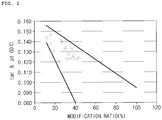
- Mathematical Formula 1 is a regression equation derived by preparing 17 kinds of modified conjugated diene-based polymers having different modification ratios, measuring dynamic viscoelasticity loss coefficient at 60°C using rubber compositions including the polymers, respectively, and making a comparison graph of the modified conjugated diene-based polymers and the dynamic viscoelasticity loss coefficient values (see FIG. 1 ).
- the Y value represents the range of the dynamic viscoelasticity loss coefficient at 60°C of the rubber composition, and if the above-mentioned range is satisfied, the tensile properties and the viscoelasticity properties of the rubber composition may be excellent in balance.
- the modified conjugated diene-based polymer may be a conjugated diene-based polymer catalyzed with a lanthanide rare earth element-containing catalyst and including a functional group in at least one terminal, particularly, a modified polymer including a functional group in at least one terminal and/or a polymer chain, and may include a modified polymer unit including a functional group and an unmodified polymer unit not including the functional group. That is, the modified polymer unit and the unmodified polymer unit represent constituent units composing one polymer in the present invention, and the conjugated diene-based polymer may be composed of a modified polymer unit and an unmodified polymer unit.
- the functional group represents a functional group derived from a modifier and a group having affinity with a filler
- the modifier may be selected from commonly known materials in this field according to the polymer and modification object, for example, may include one or more functional groups selected from an azacyclopropane group, a ketone group, a carboxyl group, a thiocarboxyl group, a carbonate, a carboxylic acid anhydride, a metal carboxylate, an oxyhalide, a urea group, a thiourea group, an amide group, a thioamide group, an isocyanate group, a thioisocyanate group, a halogenated isocyano group, an epoxy group, a thioepoxy group, an imine group and a M-Z bond (where M is selected from Sn, Si, Ge and P, and Z is a halogen atom), and may be a compound not including an active proton and an onium salt. Accordingly
- the conjugated diene-based polymer catalyzed with the lanthanide rare earth element may represent a conjugated diene-based polymer derived from a catalyst composition including a lanthanide rare earth element-containing compound, i.e., a conjugated diene-based polymer including an activated organometal part derived from a catalyst, and may be prepared by polymerizing a conjugated diene-based monomer in the presence of the catalyst composition.
- the conjugated diene-based polymer may be a butadiene homopolymer such as polybutadiene, or a butadiene copolymer such as a butadiene-isoprene copolymer.
- the conjugated diene-based polymer may include 80 to 100 wt% of a repeating unit derived from a 1,3-butadiene based monomer, and selectively 20 wt% or less of a repeating unit derived from other conjugated diene-based monomer which is copolymerizable with 1,3-butadiene monomer.
- the 1,3-butadiene may include 1,3-butadiene or the derivatives thereof such as 2,3-dimethyl-1,3-butadiene, and 2-ethyl-1,3-butadiene.
- the other conjugated diene-based monomer which is copolymerizable with 1,3-butadiene may include 2-methyl-1,3-pentadiene, 1,3-pentadiene, 3-methyl-1,3-pentadiene, 4-methyl-1,3-pentadiene, 1,3-hexadiene or 2,4-hexadiene, and any one among the compounds or a compound of two or more thereof may be used.
- the conjugated diene-based polymer may particularly be a butadiene-based polymer catalyzed with neodymium, including a repeating unit derived from a 1,3-butadiene monomer.
- the activated organometal part of the conjugated diene-based polymer may be an activated organometal part at the terminal of the conjugated diene-based polymer (activated organometal part at the terminal of a molecular chain), an activated organometal part in a main chain, or an activated organometal part in a side chain.
- the activated organometal part may be an activated organometal part at the terminal.
- the catalyst composition may include a lanthanide rare earth element-containing compound, an alkylating agent, and a halogen compound.
- the lanthanide rare earth element-containing compound any one used for the preparation of a common conjugated diene-based polymer may be used, without specific limitation.
- the lanthanide rare earth element-containing compound may be a compound including one or two or more rare earth metals of atomic numbers of 57 to 71 such as lanthanum, neodymium, cerium, gadolinium and praseodymium, and more particularly, a compound including one or two or more selected from the group consisting of neodymium, lanthanum and gadolinium, may be used.
- the lanthanide rare earth element-containing compound may be rare earth metal-containing carboxylates (for example, neodymium acetate, neodymium acrylate, neodymium methacrylate, neodymium gluconate, neodymium citrate, neodymium fumarate, neodymium lactate, neodymium maleate, neodymium oxalate, neodymium 2-ethylhexanoate, neodymium neodecanoate, etc.), organic phosphates (for example, neodymium dibutyl phosphate, neodymium dipentyl phosphate, neodymium dihexyl phosphate, neodymium diheptyl phosphate, neodymium dioctyl phosphate, neodymium bis(1-methyl heptyl)
- the lanthanide rare earth element-containing compound may be any one selected from the group consisting of Nd(2,2-diethyl decanoate) 3 , Nd(2,2-dipropyl decanoate) 3 , Nd(2,2-dibutyl decanoate) 3 , Nd(2,2-dihexyl decanoate) 3 , Nd(2,2-dioctyl decanoate) 3 , Nd(2-ethyl-2-propyl decanoate) 3 , Nd(2-ethyl-2-butyl decanoate) 3 , Nd(2-ethyl-2-hexyl decanoate) 3 , Nd(2-propyl-2-butyl decanoate) 3 , Nd(2-propyl-2-butyl decanoate) 3 , Nd(2-propyl-2-hexyl decanoate) 3 , Nd(2-propyl-2-butyl decano
- the neodymium compound may be any one selected from the group consisting of Nd(2,2-diethyl decanoate) 3 , Nd(2,2-dipropyl decanoate) 3 , Nd(2,2-dibutyl decanoate) 3 , Nd(2,2-dihexyl decanoate) 3 , and Nd(2,2-dioctyl decanoate) 3 , or a mixture of two or more thereof.
- the alkylating agent is soluble in a non-polar solvent, particularly, a non-polar hydrocarbon-based solvent, and may be an organometallic compound including a bond between a cationic metal such as metals in group 1, 2, or 3 with carbon, or a boron-containing compound. More particularly, the alkylating agent may be any one selected from the group consisting of an organoaluminum compound, an organomagnesium compound, and an organolithium compound, or a mixture of two or more thereof.
- the organoaluminum compound may include dihydrocarbylaluminum hydride such as diethylaluminum hydride, di-n-propylaluminum hydride, diisopropylaluminum hydride, din-butylaluminum hydride, diisobutylaluminum hydride (DIBAH), di-n-octylaluminum hydride, diphenylaluminum hydride, di-p-tolylaluminum hydride, dibenzylaluminum hydride, phenylethylaluminum hydride, phenyl-n-propylaluminum hydride, phenylisopropylaluminum hydride, phenyl-n-butylaluminum hydride, phenylisobutylaluminum hydride, phenyl-n-octylaluminum hydride, p-tolylethylalumin
- the organoaluminum compound may be aluminoxanes.
- the aluminoxane may be prepared by reacting trihydrocarbyl aluminum-based compounds with water. More particularly, the aluminoxane may be methylaluminoxane (MAO), modified methylaluminoxane (MMAO), ethylaluminoxane, n-propylaluminoxane, isopropylaluminoxane, butylaluminoxane, isobutylaluminoxane, n-pentylaluminoxane, neopentylaluminoxane, n-hexylaluminoxane, n-octylaluminoxane, 2-ethylhexylaluminoxane, cyclohexylaluminoxane, 1-methylcyclopentylaluminoxane, phenylaluminoxane or 2,6-dimethylphenyl a
- the organomagnesium compound may include at least one magnesium-carbon bond and is a magnesium compound which may be dissolved in a non-polar solvent, particularly, a non-polar hydrocarbon-based solvent.
- the organomagnesium compound may include an alkylmagnesium compound such as diethylmagnesium, di-n-propylmagnesium, diisopropylmagnesium, dibutylmagnesium, dihexylmagnesium, diphenylmagnesium and dibenzylmagnesium; a hydrocarbyl magnesium hydride such as methyl magnesium hydride, ethyl magnesium hydride, butyl magnesium hydride, hexyl magnesium hydride, phenyl magnesium hydride, and benzyl magnesium hydride; a hydrocarbyl magnesium halide such as methyl magnesium chloride, ethyl magnesium chloride, butyl magnesium chloride, hexyl magnesium chloride, phenyl magnesium chloride, benzyl magnesium chlor
- an alkyl lithium of R-Li as an organolithium compound (in this case, R is an alkyl group of 1 to 20 carbon atoms, more particularly, a linear alkyl group of 1 to 8 carbon atoms) may be used. More particularly, methyllithium, ethyllithium, isopropyllithium, n-butyllithium, sec-butyllithium, t-butyllithium, isobutyllithium, pentyllithium, isopentyllithium, etc. may be used, and any one or a mixture of two or more thereof may be used.
- the halogen compound may be a diatomic halogen, an interhalogen compound, a hydrogen halide, an organic halide, a nonmetal halide, a metal halide, or an organometal halide, etc., and any one or a mixture of two or more thereof may be used.
- the halogen compound may be one selected from the group consisting of an organic halide, a metal halide and an organometal halide, or a mixture of two or more thereof.
- the diatomic halogen may include fluorine, chlorine, bromine, or iodine.
- the interhalogen compound may particularly include iodine monochloride, iodine monobromide, iodine trichloride, iodine pentafluoride, iodine monofluoride, iodine trifluoride, etc.
- the hydrogen halide may particularly include hydrogen fluoride, hydrogen chloride, hydrogen bromide, or hydrogen iodide.
- the organic halide may particularly include t-butyl chloride (t-BuCl), t-butyl bromide, allyl chloride, allyl bromide, benzyl chloride, benzyl bromide, chloro-di-phenylmethane, bromo-di-phenylmethane, triphenylmethyl chloride, triphenylmethyl bromide, benzylidene chloride, benzylidene bromide, methyltrichlorosilane, phenyltrichlorosilane, dimethyldichlorosilane, diphenyldichlorosilane, trimethylchlorosilane (TMSCl), benzoyl chloride, benzoyl bromide, propionyl chloride, propionyl bromide, methyl chloroformate, methyl bromoformate, iodomethane, diiodomethane, triiodomethane (also t-
- the nonmetal halide may particularly include phosphorus trichloride, phosphorus tribromide, phosphorus pentachloride, phosphorus oxychloride, phosphorus oxybromide, boron trifluoride, boron trichloride, boron tribromide, silicon tetrafluoride, silicon tetrachloride (SiCl 4 ), silicon tetrabromide, arsenic trichloride, arsenic tribromide, selenium tetrachloride, selenium tetrabromide, tellurium tetrachloride, tellurium tetrabromide, silicon tetraiodide, arsenic triiodide, tellurium tetraiodide, boron triiodide, phosphorus triiodide, phosphorus oxyiodide or selenium tetraiodide.
- the metal halide may particularly include tin tetrachloride, tin tetrabromide, aluminum trichloride, aluminum tribromide, antimony trichloride, antimony pentachloride, antimony tribromide, aluminum trifluoride, gallium trichloride, gallium tribromide, gallium trifluoride, indium trichloride, indium tribromide, indium trifluoride, titanium tetrachloride, titanium tetrabromide, zinc dichloride, zinc dibromide, zinc difluoride, aluminum triiodide, gallium triiodide, indium triiodide, titanium tetraiodide, zinc diiodide, germanium tetraiodide, tin tetraiodide, tin diiodide, antimony triiodide or magnesium diiodide.
- the organometal halide may particularly include dimethylaluminum chloride, diethylaluminum chloride, dimethylaluminum bromide, diethylaluminum bromide, dimethylaluminum fluoride, diethylaluminum fluoride, methylaluminum dichloride, ethylaluminum dichloride, methylaluminum dibromide, ethylaluminum dibromide, methylaluminum difluoride, ethylaluminum difluoride, methylaluminum sesquichloride, ethylaluminum sesquichloride (EASC), isobutylaluminum sesquichloride, methylmagnesium chloride, methylmagnesium bromide, ethylmagnesium chloride, ethylmagnesium bromide, n-butylmagnesium chloride, n-butylmagnesium bromide, pheny
- the catalyst composition according to an embodiment of the present invention may further include a diene-based monomer in addition to the above-described components.
- the diene-based monomer may be mixed with a catalyst for polymerization and form a premixing type catalyst, or may be polymerized with components in a catalyst for polymerization, specifically with an alkylating agent such as DIBAH to form a preforming type catalyst.
- an alkylating agent such as DIBAH
- catalytic activity may be improved, and a conjugated diene-based polymer thus prepared may be further stabilized.
- the diene-based monomer any one used for the preparation of a common conjugated diene-based polymer may be used, without specific limitation.
- the diene-based monomer may be 1,3-butadiene, isoprene, 1,3-pentadiene, 1,3-hexadiene, 2,3-dimethyl-1,3-butadiene, 2-ethyl-1,3-butadiene, 2-methyl-1,3-pentadiene, 3-methyl-1,3-pentadiene, 4-methyl-1,3-pentadiene, 2,4-hexadiene, or the like, and any one among them or a mixture of two or more thereof may be used.
- the catalyst composition according to an embodiment of the present invention may further include a hydrocarbon-based solvent in addition to the above-mentioned components.
- the hydrocarbon-based solvent may particularly be a non-polar solvent which has no reactivity with the components constituting the catalyst.
- a non-polar solvent which has no reactivity with the components constituting the catalyst.
- linear, branched or circular aliphatic hydrocarbon of 5 to 20 carbon atoms such as n-pentane, n-hexane, n-heptane, n-octane, n-nonane, n-decane, isopentane, isohexane, isoheptane, isooctane, 2,2-dimethylbutane, cyclopentane, cyclohexane, methylcyclopentane and methylcyclohexane; a mixture solvent of aliphatic hydrocarbon of 5 to 20 carbon atoms, such as petroleum ether, petroleum spirits, and kerosene; or an aromatic hydrocarbon-based solvent such as benzene, toluene, ethy
- the non-polar solvent may be the linear, branched or circular aliphatic hydrocarbon of 5 to 20 carbon atoms, or the mixture solvent of the aliphatic hydrocarbon, and more particularly, n-hexane, cyclohexane, or a mixture thereof may be used.
- the peak area of the unmodified polymer unit is the peak area of chromatogram with respect to the first solution transported to the detector
- the peak area of the modified polymer unit is the peak area of chromatogram with respect to the second solution transported to the detector.
- the modification ratio may mean, for example, the ratio of a modified polymer with respect to an unmodified polymer when a polymer including a polymerization active part is modified with a modifier, and may be represented by percentage (%) with respect to the total of the modified polymer and the unmodified polymer.
- the column may be a column used for chromatography, for example, a normal phase column of which stationary phase is polar and mobile phase is non-polar, or a reverse phase column of which stationary phase is non-polar and mobile phase is polar.
- the adsorbent according to an embodiment of the present invention means the stationary phase of the column, and may be a filler filling the column.
- the adsorbent may be appropriately selected according to a modified part by the modifier.
- the adsorbent may be one selected from the group consisting of a silica-based adsorbent, a polymer-based adsorbent, an alumina (Al 2 O 3 ) adsorbent, a graphitized carbon adsorbent and a zirconia adsorbent, particularly, a silica-based adsorbent.
- the adsorption of diverse modified polymers may be favorable.
- the silica-based adsorbent may be, for example, one or more selected from the group consisting of a silica gel adsorbent derived from silica (SiO 2 ); and an adsorbent obtained by substituting the silanol group (Si-OH) at the surface of the silica gel with, or by end-capping with one or more derived units selected from the group consisting of a chain-type, branch-type or cyclic alkylsilane of 1 to 30 carbon atoms, an arylsilane of 5 to 30 carbon atoms, a chain-type, branch-type or cyclic alkylcyanosilane of 1 to 30 carbon atoms, and a chain-type, branch-type or cyclic aminoalkylsilane of 1 to 30 carbon atoms, particularly, one or more selected from the group consisting of a silica gel adsorbent; and an end-capping adsorbent with one or more derived units selected from the
- the adsorbent may, for example, have a particle size of 0.001 to 100 ⁇ m, 1 to 100 ⁇ m, 1 to 50 ⁇ m, or 3 to 30 ⁇ m, and within this range, the adsorption of a modified polymer may be favorable.
- the particle size may mean an average particle diameter according to the shape of the adsorbent, particularly, if the shape of the adsorbent is spherical or elliptical, the particle size may mean an average particle diameter with respect to the diameter or the major axis. If the adsorbent has a polyhedron shape, the particle size may mean an average particle diameter with respect to the major axis.
- the modified polymer according to an embodiment of the present invention may include a functional group including an amine group in at least one terminal, and in this case, the adsorbent may be a silica-based adsorbent which is substituted with the functional group including an amine group.
- the first solvent and the second solvent may be each independently a polar solvent or a non-polar solvent.
- the second solvent may be a non-polar solvent
- the first solvent is a non-polar solvent
- the second solvent may be a polar solvent
- the first solvent and the second solvent may be each independently a polar solvent having different polarity.
- the second solvent may be a polar solvent having low polarity
- the first solvent is a polar solvent having low polarity
- the second solvent may be a polar solvent having high polarity.
- the polarity is not represented by an absolute value but may be relative concept in accordance with the polarity of a polar solvent used as each of the first solvent and the second solvent. In this case, effects of more efficiently eluting the unmodified polymer from the first solution and the modified polymer from the second solution, respectively, may be achieved.
- the polar solvent may be used in chromatography and may be any polar solvent that is capable of dissolving a modified polymer and an unmodified polymer, without limitation.
- a modified polymer and an unmodified polymer without limitation.
- the non-polar solvent may be used in chromatography and may be any non-polar solvent that is capable of dissolving a modified polymer and an unmodified polymer, without limitation.
- a modified polymer and an unmodified polymer without limitation.
- one or more selected from the group consisting of hexane, benzene, toluene, diethyl ether, chloroform, ethyl acetate, dichloromethane, cyclohexane, tetrachloromethane, iso-octane, xylene, butyl ether, isopropyl ether, and ethylene chloride may be used.
- the first solution may be injected in a flow rate of 0.01 to 10.0 ml/min, or 0.5 to 2.0 ml/min, and within this range, the entire quantity of the modified polymer may be more efficiently adsorbed onto the adsorbent, and only the unmodified polymer may be eluted together with the first solution.
- the second solvent may be injected in a flow rate of 0.01 to 10.0 ml/min, or 0.5 to 2.0 ml/min, and within this range, effects of more efficiently eluting the second solution in which the modified polymer adsorbed onto the adsorbent is dissolved, may be achieved.
- first solution and the second solution may be controlled for easy elution of the unmodified polymer or the second solution within the above-mentioned ranges according to the volume of each column (the length or diameter of the column).
- the second solvent may be injected after eluting the entire quantity of the unmodified polymer.
- the point when the entire quantity of the unmodified polymer is eluted may mean a point when the signal of the unmodified polymer is not detected any more from a detector.
- the second solvent may be injected into the column to which the first solution has been injected after finishing the injection of the first solution.
- the second solvent may be continuously injected into the column to which the first solution has been injected according to a gradient elution by which the composition of a solvent is continuously changed. In this case, effects of more accurate detection without losing signals during the detection may be achieved.
- the first solution and the second solution may be eluted at the same time from the injection point of the second solvent, and the eluted first solution and second solution at the same time may be transported to the detector at the same time.
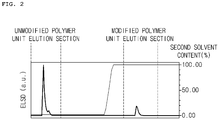
- the quantity of the first solution and the second solution transported to the detector may gradually increase or decrease according to the injection rate of the second solvent from the injection point of the second solvent, respectively, that is, the first solution may gradually decrease from 100 vol% to 0 vol% and the second solution may gradually increase from 0 vol% to 100 vol%.
- the first solution and the second solution may be detected in the detector at the same time, and according to the injection of the second solvent, the detection amount of the previously injected first solution may decrease from 100 vol% to 0 vol%, and the detection amount of the second solution may increase from 0 vol% to 100 vol% by the decreased detection amount of the first solution. After completing the elution of the first solution, only the second solution may be detected (see FIG. 2 ).
- the measurement method of the modification ratio of the conjugated diene-based polymer is conducted using a chromatography measurement apparatus, for example, a liquid chromatography measurement apparatus, particularly, a chromatography measurement apparatus including a mobile phase reservoir for storing a first solution and a second solvent, a pump for constantly and reproducibly supplying a mobile phase to a column, a sample injector for controlling the injection volume of a solution into the column or the injection volume of a solvent, a column for separating a modified polymer and an unmodified polymer, and a detector for detecting eluted modified polymer or unmodified polymer.
- a chromatography measurement apparatus for example, a liquid chromatography measurement apparatus, particularly, a chromatography measurement apparatus including a mobile phase reservoir for storing a first solution and a second solvent, a pump for constantly and reproducibly supplying a mobile phase to a column, a sample injector for controlling the injection volume of a solution into the column or the injection volume of a solvent, a column for separating
- the mobile phase reservoir may be two or more, particularly, a mobile phase reservoir for storing the first solution and a mobile phase reservoir for storing the second solvent may be respectively provided.
- the mobile phase reservoir may include a separate gradient elution apparatus for the application of gradient elution.
- the pump may generate a pressure of 0.1 to 10,000 psi or 100 to 5,000 psi, may control a flow rate to 0.01 to 20 ml or 0.1 to 10 ml, may generate no pulse during supplying a solution or a solvent, and may keep a flow rate change of 1% or less, or 0.1 to 0.5%.
- the pump may be a single-head pump or a dual-head pump, particularly, a dual-head pump, and in this case, the application of gradient elution may be favorable.
- the injector may be, for example, a Rheodyne injector or an automatic injector, and the Rheodyne injector may have, for example, a loop volume of 1 to 500 ⁇ l, 5 to 200 ⁇ l, or 10 to 100 ⁇ l, and within this range, injection accuracy may be high.
- the detector for example, may be selected from a UV/Vis detector, a fluorescence detector, a refractive index detector and an evaporative light scattering detector, particularly, an evaporative light scattering detector.
- a response factor may be constant, accurate component analysis may be possible without making an analytical calibration curve based on a standard material, detection by gradient elution may be possible, and separation performance and separation sensitivity are excellent.
- a modification ratio was measured using an evaporative light scattering detector (ELSD) of Waters Co. as the detector and injecting a specimen prepared in 1.0 mg/ml with a loop volume of 100 ⁇ l.
- ELSD evaporative light scattering detector
- the dynamic viscoelasticity loss coefficient (tan ⁇ ) is used as the index of a fuel consumption ratio. If the dynamic viscoelasticity loss coefficient value at 60°C decreases, hysteresis loss may decrease, rotational resistance properties may be improved, and thus, a fuel consumption ratio may be improved.
- the dynamic viscoelasticity loss coefficient was measured by obtaining a specimen through vulcanizing a rubber composition at 150°C for 90 minutes, and measuring using a dynamic mechanical analyzer of TA Co. with a twist mode and a frequency of 10 Hz, at a strain ratio of 3% at 60°C.
- the rubber composition according to an embodiment of the present invention may include the modified conjugated diene-based polymer in an amount of 0.1 wt% to 100 wt%, particularly, 10 wt% to 100 wt%, more particularly, 20 wt% to 90 wt%. If the amount of the modified conjugated diene-based polymer is less than 0.1 wt%, the improving effects of the abrasion resistance and crack resistance of a molded article manufactured using the rubber composition, for example, a tire may be insignificant.
- the rubber composition may further include other rubber components in addition to the modified conjugated diene-based polymer as necessary, and in this case, the rubber component may be included in an amount of 90 wt% or less with respect to the total weight of the rubber composition. Particularly, the rubber component may be included in an amount of 1 part by weight to 900 parts by weight with respect to 100 parts by weight of the modified conjugated diene-based polymer.
- the rubber component may be a natural rubber or a synthetic rubber, for example, a natural rubber (NR) including cis-1,4-polyisoprene; a modified natural rubber which is obtained by modifying or purifying a common natural rubber, such as an epoxidized natural rubber (ENR), a deproteinized natural rubber (DPNR), and a hydrogenated natural rubber; and a synthetic rubber such as a styrene-butadiene copolymer (SBR), a polybutadiene (BR), a polyisoprene (IR), a butyl rubber (IIR), an ethylenepropylene copolymer, a polyisobutylene-co-isoprene, a neoprene, a poly(ethylene-co-propylene), a poly(styrene-co-butadiene), a poly(styrene-co-isoprene), a poly(styrene-co-isopren
- the rubber composition may include 0.1 parts by weight to 150 parts by weight of a filler with respect to 100 parts by weight of the modified conjugated diene-based polymer, and the filler may be silica-based, carbon black or a combination thereof. Particularly, the filler may be carbon black.
- the carbon black filler is not specifically limited but may have a nitrogen adsorption specific surface area of, for example, 20 m 2 /g to 250 m 2 /g (measured based on N 2 SA, JIS K 6217-2:2001 ). Also, the carbon black may have a dibutylphthalate oil absorption amount (DBP) of 80 cc/100 g to 200 cc/100 g. If the nitrogen adsorption specific surface area of the carbon black is greater than 250 m 2 /g, the processability of a rubber composition may be deteriorated, and if the nitrogen adsorption specific surface area of the carbon black is less than 20 m 2 /g, reinforcing performance by the carbon black may be insignificant.
- DBP dibutylphthalate oil absorption amount
- the DBP oil absorption amount of the carbon black is greater than 200 cc/100 g, the processability of the rubber composition may be deteriorated, and if the DBP oil absorption amount of the carbon black is less than 80 cc/100 g, reinforcing performance by the carbon black may be insignificant.
- the silica is not specifically limited, but may include, for example, wet silica (hydrated silica), dry silica (anhydrous silicate), calcium silicate, aluminum silicate or colloid silica.
- the silica may be wet silica which has the most remarkable compatibility effect of the improving effect of destruction characteristics and wet grip.
- the silica may have nitrogen absorption specific surface area (nitrogen surface area per gram, N 2 SA) of 120 m 2 /g to 180 m 2 /g, and cetyl trimethyl ammonium bromide (CTAB) absorption specific surface area of 100 m 2 /g to 200 m 2 /g.
- N 2 SA nitrogen surface area per gram
- CTAB cetyl trimethyl ammonium bromide
- the nitrogen absorption specific surface area of the silica is less than 120 m 2 /g, the reinforcing performance due to silica may be deteriorated, and if the nitrogen absorption specific surface area of the silica is greater than 180 m 2 /g, the processability of the rubber composition may be deteriorated.
- the CTAB absorption specific surface area of the silica is less than 100 m 2 /g, the reinforcing performance by the silica filler may be deteriorated, and if the CTAB absorption specific surface area of the silica is greater than 200 m 2 /g, the processability of the rubber composition may be deteriorated.
- silica is used as the filler, a silane coupling agent may be used together for the improvement of reinforcing and low exothermic properties.
- the silane coupling agent may particularly include bis(3-triethoxysilylpropyl)tetrasulfide, bis(3-triethoxysilylpropyl)trisulfide, bis(3-triethoxysilylpropyl)disulfide, bis(2-triethoxysilylethyl)tetrasulfide, bis(3-trimethoxysilylpropyl)tetrasulfide, bis(2-trimethoxysilylethyl)tetrasulfide, 3-mercaptopropyltrimethoxysilane, 3-mercaptopropyltriethoxysilane, 2-mercaptoethyltrimethoxysilane, 2-mercaptoethyltriethoxysilane, 3-trimethoxysilylpropyl-N,N-dimethylthiocarbamoyltetrasulfide, 3-triethoxysilylpropyl-N,N-
- the silane coupling agent may be bis(3-triethoxysilylpropyl)polysulfide or 3-trimethoxysilylpropylbenzothiazyltetrasulfide in consideration of the improving effect of reinforcing properties.
- the rubber composition according to an embodiment of the present invention may be sulfur crosslinkable, and so may further include a vulcanizing agent.
- the vulcanizing agent may be particularly a sulfur powder and may be included in an amount of 0.1 parts by weight to 10 parts by weight with respect to 100 parts by weight of the rubber component. With the amount used in the above range, elasticity and strength required for a vulcanized rubber composition may be secured, and at the same time, a low fuel consumption ratio may be attained.
- the rubber composition according to an embodiment of the present invention may further include various additives used in a common rubber industry in addition to the above components, particularly, a vulcanization accelerator, a process oil, a plasticizer, an antiaging agent, a scorch preventing agent, a zinc white, stearic acid, a thermosetting resin, a thermoplastic resin, or the like.
- various additives used in a common rubber industry particularly, a vulcanization accelerator, a process oil, a plasticizer, an antiaging agent, a scorch preventing agent, a zinc white, stearic acid, a thermosetting resin, a thermoplastic resin, or the like.
- the vulcanization accelerator is not specifically limited, and may particularly include thiazole-based compounds such as 2-mercaptobenzothiazole (M), dibenzothiazyldisulfide (DM), and N-cyclohexyl-2-benzothiazylsulfenamide (CZ), or guanidine-based compounds such as diphenylguanidine (DPG).
- M 2-mercaptobenzothiazole
- DM dibenzothiazyldisulfide
- CZ N-cyclohexyl-2-benzothiazylsulfenamide
- DPG diphenylguanidine
- the vulcanization accelerator may be included in an amount of 0.1 parts by weight to 5 parts by weight with respect to 100 parts by weight of the rubber component.
- the process oil acts as a softener in a rubber composition and may particularly include a paraffin-based, naphthene-based, or aromatic compound. More particularly, an aromatic process oil may be used in consideration of tensile strength and abrasion resistance, and a naphthene-based or paraffin-based process oil may be used in consideration of hysteresis loss and properties at low temperature.
- the process oil may be included in an amount of 100 parts by weight or less with respect to 100 parts by weight of the rubber component. With the above-described amount range, the deterioration of the tensile strength and low exothermic properties (low fuel consumption ratio) of a vulcanized rubber may be prevented.
- the antiaging agent may particularly include N-isopropyl-N'-phenyl-p-phenylenediamine, N-(1,3-dimethylbutyl)-N'-phenyl-p-phenylenediamine, 6-ethoxy-2,2,4-trimethyl-1,2-dihydroquinoline, or a condensate of diphenylamine and acetone at a high temperature.
- the antiaging agent may be used in an amount of 0.1 parts by weight to 6 parts by weight with respect to 100 parts by weight of the rubber component.
- the rubber composition according to an embodiment of the present invention may be obtained by mulling using a mulling apparatus such as a banbury mixer, a roll, and an internal mixer according to a mixing prescription.
- a rubber composition having low exothermic properties and excellent abrasion resistance may be obtained by a vulcanization process after a molding process.
- the rubber composition may be useful to the manufacture of each member of a tire such as a tire tread, an under tread, a side wall, a carcass coating rubber, a belt coating rubber, a bead filler, a chafer, and a bead coating rubber, or to the manufacture of rubber products in various industries such as a vibration-proof rubber, a belt conveyor, and a hose.
- DIBAH diisobutylaluminum hydride
- DEAC diethylaluminum chloride
- the polymer thus obtained was added to hot water heated by steam, solvents were removed, and drying was performed to remove residual solvents and water to prepare a terminal modified butadiene polymer.
- the terminal modified butadiene polymer 70 parts by weight of carbon black, 22.5 parts by weight of a process oil, 2 parts by weight of an antiaging agent (TMDQ), 3 parts by weight of zinc oxide (ZnO), and 2 parts by weight of stearic acid were mixed to prepare a first composition.
- TMDQ antiaging agent
- ZnO zinc oxide
- stearic acid 2 parts by weight of stearic acid
- 2 parts by weight of sulfur, 2 parts by weight of a vulcanization accelerator (CZ), and 0.5 parts by weight of a vulcanization accelerator (DPG) were added, followed by gently mixing at 50°C for 1.5 minutes in 50 rpm to prepare each rubber composition.
- the terminal modified butadiene polymers were prepared through preparing a plurality of polymers by the method described in Preparation Example 3, and the modification ratio of each polymer was measured.
- a polymer having the calculated X value (rounding off the numbers to the first decimal places) was selected and used for the preparation of the rubber compositions of Examples 1 to 5.
- Y AX + 0.1645
- modification ratio (X value) of the terminal modified butadiene polymer was measured by a method explained below.
- each polymer was dissolved in cyclohexane and stored in each mobile phase reservoir of specimen (prepared in 1.0 mg/ml each), and tetrahydrofuran (THF) was stored in another mobile phase reservoir.
- the mobile phase reservoir was connected to a dual-head pump, and a solution of the mobile phase reservoir in which the polymer was dissolved was injected first into a column filled with a silica adsorbent through the pump and an injector having a loop volume of 100 ⁇ l.
- the pressure of the pump was 450 psi, and an injection rate was 0.7 ml/min.
- the tetrahydrofuran was injected into the column through the pump.
- the pressure of the pump was 380 psi, and an injection rate was 0.7 ml/min.
- modification ratio % peak area of modified polymer peak area of unmodified polymer + peak area of modified polymer ⁇ 100 [Table 1] Division Y A X Example 1 0.140 -0.00091 27 Example 2 0.120 -0.0013 34 Example 3 0.130 -0.00099 35 Example 4 0.130 -0.0011 31 Example 5 0.130 -0.0019 18
- Each rubber composition was prepared according to the same method as in Example 1, except for determining a Y value and an A value as shown in Table 2, deriving a calculated X value from Mathematical Formula 1, and using a terminal modified butadiene polymer having the X value.
- the Y value was the same as in Example 1, and the A value was determined as a value in a range deviated from a graph obtained by the rubber compositions of Comparative Examples 1 and 2 from Mathematical Formula 1 and Mathematical Formula 2.
- terminal modified butadiene polymers were prepared through preparing a plurality of polymers by the method described in Preparation Example 3, and the modification ratio of each polymer was measured.
- a polymer having the calculated X value was selected and used for the preparation of the rubber compositions of Comparative Examples 1 to 3, and the measurement of the modification ratio was performed by the same method as in Example 1.
- Each specimen was formed by vulcanizing each rubber composition at 160°C for 25 minutes.
- the tensile properties of the specimen thus formed were measured after vulcanizing the specimen at 150°C for t90 minutes, by measuring tensile stress, elongation (elongation ratio) when breaking the specimen, and tensile stress when elongated by 300% (300% modulus) according to an ASTM D412 tensile test method.
- the viscoelasticity properties of the specimen thus formed were measured as a viscoelasticity coefficient (tan ⁇ ) at 60°C using a dynamic mechanical analyzer of TA Co., Ltd. in a twist mode with a frequency of 10 Hz and a modification ratio of 3%.
- tan ⁇ viscoelasticity coefficient
- the rubber compositions of Examples 1 to 5 according to the embodiments of the present invention showed excellent processability and tensile properties, and thus, excellent mechanical properties.
- the processability properties were markedly degraded and tensile properties were degraded in Comparative Example 1 to Comparative Example 3.
- the rubber composition according to the present invention used a modified conjugated diene-based polymer of which modification ratio was controlled so as to satisfy Mathematical Formula 1 and Mathematical Formula 2, and a rubber composition of which physical properties were controlled to fulfill target properties, was found to be easily prepared.
Landscapes
- Chemical & Material Sciences (AREA)
- Health & Medical Sciences (AREA)
- Chemical Kinetics & Catalysis (AREA)
- Medicinal Chemistry (AREA)
- Polymers & Plastics (AREA)
- Organic Chemistry (AREA)
- General Chemical & Material Sciences (AREA)
- Engineering & Computer Science (AREA)
- Materials Engineering (AREA)
- Compositions Of Macromolecular Compounds (AREA)
- Addition Polymer Or Copolymer, Post-Treatments, Or Chemical Modifications (AREA)
- Polymerization Catalysts (AREA)
Applications Claiming Priority (3)
| Application Number | Priority Date | Filing Date | Title |
|---|---|---|---|
| KR20170126963 | 2017-09-29 | ||
| KR1020180112092A KR20190038344A (ko) | 2017-09-29 | 2018-09-19 | 고무 조성물 |
| PCT/KR2018/011189 WO2019066396A2 (ko) | 2017-09-29 | 2018-09-20 | 고무 조성물 |
Publications (3)
| Publication Number | Publication Date |
|---|---|
| EP3689960A2 true EP3689960A2 (de) | 2020-08-05 |
| EP3689960A4 EP3689960A4 (de) | 2020-09-02 |
| EP3689960B1 EP3689960B1 (de) | 2021-11-24 |
Family
ID=66164394
Family Applications (1)
| Application Number | Title | Priority Date | Filing Date |
|---|---|---|---|
| EP18862150.2A Active EP3689960B1 (de) | 2017-09-29 | 2018-09-20 | Kautschukzusammensetzung |
Country Status (5)
| Country | Link |
|---|---|
| US (1) | US11505624B2 (de) |
| EP (1) | EP3689960B1 (de) |
| JP (1) | JP6960041B2 (de) |
| KR (2) | KR20190038344A (de) |
| CN (1) | CN110997787B (de) |
Cited By (2)
| Publication number | Priority date | Publication date | Assignee | Title |
|---|---|---|---|---|
| EP3715386A4 (de) * | 2017-11-21 | 2020-10-21 | LG Chem, Ltd. | Kautschukzusammensetzung |
| EP4032921A4 (de) * | 2019-09-19 | 2022-11-30 | LG Chem, Ltd. | Verfahren zur herstellung eines modifizierten konjugierten dienpolymers |
Family Cites Families (23)
| Publication number | Priority date | Publication date | Assignee | Title |
|---|---|---|---|---|
| DE2950634C2 (de) | 1979-12-15 | 1985-11-07 | M.A.N. Maschinenfabrik Augsburg-Nürnberg AG, 8900 Augsburg | Kraftstoffeinspritzpumpenanordnung an einer Brennkraftmaschine |
| ATE156911T1 (de) | 1994-03-04 | 1997-08-15 | Waters Investments Ltd | Verfahren zum nachweis von polymeren in einer lösung, detektorsystem und eine ein solches detektorsystem beinhaltende chromatographievorrichtung |
| JP4434850B2 (ja) | 2004-06-18 | 2010-03-17 | 株式会社ブリヂストン | 定量方法 |
| JP2007191611A (ja) | 2006-01-20 | 2007-08-02 | Bridgestone Corp | 変性ポリブタジエンゴム配合ゴム組成物及びタイヤ |
| JP5642542B2 (ja) * | 2007-06-18 | 2014-12-17 | 株式会社ブリヂストン | アミノ基を含有するハロシラン類で官能基化された重合体 |
| US8314189B2 (en) | 2007-10-12 | 2012-11-20 | Bridgestone Corporation | Polymers functionalized with heterocyclic nitrile compounds |
| US7906592B2 (en) | 2008-07-03 | 2011-03-15 | Bridgestone Corporation | Polymers functionalized with imide compounds containing a protected amino group |
| KR101692089B1 (ko) | 2009-01-23 | 2017-01-02 | 가부시키가이샤 브리지스톤 | 폴리시아노 화합물로 관능화된 중합체 |
| WO2011002830A2 (en) * | 2009-06-30 | 2011-01-06 | Bridgestone Corporation | Polymers functionalized with hydroxyl group-containing diphenylethylene |
| WO2011002930A2 (en) * | 2009-06-30 | 2011-01-06 | Bridgestone Corporation | Hydroxyaryl functionalized polymers |
| US8338544B2 (en) | 2009-12-21 | 2012-12-25 | Bridgestone Corporation | Polymers functionalized with polyoxime compounds and methods for their manufacture |
| WO2011106765A2 (en) * | 2010-02-28 | 2011-09-01 | Bridgestone Corporation | Rubber compositions including siliceous fillers |
| JP5698560B2 (ja) | 2011-02-22 | 2015-04-08 | 旭化成ケミカルズ株式会社 | 変性共役ジエン系共重合体、その製造方法、及び変性共役ジエン系共重合体組成物 |
| TWI432466B (zh) | 2011-12-30 | 2014-04-01 | Chi Mei Corp | 主鏈改質的共軛二烯-乙烯基芳香烴共聚物及其製備方法、橡膠組成、橡膠物與輪胎 |
| KR101455508B1 (ko) | 2012-02-06 | 2014-10-27 | 주식회사 엘지화학 | 변성 공액 디엔계 중합체 및 이의 제조방법 |
| KR101594217B1 (ko) | 2013-04-25 | 2016-02-16 | 주식회사 엘지화학 | 변성 공액 디엔계 중합체의 연속 제조방법, 이로부터 수득된 중합체 및 이를 포함하는 고무 조성물 |
| KR20160060562A (ko) * | 2014-11-20 | 2016-05-30 | 주식회사 엘지화학 | 공액 디엔계 중합체 |
| CN107250166B (zh) * | 2015-02-19 | 2021-09-24 | 旭化成株式会社 | 改性共轭二烯系聚合物及其制造方法、橡胶组合物以及轮胎 |
| JP2017002189A (ja) | 2015-06-10 | 2017-01-05 | 旭化成株式会社 | 変性ジエン系重合体組成物、サイドウォール用ゴム組成物、及びタイヤ |
| KR20170000756A (ko) | 2015-06-24 | 2017-01-03 | 주식회사 엘지화학 | 공액 디엔계 중합체 제조용 촉매 조성물 및 이를 이용하여 제조된 공액 디엔계 중합체 |
| KR102058693B1 (ko) | 2015-12-22 | 2019-12-24 | 주식회사 엘지화학 | 고무 조성물 및 이로부터 제조된 타이어 |
| KR101923160B1 (ko) | 2015-12-24 | 2018-11-29 | 주식회사 엘지화학 | 변성 공액디엔계 중합체, 이의 제조방법 및 변성제 |
| KR102115390B1 (ko) | 2016-07-26 | 2020-05-27 | 주식회사 엘지화학 | 중합체 변성률 측정 방법 |
-
2018
- 2018-09-19 KR KR1020180112092A patent/KR20190038344A/ko not_active Ceased
- 2018-09-20 US US16/634,268 patent/US11505624B2/en active Active
- 2018-09-20 JP JP2020505179A patent/JP6960041B2/ja active Active
- 2018-09-20 CN CN201880049054.3A patent/CN110997787B/zh active Active
- 2018-09-20 EP EP18862150.2A patent/EP3689960B1/de active Active
-
2020
- 2020-07-30 KR KR1020200095455A patent/KR102265337B1/ko active Active
Cited By (3)
| Publication number | Priority date | Publication date | Assignee | Title |
|---|---|---|---|---|
| EP3715386A4 (de) * | 2017-11-21 | 2020-10-21 | LG Chem, Ltd. | Kautschukzusammensetzung |
| US11680153B2 (en) | 2017-11-21 | 2023-06-20 | Lg Chem, Ltd. | Rubber composition |
| EP4032921A4 (de) * | 2019-09-19 | 2022-11-30 | LG Chem, Ltd. | Verfahren zur herstellung eines modifizierten konjugierten dienpolymers |
Also Published As
| Publication number | Publication date |
|---|---|
| CN110997787A (zh) | 2020-04-10 |
| EP3689960B1 (de) | 2021-11-24 |
| EP3689960A4 (de) | 2020-09-02 |
| KR20190038344A (ko) | 2019-04-08 |
| KR102265337B1 (ko) | 2021-06-16 |
| KR20200095447A (ko) | 2020-08-10 |
| JP2020530045A (ja) | 2020-10-15 |
| JP6960041B2 (ja) | 2021-11-05 |
| CN110997787B (zh) | 2022-03-01 |
| US20200377625A1 (en) | 2020-12-03 |
| US11505624B2 (en) | 2022-11-22 |
Similar Documents
| Publication | Publication Date | Title |
|---|---|---|
| EP3715388B1 (de) | Modifiziertes konjugiertes polymere auf dienbasis und verfahren zu seiner herstellung | |
| EP3351570A1 (de) | Modifikator, modifiziertes konjugiertes dienpolymer und kautschukzusammensetzung damit | |
| EP3539994B1 (de) | Modifizierte konjugierte polymere auf dien-basis und herstellungsverfahren dafür | |
| EP3705499B1 (de) | Verfahren zur herstellung eines katalysators zur polymerisation von konjugierten dienen, katalysator und verfahren zur herstellung von konjugiertem dien-basiertem polymer unter verwendung davon | |
| KR102265337B1 (ko) | 고무 조성물 | |
| US11680153B2 (en) | Rubber composition | |
| EP3778677B1 (de) | Katalysatorzusammensetzung, verfahren zur herstellung der zusammensetzung, verfahren zur herstellung eines konjugierten polymers auf dienbasis unter verwendung der zusammensetzung und konjugiertes polymer auf dienbasis, hergestellt durch das verfahren zur herstellung des polymers | |
| US11597828B2 (en) | Rubber composition | |
| JP2022525053A (ja) | 変性剤、変性共役ジエン系重合体、およびその製造方法 | |
| EP3360905B1 (de) | Modifiziertes und konjugiertes polymer auf dienbasis und methode zu seiner herstellung | |
| JP7462735B2 (ja) | 変性共役ジエン系重合体の製造方法 | |
| EP3851485B1 (de) | Kautschukzusammensetzung und daraus hergestellter formkörper | |
| EP3896105B1 (de) | Modifiziertes konjugiertes dienbasiertes polymer, verfahren zur herstellung davon und kautschukzusammensetzung damit |
Legal Events
| Date | Code | Title | Description |
|---|---|---|---|
| STAA | Information on the status of an ep patent application or granted ep patent |
Free format text: STATUS: THE INTERNATIONAL PUBLICATION HAS BEEN MADE |
|
| PUAI | Public reference made under article 153(3) epc to a published international application that has entered the european phase |
Free format text: ORIGINAL CODE: 0009012 |
|
| STAA | Information on the status of an ep patent application or granted ep patent |
Free format text: STATUS: REQUEST FOR EXAMINATION WAS MADE |
|
| 17P | Request for examination filed |
Effective date: 20200116 |
|
| AK | Designated contracting states |
Kind code of ref document: A2 Designated state(s): AL AT BE BG CH CY CZ DE DK EE ES FI FR GB GR HR HU IE IS IT LI LT LU LV MC MK MT NL NO PL PT RO RS SE SI SK SM TR |
|
| AX | Request for extension of the european patent |
Extension state: BA ME |
|
| A4 | Supplementary search report drawn up and despatched |
Effective date: 20200804 |
|
| RIC1 | Information provided on ipc code assigned before grant |
Ipc: C08L 9/00 20060101AFI20200729BHEP Ipc: C08F 4/52 20060101ALI20200729BHEP Ipc: C08C 19/25 20060101ALI20200729BHEP Ipc: C08F 2/38 20060101ALI20200729BHEP Ipc: C08L 15/00 20060101ALI20200729BHEP Ipc: C08C 19/22 20060101ALI20200729BHEP Ipc: C08C 19/20 20060101ALI20200729BHEP |
|
| DAV | Request for validation of the european patent (deleted) | ||
| DAX | Request for extension of the european patent (deleted) | ||
| RIC1 | Information provided on ipc code assigned before grant |
Ipc: C08L 9/00 20060101AFI20210527BHEP Ipc: C08C 19/20 20060101ALI20210527BHEP Ipc: C08F 2/38 20060101ALI20210527BHEP Ipc: C08F 4/52 20060101ALI20210527BHEP Ipc: C08L 15/00 20060101ALI20210527BHEP Ipc: C08C 19/22 20060101ALI20210527BHEP Ipc: C08C 19/25 20060101ALI20210527BHEP |
|
| GRAP | Despatch of communication of intention to grant a patent |
Free format text: ORIGINAL CODE: EPIDOSNIGR1 |
|
| STAA | Information on the status of an ep patent application or granted ep patent |
Free format text: STATUS: GRANT OF PATENT IS INTENDED |
|
| INTG | Intention to grant announced |
Effective date: 20210705 |
|
| GRAS | Grant fee paid |
Free format text: ORIGINAL CODE: EPIDOSNIGR3 |
|
| GRAA | (expected) grant |
Free format text: ORIGINAL CODE: 0009210 |
|
| STAA | Information on the status of an ep patent application or granted ep patent |
Free format text: STATUS: THE PATENT HAS BEEN GRANTED |
|
| AK | Designated contracting states |
Kind code of ref document: B1 Designated state(s): AL AT BE BG CH CY CZ DE DK EE ES FI FR GB GR HR HU IE IS IT LI LT LU LV MC MK MT NL NO PL PT RO RS SE SI SK SM TR |
|
| REG | Reference to a national code |
Ref country code: GB Ref legal event code: FG4D |
|
| REG | Reference to a national code |
Ref country code: DE Ref legal event code: R096 Ref document number: 602018027305 Country of ref document: DE |
|
| REG | Reference to a national code |
Ref country code: AT Ref legal event code: REF Ref document number: 1449860 Country of ref document: AT Kind code of ref document: T Effective date: 20211215 |
|
| REG | Reference to a national code |
Ref country code: IE Ref legal event code: FG4D |
|
| REG | Reference to a national code |
Ref country code: LT Ref legal event code: MG9D |
|
| REG | Reference to a national code |
Ref country code: NL Ref legal event code: MP Effective date: 20211124 |
|
| REG | Reference to a national code |
Ref country code: AT Ref legal event code: MK05 Ref document number: 1449860 Country of ref document: AT Kind code of ref document: T Effective date: 20211124 |
|
| PG25 | Lapsed in a contracting state [announced via postgrant information from national office to epo] |
Ref country code: RS Free format text: LAPSE BECAUSE OF FAILURE TO SUBMIT A TRANSLATION OF THE DESCRIPTION OR TO PAY THE FEE WITHIN THE PRESCRIBED TIME-LIMIT Effective date: 20211124 Ref country code: LT Free format text: LAPSE BECAUSE OF FAILURE TO SUBMIT A TRANSLATION OF THE DESCRIPTION OR TO PAY THE FEE WITHIN THE PRESCRIBED TIME-LIMIT Effective date: 20211124 Ref country code: FI Free format text: LAPSE BECAUSE OF FAILURE TO SUBMIT A TRANSLATION OF THE DESCRIPTION OR TO PAY THE FEE WITHIN THE PRESCRIBED TIME-LIMIT Effective date: 20211124 Ref country code: BG Free format text: LAPSE BECAUSE OF FAILURE TO SUBMIT A TRANSLATION OF THE DESCRIPTION OR TO PAY THE FEE WITHIN THE PRESCRIBED TIME-LIMIT Effective date: 20220224 Ref country code: AT Free format text: LAPSE BECAUSE OF FAILURE TO SUBMIT A TRANSLATION OF THE DESCRIPTION OR TO PAY THE FEE WITHIN THE PRESCRIBED TIME-LIMIT Effective date: 20211124 |
|
| PG25 | Lapsed in a contracting state [announced via postgrant information from national office to epo] |
Ref country code: IS Free format text: LAPSE BECAUSE OF FAILURE TO SUBMIT A TRANSLATION OF THE DESCRIPTION OR TO PAY THE FEE WITHIN THE PRESCRIBED TIME-LIMIT Effective date: 20220324 Ref country code: SE Free format text: LAPSE BECAUSE OF FAILURE TO SUBMIT A TRANSLATION OF THE DESCRIPTION OR TO PAY THE FEE WITHIN THE PRESCRIBED TIME-LIMIT Effective date: 20211124 Ref country code: PT Free format text: LAPSE BECAUSE OF FAILURE TO SUBMIT A TRANSLATION OF THE DESCRIPTION OR TO PAY THE FEE WITHIN THE PRESCRIBED TIME-LIMIT Effective date: 20220324 Ref country code: PL Free format text: LAPSE BECAUSE OF FAILURE TO SUBMIT A TRANSLATION OF THE DESCRIPTION OR TO PAY THE FEE WITHIN THE PRESCRIBED TIME-LIMIT Effective date: 20211124 Ref country code: NO Free format text: LAPSE BECAUSE OF FAILURE TO SUBMIT A TRANSLATION OF THE DESCRIPTION OR TO PAY THE FEE WITHIN THE PRESCRIBED TIME-LIMIT Effective date: 20220224 Ref country code: NL Free format text: LAPSE BECAUSE OF FAILURE TO SUBMIT A TRANSLATION OF THE DESCRIPTION OR TO PAY THE FEE WITHIN THE PRESCRIBED TIME-LIMIT Effective date: 20211124 Ref country code: LV Free format text: LAPSE BECAUSE OF FAILURE TO SUBMIT A TRANSLATION OF THE DESCRIPTION OR TO PAY THE FEE WITHIN THE PRESCRIBED TIME-LIMIT Effective date: 20211124 Ref country code: HR Free format text: LAPSE BECAUSE OF FAILURE TO SUBMIT A TRANSLATION OF THE DESCRIPTION OR TO PAY THE FEE WITHIN THE PRESCRIBED TIME-LIMIT Effective date: 20211124 Ref country code: GR Free format text: LAPSE BECAUSE OF FAILURE TO SUBMIT A TRANSLATION OF THE DESCRIPTION OR TO PAY THE FEE WITHIN THE PRESCRIBED TIME-LIMIT Effective date: 20220225 Ref country code: ES Free format text: LAPSE BECAUSE OF FAILURE TO SUBMIT A TRANSLATION OF THE DESCRIPTION OR TO PAY THE FEE WITHIN THE PRESCRIBED TIME-LIMIT Effective date: 20211124 |
|
| PG25 | Lapsed in a contracting state [announced via postgrant information from national office to epo] |
Ref country code: SM Free format text: LAPSE BECAUSE OF FAILURE TO SUBMIT A TRANSLATION OF THE DESCRIPTION OR TO PAY THE FEE WITHIN THE PRESCRIBED TIME-LIMIT Effective date: 20211124 Ref country code: SK Free format text: LAPSE BECAUSE OF FAILURE TO SUBMIT A TRANSLATION OF THE DESCRIPTION OR TO PAY THE FEE WITHIN THE PRESCRIBED TIME-LIMIT Effective date: 20211124 Ref country code: RO Free format text: LAPSE BECAUSE OF FAILURE TO SUBMIT A TRANSLATION OF THE DESCRIPTION OR TO PAY THE FEE WITHIN THE PRESCRIBED TIME-LIMIT Effective date: 20211124 Ref country code: EE Free format text: LAPSE BECAUSE OF FAILURE TO SUBMIT A TRANSLATION OF THE DESCRIPTION OR TO PAY THE FEE WITHIN THE PRESCRIBED TIME-LIMIT Effective date: 20211124 Ref country code: DK Free format text: LAPSE BECAUSE OF FAILURE TO SUBMIT A TRANSLATION OF THE DESCRIPTION OR TO PAY THE FEE WITHIN THE PRESCRIBED TIME-LIMIT Effective date: 20211124 Ref country code: CZ Free format text: LAPSE BECAUSE OF FAILURE TO SUBMIT A TRANSLATION OF THE DESCRIPTION OR TO PAY THE FEE WITHIN THE PRESCRIBED TIME-LIMIT Effective date: 20211124 |
|
| REG | Reference to a national code |
Ref country code: DE Ref legal event code: R097 Ref document number: 602018027305 Country of ref document: DE |
|
| PLBE | No opposition filed within time limit |
Free format text: ORIGINAL CODE: 0009261 |
|
| STAA | Information on the status of an ep patent application or granted ep patent |
Free format text: STATUS: NO OPPOSITION FILED WITHIN TIME LIMIT |
|
| PG25 | Lapsed in a contracting state [announced via postgrant information from national office to epo] |
Ref country code: AL Free format text: LAPSE BECAUSE OF FAILURE TO SUBMIT A TRANSLATION OF THE DESCRIPTION OR TO PAY THE FEE WITHIN THE PRESCRIBED TIME-LIMIT Effective date: 20211124 |
|
| 26N | No opposition filed |
Effective date: 20220825 |
|
| PG25 | Lapsed in a contracting state [announced via postgrant information from national office to epo] |
Ref country code: SI Free format text: LAPSE BECAUSE OF FAILURE TO SUBMIT A TRANSLATION OF THE DESCRIPTION OR TO PAY THE FEE WITHIN THE PRESCRIBED TIME-LIMIT Effective date: 20211124 |
|
| PG25 | Lapsed in a contracting state [announced via postgrant information from national office to epo] |
Ref country code: MC Free format text: LAPSE BECAUSE OF FAILURE TO SUBMIT A TRANSLATION OF THE DESCRIPTION OR TO PAY THE FEE WITHIN THE PRESCRIBED TIME-LIMIT Effective date: 20211124 |
|
| REG | Reference to a national code |
Ref country code: CH Ref legal event code: PL |
|
| REG | Reference to a national code |
Ref country code: BE Ref legal event code: MM Effective date: 20220930 |
|
| PG25 | Lapsed in a contracting state [announced via postgrant information from national office to epo] |
Ref country code: IT Free format text: LAPSE BECAUSE OF FAILURE TO SUBMIT A TRANSLATION OF THE DESCRIPTION OR TO PAY THE FEE WITHIN THE PRESCRIBED TIME-LIMIT Effective date: 20211124 |
|
| PG25 | Lapsed in a contracting state [announced via postgrant information from national office to epo] |
Ref country code: LU Free format text: LAPSE BECAUSE OF NON-PAYMENT OF DUE FEES Effective date: 20220920 |
|
| PG25 | Lapsed in a contracting state [announced via postgrant information from national office to epo] |
Ref country code: LI Free format text: LAPSE BECAUSE OF NON-PAYMENT OF DUE FEES Effective date: 20220930 Ref country code: IE Free format text: LAPSE BECAUSE OF NON-PAYMENT OF DUE FEES Effective date: 20220920 Ref country code: CH Free format text: LAPSE BECAUSE OF NON-PAYMENT OF DUE FEES Effective date: 20220930 |
|
| PG25 | Lapsed in a contracting state [announced via postgrant information from national office to epo] |
Ref country code: BE Free format text: LAPSE BECAUSE OF NON-PAYMENT OF DUE FEES Effective date: 20220930 |
|
| PG25 | Lapsed in a contracting state [announced via postgrant information from national office to epo] |
Ref country code: CY Free format text: LAPSE BECAUSE OF FAILURE TO SUBMIT A TRANSLATION OF THE DESCRIPTION OR TO PAY THE FEE WITHIN THE PRESCRIBED TIME-LIMIT Effective date: 20211124 |
|
| PG25 | Lapsed in a contracting state [announced via postgrant information from national office to epo] |
Ref country code: MK Free format text: LAPSE BECAUSE OF FAILURE TO SUBMIT A TRANSLATION OF THE DESCRIPTION OR TO PAY THE FEE WITHIN THE PRESCRIBED TIME-LIMIT Effective date: 20211124 Ref country code: HU Free format text: LAPSE BECAUSE OF FAILURE TO SUBMIT A TRANSLATION OF THE DESCRIPTION OR TO PAY THE FEE WITHIN THE PRESCRIBED TIME-LIMIT; INVALID AB INITIO Effective date: 20180920 |
|
| PG25 | Lapsed in a contracting state [announced via postgrant information from national office to epo] |
Ref country code: TR Free format text: LAPSE BECAUSE OF FAILURE TO SUBMIT A TRANSLATION OF THE DESCRIPTION OR TO PAY THE FEE WITHIN THE PRESCRIBED TIME-LIMIT Effective date: 20211124 |
|
| PG25 | Lapsed in a contracting state [announced via postgrant information from national office to epo] |
Ref country code: MT Free format text: LAPSE BECAUSE OF FAILURE TO SUBMIT A TRANSLATION OF THE DESCRIPTION OR TO PAY THE FEE WITHIN THE PRESCRIBED TIME-LIMIT Effective date: 20211124 |
|
| PGFP | Annual fee paid to national office [announced via postgrant information from national office to epo] |
Ref country code: DE Payment date: 20250820 Year of fee payment: 8 |
|
| PGFP | Annual fee paid to national office [announced via postgrant information from national office to epo] |
Ref country code: GB Payment date: 20250820 Year of fee payment: 8 |
|
| PGFP | Annual fee paid to national office [announced via postgrant information from national office to epo] |
Ref country code: FR Payment date: 20250821 Year of fee payment: 8 |