EP3690449A1 - Cantilever, dispositif de microscopie acoustique ultrasonore comprenant le cantilever, son procédé d'utilisation et système lithographique le comprenant - Google Patents
Cantilever, dispositif de microscopie acoustique ultrasonore comprenant le cantilever, son procédé d'utilisation et système lithographique le comprenant Download PDFInfo
- Publication number
- EP3690449A1 EP3690449A1 EP19155361.9A EP19155361A EP3690449A1 EP 3690449 A1 EP3690449 A1 EP 3690449A1 EP 19155361 A EP19155361 A EP 19155361A EP 3690449 A1 EP3690449 A1 EP 3690449A1
- Authority
- EP
- European Patent Office
- Prior art keywords
- cantilever
- tip
- signal
- reception
- sample
- Prior art date
- Legal status (The legal status is an assumption and is not a legal conclusion. Google has not performed a legal analysis and makes no representation as to the accuracy of the status listed.)
- Withdrawn
Links
Images



Classifications
-
- G—PHYSICS
- G01—MEASURING; TESTING
- G01N—INVESTIGATING OR ANALYSING MATERIALS BY DETERMINING THEIR CHEMICAL OR PHYSICAL PROPERTIES
- G01N29/00—Investigating or analysing materials by the use of ultrasonic, sonic or infrasonic waves; Visualisation of the interior of objects by transmitting ultrasonic or sonic waves through the object
- G01N29/04—Analysing solids
- G01N29/06—Visualisation of the interior, e.g. acoustic microscopy
- G01N29/0654—Imaging
- G01N29/0681—Imaging by acoustic microscopy, e.g. scanning acoustic microscopy
-
- G—PHYSICS
- G01—MEASURING; TESTING
- G01N—INVESTIGATING OR ANALYSING MATERIALS BY DETERMINING THEIR CHEMICAL OR PHYSICAL PROPERTIES
- G01N29/00—Investigating or analysing materials by the use of ultrasonic, sonic or infrasonic waves; Visualisation of the interior of objects by transmitting ultrasonic or sonic waves through the object
- G01N29/02—Analysing fluids
- G01N29/036—Analysing fluids by measuring frequency or resonance of acoustic waves
-
- G—PHYSICS
- G01—MEASURING; TESTING
- G01Q—SCANNING-PROBE TECHNIQUES OR APPARATUS; APPLICATIONS OF SCANNING-PROBE TECHNIQUES, e.g. SCANNING PROBE MICROSCOPY [SPM]
- G01Q60/00—Particular types of SPM [Scanning Probe Microscopy] or microscopes; Essential components thereof
- G01Q60/24—AFM [Atomic Force Microscopy] or apparatus therefor, e.g. AFM probes
- G01Q60/32—AC mode
-
- G—PHYSICS
- G01—MEASURING; TESTING
- G01Q—SCANNING-PROBE TECHNIQUES OR APPARATUS; APPLICATIONS OF SCANNING-PROBE TECHNIQUES, e.g. SCANNING PROBE MICROSCOPY [SPM]
- G01Q70/00—General aspects of SPM probes, their manufacture or their related instrumentation, insofar as they are not specially adapted to a single SPM technique covered by group G01Q60/00
- G01Q70/06—Probe tip arrays
-
- G—PHYSICS
- G01—MEASURING; TESTING
- G01Q—SCANNING-PROBE TECHNIQUES OR APPARATUS; APPLICATIONS OF SCANNING-PROBE TECHNIQUES, e.g. SCANNING PROBE MICROSCOPY [SPM]
- G01Q70/00—General aspects of SPM probes, their manufacture or their related instrumentation, insofar as they are not specially adapted to a single SPM technique covered by group G01Q60/00
- G01Q70/08—Probe characteristics
- G01Q70/10—Shape or taper
-
- G—PHYSICS
- G01—MEASURING; TESTING
- G01Q—SCANNING-PROBE TECHNIQUES OR APPARATUS; APPLICATIONS OF SCANNING-PROBE TECHNIQUES, e.g. SCANNING PROBE MICROSCOPY [SPM]
- G01Q80/00—Applications, other than SPM, of scanning-probe techniques
-
- G—PHYSICS
- G01—MEASURING; TESTING
- G01N—INVESTIGATING OR ANALYSING MATERIALS BY DETERMINING THEIR CHEMICAL OR PHYSICAL PROPERTIES
- G01N2291/00—Indexing codes associated with group G01N29/00
- G01N2291/01—Indexing codes associated with the measuring variable
- G01N2291/014—Resonance or resonant frequency
-
- G—PHYSICS
- G01—MEASURING; TESTING
- G01N—INVESTIGATING OR ANALYSING MATERIALS BY DETERMINING THEIR CHEMICAL OR PHYSICAL PROPERTIES
- G01N2291/00—Indexing codes associated with group G01N29/00
- G01N2291/04—Wave modes and trajectories
- G01N2291/042—Wave modes
- G01N2291/0427—Flexural waves, plate waves, e.g. Lamb waves, tuning fork, cantilever
Definitions
- the present invention relates to a cantilever.
- the present invention also relates to an ultrasound acoustic microscopy device comprising the cantilever.
- the present invention further relates to a method using an ultrasound acoustic microscopy device.
- the present invention still further relates to a lithographic system including an ultrasound acoustic microscopy device.
- Ultrasound acoustical imaging is a powerful tool for use in semiconductor applications to facilitate alignment of layers, and to detect defects that arise during production of lithographic devices or for quality control of the finished product.
- lithographic products may have considerable thickness.
- 3D NAND devices, introduced as a next generation memory may comprise 100s of layers with a total thickness of few micrometers.
- relatively high frequencies are required to generate an acoustic wavefront that can penetrate deep into the sample under investigation, to be reflected by subsurface structures or defects to be located. Imaging is based in the information contained in the reflected waves.
- the improved cantilever as claimed in claim 1 of this disclosure comprises a transmission tip to contact a sample to therewith transmit an ultrasound acoustic signal as an ultrasound acoustic wave into the sample.
- the improved cantilever further comprises a reception tip separate from the transmission tip to contact the sample to receive an acoustic signal resulting from reflections of the ultrasound wave from within the sample.
- the claimed ultrasound acoustic microscopy device comprises a sample carrier, a signal generator, a scanning head holding the improved cantilever, a signal processor and a scanning mechanism.
- the signal generator is to generate an actuation signal having a frequency of at least 1GHz to be converted into the ultrasound acoustic signal for transmission into the sample.
- this actuation signal into acoustic signal conversion.
- the conversion takes place with a piezo based transducer.
- conversion into an ultrasound acoustic signal is achieved by thermally induction with optical radiation. Therewith a modulated, e.g. pulsed, laser beam is directed towards the tip or towards a position of the cantilever carrying the tip, therewith inducing a rapid periodical thermal expansion, resulting into the ultrasound acoustic signal to be transmitted by the tip as a soundwave into the sample.
- the scanning mechanism is to displace the scanning head relative to the sample, along the surface of the sample.
- the scanning mechanism may for example displace the scanning head along the surface of the sample in a contact mode or in a peak force tapping mode.
- the signal processor is to generate an image signal in response to the sensor signal (S sense ) generated in response to the received acoustic signal;.
- the cantilever By providing the cantilever with separate tips for transmission of the acoustic wavefront into the sample and for receiving acoustic waves reflected from features within the sample the sensitivity of the ultrasound acoustic microscopy device can be improved in various ways.
- the ultrasound acoustic microscopy device may be operated in a continuous mode, wherein the transmission tip transmits the ultrasound wavefront continuously while scanning the sample. This is favorable for a high scanning speed.
- the ultrasound acoustic microscopy device may be operated in a pulsed mode, wherein the transmission tip transmits the ultrasound wavefront as mutually distinct pulses. In this way disturbance of the detected signal by other acoustic signals not resulting from reflections in the sample, e.g. conducted along the surface of the sample are avoided.
- the reception tip receives the reflections as the acoustic signal to be converted into the sensor signal.
- the reflected ultrasound waves are directly converted into a sensor signal to be processed. Due to the fact that the separate tips are used to transmit and to receive, these tips and associated elements can be optimized for their proper function.
- a piezo electric element of a first piezo electric material may be used for generating the ultrasound acoustic signal and a piezo-electric element of a second piezo electric material, different from the first piezo electric material may be used for conversion of received acoustic signals into an electric signal.
- the geometrical shape of a transmitting element and a receiving element may be optimized to their function.
- a resonance (mode shape) based design may be selected to induce acoustic waves in a narrow frequency band.
- Examples thereof and associated analytical solutions are provided in Nad, Ultrasonic horn designed for ultrasonic machining technologies, Appl. Comp. Mech. 4: 79-88, 2010 and further in Shu et al, "On the design and analysis of acoustic horns for ultrasonic welding", Trans. Can. Soc Mech. Eng., 37(3):905-913, 2013 .
- Such actuators may provide for high one-way gain factors, e.g. in the range of 2-16. It is noted that a relatively high contact pressure is advantageous for achieving a high gain.
- a geometric focusing based design is used.
- Such a design having similarity with a reversed acoustic horn, provides for a relatively broad frequency band.
- the tip-size is in the same order of magnitude of the wavelength of the acoustic signal which is to be generated.
- aspects like a cantilever stiffness and a tip sharpness of the transmission tip and of the reception tip may be individually adapted.
- the improved cantilever may have a cantilever branch of a relatively low stiffness for the reception tip , so as to give a strong deflection in response to forces acting thereon.
- the improved cantilever may have a cantilever branch of a relatively high stiffness for the transmission tip, to provide for a large contact area.
- a cantilever or cantilever branch may for example be provided with an integrated read-out sensor, such as a deflection measurement pad.
- cantilever (branch) deflection can be measured by an optical beam deflection (OBD) method.
- OBD optical beam deflection
- each cantilever branch may be monitored by a respective OBD-device.
- a plurality of cantilever branches may be monitored by a shared OBD-device which has a steering mirror that alternately directs the optical beam to one of the cantilever branches to be monitored.
- cantilever branches of the transmitting element and the receiving element may be individually controlled using the sense signals indicative for their state for example using integrated control, electrostatic control, laser-heating based control or a combination thereof.
- different cantilever branches may be controlled to different contact forces / interaction regimes (attractive regime!) for optimizing send / receive and e.g. up or down mixing.
- Receiving may be done for example in a purely attractive (non-contact) interaction regime.
- elements for transmission and reception have a mutually different resonance frequency. In this way, the bandwidth of the system, which is determined by the combined properties of the elements for transmission and for reception is increased. This is in particular advantageous in a pulse wise operational mode.
- a transmission element and a receiving element may for example have a peak resonance at a frequency of 10.5 GHz and 12.5 GHz respectively.
- the signal generator is to generate a further actuation signal having a further frequency of at least 1GHz, different from the frequency with which the transmission tip is actuated.
- the acoustic signal to be converted is a difference acoustic signal having a frequency corresponding to a difference in the frequency with which the transmission tip is actuated and the further frequency, which is used to actuate the reception tip.
- a difference acoustic signal having a relatively low frequency corresponding to the difference between the frequency and the further frequency and having an amplitude and phase depending on the reflected acoustic signals results.
- This relatively low frequency signal can be detected for example by measuring deflection of a cantilever (branch) that carries the receiving element, e.g. by a reflected laserbeam, and by a subsequent demodulation using a reference difference signal.
- the presence of the reception tip separate from the transmission tip enables an embodiment, wherein a pressure exerted by the reception tip is lower than a pressure exerted by the transmission tip.
- the relatively high pressure exerted by the transmission tip provides for a good acoustical coupling between that transmission tip and the sample, while the relatively low pressure of the reception tip provides for a high non-linearity in the coupling between the reception tip and the sample. This contributes to a high signal to noise ratio in the demodulated signal.
- the ultrasound acoustic microscopy device may either be operated in a continuous mode in favor of a high scanning speed, or alternatively, in a pulsed mode, to reduce disturbance of the detected signal by other acoustic signals not resulting from reflections in the sample, e.g. conducted along the surface of the sample.
- the various reception tips may be configured to sense mutually different harmonics of the excitation signal. Additionally or alternatively, the various reception tips may be configured to sense mutually different wave modes created by diffraction/interaction with the buried features.
- Various exemplary cantilever arrangements suitable for accommodation into a scanning head are disclosed herein to combine the transmission tip and the reception tip(s).
- the transmission tip and the reception tip(s) may be arranged on a common surface of a cantilever. It is an advantage of these embodiments that it can be provided relatively by growing additional tip(s) on the cantilever near the 'normal' AFM-tip.
- one or more deflection sensors may be provided on the cantilever that provide a sense signal indicative for cantilever torsion, i.e. lateral deflection of the cantilever as opposed to longitudinal deflection.
- the cantilever is provided in the form of a triangle wherein one of the sides forms a common base portion and wherein the top of the triangle carries the transmission tip and the reception tip.
- the AFM deflection measurement pad is preferably arranged symmetrically with respect to the transmission tip and the reception tip. The symmetric arrangement facilitates the computation of the contact of each of the tips on the cantilever with the sample.
- the cantilever is provided as a T-shaped element, at a free end branching in mutually opposite directions wherein a first branch carries the transmission tip at its end and a second branch carries the reception tip at its end.
- the AFM deflection measurement pad is preferably arranged symmetrically with respect to the transmission tip and the reception tip.
- the transmission tip and the reception tip are accommodated on a surface of a respective cantilever branch facing in a direction of the carrier that is to carry the sample. It is an advantage of these embodiments that not only the properties of the tips can be individually adapted, but that furthermore the properties of the cantilever branches can be individually adapted and that their operational state, e.g. contact force can be individually controlled.
- the cantilever is provided in the form of a triangle wherein one of the sides forms a common base portion. Contrary to the embodiment referred to above, however the legs of the triangle that extent as branches from the common base portion are separate from each other at their ends, where they respectively carry the transmission tip and the reception tip. Also this embodiment can be manufactured relatively easily.
- the triangle legs extending from the common base portion can be separated from each other at their ends, for example by a focused ion beam (FIB) method.
- FIB focused ion beam
- the triangle leg carrying the transmission tip and the triangle leg carrying the reception tip are mechanically decoupled from each other. This is particular important in embodiments using heterodyne operation, relying on downmixing in the contact area with the sample. Due to the geometry wherein the triangle legs extend in an oblique direction, a relatively complicated signal analysis is necessary to compute the vertical deflection of a cantilever branch.
- a cantilever comprises separate cantilever branches for the transmission tip and the reception tip
- the branches are formed as mutually separated portions of a side of a quadrilateral, such as a rectangle.
- the side of the quadrilateral is disconnected at a position between its ends joining a respective further side coupled to a common side.
- the transmission tip and the reception tip are arranged at a respective free end of a respective separated portion.
- the properties of the cantilever branches can be easily adapted individually for optimization of the functioning of the transmission tip and of the reception tip.
- one of the cantilever branches has a relatively high stiffness which is advantageous for a transmission tip and the other one has a relatively low stiffness, which is favorable for use in combination with a reception tip that relies on a non-linear interaction with the sample to provide for down-conversion.
- this embodiment is favorable in that it allows for a mutually independent sensing of deflections of a cantilever branch in a vertical direction and in directions transverse thereto.
- Control means may be provided to control an angle of the cantilever branches respective to the sample.
- Separate OBD systems may be provided to measure the deflection of the cantilever branches.
- deflection sensing means may be integrated with the cantilever branches for this purpose.
- a plurality of reception tips may be provided, in order to better reconstruct the sub-surface features using various approaches.
- a cantilever is provided, which is a modification of the quadrilateral shaped cantilever, in that it additionally comprises a further cantilever branch that extends from the common side and between the free ends of the other two cantilever branches.
- a symmetric arrangement may be provided, wherein the additional cantilever branch carries at its free end a transmission tip and the other two cantilever branches each carry a reception tip.
- the reception tips may be configured to sense mutually different harmonics of the excitation signal. Additionally or alternatively, the reception tips may be configured to sense mutually different wave modes created by diffraction/interaction with the buried features.
- FIG. 1 schematically shows a first embodiment of an ultrasound acoustic microscopy device 1.
- the ultrasound acoustic microscopy device 1 shown in FIG. 1 comprises a sample carrier 10, a signal generator 20, a scanning head 60, a signal processor 50A and a scanning mechanism 16.
- the carrier 10 is provided to carry a sample 11 to be inspected.
- the sample 11 is for example a semi-finished- or completed semiconductor product.
- a semi-finished semiconductor product it may be desired to exactly determine the placement of earlier formed structures in order to properly align further layers.
- a completed semiconductor product it may be desired to verify if it complies with quality requirements. Such a verification may also be applied to semi-finished products. In this way malfunctions of the semiconductor manufacturing process can be rapidly detected and corrected.
- the signal generator 20 is provided to generate an actuation signal S act having a frequency f 1 of at least 1GHz.
- the scanning head 60 is provided with a cantilever 30 that comprises a transmission tip 31 to contact the sample 11 to therewith transmit an ultrasound acoustic signal generated in response to the actuation signal, as an ultrasound acoustic wave into the sample.
- the cantilever further comprises a reception tip 32 separate from the transmission tip to contact the sample to receive an acoustic signal resulting from reflections of the ultrasound wave from within the sample.
- the signal processor 50A is to generate an image signal S im in response to a sensor signal S sense obtained by conversion of the received acoustic signal.
- a receiving element associated with the reception tip 32 directly converts the reflected acoustic signal into the sensor signal (Ssense).
- the image signal S im contains the information representative for subsurface features extracted from the sensor signal S sense -
- the signal processor 50A extracts the image signal by down-mixing the sensor signal S sense with the actuation signal S act .
- the signal processor 50A also provides an input signal S z , for a vertical position controller 51 that controls a vertical position of the scanning head 60 with respect to the surface of the sample 11 using a control signal C z .
- the scanning mechanism 16 is to displace the scanning head 60 in the plane xy relative to the sample, along the surface of the sample.
- the vertical position controller 51 is provided to control the vertical position of the scanning head 60 with respect to the sample surface of the sample during this displacement, for example in a contact mode or in a peak force tapping mode,
- FIG. 2 shows a second embodiment and parts thereof are shown in more detail in FIG. 4 and 6 .
- the signal generator 20 generates a further actuation signal S act2 having a further frequency f 2 of at least 1GHz, that is different from the frequency f 1 of the actuation signal S act1 .
- the acoustic signal S sense to be received by the reception tip 32 is a difference acoustic signal having a frequency corresponding to a difference between the frequencies f1, f2 of the actuation signals S act1 and S act2 respectively.
- the difference acoustic signal results from a non-linear interaction of the ultrasound signal generated in response to the actuation signal S act1 , reflected within the sample and a further ultrasound signal generated in response to the further actuation signal S act2 .
- the difference acoustic signal has a relatively low frequency as compared to the frequency f 1 , f 2 of each of the actuation signals.
- the frequency of the difference acoustic signal as determined by the absolute value of the difference between the frequencies f 1 , f 2 may for example be in the range of 0.01-10 MHz. Due to its relatively low frequency range, the difference acoustic signal can be sensed relatively easily, for example by sensing vibration of a suspension element, e.g.
- a cantilever branch 36 to which the reception tip 32 is attached.
- this is achieved by a sensor 42, which senses a position to which a laser beam LB from a laser 40 is reflected by a surface of the cantilever branch 36.
- the difference acoustic signal may be sensed by other means, e.g. by a piezo-electric element.
- the signal processor 50B applies a heterodyne detection to the sense signal S sense using a difference signal S diff provided by the signal generator 20 to render the image signal S im .
- a receiving element associated, i.e. acoustically coupled, with the reception tip 32 has to be capable to directly convert the acoustic signal resulting from the reflections of the ultrasound signal within the sample 11.
- the cantilever 30 in the scanning head 60 comprises the transmission tip 31 and the reception tip 32 as mutually separate tips
- these tips and associated elements can have a mutually different construction to individually optimize them to their respective function.
- the transmission tip 31and its associated element on the one hand and the reception tip 32 and its associated elements on the other hand have a mutually different resonance frequency.
- they have a peak resonance at a frequency of 10.5 GHz and 12.5 GHz respectively.
- the resulting combined transmission band is broader than would be the case if their peak resonances were the same.
- Piezo electric elements may be used for this purpose, which are constructed of mutually different piezo electric materials and/or which have mutually different dimensions, e.g. have mutually different thickness.
- the provision of the transmission tip 31 and the reception tip 32 as mutually separate elements is advantageous.
- a pressure exerted by the reception tip 32 is lower than a pressure exerted by the transmission tip 31.
- the relatively high pressure exerted by the transmission tip 31 provides for a good acoustical coupling between that transmission tip and the sample, whereas the relatively low pressure of the reception tip 32 provides for a high non-linearity in the coupling between the reception tip and the sample.
- the transmission tip and the reception tip 31, 32 are accommodated on a surface of a respective cantilever branch 35, 36 facing in a direction of the carrier 10. This is advantageous in that the design of the cantilever branches can contribute to an independent optimization of the transmission function and the receiving function.
- FIGs. 3 and 4 An ultrasound acoustic microscopy device 1 having a scanning head 60 equipped with a cantilever with a common cantilever 33 surface for the transmission tip 31 and the reception tip 32 is shown in FIGs. 3 and 4 .
- the cantilever 30 used in the scanning head 60 is provided with an AFM deflection measurement pad 34 that is accommodated on the surface 33 of the cantilever 30, arranged symmetrically with respect to the transmission tip 31 and the reception tip 32.
- the triangular shaped cantilever 30 can be manufactured relatively easily.
- the controller 51 further receives a deflection signal S defl indicative for a torsion (left-right) of the cantilever in addition to the out-of-plane top-bottom signal S z which it receives from the signal processor 50B, to therewith measure and control a contact pressure of both tips 31, 32 simultaneously.
- S defl indicative for a torsion (left-right) of the cantilever in addition to the out-of-plane top-bottom signal S z which it receives from the signal processor 50B, to therewith measure and control a contact pressure of both tips 31, 32 simultaneously.
- a first OBD measurement system comprising laser 40A and sensor 42A is provided to measure a deflection of the cantilever branch 33R
- a second OBD measurement system comprising laser 40B and sensor 42B is provided to measure a deflection of the cantilever branch 33L.
- the signals from sensors 42A, 42B and deflection sensor 34 are used by control unit 51 to control the height and the angle of the cantilever 30.
- the signal from sensors 42B at the receiver side is also used by signal processor 50B to derive the image signal.
- the transmission tip and the reception tip are accommodated on a surface of a respective cantilever branch facing in a direction of the carrier that is to carry the sample.
- the properties of the tips can be individually adapted, but also the properties of the cantilever branches can be individually adapted. Also their operational state, e.g. contact force can be individually controlled.
- the cantilever is provided in the form of a triangle wherein one of the sides forms a common base portion and the other two sides form a respective cantilever branch 35, 36.
- the legs of the triangle that extent from the common base portion are separate from each other at their ends, and each form a cantilever branch 35, 36.
- Cantilever branch 35 carries the transmission tip 31 and cantilever branch 36 carries the reception tip 32.
- the controller 51 uses input signals from vertical deflection sensors 35V, 36V and from horizontal deflection sensors 35H, 36H. The controller 51 processes these signals to derive the vertical deflection of each of the cantilever branches 35, 36.
- the cantilever branches 35, 36 extend in an oblique direction, vertical movements thereof also result in a torsion along a length axis of the cantilever branches, and a more precise estimation of the vertical movement of the cantilever branches at the position of its tip can be computed on the basis of each of its deflection sensors.
- the computation by the signal processor 51 may for example be on the basis of a theoretical model or on the basis of empirical data, e.g. using a polynomial approximation or a lookup table. It is noted that the cross-coupling between vertical movements and torsion is virtually absent in the embodiment of FIG. 3 due to the fact that these cross-coupling effects substantially cancel out therein.
- the cantilever 30 of FIG. 5 can be manufactured relatively easily from the one as shown in FIG. 3 .
- the triangle legs extending from the common base portion can be separated from each other at their ends, for example by a focused ion beam (FIB) method.
- FIB focused ion beam
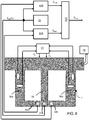
- the cantilever 30 of FIG. 5 is even more favorable when applied in the embodiment shown in FIG. 6 .
- the operation of the reception tip 32 relies on a non-linear effect at the tip-sample interface of the reception tip.
- the stiffness of the cantilever branch 36 may be dimensioned at a relatively low value as compared to that of the cantilever branch 35 carrying the transmission tip 31. This can for example be achieved in that the width of the cantilever branch 36 is less than a width of the cantilever branch 35. Also it may be contemplated to provide the cantilever branch 36 with a reduced thickness as compared to that of the cantilever branch 35.
- a cantilever 30 comprises a separate cantilever branch 35, 36 for the transmission tip 31 and the reception tip 32.
- the cantilever branches 35, 36 are formed as mutually separated portions of a side of a quadrilateral, here a rectangle.
- the side of the quadrilateral is disconnected at a position between its ends joining a respective further side coupled to a common side.
- the transmission tip 31 and the reception tip 32 are arranged at a respective free end of a respective separated portion.
- the properties of the cantilever branches 35, 36 can be even more easily adapted individually for optimization of transmission and reception.
- one of the cantilever branches has a relatively high stiffness which is advantageous for a transmission tip and the other one has a relatively low stiffness, which is favorable for use in combination with a reception tip that relies a non-linear interaction with the sample to provide for down-conversion.
- this embodiment is favorable as compared to the one of FIG. 5 and 6 , in that it allows for a mutually independent sensing of deflections of the cantilever branches in a vertical direction and in directions transverse thereto.
- the control means 51 is provided to control an angle of rotation ⁇ along the axis y of the cantilever 30 respective to the sample with control signal C ⁇ and to control a height z respective to the sample with control signal C z .
- the control means 51 may use input signals from deflection sensors 35H, 35V, 36H, 36V. Alternatively OBD systems may be provided to measure the deflection of the cantilever branches.
- the cantilever 30 is provided with a plurality of reception tips 32a, 32b carried by cantilever branches 36a, 36b respectively.
- the cantilever 30 of FIG. 8 is a modification of the quadrilateral shaped cantilever of FIG. 7 , in that it additionally comprises a further cantilever branch 35 that extends from the common side and between the free ends of the other two cantilever branches 36a, 36b.
- a symmetric arrangement may be provided, wherein the additional cantilever branch 35 carries at its free end a transmission tip 31 and the other two cantilever branches 36a, 36b each carry a reception tip 32a, 32b.
- the reception tips may be configured to sense mutually different harmonics of the excitation signal.
- reception tips may be configured to sense mutually different wave modes created by diffraction/interaction with the buried features.
- signal processor 50A derives a first image signal S imA using the output signal from reception tip 32a and signal processor 50B derives a second image signal S imB using the output signal from reception tip 32b. It could also be contemplated to arrange one of the reception tips as an indirect reception tip that relies on a down-conversion in the tip-sample interface.
- a third signal processor 50C receives the output signals from the signal processors 50A, 50B, to reconstruct an output image signal S imB .
- FIG. 9 schematically shows a lithographic system 100 for manufacturing of a multilayer semiconductor device.
- the lithographic system 100 comprises an ultrasound acoustic microscope device 1a, for example in one of the embodiments specified above.
- the lithographic system is arranged to manufacture the semiconductor device in mutually subsequent manufacturing stages 100a, 100b, ..100n.
- the mutually subsequent manufacturing stages 100a, 100b, ..100n at least comprise a first manufacturing stage 100a and a second manufacturing stage 100b.
- the ultrasound acoustic microscope device 1a is arranged to inspect a semi-finished product 11' obtained in the first manufacturing stage 100a as the sample and to provide an analysis signal S align indicative for a position of sub-surface features in the semi-finished product 11'.
- the lithographic system 100 is arranged to use the analysis signal S align for alignment of the semi-finished product 5' in the second manufacturing stage 100b.
- the lithographic system 100 comprises a further ultrasound acoustic microscope device 1n that analyzes a quality of the multilayer semiconductor device 11" and provides an output signal S Q indicative for said quality.
- the output signal S Q may be provided as a binary signal that indicates whether or not the quality of the semiconductor device meets predetermined requirements. Alternatively, or in addition the output signal SQ may provide diagnostic information enabling an operator of the lithographic system to improve its operation.
Landscapes
- Physics & Mathematics (AREA)
- General Health & Medical Sciences (AREA)
- Health & Medical Sciences (AREA)
- General Physics & Mathematics (AREA)
- Radiology & Medical Imaging (AREA)
- Nuclear Medicine, Radiotherapy & Molecular Imaging (AREA)
- Chemical & Material Sciences (AREA)
- Biochemistry (AREA)
- Analytical Chemistry (AREA)
- Immunology (AREA)
- Pathology (AREA)
- Life Sciences & Earth Sciences (AREA)
- Acoustics & Sound (AREA)
- Engineering & Computer Science (AREA)
- Power Engineering (AREA)
- Nanotechnology (AREA)
- Investigating Or Analyzing Materials By The Use Of Ultrasonic Waves (AREA)
Priority Applications (6)
| Application Number | Priority Date | Filing Date | Title |
|---|---|---|---|
| EP19155361.9A EP3690449A1 (fr) | 2019-02-04 | 2019-02-04 | Cantilever, dispositif de microscopie acoustique ultrasonore comprenant le cantilever, son procédé d'utilisation et système lithographique le comprenant |
| US17/426,588 US11927564B2 (en) | 2019-02-04 | 2020-02-03 | Cantilever, ultrasound acoustic microscopy device comprising the cantilever, method of using the same and lithographic system including the same |
| PCT/NL2020/050055 WO2020162743A1 (fr) | 2019-02-04 | 2020-02-03 | Porte-à-faux, dispositif de microscopie acoustique ultrasonore comprenant le porte-à-faux, procédé d'utilisation de celui-ci et système lithographique contenant celui-ci |
| KR1020217027724A KR102939914B1 (ko) | 2019-02-04 | 2020-02-03 | 캔틸레버, 상기 캔틸레버를 포함하는 초음파 음향 현미경 장치, 이를 사용하는 방법 및 이를 포함하는 리소그래피 시스템 |
| EP20704099.9A EP3921655A1 (fr) | 2019-02-04 | 2020-02-03 | Porte-à-faux, dispositif de microscopie acoustique ultrasonore comprenant le porte-à-faux, procédé d'utilisation de celui-ci et système lithographique contenant celui-ci |
| KR1020267007509A KR20260041159A (ko) | 2019-02-04 | 2020-02-03 | 캔틸레버, 상기 캔틸레버를 포함하는 초음파 음향 현미경 장치, 이를 사용하는 방법 및 이를 포함하는 리소그래피 시스템 |
Applications Claiming Priority (1)
| Application Number | Priority Date | Filing Date | Title |
|---|---|---|---|
| EP19155361.9A EP3690449A1 (fr) | 2019-02-04 | 2019-02-04 | Cantilever, dispositif de microscopie acoustique ultrasonore comprenant le cantilever, son procédé d'utilisation et système lithographique le comprenant |
Publications (1)
| Publication Number | Publication Date |
|---|---|
| EP3690449A1 true EP3690449A1 (fr) | 2020-08-05 |
Family
ID=65279487
Family Applications (2)
| Application Number | Title | Priority Date | Filing Date |
|---|---|---|---|
| EP19155361.9A Withdrawn EP3690449A1 (fr) | 2019-02-04 | 2019-02-04 | Cantilever, dispositif de microscopie acoustique ultrasonore comprenant le cantilever, son procédé d'utilisation et système lithographique le comprenant |
| EP20704099.9A Pending EP3921655A1 (fr) | 2019-02-04 | 2020-02-03 | Porte-à-faux, dispositif de microscopie acoustique ultrasonore comprenant le porte-à-faux, procédé d'utilisation de celui-ci et système lithographique contenant celui-ci |
Family Applications After (1)
| Application Number | Title | Priority Date | Filing Date |
|---|---|---|---|
| EP20704099.9A Pending EP3921655A1 (fr) | 2019-02-04 | 2020-02-03 | Porte-à-faux, dispositif de microscopie acoustique ultrasonore comprenant le porte-à-faux, procédé d'utilisation de celui-ci et système lithographique contenant celui-ci |
Country Status (4)
| Country | Link |
|---|---|
| US (1) | US11927564B2 (fr) |
| EP (2) | EP3690449A1 (fr) |
| KR (2) | KR102939914B1 (fr) |
| WO (1) | WO2020162743A1 (fr) |
Families Citing this family (3)
| Publication number | Priority date | Publication date | Assignee | Title |
|---|---|---|---|---|
| EP4560323A1 (fr) * | 2023-11-22 | 2025-05-28 | Oxford Instruments Nanotechnology Tools Limited | Nano-électromécanique vectoriel précis |
| NL2036631B1 (en) * | 2023-12-21 | 2025-07-07 | Nearfield Instr B V | An acoustic subsurface inspection device and method |
| EP4657060A1 (fr) * | 2024-05-30 | 2025-12-03 | Nederlandse Organisatie voor toegepast-natuurwetenschappelijk Onderzoek TNO | Microscope acoustique à contact et son procédé de fonctionnement |
Citations (4)
| Publication number | Priority date | Publication date | Assignee | Title |
|---|---|---|---|---|
| US6079255A (en) * | 1996-03-13 | 2000-06-27 | International Business Machines Corporation | Mechanically coupled alternatively usable cantilever structures for scanning a surface |
| US6196061B1 (en) * | 1998-11-05 | 2001-03-06 | Nanodevices, Inc. | AFM with referenced or differential height measurement |
| EP3349018A1 (fr) * | 2017-01-13 | 2018-07-18 | Nederlandse Organisatie voor toegepast- natuurwetenschappelijk onderzoek TNO | Dispositif de microscopie à force atomique, procédé et système lithographique |
| EP3385725A1 (fr) * | 2017-04-04 | 2018-10-10 | Nederlandse Organisatie voor toegepast- natuurwetenschappelijk onderzoek TNO | Procédé et système de microscopie à force atomique pour effectuer une imagerie souterraine |
Family Cites Families (3)
| Publication number | Priority date | Publication date | Assignee | Title |
|---|---|---|---|---|
| DE19729280C1 (de) * | 1997-07-09 | 1998-11-05 | Fraunhofer Ges Forschung | Ultraschallmikroskop |
| DE102007023435A1 (de) * | 2007-05-16 | 2008-11-20 | Jpk Instruments Ag | Verfahren zum rastersondenmikroskopischen Untersuchen einer Messprobe, Messsystem und Messsondensystem |
| WO2014144018A2 (fr) * | 2013-03-15 | 2014-09-18 | Bruker Nano, Inc. | Microscope-sonde à balayage double sonde |
-
2019
- 2019-02-04 EP EP19155361.9A patent/EP3690449A1/fr not_active Withdrawn
-
2020
- 2020-02-03 KR KR1020217027724A patent/KR102939914B1/ko active Active
- 2020-02-03 EP EP20704099.9A patent/EP3921655A1/fr active Pending
- 2020-02-03 KR KR1020267007509A patent/KR20260041159A/ko active Pending
- 2020-02-03 US US17/426,588 patent/US11927564B2/en active Active
- 2020-02-03 WO PCT/NL2020/050055 patent/WO2020162743A1/fr not_active Ceased
Patent Citations (4)
| Publication number | Priority date | Publication date | Assignee | Title |
|---|---|---|---|---|
| US6079255A (en) * | 1996-03-13 | 2000-06-27 | International Business Machines Corporation | Mechanically coupled alternatively usable cantilever structures for scanning a surface |
| US6196061B1 (en) * | 1998-11-05 | 2001-03-06 | Nanodevices, Inc. | AFM with referenced or differential height measurement |
| EP3349018A1 (fr) * | 2017-01-13 | 2018-07-18 | Nederlandse Organisatie voor toegepast- natuurwetenschappelijk onderzoek TNO | Dispositif de microscopie à force atomique, procédé et système lithographique |
| EP3385725A1 (fr) * | 2017-04-04 | 2018-10-10 | Nederlandse Organisatie voor toegepast- natuurwetenschappelijk onderzoek TNO | Procédé et système de microscopie à force atomique pour effectuer une imagerie souterraine |
Non-Patent Citations (2)
| Title |
|---|
| APPL. COMP. MECH., vol. 4, 2010, pages 79 - 88 |
| SHU ET AL.: "On the design and analysis of acoustic horns for ultrasonic welding", TRANS. CAN. SOC MECH. ENG., vol. 37, no. 3, 2013, pages 905 - 913 |
Also Published As
| Publication number | Publication date |
|---|---|
| US11927564B2 (en) | 2024-03-12 |
| KR20210141468A (ko) | 2021-11-23 |
| KR20260041159A (ko) | 2026-03-26 |
| US20220091069A1 (en) | 2022-03-24 |
| WO2020162743A1 (fr) | 2020-08-13 |
| KR102939914B1 (ko) | 2026-03-17 |
| EP3921655A1 (fr) | 2021-12-15 |
Similar Documents
| Publication | Publication Date | Title |
|---|---|---|
| EP2150973B1 (fr) | Microscopie ultrasonore non destructive de sous-surface a l'echelle d'une tranche, utilisant une detection afm de champ proche | |
| US11927564B2 (en) | Cantilever, ultrasound acoustic microscopy device comprising the cantilever, method of using the same and lithographic system including the same | |
| EP3607331B1 (fr) | Procédé et système de microscopie à force atomique pour effectuer une imagerie souterraine | |
| JP5580296B2 (ja) | プローブ検出システム | |
| TWI766932B (zh) | 外差式原子力顯微術裝置、方法以及微影製程系統 | |
| JP7428616B2 (ja) | 超音波検査装置及び超音波検査方法 | |
| WO2018132003A1 (fr) | Procédé et système de réalisation d'imagerie souterraine | |
| Köhler et al. | Grain structure visualization with surface skimming ultrasonic waves detected by laser vibrometry | |
| JP2007511970A (ja) | 複数の放射エレメント及びエレメントの接触手段を有する接触型超音波トランスデューサ | |
| EP3615948B1 (fr) | Microscopie à force atomique sous la surface avec des ondes ultrasonores guidées | |
| CN106645415A (zh) | 超声波图像装置 | |
| US12130258B2 (en) | Ultrasound sub-surface probe microscopy device and corresponding method | |
| JP2017075849A (ja) | 超音波検査装置及び超音波検査方法 | |
| EP3870977B1 (fr) | Suivi de fréquences pour microscopie à force atomique sous la surface | |
| Johansmann et al. | Laser Doppler vibrometry for measuring vibration in ultrasonic transducers | |
| Ledesma et al. | A Compact 0.5 mm 2 Immersed Nondestructive Ultrasound System Based on a PMUT-on-CMOS Array |
Legal Events
| Date | Code | Title | Description |
|---|---|---|---|
| PUAI | Public reference made under article 153(3) epc to a published international application that has entered the european phase |
Free format text: ORIGINAL CODE: 0009012 |
|
| STAA | Information on the status of an ep patent application or granted ep patent |
Free format text: STATUS: THE APPLICATION HAS BEEN PUBLISHED |
|
| AK | Designated contracting states |
Kind code of ref document: A1 Designated state(s): AL AT BE BG CH CY CZ DE DK EE ES FI FR GB GR HR HU IE IS IT LI LT LU LV MC MK MT NL NO PL PT RO RS SE SI SK SM TR |
|
| AX | Request for extension of the european patent |
Extension state: BA ME |
|
| STAA | Information on the status of an ep patent application or granted ep patent |
Free format text: STATUS: THE APPLICATION IS DEEMED TO BE WITHDRAWN |
|
| 18D | Application deemed to be withdrawn |
Effective date: 20210206 |