EP3693448B1 - Verbesserung der waschleistung durch taurat-tenside - Google Patents
Verbesserung der waschleistung durch taurat-tenside Download PDFInfo
- Publication number
- EP3693448B1 EP3693448B1 EP20153866.7A EP20153866A EP3693448B1 EP 3693448 B1 EP3693448 B1 EP 3693448B1 EP 20153866 A EP20153866 A EP 20153866A EP 3693448 B1 EP3693448 B1 EP 3693448B1
- Authority
- EP
- European Patent Office
- Prior art keywords
- washing
- cleaning agent
- weight
- fatty acid
- acid
- Prior art date
- Legal status (The legal status is an assumption and is not a legal conclusion. Google has not performed a legal analysis and makes no representation as to the accuracy of the status listed.)
- Active
Links
Classifications
-
- C—CHEMISTRY; METALLURGY
- C11—ANIMAL OR VEGETABLE OILS, FATS, FATTY SUBSTANCES OR WAXES; FATTY ACIDS THEREFROM; DETERGENTS; CANDLES
- C11D—DETERGENT COMPOSITIONS; USE OF SINGLE SUBSTANCES AS DETERGENTS; SOAP OR SOAP-MAKING; RESIN SOAPS; RECOVERY OF GLYCEROL
- C11D3/00—Other compounding ingredients of detergent compositions covered in group C11D1/00
- C11D3/16—Organic compounds
- C11D3/38—Products with no well-defined composition, e.g. natural products
- C11D3/386—Preparations containing enzymes, e.g. protease or amylase
-
- C—CHEMISTRY; METALLURGY
- C11—ANIMAL OR VEGETABLE OILS, FATS, FATTY SUBSTANCES OR WAXES; FATTY ACIDS THEREFROM; DETERGENTS; CANDLES
- C11D—DETERGENT COMPOSITIONS; USE OF SINGLE SUBSTANCES AS DETERGENTS; SOAP OR SOAP-MAKING; RESIN SOAPS; RECOVERY OF GLYCEROL
- C11D1/00—Detergent compositions based essentially on surface-active compounds; Use of these compounds as a detergent
- C11D1/02—Anionic compounds
- C11D1/37—Mixtures of compounds all of which are anionic
-
- C—CHEMISTRY; METALLURGY
- C11—ANIMAL OR VEGETABLE OILS, FATS, FATTY SUBSTANCES OR WAXES; FATTY ACIDS THEREFROM; DETERGENTS; CANDLES
- C11D—DETERGENT COMPOSITIONS; USE OF SINGLE SUBSTANCES AS DETERGENTS; SOAP OR SOAP-MAKING; RESIN SOAPS; RECOVERY OF GLYCEROL
- C11D1/00—Detergent compositions based essentially on surface-active compounds; Use of these compounds as a detergent
- C11D1/66—Non-ionic compounds
- C11D1/83—Mixtures of non-ionic with anionic compounds
-
- C—CHEMISTRY; METALLURGY
- C11—ANIMAL OR VEGETABLE OILS, FATS, FATTY SUBSTANCES OR WAXES; FATTY ACIDS THEREFROM; DETERGENTS; CANDLES
- C11D—DETERGENT COMPOSITIONS; USE OF SINGLE SUBSTANCES AS DETERGENTS; SOAP OR SOAP-MAKING; RESIN SOAPS; RECOVERY OF GLYCEROL
- C11D1/00—Detergent compositions based essentially on surface-active compounds; Use of these compounds as a detergent
- C11D1/02—Anionic compounds
- C11D1/12—Sulfonic acids or sulfuric acid esters; Salts thereof
- C11D1/28—Sulfonation products derived from fatty acids or their derivatives, e.g. esters, amides
Definitions
- the present invention relates to a washing or cleaning agent which comprises or consists of a) at least one fatty acid tauride, b) at least one further surfactant different from a), and c) at least one enzyme.
- the present invention further relates to the use of the detergent or cleaning agent according to the invention for improved stain removal, preferably make-up stains, and the use of fatty acid taurides for improved stain removal in a washing or cleaning process.
- Cosmetic stains are very stubborn because they are often a combination of very fine pigments and water-oil mixtures that can sit deep in the fibers. This ability to carry dirt and, above all, the removal of pigments from the fibers represents a challenge for many common surfactants.
- detergents or cleaning agents which comprise or consist of a) at least one fatty acid tauride and b) at least one further surfactant different from a) and c) at least one enzyme.
- fatty acid taurides preferably methyl cocoyl taurate or methyl oleoyl taurate, in particular the sodium salts of methyl cocoyl taurate or methyl oleoyl taurate, as a co-surfactant leads to improved stain removal and thus an increase in the overall washing performance of a detergent formulation in its primary detergency, in particular against cosmetic stains such as make-up stains.
- the invention relates in a first aspect to a detergent or cleaning agent according to claim 1.
- the invention relates to the use of a detergent or cleaning agent for improved stain removal.
- the invention relates to the use of fatty acid taurides for improved stain removal in a washing or cleaning process.
- At least one refers to 1 or more, for example 2, 3, 4, 5, 6, 7, 8, 9 or more. In connection with components of the compounds described herein, this information does not refer to the absolute amount of molecules, but rather to the type of component. “At least one fatty acid tauride” therefore means, for example, that only one type of fatty acid tauride compound or several different types of fatty acid tauride compounds can be included, without providing information about the amount of the individual compounds.
- the expression “essentially free of” means that the respective compound can in principle be included, but is then present in an amount that does not impair the function of the other components.
- the property “substantially free of” a particular compound is therefore preferably a total weight of less than 0.1% by weight, more preferably less than 0.001% by weight, in particular free of this, based on the total weight of detergents and cleaning agents.
- Information about the molecular weight refers to the weight-average molecular weight in g/mol, unless the number-average molecular weight is explicitly stated. It is preferably determined by GPC using polystyrene standards.
- a hydrogen atom of a compound can be replaced by a substituent through substitution.
- substituents are, for example, hydroxy, alkoxy, amino, nitro, amido, fluorine, chlorine, bromine, iodine, or carbonyl, carboxyl, ester, ether, mercapto, sulfonyl, Cyano, or linear or branched alkyl, alkenyl, alkynyl, cycloalkyl, aryl, alkylcycloalkyl, alkylcycloalkenyl, alkenylcycloalkyl, alkenylcycloalkenyl, alkylaryl, alkynylcycloalkyl, alkynylcycloalkenyl, alkynylaryl, or alkenylaryl groups with up to to 15 carbon atoms, which can contain at least one heteroatom, preferably N, O, S, Si, Se or P.
- Fatty acid taurides or fatty acid taurates are present as salts; all suitable salts can be used. These are preferably alkali metal or alkaline earth metal salts, more preferably Na and K, in particular Na.
- Cleaning products that contain Tauride are out EP2886633 A1 , CN108192759 , CN 105886147 as well as CN 103865660 known.
- the detergent or cleaning agent according to the invention contains methyl cocoyl taurate or methyl oleoyl taurate or mixtures thereof, in particular the sodium salts thereof.
- R can, for example, be an alkyl radical with 6 to 18, 10 to 18 or 12 to 18 or an alkenyl radical with 18 carbon atoms.
- the detergent or cleaning agent comprises at least one fatty acid tauride in 0.5 to 5% by weight, based on the total weight of the detergent or cleaning agent.
- Methyl cocoyl taurate or methyl oleoyl taurate are commercially available, for example, as sodium salts from Clariant under the trade names Hostapon CT or Hostapon TPHC.
- the suitable fatty acid taurides are of plant origin.
- the detergent or cleaning agent b) according to the invention contains at least one anionic surfactant which is different from a).
- Anionic, nonionic, zwitterionic and/or amphoteric surfactants can be used as further surfactants in the detergent or cleaning agent according to the invention.
- Anionic surfactants are important components of detergents and cleaning agents because they remove a variety of textile soiling and are particularly effective on greasy soiling. They are widely available commercially and have good cleaning performance on dirty surfaces.
- the surfactants that can be used can be of petrochemical, plant or microbiological origin.
- Anionic surfactants include, among others, those of the sulfonate and sulfate types.
- the preferred anionic surfactants of the sulfonate type are C9-C13 alkylbenzene sulfonates and olefin sulfonates, that is, mixtures of alkene and hydroxyalkane sulfonates and disulfonates, such as those obtained, for example, from C12-C18 monoolefins with a terminal or internal double bond by sulfonation with gaseous sulfur trioxide and subsequent alkaline or acidic hydrolysis of the sulfonation products.
- Alkanesulfonates which are obtained from C12-C18 alkanes, for example by sulfochlorination or sulfoxidation with subsequent hydrolysis or neutralization, are also suitable.
- the esters of ⁇ -sulfofatty acids for example the ⁇ -sulfonated methyl esters of hydrogenated coconut, palm kernel or tallow fatty acids, are also suitable.
- Suitable anionic surfactants are sulfated fatty acid glycerol esters.
- Fatty acid glycerol esters are to be understood as meaning the mono-, di- and triester and mixtures thereof, such as those obtained in the production by esterification of a monoglycerol with 1 to 3 mol of fatty acid or in the transesterification of triglycerides with 0.3 to 2 mol of glycerol.
- Preferred sulfated fatty acid glycerol esters are the sulfonation products of saturated fatty acids with 6 to 22 carbon atoms, for example caproic acid, caprylic acid, capric acid, myristic acid, lauric acid, palmitic acid, stearic acid or behenic acid.
- Alk(en)yl sulfates are the alkali and in particular the sodium salts of the sulfuric acid half esters of the C12-C18 fatty alcohols, for example from coconut fatty alcohol, tallow fatty alcohol, lauryl, myristyl, cetyl or stearyl alcohol or the C10-C20 oxo alcohols and those secondary half esters Alcohols of these chain lengths are preferred. Also preferred are alk(en)yl sulfates of the chain length mentioned, which contain a synthetic straight-chain alkyl radical produced on a petrochemical basis and which have a degradation behavior analogous to that of the adequate compounds based on fatty chemical raw materials.
- C12-C16 alkyl sulfates and C12-C15 alkyl sulfates as well as C14-C15 alkyl sulfates are preferred.
- 2,3-alkyl sulfates (secondary alkyl sulfates with the sulfate group in the 2- or 3-position) are also suitable anionic surfactants.
- the sulfuric acid monoesters of the straight-chain or branched C7-C21 alcohols ethoxylated with 1 to 6 moles of ethylene oxide such as 2-methyl-branched C9-C11 alcohols with an average of 3.5 moles of ethylene oxide (EO) or C12-C18 fatty alcohols with 1 up to 4 EO are suitable.
- the detergent or cleaning agent according to the invention contains 0.01 to 5% by weight, preferably 0.5 to 3% by weight and in particular 1.5 to 2.5% by weight, of an ethoxylated fatty alcohol sulfate .
- such fatty alcohol ether sulfates can have 2EO and can be derived, for example, from C12-18 fatty alcohols.
- Suitable anionic surfactants are the salts of alkylsulfosuccinic acid, which are also referred to as sulfosuccinates or sulfosuccinic acid esters and which represent monoesters and/or diesters of sulfosuccinic acid with alcohols, preferably fatty alcohols and in particular ethoxylated fatty alcohols.
- alcohols preferably fatty alcohols and in particular ethoxylated fatty alcohols.
- Preferred sulfosuccinates contain C8-C18 fatty alcohol residues or mixtures of these.
- Particularly preferred sulfosuccinates contain a fatty alcohol residue which is derived from ethoxylated fatty alcohols.
- Sulfosuccinates whose fatty alcohol residues are derived from ethoxylated fatty alcohols with a narrow homolog distribution, are particularly preferred. It is also possible to use alk(en)yl succinic acid with preferably 8 to 18 carbon atoms in the alk(en)yl chain or its salts.
- saturated and unsaturated fatty acid soaps such as the salts of lauric acid, myristic acid, palmitic acid, stearic acid, (hydrogenated) erucic acid and behenic acid, and in particular those made from natural fatty acids, for example coconut, palm kernel, are suitable. , olive oil or tallow fatty acids, derived soap mixtures.
- the anionic surfactants including soaps if present, may preferably be in the form of their sodium, potassium or magnesium salts.
- the anionic surfactants are preferably in the form of their sodium salts.
- At least one anionic surfactant preferably a linear or branched alkyl benzene sulfonate (e.g. with C9-C13) and/or an alkyl ether sulfate (e.g. with C12-18), for example sodium lauryl ether sulfate, for example with 2EO, and/or an alpha-olefin sulfonate, can be included in the detergent or cleaning agent according to the invention; this, if included, is preferably in an amount of 0.1 to 50% by weight, more preferably from 0.2 to 20% by weight, even more preferably from 0.5 to 10% by weight based on that Total weight of the detergent or cleaning agent included.
- a linear or branched alkyl benzene sulfonate e.g. with C9-C13
- an alkyl ether sulfate e.g. with C12-18
- sodium lauryl ether sulfate for example with 2EO
- the function of a further anionic surfactant more preferably a linear or branched alkyl benzene sulfonate and / or an alkyl ether sulfate, such as sodium lauryl ether sulfate (SLES), and/or an alpha-olefin sulfonate, more preferably an alkyl ether sulfate, such as sodium lauryl ether sulfate (SLES), can be partially or completely replaced, preferably to over 10%, more preferably to over 20%, still more preferably over 30%, even more preferably over 40%, even more preferably over 50% or over 50%, even more preferably over 60%, even more preferably over 70%, even more preferably over 80% , more preferably over 90%, even more preferably over 9
- a further anionic surfactant more preferably a linear or branched alkyl benzene sulfonate and / or an alkyl ether sulfate, such as sodium lauryl ether
- the addition of the at least one fatty acid tauride a) to the detergent or cleaning agent replaces a further anionic surfactant, more preferably an alkyl ether sulfate, such as sodium lauryl ether sulfate, to about 50% to about 100%, more preferably to about 50 % or about 100%.
- a further anionic surfactant more preferably an alkyl ether sulfate, such as sodium lauryl ether sulfate
- the detergent or cleaning agent according to the invention is essentially free of other anionic surfactants, preferably free of alkyl ether sulfates, such as sodium lauryl ether sulfate (SLES).
- SLES sodium lauryl ether sulfate
- the fatty acid tauride a) and the further anionic surfactant preferably an alkyl ether sulfate, such as sodium lauryl ether sulfate (SLES), for example with 1-4 or 2 EO, in a ratio of 1:10 to 10:1, are more preferred from 5:1 to 1:5, even more preferably from 1:1 or 1:1.8 (ratio a:anionic surfactant) in the detergent or cleaning agent according to the invention.
- the ratio is in particular a weight ratio. If the agent contains several anionic surfactants, the ratio given above applies either to the sum of all other anionic surfactants or to one anionic surfactant. In the latter case, this is in particular an alkyl ether sulfate.
- the washing or cleaning agent comprises a nonionic surfactant, preferably a nonionic surfactant from the group of alkoxylated fatty alcohols, alkoxylated fatty acid alkyl esters, fatty acid amides, alkoxylated fatty acid amides, polyhydroxy fatty acid amides, alkylphenol polyglycol ethers, amine oxides, alkyl polyglucosides and mixtures thereof, more preferably from the group the alcohol ethoxylates, even more preferably a C12-18 alcohol ethoxylate with 7 EO units.
- the nonionic surfactant is preferably in an amount from 0.1 to 50% by weight, more preferably from 0.2 to 20% by weight, even more preferably from 0.5 to 10% by weight, based on the total weight of the detergent or cleaning agent.
- the at least one surfactant of the detergent or cleaning agent according to the invention comprises an anionic surfactant and a nonionic surfactant, the anionic surfactant preferably being a linear or branched alkyl benzene sulfonate and/or an alkyl ether sulfate, for example sodium lauryl ether sulfate, and/or alpha-olefin sulfonate and/or the nonionic surfactant preferably comes from the group of alkoxylated fatty alcohols, alkoxylated fatty acid alkyl esters, fatty acid amides, alkoxylated fatty acid amides, polyhydroxy fatty acid amides, alkylphenol polyglycol ethers, amine oxides, alkyl polyglucosides and mixtures thereof, more preferably from the group of (fatty) alcohol ethoxylates, even more preferably includes it is a C12-18 alcohol ethoxylate with 7 EO units
- the anionic and/or the nonionic surfactant in the detergent or cleaning agent according to the invention is preferably in an amount of 0.1 to 50% by weight, more preferably of 0.2 to 20% by weight, even more preferably of 0. 5 to 10% by weight, based on the total weight of the detergent or cleaning agent.
- the nonionic surfactants used are preferably alkoxylated, advantageously ethoxylated, in particular primary alcohols with preferably 8 to 18 carbon atoms and an average of 1 to 12 moles of ethylene oxide (EO) per mole of alcohol, in which the alcohol residue is linear or preferably methyl-branched in the 2-position can contain linear and methyl-branched radicals in the mixture, as are usually present in oxo alcohol radicals.
- EO ethylene oxide
- alcohol ethoxylates with linear residues from alcohols of native origin with 12 to 18 carbon atoms, for example from coconut, palm, tallow or oleyl alcohol, and an average of 2 to 8 EO per mole of alcohol are preferred.
- the preferred ethoxylated alcohols include, for example, C12-C14 alcohols with 3 EO, 4 EO or 7 EO, C9-C1 1 alcohol with 7 EO, C13-C15 alcohols with 3 EO, 5 EO, 7 EO or 8 EO, C12-C18 alcohols with 3 EO, 5 EO or 7 EO and mixtures of these, such as mixtures of C12-C14 alcohol with 3 EO and C12-C18 alcohol with 7 EO.
- the ethoxylation levels reported represent statistical averages, which may be a whole or a fractional number for a specific product.
- Preferred alcohol ethoxylates have a narrow homolog distribution (narrow range ethoxylates, NRE).
- fatty alcohols with more than 12 EO can also be used. Examples of this are tallow fatty alcohol with 14 EO, 25 EO, 30 EO or 40 EO.
- Nonionic surfactants that contain EO and PO groups together in the molecule can also be used according to the invention. Block copolymers with EO-PO block units or PO-EO block units can be used here, but also EO-PO-EO copolymers or PO-EO-PO copolymers.
- mixed alkoxylated nonionic surfactants can also be used, in which EO and PO units are not distributed in blocks but rather randomly. Such products are obtainable by the simultaneous action of ethylene and propylene oxide on fatty alcohols.
- alkyl glucosides of the general formula RO( G ) and G is the symbol representing a glycoside unit with 5 or 6 carbon atoms, preferably glucose.
- the degree of oligomerization x which indicates the distribution of monoglycosides and oligoglycosides, is any number between 1 and 10; x is preferably 1.2 to 1.4.
- nonionic surfactants which are used either as the sole nonionic surfactant or in combination with other nonionic surfactants, are alkoxylated, preferably ethoxylated or ethoxylated and propoxylated fatty acid alkyl esters, preferably with 1 to 4 carbon atoms in the alkyl chain, in particular fatty acid methyl esters.
- Nonionic surfactants of the amine oxide type for example N-cocoalkyl-N,N-dimethylamine oxide and N-tallow alkyl-N,N-dihydroxyethylamine oxide, and the fatty acid alkanolamides may also be suitable.
- the amount of these nonionic surfactants is preferably not more than that of the ethoxylated fatty alcohols, in particular not more than half of it.
- Suitable surfactants are polyhydroxy fatty acid amides of the formula (II), in which R 3 CO represents an aliphatic acyl radical with 6 to 22 carbon atoms, R 1 represents hydrogen, an alkyl or hydroxyalkyl radical with 1 to 4 carbon atoms and [T] represents a linear or branched polyhydroxyalkyl radical with 3 to 10 carbon atoms and 3 to 10 hydroxyl groups stands.
- the polyhydroxy fatty acid amides are known substances that can usually be obtained by reductive amination of a reducing sugar with ammonia, an alkylamine or an alkanolamine and subsequent acylation with a fatty acid, a fatty acid alkyl ester or a fatty acid chloride.
- the group of polyhydroxy fatty acid amides also includes compounds of the formula (III), in which R 3 is a linear or branched alkyl or alkenyl radical with 7 to 12 carbon atoms, R 1 is a linear, branched or cyclic alkyl radical or an aryl radical with 2 to 8 carbon atoms and R 2 is a linear, branched or cyclic alkyl radical or one Aryl radical or an oxy-alkyl radical with 1 to 8 carbon atoms, with C1-C4 alkyl or phenyl radicals being preferred and [T] represents a linear polyhydroxyalkyl radical whose alkyl chain is substituted with at least two hydroxyl groups, or alkoxylated, preferably ethoxylated or propoxylated Derivatives of this residue.
- R 3 is a linear or branched alkyl or alkenyl radical with 7 to 12 carbon atoms
- R 1 is a linear, branched or cyclic alkyl radical or an
- [T] is preferably obtained by reductive amination of a sugar, for example glucose, fructose, maltose, lactose, galactose, mannose or xylose.
- a sugar for example glucose, fructose, maltose, lactose, galactose, mannose or xylose.
- the N-alkoxy or N-aryloxy substituted ones Compounds can then be converted into the desired polyhydroxy fatty acid amides by reaction with fatty acid methyl esters in the presence of an alkoxide as a catalyst.
- the detergent or cleaning agent has, in addition to compound a), a detergent or cleaning agent matrix based purely on nonionic surfactants, for example no other anionic surfactants are included.
- the detergent or cleaning agent predominantly contains surfactants from renewable raw materials and the proportion of synthetic surfactants is as low as possible or is zero.
- Suitable cation surfactants include the quaternary ammonium compounds of the formula (R i )(R ii )(R iii )(R iv )N + X-, in which R i to R iv represent four of the same or different types, in particular two long and two short-chain, alkyl radicals and
- the washing or cleaning agents can contain cationic surfactants in amounts, based on the total weight of the washing or cleaning agent, of 0.001 to 10% by weight, preferably 0.01 to 5% by weight, in particular 0.1 to 3% by weight. % contain.
- Suitable amphotensides are, for example, betaines, alkylamidoalkylamines, alkyl-substituted amino acids, acylated amino acids or biosurfactants, of which betaines are preferred within the scope of the teaching according to the invention.
- the detergent or cleaning agent according to the invention contains c) at least one enzyme.
- the detergent or cleaning agent of the present invention comprises at least one enzyme, or a combination of different enzymes, in order to ensure sufficient cleaning action, for example on dried and crusted food and dirt residues.
- Liquid, aqueous detergents or cleaning agents are preferred.
- Enzymes preferred according to the invention are amylases, proteases, (hemi)cellulases, peroxidases and/or lipases.
- amylases can be added to remove starch and glycogen.
- Alpha-, beta- and gamma-amylases ⁇ -, ⁇ -, ⁇ -amylases
- glucoamylases and maltogenic amylases can be used according to the invention.
- the amylases can come from any sources, such as bacteria, fungi, pancreatic glands of animal origin, germinated grains, yeasts, etc. Genetically modified amylases can also be used, possibly even preferably, in the detergents or cleaning agents according to the invention.
- amylase enzymes may be present in the detergents or cleaning agents according to the invention in an amount of from 0.00001% by weight to 5% by weight, preferably from 0.0001% by weight to about 1% by weight, more preferably from 0.0005 to about 0.5% by weight and in particular from 0.001 or 0.01 to about 0.4% by weight, based on the total weight of the detergent or cleaning agent and on active protein.
- proteases for the cleavage of proteins and peptide residues can also be added to the detergents or cleaning agents according to the invention.
- Proteases are particularly suitable for the hydrolytic cleavage and removal of protein residues, especially dried protein residues.
- Proteases suitable according to the invention are proteinases (endopeptidases) and peptidases (exopeptidases). Proteases that can be used can be of plant, animal, bacterial and/or fungal origin. Suitable proteases are, in particular, serine, cysteine, aspartate and metalloproteases. Genetically modified proteases can also be used, possibly even preferably, in the detergents or cleaning agents according to the invention.
- proteases are used in amounts of active protein in the range from 0.00001 to 1.5% by weight, preferably in the range from 0.0001 to 0.75% by weight, based on the total weight of the detergents or cleaning agents.
- lipases can be added to detergents or cleaning agents according to the invention to remove stubbornly adhering fatty dirt. Lipases are therefore an organic alternative to surfactants and can support the cleaning effect of the surfactants in quantities (active protein) of 0.0001 to 1% by weight. Suitable lipases can be obtained from plants (for example castor species), microorganisms and animal sources, such as pancreatic lipases.
- the aforementioned enzymes can be added individually or in any combination of mixtures to the detergents and cleaning agents according to the invention.
- Amylases in particular alpha-amylases and proteases, are particularly preferred for use in detergents and cleaning agents according to the invention.
- the enzymes that can be added can optionally be combined with any other enzymes in order to further improve the cleaning performance of the detergents or cleaning agents.
- Further enzymes suitable according to the invention are reductases, oxidases, ligninases, cutinases, pectinases, xylanases, phenoloxidases, lipoxygenases, tannases, pentosanases, malanases, glucanases, arabinosidases and any mixtures of these enzymes.
- the at least one enzyme is present in the detergent and cleaning agent according to the invention in an amount of from 0.00001 to 5% by weight, preferably from 0.0001 to 2% by weight, more preferably from 0.01 to 1 .5% by weight, based on the total weight of the detergent or cleaning agent and active protein.
- amylases can be stabilized by adding calcium chloride ions.
- calcium chloride preferably in the form of the dihydrate (CaCl 2 ⁇ 2 H 2 O) is added to the detergents or cleaning agents according to the invention.
- the amount of calcium chloride added is preferably 0.01 to 2% by weight, more preferably 0.05 to 1% by weight, even more preferably 0.08 to 1% by weight and especially about 0.1% by weight. %, based on the total weight of the detergent or cleaning agent.
- the detergent or cleaning agent comprises or consists of a) at least one fatty acid tauride, b) at least one of a) different anionic surfactants, c) at least one enzyme and d) at least one additive.
- Suitable additives can be selected from builders, bleaching agents, bleaching catalysts, bleaching activators, electrolytes, pH adjusters, perfumes, perfume carriers, fluorescent agents, dyes, hydrotropes, complexing agents, foam inhibitors, silicone oils, soil release polymers, graying inhibitors, shrinkage inhibitors, anti-wrinkle agents, antimicrobial agents, Solvents, germicides, fungicides, antioxidants, preservatives, corrosion inhibitors, antistatics, bittering agents, ironing aids, repellents and impregnating agents, skin-care active ingredients, swelling and anti-slip agents, softening components as well as UV absorbers and mixtures thereof.
- the compounds or components optionally used as additives d) are different from the compounds or components used as a), b) or c) of the detergent or cleaning agent according to the invention.
- the detergent or cleaning agent according to the invention comprises the at least one additive in an amount of 0.0001 to 30% by weight, preferably 0.1 to 20% by weight, more preferably 1 to 10% by weight, based on the total weight of the detergent or cleaning agent.
- the detergent or cleaning agent preferably contains at least one perfume or fragrance, or optionally a mixture of different perfumes or fragrances as the at least one additive.
- fragrance compounds for example synthetic products of the ester, ether, aldehyde, ketone, alcohol and hydrocarbon type, can be used as perfume oils or fragrances.
- perfume oils can also contain natural fragrance mixtures such as those available from plant sources, for example pine, citrus, jasmine, patchouli, rose or ylang-ylang oil.
- the detergent or cleaning agent contains one or more fragrances in an amount of usually up to 15% by weight, preferably 0.01 to 5% by weight, in particular 0.3 to 3% by weight, based on the total weight of the detergent or cleaning agent.
- the detergent or cleaning agent according to the invention additionally contains a bleaching agent as the at least one additive.
- sodium perborate tetrahydrate and sodium perborate monohydrate are of particular importance.
- Other useful bleaching agents are, for example, sodium percarbonates, peroxypyrophosphates, citrate perhydrates and peracid salts or organic peracids which provide H 2 O 2 , such as perbenzoates, peroxophthalates, diperazelaic acid, diperdodecanedioic acid, 4-phthalimidoperoxobutanoic acid, 5-phthalimidoperoxopentanoic acid, 6-phthalimidoperoxohexanoic acid, 7-phthalimidoperoxohept anic acid, N,N '-terephthaloyl-di-6-aminoperoxohexanoic acid and mixtures thereof.
- the preferred peracids include the phthalimidoperoxoalkanoic acids, in particular 6-phthalimidoperoxohexanoic acid (PAP).
- PAP 6-phthalimidoperoxohexanoic acid
- the bleaching agent can - if available - have been formulated in particle form in a known manner using inert carrier materials; It will preferably be used in a coated form. It is important that the enveloping material releases the encased bleaching agent under the conditions of use of the detergent or cleaning agent (at higher temperatures, pH values that change due to dilution with water, or similar).
- a preferred covering material is one that consists at least in part of saturated fatty acid.
- the amount of bleaching agent is preferably between 0.5 and 20% by weight, based on the total weight of the detergent or cleaning agent.
- bleach activators can be incorporated into the detergents and cleaning agents.
- Compounds which produce aliphatic peroxocarboxylic acids under perhydrolysis conditions can be used as bleach activators.
- TAED
- bleach catalysts can also be incorporated into the liquid detergents and cleaning agents.
- These substances are bleach-intensifying transition metal salts or transition metal complexes such as Mn, Fe, Co, Ru or Mo salen complexes or carbonyl complexes.
- Mn, Fe, Co, Ru, Mo, Ti, V and Cu complexes with nitrogen-containing tripod ligands as well as Co, Fe, Cu and Ru ammine complexes can also be used as bleaching catalysts.
- aqueous detergent or cleaning agent contains a bleach, a bleach activator and/or a bleach catalyst, it is particularly advantageous that these are present in encapsulated form in the detergent or cleaning agent.
- the detergent or cleaning agent according to the invention can contain at least one complexing agent.
- Complexing agents are also known as chelating agents or sequestering agents.
- a complexing agent can bind metal ions to prevent them from reacting with other components of a composition.
- they can be added to detergent or cleaning compositions to complex Ca and Mg ions to soften the water.
- Other complexing agents can preferably also contribute to the washing or cleaning performance.
- Suitable complexing agents are, for example, condensed phosphates, phosphonates and/or aminocarboxylic acids.
- condensed phosphates include, but are not limited to, sodium and potassium orthophosphate, sodium and potassium pyrophosphate, sodium tripolyphosphate and sodium hexametaphosphate.
- Examples of phosphonic acids, phosphonates or derivatives thereof include 2-phosphonobutane-1,2,4-tricarboxylic acid (PBTC), 1-hydroxyethane-(1,1-diphosphonic acid) (HEDP), aminotrimethylenephosphonic acid (ATMP), 2-hydroxyethyliminobis(methylenephosphonic acid) , diethylenetriaminepenta-(methylenephosphonic acid) (DTPMP), ethylenediaminetetra(methylenephosphonic acid) (EDTMP), hexamethylenediamine(tetramethylenephosphonic acid), bis(hexamethylene)triamine(pentamethylenephosphonic acid), phosphoric acid or suitable salts thereof, but are not limited thereto.
- PBTC 2-phosphonobutane-1,2,4-tricarboxylic acid
- HEDP 1-hydroxyethane-(1,1-diphosphonic acid)
- ATMP aminotrimethylenephosphonic acid
- 2-hydroxyethyliminobis(methylenephosphonic acid) di
- the detergent or cleaning agent according to the invention further contains a phosphonate-containing compound, preferably diphosphonic acid or derivatives or salts thereof, more preferably 1-hydroxyethane-(1,1-diphosphonic acid) or a suitable salt thereof.
- a phosphonate-containing compound preferably diphosphonic acid or derivatives or salts thereof, more preferably 1-hydroxyethane-(1,1-diphosphonic acid) or a suitable salt thereof.
- the detergent or cleaning agent according to the invention contains 1-hydroxyethane-(1,1-diphosphonic acid) (HEDP) or a suitable salt thereof.
- HEDP 1-hydroxyethane-(1,1-diphosphonic acid)
- the detergent or cleaning agent according to the invention is essentially free of phosphates or other phosphorus-containing compounds, in particular those that are not phosphonates.
- the detergent or cleaning agent according to the invention is also essentially free of phosphonates, such as diphosphonic acids or derivatives or salts thereof.
- the detergent or cleaning agent according to the invention is essentially free of 1-hydroxyethane-(1,1-diphosphonic acid) (HEDP) or a suitable salt thereof.
- HEDP 1-hydroxyethane-(1,1-diphosphonic acid)
- Suitable aminocarboxylic acid materials containing little or no NTA include, but are not limited to, N-hydroxyethylaminodiacetic acid, ethylenediaminetetraacetic acid (EDTA), hydroxyethylenediaminetetraacetic acid, diethylenetriaminepentaacetic acid (DTPA), N-hydroxyethylethylenediaminetriacetic acid (HEDTA), methylglycinediacetic acid (MGDA), glutamic acid-N , N-diacetic acid (GLDA), ethylenediaminesuccinylic acid (EDDS), 2-hydroxyethyliminodiacetic acid (HEIDA), iminodisuccinylic acid (IDS), 3-hydroxy-2-2'-iminodisuccinylic acid (HIDS) and other similar acids or salts thereof having an amino group with a carboxylic acid substituent .
- N-hydroxyethylaminodiacetic acid ethylenediaminetetraacetic acid (EDTA), hydroxyethylenediamine
- the detergent or cleaning agent is essentially free of aminocarboxylic acids.
- a complexing agent should be used in the detergent or cleaning agent according to the invention, it is preferably used in an amount of from 0.01 to 30% by weight, preferably from 0.1 to 20% by weight, more preferably from 0.5 to 15% by weight, based on the total weight of the detergent or cleaning agent, is used.
- the detergent or cleaning agent according to the invention can also contain one or more builders.
- the washing or cleaning agent contains water-soluble and/or water-insoluble builders, in particular selected from alkali metal aluminosilicate, crystalline alkali metal silicate with a modulus above 1, monomeric polycarboxylate, polymeric polycarboxylate and mixtures thereof, in particular in amounts in the range of 2.5 weight. -% to 30% by weight, based on the total weight of the detergent or cleaning agent.
- water-soluble and/or water-insoluble builders in particular selected from alkali metal aluminosilicate, crystalline alkali metal silicate with a modulus above 1, monomeric polycarboxylate, polymeric polycarboxylate and mixtures thereof, in particular in amounts in the range of 2.5 weight. -% to 30% by weight, based on the total weight of the detergent or cleaning agent.
- the water-soluble organic builder substances include in particular those from the class of polycarboxylic acids, in particular citric acid and sugar acids, as well as polymeric (poly)carboxylic acids, in particular the polycarboxylates accessible by oxidation of polysaccharides, polymeric acrylic acids, methacrylic acids, maleic acids and mixed polymers from these, which also contain small proportions of polymerizable substances without carboxylic acid functionality can.
- the relative molecular mass of the homopolymers of unsaturated carboxylic acids is generally between 5000 g/mol and 200,000 g/mol, that of the copolymers between 2000 g/mol and 200,000 g/mol, preferably 50,000 g/mol to 120,000 g/mol, based on free acid .
- a particularly preferred acrylic acid-maleic acid copolymer has a relative molecular weight of 50,000 g/mol to 100,000 g/mol.
- Suitable, although less preferred, compounds of this class are copolymers of acrylic acid or methacrylic acid with vinyl ethers, such as vinyl methyl ethers, vinyl esters, ethylene, propylene and styrene, in which the proportion of acid is at least 50% by weight.
- Terpolymers which contain two carboxylic acids and/or their salts as monomers and vinyl alcohol and/or a vinyl alcohol derivative or a carbohydrate as the third monomer can also be used as water-soluble organic builder substances.
- the first acidic monomer or its salt is derived from a monoethylenically unsaturated C 3 -C 8 carboxylic acid and preferably from a C 3 -C 4 monocarboxylic acid, in particular from (meth)acrylic acid.
- the second acidic monomer or its salt can be a derivative of a C 4 -C 8 dicarboxylic acid, with maleic acid being particularly preferred.
- the third monomeric unit is formed by vinyl alcohol and/or preferably an esterified vinyl alcohol.
- vinyl alcohol derivatives are preferred, which represent an ester of short-chain carboxylic acids, for example C 1 -C 4 carboxylic acids, with vinyl alcohol.
- Preferred terpolymers contain 60% by weight to 95% by weight, in particular 70% by weight to 90% by weight, of (meth)acrylic acid and/or (meth)acrylate, more preferably acrylic acid and/or acrylate, and maleic acid and/or maleinate and 5% by weight to 40% by weight, preferably 10% by weight to 30% by weight, of vinyl alcohol and/or vinyl acetate.
- the second acidic monomer or its salt can also be a derivative of an allylsulfonic acid which is in the 2-position with an alkyl radical, preferably with a C 1 -C 4 alkyl radical, or an aromatic radical, which is preferably derived from benzene or benzene derivatives , is substituted.
- Preferred terpolymers contain 40% by weight to 60% by weight, in particular 45 to 55% by weight (meth)acrylic acid and/or (meth)acrylate, more preferably acrylic acid and/or acrylate, 10% by weight to 30% by weight, preferably 15% by weight to 25% by weight, of methallylsulfonic acid and/or methallylsulfonate and, as the third monomer, 15% by weight to 40% by weight, preferably 20% by weight to 40% by weight.
- % of a carbohydrate can be, for example, a mono-, di-, oligo- or polysaccharide, with mono-, di- or oligosaccharides being preferred; sucrose is particularly preferred.
- terpolymers generally have a relative molecular mass between 1000 g/mol and 200,000 g/mol, preferably between 2000 g/mol and 50,000 g/mol and in particular between 3000 g/mol and 10,000 g/mol. They can be used, in particular for the production of liquid agents, in the form of aqueous solutions, preferably in the form of 30 to 50 percent by weight aqueous solutions. All of the polycarboxylic acids mentioned are generally used in the form of their water-soluble salts, in particular their alkali metal salts.
- Water-insoluble, water-dispersible inorganic builder materials are, in particular, crystalline or amorphous alkali aluminosilicates, in amounts of up to 50% by weight, preferably not more than 40% by weight and in liquid agents in particular from 1% by weight to 5% by weight, used.
- the crystalline aluminosilicates in detergent quality in particular zeolite NaA and optionally NaX, are preferred. Amounts close to the upper limit mentioned are preferably used in solid, particulate agents.
- Suitable aluminosilicates in particular have no particles with a grain size of over 30 ⁇ m and preferably consist of at least 80% by weight of particles with a size of less than 10 ⁇ m.
- Suitable substitutes or partial substitutes for the aluminosilicate mentioned are crystalline alkali metal silicates, which can be present alone or in a mixture with amorphous silicates.
- the alkali metal silicates that can be used as builders in the compositions preferably have a molar ratio of alkali metal oxide to SiO 2 of less than 0.95, in particular from 1:1.1 to 1:12, and can be amorphous or crystalline.
- Preferred alkali metal silicates are the sodium silicates, in particular the amorphous sodium silicates, with a molar ratio Na 2 O:SiO 2 of 1:2 to 1:2.8. Those with a molar ratio of Na 2 O:SiO 2 of 1:1.9 to 1:2.8 are preferably added as a solid and not in the form of a solution during production.
- the crystalline silicates used which can be present alone or in a mixture with amorphous silicates, are preferably crystalline layered silicates of the general formula Na 2 Si to 4 and y is a number from 0 to 20 and preferred values for x are 2, 3 or 4.
- Preferred crystalline layered silicates are those in which x assumes the values 2 or 3 in the general formula mentioned.
- ⁇ - and ⁇ -sodium disilicates Na 2 Si 2 O 5 ⁇ yH 2 O
- Practically anhydrous crystalline alkali metal silicates of the above-mentioned general formula, in which x is a number from 1.9 to 2.1, which are produced from amorphous alkali metal silicates can also be used in the agents described here.
- a crystalline sodium layered silicate with a modulus of 2 to 3 is used, as can be produced from sand and soda.
- Crystalline sodium silicates with a modulus in the range from 1.9 to 3.5 are used in detergents in a further preferred embodiment.
- Their alkali metal silicate content is preferably 1% by weight to 50% by weight and in particular 5% by weight to 35% by weight, based on the anhydrous active substance. If alkali metal aluminosilicate, in particular zeolite, is also present as an additional builder substance, the content of alkali metal silicate is preferably 1% by weight to 15% by weight and in particular 2% by weight to 8% by weight, based on the anhydrous active substance.
- the weight ratio of aluminosilicate to silicate, based on anhydrous active substances is then preferably 4:1 to 10:1.
- the weight ratio of amorphous alkali metal silicate to crystalline alkali metal silicate is preferably 1:2 to 2:1 and in particular 1:1 to 2:1.
- further water-soluble or water-insoluble inorganic substances can be included in the agents used together with it or used in processes according to the invention. Suitable in this context are the alkali metal carbonates, alkali metal bicarbonates and alkali metal sulfates and mixtures thereof. Such additional inorganic material may be present in amounts up to 30% by weight.
- the preferred solvent in the detergents or cleaning agents according to the invention is water, but organic solvents can also be present in the detergents or cleaning agents and can partially replace the water.
- Suitable organic solvents are, for example, saturated or unsaturated, preferably saturated, branched or unbranched C 1 - 20 hydrocarbons, preferably C 2 - 15 hydrocarbons, with one or more hydroxy groups, preferably a hydroxy group, and optionally one or more ether functions COC, ie oxygen atoms interrupting the carbon atom chain.
- Preferred solvents are the C 1-6 alcohols, in particular ethanol, n-propanol or iso-propanol, as well as the C 2-6 alkylene glycols and poly-C 2 - possibly etherified on one side with a C 1-6 alkanol.
- solvents are the following compounds named according to INCI: Alcohol (ethanol), Buteth-3, Butoxydiglycol, Butoxyethanol, Butoxyisopropanol, Butoxypropanol, n-Butyl Alcohol, t-Butyl Alcohol, Butylene Glycol, Butyloctanol, Diethylene Glycol, Dimethoxydiglycol, Dimethyl Ether, Dipropylene Glycol, Ethoxydiglycol, Ethoxyethanol, Ethyl Hexanediol, Glycol, Hexanediol, 1,2,6-Hexanetriol, Hexyl Alcohol, Hexylene Glycol, Isobutoxypropanol, Isopentyldiol, Isopropyl Alcohol (iso-Propanol), 3-Methoxybutanol, Methoxydiglycol, Methoxyethanol, Methoxyisopropanol, Methoxymethylbutanol, Methoxy PEG-10, Methoxy
- B methanol, ethanol, n-propanol, n-butanol, tert-butanol or phenol, or carboxylic acids, e.g. B. acetic or carbonic acid, etherified or esterified monomers or homo- or heteropolymers, in particular monomers as well as homodi- and trimers, C 2 -C 4 alkylene glycols.
- the detergents or cleaning agents contain one or more hydrophobic components.
- the hydrophobic components not only improve the cleaning effect against hydrophobic impurities such as greasy dirt, but also have a positive effect on phase separation and their reversibility in multi-phase detergents or cleaning agents.
- Suitable hydrophobic components are, for example, dialkyl ethers with identical or different C 4 - to C 14 -alkyl radicals, in particular linear dioctyl ether; Hydrocarbons with a boiling range of 100 to 300 ° C, in particular 140 to 280 ° C, e.g. B.
- hydrophobic components are mixtures of different dialkyl ethers, of dialkyl ethers and hydrocarbons, of dialkyl ethers and essential oils, of hydrocarbons and essential oils, of dialkyl ethers and hydrocarbons and essential oils and of these mixtures.
- the washing or cleaning agents can contain hydrophobic components in amounts, based on the total weight of the washing or cleaning agent, of 0.01 to 20% by weight, preferably 0.1 to 14% by weight, more preferably 0.5 to 10% by weight .-%, even more preferably 0.8 to 7% by weight.
- phase separation aids include, for example, alkali metal and alkaline earth metal halides, in particular chlorides and sulfates and nitrates, in particular sodium and potassium chloride and sulfate, as well as ammonium chloride and sulfate or mixtures thereof.
- phase separation aids in amounts, based on the total weight of the washing or cleaning agent, of 0.1 to 30% by weight, preferably 1 to 20% by weight, more preferably 3 to 15% by weight, even more preferably 5 to 12% by weight.
- the detergent or cleaning agent according to the invention can contain one or more thickeners, preferably in an amount of 0.01 to 5% by weight, more preferably of 0.05 to 2.5% by weight, even more preferably of 0.1 to 1% by weight.
- Suitable thickeners are, for example, organic natural thickeners (agar agar, carrageenan, tragacanth, gum arabic, alginates, pectins, polyoses, guar flour, locust bean gum, starch, dextrins, gelatin, casein), organic modified natural substances (carboxymethyl cellulose and other cellulose ethers, hydroxyethyl - and -propylcellulose and the like, kernel meal ethers), organic fully synthetic thickeners (polyacrylic and polymethacrylic compounds, vinyl polymers, polycarboxylic acids, polyethers, polyimines, polyamides) and inorganic thickeners (polysilicic acids, clay minerals such as montmorillonites, zeolites, silicas).
- organic natural thickeners agar agar, carrageenan, tragacanth, gum arabic, alginates, pectins, polyoses, guar flour, locust bean gum, starch, dex
- the polyacrylic and polymethacrylic compounds include, for example, the high molecular weight homopolymers of acrylic acid crosslinked with a polyalkenyl polyether, in particular an allyl ether of pentaerythritol or propylene (INCI name according to the International Dictionary of Cosmetic Ingredients of The Cosmetic, Toiletry, and Fragrance Association (CTFA): Carbomer), also known as carboxyvinyl polymers.
- a polyalkenyl polyether in particular an allyl ether of pentaerythritol or propylene
- CFA Cosmetic, Toiletry, and Fragrance Association
- the polyacrylic and polymethacrylic compounds that are suitable as thickeners have a weight-average molecular weight of >100,000 g/mol, preferably ⁇ 500,000 g/mol.
- Preferred thickeners are the polysaccharides and heteropolysaccharides, in particular the polysaccharide gums, for example gum arabic, agar, alginates, carrageenans and their salts, guar, guar gum, tragacant, gellan, ramsan, dextran or xanthan gum and their derivatives, e.g. B. propoxylated guar, as well as their mixtures.
- Other polysaccharide thickeners such as starches or cellulose derivatives, can be used alternatively, but preferably in addition to a polysaccharide gum, for example starches of various origins and starch derivatives, e.g. B.
- hydroxyethyl starch starch phosphate esters or starch acetates, or carboxymethyl cellulose or its sodium salt, methyl, ethyl, hydroxyethyl, hydroxypropyl, hydroxypropyl-methyl or hydroxyethyl-methyl cellulose or cellulose acetate.
- Polysaccharides and heteropolysaccharides suitable as thickeners preferably have a weight-average molecular weight of >1,500 g/mol, more preferably of >5,000 g/mol, even more preferably of >50,000 g/mol. In general, their weight-average molecular weight is ⁇ 250,000 g/mol.
- a particularly preferred polymer is the microbial anionic heteropolysaccharide xanthan gum, which is produced by Xanthomonas campestris and some other species under aerobic conditions with a molecular weight of 2 to 15 x 10 6 g/mol.
- the detergent or cleaning agent according to the invention is in liquid, gel or powder form, preferably in liquid, aqueous form.
- the detergent or cleaning agent according to the invention is preferably a detergent, a laundry aftertreatment agent or a laundry care agent, more preferably a detergent.
- the washing or cleaning agents according to the invention are liquid washing or cleaning agents, more preferably liquid, aqueous washing or cleaning agents, even more preferably single-phase, liquid, aqueous washing or cleaning agents.
- an insoluble solid component can also be present as a separate solid phase in single-phase detergents or cleaning agents.
- detergents or cleaning agents according to the invention are shaken, an emulsion of the liquid phase is temporarily formed, which disperses the solid phase within itself.
- Multiphase formulations are not preferred within the scope of this invention, but are not excluded.
- aqueous means that water is the main solvent in the detergent or cleaning agent according to the invention.
- the water content can be 1 to 90% by weight, for example 10 to 80% by weight, for example 50 to 80% by weight. In other embodiments, the water content is up to 20% by weight, typically 1 to 18% by weight.
- the agent is preferably liquid. In various embodiments, the agent is liquid and therefore does not contain filler salts typical of solid agents, such as sodium sulfate, in particular not in amounts greater than 5% by weight.
- the detergent or cleaning agent may contain water-soluble organic solvents, such as alcohols, in addition to water.
- liquid preferably refers to a composition that can flow at room temperature (approx. 20 ° C) and ambient pressure (approx. 1013 mbar at sea level).
- room temperature approximately 20 ° C
- ambient pressure approximately 1013 mbar at sea level
- the term can also include gel-like and pasty compositions.
- the viscosity of the liquid detergents or cleaning agents at 20 ° C is preferably 5 to 100,000 mPa s, more preferably 10 to 5000 mPa s, even more preferably 10 to 200 mPa s, measured with a Brookfield type rotational viscometer LVT or LVDV-II+ with small sample adapter at a speed of 30 min -1 , whereby the Brookfield spindle used as a measuring body must be selected so that the torque is in a favorable range and the measuring range is not exceeded.
- spindle 31 is preferred and - if required for viscosities above approximately 240 mPa s - spindle 25 is preferably used.
- the pH value of the detergents or cleaning agents according to the invention is preferably 2 to 10, preferably 4 to 8, more preferably 5 to 7, both in concentrated form and in diluted application solution.
- a pH value of about 6 to 6.5 is particularly suitable .
- Corresponding pH values in the preferred range of 5 to 7 correspond approximately to the natural pH value of human skin, so that the detergents or cleaning agents according to the invention are skin-friendly and, in particular, skin irritations due to basic pH values are avoided.
- the detergents or cleaning agents are neutral to slightly acidic, with a pH of 2 to 7, more preferably 3 to 7, even more preferably 3.5 to 7, even more preferably 4 to 6, 5, even more preferably 5 to 6, especially 5 to 6, for example 5.5, 6 or 6.5.
- acids can be added to the detergents or cleaning agents according to the invention.
- Inorganic acids are suitable, for example mineral acids, e.g. B.
- hydrochloric acid and organic acids, for example saturated or unsaturated C 1 -C 6 mono-, di- and tri-carboxylic acids and hydroxycarboxylic acids with one or more hydroxy groups such as citric acid, maleic acid, formic acid and acetic acid, aminosulfuric acid, C 6 - C 22 fatty acids and anionic sulfonic acids, as well as mixtures thereof.
- Particularly preferred acids are citric acid, more preferably used in the form of its monohydrate citric acid ⁇ 1 H 2 O, and the anion-active sulfonic acids, as well as combinations of citric acid with one or more anion-active sulfonic acids, in particular with alkylarine sulfonic acids.
- Citric acid advantageously combines acid phase separation aid and builder properties, while the anion-active sulfonic acids simultaneously act as an acid and anionic surfactant.
- one or more alkalis can also be used, for example alkali metal, alkaline earth metal and ammonium hydroxides and carbonates and ammonia or amines, preferably sodium and potassium hydroxide and alkanolamines, with monoethanolamine being particularly preferred.
- buffer substances for example, substances that change the pH value are often introduced into the washing or cleaning liquor in large quantities during the washing or cleaning process, it is preferred to add corresponding buffer substances to the washing or cleaning agent according to the invention in the application dilution in order to stabilize or buffer the pH value , for example acetates, hydrogen phosphates, hydrogen sulfates, soda or alkali metal bicarbonates.
- buffer systems are potassium hydrogen phthalate/sodium hydroxide, potassium dihydrogen phosphate/sodium hydroxide and the like.
- solid detergents or cleaning agents are also included within the scope of this invention.
- a substance is called “solid” if it is in a solid state at room temperature (approx. 20 °C) and ambient pressure (approx. 1013 mbar at sea level).
- the detergents or cleaning agents according to the invention can be produced, especially if they are liquid or pasty, by simply mixing the ingredients in an automatic mixer.
- the agents are preferably in liquid, gel or pasty form, preferably as a portion in a wholly or partially water-soluble coating, more preferably in single-use portions. The portioning makes it easier for the consumer to dose.
- the funds can be packaged in foil bags, for example.
- Pouch packaging made from water-soluble film eliminates the need for consumers to tear open the packaging. In this way, it is possible to conveniently dose a single portion sized for a wash cycle by inserting the bag directly into the washing machine or by throwing the bag into a certain amount of water, for example into a bucket, a bowl or a hand wash basin.
- the foil bag surrounding the washing portion dissolves without leaving any residue when a certain temperature is reached.
- detergent or cleaning agent according to the invention can also be provided unportioned in liquid, gel, pasty or solid form in storage bottles or packages.
- the detergents or cleaning agents according to the invention can be used for washing and/or cleaning textile fabrics.
- the invention preferably relates to detergents for washing textile fabrics.
- One aspect of the invention relates to the use of the detergent or cleaning agent according to the invention for improved stain removal, preferably of make-up stains, in particular compared to detergents or cleaning agents with identical components, but without fatty acid tauride, preferably methyl cocoyl taurate or methyl oleoyl taurate or mixtures thereof, in particular the sodium salts thereof .
- a further aspect of the invention relates to the use of fatty acid taurides, preferably methyl cocoyl taurate or methyl oleoyl taurate or mixtures thereof, in particular the sodium salts thereof, for (improved) stain removal in a washing or cleaning process, in particular for (improved) stain removal of make-up stains.
- fatty acid taurides preferably methyl cocoyl taurate or methyl oleoyl taurate or mixtures thereof, in particular the sodium salts thereof, for (improved) stain removal in a washing or cleaning process, in particular for (improved) stain removal of make-up stains.
- a further aspect of the invention relates to the use of fatty acid taurides, preferably methyl cocoyl taurate or methyl oleoyl taurate or mixtures thereof, in particular the sodium salts thereof, in a washing or cleaning agent for (improved) stain removal in a washing or cleaning process, in particular for (improved) stain removal of make-up -up stains.
- stain removal is improved, particularly compared to detergents or cleaning agents with identical components but without fatty acid tauride.
- the agents described herein do not contain active ingredients that are active against mites, such as N,N-diethyl-2-phenylacetamide, fluacrypyrim (amine) or etoxazole.
- the agents described herein do not contain betaines, such as cocoamidopropyl betaine.
- compositions described herein do not contain triterpene saponins (triterpenoid saponins) and/or sarconisates.
- Washing machine Miele ® Softtronic W1514 Washing program: 70 minutes main wash, cotton program Water temperature: 40°C Water hardness: 16°dH Detergent dosage: 8.5g Laundry items: 3.5 kg of clean textiles (excluding test fabric (stains)
Landscapes
- Chemical & Material Sciences (AREA)
- Life Sciences & Earth Sciences (AREA)
- Engineering & Computer Science (AREA)
- Chemical Kinetics & Catalysis (AREA)
- Oil, Petroleum & Natural Gas (AREA)
- Wood Science & Technology (AREA)
- Organic Chemistry (AREA)
- Detergent Compositions (AREA)
Description
- Die vorliegende Erfindung betrifft ein Wasch- oder Reinigungsmittel, das a) mindestens ein Fettsäuretaurid, b) mindestens ein weiteres von a) verschiedenes Tensid, und c) mindestens ein Enzym umfasst oder daraus besteht. Ferner betrifft die vorliegenden Erfindung die Verwendung des erfindungsgemäßen Wasch- oder Reinigungsmittels zur verbesserten Fleckenentfernung, bevorzugt von Make-up Flecken, und die Verwendung von Fettsäuretauriden zur verbesserten Fleckenentfernung in einem Wasch- oder Reinigungsprozess.
- Es besteht ein Bedarf an Wasch- und Reinigungsmitteln, bevorzugt flüssigen Wasch- oder Reinigungsmitteln, die eine verbesserte Effizienz und Reinigungsleistung, insbesondere gegen Make-up Flecken, aufweisen.
- Es ist für die Kunden von Bedeutung auch hartnäckige Kosmetikflecken aus den Textilien sichtbar nach der ersten Wäsche zu entfernen. Dies trägt außerdem zur Nachhaltigkeit bei, denn so kann auf Wiederholungswaschgänge zur Entfernung von Kosmetikflecken verzichtet werden.
- Kosmetikflecken sind sehr hartnäckig, da sie oft eine Kombination aus sehr feinen Pigmenten und Wasser-Öl-Mischungen darstellen, die tief in den Fasern sitzen können. Dieses Schmutztragevermögen und vor allem das Herauslösen der Pigmente aus den Fasern stellt eine Herausforderung für viele übliche Tenside dar.
- Überraschenderweise wurde gefunden, dass die genannten Probleme durch Wasch- oder Reinigungsmittel gelöst werden können, die a) mindestens ein Fettsäuretaurid und b) mindestens ein weiteres, von a) verschiedenes Tensid und c) mindestens ein Enzym, umfassen oder daraus bestehen.
- Die Verwendung von Fettsäuretauriden, bevorzugt von Methylcocoyltaurat oder Methyloleoyltaurat, insbesondere der Natriumsalze von Methylcocoyltaurat oder Methyloleoyltaurat, als Co-Tensid führt zur verbesserten Fleckenentfernung und somit Steigerung der Gesamtwaschleistung einer Waschmittelformulierung in ihrer Primärwaschkraft, insbesondere gegenüber Kosmetikflecken wie Make-up Flecken.
- Deshalb betrifft die Erfindung in einem ersten Aspekt ein Wasch- oder Reinigungsmittel, gemäss Anspruch 1.
- In einem zweiten Aspekt betrifft die Erfindung die Verwendung eines Wasch- oder Reinigungsmittels zur verbesserten Fleckenentfernung.
- Schließlich betrifft die Erfindung in einem dritten Aspekt die Verwendung von Fettsäuretauriden zur verbesserten Fleckenentfernung in einem Wasch- oder Reinigungsprozess.
- "Mindestens ein", wie hierin verwendet, bezieht sich auf 1 oder mehr, beispielsweise 2, 3, 4, 5, 6, 7, 8, 9 oder mehr. Im Zusammenhang mit Bestandteilen der hierin beschriebenen Verbindungen bezieht sich diese Angabe nicht auf die absolute Menge an Molekülen, sondern auf die Art des Bestandteils. "Mindestens ein Fettsäuretaurid" bedeutet daher beispielsweise, dass nur eine Art von Fettsäuretauridverbindung oder mehrere verschiedene Arten von Fettsäuretauridverbindungen, ohne Angaben über die Menge der einzelnen Verbindungen zu machen, enthalten sein können.
- Alle im Zusammenhang mit den hierin beschriebenen Wasch- oder Reinigungsmitteln angegeben Mengenangaben beziehen sich, sofern nichts anderes angegeben ist, auf Gew.-% jeweils bezogen auf das Gesamtgewicht des Wasch- oder Reinigungsmittels. Des Weiteren beziehen sich derartige Mengenangaben, die sich auf mindestens einen Bestandteil beziehen, immer auf die Gesamtmenge dieser Art von Bestandteil, die in dem Wasch- oder Reinigungsmittel enthalten ist, sofern nicht explizit etwas anderes angegeben ist. Das heißt, dass sich derartige Mengenangaben, beispielsweise im Zusammenhang mit "mindestens ein Fettsäuretaurid", auf die Gesamtmenge von Fettsäuretauriden, welche in dem Wasch- oder Reinigungsmittel enthalten sind, bezieht, wenn nicht explizit etwas anderes angegeben ist.
- Zahlenwerte, die hierin ohne Dezimalstellen angegeben sind, beziehen sich jeweils auf den vollen angegebenen Wert mit einer Dezimalstelle. So steht beispielsweise "99%" für "99,0%".
- Der Ausdrücke "ungefähr" "ca." oder "etwa", in Zusammenhang mit einem Zahlenwert, bezieht sich auf eine Varianz von ±10% bezogen auf den angegebenen Zahlenwert, bevorzugt ±5%, besonders bevorzugt ±1%.
- Der Ausdruck "im Wesentlichen frei von" bedeutet, dass die jeweilige Verbindung grundsätzlich enthalten sein kann, dann allerdings in einer Menge vorliegt, die eine Funktion der anderen Komponenten nicht beeinträchtigt. Im Rahmen der vorliegenden Erfindung wird daher unter der Eigenschaft "im Wesentlichen frei von" einer bestimmten Verbindung bevorzugt ein Gesamtgewicht von unter 0,1 Gew.-%, stärker bevorzugt unter 0,001 Gew.-%, insbesondere frei von dieser, bezogen auf das Gesamtgewicht des Wasch- und Reinigungsmittels, angesehen.
- Numerische Bereiche, die in dem Format "in/von x bis y" angegeben sind, schließen die genannten Werte ein. Wenn mehrere bevorzugte numerische Bereiche in diesem Format angegeben sind, ist es selbstverständlich, dass alle Bereiche, die durch die Kombination der verschiedenen Endpunkte entstehen, ebenfalls erfasst werden.
- Angaben über das Molekulargewicht beziehen sich auf das gewichtsmittlere Molekulargewicht in g/mol, falls nicht explizit das zahlenmittlere Molekulargewicht genannt ist. Es wird bevorzugt mittels GPC unter Verwendung von Polystyrol-Standards ermittelt.
- Der Begriff "Derivat" bezieht sich auf substituierte Verbindungen.
- Durch Substitution kann im Sinne der vorliegenden Erfindung ein Wasserstoffatom einer Verbindung durch einen Substituenten ersetzt werden. Bevorzugte Substituenten sind beispielsweise Hydroxy-, Alkoxy-, Amino-, Nitro-, Amido-, Fluor-, Chlor-, Brom-, lod-, oder Carbonyl-, Carboxyl-, Ester-, Ether-, Mercapto-, Sulfonyl-, Cyano-, oder lineare oder verzweigte Alkyl-, Alkenyl-, Alkinyl-, Cycloalkyl-, Aryl-, Alkylcycloalkyl-, Alkylcycloalkenyl-, Alkenylcycloalkyl-, Alkenylcycloalkenyl-, Alkylaryl-, Alkinylcycloalkyl-, Alkinylcycloalkenyl-, Alkinylaryl-, oder Alkenylarylgruppen mit bis zu 15 C-Atomen, die mindestens ein Heteroatom, bevorzugt N, O, S, Si, Se oder P, enthalten können.
- Fettsäuretauride bzw. Fettsäuretaurate, bevorzugt Methylcocoyltaurat oder Methyloleoyltaurat oder Mischungen davon, liegen als Salze vor, dabei können alle geeigneten Salze verwendet werden. Bevorzugt handelt es sich dabei um Alkali- oder Erdalkalisalze, stärker bevorzugt Na und K, insbesondere Na. Reinigungsmittel, die Tauride enthalten sind aus
EP2886633 A1 ,CN108192759 ,CN 105886147 sowieCN 103865660 bekannt. - Diese und weitere Aspekte, Merkmale und Vorteile der Erfindung werden für den Fachmann aus dem Studium der folgenden detaillierten Beschreibung und Ansprüche ersichtlich. Dabei kann jedes Merkmal oder jede Ausführungsform aus einem Aspekt der Erfindung in jedem anderen Aspekt der Erfindung eingesetzt werden. Beispielweise können beschriebene Merkmale oder Ausführungsformen der Wasch- oder Reinigungsmittel auch auf die beanspruchten Verwendungen angewendet werden, und umgekehrt. Ferner ist es selbstverständlich, dass die hierin enthaltenen Beispiele die Erfindung beschreiben und veranschaulichen sollen, diese aber nicht einschränken und insbesondere die Erfindung nicht auf diese Beispiele beschränkt ist.
- In einer bevorzugten Ausführungsform enthält das erfindungsgemäße Wasch- oder Reinigungsmittel Methylcocoyltaurat oder Methyloleoyltaurat oder Mischungen davon, insbesondere die Natriumsalze davon.
- In einer bevorzugten Ausführungsform enthält das erfindungsgemäße Wasch- oder Reinigungsmittel als das mindestens eine Fettsäuretaurid a) eine Verbindung der Formel (I):
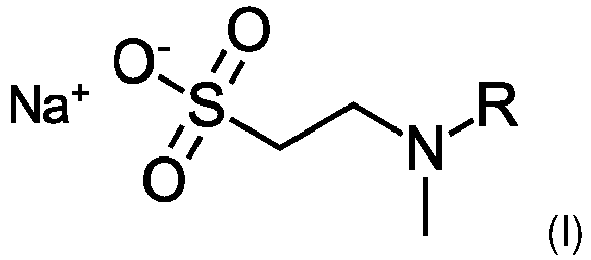
- Das Wasch- oder Reinigungsmittel umfasst das mindestens eine Fettsäuretaurid in 0,5 bis 5 Gew.-%, bezogen auf das Gesamtgewicht des Wasch- oder Reinigungsmittels.
- Methylcocoyltaurat oder Methyloleoyltaurat sind beispielsweise als Natriumsalze unter den Handelsnamen Hostapon CT oder Hostapon TPHC von der Clariant kommerziell erhältlich.
- In einer bevorzugten Ausführungsform haben die geeigneten Fettsäuretauride pflanzlichen Ursprung. Ferner enthält das erfindungsgemäße Wasch- oder Reinigungsmittel b) mindestens ein anionisches Tensid, das von a) verschieden ist.
- Als weitere Tenside können anionische, nichtionische, zwitterionische und/oder amphotere Tenside in dem erfindungsgemäßen Wasch- oder Reinigungsmittel eingesetzt werden. Anionische Tenside sind wichtige Bestandteile von Wasch- oder Reinigungsmitteln, weil sie eine Vielzahl von Textilanschmutzungen entfernen und insbesondere bei fetthaltigen Verschmutzungen wirksam sind. Sie sind kommerziell breit verfügbar und weisen eine gute Reinigungsleistung an verschmutzten Oberflächen auf. Die einsetzbaren Tenside können von petrochemischem, pflanzlichem oder mikrobiologischem Ursprung sein. Anionische Tenside umfassen unter anderem solche vom Sulfonat- und Sulfat-Typ.
- Als Aniontenside vom Sulfonat-Typ kommen dabei bevorzugt C9-C13-Alkylbenzolsulfonate, und Olefinsulfonate, das heißt Gemische aus Alken- und Hydroxyalkansulfonaten sowie Disulfonaten, wie man sie beispielsweise aus C12-C18-Monoolefinen mit end- oder innenständiger Doppelbindung durch Sulfonieren mit gasförmigem Schwefeltrioxid und anschließender alkalischer oder saurer Hydrolyse der Sulfonierungsprodukte erhält, in Betracht. Geeignet sind auch Alkansulfonate, die aus C12-C18-Alkanen beispielsweise durch Sulfochlorierung oder Sulfoxidation mit anschließender Hydrolyse bzw. Neutralisation gewonnen werden. Ebenso sind auch die Ester von α-Sulfofettsäuren (Estersulfonate), zum Beispiel die α-sulfonierten Methylester der hydrierten Kokos-, Palmkern- oder Talgfettsäuren geeignet.
- Weitere geeignete Aniontenside sind sulfierte Fettsäureglycerinester. Unter Fettsäureglycerinestern sind die Mono-, Di- und Triester sowie deren Gemische zu verstehen, wie sie bei der Herstellung durch Veresterung von einem Monoglycerin mit 1 bis 3 Mol Fettsäure oder bei der Umesterung von Triglyceriden mit 0,3 bis 2 Mol Glycerin erhalten werden. Bevorzugte sulfierte Fettsäureglycerinester sind dabei die Sulfierprodukte von gesättigten Fettsäuren mit 6 bis 22 Kohlenstoffatomen, beispielsweise der Capronsäure, Caprylsäure, Caprinsäure, Myristinsäure, Laurinsäure, Palmitinsäure, Stearinsäure oder Behensäure.
- Als Alk(en)ylsulfate werden die Alkali- und insbesondere die Natriumsalze der Schwefelsäurehalbester der C12-C18-Fettalkohole, beispielsweise aus Kokosfettalkohol, Talgfettalkohol, Lauryl-, Myristyl-, Cetyl- oder Stearylalkohol oder der C10-C20-Oxoalkohole und diejenigen Halbester sekundärer Alkohole dieser Kettenlängen bevorzugt. Weiterhin bevorzugt sind Alk(en)ylsulfate der genannten Kettenlänge, welche einen synthetischen, auf petrochemischer Basis hergestellten geradkettigen Alkylrest enthalten, die ein analoges Abbauverhalten besitzen wie die adäquaten Verbindungen auf der Basis von fettchemischen Rohstoffen. Aus waschtechnischem Interesse sind die C12-C16-Alkylsulfate und C12-C15-Alkylsulfate sowie C14-C15-Alkylsulfate bevorzugt. Auch 2,3-Alkylsulfate (sekundäre Alkylsulfate mit der Sulfatgruppe in der 2- oder 3-Position) sind geeignete Aniontenside.
- Auch die Schwefelsäuremonoester der mit 1 bis 6 Mol Ethylenoxid ethoxylierten geradkettigen oder verzweigten C7-C21-Alkohole, wie 2-Methyl-verzweigte C9-C11-Alkohole mit im Durchschnitt 3,5 Mol Ethylenoxid (EO) oder C12-C18-Fettalkohole mit 1 bis 4 EO, sind geeignet. Es ist sogar bevorzugt, dass das erfindungsgemäße Wasch- oder Reinigungsmittel 0,01 bis 5 Gew.-%, bevorzugt 0,5 bis 3 Gew.-% und insbesondere 1,5 bis 2,5 Gew.-%, eines ethoxylierten Fettalkoholsulfats enthält. In verschiedenen Ausführungsformen können derartige Fettalkoholethersulfate 2EO aufweisen und sich beispielsweise von C12-18 Fettalkoholen ableiten.
- Weitere geeignete Aniontenside sind auch die Salze der Alkylsulfobernsteinsäure, die auch als Sulfosuccinate oder als Sulfobernsteinsäureester bezeichnet werden und die Monoester und/oder Diester der Sulfobernsteinsäure mit Alkoholen, bevorzugt Fettalkoholen und insbesondere ethoxylierten Fettalkoholen darstellen. Bevorzugte Sulfosuccinate enthalten C8-C18-Fettalkoholreste oder Mischungen aus diesen. Insbesondere bevorzugte Sulfosuccinate enthalten einen Fettalkoholrest, der sich von ethoxylierten Fettalkoholen ableitet. Dabei sind wiederum Sulfosuccinate, deren Fettalkohol-Reste sich von ethoxylierten Fettalkoholen mit enger Homologenverteilung ableiten, besonders bevorzugt. Ebenso ist es auch möglich, Alk(en)ylbernsteinsäure mit bevorzugt 8 bis 18 Kohlenstoffatomen in der Alk(en)ylkette oder deren Salze einzusetzen.
- Falls eine Fettsäureseife in dem Wasch- oder Reinigungsmittel enthalten ist, eignen sich gesättigte und ungesättigte Fettsäureseifen, wie die Salze der Laurinsäure, Myristinsäure, Palmitinsäure, Stearinsäure, (hydrierten) Erucasäure und Behensäure sowie insbesondere aus natürlichen Fettsäuren, zum Beispiel Kokos-, Palmkern-, Olivenöl- oder Talgfettsäuren, abgeleitete Seifengemische.
- Die anionischen Tenside einschließlich der Seifen, falls vorhanden, können bevorzugt in Form ihrer Natrium-, Kalium- oder Magnesiumsalze vorliegen. Bevorzugt liegen die anionischen Tenside in Form ihrer Natriumsalze vor.
- Als das mindestens eine weitere Tensid b) kann, in verschiedenen Ausführungsformen, mindestens ein anionisches Tensid, bevorzugt ein lineares oder verzweigtes Alkylbenzolsulfonat (z.B. mit C9-C13) und/oder ein Alkylethersulfat (z.B. mit C12-18), beispielsweise Natriumlaurylethersulfat, beispielsweise mit 2EO, und/oder ein alpha-Olefinsulfonat, in dem erfindungsgemäßen Wasch- oder Reinigungsmittel umfasst sein; dieses ist, falls enthalten, bevorzugt in einer Menge von 0,1 bis 50 Gew.-%, stärker bevorzugt von 0,2 bis 20 Gew.-%, noch stärker bevorzugt von 0,5 bis 10 Gew.-% bezogen auf das Gesamtgewicht des Wasch- oder Reinigungsmittels, enthalten.
- In verschiedenen Ausführungsformen kann durch die Zugabe zu dem Wasch- oder Reinigungsmittel von mindestens einem Fettsäuretaurid, bevorzugt Methylcocoyltaurat oder Methyloleoyltaurat oder eine Mischung davon, stärker bevorzugt ein Natriumsalz davon, die Funktion eines weiteren anionischen Tensids, stärker bevorzugt eines linearen oder verzweigten Alkylbenzolsulfonats und/oder eines Alkylethersulfats, wie z.B. Natriumlaurylethersulfats (SLES), und/oder eines alpha-Olefinsulfonats, stärker bevorzugt eines Alkylethersulfats, wie z.B. Natriumlaurylethersulfats (SLES), teilweise oder vollständig ersetzt werden, bevorzugt zu über 10 %, stärker bevorzugt zu über 20 %, noch stärker bevorzugt zu über 30 %, noch stärker bevorzugt zu über 40 %, noch stärker bevorzugt zu etwa 50 % oder über 50 %, noch stärker bevorzugt zu über 60 %, noch stärker bevorzugt zu über 70 %, noch stärker bevorzugt zu über 80 %, noch stärker bevorzugt zu über 90 %, noch stärker bevorzugt zu über 95 %, am stärksten bevorzugt zu 100 %.
- In einer bevorzugten Ausführungsform ersetzt die Zugabe des mindestens einen Fettsäuretaurids a), zu dem Wasch- oder Reinigungsmittel, ein weiteres anionisches Tensid, stärker bevorzugt ein Alkylethersulfat, wie z.B. Natriumlaurylethersulfat, zu etwa 50 % bis zu etwa 100 %, stärker bevorzugt zu etwa 50 % oder etwa 100%.
- In einer Ausführungsform ist das erfindungsgemäße Wasch- oder Reinigungsmittel im Wesentlichen frei von weiteren anionischen Tensiden, bevorzugt frei von Alkylethersulfaten, wie z.B. Natriumlaurylethersulfat (SLES).
- In einer anderen bevorzugten Ausführungsform werden das Fettsäuretaurid a) und das weitere anionische Tensid, bevorzugt ein Alkylethersulfat, wie z.B. Natriumlaurylethersulfat (SLES), beispielsweise mit 1-4 oder 2 EO, in einem Verhältnis von 1:10 bis 10:1, stärker bevorzugt von 5:1 bis 1:5, noch stärker bevorzugt von 1:1 oder 1:1,8 (Verhältnis a):anionisches Tensid) in dem erfindungsgemäßen Wasch- oder Reinigungsmittel eingesetzt. Das Verhältnis ist insbesondere ein Gewichtsverhältnis. Wenn das Mittel mehrere anionische Tenside enthält, gilt das oben angegebene Verhältnis entweder für die Summe aller anderen anionischen Tenside oder für ein anionisches Tensid. In letzterem Fall ist dies insbesondere ein Alkylethersulfat.
- In einer weiteren bevorzugten Ausführungsform umfasst das Wasch- oder Reinigungsmittel ein nichtionisches Tensid, bevorzugt ein nichtionisches Tensid aus der Gruppe der alkoxylierten Fettalkohole, alkoxylierten Fettsäurealkylester, Fettsäureamide, alkoxylierten Fettsäureamide, Polyhydroxyfettsäureamide, Alkylphenolpolyglycolether, Aminoxide, Alkylpolyglucoside und Mischungen daraus, stärker bevorzugt aus der Gruppe der Alkoholethoxylate, noch stärker bevorzugt ein C12-18-Alkoholethoxylat mit 7 EO Einheiten. Das nichtionische Tensid ist bevorzugt in einer Menge von 0,1 bis 50 Gew.-%, stärker bevorzugt von 0,2 bis 20 Gew.-%, noch stärker bevorzugt von 0,5 bis 10 Gew.-%, bezogen auf das Gesamtgewicht des Wasch- oder Reinigungsmittels, enthalten.
- In einer weiteren bevorzugten Ausführungsform umfasst das mindestens eine Tensid des erfindungsgemäßen Wasch- oder Reinigungsmittels ein anionisches Tensid und ein nichtionisches Tensid, wobei das anionische Tensid bevorzugt ein lineares oder verzweigtes Alkylbenzolsulfonat und/oder ein Alkylethersulfat, z.B. Natriumlaurylethersulfat, und/oder alpha-Olefinsulfonat ist und/oder das nichtionische Tensid bevorzugt aus der Gruppe der alkoxylierten Fettalkohole, alkoxylierten Fettsäurealkylester, Fettsäureamide, alkoxylierten Fettsäureamide, Polyhydroxyfettsäureamide, Alkylphenolpolyglycolether, Aminoxide, Alkylpolyglucoside und Mischungen daraus, stärker bevorzugt aus der Gruppe der (Fett-)Alkoholethoxylate stammt, noch stärker bevorzugt umfasst es ein C12-18-Alkoholethoxylat mit 7 EO Einheiten. Bevorzugt liegen das anionische und/oder das nichtionische Tensid in dem erfindungsgemäßen Wasch- oder Reinigungsmittel in einer Menge von 0,1 bis 50 Gew.-%, stärker bevorzugt von 0,2 bis 20 Gew.-%, noch stärker bevorzugt von 0,5 bis 10 Gew.-%, bezogen auf das Gesamtgewicht des Wasch- oder Reinigungsmittels, vor.
- Generell werden als nichtionische Tenside bevorzugt alkoxylierte, vorteilhafterweise ethoxylierte, insbesondere primäre Alkohole mit bevorzugt 8 bis 18 C-Atomen und durchschnittlich 1 bis 12 Mol Ethylenoxid (EO) pro Mol Alkohol eingesetzt, in denen der Alkoholrest linear oder bevorzugt in 2-Stellung methylverzweigt sein kann bzw. lineare und methylverzweigte Reste im Gemisch enthalten kann, so wie sie üblicherweise in Oxoalkoholresten vorliegen. Insbesondere sind jedoch Alkoholethoxylate mit linearen Resten aus Alkoholen nativen Ursprungs mit 12 bis 18 C-Atomen, zum Beispiel aus Kokos-, Palm-, Talgfett- oder Oleylalkohol, und durchschnittlich 2 bis 8 EO pro Mol Alkohol bevorzugt. Zu den bevorzugten ethoxylierten Alkoholen gehören beispielsweise C12-C14-Alkohole mit 3 EO, 4 EO oder 7 EO, C9-C1 1 -Alkohol mit 7 EO, C13-C15-Alkohole mit 3 EO, 5 EO, 7 EO oder 8 EO, C12-C18-Alkohole mit 3 EO, 5 EO oder 7 EO und Mischungen aus diesen, wie Mischungen aus C12-C14-Alkohol mit 3 EO und C12-C18-Alkohol mit 7 EO. Die angegebenen Ethoxylierungsgrade stellen statistische Mittelwerte dar, die für ein spezielles Produkt eine ganze oder eine gebrochene Zahl sein können. Bevorzugte Alkoholethoxylate weisen eine enge Homologenverteilung auf (narrow range ethoxylates, NRE). Zusätzlich zu diesen nichtionischen Tensiden können auch Fettalkohole mit mehr als 12 EO eingesetzt werden. Beispiele hierfür sind Talgfettalkohol mit 14 EO, 25 EO, 30 EO oder 40 EO. Auch nichtionische Tenside, die EO- und PO-Gruppen zusammen im Molekül enthalten, sind erfindungsgemäß einsetzbar. Hierbei können Blockcopolymere mit EO-PO-Blockeinheiten bzw. PO-EO-Blockeinheiten eingesetzt werden, aber auch EO-PO-EO-Copolymere bzw. PO-EO-PO-Copolymere. Selbstverständlich sind auch gemischt alkoxylierte Niotenside einsetzbar, in denen EO- und PO-Einheiten nicht blockweise, sondern statistisch verteilt sind. Solche Produkte sind durch gleichzeitige Einwirkung von Ethylen- und Propylenoxid auf Fettalkohole erhältlich.
- Außerdem können als weitere nichtionische Tenside auch Alkylglucoside der allgemeinen Formel RO(G)x eingesetzt werden, in der R einen primären geradkettigen oder methylverzweigten, insbesondere in 2-Stellung methylverzweigten, aliphatischen Rest mit 8 bis 22, bevorzugt 12 bis 18 C-Atomen bedeutet und G das Symbol ist, das für eine Glycosideinheit mit 5 oder 6 C-Atomen, bevorzugt für Glucose, steht. Der Oligomerisierungsgrad x, der die Verteilung von Monoglykosiden und Oligoglykosiden angibt, ist eine beliebige Zahl zwischen 1 und 10; bevorzugt liegt x bei 1,2 bis 1,4.
- Eine weitere Klasse bevorzugter nichtionischer Tenside, die entweder als alleiniges nichtionisches Tensid oder in Kombination mit anderen nichtionischen Tensiden eingesetzt werden, sind alkoxylierte, bevorzugt ethoxylierte oder ethoxylierte und propoxylierte Fettsäurealkylester, bevorzugt mit 1 bis 4 Kohlenstoffatomen in der Alkylkette, insbesondere Fettsäuremethylester.
- Auch nichtionische Tenside vom Typ der Aminoxide, beispielsweise N-Kokosalkyl-N,N-dimethyl-aminoxid und N-Talgalkyl-N,N-dihydroxyethylaminoxid, und der Fettsäurealkanolamide können geeignet sein. Die Menge dieser nichtionischen Tenside beträgt bevorzugt nicht mehr als die der ethoxylierten Fettalkohole, insbesondere nicht mehr als die Hälfte davon.
- Weitere geeignete Tenside sind Polyhydroxyfettsäureamide der Formel (II),

- Zur Gruppe der Polyhydroxyfettsäureamide gehören auch Verbindungen der Formel (III),

- Es kann allerdings bevorzugt sein, dass das Wasch- oder Reinigungsmittel zusätzlich zu Verbindung a) eine rein auf nichtionischen Tensiden basierende Wasch- oder Reinigungsmittelmatrix aufweist, beispielsweise kein anderen anionischen Tenside enthalten sind. Insbesondere kann es im Hinblick auf die Umweltfreundlichkeit des Wasch- oder Reinigungsmittels bevorzugt sein, dass das Wasch- oder Reinigungsmittel überwiegend Tenside aus nachwachsenden Rohstoffen enthält und der Anteil an synthetischen Tensiden möglichst gering ist oder bei null liegt.
- Geeignete Kationtenside sind u.a. die quartären Ammoniumverbindungen der Formel (Ri)(Rii)(Riii)(Riv)N+ X-, in der Ri bis Riv für vier gleich- oder verschiedenartige, insbesondere zwei lang- und zwei kurzkettige, Alkylreste und X- für ein Anion, insbesondere ein Halogenidion, stehen, beispielsweise Didecyldimethylammoniumchlorid, Alkylbenzyldidecylammoniumchlorid, Alkyldimethylhydroxyethylammoniumchlorid, -bromid oder -methylsulfat, insbesondere mit C12-Alkyl, und deren Mischungen. Die Wasch- oder Reinigungsmittel können kationische Tenside in Mengen, bezogen auf das Gesamtgewicht des Wasch- oder Reinigungsmittels, von 0,001 bis 10 Gew.-%, bevorzugt 0,01 bis 5 Gew.-%, insbesondere 0,1 bis 3 Gew.-% enthalten.
- Geeignete Amphotenside (zwitterionische Tenside) sind beispielsweise Betaine, Alkylamidoalkylamine, alkylsubstituierte Aminosäuren, acylierte Aminosäuren bzw. Biotenside, von denen die Betaine im Rahmen der erfindungsgemäßen Lehre bevorzugt werden.
- Neben dem a) mindestens einen Fettsäuretaurid und dem b) mindestens einen von a) verschiedenen Tensid, enthält das erfindungsgemäße Wasch- oder Reinigungsmittel c) mindestens ein Enzym.
- Das Wasch- oder Reinigungsmittel der vorliegenden Erfindung umfasst mindestens ein Enzym, oder eine Kombination unterschiedlicher Enzyme, um ausreichende Reinigungswirkung beispielsweise bei angetrockneten und verkrusteten Speise- und Schmutzresten zu gewährleisten. Flüssige, wässrige Wasch- oder Reinigungsmitteln sind bevorzugt.
- Erfindungsgemäß bevorzugt verwendete Enzyme sind Amylasen, Proteasen, (Hemi)cellulasen, Peroxidasen und/oder Lipasen.
- Amylasen können beispielsweise zur Entfernung von Stärke und Glykogen zugesetzt werden. Erfindungsgemäß verwendbar sind alpha-, beta- und gamma-Amylasen (α-, β-, γ-Amylasen), sowie Glucoamylasen und maltogene Amylasen. Die Amylasen können aus beliebigen Quellen stammen, wie beispielsweise aus Bakterien, Pilzen, Pankreasdrüsen tierischer Herkunft, aus gekeimten Getreide, Hefen etc. Auch gentechnisch modifizierte Amylasen sind, gegebenenfalls sogar bevorzugt, in den erfindungsgemäßen Wasch- oder Reinigungsmitteln verwendbar.
- Die Amylase-Enzyme können in den erfindungsgemäßen Wasch- oder Reinigungsmitteln in einer Menge von 0,00001 Gew.-% bis 5 Gew.-% vorliegen, bevorzugt von 0,0001 Gew.-% bis etwa 1 Gew.-%, stärker bevorzugt von 0,0005 bis etwa 0,5 Gew.-% und insbesondere von 0,001 oder 0,01 bis etwa 0,4 Gew.-%, bezogen auf das Gesamtgewicht des Wasch- oder Reinigungsmittels und auf Aktivprotein.
- Neben Amylasen können den erfindungsgemäßen Wasch- oder Reinigungsmitteln auch Proteasen zur Spaltung von Proteinen und Peptidresten zugesetzt werden. Proteasen eignen sich besonders zur hydrolytischen Spaltung und Entfernung von Eiweißresten, insbesondere angetrockneten Eiweißresten.
- Erfindungsgemäß geeignete Proteasen sind Proteinasen (Endopeptidasen) und Peptidasen (Exopeptidasen). Verwendbare Proteasen können pflanzlichen, tierischen, bakteriellen und/oder pilzlichen Ursprungs sein. Geeignete Proteasen sind insbesondere Serin-, Cystein-, Aspartat- und Metallproteasen. Auch gentechnisch modifizierte Proteasen sind, gegebenenfalls sogar bevorzugt, in den erfindungsgemäßen Wasch- oder Reinigungsmitteln verwendbar.
- Typischerweise werden Proteasen in Mengen Aktivprotein im Bereich von 0,00001 bis 1,5 Gew.-%, bevorzugt im Bereich von 0,0001 bis 0,75 Gew.-% eingesetzt, basierend auf dem Gesamtgewicht der Wasch- oder Reinigungsmittel.
- Ferner können in erfindungsgemäßen Wasch- oder Reinigungsmitteln Lipasen zur Entfernung fest anhaftenden Fettschmutzes zugegeben werden. Lipasen sind somit eine Bio-Alternative zu Tensiden und können im Mengen-Bereich (Aktivprotein) von 0,0001 bis 1 Gew.-% die Reinigungswirkung der Tenside unterstützen. Geeignete Lipasen lassen sich aus Pflanzen (beispielsweise Rhizinusarten), Mikroorganismen und tierischen Quellen gewinnen, wie beispielsweise Pankreaslipasen.
- Die vorgenannten Enzyme können einzeln oder in beliebig kombinierten Mischungen miteinander den erfindungsgemäßen Wasch- und Reinigungsmitteln zugesetzt werden. Besonders bevorzugt zur Verwendung in erfindungsgemäßen Wasch- und Reinigungsmitteln sind Amylasen, insbesondere alpha-Amylasen und Proteasen.
- Die zusetzbaren Enzyme können gegebenenfalls mit beliebigen anderen Enzymen kombiniert werden, um die Reinigungsleistung der Wasch- oder Reinigungsmittel weiter zu verbessern. Weitere erfindungsgemäß geeignete Enzyme sind Reduktasen, Oxidasen, Ligninasen, Cutinasen, Pektinasen, Xylanasen, Phenoloxidasen, Lipoxygenasen, Tannasen, Pentosanasen, Malanasen, Glucanasen, Arabinosidasen und beliebige Mischungen dieser Enzyme.
- In einer bevorzugten Ausführungsform wird das mindestens eine Enzym in dem erfindungsgemäßen Wasch- und Reinigungsmittel in einer Menge von 0,00001 bis 5 Gew.-%, bevorzugt von 0,0001 bis 2 Gew.-%, stärker bevorzugt von 0,01 bis 1,5 Gew.-%, bezogen auf das Gesamtgewicht des Wasch- oder Reinigungsmittels und Aktivprotein, eingesetzt.
- Von Amylasen ist bekannt, dass diese sich durch den Zusatz von Calciumchlorid-Ionen stabilisieren lassen. Borsäure/Borate/Perborate, in Kombination mit Glycerin und/oder PEG, sowie Niotensiden mit verfügbaren Hydroxylgruppen, sind weitere geeignete Stabilisierungsmittel.
- In einer besonders bevorzugten Ausführungsform der Erfindung wird den erfindungsgemäßen Wasch- oder Reinigungsmitteln daher Calciumchlorid, bevorzugt in Form des Dihydrates (CaCl2 × 2 H2O), zugesetzt.
- Die Menge an zugesetztem Calciumchlorid beträgt bevorzugt 0,01 bis 2 Gew.-%, stärker bevorzugt 0,05 bis 1 Gew.-%, noch stärker bevorzugt 0,08 bis 1 Gew.-% und insbesondere etwa 0,1 Gew.-%, bezogen auf das Gesamtgewicht des Wasch- oder Reinigungsmittels.
- In einer bevorzugten Ausführungsform umfasst oder besteht das Wasch- oder Reinigungsmittel aus a) mindestens einem Fettsäuretaurid, b) mindestens einem von a) verschiedenen anionischem Tensid, c) mindestens einem Enzym und d) mindestens einem Additiv.
- Geeignete Additive sind auswählbar aus Gerüststoffen, Bleichmitteln, Bleichkatalysatoren, Bleichaktivatoren, Elektrolyten, pH-Stellmitteln, Parfümen, Parfümträgern, Fluoreszenzmitteln, Farbstoffen, Hydrotropen, Komplexbildnern, Schauminhibitoren, Silikonölen, Soil-Release-Polymeren, Vergrauungsinhibitoren, Einlaufverhinderern, Knitterschutzmitteln, antimikrobiellen Wirkstoffen, Lösungsmitteln, Germiziden, Fungiziden, Antioxidantien, Konservierungsmitteln, Korrosionsinhibitoren, Antistatika, Bittermitteln, Bügelhilfsmitteln, Phobier- und Imprägniermitteln, Haut-pflegenden Wirkstoffen, Quell- und Schiebefestmitteln, weichmachenden Komponenten sowie UV-Absorbern und Mischungen daraus.
- Die als Additive d) optional eingesetzten Verbindungen oder Komponenten sind verschieden zu den als a), b) oder c) eingesetzten Verbindungen oder Komponenten des erfindungsgemäßen Wasch- oder Reinigungsmittels.
- In einer bevorzugten Ausführungsform umfasst das erfindungsgemäße Wasch- oder Reinigungsmittel das mindestens eine Additiv in einer Menge von 0,0001 bis 30 Gew.-%, bevorzugt 0,1 bis 20 Gew.-%, stärker bevorzugt 1 bis 10 Gew.-%, bezogen auf das Gesamtgewicht des Wasch- oder Reinigungsmittels.
- Bevorzugt enthält das Wasch- oder Reinigungsmittel mindestens einen Parfüm- bzw. Duftstoff, oder gegebenenfalls eine Mischung unterschiedlicher Parfüm-/ bzw. Duftstoffe als das mindestens eine Additiv.
- Als Parfümöle bzw. Duftstoffe können im Rahmen der vorliegenden Erfindung einzelne Riechstoffverbindungen, z.B. die synthetischen Produkte vom Typ der Ester, Ether, Aldehyde, Ketone, Alkohole und Kohlenwasserstoffe verwendet werden. Bevorzugt werden jedoch Mischungen verschiedener Riechstoffe verwendet, die gemeinsam eine ansprechende Duftnote erzeugen. Solche Parfümöle können auch natürliche Riechstoffgemische enthalten, wie sie aus pflanzlichen Quellen zugänglich sind, z.B. Pinien-, Citrus-, Jasmin-, Patchouli-, Rosen- oder Ylang-Ylang-Öl.
- In einer bevorzugten Ausführungsform enthält das Wasch- oder Reinigungsmittels ein oder mehrere Duftstoffe in einer Menge von üblicherweise bis 15 Gew.-%, bevorzugt 0,01 bis 5 Gew.-%, insbesondere 0,3 bis 3 Gew.-%, bezogen auf das Gesamtgewicht des Wasch- oder Reinigungsmittels.
- In einer bevorzugten Ausführungsform enthält das erfindungsgemäße Wasch- oder Reinigungsmittel zusätzlich ein Bleichmittel als das mindestens eine Additiv.
- Unter den als Bleichmittel dienenden, in Wasser H2O2 liefernden Verbindungen haben das Natriumperborattetrahydrat und das Natriumperboratmonohydrat besondere Bedeutung. Weitere brauchbare Bleichmittel sind beispielsweise Natriumpercarbonate, Peroxypyrophosphate, Citratperhydrate sowie H2O2 liefernde persaure Salze oder organische Persäuren, wie Perbenzoate, Peroxophthalate, Diperazelainsäure, Diperdodecandisäure, 4-Phthalimidoperoxobutansäure, 5-Phthalimidoperoxopentansäure, 6-Phthalimidoperoxohexansäure, 7-Phthalimidoperoxoheptansäure, N,N'-terephthaloyl-di-6-aminoperoxohexansäure und Mischungen aus diesen. Zu den bevorzugten Persäuren gehören die Phthalimidoperoxoalkansäuren, insbesondere 6-Phthalimidoperoxohexansäure (PAP). Das Bleichmittel kann - falls vorhanden - in bekannter Weise unter Einsatz inerter Trägermaterialien in Teilchenform konfektioniert worden sein; bevorzugt wird es in umhüllter Form eingesetzt werden. Dabei ist wichtig, dass das umhüllende Material unter den Anwendungsbedingungen des Wasch- oder Reinigungsmittels (bei höherer Temperatur, sich durch Verdünnung mit Wasser veränderndem pH-Wert, oder ähnlichem) das umhüllte Bleichmittel freigibt. Ein bevorzugtes umhüllendes Material ist eines, das zumindest anteilsweise aus gesättigter Fettsäure besteht.
- Die Menge an Bleichmittel beträgt bevorzugt zwischen 0,5 und 20 Gew.-% bezogen auf das Gesamtgewicht des Wasch- oder Reinigungsmittels.
- Um beim Waschen bei Temperaturen von 60 °C und darunter eine verbesserte Bleichwirkung zu erreichen, können Bleichaktivatoren in die Wasch- und Reinigungsmittel eingearbeitet werden. Als Bleichaktivatoren können Verbindungen, die unter Perhydrolysebedingungen aliphatische Peroxocarbonsäuren ergeben, eingesetzt werden. Bevorzugt sind mehrfach acylierte Alkylendiamine, insbesondere Tetraacetylethylendiamin (TAED), acylierte Triazinderivate, insbesondere 1,5-Diacetyl-2,4-dioxohexahydro-1,3,5-triazin (DADHT), acylierte Glykolurile, insbesondere Tetraacetylglykoluril (TAGU), N-Acylimide, insbesondere N-Nonanoylsuccinimid (NOSI), acylierte Phenolsulfonate, insbesondere n-Nonanoyl- oder Isononanoyloxybenzolsulfonat (n- bzw. iso-NOBS), Carbonsäureanhydride, insbesondere Phthalsäureanhydrid, acylierte mehrwertige Alkohole, insbesondere Triacetin, Ethylenglykoldiacetat und 2,5-Diacetoxy-2,5-dihydrofuran.
- Zusätzlich zu den konventionellen Bleichaktivatoren oder an deren Stelle können auch so genannte Bleichkatalysatoren in die flüssigen Wasch- und Reinigungsmittel eingearbeitet werden. Bei diesen Stoffen handelt es sich um bleichverstärkende Übergangsmetallsalze bzw. Übergangsmetallkomplexe wie beispielsweise Mn-, Fe-, Co-, Ru - oder Mo-Salenkomplexe oder -carbonylkomplexe. Auch Mn-, Fe-, Co-, Ru-, Mo-, Ti-, V- und Cu-Komplexe mit stickstoffhaltigen Tripod-Liganden sowie Co-, Fe-, Cu- und Ru-Amminkomplexe sind als Bleichkatalysatoren verwendbar.
- Sollte das, bevorzugt flüssige, stärker bevorzugt flüssige, wässrige Wasch- oder Reinigungsmittel ein Bleichmittel, einen Bleichaktivator und/oder einen Bleichkatalysator enthalten, so ist es insbesondere vorteilhaft, dass diese in verkapselter Form in dem Wasch- oder Reinigungsmittel vorliegen.
- In bevorzugten Ausführungsformen kann das erfindungsgemäße Wasch- oder Reinigungsmittel mindestens einen Komplexbildner enthalten. Komplexbildner sind auch unter den Namen Chelatbildner oder Sequestrierungsmittel bekannt. Typischerweise kann ein Komplexbildner Metallionen binden, um diese an einer Reaktion mit anderen Bestandteilen einer Zusammensetzung zu hindern. Beispielsweise können sie Waschmittel- oder Reinigungszusammensetzungen zugesetzt werden, um Ca- und Mg-Ionen zu komplexieren, um das Wasser zu enthärten. Andere Komplexierungsmittel können bevorzugt auch zur Wasch- oder Reinigungsleistung beitragen.
- Geeignete Komplexbildner sind beispielsweise kondensierte Phosphate, Phosphonate, und/oder Aminocarbonsäuren.
- Beispiele für kondensierte Phosphate schließen Natrium- und Kaliumorthophosphat, Natrium- und Kaliumpyrophosphat, Natriumtripolyphosphat und Natriumhexametaphosphat ein, ohne darauf beschränkt zu sein.
- Beispiele für Phosphonsäuren, Phosphonate oder Derivate davon schließen 2-Phosphonobutan-1,2,4-tricarbonsäure (PBTC), 1-Hydroxyethan-(1,1-diphosphonsäure) (HEDP), Aminotrimethylenphosphonsäure (ATMP), 2-Hydroxyethyliminobis(methylenphosphonsäure), Diethylentriaminpenta-(methylenphosphonsäure) (DTPMP), Ethylendiamintetra(methylenphosphonsäure) (EDTMP) Hexamethylendiamin(tetramethylenphosphonsäure), Bis(hexamethylen)triamin(pentamethylen-phosphonsäure), Phosphorsäure oder geeignete Salze davon ein, ohne darauf beschränkt zu sein.
- In einer bevorzugten Ausführungsform enthält das erfindungsgemäße Wasch- oder Reinigungsmittel ferner eine phosphonat-haltige Verbindung, bevorzugt Diphosphonsäure oder Derivate oder Salze davon, stärker bevorzugt 1-Hydroxyethan-(1,1-diphosphonsäure) oder ein geeignetes Salz davon.
- In einer bevorzugten Ausführungsform enthält das erfindungsgemäße Wasch- oder Reinigungsmittel 1-Hydroxyethan-(1,1-diphosphonsäure) (HEDP) oder ein geeignetes Salz davon.
- In einer Ausführungsform ist das erfindungsgemäße Wasch- oder Reinigungsmittel im Wesentlichen frei von Phosphaten oder anderen phosphorhaltigen Verbindungen, insbesondere solchen die keine Phosphonate sind.
- In einer anderen Ausführungsform ist das erfindungsgemäße Wasch- oder Reinigungsmittel auch im Wesentlichen frei von Phosphonaten, wie z.B. Diphosphonsäuren oder Derivaten oder Salzen davon.
- In einer Ausführungsform ist das erfindungsgemäße Wasch- oder Reinigungsmittel im Wesentlichen frei von 1-Hydroxyethan-(1,1-diphosphonsäure) (HEDP) oder einem geeigneten Salz davon.
- Geeignete Aminocarbonsäurematerialien, die wenig oder kein NTA enthalten, schließen ein, sind jedoch nicht beschränkt auf N-Hydroxyethylaminodiessigsäure, Ethylendiamintetraessigsäure (EDTA), Hydroxyethylendiamintetraessigsäure, Diethylentriaminpentaessigsäure (DTPA), N-Hydroxyethylethylendiamintriessigsäure (HEDTA), Methylglycindiessigsäure (MGDA), Glutaminsäure-N,N-Diessigsäure (GLDA), Ethylendiaminsuccinylsäure (EDDS), 2-Hydroxyethyliminodiessigsäure (HEIDA), Iminodisuccinylsäure (IDS), 3-Hydroxy-2-2'-iminodisuccinylsäure (HIDS) und andere ähnliche Säuren oder Salze davon mit einer Aminogruppe mit einem Carbonsäuresubstituenten.
- In einer bevorzugten Ausführungsform ist das Wasch- oder Reinigungsmittel jedoch im Wesentlichen frei von Aminocarbonsäuren.
- Wenn ein Komplexbildner in dem erfindungsgemäßen Wasch- oder Reinigungsmittel eingesetzt werden sollte, wird dieser bevorzugt in einer Menge von 0,01 bis 30 Gew.-%, bevorzugt von 0,1 bis 20 Gew.-%, stärker bevorzugt von 0,5 bis 15 Gew.-%, bezogen auf das Gesamtgewicht des Wasch- oder Reinigungsmittels, eingesetzt.
- Das erfindungsgemäße Wasch- oder Reinigungsmittel kann ferner einen oder mehrere Builder enthalten.
- In einer weiteren bevorzugten Ausführungsform enthält das Wasch- oder Reinigungsmittel wasserlöslichen und/oder wasserunlöslichen Builder, insbesondere ausgewählt aus Alkalialumosilikat, kristallinem Alkalisilikat mit Modul über 1, monomerem Polycarboxylat, polymerem Polycarboxylat und deren Mischungen, insbesondere in Mengen im Bereich von 2,5 Gew.-% bis 30 Gew.-%, bezogen auf das Gesamtgewicht des Wasch- oder Reinigungsmittels.
- Zu den wasserlöslichen organischen Buildersubstanzen gehören insbesondere solche aus der Klasse der Polycarbonsäuren, insbesondere Citronensäure und Zuckersäuren, sowie der polymeren (Poly-)carbonsäuren, insbesondere die durch Oxidation von Polysacchariden zugänglichen Polycarboxylate, polymere Acrylsäuren, Methacrylsäuren, Maleinsäuren und Mischpolymere aus diesen, die auch geringe Anteile polymerisierbarer Substanzen ohne Carbonsäurefunktionalität einpolymerisiert enthalten können. Die relative Molekülmasse der Homopolymeren ungesättigter Carbonsäuren liegt im allgemeinen zwischen 5000 g/mol und 200000 g/mol, die der Copolymeren zwischen 2000 g/mol und 200000 g/mol, bevorzugt 50000 g/mol bis 120000 g/mol, bezogen auf freie Säure. Ein besonders bevorzugtes Acrylsäure-Maleinsäure-Copolymer weist eine relative Molekülmasse von 50000 g/mol bis 100000 g/mol auf. Geeignete, wenn auch weniger bevorzugte Verbindungen dieser Klasse sind Copolymere der Acrylsäure oder Methacrylsäure mit Vinylethern, wie Vinylmethylethern, Vinylester, Ethylen, Propylen und Styrol, in denen der Anteil der Säure mindestens 50 Gew.-% beträgt.
- Als wasserlösliche organische Buildersubstanzen können auch Terpolymere eingesetzt werden, die als Monomere zwei Carbonsäuren und/oder deren Salze sowie als drittes Monomer Vinylalkohol und/oder ein Vinylalkohol-Derivat oder ein Kohlenhydrat enthalten. Das erste saure Monomer oder dessen Salz leitet sich von einer monoethylenisch ungesättigten C3-C8-Carbonsäure und bevorzugt von einer C3-C4-Monocarbonsäure, insbesondere von (Meth-)acrylsäure ab. Das zweite saure Monomer oder dessen Salz kann ein Derivat einer C4-C8-Dicarbonsäure sein, wobei Maleinsäure besonders bevorzugt ist. Die dritte monomere Einheit wird in diesem Fall von Vinylalkohol und/oder bevorzugt einem veresterten Vinylalkohol gebildet. Insbesondere sind Vinylalkohol-Derivate bevorzugt, welche einen Ester aus kurzkettigen Carbonsäuren, beispielsweise von C1-C4-Carbonsäuren, mit Vinylalkohol darstellen. Bevorzugte Terpolymere enthalten dabei 60 Gew.-% bis 95 Gew.-%, insbesondere 70 Gew.-% bis 90 Gew.-% (Meth)acrylsäure und/oder (Meth)acrylat, stärker bevorzugt Acrylsäure und/oder Acrylat, und Maleinsäure und/oder Maleinat sowie 5 Gew.-% bis 40 Gew.-%, bevorzugt 10 Gew.-% bis 30 Gew.-% Vinylalkohol und/oder Vinylacetat. Ganz besonders bevorzugt sind dabei Terpolymere, in denen das Gewichtsverhältnis (Meth)acrylsäure und/oder (Meth)acrylat zu Maleinsäure und/oder Maleat zwischen 1:1 und 4:1, bevorzugt zwischen 2:1 und 3:1 und insbesondere 2:1 und 2,5:1 liegt. Dabei sind sowohl die Mengen als auch die Gewichtsverhältnisse auf die Säuren bezogen. Das zweite saure Monomer oder dessen Salz kann auch ein Derivat einer Allylsulfonsäure sein, die in 2-Stellung mit einem Alkylrest, bevorzugt mit einem C1-C4-Alkylrest, oder einem aromatischen Rest, der sich bevorzugt von Benzol oder Benzol-Derivaten ableitet, substituiert ist. Bevorzugte Terpolymere enthalten dabei 40 Gew.-% bis 60 Gew.-%, insbesondere 45 bis 55 Gew.-% (Meth)acrylsäure und/oder (Meth)acrylat, stärker bevorzugt Acrylsäure und/oder Acrylat, 10 Gew.-% bis 30 Gew.-%, bevorzugt 15 Gew.-% bis 25 Gew.-% Methallylsulfonsäure und/oder Methallylsulfonat und als drittes Monomer 15 Gew.-% bis 40 Gew.-%, bevorzugt 20 Gew.-% bis 40 Gew.-% eines Kohlenhydrats. Dieses Kohlenhydrat kann dabei beispielsweise ein Mono-, Di-, Oligo- oder Polysaccharid sein, wobei Mono-, Di- oder Oligosaccharide bevorzugt sind, besonders bevorzugt ist Saccharose. Durch den Einsatz des dritten Monomers werden vermutlich Sollbruchstellen in dem Polymer eingebaut, die für die gute biologische Abbaubarkeit des Polymers verantwortlich sind. Diese Terpolymere weisen im Allgemeinen eine relative Molekülmasse zwischen 1000 g/mol und 200000 g/mol, bevorzugt zwischen 2000 g/mol und 50000 g/mol und insbesondere zwischen 3000 g/mol und 10000 g/mol auf. Sie können, insbesondere zur Herstellung flüssiger Mittel, in Form wässriger Lösungen, bevorzugt in Form 30- bis 50-gewichtsprozentiger wässriger Lösungen eingesetzt werden. Alle genannten Polycarbonsäuren werden in der Regel in Form ihrer wasserlöslichen Salze, insbesondere ihre Alkalisalze, eingesetzt.
- Als wasserunlösliche, wasserdispergierbare anorganische Buildermaterialien werden insbesondere kristalline oder amorphe Alkalialumosilikate, in Mengen von bis zu 50 Gew.-%, bevorzugt nicht über 40 Gew.-% und in flüssigen Mitteln insbesondere von 1 Gew.-% bis 5 Gew.-%, eingesetzt. Unter diesen sind die kristallinen Alumosilikate in Waschmittelqualität, insbesondere Zeolith NaA und gegebenenfalls NaX, bevorzugt. Mengen nahe der genannten Obergrenze werden bevorzugt in festen, teilchenförmigen Mitteln eingesetzt. Geeignete Alumosilikate weisen insbesondere keine Teilchen mit einer Korngröße über 30 µm auf und bestehen bevorzugt zu wenigstens 80 Gew.-% aus Teilchen mit einer Größe unter 10 µm. Ihr Calciumbindevermögen, das nach den Angaben der deutschen Patentschrift
DE 24 12 837 A1 bestimmt werden kann, liegt im Bereich von 100 bis 200 mg CaO pro Gramm. Geeignete Substitute oder Teilsubstitute für das genannte Alumosilikat sind kristalline Alkalisilikate, die allein oder im Gemisch mit amorphen Silikaten vorliegen können. Die in den Mitteln als Gerüststoffe brauchbaren Alkalisilikate weisen bevorzugt ein molares Verhältnis von Alkalioxid zu SiO2 unter 0,95, insbesondere von 1:1,1 bis 1:12 auf und können amorph oder kristallin vorliegen. Bevorzugte Alkalisilikate sind die Natriumsilikate, insbesondere die amorphen Natriumsilikate, mit einem molaren Verhältnis Na2O:SiO2 von 1:2 bis 1:2,8. Solche mit einem molaren Verhältnis Na2O:SiO2 von 1:1,9 bis 1:2,8 werden im Rahmen der Herstellung bevorzugt als Feststoff und nicht in Form einer Lösung zugegeben. Als kristalline Silikate, die allein oder im Gemisch mit amorphen Silikaten vorliegen können, werden bevorzugt kristalline Schichtsilikate der allgemeinen Formel Na2SixO2x+1 · yH2O eingesetzt, in der x, das sogenannte Modul, eine Zahl von 1,9 bis 4 und y eine Zahl von 0 bis 20 ist und bevorzugte Werte für x 2, 3 oder 4 sind. Bevorzugte kristalline Schichtsilikate sind solche, bei denen x in der genannten allgemeinen Formel die Werte 2 oder 3 annimmt. Insbesondere sind sowohl β- als auch δ-Natriumdisilikate (Na2Si2O5·yH2O) bevorzugt. Auch aus amorphen Alkalisilikaten hergestellte, praktisch wasserfreie kristalline Alkalisilikate der obengenannten allgemeinen Formel, in der x eine Zahl von 1,9 bis 2,1 bedeutet, können in den hierin beschriebenen Mitteln eingesetzt werden. In einer weiteren bevorzugten Ausführungsform erfindungsgemäßer Mittel wird ein kristallines Natriumschichtsilikat mit einem Modul von 2 bis 3 eingesetzt, wie es aus Sand und Soda hergestellt werden kann. Kristalline Natriumsilikate mit einem Modul im Bereich von 1,9 bis 3,5, werden in einer weiteren bevorzugten Ausführungsform in Waschmitteln eingesetzt. Deren Gehalt an Alkalisilikaten beträgt bevorzugt 1 Gew.-% bis 50 Gew.-% und insbesondere 5 Gew.-% bis 35 Gew.-%, bezogen auf wasserfreie Aktivsubstanz. Falls als zusätzliche Buildersubstanz auch Alkalialumosilikat, insbesondere Zeolith, vorhanden ist, beträgt der Gehalt an Alkalisilikat bevorzugt 1 Gew.-% bis 15 Gew.-% und insbesondere 2 Gew.-% bis 8 Gew.-%, bezogen auf wasserfreie Aktivsubstanz. Das Gewichtsverhältnis Alumosilikat zu Silikat, jeweils bezogen auf wasserfreie Aktivsubstanzen, beträgt dann bevorzugt 4:1 bis 10:1. In Mitteln, die sowohl amorphe als auch kristalline Alkalisilikate enthalten, beträgt das Gewichtsverhältnis von amorphem Alkalisilikat zu kristallinem Alkalisilikat bevorzugt 1:2 bis 2:1 und insbesondere 1:1 bis 2:1. Zusätzlich zum genannten anorganischen Builder können weitere wasserlösliche oder wasserunlösliche anorganische Substanzen in den Mitteln mit diesem zusammen verwendet oder in erfindungsgemäßen Verfahren eingesetzt werden, enthalten sein. Geeignet sind in diesem Zusammenhang die Alkalicarbonate, Alkalihydrogencarbonate und Alkalisulfate sowie deren Gemische. Derartiges zusätzliches anorganisches Material kann in Mengen bis zu 30 Gew.-% vorhanden sein. - Bevorzugtes Lösungsmittel in den erfindungsgemäßen Wasch- oder Reinigungsmitteln ist Wasser, jedoch können auch organische Lösungsmittel in den Wasch- oder Reinigungsmitteln vorliegen und das Wasser teilweise ersetzen.
- Geeignete organische Lösungsmittel sind beispielsweise gesättigte oder ungesättigte, bevorzugt gesättigte, verzweigte oder unverzweigte C1-20-Kohlenwasserstoffe, bevorzugt C2-15-Kohlenwasserstoffe, mit einer oder mehreren Hydroxygruppen, bevorzugt einer Hydroxygruppe, und ggf. einer oder mehreren Etherfunktionen C-O-C, d. h. die Kohlenstoffatomkette unterbrechenden Sauerstoffatomen.
- Bevorzugte Lösungsmittel sind die C1-6-Alkohole, insbesondere Ethanol, n-Propanol oder iso-Propanol wie auch die - ggf. einseitig mit einem C1-6-Alkanol veretherten - C2-6- Alkylenglykole und Poly-C2-3-alkylenglykolether mit durchschnittlich 1 bis 9 gleichen oder verschiedenen, bevorzugt gleichen, Alkylenglykolgruppen pro Molekül, insbesondere die einseitig mit einem C1-6-Alkanol veretherten Poly-C2-3-alkylenglykolether mit durchschnittlich 1 bis 9, bevorzugt 2 bis 3, Ethylen- oder Propylenglykolgruppen, beispielsweise PPG-2 Methyl Ether (Dipropylenglykolmonomethylether).
- Beispielhafte Lösungsmittel sind die folgenden gemäß INCI benannten Verbindungen: Alcohol (Ethanol), Buteth-3, Butoxydiglycol, Butoxyethanol, Butoxyisopropanol, Butoxypropanol, n-Butyl Alcohol, t-Butyl Alcohol, Butylene Glycol, Butyloctanol, Diethylene Glycol, Dimethoxydiglycol, Dimethyl Ether, Dipropylene Glycol, Ethoxydiglycol, Ethoxyethanol, Ethyl Hexanediol, Glycol, Hexanediol, 1,2,6-Hexanetriol, Hexyl Alcohol, Hexylene Glycol, Isobutoxypropanol, Isopentyldiol, Isopropyl Alcohol (iso-Propanol), 3-Methoxybutanol, Methoxydiglycol, Methoxyethanol, Methoxyisopropanol, Methoxymethylbutanol, Methoxy PEG-10, Methylal, Methyl Alcohol, Methyl Hexyl Ether, Methylpropanediol, Neopentyl Glycol, PEG-4, PEG-6, PEG-7, PEG-8, PEG- 9, PEG-6 Methyl Ether, Pentylene Glycol, PPG-7, PPG-2-Buteth-3, PPG-2 Butyl Ether, PPG-3 Butyl Ether, PPG-2 Methyl Ether, PPG-3 Methyl Ether, PPG-2 Propyl Ether, Propanediol, Propyl Alcohol (n-Propanol), Propylene Glycol, Propylene Glycol Butyl Ether, Propylene Glycol Propyl Ether, Tetrahydrofurfuryl Alcohol, Trimethylhexanol, zusammen mit aliphatischen oder aromatischen Alkoholen, z. B. Methanol, Ethanol, n-Propanol, n- Butanol, tert-Butanol oder Phenol, oder Carbonsäuren, z. B. Essig- oder Kohlensäure, verether- bzw. -esterte Monomere oder Homo- oder Heteropolymere, insbesondere Monomere sowie Homodi- und Trimere, C2-C4-Alkylenglykole.
- In einer bevorzugten Ausführungsform der Erfindung enthalten die Wasch- oder Reinigungsmittel eine oder mehrere hydrophobe Komponenten. Die Hydrophobkomponenten verbessern nicht nur die Reinigungswirkung gegenüber hydrophoben Verunreinigungen wie Fettschmutz, sondern wirken sich bei mehrphasigen Wasch- oder Reinigungsmitteln zudem positiv auf die Phasentrennung und deren Reversibilität aus. Geeignete Hydrophobkomponenten sind beispielsweise Dialkylether mit gleichen oder verschiedenen C4- bis C14-Alkylresten, insbesondere linearer Dioctylether; Kohlenwasserstoffe mit einem Siedebereich von 100 bis 300°C, insbesondere 140 bis 280°C, z. B. aliphatische Kohlenwasserstoffe mit einem Siedebereich von 145 bis 200°C, Isoparaffine mit einem Siedebereich von 200 bis 260°C; etherische Öle, insbesondere Limonen und das aus Kiefernwurzeln und -stubben extrahierte Pine Oil; und auch Mischungen dieser Hydrophobkomponenten, insbesondere Mischungen von zwei oder drei der genannten Hydrophobkomponenten. Bevorzugte Gemische von Hydrophobkomponenten sind Gemische von verschiedenen Dialkylethern, von Dialkylethern und Kohlenwasserstoffen, von Dialkylethern und etherischen Ölen, von Kohlenwasserstoffen und etherischen Ölen, von Dialkylethern und Kohlenwasserstoffen und etherischen Ölen und von diesen Gemischen. Die Wasch- oder Reinigungsmittel können Hydrophobkomponenten in Mengen, bezogen auf das Gesamtgewicht des Wasch- oder Reinigungsmittels, von 0,01 bis 20 Gew.-%, bevorzugt 0,1 bis 14 Gew.-%, stärker bevorzugt 0,5 bis 10 Gew.-%, noch stärker bevorzugt 0,8 bis 7 Gew.-%, enthalten.
- Sofern die erfindungsgemäßen Wasch- oder Reinigungsmittel mehrphasig formuliert werden, können sie ein oder mehrere Phasentrennhilfsmittel enthalten. Geeignete Phasentrennhilfsmittel sind neben der Citronensäure bzw. den Citraten beispielsweise die Alkalimetall- und Erdalkalimetallhalogenide, insbesondere -chloride, und -sulfate sowie -nitrate, insbesondere Natrium- und Kaliumchlorid und -sulfat, sowie Ammoniumchlorid und -sulfat bzw. deren Mischungen.
- Solche Salze unterstützen als - die Ionenstärke erhöhende - starke Elektrolyte die Phasentrennung durch den Salzeffekt. Hierbei hat sich Natriumchlorid als besonders wirksam erwiesen, während Natriumsulfat und insbesondere Magnesiumsulfat weniger phasentrennend wirken. Die Wasch- oder Reinigungsmittel können Phasentrennhilfsmittel in Mengen, bezogen auf das Gesamtgewicht des Wasch- oder Reinigungsmittels, von 0,1 bis 30 Gew.-%, bevorzugt 1 bis 20 Gew.-%, stärker bevorzugt 3 bis 15 Gew.-%, noch stärker bevorzugt 5 bis 12 Gew.-%, enthalten.
- Zur Einstellung der Viskosität kann das erfindungsgemäße Wasch- oder Reinigungsmittel ein oder mehrere Verdickungsmittel, bevorzugt in einer Menge von 0,01 bis 5 Gew.-%, stärker bevorzugt von 0,05 bis 2,5 Gew.-%, noch stärker bevorzugt von 0,1 bis 1 Gew.-%, enthalten.
- Geeignete Verdickungsmittel sind beispielsweise organische natürliche Verdickungsmittel (Agar-Agar, Carrageen, Tragant, Gummi arabicum, Alginate, Pektine, Polyosen, Guar-Mehl, Johannisbrotbaumkernmehl, Stärke, Dextrine, Gelatine, Casein), organische abgewandelte Naturstoffe (Carboxymethylcellulose und andere Celluloseether, Hydroxyethyl- und -propylcellulose und dergleichen, Kernmehlether), organische vollsynthetische Verdickungsmittel (Polyacryl- und Polymethacryl-Verbindungen, Vinylpolymere, Polycarbonsäuren, Polyether, Polyimine, Polyamide) und anorganisch Verdickungsmittel (Polykieselsäuren, Tonmineralien wie Montmorillonite, Zeolithe, Kieselsäuren).
- Zu den Polyacryl- und Polymethacryl-Verbindungen zählen beispielsweise die hochmolekulare mit einem Polyalkenylpolyether, insbesondere einem Allylether von Pentaerythrit oder Propylen, vernetzten Homopolymere der Acrylsäure (INCI Bezeichnung gemäß International Dictionary of Cosmetic Ingredients der The Cosmetic, Toiletry, and Fragrance Association (CTFA): Carbomer), die auch als Carboxyvinylpolymere bezeichnet werden. Weiterhin fallen darunter folgende Acrylsäure-Copolymere: (i) Copolymere von zwei oder mehr Monomeren aus der Gruppe der Acrylsäure, Methacrylsäure und ihrer einfachen, bevorzugt mit C1-4-Alkanolen gebildeten, Ester (INCI Acrylates Copolymer), zu denen etwa die Copolymere von Methacrylsäure, Butylacrylat und Methylmethacrylat (CAS-Bezeichnung gemäß Chemical Abstracts Service: 25035-69-2) oder von Butylacrylat und Methylmethacrylat (CAS 25852-37-3) gehören; (ii) vernetzte hochmolekulare Acrylsäurecopolymere, zu denen etwa die mit einem Allylether des Pentaerythrits vernetzten Copolymere von C10-30-Alkylacrylaten mit einem oder mehreren Monomeren aus der Gruppe der Acrylsäure, Methacrylsäure und ihrer einfachen, bevorzugt mit C1-4-Alkanolen gebildeten, Ester (INCI Acrylates/C10-30 Alkyl Acrylate Crosspolymer) gehören. Neben der verdickenden Wirkung können diese Verbindungen in Waschmitteln weitere Effekte, wie z. B. Vergrauungsschutz, aufweisen.
- In einer bevorzugten Ausführungsform weisen die Polyacryl- und Polymethacryl-Verbindungen, die als Verdickungsmittel geeignet sind, ein gewichtsmittleres Molekulargewicht von >100.000 g/mol, bevorzugt von <500.000 g/mol auf.
- Bevorzugte Verdickungsmittel sind die Polysaccharide und Heteropolysaccharide, insbesondere die Polysaccharidgummen, beispielsweise Gummi arabicum, Agar, Alginate, Carrageene und ihre Salze, Guar, Guaran, Tragacant, Gellan, Ramsan, Dextran oder Xanthan und ihre Derivate, z. B. propoxyliertes Guar, sowie ihre Mischungen. Andere Polysaccharidverdicker, wie Stärken oder Cellulosederivate, können alternativ, bevorzugt aber zusätzlich zu einem Polysaccharidgummi eingesetzt werden, beispielsweise Stärken verschiedensten Ursprungs und Stärkederivate, z. B. Hydroxyethylstärke, Stärkephosphatester oder Stärkeacetate, oder Carboxymethylcellulose bzw. ihr Natriumsalz, Methyl-, Ethyl-, Hydroxyethyl-, Hydroxypropyl-, Hydroxypropyl-methyl- oder Hydroxyethyl-methyl-cellulose oder Celluloseacetat.
- Als Verdickungsmittel geeignete Polysaccharide und Heteropolysaccharide weisen bevorzugt ein gewichtsmittleres Molekulargewicht von >1.500 g/mol auf, stärker bevorzugt von >5.000 g/mol, noch stärker bevorzugt von >50.000 g/mol. Im Allgenmeinen ist ihr gewichtsmittleres Molekulargewicht <250.000 g/mol.
- Ein besonders bevorzugtes Polymer ist das mikrobielle anionische Heteropolysaccharid Xanthan Gum, das von Xanthomonas campestris und einigen anderen Species unter aeroben Bedingungen mit einem Molekulargewicht von 2 bis 15 × 106 g/mol produziert wird.
- In einer bevorzugten Ausführungsform liegt das erfindungsgemäße Wasch- oder Reinigungsmittel in flüssiger, gelförmiger oder pulverartiger Form, bevorzugt in flüssiger, wässriger Form, vor.
- Bevorzugt ist das erfindungsgemäße Wasch- oder Reinigungsmittel ein Waschmittel, ein Wäschenachbehandlungsmittel oder ein Wäschepflegemittel, stärker bevorzugt ein Waschmittel.
- In einer bevorzugten Ausführungsform sind die erfindungsgemäßen Wasch- oder Reinigungsmittel flüssige Wasch- oder Reinigungsmittel, stärker bevorzugt flüssige, wässrige Wasch- oder Reinigungsmittel, noch stärker bevorzugt einphasige, flüssige, wässrige Wasch- oder Reinigungsmittel.
- Weiter kann ein unlöslicher Feststoffbestandteil auch als eigene, feste Phase in einphasigen Wasch- oder Reinigungsmitteln vorliegen. Beim Aufschütteln derartiger erfindungsgemäßer Wasch- oder Reinigungsmittel bildet sich temporär eine Emulsion der flüssigen Phase, welche die feste Phase in sich dispergiert.
- Mehrphasige Formulierungen sind im Rahmen dieser Erfindung nicht bevorzugt, sind jedoch nicht ausgeschlossen.
- "Wässrig" bedeutet im Rahmen dieser Erfindung, dass Wasser das Hauptlösungsmittel in dem erfindungsgemäßen Wasch- oder Reinigungsmittel ist. Der Wassergehalt kann, bezogen auf das Gesamtgewicht des Wasch- oder Reinigungsmittels 1 bis 90 Gew.-% betragen, beispielsweise 10 bis 80 Gew.-%, beispielsweise 50 bis 80 Gew.-%. In anderen Ausführungsformen beträgt der Wassergehalt bis zu 20 Gew.-%, typischerweise 1 bis 18 Gew.-%. Auch in diesen Ausführungsformen ist das Mittel vorzugsweise flüssig. In verschiedenen Ausführungsformen ist das Mittel flüssig und enthält somit keine für feste Mittel typische Füllstoffsalze, wie Natriumsulfat, insbesondere nicht in Mengen größer 5 Gew.-%.
- Das Wasch- oder Reinigungsmittel kann jedoch wasserlösliche organische Lösungsmittel, wie beispielsweise Alkohole, zusätzlich zum Wasser, enthalten.
- Der Begriff "flüssig" bezeichnet bevorzugt eine bei Raumtemperatur (ca. 20 °C) und Umgebungsdruck (ca. 1013 mbar auf Meereshöhe) fließfähige Zusammensetzung. Unter den Begriff können auch gelförmige und pastöse Zusammensetzungen fallen.
- Die Viskosität der flüssigen Wasch- oder Reinigungsmittel beträgt bei 20 °C bevorzugt 5 bis 100.000 mPa·s, stärker bevorzugt 10 bis 5000 mPa·s, noch stärker bevorzugt 10 bis 200 mPa·s, gemessen mit einem Rotationsviskosimeter der Fa. Brookfield vom Typ LVT oder LVDV-II+ mit Small Sample Adapter bei einer Drehzahl von 30 min-1, wobei die als Messkörper verwendete Spindel nach Brookfield so zu wählen ist, dass das Drehmoment in einem günstigen Bereich liegt und der Messbereich nicht überschritten wird. In diesem Rahmen wird Spindel 31 bevorzugt und - falls bei Viskositäten oberhalb von etwa 240 mPa·s erforderlich - bevorzugt auf Spindel 25 zurückgegriffen.
- Der pH-Wert der erfindungsgemäßen Wasch- oder Reinigungsmittel beträgt bevorzugt sowohl in konzentrierter Form wie auch in verdünnter Anwendungslösung 2 bis 10, bevorzugt 4 bis 8, stärker bevorzugt 5 bis 7. Insbesondere geeignet ist ein pH-Wert von etwa 6 bis 6,5.
- Entsprechende pH-Werte im bevorzugten Bereich von 5 bis 7 entsprechen näherungsweise dem natürlichen pH-Wert menschlicher Haut, so dass die erfindungsgemäßen Wasch- oder Reinigungsmittel hautverträglich sind und insbesondere Hautirritationen infolge basischer pH- Werte vermieden werden.
- In einer bevorzugten Ausführungsform der Erfindung sind die Wasch- oder Reinigungsmittel neutral bis schwach sauer eingestellt, mit einem pH-Wert von 2 bis 7, stärker bevorzugt 3 bis 7, noch stärker bevorzugt 3,5 bis 7, noch stärker bevorzugt 4 bis 6,5, noch stärker bevorzugt 5 bis 6, insbesondere 5 bis 6, beispielsweise 5,5, 6 oder 6,5. Zur Einstellung eines solchen pH- Wertes können den erfindungsgemäßen Wasch- oder Reinigungsmitteln Säuren zugesetzt werden. Geeignet sind anorganische Säuren, beispielsweise die Mineralsäuren, z. B. Salzsäure, und organische Säuren, beispielsweise gesättigte oder ungesättigte C1-C6-Mono-,Di- sowie Tri-Carbonsäuren und -Hydroxycarbonsäuren mit einer oder mehreren Hydroxygruppen wie beispielsweise Zitronensäure, Maleinsäure, Ameisensäure und Essigsäure, Aminoschwefelsäure, C6-C22-Fettsäuren und anionaktive Sulfonsäuren, sowie deren Mischungen. Besonders bevorzugte Säuren sind Zitronensäure, stärker bevorzugt eingesetzt in Form ihres Monohydrats Zitronensäure × 1 H2O, und die anionaktiven Sulfonsäuren, sowie Kombinationen von Zitronensäure mit einer oder mehreren anionaktiven Sulfonsäuren, insbesondere mit Alkylarinsulfonsäuren. Die Zitronensäure vereint in sich in vorteilhafter Weise Säure-Phasentrennhilfsmittel- und Buildereigenschaften, während die anionaktiven Sulfonsäuren zugleich als Säure und anionisches Tensid wirken.
- Gegebenenfalls können zusätzlich ein oder mehrere Alkalien eingesetzt werden, beispielsweise Alkalimetall-, Erdalkalimetall- und Ammoniumhydroxide sowie -carbonate und Ammoniak bzw. Amine, bevorzugt Natrium- und Kaliumhydroxid sowie Alkanolamine, wobei Monoethanolamin besonders bevorzugt ist.
- Da beispielsweise während des Wasch- oder Reinigungsvorgangs oft pH-Wert verändernde Substanzen in größerer Menge in die Wasch- oder Reinigungsflotte eingetragen werden, ist es bevorzugt zur Stabilisierung bzw. Pufferung des pH-Wertes dem erfindungsgemäßen Wasch- oder Reinigungsmittel in der Anwendungsverdünnung entsprechende Puffersubstanzen hinzuzufügen, beispielsweise Acetate, Hydrogenphosphate, Hydrogensulfate, Soda oder Alkalimetallbicarbonate. Besonders geeignete Puffersysteme sind Kaliumhydrogenphthalat/Natriumhydroxid, Kaliumdihydrogenphosphat/Natriumhydroxid und dergleichen.
- Im Rahmen dieser Erfindung sind jedoch auch feste Wasch- oder Reinigungsmittel umfasst. Ein Stoff, wird als "fest" bezeichnet, wenn er bei Raumtemperatur (ca. 20 °C) und Umgebungsdruck (ca. 1013 mbar auf Meereshöhe) im festen Aggregatzustand vorliegt.
- Die erfindungsgemäßen Wasch- oder Reinigungsmittel können, besonders, wenn sie flüssig oder pastös sind, durch einfaches Mischen der Inhaltsstoffe in einem automatischen Mischer hergestellt werden.
- In einer bevorzugten Ausführungsform liegen die Mittel, bevorzugt in flüssiger, gelförmiger oder pastöser Form vor, bevorzugt als Portion in einer ganz oder teilweise wasserlöslichen Umhüllung, stärker bevorzugt in Einmalportionen. Die Portionierung erleichtert dem Verbraucher die Dosierbarkeit.
- Die Mittel können dabei beispielsweise in Folienbeutel eingepackt vorliegen. Beutelverpackungen aus wasserlöslicher Folie machen ein Aufreißen der Verpackung durch den Verbraucher unnötig. Auf diese Weise ist ein bequemes Dosieren einer einzelnen, für einen Waschgang bemessenen Portion durch Einlegen des Beutels direkt in die Waschmaschine oder durch Einwerfen des Beutels in eine bestimmte Menge Wasser, beispielsweise in einen Eimer, eine Schüssel oder in ein Handwaschbecken, möglich. Der die Waschportion umgebende Folienbeutel löst sich bei Erreichen einer bestimmten Temperatur rückstandsfrei auf.
- Im Stand der Technik existieren zahlreiche Verfahren zur Herstellung wasserlöslicher Waschmittelportionen, die grundsätzlich auch im Rahmen der vorliegenden Erfindung brauchbar sind.
- Das erfindungsgemäße Wasch- oder Reinigungsmittel kann jedoch auch unportioniert in flüssiger, gelförmiger, pastöser oder fester Form in Vorratsflaschen oder Paketen bereitgestellt werden.
- Die erfindungsgemäßen Wasch- oder Reinigungsmittel können zum Waschen und/oder Reinigen von textilen Flächengebilden, verwendet werden. Bevorzugt betrifft die Erfindung Waschmittel zum Waschen von textilen Flächengebilden.
- Ein Aspekt der Erfindung betrifft die Verwendung des erfindungsgemäßen Wasch- oder Reinigungsmittels zur verbesserten Fleckenentfernung, bevorzugt von Make-up Flecken, insbesondere gegenüber Wasch- oder Reinigungsmitteln mit identischen Komponenten, jedoch ohne Fettsäuretaurid, bevorzugt Methylcocoyltaurat oder Methyloleoyltaurat oder Mischungen davon, insbesondere die Natriumsalze davon.
- Ein weiterer Aspekt der Erfindung betrifft die Verwendung von Fettsäuretauriden, bevorzugt Methylcocoyltaurat oder Methyloleoyltaurat oder Mischungen davon, insbesondere die Natriumsalze davon, zur (verbesserten) Fleckentfernung in einem Wasch- oder Reinigungsprozess, insbesondere zur (verbesserten) Fleckentfernung von Make-up Flecken.
- Ein weiterer Aspekt der Erfindung betrifft die Verwendung von Fettsäuretauriden, bevorzugt Methylcocoyltaurat oder Methyloleoyltaurat oder Mischungen davon, insbesondere die Natriumsalze davon, in einem Wasch- oder Reinigungsmittel zur (verbesserten) Fleckentfernung in einem Wasch- oder Reinigungsprozess, insbesondere zur (verbesserten) Fleckentfernung von Make-up Flecken. In derartigen Anwendungen ist die Fleckentfernung insbesondere gegenüber Wasch- oder Reinigungsmitteln mit identischen Komponenten, jedoch ohne Fettsäuretaurid, verbessert.
- In verschiedenen Ausführungsformen enthalten die hierin beschriebenen Mittel keine Wirkstoffe, die gegen Milben wirken, wie beispielsweise N,N-diethyl-2-phenylacetamid, Fluacrypyrim (Amin) oder Etoxazol.
- In verschiedenen Ausführungsformen enthalten die hierin beschriebenen Mittel keine Betaine, wie beispielsweise Cocoamidopropylbetain.
- In verschiedenen Ausführungsformen enthalten die hierin beschriebenen Mittel keine Triterpen-Saponine (triterpenoide Saponine) und/oder Sarconisate.
-
Waschmaschine: Miele® Softtronic W1514 Waschprogramm: 70 Minuten Hauptwäsche, Baumwollprogramm Wassertemperatur: 40 °C Wasserhärte: 16°dH Waschmitteldosierung: 8,5 g Wäscheposten: 3,5 kg saubere Textilien (exkl. Testgewebe (Flecken) - Standardisierte Flecken wurden unter den oben genannten Bedingungen mit den in Tabelle 1 genannten Waschmittelzusammensetzungen gewaschen (alle Prozentangaben beziehen sich auf Gewichtsprozent). C1 stellt ein Vergleichswaschmittel dar. Nach dem Waschen wurden die Textilien an der Luft getrocknet. Die Reinigungskraft wurde mittels spektraphotometrischer Analyse geprüft, durch Vergleich der Waschergebnisse mit den Waschergebnissen der Referenz C1, unter Bezugnahme auf die Mittelwerte von 6 Bestimmungen mit dem beschriebenen Waschverfahren. In Tabelle 2 wurden die Flecken zusammengefasst, die durch P1 bzw. P2 besser entfernt wurden, als durch C1.
Tabelle 1: Waschmittelzusammensetzungen (C1: Vergleichswaschmittel, P1/P2: erfindungsgemäße Waschmittel). C1 P1 P2 Ethoxylierter C12-18 Alkohol mit 7 EO 7 7 7 Fettalkohol mit 2 EO, sulfatiert 3 3 3 C12-18 Fettsäure, Monoethanolammoniumsalz 1,5 1,5 1,5 Lineare Alkylbenzolsulfonsäure, Monoethanolammoniumsalz 9 9 9 Methyloleoyltaurat - 2 - Methylcocoyltaurat - - 2 Zitronensäure 1 1 1 Glycerin 1,5 1,5 1,5 DTPMP 0,5 0,5 0,5 Enzyme 1 1 1 Wasser ad 100 Tabelle 2: Differenzen der Remissionswerte (ΔL) der erfindungsgemäßen Waschmittelzusammensetzungen P1 und P2 zum ähnlich zusammengesetzten Waschmittel ohne erfindungswesentliches Tensid (C1) als Mittelwerte aus 6 Bestimmungen. Fleck ΔL (P1) ΔL (P2) Lippenstift 1 0,9 3,0 Make-up 1 8,1 10,4 Make-up 2 5,1 6,4 Make-up 3 2,9 4,6
Claims (12)
- Wasch- oder Reinigungsmittel, dasa) mindestens ein Fettsäuretaurid;b) mindestens ein weiteres, von a) verschiedenes Tensid;c) mindestens ein Enzym; undd) optional mindestens ein Additiv, ausgewählt aus der Gruppe bestehend aus Gerüststoffen, Bleichmitteln, Bleichkatalysatoren, Bleichaktivatoren, Elektrolyten, pH-Stellmitteln, Parfümen, Parfümträgern, Fluoreszenzmitteln, Farbstoffen, Hydrotropen, Komplexbildnern, Schauminhibitoren, Silikonölen, Soil-Release-Polymeren, Vergrauungsinhibitoren, Einlaufverhinderern, Knitterschutzmitteln, antimikrobiellen Wirkstoffen, Lösungsmitteln, Germiziden, Fungiziden, Antioxidantien, Konservierungsmitteln, Korrosionsinhibitoren, Antistatika, Bittermitteln, Bügelhilfsmitteln, Phobier- und Imprägniermitteln, Haut-pflegenden Wirkstoffen, Quell- und Schiebefestmitteln, weichmachenden Komponenten sowie UV-Absorbern und Mischungen daraus, umfasst oder daraus besteht,dadurch gekennzeichnet, dass das mindestens eine weitere Tensid mindestens ein anionisches Tensid umfasst und das Fettsäuretaurid a) und das weitere anionische Tensid, bevorzugt ein Alkylethersulfat, in einem Gewichts-Verhältnis von 1:10 bis 10:1 eingesetzt werden,wobei das mindestens eine Fettsäuretaurid in 0,5 bis 5 Gew.-%, bezogen auf das Gesamtgewicht des Wasch- oder Reinigungsmittels, enthalten ist.
- Wasch- oder Reinigungsmittel gemäß Anspruch 1, wobei das mindestens eine Fettsäuretaurid Methylcocoyltaurat oder Methyloleoyltaurat oder Mischungen davon umfasst, insbesondere die Natriumsalze davon.
- Wasch- oder Reinigungsmittel gemäß einem der Ansprüche 1 bis 2, wobei das mindestens eine anionische Tensid ein lineares oder verzweigtes Alkylbenzolsulfonat und/oder ein Alkylethersulfat, insbesondere Natriumlaurylethersulfat, und/oder ein alpha-Olefinsulfonat umfasst; und/oder in einer Menge von 0,1 bis 50 Gew.-%, bevorzugt von 0,2 bis 20 Gew.-%, stärker bevorzugt 0,5 bis 10 Gew.-% bezogen auf das Gesamtgewicht des Wasch- oder Reinigungsmittels, enthalten ist.
- Wasch- oder Reinigungsmittel gemäß einem der Ansprüche 1 bis 3, wobei das Fettsäuretaurid a) und das weitere anionische Tensid, bevorzugt ein Alkylethersulfat, in einem Gewichts-Verhältnis von 5:1 bis 1:5, noch stärker bevorzugt von 1:1 oder 1:1,8 (Verhältnis a):anionisches Tensid) eingesetzt werden.
- Wasch- oder Reinigungsmittel gemäß einem der Ansprüche 1 bis 4, enthaltend des weiteren mindestens ein nichtionisches Tensid, bevorzugt ein nichtionisches Tensid aus der Gruppe der alkoxylierten Fettalkohole, alkoxylierten Fettsäurealkylester, Fettsäureamide, alkoxylierten Fettsäureamide, Polyhydroxyfettsäureamide, Alkylphenolpolyglycolether, Aminoxide, Alkylpolyglucoside und Mischungen daraus, stärker bevorzugt aus der Gruppe der Alkoholethoxylate, noch stärker bevorzugt ein C12-18-Alkoholethoxylat mit 7 EO Einheiten, umfasst; wobei das mindestens eine nichtionische Tensid vorzugsweise in einer Menge von 0,1 bis 50 Gew.-%, bevorzugt von 0,2 bis 20 Gew.-%, stärker bevorzugt 0,5 bis 10 Gew.-% bezogen auf das Gesamtgewicht des Wasch- oder Reinigungsmittels, enthalten ist.
- Wasch- oder Reinigungsmittel gemäß einem der Ansprüche 1 bis 5, wobei das mindestens eine Enzym ausgewählt ist aus der Gruppe bestehend aus Amylasen, Proteasen, Cellulasen, Peroxidasen und Lipasen; und/oder in einer Menge von 0,00001 bis 5 Gew.-%, bevorzugt von 0,0001 bis 2 Gew.-%, stärker bevorzugt 0,01 bis 1,5 Gew.-%, bezogen auf das Gesamtgewicht des Wasch- oder Reinigungsmittels, enthalten ist.
- Wasch- oder Reinigungsmittel gemäß einem der Ansprüche 1 bis 6, wobei das mindestens eine Additiv in einer Menge von 0,0001 bis 30 Gew.-%, bevorzugt 0,1 bis 20 Gew.-%, stärker bevorzugt von 1 bis 10 Gew.-%, bezogen auf das Gesamtgewicht des Wasch- oder Reinigungsmittels, enthalten ist.
- Wasch- oder Reinigungsmittel gemäß einem der Ansprüche 1 bis 7, wobei das Mittel ferner eine phosphonat-haltige Verbindung, bevorzugt Diphosphonsäure oder Derivate oder Salze davon, stärker bevorzugt 1-Hydroxyethan-(1,1-diphosphonsäure) oder ein geeignetes Salz davon, umfasst.
- Wasch- oder Reinigungsmittel gemäß einem der Ansprüche 1 bis 8, wobei das Mittel in flüssiger oder gelförmiger Form, bevorzugt in flüssiger, wässriger Form, vorliegt.
- Wasch- oder Reinigungsmittel gemäß einem der Ansprüche 1 bis 9, wobei das Mittel keine Triterpen-Saponine und/oder Betaine und/oder gegen Milben wirksame Wirkstoffe, insbesondere N,N-Diethyl-2-phenylacetamid, Fluacrypyrim (Amin) oder Etoxazol, enthält.
- Verwendung eines Wasch- oder Reinigungsmittel gemäß einem der Ansprüche 1 bis 10 zur verbesserten Fleckenentfernung, bevorzugt von Make-up Flecken, insbesondere gegenüber Wasch- oder Reinigungsmitteln mit identischen Komponenten, jedoch ohne Fettsäuretauride.
- Verwendung von Fettsäuretauriden zur Verbesserung der Fleckenentfernung eines Wasch- oder Reinigungsmittels in einem Wasch- oder Reinigungsprozess, insbesondere der Entfernung von Make-up Flecken.
Applications Claiming Priority (1)
| Application Number | Priority Date | Filing Date | Title |
|---|---|---|---|
| DE102019102452.8A DE102019102452A1 (de) | 2019-01-31 | 2019-01-31 | Verbesserung der Waschleistung durch Taurat-Tenside |
Publications (2)
| Publication Number | Publication Date |
|---|---|
| EP3693448A1 EP3693448A1 (de) | 2020-08-12 |
| EP3693448B1 true EP3693448B1 (de) | 2023-12-27 |
Family
ID=69326418
Family Applications (1)
| Application Number | Title | Priority Date | Filing Date |
|---|---|---|---|
| EP20153866.7A Active EP3693448B1 (de) | 2019-01-31 | 2020-01-27 | Verbesserung der waschleistung durch taurat-tenside |
Country Status (2)
| Country | Link |
|---|---|
| EP (1) | EP3693448B1 (de) |
| DE (1) | DE102019102452A1 (de) |
Cited By (1)
| Publication number | Priority date | Publication date | Assignee | Title |
|---|---|---|---|---|
| WO2026093297A1 (en) * | 2024-10-29 | 2026-05-07 | Unilever Ip Holdings B.V. | A unit dose article |
Families Citing this family (2)
| Publication number | Priority date | Publication date | Assignee | Title |
|---|---|---|---|---|
| DE102023201265A1 (de) | 2023-02-15 | 2024-08-22 | Henkel Ag & Co. Kgaa | Herstellverfahren für flüssige Wasch- oder Reinigungsmittel |
| DE102023201266A1 (de) | 2023-02-15 | 2024-08-22 | Henkel Ag & Co. Kgaa | Herstellverfahren für flüssige Wasch- oder Reinigungsmittel |
Citations (1)
| Publication number | Priority date | Publication date | Assignee | Title |
|---|---|---|---|---|
| CN103865660A (zh) * | 2014-02-15 | 2014-06-18 | 上海方木精细化工有限公司 | 加酶洗衣粉 |
Family Cites Families (5)
| Publication number | Priority date | Publication date | Assignee | Title |
|---|---|---|---|---|
| AT330930B (de) | 1973-04-13 | 1976-07-26 | Henkel & Cie Gmbh | Verfahren zur herstellung von festen, schuttfahigen wasch- oder reinigungsmitteln mit einem gehalt an calcium bindenden substanzen |
| DE102013226377A1 (de) * | 2013-12-18 | 2015-06-18 | Werner & Mertz Gmbh | Waschmitteladditiv, insbesondere Fleckenentfernungsmittel |
| CN105886147B (zh) * | 2016-06-20 | 2018-06-05 | 左牧冉 | 一种抑菌除螨洗衣液 |
| CN108192759A (zh) * | 2017-12-29 | 2018-06-22 | 张艳雪 | 一种环保型汽车玻璃洗涤液及其配制工艺 |
| CN108659986A (zh) * | 2018-07-09 | 2018-10-16 | 安徽衣露士生物科技有限公司 | 一种易漂洗洗衣液 |
-
2019
- 2019-01-31 DE DE102019102452.8A patent/DE102019102452A1/de not_active Withdrawn
-
2020
- 2020-01-27 EP EP20153866.7A patent/EP3693448B1/de active Active
Patent Citations (1)
| Publication number | Priority date | Publication date | Assignee | Title |
|---|---|---|---|---|
| CN103865660A (zh) * | 2014-02-15 | 2014-06-18 | 上海方木精细化工有限公司 | 加酶洗衣粉 |
Cited By (1)
| Publication number | Priority date | Publication date | Assignee | Title |
|---|---|---|---|---|
| WO2026093297A1 (en) * | 2024-10-29 | 2026-05-07 | Unilever Ip Holdings B.V. | A unit dose article |
Also Published As
| Publication number | Publication date |
|---|---|
| EP3693448A1 (de) | 2020-08-12 |
| DE102019102452A1 (de) | 2020-08-06 |
Similar Documents
| Publication | Publication Date | Title |
|---|---|---|
| EP2134826B1 (de) | Vergrauungsinhibierendes waschmittel | |
| EP2176392B1 (de) | Farbschützendes wasch- oder reinigungsmittel mit optischem aufheller | |
| DE102007058846A1 (de) | Wasch- oder Reinigungsmittel mit Amidinverbindungen und/oder Amidiniumbicarbonaten | |
| EP3545067B1 (de) | Portionsbeutel mit bleichaktivator/komplexbildner-compound | |
| EP3693448A1 (de) | Verbesserung der waschleistung durch taurat-tenside | |
| WO2008155160A1 (de) | Flüssiges, hochschäumendes wasch- oder reinigungsmittel mit stabiler viskosität | |
| DE102006004697A1 (de) | Wasch- oder Reinigungsmittel mit Farbübertragungsinhibitor | |
| DE102007005419A1 (de) | Enzym-haltiges Wasch- oder Reinigungsmittel mit verbesserter Stabilität | |
| WO2008012141A2 (de) | Wasch- oder reinigungsmittel mit verbessertem dispergiervermögen | |
| DE102016201173A1 (de) | Verbessertes Anti-Pilling auf Polyester Textilien durch Einsatz einer Cutinase | |
| EP3666871A1 (de) | Wasch- oder reinigungsmittel enthaltend iminodisuccinat und/oder iminotrisuccinat | |
| EP3420061A1 (de) | Optimierte tensid-enzym mischungen | |
| DE102004040848A1 (de) | Reiniger mit Fäkalschmutz-abweisenden Eigenschaften | |
| EP2922884B1 (de) | Amphiphile blockcopolymere und maschinelle geschirrspülmittel enthaltend diese | |
| EP2414495B1 (de) | Reinigungsmittel für böden | |
| WO2017174537A1 (de) | Wasch- oder reinigungsmittel mit lebenden mikroorganismen | |
| DE102005044514A1 (de) | Wasch- und Reinigungsmittel mit hautpflegenden Inhaltsstoffen | |
| DE102006013104A1 (de) | Mehrphasiges Wasch-, Spül- oder Reinigungsmittel mit vertikalen Phasengrenzen | |
| DE102018133473A1 (de) | Waschmittel für bleichbare Anschmutzungen | |
| DE102018133468A1 (de) | Wasch- oder Reinigungsmittel enthaltend mindestens ein Vinylamidhomopolymer und/oder Vinylamid-Vinylpyrrolidoncopolymer | |
| DE102023212456A1 (de) | Verbesserte Textilpflege durch Waschmittel enthaltend Copolymere | |
| EP2108038B1 (de) | Wasch- oder reinigungsmittel mit stabiler viskosität | |
| WO2024125934A1 (de) | Peptide als farbübertragungsinhibitoren für wasch- oder reinigungsmittel | |
| EP4663735A1 (de) | Waschmittel zur stärkung der textilstruktur | |
| EP2882836B1 (de) | Maschinelles geschirrspülmittel enthaltend hydrophob modifizierte polysaccharide |
Legal Events
| Date | Code | Title | Description |
|---|---|---|---|
| PUAI | Public reference made under article 153(3) epc to a published international application that has entered the european phase |
Free format text: ORIGINAL CODE: 0009012 |
|
| STAA | Information on the status of an ep patent application or granted ep patent |
Free format text: STATUS: THE APPLICATION HAS BEEN PUBLISHED |
|
| AK | Designated contracting states |
Kind code of ref document: A1 Designated state(s): AL AT BE BG CH CY CZ DE DK EE ES FI FR GB GR HR HU IE IS IT LI LT LU LV MC MK MT NL NO PL PT RO RS SE SI SK SM TR |
|
| AX | Request for extension of the european patent |
Extension state: BA ME |
|
| STAA | Information on the status of an ep patent application or granted ep patent |
Free format text: STATUS: REQUEST FOR EXAMINATION WAS MADE |
|
| 17P | Request for examination filed |
Effective date: 20210211 |
|
| RBV | Designated contracting states (corrected) |
Designated state(s): AL AT BE BG CH CY CZ DE DK EE ES FI FR GB GR HR HU IE IS IT LI LT LU LV MC MK MT NL NO PL PT RO RS SE SI SK SM TR |
|
| STAA | Information on the status of an ep patent application or granted ep patent |
Free format text: STATUS: EXAMINATION IS IN PROGRESS |
|
| 17Q | First examination report despatched |
Effective date: 20220901 |
|
| REG | Reference to a national code |
Ref country code: DE Ref legal event code: R079 Free format text: PREVIOUS MAIN CLASS: C11D0001370000 Ipc: C11D0001280000 Ref document number: 502020006480 Country of ref document: DE |
|
| P01 | Opt-out of the competence of the unified patent court (upc) registered |
Effective date: 20230531 |
|
| GRAP | Despatch of communication of intention to grant a patent |
Free format text: ORIGINAL CODE: EPIDOSNIGR1 |
|
| STAA | Information on the status of an ep patent application or granted ep patent |
Free format text: STATUS: GRANT OF PATENT IS INTENDED |
|
| RIC1 | Information provided on ipc code assigned before grant |
Ipc: C11D 1/83 20060101ALI20230703BHEP Ipc: C11D 3/386 20060101ALI20230703BHEP Ipc: C11D 1/37 20060101ALI20230703BHEP Ipc: C11D 1/28 20060101AFI20230703BHEP |
|
| INTG | Intention to grant announced |
Effective date: 20230719 |
|
| GRAS | Grant fee paid |
Free format text: ORIGINAL CODE: EPIDOSNIGR3 |
|
| GRAA | (expected) grant |
Free format text: ORIGINAL CODE: 0009210 |
|
| STAA | Information on the status of an ep patent application or granted ep patent |
Free format text: STATUS: THE PATENT HAS BEEN GRANTED |
|
| AK | Designated contracting states |
Kind code of ref document: B1 Designated state(s): AL AT BE BG CH CY CZ DE DK EE ES FI FR GB GR HR HU IE IS IT LI LT LU LV MC MK MT NL NO PL PT RO RS SE SI SK SM TR |
|
| REG | Reference to a national code |
Ref country code: GB Ref legal event code: FG4D Free format text: NOT ENGLISH |
|
| REG | Reference to a national code |
Ref country code: CH Ref legal event code: EP |
|
| REG | Reference to a national code |
Ref country code: DE Ref legal event code: R096 Ref document number: 502020006480 Country of ref document: DE |
|
| REG | Reference to a national code |
Ref country code: IE Ref legal event code: FG4D Free format text: LANGUAGE OF EP DOCUMENT: GERMAN |
|
| PG25 | Lapsed in a contracting state [announced via postgrant information from national office to epo] |
Ref country code: GR Free format text: LAPSE BECAUSE OF FAILURE TO SUBMIT A TRANSLATION OF THE DESCRIPTION OR TO PAY THE FEE WITHIN THE PRESCRIBED TIME-LIMIT Effective date: 20240328 |
|
| REG | Reference to a national code |
Ref country code: LT Ref legal event code: MG9D |
|
| PG25 | Lapsed in a contracting state [announced via postgrant information from national office to epo] |
Ref country code: LT Free format text: LAPSE BECAUSE OF FAILURE TO SUBMIT A TRANSLATION OF THE DESCRIPTION OR TO PAY THE FEE WITHIN THE PRESCRIBED TIME-LIMIT Effective date: 20231227 |
|
| PG25 | Lapsed in a contracting state [announced via postgrant information from national office to epo] |
Ref country code: ES Free format text: LAPSE BECAUSE OF FAILURE TO SUBMIT A TRANSLATION OF THE DESCRIPTION OR TO PAY THE FEE WITHIN THE PRESCRIBED TIME-LIMIT Effective date: 20231227 |
|
| PG25 | Lapsed in a contracting state [announced via postgrant information from national office to epo] |
Ref country code: LT Free format text: LAPSE BECAUSE OF FAILURE TO SUBMIT A TRANSLATION OF THE DESCRIPTION OR TO PAY THE FEE WITHIN THE PRESCRIBED TIME-LIMIT Effective date: 20231227 Ref country code: GR Free format text: LAPSE BECAUSE OF FAILURE TO SUBMIT A TRANSLATION OF THE DESCRIPTION OR TO PAY THE FEE WITHIN THE PRESCRIBED TIME-LIMIT Effective date: 20240328 Ref country code: FI Free format text: LAPSE BECAUSE OF FAILURE TO SUBMIT A TRANSLATION OF THE DESCRIPTION OR TO PAY THE FEE WITHIN THE PRESCRIBED TIME-LIMIT Effective date: 20231227 Ref country code: ES Free format text: LAPSE BECAUSE OF FAILURE TO SUBMIT A TRANSLATION OF THE DESCRIPTION OR TO PAY THE FEE WITHIN THE PRESCRIBED TIME-LIMIT Effective date: 20231227 Ref country code: BG Free format text: LAPSE BECAUSE OF FAILURE TO SUBMIT A TRANSLATION OF THE DESCRIPTION OR TO PAY THE FEE WITHIN THE PRESCRIBED TIME-LIMIT Effective date: 20240327 |
|
| REG | Reference to a national code |
Ref country code: NL Ref legal event code: MP Effective date: 20231227 |
|
| PG25 | Lapsed in a contracting state [announced via postgrant information from national office to epo] |
Ref country code: NL Free format text: LAPSE BECAUSE OF FAILURE TO SUBMIT A TRANSLATION OF THE DESCRIPTION OR TO PAY THE FEE WITHIN THE PRESCRIBED TIME-LIMIT Effective date: 20231227 |
|
| PG25 | Lapsed in a contracting state [announced via postgrant information from national office to epo] |
Ref country code: SE Free format text: LAPSE BECAUSE OF FAILURE TO SUBMIT A TRANSLATION OF THE DESCRIPTION OR TO PAY THE FEE WITHIN THE PRESCRIBED TIME-LIMIT Effective date: 20231227 Ref country code: RS Free format text: LAPSE BECAUSE OF FAILURE TO SUBMIT A TRANSLATION OF THE DESCRIPTION OR TO PAY THE FEE WITHIN THE PRESCRIBED TIME-LIMIT Effective date: 20231227 Ref country code: NO Free format text: LAPSE BECAUSE OF FAILURE TO SUBMIT A TRANSLATION OF THE DESCRIPTION OR TO PAY THE FEE WITHIN THE PRESCRIBED TIME-LIMIT Effective date: 20240327 Ref country code: NL Free format text: LAPSE BECAUSE OF FAILURE TO SUBMIT A TRANSLATION OF THE DESCRIPTION OR TO PAY THE FEE WITHIN THE PRESCRIBED TIME-LIMIT Effective date: 20231227 Ref country code: LV Free format text: LAPSE BECAUSE OF FAILURE TO SUBMIT A TRANSLATION OF THE DESCRIPTION OR TO PAY THE FEE WITHIN THE PRESCRIBED TIME-LIMIT Effective date: 20231227 Ref country code: HR Free format text: LAPSE BECAUSE OF FAILURE TO SUBMIT A TRANSLATION OF THE DESCRIPTION OR TO PAY THE FEE WITHIN THE PRESCRIBED TIME-LIMIT Effective date: 20231227 |
|
| PG25 | Lapsed in a contracting state [announced via postgrant information from national office to epo] |
Ref country code: IS Free format text: LAPSE BECAUSE OF FAILURE TO SUBMIT A TRANSLATION OF THE DESCRIPTION OR TO PAY THE FEE WITHIN THE PRESCRIBED TIME-LIMIT Effective date: 20240427 |
|
| PG25 | Lapsed in a contracting state [announced via postgrant information from national office to epo] |
Ref country code: CZ Free format text: LAPSE BECAUSE OF FAILURE TO SUBMIT A TRANSLATION OF THE DESCRIPTION OR TO PAY THE FEE WITHIN THE PRESCRIBED TIME-LIMIT Effective date: 20231227 |
|
| PG25 | Lapsed in a contracting state [announced via postgrant information from national office to epo] |
Ref country code: SK Free format text: LAPSE BECAUSE OF FAILURE TO SUBMIT A TRANSLATION OF THE DESCRIPTION OR TO PAY THE FEE WITHIN THE PRESCRIBED TIME-LIMIT Effective date: 20231227 |
|
| PG25 | Lapsed in a contracting state [announced via postgrant information from national office to epo] |
Ref country code: SM Free format text: LAPSE BECAUSE OF FAILURE TO SUBMIT A TRANSLATION OF THE DESCRIPTION OR TO PAY THE FEE WITHIN THE PRESCRIBED TIME-LIMIT Effective date: 20231227 Ref country code: SK Free format text: LAPSE BECAUSE OF FAILURE TO SUBMIT A TRANSLATION OF THE DESCRIPTION OR TO PAY THE FEE WITHIN THE PRESCRIBED TIME-LIMIT Effective date: 20231227 Ref country code: RO Free format text: LAPSE BECAUSE OF FAILURE TO SUBMIT A TRANSLATION OF THE DESCRIPTION OR TO PAY THE FEE WITHIN THE PRESCRIBED TIME-LIMIT Effective date: 20231227 Ref country code: IT Free format text: LAPSE BECAUSE OF FAILURE TO SUBMIT A TRANSLATION OF THE DESCRIPTION OR TO PAY THE FEE WITHIN THE PRESCRIBED TIME-LIMIT Effective date: 20231227 Ref country code: IS Free format text: LAPSE BECAUSE OF FAILURE TO SUBMIT A TRANSLATION OF THE DESCRIPTION OR TO PAY THE FEE WITHIN THE PRESCRIBED TIME-LIMIT Effective date: 20240427 Ref country code: EE Free format text: LAPSE BECAUSE OF FAILURE TO SUBMIT A TRANSLATION OF THE DESCRIPTION OR TO PAY THE FEE WITHIN THE PRESCRIBED TIME-LIMIT Effective date: 20231227 Ref country code: CZ Free format text: LAPSE BECAUSE OF FAILURE TO SUBMIT A TRANSLATION OF THE DESCRIPTION OR TO PAY THE FEE WITHIN THE PRESCRIBED TIME-LIMIT Effective date: 20231227 |
|
| PG25 | Lapsed in a contracting state [announced via postgrant information from national office to epo] |
Ref country code: PL Free format text: LAPSE BECAUSE OF FAILURE TO SUBMIT A TRANSLATION OF THE DESCRIPTION OR TO PAY THE FEE WITHIN THE PRESCRIBED TIME-LIMIT Effective date: 20231227 Ref country code: PT Free format text: LAPSE BECAUSE OF FAILURE TO SUBMIT A TRANSLATION OF THE DESCRIPTION OR TO PAY THE FEE WITHIN THE PRESCRIBED TIME-LIMIT Effective date: 20240429 |
|
| PG25 | Lapsed in a contracting state [announced via postgrant information from national office to epo] |
Ref country code: PT Free format text: LAPSE BECAUSE OF FAILURE TO SUBMIT A TRANSLATION OF THE DESCRIPTION OR TO PAY THE FEE WITHIN THE PRESCRIBED TIME-LIMIT Effective date: 20240429 Ref country code: PL Free format text: LAPSE BECAUSE OF FAILURE TO SUBMIT A TRANSLATION OF THE DESCRIPTION OR TO PAY THE FEE WITHIN THE PRESCRIBED TIME-LIMIT Effective date: 20231227 |
|
| REG | Reference to a national code |
Ref country code: CH Ref legal event code: PL |
|
| PG25 | Lapsed in a contracting state [announced via postgrant information from national office to epo] |
Ref country code: LU Free format text: LAPSE BECAUSE OF NON-PAYMENT OF DUE FEES Effective date: 20240127 |
|
| PG25 | Lapsed in a contracting state [announced via postgrant information from national office to epo] |
Ref country code: LU Free format text: LAPSE BECAUSE OF NON-PAYMENT OF DUE FEES Effective date: 20240127 Ref country code: MC Free format text: LAPSE BECAUSE OF FAILURE TO SUBMIT A TRANSLATION OF THE DESCRIPTION OR TO PAY THE FEE WITHIN THE PRESCRIBED TIME-LIMIT Effective date: 20231227 |
|
| REG | Reference to a national code |
Ref country code: DE Ref legal event code: R097 Ref document number: 502020006480 Country of ref document: DE |
|
| PG25 | Lapsed in a contracting state [announced via postgrant information from national office to epo] |
Ref country code: DK Free format text: LAPSE BECAUSE OF FAILURE TO SUBMIT A TRANSLATION OF THE DESCRIPTION OR TO PAY THE FEE WITHIN THE PRESCRIBED TIME-LIMIT Effective date: 20231227 |
|
| PG25 | Lapsed in a contracting state [announced via postgrant information from national office to epo] |
Ref country code: BE Free format text: LAPSE BECAUSE OF NON-PAYMENT OF DUE FEES Effective date: 20240131 |
|
| PG25 | Lapsed in a contracting state [announced via postgrant information from national office to epo] |
Ref country code: CH Free format text: LAPSE BECAUSE OF NON-PAYMENT OF DUE FEES Effective date: 20240131 |
|
| PG25 | Lapsed in a contracting state [announced via postgrant information from national office to epo] |
Ref country code: DK Free format text: LAPSE BECAUSE OF FAILURE TO SUBMIT A TRANSLATION OF THE DESCRIPTION OR TO PAY THE FEE WITHIN THE PRESCRIBED TIME-LIMIT Effective date: 20231227 Ref country code: CH Free format text: LAPSE BECAUSE OF NON-PAYMENT OF DUE FEES Effective date: 20240131 Ref country code: BE Free format text: LAPSE BECAUSE OF NON-PAYMENT OF DUE FEES Effective date: 20240131 |
|
| PLBE | No opposition filed within time limit |
Free format text: ORIGINAL CODE: 0009261 |
|
| STAA | Information on the status of an ep patent application or granted ep patent |
Free format text: STATUS: NO OPPOSITION FILED WITHIN TIME LIMIT |
|
| REG | Reference to a national code |
Ref country code: BE Ref legal event code: MM Effective date: 20240131 |
|
| 26N | No opposition filed |
Effective date: 20240930 |
|
| PG25 | Lapsed in a contracting state [announced via postgrant information from national office to epo] |
Ref country code: IE Free format text: LAPSE BECAUSE OF NON-PAYMENT OF DUE FEES Effective date: 20240127 |
|
| PG25 | Lapsed in a contracting state [announced via postgrant information from national office to epo] |
Ref country code: IE Free format text: LAPSE BECAUSE OF NON-PAYMENT OF DUE FEES Effective date: 20240127 |
|
| PGFP | Annual fee paid to national office [announced via postgrant information from national office to epo] |
Ref country code: DE Payment date: 20250121 Year of fee payment: 6 |
|
| PG25 | Lapsed in a contracting state [announced via postgrant information from national office to epo] |
Ref country code: SI Free format text: LAPSE BECAUSE OF FAILURE TO SUBMIT A TRANSLATION OF THE DESCRIPTION OR TO PAY THE FEE WITHIN THE PRESCRIBED TIME-LIMIT Effective date: 20231227 |
|
| PGFP | Annual fee paid to national office [announced via postgrant information from national office to epo] |
Ref country code: AT Payment date: 20250417 Year of fee payment: 5 |
|
| PGFP | Annual fee paid to national office [announced via postgrant information from national office to epo] |
Ref country code: FR Payment date: 20250127 Year of fee payment: 6 |
|
| PGFP | Annual fee paid to national office [announced via postgrant information from national office to epo] |
Ref country code: GB Payment date: 20250128 Year of fee payment: 6 |
|
| PG25 | Lapsed in a contracting state [announced via postgrant information from national office to epo] |
Ref country code: CY Free format text: LAPSE BECAUSE OF FAILURE TO SUBMIT A TRANSLATION OF THE DESCRIPTION OR TO PAY THE FEE WITHIN THE PRESCRIBED TIME-LIMIT; INVALID AB INITIO Effective date: 20200127 |
|
| PG25 | Lapsed in a contracting state [announced via postgrant information from national office to epo] |
Ref country code: HU Free format text: LAPSE BECAUSE OF FAILURE TO SUBMIT A TRANSLATION OF THE DESCRIPTION OR TO PAY THE FEE WITHIN THE PRESCRIBED TIME-LIMIT; INVALID AB INITIO Effective date: 20200127 |
|
| PG25 | Lapsed in a contracting state [announced via postgrant information from national office to epo] |
Ref country code: TR Free format text: LAPSE BECAUSE OF FAILURE TO SUBMIT A TRANSLATION OF THE DESCRIPTION OR TO PAY THE FEE WITHIN THE PRESCRIBED TIME-LIMIT Effective date: 20231227 |
|
| REG | Reference to a national code |
Ref country code: AT Ref legal event code: MM01 Ref document number: 1644527 Country of ref document: AT Kind code of ref document: T Effective date: 20250127 |
|
| PG25 | Lapsed in a contracting state [announced via postgrant information from national office to epo] |
Ref country code: AT Free format text: LAPSE BECAUSE OF NON-PAYMENT OF DUE FEES Effective date: 20250127 |