EP3694207B1 - Dispositifs d'imagerie à ouvertures multiples 3d, dispositif d'imagerie à ouvertures multiples, procédé de fourniture d'un signal de sortie d'un dispositif d'imagerie à ouvertures multiples 3d et procédé de détection d'un champ visuel complet - Google Patents
Dispositifs d'imagerie à ouvertures multiples 3d, dispositif d'imagerie à ouvertures multiples, procédé de fourniture d'un signal de sortie d'un dispositif d'imagerie à ouvertures multiples 3d et procédé de détection d'un champ visuel complet Download PDFInfo
- Publication number
- EP3694207B1 EP3694207B1 EP20167218.5A EP20167218A EP3694207B1 EP 3694207 B1 EP3694207 B1 EP 3694207B1 EP 20167218 A EP20167218 A EP 20167218A EP 3694207 B1 EP3694207 B1 EP 3694207B1
- Authority
- EP
- European Patent Office
- Prior art keywords
- image sensor
- view
- aperture imaging
- imaging device
- image
- Prior art date
- Legal status (The legal status is an assumption and is not a legal conclusion. Google has not performed a legal analysis and makes no representation as to the accuracy of the status listed.)
- Active
Links
Images

















Classifications
-
- H—ELECTRICITY
- H04—ELECTRIC COMMUNICATION TECHNIQUE
- H04N—PICTORIAL COMMUNICATION, e.g. TELEVISION
- H04N13/00—Stereoscopic video systems; Multi-view video systems; Details thereof
- H04N13/20—Image signal generators
- H04N13/204—Image signal generators using stereoscopic image cameras
- H04N13/239—Image signal generators using stereoscopic image cameras using two two-dimensional [2D] image sensors having a relative position equal to or related to the interocular distance
-
- H—ELECTRICITY
- H04—ELECTRIC COMMUNICATION TECHNIQUE
- H04N—PICTORIAL COMMUNICATION, e.g. TELEVISION
- H04N13/00—Stereoscopic video systems; Multi-view video systems; Details thereof
- H04N13/10—Processing, recording or transmission of stereoscopic or multi-view image signals
- H04N13/106—Processing image signals
- H04N13/172—Processing image signals image signals comprising non-image signal components, e.g. headers or format information
- H04N13/178—Metadata, e.g. disparity information
-
- H—ELECTRICITY
- H04—ELECTRIC COMMUNICATION TECHNIQUE
- H04N—PICTORIAL COMMUNICATION, e.g. TELEVISION
- H04N23/00—Cameras or camera modules comprising electronic image sensors; Control thereof
- H04N23/45—Cameras or camera modules comprising electronic image sensors; Control thereof for generating image signals from two or more image sensors being of different type or operating in different modes, e.g. with a CMOS sensor for moving images in combination with a charge-coupled device [CCD] for still images
Definitions
- the present invention relates to 3D multi-aperture imaging devices and thus to multi-aperture imaging devices that are designed to capture an entire field of view at least stereoscopically, to a method for providing an output signal of a 3D multi-aperture imaging device and to a method for capturing an entire field of view.
- each channel is assigned a contiguous partial field of view, which is transformed into a contiguous partial image area.
- WO 2011/063347 A2 discloses a 3D multi-aperture imaging device.
- WO 2015/037211 A1 discloses a multi-aperture imaging device that outputs metadata about the structure of the multi-aperture imaging device.
- a concept that enables image processing of image data captured with 3D multi-aperture imaging devices and multi-aperture imaging devices would also be desirable.
- An object of the present invention is therefore to provide a 3D multi-aperture imaging device and a method for providing an output signal to a 3D multi-aperture imaging device that enable processing of the captured images with a high functional bandwidth.
- Another object of the present invention is to provide a miniaturized 3D multi-aperture imaging device and a method for acquiring an entire field of view that enable miniaturization of the multi-aperture imaging device.
- a first aspect of the present invention is based on the knowledge that the generation of an output signal of a 3D multi-aperture imaging device takes place in such a way that image information from pixels of the 3D multi-aperture imaging device is suitably combined with meta information to form an output signal, so that subsequent processing of the image information and / or a change thereof is made possible independently of the 3D multi-aperture imaging device, whereby essential information about the structure of the 3D multi-aperture imaging device can be taken into account and/or used at the same time.
- the concept of the output signal can be applied to various types of 3D multi-aperture imaging devices even if the 3D multi-aperture imaging devices differ in their structure.
- a second aspect of the present invention is based on the knowledge that an orientation or position of mutually adjacent partial visual fields of an overall visual field can be varied or transformed compared to an orientation or arrangement of mutually adjacent optical channels of a multi-aperture imaging device in order to adapt the structure of a single-row array of optical channels to a device or to a system in which the multi-aperture imaging device is installed, without having to accept a restriction with regard to the field of view to be captured.
- a 3D multi-aperture imaging device includes an image sensor having a plurality of image sensor areas, each image sensor area comprising a plurality of pixels.
- the 3D multi-aperture imaging device comprises a first plurality of optical channels for imaging overlapping first partial visual fields of an overall visual field onto first image sensor regions of the image sensor.
- the 3D multi-aperture imaging device includes a second plurality of optical channels for imaging second visual fields of the overall visual field that overlap with one another and with the first partial fields of view onto two image sensor regions of the image sensor.
- the first and second pluralities of optical channels are arranged laterally offset from one another by a basic distance.
- the 3D multi-aperture imaging device includes a processor formed is to receive image sensor data from the image sensor that includes information about the first and second partial fields of view imaged on the first and second plurality of image sensor areas, and is configured to provide an output signal that includes a data header and payload data.
- the data header includes information regarding the structure of the 3D multi-aperture imaging device.
- the useful data includes image information obtained from the pixels of the first image sensor area and the second image sensor area.
- the advantage of this exemplary embodiment is that the user data can be subsequently processed by taking into account the information contained in the data header regarding the structure of the 3D multi-aperture imaging device.
- the structure of the 3D multi-aperture imaging device does not have to be completely known, since corresponding information can be obtained from the output signal.
- images from different 3D multi-aperture imaging devices can be processed and the differences can be taken from the output signal itself.
- an image signal according to claim 13 comprises a data header which has information regarding a structure of a 3D multi-aperture imaging device, and payload data which has image information obtained from pixels of first image sensor areas and second image sensor areas of the 3D multi-aperture imaging device, the image information of the first and second image sensor areas each relate to a plurality of partial visual fields of an overall visual field.
- the advantage of this is that the structure and/or processability of the user data can be represented by the data header, so that the image data can be different, i.e. H. 3D multi-aperture imaging devices that have a different structure can be described using output signals that have the same structure, which enables consistently high-quality processing of the user data.
- a device for processing an input signal having the characteristics of the previously described output signal or image signal, an input interface for receiving the input signal and a processor for processing the payload data in consideration the information regarding the structure of the 3D multi-aperture imaging device for at least first image sensor information of a first partial field of view and a second partial field of view.
- the advantage of this exemplary embodiment is that the device can receive and process input signals from 3D multi-aperture imaging devices, each with a different structure.
- a method according to claim 14 for providing an output signal of a 3D multi-aperture imaging device comprises the following steps: providing an image sensor with a plurality of image sensor areas, each image sensor area comprising a plurality of pixels; Providing a plurality of optical channels for imaging overlapping first partial fields of view of an overall field of view onto first image sensor regions of the image sensor; Providing a second plurality of optical channels for imaging second partial visual fields of the overall field of view overlapping one another and with the first partial field of view onto second image sensor regions of the image sensor, wherein the first and second plurality of optical channels are arranged so that they are laterally offset from one another by a base distance ; receiving image sensor data from the image sensor, the image sensor data comprising the information about the first and second partial fields of view imaged on the first and second plurality of image sensor areas; and generating the output signal, so that the output signal has a data header and payload data, so that the data header has information regarding the structure of the 3D multi-aperture imaging device
- a multi-aperture imaging device includes an image sensor having a plurality of image sensor areas, each image sensor area including a plurality of pixels.
- the multi-aperture imaging device includes a plurality of optical channels for imaging overlapping partial visual fields of an overall visual field onto image sensor areas of the image sensor.
- the plurality of optical channels form a one-dimensional array arranged along a first direction, while the partial fields of view of the (total) field of view form a one-dimensional array arranged along a second direction perpendicular to the first direction.
- extension directions of the optical channels and the partial object areas or partial fields of view in the overall field of view can be arranged tilted or rotated relative to one another, so that, for example, the multi-aperture imaging device can be arranged vertically in a device or a system, such as a vehicle, while the field of view extends horizontally.
- a method for detecting an overall field of view comprises the steps of: arranging an image sensor having a plurality of image sensor areas, each image sensor area comprising a plurality of pixels; Arranging a plurality of optical channels for imaging overlapping partial visual fields of the overall visual field onto image sensor areas of the image sensor.
- the arrangement of the plurality of optical channels occurs such that the plurality of optical channels form a one-dimensional array that is arranged along a first direction, while the partial areas of the field of view form a one-dimensional array that is arranged along a second direction perpendicular to the first direction is.
- the elements marked with a reference numeral marked with an index 1 in the first position from the left subsequently belong to the first component 1 for the right channels, module 11a, of the device 1000 and the elements marked with a reference numeral are provided, which is provided with an index 2 at the first position from the left, thus belong to the second component 2 or a second module 11b for the left channels, module 2, of the device 1000.
- the number of modules in Fig. 1b is two, the device could also have more, which are arranged at a respective base distance from one another.
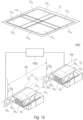
- Fig. 1a shows a schematic perspective view of a 3D multi-aperture imaging device 1000.
- the 3D multi-aperture imaging device 1000 includes an image sensor 12.
- the image sensor 12 includes a plurality of image sensor areas 58 11 - 58 24 .
- Each of the image sensor areas 58 11 - 58 24 includes a plurality of pixels, so that each of the image sensor areas 58 11 - 58 24 is designed to capture a partial image of an overall image.
- the overall image can be understood as an image of an overall visual field 72.
- the 3D multi-aperture imaging device 1000 may include two or more modules 11 or multi-aperture imaging devices 11.
- Each of the multi-aperture imaging devices 11a and 11b can be designed to at least almost completely or completely image the entire field of view and to form a channel of an at least stereoscopic detection system.
- a first channel can be, for example, a "right” channel, while a second channel can be a "left” channel.
- left/right is not intended to have a restrictive effect in this context, but can also be referred to with any other terms, such as top, bottom, middle, front, back or the like.
- the 3D multi-aperture imaging device 1000 includes, for example, a first module 11a with a first plurality of optical channels 16 11 - 16 14 , which are arranged to form an array 14 1 . Furthermore, the 3D multi-aperture imaging device 1000 includes a second module 11b with a second plurality of optical channels 16 21 - 16 24 arranged into a second array 14 2 . Modules 11a and 11b come with a Base distance BA is arranged offset from one another, so that at least stereoscopic information can be derived based on the resulting disparity.
- Each of the optical channels 16 11 - 16 24 is designed to capture a partial field of view 74a - 74d or partial field of view 74a - 74d of an overall field of view 72.
- At least adjacent partial visual fields can overlap with one another, for example the partial visual fields 74a and 74b or the partial visual fields 74b and 74c, but also diagonally adjacent partial visual fields, such as the partial visual fields 74a and 74c or 74b and 74d.
- the overlap can enable a simple calculation of the overall image from partial images in that the overlapping image areas provide information about how the partial images should be put together, for example as part of a stitching process.
- all partial areas 74a - 74d can also overlap with one another.
- the optical channel 16 11 is designed, for example, to image the partial field of view 74a or 74 11 onto the image sensor area 58 11 .
- the optical channel 16 21 is designed, for example, to image the partial field of view 74a or 74 21 onto the image sensor area 58 21 .
- each partial area 74a - 74d is imaged onto two image sensor areas by two optical channels.
- the partial area 74a is shown in such a way that it is imaged completely by the module 11a as a partial field of view 74 11 and completely by the module 11b as a partial field of view 74 21 , it is understood that the partial fields of view 74 11 and 74 21 are not completely identical are, for example based on manufacturing tolerances. However, such effects can be compensated for by calibration or the like and will be ignored below.
- the image sensor areas 58 11 - 58 14 and the optical channels 16 11 - 16 14 can be components of the first imaging module 11a, while the image sensor areas 58 21 - 58 24 and the optical channels 16 21 - 16 24 can be components of the second imaging module 11b.
- Each of the imaging modules 11a and 11b is designed, for example, to capture the overall field of view 72, which means that the 3D multi-aperture imaging device can capture the overall field of view 72 stereoscopically using the modules 11a and 11b.
- the partial visual fields 74 21 - 74 24 detected by the optical channels 16 21 - 16 24 can essentially correspond to the visual fields 74 11 - 74 14 , so that they also correspond to each other overlapping partial visual fields 74 21 - 74 24 essentially or completely overlap with the first partial visual fields 74 11 - 74 14 , which is represented by the designation 74a - 74d.
- the 3D multi-aperture imaging device includes a processor 1002 configured to receive image sensor data 1004 11 - 1004 14 from the first module 11a and image sensor data 1004 21 - 1004 24 from the second module 11b.
- the image sensor data 1004 11 - 1004 24 can, for example, include the signal or sample values of the image sensor areas 58 11 - 58 24 or can also include values derived therefrom, such as a pixel value or a color value.
- the image sensor can be designed as a charge-coupled device (CCD), as a complementary metal oxide semiconductor (CMOS) or as a differently formed image sensor.
- CMOS complementary metal oxide semiconductor
- the image sensor data 1004 11 - 1004 24 can each be the output values of the respective sensor or sub-sensor.
- the image sensor data 1004 11 - 1004 24 have information about the partial fields of view 74 11 - 74 14 and 74 21 - 74 24 mapped to the image sensor areas 58 11 - 58 14 and 58 21 - 58 24 .
- the processor 1002 is designed to provide an output signal 1006 that has a data header 1008 and payload data 1012.
- the data header 1008 includes information regarding the structure of the 3D multi-aperture imaging device 1000.
- the payload data 1012 has image information obtained from the pixels of the image sensor areas 58 11 - 58 14 and 58 21 - 58 24 . This is processed information, which will be explained in detail later.
- the output signal 1006 can therefore be an image signal. Alternatively, it can also be a video signal if several images of the entire field of view are recorded as a video.
- the 3D multi-aperture imaging device 1000 may optionally have an output interface 1014 through which the output signal 1004 can be output.
- the output interface 1014 may be a wireless or wired interface.
- the output interface 1014 may be permanently or temporarily connected to a memory, such as a hard drive or an external storage medium such as a Universal Serial Bus (USB) memory module or a memory card.
- the output interface 1014 may be designed to be wired or wireless Connect to another device, such as a computer or laptop.
- a memory module can also be arranged.
- modules 11a and 11b are shown such that the optical channels 16 11 and 16 21 the partial field of view 74a, the optical channels 16 12 and 16 22 the partial field of view 74b, the optical channels 16 13 and 16 23 the partial field of view 74c and the optical channels 16 14 and 16 24 capture the partial field of view 74d and are arranged in the modules 11a and 11b in the same order along a line extension direction 146 of the arrays 14 1 and 14 2 , the modules 11a and 11b can also be arranged in a different order and / or one have different numbers from each other.
- the optical channel 16 21 can detect a partial field of view 74a - 74d that is different from the optical channel 16 11
- the optical channel 16 22 can detect a partial field of view 74a - 74d that is different from the optical channel 16 12
- the optical channel 16 23 can capture a partial field of view that is different from the optical channel 16 13
- the optical channel 16 24 can capture a partial field of view 74a - 74d that is different from the optical channel 16 14 .
- the partial fields of view 74a - 74d can be imaged such that there is an equal, constant disparity between optical channels directed at the same partial field of view 74a - 74d, as shown in FIG Fig. 1a is described, or that, alternatively, different disparities may be present for different partial visual fields 74a - 74d.
- Fig. 1b shows the 3D multi-aperture imaging device 1000 as it can be used according to exemplary embodiments described here.
- the image sensor 12 can be divided into two components 12 1 and 12 2 , one component 12 1 for the "right" optical channels 16 1 and the other component 12 2 for the "left" channels 16 2 .
- the right and left optical channels 16 1 and 16 2 are in the example of Fig. 1b constructed identically, but arranged laterally offset from one another by the base distance BA in order to obtain as much depth information as possible regarding the scene located in the field of view of the device 1000.
- Each plurality 16 1 and 16 2 of optical channels comprises four optical channels arranged next to one another.
- the individual “right” channels are distinguished by the second subscript.
- the channels are indexed from right to left. That is, the optical channel 16 11 , which is in Fig. 1b is not shown because of a partial removal chosen for the purpose of clarity, is arranged, for example, along the base distance direction 108, along which the left and right channels are arranged offset from one another at the base distance BA, at the extreme right edge, ie furthest away from the majority 16 2 left channels, with the other right channels 16 12 - 16 14 following along the base distance direction 108.
- the channels 16 11 - 16 14 therefore form a single-line array of optical channels, the line extension direction of which corresponds to the base distance direction 108.
- the left channels 16 2 are constructed in the same way. They are also distinguished from each other by the second subscript.
- the left channels 16 21 - 16 24 are arranged next to each other and in the same direction as the right channels 16 11 - 16 14 , namely so that the channel 16 21 is closest to the right channels and the channel 16 24 is furthest away latter.
- Each of the right channels 16 11 - 16 14 includes a corresponding optic, which, as shown in Fig. 1b is indicated, can consist of a lens system. Alternatively, each channel could have a lens.
- Each optical channel 16 11 - 16 14 receives one of overlapping partial fields of view 74a-d or 74 11-14 of the overall field of view 72, which overlap one another, as is the case in connection with Fig. 1a is described.
- the optical channel 16 12 images the partial field of view 74 12 onto an image sensor area 58 12
- the optical channel 16 13 an assigned partial field of view 74 13 onto a corresponding one Fig. 1b non-visible image sensor area 58 13 of the image sensor 12
- the optical channel 16 14 an assigned partial field of view 74 14 on a corresponding image sensor area 58 14 , which is also in Fig. 1b not shown due to obscurity.
- the image sensor areas 58 11 - 58 14 of the image sensor 12 or the component 12 1 of the image sensor 12 are arranged in a plane parallel to the base distance direction BA or parallel to the line extension direction 108, and lens planes of the optics of the optical channels 16 11 - 16 14 parallel.
- the image sensor areas 58 11 - 58 14 are arranged among one another with a lateral inter-channel distance 110, with which the optics of the optical channels 16 11 - 16 14 are also arranged among one another in this direction, so that the optical axes and beam paths of the optical channels 16 11 - 16 14 between the image sensor areas 58 11 - 58 14 and the optics 16 11 - 16 14 run parallel to each other.
- centers of the image sensor areas 58 11 - 58 14 and optical centers of the optics of the optical channels 16 11 - 16 14 are arranged on the respective optical axis, which run perpendicular to the aforementioned common plane of the image sensor areas 58 11 - 58 14 .
- the optical axes or beam paths of the optical channels 16 11 - 16 14 are deflected by a beam deflection device 18 1 and are thus provided with a divergence, which leads to the partial fields of view 74 11 - 74 14 of the optical channels 16 11 - 16 14 mutually facing each other only partially overlap, such as B. so that in pairs the partial visual fields 74 11 - 74 14 overlap at most 50% in the solid angle.
- the beam deflection device 18 1 can, as in Fig. 1b is indicated, for example for each optical channel 16 11 - 16 14 have a reflective facet, which is tilted differently relative to one another under the channels 16 11 - 16 14 .
- a mean inclination of the reflective facets relative to the image sensor plane deflects the overall field of view of the right channels 16 11 - 16 14 in a direction that is, for example, perpendicular to the plane in which the optical axes of the optics of the optical channels 16 11 - 16 14 are in front of or .
- the beam deflection device 18 1 could also use prisms for refractive beam deflection of the individual optical axes or beam paths of the optical channels 16 11 - 16 14 .
- the beam deflection device 18 1 provides the beam paths of the optical channels 16 11 - 16 14 with a divergence such that the channels 16 11 - 16 14 , which are actually arranged next to one another linearly in the direction 108, cover the overall field of view 72 two-dimensionally or in a second direction perpendicular to the line extension direction 108 .
- the beam paths or optical axes could also deviate from the parallelism described, but that the parallelism of the beam paths of the optical channels could still be so pronounced that the partial fields of view that pass through the individual channels 16 11 - 16 14 are covered or imaged onto the respective image sensor areas 58 11 - 58 14 , without further measures, such as beam deflection, would largely overlap, so that in order to cover a larger overall field of view through the multi-aperture imaging device 1000, the beam deflection device 18 also includes the beam paths An additional divergence ensures that the partial visual fields of the channels 16 11 - 16 14 overlap each other less.
- the beam deflection device 18 ensures that the overall field of view is averaged over all azimuthal angles or over all transversal directions Has an opening angle that is greater than 1.5 times the corresponding average opening angle of the partial fields of view of the optical channels 16 11 - 16 14 .
- the left channels 16 21 - 16 24 are now also constructed and positioned relative to the respective assigned image sensor areas 58 21 - 58 24 , which are in the same plane as the optical axes of the channels 16 11 - 16 14 parallel optical axes of the optical channels 16 21 - 16 24 are deflected by a corresponding beam deflection device 18 2 , so that the optical channels 16 21 - 16 24 record the same overall field of view 72 in an almost congruent manner, namely in partial fields of view 74 21 - 74 24 , into which the overall field of view 72 is divided two-dimensionally, which overlap each other, and each of which almost completely overlaps with the corresponding partial field of view 74 11 - 74 14 of a corresponding channel of the right channels 16 11 - 16 14 .
- the image sensor areas 58 11 - 58 24 can, for example, each be formed from an image sensor chip, as is described for the image sensor 12 in FIG. 1a , consist of a few image sensor chips, two or just one common image sensor chip.
- the 3D multi-aperture imaging device includes a processor 1002, which takes over the task of, for example, the images captured during an acquisition by the 3D multi-aperture imaging device 1000 through the right optical channels 16 11 - 16 14 to a first to merge the overall picture.
- the problem that has to be overcome is the following: Due to the inter-channel distances 110 between adjacent channels of the right channels 16 11 - 16 14 , the images that are recorded through the channels 16 11 - 16 14 in the image areas 58 11 - 58 14 are recorded, not simply or translationally moved and placed on top of each other. In other words, they cannot be easily put together.
- Disparity is called the lateral offset along the direction BA, 108 or 110 in the images of the image sensor areas 58 11 - 58 14 when recording the same scene, which correspond to one another but are in different images.
- the disparity of mutually corresponding image content depends in turn on the distance of this image content in the scene, ie the distance of the corresponding object from the device 1000.
- the processor 1002 could now try to evaluate disparities among the images of the image sensor areas 58 11 - 58 14 itself, around these pictures with each other to merge into a first overall picture, namely a “right overall picture”.
- the disadvantage is that the inter-channel distance 110 is present, and thus creates the problem that the inter-channel distance 110 is, on the other hand, also relatively small, so that the depth resolution or estimation is only inaccurate.
- the processor of Fig. 1b therefore uses in the overlap area 114 between the partial fields of view 74 11 and 74 12 to merge disparities in a pair of images, one of which is recorded through one of the left channels 16 21 or 16 22 , the imaged second partial field of view, namely 74 21 or 74 22 , overlapped with the overlap area 114.
- the process 1002 for merging the images of the image sensor areas 58 11 and 58 12 evaluates disparities in images, one of which is captured by one of the image sensor areas 58 21 or 58 22 and another by one of the channels involved in the overlap area 114, ie a Image captured by one of the image sensor areas 58 11 or 58 12 .
- Such a pair then has a base spacing corresponding to the base base spacing BA plus/minus one or none of a channel base spacing 110.
- the latter base spacing is significantly larger than a single channel base spacing 110, which is why the disparities in the overlap area 86 are easier for the processor 1002 to determine.
- the processor 1002 therefore evaluates disparities that arise with an image of the left channels, preferably, but not exclusively, between images from one of the right channels and one of the left channels.
- the processor 1002 takes that part of the partial field of view 74 11 that does not overlap with one of the other partial fields of view of the right channels more or less directly from the image 58 11 and does the same for the non-overlapping areas the partial visual fields 74 12 , 74 13 and 74 14 based on the images of the image sensor areas 58 12 - 58 14 , the images of the image sensor areas 58 11 - 58 14 being recorded simultaneously, for example. Only in the overlap areas of adjacent partial visual fields, such as. B.
- the processor then draws 1002 disparities from image pairs whose overlap in the overall field of view 72 overlaps in the overlap area, but of which in the majority but not exclusively one is recorded through one of the right channels and the other through one of the left channels, such as B. again at the same time.
- the processor 1002 could warp all images of the right channel according to an evaluation of disparities between pairs of images, one of which was acquired through the right channels and the other through the left channels .
- the overall image that is calculated by the processor 1002 for the images of the right channels could be virtually at one point of view not only in the overlapping area of the partial fields of view 74 11 - 74 14 of the right channels, but also in the non-overlapping area.
- warped which lies, for example, laterally in the middle between the right channels 16 11 - 16 14 , in that disparities from image pairs are also evaluated by the processor 1002 for those areas of the partial visual fields 74 11 - 74 14 that do not overlap each other where one image was captured through one of the right channels and another image was captured through one of the left channels.
- the 3D multi-aperture imaging device 1000 from Fig. 1b is not only capable of generating an overall image from the images of the right channels, but the 3D multi-aperture imaging device 140 of Fig. 1b is also able, at least in one operating mode, to generate an overall image of the images of the left channels and/or a depth map in addition to the overall image of the right channels from a recording in addition to the overall image of the first channels.
- the processor 1002 is designed, for example, to merge images that are recorded through the left optical channels 16 21 - 16 24 or the image sensor areas 58 21 - 58 24 into a second overall image, namely an overall image of the left channel, and to use disparities in a pair of images in an overlap area of laterally adjacent partial visual fields 74 21 - 74 24 of the left optical channels, the majority of which but not exclusively one of which is recorded through a right optical channel 16 11 - 16 14 and overlaps with the corresponding overlap area of the pair of partial visual fields 74 21 - 74 24 , and the other is preferably recorded through one of the left optical channels, the partial field of view of which overlaps with the respective overlap area.
- the processor 1002 outputs two overall images for one recording, namely one for the right optical channels and the other for the left optical channels. These two overall images could, for example, be fed separately to a user of the user's two eyes and thus lead to a three-dimensional impression of the recorded scene.
- the processor 1002 generates a depth map in addition to the overall image for the right channels using disparities in pairs of images that have at least one pair for each of the right channels 16 11 - 16 14 that have a Has an image that is recorded through the respective right channel, and another image that is recorded through one of the left channels.
- the depth map is generated by the processor 1002
- the two alternatives can also both be processed by the processor 1002: It could first generate the two overall images, namely one for the right optical channels and the other for the left optical channels, as described above, by merging the images of the right channels in the overlap areas between the images of the right channels, disparities from pairs of images are also used, one of which belongs to the images of the left channels, and when merging the images of the left channels, disparities are also used in the overlap areas between the images of the left channels Pairs of images are used, one of which belongs to the images of the right channels, in order to then generate an overall image with an associated depth map from the overall images obtained in this way, which represent the scene in the overall field of view from different perspectives, such as. B.
- the processor used 1002 then the right and left overall image, as it were as an interim result from the previous fusion of the left and right individual images.
- the processor here evaluated disparities in the two intermediate result overall images in order to obtain the depth map and carry out the warping or warping/merging of it.
- processor 1002 can perform the evaluation of disparities in a pair of images, for example, by cross-correlating image regions.
- the overall visual field 72 is covered differently by the partial visual fields of the left channels on the one hand and by the partial visual fields of the right channels on the other hand, there may also be more or fewer than four channels (regardless of whether they belong to the left or right channels).
- overlap as e.g. B. was also the case with the mutual overlap between the overlap areas of partial visual fields adjacent in the row direction or column direction in the previous examples, where the partial visual fields of the right channels and the partial visual fields of the left channels were each arranged in columns and rows.
- the number of sources of disparity in general is that: N 2 , where N denotes the number of channels with overlapping partial visual fields.
- the processor 1002 optionally carries out, among other things, a channel-by-channel correction of perspective imaging distortions of the respective channel and/or an adjustment of the image brightness both in each channel and between the channels.
- Fig. 1b was in many ways merely exemplary.
- the number of optical channels is not four, but is somehow greater than or equal to 2 or lies between 2 and 10, both inclusive, and the overlap area of the partial visual fields of the right optical channels can, as far as for each partial visual field or each channel, be the pair the largest overlap to the respective partial field of view is considered, in terms of area for all these pairs lie between 1/2 and 1/1000 of an average image size of the images recorded by the image areas 58 11 - 58 14 , measured for example in the image plane, ie the plane of the image sensor areas.
- the number of left optical channels, N L , and right optical channels, NR does not necessarily have to be the same and a division of the total field of view 72 into the partial fields of view of the left channels and the partial fields of view of the right channels is not approximately the same has to be like this Fig. 1b was the case.
- the partial visual fields and their overlap it can be the case, for example, that the partial visual fields extend into one another by at least 20, 100, 500 or 1000 pixels, as long as an image distance or object distance of 10 m is considered, at least for all pairs with the largest overlap, This can apply to the right channels as well as the left channels.
- the left optical channels or the right optical channels could also form a two-dimensional array of optical channels.
- the single-row arrays could have a collinear row extension direction.
- the arrangement of Fig. 1b is, however, advantageous because it results in a minimum overall height perpendicular to the plane in which the optical axes of the optical channels, ie both the right and the left channels, lead before or without beam deflection.
- the image sensor 12 it was already mentioned that it can be formed from one, two or more chips.
- one chip could be provided per image sensor area 58 11 - 58 14 and 58 21 - 58 24 , whereby in the case of several chips, the same can be attached to one or more circuit boards, such as. B. a board for the left channels or the image sensors of the left channels and a board for the image sensors of the right channels.
- Fig. 1b It is therefore possible to place adjacent channels within the channels of the right or left channels as close as possible, with the channel spacing 110 corresponding approximately to the lens diameter in the optimal case. This results in a small channel spacing and therefore a low disparity.
- the right channels on the one hand and the left channels on the other hand can be arranged at any distance BA from one another, so that large disparities can be achieved. Overall, there is the possibility of artifact-reduced or even -free image fusion and the creation of depth maps with a passive optical imaging system.
- Fig. 2 additionally shows that the processor 1002 serves as a basis for merging images that have been captured by a pair of image sensors onto which a pair of optics of the left channels images a pair of immediately adjacent partial visual fields, as is exemplary for the partial visual fields 74 11 and 74 12 is the case, beyond this pair of images there are disparities in one or more of the total 4 2 , ie "two out of four", can use disparity sources, ie pairs of images from image sensor areas that relate to disparities to scene objects in the overlap area between this pair of immediately adjacent partial fields of view.
- disparity sources ie pairs of images from image sensor areas that relate to disparities to scene objects in the overlap area between this pair of immediately adjacent partial fields of view.
- the processor may use one or more of additional sources 2 to 5 for fusion support.
- the processor 1002 also calculates a depth map according to the alternative mentioned above
- the processor can determine the depth map at each point of the field of view 72 from evaluating the disparities of more than one pair of images, one through a right channel and one through a left channel is imaged onto a respective image sensor area and recorded by the latter, namely at points at which another pair overlaps each other beyond the partial field of view of a right channel and the partial field of view of a left channel.
- Fig. 2 This is only the case in the overlap areas of partial visual fields of right channels, which are identical to the overlap areas of partial visual fields of left channels due to the congruence with the partial visual fields of left channels, but in other exemplary embodiments the congruence may not be present.
- the 3D multi-aperture imaging device of Fig. 1a and 1b can, for example, be installed in a flat housing of a mobile device, such as a B. a mobile phone, be installed.
- the plane of the image sensor areas 12 11 - 12 14 and 12 21 - 12 24 as well as any lens plane of the optics of the left and right channels can run parallel to a thickness direction of the flat housing. Due to the beam deflection by the beam deflection device 18 1 or 18 2 , the overall field of view of the 3D multi-aperture imaging device would lie, for example, in front of a front, in which, for example, a screen of the mobile device is positioned, or in front of a back of the mobile device.
- the output signal 1006 has two components, namely the data header 1008 and the payload data 1012, the data header 1008 and the payload data 1012 can also be arranged interleaved with one another or in any order, as long as there is an assignment of the respective ones Content about the data header 1008 or the payload data 1012 is possible. Furthermore, the output signal 1006 can also have other components, such as sequential numbers or checksums.
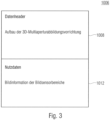
- Fig. 3 shows a schematic view of a structure of the output signal 1006, which has the data header or header 1008 and the payload 1012.
- the data header 1008 includes information regarding the structure of the 3D multi-aperture imaging device.
- the information regarding the structure of the 3D multi-aperture imaging device can take into account a number of structural data, including a number of imaging modules, an assignment of the optical channels to the partial visual fields, a size and / or arrangement of the partial visual fields in the overall visual field or the like.
- the payload data 1012 includes image information of the image sensor areas. These can be, for example, processed or unprocessed image sensor values.
- the image information can, for example, be available continuously for individual pixels or already sorted with respect to the overall image.
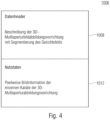
- Fig. 4 shows a schematic view of a structure of the output signal 1006, in which the data header 1008 has the description of the 3D multi-aperture imaging device and information regarding a segmentation of the overall field of view.
- the information from the segmentation of the overall field of view can relate to the first or second partial fields of view of the first or second or a further module of the 3D multi-aperture imaging device.
- the information can, for example, include information about the number of partial visual fields in which the overall visual field is segmented, for example based on which number of optical channels is arranged in the respective imaging module.
- the segmentation can be the same for at least two or all mapping modules, but can also differ from one another for at least two or all mapping modules.
- the at least two imaging modules of the 3D multi-aperture imaging device are constructed the same.
- a single statement regarding the segmentation of the field of view in the data header 1008 may be sufficient, since this information can be transferred to all imaging modules.
- at least a first imaging module is designed differently from a further imaging module, which means that the number and/or arrangement of the partial visual fields in the overall visual field differs.
- the data header 1008 can contain the information regarding the segmentation of the field of view for two, several or even all of the imaging modules of the 3D multi-aperture imaging device.
- the information regarding the segmentation of the overall visual field can therefore relate to a position and/or orientation of a partial visual field in the overall visual field and/or relate to which image sensor area the partial visual field is imaged on.
- the information regarding the structure of the 3D multi-aperture imaging device can relate to the number, the design, the orientation of the Imaging modules in space or distances between the imaging modules in the 3D multi-aperture imaging device, ie, the base distance BA.
- the description of the 3D multi-aperture imaging device may refer to the structure of the 3D multi-aperture imaging device.
- the data header 1008 may contain information about what base spacing the imaging modules have, what number of optical channels are arranged in the array 14 1 and/or 14 2 or what order or orientation they have in space or in the imaging modules. Alternatively or additionally, a position of the imaging modules and/or an orientation of them in space can also be specified. With a comparable design of the imaging modules, a single piece of information regarding this design may be sufficient to describe all imaging modules of the 3D multi-aperture imaging device.
- the processor can be designed to form the output signal such that the data header 1008 has information regarding the base distance BA.
- the payload data includes pixel-by-pixel image information of the individual optical channels of the 3D multi-aperture imaging device.
- the information of the pixels of the image sensor areas of the image sensor can be arranged sequentially one after the other in the payload data 1012 according to a predefined order.
- additional and/or alternative information can be arranged.
- the image information ie the pixel values
- an image format such as JPEG, Blender, IGES or the like, with and without compression can be implemented as the processed form.
- Information relating to a three-dimensional image can be part of the user data 1012, but also a plurality of two-dimensional images from which three-dimensional effects or information can then be derived.
- the processor 1002 is designed according to an exemplary embodiment to form the output signal such that the payload data includes information regarding the compressed image data.
- the processor 1002 may be designed to, for example, sequentially evaluate each image sensor area and thus each partial field of view sequentially and to process the image information obtained from the pixels of the image sensor areas.
- the pixel-by-pixel image information of the useful data 1012 can have a structure in which each partial field of view is described one after the other in a mosaic-like manner.
- a mosaic-like shape can be obtained, for example, by interleaving the partial visual fields 74a-d in the overlap areas 114.
- the processor 1002 is designed to preprocess the image information of the image sensor areas, for example in order to obtain a demosaiced overall image.
- the processor 1002 is designed to form the output signal 1006 so that the payload data 1012 contains information relating to the overall image. For example, each column or each line of the overall image can be reproduced sequentially as pixel-by-pixel image information. In contrast, with the mosaic-like display, each partial image can be displayed in columns or rows.
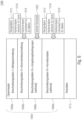
- the Fig. 5a and 5b 10 show a schematic view of a structure of the output signal 1006, which is formed by the processor 1002 by taking into account a variety of information sources. They are there Fig. 5a and 5b to be understood as a figure, that means that the in Fig. 5b shown section of the data header 1008 part of the in Fig. 5a data header shown is 1008 and that the in Fig. 5b
- the useful data 1012 shown are also part of the output signal 1006, like those in the Fig. 5a shown parts of the data header 1008.
- components 1008a, 1008b, 1008c and 1008d are shown as separate blocks of information, information contained in the data header 1008 can have any structure with one another.
- the segmentation shown is for illustrative purposes only and is not intended to have a restrictive effect.
- the processor 1002 may be configured to form the output signal 1006 such that the data header includes information regarding the number of imaging modules 11.
- the imaging modules can be designed to completely capture the entire field of vision, which means that the information regarding the number of imaging modules can be equated to a number of total images of the entire field of vision.
- the data header has information about which Number of optical channels per imaging module 11 is arranged.
- the data header 1008 may have information about which number of pixels are arranged along a first and/or second image axis for example, can be described as horizontal and vertical.
- the information can relate to the number of pixels recorded per partial image, i.e. image sensor area, and/or the overall image or pixels arranged in the overall image.
- the processor can be designed to form the output signal 1006 such that the payload data contains information regarding the image sensor areas 58, for example regarding a number of pixels along a row and/or column or a geometric extent of the image sensor areas 58.
- the respective information can be identical for all imaging modules 11 and/or for the optical channels, i.e. the partial images, so that the presence of the information regarding all imaging modules and/or partial images leads to a sufficient description.
- individual information can also be arranged individually for each imaging module or partial image in the data header 1008.
- This foregoing description of the A) number of modules, B) number of channels per module, and C) number of pixels along the image axes and/or the base spacing may be arranged as a meta-description regarding the structure of the 3D multi-aperture imaging device 1000 and is as element 1008a of the Data header 1008 marked.
- the information can be inserted individually and in any combination with one another by the processor, for example a specification of a model number or the like of an imaging module or 3D multi-apeture imaging device can provide similar information if the implementation of the module or device is thereby encoded.
- the processor 1002 is designed to add information to the output signal 1006 about which optical channel looks into which section of the overall field of view and/or what distance the optical channels are from one another. This can be particularly advantageous for the individual partial images in the output signal 1006.
- a geometry description that can be inserted by the processor 1002 into the data header 1008 of the output signal 1006 is identified as element 1008b of the data header 1008.
- the geometry description can relate to D) a pixel size of the pixels of the image sensor areas 58 of the image sensor 12.
- the pixels have identical or comparable sizes.
- the pixel size can therefore be specified globally for all pixels.
- the total number of pixels of the image sensor areas 58 have different sizes from one another.
- the pixel size can be changed for each different version of the Pixels and for assigning the size to the respective pixels can be arranged in the element 1008b.
- the processor 1002 can be designed to form the output signal 1006 such that the data header 1008 has information regarding a number of pixels for a first image extension direction and a number of pixels for a second image extension direction at least for one of the image sensor areas 58 can.
- This can, for example, be the extension directions along which the partial visual fields extend in space.
- the first and second directions may be perpendicular to each other and correspond to a number of rows or columns.
- the processor 1002 can be designed to E) insert two-dimensional (X/Y) or three-dimensional (X/Y/Z) coordinates for one, several or each optical channel of each module 11 or at least insert a relative positioning to one another.
- the coordinates can therefore be local coordinates of an arrangement of the optical channels 16 with respect to other optical channels and/or global coordinates, i.e. H. an arrangement of the optical channels within the 3D multi-aperture imaging device. In both cases, an arrangement of the optical channels 16 in the module 11 and/or in the 3D multi-aperture imaging device 1000 can be described.
- the processor 1002 can be designed to form the output signal 1006 such that the data header 1008 for at least one of the optical channels 16 has information regarding a spatial coordinate of the at least one optical channel 16 in the 3D multi-aperture imaging device 1000.
- the output signal 1006 can be formed in such a way that it contains information about a geometric arrangement of the optical channels.
- the element 1008b of the data header 1008 can further be formed by the processor 1002 in such a way that it includes information F) regarding a field angle range of at least one optical channel or also the imaging module.
- the field angle range can be specified as an interval along one, preferably along two image directions. This can also be referred to as "ranging from ising to ..""or viewing direction ⁇ xy".
- the field angle range can be specified by a central direction of the module 11 or the optical channel 16 and can be supplemented by an extension of the field angle range along at least one, preferably two, image axes.
- the data header 1008 may additionally include an optional element 1008c that includes information G) about environmental conditions of the 3D multi-aperture imaging device 1000.
- an optional element 1008c that includes information G) about environmental conditions of the 3D multi-aperture imaging device 1000.
- a pressure of an atmosphere or environment surrounding the 3D multi-aperture imaging device, an ambient temperature of the 3D multi-aperture imaging device, an operating temperature of the 3D multi-aperture imaging device, a time of image capture or generation of the output signal 1006 and / or a position of the 3D multi-aperture imaging device in the Data header 1008 must be inserted.
- the location can be determined, for example, using a positioning system such as GPS, Galileo or Glonass or provided by an external data source such as a sensor.
- the processor may be designed to form the data header 1008 such that it includes information about an orientation or viewing direction of the at least one optical channel, a module and/or the 3D multiperture imaging device.
- the processor can be designed to form the data header 1008 such that the element 1008c has camera-specific information regarding at least one autofocus drive.
- the at least one autofocus drive can, for example, have been used to focus the captured image.
- the camera-specific information can include information about focusing of the image information or user data. This can be a focusing system used jointly for all modules, ie an autofocus drive, for module-specific focusing, ie at least two autofocus drives, or channel-specific focusing, ie having a large number of autofocus drives.
- the information can be the indication of a global or relative position of an element of the autofocus drive and/or a controlled variable, such as a current variable or a voltage variable for controlling the autofocus drive. The global or relative position can be reconstructed from the controlled variable so that conclusions can be drawn about the focusing.
- the data header 1008 of the output signal 1006 may also be as described in FIG Fig. 5b is shown, an optional element 1008d having information regarding possible corrections.
- the element 1008d and thus the data header 1008 can contain information regarding an H) indication of at least one optical channel of the 3D multi-aperture imaging device, regarding an I) vignetting, i.e. H. a shading of the overall image or partial image towards the edge of the image, and / or information about J) defective pixels on the image sensor or the image sensor areas 58.
- H indication of at least one optical channel of the 3D multi-aperture imaging device
- I) vignetting i.e. H. a shading of the overall image or partial image towards the edge of the image
- J defective pixels on the image sensor or the image sensor areas 58.
- Each of the information H), I) and J) can also be used later to correct the image .
- the payload 1012 can, as is the case in connection with the Fig. 4 is described by K), include pixel-by-pixel image data.
- identifying information relating to the pixels can be continuously specified, for example, according to option a), color information.
- color information Based on an image sensor used, for example an assignment of four color values per pixel according to a red-green-green-blue scheme, for example according to a Bayer filter or according to a red-green-blue-white arrangement or the like.
- the respective color information and/or brightness information can be arranged continuously for continuous pixels in the payload data 1012.
- the color information can also be arranged by the processor 1002 following another, reconstructable scheme.
- the image data can also have pixel-by-pixel depth data, have information about a segmentation of pixels into pixel clusters and/or have information about depth information and/or distance information regarding pixel clusters.
- the image data in the payload data can be arranged in a cluster-wise manner and the depth data or the cluster information can be arranged accordingly in the data header.
- the pixel values can optionally be arranged continuously without separating information, wrapping information or intermediate information, for example if the size of each image can be derived from the header data, for example by information C).
- a start/stop character string can be arranged between the pixel values or between some pixel values.
- the start/stop string may include at least one bit and indicate that a new portion of the image begins, such as a new field, a new column of images, or a new line of images. This means that the payload contains information regarding a line break or a column break of the captured image. This can be advantageous if the aforementioned information C) is absent in the header data.
- information can be inserted in the header data for each group of pixels, which enables an identification of the imaging module 11 and the optical channel 16, that is to say an assignment of the pixels to the module 11 and the optical channel 16, as it is is indicated by option L)c).
- the image data is arranged as M)a) raw data (RAW) and/or as M)b) compressed image data and/or as M)c) demosaiced image data in the payload data 1012.
- the image data can have pixel-by-pixel depth data, have information about a segmentation of pixels into pixel clusters and/or have information about depth information and/or distance information regarding pixel clusters.
- Fig. 6 shows a schematic overview of the output signal 1006, which may have the elements 1008a - 1008d of the data header 1008.
- design data 1015 of the 3D multi-aperture imaging device (3D-MAAV) can be taken into account by the processor 1002. This can include, for example, the pixel size D).
- calibration data 1016 can also be used by the processor 1002, for example by the processor 1002 reading it from a data memory.
- the calibration data for example the field angle range F) can be the same across a series of multi-aperture imaging devices of the same or identical design.
- individual calibration data 1018 from the processor 1002 may also be used, such as calibration data that is unique to the 3D multi-aperture imaging device, such as the actual coordinates E) of the optical channels in the 3D multi-aperture imaging device. For example, manufacturing tolerances can be compensated for.
- design data 1015' can be utilized by the processor 1002 in such a way that the distortion H) of the optical channels and/or the vignetting I) are taken into account.
- this data or information H) and/or I) can also be used as calibration data 1016', which is identical for the series of 3D multi-aperture imaging devices.
- calibration data 1018' can be used by the processor 1002 are, for example, by measuring the pixels in order to detect the defective pixels J) and to take this into account in the useful data and/or in the correction data 1008d.
- the output signal 1006 can, for example, be stored as a file or data block in a memory or transmitted as a signal.
- a number of optical channels per image, a number of modules and/or a number of horizontal and vertical pixels per partial image can be specified globally for all modules 11 in the data header 1008.
- the number of modules can be a number of quasi-redundant images, which represents a multiplicity of views.
- a stereo recording can be obtained with a number of two modules, a triplet recording with a number of modules and a Quattro recording with a number of four modules.
- several, i.e. H. more than four imaging modules or multi-aperture imaging devices can be arranged.
- the 3D multi-aperture imaging device has three multi-aperture imaging devices, i.e. H. Modules, it comprises, for example, a third plurality of optical channels for imaging mutually overlapping third partial visual fields of the overall visual field with the first partial visual fields onto third image sensor areas of the image sensor, the first and second plurality of optical channels being laterally separated from one another by a basic distance are arranged offset.
- the processor is designed to receive image sensor data from the image sensor, which has information about the third partial fields of view imaged on the third plurality of image sensor areas, and is designed to provide the output signal such that the useful data from the pixels of the first image sensor areas, the second Image sensor areas and the third image sensor areas have image information obtained.
- the information in the data header can relate to a structure or arrangement of the three modules. Alternatively, as already described, a larger number of modules is possible.
- a number of modules for at least two modules 11 or for each module 11 a number of optical channels per image and/or a number of pixels horizontally and vertically per partial image can also be specified, for example if the modules are different from one another.
- Individual and global information regarding the modules can also be arranged together in the output signal 1006, which can lead to redundant information reproduction.
- the geometry data 1008b of the channel arrangement can refer to a number and/or designation of the module, to a number and/or designation of the optical channel in the respective module 11, to a two-dimensional or three-dimensional coordinate of the channel or module and/or to an angular orientation at least of an optical channel in the 3D multi-aperture imaging device.
- the geometry data may be derived and/or provided based on knowledge of the design data, such as in a memory. Alternatively, the geometry data can also be determined by a measurement, which can lead to at least partial compensation of manufacturing tolerances.
- the geometry data can also be dependent on external influencing variables such as temperature and pressure. Knowledge of these sizes during further image processing or image reconstruction enables a correspondingly adapted correction to be carried out.
- camera information such as a manufacturer, a model, an aperture number, an exposure time, an ISO value, a light value, a focal length, flash usage and/or flash strength
- the camera information can contain information about position data or information about a controlled variable (control current, control voltage) of the autofocus drives.
- the geometry data 1008b can further specify a field angle range and/or a central field or viewing direction as well as an extent (horizontal/vertical) of the field angle along the image axes on a channel-by-channel basis, i.e. for each optical channel.
- the field angle data can be design data.
- the field angle data can also be measured in the course of a calibration, whereby the calibration can be determined on the specific structure or can correspond to typical values that are determined on a representative specimen.
- additional parameters such as pressure and temperature can be included to select or calculate the data set, whereby the data sets can be obtained from design data or from calibration, whereby the calibration can be determined on the specific structure and corresponds to typical values that can be obtained on a representative specimen were determined.
- the geometry data 1008b can alternatively or additionally have a number of rows and/or columns per optical channel, also globally or individually per channel. Alternatively or additionally, information regarding the pixel size may be inserted by the processor 1002.
- Element 1008d may include additional environmental conditions such as pressure, temperature, time, or location. Such information can be obtained by connecting the processor 1002 to external sensors in the Fig. 6 Sensor data 1022 shown are received from the processor 1002.
- the optional element 1008d may contain correction data for the optics.
- design data relating to the optical and/or perspective (Keystone) distortion can be accessed by the processor 1002 and processed by the processor 1002.
- measured data from a calibration can be processed, whereby the calibration can be determined on the specific structure or can correspond to typical values that were determined on a representative example of a 3D multi-aperture imaging device.
- vignetting I it can be global or channel-specific design data or calibration data, as explained above.
- information J) regarding defective pixels can be arranged on the image sensor 12.
- the payload 12 i.e. the payload
- the image data can be arranged as RAW, as compressed or packed image data, such as JPEG or the like, and/or as a demosaiced image in the payload data 1012.
- Different files containing geometry data, correction data and payload can also be generated by the processor 1002, that is, the output signal 1006 can be generated in a disjointed manner.
- the output signal 1006 can also be generated so that a separate payload file is output by the processor 1002 for each optical channel.
- the channel-wise or cluster-wise depth information can also be inserted into the data header 1008 by the processor 1002 in the form of geometry data.
- Fig. 7 shows a schematic view of a multi-aperture imaging device 2000 according to a second aspect of the exemplary embodiments described herein, which can be arranged, for example, as an imaging module 11 in the 3D multi-aperture imaging device 1000.
- the multi-aperture imaging device 2000 is designed to image the partial fields of view 74a - 74d onto the image sensor 12 by means of the optical channels 16a - 16d, each of which has at least one optic or lens 64a - 64d.
- the array 14 is arranged, for example, along the line extension direction 146.
- the optical channels 16a - 16d are thus arranged in a one-dimensional array 14, which means that the optical channels 16a - 16d are arranged in a single row, for example.
- the overall field of view 72 can extend in space along a first image direction 142 and along a second image direction 144, whereby the directions 142 and 144 can be perpendicular to one another.
- the partial fields of view 74a - 74d can be arranged next to one another and overlapping one another along the direction 142, so that an extension of the image along the direction 144 is determined by the number of pixels and / or by the field angle of the optical channels 16a - 16d along the direction 144 and the Expansion of the image along the direction 142 is influenced or determined by the number of pixels and the field angle of the optical channels 16a - 16a along the direction 142 and additionally by the number of partial fields of view 74a - 74d and by the overlap factors.
- the plurality of optical channels 16a - 16d form the one-dimensional array 14, which is arranged in space along the direction 144 and 146, while the partial fields of view 74a - 74d of the overall field of view also form a one-dimensional array, which is vertical along the direction 142 to the direction 144 is arranged.
- the multi-aperture imaging device 2000 can thus have the feature that a conversion takes place between an arrangement direction of the array 14 and an arrangement of the corresponding partial visual fields 74a - 74d in space. This can be done, for example, by a respective viewing direction of the optical channels 16a - 16d.
- the multi-aperture imaging device 2000 can have a beam deflection device, not shown, which carries out such a deflection.
- the multi-aperture imaging device 2000 can advantageously be arranged in systems in which images are essentially captured that have a significantly greater extent along a first image direction 142 compared to a second image direction 144.
- This can apply, for example, to camera systems in vehicles that track the vehicle's route along a horizontal direction capture.
- the direction 142 can be a horizontal direction, for example.
- the optical channels 16a-16d may be arranged along a vertical direction in the vehicle. It is understood that the directions 142 and 146 are interchangeable, which means that the horizontal and vertical information should not have a restrictive effect.
- the multi-aperture imaging device 2000 can be arranged in at least two versions as modules 11a and 11b in the 3D multi-aperture imaging device 1000. Deviating from the illustration, the 3D multi-aperture device may have fewer or more than 4 channels, but at least two.
- Fig. 8 shows a schematic block diagram of a device 3000 for processing the output signal 1006.
- the device 3000 may have a wireless or wired interface 1023 for receiving the output signal 1006.
- the signal 1006 is therefore referred to as the input signal for the device 3000.
- the device 3000 includes a processor 1024 for processing the payload data 1012 of the input signal 1006, taking into account the information regarding the structure of the 3D multi-aperture imaging device 1000 for at least first image sensor information of a partial field of view 74 11 - 74 24 of the first module 11a and a partial field of view 74 21 - 74 24 the second module 11b. Additionally, processor 1024 may be configured to process other or additional information from data header 1008.
- a function that can be implemented by the processor 1024 is, for example, a subsequent change in focus of varying areas in the image data that are contained in the payload data 1012 of the input signal 1006.
- the device 3000 can be designed to output an image signal 1026 that enables the post-processed image data to be displayed.
- the signal 1026 can be displayed on an optional monitor 1028 or display 1028.
- the signal 1026 can also be transmitted wired or wirelessly, for example to another device.
- the other device may be another processing device or a storage element.
- the device 3000 may be configured to process the output signal even if it indicates that a number of modules greater than two were used to capture the entire field of view.
- the recorded image data of the 3D multi-aperture imaging device 1000 can thus be stored in a format that enables the calculation of three-dimensional object data and the subsequent, i.e. after the actual image recording, object distance-dependent definition of the areas to be focused.
- the data format can consist of or at least have a header and a payload area. Descriptive data of the image-capturing multi-aperture imaging system and possibly additional sensor data can be listed in the header area, whereas essentially the pixel-by-pixel image data can be listed in the payload area.
- Multi-aperture imaging systems obtained in this way can have a linear channel arrangement, i.e. H. have optical channels arranged in a single row and have a small or even minimal size.
- the aspects described above enable customizable three-dimensional image capture and display.
- the depth of field range can be determined subsequently.
- multi-aperture imaging devices and 3D multi-aperture imaging devices each of which can be combined as additional features with the features of the 3D multi-aperture imaging device 1000.
- Fig. 9a shows a schematic side sectional view of a device 10 according to an exemplary embodiment in a first operating state.
- the device 10 may be a mobile or immobile device, such as a cell phone, a smartphone, a mobile computer such as a tablet computer, and/or a mobile music player.
- the device 10 comprises a multi-aperture imaging device 11, which has an image sensor 12, an array 14 of optical channels 16 arranged next to one another and a beam deflection device 18.
- the beam deflecting device 18 is designed to deflect a beam path 17 of the optical channels 16 and will be described in detail later.
- the device 10 comprises a housing 22 which has outer surfaces 23 which enclose a housing volume 24.
- This means that the housing volume 24 can include an internal volume of the housing 22 and the volume of the housing 22.
- the housing volume also includes a volume that is claimed by the housing walls and is thus enclosed by the outer surfaces 23 of the housing.
- the housing 22 can be transparent or opaque and can include, for example, plastic materials and/or metal materials.
- the beam deflection device 18 has a first position within the housing volume 24.
- the housing 22 and/or components arranged in the housing 22 can block the beam path 17 of the optical channels 16 after deflection by the beam deflection device 18, so that a field of view 26 arranged outside the housing 22 should not be captured or only to a limited extent with the multi-aperture imaging device 11 is detectable.
- the components can be, for example, a battery, circuit boards, non-transparent areas of the housing 22 or the like. In other words, another, possibly non-optical component can be arranged on a housing instead of a previous camera lens.
- the housing 22 may have an opening 28 through which the housing volume 24 is connected to an outer volume 25 of the housing 22.
- the opening 28 can temporarily be completely or partially closed by a cover 32.
- the first operating state of the device 10 can be an inactive operating state of the multi-aperture imaging device 11, in which the optical channels 16 are, for example, directed to the inside of the housing 22 or are not deflected.
- the overall height of the structure of the multi-aperture imaging device is at least partially determined by the diameter of optics of the optical channels 16 (lenses).
- the extent of the mirrors (beam deflecting device) in this thickness direction is equal to the extent of the lenses in this direction.
- the beam path of the optical channel 16 passes through the mirror 18 circumcised. This leads to a reduction in image brightness, although this reduction depends on the field angle.
- the present exemplary embodiments solve this problem by moving parts or the entire multi-channel camera structure, so that in the operating state of the camera, parts of the structure can be moved over the housing, for example.
- a smartphone stands out compared to the state of not using the camera. The movement of the parts, such as B.
- the beam deflection device can be rotary (folding out or unfolding), translational (extending) or a mixed form.
- the additional movements of parts or the entire system enable, similar to well-known zoom lenses on compact cameras, a minimal design when the cameras are not in use mode and a larger design that is optimized for the implementation of the technical function when the camera is in use mode.
- Fig. 9b shows a schematic side sectional view of the device 10 in a second operating state.
- the beam deflection device 18 has a second position outside the housing volume 24. This allows the beam deflection device 18 to deflect the beam paths 17 of the optical channels 16 outside the housing volume 24 and the field of view 26 outside the housing 22 to be detectable by the multi-aperture imaging device 11.
- the cover 32 can be made from the in Figure 1a shown position, so that the beam deflection device 18 can be moved out of the housing volume 24 through the opening 28 of the housing 22.
- the beam deflection device 18 can be moved translationally and/or rotationally between the first position and the second position. It is advantageous that the components within the housing 22 and/or the housing 22 do not block the deflected beam path 17 of the optical channels 16.
- the multi-aperture imaging device 11 may be arranged in a camera housing, which in turn is at least partially arranged in the housing 22.
- the camera housing can, for example, be at least partially supported by a traversing carriage, as in connection with Fig. 13 is described, be formed. This differs from a concept in which a single-channel camera is oriented in different directions using a folding mechanism, in that in this case rotation or tilting of an image sensor and/or the imaging optics can be avoided.
- An overall field of view can be detected by means of the device 10 in such a way that the beam deflecting device is moved from the first position to the second position, in which the beam deflecting device is at least partially outside a housing volume is placed. If the beam deflecting device has the second position, the entire field of view can be captured with the array of optical channels of the multi-aperture imaging device arranged next to one another, the beam paths of which are deflected by the beam deflecting device.
- Fig. 10a shows a schematic side sectional view of a device 20 according to a further exemplary embodiment in a first operating state.
- the device 20 has the cover 23, which is rotatably mounted on the housing 22, for example via a connecting element 34a and/or via an optional connecting element 34b.
- the connecting element 34a and/or 34b can be designed to enable tilting and therefore a rotational movement between the cover 23 of the beam deflection device 18 relative to the housing 22 and, for example, be formed as a hinge or roller bearing.
- the beam deflecting device 18 can form a cover of the housing or be a part thereof. One of the beam-deflecting surfaces of the beam deflecting device 18 may be an outer edge of the housing.
- the beam deflection device 18 has a first position and partially or completely closes the housing 22.
- the beam deflection device 18 can have a reflective area for deflecting the beam path 17 and have contact areas that are designed to form mechanical contact with the housing 22 in the first position. To put it simply, the camera may not be visible or barely visible when not in use.
- Fig. 10b shows a schematic side sectional view of the device 20 in a second operating state.
- the beam deflection device 18 can be moved in rotation relative to the housing 22, ie, folded out, so that the housing volume 24 is opened.
- the rotational tilting enables an inclined or tilted orientation of the beam deflection device 18 relative to a course of the beam path 17 of the optical channels 16 between the image sensor 12 and the beam deflection device 18, so that the beam path 17 is deflected in a first direction 19a at the beam deflection device 18.
- Fig. 10c shows a schematic side sectional view of the device 20 in a third position.
- the device 20 can have the second operating state.
- the beam deflection device 18 can deflect the beam path 17 of the optical channels 16 in a different direction 19b, so that a different field of vision or a field of vision positioned at a different location can be detected.
- it can be a first side and an opposite side, such as front and back, left and right or top and bottom of the device 20 and/or a user, into which the beam path 17 is deflected.
- the connecting elements 34a and 34b can, for example, be connected to a frame structure and the beam deflection device 18, so that the beam deflection device 18 can alternately have the second or third position. Due to a switchable viewing direction of the multi-aperture imaging device, previous solutions, particularly in smartphones, can be replaced by one structure using two cameras with a forward and rear viewing direction.
- Fig. 11a shows a schematic side sectional view of a device 30 according to a further exemplary embodiment in the first operating state.
- the device 30 has an at least partially transparent cover 36, which is arranged between an outer edge 23 of the housing 22 and the multi-aperture imaging device 11.
- the at least partially transparent cover is connected to the beam deflector 18 and is designed to move based on a movement of the beam deflector 18.
- the at least partially transparent cover 36 can have, for example, polymer and/or glass materials.
- Devices may be provided which enable the optics to be encapsulated to protect against contamination with the possibility of changing the encapsulated volume (movable cover glasses).
- Fig. 11b shows a schematic side sectional view of the device 30 in the second operating state.
- the at least partially transparent cover is at least partially moved out of the housing volume 24. This can be done by rotating the beam deflecting device around the connecting element 34.
- the beam deflection device 18 is designed to deflect the beam path 17 of the optical channels 16 so that the optical channels run through the at least partially transparent cover.
- the cover 36 is designed to reduce or prevent entry of particles, dirt and/or moisture into the housing volume 24.
- the cover 36 can be designed to be transparent to the beam paths 17 and/or partially opaque.
- the cover 36 can be electromagnetic for certain wavelength ranges Radiation be opaque.
- the advantage of the cover 36 is that due to the reduced amount of particles, dirt and/or moisture, a long operating time of the device and/or a permanently high image quality can be obtained, since contamination of the optics of the optical channels is low.
- Fig. 11c shows a schematic side sectional view of the device 30, in which the beam deflection device 18 with an optional actuator 38 translates along a direction y perpendicular to a direction x of the beam path 17 between the image sensor 12 and the optical channels 16 and perpendicular to a direction z perpendicular to a line extension direction the array of optical channels 16 is movable.
- the beam deflecting device 18 can also be moved translationally based on the rotational movement around the connecting element 34, for example via a guide, a lever or the like.
- the unfolding (rotational movement) can be done manually or using an actuator.
- the optional actuator 38 can be arranged on the beam deflection device 18. Alternatively, the actuator 38 can be arranged between the housing 22 and the beam deflecting device 18.
- the actuator 38 can be arranged, for example, between the housing 22 and the connecting element 34a and/or between the connecting element 34a and the beam deflecting device 18.
- the advantage of this is that the translational movement of the beam deflection device along the x-direction of the housing means that shading of the field of view to be captured by the housing 22 can be reduced.
- Fig. 12a shows a schematic side sectional view of a device 40 according to an exemplary embodiment in the first operating state.
- the beam deflector 18 is arranged in the first position within the housing volume of the housing 22 and is designed to be moved from the first position to the second position based on a translational movement 42, which is shown schematically in Fig. 12b is shown.
- the housing can have the cover 32, which closes the housing 22 or an opening therein in the first operating state.
- the beam deflecting device 18 In the first operating state, the beam deflecting device 18 can be oriented such that it has a minimum extension perpendicular to a direction x, which is defined by the optical beam path within the housing 22.
- Fig. 12b shows a schematic side sectional view of the device 40 in the second operating state.
- the beam deflection device is moved out of the housing volume 24 based on the translational movement 42, for example along the x-direction.
- the beam deflection device 18 can be moved through the opening 28.
- the beam deflection device 18 can be rotatably movable about a rotation axis 44.
- the beam deflection device 18 can carry out a rotational movement about the rotation axis 44.
- An angular orientation of the beam deflection unit can be compared to the first operating state Fig. 12a be changed so that the area of the beam deflection device used by the beam path of the multi-aperture imaging device increases compared to the first operating state.
- a rotational movement 46 about the axis of rotation 44 enables a variable inclination of the beam deflection device 18 relative to the beam path 17 between the optical channels 16 and the beam deflection device 18 and thus a variable direction in which the beam path 17 of the optical channels 16 is deflected.
- the optical channels 16 can have optics 64a-b.
- optics 64a-b of the optical channels 16 and/or the image sensor 12 can be arranged outside the housing volume 24 in the second operating state.
- the optics 64a-b of the optical channels 16 and/or the image sensor 12 can be moved along with the beam deflection device 18.
- multi-aperture cameras with a linear channel arrangement include several optical channels that are arranged next to one another and each transmit parts of the overall field of view.
- a mirror is advantageously attached in front of the imaging lenses, which can be used to deflect the beam and contributes to reducing the overall height.
- a mirror adapted to each channel such as a facet mirror, where the facets are flat or arbitrarily curved or provided with a free-form surface, it is advantageously possible for the imaging optics of the optical channels to be constructed essentially identically, whereas the viewing direction of the channels is determined by the individual facets of the mirror array are specified.
- a surface of the beam deflection device is mirrored at least on the reflective facets assigned to the optical channels.
- the imaging optics of the channels are designed differently, so that different viewing directions result from the angle of the mirror facet and the design of the respective optical channel. It is also possible for several channels to use the same area of the beam deflection device and therefore the number of facets is smaller than that of the channels.
- the deflection mirror can be rotatably mounted, with the axis of rotation running, for example, parallel to the direction of extension of the channels.
- the deflection mirror can be reflective on both sides, whereby metallic or dielectric layers (sequences) can be used.
- the rotation of the mirror can be analog or bistable or multi-stable.
- the beam deflection device can be movable between at least a first position and a second position, with the beam paths being deflected in directions different from one another in each position. Similar to the positions of the beam deflection device 18 in the Fig. 10a-c As described, the beam deflection device can also be moved about an axis of rotation. In addition to the translational movement of the housing cover 32 and the beam deflection device 18, parts or all additional components of the multi-aperture imaging device can be moved translationally in the same direction, with the same or different adjustment paths being possible.
- Fig. 13a shows a schematic side sectional view of a device 50 in which the cover 32 is arranged to be rotatably movable via a movement element 34 on a housing side 22b of the housing 22.
- the beam deflection device 18 can be mechanically connected to a travel carriage 47.
- the travel carriage 47 can be understood as a mechanical transport device for moving at least the beam deflection device 18.
- the device 50 can include an actuator 33, which is designed to move the carriage 47 translationally.
- the actuator can include any drive, such as a stepper motor, a piezoelectric drive or a moving coil drive.
- the device 50 may include an actuator 33′ that is designed to release a mechanical lock 35 that locks the cover 32 and the housing on at least one housing side 22a.
- the beam deflection device or the travel carriage 47 can be moved out of the housing by means of a spring force when the lock 33 'is released.
- the lock 35 can be designed to hold the beam deflecting device 18 in the first position.
- the carriage 47 can also be arranged in the device 40. This means that the travel carriage 47 can also be used when the cover 32 moves in a translational manner.
- Fig. 13b shows a schematic side sectional view of the device 50 in which the traversing carriage 47 is moved along the translational direction of movement 42, so that the beam deflection device 18 is moved out of the housing volume 24.
- the image sensor 12 and/or optics of the optical channels 16 can also be mechanically connected to the travel carriage 47 and can be moved along with the beam deflection device 18 to the same extent.
- the image sensor 12 and/or the optics of the optical channels 16 can be moved to a smaller extent than the beam deflection device 18, so that a distance between the image sensor 12, the optics and / or beam deflection device 18 is increased during an extension.
- the image sensor 12 and/or the optics of the optical channels can be arranged stationary with respect to the housing, so that only the beam deflection device 18 is moved by means of the travel carriage 47.
- An increasing distance between the image sensor 12, the optics and/or beam deflection device 18 during extension enables a small distance between the components in the first operating state, so that the multi-aperture imaging device can be accommodated in the housing 22 with a small space requirement.
- Fig. 13c shows a schematic side sectional view of the device 50 in the second operating state.
- the beam deflection device can be rotatably mounted in order to carry out the rotational movement 46, as is described, for example, for the device 40. How it relates to Fig. 12b is described, the angular orientation of the beam deflection device 18 can be compared to the first operating state Fig. 13a or the state in Fig. 13b be changed so that the area of the beam deflection unit used by the beam path of the multi-aperture imaging device increases compared to the first operating state.
- a side of the beam deflection device 18 facing the optical channels 16 or the image sensor 12 can have a dimension B perpendicular to the translational direction of movement 42, for example along the y-direction, which is larger than a dimension A of the image sensor 12 or the optical Channels 16 along this direction.
- the dimension B is, for example, perpendicular to a line extension direction of the array and parallel to a surface of an image sensor on which the optical channels impinge. This can result in a high level of light being deflectable by the steel deflection device 18 and a brightness of an image to be captured being high.
- the extent or dimension B is smaller than in the position shown in Fig. 13c position shown or a position in which the beam deflection device 18 directs the beam path in a different viewing direction.
- Fig. 14a shows a schematic side sectional view of a device 60 according to an exemplary embodiment in the first operating state.
- the beam deflection device 18 has the first position.
- the device 50 has at least partially transparent covers 36a and 36b, which are connected to the cover 32 and can be moved with it along the translational direction of movement 42 .
- the at least partially transparent covers 36a and 36b can each be arranged on different sides of the beam deflection device 18 between the same and the housing 22.
- the covers 36a and 36b In the first operating state, the covers 36a and 36b can be arranged partially or completely within the housing volume 24.
- the covers 36a and 36b can, for example, be attached to the one in the Fig. 13a-c shown traversing carriage 47 arranged or transparent areas of the traversing carriage 47.
- Fig. 14b shows a schematic side sectional view of the device 60, in which the beam deflection device 18 has an intermediate position between the first position and the second position.
- the intermediate position of the beam deflection device can be maintained during a retraction or extension of the beam deflection device 18 into the housing volume 24 or out of the housing volume 24.
- the beam deflection device 18 is partially moved out of the housing volume 24.
- Fig. 14c shows a schematic side sectional view of the device 60, in which the beam deflection device 18 has the second position, that is, the beam deflection device 18 is, for example, completely moved out of the housing volume 24.
- the at least partially transparent covers 36a and 36b have a distance 48 from one another that is smaller than a comparable distance between side surfaces of the housing 22a and 22b.
- Fig. 14d shows a schematic side sectional view of the device 60, in which a distance between the at least partially transparent covers 36a and 36b compared to the Fig. 14a-c is enlarged.
- the at least partially transparent covers 36a and/or 36b can be movable along a translational movement direction 52a or 52b facing away from the other at least partially transparent cover 36a or 36b, for example along a positive or negative y-direction.
- the illustrated state of the at least partially transparent covers 36a and 36b can be understood as a retracted or folded state.
- the state shown can be understood as an extended or unfolded state, in which a distance 48 'between the at least partially transparent covers 36a and 36b is changed, for example increased, compared to the distance 48.
- the distance 48 'can for example, be greater than or equal to the distance between the comparable sides of the housing 22.
- the beam deflecting device 18 is designed to deflect the beam paths of the optical channels so that they pass through the at least partially transparent covers 36a and / or 36b run. Like it in connection with Fig. 12b , Fig. 13a and Fig. 13b is described, the angular orientation of the beam deflection device 18 can be compared to the first operating state Fig. 14a or the state in Fig.
- the increased distance 48' can alternatively or additionally enable an increased extent of the rotational movement 46.
- the beam deflection device 18 can be switched between at least a first and a further position, each position being able to be assigned to a viewing direction of the multi-aperture imaging device.
- the rotation of the mirror can be analog or bistable or multi-stable.
- the rotational movement 46 for changing a viewing direction of the multi-aperture imaging device can be combined with a rotational movement of the beam deflecting device 18 for optical image stabilization, which is in connection with Fig. 9 is described.
- the covers 36a and/or 36b may encapsulate the other components of the multi-aperture imaging device.
- the oppositely arranged covers 36a and/or 36b or transparent areas thereof can have a switchable aperture, so that the switchable aperture is introduced, for example, above and/or below or along any other direction of the beam deflection device.
- the aperture can be switched depending on the operating status and viewing direction of the camera. For example, an unused viewing direction of the multi-aperture imaging device can be at least partially closed by the aperture in order to reduce the entry of false light.
- the panels can e.g. B. be moved mechanically or electrochromic.
- the areas influenced by the aperture can also be equipped with a switchable aperture that covers the optical structure when not in use.
- the aperture can be electrically controllable and comprise an electrochromic layer (sequence).
- the aperture can comprise a mechanically moving part.
- the movement can occur using pneumatic, hydraulic, piezoelectric actuators, DC motors, stepper motors, thermal actuators, electrostatic actuators, electrostrictive and/or magnetostrictive actuators or drives.
- the diaphragm can be switched to allow the beam paths of the optical channels to pass through.
- the multi-aperture imaging device can have a first operating state and a second operating state.
- the beam deflecting device can deflect the beam path of the optical channels in the first operating state so that it passes through a first transparent area the cover 36a runs.
- the beam path of the optical channels can be redirected so that it runs through a second transparent area of the cover 36b.
- a first aperture 53a can be designed to optically at least partially close the first transparent area in the second operating state.
- a second aperture 53b can be designed to temporarily at least partially optically close the second transparent area in the first operating state. In this way, entry of false light from a direction that is not the current viewing direction of the multi-aperture imaging device can be reduced, which has an advantageous effect on the image quality.
- the first and/or second aperture 53a-b can be effective for at least one, for at least two or for all of the optical channels.
- At least one, at least two or all optical channels of the multi-aperture imaging device can run through the first aperture when the beam path of the optical channels is directed through the first transparent region and run through the second aperture when the beam path of the optical channels through the second transparent Area is controlled.
- the housing can be opened and/or the beam deflecting device can be extended in such a way that, if necessary, the imaging module, ie the optical channels, optics thereof and/or the image sensor are moved out of the housing volume.
- a change in the angle of the beam deflecting device can enable an expansion of the multi-aperture imaging device in the thickness direction to be large and/or that the beam deflecting device can deflect the beam path "forward" and "back” without hindrance.
- Cover glasses such as the covers 36, can also be fixed with respect to the unfolded or extended elements.
- the cover glasses can have any flat or non-flat surfaces.
- Fig. 15 shows a schematic perspective view of a device 70 according to an exemplary embodiment, which has three multi-aperture imaging devices 11a-c.
- the device 70 may include the processor 1002 as described for the multi-aperture imaging device 1000.
- the multi-aperture imaging devices 11a-c can be translationally movable along a respective translational movement direction 42a-c.
- the multi-aperture imaging devices 11a-c can be arranged in secondary sides 22c-f of the housing 22.
- the housing can be formed flat, which means a first extension of the housing 22 along a first housing direction, for example an x-direction, and a second extension of the housing 22 along a second housing direction, for example a z-direction, can be at least three times the dimension, at least five times the dimension, or at least seven times the dimension Dimension compared to a third extent of the housing 22 along a third housing direction, approximately the y-direction.
- a main side 22a and/or 22b of the housing 22 may have the first and second dimensions and, for example, be arranged parallel to an x/z plane in space.
- the secondary pages 22c-f can connect the main pages 22a and 22b or be arranged between them.
- the multi-aperture imaging devices 11a and 11b may be arranged in or on the same side 22d in the housing 22 and, for example, have a basic distance BA from one another, such as for the purpose of stereoscopy. More than two modules would also be conceivable.
- the overall field of view can be captured stereoscopically or higher by using the multi-aperture imaging device 11c and at least one further multi-aperture imaging device 11a and/or 11b.
- the multi-aperture imaging devices 11a, 11b and/or 11c can be individually movable. Alternatively, two or more modules can also be moved together as an overall system.
- the device 70 can be designed to capture an entire field of view at least stereoscopically.
- the overall field of view is arranged, for example, on one of the main sides 22a or 22b, but can also be arranged on a secondary side 22c-f.
- the multi-aperture imaging devices 11a-c can each record the entire field of view.
- the multi-aperture imaging devices 11a-c are shown arranged spatially spaced apart from one another, the multi-aperture imaging devices 11a, 11b and/or 11c can also be arranged spatially adjacent or combined.
- the arrays of the imaging devices 11a and 11b which may be formed in one row, can be arranged next to one another or parallel to one another, as is the case, for example, in connection with Fig. 21b is to describe.
- the arrays may form rows of each other, with each multi-aperture imaging device 11a and 11b having a single-row array.
- the imaging devices 11a and 11b can have a common beam deflection device and/or a common carrier of optics for the optical channels and/or a common image sensor.
- Fig. 16 shows an enlarged perspective view of a section of the device 70 and the multi-aperture imaging devices 11a and 11b.
- the device 70 has the second operating state.
- the multi-aperture imaging device 11a and/or 11b protrudes beyond the original housing side.
- the beam deflection devices 18a and 18b are at least partially moved outside the housing volume based on the translational movement directions 42a and 42b.
- only part of the beam deflection devices of the multi-aperture imaging devices 11a-c can be moved out of the housing volume of the housing 22.
- the multi-aperture imaging devices 11a-b each have, for example, four optical channels 16a-d and 16e-h.
- the beam deflection devices 18a and 18b are each designed to deflect the beam paths 17a-d and 17e-h of the optical channels 16a-d and 17e-h, respectively.
- other multi-aperture imaging devices may have different numbers of optical channels.
- the multi-aperture imaging devices 11a-b may have the same or a different number of optical channels.
- the multi-aperture imaging devices 11a and 11b each have illuminators 54a and 54b and 54c and 54d, respectively.
- the lighting devices 54a-d are designed to at least partially illuminate the overall visual field to be captured and can, for example, each be designed to illuminate a center of the overall visual field to be captured (object area).
- at least one of the lighting devices 54a or 54b or 54c or 54d can be arranged so that it illuminates the entire field of view along a central viewing direction of the optical channels 16a-d or 16e-h.
- the overall field of view can have different partial fields of view, each of which is captured by at least one optical channel 16a-d or 16e-h.
- a mean viewing direction of optical channels 16a-d or 16e-h can be, for example, a geometric mean of the viewing directions or a median value of the viewing directions.
- the lighting devices 54a-b and 54c-d can be operated as flash lights of the respective multi-aperture imaging device 11a or 11b and can include any light source.
- the light source can advantageously be designed, for example, as a light-emitting diode (LED), since these have a small installation space requirement and a low energy requirement.
- a multi-aperture imaging device include none, one or more than two illumination devices 54a-d, wherein the number of illumination devices 54a-d of a multi-aperture imaging device can be different or the same as other multi-aperture imaging devices of a device. At least one of the lighting devices 54a-d can be designed to illuminate multiple fields of view.
- light can be emitted by the lighting device in one or more directions.
- the lighting device can emit light along at least two viewing directions of the multi-aperture imaging device.
- the lighting device can comprise at least two light sources.
- the light sources can emit light in opposite sides of the device.
- a light source can be attached to a top and a bottom, a front and a back and / or a left and right side of the carriage 47, whereby only the light source (s) on the side that is to be recorded are used Field of view corresponding to the selected orientation and thus the operating state of the beam deflection device 18 is opposite and emits light in its direction.
- light sources 54i can be arranged on the front and back of the travel carriage 47b and, depending on the position of the beam deflection device 18b, corresponding light sources can be used.
- the other light sources opposite can remain unused.
- the illumination devices 54a and 54b are arranged between the beam deflection device 18a and the image sensor 12a of the multi-aperture imaging device 11a.
- the beam deflecting device 18 can be designed to deflect illumination radiation, such as a flash, emitted by the illumination device 54a and/or 54b.
- the lighting devices 54a-b can be arranged within the housing volume in the first operating state and in the second operating state of the device 70.
- the illumination radiation can be at least partially part of the beam paths 17a-d.
- an illumination device 54c and/or 54d can be arranged laterally next to the beam deflection device on the travel carriage 47b.
- the lighting devices 54c and 54d can be moved into or out of the housing 22 with the translational movement 42b.
- the lighting device is described in connection with the device 70, can also other devices or multi-aperture imaging devices described herein include an illumination device.
- the lighting devices 54c and 54d can be mechanically connected to the travel carriage 47a and thus arranged within the volume 24 in the first operating state and therefore not visible to a user.
- the lighting devices 54a and 54b can alternatively and/or additionally be arranged stationary in the housing 22. A movement of the travel carriage 47b can cause a movement of the lighting devices 54c and 54d.
- optics 16a-d or 16e-f and possibly the image sensor 12a or 12b can also be moved out of the housing volume by the movement of the travel carriage 47a or 47b.
- LEDs can be attached to the moving parts to provide additional lighting (flashlight).
- the LEDs can be attached in such a way that they radiate in the central direction of the channels or the beam deflection devices can provide additional areas that are used to deflect the radiation.
- Fig. 17 shows a schematic perspective view of a device 90 according to an exemplary embodiment, which has the second operating state.
- the beam deflector 18 may be connected to the multi-aperture imaging device by means of fasteners 56a and 56b.
- the fastening elements 56a and 56b can be part of a traversing carriage.
- Fig. 18a shows a schematic perspective view of a device 100 according to an exemplary embodiment in the first operating state.
- the cover 32 can form a plane with a main housing side and/or a housing side, for example the housing side 22c.
- No gap or only a small gap such as less than or equal to 1 mm, less than or equal to 0.5 mm or less than or equal to 0.1 mm, can be arranged between the cover 32 and the housing side 22c, so that a transition between the cover 32 and the housing side 22c is not or barely noticeable. To put it simply, the cover 32 may not be visible.
- Fig. 18b shows a schematic view of the device 100 in the second operating state.
- the beam deflection device 18 has the second position outside the housing volume. Viewed from the outside, the extended multi-aperture imaging device can be enclosed on all sides by the stationary housing frame and/or have the appearance of a button.
- the device 100 can be designed to act according to mechanical pressure on the cover 32 Fig. 18a to release a mechanical lock so that the beam deflection device can be moved out of the housing 22, for example based on a spring force.
- the mechanical pressure can be generated, for example, by an actuator and/or by a user, for example by finger pressure.
- the beam deflection device can be moved back into the first position by means of the actuator or by means of mechanical pressure and can actuate a lock there.
- the actuator can be, for example, the actuator 33 or 33 '.
- the movement can also be done manually, so that the user moves the parts or the entire system in or out or folds them in or out using their own power.
- the movement can in particular be a combination of manual operation and the effect of spring force.
- the user manually folds or pushes parts or the entire system into the housing of the device to switch off the camera, such as: B. a smartphone, tensions a spring and a locking mechanism maintains this position.
- the switchable locking mechanism is released by a suitable controllable mechanism, such as an electrical relay, and the spring force of the spring causes the parts of the camera or the entire system to be extended or unfolded.
- a suitable controllable mechanism such as an electrical relay
- the cover which forms part of the housing, the extendable and/or tiltable part and/or a further mechanism attached thereto can be shaped in such a way that a (finger) pressure on this cover releases the lock, the parts or even extend or fold the entire system and, if necessary, start the image capture software on the device.
- Fig. 18c shows a schematic representation of an alternative to Fig. 18a , in which the cover 32 is formed in such a way that a continuous gap is formed between the main sides of the housing 22 in the secondary side 22c. This allows only two instead of four in Fig. 18a columns shown in the housing 22 are noticeable.
- the extendable or fold-out cover 32 and/or other covers can be formed as part(s) of the housing 22 on one or more edge sides of the flat housing.
- Fig. 19a-c show a multi-aperture imaging device 11 according to an exemplary embodiment of the present application.
- the multi-aperture imaging device 11 of Fig. 19a-c comprises a single-row array 14 of optical channels 16a-d arranged next to one another.
- Each optical channel 16a-d includes optics 64a-d for imaging a respective partial field of view 74a-d of an overall field of view 72 of the device 11 onto a respectively assigned image sensor area 58a-d of an image sensor 12.
- the image sensor areas 58a-d can each be formed from a chip, for example be, which includes a corresponding pixel array, with the chips as in the Fig. 19a-c indicated, can be mounted on a common substrate or a common circuit board 62.
- the image sensor areas 58a-d may be formed from a part of a common pixel array that extends continuously over the image sensor areas 58a-d, with the common pixel array being formed, for example, on a single chip. For example, only the pixel values of the common pixel array in the image sensor areas 58a-d are then read out.
- Various mixtures of these alternatives are of course also possible, such as: B. the presence of a chip for two or more channels and another chip for other channels or the like. In the case of several chips of the image sensor 12, these can be mounted, for example, on one or more circuit boards, such as. B. all together or in groups or the like.
- Fig. 19a-c Four optical channels 16a-d are arranged in a single line next to each other in the line extension direction of the array 14, but the number four is only exemplary and could also take any other number greater than one.
- the array 14 can also have further lines that extend along the line extension direction.
- Optical axes or the beam paths 17a-d of the optical channels 16a-d run parallel to one another between the image sensor areas 58a-d and the optics 64a-d.
- the image sensor areas 58a-d are arranged, for example, in a common plane, as are the optical centers of the optics 64a-d. Both levels are parallel to each other, ie parallel to the common plane of the image sensor areas 58a-d.
- optical centers of the optics 64a-d coincide with centers of the image sensor areas 58a-d.
- the optics 64a-d on the one hand and the image sensor areas 58a-d are arranged in these parallel planes with the same repetition distance in the line extension direction.
- An image-side distance between image sensor areas 58a-d and the associated optics 64a-d is set so that the images on the image sensor areas 58a-d are set to a desired object distance.
- the distance is, for example, in a range equal to or greater than the focal length of the optics 64a-d or, for example, in a range between one and two times the focal length of the optics 64a-d, both inclusive.
- the image-side distance along the optical axis 17a-d between the image sensor area 58a-d and the optics 64a-d can also be adjustable, such as. B. manually by a user or automatically via an autofocus control.
- the beam deflection device 18 deflects the beam paths 17a-d or optical axes with a channel-specific deviation into an overall field of view direction 76.
- the overall field of view direction 76 runs, for example, parallel to a plane that is perpendicular to the line extension direction of the array 14 and parallel to the course of the optical axes 17a-d before or without beam deflection.
- the overall field of view direction 76 emerges from the optical axes 17a-d by rotation about the line extension direction by an angle that is >0° and ⁇ 180° and is, for example, between 80 and 100° and can be, for example, 90°.
- the overall field of view of the device 11, which corresponds to the overall coverage of the partial fields of view 74a-d, is therefore not in the direction of an extension of the series connection of the image sensor 12 and the array 14 in the direction of the optical axes 17a-d, but rather the overall field of view is located laterally due to the beam deflection to image sensor 12 and array 14 in a direction in which the overall height of device 11 is measured, ie the lateral direction perpendicular to the line extension direction.
- the beam deflection device 18 directs each beam path or the beam path of each optical channel 16a-d with a channel-specific Deviation from the deflection just mentioned leading to direction 76.
- the beam deflection device 18 includes a reflecting facet 68a-d for each channel 16a-d. These are slightly inclined towards each other. The mutual tilting of the facets 68a-d is selected such that when the beam is deflected by the beam deflection device 18, the partial fields of view 74a-d are provided with a slight divergence, such that the partial fields of view 74a-d only partially overlap.
- the individual deflection can also be designed in such a way that the partial visual fields 74a-d cover the overall visual field 72 two-dimensionally, ie are arranged in a two-dimensional distribution in the overall visual field 72.
- the beam deflection device 18 can also be designed differently than what has been described so far.
- the beam deflection device 18 does not necessarily have a reflective effect. It can also be designed differently than in the form of a facet mirror, such as. B. in the form of transparent prism wedges.
- the average beam deflection could be 0°, i.e. H.
- the direction 76 could, for example, be parallel to the beam paths 17a-d before or without beam deflection or, in other words, the device 11 could continue to "look straight ahead" despite the beam deflection device 18.
- the channel-specific deflections by the beam deflection device 18 would again lead to the partial fields of view 74a-d only slightly overlapping each other, such as. B. in pairs with an overlap ⁇ 10% based on the solid angle areas of the partial fields of view 74a-d.
- the beam paths or optical axes could also deviate from the described parallelism and yet the parallelism of the beam paths of the optical channels could still be so pronounced that the partial fields of view that are covered by the individual channels 16a-N or on the respective image sensor areas 58a-d would largely overlap without further measures, such as beam deflection, so that in order to cover a larger overall field of view by the multi-aperture imaging device 11, the beam deflection device 18 provides the beam paths with an additional divergence in such a way that the partial fields of view of N optical channels 16a-N overlap less with each other.
- the beam deflection device 18 ensures, for example, that the overall field of view has an opening angle that is greater than 1.5 times the opening angle of the individual partial fields of view the optical channels 16a-N.
- the beam paths 17a-d With a kind of advance divergence of the beam paths 17a-d, it would also be possible that, for example, not all facet inclinations differ, but that some groups of channels, for example, have facets with the same inclination. The latter can then be formed in one piece or continuously merging into one another, so to speak as a facet that is assigned to this group of channels adjacent in the direction of the line extension.
- the divergence of the optical axes of these channels could then come from the divergence of these optical axes, as achieved by lateral offset between optical centers of the optics and image sensor areas of the channels or prism structures or decentered lens cutouts.
- the preliminary divergence could, for example, be limited to one level.
- the optical axes could, for example, run in a common plane before or without beam deflection, but divergent in this, and the facets only cause an additional divergence in the other transverse plane, that is, they are all parallel to the line extension direction and only different from one another than the one mentioned above common plane of the optical axes inclined, whereby here again several facets can have the same inclination or could be assigned to a group of channels, the optical axes of which, for example, already differ in the aforementioned common plane of the optical axes in pairs before or without beam deflection.
- the entire divergence could also be achieved by the lateral offset between the optical centers of the optics on the one hand and centers of the image sensor areas on the other hand, or by prism structures or decentered lens cutouts.
- the aforementioned possible preliminary divergence can be achieved, for example, by the optical centers of the optics lying on a straight line along the line extension direction, while the centers of the image sensor areas depend on the projection of the optical centers along the normal of the plane of the image sensor areas onto points on a straight line are arranged differently in the image sensor plane, such as. B. at points that deviate from the points on the aforementioned straight line in the image sensor plane on a channel-specific basis along the line extension direction and/or along the direction perpendicular to both the line extension direction and the image sensor normal.
- advance divergence can be achieved by having the centers of the image sensors lie on a straight line along the line extension direction, while the centers of the Optics are arranged differently from the projection of the optical centers of the image sensors along the normal of the plane of the optical centers of the optics to points on a straight line in the optical center plane, such as. B. at points that deviate from the points on the aforementioned straight line in the optical center plane on a channel-specific basis along the line extension direction and/or along the direction perpendicular to both the line extension direction and the normal of the optical center plane. It is preferred if the aforementioned channel-specific deviation from the respective projection only runs in the line extension direction, i.e.
- optical axes are only in a common plane and are provided with a preliminary divergence. Both optical centers and image sensor area centers then lie on a straight line parallel to the line extension direction, but with different spacings.
- a purely in-plane offset in the line extension direction does not change the overall height, but this may result in fewer facets and/or the facets only have a tilt in an angular orientation, which simplifies the structure.
- Fig. 19d and 19e exemplary for the case of optics held on a common carrier, in which the adjacent channels 16a and 16b on the one hand and the adjacent channels 16c and 16d on the other hand run in the common plane, each squinting towards one another, i.e. provided with a pre-divergence 17a and 17b or 17c and 17d.
- the facets 68a and 68b may be formed by one facet and the facets 68c and 68d may be formed by another facet, as shown by dashed lines between the respective pairs of facets, and the only two facets are inclined in one direction only and both parallel to the line extension direction. It is also possible that individual facets only have a tilt in one spatial direction.
- optical channels are assigned to the same partial field of view, such as. B. for the purpose of superresolution or to increase the resolution with which the corresponding partial field of view is scanned through these channels.
- the optical channels within such a group would then run parallel, for example, before the beam was deflected and would be redirected to a partial field of view by a facet.
- pixel images from the image sensor would be one Channel of a group in intermediate positions between images of the pixels of the image sensor of another channel of this group.
- the multi-aperture imaging device can have a first plurality of optical channels which are designed to capture an entire field of view, possibly completely.
- a second plurality of optical channels of the multi-aperture imaging device can be designed to also and, if necessary, completely capture the entire field of view.
- the overall field of view can thus be recorded at least stereoscopically through the first plurality of optical channels and through the second plurality of optical channels.
- the first plurality of optical channels and the second plurality of optical channels can impinge on a common image sensor, use a common array (array optics) and/or be deflected by a common beam deflection device.
- a coherent array camera is formed, which can be controlled together as a device, for example with regard to focus and/or image stabilization, which is advantageous because all channels are influenced simultaneously and using the same actuators become.
- the monolithic structure results in advantages with regard to the mechanical stability of the overall arrangement, particularly in the event of temperature changes. This is advantageous for composing the overall image from the partial images of the individual channels as well as for obtaining three-dimensional object data when used in stereo, triple, quattro, etc. systems with multiple scanning of the entire field of view through different numbers of channels 16.
- the following discussion deals with the optics 64a-d, whose lens planes are also parallel to the common plane of the image sensor areas 58a-d.
- lenses of the optics 64a-d of the optical channels 16a-d are attached to a main side 66a of the substrate 66 via one or more lens holders and are mechanically connected to one another via the substrate 66.
- the beam paths 17a-d of the plurality of optical channels 16a-d run through the substrate 66.
- the substrate 66 is therefore formed at least in regions from transparent material and is plate-shaped or, for example, has the shape of a parallelepiped or other convex body with a planar main side 66a and an opposite, also planar main side 66b.
- the main sides are preferably positioned perpendicular to the beam paths 17a-d. As described below, according to exemplary embodiments, there may be deviations from the pure parallelepiped shape, which can be attributed to the lenses of the optics being formed in one piece with the substrate.
- the flat carrier substrate 66 is, for example, a substrate made of glass or polymer.
- the carrier substrate 66 may comprise a glass plate.
- the material of the substrate 66 can be selected according to the aspects of high optical transparency and low temperature coefficient or other mechanical properties such as hardness, elastic or torsional modulus.
- the substrate 66 can be designed as a simple flat part of the beam path without any additional lenses being accommodated directly on it.
- apertures such as: B. aperture or false light diaphragms, and/or filter layers, such as. B. IR block filters can be attached to the substrate surfaces or consist of several layers of different substrates, on the surfaces of which apertures and filter layers can be attached, which in turn can be arranged channel by channel, for. B. can differ in their spectral absorption.
- the substrate 66 can consist of material that has different properties, in particular non-constant absorption, in different regions of the electromagnetic spectrum that can be detected by the image sensor.
- Each optics 64a-d includes three lenses. However, the number of lenses can be freely selected. The number could be 1, 2 or any other number.
- the lenses can be convex, only an optically imaging functional surface such as. B. have a spherical, an aspherical, a free-form surface, or two, such as. B. two opposite each other, for example to give a convex or a concave lens shape.
- Several optically effective lens surfaces are also possible, such as: B. by building a lens from several materials.
- a first lens 78a-d of each optical channel 16a-d or optics is in the embodiment of Fig. 19a-c formed on the main page 66a.
- the lenses 78a-d have been produced, for example, by molding on the main side 66a of the substrate 66 and consist, for example, of polymer, such as. B. made of UV-curable polymer.
- the molding takes place, for example, using a molding tool and the hardening can take place, for example, via temperature and/or UV radiation.
- Each optics 64a-d has a further second and third lens 82a-d and 84a-d, respectively.
- These lenses are, for example, mutually fixed in the interior of the respective lens holder via axially extending tubular lens holders 86a-d and fixed via the latter on the main side 66b, such as. B. using gluing or another joining technique.
- Openings 88a-d of the lens holders 86a-d are provided, for example, with a circular cross section, in the cylindrical inside of which the lenses 82a-d and 84a-d are fastened.
- the lenses lie coaxially on the respective optical axis of the beam paths 17a-d.
- the lens holders 86a-d can also have a cross section that changes over their length or along the respective optical axes.
- the cross section can have an increasingly rectangular or square character as the distance to the image sensor 12 becomes smaller.
- the external shape of the lens holders can therefore also differ from the shape of the openings.
- the material of the lens holders can be light-absorbing. According to the squinting optics previously described in connection with FIGS. 11d and 11e, the lens holders can also not be rotationally symmetrical and/or not coaxial.
- the attachment via the aforementioned lens holders occurs, for example, in such a way that lens vertices of the lenses held by them are spaced from the substrate 66.
- the substrate 66 is planar on both sides and therefore has no refractive power effect.
- the substrate 66 it would also be possible for the substrate 66 to have mechanical structures, such as. B. depressions or projections that enable easy, positive and / or non-positive alignment of subsequent components, such as. B. connecting individual lenses or housing parts.
- the substrate 66 on the main side 66b could have structures that facilitate attachment or alignment at the positions at which the respective end of the tube of the Lens holder 86a-d of the respective optics 64a-d is attached.
- These structures can be, for example, a circular recess or a recess with a different shape that corresponds to the shape of a side of the respective lens holder facing the substrate, into which the side of the respective lens holder 84a-d can engage. It should be emphasized once again that other opening cross sections and, correspondingly, possibly other lens apertures than circular ones are also possible.
- Fig. 19a-c So it breaks away from a classic structure of camera modules that have individual lenses and have a non-transparent housing carrier that completely encloses them to hold the individual lenses. Rather, the above exemplary embodiment uses a transparent body 66 as a substrate carrier. This extends over several adjacent optical channels 16a-d in order to be penetrated by their imaging beam path. It doesn't disrupt the image, but it doesn't increase the height either.
- the substrate 66 does not necessarily extend over all channels 16a-d of the multi-aperture imaging device 11.
- each optics 64a-d it would be possible for each optics 64a-d to have lenses on both sides 66a and 66b held via lens carriers, as shown in FIG Fig. 19f is shown.
- the number of lenses in a lens carrier 86a-h can also be freely selected. Only one lens or more than two could be present in such a carrier 86a-h. As in Fig. 19f shown, it could be that on both sides 66a and 66b lenses are mounted via respective lens carriers 86a-d and 86e-h on the respective side 66a and 66b.
- Fig. 20 shows by way of example that the multi-aperture imaging device 11 of Fig. 19a-c could be supplemented by one or more of the additional facilities described below.
- a device 92 could be present to rotate the beam deflecting device 18 about the axis of rotation 44, which is parallel to the line extension direction of the array 14.
- the axis of rotation 44 lies, for example, in the plane of the beam paths 17a-d or is less than a quarter of a diameter away from the optics 64a-d. Alternatively, it would of course also be possible for the axis of rotation to be further away, such as. B. less than one optic diameter or less than four optic diameters.
- the device 92 can be provided, for example, to the beam deflection device 18 with a short response time in only a small angular range, such as. B.
- the device 92 would be controlled, for example, by an image stabilization control.
- the device 92 could be designed to use larger angle adjustments to adjust the overall field of view, which is determined by the overall coverage of the partial fields of view 74a-d ( Fig. 19a ) is defined to change in its direction. It would also be possible for deflections to be achieved by rotating the beam deflection device 18 in which the overall field of view is arranged in the opposite direction relative to the device 11, for example by the beam deflection device 18 being designed as a mirror array that is reflective on both sides.
- the device 11 can have a device 94 in order to move the optics 64a-d by means of the substrate 66 or the substrate 66 itself and thus the optics 64a-d translationally along the line extension direction.
- the device 94 could, for example, also be controlled by the aforementioned image stabilization control in order to achieve image stabilization transversely to the image stabilization achieved by the rotation of the mirror deflection device 18 by a movement 96 along the line extension direction.
- the device 11 can additionally or alternatively have a device 98 for changing the image-side distance between the image sensor 12 and the optics 64a-d or between the image sensor 12 and the carrier 66 in order to achieve a depth of field adjustment.
- the device 98 can be controlled by a manual user control or by an autofocus control or focusing device of the device 11.
- the device 94 therefore serves as a suspension of the substrate 66 and is preferably, as in Fig. 20 indicated laterally next to the substrate 66 along the line extension direction in order not to increase the overall height. It also applies to the devices 92 and 98 that they are preferably arranged in the plane of the optical beam paths in order not to increase the overall height.
- the device 98 can also be connected to the beam deflection device 18 and move it simultaneously or almost simultaneously, so that when the image-side distance between the image sensor 12 and the optics 64a-d changes, a distance between the optics 64a-d and that of the beam deflection device 18 essentially remains constant or constant.
- the devices 92, 94 and/or 98 can be implemented based on pneumatic, hydraulic, piezoelectric actuators, DC motors, stepper motors, thermal actuators, electrostatic actuators, electrostrictive and/or magnetostrictive actuators or drives.
- the optics 64a-d are not only connected to each other, such as. B. via the already mentioned transparent substrate, but also relative to the beam deflection device can be held in a constant relative position, such as. B. via a suitable frame, which preferably does not increase the overall height and therefore preferably runs in the plane of the components 12, 14 and 18 or in the plane of the beam paths.
- the constancy of the relative position could be limited to the distance between the optics and the beam deflection device along the optical axes, so that the device 98, for example, moves the optics 64a-d together with the beam deflection device translationally along the optical axes.
- the optics-to-beam deflector distance could be set to a minimum distance so that the beam path of the channels is not laterally restricted by the segments of the beam deflector 18, which reduces the overall height, since otherwise the segments 68a-d with respect to the lateral extent for The largest distance between the optics and the beam deflection device would have to be dimensioned in order not to cut into the beam path.
- the constancy of the relative position of the aforementioned frames could hold the optics and the beam deflection device rigidly relative to one another along the x-axis, so that the device 94 would move the optics 64a-d together with the beam deflection device translationally along the line extension direction.
- the beam deflecting device 18 described above for deflecting the beam path of the optical channels, together with the actuator 92 for generating the rotational movement of the beam deflecting device 18, enables optical image stabilization control the multi-aperture imaging device 11 an image or overall field of view stabilization in two dimensions, namely through the translational movement of the substrate 66 an image stabilization along a first image axis, which runs essentially parallel to the line extension direction, and through the generation of the rotational movement of the beam deflection device 18 an image stabilization along a second Image axis that runs essentially parallel to the optical axes before or without beam deflection, or - looking at the deflected optical axes - perpendicular to the optical axes and the line extension direction.
- the arrangement described can cause a translational movement of the beam deflection device fixed in the frame in question and of the array 14 perpendicular to the line extension direction, such as. B. by the described actuator 98, which can be used to implement a focus adjustment and thus an autofocus function.
- a translational relative movement between the image sensor 12 and the array 14 can also be implemented. This relative movement can be provided, for example, by the device 94 and/or the device 98.
- the device when recording via the image sensor areas, the device records an image of a scene per channel, which has been imaged by the channels onto the image sensor areas, and that the device optionally has a processor can, which combines or merges the images into an overall image that corresponds to the scene in the overall field of view, and / or provides additional data, such as 3D image data and depth information of the object scene for the creation of depth maps and for software implementation such as.
- the latter tasks could also be carried out by that processor or externally.
- the processor could also represent a component external to the multi-aperture imaging device.
- Fig. 21a illustrates that devices 11 of the previously described alternatives can be installed, for example, in a flat housing of a portable device 130, such as a mobile phone, a smartphone or media player or the like, in which case, for example, the planes of the image sensor 12 or the image sensor areas and the lens planes the optics of the optical channels 16 perpendicular to the flat extension direction of the flat housing or parallel to the thickness direction.
- the beam deflecting device 18 would ensure that the overall field of view of the multi-aperture imaging device 11 lies in front of a front side 102 of the flat housing, which also has a screen, for example.
- a deflection would also be possible in such a way that the field of view is located in front of a rear side of the flat housing, which is opposite the front side 102.
- the housing 22 of the device 130 or the device itself can be flat, since the illustrated position of the device 11 in the housing allows the overall height of the device 11, which is parallel to the thickness of the housing, to be kept low.
- Switchability could also be provided by providing a window on the side opposite side 102 and, for example, moving the beam deflection device between two positions, for example by executing the latter as a front and back reflecting mirror and rotating it from one position to the other is, or as a facet mirror with one set of facets for one position and another set of facets for the other position, the facet sets lying next to each other in the line extension direction and switched between the positions by translational back and forth movement of the beam deflection device along the line extension direction becomes.
- Installation of the device 11 in another possibly non-portable device, such as. B. a car would of course also be possible.
- modules 11 whose partial fields of view of their channels cover the same field of view completely and optionally even in a congruent manner, can be with a basic distance BA (cf. Fig. 15 ) to each other along a line extension direction that is the same for both modules in the device 130, such as for the purpose of stereoscopy. More than two modules would also be conceivable.
- the row extension directions of the modules 11 could also not be collinear, but merely parallel to one another.
- a device 11 or a module could also be equipped with channels in such a way that they completely cover the same overall field of view in groups.
- the modules can be arranged in one/several row(s)/row(s) or at any location on the device.
- modules can be designed the same or different.
- a first module can be designed to carry out a stereoscopic detection of the entire field of view.
- a second module may be configured to perform simple detection, stereoscopic detection, or higher order detection.
- the beam deflection device could also be missing in alternative exemplary embodiments compared to the exemplary embodiments described above. If only a partial mutual overlap of the partial fields of view is desired, then this could be achieved, for example, via mutual lateral offsets between the center of the image sensor area and the optical center of the optics of the corresponding channel.
- the actuators according to _ Fig. 20 could of course still be used, with the actuator 94, for example, being able to replace the device 92 in addition to a translational movement of the optics or the carrier 66.
- the above exemplary embodiments show a multi-aperture imaging device with a single-line array of optical channels arranged next to one another, in which a substrate made of, for example, glass or polymer, extending over the channels, extends somewhere in the beam path of the multi-aperture imaging device to improve stability.
- the substrate can also contain lenses on the front and/or back.
- the lenses can consist of the material of the substrate (such as created by hot stamping) or can be molded onto it.
- There can be additional lenses in front of and behind the substrate that are not on substrates and are mounted individually.
- a substrate which can also be equipped with lenses according to the above examples, i.e., among other things, with lenses that are attached to the main sides 66a and / or 66b via lens holders, but is shown here as an example as being produced in one piece by, for example, injection molding or the like that lenses are formed on the two sides 66a and 66b, as of course molded lenses made of a material other than the material of the parallelepiped-shaped substrate 66 would also be possible, as well as lenses on only one of the sides 66a or 66b. Both substrates are transparent and are penetrated by the beam paths, namely through the main sides 66a and 66b.
- the above exemplary embodiments can therefore be implemented in the form of a multi-aperture imaging device, namely with a single-line channel arrangement, whereby each channel transmits a partial visual field of an overall visual field and the partial visual fields partially overlap.
- a setup with several of these multi-aperture imaging devices for stereo, trio, quattro, etc. setups for 3D image recording is possible.
- the majority of modules can be designed as a continuous line.
- the connected row could use identical actuators and a common beam deflecting element.
- One or more mechanically reinforcing substrates that may be present in the beam path can extend over the entire line, which can form a stereo, trio, quattro structure.
- Superresolution methods can be used, with several channels imaging the same partial image areas.
- the optical axes can also run divergently without a beam deflection device, so that fewer facets are required on the beam deflection unit.
- the facets then advantageously only have one angular component.
- the image sensor can be in one piece, have only one connected pixel matrix or several interrupted ones.
- the image sensor can be composed of many sub-sensors, e.g. B. are arranged next to each other on a circuit board.
- An autofocus drive and a focusing device can be designed so that the beam deflection element is moved synchronously with the optics or is stationary. In the absence of a preliminary divergence, exemplary embodiments provide that the beam paths between the image sensor 12 and the beam deflection device 18 run essentially or completely parallel.
- Fig. 21b shows a schematic structure comprising a first multi-aperture imaging device 11a and a second multi-aperture imaging device 11b, as can be arranged, for example, in the device 130.
- the two multi-aperture imaging devices 11a and 11b can form a common multi-aperture imaging device 11 and have a common image sensor 12 and/or a common array 14.
- the single-row arrays 14a or 14 1 and 14b or 14 2 form, for example, a common row in the common array 14.
- the image sensors 12a and 12b can form the common image sensor 12 and, for example, on a common substrate or on a common circuit carrier such as one be mounted on a common circuit board or a common flexboard.
- the image sensors 12a and 12b can also comprise substrates that are different from one another.
- Various mixtures of these alternatives are of course also possible, such as multi-aperture imaging devices comprising a common image sensor, a common array and/or a common beam deflector 18, as well as other multi-aperture imaging devices that have separate components.
- Advantageous of a common image sensor, a common one single-row array and/or a common beam deflection device is that movement of a respective component can be achieved with great precision by controlling a small number of actuators and synchronization between actuators can be reduced or avoided. Furthermore, high thermal stability can be obtained.
- further multi-aperture imaging devices can also have a common array, a common image sensor and/or a common beam deflection device.
- the structure of the multi-aperture imaging device 11 can, for example, be used for stereoscopic detection of a total or partial field of view if optical channels of different partial multi-aperture imaging devices 11a and 11b are directed to the same partial field of view.
- additional partial multi-aperture imaging devices can be integrated into the common multi-aperture imaging devices, enabling higher order detection compared to stereo.
- Fig. 22a shows an exemplary embodiment of a multi-aperture imaging device 150.
- the image sensor areas 58a-d are preferably arranged in a common plane, namely the image plane of the optical channels 16 or their optics.
- this plane is parallel to the plane that is spanned by a z and a y axis of a Cartesian coordinate system, which is in Fig. 22a to simplify the following description and provided with the reference number 115.
- the size of the multi-aperture imaging device 150 is larger along the line extension direction than the diameter of a lens.
- the minimum extent of the multi-aperture imaging device 150 as determined by the mutual arrangement of the image sensor 12 to the optics 64 along the z-axis, ie along the optical axes or beam paths of the optical channels 16a-d, is smaller than the minimum extent along the z-axis, but due to the design of the optical channels 16a-d as a single-line array, it is larger than the minimum extension of the multi-aperture imaging device in the lateral direction y perpendicular to the line extension direction z. The latter is due to the lateral extent of each individual optical channel 16a-d, such as. B. the extent of the optics 64a-d along the y-axis, possibly including the holder 66.
- the optical axes 17a-d before or without the deflection by the beam deflection device 18 or, for example, on the optics 64a-d, parallel to one another, as shown in Fig. 22a is shown, or they deviate only slightly from this.
- the corresponding centered positioning of optics 64a-d and the image sensor areas 58a-d is easy to produce and favorable in terms of minimizing the installation space.
- the parallelism of the beam paths of the optical channels also means that the partial fields of view that are covered by the individual channels 16a-d or imaged onto the respective image sensor areas 58a-d would almost completely overlap without further measures, such as beam deflection .
- a further function of the beam deflection device 18 is to provide the beam paths with a divergence in such a way that the partial fields of view of the channels 16a-d overlap each other less.
- the optical axes 17a-d of the beam paths of the optical channels 16a-d are parallel to one another before or without the beam deflection device 18 or are less than a tenth of a minimum opening angle compared to a parallel alignment along the alignment averaged over all channels Partial fields of view of the optical channels 16a-d differ. Without additional measures, the partial visual fields largely overlapped.
- each optical channel 16a-d it includes a reflective facet 68a-d that is uniquely assigned to this channel, which are each optically planar and inclined towards one another, namely in such a way that the partial fields of view of the optical channels overlap less in terms of solid angles and, for example, cover an overall field of view that has a Has opening angle which is, for example, greater than 1.5 times the opening angle of the individual partial fields of view of the optical channels 16a-d.
- a reflective facet 68a-d that is uniquely assigned to this channel, which are each optically planar and inclined towards one another, namely in such a way that the partial fields of view of the optical channels overlap less in terms of solid angles and, for example, cover an overall field of view that has a Has opening angle which is, for example, greater than 1.5 times the opening angle of the individual partial fields of view of the optical channels 16a-d.
- the mutual inclination of the reflecting facet 68a-d ensures that the optical channels 16a-d, which are actually arranged next to one another linearly along the z-axis, cover the overall field of view 72 according to a two-dimensional arrangement of the partial fields of view 74a-d.
- the optical axes of the optical channels are deflected by 90° in the yz plane around the z axis and on average the optical axes are not tilted out of the yz plane.
- ⁇ x 1 the angle of inclination of the facet 68a relative to the xz plane, measured in the xy plane, ie the tilting of the facet 68a about the z-axis relative to the xz plane in which the optical axes 17a-d run.
- the angle of attack can be greater than an angle of inclination of the inclination of the reflective facet assigned to this channel relative to the carrier substrate through which the optical channels run.
- the carrier substrate can be positioned parallel to a line extension direction of the array 14 and the angle of attack can lie in a plane perpendicular to the line extension direction.
- Figs. 22b-22e show side views of a beam deflection device according to an exemplary embodiment for four optical channels, which are arranged linearly or on one side.
- the beam deflection device 18 from Figs. 22b-22e could be used as a beam deflection device Fig. 19a can be used, but then the partial fields of view are not as in Fig. 19a shown in the clockwise direction 3, 4, 2, 1 would cover the entire field of view, but in the clockwise direction according to the range sequence 4, 2, 1, 3.
- the angles of inclination of the facets 68a-d are in Fig. 22b-e drawn. They are distinguished from each other by superscripts 1-4 or assigned to the respective channel.
- ⁇ x 1 is here as well ⁇ x 4 0°.
- the back of the carrier substrate ie the side opposite the surface provided with the facets 68a-d, is in Figs. 22b-22e displayed as 121.
- the material forming the parallelepiped-shaped portion of the carrier substrate 123 is located below the dashed line 125. It can be seen that the additional material added to this has little volume, so that molding is made easier.
- the carrier substrate 123 is at an angle of attack ⁇ x 0 placed inclined relative to the image sensor 12, namely around the axis around which the mean direction of the optical axes of the optical channels is deflected, ie the z-axis in Fig. 22a .
- This angle of attack ensures that the surface of the beam deflection device 18 facing the image sensor 12 already causes a “rough deflection” of the beam paths of the optical channels.
- the angle of attack applies to each channel ⁇ x 0 is greater than the slope, ie ⁇ x 0 > Max ⁇ x ⁇ e.g for all channels. It is even more preferred if said inequality is already for ⁇ x 0 / 2 or even for ⁇ x 0 / 3 is satisfied. In other words, it is preferred if the angle of attack is large compared to the angles of inclination of the facets 68a-d, so that the additional material is small compared to a purely parallelepiped shape of the beam deflection device 18.
- ⁇ x 0 For example, it can be between 30° and 60° inclusive.
- the production of the beam deflection device 18 from Figs. 22b-22e can be done, for example, by molding the additional material onto the carrier substrate 123 using a molding tool.
- the carrier substrate 123 could be glass, for example, while the additional material molded on it is polymer.
- Another possibility would be for the beam deflection device 18 to be from Figs. 22b-22e is formed in one piece by injection molding or the like. This results in the surface of the beam deflecting device facing the image sensor being mirrored at least on the reflective facets assigned to the optical channels.
- the carrier substrate can be rotatably mounted in a rotational manner, as is the case, for example, in connection with Fig. 12b is described.
- Reasons for non-compliance may include, for example, non-compliance with manufacturing variances, such as: B. Inaccuracies in the relative positions of the optics 64a-d to one another and relative to the image sensor 12. Manufacturing inaccuracies can also include an inaccuracy in the installation of the mirror deflection device 18 and possibly the relative positions of the facets 68a-d to one another if the beam deflection device has 18 facets 68a- d has. In addition or as an alternative to the manufacturing-related tolerance deviations, temperature fluctuations can ensure that one or more of the above assumptions do not apply or are not sufficiently adhered to.
- the algorithm executed by the processor 112 for combining or merging the images of the image sensor areas 58a-d into the overall image may possibly deviate from an optimal alignment and arrangement of the Balance components, such as: B. Deviations of the positions of the partial visual fields 74a-d within the overall visual field 72 from a target constellation of relative positions of the partial visual fields to one another.
- the processor 112 could, for example, compensate for such deviations to a certain extent. However, if certain deviation limits are exceeded (non-compliance with assumption 2), the processor 112, for example, would not be able to compensate for the deviations.
- the multi-aperture imaging device 150 includes Fig. 22a an adjusting device 116 for channel-specific changing of a relative position between the image sensor area 58i of a respective optical channel 16i, the optics 64i of the respective optical channel 16i and the beam deflection device 18 or the corresponding segment 68i of the same or for channel-specific changing of an optical property 16i or an optical property of the segment 68i of the beam deflection device 18 relating to the deflection of the beam path of the respective optical channel.
- the setting device 116 is controlled by default values or carries out the setting tasks according to the default values. These are provided by a memory 118 and/or a controller 122, which are explained below.
- the device 150 has, for example, a memory 118 with stored default values for channel-specific control of the setting device 116.
- the default values can be specified by the manufacturer and stored in the memory 118.
- the processor 112 may, for example, as described in Fig. 22a is indicated by a dashed line 124, via evaluations of recorded images of the image sensor areas 58a-d, such as. B. images that are to be combined by the processor 112 or merged into an overall image, will be able to improve or update the stored default values in the memory 118.
- the processor 112 records a scene by setting the multi-aperture imaging device 150 via the setting device 116 with current stored default values, as will be described in more detail below.
- the default values are read from the memory 118 and used by the setting device 116 for channel-specific setting.
- Processor 112 wins Analysis of the images recorded in this way of the image sensor areas 58a-d Information about how the stored default values in the memory 118 that were just used for recording should be modified in order to produce a more accurate one in the next recording using these improved or updated default values in the next recording or improved compliance with the above assumptions.
- the stored default values can have a complete set of setting values, i.e. H. a set of setting values to completely adjust the device 150. They are selected as described above and further explained below in order to reduce or eliminate certain channel-specific deviations in the optical properties of the channels from a target characteristic
- the default values contain several sets of setting values, such as: B. one per a sequence of consecutive temperature intervals, so that the set of setting values that is currently suitable for a current situation is always used for an image recording.
- the controller 122 can access or look up the table of assignments between default value sets and different predetermined situations in the memory 118.
- the controller 122 receives sensor data that reflects the current situation, such as: B. data regarding temperature, pressure, humidity, position of the device 150 in space and / or a current acceleration or current rotation rate of the device 150, and determines from this data one of the several default value sets in the memory 118, namely the one that is the predetermined one Situation is assigned that comes closest to the current situation, as described by the sensor data.
- Sensor data can also be obtained from the image sensor data of the image sensor areas themselves. For example, the controller 122 selects a set in whose associated temperature interval the current temperature falls. The default values of the selected set from the memory 118 used for a specific image capture by the setting device 116 can then be updated again when the optional feedback 124 is used.
- the stored default values can, for example, be designed in such a way that a measure of a dispersion of a distribution of one or more properties among the optical channels is reduced by controlling the adjustment device using the stored default values, namely a transversal deviation of the partial fields of view from a regular distribution of the partial fields of view, focal lengths of the optics, or depth of field distances of the optical channels.
- the default values could be determined in the controller 122 without a memory 118, namely by permanently integrating, for example, a mapping of the current sensor data to suitable default values into the controller 122.
- the mapping can be described by a functional connection between sensor data and default values.
- the functional connection could be adaptable through parameters.
- the parameters could be adapted via feedback 124.
- the memory 118 can be, for example, a non-volatile memory. It may be read-only memory, but rewritable memory is also possible.
- the controller 122 and the processor 112 may be implemented in software, hardware, or programmable hardware. They can be programs executed on a common microprocessor.
- the sensors for providing the sensor data for the controller 122 may belong to the device 150, such as. B. the image sensor areas, or external components, such as components of the device in which the device is installed, as will be explained with regard to the following figures.
- the setting device 116 from Fig. 22a can apply to one, several or all of the design variants described below. Special combinations are also discussed below.
- the setting device 116 comprises, for example, an actuator 126i for each channel 16i, which controls the optics 64i of the corresponding channel 16i in the axial direction along the optical axis 17i or along the beam path and/or transversally or transversely thereto along the z- Axis and/or the y-axis moves.
- the actuator 126i could, for example, also move the image sensor 12 or an individual image sensor area 58i.
- the actuator 126i could cause a relative movement of the image sensor area 58i, optics 64i and/or the corresponding segment 64i of the beam deflection device 18.
- the adjusting device 116 includes a phase-changing optical element or a phase-changing element 128i for each Channel 16i, which, as in Fig. 23a indicated, can be integrated into the respective optics 64ai (128i"), can be integrated into the segment 68i (128i""), positioned between the image sensor area 58i and the optics 64i (128i') or between the optics 64i and the beam deflection device segment 68i (128i'). can be, with combinations of the aforementioned possibilities also being possible.
- the phase-changing optical element 128i can, for example, bring about a location-dependent change in a refractive index, i.e.
- phase-changing optical element 128i causes a change in the shape of an optically active surface, such as by using piezos that mechanically act on flexible, solid, transparent materials and cause deformation or by using the electrowetting effect.
- the phase change element 128i "could, for example, the refractive index of the optics 64i change.
- the phase change element 128i could change a shape of an optical lens surface of the optics 64i and thereby change the effective refractive power of the optics 64i.
- phase change element 128i ⁇ could, for example, on an optically relevant surface of the segments 68i, such as on the reflective facet generate a sinusoidal phase grating to cause a virtual tilt of the corresponding surface.
- the phase change element 128i' or phase change element 128i" could redirect the optical axis.
- the phase change caused by the phase-changing optical element 128i can be largely rotationally symmetrical, such as. B. be rotationally symmetrical about the optical axis 17i, and thus in the case 128i", for example, bring about a change in the focal length of the optics 64i.
- the phase change caused by the element 128i can also be largely linear, such as. linearly along the z-axis or linearly along the y-axis to cause a change in the deflection angle or a deflection of the optical axis 17i in the corresponding direction.
- the rotationally symmetrical phase change can be used for focusing, and the linear phase change can be used to correct the position of the partial field of view of the corresponding optical channel 16i.
- the setting device 116 includes an actuator 132i for each channel 16i, which controls the segment 68i, such as. B. the reflective facet of the respective channel 16i, in its angular orientation with respect to the optical Axis 17i changes, ie the angle of attack ⁇ x i .
- the segment 68i is not limited to a reflective facet.
- Each segment 68i could also be designed as a prism that deflects the direction of the optical axis 17i in the yz plane while the prism is traversed by the beam path of the optical channel 16i.
- a pneumatic, hydraulic, piezoelectric, thermal, electrostatic or electrodynamic drive or a DC drive can be used. or stepper motor or again a moving coil drive can be used.
- the multi-aperture imaging device 150 can optionally comprise, in addition to the adjustment device 116, one or more actuators 134 for generating a channel-global, ie the same for all optical channels 16a-d, relative movement between image sensor 12, optical array 14 and beam deflection device 18.
- the one or more additional actuators 134 can do so, as described in Fig. 22a is indicated, be part of an optionally present autofocus control 136 (autofocus/focusing device) and/or an optionally present image stabilization control of the multi-aperture imaging device.
- FIG. 24 shows the multi-aperture imaging device 150 of Fig. 22a , wherein the optics 64a-d of the optical channels 16a-d are mechanically fixed to one another via the common carrier 66.
- this common holder it is now possible to subject the optics 64a-d to a global movement that is the same for all channels, such as. B. by a translational movement of the carrier 66 in the z-direction, ie along the line extension direction of the array 14.
- An actuator 134a is provided for this purpose.
- the actuator 134a therefore generates a translational movement of the optics 64a-d, which is the same for all optical channels 16a-d, in that the actuator 134a subjects the common carrier 66 to the translational movement along the x-axis.
- the type of actuator 134a reference is made to the examples referred to Fig. 23a and 23b was pointed out.
- the device 150 includes an actuator 134b for changing the image sensor 58i to optics 64i distance along the x-axis or along the optical axis 17i on a channel-global basis, ie for all optical channels 16a-d.
- the actuator 134b for changing the image sensor 58i to optics 64i distance along the x-axis or along the optical axis 17i on a channel-global basis, ie for all optical channels 16a-d.
- the actuator undergoes, for example 134b, the optics 64a-d undergo the translational movement along the z-axis to change the distance from the associated image sensor sections 58a-d not via the carrier 66, but also via the actuator 134a, which is thus also subjected to the translational movement along the x-axis and serves as a kind of suspension for the carrier 66.
- the device includes 150 of Fig 17 an actuator 134c for rotating the beam deflector 18 about an axis that runs parallel to the z-axis and lies in or not far from the plane in which the optical axes 17a-d extend.
- the actuators 134b and 134c reference is made to the list of examples with reference to possible implementation examples Fig. 23a and 23b was delivered in the foregoing.
- the rotational movement or rotational movement that is exerted on the beam deflection device 18 by the actuator 134c has the same effect on the segments 68a-d of the beam deflection device 18 for all channels 16a-d, ie it is channel-global.
- the autofocus control 136 is now able, for example, to control the focus of a recording by the device 150 by means of the channels 16a-d in a channel-global sense.
- the image stabilization control 138 is able to stabilize the overall field of view 72 against camera shake caused by a user, for example, by means of the actuator 134c in a first direction 142 and by means of the actuator 134a in a direction perpendicular thereto 144.
- the first direction 142 can be obtained by a rotational movement about the rotation axis 44.
- a translational movement of the beam deflection device 18 and/or the array 14 can alternatively or additionally be generated by the actuator 134.
- the directions 142, 142' and 144 can be parallel to the image axes, in a plane of the direction or correspond to them.
- Image stabilizers described herein can be designed to work together for two, a plurality or all beam paths of the optical channels. This means that there is no need for channel-specific image stabilization, which is an advantage.
- the device 150 of Fig. 22a for each channel 16a-d an actuator, for example an actuator 126i for each channel 16i, in order to subject the image sensor areas 58a-d to a translational movement along the z-axis and/or along the y-axis on a channel-specific basis, for example in order to avoid manufacturing inaccuracies or temperature-related ones To compensate for drifts in the partial visual fields within the overall visual field.
- the device 150 of Fig. 22a could alternatively or additionally have an actuator 128i" in order to compensate for differences in focal length of the optics 64a-d, which occurred in an undesirable manner due to manufacturing.
- the device 150 can be from Fig.
- the device 150 can then finally have actuators of the type 128i 'or 128i'.
- the device 150 can therefore have an actuator 134c, which is designed to rotate the beam deflection device 18 about an axis that is parallel to the line extension direction z of the array 14.
- the axis of rotation lies, for example, in the plane of the optical axes 17a-d or less than a quarter of a diameter of the optics 64a-d away from it.
- the axis of rotation can be further away, such as. B. less than one optic diameter or less than four optic diameters.
- the actuator 134c can be provided, for example, to control the beam deflection device 18 with a short response time in only a small angular range, such as. B.
- the actuator 134c would be controlled by the image stabilization control 138, for example.
- actuator 134c could be designed to use larger angle adjustments to adjust the overall field of view 72, which is determined by the overall coverage of the partial fields of view 74a-d ( Fig. 22a ) is defined to change in its direction. It would also be possible for deflections to be achieved by rotating the beam deflection device 18 in which the overall field of view is arranged in the opposite direction relative to the device 150, for example by the beam deflection device 18 being designed as a mirror array that is reflective on both sides.
- the device 150 can have an actuator 134a, which is designed to move the optics 64a-d by means of the substrate 66 or the substrate 66 itself and thus the optics 64a-d translationally along the line extension direction.
- the actuator 134a could, for example, also be controlled by the aforementioned image stabilization control in order to be controlled by the movement 96 to achieve image stabilization along the line extension direction transverse to the image stabilization that is realized by the rotation of the mirror deflection device 18.
- the device 150 can additionally or alternatively have an actuator 134b for changing the image-side distance between the image sensor 12 and the optics 64a-d or between the image sensor 12 and the body 66 in order to achieve a depth of field adjustment, cf. Fig. 20 .
- the device 98 can be controlled by manual user control or by autofocus control of the device 150.
- the actuator 134a therefore serves as a suspension of the substrate 66 and is preferably, as in Fig. 22a indicated laterally next to the substrate 66 along the line extension direction in order not to increase the overall height. It also applies to the actuators 134b and 134c that they are preferably arranged in the plane of the optical beam paths in order not to increase the overall height.
- the optics 64a-d are not only connected to each other, such as. B. via the already mentioned transparent substrate, but also relative to the beam deflection device can be held in a constant relative position, such as. B. via a suitable frame, which preferably does not increase the overall height and therefore preferably runs in the plane of the components 12, 14 and 66 or in the plane of the beam paths.
- the constancy of the relative position could be limited to the distance between the optics and the beam deflection device along the optical axes, so that the actuator 134b, for example, moves the optics 64a-d together with the beam deflection device 18 translationally along the optical axes.
- the optics-to-beam deflector distance could be set to a minimum distance so that the beam path of the channels is not laterally restricted by the segments of the beam deflector 18, which reduces the overall height, otherwise the segments 68i are the largest in terms of lateral extent
- the distance between the optics and the beam deflection device must be dimensioned so as not to cut into the beam path.
- the constancy of the relative position could mean that the aforementioned frame holds the optics and the beam deflection device rigidly relative to one another along the z-axis, so that the actuator 134a would move the optics 64a-d together with the beam deflection device translationally along the line extension direction.
- the beam deflecting device 18 described above for deflecting the beam path of the optical channels, together with the actuator 134c, enables the rotational movement to be generated the beam deflection device 18 and the actuator 134a of an optical image stabilization control of the multi-aperture imaging device 150 an image or overall image field stabilization in two dimensions, namely through the translational movement of the substrate 66 an image stabilization along a first image axis, which runs essentially parallel to the line extension direction, and through the generation the rotational movement of the beam deflection device 18 image stabilization along a second image axis, which runs essentially parallel to the optical axes before or without beam deflection, or - if one considers the deflected optical axes - perpendicular to the optical axes and the line extension direction.
- the arrangement described can cause a translational movement of the beam deflection device fixed in the frame in question and of the array 14 perpendicular to the line extension direction, such as. B. by the described actuator 54, which can be used to implement a focus adjustment and thus an autofocus function.
- Fig. 25 shows a schematic view of a multi-aperture imaging device 180 to illustrate an advantageous arrangement of actuators, for example for image stabilization and/or for adjusting a focus.
- the image sensor 12, the array 14 and the beam deflection device 18 can span a cuboid in space.
- the cuboid can also be understood as a virtual cuboid and can, for example, have a minimum volume and in particular a minimum vertical extent along a direction parallel to the y-direction or a thickness direction and include the image sensor 12, the single-row array 14 and the beam deflection device 18.
- the minimum volume can also be understood as describing a cuboid that is spanned by the arrangement and/or operational movement of the image sensor 12, the array 14 and/or the beam deflecting device 18.
- the array 14 can have a line extension direction 146, along which the optical channels 16a and 16b are arranged next to one another, possibly parallel to one another.
- the line extension direction 146 can be arranged stationary in space.
- the virtual cuboid can have two sides, which are aligned oppositely parallel to one another, parallel to the line extension direction 146 of the single-row array 14 and parallel to a part of the beam path 17a and / or 17b of the optical channels 16a and 16b between the image sensor 12 and the beam deflecting device 18 are. In simple terms, but without a restrictive effect, these can be, for example, a top and a bottom of the virtual cuboid.
- the two sides can span a first level 148a and a second level 148b. That is, the two sides of the cuboid can each be part of the level 148a or 148b.
- Further components of the multi-aperture imaging device can be arranged completely, but at least partially, within the area between the planes 148a and 148b, so that the installation space requirement of the multi-aperture imaging device 180 along a direction parallel to a surface normal of the planes 148a and/or 148b is low, which is advantageous.
- a volume of the multi-aperture imaging device may have a small or minimal installation space between the planes 148a and 148b.
- an installation space of the multi-aperture imaging device can be large or arbitrarily large.
- the volume of the virtual cuboid is influenced, for example, by an arrangement of the image sensor 12, the single-row array 14 and the beam deflection device 18, the arrangement of these components according to the exemplary embodiments described herein being such that the installation space of these components along the direction perpendicular to the Levels and therefore the distance between levels 148a and 148b from one another becomes small or minimal. Compared to other arrangements of the components, the volume and/or the distance of other sides of the virtual cuboid can be increased.
- the multi-aperture imaging device 180 includes an actuator device 152 for generating a relative movement between the image sensor 12, the single-row array 14 and the beam deflection device 18.
- the actuator device 152 is at least partially arranged between the planes 148a and 148b.
- the actuator device 152 can be designed to move at least one of the image sensor 12, the single-row array 14 or the beam deflection device 18 rotationally about at least one axis and/or translationally along one or more directions.
- the actuator device 152 can have at least one actuator, such as the actuator 128i, 132i and/or 134, for channel-specific changing of a relative position between the image sensor area 58i of a respective optical channel 16i, the optics 64i of the respective optical channel 16i and the beam deflecting device 18 or . of the corresponding segment 68i of the same or for channel-specific changing of an optical property 16i or an optical property of the segment 68i of the beam deflection device 18 relating to the deflection of the beam path of the respective optical channel.
- the actuator device can implement an autofocus and / or optical image stabilization, as described above.
- the actuator device 152 may have a dimension or extension 154 parallel to the thickness direction. A share of not more than 50%, not more than 30% or not more than 10% of the dimension 154 can extend beyond the level 148a and/or 148b or protrude from the area starting from an area between the levels 148a and 148b. This means that the actuator device 152 protrudes at most insignificantly beyond the plane 148a and/or 148b. According to exemplary embodiments, the actuator device 152 does not protrude beyond the levels 148a and 148b. The advantage of this is that an extent of the multi-aperture imaging device 180 along the thickness direction is not increased by the actuator device 152.
- the 3D multi-aperture imaging device 1000 is described as having a number of at least two multi-aperture imaging devices 11, which may be formed the same or different from each other.
- a 3D multi-aperture imaging device 1000 can also have more than two multi-aperture imaging devices, which can be formed the same or different from one another.
- the output signal can have a corresponding data header and/or corresponding payload information.
- embodiments of the invention may be implemented in hardware or in software.
- the implementation may be using a digital storage medium such as a floppy disk, a DVD, a Blu-ray Disc, a CD, a ROM, a PROM, an EPROM, an EEPROM or a FLASH memory, a hard drive or other magnetic or optical memory are carried out on which electronically readable control signals are stored, which can interact or interact with a programmable computer system in such a way that the respective method is carried out. Therefore, the digital storage medium can be computer readable.
- Some embodiments according to the invention thus include a data carrier that has electronically readable control signals that are capable of interacting with a programmable computer system such that one of the methods described herein is carried out.
- embodiments of the present invention may be implemented as a computer program product with a program code, the program code being effective to perform one of the methods when the computer program product runs on a computer.
- the program code can, for example, also be stored on a machine-readable medium.
- inventions include the computer program for performing one of the methods described herein, the computer program being stored on a machine-readable medium.
- an exemplary embodiment of the method according to the invention is therefore a computer program that has a program code for carrying out one of the methods described herein when the computer program runs on a computer.
- a further exemplary embodiment of the method according to the invention is therefore a data carrier (or a digital storage medium or a computer-readable medium) on which the computer program for carrying out one of the methods described herein is recorded.
- a further exemplary embodiment of the method according to the invention is therefore a data stream or a sequence of signals which represents the computer program for carrying out one of the methods described herein.
- the data stream or the sequence of signals can, for example, be configured to be transferred via a data communication connection, for example via the Internet.
- Another embodiment includes a processing device, such as a computer or a programmable logic device, configured or adapted to perform one of the methods described herein.
- a processing device such as a computer or a programmable logic device, configured or adapted to perform one of the methods described herein.
- Another embodiment includes a computer on which the computer program for performing one of the methods described herein is installed.
- a programmable logic device e.g., a field programmable gate array, an FPGA
- a field programmable gate array may cooperate with a microprocessor to perform any of the methods described herein.
- the methods are performed by any hardware device. This can be universally applicable hardware such as a computer processor (CPU) or hardware specific to the method, such as an ASIC.
- a signal encoded according to the invention may be stored on a digital storage medium or may be transmitted on a transmission medium such as a wireless transmission medium or a wired transmission medium, e.g. the Internet.
- aspects have been described in connection with a device, it is understood that these aspects also represent a description of the corresponding method, so that a block or a component of a device is also to be understood as a corresponding method step or as a feature of a method step. Analogously, aspects that have been described in connection with or as a method step also represent a description of a corresponding block or detail or feature of a corresponding device.
Landscapes
- Engineering & Computer Science (AREA)
- Multimedia (AREA)
- Signal Processing (AREA)
- Library & Information Science (AREA)
- Human Computer Interaction (AREA)
- Testing, Inspecting, Measuring Of Stereoscopic Televisions And Televisions (AREA)
- Studio Devices (AREA)
- Cameras In General (AREA)
- Stereoscopic And Panoramic Photography (AREA)
Claims (14)
- Dispositif (3000) de traitement d'un signal d'entrée (1006) qui présente un en-tête de données (1008) et des données utiles, dans lequel l'en-tête de données (1008) présente une information relative à une structure d'un dispositif d'imagerie multi-ouverture 3D (70; 1000), l'en-tête de données (1008) présente une information relative à un nombre d'une première pluralité de canaux optiques (141) d'un premier module du dispositif d'imagerie multi-ouverture 3D ou une deuxième pluralité de canaux optiques (142) d'un deuxième module du dispositif d'imagerie multi-ouverture 3D et dans lequel les données utiles présentent des informations d'image obtenues à partir de pixels de premières zones de capteur d'image (5811, 5812, 5813, 5814) et de deuxièmes zones de capteur d'image (5821, 5822, 5823, 5824), dans lequel les informations d'image des premières et deuxièmes zones de capteur d'image se rapportent, chacune, à une pluralité de champs de vision partiels (7411, 7412, 7413, 7414, 7421, 7422, 7423, 7424) d'un champ de vision global (72);dans lequel l'en-tête de données (1008) présente, dans les informations relatives à la structure, une information relative à une segmentation du champ de vision global (72) en de premiers champs de vision partiels (7411, 7412, 7413, 7414) du premier module ou en de deuxièmes champs de vision partiels (7421, 7422, 7423, 7424) du deuxième module et une attribution de canaux optiques aux champs de vision partiels;dans lequel les données utiles présentent une information relative à une image globale calculée par un procédé d'assemblage à partir d'une composition d'images partielles de champs de vision partiels; dans lequel le dispositif présente:une interface d'entrée (1023) destinée à recevoir le signal d'entrée (1006); etun processeur (1002) destiné à traiter les données utiles en tenant compte de l'information relative à la structure du dispositif d'imagerie multi-ouverture 3D (70; 1000) pour au moins des premières informations de capteur d'image d'un premier champ de vision partiel parmi la pluralité de champs de vision partiels (7411, 7412, 7413, 7414, 7421, 7422, 7423, 7424) du premier module et d'un deuxième champ de vision partiel parmi la pluralité de champs de vision partiels (7411, 7412, 7413, 7414, 7421, 7422, 7423, 7424) du deuxième module; et à effectuer une correction adaptée à la structure du dispositif d'imagerie multi-ouverture 3D.
- Dispositif d'imagerie multi-ouverture 3D (70; 1000) avec:un capteur d'image (12) avec une pluralité de zones de capteur d'image (5811, 5812, 5813, 5814, 5821, 5822, 5823, 5824), où chaque zone de capteur d'image (58) comporte une pluralité de pixels;une première pluralité (141) de canaux optiques (1611, 1612, 1613, 1614) d'un premier module du dispositif d'imagerie multi-ouverture 3D destinés à reproduire des premiers champs de vision partiels (7411, 7412, 7413, 7414) venant en chevauchement l'un avec l'autre d'un champ de vision global (72) sur des premières zones de capteur d'image (5811, 5812, 5813, 5814) du capteur d'image (12);une deuxième pluralité (142) de canaux optiques (1621, 1622, 1623, 1624) d'un deuxième module du dispositif d'imagerie multi-ouverture 3D destinés à reproduire des deuxièmes champs de vision partiels (7421, 7422, 7423, 7424) venant en chevauchement l'un avec l'autre et avec les premiers champs de vision partiels du champ de vision global (72) sur des deuxièmes zones de capteur d'image (5821, 5822, 5823, 5824) du capteur d'image, où la première et la deuxième pluralité de canaux optiques sont disposés décalées latéralement l'une par rapport à l'autre d'une distance de base (BA);un processeur (1002) qui est conçu pour recevoir les données de capteur d'image (100411, 100412, 100413, 100414, 100421, 100422, 100423, 100424) du capteur d'image (12) qui présentent les informations relatives aux premiers et deuxièmes champs de vision partiels (7411, 7412, 7413, 7414, 7421, 7422, 7423, 7424) reproduits sur la première et la deuxième pluralité de zones de capteur d'image (5811, 5812, 5813, 5814, 5821, 5822, 5823, 5824), et qui est conçu pour fournir un signal de sortie (1006) pour un dispositif selon la revendication 1 qui présente un en-tête de données (1008) et des données utiles (1012), où l'en-tête de données (1008) présente une information relative à la structure du dispositif d'imagerie multi-ouverture 3D (70; 1000) et où les données utiles (1012) présentent des informations d'image obtenues à partir des pixels des premières zones de capteur d'image et des deuxièmes zones de capteur d'image et une information relative à une image globale calculée par un procédé d'assemblage à partir d'une composition d'images partielles de champs de vision partiels;dans lequel le processeur (1002) est conçu pour former le signal de sortie (1006) de sorte que l'en-tête de données (1008) présente une information relative à un nombre de la première pluralité ou de la deuxième pluralité de canaux optiques (141, 142);dans lequel le processeur (1002) est conçu pour former le signal de sortie (1006) de sorte que l'en-tête de données (1008) présente, dans les informations relatives à la structure, une information relative à une segmentation du champ de vision global (72) en premiers ou deuxièmes champs de vision partiels (7411, 7412, 7413, 7414, 7421, 7422, 7423, 7424) et une attribution de canaux optiques aux champs de vision partiels.
- Dispositif d'imagerie multi-ouverture 3D selon la revendication 2, dans lequel le processeur (1002) est conçu pour former le signal de sortie (1006) de sorte que l'en-tête de données (1008) présente, au moins pour une première zone de capteur d'image (58), une information relative à un nombre de pixels relatif à une première direction d'extension d'image (142) et à un nombre de pixels pour une deuxième direction d'extension d'image (144).
- Dispositif d'imagerie multi-ouverture 3D selon l'une des revendications 2 ou 3, dans lequel le processeur (1002) est conçu pour former le signal de sortie (1006) de sorte que l'en-tête de données (1008) présente, pour au moins l'un des canaux optiques (16), une information relative à une coordonnée spatiale de l'au moins un canal optique (16) dans le dispositif d'imagerie multi-ouverture 3D.
- Dispositif d'imagerie multi-ouverture 3D selon l'une des revendications 2 à 4, dans lequel le processeur (1002) est conçu pour former le signal de sortie (1006) de sorte que l'en-tête de données (1008) présente une information relative à une grandeur de pixel d'au moins l'un des pixels de l'une des premières ou deuxièmes zones de capteur d'image (5811, 5812, 5813, 5814, 5821, 5822, 5823, 5824).
- Dispositif d'imagerie multi-ouverture 3D selon l'une des revendications 2 à 5, dans lequel le processeur (1002) est conçu pour former le signal de sortie (1006) de sorte que l'en-tête de données (1008) présente une information relative à une pression d'une atmosphère entourant l'optique d'imagerie multi-ouverture 3D, à une température ambiante de l'optique d'imagerie multi-ouverture 3D et/ou à une température de fonctionnement de l'optique d'imagerie multi-ouverture 3D.
- Dispositif d'imagerie multi-ouverture 3D selon l'une des revendications 2 à 6, dans lequel le processeur (1002) est conçu pour former le signal de sortie (1006) de sorte que l'en-tête de données (1008) présente une information relative à une distorsion d'au moins un canal optique du dispositif d'imagerie multi-ouverture 3D.
- Dispositif d'imagerie multi-ouverture 3D selon l'une des revendications précédentes 2 à 7, dans lequel le processeur (1002) est conçu pour former le signal de sortie (1006) de sorte que l'en-tête de données (1008) présente une information relative à un vignettage d'au moins un canal optique du dispositif d'imagerie multi-ouverture 3D.
- Dispositif d'imagerie multi-ouverture 3D selon l'une des revendications 2 à 8, dans lequel le processeur (1002) est conçu pour former le signal de sortie (1006) de sorte que l'en-tête de données (1008) présente une information relative à un pixel défectueux du capteur d'image (12).
- Dispositif d'imagerie multi-ouverture 3D selon l'une des revendications 2 à 9, dans lequel le processeur (1002) est conçu pour former le signal de sortie (1006) de sorte que les données utiles présentent une information relative à un saut de rangée ou un saut de colonne de l'image capturée.
- Dispositif d'imagerie multi-ouverture 3D selon l'une des revendications 2 à 10, dans lequel la première pluralité (141) de canaux optiques est disposée dans un premier réseau d'une seule rangée (141), et dans lequel la deuxième pluralité de canaux optiques est disposée dans un deuxième réseau d'une seule rangée (142).
- Dispositif d'imagerie multi-ouverture 3D selon l'une des revendications 2 à 11, comportant par ailleurs une troisième pluralité de canaux optiques pour reproduire des troisièmes champs de vision partiels du champ de vision total (72) venant en chevauchement entre eux et avec les premiers champs de vision partiels sur les troisièmes zones du capteur d'image, dans lequel la première et la deuxième pluralité de canaux optiques sont disposées décalées latéralement l'une par rapport à l'autre d'une distance de base (BA);
dans lequel le processeur (1002) est configuré pour recevoir des données de capteur d'image du capteur d'image (12) qui présentent des informations sur les troisièmes champs visuels partiels reproduits sur la troisième pluralité de zones de capteur d'image, et est conçu pour mettre à disposition le signal de sortie (1006) de sorte que les données utiles (1012) présentent des informations d'image obtenues à partir de pixels des premières zones de capteur d'image, des deuxièmes zones de capteur d'image et des troisièmes zones de capteur d'image. - Signal (1006) aux caractéristiques suivantes:un en-tête de données (1008) qui présente une information relative à la structure d'un dispositif d'imagerie multi-ouverture 3D, où l'en-tête de données (1008) présente une information relative à un nombre de la première pluralité de canaux optiques (141) d'un premier module du dispositif d'imagerie multi-ouverture 3D ou d'une deuxième pluralité de canaux optiques (142) d'un deuxième module; etdans lequel l'en-tête de données (1008) présente, dans les informations relatives à la structure, une information relative à une segmentation du champ de vision global (72) en premiers champs de vision partiels (7411, 7412, 7413, 7414) du premier module ou en deuxièmes champs de vision partiels (7421, 7422, 7423, 7424) du deuxième module et une attribution de canaux optiques aux champs de vision partiels; dans lequel le signal présente:
des données utiles (1012) qui présentent les informations d'image (100411, 100412, 100413, 100414, 100421, 100422, 100423, 100424) obtenues à partir de pixels de premières zones de capteur d'image (5811, 5812, 5813, 5814) et de deuxièmes zones de capteur d'image (5821, 5822, 5823, 5824) du dispositif d'imagerie multi-ouverture 3D et une information relative à une image globale calculée par un procédé d'assemblage à partir d'une composition d'images partielles de champs de vision partiels, où les informations d'image des premières et deuxièmes zones de capteur d'image se rapportent, chacune, à une pluralité de champs de vision partiels (7411, 7412, 7413, 7414, 7421, 7422, 7423, 7424) d'un champ de vision global (72). - Procédé pour mettre à disposition un signal de sortie (1006) d'un dispositif d'imagerie multi-ouverture 3D (70; 1000), aux étapes suivantes consistant à:prévoir un capteur d'image (12) avec une pluralité de zones de capteur d'image (5811, 5812, 5813, 5814, 5821, 5822, 5823, 5824), où chaque zone de capteur d'image comporte une pluralité de pixels;prévoir une première pluralité (141) de canaux optiques (1611, 1612, 1613, 1614) pour reproduire des premiers champs de vision partiels (7411, 7412, 7413, 7414) venant en chevauchement l'un avec l'autre d'un champ de vision total (72) sur des premières zones de capteur d'image (5811, 5812, 5813, 5814) du capteur d'image;prévoir une deuxième pluralité (142) de canaux optiques (1621, 1622,1623,1624) pour reproduire des deuxième champs de vision partiels (7421, 7422, 7423, 7424) du champ de vision total (72) venant en chevauchement l'un avec l'autre et avec les premiers champs de vision partiels (7411, 7412, 7413, 7414) sur des deuxièmes zones de capteur d'image (5821, 5822, 5823, 5824) du capteur d'image (12), où la première et la deuxième pluralité de canaux optiques (141, 142) sont disposées de sorte qu'elles soient disposées décalées latéralement l'une par rapport à l'autre d'une distance de base (BA);recevoir les données de capteur d'image (100411, 100412, 100413, 100414, 100421, 100422, 100423, 100424) du capteur d'image (12) qui présentent des informations sur les premiers et deuxièmes champs visuels partiels (7411, 7412, 7413, 7414, 7421, 7422, 7423, 7424) reproduits sur la première et la deuxième pluralité de zones de capteur d'image; etgénérer le signal de sortie (1006) pour un dispositif selon la revendication 1, de sorte que le signal de sortie présente un en-tête de données (1008) et des données utiles, de sorte que l'en-tête de données (1008) présente une information relative à la structure du dispositif d'imagerie multi-ouverture 3D et de sorte que les données utiles présentent des informations d'image obtenues à partir des pixels de la première zone de capteur d'image et de la deuxième zone de capteur d'image et une information relative à une image globale calculée par un procédé d'assemblage à partir d'une composition d'images partielles de champs de vision partiels;de sorte que l'en-tête de données (1008) présente une information relative à un nombre de la première pluralité de canaux optiques (141) d'un premier module du dispositif d'imagerie multi-ouverture 3D ou la deuxième pluralité de canaux optiques (142) d'un deuxième module;de sorte que l'en-tête de données (1008) présente, dans les informations relatives à la structure, une information relative à une segmentation du champ de vision global (72) en premiers champs de vision partiels (7411, 7412, 7413, 7414) du premier module ou en deuxièmes champs de vision partiels (7421, 7422, 7423, 7424) du deuxième module et une attribution de canaux optiques aux champs de vision partiels.
Applications Claiming Priority (3)
| Application Number | Priority Date | Filing Date | Title |
|---|---|---|---|
| DE102016208210.8A DE102016208210A1 (de) | 2016-05-12 | 2016-05-12 | 3d-multiaperturabbildungsvorrichtungen, multiaperturabbildungsvorrichtung, verfahren zum bereitstellen eines ausgangssignals einer 3d-multiaperturabbildungsvorrichtung und verfahren zum erfassen eines gesamtgesichtsfeldes |
| PCT/EP2017/061028 WO2017194524A1 (fr) | 2016-05-12 | 2017-05-09 | Dispositifs d'imagerie tridimensionnelle multi-ouvertures, dispositif d'imagerie multi-ouvertures, procédé de fourniture d'un signal de sortie d'un dispositif d'imagerie tridimensionnelle multi-ouvertures et procédé de détection d'un champ de vision total |
| EP17726551.9A EP3456041B1 (fr) | 2016-05-12 | 2017-05-09 | Dispositifs d'imagerie tridimensionnelle multi-ouvertures, dispositif d'imagerie multi-ouvertures, procédé de fourniture d'un signal de sortie d'un dispositif d'imagerie tridimensionnelle multi-ouvertures et procédé de détection d'un champ de vision total |
Related Parent Applications (1)
| Application Number | Title | Priority Date | Filing Date |
|---|---|---|---|
| EP17726551.9A Division EP3456041B1 (fr) | 2016-05-12 | 2017-05-09 | Dispositifs d'imagerie tridimensionnelle multi-ouvertures, dispositif d'imagerie multi-ouvertures, procédé de fourniture d'un signal de sortie d'un dispositif d'imagerie tridimensionnelle multi-ouvertures et procédé de détection d'un champ de vision total |
Publications (2)
| Publication Number | Publication Date |
|---|---|
| EP3694207A1 EP3694207A1 (fr) | 2020-08-12 |
| EP3694207B1 true EP3694207B1 (fr) | 2024-03-20 |
Family
ID=58800778
Family Applications (2)
| Application Number | Title | Priority Date | Filing Date |
|---|---|---|---|
| EP17726551.9A Active EP3456041B1 (fr) | 2016-05-12 | 2017-05-09 | Dispositifs d'imagerie tridimensionnelle multi-ouvertures, dispositif d'imagerie multi-ouvertures, procédé de fourniture d'un signal de sortie d'un dispositif d'imagerie tridimensionnelle multi-ouvertures et procédé de détection d'un champ de vision total |
| EP20167218.5A Active EP3694207B1 (fr) | 2016-05-12 | 2017-05-09 | Dispositifs d'imagerie à ouvertures multiples 3d, dispositif d'imagerie à ouvertures multiples, procédé de fourniture d'un signal de sortie d'un dispositif d'imagerie à ouvertures multiples 3d et procédé de détection d'un champ visuel complet |
Family Applications Before (1)
| Application Number | Title | Priority Date | Filing Date |
|---|---|---|---|
| EP17726551.9A Active EP3456041B1 (fr) | 2016-05-12 | 2017-05-09 | Dispositifs d'imagerie tridimensionnelle multi-ouvertures, dispositif d'imagerie multi-ouvertures, procédé de fourniture d'un signal de sortie d'un dispositif d'imagerie tridimensionnelle multi-ouvertures et procédé de détection d'un champ de vision total |
Country Status (9)
| Country | Link |
|---|---|
| US (1) | US10708570B2 (fr) |
| EP (2) | EP3456041B1 (fr) |
| JP (1) | JP6864411B2 (fr) |
| KR (1) | KR102211291B1 (fr) |
| CN (1) | CN109479126B (fr) |
| DE (1) | DE102016208210A1 (fr) |
| ES (1) | ES2808940T3 (fr) |
| TW (1) | TWI665469B (fr) |
| WO (1) | WO2017194524A1 (fr) |
Families Citing this family (18)
| Publication number | Priority date | Publication date | Assignee | Title |
|---|---|---|---|---|
| DE102017204035B3 (de) | 2017-03-10 | 2018-09-13 | Fraunhofer-Gesellschaft zur Förderung der angewandten Forschung e.V. | Multiaperturabbildungsvorrichtung, Abbildungssystem und Verfahren zum Bereitstellen einer Multiaperturabbildungsvorrichtung |
| DE102017206442B4 (de) | 2017-04-13 | 2021-01-28 | Fraunhofer-Gesellschaft zur Förderung der angewandten Forschung e.V. | Vorrichtung zur Abbildung von Teilgesichtsfeldern, Multiaperturabbildungsvorrichtung und Verfahren zum Bereitstellen derselben |
| DE102017206429A1 (de) | 2017-04-13 | 2018-10-18 | Fraunhofer-Gesellschaft zur Förderung der angewandten Forschung e.V. | Multiaperturabbildungsvorrichtung, Abbildungssystem und Verfahren zum Bereitstellen einer Multiaperturabbildungsvorrichtung |
| DE102017208709B3 (de) | 2017-05-23 | 2018-10-25 | Fraunhofer-Gesellschaft zur Förderung der angewandten Forschung e.V. | Multiaperturabbildungsvorrrichtung und Verfahren zum Bereitstellen einer Multiaperturabbildungsvorrichtung |
| DE102017211586A1 (de) | 2017-07-06 | 2019-01-10 | Fraunhofer-Gesellschaft zur Förderung der angewandten Forschung e.V. | Multiaperturabbildungsvorrichtung mit geringer falschlichtempfindlichkeit, abbildungssystem und verfahren zum bereitstellen einer multiaperturabbildungsvorrichtung |
| DE102017216172A1 (de) | 2017-09-13 | 2019-03-14 | Fraunhofer-Gesellschaft zur Förderung der angewandten Forschung e.V. | Multiaperturabbildungsvorrichtung mit geringer bauhöhe und umschaltbarer blickrichtung, abbildungssystem und verfahren zum bereitstellen einer multiaperturabbildungsvorrichtung |
| KR102018984B1 (ko) * | 2018-05-15 | 2019-09-05 | 재단법인 다차원 스마트 아이티 융합시스템 연구단 | 베이스라인을 증가시키기 위한 카메라 시스템 |
| US10581611B1 (en) | 2018-10-02 | 2020-03-03 | Capital One Services, Llc | Systems and methods for cryptographic authentication of contactless cards |
| KR102912430B1 (ko) | 2018-11-09 | 2026-01-13 | 엘지전자 주식회사 | 프리즘 장치, 이를 구비하는 카메라 |
| DE102018222830A1 (de) * | 2018-12-10 | 2020-06-10 | Fraunhofer-Gesellschaft zur Förderung der angewandten Forschung e.V. | Multikanalabbildungsvorrichtung und vorrichtung mit einer multiaperturabbildungsvorrichtung |
| DE102018222861A1 (de) | 2018-12-21 | 2020-06-25 | Fraunhofer-Gesellschaft zur Förderung der angewandten Forschung e.V. | Vorrichtung mit einer Multiaperturabbildungsvorrichtung zum Akkumulieren von Bildinformation |
| DE102018222865A1 (de) * | 2018-12-21 | 2020-06-25 | Fraunhofer-Gesellschaft zur Förderung der angewandten Forschung e.V. | Vorrichtung mit einer Multiaperturabbildungsvorrichtung zur Erzeugung einer Tiefenkarte |
| CN114270815B (zh) * | 2019-06-06 | 2025-03-18 | 弗劳恩霍夫应用研究促进协会 | 多通道成像设备和具有多孔径成像设备的设备 |
| DE102020207302A1 (de) * | 2020-06-10 | 2021-12-16 | Fraunhofer-Gesellschaft zur Förderung der angewandten Forschung eingetragener Verein | Vorrichtung und Verfahren zur Aufnahme eines projizierten Punktmusters in einer Anzeigevorrichtung |
| CN112217574B (zh) * | 2020-10-09 | 2022-02-11 | 西安石油大学 | 一种计算任意复杂形状光学接收器的孔径平均函数的方法和实现装置 |
| DE102021202719A1 (de) | 2021-03-19 | 2022-09-22 | Fraunhofer-Gesellschaft zur Förderung der angewandten Forschung eingetragener Verein | Kamerasystem zum erzeugen einer lückenlosen optischen abbildung |
| EP4064117A1 (fr) * | 2021-03-24 | 2022-09-28 | Volkswagen Aktiengesellschaft | Procédé d'exécution automatique d'une fonction de véhicule, procédé d'évaluation d'une procédé de vision informatique et unité d'évaluation pour un véhicule |
| US20230341555A1 (en) * | 2022-04-20 | 2023-10-26 | Lawrence Livermore National Security, Llc | Systems and methods for arrayed image switching |
Family Cites Families (19)
| Publication number | Priority date | Publication date | Assignee | Title |
|---|---|---|---|---|
| JP2003143460A (ja) * | 2001-08-24 | 2003-05-16 | Fuji Photo Film Co Ltd | デジタルカメラ |
| EP1635138A4 (fr) * | 2003-05-29 | 2011-05-04 | Olympus Corp | Module optique stereo et camera stereo |
| US20100265385A1 (en) * | 2009-04-18 | 2010-10-21 | Knight Timothy J | Light Field Camera Image, File and Configuration Data, and Methods of Using, Storing and Communicating Same |
| KR101506217B1 (ko) | 2008-01-31 | 2015-03-26 | 삼성전자주식회사 | 스테레오스코픽 영상의 부분 데이터 구간 재생을 위한스테레오스코픽 영상 데이터스트림 생성 방법과 장치, 및스테레오스코픽 영상의 부분 데이터 구간 재생 방법과 장치 |
| WO2009097552A1 (fr) * | 2008-02-01 | 2009-08-06 | Omnivision Cdm Optics, Inc. | Systemes et procedes de fusion de donnees d’image |
| CN101482693A (zh) * | 2008-12-01 | 2009-07-15 | 深圳市掌网立体时代视讯技术有限公司 | 单传感器并列式立体图像拍摄方法及装置 |
| EP2502115A4 (fr) * | 2009-11-20 | 2013-11-06 | Pelican Imaging Corp | Capture et traitement d'images au moyen d'un réseau de caméras monolithique équipé d'imageurs hétérogènes |
| US9001227B2 (en) * | 2010-04-05 | 2015-04-07 | Qualcomm Incorporated | Combining data from multiple image sensors |
| WO2011156928A2 (fr) * | 2010-06-14 | 2011-12-22 | Heptagon Oy | Caméra et procédé de fabrication de plusieurs caméras |
| DE102010031535A1 (de) * | 2010-07-19 | 2012-01-19 | Fraunhofer-Gesellschaft zur Förderung der angewandten Forschung e.V. | Bildaufnahmevorrichtung und Verfahren zum Aufnehmen eines Bildes |
| EP2434751A3 (fr) * | 2010-09-28 | 2014-06-18 | Nokia Corporation | Procédé et appareil pour déterminer les rôles pour génération et compilation de média |
| TWI575494B (zh) * | 2011-08-19 | 2017-03-21 | 半導體能源研究所股份有限公司 | 半導體裝置的驅動方法 |
| JP5978610B2 (ja) | 2011-12-09 | 2016-08-24 | ソニー株式会社 | 情報処理装置、情報処理方法及びプログラム |
| CN103188424B (zh) * | 2011-12-27 | 2018-10-09 | 财富文化产业集团(深圳)有限公司 | 3d成像模组及3d成像方法 |
| CN107346061B (zh) * | 2012-08-21 | 2020-04-24 | 快图有限公司 | 用于使用阵列照相机捕捉的图像中的视差检测和校正的系统和方法 |
| US9398264B2 (en) * | 2012-10-19 | 2016-07-19 | Qualcomm Incorporated | Multi-camera system using folded optics |
| JP6476658B2 (ja) * | 2013-09-11 | 2019-03-06 | ソニー株式会社 | 画像処理装置および方法 |
| DE102014212104A1 (de) | 2014-06-24 | 2015-12-24 | Fraunhofer-Gesellschaft zur Förderung der angewandten Forschung e.V. | Vorrichtung und verfahren zur relativen positionierung einer multiaperturoptik mit mehreren optischen kanälen relativ zu einem bildsensor |
| DE102014213371B3 (de) * | 2014-07-09 | 2015-08-06 | Fraunhofer-Gesellschaft zur Förderung der angewandten Forschung e.V. | Vorrichtung und verfahren zur erfassung eines objektbereichs |
-
2016
- 2016-05-12 DE DE102016208210.8A patent/DE102016208210A1/de not_active Ceased
-
2017
- 2017-05-09 KR KR1020187035937A patent/KR102211291B1/ko active Active
- 2017-05-09 CN CN201780043827.2A patent/CN109479126B/zh active Active
- 2017-05-09 EP EP17726551.9A patent/EP3456041B1/fr active Active
- 2017-05-09 JP JP2018559720A patent/JP6864411B2/ja active Active
- 2017-05-09 WO PCT/EP2017/061028 patent/WO2017194524A1/fr not_active Ceased
- 2017-05-09 EP EP20167218.5A patent/EP3694207B1/fr active Active
- 2017-05-09 ES ES17726551T patent/ES2808940T3/es active Active
- 2017-05-11 TW TW106115625A patent/TWI665469B/zh active
-
2018
- 2018-10-31 US US16/176,248 patent/US10708570B2/en active Active
Also Published As
| Publication number | Publication date |
|---|---|
| ES2808940T3 (es) | 2021-03-02 |
| US10708570B2 (en) | 2020-07-07 |
| TWI665469B (zh) | 2019-07-11 |
| EP3694207A1 (fr) | 2020-08-12 |
| EP3456041A1 (fr) | 2019-03-20 |
| KR20190007021A (ko) | 2019-01-21 |
| WO2017194524A1 (fr) | 2017-11-16 |
| DE102016208210A1 (de) | 2017-11-16 |
| US20190068950A1 (en) | 2019-02-28 |
| JP2019522913A (ja) | 2019-08-15 |
| JP6864411B2 (ja) | 2021-04-28 |
| CN109479126A (zh) | 2019-03-15 |
| KR102211291B1 (ko) | 2021-02-02 |
| EP3456041B1 (fr) | 2020-04-29 |
| TW201802541A (zh) | 2018-01-16 |
| CN109479126B (zh) | 2021-05-04 |
Similar Documents
| Publication | Publication Date | Title |
|---|---|---|
| EP3694207B1 (fr) | Dispositifs d'imagerie à ouvertures multiples 3d, dispositif d'imagerie à ouvertures multiples, procédé de fourniture d'un signal de sortie d'un dispositif d'imagerie à ouvertures multiples 3d et procédé de détection d'un champ visuel complet | |
| EP3366032B1 (fr) | Dispositif comportant un dispositif de reproduction à ouvertures multiples, procédé de fabrication de celui-ci et procédé de détection d'un champ visuel global | |
| EP3403392B1 (fr) | Détecteur optique à ouvertures multiples et methode de détection de signaux optiques | |
| EP3371650B1 (fr) | Dispositif imageur multi-ouvertures, système imageur et procédé de détection d'une zone d'objet | |
| EP3403393B1 (fr) | Dispositifs imageurs à plusieurs ouvertures, leur procédé de fabrication et système imageur | |
| DE102015215845B4 (de) | Multiaperturabbildungsvorrichtung mit kanalindividueller Einstellbarkeit | |
| EP3338129B1 (fr) | Dispositif de représentation à ouvertures multiples avec substrat optique | |
| DE102015215836B4 (de) | Multiaperturabbildungsvorrichtung mit einer reflektierende Facetten aufweisenden Strahlumlenkvorrichtung | |
| EP3860108B1 (fr) | Dispositif de reproduction multi-ouverture, système de reproduction et procédé de fourniture d'un dispositif de reproduction multi-ouverture | |
| WO2018188815A1 (fr) | Dispositif de représentation de champs de vision partiels, dispositif de représentation d'ouvertures multiples et procédé de production de ceux-ci | |
| DE102017204035B3 (de) | Multiaperturabbildungsvorrichtung, Abbildungssystem und Verfahren zum Bereitstellen einer Multiaperturabbildungsvorrichtung | |
| EP4325875B1 (fr) | Dispositif doté d'un dispositif de reproduction à ouvertures multiples pour générer une carte de profondeur | |
| DE102015017384B4 (de) | Vorrichtung mit einer Multiaperturabbildungsvorrichtung, Verfahren zum Bereitstellen derselben und Verfahren zum Erfassen eines Gesamtgesichtsfeldes | |
| DE102017012197A1 (de) | Multiaperturabbildungsvorrichtung, Abbildungssystem und Verfahren zum Bereitstellen einer Multiaperturabbildungsvorrichtung |
Legal Events
| Date | Code | Title | Description |
|---|---|---|---|
| PUAI | Public reference made under article 153(3) epc to a published international application that has entered the european phase |
Free format text: ORIGINAL CODE: 0009012 |
|
| STAA | Information on the status of an ep patent application or granted ep patent |
Free format text: STATUS: THE APPLICATION HAS BEEN PUBLISHED |
|
| AC | Divisional application: reference to earlier application |
Ref document number: 3456041 Country of ref document: EP Kind code of ref document: P |
|
| AK | Designated contracting states |
Kind code of ref document: A1 Designated state(s): AL AT BE BG CH CY CZ DE DK EE ES FI FR GB GR HR HU IE IS IT LI LT LU LV MC MK MT NL NO PL PT RO RS SE SI SK SM TR |
|
| STAA | Information on the status of an ep patent application or granted ep patent |
Free format text: STATUS: REQUEST FOR EXAMINATION WAS MADE |
|
| 17P | Request for examination filed |
Effective date: 20210205 |
|
| RBV | Designated contracting states (corrected) |
Designated state(s): AL AT BE BG CH CY CZ DE DK EE ES FI FR GB GR HR HU IE IS IT LI LT LU LV MC MK MT NL NO PL PT RO RS SE SI SK SM TR |
|
| STAA | Information on the status of an ep patent application or granted ep patent |
Free format text: STATUS: EXAMINATION IS IN PROGRESS |
|
| 17Q | First examination report despatched |
Effective date: 20211213 |
|
| RAP3 | Party data changed (applicant data changed or rights of an application transferred) |
Owner name: FRAUNHOFER-GESELLSCHAFT ZUR FOERDERUNG DER ANGEWANDTEN FORSCHUNG E.V. |
|
| GRAP | Despatch of communication of intention to grant a patent |
Free format text: ORIGINAL CODE: EPIDOSNIGR1 |
|
| STAA | Information on the status of an ep patent application or granted ep patent |
Free format text: STATUS: GRANT OF PATENT IS INTENDED |
|
| RIC1 | Information provided on ipc code assigned before grant |
Ipc: H04N 23/45 20230101ALI20230619BHEP Ipc: H04N 13/178 20180101ALI20230619BHEP Ipc: H04N 13/239 20180101AFI20230619BHEP |
|
| INTG | Intention to grant announced |
Effective date: 20230714 |
|
| GRAJ | Information related to disapproval of communication of intention to grant by the applicant or resumption of examination proceedings by the epo deleted |
Free format text: ORIGINAL CODE: EPIDOSDIGR1 |
|
| STAA | Information on the status of an ep patent application or granted ep patent |
Free format text: STATUS: EXAMINATION IS IN PROGRESS |
|
| INTC | Intention to grant announced (deleted) | ||
| GRAP | Despatch of communication of intention to grant a patent |
Free format text: ORIGINAL CODE: EPIDOSNIGR1 |
|
| STAA | Information on the status of an ep patent application or granted ep patent |
Free format text: STATUS: GRANT OF PATENT IS INTENDED |
|
| INTG | Intention to grant announced |
Effective date: 20231005 |
|
| GRAS | Grant fee paid |
Free format text: ORIGINAL CODE: EPIDOSNIGR3 |
|
| GRAA | (expected) grant |
Free format text: ORIGINAL CODE: 0009210 |
|
| STAA | Information on the status of an ep patent application or granted ep patent |
Free format text: STATUS: THE PATENT HAS BEEN GRANTED |
|
| AC | Divisional application: reference to earlier application |
Ref document number: 3456041 Country of ref document: EP Kind code of ref document: P |
|
| AK | Designated contracting states |
Kind code of ref document: B1 Designated state(s): AL AT BE BG CH CY CZ DE DK EE ES FI FR GB GR HR HU IE IS IT LI LT LU LV MC MK MT NL NO PL PT RO RS SE SI SK SM TR |
|
| REG | Reference to a national code |
Ref country code: GB Ref legal event code: FG4D Free format text: NOT ENGLISH |
|
| REG | Reference to a national code |
Ref country code: CH Ref legal event code: EP |
|
| REG | Reference to a national code |
Ref country code: IE Ref legal event code: FG4D Free format text: LANGUAGE OF EP DOCUMENT: GERMAN |
|
| REG | Reference to a national code |
Ref country code: DE Ref legal event code: R096 Ref document number: 502017015956 Country of ref document: DE |
|
| P01 | Opt-out of the competence of the unified patent court (upc) registered |
Effective date: 20240403 |
|
| PG25 | Lapsed in a contracting state [announced via postgrant information from national office to epo] |
Ref country code: LT Free format text: LAPSE BECAUSE OF FAILURE TO SUBMIT A TRANSLATION OF THE DESCRIPTION OR TO PAY THE FEE WITHIN THE PRESCRIBED TIME-LIMIT Effective date: 20240320 |
|
| REG | Reference to a national code |
Ref country code: LT Ref legal event code: MG9D |
|
| PG25 | Lapsed in a contracting state [announced via postgrant information from national office to epo] |
Ref country code: GR Free format text: LAPSE BECAUSE OF FAILURE TO SUBMIT A TRANSLATION OF THE DESCRIPTION OR TO PAY THE FEE WITHIN THE PRESCRIBED TIME-LIMIT Effective date: 20240621 |
|
| PG25 | Lapsed in a contracting state [announced via postgrant information from national office to epo] |
Ref country code: RS Free format text: LAPSE BECAUSE OF FAILURE TO SUBMIT A TRANSLATION OF THE DESCRIPTION OR TO PAY THE FEE WITHIN THE PRESCRIBED TIME-LIMIT Effective date: 20240620 Ref country code: HR Free format text: LAPSE BECAUSE OF FAILURE TO SUBMIT A TRANSLATION OF THE DESCRIPTION OR TO PAY THE FEE WITHIN THE PRESCRIBED TIME-LIMIT Effective date: 20240320 |
|
| PG25 | Lapsed in a contracting state [announced via postgrant information from national office to epo] |
Ref country code: RS Free format text: LAPSE BECAUSE OF FAILURE TO SUBMIT A TRANSLATION OF THE DESCRIPTION OR TO PAY THE FEE WITHIN THE PRESCRIBED TIME-LIMIT Effective date: 20240620 Ref country code: NO Free format text: LAPSE BECAUSE OF FAILURE TO SUBMIT A TRANSLATION OF THE DESCRIPTION OR TO PAY THE FEE WITHIN THE PRESCRIBED TIME-LIMIT Effective date: 20240620 Ref country code: LT Free format text: LAPSE BECAUSE OF FAILURE TO SUBMIT A TRANSLATION OF THE DESCRIPTION OR TO PAY THE FEE WITHIN THE PRESCRIBED TIME-LIMIT Effective date: 20240320 Ref country code: HR Free format text: LAPSE BECAUSE OF FAILURE TO SUBMIT A TRANSLATION OF THE DESCRIPTION OR TO PAY THE FEE WITHIN THE PRESCRIBED TIME-LIMIT Effective date: 20240320 Ref country code: GR Free format text: LAPSE BECAUSE OF FAILURE TO SUBMIT A TRANSLATION OF THE DESCRIPTION OR TO PAY THE FEE WITHIN THE PRESCRIBED TIME-LIMIT Effective date: 20240621 Ref country code: FI Free format text: LAPSE BECAUSE OF FAILURE TO SUBMIT A TRANSLATION OF THE DESCRIPTION OR TO PAY THE FEE WITHIN THE PRESCRIBED TIME-LIMIT Effective date: 20240320 Ref country code: BG Free format text: LAPSE BECAUSE OF FAILURE TO SUBMIT A TRANSLATION OF THE DESCRIPTION OR TO PAY THE FEE WITHIN THE PRESCRIBED TIME-LIMIT Effective date: 20240320 |
|
| REG | Reference to a national code |
Ref country code: NL Ref legal event code: FP |
|
| PG25 | Lapsed in a contracting state [announced via postgrant information from national office to epo] |
Ref country code: SE Free format text: LAPSE BECAUSE OF FAILURE TO SUBMIT A TRANSLATION OF THE DESCRIPTION OR TO PAY THE FEE WITHIN THE PRESCRIBED TIME-LIMIT Effective date: 20240320 Ref country code: LV Free format text: LAPSE BECAUSE OF FAILURE TO SUBMIT A TRANSLATION OF THE DESCRIPTION OR TO PAY THE FEE WITHIN THE PRESCRIBED TIME-LIMIT Effective date: 20240320 |
|
| PG25 | Lapsed in a contracting state [announced via postgrant information from national office to epo] |
Ref country code: IS Free format text: LAPSE BECAUSE OF FAILURE TO SUBMIT A TRANSLATION OF THE DESCRIPTION OR TO PAY THE FEE WITHIN THE PRESCRIBED TIME-LIMIT Effective date: 20240720 |
|
| PG25 | Lapsed in a contracting state [announced via postgrant information from national office to epo] |
Ref country code: PT Free format text: LAPSE BECAUSE OF FAILURE TO SUBMIT A TRANSLATION OF THE DESCRIPTION OR TO PAY THE FEE WITHIN THE PRESCRIBED TIME-LIMIT Effective date: 20240722 Ref country code: SM Free format text: LAPSE BECAUSE OF FAILURE TO SUBMIT A TRANSLATION OF THE DESCRIPTION OR TO PAY THE FEE WITHIN THE PRESCRIBED TIME-LIMIT Effective date: 20240320 |
|
| PG25 | Lapsed in a contracting state [announced via postgrant information from national office to epo] |
Ref country code: ES Free format text: LAPSE BECAUSE OF FAILURE TO SUBMIT A TRANSLATION OF THE DESCRIPTION OR TO PAY THE FEE WITHIN THE PRESCRIBED TIME-LIMIT Effective date: 20240320 |
|
| PG25 | Lapsed in a contracting state [announced via postgrant information from national office to epo] |
Ref country code: EE Free format text: LAPSE BECAUSE OF FAILURE TO SUBMIT A TRANSLATION OF THE DESCRIPTION OR TO PAY THE FEE WITHIN THE PRESCRIBED TIME-LIMIT Effective date: 20240320 Ref country code: CZ Free format text: LAPSE BECAUSE OF FAILURE TO SUBMIT A TRANSLATION OF THE DESCRIPTION OR TO PAY THE FEE WITHIN THE PRESCRIBED TIME-LIMIT Effective date: 20240320 |
|
| PG25 | Lapsed in a contracting state [announced via postgrant information from national office to epo] |
Ref country code: PL Free format text: LAPSE BECAUSE OF FAILURE TO SUBMIT A TRANSLATION OF THE DESCRIPTION OR TO PAY THE FEE WITHIN THE PRESCRIBED TIME-LIMIT Effective date: 20240320 |
|
| PG25 | Lapsed in a contracting state [announced via postgrant information from national office to epo] |
Ref country code: SK Free format text: LAPSE BECAUSE OF FAILURE TO SUBMIT A TRANSLATION OF THE DESCRIPTION OR TO PAY THE FEE WITHIN THE PRESCRIBED TIME-LIMIT Effective date: 20240320 |
|
| PG25 | Lapsed in a contracting state [announced via postgrant information from national office to epo] |
Ref country code: SM Free format text: LAPSE BECAUSE OF FAILURE TO SUBMIT A TRANSLATION OF THE DESCRIPTION OR TO PAY THE FEE WITHIN THE PRESCRIBED TIME-LIMIT Effective date: 20240320 Ref country code: SK Free format text: LAPSE BECAUSE OF FAILURE TO SUBMIT A TRANSLATION OF THE DESCRIPTION OR TO PAY THE FEE WITHIN THE PRESCRIBED TIME-LIMIT Effective date: 20240320 Ref country code: RO Free format text: LAPSE BECAUSE OF FAILURE TO SUBMIT A TRANSLATION OF THE DESCRIPTION OR TO PAY THE FEE WITHIN THE PRESCRIBED TIME-LIMIT Effective date: 20240320 Ref country code: PT Free format text: LAPSE BECAUSE OF FAILURE TO SUBMIT A TRANSLATION OF THE DESCRIPTION OR TO PAY THE FEE WITHIN THE PRESCRIBED TIME-LIMIT Effective date: 20240722 Ref country code: PL Free format text: LAPSE BECAUSE OF FAILURE TO SUBMIT A TRANSLATION OF THE DESCRIPTION OR TO PAY THE FEE WITHIN THE PRESCRIBED TIME-LIMIT Effective date: 20240320 Ref country code: IS Free format text: LAPSE BECAUSE OF FAILURE TO SUBMIT A TRANSLATION OF THE DESCRIPTION OR TO PAY THE FEE WITHIN THE PRESCRIBED TIME-LIMIT Effective date: 20240720 Ref country code: ES Free format text: LAPSE BECAUSE OF FAILURE TO SUBMIT A TRANSLATION OF THE DESCRIPTION OR TO PAY THE FEE WITHIN THE PRESCRIBED TIME-LIMIT Effective date: 20240320 Ref country code: EE Free format text: LAPSE BECAUSE OF FAILURE TO SUBMIT A TRANSLATION OF THE DESCRIPTION OR TO PAY THE FEE WITHIN THE PRESCRIBED TIME-LIMIT Effective date: 20240320 Ref country code: CZ Free format text: LAPSE BECAUSE OF FAILURE TO SUBMIT A TRANSLATION OF THE DESCRIPTION OR TO PAY THE FEE WITHIN THE PRESCRIBED TIME-LIMIT Effective date: 20240320 |
|
| REG | Reference to a national code |
Ref country code: DE Ref legal event code: R097 Ref document number: 502017015956 Country of ref document: DE |
|
| REG | Reference to a national code |
Ref country code: CH Ref legal event code: PL |
|
| PG25 | Lapsed in a contracting state [announced via postgrant information from national office to epo] |
Ref country code: MC Free format text: LAPSE BECAUSE OF FAILURE TO SUBMIT A TRANSLATION OF THE DESCRIPTION OR TO PAY THE FEE WITHIN THE PRESCRIBED TIME-LIMIT Effective date: 20240320 |
|
| PG25 | Lapsed in a contracting state [announced via postgrant information from national office to epo] |
Ref country code: DK Free format text: LAPSE BECAUSE OF FAILURE TO SUBMIT A TRANSLATION OF THE DESCRIPTION OR TO PAY THE FEE WITHIN THE PRESCRIBED TIME-LIMIT Effective date: 20240320 |
|
| PG25 | Lapsed in a contracting state [announced via postgrant information from national office to epo] |
Ref country code: LU Free format text: LAPSE BECAUSE OF NON-PAYMENT OF DUE FEES Effective date: 20240509 |
|
| PLBE | No opposition filed within time limit |
Free format text: ORIGINAL CODE: 0009261 |
|
| STAA | Information on the status of an ep patent application or granted ep patent |
Free format text: STATUS: NO OPPOSITION FILED WITHIN TIME LIMIT |
|
| PG25 | Lapsed in a contracting state [announced via postgrant information from national office to epo] |
Ref country code: MC Free format text: LAPSE BECAUSE OF FAILURE TO SUBMIT A TRANSLATION OF THE DESCRIPTION OR TO PAY THE FEE WITHIN THE PRESCRIBED TIME-LIMIT Effective date: 20240320 Ref country code: LU Free format text: LAPSE BECAUSE OF NON-PAYMENT OF DUE FEES Effective date: 20240509 Ref country code: DK Free format text: LAPSE BECAUSE OF FAILURE TO SUBMIT A TRANSLATION OF THE DESCRIPTION OR TO PAY THE FEE WITHIN THE PRESCRIBED TIME-LIMIT Effective date: 20240320 Ref country code: CH Free format text: LAPSE BECAUSE OF NON-PAYMENT OF DUE FEES Effective date: 20240531 |
|
| REG | Reference to a national code |
Ref country code: BE Ref legal event code: MM Effective date: 20240531 |
|
| 26N | No opposition filed |
Effective date: 20241223 |
|
| PG25 | Lapsed in a contracting state [announced via postgrant information from national office to epo] |
Ref country code: IE Free format text: LAPSE BECAUSE OF NON-PAYMENT OF DUE FEES Effective date: 20240509 |
|
| PG25 | Lapsed in a contracting state [announced via postgrant information from national office to epo] |
Ref country code: SI Free format text: LAPSE BECAUSE OF FAILURE TO SUBMIT A TRANSLATION OF THE DESCRIPTION OR TO PAY THE FEE WITHIN THE PRESCRIBED TIME-LIMIT Effective date: 20240320 Ref country code: BE Free format text: LAPSE BECAUSE OF NON-PAYMENT OF DUE FEES Effective date: 20240531 |
|
| PGFP | Annual fee paid to national office [announced via postgrant information from national office to epo] |
Ref country code: NL Payment date: 20250522 Year of fee payment: 9 |
|
| PGFP | Annual fee paid to national office [announced via postgrant information from national office to epo] |
Ref country code: DE Payment date: 20250519 Year of fee payment: 9 |
|
| PGFP | Annual fee paid to national office [announced via postgrant information from national office to epo] |
Ref country code: GB Payment date: 20250522 Year of fee payment: 9 |
|
| PGFP | Annual fee paid to national office [announced via postgrant information from national office to epo] |
Ref country code: IT Payment date: 20250530 Year of fee payment: 9 |
|
| REG | Reference to a national code |
Ref country code: AT Ref legal event code: MM01 Ref document number: 1668840 Country of ref document: AT Kind code of ref document: T Effective date: 20240509 |
|
| PGFP | Annual fee paid to national office [announced via postgrant information from national office to epo] |
Ref country code: FR Payment date: 20250523 Year of fee payment: 9 |
|
| PG25 | Lapsed in a contracting state [announced via postgrant information from national office to epo] |
Ref country code: AT Free format text: LAPSE BECAUSE OF NON-PAYMENT OF DUE FEES Effective date: 20240509 |
|
| PG25 | Lapsed in a contracting state [announced via postgrant information from national office to epo] |
Ref country code: CY Free format text: LAPSE BECAUSE OF FAILURE TO SUBMIT A TRANSLATION OF THE DESCRIPTION OR TO PAY THE FEE WITHIN THE PRESCRIBED TIME-LIMIT; INVALID AB INITIO Effective date: 20170509 |
|
| PG25 | Lapsed in a contracting state [announced via postgrant information from national office to epo] |
Ref country code: HU Free format text: LAPSE BECAUSE OF FAILURE TO SUBMIT A TRANSLATION OF THE DESCRIPTION OR TO PAY THE FEE WITHIN THE PRESCRIBED TIME-LIMIT; INVALID AB INITIO Effective date: 20170509 |