EP3696208B1 - Epoxidharz, epoxidharzzusammensetzung, gehärtetes epoxidharzprodukt und verbundstoffmaterial - Google Patents
Epoxidharz, epoxidharzzusammensetzung, gehärtetes epoxidharzprodukt und verbundstoffmaterial Download PDFInfo
- Publication number
- EP3696208B1 EP3696208B1 EP17927776.9A EP17927776A EP3696208B1 EP 3696208 B1 EP3696208 B1 EP 3696208B1 EP 17927776 A EP17927776 A EP 17927776A EP 3696208 B1 EP3696208 B1 EP 3696208B1
- Authority
- EP
- European Patent Office
- Prior art keywords
- group
- epoxy resin
- epoxy
- formula
- independently represents
- Prior art date
- Legal status (The legal status is an assumption and is not a legal conclusion. Google has not performed a legal analysis and makes no representation as to the accuracy of the status listed.)
- Active
Links
Classifications
-
- C—CHEMISTRY; METALLURGY
- C09—DYES; PAINTS; POLISHES; NATURAL RESINS; ADHESIVES; COMPOSITIONS NOT OTHERWISE PROVIDED FOR; APPLICATIONS OF MATERIALS NOT OTHERWISE PROVIDED FOR
- C09K—MATERIALS FOR MISCELLANEOUS APPLICATIONS, NOT PROVIDED FOR ELSEWHERE
- C09K19/00—Liquid crystal materials
- C09K19/04—Liquid crystal materials characterised by the chemical structure of the liquid crystal components, e.g. by a specific unit
-
- C—CHEMISTRY; METALLURGY
- C08—ORGANIC MACROMOLECULAR COMPOUNDS; THEIR PREPARATION OR CHEMICAL WORKING-UP; COMPOSITIONS BASED THEREON
- C08G—MACROMOLECULAR COMPOUNDS OBTAINED OTHERWISE THAN BY REACTIONS ONLY INVOLVING UNSATURATED CARBON-TO-CARBON BONDS
- C08G59/00—Polycondensates containing more than one epoxy group per molecule; Macromolecules obtained by polymerising compounds containing more than one epoxy group per molecule using curing agents or catalysts which react with the epoxy groups
- C08G59/18—Macromolecules obtained by polymerising compounds containing more than one epoxy group per molecule using curing agents or catalysts which react with the epoxy groups ; e.g. general methods of curing
- C08G59/20—Macromolecules obtained by polymerising compounds containing more than one epoxy group per molecule using curing agents or catalysts which react with the epoxy groups ; e.g. general methods of curing characterised by the epoxy compounds used
- C08G59/22—Di-epoxy compounds
- C08G59/24—Di-epoxy compounds carbocyclic
- C08G59/245—Di-epoxy compounds carbocyclic aromatic
-
- C—CHEMISTRY; METALLURGY
- C08—ORGANIC MACROMOLECULAR COMPOUNDS; THEIR PREPARATION OR CHEMICAL WORKING-UP; COMPOSITIONS BASED THEREON
- C08G—MACROMOLECULAR COMPOUNDS OBTAINED OTHERWISE THAN BY REACTIONS ONLY INVOLVING UNSATURATED CARBON-TO-CARBON BONDS
- C08G59/00—Polycondensates containing more than one epoxy group per molecule; Macromolecules obtained by polymerising compounds containing more than one epoxy group per molecule using curing agents or catalysts which react with the epoxy groups
- C08G59/02—Polycondensates containing more than one epoxy group per molecule
- C08G59/04—Polycondensates containing more than one epoxy group per molecule of polyhydroxy compounds with epihalohydrins or precursors thereof
- C08G59/06—Polycondensates containing more than one epoxy group per molecule of polyhydroxy compounds with epihalohydrins or precursors thereof of polyhydric phenols
- C08G59/066—Polycondensates containing more than one epoxy group per molecule of polyhydroxy compounds with epihalohydrins or precursors thereof of polyhydric phenols with chain extension or advancing agents
-
- C—CHEMISTRY; METALLURGY
- C08—ORGANIC MACROMOLECULAR COMPOUNDS; THEIR PREPARATION OR CHEMICAL WORKING-UP; COMPOSITIONS BASED THEREON
- C08G—MACROMOLECULAR COMPOUNDS OBTAINED OTHERWISE THAN BY REACTIONS ONLY INVOLVING UNSATURATED CARBON-TO-CARBON BONDS
- C08G59/00—Polycondensates containing more than one epoxy group per molecule; Macromolecules obtained by polymerising compounds containing more than one epoxy group per molecule using curing agents or catalysts which react with the epoxy groups
- C08G59/18—Macromolecules obtained by polymerising compounds containing more than one epoxy group per molecule using curing agents or catalysts which react with the epoxy groups ; e.g. general methods of curing
- C08G59/182—Macromolecules obtained by polymerising compounds containing more than one epoxy group per molecule using curing agents or catalysts which react with the epoxy groups ; e.g. general methods of curing using pre-adducts of epoxy compounds with curing agents
- C08G59/184—Macromolecules obtained by polymerising compounds containing more than one epoxy group per molecule using curing agents or catalysts which react with the epoxy groups ; e.g. general methods of curing using pre-adducts of epoxy compounds with curing agents with amines
-
- C—CHEMISTRY; METALLURGY
- C08—ORGANIC MACROMOLECULAR COMPOUNDS; THEIR PREPARATION OR CHEMICAL WORKING-UP; COMPOSITIONS BASED THEREON
- C08G—MACROMOLECULAR COMPOUNDS OBTAINED OTHERWISE THAN BY REACTIONS ONLY INVOLVING UNSATURATED CARBON-TO-CARBON BONDS
- C08G59/00—Polycondensates containing more than one epoxy group per molecule; Macromolecules obtained by polymerising compounds containing more than one epoxy group per molecule using curing agents or catalysts which react with the epoxy groups
- C08G59/18—Macromolecules obtained by polymerising compounds containing more than one epoxy group per molecule using curing agents or catalysts which react with the epoxy groups ; e.g. general methods of curing
- C08G59/20—Macromolecules obtained by polymerising compounds containing more than one epoxy group per molecule using curing agents or catalysts which react with the epoxy groups ; e.g. general methods of curing characterised by the epoxy compounds used
- C08G59/22—Di-epoxy compounds
- C08G59/24—Di-epoxy compounds carbocyclic
-
- C—CHEMISTRY; METALLURGY
- C08—ORGANIC MACROMOLECULAR COMPOUNDS; THEIR PREPARATION OR CHEMICAL WORKING-UP; COMPOSITIONS BASED THEREON
- C08G—MACROMOLECULAR COMPOUNDS OBTAINED OTHERWISE THAN BY REACTIONS ONLY INVOLVING UNSATURATED CARBON-TO-CARBON BONDS
- C08G59/00—Polycondensates containing more than one epoxy group per molecule; Macromolecules obtained by polymerising compounds containing more than one epoxy group per molecule using curing agents or catalysts which react with the epoxy groups
- C08G59/18—Macromolecules obtained by polymerising compounds containing more than one epoxy group per molecule using curing agents or catalysts which react with the epoxy groups ; e.g. general methods of curing
- C08G59/40—Macromolecules obtained by polymerising compounds containing more than one epoxy group per molecule using curing agents or catalysts which react with the epoxy groups ; e.g. general methods of curing characterised by the curing agents used
- C08G59/50—Amines
-
- C—CHEMISTRY; METALLURGY
- C08—ORGANIC MACROMOLECULAR COMPOUNDS; THEIR PREPARATION OR CHEMICAL WORKING-UP; COMPOSITIONS BASED THEREON
- C08G—MACROMOLECULAR COMPOUNDS OBTAINED OTHERWISE THAN BY REACTIONS ONLY INVOLVING UNSATURATED CARBON-TO-CARBON BONDS
- C08G59/00—Polycondensates containing more than one epoxy group per molecule; Macromolecules obtained by polymerising compounds containing more than one epoxy group per molecule using curing agents or catalysts which react with the epoxy groups
- C08G59/18—Macromolecules obtained by polymerising compounds containing more than one epoxy group per molecule using curing agents or catalysts which react with the epoxy groups ; e.g. general methods of curing
- C08G59/40—Macromolecules obtained by polymerising compounds containing more than one epoxy group per molecule using curing agents or catalysts which react with the epoxy groups ; e.g. general methods of curing characterised by the curing agents used
- C08G59/50—Amines
- C08G59/504—Amines containing an atom other than nitrogen belonging to the amine group, carbon and hydrogen
-
- C—CHEMISTRY; METALLURGY
- C08—ORGANIC MACROMOLECULAR COMPOUNDS; THEIR PREPARATION OR CHEMICAL WORKING-UP; COMPOSITIONS BASED THEREON
- C08G—MACROMOLECULAR COMPOUNDS OBTAINED OTHERWISE THAN BY REACTIONS ONLY INVOLVING UNSATURATED CARBON-TO-CARBON BONDS
- C08G59/00—Polycondensates containing more than one epoxy group per molecule; Macromolecules obtained by polymerising compounds containing more than one epoxy group per molecule using curing agents or catalysts which react with the epoxy groups
- C08G59/18—Macromolecules obtained by polymerising compounds containing more than one epoxy group per molecule using curing agents or catalysts which react with the epoxy groups ; e.g. general methods of curing
- C08G59/40—Macromolecules obtained by polymerising compounds containing more than one epoxy group per molecule using curing agents or catalysts which react with the epoxy groups ; e.g. general methods of curing characterised by the curing agents used
- C08G59/62—Alcohols or phenols
- C08G59/621—Phenols
-
- C—CHEMISTRY; METALLURGY
- C08—ORGANIC MACROMOLECULAR COMPOUNDS; THEIR PREPARATION OR CHEMICAL WORKING-UP; COMPOSITIONS BASED THEREON
- C08G—MACROMOLECULAR COMPOUNDS OBTAINED OTHERWISE THAN BY REACTIONS ONLY INVOLVING UNSATURATED CARBON-TO-CARBON BONDS
- C08G59/00—Polycondensates containing more than one epoxy group per molecule; Macromolecules obtained by polymerising compounds containing more than one epoxy group per molecule using curing agents or catalysts which react with the epoxy groups
- C08G59/18—Macromolecules obtained by polymerising compounds containing more than one epoxy group per molecule using curing agents or catalysts which react with the epoxy groups ; e.g. general methods of curing
- C08G59/68—Macromolecules obtained by polymerising compounds containing more than one epoxy group per molecule using curing agents or catalysts which react with the epoxy groups ; e.g. general methods of curing characterised by the catalysts used
- C08G59/688—Macromolecules obtained by polymerising compounds containing more than one epoxy group per molecule using curing agents or catalysts which react with the epoxy groups ; e.g. general methods of curing characterised by the catalysts used containing phosphorus
-
- C—CHEMISTRY; METALLURGY
- C08—ORGANIC MACROMOLECULAR COMPOUNDS; THEIR PREPARATION OR CHEMICAL WORKING-UP; COMPOSITIONS BASED THEREON
- C08J—WORKING-UP; GENERAL PROCESSES OF COMPOUNDING; AFTER-TREATMENT NOT COVERED BY SUBCLASSES C08B, C08C, C08F, C08G or C08H
- C08J5/00—Manufacture of articles or shaped materials containing macromolecular substances
- C08J5/04—Reinforcing macromolecular compounds with loose or coherent fibrous material
- C08J5/0405—Reinforcing macromolecular compounds with loose or coherent fibrous material with inorganic fibres
- C08J5/042—Reinforcing macromolecular compounds with loose or coherent fibrous material with inorganic fibres with carbon fibres
-
- C—CHEMISTRY; METALLURGY
- C08—ORGANIC MACROMOLECULAR COMPOUNDS; THEIR PREPARATION OR CHEMICAL WORKING-UP; COMPOSITIONS BASED THEREON
- C08K—Use of inorganic or non-macromolecular organic substances as compounding ingredients
- C08K3/00—Use of inorganic substances as compounding ingredients
- C08K3/02—Elements
- C08K3/04—Carbon
-
- C—CHEMISTRY; METALLURGY
- C08—ORGANIC MACROMOLECULAR COMPOUNDS; THEIR PREPARATION OR CHEMICAL WORKING-UP; COMPOSITIONS BASED THEREON
- C08L—COMPOSITIONS OF MACROMOLECULAR COMPOUNDS
- C08L63/00—Compositions of epoxy resins; Compositions of derivatives of epoxy resins
-
- C—CHEMISTRY; METALLURGY
- C09—DYES; PAINTS; POLISHES; NATURAL RESINS; ADHESIVES; COMPOSITIONS NOT OTHERWISE PROVIDED FOR; APPLICATIONS OF MATERIALS NOT OTHERWISE PROVIDED FOR
- C09K—MATERIALS FOR MISCELLANEOUS APPLICATIONS, NOT PROVIDED FOR ELSEWHERE
- C09K19/00—Liquid crystal materials
- C09K19/04—Liquid crystal materials characterised by the chemical structure of the liquid crystal components, e.g. by a specific unit
- C09K2019/0444—Liquid crystal materials characterised by the chemical structure of the liquid crystal components, e.g. by a specific unit characterized by a linking chain between rings or ring systems, a bridging chain between extensive mesogenic moieties or an end chain group
- C09K2019/0448—Liquid crystal materials characterised by the chemical structure of the liquid crystal components, e.g. by a specific unit characterized by a linking chain between rings or ring systems, a bridging chain between extensive mesogenic moieties or an end chain group the end chain group being a polymerizable end group, e.g. -Sp-P or acrylate
Definitions
- the invention relates to an epoxy resin, an epoxy resin composition, an epoxy resin cured product, and a composite material.
- Epoxy resin is highly heat-resistant and is used in various applications. Recently, epoxy resin having improved heat conductivity has been considered in view of a trend toward increasing the operation temperature of power devices in which epoxy resin is used, and the like.
- a cured product of epoxy resin that includes an epoxy compound having a mesogenic structure (hereinafter, also referred to as a mesogen-containing epoxy resin) exhibits excellent heat conductivity and fracture toughness.
- the mesogen-containing epoxy resin tends to have a higher viscosity as compared with other epoxy resins, and may not have sufficient fluidity during processing.
- Patent Document 1 discloses in synthesis example 1 the preparation of an epoxy resin from a tetramethyl biphenol-type epoxy resin (Brand name: YX-4000H Japan Epoxy Resins Co., Ltd) and 4, 4'- biphenol. Then it is cured with DDM.
- Patent Document 1 International Publication No. WO 2016-104772
- Patent Document 2 JP 2015 203086 A
- the method of adding a solvent to a mesogen-containing epoxy resin may cause formation of voids during curing and affect the product quality.
- the mesogen-containing epoxy resin described in Patent Document 1 achieves a lowered softening point, but still has high viscosity and needs to be improved from the viewpoint of ease of handling. In addition, further improvement in fracture toughness of a cured product of the epoxy resin is desired.
- the invention aims to provide an epoxy resin and an epoxy resin composition that exhibit excellent ease of handling and excellent fracture toughness in a cured state.
- the invention also aims to provide an epoxy resin cured product and a composite material obtained by using the epoxy resin or the epoxy resin composition.
- an epoxy resin and an epoxy resin composition that exhibit excellent ease of handling and excellent fracture toughness in a cured state are provided. Further, an epoxy resin cured product and a composite material obtained by using the epoxy resin or the epoxy resin composition are provided.
- the "process” refers not only to a process that is independent from the other steps, but also to a step that cannot be clearly distinguished from the other steps, as long as the aim of the process is achieved.
- the numerical range represented by "A to B" includes A and B as a minimum value and a maximum value, respectively.
- the content of the component refers to a total content of the substances, unless otherwise stated.
- the particle size of the component refers to a particle size of a mixture of the more than one kind of particles.
- the epoxy compound refers to a compound having an epoxy group in its molecule.
- the epoxy resin refers to a collective concept of epoxy compounds that are not in a cured state.
- the epoxy resin of the disclosure includes an epoxy compound having at least two mesogenic structures and at least one divalent biphenyl group (hereinafter, also referred to as a specific epoxy compound).
- the epoxy resin of the present invention comprises an epoxy compound having at least two mesogenic structures and at least one divalent biphenyl group, wherein at least one of the at least two mesogenic structures includes a structure represented by the following Formula (4): wherein each of R 3 to R 6 independently represents a hydrogen atom or an alkyl group of 1 to 3 carbon atoms.
- the mesogenic structure includes a biphenyl structure
- the biphenyl structure is not regarded as the "divalent biphenyl group”.
- the epoxy resin may include a single kind of specific epoxy resin, or may include two or more kinds thereof.
- the mesogenic structure refers to a structure of an epoxy compound that is included in an epoxy resin that is capable of exhibiting liquid crystallinity.
- Examples of the mesogenic structure of the specific epoxy compound include a biphenyl structure, a phenyl benzoate structure, a cyclohexyl benzoate structure, an azobenzene structure, a stilbene structure, a terphenyl structure, an anthracene structure, derivatives of these structures, and a structure in which two or more of these structures are linked via a linking group.
- An epoxy resin including an epoxy compound having a mesogenic structure forms, in a cured product, a higher-order structure.
- the higher-order structure refers to a structure in which structural elements are arranged to form a micro-and-organized structure.
- the higher-order structure include a crystalline phase and a liquid crystalline phase, and existence thereof can be determined with a polarizing microscope. Specifically, existence of a higher-order structure can be determined by whether or not an interference pattern due to depolarization is observed under crossed Nicols.
- a higher-order structure generally exists in a cured product of an epoxy resin composition and forms a domain structure in the form of an island, wherein each island corresponds to a higher-order structure.
- the structural elements of the higher-order structure are generally formed by covalent bonding.
- Examples of a higher-order structure formed in a cured product include a nematic structure and a smectic structure, which are a liquid crystal structure, respectively.
- the nematic structure is a liquid crystal structure that has only an orientational order in which molecules are arranged in one direction.
- the smectic structure is a liquid crystal structure that has a one-dimensional order in addition to an orientational order, and forms a lamellar structure. The degree of order is higher in a smectic structure than in a nematic structure. Therefore, a smectic structure is preferred in terms of thermal conductivity and fracture toughness of a cured product.
- the mesogenic structure of the specific epoxy compound may be a structure represented by the following Formula (1).
- X represents a single bond or a linking group that includes at least one divalent group selected from the following Group (A).
- Each Y independently represents an aliphatic hydrocarbon group having 1 to 8 carbon atoms, an alkoxy group having 1 to 8 carbon atoms, a fluorine atom, a chlorine atom, a bromine atom, an iodine atom, a cyano group, a nitro group or an acetyl group; and each n independently represents an integer from 0 to 4.
- each Y independently represents an aliphatic hydrocarbon group having 1 to 8 carbon atoms, an alkoxy group having 1 to 8 carbon atoms, a fluorine atom, a chlorine atom, a bromine atom, an iodine atom, a cyano group, a nitro group or an acetyl group; each n independently represents an integer from 0 to 4; k represents an integer from 0 to 7; m represents an integer from 0 to 8; and l represents an integer from 0 to 12.
- an epoxy resin including a specific epoxy compound is more likely to reduce the viscosity as the temperature is increased, and is easier to handle, as compared with an epoxy resin including a compound obtained by reaction of an epoxy monomer having a mesogenic structure and a divalent phenol compound (i.e., an epoxy compound having a phenylene group in the molecule) as described in Patent Document 1.
- a degree of molecular motion of the specific epoxy compound, including a divalent biphenyl group is greater than that of an epoxy compound including a phenylene group, due to the greater molecular weight.
- the structure of the specific epoxy compound is not particularly limited, as long as at least two mesogenic structures represented by Formula (1) and at least one divalent biphenyl group are included therein.
- the at least two mesogenic structures included in the same molecule of the specific epoxy compound represented by Formula (1) may be the same or different from each other.
- X is at least one linking group selected from the divalent groups in Group (A)
- X is preferably at least one linking group selected from the divalent groups included in the following Group (Aa); more preferably a linking group that is selected from the divalent groups included in the following Group (Aa) and has a ring structure.
- each Y independently represents an aliphatic hydrocarbon group having 1 to 8 carbon atoms, an alkoxy group having 1 to 8 carbon atoms, a fluorine atom, a chlorine atom, a bromine atom, an iodine atom, a cyano group, a nitro group or an acetyl group; each n independently represents an integer from 0 to 4; k represents an integer from 0 to 7; m represents an integer from 0 to 8; and 1 represents an integer from 0 to 12.
- At least one of the mesogenic structures, included in at least one of epoxy compound A or epoxy compound B is a mesogenic structure represented by the following Formula (2); and it is more preferred that all of mesogenic structures, included in at least one of epoxy compound A or epoxy compound B, are a mesogenic structure represented by the following Formula (2).
- the epoxy resin comprises a specific epoxy compound, wherein at least one of the mesogenic structures represented by Formula (1) included in the specific epoxy compound is a mesogenic structure represented by the following Formula (4); and it is preferred that all of the mesogenic structures represented by Formula (1) included in the specific structure are a mesogenic structure represented by the following Formula (4).
- each of R 3 to R 6 independently represents a hydrogen atom or an alkyl group having 1 to 3 carbon atoms.
- Each of R 3 to R 6 is preferably independently a hydrogen atom or an alkyl group having 1 or 2 carbon atoms, more preferably a hydrogen atom or a methyl group, further preferably a hydrogen atom.
- the number of hydrogen atoms represented by R 3 to R 6 is preferably 2 to 4, more preferably 3 or 4, further preferably 4.
- at least one of R 3 or R 6 is preferably an alkyl group having 1 to 3 carbon atoms.
- Examples of the divalent biphenyl group included in the specific epoxy compound include a structure represented by the following Formula (5).
- * represents a bonding site to an adjacent atom.
- the adjacent atom include an oxygen atom and a nitrogen atom.
- R 1 and R 2 independently represents a monovalent alkyl group having 1 to 8 carbon atoms.
- Each m independently is an integer from 0 to 4.
- Each of R 1 and R 2 independently represents an alkyl group having 1 to 8 carbon atoms, more preferably an alkyl group having 1 to 3 carbon atoms, further preferably a methyl group.
- Each m independently preferably an integer from 0 to 2, more preferably 0 or 1, further preferably 0.
- a specific epoxy compound having a structure represented by Formula (5a) tends to have a linear molecular structure, and therefore, it is considered to have a high degree of molecular stacking property and easier to form a higher-order structure.
- definitions and preferred examples of ⁇ , R 1 , R 2 and m are the same as the definitions and preferred examples of ⁇ , R 1 , R 2 and m in Formulae (5).
- the specific epoxy compound preferably has a structure in which one divalent biphenyl is disposed between two mesogenic structures represented by Formula (1).
- the structure in which one divalent biphenyl group is disposed between two mesogenic structures represented by Formula (1) is not particularly limited.
- the structure may be a structure in which an epoxy group of a compound, which has a mesogenic structure and an epoxy group, is reacted with a functional group capable of reacting with an epoxy group of an epoxy compound, which has a biphenyl group and the functional group.
- the specific epoxy compound has a structure in which one divalent biphenyl is disposed between two mesogenic structures represented by Formula (4).
- the specific epoxy compound may be an epoxy compound having a structure represented by the following Formula (1-A).
- definitions and preferred examples of X, Y and n are the same as the definitions and preferred examples of X, Y and n in Formula (1).
- Definitions and preferred examples of R 1 , R 2 and m are the same as the definitions and preferred examples of R 1 , R 2 and m in Formulae (5).
- Each Z independently represents -O- or -NH-.
- each of the benzene rings attached with R 1 or R 2 in Formula (1-A) preferably has 2 to 4 hydrogen atoms, more preferably 3 or 4 hydrogen atoms, further preferably 4 hydrogen atoms.
- the epoxy compound having a structure represented by Formula (1-A) is preferably an epoxy compound having a structure represented by Formula (2-A).
- Examples of the epoxy compound having a structure represented by Formula (1-A) include an epoxy compound having a structure selected from the group consisting of the following Formulae (3-A), (3-B), (4-A) and (4-B).
- definitions and preferred examples of R 3 to R 6 are the same as the definitions and preferred examples of R 3 to R 6 in Formula (4). Further, the definitions and preferred examples of R 1 , R 2 , m and Z are the same as the definitions and preferred examples of R 1 , R 2 , m and Z in Formula (1-A).
- the number of the structure represented by Formula (1) in the specific epoxy compound is not particularly limited as long as it is two or more. From the viewpoint of reducing the viscosity, at least a part of the specific epoxy compound is preferably a compound having two of the structures represented by Formula (1) (dimer compound).
- Examples of the specific epoxy compound as a dimer compound include a compound represented by the following Formula (1-A-A).
- definitions and preferred examples of X, Y, n, m, R 1 , R 2 and Z are the same as the definitions and preferred examples of X, Y, n, m, R 1 , R 2 and Z in Formula (1-A).
- the epoxy compound having a structure represented by Formula (1-A-A) is preferably an epoxy compound having a structure represented by the following Formula (2-A-A).
- the epoxy compound represented by Formula (1-A-A) include an epoxy compound having a structure represented by the following Formulae (3-A-A) to (3-A-C) and Formulae (4-A-A) to (4-A-C).
- R 3 to R 6 , R 1 , R 2 , m and Z are the same as the definitions and preferred examples of R 3 to R 6 , R 1 , R 2 , m and Z in Formulae (3-A), (3-B), (4-A) and (4-B).
- the method of synthesizing a specific epoxy compound is not particularly limited.
- the specific epoxy compound may be obtained by allowing a compound represented by the following Formula (1-m), hereinafter also referred to as a mesogenic epoxy monomer, to react with a biphenyl compound having a functional group that can react with the epoxy group of the mesogenic epoxy monomer.
- definitions and preferred examples of X, Y and n are the same as the definitions and preferred examples of X, Y and n in the mesogenic structure of the specific epoxy compound represented by Formula (1).
- the mesogenic epoxy monomer represented by Formula (1-m) is preferably a mesogenic epoxy monomer having a structure represented by the following Formula (2-m).
- the mesogenic epoxy monomer represented by Formula (1-m) is more preferably a mesogenic epoxy monomer having a structure represented by the following Formula (3-m) or Formula (4-m).
- R 3 to R 6 are the same as the definitions and preferred examples of R 3 to R 6 in Formula (3) and Formula (4).
- the method of reacting a mesogenic epoxy monomer and a biphenyl compound having a functional group that can react with an epoxy group of the mesogenic epoxy monomer is not specifically limited.
- the reaction can be performed by dissolving a mesogenic epoxy monomer and a biphenyl compound having a functional group that can react with an epoxy group of the mesogenic epoxy monomer, and optionally a reaction catalyst, in a solvent, and stirring the same while heating.
- the specific epoxy compound may be synthesized by mixing a mesogenic epoxy monomer and a biphenyl compound having a functional group that can react with an epoxy group of the mesogenic epoxy monomer, without using a solvent, and stirring the mixture while heating.
- the solvent used for the synthesis is not particularly limited, as long as it can dissolve a mesogenic epoxy monomer and a biphenyl compound having a functional group that is capable of reacting with an epoxy group of the mesogenic epoxy monomer, and can be heated to a temperature required to cause reaction of the compounds.
- Specific examples of the solvent include cyclohexanone, cyclopentanone, ethyl lactate, propyleneglycol monomethyl ether, N-methyl pyrrolidone, methyl cellosolve, ethyl cellosolve, and propyleneglycol monopropyl ether.
- the amount of the solvent is not particularly limited, as long as a mesogenic epoxy monomer and a biphenyl compound having a functional group that is capable of reacting with an epoxy group of the mesogenic epoxy monomer, and optionally a reaction catalyst, can be dissolved at a reaction temperature.
- the degree of solubility depends on the type of the raw materials, the solvent and the like, the viscosity of the solvent after the reaction tends to be in a preferred range when the solvent is used in an amount that adjusts an initial solid content concentration to be from 20% by mass to 60% by mass, for example.
- the biphenyl compound having a functional group that is capable of reacting with an epoxy group of the mesogenic epoxy monomer is not particularly limited.
- the biphenyl compound is preferably at least one selected from the group consisting of a dihydroxybiphenyl compound, having a structure in which two hydroxy groups are bonded to each of the benzene rings that form a biphenyl structure, respectively; and a diaminobiphenyl compound, having a structure in which two amino groups are bonded to each of the benzene rings that form a biphenyl structure, respectively (hereinafter, also referred to as specific biphenyl compounds).
- dihydroxybiphenyl compound examples include 2,2'-dihydroxybiphenyl, 2,3'-dihydroxybiphenyl, 2,4'-dihydroxybiphenyl, 3,3'-dihydroxybiphenyl, 3,4'-dihydroxybiphenyl, 4,4'-dihydroxybiphenyl and derivatives thereof.
- diaminobiphenyl compound examples include 2,2'-diaminobiphenyl, 2,3'-diaminoibiphenyl, 2,4'-diaminobiphenyl, 3,3'-diaminobiphenyl, 3,4'-diaminobiphenyl, 4,4'-diaminobiphenyl and derivatives thereof.
- Derivatives of the specific biphenyl compound include a specific biphenyl compound having a substitute, such as an alkyl group of from 1 to 8 carbon atoms, on the benzene ring.
- a single kind of the specific biphenyl compound may be used alone, or two or more kinds may be used in combination.
- the type of the reaction catalyst is not particularly limited, and may be selected based on the reaction rate, reaction temperate, storage stability and the like.
- Specific examples of the reaction catalyst include an imidazole compound, an organic phosphorous compound, a tertiary amine compound and a quaternary ammonium salt.
- a single kind of the reaction catalyst may be used alone, or two or more kinds may be used in combination.
- the reaction catalyst is preferably an organic phosphorous compound.
- the organic phosphorous compound include an organic phosphine compound; a compound having intermolecular polarization obtained by adding, to an organic phosphine compound, a compound having a ⁇ bond such as a maleic acid anhydride, a quinone compound, diazodiphenyl methane or a phenol resin; and a complex formed by an organic phosphine compound and an organic boron compound.
- organic phosphine compound examples include triphenylphosphine, diphenyl(p-tolyl)phosphine, tris(alkylphenyl)phosphine, tris(alkoxyphenyl)phosphine, tris(alkylalkoxyphenyl)phosphine, tris(dialkylphenyl)phosphine, tris(trialkylphenyl)phosphine, tris(tetraalkylphenyl)phosphine, tris(dialkoxyphenyl)phosphine, tris(trialkoxyphenyl)phosphine, tris(tetraalkoxyphenyl)phosphine, trialkylphosphine, dialkylarylphosphine and alkyldiarylphosphine.
- the quinone compound examples include 1,4-benzoquinone, 2,5-toluquinone, 1,4-naphthoquinone, 2,3-dimethylbenzoquinone, 2,6-dimethylbenzoquinone, 2,3-dimethoxy-5-methyl-1,4-benzoquinone, 2,3-dimethoxy-1,4-benzoquinone, and phenyl-1,4-benzoquinone.
- organic boron compound examples include tetraphenyl borate, tetra-p-tolyl borate and tetra-n-butyl borate.
- the amount of the reaction catalyst is not particularly limited. From the viewpoint of reaction rate and storage stability, the amount of the reaction catalyst is preferably from 0.1 parts by mass to 1.5 parts by mass, more preferably from 0.2 parts by mass to 1 part by mass, with respect to 100 parts by mass of the total amount of the mesogenic epoxy monomer and the compound having a functional group that is capable of reacting with an epoxy group of the mesogenic epoxy monomer.
- the total of the mesogenic epoxy monomer may react to form a specific epoxy compound, or the mesogenic epoxy monomer may partly remain in an unreacted state. From the viewpoint of thermal resistance as described later, the mesogenic epoxy monomer preferably partly remains in an unreacted state.
- the specific epoxy compound can be synthesized by using a reaction container, such as a flask in a small scale or a reaction cauldron in a large scale.
- a reaction container such as a flask in a small scale or a reaction cauldron in a large scale.
- a specific example of the synthesis method is described below.
- a mesogenic epoxy monomer is placed in a reaction container and a solvent is added as necessary, and the epoxy monomer is dissolved by heating the reaction container to a reaction temperature with an oil bath or a heating medium. Then, a biphenyl compound having a functional group that is capable of reacting with an epoxy group of the mesogenic epoxy monomer is added thereto. After dissolving the compound in the solvent, a reaction catalyst is added as necessary, thereby starting the reaction. Subsequently, the solvent is removed under reduced pressure as necessary, whereby a specific epoxy compound is obtained.
- the reaction temperature is not particularly limited, as long as the reaction of a mesogenic epoxy group and a functional group that is capable of reacting with an epoxy group can proceed.
- the reaction temperature is preferably in a range of from 100 °C to 180 °C, more preferably from 100 °C to 150 °C.
- the reaction temperature is 100 °C or higher, the time for completing the reaction tends to be shortened.
- the reaction temperature is 180 °C or less, possibility of causing gelation tends to be reduced.
- the ratio of the mesogenic epoxy monomer to the biphenyl compound having a functional group that is capable of reacting with an epoxy group of the mesogenic epoxy monomer is not particularly limited.
- the ratio may be adjusted to satisfy a ratio of the number of equivalent of epoxy group (A) to the number of equivalent of the functional group that is capable of reacting with an epoxy group (B), represented by A:B, of from 10:10 to 10:0.01.
- A:B is preferably from 10:5 to 10:0.1.
- the range of A:B is preferably from 10:1.6 to 10:3.0, more preferably from 10:1.8 to 10:2.9, further preferably from 10:2.0 to 10:2.8.
- the structure of the specific epoxy compound can be determined by, for example, matching a molecular weight of the specific epoxy compound, which is presumed to be obtained by the reaction of the mesogenic epoxy monomer and the biphenyl compound having a functional group that is capable of reacting with an epoxy group of the mesogenic epoxy monomer, with a molecular weight of a target compound obtained by liquid chromatography that is performed by a liquid chromatograph having a UV spectrum detector and a mass spectrum detector.
- the UV spectrum detector detects an absorbance at a wavelength of 280 nm and the mass spectrum detector detects an ionization voltage as 2700 V.
- the weight-average molecular weight (Mw) of the epoxy resin is not particularly limited. From the viewpoint of lowering the viscosity, the weight-average molecular weight (Mw) of the epoxy resin is preferably within a range of from 800 to 1300.
- the number-average molecular weight (Mn) and the weight-average molecular weight (Mw) of the epoxy resin is measured by liquid chromatography.
- the liquid chromatography is performed at a sample concentration of 0.5% by mass and a flow rate of 1.0 ml/min, using tetrahydrofuran as a mobile phase.
- a calibration curve is obtained by using a polystyrene standard sample, and the Mn and Mw (polystyrene-based) are calculated.
- the measurement can be performed by using a high performance liquid chromatograph (for example, L6000 from Hitachi, Ltd.) and a data analyzer (for example, C-R4A from Shimadzu Corporation) with GPC columns (for example, G2000HXL and G3000 HXL from Tosoh Corporation).
- a high performance liquid chromatograph for example, L6000 from Hitachi, Ltd.
- a data analyzer for example, C-R4A from Shimadzu Corporation
- GPC columns for example, G2000HXL and G3000 HXL from Tosoh Corporation.
- the epoxy equivalent amount of the epoxy resin is not particularly limited. From the viewpoint of achieving both fluidity of the epoxy resin and thermal conductivity of a cured product thereof, the epoxy equivalent amount is preferably from 245 g/eq to 360 g/eq, more preferably from 250 g/eq to 355 g/eq, further preferably from 260 g/eq to 350 g/eq.
- the epoxy equivalent amount of the epoxy resin is 245 g/eq or more, crystallinity of the epoxy resin is not too high and the fluidity is less likely to be lowered.
- the epoxy equivalent amount of the epoxy resin is 360 g/eq or less, the crosslinking density of the epoxy resin is not too low and a high degree of thermal conductivity of a formed product tends to be achieved.
- the epoxy equivalent amount of the epoxy resin is measured by perchloric acid titration.
- the epoxy resin of the disclosure preferably includes both a specific epoxy compound and a mesogenic epoxy monomer.
- a specific epoxy compound and a mesogenic epoxy monomer exist at a suitable proportion in an epoxy resin, a degree of crosslinking density during curing can be increased and a cured product having more suitable thermal resistance can be obtained.
- the proportion in amount of a specific epoxy compound and a mesogenic epoxy monomer can be adjusted by the amount of a mesogenic epoxy monomer and a biphenyl compound having a functional group that can react with an epoxy group of the mesogenic epoxy monomer, or other reaction conditions.
- the proportion of the mesogenic epoxy monomer in the epoxy resin is preferably 50% or less of the total epoxy resin. It has been found that an epoxy resin, in which the proportion of the mesogenic epoxy monomer is 50% or less, is easier to decrease in viscosity as the temperature is increased and exhibits excellent handleability, as compared with an epoxy resin, in which the proportion of the mesogenic epoxy monomer is more than 50%. The reason for this is not exactly clear, but it is presumed that an epoxy resin, in which the proportion of the mesogenic epoxy monomer is 50% or less, is less likely to cause crystal precipitation at a temperature lower than the melting temperature of the epoxy resin.
- the proportion of the epoxy monomer in the epoxy resin can be calculated from a chart obtained by liquid chromatography, for example.
- the proportion of the mesogenic epoxy monomer is regarded as a proportion of a peak derived from the mesogenic epoxy monomer with respect to the total area of the peaks derived from all components in the epoxy resin, in a chart obtained by liquid chromatography by the following equation.
- the area of the peaks is determined by detecting an absorbance at a wavelength of 280 nm.
- Proportion of area of peak derived from mesogenic epoxy monomer (area of peak derived from mesogenic epoxy monomer/total area of peaks derived from all components) x 100
- the liquid chromatography is performed by using tetrahydrofuran as a mobile phase, at a sample concentration of 0.5% by mass and a flow rate of 1.0 ml/min.
- the measurement can be performed by using, for example, L6000 from Hitachi, Ltd as a high-speed liquid chromatograph and C-R4A from Shimadzu Corporation as a data analyzer, with GPC columns such as G2000HXL and G3000HXL from Tosoh Corporation.
- the proportion of the mesogenic epoxy monomer is preferably 50% or less, more preferably 49% or less, further preferably 48% or less, of the total epoxy resin.
- the proportion of the mesogenic epoxy monomer is preferably 35% or more, more preferably 37% or more, further preferably 40% or more, of the total epoxy resin.
- the epoxy resin composition of the present invention comprises an epoxy resin as defined in the appended claims and a curing agent.
- the type of the curing agent included in the epoxy resin composition is not particularly limited, as long as it can cause a curing reaction with an epoxy resin.
- Specific examples of the curing agent include an amine curing agent, a phenol curing agent, an acid anhydride curing agent, a polymercaptan curing agent, a polyaminoamide curing agent, an isocyanate curing agent, and a block isocyanate curing agent.
- a single kind of the curing agent may be used alone, or two or more kinds may be used in combination.
- a curing agent is preferably an amine curing agent or a phenol curing agent, more preferably an amine curing agent, further preferably an amine compound having at least two amino groups that are directly bonded to an aromatic ring.
- amine curing agent examples include 3,3'-diaminodiphenylsulfone, 4,4'-diaminodiphenylsulfone, 4,4'-diaminodiphenylmethane, 4,4'-diaminodiphenylether, 4,4'-diamino-3,3'-dimethoxybiphenyl, 4,4'-diaminophenylbenzoate, 1,5-diaminonaphthalene, 1,3-diaminonaphthalene, 1,4-diaminonaphthalene, 1,8-diaminonaphthalene, 1,3-diaminobenzene, 1,4-diaminobenzene, 4,4'-diaminobenzanilide, and trimethylene-bis-4-aminobenzoate.
- the curing agent is preferably 3,3'-diaminodiphenylsulfone, 4,4'-diaminodiphenylsulfone, 1,3-diaminobenzene, 1,4-diaminobenzene, 4,4'-diaminobenzanilide, 1,5-diaminonaphthalene, 4,4'-diaminodiphenylmethane or trimethylene-bis-4-aminobenzoate.
- the curing agent is more preferably 3,3'-diaminodiphenylsulfone.
- the phenol curing agent examples include a low-molecular phenol compound and a phenol novolac resin, which is obtained by linking low-molecular phenol compounds with a methylene group or the like.
- the low-molecular phenol compound examples include a monofunctional phenol compound, such as phenol, o-cresol, m-cresol and p-cresol; a difunctional phenol compound, such as catechol, resorcinol and hydroquinone; and a trifunctional phenol compound such as 1,2,3-trihydroxybenzene, 1,2,4-trihydroxybenzene and 1,3,5-trihydroxybenzene.
- the amount of the curing agent in the epoxy resin composition is not particularly limited. From the viewpoint of efficiency of curing reaction, the amount of the curing agent preferably satisfies a ratio of equivalent amount A of the functional group of the curing agent in the epoxy resin composition with respect to equivalent amount B of the epoxy group of the epoxy resin (A/B) of from 0.3 to 3.0, more preferably from 0.5 to 2.0.
- the epoxy resin composition may include components other than the epoxy resin and the curing agent.
- the epoxy resin composition may include a curing catalyst, a filler or the like.
- Specific examples of the curing catalyst include the compounds as described above as a reaction catalyst used for the synthesis of the specific epoxy compound.
- the epoxy resin composition can be suitably used for a processing method that requires low viscosity and excellent fluidity.
- the epoxy resin composition may be used for a process of producing FRPs (Fiber-Reinforced Plastics), in which fibers are impregnated with an epoxy resin composition while heating, or a process of producing a sheet-like product in which an epoxy resin composition is spread with a squeegee or the like while heating.
- FRPs Fiber-Reinforced Plastics
- the epoxy resin composition is also suitably used for a method in which a solvent is desirably not added or reduced in order to suppress formation of voids in a cured product (such as production of FRPs used for aeroplanes or spaceships).
- the epoxy resin cured product of the present invention comprises a cured product the epoxy resin composition as described above.
- the composite material of the present invention comprises the epoxy resin cured product and a reinforcing material.
- the reinforcing material include carbon material, glass, aromatic polyamide resins such as Kevlar (registered trade name), ultra high molecular weight polyethylene, alumina, boron nitride, aluminum nitride, mica and silicon.
- the form of the reinforcing material is not particularly limited, and examples thereof include fibers and particles (filler).
- the composite material may include a single kind of reinforcing material alone, or may include two or more kinds in combination.
- 2,2'-dihydroxybiphenyl was added as a specific biphenyl compound, such that the ratio of the equivalent amount of epoxy group of the mesogenic epoxy monomer (A) to the equivalent amount of hydroxy group of 2,2'-dihydroxybiphenyl (A:B) was 10:2.5, and 0.5 g of triphenylphosphine were added as a reaction catalyst.
- the heating of the mixture was continued in an oil bath at 120 °C for 3 hours. Thereafter, propyleneglycol monomethyl ether was evaporated under reduced pressure, and the residue was cooled to room temperature (25 °C). An epoxy resin, in which a part of the mesogenic epoxy monomer is reacted with 2,2'-dihydroxybiphenyl to form a multimer (specific epoxy compound), was thus obtained.
- An epoxy resin cured product was prepared in a similar manner to Reference Example 1, except that 50 g of biphenyl-type epoxy resin (YL6121H, Mitsubishi Chemical Corporation) and 19.3 g of 3,3'-diaminodiphenylsulfone as a curing agent were used. A sample was prepared from the epoxy resin cured product in a similar manner to Reference Example 1.
- An epoxy resin cured product was prepared in a similar manner to Reference Example 1, except that 50 g of bisphenol A epoxy resin (EPIKOTE 828XA, Mitsubishi Chemical Corporation) and 15.1 g of 3,3'-diaminodiphenylsulfone as a curing agent were used. A sample was prepared from the epoxy resin cured product in a similar manner to Reference Example 1.
- An epoxy resin cured product was prepared in a similar manner to Reference Example 1, except that 50 g of a mesogenic epoxy monomer having a structure described below and 13.8 g of 3,3'-diaminodiphenylsulfone as a curing agent were used. A sample was prepared from the epoxy resin cured product in a similar manner to Reference Example 1.
- An epoxy resin was prepared in a similar manner to Reference Example 1, except that the mesogenic epoxy monomer was allowed to react with hydroquinone, instead of 4,4'-dihydroxybiphenyl.
- An epoxy resin cured product was prepared in a similar manner to Reference Example 1, except that 50 g of the obtained epoxy resin and 9.7 g of 3,3'-diaminodiphenylsulfone as a curing agent were used. A sample was prepared from the epoxy resin cured product in a similar manner to Reference Example 1.
- the viscosity behavior of the epoxy resin was evaluated by measuring the dynamic shear viscosity (Pa ⁇ s).
- the dynamic shear viscosity (Pa s) was measured with a rheometer (MCR-301 from Anton-Paar GmbH) in an oscillation mode, according to JIS K 7244-10:2005. The measurement was conducted using a parallel plate with a diameter of 12 mm at a frequency of 1 Hz, a gap of 0.2mm, and a torsion of 2%.
- the temperature of the epoxy resin was decreased from 150 °C to 30 °C at a rate of 2 °C/min (temperature decrease step), and then the temperature of the epoxy resin was increased from 30 °C to 150 °C at a rate of 2 °C/min (temperature increase step), and a dynamic shear viscosity at 70 °C at the temperature increase step was measured.
- the results are shown in Table 1.
- the fracture toughness (MPa ⁇ m 1/2 ) of the sample was calculated based on the result of three-point bending test based on ASTM D5045, using a tester (Instron 5948, Instron). The results are shown in Table 1.
- the epoxy resins of the Reference Examples and Examples including a specific epoxy compound having a mesogenic structure and a biphenyl group, exhibited a low viscosity at 70 °C, indicating favorable handleability. Further, the cured products obtained from the epoxy resins exhibited favorable fracture toughness.
- Comparative Example 2 in which an epoxy compound not having a mesogenic structure was used, the viscosity at 70 °C was low but the fracture toughness of the cured product was lower than the Reference Examples and Examples.
- Comparative Example 4 in which an epoxy compound having a phenyelene group but not having a biphenyl group was used, the viscosity at 70 °C was low but the fracture toughness of the cured product was lower than the Reference Examples and Examples.
Landscapes
- Chemical & Material Sciences (AREA)
- Organic Chemistry (AREA)
- Chemical Kinetics & Catalysis (AREA)
- Polymers & Plastics (AREA)
- Medicinal Chemistry (AREA)
- Health & Medical Sciences (AREA)
- Materials Engineering (AREA)
- Engineering & Computer Science (AREA)
- Inorganic Chemistry (AREA)
- Manufacturing & Machinery (AREA)
- Crystallography & Structural Chemistry (AREA)
- Epoxy Resins (AREA)
- Compositions Of Macromolecular Compounds (AREA)
Claims (14)
- Epoxidharz, umfassend eine Epoxyverbindung mit mindestens zwei mesogenen Strukturen und mindestens einer zweiwertigen Biphenylgruppe, wobei mindestens eine von den mindestens zwei mesogenen Strukturen eine durch die folgende Formel (4) dargestellte Struktur einschließt:

- Epoxidharz gemäß Anspruch 1, wobei die Epoxyverbindung eine Struktur aufweist, in der die zweiwertige Biphenylgruppe sich zwischen den mindestens zwei mesogenen Strukturen befindet.
- Epoxidharz gemäß Anspruch 1 oder Anspruch 2, wobei mindestens eine der mindestens zwei mesogenen Strukturen eine durch die folgende Formel (1) dargestellte Struktur ist:
 wobei in Formel (1) X eine Einfachbindung oder eine Verknüpfungsgruppe darstellt, die mindestens eine zweiwertige Gruppe, ausgewählt aus der folgenden Gruppe (A), einschließt, jedes Y unabhängig eine aliphatische Kohlenwasserstoffgruppe mit 1 bis 8 Kohlenstoffatomen, eine Alkoxygruppe mit 1 bis 8 Kohlenstoffatomen, ein Fluoratom, ein Chloratom, ein Bromatom, ein Iodatom, eine Cyanogruppe, eine Nitrogruppe oder eine Acetylgruppe darstellt und jedes n unabhängig eine ganze Zahl von 0 bis 4 darstellt:

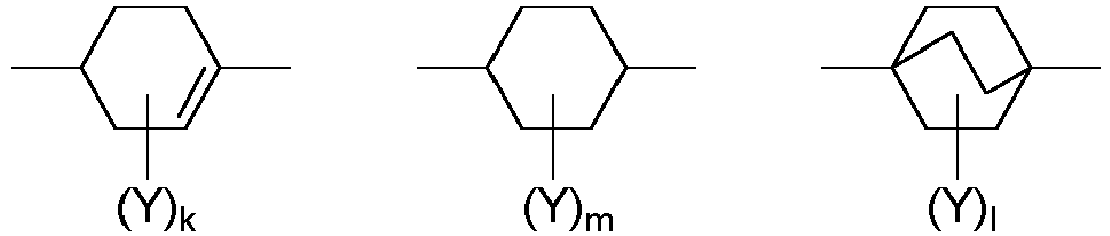 wobei in Gruppe (A) jedes Y unabhängig eine aliphatische Kohlenwasserstoffgruppe mit 1 bis 8 Kohlenstoffatomen, eine Alkoxygruppe mit 1 bis 8 Kohlenstoffatomen, ein Fluoratom, ein Chloratom, ein Bromatom, ein Iodatom, eine Cyanogruppe, eine Nitrogruppe oder eine Acetylgruppe darstellt, jedes n unabhängig eine ganze Zahl von 0 bis 4 darstellt, k eine ganze Zahl von 0 bis 7 darstellt, m eine ganze Zahl von 0 bis 8 darstellt und 1 eine ganze Zahl von 0 bis 12 darstellt.
 - Epoxidharz gemäß Anspruch 3, wobei die durch Formel (1) dargestellte Struktur eine durch die folgende Formel (2) dargestellte Struktur ist:

- Epoxidharz gemäß Anspruch 3 oder Anspruch 4, wobei die Epoxyverbindung eine Epoxyverbindung mit einer durch die folgende Formel (1-A) dargestellten Struktur umfasst:

- Epoxidharz gemäß Anspruch 5, wobei die Epoxyverbindung mit einer durch die Formel (1-A) dargestellten Struktur eine Epoxyverbindung mit einer durch die folgende Formel (2-A) dargestellten Struktur umfasst:

- Epoxidharz gemäß einem der Ansprüche 1 bis 6, wobei die Epoxyverbindung eine Struktur aufweist, in der sich eine zweiwertige Biphenylgruppe zwischen zwei der durch Formel (4) dargestellten Strukturen befindet.
- Epoxidharz gemäß Anspruch 6 oder Anspruch 7, wobei die Epoxyverbindung eine Epoxyverbindung mit einer Struktur einschließt, die durch mindestens eine, ausgewählt aus der Gruppe, bestehend aus der folgenden Formel (4-A) und Formel (4-B), dargestellt ist:


- Epoxidharz gemäß einem von Anspruch 1 bis Anspruch 8, ferner umfassend ein durch die folgende Formel (1-m) dargestelltes mesogenes Epoxymonomer:
 wobei in Formel (1-m) X eine Einfachbindung oder eine Verknüpfungsgruppe darstellt, die mindestens eine zweiwertige Gruppe, ausgewählt aus der folgenden Gruppe (A), einschließt, jedes Y unabhängig eine aliphatische Kohlenwasserstoffgruppe mit 1 bis 8 Kohlenstoffatomen, eine Alkoxygruppe mit 1 bis 8 Kohlenstoffatomen, ein Fluoratom, ein Chloratom, ein Bromatom, ein Iodatom, eine Cyanogruppe, eine Nitrogruppe oder eine Acetylgruppe darstellt und jedes n unabhängig eine ganze Zahl von 0 bis 4 darstellt:

 wobei in Gruppe (A) jedes Y unabhängig eine aliphatische Kohlenwasserstoffgruppe mit 1 bis 8 Kohlenstoffatomen, eine Alkoxygruppe mit 1 bis 8 Kohlenstoffatomen, ein Fluoratom, ein Chloratom, ein Bromatom, ein Iodatom, eine Cyanogruppe, eine Nitrogruppe oder eine Acetylgruppe darstellt, jedes n unabhängig eine ganze Zahl von 0 bis 4 darstellt, k eine ganze Zahl von 0 bis 7 darstellt, m eine ganze Zahl von 0 bis 8 darstellt und 1 eine ganze Zahl von 0 bis 12 darstellt.
 - Epoxidharz gemäß Anspruch 9, wobei das durch Formel (1-m) dargestellte mesogene Epoxymonomer ein durch die folgende Formel (2-m) dargestelltes mesogenes Epoxymonomer einschließt:

- Epoxidharz gemäß Anspruch 9, wobei das durch Formel (1-m) dargestellte mesogene Epoxymonomer ein mesogenes Epoxymonomer, dargestellt durch die folgende Formel (3-m) oder Formel (4-m) einschließt:


- Epoxidharzzusammensetzung, umfassend das Epoxidharz gemäß einem von Anspruch 1 bis Anspruch 11 und ein Härtungsmittel.
- Gehärtetes Epoxidharzprodukt, umfassend ein gehärtetes Produkt der Epoxidharzzusammensetzung gemäß Anspruch 12.
- Verbundmaterial, umfassend das gehärtete Epoxidharzprodukt gemäß Anspruch 13 und ein Verstärkungsmaterial.
Applications Claiming Priority (1)
| Application Number | Priority Date | Filing Date | Title |
|---|---|---|---|
| PCT/JP2017/035659 WO2019064545A1 (ja) | 2017-09-29 | 2017-09-29 | エポキシ樹脂、エポキシ樹脂組成物、エポキシ樹脂硬化物及び複合材料 |
Publications (3)
| Publication Number | Publication Date |
|---|---|
| EP3696208A1 EP3696208A1 (de) | 2020-08-19 |
| EP3696208A4 EP3696208A4 (de) | 2021-05-12 |
| EP3696208B1 true EP3696208B1 (de) | 2023-08-09 |
Family
ID=65901370
Family Applications (1)
| Application Number | Title | Priority Date | Filing Date |
|---|---|---|---|
| EP17927776.9A Active EP3696208B1 (de) | 2017-09-29 | 2017-09-29 | Epoxidharz, epoxidharzzusammensetzung, gehärtetes epoxidharzprodukt und verbundstoffmaterial |
Country Status (6)
| Country | Link |
|---|---|
| US (1) | US11440990B2 (de) |
| EP (1) | EP3696208B1 (de) |
| JP (1) | JP7003999B2 (de) |
| KR (1) | KR102408632B1 (de) |
| CN (1) | CN111148777B (de) |
| WO (1) | WO2019064545A1 (de) |
Families Citing this family (1)
| Publication number | Priority date | Publication date | Assignee | Title |
|---|---|---|---|---|
| JP7095732B2 (ja) * | 2018-02-22 | 2022-07-05 | 昭和電工マテリアルズ株式会社 | エポキシ樹脂、エポキシ樹脂組成物、エポキシ樹脂硬化物及びその製造方法、複合材料、絶縁部材、電子機器、構造材料並びに移動体 |
Family Cites Families (9)
| Publication number | Priority date | Publication date | Assignee | Title |
|---|---|---|---|---|
| JP2004010762A (ja) * | 2002-06-07 | 2004-01-15 | Hitachi Ltd | エポキシ樹脂,エポキシ樹脂組成物,エポキシ樹脂硬化物及びそれらの製造方法 |
| JP5348740B2 (ja) | 2008-06-23 | 2013-11-20 | 日本化薬株式会社 | エポキシ樹脂、エポキシ樹脂組成物、およびその硬化物 |
| JP6102082B2 (ja) | 2012-04-26 | 2017-03-29 | 日立化成株式会社 | エポキシ樹脂組成物、半硬化エポキシ樹脂組成物、硬化エポキシ樹脂組成物、樹脂シート、プリプレグ、積層板、金属基板、及びプリント配線板 |
| JP2015203086A (ja) * | 2014-04-16 | 2015-11-16 | 日本化薬株式会社 | エポキシ樹脂、エポキシ樹脂組成物および硬化物 |
| CN107108856B (zh) | 2014-12-26 | 2022-05-31 | 昭和电工材料株式会社 | 环氧树脂、环氧树脂组合物、含有无机填料的环氧树脂组合物、树脂片、固化物以及环氧化合物 |
| US10941241B2 (en) | 2016-02-25 | 2021-03-09 | Showa Denko Materials Co., Ltd. | Epoxy resin molding material, molded product, molded cured product, and method for producing molded cured product |
| WO2018070053A1 (ja) | 2016-10-14 | 2018-04-19 | 日立化成株式会社 | エポキシ樹脂、エポキシ樹脂組成物、エポキシ樹脂硬化物及び複合材料 |
| WO2018070051A1 (ja) | 2016-10-14 | 2018-04-19 | 日立化成株式会社 | エポキシ樹脂、エポキシ樹脂組成物、エポキシ樹脂硬化物及び複合材料 |
| KR102686755B1 (ko) | 2016-10-14 | 2024-07-18 | 가부시끼가이샤 레조낙 | 에폭시 수지, 에폭시 수지 조성물, 에폭시 수지 경화물 및 복합 재료 |
-
2017
- 2017-09-29 US US16/651,039 patent/US11440990B2/en active Active
- 2017-09-29 WO PCT/JP2017/035659 patent/WO2019064545A1/ja not_active Ceased
- 2017-09-29 JP JP2019544147A patent/JP7003999B2/ja active Active
- 2017-09-29 KR KR1020207009521A patent/KR102408632B1/ko active Active
- 2017-09-29 EP EP17927776.9A patent/EP3696208B1/de active Active
- 2017-09-29 CN CN201780095358.9A patent/CN111148777B/zh active Active
Also Published As
| Publication number | Publication date |
|---|---|
| KR102408632B1 (ko) | 2022-06-13 |
| EP3696208A4 (de) | 2021-05-12 |
| US20200247943A1 (en) | 2020-08-06 |
| WO2019064545A1 (ja) | 2019-04-04 |
| JPWO2019064545A1 (ja) | 2020-11-19 |
| CN111148777A (zh) | 2020-05-12 |
| CN111148777B (zh) | 2023-08-11 |
| EP3696208A1 (de) | 2020-08-19 |
| JP7003999B2 (ja) | 2022-01-21 |
| US11440990B2 (en) | 2022-09-13 |
| KR20200055004A (ko) | 2020-05-20 |
Similar Documents
| Publication | Publication Date | Title |
|---|---|---|
| EP3514191B1 (de) | Epoxidharz, epoxidharzzusammensetzung, gehärtetes epoxidharzprodukt und verbundmaterial | |
| EP3527604B1 (de) | Epoxidharz, epoxidharzzusammensetzung, gehärtetes epoxidharzprodukt und verbundmaterial | |
| EP3514190B1 (de) | Epoxidharz, epoxidharzzusammensetzung, gehärtetes epoxidharzprodukt und verbundstoff | |
| EP3597687B1 (de) | Epoxidharz, epoxidharzzusammensetzung, gehärtetes epoxidharzprodukt und verbundstoffmaterial | |
| EP3476879B1 (de) | Epoxidharzzusammensetzung, gehärtetes produkt und verbundmaterial | |
| EP3757147B1 (de) | Epoxidharz, epoxidharzzusammensetzung, gehärtetes epoxidharzprodukt und verbundstoffmaterial | |
| EP3696208B1 (de) | Epoxidharz, epoxidharzzusammensetzung, gehärtetes epoxidharzprodukt und verbundstoffmaterial | |
| CN112673040B (zh) | 环氧树脂、环氧树脂组合物、环氧树脂固化物及复合材料 | |
| EP3680268B1 (de) | Epoxidharz, epoxidharzzusammensetzung, gehärtetes epoxidharzprodukt und verbundstoffmaterial | |
| EP3686231B1 (de) | Epoxidharz, epoxidharzzusammensetzung, gehärtetes epoxidharzprodukt und verbundstoff | |
| EP3851474B1 (de) | Epoxidharz, epoxidharzzusammensetzung, gehärtetes epoxidharzprodukt und verbundstoffmaterial | |
| JP7243092B2 (ja) | エポキシ樹脂、エポキシ樹脂組成物、エポキシ樹脂硬化物及び複合材料 | |
| US11840600B2 (en) | Cured epoxy resin material, epoxy resin composition, molded article, and composite material | |
| EP3680269B1 (de) | Epoxidharz, epoxidharzzusammensetzung, gehärtetes epoxidharzprodukt und verbundstoffmaterial | |
| JP2019065126A (ja) | エポキシ樹脂組成物、エポキシ樹脂硬化物及び複合材料 | |
| JP7243091B2 (ja) | エポキシ樹脂、エポキシ樹脂組成物、エポキシ樹脂硬化物及び複合材料 | |
| JP7119801B2 (ja) | エポキシ樹脂、エポキシ樹脂組成物、エポキシ樹脂硬化物及び複合材料 |
Legal Events
| Date | Code | Title | Description |
|---|---|---|---|
| STAA | Information on the status of an ep patent application or granted ep patent |
Free format text: STATUS: THE INTERNATIONAL PUBLICATION HAS BEEN MADE |
|
| PUAI | Public reference made under article 153(3) epc to a published international application that has entered the european phase |
Free format text: ORIGINAL CODE: 0009012 |
|
| STAA | Information on the status of an ep patent application or granted ep patent |
Free format text: STATUS: REQUEST FOR EXAMINATION WAS MADE |
|
| 17P | Request for examination filed |
Effective date: 20200401 |
|
| AK | Designated contracting states |
Kind code of ref document: A1 Designated state(s): AL AT BE BG CH CY CZ DE DK EE ES FI FR GB GR HR HU IE IS IT LI LT LU LV MC MK MT NL NO PL PT RO RS SE SI SK SM TR |
|
| AX | Request for extension of the european patent |
Extension state: BA ME |
|
| DAV | Request for validation of the european patent (deleted) | ||
| DAX | Request for extension of the european patent (deleted) | ||
| A4 | Supplementary search report drawn up and despatched |
Effective date: 20210412 |
|
| RIC1 | Information provided on ipc code assigned before grant |
Ipc: C08G 59/24 20060101AFI20210406BHEP Ipc: C08G 59/50 20060101ALI20210406BHEP Ipc: C08L 63/00 20060101ALI20210406BHEP Ipc: C08G 59/06 20060101ALI20210406BHEP Ipc: C08G 59/18 20060101ALI20210406BHEP Ipc: C08G 59/62 20060101ALI20210406BHEP Ipc: C09K 19/38 20060101ALI20210406BHEP |
|
| STAA | Information on the status of an ep patent application or granted ep patent |
Free format text: STATUS: EXAMINATION IS IN PROGRESS |
|
| 17Q | First examination report despatched |
Effective date: 20211126 |
|
| GRAP | Despatch of communication of intention to grant a patent |
Free format text: ORIGINAL CODE: EPIDOSNIGR1 |
|
| STAA | Information on the status of an ep patent application or granted ep patent |
Free format text: STATUS: GRANT OF PATENT IS INTENDED |
|
| RAP3 | Party data changed (applicant data changed or rights of an application transferred) |
Owner name: RESONAC CORPORATION |
|
| INTG | Intention to grant announced |
Effective date: 20230306 |
|
| GRAS | Grant fee paid |
Free format text: ORIGINAL CODE: EPIDOSNIGR3 |
|
| GRAA | (expected) grant |
Free format text: ORIGINAL CODE: 0009210 |
|
| STAA | Information on the status of an ep patent application or granted ep patent |
Free format text: STATUS: THE PATENT HAS BEEN GRANTED |
|
| AK | Designated contracting states |
Kind code of ref document: B1 Designated state(s): AL AT BE BG CH CY CZ DE DK EE ES FI FR GB GR HR HU IE IS IT LI LT LU LV MC MK MT NL NO PL PT RO RS SE SI SK SM TR |
|
| REG | Reference to a national code |
Ref country code: GB Ref legal event code: FG4D |
|
| REG | Reference to a national code |
Ref country code: CH Ref legal event code: EP |
|
| REG | Reference to a national code |
Ref country code: IE Ref legal event code: FG4D |
|
| REG | Reference to a national code |
Ref country code: DE Ref legal event code: R096 Ref document number: 602017072659 Country of ref document: DE |
|
| REG | Reference to a national code |
Ref country code: LT Ref legal event code: MG9D |
|
| REG | Reference to a national code |
Ref country code: NL Ref legal event code: MP Effective date: 20230809 |
|
| REG | Reference to a national code |
Ref country code: AT Ref legal event code: MK05 Ref document number: 1597464 Country of ref document: AT Kind code of ref document: T Effective date: 20230809 |
|
| PG25 | Lapsed in a contracting state [announced via postgrant information from national office to epo] |
Ref country code: GR Free format text: LAPSE BECAUSE OF FAILURE TO SUBMIT A TRANSLATION OF THE DESCRIPTION OR TO PAY THE FEE WITHIN THE PRESCRIBED TIME-LIMIT Effective date: 20231110 |
|
| PG25 | Lapsed in a contracting state [announced via postgrant information from national office to epo] |
Ref country code: IS Free format text: LAPSE BECAUSE OF FAILURE TO SUBMIT A TRANSLATION OF THE DESCRIPTION OR TO PAY THE FEE WITHIN THE PRESCRIBED TIME-LIMIT Effective date: 20231209 |
|
| PG25 | Lapsed in a contracting state [announced via postgrant information from national office to epo] |
Ref country code: SE Free format text: LAPSE BECAUSE OF FAILURE TO SUBMIT A TRANSLATION OF THE DESCRIPTION OR TO PAY THE FEE WITHIN THE PRESCRIBED TIME-LIMIT Effective date: 20230809 Ref country code: RS Free format text: LAPSE BECAUSE OF FAILURE TO SUBMIT A TRANSLATION OF THE DESCRIPTION OR TO PAY THE FEE WITHIN THE PRESCRIBED TIME-LIMIT Effective date: 20230809 Ref country code: PT Free format text: LAPSE BECAUSE OF FAILURE TO SUBMIT A TRANSLATION OF THE DESCRIPTION OR TO PAY THE FEE WITHIN THE PRESCRIBED TIME-LIMIT Effective date: 20231211 Ref country code: NO Free format text: LAPSE BECAUSE OF FAILURE TO SUBMIT A TRANSLATION OF THE DESCRIPTION OR TO PAY THE FEE WITHIN THE PRESCRIBED TIME-LIMIT Effective date: 20231109 Ref country code: NL Free format text: LAPSE BECAUSE OF FAILURE TO SUBMIT A TRANSLATION OF THE DESCRIPTION OR TO PAY THE FEE WITHIN THE PRESCRIBED TIME-LIMIT Effective date: 20230809 Ref country code: LV Free format text: LAPSE BECAUSE OF FAILURE TO SUBMIT A TRANSLATION OF THE DESCRIPTION OR TO PAY THE FEE WITHIN THE PRESCRIBED TIME-LIMIT Effective date: 20230809 Ref country code: LT Free format text: LAPSE BECAUSE OF FAILURE TO SUBMIT A TRANSLATION OF THE DESCRIPTION OR TO PAY THE FEE WITHIN THE PRESCRIBED TIME-LIMIT Effective date: 20230809 Ref country code: IS Free format text: LAPSE BECAUSE OF FAILURE TO SUBMIT A TRANSLATION OF THE DESCRIPTION OR TO PAY THE FEE WITHIN THE PRESCRIBED TIME-LIMIT Effective date: 20231209 Ref country code: HR Free format text: LAPSE BECAUSE OF FAILURE TO SUBMIT A TRANSLATION OF THE DESCRIPTION OR TO PAY THE FEE WITHIN THE PRESCRIBED TIME-LIMIT Effective date: 20230809 Ref country code: GR Free format text: LAPSE BECAUSE OF FAILURE TO SUBMIT A TRANSLATION OF THE DESCRIPTION OR TO PAY THE FEE WITHIN THE PRESCRIBED TIME-LIMIT Effective date: 20231110 Ref country code: FI Free format text: LAPSE BECAUSE OF FAILURE TO SUBMIT A TRANSLATION OF THE DESCRIPTION OR TO PAY THE FEE WITHIN THE PRESCRIBED TIME-LIMIT Effective date: 20230809 Ref country code: AT Free format text: LAPSE BECAUSE OF FAILURE TO SUBMIT A TRANSLATION OF THE DESCRIPTION OR TO PAY THE FEE WITHIN THE PRESCRIBED TIME-LIMIT Effective date: 20230809 |
|
| PG25 | Lapsed in a contracting state [announced via postgrant information from national office to epo] |
Ref country code: PL Free format text: LAPSE BECAUSE OF FAILURE TO SUBMIT A TRANSLATION OF THE DESCRIPTION OR TO PAY THE FEE WITHIN THE PRESCRIBED TIME-LIMIT Effective date: 20230809 |
|
| PG25 | Lapsed in a contracting state [announced via postgrant information from national office to epo] |
Ref country code: ES Free format text: LAPSE BECAUSE OF FAILURE TO SUBMIT A TRANSLATION OF THE DESCRIPTION OR TO PAY THE FEE WITHIN THE PRESCRIBED TIME-LIMIT Effective date: 20230809 |
|
| PG25 | Lapsed in a contracting state [announced via postgrant information from national office to epo] |
Ref country code: SM Free format text: LAPSE BECAUSE OF FAILURE TO SUBMIT A TRANSLATION OF THE DESCRIPTION OR TO PAY THE FEE WITHIN THE PRESCRIBED TIME-LIMIT Effective date: 20230809 Ref country code: RO Free format text: LAPSE BECAUSE OF FAILURE TO SUBMIT A TRANSLATION OF THE DESCRIPTION OR TO PAY THE FEE WITHIN THE PRESCRIBED TIME-LIMIT Effective date: 20230809 Ref country code: ES Free format text: LAPSE BECAUSE OF FAILURE TO SUBMIT A TRANSLATION OF THE DESCRIPTION OR TO PAY THE FEE WITHIN THE PRESCRIBED TIME-LIMIT Effective date: 20230809 Ref country code: EE Free format text: LAPSE BECAUSE OF FAILURE TO SUBMIT A TRANSLATION OF THE DESCRIPTION OR TO PAY THE FEE WITHIN THE PRESCRIBED TIME-LIMIT Effective date: 20230809 Ref country code: DK Free format text: LAPSE BECAUSE OF FAILURE TO SUBMIT A TRANSLATION OF THE DESCRIPTION OR TO PAY THE FEE WITHIN THE PRESCRIBED TIME-LIMIT Effective date: 20230809 Ref country code: CZ Free format text: LAPSE BECAUSE OF FAILURE TO SUBMIT A TRANSLATION OF THE DESCRIPTION OR TO PAY THE FEE WITHIN THE PRESCRIBED TIME-LIMIT Effective date: 20230809 Ref country code: SK Free format text: LAPSE BECAUSE OF FAILURE TO SUBMIT A TRANSLATION OF THE DESCRIPTION OR TO PAY THE FEE WITHIN THE PRESCRIBED TIME-LIMIT Effective date: 20230809 |
|
| REG | Reference to a national code |
Ref country code: CH Ref legal event code: PL |
|
| REG | Reference to a national code |
Ref country code: DE Ref legal event code: R097 Ref document number: 602017072659 Country of ref document: DE |
|
| PG25 | Lapsed in a contracting state [announced via postgrant information from national office to epo] |
Ref country code: LU Free format text: LAPSE BECAUSE OF NON-PAYMENT OF DUE FEES Effective date: 20230929 |
|
| REG | Reference to a national code |
Ref country code: BE Ref legal event code: MM Effective date: 20230930 |
|
| PG25 | Lapsed in a contracting state [announced via postgrant information from national office to epo] |
Ref country code: LU Free format text: LAPSE BECAUSE OF NON-PAYMENT OF DUE FEES Effective date: 20230929 Ref country code: IT Free format text: LAPSE BECAUSE OF FAILURE TO SUBMIT A TRANSLATION OF THE DESCRIPTION OR TO PAY THE FEE WITHIN THE PRESCRIBED TIME-LIMIT Effective date: 20230809 Ref country code: MC Free format text: LAPSE BECAUSE OF FAILURE TO SUBMIT A TRANSLATION OF THE DESCRIPTION OR TO PAY THE FEE WITHIN THE PRESCRIBED TIME-LIMIT Effective date: 20230809 |
|
| PLBE | No opposition filed within time limit |
Free format text: ORIGINAL CODE: 0009261 |
|
| STAA | Information on the status of an ep patent application or granted ep patent |
Free format text: STATUS: NO OPPOSITION FILED WITHIN TIME LIMIT |
|
| REG | Reference to a national code |
Ref country code: IE Ref legal event code: MM4A |
|
| PG25 | Lapsed in a contracting state [announced via postgrant information from national office to epo] |
Ref country code: IE Free format text: LAPSE BECAUSE OF NON-PAYMENT OF DUE FEES Effective date: 20230929 |
|
| 26N | No opposition filed |
Effective date: 20240513 |
|
| PG25 | Lapsed in a contracting state [announced via postgrant information from national office to epo] |
Ref country code: CH Free format text: LAPSE BECAUSE OF NON-PAYMENT OF DUE FEES Effective date: 20230930 |
|
| GBPC | Gb: european patent ceased through non-payment of renewal fee |
Effective date: 20231109 |
|
| PG25 | Lapsed in a contracting state [announced via postgrant information from national office to epo] |
Ref country code: IE Free format text: LAPSE BECAUSE OF NON-PAYMENT OF DUE FEES Effective date: 20230929 Ref country code: CH Free format text: LAPSE BECAUSE OF NON-PAYMENT OF DUE FEES Effective date: 20230930 Ref country code: SI Free format text: LAPSE BECAUSE OF FAILURE TO SUBMIT A TRANSLATION OF THE DESCRIPTION OR TO PAY THE FEE WITHIN THE PRESCRIBED TIME-LIMIT Effective date: 20230809 |
|
| PG25 | Lapsed in a contracting state [announced via postgrant information from national office to epo] |
Ref country code: BE Free format text: LAPSE BECAUSE OF NON-PAYMENT OF DUE FEES Effective date: 20230930 |
|
| PG25 | Lapsed in a contracting state [announced via postgrant information from national office to epo] |
Ref country code: GB Free format text: LAPSE BECAUSE OF NON-PAYMENT OF DUE FEES Effective date: 20231109 |
|
| PG25 | Lapsed in a contracting state [announced via postgrant information from national office to epo] |
Ref country code: GB Free format text: LAPSE BECAUSE OF NON-PAYMENT OF DUE FEES Effective date: 20231109 |
|
| PG25 | Lapsed in a contracting state [announced via postgrant information from national office to epo] |
Ref country code: BG Free format text: LAPSE BECAUSE OF FAILURE TO SUBMIT A TRANSLATION OF THE DESCRIPTION OR TO PAY THE FEE WITHIN THE PRESCRIBED TIME-LIMIT Effective date: 20230809 |
|
| PG25 | Lapsed in a contracting state [announced via postgrant information from national office to epo] |
Ref country code: BG Free format text: LAPSE BECAUSE OF FAILURE TO SUBMIT A TRANSLATION OF THE DESCRIPTION OR TO PAY THE FEE WITHIN THE PRESCRIBED TIME-LIMIT Effective date: 20230809 |
|
| PG25 | Lapsed in a contracting state [announced via postgrant information from national office to epo] |
Ref country code: CY Free format text: LAPSE BECAUSE OF FAILURE TO SUBMIT A TRANSLATION OF THE DESCRIPTION OR TO PAY THE FEE WITHIN THE PRESCRIBED TIME-LIMIT; INVALID AB INITIO Effective date: 20170929 |
|
| PG25 | Lapsed in a contracting state [announced via postgrant information from national office to epo] |
Ref country code: HU Free format text: LAPSE BECAUSE OF FAILURE TO SUBMIT A TRANSLATION OF THE DESCRIPTION OR TO PAY THE FEE WITHIN THE PRESCRIBED TIME-LIMIT; INVALID AB INITIO Effective date: 20170929 |
|
| PGFP | Annual fee paid to national office [announced via postgrant information from national office to epo] |
Ref country code: DE Payment date: 20250805 Year of fee payment: 9 |
|
| PGFP | Annual fee paid to national office [announced via postgrant information from national office to epo] |
Ref country code: FR Payment date: 20250808 Year of fee payment: 9 |
|
| PG25 | Lapsed in a contracting state [announced via postgrant information from national office to epo] |
Ref country code: TR Free format text: LAPSE BECAUSE OF FAILURE TO SUBMIT A TRANSLATION OF THE DESCRIPTION OR TO PAY THE FEE WITHIN THE PRESCRIBED TIME-LIMIT Effective date: 20230809 |