EP3699312A1 - Ferritbasierter edelstahl mit ausgezeichneter schlagzähigkeit und verfahren zur herstellung davon - Google Patents
Ferritbasierter edelstahl mit ausgezeichneter schlagzähigkeit und verfahren zur herstellung davon Download PDFInfo
- Publication number
- EP3699312A1 EP3699312A1 EP18889514.8A EP18889514A EP3699312A1 EP 3699312 A1 EP3699312 A1 EP 3699312A1 EP 18889514 A EP18889514 A EP 18889514A EP 3699312 A1 EP3699312 A1 EP 3699312A1
- Authority
- EP
- European Patent Office
- Prior art keywords
- less
- stainless steel
- hot
- ferritic stainless
- rolling
- Prior art date
- Legal status (The legal status is an assumption and is not a legal conclusion. Google has not performed a legal analysis and makes no representation as to the accuracy of the status listed.)
- Pending
Links
Images




Classifications
-
- C—CHEMISTRY; METALLURGY
- C22—METALLURGY; FERROUS OR NON-FERROUS ALLOYS; TREATMENT OF ALLOYS OR NON-FERROUS METALS
- C22C—ALLOYS
- C22C38/00—Ferrous alloys, e.g. steel alloys
- C22C38/18—Ferrous alloys, e.g. steel alloys containing chromium
- C22C38/28—Ferrous alloys, e.g. steel alloys containing chromium with titanium or zirconium
-
- C—CHEMISTRY; METALLURGY
- C21—METALLURGY OF IRON
- C21D—MODIFYING THE PHYSICAL STRUCTURE OF FERROUS METALS; GENERAL DEVICES FOR HEAT TREATMENT OF FERROUS OR NON-FERROUS METALS OR ALLOYS; MAKING METAL MALLEABLE, e.g. BY DECARBURISATION OR TEMPERING
- C21D1/00—General methods or devices for heat treatment, e.g. annealing, hardening, quenching or tempering
- C21D1/26—Methods of annealing
-
- C—CHEMISTRY; METALLURGY
- C21—METALLURGY OF IRON
- C21D—MODIFYING THE PHYSICAL STRUCTURE OF FERROUS METALS; GENERAL DEVICES FOR HEAT TREATMENT OF FERROUS OR NON-FERROUS METALS OR ALLOYS; MAKING METAL MALLEABLE, e.g. BY DECARBURISATION OR TEMPERING
- C21D6/00—Heat treatment of ferrous alloys
-
- C—CHEMISTRY; METALLURGY
- C21—METALLURGY OF IRON
- C21D—MODIFYING THE PHYSICAL STRUCTURE OF FERROUS METALS; GENERAL DEVICES FOR HEAT TREATMENT OF FERROUS OR NON-FERROUS METALS OR ALLOYS; MAKING METAL MALLEABLE, e.g. BY DECARBURISATION OR TEMPERING
- C21D6/00—Heat treatment of ferrous alloys
- C21D6/002—Heat treatment of ferrous alloys containing Cr
-
- C—CHEMISTRY; METALLURGY
- C21—METALLURGY OF IRON
- C21D—MODIFYING THE PHYSICAL STRUCTURE OF FERROUS METALS; GENERAL DEVICES FOR HEAT TREATMENT OF FERROUS OR NON-FERROUS METALS OR ALLOYS; MAKING METAL MALLEABLE, e.g. BY DECARBURISATION OR TEMPERING
- C21D6/00—Heat treatment of ferrous alloys
- C21D6/004—Heat treatment of ferrous alloys containing Cr and Ni
-
- C—CHEMISTRY; METALLURGY
- C21—METALLURGY OF IRON
- C21D—MODIFYING THE PHYSICAL STRUCTURE OF FERROUS METALS; GENERAL DEVICES FOR HEAT TREATMENT OF FERROUS OR NON-FERROUS METALS OR ALLOYS; MAKING METAL MALLEABLE, e.g. BY DECARBURISATION OR TEMPERING
- C21D6/00—Heat treatment of ferrous alloys
- C21D6/005—Heat treatment of ferrous alloys containing Mn
-
- C—CHEMISTRY; METALLURGY
- C21—METALLURGY OF IRON
- C21D—MODIFYING THE PHYSICAL STRUCTURE OF FERROUS METALS; GENERAL DEVICES FOR HEAT TREATMENT OF FERROUS OR NON-FERROUS METALS OR ALLOYS; MAKING METAL MALLEABLE, e.g. BY DECARBURISATION OR TEMPERING
- C21D6/00—Heat treatment of ferrous alloys
- C21D6/008—Heat treatment of ferrous alloys containing Si
-
- C—CHEMISTRY; METALLURGY
- C21—METALLURGY OF IRON
- C21D—MODIFYING THE PHYSICAL STRUCTURE OF FERROUS METALS; GENERAL DEVICES FOR HEAT TREATMENT OF FERROUS OR NON-FERROUS METALS OR ALLOYS; MAKING METAL MALLEABLE, e.g. BY DECARBURISATION OR TEMPERING
- C21D8/00—Modifying the physical properties of ferrous metals or ferrous alloys by deformation combined with, or followed by, heat treatment
- C21D8/02—Modifying the physical properties of ferrous metals or ferrous alloys by deformation combined with, or followed by, heat treatment during manufacturing of plates or strips
-
- C—CHEMISTRY; METALLURGY
- C21—METALLURGY OF IRON
- C21D—MODIFYING THE PHYSICAL STRUCTURE OF FERROUS METALS; GENERAL DEVICES FOR HEAT TREATMENT OF FERROUS OR NON-FERROUS METALS OR ALLOYS; MAKING METAL MALLEABLE, e.g. BY DECARBURISATION OR TEMPERING
- C21D8/00—Modifying the physical properties of ferrous metals or ferrous alloys by deformation combined with, or followed by, heat treatment
- C21D8/02—Modifying the physical properties of ferrous metals or ferrous alloys by deformation combined with, or followed by, heat treatment during manufacturing of plates or strips
- C21D8/0221—Modifying the physical properties of ferrous metals or ferrous alloys by deformation combined with, or followed by, heat treatment during manufacturing of plates or strips characterised by the working steps
- C21D8/0226—Hot rolling
-
- C—CHEMISTRY; METALLURGY
- C21—METALLURGY OF IRON
- C21D—MODIFYING THE PHYSICAL STRUCTURE OF FERROUS METALS; GENERAL DEVICES FOR HEAT TREATMENT OF FERROUS OR NON-FERROUS METALS OR ALLOYS; MAKING METAL MALLEABLE, e.g. BY DECARBURISATION OR TEMPERING
- C21D8/00—Modifying the physical properties of ferrous metals or ferrous alloys by deformation combined with, or followed by, heat treatment
- C21D8/02—Modifying the physical properties of ferrous metals or ferrous alloys by deformation combined with, or followed by, heat treatment during manufacturing of plates or strips
- C21D8/0247—Modifying the physical properties of ferrous metals or ferrous alloys by deformation combined with, or followed by, heat treatment during manufacturing of plates or strips characterised by the heat treatment
- C21D8/0263—Modifying the physical properties of ferrous metals or ferrous alloys by deformation combined with, or followed by, heat treatment during manufacturing of plates or strips characterised by the heat treatment following hot rolling
-
- C—CHEMISTRY; METALLURGY
- C21—METALLURGY OF IRON
- C21D—MODIFYING THE PHYSICAL STRUCTURE OF FERROUS METALS; GENERAL DEVICES FOR HEAT TREATMENT OF FERROUS OR NON-FERROUS METALS OR ALLOYS; MAKING METAL MALLEABLE, e.g. BY DECARBURISATION OR TEMPERING
- C21D9/00—Heat treatment, e.g. annealing, hardening, quenching or tempering, adapted for particular articles; Furnaces therefor
- C21D9/46—Heat treatment, e.g. annealing, hardening, quenching or tempering, adapted for particular articles; Furnaces therefor for sheet metals
-
- C—CHEMISTRY; METALLURGY
- C22—METALLURGY; FERROUS OR NON-FERROUS ALLOYS; TREATMENT OF ALLOYS OR NON-FERROUS METALS
- C22C—ALLOYS
- C22C38/00—Ferrous alloys, e.g. steel alloys
-
- C—CHEMISTRY; METALLURGY
- C22—METALLURGY; FERROUS OR NON-FERROUS ALLOYS; TREATMENT OF ALLOYS OR NON-FERROUS METALS
- C22C—ALLOYS
- C22C38/00—Ferrous alloys, e.g. steel alloys
- C22C38/001—Ferrous alloys, e.g. steel alloys containing N
-
- C—CHEMISTRY; METALLURGY
- C22—METALLURGY; FERROUS OR NON-FERROUS ALLOYS; TREATMENT OF ALLOYS OR NON-FERROUS METALS
- C22C—ALLOYS
- C22C38/00—Ferrous alloys, e.g. steel alloys
- C22C38/004—Very low carbon steels, i.e. having a carbon content of less than 0,01%
-
- C—CHEMISTRY; METALLURGY
- C22—METALLURGY; FERROUS OR NON-FERROUS ALLOYS; TREATMENT OF ALLOYS OR NON-FERROUS METALS
- C22C—ALLOYS
- C22C38/00—Ferrous alloys, e.g. steel alloys
- C22C38/02—Ferrous alloys, e.g. steel alloys containing silicon
-
- C—CHEMISTRY; METALLURGY
- C22—METALLURGY; FERROUS OR NON-FERROUS ALLOYS; TREATMENT OF ALLOYS OR NON-FERROUS METALS
- C22C—ALLOYS
- C22C38/00—Ferrous alloys, e.g. steel alloys
- C22C38/04—Ferrous alloys, e.g. steel alloys containing manganese
-
- C—CHEMISTRY; METALLURGY
- C22—METALLURGY; FERROUS OR NON-FERROUS ALLOYS; TREATMENT OF ALLOYS OR NON-FERROUS METALS
- C22C—ALLOYS
- C22C38/00—Ferrous alloys, e.g. steel alloys
- C22C38/06—Ferrous alloys, e.g. steel alloys containing aluminium
-
- C—CHEMISTRY; METALLURGY
- C22—METALLURGY; FERROUS OR NON-FERROUS ALLOYS; TREATMENT OF ALLOYS OR NON-FERROUS METALS
- C22C—ALLOYS
- C22C38/00—Ferrous alloys, e.g. steel alloys
- C22C38/18—Ferrous alloys, e.g. steel alloys containing chromium
- C22C38/20—Ferrous alloys, e.g. steel alloys containing chromium with copper
-
- C—CHEMISTRY; METALLURGY
- C22—METALLURGY; FERROUS OR NON-FERROUS ALLOYS; TREATMENT OF ALLOYS OR NON-FERROUS METALS
- C22C—ALLOYS
- C22C38/00—Ferrous alloys, e.g. steel alloys
- C22C38/18—Ferrous alloys, e.g. steel alloys containing chromium
- C22C38/40—Ferrous alloys, e.g. steel alloys containing chromium with nickel
- C22C38/42—Ferrous alloys, e.g. steel alloys containing chromium with nickel with copper
-
- C—CHEMISTRY; METALLURGY
- C22—METALLURGY; FERROUS OR NON-FERROUS ALLOYS; TREATMENT OF ALLOYS OR NON-FERROUS METALS
- C22C—ALLOYS
- C22C38/00—Ferrous alloys, e.g. steel alloys
- C22C38/18—Ferrous alloys, e.g. steel alloys containing chromium
- C22C38/40—Ferrous alloys, e.g. steel alloys containing chromium with nickel
- C22C38/50—Ferrous alloys, e.g. steel alloys containing chromium with nickel with titanium or zirconium
-
- C—CHEMISTRY; METALLURGY
- C21—METALLURGY OF IRON
- C21D—MODIFYING THE PHYSICAL STRUCTURE OF FERROUS METALS; GENERAL DEVICES FOR HEAT TREATMENT OF FERROUS OR NON-FERROUS METALS OR ALLOYS; MAKING METAL MALLEABLE, e.g. BY DECARBURISATION OR TEMPERING
- C21D2201/00—Treatment for obtaining particular effects
- C21D2201/05—Grain orientation
-
- C—CHEMISTRY; METALLURGY
- C21—METALLURGY OF IRON
- C21D—MODIFYING THE PHYSICAL STRUCTURE OF FERROUS METALS; GENERAL DEVICES FOR HEAT TREATMENT OF FERROUS OR NON-FERROUS METALS OR ALLOYS; MAKING METAL MALLEABLE, e.g. BY DECARBURISATION OR TEMPERING
- C21D2211/00—Microstructure comprising significant phases
- C21D2211/005—Ferrite
Definitions
- the present disclosure relates to a ferritic stainless steel with excellent impact toughness and a manufacturing method thereof, and more particularly, to a ferritic stainless hot-rolled annealed steel sheet containing Ti and having excellent impact property of 6 mm or more in thickness and a manufacturing method thereof.
- Ferritic stainless steel has inferior workability, impact toughness and high temperature strength compared to austenitic stainless steel, but since it does not contain a large amount of Ni, it is inexpensive and has low thermal expansion. In recent years, it is preferred to use it for automobile exhaust system component materials. In particular, flanges for exhaust systems have recently been converted into ferritic stainless thick plates with improved corrosion resistance and durability due to micro-cracks and exhaust gas leakage problems.
- STS409L material is a steel grade to prevent sensitization of welds by stabilizing C and N with Ti at 11% Cr, has excellent workability and mainly used at temperatures below 700°C.
- STS409L material is the most widely used steel grade because it has some corrosion resistance even to the condensate component generated in the automobile exhaust system.
- ferritic stainless steel As the thickness of ferritic stainless steel is thicker than that of austenitic stainless steel, workability and impact toughness are inferior. Therefore, ferritic stainless steel has a brittle crack or crack propagation during cold rolling to a target thickness after hot rolling, thereby causing fracture of the plate.
- impact properties are inferior, such as cracks generated by impacts. Due to this low impact property, STS409L steel with a thickness of 6.0mm or more is a very difficult steel to manufacture and process.
- the embodiments of the present disclosure solve the above problems, and thus provide a ferritic stainless steel with improved impact toughness and a manufacturing method thereof by securing a recovery structure rather than a completely recrystallized structure by controlling the annealing temperature of ferritic stainless hot-rolled thick plate with a thickness of 6.0 mm or more.
- a ferritic stainless steel with excellent impact toughness includes, in percent (%) by weight of the entire composition, C: more than 0 and 0.01% or less, Si: 0.8% or less, Mn: 0.5% or less, Cr: 10 to 14%, Ti: 0.01 to 0.45%, N: more than 0 and 0.015% or less, the remainder of iron (Fe) and other inevitable impurities, and an average misorientation between grains of microstructure is 0.6 to 1.1 °.
- the stainless steel may have a thickness of 6.0 to 25.0mm.
- the ferritic stainless steel may further include Ni: 0.3% or less, Cu: 0.5% or less, Al: 0.1% or less.
- the stainless steel may satisfy a following equation (1) Ti / C + N ⁇ 3 Ti, C, N mean the content (% by weight) of each element.
- the stainless steel may have a yield strength of 305 MPa or more, a tensile strength of 420 MPa or more, an elongation of 35 to 40%, and satisfies the following equation (2). 20 ° C charpy impact energy ⁇ 40 ° C charpy impact energy ⁇ 750 J / cm 2
- a manufacturing method of a ferritic stainless steel with excellent impact toughness includes: heating a slab comprising, in percent (%) by weight of the entire composition, C: more than 0 and 0.01% or less, Si: 0.8% or less, Mn: 0.5% or less, Cr: 10 to 14%, Ti: 0.01 to 0.45%, N: more than 0 and 0.015% or less, the remainder of iron (Fe) and other inevitable impurities to 1,220°C or less; rough rolling the heated slab; finishing rolling the rough rolled bar; and annealing the hot rolled steel sheet, and a sum of reduction ratio at the rear end of the rough rolling is 54% or more, and a thickness of the hot rolled steel sheet is 6.0 to 25.0 mm.
- the slab may further include Ni: 0.3% or less, Cu: 0.5% or less, Al: 0.1% or less and satisfies a following equation (1) Ti / C + N ⁇ 3 Ti, C, N mean the content (% by weight) of each element.
- the temperature of the rough rolled bar may be 1,020 to 970°C.
- the finishing rolling end temperature may be 960°C or less.
- the hot rolling annealing may be performed at 850 to 980°C, and an average misorientation between grains of microstructure of the hot-rolled annealed steel sheet may be 0.6 to 1.1 °.
- a high charpy impact energy value can be exhibited.
- ferritic stainless steel having excellent impact toughness and yield strength of 305 MPa or more and tensile strength of 440 MPa or more.
- a ferritic stainless steel with excellent impact toughness includes, in percent (%) by weight of the entire composition, C: more than 0 and 0.01% or less, Si: 0.8% or less, Mn: 0.5% or less, Cr: 10 to 14%, Ti: 0.01 to 0.45%, N: more than 0 and 0.015% or less, the remainder of iron (Fe) and other inevitable impurities.
- part when a part "includes” or “comprises” an element, unless there is a particular description contrary thereto, the part may further include other elements, not excluding the other elements.
- the present disclosure secures a microstructure in a recovery step, not a completely recrystallized microstructure by controlling the hot rolling and hot rolling annealing process of hot rolled thick plate having a thickness of 6.0mm or more, rearranges the dislocations arranged in disorder in the recovered grain boundaries through annealing at a specific temperature and improves the impact toughness of the Ti-containing ferritic stainless hot-rolled thick plate by suppressing the propagation of impact through the rearranged dislocations.
- 'ferritic stainless steel means a hot-rolled annealed steel sheet with a thickness of 6.0 mm or more.
- a ferritic stainless steel with excellent impact toughness includes, in percent (%) by weight of the entire composition, C: more than 0 and 0.01% or less, Si: 0.8% or less, Mn: 0.5% or less, Cr: 10 to 14%, Ti: 0.01 to 0.45%, N: more than 0 and 0.015% or less, the remainder of iron (Fe) and other inevitable impurities, has an average misorientation between grains of microstructure of 0.6 to 1.1° and has a thickness of 6.0 to 25.0mm.
- the target steel grade to improve impact toughness is a ferritic stainless thick plate containing Cr: 10 to 14 wt% and Ti: 0.01 to 0.45 wt%, for example, STS409L steel grade.
- the unit is % by weight.
- the content of C and N is more than 0 and less than 0.01 %.
- C and N being present in an interstitial form as Ti(C, N) carbonitride-forming elements
- Ti(C, N) carbonitride is not formed when C and N contents are high, and C and N present at a high concentration deteriorate elongation and low-temperature impact properties of the material.
- the material is used at 600 °C or below for a long period of time after welding, intergranular corrosion occurs due to generation of Cr 23 C 6 carbide, and therefore the content of C and N is preferably controlled to be 0.01% or less, respectively.
- the content of Si is 0.8% or less.
- Si is an element added as a deoxidizing element, and when its content is increased as a ferrite-phase forming element, ferrite-phase stability is increased. If the content of Si is more than 0.8%, steelmaking Si inclusions are increased and surface defects occur. For this reason, the Si content is preferably controlled to be 0.8% or less.
- the content of Mn is 0.5% or less.
- the Mn content is preferably controlled to be 0.5% or less.
- the content of Cr is 10 to 14%.
- Cr is an essential element for ensuring corrosion resistance of stainless steel.
- the content of Cr is low, corrosion resistance is lowered in an atmosphere of condensed water, and when the content is high, strength is increased and elongation and impact characteristics are lowered.
- the target steel type to improve impact toughness is a ferritic stainless steel thick plate containing 10 to 14% Cr, the content of Cr is limited to 10 to 14%.
- the content of Ti is 0.01 to 0.45%.
- Ti is an effective element that fixes C and N to prevent intergranular corrosion.
- Ti is preferably controlled to be at least 0.01% or more.
- the Ti content is controlled to be 0.45% or less and more preferably 0.35% or less.
- the ratio of Ti / (C + N) is controlled to be at least 3 or higher.
- ferritic stainless steel with excellent impact toughness may further include Ni: 0.3% or less, Cu: 0.5% or less, Al: 0.1% or less.
- the content of Ni is 0.3% or less.
- Ni is an effective element for suppressing the evolution of the pitting, and it is also effective in improving the toughness of the hot rolled steel sheet when a small amount of 0.01% or more is added.
- the addition of a large amount may cause material hardening and toughness deterioration due to solid solution strengthening, and there is a problem that the alloy cost increases. Therefore, it is preferable to limit it to 0.3% or less.
- the content of Cu is 0.5% or less.
- Cu serves to improve corrosion resistance when a certain amount is added, but it is preferable to limit it to 0.5% or less since excessive addition generates Cu precipitates and decreases toughness.
- the content of Al is 0.1 % or less.
- Al is useful as a deoxidizing element and its effect can be expressed at 0.005% or more.
- the excessive addition causes the lowering of ductility and toughness at room temperature, so the upper limit is set to 0.1% and need not be contained.
- the thickness of ferritic stainless steel to improve impact toughness is 6.0 to 25.0 mm.
- the thickness of the ferritic stainless steel according to the present disclosure for solving this is 6.0 mm or more.
- the upper limit may be 25.0 mm in consideration of the thickness of the rough-rolled bar after rough-rolling. Preferably, it may be 12.0 mm or less to be suitable for manufacturing use.
- the microstructure of ferritic stainless steel with excellent impact toughness may be a recovery structure having an average misorientation between grains of 0.6 to 1.1 °.
- recrystallized recovery structures exhibit superior impact properties compared to non-annealed or fully recrystallized structures.
- the recovery structures may be difficult to distinguish from non-annealed and fully recrystallized structures, but can be distinguished through misorientation between grains between grain boundaries in the grain boundary structure.
- misorientation between grains between grain boundaries in the grain boundary structure In general, it is known that the average misorientation between grains of a deformed specimen increases because the distortion of crystal orientation increases as the amount of deformation increases.
- the average misorientation between grains of the non-annealed structure is 1.2° or more, and the average misorientation between grains of the fully recrystallized structure is 0.5° or less. That is, the average misorientation between grains gradually decreases from a non-annealed structure to a fully recrystallized structure, which means that recrystallization is performed by arranging in a direction in which grain-boundary energy decreases.
- the non-annealed structure has high strength and low elongation due to the stress remaining inside, and the impact property is inferior, and the fully recrystallized structure has low strength due to stress removal and cannot suppress the propagation of impact due to dissipation of dislocation.
- the ferritic stainless steel according to the present disclosure can improve the impact toughness by suppressing the propagation of the impact by relocating the dislocation generated through the low temperature hot rolling process, which will be described later, to the recovered grain boundaries.
- the ferritic stainless steel with excellent impact toughness of the present disclosure can satisfy the following equation (2). 20 ° C charpy impact energy ⁇ 40 ° C charpy impact energy ⁇ 750 J / cm 2
- 20°C charpy impact energy of ferritic stainless steel according to the present disclosure may represent 15 J/cm 2 or more, and 40°C charpy impact energy may represent 50 J/cm 2 or more.
- the manufacturing method of a ferritic stainless steel with excellent impact toughness includes a heating a slab including, in percent (%) by weight of the entire composition, C: more than 0 and 0.01% or less, Si: 0.8% or less, Mn: 0.5% or less, Cr: 10 to 14%, Ti: 0.01 to 0.45%, N: more than 0 and 0.015% or less, the remainder of iron (Fe) and other inevitable impurities to 1,220°C or less; a rough rolling the heated slab; a finishing rolling the rough rolled bar; and an annealing the hot rolled steel sheet, and a sum of reduction ratio at the rear end of the rough rolling is 54% or more, and a thickness of the hot rolled steel sheet is 6.0 to 25.0 mm.
- the heated slab After heating the slab containing the alloy element of the above composition to 1,220°C or less prior to hot rolling, the heated slab can be rough rolled. At this time, it is possible to control the sum of the reduction ratio at the rear end of the rough rolling to 54% or more.
- the reduction ratio is lowered, so that the amount of dislocation is reduced as the stress applied to the material is low. Therefore, as the thickness of the hot rolled steel sheet becomes thicker, the heating furnace temperature before hot rolling is made as low as possible, and when hot rolling, the load distribution of the rough rolling is moved to the rear end to perform a strong reduction at the rear end having a lower temperature than the front end.
- the slab heating temperature is preferably 1,220°C or less for dislocation generation through low temperature hot rolling, and when the slab temperature is too low, rough rolling is impossible, so the lower limit of the heating temperature may be 1,150°C or higher.
- the rough rolling rear end in the present disclosure may mean the last rolling mill and the second rolling mill at the end. Even in the rough rolling step consisting of five or more rolling mills, it may mean the last rolling mill and the second rolling mill at the end.
- the reduction ratio of the two rear-end rolling mills may be 27% or more, respectively. It is possible to smoothly generate dislocation of the hot rolled steel sheet by strongly reducing so that the sum of the reduction ratio at the rear end of the rough rolling is 54% or more.
- the rough-rolled bar manufactured through the rough-rolling process may be finished rolled to a thickness of 6.0 to 25.0 mm, and then heat-annealed.
- the rough rolling bar before the finish rolling may have a temperature of 1,020 to 970°C, and the end temperature of the finish rolling may be 960°C or less. More preferably, the finish rolling end temperature may be 920°C or less.
- a large amount of dislocation can be generated by performing a low temperature hot rolling process by controlling the slab heated to 1,220°C or less to the above temperature range.
- the hot-rolled steel sheet may be annealed at 850 to 980°C.
- the annealing temperature is less than 850°C, the annealing time for dislocation relocation takes a long time to decrease productivity, and when it exceeds 980°C, recrystallization may be performed beyond relocation of the dislocation.
- the hot rolled steel sheet is manufactured according to the load distribution at the rear end of the rough rolling and the temperature range of the low temperature hot rolling process, and hot rolling annealing heat treatment in the range of 850 to 980°C should be performed.
- the ferritic stainless hot-rolled annealed steel sheet subjected to the low-temperature hot-rolling process and hot-rolled annealing heat treatment may have a recovery structure with an average misorientation between grains of microstructure of 0.6 to 1.1°.
- the slab of the composition shown in Table 1 was heated to 1,200°C, and then hot rolled to a thickness of 10.0 mm so that the finish rolling end temperature was 940°C by setting the sum of the reduction ratios at the rear of the rough rolling to 55%. At this time, the mass-flow temperature of the rough rolling bar before finishing rolling was set to about 1,000°C.
- Non-annealing (A), 930°C hot-rolled annealing (B: B-1, B-2), and 1,020°C hot-rolled annealing (C) were performed on 10.0 mm thick hot rolled steel sheets, respectively, to prepare 11Cr-0.2Ti ferritic stainless steel sheets.
- the 930°C hot-rolled annealed steel sheet which is an example range of the present disclosure, was produced in two types, B-1 and B-2, to confirm reproducibility.
- Hot-Rolled Annealing B: B-1, B-2
- 1,020°C Hot Rolled Annealing C 11Cr-0.2Ti ferritic stainless steel.
- Two kinds of steel sheets B-1 and B-2 annealed at 930°C hot rolling are prepared.
- FIG. 1 is a photograph showing the microstructure of a hot-rolled annealed steel sheet according to the annealing temperature of the embodiment of the present disclosure.
- FIG. 1 shows microstructures of hot-rolled annealed steel sheets prepared by non-annealing (A), hot rolling annealing at 930°C (B: B-1, B-2), and hot rolling annealing (C) at 1,020°C, respectively.
- A is a non-annealed hot rolled black coil, which represents the structure after typical hot rolling.
- C is mostly recrystallized by hot-annealing at 1,020°C. However, since the hot rolling reduction ratio is low, some unrecrystallized band structure was observed.
- the microstructure annealed at 930°C which is the hot rolled annealing temperature range of the present disclosure, is a structure of an unrecrystallized recovery step, and some fine grains are observed.
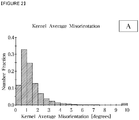
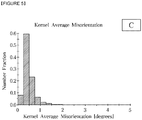
- the Kernel Average Misorientation method is a technique capable of analyzing average misorientation between grains according to the average amount of deformation of a material through Electron Back Scattered Diffracrion (EBSD).
- EBSD Electron Back Scattered Diffracrion
- FIGS. 2 to 5 are graphs showing an average misorientation between grains of a hot-rolled annealed steel sheet according to an annealing temperature of the embodiment of the present disclosure analyzed according to the Kernel Average Misorientation method.
- the average misorientation between grains of Comparative Example 1 (A) showing a non-annealed hot rolled black coil was the highest with 1.44° and the average misorientation between grains of completely recrystallized Comparative Example 2 (C) was about 0.4°, showing the smallest misorientation.
- the average misorientation of the B-1 and B-2 recovery structures corresponding to the present disclosure example was about 0.87°, indicating a moderate level of average misorientation between the non-annealed hot-rolled black coil A and completely recrystallized C.
- FIG. 6 is a graph showing the charpy impact energy value for each temperature according to the annealing temperature of the embodiment of the present disclosure.
- the yield strength and tensile strength of the present disclosure examples indicate lower yield strength and tensile strength values as stress is relaxed compared to Comparative Example 1 (A), and the elongation shows an improved value of about 3 to 4%.
- Comparative Example 2 (C) shows lower yield strength and tensile strength values due to dislocation disappearance generated during hot rolling and stress elimination, and elongation also shows a high value of 41 %.
- the ferritic stainless steel according to the present disclosure has improved toughness and brittleness of a hot-rolled thick plate with a thickness of 6.0 mm or more, and can prevent winter season cracking.
Landscapes
- Chemical & Material Sciences (AREA)
- Engineering & Computer Science (AREA)
- Mechanical Engineering (AREA)
- Materials Engineering (AREA)
- Metallurgy (AREA)
- Organic Chemistry (AREA)
- Physics & Mathematics (AREA)
- Thermal Sciences (AREA)
- Crystallography & Structural Chemistry (AREA)
- Heat Treatment Of Steel (AREA)
Applications Claiming Priority (2)
| Application Number | Priority Date | Filing Date | Title |
|---|---|---|---|
| KR1020170172355A KR102020511B1 (ko) | 2017-12-14 | 2017-12-14 | 충격 인성이 우수한 페라이트계 스테인리스강 및 그 제조방법 |
| PCT/KR2018/010694 WO2019117432A1 (ko) | 2017-12-14 | 2018-09-12 | 충격 인성이 우수한 페라이트계 스테인리스강 및 그 제조방법 |
Publications (2)
| Publication Number | Publication Date |
|---|---|
| EP3699312A4 EP3699312A4 (de) | 2020-08-26 |
| EP3699312A1 true EP3699312A1 (de) | 2020-08-26 |
Family
ID=66820323
Family Applications (1)
| Application Number | Title | Priority Date | Filing Date |
|---|---|---|---|
| EP18889514.8A Pending EP3699312A1 (de) | 2017-12-14 | 2018-09-12 | Ferritbasierter edelstahl mit ausgezeichneter schlagzähigkeit und verfahren zur herstellung davon |
Country Status (5)
| Country | Link |
|---|---|
| US (1) | US11718887B2 (de) |
| EP (1) | EP3699312A1 (de) |
| KR (1) | KR102020511B1 (de) |
| CN (2) | CN120888846A (de) |
| WO (1) | WO2019117432A1 (de) |
Families Citing this family (3)
| Publication number | Priority date | Publication date | Assignee | Title |
|---|---|---|---|---|
| KR102424980B1 (ko) * | 2020-11-19 | 2022-07-25 | 주식회사 포스코 | 강도, 가공성 및 내식성이 향상된 페라이트계 스테인리스강 |
| CN112746160A (zh) * | 2020-12-30 | 2021-05-04 | 四川川锅锅炉有限责任公司 | 低温退火对大尺寸20g高压锅炉管冲击韧性的改善方法 |
| JP2025014954A (ja) * | 2023-07-20 | 2025-01-30 | Jfeスチール株式会社 | フェライト系ステンレス熱延焼鈍鋼板およびその製造方法 |
Family Cites Families (15)
| Publication number | Priority date | Publication date | Assignee | Title |
|---|---|---|---|---|
| DE3139625C2 (de) | 1981-10-06 | 1983-10-06 | Lindauer Dornier Gmbh, 8990 Lindau | Vorrichtung zum Vereinzeln von Weblitzen oder Lamellen |
| JPH08296000A (ja) | 1995-04-24 | 1996-11-12 | Nippon Steel Corp | 加工性および耐食性に優れたフェライト系ステンレス鋼およびその製造方法 |
| WO1997003216A1 (en) * | 1995-07-07 | 1997-01-30 | Highveld Steel & Vanadium Corporation Limited | A steel |
| JP3922740B2 (ja) * | 1996-08-15 | 2007-05-30 | 新日本製鐵株式会社 | 表面特性及び耐食性の優れたフェライト系ステンレス鋼薄板の製造方法 |
| KR100762151B1 (ko) * | 2001-10-31 | 2007-10-01 | 제이에프이 스틸 가부시키가이샤 | 딥드로잉성 및 내이차가공취성이 우수한 페라이트계스테인리스강판 및 그 제조방법 |
| JP2011214063A (ja) | 2010-03-31 | 2011-10-27 | Jfe Steel Corp | フェライト系ステンレス鋼板およびその製造方法 |
| JP5737951B2 (ja) * | 2011-01-05 | 2015-06-17 | 日新製鋼株式会社 | Ti含有フェライト系ステンレス鋼熱延コイルおよび製造法 |
| KR101463311B1 (ko) | 2012-12-20 | 2014-11-18 | 주식회사 포스코 | 페라이트계 스테인리스강 및 그 제조 방법 |
| JP5908936B2 (ja) * | 2014-03-26 | 2016-04-26 | 新日鐵住金ステンレス株式会社 | フランジ用フェライト系ステンレス鋼板とその製造方法およびフランジ部品 |
| JP6542249B2 (ja) * | 2014-10-31 | 2019-07-10 | 日鉄ステンレス株式会社 | フェライト系ステンレス鋼板、鋼管およびその製造方法 |
| KR101553607B1 (ko) | 2014-12-26 | 2015-09-17 | 주식회사 포스코 | 연성이 우수한 페라이트계 스테인리스 강재 및 그 제조방법 |
| KR102267129B1 (ko) * | 2016-02-02 | 2021-06-18 | 닛테츠 스테인레스 가부시키가이샤 | Nb함유 페라이트계 스테인리스 열연 강판 및 그 제조 방법과, Nb함유 페라이트계 스테인리스 냉연 강판 및 그 제조 방법 |
| RU2728362C2 (ru) | 2016-03-24 | 2020-07-29 | Ниппон Стил Стэйнлесс Стил Корпорейшн | ЛИСТ ИЗ СОДЕРЖАЩЕЙ Ti ФЕРРИТНОЙ НЕРЖАВЕЮЩЕЙ СТАЛИ, ИМЕЮЩЕЙ ХОРОШУЮ УДАРНУЮ ВЯЗКОСТЬ, А ТАКЖЕ ФЛАНЕЦ |
| JP6022097B1 (ja) * | 2016-03-30 | 2016-11-09 | 日新製鋼株式会社 | Ti含有フェライト系ステンレス鋼板および製造方法 |
| JP6261648B2 (ja) | 2016-05-16 | 2018-01-17 | 日新製鋼株式会社 | 排気管フランジ部品用Ti含有フェライト系ステンレス鋼板および製造方法 |
-
2017
- 2017-12-14 KR KR1020170172355A patent/KR102020511B1/ko active Active
-
2018
- 2018-09-12 US US16/765,300 patent/US11718887B2/en active Active
- 2018-09-12 EP EP18889514.8A patent/EP3699312A1/de active Pending
- 2018-09-12 CN CN202511003158.9A patent/CN120888846A/zh active Pending
- 2018-09-12 WO PCT/KR2018/010694 patent/WO2019117432A1/ko not_active Ceased
- 2018-09-12 CN CN201880080609.0A patent/CN111479944A/zh active Pending
Also Published As
| Publication number | Publication date |
|---|---|
| WO2019117432A1 (ko) | 2019-06-20 |
| US20200283870A1 (en) | 2020-09-10 |
| KR102020511B1 (ko) | 2019-09-10 |
| CN120888846A (zh) | 2025-11-04 |
| CN111479944A (zh) | 2020-07-31 |
| EP3699312A4 (de) | 2020-08-26 |
| KR20190071360A (ko) | 2019-06-24 |
| US11718887B2 (en) | 2023-08-08 |
Similar Documents
| Publication | Publication Date | Title |
|---|---|---|
| KR101602088B1 (ko) | 내열 페라이트계 스테인리스 냉연 강판, 냉연 소재용 페라이트계 스테인리스 열연 강판 및 그들의 제조 방법 | |
| EP3859041A1 (de) | Hochfestes kaltgewalztes stahlblech mit hohem lochausdehnungsverhältnis, hochfestes feuerverzinktes stahlblech und herstellungsverfahren dafür | |
| JP5303856B2 (ja) | 低温靭性に優れ、かつ強度異方性が小さい高張力鋼材の製造方法 | |
| JP7010418B1 (ja) | 高強度熱延鋼板及びその製造方法 | |
| JP5321605B2 (ja) | 延性に優れる高強度冷延鋼板およびその製造方法 | |
| EP3839087B1 (de) | Warmgewalztes und ungeglühtes ferritisches nichtrostendes stahlblech mit ausgezeichneter schlagzähigkeit und verfahren zu seiner herstellung | |
| JP7666193B2 (ja) | 鋼板、部材及びそれらの製造方法 | |
| JP2019002053A (ja) | フェライト系ステンレス鋼板、鋼管および排気系部品用フェライト系ステンレス部材ならびにフェライト系ステンレス鋼板の製造方法 | |
| US11718887B2 (en) | Ferrite-based stainless steel having excellent impact toughness, and method for producing same | |
| EP3587610A1 (de) | Warmgewalztes und geglühtes ferritisches rostfreies stahlblech und verfahren zur herstellung davon | |
| EP3498877B1 (de) | Hochfestes stahlblech mit ausgezeichneter formbarkeit und herstellungsverfahren dafür | |
| KR20180027689A (ko) | 성형성 및 리징 특성이 우수한 페라이트계 스테인리스강의 제조 방법 | |
| KR20210009606A (ko) | 강도가 향상된 오스테나이트계 스테인리스강 및 그 제조 방법 | |
| CN109440004B (zh) | 罐用钢板及其制造方法 | |
| JP7831912B2 (ja) | 熱延鋼板及びその製造方法 | |
| KR101999000B1 (ko) | 용접강도가 우수한 고망간 강판 및 이의 제조방법 | |
| KR101228753B1 (ko) | 형상 품질이 우수한 초고강도 냉연강판 및 그 제조방법 | |
| CN113166906B (zh) | 具有优异的低温冲击韧性的热轧钢板及其制造方法 | |
| KR20190077672A (ko) | 리징성이 우수한 페라이트계 스테인리스강 | |
| US12392005B2 (en) | Ferritic stainless steel with improved high temperature creep resistance and manufacturing method therefor | |
| WO2020218244A1 (ja) | 冷間ロール成形角形鋼管用熱延鋼帯およびその製造方法、ならびに冷間ロール成形角形鋼管の製造方法 | |
| JP4959061B2 (ja) | 張り出し性に優れたフェライト系ステンレス鋼板およびその製造方法 | |
| JP4135434B2 (ja) | 熱延鋼板およびその製造方法 | |
| KR20180068087A (ko) | 충격 인성이 개선된 페라이트계 스테인리스강 및 이의 제조 방법 | |
| EP4170055A1 (de) | Hochfestes stahlblech mit hervorragender formbarkeit und verfahren zur herstellung davon |
Legal Events
| Date | Code | Title | Description |
|---|---|---|---|
| STAA | Information on the status of an ep patent application or granted ep patent |
Free format text: STATUS: THE INTERNATIONAL PUBLICATION HAS BEEN MADE |
|
| PUAI | Public reference made under article 153(3) epc to a published international application that has entered the european phase |
Free format text: ORIGINAL CODE: 0009012 |
|
| STAA | Information on the status of an ep patent application or granted ep patent |
Free format text: STATUS: REQUEST FOR EXAMINATION WAS MADE |
|
| 17P | Request for examination filed |
Effective date: 20200518 |
|
| A4 | Supplementary search report drawn up and despatched |
Effective date: 20200624 |
|
| AK | Designated contracting states |
Kind code of ref document: A1 Designated state(s): AL AT BE BG CH CY CZ DE DK EE ES FI FR GB GR HR HU IE IS IT LI LT LU LV MC MK MT NL NO PL PT RO RS SE SI SK SM TR |
|
| AX | Request for extension of the european patent |
Extension state: BA ME |
|
| DAV | Request for validation of the european patent (deleted) | ||
| DAX | Request for extension of the european patent (deleted) | ||
| RAP3 | Party data changed (applicant data changed or rights of an application transferred) |
Owner name: POSCO HOLDINGS INC. |
|
| RAP1 | Party data changed (applicant data changed or rights of an application transferred) |
Owner name: POSCO CO., LTD |