EP3699342A1 - Procédé de fabrication d'une pièce tricotée ainsi que pièce tricotée - Google Patents
Procédé de fabrication d'une pièce tricotée ainsi que pièce tricotée Download PDFInfo
- Publication number
- EP3699342A1 EP3699342A1 EP19158771.6A EP19158771A EP3699342A1 EP 3699342 A1 EP3699342 A1 EP 3699342A1 EP 19158771 A EP19158771 A EP 19158771A EP 3699342 A1 EP3699342 A1 EP 3699342A1
- Authority
- EP
- European Patent Office
- Prior art keywords
- knitted
- stitches
- thread
- needle bed
- knitting
- Prior art date
- Legal status (The legal status is an assumption and is not a legal conclusion. Google has not performed a legal analysis and makes no representation as to the accuracy of the status listed.)
- Granted
Links
Images


Classifications
-
- D—TEXTILES; PAPER
- D04—BRAIDING; LACE-MAKING; KNITTING; TRIMMINGS; NON-WOVEN FABRICS
- D04B—KNITTING
- D04B1/00—Weft knitting processes for the production of fabrics or articles not dependent on the use of particular machines; Fabrics or articles defined by such processes
- D04B1/22—Weft knitting processes for the production of fabrics or articles not dependent on the use of particular machines; Fabrics or articles defined by such processes specially adapted for knitting goods of particular configuration
- D04B1/24—Weft knitting processes for the production of fabrics or articles not dependent on the use of particular machines; Fabrics or articles defined by such processes specially adapted for knitting goods of particular configuration wearing apparel
- D04B1/26—Weft knitting processes for the production of fabrics or articles not dependent on the use of particular machines; Fabrics or articles defined by such processes specially adapted for knitting goods of particular configuration wearing apparel stockings
- D04B1/265—Surgical stockings
-
- D—TEXTILES; PAPER
- D04—BRAIDING; LACE-MAKING; KNITTING; TRIMMINGS; NON-WOVEN FABRICS
- D04B—KNITTING
- D04B1/00—Weft knitting processes for the production of fabrics or articles not dependent on the use of particular machines; Fabrics or articles defined by such processes
- D04B1/10—Patterned fabrics or articles
- D04B1/102—Patterned fabrics or articles with stitch pattern
-
- D—TEXTILES; PAPER
- D04—BRAIDING; LACE-MAKING; KNITTING; TRIMMINGS; NON-WOVEN FABRICS
- D04B—KNITTING
- D04B1/00—Weft knitting processes for the production of fabrics or articles not dependent on the use of particular machines; Fabrics or articles defined by such processes
- D04B1/14—Other fabrics or articles characterised primarily by the use of particular thread materials
- D04B1/18—Other fabrics or articles characterised primarily by the use of particular thread materials elastic threads
-
- A—HUMAN NECESSITIES
- A61—MEDICAL OR VETERINARY SCIENCE; HYGIENE
- A61F—FILTERS IMPLANTABLE INTO BLOOD VESSELS; PROSTHESES; DEVICES PROVIDING PATENCY TO, OR PREVENTING COLLAPSING OF, TUBULAR STRUCTURES OF THE BODY, e.g. STENTS; ORTHOPAEDIC, NURSING OR CONTRACEPTIVE DEVICES; FOMENTATION; TREATMENT OR PROTECTION OF EYES OR EARS; BANDAGES, DRESSINGS OR ABSORBENT PADS; FIRST-AID KITS
- A61F13/00—Bandages or dressings; Absorbent pads
- A61F13/06—Bandages or dressings; Absorbent pads specially adapted for feet or legs; Corn-pads; Corn-rings
-
- A—HUMAN NECESSITIES
- A61—MEDICAL OR VETERINARY SCIENCE; HYGIENE
- A61F—FILTERS IMPLANTABLE INTO BLOOD VESSELS; PROSTHESES; DEVICES PROVIDING PATENCY TO, OR PREVENTING COLLAPSING OF, TUBULAR STRUCTURES OF THE BODY, e.g. STENTS; ORTHOPAEDIC, NURSING OR CONTRACEPTIVE DEVICES; FOMENTATION; TREATMENT OR PROTECTION OF EYES OR EARS; BANDAGES, DRESSINGS OR ABSORBENT PADS; FIRST-AID KITS
- A61F13/00—Bandages or dressings; Absorbent pads
- A61F13/06—Bandages or dressings; Absorbent pads specially adapted for feet or legs; Corn-pads; Corn-rings
- A61F13/08—Elastic stockings; for contracting aneurisms
-
- A—HUMAN NECESSITIES
- A61—MEDICAL OR VETERINARY SCIENCE; HYGIENE
- A61F—FILTERS IMPLANTABLE INTO BLOOD VESSELS; PROSTHESES; DEVICES PROVIDING PATENCY TO, OR PREVENTING COLLAPSING OF, TUBULAR STRUCTURES OF THE BODY, e.g. STENTS; ORTHOPAEDIC, NURSING OR CONTRACEPTIVE DEVICES; FOMENTATION; TREATMENT OR PROTECTION OF EYES OR EARS; BANDAGES, DRESSINGS OR ABSORBENT PADS; FIRST-AID KITS
- A61F13/00—Bandages or dressings; Absorbent pads
- A61F13/10—Bandages or dressings; Absorbent pads specially adapted for fingers, hands or arms; Finger-stalls; Nail-protectors
-
- D—TEXTILES; PAPER
- D10—INDEXING SCHEME ASSOCIATED WITH SUBLASSES OF SECTION D, RELATING TO TEXTILES
- D10B—INDEXING SCHEME ASSOCIATED WITH SUBLASSES OF SECTION D, RELATING TO TEXTILES
- D10B2403/00—Details of fabric structure established in the fabric forming process
- D10B2403/02—Cross-sectional features
-
- D—TEXTILES; PAPER
- D10—INDEXING SCHEME ASSOCIATED WITH SUBLASSES OF SECTION D, RELATING TO TEXTILES
- D10B—INDEXING SCHEME ASSOCIATED WITH SUBLASSES OF SECTION D, RELATING TO TEXTILES
- D10B2509/00—Medical; Hygiene
- D10B2509/02—Bandages, dressings or absorbent pads
- D10B2509/028—Elastic support stockings or elastic bandages
Definitions
- the invention relates to a method for producing a knitted part from at least one knitted thread forming loops and at least one elastic weft thread on a knitting machine having a first and a second needle bed.
- Knitted parts for example in the form of a leg or arm sock or a bandage, etc., are often pulled over a joint.
- the knitted material is pushed together in the bend of the joint and wrinkles are formed.
- This wrinkle formation for example in the hollow of the knee or the crook of the arm, is often perceived as uncomfortable, especially when a certain pressure is to be exerted on the underlying fabric via the knitted part, for example when the knitted part is designed as a compressive knitted part, e.g. B.
- a compressive knitted part in the form of a compression stocking, where a compressive knitted part must exert a defined pressure on the underlying tissue, as defined for example in the quality and test regulations for medical compression stockings according to quality assurance RAL-GZ 38771 "Medical compression stockings".
- Such a compressive knitted part differs from a conventional, somewhat more elastic knitted part.
- the invention is therefore based on the problem of specifying a method for producing a knitted part which is improved in comparison.
- This production method of a knitted part according to the invention enables the formation of a structural section consisting of several parallel rows of stitches that are parallel to one another, seen in the longitudinal direction of the knitted wales, that can be pulled apart when a tensile load acts in the longitudinal direction of the knitted fabric, and that are displaceable relative to one another when an oppositely acting compressive stress acts, without forming folds to a large extent.
- the result is a row or rib structure, the knitted part looking identical from both sides, only the individual ribs are offset from one another in the direction of the wales and are in different planes.
- the knitted fabric in the structural area is automatically stretched again, i.e. the previously deformed areas in the structural section are actively pulled apart again axially so that the basic form is resumed.
- the structural section is also on the opposite side of the joint, for example if it runs completely around the knitted part, the structural section is stretched on this side.
- the structure section builds up an inherent restoring force. If the meandering rows of stitches are pulled apart, they are stretched relative to one another, this stretching building up the restoring force. If the joint is now stretched again, on the one hand the meshes are pushed together again via these stretching movements, on the other hand this movement is also supported by the quasi-relaxing structural section.
- the method described above is provided in order to form such a meandering rib structure in the stitch sequence.
- This method initially provides that in step a) at least one row of stitches with a right-right weave is knitted with the knitted thread on both needle beds of the knitting machine.
- the knitting machine can preferably be a machine with a stitch transfer device, in particular a flat knitting machine with two needle beds, namely a first and a second needle bed, often also referred to as a front and rear needle bed, on which machine the knitted fabric is automatically produced, ie the steps of the report are carried out automatically.
- a corresponding process sequence would also be conceivable a circular knitting machine with two needle beds. Regardless of this, at least one row of stitches is knitted with a right-right weave on both needle beds.
- step c) the stitches are knitted on the first needle bed with the knitted thread of a right-left weave, which means that knitting is only carried out on the first needle bed, for example the front needle bed, while on the second, then the rear needle bed is not knitted. By knitting off, the stitches on the first needle bed are therefore complete.
- This step can also be carried out simultaneously with steps a) and b), or only with step b).
- step d) the knitted stitches on the first needle bed are transferred to the second needle bed. That is, for example, the stitches knitted on the front needle bed are hung on the rear needle bed. So all stitches are collected on the second needle bed.
- step e the stitches on the second needle bed are now also knitted with a right-left weave.
- step e two superimposed stitches on the rear needle bed, namely the transferred stitches of the first needle bed and the stitches that have now also been knitted on the second needle bed.
- Steps a) - e) form the first part of the repeat consisting of steps a) - j). This is followed by the second part of the report with steps f) - j).
- step f) there is now another knitting of at least one row of stitches with a right-right weave on both needle beds with the knitted thread, more or less in accordance with step a).
- step g) the elastic weft thread is again inserted, that is, it is inserted between the sinker loops or between the right-to-right stitches located on both needle beds.
- this insertion of the elastic weft thread can take place simultaneously with the knitting of the right-right stitches on both needle beds according to step f).
- step h) the stitches are knitted on the second needle bed with the knitted thread of a right-left weave. So here the rows are knitted on the second needle bed, while nothing is knitted on the first needle bed. The knitting takes place here on the other needle bed, compared to step c). After step h), the stitches on the second needle bed are therefore complete. Steps f), g) and h) can also be carried out simultaneously within this part of the report, but only two of them can also be carried out simultaneously.
- step i) the stitches located on the second needle bed are transferred to the first needle bed.
- all stitches are now collected on the first needle bed, for example on the front needle bed, while in step d) in the first repeat part the needles were collected on the second or rear needle bed.
- step j the stitches located on the first needle bed are knitted off with the knitted thread with a right-left weave. This means that these stitches are now also located on the first needle bed are completed and there are now virtually two stitches on the first needle bed.
- step j The second part of the report is now completed with step j). Accordingly, with a repeat, two rows of stitches positioned offset to one another in relation to the thickness of the knitted fabric or located in two different planes, which are naturally connected to one another, are knitted. In order to further enlarge the structural section in the direction of the wales, that is to say in the longitudinal direction of the knitted fabric, steps a) - j) are now repeated as often as required, so that a continued meandering course or rib structure results.
- steps a), b) and c) and f), g) and h) are carried out simultaneously.
- steps a) and b), b) and c) or a), b; and c) or f) and g), g) and h) or f), g) and h) at the same time.
- the steps can also be carried out one after the other.
- the knitted part completely as a structured knitted part consisting of meandering rows of stitches or ribs.
- a) one or more rows of basic knit stitches knitted with the knitted thread are knitted in a basic knit type with an inserted weft thread
- j) after carrying out the last step j), to have one or more basic knit rows knitted with the knitted thread in a basic knit type with inserted weft thread to knit.
- the basic knitted weave can be of any desired type, for example a right-right weave, a right-left weave, etc., the basic knitted weave being able to be the same or different in the basic knitted areas offset in the wale direction.
- the courses of stitches knitted in steps a) -j) it is possible for the courses of stitches knitted in steps a) -j) to be knitted over the entire width of the knitted part. Since a bandage or a leg or arm sock is a tubular knitted part, the meandering structural section consequently extends 360 ° around the entire knitted part.
- the rows of stitches knitted in steps a) -j) are only knitted in sections over the width of the knitted part, with one or both sides of the in the direction of the knitted fabric width (i.e. perpendicular to the wales)
- Steps a) - j) knitted rows of stitches are followed by rows of basic knit stitches with the basic knit type of weave.
- the meandering structural section is so to speak embedded in the basic knitted fabric that can be knitted on the right and / or left, viewed in the direction of the knitted fabric width, and of course also above and / or below it. Any number of integration or positioning options with regard to the structural part are therefore conceivable, and of course several separate structural sections can also be integrated at different positions.
- gussets for the formation of one or more gussets in steps a) -j) knitted rows of stitches are knitted only in sections and with varying row length, seen in the direction of the knitted fabric width, whereby adjacent to each or several shorter stitches one over the the entire width of the row is knitted.
- one or more gussets are knitted in, these gussets being significantly shorter compared to a maximum course length.
- These rows of stitches are knitted between two longer rows of stitches, so that the knitted fabric can be shaped more or less geometrically due to the additional short rows of stitches and it is possible to give it a somewhat different shape, for example deviating from a pure tubular shape.
- a shorter row of stitches between two longer continuous rows of stitches can be knitted between two continuous rows of stitches.
- Such a gusset can only be provided on one longitudinal side of the knitted part or structural part, extending in the width direction towards the middle of the knitted fabric; alternatively, a gusset can also be provided on an opposite longitudinal side of the knitted or structural part, but this gusset can also be seen in the direction of the wales, can be axially offset from one another.
- Knitted threads with different thread or yarn qualities or knitted threads made from different thread or yarn materials can also be used exist, are used, which are knitted in the structural section or also in the or the adjacent knitted areas.
- the structural section and the adjacent knitted section (s) can be knitted from threads of different qualities and / or materials, so that the areas differ in this regard.
- threads of different quality and / or material can also be knitted within the structural section or an adjacent knitted area or in both. As a result, there is also a great deal of variation here.
- a machine with a stitch transfer device is particularly preferably used as the knitting machine, in particular a flat knitting machine with a first and a second or a front and a rear needle bed, so that the knitted part is a flat knitted fabric, which is formed into a tube via a longitudinal seam, the bandage or leg stocking - or arm sock shape is sewn accordingly.
- the knitted part is particularly preferably a compressive knitted part which, as described in the introduction, exerts a certain pressure on the overlapped tissue, this pressure being exerted for medical or therapeutic purposes.
- a compressive knitted part differs from a conventional knitted part with a certain basic elasticity in that it has a certain high minimum pressure, as defined in the quality and test provisions already described for example for medical compression stockings, including different compression classes can be distinguished.
- a distinction is usually made between classes I - IV, as is also the case in the quality assurance RAL GZ 387/1 mentioned.
- these quality and test provisions relate to the area of medical compression stockings, this RAL can also be used in a corresponding manner, for example, for the formation of arm trunks or bandages or orthoses or the like.
- the invention also relates to a knitted part which is produced according to the method.
- This knitted part shows how stated above, a corresponding structural section with the mutually meandering alternating rows of stitches that lie in different planes, the knitted part geometry being generated and defined solely by the method according to the invention or the sequence of the individual steps.
- the invention relates to a knitted part, consisting of at least one knitted thread and at least one elastic weft thread, comprising at least one structural section consisting of several rows of stitches lying parallel to one another and meandering in the longitudinal direction of the knitted fabric Restoring force can be pulled apart and which can be displaced against one another when an oppositely acting pressure load acts.
- the longitudinal direction of the knitted fabric means in the direction of the wales.
- the structure section can extend over the entire width of the knitted part or only in sections over the width of the knitted part, that is, in the case of a tubular knitted part, it can either run around 360 °, or only around a section, for example 270 ° or 180 ° or less.
- the width can be chosen as desired, depending on the type of knitted part and depending on where it is worn on the body, etc.
- At least one gusset can be knitted in the structural part, whereby the formation of several gussets is of course also conceivable.
- the gussets are produced by knitting in or forming a plurality of shorter rows of stitches compared with the remaining rows of stitches with greater or maximum length, as is well known to the person skilled in the art.
- the knitted part is knitted from at least two different colored knitted threads, the use of these differently colored knitted threads ultimately being arbitrary, that is, their processing on the first or the second needle bed can ultimately be chosen arbitrarily, so that consequently the knitted part any colored appearance can be given. It is also possible to use knitted threads with different thread or yarn qualities or knitted threads which consist of different thread or yarn materials, which are knitted in the structural section or also in the adjacent knitted area (s).
- Fig. 1 shows in the form of a schematic diagram a complete repeat with which a knitted part with a structural section according to the invention can be formed, preferably on a knitting machine with a stitch transfer device, in particular a flat knitting machine. Steps a) -j) are shown, which can be carried out in sequence, wherein steps a) and b) or f) and g) can also be carried out simultaneously.
- steps a) -j) are preferably carried out on a flat knitting machine with a first and a second needle bed.
- the repeat itself begins in step a) with at least one row of stitches being knitted with a right-to-right weave on the first needle bed 1 and on the second needle bed 2 using a knitted thread 3.
- step b either following or simultaneously with step a), an elastic weft thread 4 is inserted between the sinker loops, that is between the loops knitted on the first and second needle beds 1, 2 in step a).
- the term "sinker stitch” describes the area between the stitches knitted on the two needle beds 1, 2.
- step c) optionally simultaneously with step b) or steps a) and b), the stitches are knitted on the first needle bed 1 with the knitted thread 3. This is done in a right-left weave. As in Fig. 1 shown, is not knitted on the rear second needle bed 2.
- the knitted stitches of the first needle bed 1 are transferred to the needles of the second needle bed 2. This means that all stitches are collected on the second needle bed 2 or on its needles.
- step e the knitted thread 3 is still knitted on the second needle bed 2, while the first needle bed 1 is not knitted. This means that both the knitted and transferred stitches of the first needle bed 1 and the knitted stitches of the second needle bed 2 now hang on the needles of the second needle bed 2.
- step e) the first part of the repeat including steps a) -e) ends.
- the second part of the report comprises steps f) - j).
- knitting is now carried out on the first and second needle beds 1, 2 with the knitted thread 3 with a right-right weave. So it is again knitted on both needle beds.
- step g) the elastic weft thread 4 is inserted between the sinker loops, that is, between the loops knitted on the needle beds 1, 2. This step can also be carried out simultaneously with step f).
- step h) in contrast to step c) - the stitches are knitted on the second needle bed 2 or on its needles with the knitted thread 3. There is no knitting on the first needle bed 1.
- Step h) can be carried out simultaneously with step g) or steps f) and g).
- step i) the knitted stitches of the second needle bed 2 are now transferred to the needles of the first needle bed 1, as shown by the arrows 6. The reversing direction is therefore opposite to that according to step d).
- step i) the stitches are collected on the needles of the front first needle bed 1, which now has the stitches knitted thereon in step f) as well as the knitted stitches of the second needle bed.
- step j) the knitted thread 3 is knitted on the first needle bed 1, which means that both the knitted, crossed stitches of the second needle bed 2 and the knitted stitches of the first needle bed 1 are now hanging on the front, first needle bed.
- the report then begins again with steps a) -j).
- the repeat is carried out as long as the structural section produced here is supposed to be long, viewed in the direction of the wales.
- the individual rows of stitches can either be knitted over the entire width or only in sections, which will be discussed below.
- FIGS. 2 - 4 show basic representations of the structure area knitted via steps a) -j) to explain its structure or geometry and function.
- the figures each show sectional or side views.
- Fig. 2 shows the structural area 7 in the relaxed, normal state. Shown are meandering rows of stitches 8, 9, which were knitted on the respective two needle beds 1, 2 with the aid of the method according to the invention.
- the courses 8 over the first repeat part comprising steps a) -e) are formed on the first needle bed 1, while the courses 9 over the second repeat part comprising steps f) - j) can be formed on the needles of the second needle bed 2.
- the knitted structural section 7 is arranged in the carrying position in the area of a joint bend, for example a knee or arm joint. If the leg or arm is bent, the structural area in the bend of the joint is pushed together and compressed, which in Fig. 3 is shown. Due to the meander structure, there is a kind of accordion-like pushing together, in the course of which the rows of stitches 8, 9 are pushed against each other and also slightly below each other after they are on different levels I, II as explained. A change in geometry is thus initiated in that the structural section is merely pushed together, without there being any noticeable folds resulting from the material itself being pushed together. This is very pleasant for the wearer because wrinkles are annoying.
- Fig. 4 Fig. 13 shows a structure portion state in which the structure portion 7 is stretched. This is the case when the structural section is positioned, for example, in the elbow or knee area.
- the courses 8, 9 are pulled apart in the longitudinal direction of the knitted fabric, that is, in the direction of the wales, that is to say that the meander structure is stretched in the longitudinal direction.
- Fig. 4 shows the tensioned state. It can be seen that the individual rows of stitches 8, 9 are still slightly offset in terms of planes.
- an inherent restoring force builds up, which is also shown to a lesser extent during the compression Fig. 3 builds up. This relatively high restoring force leads to the knitted part or the structural section automatically contracting when the joint is stretched and relaxed again and accordingly in the relaxed state Fig. 2 transforms.
- the left-left weave with an inserted weft thread thus enables the rib structure according to the invention and thus the structure region 7 to be formed with the properties and advantages described above.
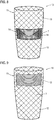
- Fig. 5 shows a plan view of the structural section 7 in a somewhat stretched state, so that the individual sections are clearly visible.
- the arrow L also indicates the longitudinal direction of the knitted fabric, that is to say the direction of the wales, and the arrow Q indicates the transverse direction of the knitted fabric, that is to say the width direction perpendicular to the wales.
- Fig. 6 shows a first example of a knitted part 10 according to the invention here in the form of a knee bandage 11. It is a tubular knitted part 10 that is knitted on a flat knitting machine with two needle beds and then connected to the tubular shape via a longitudinal seam.
- the knitted part 10 here has three distinguishable knitted fabric areas, namely a first basic knitted fabric area 12 which is knitted from the knitted fabric 3 with inserted weft thread 4 in a basic knitted fabric of any type.
- This first basic knitted region 12 is followed by the structural section 7, which is knitted in the manner according to the invention as described above.
- This is then followed in the direction of the wales by a second basic knitted area 13 made of knitted thread 3 with inserted weft thread 4, which is also knitted in any basic knitted fabric, which can be the same as in basic knitted area 12, but can also be different.
- the structural section 7 runs around completely, that is to say by 360 °, and forms a ring shape.
- the raised or meandering rows of stitches are shown by the transverse lines.
- Fig. 7 shows a knitted part 10 of a second embodiment, again in the form of a knee bandage 11, in which a large basic knitted area 12 is knitted, in which the structural area 7 is embedded on all sides.
- the circumferential area around which the rows of stitches 8, 9 or the structural area 7 is knitted can vary as required, depending on the form of application or the desired wearing comfort, etc.
- Fig. 8 shows a third embodiment of a knitted part 10 according to the invention again in the form of a knee bandage 11.
- This knitted part 10 also has a basic knitted area 12 in which a first structural area 7 is embedded, which is therefore completely surrounded by the basic knitted area 12.
- This Structural area 7 is in the wearing position in the hollow of the knee, that is to say that Fig. 8 the back of the bandage shows.
- the structure area 7 is knitted with a gusset 14 on both sides, as is shown by the clearly shorter, non-continuous lines that represent shorter rows of stitches.
- a gusset 14 is produced by knitting short rows of stitches between continuous rows of stitches, that is, viewed in the direction of the wales (L in Fig. 5 ) the number of courses within the wales in cross direction (Q in Fig. 5 ) of the knit varies. This enables a geometric shaping of the entire knitted fabric.
- Fig. 9 finally shows the front side of the knitted part 10 or the knee support 11 Fig. 8 with the basic knitted area 12 as well as a second structural section 7, which here is also only knitted in sections, that is, does not run around completely, and which is knitted free of gouges. It is located, for example, further above the first structural section 7 located on the other side and in the wearing position above the kneecap, which is enclosed or overlapped or the like, for example, by a pad or the like integrated in the knitted part 10, not shown in detail.
- the knitted part 10 is preferably a compression knitted fabric, which thus exerts a defined compression pressure on the underlying tissue.
- the knitted part 10 can also be of a different type, for example a simple leg stocking, for example a compressive thrombosis stocking, or an arm stocking with compressive properties, or an orthosis or the like, the list not being limited to this.
Landscapes
- Engineering & Computer Science (AREA)
- Textile Engineering (AREA)
- Knitting Of Fabric (AREA)
Priority Applications (2)
| Application Number | Priority Date | Filing Date | Title |
|---|---|---|---|
| EP19158771.6A EP3699342B1 (fr) | 2019-02-22 | 2019-02-22 | Procédé de fabrication d'une pièce tricotée ainsi que pièce tricotée |
| ES19158771T ES2904363T3 (es) | 2019-02-22 | 2019-02-22 | Procedimiento para la fabricación de una pieza de punto, así como pieza de punto |
Applications Claiming Priority (1)
| Application Number | Priority Date | Filing Date | Title |
|---|---|---|---|
| EP19158771.6A EP3699342B1 (fr) | 2019-02-22 | 2019-02-22 | Procédé de fabrication d'une pièce tricotée ainsi que pièce tricotée |
Publications (2)
| Publication Number | Publication Date |
|---|---|
| EP3699342A1 true EP3699342A1 (fr) | 2020-08-26 |
| EP3699342B1 EP3699342B1 (fr) | 2021-11-17 |
Family
ID=65529501
Family Applications (1)
| Application Number | Title | Priority Date | Filing Date |
|---|---|---|---|
| EP19158771.6A Active EP3699342B1 (fr) | 2019-02-22 | 2019-02-22 | Procédé de fabrication d'une pièce tricotée ainsi que pièce tricotée |
Country Status (2)
| Country | Link |
|---|---|
| EP (1) | EP3699342B1 (fr) |
| ES (1) | ES2904363T3 (fr) |
Cited By (1)
| Publication number | Priority date | Publication date | Assignee | Title |
|---|---|---|---|---|
| DE102022121165A1 (de) * | 2022-08-22 | 2024-02-22 | Julius Zorn Gmbh | Kompressionsgestrick und Verfahren zur Herstellung eines Kompressionsgestricks, insbesondere zur Herstellung von gestrickten Stumpfstrümpfen mit kompressiver Wirkung |
Citations (3)
| Publication number | Priority date | Publication date | Assignee | Title |
|---|---|---|---|---|
| DE4237389A1 (de) * | 1992-11-05 | 1994-05-11 | Beiersdorf Ag | Bandage für das Kniegelenk |
| WO1997039172A1 (fr) * | 1996-04-16 | 1997-10-23 | Ferd. Hauber Gmbh & Co. Kg | Textile tricote faisant partie de bandages ou d'autres auxiliaires orthopediques |
| US20070051137A1 (en) * | 2003-10-10 | 2007-03-08 | Shima Seiki Mfg., Ltd. | Knitting method of tubular knitted fabric with projection, and tubular knitted fabric with projection |
-
2019
- 2019-02-22 EP EP19158771.6A patent/EP3699342B1/fr active Active
- 2019-02-22 ES ES19158771T patent/ES2904363T3/es active Active
Patent Citations (3)
| Publication number | Priority date | Publication date | Assignee | Title |
|---|---|---|---|---|
| DE4237389A1 (de) * | 1992-11-05 | 1994-05-11 | Beiersdorf Ag | Bandage für das Kniegelenk |
| WO1997039172A1 (fr) * | 1996-04-16 | 1997-10-23 | Ferd. Hauber Gmbh & Co. Kg | Textile tricote faisant partie de bandages ou d'autres auxiliaires orthopediques |
| US20070051137A1 (en) * | 2003-10-10 | 2007-03-08 | Shima Seiki Mfg., Ltd. | Knitting method of tubular knitted fabric with projection, and tubular knitted fabric with projection |
Cited By (1)
| Publication number | Priority date | Publication date | Assignee | Title |
|---|---|---|---|---|
| DE102022121165A1 (de) * | 2022-08-22 | 2024-02-22 | Julius Zorn Gmbh | Kompressionsgestrick und Verfahren zur Herstellung eines Kompressionsgestricks, insbesondere zur Herstellung von gestrickten Stumpfstrümpfen mit kompressiver Wirkung |
Also Published As
| Publication number | Publication date |
|---|---|
| EP3699342B1 (fr) | 2021-11-17 |
| ES2904363T3 (es) | 2022-04-04 |
Similar Documents
| Publication | Publication Date | Title |
|---|---|---|
| EP2792774B1 (fr) | Tricot circulaire compressif destiné à être enfilé sur une extrémité présentant une articulation | |
| EP3214213B1 (fr) | Pièce tricotée sur métier tubulaire et son procédé de production | |
| DE2458649A1 (de) | Einteilige nahtlose unterhose und verfahren zur herstellung derselben | |
| EP3673878B1 (fr) | Article de contention tricoté | |
| EP3246439B1 (fr) | Piece tricotee | |
| DE102015115228B3 (de) | Flachgestrick in Form eines das Gesäß umfassenden Hosenteils, kompressive Hose umfassend ein solches Flachgestrick sowie Verfahren zur Herstellung eines solchen Flachgestricks | |
| DE102007063148A1 (de) | Nahtloses Kompressionsgestrick und Verfahren zu dessen Herstellung | |
| DE2841836A1 (de) | Verfahren zum stricken eines mit aermel versehenen kleidungsstuecks | |
| EP3412816B1 (fr) | Tricot de compression d'un tricot de base et d'un fils de trame élastique introduit dans ledit tricot de base, article de contention incorporant ledit tricot de compression ainsi que procédé de fabrication d'un tricot de compression | |
| EP3141644B1 (fr) | Piece tricotee compressive et procede de fabrication | |
| DE102015012153A1 (de) | Verfahren zum Stricken eines Gestricks | |
| DE102015100936B4 (de) | Verfahren zur Herstellung eines Gestrickteils, insbesondere einer Bandage, sowie Gestrickteil | |
| EP4137626B1 (fr) | Procédé de fabrication d'un article de compression sans couture sur un métier à tricoter rectiligne | |
| EP3699342B1 (fr) | Procédé de fabrication d'une pièce tricotée ainsi que pièce tricotée | |
| EP3640383B1 (fr) | Pièce tricotée | |
| EP1378596B1 (fr) | Procédé pour la réalisation d'un tricot ayant une section tubulaire | |
| DE102015110313B4 (de) | Rundgestrick | |
| DE102015122018B4 (de) | Kompressives Strickteil | |
| EP2848235B1 (fr) | Article de compression | |
| DE202016101785U1 (de) | Gestrickteil | |
| EP4328366A1 (fr) | Tricot de compression et procédé de fabrication d'un tricot de compression, en particulier pour la fabrication de bas de moignon tricotés à effet de compression | |
| EP0724869A1 (fr) | Bas contre la thrombose ou partie de bas d'un collant contre la thrombose et procédé pour leur fabrication | |
| DE202022104736U1 (de) | Kompressionsgestrick, insbesondere zur Herstellung von gestrickten Stumpfstrümpfen mit kompressiver Wirkung | |
| EP2199445A1 (fr) | Habillement de jambe tricoté et son procédé de fabrication | |
| DE102016003893A1 (de) | Stützwäsche und Verfahren zum Stricken von dieser |
Legal Events
| Date | Code | Title | Description |
|---|---|---|---|
| PUAI | Public reference made under article 153(3) epc to a published international application that has entered the european phase |
Free format text: ORIGINAL CODE: 0009012 |
|
| STAA | Information on the status of an ep patent application or granted ep patent |
Free format text: STATUS: THE APPLICATION HAS BEEN PUBLISHED |
|
| AK | Designated contracting states |
Kind code of ref document: A1 Designated state(s): AL AT BE BG CH CY CZ DE DK EE ES FI FR GB GR HR HU IE IS IT LI LT LU LV MC MK MT NL NO PL PT RO RS SE SI SK SM TR |
|
| AX | Request for extension of the european patent |
Extension state: BA ME |
|
| STAA | Information on the status of an ep patent application or granted ep patent |
Free format text: STATUS: REQUEST FOR EXAMINATION WAS MADE |
|
| 17P | Request for examination filed |
Effective date: 20210210 |
|
| RBV | Designated contracting states (corrected) |
Designated state(s): AL AT BE BG CH CY CZ DE DK EE ES FI FR GB GR HR HU IE IS IT LI LT LU LV MC MK MT NL NO PL PT RO RS SE SI SK SM TR |
|
| GRAP | Despatch of communication of intention to grant a patent |
Free format text: ORIGINAL CODE: EPIDOSNIGR1 |
|
| STAA | Information on the status of an ep patent application or granted ep patent |
Free format text: STATUS: GRANT OF PATENT IS INTENDED |
|
| INTG | Intention to grant announced |
Effective date: 20210804 |
|
| GRAS | Grant fee paid |
Free format text: ORIGINAL CODE: EPIDOSNIGR3 |
|
| GRAA | (expected) grant |
Free format text: ORIGINAL CODE: 0009210 |
|
| STAA | Information on the status of an ep patent application or granted ep patent |
Free format text: STATUS: THE PATENT HAS BEEN GRANTED |
|
| AK | Designated contracting states |
Kind code of ref document: B1 Designated state(s): AL AT BE BG CH CY CZ DE DK EE ES FI FR GB GR HR HU IE IS IT LI LT LU LV MC MK MT NL NO PL PT RO RS SE SI SK SM TR |
|
| REG | Reference to a national code |
Ref country code: GB Ref legal event code: FG4D Free format text: NOT ENGLISH |
|
| REG | Reference to a national code |
Ref country code: DE Ref legal event code: R096 Ref document number: 502019002745 Country of ref document: DE |
|
| REG | Reference to a national code |
Ref country code: IE Ref legal event code: FG4D Free format text: LANGUAGE OF EP DOCUMENT: GERMAN |
|
| REG | Reference to a national code |
Ref country code: AT Ref legal event code: REF Ref document number: 1448133 Country of ref document: AT Kind code of ref document: T Effective date: 20211215 |
|
| REG | Reference to a national code |
Ref country code: LT Ref legal event code: MG9D |
|
| REG | Reference to a national code |
Ref country code: NL Ref legal event code: MP Effective date: 20211117 |
|
| REG | Reference to a national code |
Ref country code: ES Ref legal event code: FG2A Ref document number: 2904363 Country of ref document: ES Kind code of ref document: T3 Effective date: 20220404 |
|
| PG25 | Lapsed in a contracting state [announced via postgrant information from national office to epo] |
Ref country code: RS Free format text: LAPSE BECAUSE OF FAILURE TO SUBMIT A TRANSLATION OF THE DESCRIPTION OR TO PAY THE FEE WITHIN THE PRESCRIBED TIME-LIMIT Effective date: 20211117 Ref country code: LT Free format text: LAPSE BECAUSE OF FAILURE TO SUBMIT A TRANSLATION OF THE DESCRIPTION OR TO PAY THE FEE WITHIN THE PRESCRIBED TIME-LIMIT Effective date: 20211117 Ref country code: FI Free format text: LAPSE BECAUSE OF FAILURE TO SUBMIT A TRANSLATION OF THE DESCRIPTION OR TO PAY THE FEE WITHIN THE PRESCRIBED TIME-LIMIT Effective date: 20211117 Ref country code: BG Free format text: LAPSE BECAUSE OF FAILURE TO SUBMIT A TRANSLATION OF THE DESCRIPTION OR TO PAY THE FEE WITHIN THE PRESCRIBED TIME-LIMIT Effective date: 20220217 |
|
| PG25 | Lapsed in a contracting state [announced via postgrant information from national office to epo] |
Ref country code: IS Free format text: LAPSE BECAUSE OF FAILURE TO SUBMIT A TRANSLATION OF THE DESCRIPTION OR TO PAY THE FEE WITHIN THE PRESCRIBED TIME-LIMIT Effective date: 20220317 Ref country code: SE Free format text: LAPSE BECAUSE OF FAILURE TO SUBMIT A TRANSLATION OF THE DESCRIPTION OR TO PAY THE FEE WITHIN THE PRESCRIBED TIME-LIMIT Effective date: 20211117 Ref country code: PT Free format text: LAPSE BECAUSE OF FAILURE TO SUBMIT A TRANSLATION OF THE DESCRIPTION OR TO PAY THE FEE WITHIN THE PRESCRIBED TIME-LIMIT Effective date: 20220317 Ref country code: PL Free format text: LAPSE BECAUSE OF FAILURE TO SUBMIT A TRANSLATION OF THE DESCRIPTION OR TO PAY THE FEE WITHIN THE PRESCRIBED TIME-LIMIT Effective date: 20211117 Ref country code: NO Free format text: LAPSE BECAUSE OF FAILURE TO SUBMIT A TRANSLATION OF THE DESCRIPTION OR TO PAY THE FEE WITHIN THE PRESCRIBED TIME-LIMIT Effective date: 20220217 Ref country code: NL Free format text: LAPSE BECAUSE OF FAILURE TO SUBMIT A TRANSLATION OF THE DESCRIPTION OR TO PAY THE FEE WITHIN THE PRESCRIBED TIME-LIMIT Effective date: 20211117 Ref country code: LV Free format text: LAPSE BECAUSE OF FAILURE TO SUBMIT A TRANSLATION OF THE DESCRIPTION OR TO PAY THE FEE WITHIN THE PRESCRIBED TIME-LIMIT Effective date: 20211117 Ref country code: HR Free format text: LAPSE BECAUSE OF FAILURE TO SUBMIT A TRANSLATION OF THE DESCRIPTION OR TO PAY THE FEE WITHIN THE PRESCRIBED TIME-LIMIT Effective date: 20211117 Ref country code: GR Free format text: LAPSE BECAUSE OF FAILURE TO SUBMIT A TRANSLATION OF THE DESCRIPTION OR TO PAY THE FEE WITHIN THE PRESCRIBED TIME-LIMIT Effective date: 20220218 |
|
| PG25 | Lapsed in a contracting state [announced via postgrant information from national office to epo] |
Ref country code: SM Free format text: LAPSE BECAUSE OF FAILURE TO SUBMIT A TRANSLATION OF THE DESCRIPTION OR TO PAY THE FEE WITHIN THE PRESCRIBED TIME-LIMIT Effective date: 20211117 Ref country code: SK Free format text: LAPSE BECAUSE OF FAILURE TO SUBMIT A TRANSLATION OF THE DESCRIPTION OR TO PAY THE FEE WITHIN THE PRESCRIBED TIME-LIMIT Effective date: 20211117 Ref country code: RO Free format text: LAPSE BECAUSE OF FAILURE TO SUBMIT A TRANSLATION OF THE DESCRIPTION OR TO PAY THE FEE WITHIN THE PRESCRIBED TIME-LIMIT Effective date: 20211117 Ref country code: EE Free format text: LAPSE BECAUSE OF FAILURE TO SUBMIT A TRANSLATION OF THE DESCRIPTION OR TO PAY THE FEE WITHIN THE PRESCRIBED TIME-LIMIT Effective date: 20211117 Ref country code: DK Free format text: LAPSE BECAUSE OF FAILURE TO SUBMIT A TRANSLATION OF THE DESCRIPTION OR TO PAY THE FEE WITHIN THE PRESCRIBED TIME-LIMIT Effective date: 20211117 Ref country code: CZ Free format text: LAPSE BECAUSE OF FAILURE TO SUBMIT A TRANSLATION OF THE DESCRIPTION OR TO PAY THE FEE WITHIN THE PRESCRIBED TIME-LIMIT Effective date: 20211117 |
|
| REG | Reference to a national code |
Ref country code: DE Ref legal event code: R097 Ref document number: 502019002745 Country of ref document: DE |
|
| PLBE | No opposition filed within time limit |
Free format text: ORIGINAL CODE: 0009261 |
|
| STAA | Information on the status of an ep patent application or granted ep patent |
Free format text: STATUS: NO OPPOSITION FILED WITHIN TIME LIMIT |
|
| PG25 | Lapsed in a contracting state [announced via postgrant information from national office to epo] |
Ref country code: MC Free format text: LAPSE BECAUSE OF FAILURE TO SUBMIT A TRANSLATION OF THE DESCRIPTION OR TO PAY THE FEE WITHIN THE PRESCRIBED TIME-LIMIT Effective date: 20211117 |
|
| REG | Reference to a national code |
Ref country code: CH Ref legal event code: PL |
|
| REG | Reference to a national code |
Ref country code: BE Ref legal event code: MM Effective date: 20220228 |
|
| 26N | No opposition filed |
Effective date: 20220818 |
|
| PG25 | Lapsed in a contracting state [announced via postgrant information from national office to epo] |
Ref country code: AL Free format text: LAPSE BECAUSE OF FAILURE TO SUBMIT A TRANSLATION OF THE DESCRIPTION OR TO PAY THE FEE WITHIN THE PRESCRIBED TIME-LIMIT Effective date: 20211117 Ref country code: LU Free format text: LAPSE BECAUSE OF NON-PAYMENT OF DUE FEES Effective date: 20220222 |
|
| PG25 | Lapsed in a contracting state [announced via postgrant information from national office to epo] |
Ref country code: SI Free format text: LAPSE BECAUSE OF FAILURE TO SUBMIT A TRANSLATION OF THE DESCRIPTION OR TO PAY THE FEE WITHIN THE PRESCRIBED TIME-LIMIT Effective date: 20211117 |
|
| PG25 | Lapsed in a contracting state [announced via postgrant information from national office to epo] |
Ref country code: LI Free format text: LAPSE BECAUSE OF NON-PAYMENT OF DUE FEES Effective date: 20220228 Ref country code: IE Free format text: LAPSE BECAUSE OF NON-PAYMENT OF DUE FEES Effective date: 20220222 Ref country code: CH Free format text: LAPSE BECAUSE OF NON-PAYMENT OF DUE FEES Effective date: 20220228 |
|
| PG25 | Lapsed in a contracting state [announced via postgrant information from national office to epo] |
Ref country code: BE Free format text: LAPSE BECAUSE OF NON-PAYMENT OF DUE FEES Effective date: 20220228 |
|
| P01 | Opt-out of the competence of the unified patent court (upc) registered |
Effective date: 20230427 |
|
| GBPC | Gb: european patent ceased through non-payment of renewal fee |
Effective date: 20230222 |
|
| PG25 | Lapsed in a contracting state [announced via postgrant information from national office to epo] |
Ref country code: GB Free format text: LAPSE BECAUSE OF NON-PAYMENT OF DUE FEES Effective date: 20230222 |
|
| PG25 | Lapsed in a contracting state [announced via postgrant information from national office to epo] |
Ref country code: GB Free format text: LAPSE BECAUSE OF NON-PAYMENT OF DUE FEES Effective date: 20230222 |
|
| PG25 | Lapsed in a contracting state [announced via postgrant information from national office to epo] |
Ref country code: MK Free format text: LAPSE BECAUSE OF FAILURE TO SUBMIT A TRANSLATION OF THE DESCRIPTION OR TO PAY THE FEE WITHIN THE PRESCRIBED TIME-LIMIT Effective date: 20211117 Ref country code: CY Free format text: LAPSE BECAUSE OF FAILURE TO SUBMIT A TRANSLATION OF THE DESCRIPTION OR TO PAY THE FEE WITHIN THE PRESCRIBED TIME-LIMIT Effective date: 20211117 |
|
| PG25 | Lapsed in a contracting state [announced via postgrant information from national office to epo] |
Ref country code: HU Free format text: LAPSE BECAUSE OF FAILURE TO SUBMIT A TRANSLATION OF THE DESCRIPTION OR TO PAY THE FEE WITHIN THE PRESCRIBED TIME-LIMIT; INVALID AB INITIO Effective date: 20190222 |
|
| PGFP | Annual fee paid to national office [announced via postgrant information from national office to epo] |
Ref country code: IT Payment date: 20240228 Year of fee payment: 6 Ref country code: FR Payment date: 20240222 Year of fee payment: 6 |
|
| PGFP | Annual fee paid to national office [announced via postgrant information from national office to epo] |
Ref country code: ES Payment date: 20240328 Year of fee payment: 6 |
|
| PG25 | Lapsed in a contracting state [announced via postgrant information from national office to epo] |
Ref country code: MT Free format text: LAPSE BECAUSE OF FAILURE TO SUBMIT A TRANSLATION OF THE DESCRIPTION OR TO PAY THE FEE WITHIN THE PRESCRIBED TIME-LIMIT Effective date: 20211117 |
|
| PGFP | Annual fee paid to national office [announced via postgrant information from national office to epo] |
Ref country code: DE Payment date: 20250218 Year of fee payment: 7 |
|
| REG | Reference to a national code |
Ref country code: AT Ref legal event code: MM01 Ref document number: 1448133 Country of ref document: AT Kind code of ref document: T Effective date: 20240222 |
|
| PG25 | Lapsed in a contracting state [announced via postgrant information from national office to epo] |
Ref country code: AT Free format text: LAPSE BECAUSE OF NON-PAYMENT OF DUE FEES Effective date: 20240222 |
|
| PG25 | Lapsed in a contracting state [announced via postgrant information from national office to epo] |
Ref country code: TR Free format text: LAPSE BECAUSE OF FAILURE TO SUBMIT A TRANSLATION OF THE DESCRIPTION OR TO PAY THE FEE WITHIN THE PRESCRIBED TIME-LIMIT Effective date: 20211117 |
|
| PG25 | Lapsed in a contracting state [announced via postgrant information from national office to epo] |
Ref country code: IT Free format text: LAPSE BECAUSE OF NON-PAYMENT OF DUE FEES Effective date: 20250222 Ref country code: FR Free format text: LAPSE BECAUSE OF NON-PAYMENT OF DUE FEES Effective date: 20250228 |
|
| REG | Reference to a national code |
Ref country code: ES Ref legal event code: FD2A Effective date: 20260330 |
|
| PG25 | Lapsed in a contracting state [announced via postgrant information from national office to epo] |
Ref country code: ES Free format text: LAPSE BECAUSE OF NON-PAYMENT OF DUE FEES Effective date: 20250223 |
|
| PGFP | Annual fee paid to national office [announced via postgrant information from national office to epo] |
Ref country code: AT Payment date: 20260410 Year of fee payment: 5 |