EP3699708B1 - Vorrichtung zur überwachung einer produktionsanlage, verfahren zur überwachung einer produktionsanlage und programm zur überwachung einer produktionsanlage - Google Patents
Vorrichtung zur überwachung einer produktionsanlage, verfahren zur überwachung einer produktionsanlage und programm zur überwachung einer produktionsanlage Download PDFInfo
- Publication number
- EP3699708B1 EP3699708B1 EP17929217.2A EP17929217A EP3699708B1 EP 3699708 B1 EP3699708 B1 EP 3699708B1 EP 17929217 A EP17929217 A EP 17929217A EP 3699708 B1 EP3699708 B1 EP 3699708B1
- Authority
- EP
- European Patent Office
- Prior art keywords
- production facility
- main component
- log data
- text feature
- feature amount
- Prior art date
- Legal status (The legal status is an assumption and is not a legal conclusion. Google has not performed a legal analysis and makes no representation as to the accuracy of the status listed.)
- Active
Links
Images




Classifications
-
- G—PHYSICS
- G05—CONTROLLING; REGULATING
- G05B—CONTROL OR REGULATING SYSTEMS IN GENERAL; FUNCTIONAL ELEMENTS OF SUCH SYSTEMS; MONITORING OR TESTING ARRANGEMENTS FOR SUCH SYSTEMS OR ELEMENTS
- G05B23/00—Testing or monitoring of control systems or parts thereof
- G05B23/02—Electric testing or monitoring
- G05B23/0205—Electric testing or monitoring by means of a monitoring system capable of detecting and responding to faults
- G05B23/0218—Electric testing or monitoring by means of a monitoring system capable of detecting and responding to faults characterised by the fault detection method dealing with either existing or incipient faults
- G05B23/0243—Electric testing or monitoring by means of a monitoring system capable of detecting and responding to faults characterised by the fault detection method dealing with either existing or incipient faults model based detection method, e.g. first-principles knowledge model
- G05B23/0245—Electric testing or monitoring by means of a monitoring system capable of detecting and responding to faults characterised by the fault detection method dealing with either existing or incipient faults model based detection method, e.g. first-principles knowledge model based on a qualitative model, e.g. rule based; if-then decisions
-
- G—PHYSICS
- G05—CONTROLLING; REGULATING
- G05B—CONTROL OR REGULATING SYSTEMS IN GENERAL; FUNCTIONAL ELEMENTS OF SUCH SYSTEMS; MONITORING OR TESTING ARRANGEMENTS FOR SUCH SYSTEMS OR ELEMENTS
- G05B23/00—Testing or monitoring of control systems or parts thereof
- G05B23/02—Electric testing or monitoring
- G05B23/0205—Electric testing or monitoring by means of a monitoring system capable of detecting and responding to faults
- G05B23/0218—Electric testing or monitoring by means of a monitoring system capable of detecting and responding to faults characterised by the fault detection method dealing with either existing or incipient faults
- G05B23/0224—Process history based detection method, e.g. whereby history implies the availability of large amounts of data
- G05B23/0227—Qualitative history assessment, whereby the type of data acted upon, e.g. waveforms, images or patterns, is not relevant, e.g. rule based assessment; if-then decisions
- G05B23/0229—Qualitative history assessment, whereby the type of data acted upon, e.g. waveforms, images or patterns, is not relevant, e.g. rule based assessment; if-then decisions knowledge based, e.g. expert systems; genetic algorithms
-
- G—PHYSICS
- G05—CONTROLLING; REGULATING
- G05B—CONTROL OR REGULATING SYSTEMS IN GENERAL; FUNCTIONAL ELEMENTS OF SUCH SYSTEMS; MONITORING OR TESTING ARRANGEMENTS FOR SUCH SYSTEMS OR ELEMENTS
- G05B19/00—Program-control systems
- G05B19/02—Program-control systems electric
- G05B19/418—Total factory control, i.e. centrally controlling a plurality of machines, e.g. direct or distributed numerical control [DNC], flexible manufacturing systems [FMS], integrated manufacturing systems [IMS] or computer integrated manufacturing [CIM]
- G05B19/41875—Total factory control, i.e. centrally controlling a plurality of machines, e.g. direct or distributed numerical control [DNC], flexible manufacturing systems [FMS], integrated manufacturing systems [IMS] or computer integrated manufacturing [CIM] characterised by quality surveillance of production
-
- G—PHYSICS
- G06—COMPUTING OR CALCULATING; COUNTING
- G06N—COMPUTING ARRANGEMENTS BASED ON SPECIFIC COMPUTATIONAL MODELS
- G06N5/00—Computing arrangements using knowledge-based models
- G06N5/02—Knowledge representation; Symbolic representation
- G06N5/022—Knowledge engineering; Knowledge acquisition
- G06N5/025—Extracting rules from data
-
- G—PHYSICS
- G05—CONTROLLING; REGULATING
- G05B—CONTROL OR REGULATING SYSTEMS IN GENERAL; FUNCTIONAL ELEMENTS OF SUCH SYSTEMS; MONITORING OR TESTING ARRANGEMENTS FOR SUCH SYSTEMS OR ELEMENTS
- G05B2219/00—Program-control systems
- G05B2219/30—Nc systems
- G05B2219/32—Operator till task planning
- G05B2219/32179—Quality control, monitor production tool with multiple sensors
-
- G—PHYSICS
- G05—CONTROLLING; REGULATING
- G05B—CONTROL OR REGULATING SYSTEMS IN GENERAL; FUNCTIONAL ELEMENTS OF SUCH SYSTEMS; MONITORING OR TESTING ARRANGEMENTS FOR SUCH SYSTEMS OR ELEMENTS
- G05B2219/00—Program-control systems
- G05B2219/30—Nc systems
- G05B2219/32—Operator till task planning
- G05B2219/32196—Store audit, history of inspection, control and workpiece data into database
-
- G—PHYSICS
- G05—CONTROLLING; REGULATING
- G05B—CONTROL OR REGULATING SYSTEMS IN GENERAL; FUNCTIONAL ELEMENTS OF SUCH SYSTEMS; MONITORING OR TESTING ARRANGEMENTS FOR SUCH SYSTEMS OR ELEMENTS
- G05B2223/00—Indexing scheme associated with group G05B23/00
- G05B2223/02—Indirect monitoring, e.g. monitoring production to detect faults of a system
-
- G—PHYSICS
- G06—COMPUTING OR CALCULATING; COUNTING
- G06N—COMPUTING ARRANGEMENTS BASED ON SPECIFIC COMPUTATIONAL MODELS
- G06N20/00—Machine learning
- G06N20/10—Machine learning using kernel methods, e.g. support vector machines [SVM]
-
- G—PHYSICS
- G06—COMPUTING OR CALCULATING; COUNTING
- G06N—COMPUTING ARRANGEMENTS BASED ON SPECIFIC COMPUTATIONAL MODELS
- G06N20/00—Machine learning
- G06N20/20—Ensemble learning
-
- Y—GENERAL TAGGING OF NEW TECHNOLOGICAL DEVELOPMENTS; GENERAL TAGGING OF CROSS-SECTIONAL TECHNOLOGIES SPANNING OVER SEVERAL SECTIONS OF THE IPC; TECHNICAL SUBJECTS COVERED BY FORMER USPC CROSS-REFERENCE ART COLLECTIONS [XRACs] AND DIGESTS
- Y02—TECHNOLOGIES OR APPLICATIONS FOR MITIGATION OR ADAPTATION AGAINST CLIMATE CHANGE
- Y02P—CLIMATE CHANGE MITIGATION TECHNOLOGIES IN THE PRODUCTION OR PROCESSING OF GOODS
- Y02P90/00—Enabling technologies with a potential contribution to greenhouse gas [GHG] emissions mitigation
- Y02P90/02—Total factory control, e.g. smart factories, flexible manufacturing systems [FMS] or integrated manufacturing systems [IMS]
Definitions
- the present invention relates to a production facility monitoring device, a production facility monitoring method, and a production facility monitoring program.
- an item to be monitored is set in advance, and an abnormality that appears in the item to be monitored is detected. Therefore, an abnormality that appears in an item other than the item to be monitored cannot be detected.
- an object of the present invention is to provide a production facility monitoring device, a production facility monitoring method, and a production facility monitoring program that can determine an abnormal degree of a production facility with high accuracy on the basis of log data.
- a degree of abnormality of a production facility can be accurately determined on the basis of log data.
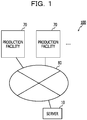
- FIG. 1 schematically illustrates a configuration of a production facility monitoring system 100 according to an embodiment.
- a network 80 such as the Internet or a Local Area Network (LAN).
- the production facility 70 is a facility used in a product production process.
- log data in which states of the facility and a product are written is generated.
- the log data generated by the production facility 70 is transmitted to the server 10 via the network 80.
- the server 10 is a device that determines a degree of abnormality (whether or not abnormality occurs, in present example) of the production facility 70 on the basis of the log data received from the production facility 70 and outputs a determination result.
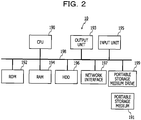
- FIG. 2 illustrates a hardware configuration of the server 10.
- the server 10 includes a Central Processing Unit (CPU) 190, a Read Only Memory (ROM) 192, a Random Access Memory (RAM) 194, a storage unit (here, Hard Disk Drive (HDD)) 196, a network interface 197, an output unit 193, an input unit 195, a portable storage medium drive 199, or the like.
- Each component of the server 10 is connected to a bus 198.
- the output unit 193 includes a liquid crystal display, a speaker, and the like.
- the input unit 195 includes a keyboard, a mouse, a touch panel, and the like.
- the CPU 190 executes a program (including production facility monitoring program) stored in the ROM 192 or the HDD 196 or a program (including production facility monitoring program) read by the portable storage medium drive 199 from a portable storage medium 191, to implement the functions of the units illustrated in FIG. 3 .
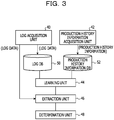
- FIG. 3 illustrates a functional block diagram of the server 10. As illustrated in FIG. 3 , in the server 10, by executing a program by the CPU 190, functions as a log acquisition unit 40, a production history information acquisition unit 42, a learning unit 44, an extraction unit 46, and a determination unit 48 are implemented.
- the log acquisition unit 40 acquires the log data transmitted from each production facility 70 and stores the log data in a log DB 50. Furthermore, in a case where the acquired log data is log data to be monitored, the log acquisition unit 40 transmits the acquired log data to the extraction unit 46.
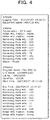
- the log data is data as illustrated in FIG. 4 .
- an apparatus name, a unit name, a program name, a lot number, a serial number, version information, each work record, error information, test data, a communication history, and the like are written.
- the log DB 50 is a database that stores the log data illustrated in FIG. 4 .
- the production history information acquisition unit 42 acquires production history information in which normal and abnormal states of the production facility 70 are recorded from the production facility 70 or other devices and stores the acquired information to the production history information DB 52.
- the production history information DB 52 has a data structure as illustrated in FIG. 5 .
- the production history information DB 52 includes fields of a unit name, a lot number, a serial number, an apparatus name, a process name, a start date and time, an end date and time, and pass/fail.
- the name of the production facility 70 is stored in the field of the unit name, a lot number and a serial number of a product produced in the production facility 70 are respectively stored in the fields of the lot number and the serial number.
- a name of a device including the production facility 70 is stored in the field of the apparatus name, and a name of a process performed by the production facility 70 is stored in the field of the process name.
- Information regarding a start date and time and information regarding an end date and time of the process performed by the production facility 70 are respectively stored in the fields of the start date and time and the end date and time, and information indicating pass or fail determined on the basis of the product (normal or abnormal) is stored in the field of pass/fail.
- the learning unit 44 generates a classification rule used to determine whether the production facility 70 is normal or abnormal from the log data to be monitored on the basis of the log data stored in the log DB 50 and the production history information stored in the production history information DB 52.
- the learning unit 44 extracts a text feature amount obtained from the number of texts (characters) included in each piece of log data.
- the text feature amount can be the number of characters of the text included in the log data, the number of bytes of the text included in the log data, the number of lines of the log data, the number of types of texts included in the log data (the number of all the types of character code included in log data), the number of characters of each numerical character included in the log data, the number of characters of each alphabetic character included in the log data, the number of characters of each symbol included in the log data, the number of characters of each Japanese character included in the log data, or a main component of a vector obtained by aggregating two or more items described above.
- the text feature amount includes a first main component and a second main component obtained by analyzing the main component of the vector including the number of characters of each numerical character, the number of characters of each alphabetic character, and the number of characters of each symbol.
- the text (character) means all the one-byte character of the JIS code.
- the number of alphabetic characters is a sum total of the number of uppercase and lowercase characters.
- the learning unit 44 creates a classification rule used to determine normal/abnormal from the text feature amount of the log data to be monitored on the basis of the text feature amount extracted from each piece of log data and the production history information (information indicating normal or abnormal) of the production facility 70 at the time when each piece of log data is obtained. Note that details of the classification rule will be further described later.
- the extraction unit 46 When acquiring the log data of the production facility 70 to be monitored from the log acquisition unit 40, the extraction unit 46 extracts a text feature amount of the acquired log data. Note that the text feature amount extracted by the extraction unit 46 is a feature amount which is the same as the text feature amount extracted from the log data at the time when the learning unit 44 creates the classification rule.
- the determination unit 48 determines whether the production facility 70 to be monitored is normal or abnormal by using the text feature amount extracted by the extraction unit 46 and the classification rule generated by the learning unit 44. In a case of determining that the production facility 70 to be monitored is abnormal, the determination unit 48 notifies the determination result via the output unit 193 (output warning).
- FIG. 6 illustrates a flowchart of an example of processing (learning processing) of the learning unit 44
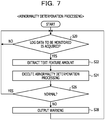
- FIG. 7 illustrates a flowchart of an example of processing (abnormality determination processing) of the extraction unit 46 and the determination unit 48.
- the learning unit 44 executes the processing in FIG. 6 at a predetermined learning timing.
- the predetermined learning timing is, for example, a timing for each predetermined time.
- the predetermined learning timing is not limited to this and can be a timing when a predetermined number of pieces of log data is newly stored in the log DB 50, for example.
- step S10 the learning unit 44 acquires existing log data from the log DB 50 and extracts a text feature amount.
- the learning unit 44 acquires the log data of the same process executed by the same production facility 70.
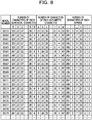
- FIG. 8 it is assumed that pieces of log data respectively having serial numbers 00159, 00160, ... have been acquired.
- the learning unit 44 obtains the number of characters of each numerical character, the number of characters of each alphabetic character, and the number of characters of each symbol from the log data as illustrated in FIG. 8 .
- the learning unit 44 extracts the first main component and the second main component obtained by analyzing the main component of the vector including the number of characters of each numerical character, the number of characters of each alphabetic character, and the number of characters of each symbol obtained from each piece of log data as the text feature amounts.
- the first main component and the second main component as the text feature amounts of each piece of log data are illustrated in a table.
- step S12 the learning unit 44 acquires production history information corresponding to the acquired log data from the production history information DB 52.
- the production history information corresponding to the log data is specified from the production history information DB 52 in FIG. 5 by using the serial number and the like, and information indicating pass/fail (normal/abnormal) when each piece of log data is acquired is acquired. Note that, in the table in FIG. 9 , the information indicating pass/fail (normal/abnormal) is associated with the serial number of the log data.
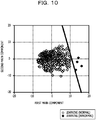
- step S14 the learning unit 44 learns (machine learning) a classification rule. Specifically, as illustrated in FIG. 10 , the learning unit 44 plots the text feature amount of each piece of log data on a graph, specifies a boundary that can classify normal and abnormal by two-class linear classification, and creates the classification rule used to classify a normal range and an abnormal range. In the example in FIG. 10 , the learning unit 44 creates the classification rule that classifies the left side of a boundary line (thick solid line) in FIG. 10 as normal and the right side as abnormal.
- a boundary line thin solid line
- step S14 when the processing up to step S14 is terminated, all the processing in FIG. 6 is terminated. Note that all the processes in the processing in FIG. 6 are executed.
- step S20 the extraction unit 46 waits until the log data to be monitored is acquired. In other words, when acquiring new log data from the log acquisition unit 40 as a monitoring target, the extraction unit 46 shifts to step S22.
- the extraction unit 46 extracts a text feature amount from the acquired log data to be monitored.
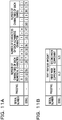
- the extraction unit 46 obtains the number of characters of each numerical character, the number of characters of each alphabetic character, and the number of characters of each symbol indicated in FIG. 11(a) from the log data. Then, the extraction unit 46 obtains a first main component and a second main component indicated in FIG. 11(b) by analyzing the main component of the vector including each of the obtained numbers of characters and sets the first main component and the second main component as text feature amounts.
- step S24 the determination unit 48 executes the abnormality determination processing. For example, in a case of the log data to be monitored in FIG. 11(b) , when the log data is plotted on a coordinate system in FIG. 12 on the basis of the first main component and the second main component, the log data is plotted on a position indicated by x. In this case, since the plotted position is positioned on the right side of the boundary line (thick solid line) defined by the classification rule, the determination unit 48 determines that the production facility 70 is "abnormal".
- step S26 the determination unit 48 determines whether or not the production facility 70 is normal. In a case where the determination in step S26 is affirmative (in a case of normal), the processing returns to step S20. On the other hand, in a case where the determination in step S26 is denied (in a case of abnormal), the processing shifts to step S28.
- the determination unit 48 In a case where the processing shifts to step S28, the determination unit 48 outputs a warning. In this case, the determination unit 48 notifies that an abnormality occurs in the production facility 70 by an image and/or sound via the output unit 193. Note that the notification is not limited to this, and the determination unit 48 may transmit warning information to an external device (terminal and the like) that can communicate with the server 10.
- step S28 After the processing in step S28 is terminated, the processing returns to step S20. Then, the processing is repeatedly executed.
- the learning unit 44 learns the classification rule that classifies an abnormal degree of the production facility 70 on the basis of the text feature amount (including a first main component and second main component) obtained from the number of characters in texts included in the plurality of pieces of log data obtained in a predetermined process of the production facility 70 and the production history information of the production facility, the extraction unit 46 extracts the text feature amount of the log data to be monitored obtained in the predetermined process of the production facility 70, and the determination unit 48 determines an abnormal degree of the production facility 70 when the log data to be monitored is obtained on the basis of the extracted text feature amount and the classification rule.
- the text feature amount including a first main component and second main component
- the first main component and the second main component obtained as a result of the main component analysis on the vector including the number of texts included in the log data are used as the text feature amounts. Therefore, even if the target character string and the like is not determined in advance, it is possible to set a classification rule with high accuracy, and it is possible to determine normality or abnormality with high accuracy.
- three or more main components obtained by the main component analysis can be used as the text feature amounts.
- the boundary that classifies normal and abnormal defined by the classification rule is a plane.
- the text feature amounts are the first main component and the second main component obtained as a result of the main component analysis on the vector including the number of texts included in the log data.
- the classification rule may be created by a plurality of methods, and the normal/abnormal determination may be made by using a classification rule with the highest determination accuracy among the plurality of created classification rules.
- the plurality of methods for creating the classification rule in addition to the method in the above embodiment, a method such as a decision tree, a support vector machine, a random forest, or the like can be used.
- so-called cross-validation may be performed in which the log data acquired from the log DB 50 is divided into two, and each classification rule is created by using one of the divided data, and the determination accuracy of each classification rule is obtained by using another one.
- the present invention is not limited to this, and it may be determined which one of three or more states the production facility 70 is in. In this case, for example, if "normal”, “abnormal”, “high abnormal tendency”, and the like is stored in the field of "pass/fail" in the production history information DB 52, the classification rule used to determine which one of the three or more states the production facility 70 is in can be created by creating the classification rule on the basis of this.
- processing functions can be implemented by a computer.
- a program is provided that describes processing content of a function that a processing apparatus should have.
- the program is executed on the computer, whereby the above processing function is implemented on the computer.
- the program in which the processing content is written can be recorded in a computer-readable reading medium (except for carrier wave).
- the program is sold in a form of a portable recording medium such as a digital versatile disc (DVD) or a compact disc read only memory (CD-ROM) in which the program is recorded. Furthermore, it is possible to store the program in a storage device of a server computer and transfer the program from the server computer to another computer through a network.
- DVD digital versatile disc
- CD-ROM compact disc read only memory
- the computer which executes the program stores, for example, the program recorded in the portable reading medium or the program transferred from the server computer in a storage device of the computer. Then, the computer reads the program from the storage device of the computer and executes processing according to the program. Note that, the computer can also read the program directly from the portable recording medium and execute processing according to the program. Furthermore, the computer also can sequentially execute processing according to the received program each time when the program is transferred from the server computer.
Landscapes
- Engineering & Computer Science (AREA)
- General Physics & Mathematics (AREA)
- Physics & Mathematics (AREA)
- Automation & Control Theory (AREA)
- General Engineering & Computer Science (AREA)
- Theoretical Computer Science (AREA)
- Software Systems (AREA)
- Data Mining & Analysis (AREA)
- Mathematical Physics (AREA)
- Computing Systems (AREA)
- Evolutionary Computation (AREA)
- Artificial Intelligence (AREA)
- Evolutionary Biology (AREA)
- Computational Linguistics (AREA)
- Quality & Reliability (AREA)
- Bioinformatics & Computational Biology (AREA)
- Bioinformatics & Cheminformatics (AREA)
- Life Sciences & Earth Sciences (AREA)
- Manufacturing & Machinery (AREA)
- General Factory Administration (AREA)
- Testing And Monitoring For Control Systems (AREA)
- Management, Administration, Business Operations System, And Electronic Commerce (AREA)
- Debugging And Monitoring (AREA)
- Computer Vision & Pattern Recognition (AREA)
- Medical Informatics (AREA)
Claims (11)
- Vorrichtung (10) zur Überwachung einer Produktionsanlage, die dazu ausgelegt ist, einen Zustand einer Produktionsanlage (70) zu überwachen, wobei die Vorrichtung umfasst:eine Lerneinheit (44), die dazu ausgelegt ist, eine Klassifizierungsregel zu lernen, die einen anormalen Grad der Produktionsanlage basierend auf einer Textmerkmalsmenge klassifiziert, die eine erste Hauptkomponente und eine zweite Hauptkomponente aufweist, die durch Durchführen einer Hauptkomponentenanalyse einer Hauptkomponente eines Vektors erhalten werden, der eine Anzahl von numerischen Zeichen, eine Anzahl von alphabetischen Zeichen und eine Anzahl von Symbolzeichen in Texten aufweist, die in einer Vielzahl von Stücken von Protokolldaten enthalten sind, die in einem vorbestimmten Prozess der Produktionsanlage, und Produktionsverlaufsinformationen, in denen normale und anormale Zustände der Produktionsanlage (70) aufgezeichnet werden, erhalten werden;eine Extraktionseinheit (46), die dazu ausgelegt ist, eine Textmerkmalsmenge aus zu überwachenden Protokolldaten, die in dem vorbestimmten Prozess der Produktionsanlage erhalten werden, zu extrahieren; undeine Bestimmungseinheit (48), die dazu ausgelegt ist, einen anormalen Grad der Produktionsanlage zu bestimmen, wenn die zu überwachenden Protokolldaten erhalten werden, basierend auf der von der Extraktionseinheit (46) extrahierten Textmerkmalsmenge und der Klassifizierungsregel.
- Vorrichtung (10) zur Überwachung einer Produktionsanlage nach Anspruch 1, wobei die Lerneinheit (44) dazu ausgelegt ist, die erste Hauptkomponente und die zweite Hauptkomponente in einem Graphen darzustellen und auf dem Graphen eine Grenze zu spezifizieren, die die normalen und anormalen Zustände der Produktionsanlage (70) klassifiziert, um die Klassifizierungsregel zu erzeugen.
- Vorrichtung (10) zur Überwachung einer Produktionsanlage nach Anspruch 2, wobei die Textmerkmalsmenge eine Hauptkomponente des Vektors ist, die durch Aggregieren der ersten Hauptkomponente und der zweiten Hauptkomponente erhalten wird.
- Vorrichtung (10) zur Überwachung einer Produktionsanlage nach Anspruch 2, wobei der Textmerkmalsbetrag eines von einer Differenz oder einem Korrelationskoeffizienten der ersten Hauptkomponente und der zweiten Hauptkomponente ist.
- Vorrichtung (10) zur Überwachung einer Produktionsanlage nach einem der Ansprüche 1 bis 4, wobei
die Lerneinheit (44) dazu ausgelegt ist, eine Klassifizierungsregel zu bestimmen, die zur Bestimmung durch die Bestimmungseinheit (48) verwendet wird, durch Erzeugen einer Vielzahl von Klassifizierungsregeln basierend auf unterschiedlichen Textmerkmalsmengen und Durchführen einer Kreuzvalidierung an der Vielzahl von Klassifizierungsregeln. - Verfahren zur Überwachung einer Produktionsanlage, das einen Zustand einer Produktionsanlage (70) überwacht, wobei das Verfahren einen Computer veranlasst, eine Verarbeitung auszuführen, die umfasst:Lernen (S14) einer Klassifizierungsregel, die einen anormalen Grad der Produktionsanlage basierend auf einer Textmerkmalsmenge klassifiziert, die eine erste Hauptkomponente und eine zweite Hauptkomponente aufweist, die durch Durchführen einer Hauptkomponentenanalyse an einer Hauptkomponente eines Vektors erhalten werden, der eine Anzahl von numerischen Zeichen, eine Anzahl von alphabetischen Zeichen und eine Anzahl von Symbolzeichen in Texten aufweist, die in einer Vielzahl von Stücken von Protokolldaten enthalten sind, die in einem vorbestimmten Prozess der Produktionsanlage und Produktionsverlaufsinformationen, in denen normale und anormale Zustände der Produktionsanlage (70) aufgezeichnet sind, erhalten werden;Extrahieren (S22) einer Textmerkmalsmenge von zu überwachenden Protokolldaten, die in dem vorbestimmten Prozess der Produktionsanlage erhalten werden; undBestimmen (S24) eines anormalen Grades der Produktionsanlage, wenn die zu überwachenden Protokolldaten erhalten werden, basierend auf der extrahierten Textmerkmalsmenge und der Klassifizierungsregel.
- Verfahren zur Überwachung einer Produktionsanlage nach Anspruch 6, wobei die Lernverarbeitung Darstellen der ersten Hauptkomponente und der zweiten Hauptkomponente in einem Graphen und Spezifizieren einer Grenze auf dem Graphen, die die normalen und anormalen Zustände der Produktionsanlage (70) klassifiziert, um die Klassifizierungsregel zu erzeugen, umfasst.
- Verfahren zur Überwachung einer Produktionsanlage nach Anspruch 7, wobei die Textmerkmalsmenge eine Hauptkomponente des Vektors ist, die durch Aggregieren der ersten Hauptkomponente und der zweiten Hauptkomponente erhalten wird.
- Verfahren zur Überwachung einer Produktionsanlage nach Anspruch 7, wobei die Textmerkmalsmenge eines von einer Differenz oder einem Korrelationskoeffizienten der ersten Hauptkomponente und der zweiten Hauptkomponente ist.
- Verfahren zur Überwachung einer Produktionsanlage nach einem der Ansprüche 6 bis 9, wobei bei der Lernverarbeitung eine zur Bestimmung verwendete Klassifizierungsregel durch Erzeugen einer Vielzahl von Klassifizierungsregeln basierend auf unterschiedlichen Textmerkmalsmengen und Durchführen einer Kreuzvalidierung an der Vielzahl von Klassifizierungsregeln bestimmt wird.
- Programm zur Überwachung einer Produktionsanlage, das einen Zustand einer Produktionsanlage (70) überwacht, wobei das Programm einen Computer veranlasst, eine Verarbeitung auszuführen, die umfasst:Lernen (S14) einer Klassifizierungsregel, die einen anormalen Grad der Produktionsanlage basierend auf einer Textmerkmalsmenge klassifiziert, die eine erste Hauptkomponente und eine zweite Hauptkomponente aufweist, die durch Durchführen einer Hauptkomponentenanalyse an einer Hauptkomponente eines Vektors erhalten wird, der eine Anzahl von numerischen Zeichen, eine Anzahl von alphabetischen Zeichen und eine Anzahl von Symbolzeichen in Texten aufweist, die in einer Vielzahl von Stücken von Protokolldaten enthalten sind, die in einem vorbestimmten Prozess der Produktionsanlage und Produktionsverlaufsinformationen, in denen normale und anormale Zustände der Produktionsanlage (70) aufgezeichnet sind, erhalten werden;Extrahieren (S22) einer Textmerkmalsmenge von zu überwachenden Protokolldaten, die in dem vorbestimmten Prozess der Produktionsanlage erhalten werden; undBestimmen (S24) eines anormalen Grades der Produktionsanlage, wenn die zu überwachenden Protokolldaten erhalten werden, basierend auf der extrahierten Textmerkmalsmenge und der Klassifizierungsregel.
Applications Claiming Priority (1)
| Application Number | Priority Date | Filing Date | Title |
|---|---|---|---|
| PCT/JP2017/037388 WO2019077656A1 (ja) | 2017-10-16 | 2017-10-16 | 生産設備監視装置、生産設備監視方法及び生産設備監視プログラム |
Publications (3)
| Publication Number | Publication Date |
|---|---|
| EP3699708A1 EP3699708A1 (de) | 2020-08-26 |
| EP3699708A4 EP3699708A4 (de) | 2020-09-09 |
| EP3699708B1 true EP3699708B1 (de) | 2021-07-28 |
Family
ID=66174386
Family Applications (1)
| Application Number | Title | Priority Date | Filing Date |
|---|---|---|---|
| EP17929217.2A Active EP3699708B1 (de) | 2017-10-16 | 2017-10-16 | Vorrichtung zur überwachung einer produktionsanlage, verfahren zur überwachung einer produktionsanlage und programm zur überwachung einer produktionsanlage |
Country Status (5)
| Country | Link |
|---|---|
| US (1) | US11650579B2 (de) |
| EP (1) | EP3699708B1 (de) |
| JP (1) | JP6866930B2 (de) |
| CN (1) | CN111133396B (de) |
| WO (1) | WO2019077656A1 (de) |
Families Citing this family (16)
| Publication number | Priority date | Publication date | Assignee | Title |
|---|---|---|---|---|
| RS63767B1 (sr) * | 2019-03-06 | 2022-12-30 | Komax Holding Ag | Računarski implementiran postupak za kontrolu većeg broja uređaja za obradu kablova i kontrolni sistem |
| US12523992B2 (en) | 2019-05-09 | 2026-01-13 | Dürr Systems Ag | Method for checking workpieces, checking facility and treatment facility |
| KR102885606B1 (ko) | 2019-05-09 | 2025-11-14 | 듀르 시스템스 아게 | 작업물 제어 방법, 제어 시스템 및 기계가공 시스템 |
| US12517504B2 (en) | 2019-05-09 | 2026-01-06 | Dürr Systems Ag | Analysis method and devices for same |
| CN113811828A (zh) | 2019-05-09 | 2021-12-17 | 杜尔系统股份公司 | 用于分析质量缺陷的方法 |
| WO2021095594A1 (ja) * | 2019-11-13 | 2021-05-20 | Jfeスチール株式会社 | 生産設備の監視方法、生産設備の監視装置、及び生産設備の操業方法 |
| CN114730180B (zh) | 2019-11-13 | 2025-11-04 | 杰富意钢铁株式会社 | 生产设备的运行方法以及运行系统 |
| US11556636B2 (en) * | 2020-06-30 | 2023-01-17 | Microsoft Technology Licensing, Llc | Malicious enterprise behavior detection tool |
| AU2020477732B2 (en) * | 2020-11-19 | 2024-02-01 | Ntt, Inc. | Estimation device, estimation method, and estimation program |
| US12158894B2 (en) * | 2022-10-21 | 2024-12-03 | Elementum Ltd | Systems and methods for a data-driven workflow platform |
| CN115794465B (zh) * | 2022-11-10 | 2023-12-19 | 上海鼎茂信息技术有限公司 | 一种日志异常检测方法及系统 |
| JP2024108614A (ja) * | 2023-01-31 | 2024-08-13 | オムロン株式会社 | 方法、プログラム、および、装置 |
| CN116430831B (zh) * | 2023-04-26 | 2023-10-31 | 宁夏五谷丰生物科技发展有限公司 | 应用于食用油生产控制系统的数据异常监控方法及系统 |
| CN116561397B (zh) * | 2023-05-26 | 2026-03-20 | 北京联想科技服务有限公司 | 一种数据处理方法、装置、设备及存储介质 |
| CN116846786A (zh) * | 2023-07-11 | 2023-10-03 | 上海洪朴信息科技有限公司 | 用于设备异常监测的哨兵系统及设备异常监测方法 |
| CN121051078B (zh) * | 2025-10-31 | 2026-02-10 | 宁波芯联心医疗科技有限公司 | 基于大数据的医疗传感设备生产日志分析方法及装置 |
Family Cites Families (17)
| Publication number | Priority date | Publication date | Assignee | Title |
|---|---|---|---|---|
| JPH0850507A (ja) | 1994-06-01 | 1996-02-20 | Nippondenso Co Ltd | 異常復帰手順教示システム |
| JP2008118068A (ja) | 2006-11-08 | 2008-05-22 | Renesas Technology Corp | 半導体装置の生産管理システム |
| JP5301310B2 (ja) * | 2009-02-17 | 2013-09-25 | 株式会社日立製作所 | 異常検知方法及び異常検知システム |
| CN101556553B (zh) * | 2009-03-27 | 2011-04-06 | 中国科学院软件研究所 | 基于需求变更的缺陷预测方法和系统 |
| JP5363927B2 (ja) | 2009-09-07 | 2013-12-11 | 株式会社日立製作所 | 異常検知・診断方法、異常検知・診断システム、及び異常検知・診断プログラム |
| JP5601231B2 (ja) | 2011-02-01 | 2014-10-08 | 株式会社デンソー | 製造ライン監視システム |
| JP5591871B2 (ja) * | 2012-06-04 | 2014-09-17 | 日本電信電話株式会社 | 回答タイプ推定装置、方法、及びプログラム |
| CN103177215B (zh) * | 2013-03-05 | 2016-01-20 | 四川电力科学研究院 | 基于软件控制流特征的计算机恶意软件检测新方法 |
| JP6075238B2 (ja) * | 2013-08-01 | 2017-02-08 | 株式会社デンソー | 文字認識装置および文字認識方法 |
| CN103514398B (zh) * | 2013-10-18 | 2016-08-17 | 中国科学院信息工程研究所 | 一种实时在线日志检测方法及系统 |
| WO2015072085A1 (ja) | 2013-11-12 | 2015-05-21 | 日本電気株式会社 | ログ分析システム、ログ分析方法、および、記憶媒体 |
| CN106415507B (zh) * | 2014-06-06 | 2019-05-21 | 日本电信电话株式会社 | 日志分析装置、攻击检测装置、攻击检测方法以及程序 |
| EP3015936B1 (de) * | 2014-10-31 | 2016-09-07 | Sap Se | System und Verfahren zur Erzeugung von Anweisungen zum Reparieren eines elektromechanischen Systems |
| DE102015225144A1 (de) * | 2015-12-14 | 2017-06-14 | Siemens Aktiengesellschaft | System und Verfahren zur Diagnose von zumindest einer wartungsbedürftigen Komponente eines Geräts und/oder Anlage |
| WO2017149598A1 (ja) * | 2016-02-29 | 2017-09-08 | 三菱電機株式会社 | 機器分類装置 |
| WO2017154844A1 (ja) * | 2016-03-07 | 2017-09-14 | 日本電信電話株式会社 | 分析装置、分析方法および分析プログラム |
| CN106940679B (zh) * | 2017-02-23 | 2020-10-02 | 中科创达软件股份有限公司 | 数据处理方法及装置 |
-
2017
- 2017-10-16 EP EP17929217.2A patent/EP3699708B1/de active Active
- 2017-10-16 CN CN201780095024.1A patent/CN111133396B/zh not_active Expired - Fee Related
- 2017-10-16 WO PCT/JP2017/037388 patent/WO2019077656A1/ja not_active Ceased
- 2017-10-16 JP JP2019548801A patent/JP6866930B2/ja not_active Expired - Fee Related
-
2020
- 2020-03-05 US US16/809,713 patent/US11650579B2/en active Active
Also Published As
| Publication number | Publication date |
|---|---|
| JPWO2019077656A1 (ja) | 2020-07-30 |
| WO2019077656A1 (ja) | 2019-04-25 |
| US11650579B2 (en) | 2023-05-16 |
| EP3699708A1 (de) | 2020-08-26 |
| JP6866930B2 (ja) | 2021-04-28 |
| US20200201309A1 (en) | 2020-06-25 |
| EP3699708A4 (de) | 2020-09-09 |
| CN111133396B (zh) | 2023-03-24 |
| CN111133396A (zh) | 2020-05-08 |
Similar Documents
| Publication | Publication Date | Title |
|---|---|---|
| EP3699708B1 (de) | Vorrichtung zur überwachung einer produktionsanlage, verfahren zur überwachung einer produktionsanlage und programm zur überwachung einer produktionsanlage | |
| JP6643211B2 (ja) | 異常検知システム及び異常検知方法 | |
| KR101711936B1 (ko) | 머신 상태 모니터링에서 결함 진단을 위한 일반화된 패턴 인식 | |
| US9753801B2 (en) | Detection method and information processing device | |
| US10572512B2 (en) | Detection method and information processing device | |
| US10679135B2 (en) | Periodicity analysis on heterogeneous logs | |
| CN114461534B (zh) | 软件性能测试方法、系统、电子设备及可读存储介质 | |
| JP6356920B2 (ja) | 故障診断装置、故障診断方法、及び故障診断プログラム | |
| CN113359682A (zh) | 设备故障预测方法、装置、设备故障预测平台及介质 | |
| JPWO2017081865A1 (ja) | ログ分析システム、方法、及び記録媒体 | |
| Lai et al. | Accelerated multiple alarm flood sequence alignment for abnormality pattern mining | |
| CN117874236A (zh) | 错误日志的处理方法、装置、电子设备及可读存储介质 | |
| CN116340172A (zh) | 基于测试场景的数据收集方法、装置及测试用例检测方法 | |
| Shah et al. | Automated log analysis and anomaly detection using machine learning | |
| EP3991054B1 (de) | Verfahren zur erzeugung einer kohärenten darstellung für mindestens zwei logdateien | |
| JP6340990B2 (ja) | メッセージ表示方法、メッセージ表示装置、およびメッセージ表示プログラム | |
| US20190294523A1 (en) | Anomaly identification system, method, and storage medium | |
| CN108932524A (zh) | 用于确定系统的异常状态的方法和装置 | |
| JP2016076020A (ja) | グループ化方法、グループ化装置、およびグループ化プログラム | |
| JP2014115768A (ja) | ログ判定システム、ログ判定基準構築装置及びログ判定方法 | |
| CN120162716A (zh) | 基于多维特征的硬盘异常检测方法、装置、介质及设备 | |
| JP2012108708A (ja) | 障害検知装置、情報処理方法、およびプログラム | |
| JP7535971B2 (ja) | 分析システム、学習装置、異常兆候検知システム、異常兆候検知方法およびプログラム | |
| CN117076968A (zh) | 大数据平台监控方法、装置和设备 | |
| ChuahM et al. | Failure diagnosis for cluster systems using partial correlations |
Legal Events
| Date | Code | Title | Description |
|---|---|---|---|
| STAA | Information on the status of an ep patent application or granted ep patent |
Free format text: STATUS: THE INTERNATIONAL PUBLICATION HAS BEEN MADE |
|
| PUAI | Public reference made under article 153(3) epc to a published international application that has entered the european phase |
Free format text: ORIGINAL CODE: 0009012 |
|
| STAA | Information on the status of an ep patent application or granted ep patent |
Free format text: STATUS: REQUEST FOR EXAMINATION WAS MADE |
|
| 17P | Request for examination filed |
Effective date: 20200227 |
|
| AK | Designated contracting states |
Kind code of ref document: A1 Designated state(s): AL AT BE BG CH CY CZ DE DK EE ES FI FR GB GR HR HU IE IS IT LI LT LU LV MC MK MT NL NO PL PT RO RS SE SI SK SM TR |
|
| AX | Request for extension of the european patent |
Extension state: BA ME |
|
| A4 | Supplementary search report drawn up and despatched |
Effective date: 20200807 |
|
| RIC1 | Information provided on ipc code assigned before grant |
Ipc: G05B 19/418 20060101ALI20200803BHEP Ipc: G05B 23/02 20060101AFI20200803BHEP |
|
| STAA | Information on the status of an ep patent application or granted ep patent |
Free format text: STATUS: EXAMINATION IS IN PROGRESS |
|
| DAV | Request for validation of the european patent (deleted) | ||
| DAX | Request for extension of the european patent (deleted) | ||
| 17Q | First examination report despatched |
Effective date: 20201223 |
|
| GRAP | Despatch of communication of intention to grant a patent |
Free format text: ORIGINAL CODE: EPIDOSNIGR1 |
|
| STAA | Information on the status of an ep patent application or granted ep patent |
Free format text: STATUS: GRANT OF PATENT IS INTENDED |
|
| INTG | Intention to grant announced |
Effective date: 20210503 |
|
| GRAS | Grant fee paid |
Free format text: ORIGINAL CODE: EPIDOSNIGR3 |
|
| GRAA | (expected) grant |
Free format text: ORIGINAL CODE: 0009210 |
|
| STAA | Information on the status of an ep patent application or granted ep patent |
Free format text: STATUS: THE PATENT HAS BEEN GRANTED |
|
| AK | Designated contracting states |
Kind code of ref document: B1 Designated state(s): AL AT BE BG CH CY CZ DE DK EE ES FI FR GB GR HR HU IE IS IT LI LT LU LV MC MK MT NL NO PL PT RO RS SE SI SK SM TR |
|
| REG | Reference to a national code |
Ref country code: GB Ref legal event code: FG4D |
|
| REG | Reference to a national code |
Ref country code: CH Ref legal event code: EP |
|
| REG | Reference to a national code |
Ref country code: AT Ref legal event code: REF Ref document number: 1415267 Country of ref document: AT Kind code of ref document: T Effective date: 20210815 |
|
| REG | Reference to a national code |
Ref country code: IE Ref legal event code: FG4D |
|
| REG | Reference to a national code |
Ref country code: DE Ref legal event code: R096 Ref document number: 602017043179 Country of ref document: DE |
|
| REG | Reference to a national code |
Ref country code: LT Ref legal event code: MG9D |
|
| PGFP | Annual fee paid to national office [announced via postgrant information from national office to epo] |
Ref country code: GB Payment date: 20210802 Year of fee payment: 5 |
|
| REG | Reference to a national code |
Ref country code: NL Ref legal event code: MP Effective date: 20210728 |
|
| REG | Reference to a national code |
Ref country code: AT Ref legal event code: MK05 Ref document number: 1415267 Country of ref document: AT Kind code of ref document: T Effective date: 20210728 |
|
| PG25 | Lapsed in a contracting state [announced via postgrant information from national office to epo] |
Ref country code: RS Free format text: LAPSE BECAUSE OF FAILURE TO SUBMIT A TRANSLATION OF THE DESCRIPTION OR TO PAY THE FEE WITHIN THE PRESCRIBED TIME-LIMIT Effective date: 20210728 Ref country code: SE Free format text: LAPSE BECAUSE OF FAILURE TO SUBMIT A TRANSLATION OF THE DESCRIPTION OR TO PAY THE FEE WITHIN THE PRESCRIBED TIME-LIMIT Effective date: 20210728 Ref country code: FI Free format text: LAPSE BECAUSE OF FAILURE TO SUBMIT A TRANSLATION OF THE DESCRIPTION OR TO PAY THE FEE WITHIN THE PRESCRIBED TIME-LIMIT Effective date: 20210728 Ref country code: ES Free format text: LAPSE BECAUSE OF FAILURE TO SUBMIT A TRANSLATION OF THE DESCRIPTION OR TO PAY THE FEE WITHIN THE PRESCRIBED TIME-LIMIT Effective date: 20210728 Ref country code: HR Free format text: LAPSE BECAUSE OF FAILURE TO SUBMIT A TRANSLATION OF THE DESCRIPTION OR TO PAY THE FEE WITHIN THE PRESCRIBED TIME-LIMIT Effective date: 20210728 Ref country code: LT Free format text: LAPSE BECAUSE OF FAILURE TO SUBMIT A TRANSLATION OF THE DESCRIPTION OR TO PAY THE FEE WITHIN THE PRESCRIBED TIME-LIMIT Effective date: 20210728 Ref country code: AT Free format text: LAPSE BECAUSE OF FAILURE TO SUBMIT A TRANSLATION OF THE DESCRIPTION OR TO PAY THE FEE WITHIN THE PRESCRIBED TIME-LIMIT Effective date: 20210728 Ref country code: BG Free format text: LAPSE BECAUSE OF FAILURE TO SUBMIT A TRANSLATION OF THE DESCRIPTION OR TO PAY THE FEE WITHIN THE PRESCRIBED TIME-LIMIT Effective date: 20211028 Ref country code: PT Free format text: LAPSE BECAUSE OF FAILURE TO SUBMIT A TRANSLATION OF THE DESCRIPTION OR TO PAY THE FEE WITHIN THE PRESCRIBED TIME-LIMIT Effective date: 20211129 Ref country code: NL Free format text: LAPSE BECAUSE OF FAILURE TO SUBMIT A TRANSLATION OF THE DESCRIPTION OR TO PAY THE FEE WITHIN THE PRESCRIBED TIME-LIMIT Effective date: 20210728 Ref country code: NO Free format text: LAPSE BECAUSE OF FAILURE TO SUBMIT A TRANSLATION OF THE DESCRIPTION OR TO PAY THE FEE WITHIN THE PRESCRIBED TIME-LIMIT Effective date: 20211028 |
|
| PG25 | Lapsed in a contracting state [announced via postgrant information from national office to epo] |
Ref country code: PL Free format text: LAPSE BECAUSE OF FAILURE TO SUBMIT A TRANSLATION OF THE DESCRIPTION OR TO PAY THE FEE WITHIN THE PRESCRIBED TIME-LIMIT Effective date: 20210728 Ref country code: LV Free format text: LAPSE BECAUSE OF FAILURE TO SUBMIT A TRANSLATION OF THE DESCRIPTION OR TO PAY THE FEE WITHIN THE PRESCRIBED TIME-LIMIT Effective date: 20210728 Ref country code: GR Free format text: LAPSE BECAUSE OF FAILURE TO SUBMIT A TRANSLATION OF THE DESCRIPTION OR TO PAY THE FEE WITHIN THE PRESCRIBED TIME-LIMIT Effective date: 20211029 |
|
| PG25 | Lapsed in a contracting state [announced via postgrant information from national office to epo] |
Ref country code: DK Free format text: LAPSE BECAUSE OF FAILURE TO SUBMIT A TRANSLATION OF THE DESCRIPTION OR TO PAY THE FEE WITHIN THE PRESCRIBED TIME-LIMIT Effective date: 20210728 |
|
| REG | Reference to a national code |
Ref country code: DE Ref legal event code: R097 Ref document number: 602017043179 Country of ref document: DE |
|
| REG | Reference to a national code |
Ref country code: CH Ref legal event code: PL |
|
| PG25 | Lapsed in a contracting state [announced via postgrant information from national office to epo] |
Ref country code: SM Free format text: LAPSE BECAUSE OF FAILURE TO SUBMIT A TRANSLATION OF THE DESCRIPTION OR TO PAY THE FEE WITHIN THE PRESCRIBED TIME-LIMIT Effective date: 20210728 Ref country code: SK Free format text: LAPSE BECAUSE OF FAILURE TO SUBMIT A TRANSLATION OF THE DESCRIPTION OR TO PAY THE FEE WITHIN THE PRESCRIBED TIME-LIMIT Effective date: 20210728 Ref country code: RO Free format text: LAPSE BECAUSE OF FAILURE TO SUBMIT A TRANSLATION OF THE DESCRIPTION OR TO PAY THE FEE WITHIN THE PRESCRIBED TIME-LIMIT Effective date: 20210728 Ref country code: EE Free format text: LAPSE BECAUSE OF FAILURE TO SUBMIT A TRANSLATION OF THE DESCRIPTION OR TO PAY THE FEE WITHIN THE PRESCRIBED TIME-LIMIT Effective date: 20210728 Ref country code: CZ Free format text: LAPSE BECAUSE OF FAILURE TO SUBMIT A TRANSLATION OF THE DESCRIPTION OR TO PAY THE FEE WITHIN THE PRESCRIBED TIME-LIMIT Effective date: 20210728 Ref country code: AL Free format text: LAPSE BECAUSE OF FAILURE TO SUBMIT A TRANSLATION OF THE DESCRIPTION OR TO PAY THE FEE WITHIN THE PRESCRIBED TIME-LIMIT Effective date: 20210728 |
|
| PLBE | No opposition filed within time limit |
Free format text: ORIGINAL CODE: 0009261 |
|
| STAA | Information on the status of an ep patent application or granted ep patent |
Free format text: STATUS: NO OPPOSITION FILED WITHIN TIME LIMIT |
|
| REG | Reference to a national code |
Ref country code: BE Ref legal event code: MM Effective date: 20211031 |
|
| PG25 | Lapsed in a contracting state [announced via postgrant information from national office to epo] |
Ref country code: MC Free format text: LAPSE BECAUSE OF FAILURE TO SUBMIT A TRANSLATION OF THE DESCRIPTION OR TO PAY THE FEE WITHIN THE PRESCRIBED TIME-LIMIT Effective date: 20210728 |
|
| 26N | No opposition filed |
Effective date: 20220429 |
|
| PG25 | Lapsed in a contracting state [announced via postgrant information from national office to epo] |
Ref country code: LU Free format text: LAPSE BECAUSE OF NON-PAYMENT OF DUE FEES Effective date: 20211016 Ref country code: IT Free format text: LAPSE BECAUSE OF FAILURE TO SUBMIT A TRANSLATION OF THE DESCRIPTION OR TO PAY THE FEE WITHIN THE PRESCRIBED TIME-LIMIT Effective date: 20210728 Ref country code: BE Free format text: LAPSE BECAUSE OF NON-PAYMENT OF DUE FEES Effective date: 20211031 |
|
| PG25 | Lapsed in a contracting state [announced via postgrant information from national office to epo] |
Ref country code: LI Free format text: LAPSE BECAUSE OF NON-PAYMENT OF DUE FEES Effective date: 20211031 Ref country code: CH Free format text: LAPSE BECAUSE OF NON-PAYMENT OF DUE FEES Effective date: 20211031 |
|
| PG25 | Lapsed in a contracting state [announced via postgrant information from national office to epo] |
Ref country code: FR Free format text: LAPSE BECAUSE OF NON-PAYMENT OF DUE FEES Effective date: 20211031 |
|
| PG25 | Lapsed in a contracting state [announced via postgrant information from national office to epo] |
Ref country code: IE Free format text: LAPSE BECAUSE OF NON-PAYMENT OF DUE FEES Effective date: 20211016 |
|
| GBPC | Gb: european patent ceased through non-payment of renewal fee |
Effective date: 20221016 |
|
| PG25 | Lapsed in a contracting state [announced via postgrant information from national office to epo] |
Ref country code: CY Free format text: LAPSE BECAUSE OF FAILURE TO SUBMIT A TRANSLATION OF THE DESCRIPTION OR TO PAY THE FEE WITHIN THE PRESCRIBED TIME-LIMIT Effective date: 20210728 |
|
| PG25 | Lapsed in a contracting state [announced via postgrant information from national office to epo] |
Ref country code: HU Free format text: LAPSE BECAUSE OF FAILURE TO SUBMIT A TRANSLATION OF THE DESCRIPTION OR TO PAY THE FEE WITHIN THE PRESCRIBED TIME-LIMIT; INVALID AB INITIO Effective date: 20171016 |
|
| PG25 | Lapsed in a contracting state [announced via postgrant information from national office to epo] |
Ref country code: GB Free format text: LAPSE BECAUSE OF NON-PAYMENT OF DUE FEES Effective date: 20221016 |
|
| PGFP | Annual fee paid to national office [announced via postgrant information from national office to epo] |
Ref country code: DE Payment date: 20230830 Year of fee payment: 7 |
|
| PG25 | Lapsed in a contracting state [announced via postgrant information from national office to epo] |
Ref country code: MK Free format text: LAPSE BECAUSE OF FAILURE TO SUBMIT A TRANSLATION OF THE DESCRIPTION OR TO PAY THE FEE WITHIN THE PRESCRIBED TIME-LIMIT Effective date: 20210728 |
|
| PG25 | Lapsed in a contracting state [announced via postgrant information from national office to epo] |
Ref country code: MT Free format text: LAPSE BECAUSE OF FAILURE TO SUBMIT A TRANSLATION OF THE DESCRIPTION OR TO PAY THE FEE WITHIN THE PRESCRIBED TIME-LIMIT Effective date: 20210728 |
|
| REG | Reference to a national code |
Ref country code: DE Ref legal event code: R119 Ref document number: 602017043179 Country of ref document: DE |
|
| PG25 | Lapsed in a contracting state [announced via postgrant information from national office to epo] |
Ref country code: DE Free format text: LAPSE BECAUSE OF NON-PAYMENT OF DUE FEES Effective date: 20250501 |
|
| PG25 | Lapsed in a contracting state [announced via postgrant information from national office to epo] |
Ref country code: TR Free format text: LAPSE BECAUSE OF FAILURE TO SUBMIT A TRANSLATION OF THE DESCRIPTION OR TO PAY THE FEE WITHIN THE PRESCRIBED TIME-LIMIT Effective date: 20210728 |