EP3700236B1 - Identification d'une activité malveillante basée sur l'analyse du parcours du dispositif mobile - Google Patents
Identification d'une activité malveillante basée sur l'analyse du parcours du dispositif mobile Download PDFInfo
- Publication number
- EP3700236B1 EP3700236B1 EP20158362.2A EP20158362A EP3700236B1 EP 3700236 B1 EP3700236 B1 EP 3700236B1 EP 20158362 A EP20158362 A EP 20158362A EP 3700236 B1 EP3700236 B1 EP 3700236B1
- Authority
- EP
- European Patent Office
- Prior art keywords
- geographic area
- location data
- mobile
- subscriber
- actual
- Prior art date
- Legal status (The legal status is an assumption and is not a legal conclusion. Google has not performed a legal analysis and makes no representation as to the accuracy of the status listed.)
- Active
Links
Images



Classifications
-
- H—ELECTRICITY
- H04—ELECTRIC COMMUNICATION TECHNIQUE
- H04W—WIRELESS COMMUNICATION NETWORKS
- H04W12/00—Security arrangements; Authentication; Protecting privacy or anonymity
- H04W12/12—Detection or prevention of fraud
-
- H—ELECTRICITY
- H04—ELECTRIC COMMUNICATION TECHNIQUE
- H04W—WIRELESS COMMUNICATION NETWORKS
- H04W12/00—Security arrangements; Authentication; Protecting privacy or anonymity
- H04W12/12—Detection or prevention of fraud
- H04W12/121—Wireless intrusion detection systems [WIDS]; Wireless intrusion prevention systems [WIPS]
- H04W12/122—Counter-measures against attacks; Protection against rogue devices
-
- H—ELECTRICITY
- H04—ELECTRIC COMMUNICATION TECHNIQUE
- H04W—WIRELESS COMMUNICATION NETWORKS
- H04W12/00—Security arrangements; Authentication; Protecting privacy or anonymity
- H04W12/10—Integrity
- H04W12/104—Location integrity, e.g. secure geotagging
-
- H—ELECTRICITY
- H04—ELECTRIC COMMUNICATION TECHNIQUE
- H04W—WIRELESS COMMUNICATION NETWORKS
- H04W4/00—Services specially adapted for wireless communication networks; Facilities therefor
- H04W4/02—Services making use of location information
- H04W4/029—Location-based management or tracking services
-
- H—ELECTRICITY
- H04—ELECTRIC COMMUNICATION TECHNIQUE
- H04W—WIRELESS COMMUNICATION NETWORKS
- H04W64/00—Locating users or terminals or network equipment for network management purposes, e.g. mobility management
- H04W64/006—Locating users or terminals or network equipment for network management purposes, e.g. mobility management with additional information processing, e.g. for direction or speed determination
Definitions
- SS7 Simalling System No. 7
- SS7 TCAP communication sessions A known weakness in SS7 (Signalling System No. 7) is the possibility for an attacker to pose as a legitimate network node and engage other nodes in SS7 TCAP communication sessions, receiving privileged data from these nodes, or sending them new, incorrect or malicious data.
- the system disclosed requires a dedicated third party server that polls a network to identify different mobile devices and requires the GPS coordinates of each device for making calculations, as well as requiring a transaction to take place from the mobile device.
- Chinese Patent Publication number CN106228799 assigned to Fujian Information Tech Co Led, discloses a system and method for monitoring illegal tampering of vehicle location information.
- the scientific article " Use of Presence and Location Information for Situational Awareness" by Lucelius presented at The third International Conference on Digital telecommunications, 2008, ICDT '08, IEEE, Piscataway, NJ, USA, published on 29 June 2008, pages 117 -125, ISBN: 978-0-7695-3188-5 ) teaches the use of presence data in a military context.
- Embodiments of the present invention are directed to a system and method for identification of malicious activity based on analysis of a travel path of a mobile device of a mobile subscriber moving through a plurality of geographic areas, where the malicious activity is at least one received spoofed location data.
- An important aspect of the invention is that the solution analyses and compares all possible permutations of travel between geographic areas to accurately and quickly detect a malicious or fraudulent activity.
- the system and method of the invention does not need to query each device to determine current location data or require a third party server infrastructure that is required to collect and infer location data of each mobile device. Instead the system and method only requires mobile device location data using existing telecom protocols automatically available at a network switch or mobile switching centre.
- the invention can operate and detect a malicious device before a fraudulent transaction takes place by analysing the travel path of a mobile device, as set out in the appended claims.
- Such malicious activity is detected if the mobile subscriber is moving too fast through the travel path i.e. the analysis of the location data suggests a travel path and the timestamps of such received packets aids in determination as to whether such movement through the travel path is plausible or not.
- the above mentioned geographic area is a predefined area which may be defined by the boundaries of a country, state, or town.
- FIG. 1 exemplarily illustrates a travel path of a mobile subscriber in accordance with some embodiments of the present invention.
- Each hexagonal area represented in FIG. 1 is a predefined geographic area e.g. the hexagonal area represented labelled as 101.
- the mobile device of the subscriber sends location data when a subscriber registers to a mobile phone network of the geographic area.
- location data For example, in pre-existing telecom protocols, there are specific packets that indicates an update/change in the current location of a subscriber. The following list is an example, without presumption of being exhaustive, of such packets: in SS7 Protocol - UpdateLocation, UpdateLocationGPRS, optionally SendAuthenticationlnfo may be used; in Diameter (4G) protocol - UpdateLocation-Request packets and in 5G - equivalent packets. Other location data can also be used.
- the protocols that the method and system of the invention can use comprises one or more of the following protocols: SS7, Diameter, 5G, GTP (data), ISUP (voice), SIP (voice).
- SS7 Diameter
- 5G data
- GTP data
- ISUP voice
- SIP voice
- SS7 protocol is described in more detail below.
- These packets contain a field that can indicate what geographic area the subscriber is in.
- this field could be a Global Title (GT), which is a form of a phone number that indicates what network node the subscriber's phone is currently registered to.
- Location information can be derived from the numbering plan of the network node's GT. For example, if an UpdateLocation packet was received with a Source or registered GT field of +353861234567, then by analysing the Telephone Country Code +353, a system would know that the node was based in Ireland.
- Equivalent analysis could be performed on other packets within these protocols, or on packets within new protocols, but the basis is to take information from the received packet, to infer what geographic areas the subscriber's phone is currently or purportedly based in.
- the unit of geographic area does not have to strictly be based on a country level, if the received information allows a smaller geographic area to be determined, then that could be used. For example, an SS7 UpdateLocation packet could be received with a source or registered GT of +1 (907) 123 4567. Then by analysing the Telephone Country Code +1 (US) and the area code (907) Alaska, a system would know that the node was based in Alaska, United States. This information could come both from public sources, or if the internal network node information of an operator is available to the system.
- any Telecom signalling packet that indicates or updates a subscriber location which can be matched to a geographic area, can be used to indicate a change of geographic area, and can be compared against the previous geographic areas.
- any location data in accordance with the claimed invention may comprise any data packet or signal which may be used to determine the geographic area within which a mobile phone is located. Also, the time of receipt of said data packet or signal may be used as the timestamp.
- FIG.1 exemplarily illustrates a mobile subscriber moving through the geographic areas i.e. the mobile device of the subscriber transmits a first location data at time T 1 when the subscriber is within the geographical area G 1 .
- the mobile phone of the subscriber transmits a second location data at time T 2 when the subscriber is within the geographical area G 2 .
- the mobile phone of the subscriber transmits a third location data at time T 3 when the subscriber is within the geographical area G 3 .
- the n th location data is transmitted by the mobile device of the subscriber at time T n when the subscriber is within the geographical area G n .
- FIG. 2 is similar to FIG. 1 exemplarily illustrates a travel path of a mobile subscriber where the geographic areas through which a subscriber travels are countries of Europe.
- FIG. 3 is a flow chart illustrating an embodiment of the inventive method for identification of malicious activity based on analysis of a travel path of a mobile device of a mobile subscriber moving through a plurality of geographic areas which is explained below with reference to FIG. 1 and FIG. 2 .
- the method of analysis of a travel path of a mobile device of a mobile subscriber comprises the steps of:
- the t min between two geographical area may be computed as per the following process in accordance with some of the embodiments of the present invention.
- a subscriber is moving through contiguous countries. It will be appreciated that the invention can operate equally as well for non-contiguous regions where the regions do not necessarily need to bound each other.
- the contiguous path is:
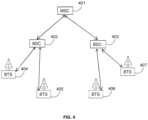
- FIG. 4 is a diagram illustrating a general architecture of a mobile telephone network, in accordance with some embodiments of the present invention.
- Base Transceiver Stations (BTS) 404, 405 and 406, 407 are in communication with respective Base Station Controllers (BSC) 402 and 403.
- BSC Base Station Controllers
- the BSC controls and manages the BTSs and performs essential functions like routing and handoffs.
- the BSCs 402, 403 are in communication with the Mobile Switching Centre (MSC) 401 which is responsible for overall management for roaming of the subscriber to different geographical areas.
- MSC Mobile Switching Centre
- FIG. 5 is a functional block diagram illustrating the primary components of a MSC 401, 500 for identification of malicious activity based on analysis of a travel path of a mobile device of a mobile subscriber moving through a plurality of geographic areas in accordance with some embodiments of the present invention.
- the MSC comprises a processor 501, a memory 502 operatively coupled to the processor 501; and a transceiver 503 operatively coupled to the processor 501.
- the processor 501 configured to receive "n" number of location data associated with said mobile device through said transceiver 503, each of "n" location data comprising an indication of the geographic area of the mobile subscriber G n and a receipt timestamp T n .
- the processor 501 determines the actual travel time t actual of the mobile subscriber from a geographic area G n and a subsequently visited geographic area G n+a based on a difference between timestamps T n and T n+a , where a ⁇ 2.
- the processor further determines a minimum transition time t min for the subscriber of the mobile device to move from the geographic area G n to the subsequently visited geographic area G n+a by computing the distance of the path of travel from G n to G n+a (i.e. a sum transition time between each G n to G n+1 ... to G n+a ).
- the determination of a minimum transition time t min is based on looking up a database stored in memory 502.
- the processor 501 finally identifies a malicious activity based on comparison of the actual travel time t actual and the minimum transition time t min wherein t actual ⁇ t min .
- the malicious activity is at least one received spoofed location data.
- the processor 501 receives at least three location data associated with said mobile communication device, said first update packet each packet comprising indication of the geographic area of the mobile subscriber and a receipt timestamp. Further, the processor 501 determines the actual travel time of the mobile subscriber from the first geographic area and the third geographic area based on a difference between timestamps of the first location data and the third location data.
- the processor determines a minimum transition time for the subscriber of the mobile device to move from the first geographic area to the third geographic area through the second geographic area and the processor 501 identifies a malicious activity based on comparison of the actual travel time and the minimum transition time wherein actual travel time is less than minimum transition time between the first geographic area and the third geographic area through the second geographic area.
- the process described in the present disclosure may be implemented using various means.
- the process described in the present disclosure may be implemented in hardware, firmware, software, or any combination thereof.
- the processing units, or processors(s) may be implemented within one or more application specific integrated circuits (ASICs), digital signal processors (DSPs), digital signal processing devices (DSPDs), programmable logic devices (PLDs), field programmable gate arrays (FPGAs), processors, controllers, micro-controllers, microprocessors, electronic devices, other electronic units designed to perform the functions described herein, or a combination thereof.
- ASICs application specific integrated circuits
- DSPs digital signal processors
- DSPDs digital signal processing devices
- PLDs programmable logic devices
- FPGAs field programmable gate arrays
- processors controllers, micro-controllers, microprocessors, electronic devices, other electronic units designed to perform the functions described herein, or a combination thereof.
- software codes may be stored in a memory and executed by a processor.
- Memory may be implemented within the processor unit or external to the processor unit.
- memory refers to any type of volatile memory or nonvolatile memory.
Landscapes
- Engineering & Computer Science (AREA)
- Computer Networks & Wireless Communication (AREA)
- Signal Processing (AREA)
- Computer Security & Cryptography (AREA)
- Mobile Radio Communication Systems (AREA)
Claims (12)
- Un procédé d'analyse d'un trajet de parcours d'un dispositif mobile d'un abonné mobile se déplaçant au travers d'une pluralité de zones géographiques, comprenant :a) la réception d'un nombre "n" de données de localisation associées audit dispositif mobile, chacune des "n" données de localisation comprenant une indication de la zone géographique de l'abonné mobile Gn et un timbre à date de réception Tn,b) la détermination du temps de parcours effectif tactual de l'abonné mobile à partir d'une zone géographique Gn et d'une zone géographique visitée subséquemment Gn+a en fonction d'une différence entre des timbres à date Tn et Tn+a, où a ≥ 2,c) la détermination d'un temps de transition minimal tmin pour l'abonné du dispositif mobile pour se déplacer de la zone géographique Gn vers la zone géographique visitée subséquemment Gn+a au travers du trajet de parcours,d) la comparaison du temps de parcours effectif tactual et du temps de transition minimal tmin où tactual < tmin, ledit procédé étant caractérisé par :e) l'identification d'une activité suspecte en fonction de ladite comparaison où l'activité suspecte est au moins des données de localisation usurpées reçues où les données de localisation sont obtenues au moyen de protocoles de télécommunication existants automatiquement disponibles auprès d'un commutateur de réseau ou d'un centre de commutation mobile.
- Le procédé selon la Revendication 1 où les opérations b), c) et d) sont répétées pour les premières "n-a" données de localisation.
- Le procédé selon la Revendication 1 ou 2 où la zone géographique Gn est représentée par un pays, un état, une ville.
- Le procédé selon l'une quelconque des Revendications précédentes où la zone géographique est une partition dans une carte prédéterminée avec des zones géographiques partitionnées prédéterminées.
- Un procédé selon l'une quelconque des Revendications 1 à 4 et destiné à la détection d'une transition suspecte du dispositif de communication mobile effectuant une transition entre au moins trois régions comprenant les opérations suivantes :la réception d'au moins trois séries de données de localisation associées audit dispositif de communication mobile, chaque série de données de localisation comprenant une indication de la zone géographique de l'abonné mobile et le timbre à date de réception,la détermination du temps de parcours effectif de l'abonné mobile à partir de la première zone géographique et de la troisième zone géographique en fonction d'une différence entre des timbres à date des premières données de localisation et des troisièmes données de localisation,la détermination du temps de transition minimal pour l'abonné du dispositif mobile pour se déplacer de la première zone géographique vers la troisième zone géographique, etl'identification de l'activité suspecte en fonction d'une comparaison du temps de parcours effectif et du temps de transition minimal où le temps de parcours effectif est inférieur au temps de transition minimal entre la première zone géographique et la troisième zone géographique au travers de la deuxième zone géographique.
- Le procédé selon l'une quelconque des Revendications 1 à 5 comprenant l'opération de comparaison d'une identification d'une activité suspecte obtenue à partir d'un premier protocole avec une identification d'une activité suspecte obtenue à partir d'un deuxième protocole de façon à corréler si une activité est malveillante.
- Le procédé selon la Revendication 6 où le premier protocole et/ou le deuxième protocole est sélectionné parmi un des protocoles suivants : SS7 dans un réseau conforme à la norme 2G ou 3G, Diameter dans un réseau conforme à la norme 4G, N32 dans un réseau conforme à la norme 5G, GTP dans un réseau de données, ISUP dans un réseau vocal, SIP dans un réseau vocal.
- Un centre de commutation mobile destiné à l'analyse d'un trajet de parcours d'un dispositif mobile d'un abonné mobile se déplaçant au travers d'une pluralité de zones géographiques, comprenant :un processeur (501),une mémoire (502) couplée de manière opérationnelle au processeur, etun émetteur-récepteur (503) couplé de manière opérationnelle au processeur,ledit processeur étant configuré de façon à :recevoir un nombre "n" de données de localisation associées audit dispositif mobile, chacune des "n" données de localisation comprenant une indication de la zone géographique de l'abonné mobile Gn et un timbre à date de réception Tn, etdéterminer le temps de parcours effectif tactual de l'abonné mobile à partir d'une zone géographique Gn et d'une zone géographique visitée subséquemment Gn+a en fonction d'une différence entre des timbres à date Tn et Tn+a où a ≥ 2,déterminer un temps de transition minimal tmin pour l'abonné du dispositif mobile pour se déplacer de la zone géographique Gn vers la zone géographique visitée subséquemment Gn+a au travers du trajet de parcours,la comparaison du temps de parcours effectif tactual et du temps de transition minimal tmin où tactual < tmin,l'identification d'une activité suspecte en fonction de ladite comparaison où l'activité suspecte est au moins des données de localisation usurpées reçues où les données de localisation sont obtenues au moyen de protocoles de télécommunication existants automatiquement disponibles auprès d'un commutateur de réseau ou du centre de commutation mobile.
- Le centre de commutation mobile selon la Revendication 8 où la zone géographique représente un pays, un état et une ville.
- Le centre de commutation mobile selon la Revendication 8 ou 9 où la zone géographique est une partition dans une carte prédéterminée avec des zones géographiques partitionnées prédéterminées.
- Le centre de commutation mobile selon l'une quelconque des Revendications 8 à 10 destiné à l'identification d'une activité malveillante en fonction de l'analyse du trajet de parcours du dispositif mobile de l'abonné mobile se déplaçant au travers de zones géographiques, ledit centre de commutation mobile comprenant :
ledit processeur étant configuré en outre de façon à :recevoir au moins trois séries de données de localisation associées audit dispositif de communication mobile, lesdites premières données de localisation comprenant une indication de la zone géographique de l'abonné mobile et le timbre à date de réception,déterminer le temps de parcours effectif de l'abonné mobile à partir de la première zone géographique et de la troisième zone géographique en fonction d'une différence entre des timbres à date des premières données de localisation et des troisièmes données de localisation,déterminer le temps de transition minimal pour l'abonné du dispositif mobile pour se déplacer de la première zone géographique vers la troisième zone géographique, etidentifier l'activité suspecte en fonction d'une comparaison du temps de parcours effectif et du temps de transition minimal où le temps de parcours effectif est inférieur au temps de transition minimal entre la première zone géographique et la troisième zone géographique au travers de la deuxième zone géographique. - Un programme informatique contenant des instructions de programme destinées à amener un ordinateur à exécuter le procédé selon l'une quelconque des Revendications 1 à 7.
Applications Claiming Priority (1)
| Application Number | Priority Date | Filing Date | Title |
|---|---|---|---|
| EP19158161 | 2019-02-19 |
Publications (3)
| Publication Number | Publication Date |
|---|---|
| EP3700236A1 EP3700236A1 (fr) | 2020-08-26 |
| EP3700236C0 EP3700236C0 (fr) | 2023-06-07 |
| EP3700236B1 true EP3700236B1 (fr) | 2023-06-07 |
Family
ID=65576126
Family Applications (1)
| Application Number | Title | Priority Date | Filing Date |
|---|---|---|---|
| EP20158362.2A Active EP3700236B1 (fr) | 2019-02-19 | 2020-02-19 | Identification d'une activité malveillante basée sur l'analyse du parcours du dispositif mobile |
Country Status (2)
| Country | Link |
|---|---|
| US (1) | US11166162B2 (fr) |
| EP (1) | EP3700236B1 (fr) |
Families Citing this family (1)
| Publication number | Priority date | Publication date | Assignee | Title |
|---|---|---|---|---|
| US12033152B2 (en) * | 2019-02-19 | 2024-07-09 | Adaptive Mobile Security Limited | Identification of malicious activity based on analysis of travel path of a mobile device |
Family Cites Families (7)
| Publication number | Priority date | Publication date | Assignee | Title |
|---|---|---|---|---|
| EP1407624A2 (fr) * | 2001-07-16 | 2004-04-14 | Wavemarket, Inc. | Systeme de distribution de services d'avertissement a des stations mobiles dans un reseau de communication sans fil |
| US9119077B2 (en) * | 2011-07-26 | 2015-08-25 | The Boeing Company | Wireless network security |
| US10235683B2 (en) * | 2014-07-18 | 2019-03-19 | PlaceIQ, Inc. | Analyzing mobile-device location histories to characterize consumer behavior |
| US9483765B2 (en) * | 2013-12-09 | 2016-11-01 | Mastercard International Incorporated | Systems and methods for monitoring payment transactions for fraud using social media |
| WO2015103216A1 (fr) | 2014-01-02 | 2015-07-09 | Visa International Service Association | Brouillage de localisation pour authentification |
| EP3102965B1 (fr) * | 2014-02-05 | 2023-07-26 | Verve Group, Inc. | Procédés et appareil d'identification et de classement d'emplacements synthétiques pour des applications mobiles |
| CN106228799B (zh) | 2016-08-04 | 2019-05-10 | 神州优车(福建)信息技术有限公司 | 监控非法篡改车辆位置信息的方法和装置 |
-
2020
- 2020-02-19 EP EP20158362.2A patent/EP3700236B1/fr active Active
- 2020-02-19 US US16/795,460 patent/US11166162B2/en active Active
Also Published As
| Publication number | Publication date |
|---|---|
| EP3700236C0 (fr) | 2023-06-07 |
| US20200267556A1 (en) | 2020-08-20 |
| US11166162B2 (en) | 2021-11-02 |
| EP3700236A1 (fr) | 2020-08-26 |
Similar Documents
| Publication | Publication Date | Title |
|---|---|---|
| US20220337977A1 (en) | Location intelligence management system | |
| US8849254B2 (en) | Location intelligence management system | |
| CA2779406C (fr) | Systeme de gestion de renseignements de localisation | |
| KR100941554B1 (ko) | 위치 측정 기술 및 장치 식별자를 이용한 분실 및 도난 이동 장치의 추적 | |
| KR20230058457A (ko) | 이동성 패턴들을 사용하는 5g 사용자 장비(ue) 이력 이동성 추적 및 보안 스크리닝을 위한 방법들, 시스템들, 및 컴퓨터 판독가능 매체들 | |
| EP2276319A1 (fr) | Procédé et dispositif de surveillance de position | |
| CN117296358A (zh) | 对漫游到相邻国家的出境订户进行速度检查的方法、系统和计算机可读介质 | |
| CN110392023B (zh) | 基于7号信令网络的网络入侵检测方法、装置、电子设备及存储介质 | |
| US9883345B2 (en) | System and method for geography-based correlation of cellular and WLAN identifiers | |
| KR20110097947A (ko) | 긴급 서비스를 위한 예측 통지 시스템 | |
| CN112448894A (zh) | 阻断信令风暴的方法、装置、设备及存储介质 | |
| CN105307119A (zh) | 一种基于rssi基站信号估计的伪基站定位方法 | |
| US7885664B2 (en) | Method for generating triggers based on the position of a terminal in a mobile communication network, related network and computer program product therefor | |
| NL2023416B1 (en) | A device, a system and method of identifying interfering devices in position measurements | |
| US12579547B2 (en) | Identification of malicious activity based on analysis of travel path of a mobile device | |
| EP3700236B1 (fr) | Identification d'une activité malveillante basée sur l'analyse du parcours du dispositif mobile | |
| WO2015058123A1 (fr) | Système de gestion de renseignements d'emplacements pour la sécurité à la frontière | |
| US8868107B2 (en) | Wireless terminal surveillance system | |
| FI112582B (fi) | Matkaviestinjärjestelmä | |
| CN117813853A (zh) | 用于通信网络的方法和系统 |
Legal Events
| Date | Code | Title | Description |
|---|---|---|---|
| PUAI | Public reference made under article 153(3) epc to a published international application that has entered the european phase |
Free format text: ORIGINAL CODE: 0009012 |
|
| STAA | Information on the status of an ep patent application or granted ep patent |
Free format text: STATUS: THE APPLICATION HAS BEEN PUBLISHED |
|
| AK | Designated contracting states |
Kind code of ref document: A1 Designated state(s): AL AT BE BG CH CY CZ DE DK EE ES FI FR GB GR HR HU IE IS IT LI LT LU LV MC MK MT NL NO PL PT RO RS SE SI SK SM TR |
|
| AX | Request for extension of the european patent |
Extension state: BA ME |
|
| STAA | Information on the status of an ep patent application or granted ep patent |
Free format text: STATUS: REQUEST FOR EXAMINATION WAS MADE |
|
| 17P | Request for examination filed |
Effective date: 20210225 |
|
| RBV | Designated contracting states (corrected) |
Designated state(s): AL AT BE BG CH CY CZ DE DK EE ES FI FR GB GR HR HU IE IS IT LI LT LU LV MC MK MT NL NO PL PT RO RS SE SI SK SM TR |
|
| STAA | Information on the status of an ep patent application or granted ep patent |
Free format text: STATUS: EXAMINATION IS IN PROGRESS |
|
| 17Q | First examination report despatched |
Effective date: 20210819 |
|
| REG | Reference to a national code |
Ref country code: DE Ref legal event code: R079 Ref document number: 602020011454 Country of ref document: DE Free format text: PREVIOUS MAIN CLASS: H04W0004029000 Ipc: H04L0009000000 |
|
| RIC1 | Information provided on ipc code assigned before grant |
Ipc: H04L 9/00 20060101AFI20220901BHEP |
|
| GRAP | Despatch of communication of intention to grant a patent |
Free format text: ORIGINAL CODE: EPIDOSNIGR1 |
|
| STAA | Information on the status of an ep patent application or granted ep patent |
Free format text: STATUS: GRANT OF PATENT IS INTENDED |
|
| INTG | Intention to grant announced |
Effective date: 20221115 |
|
| GRAS | Grant fee paid |
Free format text: ORIGINAL CODE: EPIDOSNIGR3 |
|
| GRAA | (expected) grant |
Free format text: ORIGINAL CODE: 0009210 |
|
| STAA | Information on the status of an ep patent application or granted ep patent |
Free format text: STATUS: THE PATENT HAS BEEN GRANTED |
|
| AK | Designated contracting states |
Kind code of ref document: B1 Designated state(s): AL AT BE BG CH CY CZ DE DK EE ES FI FR GB GR HR HU IE IS IT LI LT LU LV MC MK MT NL NO PL PT RO RS SE SI SK SM TR |
|
| REG | Reference to a national code |
Ref country code: GB Ref legal event code: FG4D |
|
| REG | Reference to a national code |
Ref country code: CH Ref legal event code: EP Ref country code: AT Ref legal event code: REF Ref document number: 1578008 Country of ref document: AT Kind code of ref document: T Effective date: 20230615 |
|
| REG | Reference to a national code |
Ref country code: DE Ref legal event code: R096 Ref document number: 602020011454 Country of ref document: DE |
|
| U01 | Request for unitary effect filed |
Effective date: 20230707 |
|
| U07 | Unitary effect registered |
Designated state(s): AT BE BG DE DK EE FI FR IT LT LU LV MT NL PT SE SI Effective date: 20230720 |
|
| REG | Reference to a national code |
Ref country code: LT Ref legal event code: MG9D |
|
| PG25 | Lapsed in a contracting state [announced via postgrant information from national office to epo] |
Ref country code: NO Free format text: LAPSE BECAUSE OF FAILURE TO SUBMIT A TRANSLATION OF THE DESCRIPTION OR TO PAY THE FEE WITHIN THE PRESCRIBED TIME-LIMIT Effective date: 20230907 Ref country code: ES Free format text: LAPSE BECAUSE OF FAILURE TO SUBMIT A TRANSLATION OF THE DESCRIPTION OR TO PAY THE FEE WITHIN THE PRESCRIBED TIME-LIMIT Effective date: 20230607 |
|
| PG25 | Lapsed in a contracting state [announced via postgrant information from national office to epo] |
Ref country code: RS Free format text: LAPSE BECAUSE OF FAILURE TO SUBMIT A TRANSLATION OF THE DESCRIPTION OR TO PAY THE FEE WITHIN THE PRESCRIBED TIME-LIMIT Effective date: 20230607 Ref country code: HR Free format text: LAPSE BECAUSE OF FAILURE TO SUBMIT A TRANSLATION OF THE DESCRIPTION OR TO PAY THE FEE WITHIN THE PRESCRIBED TIME-LIMIT Effective date: 20230607 Ref country code: GR Free format text: LAPSE BECAUSE OF FAILURE TO SUBMIT A TRANSLATION OF THE DESCRIPTION OR TO PAY THE FEE WITHIN THE PRESCRIBED TIME-LIMIT Effective date: 20230908 |
|
| PG25 | Lapsed in a contracting state [announced via postgrant information from national office to epo] |
Ref country code: SK Free format text: LAPSE BECAUSE OF FAILURE TO SUBMIT A TRANSLATION OF THE DESCRIPTION OR TO PAY THE FEE WITHIN THE PRESCRIBED TIME-LIMIT Effective date: 20230607 |
|
| PG25 | Lapsed in a contracting state [announced via postgrant information from national office to epo] |
Ref country code: IS Free format text: LAPSE BECAUSE OF FAILURE TO SUBMIT A TRANSLATION OF THE DESCRIPTION OR TO PAY THE FEE WITHIN THE PRESCRIBED TIME-LIMIT Effective date: 20231007 |
|
| PG25 | Lapsed in a contracting state [announced via postgrant information from national office to epo] |
Ref country code: SM Free format text: LAPSE BECAUSE OF FAILURE TO SUBMIT A TRANSLATION OF THE DESCRIPTION OR TO PAY THE FEE WITHIN THE PRESCRIBED TIME-LIMIT Effective date: 20230607 Ref country code: SK Free format text: LAPSE BECAUSE OF FAILURE TO SUBMIT A TRANSLATION OF THE DESCRIPTION OR TO PAY THE FEE WITHIN THE PRESCRIBED TIME-LIMIT Effective date: 20230607 Ref country code: RO Free format text: LAPSE BECAUSE OF FAILURE TO SUBMIT A TRANSLATION OF THE DESCRIPTION OR TO PAY THE FEE WITHIN THE PRESCRIBED TIME-LIMIT Effective date: 20230607 Ref country code: IS Free format text: LAPSE BECAUSE OF FAILURE TO SUBMIT A TRANSLATION OF THE DESCRIPTION OR TO PAY THE FEE WITHIN THE PRESCRIBED TIME-LIMIT Effective date: 20231007 Ref country code: CZ Free format text: LAPSE BECAUSE OF FAILURE TO SUBMIT A TRANSLATION OF THE DESCRIPTION OR TO PAY THE FEE WITHIN THE PRESCRIBED TIME-LIMIT Effective date: 20230607 |
|
| PG25 | Lapsed in a contracting state [announced via postgrant information from national office to epo] |
Ref country code: PL Free format text: LAPSE BECAUSE OF FAILURE TO SUBMIT A TRANSLATION OF THE DESCRIPTION OR TO PAY THE FEE WITHIN THE PRESCRIBED TIME-LIMIT Effective date: 20230607 |
|
| REG | Reference to a national code |
Ref country code: DE Ref legal event code: R097 Ref document number: 602020011454 Country of ref document: DE |
|
| U20 | Renewal fee for the european patent with unitary effect paid |
Year of fee payment: 5 Effective date: 20240228 |
|
| PLBE | No opposition filed within time limit |
Free format text: ORIGINAL CODE: 0009261 |
|
| STAA | Information on the status of an ep patent application or granted ep patent |
Free format text: STATUS: NO OPPOSITION FILED WITHIN TIME LIMIT |
|
| 26N | No opposition filed |
Effective date: 20240308 |
|
| PG25 | Lapsed in a contracting state [announced via postgrant information from national office to epo] |
Ref country code: MC Free format text: LAPSE BECAUSE OF FAILURE TO SUBMIT A TRANSLATION OF THE DESCRIPTION OR TO PAY THE FEE WITHIN THE PRESCRIBED TIME-LIMIT Effective date: 20230607 |
|
| REG | Reference to a national code |
Ref country code: CH Ref legal event code: PL |
|
| PG25 | Lapsed in a contracting state [announced via postgrant information from national office to epo] |
Ref country code: CH Free format text: LAPSE BECAUSE OF NON-PAYMENT OF DUE FEES Effective date: 20240229 |
|
| PG25 | Lapsed in a contracting state [announced via postgrant information from national office to epo] |
Ref country code: CH Free format text: LAPSE BECAUSE OF NON-PAYMENT OF DUE FEES Effective date: 20240229 |
|
| U20 | Renewal fee for the european patent with unitary effect paid |
Year of fee payment: 6 Effective date: 20250228 |
|
| PG25 | Lapsed in a contracting state [announced via postgrant information from national office to epo] |
Ref country code: CY Free format text: LAPSE BECAUSE OF FAILURE TO SUBMIT A TRANSLATION OF THE DESCRIPTION OR TO PAY THE FEE WITHIN THE PRESCRIBED TIME-LIMIT; INVALID AB INITIO Effective date: 20200219 |
|
| PG25 | Lapsed in a contracting state [announced via postgrant information from national office to epo] |
Ref country code: HU Free format text: LAPSE BECAUSE OF FAILURE TO SUBMIT A TRANSLATION OF THE DESCRIPTION OR TO PAY THE FEE WITHIN THE PRESCRIBED TIME-LIMIT; INVALID AB INITIO Effective date: 20200219 |
|
| PG25 | Lapsed in a contracting state [announced via postgrant information from national office to epo] |
Ref country code: TR Free format text: LAPSE BECAUSE OF FAILURE TO SUBMIT A TRANSLATION OF THE DESCRIPTION OR TO PAY THE FEE WITHIN THE PRESCRIBED TIME-LIMIT Effective date: 20230607 |
|
| U20 | Renewal fee for the european patent with unitary effect paid |
Year of fee payment: 7 Effective date: 20260228 |
|
| PGFP | Annual fee paid to national office [announced via postgrant information from national office to epo] |
Ref country code: GB Payment date: 20260224 Year of fee payment: 7 |
|
| PGFP | Annual fee paid to national office [announced via postgrant information from national office to epo] |
Ref country code: IE Payment date: 20260224 Year of fee payment: 7 |