EP3700247A1 - Dispositif électronique et procédé destinés à une communication sans fil - Google Patents
Dispositif électronique et procédé destinés à une communication sans fil Download PDFInfo
- Publication number
- EP3700247A1 EP3700247A1 EP18869999.5A EP18869999A EP3700247A1 EP 3700247 A1 EP3700247 A1 EP 3700247A1 EP 18869999 A EP18869999 A EP 18869999A EP 3700247 A1 EP3700247 A1 EP 3700247A1
- Authority
- EP
- European Patent Office
- Prior art keywords
- user
- action
- electronic apparatus
- state
- communication quality
- Prior art date
- Legal status (The legal status is an assumption and is not a legal conclusion. Google has not performed a legal analysis and makes no representation as to the accuracy of the status listed.)
- Withdrawn
Links
Images






Classifications
-
- H—ELECTRICITY
- H04—ELECTRIC COMMUNICATION TECHNIQUE
- H04W—WIRELESS COMMUNICATION NETWORKS
- H04W24/00—Supervisory, monitoring or testing arrangements
- H04W24/02—Arrangements for optimising operational condition
-
- H—ELECTRICITY
- H04—ELECTRIC COMMUNICATION TECHNIQUE
- H04L—TRANSMISSION OF DIGITAL INFORMATION, e.g. TELEGRAPHIC COMMUNICATION
- H04L45/00—Routing or path finding of packets in data switching networks
- H04L45/02—Topology update or discovery
-
- H—ELECTRICITY
- H04—ELECTRIC COMMUNICATION TECHNIQUE
- H04W—WIRELESS COMMUNICATION NETWORKS
- H04W16/00—Network planning, e.g. coverage or traffic planning tools; Network deployment, e.g. resource partitioning or cells structures
- H04W16/02—Resource partitioning among network components, e.g. reuse partitioning
- H04W16/10—Dynamic resource partitioning
-
- H—ELECTRICITY
- H04—ELECTRIC COMMUNICATION TECHNIQUE
- H04W—WIRELESS COMMUNICATION NETWORKS
- H04W16/00—Network planning, e.g. coverage or traffic planning tools; Network deployment, e.g. resource partitioning or cells structures
- H04W16/18—Network planning tools
-
- H—ELECTRICITY
- H04—ELECTRIC COMMUNICATION TECHNIQUE
- H04W—WIRELESS COMMUNICATION NETWORKS
- H04W16/00—Network planning, e.g. coverage or traffic planning tools; Network deployment, e.g. resource partitioning or cells structures
- H04W16/22—Traffic simulation tools or models
-
- H—ELECTRICITY
- H04—ELECTRIC COMMUNICATION TECHNIQUE
- H04W—WIRELESS COMMUNICATION NETWORKS
- H04W24/00—Supervisory, monitoring or testing arrangements
- H04W24/10—Scheduling measurement reports ; Arrangements for measurement reports
-
- H—ELECTRICITY
- H04—ELECTRIC COMMUNICATION TECHNIQUE
- H04W—WIRELESS COMMUNICATION NETWORKS
- H04W48/00—Access restriction; Network selection; Access point selection
- H04W48/20—Selecting an access point
-
- H—ELECTRICITY
- H04—ELECTRIC COMMUNICATION TECHNIQUE
- H04W—WIRELESS COMMUNICATION NETWORKS
- H04W72/00—Local resource management
- H04W72/04—Wireless resource allocation
- H04W72/044—Wireless resource allocation based on the type of the allocated resource
- H04W72/0453—Resources in frequency domain, e.g. a carrier in FDMA
-
- H—ELECTRICITY
- H04—ELECTRIC COMMUNICATION TECHNIQUE
- H04W—WIRELESS COMMUNICATION NETWORKS
- H04W72/00—Local resource management
- H04W72/50—Allocation or scheduling criteria for wireless resources
- H04W72/54—Allocation or scheduling criteria for wireless resources based on quality criteria
- H04W72/541—Allocation or scheduling criteria for wireless resources based on quality criteria using the level of interference
-
- H—ELECTRICITY
- H04—ELECTRIC COMMUNICATION TECHNIQUE
- H04W—WIRELESS COMMUNICATION NETWORKS
- H04W72/00—Local resource management
- H04W72/50—Allocation or scheduling criteria for wireless resources
- H04W72/54—Allocation or scheduling criteria for wireless resources based on quality criteria
- H04W72/542—Allocation or scheduling criteria for wireless resources based on quality criteria using measured or perceived quality
-
- H—ELECTRICITY
- H04—ELECTRIC COMMUNICATION TECHNIQUE
- H04W—WIRELESS COMMUNICATION NETWORKS
- H04W88/00—Devices specially adapted for wireless communication networks, e.g. terminals, base stations or access point devices
- H04W88/08—Access point devices
-
- H—ELECTRICITY
- H04—ELECTRIC COMMUNICATION TECHNIQUE
- H04W—WIRELESS COMMUNICATION NETWORKS
- H04W88/00—Devices specially adapted for wireless communication networks, e.g. terminals, base stations or access point devices
- H04W88/18—Service support devices; Network management devices
Definitions
- the present disclosure generally relates to the field of wireless communications, and in particularly to resource management in a User Centric Network (UCN), and more particularly to an electronic apparatus and a method for wireless communications.
- UCN User Centric Network
- UDN ultra-dense network
- UCN user centric network
- an electronic apparatus for wireless communications includes processing circuitry.
- the processing circuitry is configured to: determine a coordination access point group for a user within a predetermined range, by taking a wireless network topology structure of a wireless network as a state; and re-determine a coordination access point group for the user in response to a change of the wireless network topology structure, wherein the wireless network topology structure comprises a distribution of users and a distribution of access points.
- a method for wireless communications includes: determining a coordination access point group for a user within a predetermined range, by taking a wireless network topology structure of a wireless network as a state; and re-determining a coordination access point group for the user in response to a change of the wireless network topology structure, wherein the wireless network topology structure comprises a distribution of users and a distribution of access points.
- the coordination access point group (APG) can be dynamically selected, thereby meeting the communication requirements of all users in a better way.
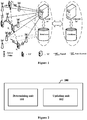
- FIG. 1 is a schematic diagram showing a scenario of the UUDN.
- AP access point
- UE user equipment
- the UE performs coordination transmission by using different APs.
- each of the APs is communicatively connected to a spectrum management device such as a spectrum coordinator (SC).
- SC spectrum coordinator
- the SC determines a coordination APG for the UE within a management range of the SC.
- the coordination APG is a group of APs having coordination relationships with the corresponding UE, that is, a group of Aps providing communication access services to the UE.
- a local SC may properly communicate with an adjacent SC, so as to interchange information. It can be seen that, compared with a conventional cellular network architecture, the network architecture shown in Figure 1 is characterized in the great number of APs, which is even greater than the number of the UE.
- the AP described herein may be any node which provides network communication service, such as a base station, a small base station or the like.
- the base station may be implemented as any type of evolved node B (eNB), such as a macro eNB and a small eNB.
- eNB evolved node B
- the small eNB may be an eNB such as a pico eNB, a micro eNB, and a home (femto) eNB that covers a cell smaller than a macro cell.
- the base station may be realized as any other types of base stations such as a NodeB and a base transceiver station (BTS).
- BTS base transceiver station
- the base station may include a main body (that is also referred to as a base station apparatus) configured to control wireless communication, and one or more remote radio heads (RRH) disposed in a different place from the main body.
- a main body that is also referred to as a base station apparatus
- RRH remote radio heads
- various types of terminals may each operate as the base station by temporarily or semi-persistently executing a base station function.
- the UE or the user may be any wireless communication device providing service or any terminal device.
- the terminal device may be implemented as a mobile terminal (such as a smart phone, a tablet personal computer (PC), a notebook PC, a portable game terminal, a portable/dongle mobile router and a digital camera) or an in-vehicle terminal (such as a car navigation device).
- the terminal device may also be implemented as a terminal (that is also referred to as a machine type communication (MTC) terminal) that performs machine-to-machine (M2M) communication.
- the terminal device may be a wireless communication module (such as an integrated circuit module including a single die) installed on each of the above terminals.
- SC shown in Figure 1 is just an example of the spectrum management device, other types of the spectrum management device such as a spectrum access system (SAS) may be adopted, which are not restrictive.
- SAS spectrum access system
- an electronic apparatus 100 for wireless communications is provided according to an embodiment of the present disclosure.
- the electronic apparatus 100 includes a determining unit 101 and an updating unit 102.
- the determining unit 101 is configured to determine a coordination access point group (APG) for a user within a predetermined range, by taking a wireless network topology structure of a wireless network as a state.
- the updating unit 102 is configured to re-determine a coordination access point group for the user in response to a change of the wireless network topology structure.
- the determining unit 101 and the updating unit 102 each may be implemented by one or more processing circuitries.
- the processing circuitry for example, may be implemented as a chip.
- the electronic apparatus 100 for example, may be located on the spectrum management device (such as the SC or the SAS) shown in Figure 1 . Alternatively, the electronic apparatus 100 may be communicatively connected to the spectrum management device.
- the electronic apparatus 100 may determine the coordination APG for the user within the predetermined range by using a reinforcement learning algorithm.
- the predetermined range for example, may be at least a part of a management range of the spectrum management device on which the electronic apparatus is located.
- the reinforcement learning algorithm learning is regarded as a process of exploring evaluation, to learn a map from an environment state to an action, so that a selected action can obtain a maximum award from the environment, that is, so that an external environment evaluates a learning system in some sense as optimum (or operation performance of a whole system is optimum).
- the reinforcement learning algorithm used herein may include a Q-learning algorithm, a difference learning algorithm or the like.
- the wireless network topology structure may be taken as a state.
- the wireless network topology structure includes a distribution of users and a distribution of access points.
- the wireless network topology structure changes.
- the wireless network topology structure changes, for example, corresponding to states S t , S t+1 , and S t+2 shown in Figure 1 .
- the coordination APG determined for the user in a previous state may be not applicable in a new state, for example, may not meet communication requirements of the user. Therefore, the updating unit 102 re-determines a coordination APG for the user in response to a change of the wireless network topology structure, so as to provide stable and continuous communication service to the user.
- the change of the wireless network topology structure includes a change of a position of the user.
- the change is detected by the user.
- the user reports the change to the electronic apparatus 100 and requests the electronic apparatus 100 to re-determine a coordination APG for the user.
- the change of the wireless network topology structure further includes a change of a position of the access point.
- the access point also reports the change of the position of the access point to the electronic apparatus 100.
- the electronic apparatus 100 may re-determine a coordination APG for the user based on the change.
- the determining unit 101 may take a coordination relationship between the user and the access point as an action in the reinforcement learning algorithm, and with respect to each action, calculate an evaluation of the action based on a degree of meeting communication quality requirement of the user and a resulting network overhead when performing the action.
- the user has specific requirements for communication quality of the user.
- the degree of meeting communication quality requirement of the user indicates one aspect of the evaluation of the action.
- the communication quality requirement of the user may be represented by, for example, quality of service (QoS) required by the user.
- QoS quality of service
- SINR signal to interference and noise ratio
- the action changes correspondingly. For example, an action determined in the previous state changes to another action.
- the change of the action indicates the change of the coordination APG of the UE, resulting in switching between APs, which incurs the network overhead.
- the network overhead is expected to be as small as possible. Therefore, the network overhead indicates another aspect of the evaluation of the action.
- the determining unit 101 determines the coordination APG for the user in the current state based on an action with the highest evaluation. In other words, the determining unit 101 determines the action with the highest evaluation as an action to be performed, so as to determine coordination APGs for respective users.
- the action with the highest evaluation is an action when being performed results in the highest degree of meeting the communication quality requirement of the user and the lowest network overhead, compared with other actions.
- a i ′ a 11 a 12 ⁇ a 1 M a 21 a 22 ⁇ a 2 M ⁇ ⁇ ⁇ ⁇ a N 1 a N 2 ⁇ a NM N ⁇ M
- equation (1) may be transformed into a vector represented by equation (2).
- a i a 11 a 12 ⁇ a 1 M a 21 a 22 ⁇ a 2 M ⁇ a N 1 a N 2 ⁇ a NM 1 ⁇ NM
- rows in the equation (1) are rearranged in one row.
- each of the multiple actions is taken as one row, to form an action matrix.
- multiple actions are initially generated for a state, such as the state S t .
- the generated actions may be defined by setting a predetermined condition.
- the predetermined condition may include, for example, one or more of: the generated action causes the communication quality for each user to meet the communication quality requirement of the user; and the network overhead produced when using this coordination relationship relative to an action determined in the previous state does not exceed a predetermined overhead threshold.
- the communication quality requirement may be expressed by the SINR threshold.
- a degree of meeting communication quality requirement of each user and a resulting network overhead when performing each action in the state are taken as the evaluation of the action.
- the evaluation of the action is expressed by a Q-value. Evaluations of actions form a Q-value matrix.
- the determining unit 101 may calculate the degree of meeting communication quality requirement of each user using an SINR threshold for the user and an estimated SINR of the user.
- the estimated SINR of a user being closer to the SINR threshold for the user indicates a higher degree of meeting communication quality requirement of the user.
- the determining unit 101 may take degrees of meeting communication quality requirement of the users into consideration comprehensively.
- the degree of meeting communication quality requirement of the user includes a utility value of all users and a cost value of not meeting the SINR of the user.
- the utility value of the user is calculated from a utility function.
- the utility function is a non-linear function of a ratio of the estimated SINR of the user to the SINR threshold for the user.
- the cost value depends on a difference between the SINR threshold of a user and the estimated SINR of the user.
- the utility value is used to represent a degree of satisfaction of the estimated SINR of the user relative to the SINR threshold.
- the cost value is used to denote a degree of dissatisfaction of the estimated SINR of the user relative to the SINR threshold.
- the degree of meeting communication quality requirement of the user R ( S t , A i ) may be calculated by using the following equation (3):
- R S t A i ⁇ n N U n ⁇ ⁇ ⁇ n N max 0 , SINR n th ⁇ SINR n 2
- U n denotes a utility value of an n-th user, which is calculated from a utility function of the user, for example, by using the following equation (4), where ⁇ denotes a cost factor, SINR n th denotes a SINR threshold for the n-th user, and SINR n denotes an estimated SINR of the n-th user.
- tanh ( ) denotes a hyperbolic tangent function
- ⁇ denotes an extension factor (for example, which may be equal to 3.5834)
- ⁇ denotes a symmetric center (for example, which may be equal to 0.8064).
- Figure 3 shows a curve of an example of the utility function. As shown in Figure 3 , in a case that the SINR of the user is greater than the SINR threshold for the user, the curve of the utility function is changes relatively slowly and approximates 1, so as to avoid an overlarge R value due to an over-high SINR of a user. It should be understood that the utility function is not limited to the form expressed by the equation (4), but may be modified properly.
- SINR n th may be provided by the user.
- SINR n may be estimated by various communication system models.
- p j and p k denote power of a j-th AP and power of a k-th AP respectively
- d nj denotes a distance between the n-th user and the j-th AP
- d nk denote a distance between the n-th user and the k-th AP
- ⁇ denotes a path loss factor
- ⁇ c ( n ) denotes a coordination APG for the n-th user
- ⁇ I ( n ) denotes an interference APG for the n-
- the determining unit 101 calculates the degree of meeting communication quality requirement of the user.
- the degree of meeting communication quality requirement of the user is equivalent to a bonus.
- Position information of the user, position information and emitting power of the access point, and the communication quality requirement of the user such as the SINR threshold, are used in the above calculation.
- the determining unit 101 may be further configured to use, with respect to each action, a difference between this action and an action determined in a previous state as the network overhead produced by this action. For example, in a case that the determining unit 101 determines the action with the highest evaluation as the action to be performed, the action determined in the previous state is an action with the highest evaluation in the previous state. In a case that the current state is an initial state, that is, there is no previous state, the network overhead may be set to be zero.
- the determining unit 101 may use operation amount for performing network switching operation when performing an action, as compared with the action determined in the previous state, as a network overhead produced by the action.
- the action may be represented by a binarization matrix of the coordination relationship.
- the network overhead may be represented by a Hamming distance between actions, as expressed by the following equation (6).
- the Hamming distance between actions physically means the number of the switched coordination APs between two APG options.
- the network overhead is equivalent to the cost value.
- PH S t A i ⁇ ⁇ ⁇ n N D ham A i A S t ⁇ 1 2
- a S t- 1 denotes an action determined to be performed in the previous state S t-1
- ⁇ denotes a cost factor
- D ham ( ) denotes a calculation of the Hamming distance.
- PH ( S t , A i ) may be set to be zero.
- the network overhead produced when performing the action is taken into consideration only when the network overhead exceeds a predetermined overhead threshold.
- T d denotes a predetermined network overhead threshold, that is, a predetermined Hamming distance threshold.
- the network overhead is calculated only when the Hamming distance between an action A i and an action A S t -1 is greater than the predetermined network overhead threshold T d . Otherwise, the network overhead is set to be zero.
- the predetermined network overhead threshold is used in this calculation.
- the predetermined network overhead threshold may be provided by the AP.
- the evaluation of the action may be calculated as follows, so as to obtain a Q-value matrix Q ( S t ) in the state S t .
- an action corresponding to the largest Q-value that is, an action with the highest evaluation may be determined as a selected result of the APG in the state S t . In this case, the communication quality requirement of each user is met as much as possible, and the network overhead produced by switching the AP is reduced.
- the electronic apparatus 100 may further include a storage unit 103.
- the storage unit 103 is configured to store, with respect to each state, each action in the state in association with an evaluation calculated with respect to the action as an evaluation matrix.
- the storage unit 103 may be implemented by various storages.
- the evaluation for example, may include two aspects of the above described degree of meeting communication quality requirement of the user (for example, R ( S t , A i )) and the network overhead produced by performing the action (for example, PH ( S t , A i )).
- the updating unit 102 may be configured to determine, when the state changes and in a case that there is an evaluation matrix for the changed state, an action to be performed in the changed state based on content of the evaluation matrix. Specifically, an action suitable for the current state, for example, the action with the highest evaluation, may be selected based on the current state. After the action is selected, the coordination relationship between the UE and the AP is determined correspondingly. In this way, calculation load can be reduced, processing speed can be increased, and the APG can be switched quickly and stably while the user is in the mobile state.
- an evaluation matrix is created for the changed state as described in the above.
- the updating unit 102 may be further configured to update, when the state changes, an evaluation of the action performed in the previous state which is stored in the storage unit 103 using information of actual communication quality of the user when performing the determined action in the previous state.
- the actual communication quality of the user is acquired by measuring by the user.
- the updating unit 102 may replace the stored degree of meeting communication quality requirement that is obtained by estimation with the degree of meeting communication quality requirement that is calculated based on the actual communication quality of the user.
- SINR n actual denotes an actual SINR of an n-th user, which is also used when calculating U n in equation (9).
- SINR n actual is a numerator in the tanh function when calculating U n by using equation (4).
- the evaluation matrix is updated based on the information of the actual communication quality. In a case that actual communication quality corresponding to an action determined in a state is poor, the previously selected action would not be selected when returning to this state afterwards, thereby improving the communication quality.
- correlation between the changed state, that is, the current state, and the previous state may also be taken into consideration when updating the evaluation matrix.
- the updating unit 102 is configured to replace a portion of the evaluation of the action performed in the previous state which is related to the degree of meeting the communication quality requirement of the user with a following calculated value: a weighted sum of the actual degree of meeting the communication quality requirement of the user in the previous state and the estimated highest degree of meeting the communication quality requirement of the user in the current state.
- the updating unit 102 may replace the stored R ( S t , A i ) with the following equation (10): R S t A i ⁇ R t + 1 + ⁇ max A R S t + 1 A where R t +1 is the same as that in the equation (9).
- max A R S t + 1 A denotes that an action A is to be found in the state S t +1 so that R ( S t + 1 , A) is the maximum among R values of all actions.
- the wireless network topology structure being taken as the state may further include other variable parameters, such as one or more of: communication quality requirement of the UE, maximum emitting power of the AP, a predetermined network overhead threshold of the AP, and the like. That is, changes of the parameters may also cause the updating unit 102 to re-determine the APG, or update the stored evaluation of the action performed in the previous state.
- the electronic apparatus 100 in this embodiment can determine coordination APGs for different states by using the reinforcement learning algorithm, to dynamically select the APG, thereby meeting communication quality requirements of all users in a better way.
- the reinforcement learning algorithm is taken as an example in the above description, the present disclosure is not limited thereto, other algorithms may also be used to determine the coordination APG.
- Figure 5 is a block diagram showing function modules of an electronic apparatus 200 for wireless communications according to another embodiment of the present disclosure.
- the electronic apparatus 200 may further include a grouping unit 201.
- the grouping unit 201 is configured to: in each state, acquire an action by grouping the access points taking a user as a center and selecting the coordination APG for the user within a group of the user.
- the grouping unit 201 may be implemented by one or more processing circuitries.
- the processing circuitry for example, may be implemented as a chip.
- the electronic apparatus 200 may further include the storage unit 103 described with reference to Figure 4 .
- the grouping unit 201 may perform the grouping based on a Euclidean distance between the user and the access point.
- a position of the AP and a position of the UE in a wireless network vary in different states, and the subordination parameter value also varies in different states.
- a short Euclidean distance from the AP to the UE corresponds to a large subordination parameter value. If a subordination parameter value of the AP to a certain UE is large, the AP is assigned to the UE. In this way, a group for each UE is established.
- the determining unit 101 randomly selects the coordination access point group for the user within the group of the user, and takes the coordination relationship between the user and the access point which meets a predetermined condition as the action.
- the predetermined condition may include one or more of: the communication quality for each user meets the communication quality requirement of the user; and the network overhead produced when using this coordination relationship relative to an action determined in the previous state does not exceed a predetermined overhead threshold.
- a difference between this embodiment and the first embodiment lies in that, the action in this embodiment is generated in a different manner.
- the action is represented by the binarization matrix
- an element corresponding to an AP outside of the group for the UE is set to be a value denoting no coordination relationship (for example, zero).
- a selectable range of the coordination APs for the user can be reduced, so as to easily determine a reasonable action, thereby improving selection accuracy and reducing calculation load.
- FIG 6 is a block diagram showing function modules of an electronic apparatus 300 for wireless communications according to another embodiment of the present disclosure.
- the electronic apparatus 300 further includes an estimating unit 301.
- the estimating unit 301 is configured to estimate, with respect to each state, a new action based on a preliminarily acquired action.
- the estimating unit 301 may be implemented by one or more processing circuitries.
- the processing circuitry for example, may be implemented as a chip.
- the electronic apparatus 300 may further includes the storage unit 103 described with reference to Figure 4 , the grouping unit 201 described with reference to Figure 5 and the like.
- the action is preliminarily generated by randomly selecting the AP for the user.
- the new action may be estimated further based on the preliminarily acquired actions.
- the estimating unit 301 may estimate the new action by using a genetic algorithm (GA).
- GA genetic algorithm
- the estimating unit 301 may select N p actions having better R values from among the preliminarily acquired actions to form original populations of the genetic algorithm.
- a network fitness matrix of the original populations is calculated.
- a selection operation is performed. For example, by using a roulette selection method, a probability that each individual appears among children is calculated based on a network fitness value of the individual in the original populations, and N p individuals are randomly selected based on the probability to form a children populations.
- a crossover operation is performed. Two individuals A m and A n are selected randomly from among the formed children populations. The crossover operation is performed on multiple points that are selected randomly, to form a new individual or populations. For example, the crossover operation performed on an i-th bit of an m-th individual A m and an i-th bit of an n-th individual A n are expressed as the following equation (14):
- a mutation operation is performed.
- An individual in the populations obtained by the crossover operation is selected randomly.
- the mutation operation is performed on a point randomly selected in the individual, to generate a more excellent individual. Since a chromosome of the individual is represented by 0 or 1, the mutation operation is performed to change a chromosome represented by 0 into a chromosome represented by 1, or to change a chromosome represented by 1 into a chromosome represented by 0. In this way, a new individual, that is, a new action is obtained.
- the estimating unit 301 may repeat the selection operation, the crossover operation and the mutation operation, so as to generate multiple new actions. For example, the number of times for repeating the operations may be set in advance.
- the estimating unit 301 is further configured to take an action estimated by using the genetic algorithm as a new action only if the action satisfies a predetermined condition.
- the predetermined condition may include one or more of: the communication quality for each user meets the communication quality requirement of the user; and the network overhead produced when using this action relative to an action determined in the previous state does not exceed a predetermined overhead threshold.
- the new action obtained in the above is added to preliminarily acquired actions, to form a new action group.
- the determining unit 101 determines an evaluation (for example, the Q-value in the first embodiment) of an action by using the reinforcement learning algorithm, to select an action with the highest evaluation as an action to be performed in the current state, so as to determine the coordination APG for each user.
- the electronic apparatus 300 in this embodiment obtains a new action by using an estimation method such as the genetic algorithm, so as to expand the action group, such that an optimal coordination APG can be determined more accurately.
- FIG 7 is a block diagram showing function modules of an electronic apparatus 400 for wireless communications according to another embodiment of the present disclosure.
- the electronic apparatus 400 may further include a transceiving unit 401.
- the transceiving unit 401 is configured to receive one or more of position information and communication quality requirement of the user and one or more of position information, information of maximum emitting power and a predetermined network overhead threshold of the access point, and transmit information of the determined coordination access point group to the access point.
- the transceiving unit 401 may be implemented by a communication interface.
- the communication interface for example, may include a network interface, or an antenna and a transceiving circuitry, and the like.
- the electronic apparatus 400 may further includes the storage unit 103 described with reference to Figure 4 , the grouping unit 201 described with reference to Figure 5 , and the estimating unit 301 described with reference to Figure 6 .
- the above information received by the transceiving unit 401 is used to determine and update the coordination APG for the user. For example, in a case that the wireless network topology structure being taken as the state changes, the transceiving unit 401 re-acquires the above information.
- the transceiving unit 401 is further configured to receive information of the actual communication quality of the user. For example, in a case that the state changes, the user reports actual communication quality, for example, an actual SINR and an actual utility value, obtained by performing the determined action in a state before changing, to the electronic apparatus 400.
- actual communication quality for example, an actual SINR and an actual utility value, obtained by performing the determined action in a state before changing
- the position information and communication quality requirement of the user may be provided to the transceiving unit 401 directly or via the access point.
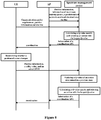
- Figure 8 shows a schematic diagram of an information procedure between a user (UE), an access point (AP) and a spectrum management device (for example, the SC or the SAS) in a case that the electronic apparatus 400 is arranged on the spectrum management device.
- UE user
- AP access point
- SC spectrum management device
- the UE requests an AP for coordination communication from the spectrum management device, and reports position information and information of the communication quality requirement such as the SINR threshold for the user to the spectrum management device.
- the AP reports the position information, the information of the maximum emitting power and the predetermined network overhead threshold of the AP to the spectrum management device.
- the AP may report the position information of the AP only in a process of system initialization.
- the UE may directly report related information to the spectrum management device.
- the UE may report the related information to the spectrum management device via the AP.
- the information reported by the AP further includes the position information and the information of the communication quality requirement of the user.
- the spectrum management device selects the coordination APG for the user.
- the spectrum management device may select an action having the largest Q-value by using the Q-learning reinforcement learning algorithm as described in detail in the first embodiment, so as to determine the coordination APG for each user. It should be noted that, in a case that evaluation matrixes for multiple states are stored in the spectrum management device, and if the current state is included in the stored states, the action may be selected based on the store evaluation matrixes without repeating the reinforcement learning algorithm.
- the spectrum management device transmits information of the determined coordination APG to the AP, so that the AP can coordinate with the UE based on the information.
- the UE if only the position of the UE can change, the UE, for example, periodically determines whether the position of the UE changes. In a case that the position of the UE changes or the change reaches a certain degree, which indicates that the wireless network topology structure changes, the UE is required to request a new coordination APG. In this case, the UE reports the changed position information of the UE to the spectrum management device. The UE further reports an actual utility value and an actual SINR of the UE that are obtained by performing the determined action in a state before changing, to the spectrum management device. The spectrum management device updates, based on the actual utility value and the actual SINR that are provided by the UE, a Q-value of the action determined in the previous state.
- the spectrum management device further reselects, based on current position information of the UE, an action to be performed in the current state. For example, as described in the above, the spectrum management device may perform the selection by performing the Q-learning reinforcement learning algorithm. Alternatively, in a case that an evaluation matrix for the current state is stored in the spectrum management device, the action to be performed may be selected by searching for the evaluation matrix. Similarly, the spectrum management device transmits information of the determined coordination APG to the AP, so that the AP can coordinate with the UE based on the information.
- Figure 9 is a schematic diagram showing a simulation scenario of the first simulation instance, where a triangle denotes UE, a square denotes an AP, and a dashed line with an arrow indicates a movement trace of one UE.
- Figure 9 shows four different positions of the UE, which denote states S 1 , S 2 , S 3 and S 4 respectively.
- Parameters used in simulation are listed as follows: an operation frequency of 3.5GHz, a channel bandwidth of 10MHz, 3 UEs, emitting power of 0dBm, 16 APs, an SINR threshold for the UE of 7dB, a noise figure of 5dB at a receiver of the UE, 10 generations of population evolution in the genetic algorithm, a crossover ratio of 0.7, a mutation ratio of 0.1, 10 individuals, and a Hamming distance threshold of 5.
- the UE uploads the position information and the information of communication quality requirement to the spectrum management device.
- the AP uploads the position information, the information of the maximum emitting power, and the Hamming distance threshold to the spectrum management device.
- the spectrum management device generates some preliminary actions, and generates, based on the preliminary actions, new actions by using the genetic algorithm.
- the preliminary actions and the new actions form an action matrix A 1 .
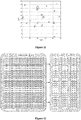
- An example of the action matrix A 1 in the state S 1 is shown on the left side in Figure 10 , where each row denotes one action, that is, one coordination relationship between the AP and the UE, and 18 actions are shown.
- Each action is represented by a binary sequence including 48 bits.
- There are M (M 16 in this embodiment) APs. Bits 1 to M denote a coordination relationship between a user 1 and the APs, and Bits M+1 to 2M denote a coordination relationship between a user 2 and the APs, and so on.
- the spectrum management matrix generates a Q-value matrix Q ( S 1 , A 1 ) corresponding to the matrix A 1 by using the above mentioned Q-learning algorithm, as shown on the right side in Figure 10 .
- the Q-value matrix is calculated by using the above equations (3) to (5) and (7) to (8).
- the state S 1 is an initial state
- PH ( S 1 , A 1 ) is a null matrix.
- the spectrum management device selects an action corresponding to a maximum value in the Q-value matrix, for example, an action 15, and notifies the AP to coordinate with the UE based on this action.
- Figure 11 is a schematic diagram showing a result after the action 15 is performed. A UE and an AP that are circled with lines having the same line type have the coordination relationship.
- the state S 1 changes to the state S 2 due to movement of the UE.
- the UE uploads new position information, and an actual SINR and an actual utility value that are obtained by performing the action 15 in the state S 1 to the spectrum management device.
- the spectrum management device calculates an actual degree of meeting communication quality requirement obtained by performing the action 15 based on this information and by using the equation (9), and updates a value of R_15 in R ( S 1 , A 1 ) by using equation (10).
- equation (10) ⁇ is set to be zero.
- the spectrum management device updates the action matrix in the state S 1 by using the genetic algorithm, to obtain an action matrix A 2 in the state S 2 , as shown on the left side in Figure 12 .
- the spectrum management device generates a Q-value matrix Q ( S 2 , A 2 ) corresponding to A 2 by using the above mentioned Q-learning algorithm, as shown on the right side in Figure 12 .
- the Q-value matrix is calculated by using the above equations (3) to (5) and (7) to (8).
- the spectrum management device selects an action corresponding to a maximum value in the Q-value matrix, for example, an action 11, and notifies the AP to coordinate with the UE based on this action.
- Figure 13 is a schematic diagram showing a result after the action 11 is performed. The UE and the AP that are circled with lines having the same line type have the coordination relationship.
- the spectrum management device When the state successively changes into the states S 3 and S 4 , the spectrum management device performs operation similar to that in the state S 2 , which is not repeated herein.
- FIGS 14 and 15 respectively show two simulation scenarios of the second simulation instance, where a dashed line with an arrow indicates a movement trace of a UE.
- a dashed line with an arrow indicates a movement trace of a UE.
- the UE reciprocates along the dashed line, thus the state changes from state S 1 to S9 and then to S1, that is S 1 ⁇ S 9 ⁇ S 1 .
- the UE moves cyclically along a rectangle formed by a dashed line. It is assumed that positions of UEs other than the above UE and APs remain unchanged in the two scenarios.
- Parameters used in the simulation are listed as follows: an operation frequency of 28GHz, a channel bandwidth of 10MHz, 6 UEs, emitting power of 0dBm, 60 APs, an SINR threshold for the UE of 7dB, a noise figure of 5dB at a receiver of the UE, 10 generations of population evolution in the genetic algorithm, a crossover ratio of 0.7, a mutation ratio of 0.1, 10 individuals, a beam width of ⁇ /4, and a Hamming distance threshold of 5 in the simulation scenario 1, and a Hamming distance threshold of 10 in the simulation scenario 2.
- a new action is acquired by using the genetic algorithm, but the action is determined based on only a switch threshold, that is, a Hamming distance threshold T d for the APG reselection.
- Figure 16 is a comparison diagram of a cumulative distribution function (CDF) of a user satisfaction rate obtained based on the simulation scenario 1, where a solid line denotes a CDF curve corresponding to the reinforcement learning algorithm, an upper dashed line denotes a CDF curve corresponding to the comparison algorithm in a case of a Hamming distance threshold being 5, and a lower dashed line denotes a CDF curve corresponding to the comparison algorithm in a case of a Hamming distance threshold being 20. It can be seen that, performance based on the reinforcement learning algorithm is superior to that based on the comparison algorithm.
- CDF cumulative distribution function
- Figure 17 shows ratios of meeting communication quality requirement such as QoS requirement of a user, in a case that the UE moves along a rectangle trace in the simulation scenario 2 with different numbers of rounds. It can be seen that, with the number of rounds increasing, a satisfaction rate of the user increases correspondingly, that is, the effect of the reinforcement learning algorithm is increasingly significant over time.
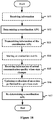
- FIG 18 is a flowchart of a method for wireless communications according to an embodiment of the present disclosure.
- the method for wireless communications includes: determining a coordination APG for a user within a predetermined range, by taking a wireless network topology structure of a wireless network as a state (S12); and re-determining a coordination APG for the user in response to a change of the wireless network topology structure (S17).
- the wireless network topology structure may include a distribution of users and a distribution of access points.
- the coordination APG may be determined by using a reinforcement learning algorithm in step S12.
- step S12 a coordination relationship between the user and an access point is taken as an action in the reinforcement learning algorithm, and with respect to each action, an evaluation of the action is calculated based on a degree of meeting communication quality requirement of the user and a resulting network overhead when performing the action.
- the coordination APG for the user in a current state is determined based on an action with the highest evaluation.
- the action with the highest evaluation is an action when being performed results in the highest degree of meeting the communication quality requirement of the user and the lowest network overhead, compared with other actions.
- the degree of meeting the communication quality requirement of each user is calculated by using a signal to interference and noise ratio threshold for the user and an estimated signal to interference and noise ratio of the user.
- the degree of meeting the communication quality requirement of the user may include a utility value of all users and a cost value of not meeting the signal to interference and noise ratio of the user.
- the utility value of the users is calculated from a utility function.
- the utility function is a non-linear function of a ratio of the estimated signal to interference and noise ratio of the user to the signal to interference and noise ratio threshold for the user.
- the cost value depends on a difference between the signal to interference and noise ratio threshold for a user and the estimated signal to interference and noise ratio of the user.
- a difference between this action and an action determined in a previous state may be used as the network overhead produced by this action.
- the action may be represented by a binarization matrix of the coordination relationship.
- the network overhead may be represented by a Hamming distance between actions. The network overhead produced when performing the action may be taken into consideration only when the network overhead exceeds a predetermined overhead threshold.
- the above method may further include: receiving one or more of position information and communication quality requirement of the user, and one or more of position information, information of maximum emitting power and a predetermined network overhead threshold of the access point (S11), and transmitting information of the determined coordination access point group to the access point (S13).
- the information received in step S11 is used in calculation in step S12.
- the above method may further include a step S14 of storing, with respect to each state, each action in this state in association with an evaluation calculated with respect to the action, as an evaluation matrix.
- the above method may further include a step S15 of receiving information of actual communication quality of the user in a case that the state changes.
- the above method further includes a step S16 of updating stored evaluation of the action performed in the previous state using information of the actual communication quality of the user when performing the determined action in the previous state, that is, updating the content of the evaluation matrix.
- a portion of the evaluation of the action performed in the previous state which is related to the degree of meeting the communication quality requirement of the user may be replaced with a following calculated value: a weighted sum of the actual degree of meeting the communication quality requirement of the user in the previous state and the estimated highest degree of meeting the communication quality requirement of the user in the current state.
- the above method may further include: acquiring, in each state, the action by grouping the access points taking the user as a center and selecting the coordination access point group for the user within a group of the user.
- the grouping may be performed based on a Euclidean distance between the user and the access point.
- the coordination access point group for the user is randomly selected within the group of the user, and the coordination relationship between the user and the access point which meets a predetermined condition is taken as the action.
- the predetermined condition may include one or more of: the communication quality for each user meets the communication quality requirement of the user; and the network overhead produced when using this coordination relationship relative to an action determined in the previous state does not exceed a predetermined overhead threshold.
- a new action may be estimated based on a preliminarily acquired action when acquiring actions.
- the new action may be estimated by using a genetic algorithm.
- An action estimated by using the genetic algorithm may be taken as the new action only when the action meets the above predetermined condition.
- each of the electronic apparatus 100 to 400 may be implemented as various servers, such as a tower server, a rack-mounted server, and a blade server.
- Each of the electronic apparatus 100 to 400 may be a control module (such as an integrated circuitry module including a single die, and a card or blade inserted in a groove of a blade server) mounted on a server.
- FIG 19 is a block diagram showing an example of a schematic configuration of a server 700 to which the technology of the present disclosure may be applied.
- the server 700 includes a processor 701, a memory 702, a storage 703, a network interface 704, and a bus 706.
- the processor 701 may be, for example, a central processing unit (CPU) or a digital signal processor (DSP), and controls functions of the server 700.
- the memory 702 includes random access memory (RAM) and read only memory (ROM), and stores a program that is executed by the processor 701 and data.
- the storage 703 may include a storage medium such as a semiconductor memory and a hard disk.
- the network interface 704 is a wired communication interface for connecting the server 700 to a wired communication network 705.
- the wired communication network 705 may be a core network such as an Evolved Packet Core (EPC), or a packet data network (PDN) such as the Internet.
- EPC Evolved Packet Core
- PDN packet data network
- the bus 706 connects the processor 701, the memory 702, the storage 703, and the network interface 704 to each other.
- the bus 706 may include two or more buses (such as a high speed bus and a low speed bus) each of which has different speed.
- the determining unit 101, the updating unit 102, the grouping unit 201, the estimating unit 301 and the like that are respectively described with reference to Figures 2 , 5, 6 may be implemented by the processor 701.
- the storage unit 103 described with reference to Figure 4 may be implemented by, for example, the memory 702 or the storage 703.
- the transceiving unit 401 described with reference to Figure 7 may be implemented by, for example, the network interface 704. A part of functions of the storage unit103 and the transceiving unit 401 may also be implemented by the processor 701.
- the processor 701 may perform selecting and updating of the coordination APG by performing functions of the determining unit 101, the updating unit 102 and the like.
- the present disclosure further discloses a program product in which machine-readable instruction codes are stored.
- the aforementioned methods according to the embodiments can be implemented when the instruction codes are read and executed by a machine.
- the memory medium includes but is not limited to soft disc, optical disc, magnetic optical disc, memory card, memory stick and the like.
- a program constituting the software is installed in a computer with a dedicated hardware structure (e.g. the general computer 2000 shown in Figure 20 ) from a storage medium or network, wherein the computer is capable of implementing various functions when installed with various programs.
- a dedicated hardware structure e.g. the general computer 2000 shown in Figure 20
- the computer is capable of implementing various functions when installed with various programs.
- a central processing unit (CPU) 2001 executes various processing according to a program stored in a read-only memory (ROM) 2002 or a program loaded to a random access memory (RAM) 2003 from a memory section 2008.
- the data needed for the various processing of the CPU 2001 may be stored in the RAM 2003 as needed.
- the CPU 2001, the ROM 2002 and the RAM 2003 are linked with each other via a bus 2004.
- An input/output interface 2005 is also linked to the bus 2004.
- the following components are linked to the input/output interface 2005: an input section 2006 (including keyboard, mouse and the like), an output section 2007 (including displays such as a cathode ray tube (CRT), a liquid crystal display (LCD), a loudspeaker and the like), a memory section 2008 (including hard disc and the like), and a communication section 2009 (including a network interface card such as a LAN card, modem and the like).
- the communication section 2009 performs communication processing via a network such as the Internet.
- a driver 2010 may also be linked to the input/output interface 2005, if needed. If needed, a removable medium 2011, for example, a magnetic disc, an optical disc, a magnetic optical disc, a semiconductor memory and the like, may be installed in the driver 2010, so that the computer program read therefrom is installed in the memory section 2008 as appropriate.
- programs forming the software are installed from a network such as the Internet or a memory medium such as the removable medium 2011.
- the memory medium is not limited to the removable medium 2011 shown in Figure 20 , which has program stored therein and is distributed separately from the apparatus so as to provide the programs to users.
- the removable medium 2011 may be, for example, a magnetic disc (including floppy disc (registered trademark)), a compact disc (including compact disc read-only memory (CD-ROM) and digital versatile disc (DVD), a magneto optical disc (including mini disc (MD)(registered trademark)), and a semiconductor memory.
- the memory medium may be the hard discs included in ROM 2002 and the memory section 2008 in which programs are stored, and can be distributed to users along with the device in which they are incorporated.
- the respective components or steps can be decomposed and/or recombined. These decompositions and/or recombinations shall be regarded as equivalent solutions of the disclosure. Moreover, the above series of processing steps can naturally be performed temporally in the sequence as described above but will not be limited thereto, and some of the steps can be performed in parallel or independently from each other.
- the term “include”, “comprise” or any variant thereof is intended to encompass nonexclusive inclusion so that a process, method, article or device including a series of elements includes not only those elements but also other elements which have been not listed definitely or an element(s) inherent to the process, method, article or device.
- the expression “comprising a(n) ??" in which an element is defined will not preclude presence of an additional identical element(s) in a process, method, article or device comprising the defined element(s)" unless further defined.
Landscapes
- Engineering & Computer Science (AREA)
- Computer Networks & Wireless Communication (AREA)
- Signal Processing (AREA)
- Quality & Reliability (AREA)
- Computer Security & Cryptography (AREA)
- Mobile Radio Communication Systems (AREA)
Applications Claiming Priority (2)
| Application Number | Priority Date | Filing Date | Title |
|---|---|---|---|
| CN201711009075.6A CN109714772A (zh) | 2017-10-25 | 2017-10-25 | 用于无线通信的电子设备和方法 |
| PCT/CN2018/110964 WO2019080771A1 (fr) | 2017-10-25 | 2018-10-19 | Dispositif électronique et procédé destinés à une communication sans fil |
Publications (2)
| Publication Number | Publication Date |
|---|---|
| EP3700247A1 true EP3700247A1 (fr) | 2020-08-26 |
| EP3700247A4 EP3700247A4 (fr) | 2020-11-11 |
Family
ID=66246287
Family Applications (1)
| Application Number | Title | Priority Date | Filing Date |
|---|---|---|---|
| EP18869999.5A Withdrawn EP3700247A4 (fr) | 2017-10-25 | 2018-10-19 | Dispositif électronique et procédé destinés à une communication sans fil |
Country Status (5)
| Country | Link |
|---|---|
| US (1) | US11140561B2 (fr) |
| EP (1) | EP3700247A4 (fr) |
| CN (2) | CN109714772A (fr) |
| TW (1) | TWI756438B (fr) |
| WO (1) | WO2019080771A1 (fr) |
Families Citing this family (6)
| Publication number | Priority date | Publication date | Assignee | Title |
|---|---|---|---|---|
| JP6805193B2 (ja) * | 2018-02-13 | 2020-12-23 | 日本電信電話株式会社 | 無線通信システム、無線通信方法、基地局及び端末 |
| US11665777B2 (en) * | 2018-09-28 | 2023-05-30 | Intel Corporation | System and method using collaborative learning of interference environment and network topology for autonomous spectrum sharing |
| CN111124332B (zh) * | 2019-11-18 | 2024-03-01 | 北京小米移动软件有限公司 | 设备呈现内容的控制方法、控制装置及存储介质 |
| EP4002709A1 (fr) * | 2020-11-16 | 2022-05-25 | Nokia Technologies Oy | Division de polarisation pour un débit mimo amélioré |
| CN115209440B (zh) * | 2021-04-09 | 2025-04-04 | 华为技术有限公司 | 网络拓扑的识别方法、装置及无线通信系统 |
| US12372948B2 (en) * | 2022-04-01 | 2025-07-29 | Ford Global Technologies, Llc | Controlling operational characteristics of a plurality of wireless access points of a manufacturing environment |
Family Cites Families (15)
| Publication number | Priority date | Publication date | Assignee | Title |
|---|---|---|---|---|
| KR101572891B1 (ko) * | 2009-01-30 | 2015-11-30 | 엘지전자 주식회사 | 적응적 CoMP 방식 선택 방법 |
| US10250364B2 (en) * | 2011-12-09 | 2019-04-02 | Nokia Corporation | Channel measurements supporting coordinated multi-point operation |
| JP5962670B2 (ja) * | 2012-01-26 | 2016-08-03 | ソニー株式会社 | 無線通信装置及び無線通信方法、並びに無線通信システム |
| US8953478B2 (en) * | 2012-01-27 | 2015-02-10 | Intel Corporation | Evolved node B and method for coherent coordinated multipoint transmission with per CSI-RS feedback |
| US9497639B2 (en) * | 2012-03-06 | 2016-11-15 | Qualcomm Incorporated | Methods and apparatus for adapting femtocell properties based on changes detected in network topology |
| US9867201B2 (en) * | 2012-05-07 | 2018-01-09 | Nokia Solutions And Networks Oy | Joint assignment and scheduling for overlapping CoMP clusters |
| US20140235266A1 (en) | 2013-02-16 | 2014-08-21 | Qualcomm Incorporated | Focused assistance data for WiFi access points and femtocells |
| US9184998B2 (en) * | 2013-03-14 | 2015-11-10 | Qualcomm Incorporated | Distributed path update in hybrid networks |
| CN105338650B (zh) * | 2014-08-08 | 2019-02-22 | 电信科学技术研究院 | 一种异构网络中的接入方法和装置 |
| US9883445B2 (en) * | 2015-06-22 | 2018-01-30 | Samsung Electronics Co., Ltd. | Method and apparatus for operation in coexistence environment of cellular, non-cellular, macro and micro networks |
| CN107736048B (zh) * | 2015-07-25 | 2020-04-28 | 华为技术有限公司 | 一种分配接入回程资源的方法及装置 |
| CN105451250B (zh) | 2015-09-01 | 2017-07-11 | 电信科学技术研究院 | 一种网络接入点动态组网方法及设备 |
| CN106788646B (zh) | 2015-11-24 | 2022-03-18 | 上海诺基亚贝尔股份有限公司 | 用于利用虚拟小区进行通信的方法和装置以及通信系统 |
| WO2018176415A1 (fr) * | 2017-03-31 | 2018-10-04 | 华为技术有限公司 | Procédé de détermination d'une cellule coopérative, et dispositif de réseau |
| US20190019082A1 (en) * | 2017-07-12 | 2019-01-17 | International Business Machines Corporation | Cooperative neural network reinforcement learning |
-
2017
- 2017-10-25 CN CN201711009075.6A patent/CN109714772A/zh active Pending
-
2018
- 2018-06-04 TW TW107119148A patent/TWI756438B/zh not_active IP Right Cessation
- 2018-10-19 CN CN201880044183.3A patent/CN110809893B/zh active Active
- 2018-10-19 EP EP18869999.5A patent/EP3700247A4/fr not_active Withdrawn
- 2018-10-19 WO PCT/CN2018/110964 patent/WO2019080771A1/fr not_active Ceased
- 2018-10-19 US US16/634,887 patent/US11140561B2/en not_active Expired - Fee Related
Also Published As
| Publication number | Publication date |
|---|---|
| EP3700247A4 (fr) | 2020-11-11 |
| TWI756438B (zh) | 2022-03-01 |
| US20200236560A1 (en) | 2020-07-23 |
| US11140561B2 (en) | 2021-10-05 |
| CN109714772A (zh) | 2019-05-03 |
| WO2019080771A1 (fr) | 2019-05-02 |
| CN110809893A (zh) | 2020-02-18 |
| CN110809893B (zh) | 2024-12-17 |
| TW201918109A (zh) | 2019-05-01 |
Similar Documents
| Publication | Publication Date | Title |
|---|---|---|
| US11140561B2 (en) | Electronic device and method for wireless communication | |
| CN114363921B (zh) | Ai网络参数的配置方法和设备 | |
| US12035421B2 (en) | Procedure for optimization of self-organizing network | |
| EP3709696B1 (fr) | Appareil électronique et procédé utilisés dans des communications sans fil et support de mémoire lisible par ordinateur | |
| KR20240099494A (ko) | 통신 방법 및 장치 | |
| US12010571B2 (en) | Spectral efficiency prediction with artificial intelligence for enhancing carrier aggregation and proactive radio resource management | |
| Arvinte et al. | Beam management in 5G NR using geolocation side information | |
| KR20240114286A (ko) | 통신 방법 및 장치 | |
| EP4195791B1 (fr) | Sélection de paramètres de commande de puissance | |
| US20250008346A1 (en) | Methods and devices for multi-cell radio resource management algorithms | |
| Krishnan et al. | Optimizing throughput performance in distributed MIMO Wi-Fi networks using deep reinforcement learning | |
| CN117639862A (zh) | Csi预测处理方法、装置、通信设备及可读存储介质 | |
| US20240155383A1 (en) | Reinforcement learning for son parameter optimization | |
| US12574298B2 (en) | Machine learning model distribution | |
| WO2023088387A1 (fr) | Procédé et appareil de prédiction de canal, ue, et système | |
| KR20250144481A (ko) | 통신 방법, 장치 및 시스템 | |
| Araujo et al. | Deployment of small cells and a transport infrastructure concurrently for next-generation mobile access networks | |
| CN112929907B (zh) | 天线参数的确定方法及装置 | |
| US20250053873A1 (en) | Data evaluation for ai/ml | |
| EP4488883A1 (fr) | Procédé de traitement de données et appareil associé | |
| US10959115B2 (en) | Communication methods and devices for joint optimization of transmit power and transmission rate | |
| US12245047B2 (en) | Electronic device and method for wireless communication, and computer readable storage medium for determining and using a spectrum sharing mode | |
| Valach et al. | Optimization of LoRa networks using multi-armed bandit algorithms | |
| WO2026011988A1 (fr) | Procédé de communication et appareil associé | |
| WO2025078006A1 (fr) | Attribution de sous-bande d'apprentissage sur graphes |
Legal Events
| Date | Code | Title | Description |
|---|---|---|---|
| STAA | Information on the status of an ep patent application or granted ep patent |
Free format text: STATUS: THE INTERNATIONAL PUBLICATION HAS BEEN MADE |
|
| PUAI | Public reference made under article 153(3) epc to a published international application that has entered the european phase |
Free format text: ORIGINAL CODE: 0009012 |
|
| STAA | Information on the status of an ep patent application or granted ep patent |
Free format text: STATUS: REQUEST FOR EXAMINATION WAS MADE |
|
| 17P | Request for examination filed |
Effective date: 20200504 |
|
| AK | Designated contracting states |
Kind code of ref document: A1 Designated state(s): AL AT BE BG CH CY CZ DE DK EE ES FI FR GB GR HR HU IE IS IT LI LT LU LV MC MK MT NL NO PL PT RO RS SE SI SK SM TR |
|
| AX | Request for extension of the european patent |
Extension state: BA ME |
|
| A4 | Supplementary search report drawn up and despatched |
Effective date: 20201012 |
|
| RIC1 | Information provided on ipc code assigned before grant |
Ipc: H04W 16/10 20090101AFI20201006BHEP Ipc: H04W 36/18 20090101ALN20201006BHEP |
|
| DAV | Request for validation of the european patent (deleted) | ||
| DAX | Request for extension of the european patent (deleted) | ||
| RAP3 | Party data changed (applicant data changed or rights of an application transferred) |
Owner name: SONY GROUP CORPORATION |
|
| STAA | Information on the status of an ep patent application or granted ep patent |
Free format text: STATUS: THE APPLICATION HAS BEEN WITHDRAWN |
|
| 18W | Application withdrawn |
Effective date: 20220404 |