EP3700967B1 - Procédé de séchage par pulvérisation - Google Patents
Procédé de séchage par pulvérisation Download PDFInfo
- Publication number
- EP3700967B1 EP3700967B1 EP18792930.2A EP18792930A EP3700967B1 EP 3700967 B1 EP3700967 B1 EP 3700967B1 EP 18792930 A EP18792930 A EP 18792930A EP 3700967 B1 EP3700967 B1 EP 3700967B1
- Authority
- EP
- European Patent Office
- Prior art keywords
- branched
- unbranched
- polymeric dispersant
- polysaccharide
- alkyl group
- Prior art date
- Legal status (The legal status is an assumption and is not a legal conclusion. Google has not performed a legal analysis and makes no representation as to the accuracy of the status listed.)
- Active
Links
Classifications
-
- C—CHEMISTRY; METALLURGY
- C08—ORGANIC MACROMOLECULAR COMPOUNDS; THEIR PREPARATION OR CHEMICAL WORKING-UP; COMPOSITIONS BASED THEREON
- C08J—WORKING-UP; GENERAL PROCESSES OF COMPOUNDING; AFTER-TREATMENT NOT COVERED BY SUBCLASSES C08B, C08C, C08F, C08G or C08H
- C08J3/00—Processes of treating or compounding macromolecular substances
- C08J3/12—Powdering or granulating
- C08J3/122—Pulverisation by spraying
-
- C—CHEMISTRY; METALLURGY
- C04—CEMENTS; CONCRETE; ARTIFICIAL STONE; CERAMICS; REFRACTORIES
- C04B—LIME, MAGNESIA; SLAG; CEMENTS; COMPOSITIONS THEREOF, e.g. MORTARS, CONCRETE OR LIKE BUILDING MATERIALS; ARTIFICIAL STONE; CERAMICS; REFRACTORIES; TREATMENT OF NATURAL STONE
- C04B24/00—Use of organic materials as active ingredients for mortars, concrete or artificial stone, e.g. plasticisers
- C04B24/24—Macromolecular compounds
- C04B24/38—Polysaccharides or derivatives thereof
- C04B24/383—Cellulose or derivatives thereof
-
- C—CHEMISTRY; METALLURGY
- C04—CEMENTS; CONCRETE; ARTIFICIAL STONE; CERAMICS; REFRACTORIES
- C04B—LIME, MAGNESIA; SLAG; CEMENTS; COMPOSITIONS THEREOF, e.g. MORTARS, CONCRETE OR LIKE BUILDING MATERIALS; ARTIFICIAL STONE; CERAMICS; REFRACTORIES; TREATMENT OF NATURAL STONE
- C04B28/00—Compositions of mortars, concrete or artificial stone, containing inorganic binders or the reaction product of an inorganic and an organic binder, e.g. polycarboxylate cements
- C04B28/02—Compositions of mortars, concrete or artificial stone, containing inorganic binders or the reaction product of an inorganic and an organic binder, e.g. polycarboxylate cements containing hydraulic cements other than calcium sulfates
-
- C—CHEMISTRY; METALLURGY
- C04—CEMENTS; CONCRETE; ARTIFICIAL STONE; CERAMICS; REFRACTORIES
- C04B—LIME, MAGNESIA; SLAG; CEMENTS; COMPOSITIONS THEREOF, e.g. MORTARS, CONCRETE OR LIKE BUILDING MATERIALS; ARTIFICIAL STONE; CERAMICS; REFRACTORIES; TREATMENT OF NATURAL STONE
- C04B28/00—Compositions of mortars, concrete or artificial stone, containing inorganic binders or the reaction product of an inorganic and an organic binder, e.g. polycarboxylate cements
- C04B28/14—Compositions of mortars, concrete or artificial stone, containing inorganic binders or the reaction product of an inorganic and an organic binder, e.g. polycarboxylate cements containing calcium sulfate cements
-
- C—CHEMISTRY; METALLURGY
- C04—CEMENTS; CONCRETE; ARTIFICIAL STONE; CERAMICS; REFRACTORIES
- C04B—LIME, MAGNESIA; SLAG; CEMENTS; COMPOSITIONS THEREOF, e.g. MORTARS, CONCRETE OR LIKE BUILDING MATERIALS; ARTIFICIAL STONE; CERAMICS; REFRACTORIES; TREATMENT OF NATURAL STONE
- C04B40/00—Processes, in general, for influencing or modifying the properties of mortars, concrete or artificial stone compositions, e.g. their setting or hardening ability
- C04B40/0028—Aspects relating to the mixing step of the mortar preparation
- C04B40/0039—Premixtures of ingredients
- C04B40/0042—Powdery mixtures
-
- C—CHEMISTRY; METALLURGY
- C04—CEMENTS; CONCRETE; ARTIFICIAL STONE; CERAMICS; REFRACTORIES
- C04B—LIME, MAGNESIA; SLAG; CEMENTS; COMPOSITIONS THEREOF, e.g. MORTARS, CONCRETE OR LIKE BUILDING MATERIALS; ARTIFICIAL STONE; CERAMICS; REFRACTORIES; TREATMENT OF NATURAL STONE
- C04B2103/00—Function or property of ingredients for mortars, concrete or artificial stone
- C04B2103/0045—Polymers chosen for their physico-chemical characteristics
- C04B2103/0057—Polymers chosen for their physico-chemical characteristics added as redispersable powders
-
- C—CHEMISTRY; METALLURGY
- C04—CEMENTS; CONCRETE; ARTIFICIAL STONE; CERAMICS; REFRACTORIES
- C04B—LIME, MAGNESIA; SLAG; CEMENTS; COMPOSITIONS THEREOF, e.g. MORTARS, CONCRETE OR LIKE BUILDING MATERIALS; ARTIFICIAL STONE; CERAMICS; REFRACTORIES; TREATMENT OF NATURAL STONE
- C04B2103/00—Function or property of ingredients for mortars, concrete or artificial stone
- C04B2103/0068—Ingredients with a function or property not provided for elsewhere in C04B2103/00
- C04B2103/0082—Segregation-preventing agents; Sedimentation-preventing agents
-
- C—CHEMISTRY; METALLURGY
- C08—ORGANIC MACROMOLECULAR COMPOUNDS; THEIR PREPARATION OR CHEMICAL WORKING-UP; COMPOSITIONS BASED THEREON
- C08J—WORKING-UP; GENERAL PROCESSES OF COMPOUNDING; AFTER-TREATMENT NOT COVERED BY SUBCLASSES C08B, C08C, C08F, C08G or C08H
- C08J2300/00—Characterised by the use of unspecified polymers
- C08J2300/12—Polymers characterised by physical features, e.g. anisotropy, viscosity or electrical conductivity
-
- C—CHEMISTRY; METALLURGY
- C08—ORGANIC MACROMOLECULAR COMPOUNDS; THEIR PREPARATION OR CHEMICAL WORKING-UP; COMPOSITIONS BASED THEREON
- C08J—WORKING-UP; GENERAL PROCESSES OF COMPOUNDING; AFTER-TREATMENT NOT COVERED BY SUBCLASSES C08B, C08C, C08F, C08G or C08H
- C08J2301/00—Characterised by the use of cellulose, modified cellulose or cellulose derivatives
- C08J2301/08—Cellulose derivatives
- C08J2301/26—Cellulose ethers
-
- C—CHEMISTRY; METALLURGY
- C08—ORGANIC MACROMOLECULAR COMPOUNDS; THEIR PREPARATION OR CHEMICAL WORKING-UP; COMPOSITIONS BASED THEREON
- C08J—WORKING-UP; GENERAL PROCESSES OF COMPOUNDING; AFTER-TREATMENT NOT COVERED BY SUBCLASSES C08B, C08C, C08F, C08G or C08H
- C08J2301/00—Characterised by the use of cellulose, modified cellulose or cellulose derivatives
- C08J2301/08—Cellulose derivatives
- C08J2301/26—Cellulose ethers
- C08J2301/28—Alkyl ethers
-
- C—CHEMISTRY; METALLURGY
- C08—ORGANIC MACROMOLECULAR COMPOUNDS; THEIR PREPARATION OR CHEMICAL WORKING-UP; COMPOSITIONS BASED THEREON
- C08J—WORKING-UP; GENERAL PROCESSES OF COMPOUNDING; AFTER-TREATMENT NOT COVERED BY SUBCLASSES C08B, C08C, C08F, C08G or C08H
- C08J2303/00—Characterised by the use of starch, amylose or amylopectin or of their derivatives or degradation products
- C08J2303/04—Starch derivatives
- C08J2303/08—Ethers
-
- C—CHEMISTRY; METALLURGY
- C08—ORGANIC MACROMOLECULAR COMPOUNDS; THEIR PREPARATION OR CHEMICAL WORKING-UP; COMPOSITIONS BASED THEREON
- C08J—WORKING-UP; GENERAL PROCESSES OF COMPOUNDING; AFTER-TREATMENT NOT COVERED BY SUBCLASSES C08B, C08C, C08F, C08G or C08H
- C08J2305/00—Characterised by the use of polysaccharides or of their derivatives not provided for in groups C08J2301/00 or C08J2303/00
-
- C—CHEMISTRY; METALLURGY
- C08—ORGANIC MACROMOLECULAR COMPOUNDS; THEIR PREPARATION OR CHEMICAL WORKING-UP; COMPOSITIONS BASED THEREON
- C08J—WORKING-UP; GENERAL PROCESSES OF COMPOUNDING; AFTER-TREATMENT NOT COVERED BY SUBCLASSES C08B, C08C, C08F, C08G or C08H
- C08J2400/00—Characterised by the use of unspecified polymers
- C08J2400/12—Polymers characterised by physical features, e.g. anisotropy, viscosity or electrical conductivity
-
- C—CHEMISTRY; METALLURGY
- C08—ORGANIC MACROMOLECULAR COMPOUNDS; THEIR PREPARATION OR CHEMICAL WORKING-UP; COMPOSITIONS BASED THEREON
- C08J—WORKING-UP; GENERAL PROCESSES OF COMPOUNDING; AFTER-TREATMENT NOT COVERED BY SUBCLASSES C08B, C08C, C08F, C08G or C08H
- C08J2401/00—Characterised by the use of cellulose, modified cellulose or cellulose derivatives
- C08J2401/08—Cellulose derivatives
- C08J2401/26—Cellulose ethers
-
- C—CHEMISTRY; METALLURGY
- C08—ORGANIC MACROMOLECULAR COMPOUNDS; THEIR PREPARATION OR CHEMICAL WORKING-UP; COMPOSITIONS BASED THEREON
- C08J—WORKING-UP; GENERAL PROCESSES OF COMPOUNDING; AFTER-TREATMENT NOT COVERED BY SUBCLASSES C08B, C08C, C08F, C08G or C08H
- C08J2401/00—Characterised by the use of cellulose, modified cellulose or cellulose derivatives
- C08J2401/08—Cellulose derivatives
- C08J2401/26—Cellulose ethers
- C08J2401/28—Alkyl ethers
-
- C—CHEMISTRY; METALLURGY
- C08—ORGANIC MACROMOLECULAR COMPOUNDS; THEIR PREPARATION OR CHEMICAL WORKING-UP; COMPOSITIONS BASED THEREON
- C08J—WORKING-UP; GENERAL PROCESSES OF COMPOUNDING; AFTER-TREATMENT NOT COVERED BY SUBCLASSES C08B, C08C, C08F, C08G or C08H
- C08J2403/00—Characterised by the use of starch, amylose or amylopectin or of their derivatives or degradation products
- C08J2403/04—Starch derivatives
- C08J2403/08—Ethers
-
- C—CHEMISTRY; METALLURGY
- C08—ORGANIC MACROMOLECULAR COMPOUNDS; THEIR PREPARATION OR CHEMICAL WORKING-UP; COMPOSITIONS BASED THEREON
- C08J—WORKING-UP; GENERAL PROCESSES OF COMPOUNDING; AFTER-TREATMENT NOT COVERED BY SUBCLASSES C08B, C08C, C08F, C08G or C08H
- C08J2405/00—Characterised by the use of polysaccharides or of their derivatives not provided for in groups C08J2401/00 or C08J2403/00
-
- C—CHEMISTRY; METALLURGY
- C08—ORGANIC MACROMOLECULAR COMPOUNDS; THEIR PREPARATION OR CHEMICAL WORKING-UP; COMPOSITIONS BASED THEREON
- C08J—WORKING-UP; GENERAL PROCESSES OF COMPOUNDING; AFTER-TREATMENT NOT COVERED BY SUBCLASSES C08B, C08C, C08F, C08G or C08H
- C08J2433/00—Characterised by the use of homopolymers or copolymers of compounds having one or more unsaturated aliphatic radicals, each having only one carbon-to-carbon double bond, and only one being terminated by only one carboxyl radical, or of salts, anhydrides, esters, amides, imides, or nitriles thereof; Derivatives of such polymers
- C08J2433/04—Characterised by the use of homopolymers or copolymers of compounds having one or more unsaturated aliphatic radicals, each having only one carbon-to-carbon double bond, and only one being terminated by only one carboxyl radical, or of salts, anhydrides, esters, amides, imides, or nitriles thereof; Derivatives of such polymers esters
- C08J2433/06—Characterised by the use of homopolymers or copolymers of compounds having one or more unsaturated aliphatic radicals, each having only one carbon-to-carbon double bond, and only one being terminated by only one carboxyl radical, or of salts, anhydrides, esters, amides, imides, or nitriles thereof; Derivatives of such polymers esters of esters containing only carbon, hydrogen, and oxygen, the oxygen atom being present only as part of the carboxyl radical
- C08J2433/08—Homopolymers or copolymers of acrylic acid esters
-
- C—CHEMISTRY; METALLURGY
- C08—ORGANIC MACROMOLECULAR COMPOUNDS; THEIR PREPARATION OR CHEMICAL WORKING-UP; COMPOSITIONS BASED THEREON
- C08J—WORKING-UP; GENERAL PROCESSES OF COMPOUNDING; AFTER-TREATMENT NOT COVERED BY SUBCLASSES C08B, C08C, C08F, C08G or C08H
- C08J2433/00—Characterised by the use of homopolymers or copolymers of compounds having one or more unsaturated aliphatic radicals, each having only one carbon-to-carbon double bond, and only one being terminated by only one carboxyl radical, or of salts, anhydrides, esters, amides, imides, or nitriles thereof; Derivatives of such polymers
- C08J2433/24—Homopolymers or copolymers of amides or imides
- C08J2433/26—Homopolymers or copolymers of acrylamide or methacrylamide
-
- C—CHEMISTRY; METALLURGY
- C08—ORGANIC MACROMOLECULAR COMPOUNDS; THEIR PREPARATION OR CHEMICAL WORKING-UP; COMPOSITIONS BASED THEREON
- C08J—WORKING-UP; GENERAL PROCESSES OF COMPOUNDING; AFTER-TREATMENT NOT COVERED BY SUBCLASSES C08B, C08C, C08F, C08G or C08H
- C08J2471/00—Characterised by the use of polyethers obtained by reactions forming an ether link in the main chain; Derivatives of such polymers
-
- Y—GENERAL TAGGING OF NEW TECHNOLOGICAL DEVELOPMENTS; GENERAL TAGGING OF CROSS-SECTIONAL TECHNOLOGIES SPANNING OVER SEVERAL SECTIONS OF THE IPC; TECHNICAL SUBJECTS COVERED BY FORMER USPC CROSS-REFERENCE ART COLLECTIONS [XRACs] AND DIGESTS
- Y02—TECHNOLOGIES OR APPLICATIONS FOR MITIGATION OR ADAPTATION AGAINST CLIMATE CHANGE
- Y02W—CLIMATE CHANGE MITIGATION TECHNOLOGIES RELATED TO WASTEWATER TREATMENT OR WASTE MANAGEMENT
- Y02W30/00—Technologies for solid waste management
- Y02W30/50—Reuse, recycling or recovery technologies
- Y02W30/91—Use of waste materials as fillers for mortars or concrete
Definitions
- the present invention relates to a process for producing a powdery composition containing at least one polymeric dispersant (PD) which comprises structural units with anionic and/or anionogenic groups and structural units with polyether side chains, and at least one polysaccharide (PS). Furthermore, a powdery composition obtained from the process and the use of the powdery composition as a rheological additive.
- PD polymeric dispersant
- PS polysaccharide
- Polysaccharides are important additives, which, in addition to retaining water, are used primarily to adjust the rheological properties of the corresponding building material mixtures, for example viscosity and/or thixotropy. Thixotropic properties are necessary, for example, in tile adhesive mortars to improve slip resistance while at the same time allowing the position of tiles to be easily corrected.
- Cellulose ethers, non-ionic starch ethers or microbiologically produced polysaccharides are preferred.
- dispersants play an important role in dry mortar mixes. It is known that aqueous slurries of powdery inorganic or organic substances, such as clays, silicate powder, chalk, soot, rock powder and hydraulic binders, are often used as additives in the form of dispersants to improve their processability, ie kneadability, spreadability, sprayability, pumpability or flowability added. Such additives are able to break up solid agglomerates, disperse the particles formed and in this way improve processability. This effect is specifically exploited in the production of building material mixtures that contain hydraulic binders such as cement or hydraulic lime, or latent hydraulic binders such as fly ash, blast furnace slag or pozzolans. Also for on These dispersants are used in calcium sulfate-based binder systems, such as hemihydrate or anhydrite.
- additives are used which are generally referred to as water reducing or flow agents.
- water reducing or flow agents are used in particular as copolymers which are produced, for example, by radical copolymerization of acid monomers with polyether macromonomers or by polycondensation of aromatic monomers which comprise polyethers and anionic groups.
- the packing density of the dry mortar can be adjusted accordingly in order to create as few voids as possible in the mortar.
- the disadvantage of this method is that the grain bands of the mortar have to be extremely well matched to one another, which is not possible or only very difficult with today's often highly fluctuating raw material quality. Furthermore, the flowability of the powder also suffers.
- Another possibility is to increase the density of the to adapt the individual rheology additives with other salts and to produce the powders with identical grain size distribution.
- the disadvantage of this method is its high technical complexity (very high optimization effort), since different drying methods and starting substrates to be dried produce different particle sizes and particle size distributions in a way that is difficult to predict.
- EP2695866 relates to a process for producing a powdered dry mortar additive which contains calcium silicate hydrate and one or more rheology additives selected from redispersible polymer powders and/or modified polysaccharides, wherein the rheology additive(s) in powdered form are brought into contact with an aqueous suspension of calcium silicate hydrate.
- a further subject matter are dry mortar additives which are obtainable from the process according to the invention and their use in building material mixtures and building material mixtures containing the dry mortar additives.
- rheology additives based on polysaccharides can only be converted into powder form with relative effort. This is generally done by means of roller drying and subsequent grinding of the resulting, rather coarse-particle dry mass. These masses are often flaky and angular, which also has a negative effect on the flowability of the powder products.
- the aim of this invention was to provide a process which allows the disadvantages of the prior art described above to be avoided in a simple, safe and effective manner and to provide high-quality dry mortar mixtures (in particular free-flowing powders with high flowability) which are largely resistant to segregation. Furthermore, the aim of the invention was to provide a cost-effective, simple and effective process which allows powdered compositions which comprise at least polysaccharides to be produced on an industrial scale in a process with a high space-time yield. In particular, grinding steps should be avoided as far as possible, as these are time-consuming and relatively expensive.
- the object is also achieved by a powdered composition obtained from the process according to the invention and by a building material composition containing the powdered compositions according to the invention and at least one inorganic binder.
- the object is also achieved by the use of the powdered compositions according to the invention as a rheological additive for cement, calcium sulfate hemihydrate, anhydrite, granulated blast furnace slag, fly ash, silica dust, metakaolin, natural pozzolans, burned oil shale, calcium aluminate cement or calcium sulfoaluminate cement-containing building material mixtures, as well as by the use for the production of dry mortar mixtures in order to prevent demixing of the polymeric dispersant (PD) and the polysaccharide (PS) in the dry mortar.
- PD polymeric dispersant
- PS polysaccharide
- the powdery compositions according to the invention obtained from the process contain at least one polymeric dispersant (PD) which comprises at least one structural unit comprising anionic groups and/or at least one structural unit comprising anionogenic groups and at least one structural unit with polyether side chains.
- PD polymeric dispersant
- the anionic groups are not particularly limited, but preferably comprise carboxylate groups, phosphonate groups and phosphate groups. Sulfonate groups and sulfate groups are also possible as anionic groups, but these are less preferred.
- anionogenic groups should preferably be understood to mean chemical groups which can release an anionic group through a chemical reaction, preferably through a hydrolysis reaction and/or an acid/base reaction; carboxylates, phosphonates or phosphates can preferably be released, particularly preferably carboxylates .
- carboxylates, phosphonates or phosphates can preferably be released, particularly preferably carboxylates .
- This can be done, for example, by a hydrolysis reaction of corresponding esters of carboxylic acids, phosphonic acids or phosphoric acid, also by a hydrolysis reaction of corresponding acid anhydrides, for example maleic anhydride in polymerized form.
- an anionogenic group means a protonated acid function, such as a carboxylic acid (COOH), which can be converted into an anionic group depending on the pH of the aqueous system (particularly when the pH increases).
- COOH carboxylic acid
- the polymeric dispersant (PD) also comprises polyether side chains, preferably the polyether side chains are poly(alkylene glycol) or comprise poly(alkylene glycol). Particularly preferably, the poly(alkylene glycol) contains more than 60 mol-%, particularly preferably more than 80 mol-% poly(ethylene glycol), based on the poly(alkylene glycol).
- the dispersants (PD) are used in particular as water reducers to increase the strength of hydraulic building material mixtures, with the same or improved workability, and to increase the durability of structures made of hydraulic binders.
- the dispersants are particularly used in cementitious building material mixtures, such as mortar and concrete.
- the polymeric dispersants (PD) surprisingly reduce the viscosity of dispersions of polysaccharides and thus enable efficient spray drying. Further details on the dispersants (DP) can be found in the following text and the claims.
- the polysaccharides (PS) in the composition according to the invention serve to adjust the rheological properties of the corresponding building material mixtures, for example the viscosity and thixotropy in the fresh state. They also serve as a water retention agent to prevent the water necessary for setting from being withdrawn from the hydraulic binder prematurely due to, for example, absorbent substrates or surfaces.
- the polysaccharides are preferably water-soluble, preferably the water solubility is greater than 1 g/l, particularly preferably greater than 5 g/l.
- the water solubility is particularly preferably from 10 g/l to 20 g/l.
- Preferred polysaccharides are cellulose ethers, for example alkylcelluloses such as methylcellulose, ethylcellulose, propylcellulose and methylethylcellulose, hydroxyalkylcelluloses such as hydroxyethylcellulose (HEC), hydroxypropylcellulose (HPC) and hydroxyethylhydroxypropylcellulose, alkylhydroxyalkylcelluloses such as methylhydroxyethylcellulose (MHEC), methylhydroxypropylcellulose (MHPC) and propylhydroxypropylcellulose.
- alkylcelluloses such as methylcellulose, ethylcellulose, propylcellulose and methylethylcellulose
- HEC hydroxyethylcellulose
- HPC hydroxypropylcellulose
- MHEC methylhydroxyethylcellulose
- MHPC methylhydroxypropylcellulose
- Preferred cellulose ether derivatives are methylcellulose (MC), hydroxypropylcellulose (HPC), hydroxyethylcellulose (HEC) and ethylhydroxyethylcellulose (EHEC), particularly preferred are methylhydroxyethylcellulose (MHEC) and methylhydroxypropylcellulose (MHPC).
- MC methylcellulose
- HPC hydroxypropylcellulose
- HEC hydroxyethylcellulose
- EHEC ethylhydroxyethylcellulose
- MHEC methylhydroxyethylcellulose
- MHPC methylhydroxypropylcellulose
- non-ionic starch ether derivatives are also preferably used, such as hydroxypropyl starch, hydroxyethyl starch and methylhydroxypropyl starch. Hydroxypropyl starch is preferred.
- the starch ether derivatives are present in the dry mixture either alone, but preferably in combination with one or more of the above-mentioned cellulose ether derivatives, particularly preferably they are present together with methylhydroxyethylcellulose (MHEC) and/or methylhydroxypropylcellulose (MHPC).
- Naturally occurring polysaccharides such as alginates, carrageenans and galactomannans.
- These naturally occurring polysaccharides are preferably of plant origin. These can be obtained from corresponding natural products, for example algae or plants, especially plant seeds, using extractive processes. For example, in the case of alginates and carrageenans from algae, in the case of galactomannans from carob seeds and also from guar beans. It is also possible to use polysaccharides (PS) obtained from fungus cultures.
- PS polysaccharides
- the water retention agents based on polysaccharide structures are present, based on the dry mixture, from 0.01 to 1.5% by weight, preferably from 0.05 to 1.2% by weight, particularly preferably from 0.1 to 1.0% by weight.
- the weight ratio of polymeric dispersant (PD) to polysaccharide (PS) is from 2/1 to 50/1, preferably 25/1 to 50/1, particularly preferably from 30/1 to 40/1.
- the use of little dispersant (PD) compared to the polysaccharide (PS) tends to lead to higher viscosities of the spray feed obtained, which makes efficient spray drying more difficult.
- the use of little polysaccharide (PS) compared to the dispersant (PD) leads to a relatively low space-time yield with respect to the polysaccharide and consequently to relatively low viscosities in the application, which is a disadvantage in terms of sedimentation robustness.
- the weight ratio of polymeric dispersant (PD) to polysaccharide (PS) is 3/1 to 50/1, particularly preferably 9/1 to 40/1, and the powdery composition consists of at least 65% by weight, preferably at least 75% by weight, particularly preferably at least 85% by weight of the polymeric dispersant.
- the viscosity of the dispersion obtained in step a) is preferably less than 5,000 mPas, particularly preferably less than 2,000 mPas.
- a low viscosity facilitates the spray drying process, in particular it prevents the formation of drops in the spray dryer that are too large and do not dry out during the drying time.
- a viscosity that is too high makes it difficult to spray the solution.
- the solids content of the dispersion obtained in step a) is greater than 25 wt.%, particularly preferably greater than 30 wt.% and especially preferably from 35 wt.% to 55 wt.%.
- Spray drying is a method for producing dry powder from liquids or dispersions in a gentle and effective manner.
- Process step b) Spray drying of the aqueous dispersion produced in process step a) is preferably carried out at an inlet temperature in the range of 120 to 300 °C and an outlet temperature in the range of 60 to 120 °C. Drying is carried out using a drying gas which has the above-mentioned inlet temperature.
- Suitable spray nozzles are single-substance nozzles, as well as multi-channel nozzles such as two-substance nozzles, three-channel nozzles or four-channel nozzles. Such nozzles can also be designed as so-called “ultrasonic nozzles”. Such nozzles are commercially available.
- an atomizing gas can also be supplied. Air or an inert gas such as nitrogen or argon can be used as the atomizing gas.
- the gas pressure of the atomizing gas can preferably be up to 1 MPa absolute, preferably 0.12 to 0.5 MPa absolute.
- Ultrasonic nozzles can be operated with or without atomizing gas. With ultrasonic nozzles, atomization is achieved by causing the phase to be atomized to vibrate. Depending on the nozzle size and design, the ultrasonic nozzles can be operated at a frequency of 16 to 120 kHz.
- the throughput of liquid phase to be sprayed per nozzle depends on the nozzle size.
- the throughput can be 500 g/h to 1000 kg/h solution or suspension.
- the throughput is preferably in the range of 10 to 1000 kg/h.
- the liquid pressure can be 0.2 to 40 MPa absolute. If an atomizing gas is used, the liquid can be supplied without pressure.
- a drying gas such as air or one of the inert gases mentioned is fed to the spray drying device.
- the drying gas can be fed in parallel or countercurrent to the sprayed liquid, preferably in parallel.
- the inlet temperature of the drying gas can be 120 to 300 °C, preferably 150 to 230 °C, the outlet temperature 60 to 135 °C.
- the magnitude of the spray parameters to be used depends largely on the size of the devices.
- the devices are commercially available and appropriate sizes are usually recommended by the manufacturer.
- the spraying process is preferably operated such that the average droplet size of the sprayed phases is 5 to 2,000 ⁇ m, preferably 5 to 500 ⁇ m, particularly preferably 5 to 200 ⁇ m.
- the average droplet size can be determined by means of laser diffraction or high-speed cameras coupled with image analysis.
- the polymeric dispersant (PD) is a polymer, preferably a copolymer, which was obtained by polymerization, preferably radical polymerization, of ethylenically unsaturated monomers, at least one monomer which has at least one anionic and/or at least one anionogenic group , and at least one monomer comprising at least one polyether side chain.
- the anionic group is selected from carboxylate, phosphonate or phosphate, particularly preferably carboxylate and/or phosphate, wherein one or more of the anionic groups carboxylate, phosphonate, phosphate may be present in the dispersant (PD).
- PD dispersant
- the anionogenic group is selected from carboxylic acid esters, phosphonic acid esters or phosphoric acid esters, particularly preferably carboxylic acid esters and/or phosphoric acid esters, wherein one or more of the ester groups are carboxylic acid esters, phosphonic acid esters or phosphoric acid esters in the dispersant (PD) It is also possible that anionic and anionogenic groups are present in the polymeric dispersant (PD), for example from the polymerization of anionic monomers and anionogenic monomers.
- An example of a structural unit with more than one anionic group would be the salt of maleic acid in polymerized form, and an example of a monomer comprising an anionic and an anionogenic group would be hydrolyzable half esters of maleic acid. Monomer units comprising two anionogenic groups would be, for example, hydrolyzable diesters of maleic acid.
- the dispersants (PD) used in the process according to the invention are polymers, preferably copolymers, and have structural units with anionic and/or anionogenic groups as well as structural units with polyether side chains.
- the process preferably uses dispersants which are copolymers and originate from a radical polymerization of ethylenically unsaturated monomers, on the one hand using monomers with structural units comprising anionic and/or anionogenic groups and on the other hand using monomers with structural units comprising polyether side chains.
- copolymers from polycondensation reactions which have structural units with anionic and/or anionogenic groups and structural units with polyether side chains
- polycondensates of aromatic compounds with (form)aldehyde for example polycondensates of aromatic compounds with (form)aldehyde.
- the aromatic monomers used in addition to aldehydes, preferably formaldehyde comprise on the one hand a polyether side chain (e.g. alkoxylated phenol) and on the other hand a phosphate group (e.g. phenoxyethanol phosphate).
- polyether side chain e.g. alkoxylated phenol
- phosphate group e.g. phenoxyethanol phosphate
- the anionic groups are preferably understood to mean carboxylates, phosphonates or phosphates, whereby the polymeric dispersants (PD) can comprise only one of the three anionic groups or several.
- Carboxylates and/or phosphates are particularly preferred as anionic groups.
- the term anionogenic groups is preferably understood to mean chemical groups which release carboxylates, phosphonates or phosphates through a chemical reaction, preferably through a hydrolysis reaction, for example through a hydrolysis reaction of corresponding esters of carboxylic acids, phosphonic acids or phosphoric acid, likewise through a hydrolysis reaction of corresponding acid anhydrides, such as maleic anhydride in polymerized form.
- the anionogenic group is preferably a carboxylic anhydride or a carboxylic ester which, after a corresponding hydrolysis reaction, leads to a structure comprising at least one carboxylate group.
- cation equivalent in this patent application preferably means any type of cation (other than the hydronium ion), where the cation is indicated without its charge and divided by its charge number.
- the kind of cation is not specifically limited except for hydronium ion.
- alkali metal cations are alkali metal cations, (alkyl)ammonium cations, alkanolammonium cations, 1 ⁇ 2 alkaline earth metal cations, 1/3 Al, transition metal cations with a charge number of 2 or 3, preferably 1/3 Fe, 1 ⁇ 2 Fe or 1 ⁇ 2 Zn.
- the cation equivalent is Li, Na or K, since the charge number is 1.
- M is particularly preferably selected from the group H, Li, Na, K, 1 ⁇ 2 Mg, 1 ⁇ 2 Ca, 1 ⁇ 2 Ba, 1 ⁇ 2 Zn, 1/3 Al, 1 ⁇ 2 Fe or 1/3 Fe.
- a charge density of the polymeric dispersant (PD) that is too low is less effective because the viscosity of the polysaccharide (PD) dispersion cannot be reduced as effectively.
- High charge densities result in a too rapid loss of dispersing efficiency in the application and too great a delay in the inorganic binders.
- a method is preferred in which in process step a) the aqueous dispersion is prepared by initially introducing an aqueous solution of the polymeric dispersant (PD), which comprises more than 70%, preferably more than 80%, particularly preferably more than 90% of the polymeric dispersant (PD) used, and adding the polysaccharide (PS) to the aqueous solution of the polymeric dispersant (PD).
- the polysaccharide (PS) can be added in solid or dissolved form or in swollen form, preferably it is added in solid form. It is advantageous to add the polysaccharide (PS) in solid form, since the viscosity decreases more quickly and the polysaccharide is easier to dose as a solid for practical reasons.
- the remaining (difference 100%) polymeric dispersant (PD) can be added in any way, for example at the end of the addition of the polysaccharide (PS) or parallel to the addition of the polysaccharide (PS).
- step a it is advantageous if there is an excess of polymeric dispersant (PD) compared to the polysaccharide (PS) at the beginning of the process, since in this way dispersions with particularly low viscosity can be obtained in step a). It is most preferred that 95 to 100%, particularly preferably 100%, of the polymeric dispersant (PD) used is introduced and then the polysaccharide (PS) is added.
- PD polymeric dispersant
- the aqueous dispersion is prepared by initially introducing an aqueous solution of the polymeric dispersant (PD), which comprises more than 70%, preferably more than 80%, particularly preferably more than 90%, of the polymeric dispersant (PD) used, and adding the polysaccharide (PS) to the aqueous solution of the polymeric dispersant (PD); the polysaccharide (PS) is preferably added in portions.
- PD polymeric dispersant
- PS polysaccharide
- portionwise addition preferably means that less than 50% of the polysaccharide (PS) is added at once, particularly preferably that less than 30% of the polysaccharide (PS) is added at once.
- portionwise addition particularly preferably means that the polysaccharide (PS) is added over a period of at least 5 minutes, particularly preferably 5 to 15 minutes.
- the aqueous dispersion is produced in that an aqueous solution of the polymeric dispersant (PD), which contains more than 70%, preferably more than 80%, particularly preferably more than 90%, of the used polymeric dispersant (PD), and the polysaccharide (PS) is added to the aqueous solution of the polymeric dispersant (PD), preferably the polysaccharide (PS) is added while stirring the dispersion, particularly preferably in portions and with stirring presented dispersion.
- PD polymeric dispersant
- PS polysaccharide
- a dispersion with a dispersion viscosity of less than 10,000 mPa ⁇ s is included.
- polysaccharide (PS) a) is a cellulose ether and is selected from the group of alkyl celluloses, hydroxyalkyl celluloses or alkyl hydroxyalkyl celluloses or b) is a non-ionic starch ether, c) is a microbiologically produced polysaccharide, d) is a naturally occurring polysaccharide, preferably naturally occurring and of plant origin, or e) is a polysaccharide which is obtained from fungus cultures, wherein in each case one or more of the polysaccharides mentioned above under a) to e) are used.
- over Schizophyllan is a polysaccharide (PS) produced by fungal cultures.
- One or more of the above-mentioned types a) to e) of polysaccharides, or several representatives of these types, can be used.
- the c) microbiologically produced polysaccharide is preferred over the a) cellulose ethers and over the b) nonionic starch ethers.
- the c) microbiologically produced polysaccharide is preferably selected from the group welan gum, xanthan gum or diutan gum, whereby the respective polysaccharides can be used individually or in mixtures.
- the preferred polysaccharide (PS) is diutan gum and/or xanthan gum, and diutan gum is particularly preferred.
- a process is preferred in which the weight ratio of polymeric dispersant (PD) to polysaccharide (PS) is from 10/1 to 50/1.
- a process is preferred in which the water content of the aqueous dispersion of polymeric dispersant (PD) and polysaccharide (PS) from step a) is greater than 35% by weight and less than 65% by weight.
- Preferred is a process wherein in the aqueous dispersion of polymeric dispersant (PD) and polysaccharide (PS) of step a), the sum of the weight fractions of PD and PS based on the weight of the total aqueous dispersion is at least 30 wt.%, preferably at least 35 wt.%.
- PD polymeric dispersant
- PS polysaccharide
- step a) containing the polymeric dispersant(s) (PD) and the polysaccharide(s) contains less than 5% by weight of inorganic substances having a surface charge greater than 4 e - /nm 2 -.
- step a) containing the polymeric dispersant(s) (PD) and the polysaccharide(s) contains less than 5% by weight of calcium silicate hydrate.
- the invention also relates to powdered compositions obtained from one of the processes according to the invention.
- the invention also relates to building material compositions containing the powdered compositions obtained from the process according to the invention and inorganic binders selected from the group of cement, calcium sulfate hemihydrate, anhydrite, blast furnace slag, fly ash, silica fume, metakaolin, natural pozzolans, burnt Oil shale, calcium aluminate cement or calcium sulfoaluminate cement, one or more of the binders mentioned being present in the building material mixtures.
- inorganic binders selected from the group of cement, calcium sulfate hemihydrate, anhydrite, blast furnace slag, fly ash, silica fume, metakaolin, natural pozzolans, burnt Oil shale, calcium aluminate cement or calcium sulfoaluminate cement, one or more of the binders mentioned being present in the building material mixtures.
- the invention also relates to the use of the powdered compositions according to the invention as a rheological additive, preferably for preventing segregation, for building material mixtures containing cement, calcium sulfate hemihydrate, anhydrite, granulated blast furnace slag, fly ash, silica dust, metakaolin, natural pozzolans, burnt oil shale, calcium aluminate cement or calcium sulfoaluminate cement, wherein one or more of the binders mentioned are present in the building material mixtures.
- the building material mixtures are preferably flowable fillers or flowing screeds.
- the advantage of the powdered compositions according to the invention is that segregation (so-called bleeding of the building material mixture) can be avoided, particularly in flowable systems such as flowable fillers and flowing screeds.
- the preferred dosage of the powdery compositions according to the invention is 0.05% by weight based on the binder, preferably on cement.
- Preferred building material mixtures are those which contain cement as a hydraulic binder or which contain more than 10% by weight of cement.
- the invention also relates to the use of the powdered compositions according to the invention for producing dry mortar mixtures in order to prevent segregation of the polymeric dispersant (PD) and the polysaccharide (PS) in the dry mortar.
- PD polymeric dispersant
- PS polysaccharide
- PCE 1 A comb polymer made from ethoxylated hydroxybutyl vinyl ether (3000 g/mol) and acrylic acid in a ratio of 10/1. Charge density 2.688 meq/g.
- PCE 2 A comb polymer made from ethoxylated hydroxybutyl vinyl ether (3000 g/mol) and acrylic acid in a 5/1 ratio. Charge density 1.488. meq/g.
- PCE 3 A comb polymer of ethoxylated hydroxybutyl vinyl ether (3000 g/mol) and acrylic acid in a ratio of 2/1. Charge density 0.636 meq/g.
- Polymer 4 Polymer produced according to WO15091461 A1 , Table 1 Example 7.
- the resulting powder was tested in a mortar recipe of a ternary self-leveling compound (see Table 2) against a physical mixture of the components PCE 2 and Kelco-Crete DG-F (comparative example 1) according to DIN EN 12706.
- the two powder composites (physical mixing and co-drying) were placed in a plastic bottle on a shaking table for 24 h. A sample from above and a sample from below were then taken from both of them using a spatula through punched openings in the bottle and tested against each other.
- the results of the flow rate after 8 minutes and the flow time of the Ford Cup DIN No. 4 are shown in Table 3.
- Culminal C-4053 is a methyl cellulose available from Ashland.
- Walocel MKX 6000 is a methyl hydroxypropyl cellulose available from DOW.
Landscapes
- Chemical & Material Sciences (AREA)
- Engineering & Computer Science (AREA)
- Ceramic Engineering (AREA)
- Organic Chemistry (AREA)
- Chemical Kinetics & Catalysis (AREA)
- Structural Engineering (AREA)
- Materials Engineering (AREA)
- Inorganic Chemistry (AREA)
- Health & Medical Sciences (AREA)
- Polymers & Plastics (AREA)
- Medicinal Chemistry (AREA)
- Emulsifying, Dispersing, Foam-Producing Or Wetting Agents (AREA)
- Compositions Of Macromolecular Compounds (AREA)
Claims (14)
- Procédé de préparation d'une composition sous forme de poudre contenant au moins un dispersant polymère (PD), qui comprend au moins un motif structural comprenant des groupes anioniques et/ou au moins un motif structural comprenant des groupes anionogènes ainsi qu'au moins un motif structural comprenant des chaînes latérales de polyéther, et au moins un polysaccharide (PS), le rapport pondéral de dispersant polymère (PD) à polysaccharide (PS) valant 2/1 à 50/1 et la composition sous forme de poudre étant constituée du dispersant polymère à raison d'au moins 65% en poids, et les étapes de procédé suivantes étant réalisées :a) préparation d'une dispersion aqueuse présentant une viscosité de la dispersion inférieure à 10.000 mPa.s (mesurée au moyen d'un viscosimètre de Brookfield (module LV1) à 20°C), contenant ledit au moins un dispersant polymère (PD) et ledit au moins un polysaccharide (PS),b) séchage par pulvérisation de la dispersion aqueuse préparée dans l'étape de procédé a).
- Procédé selon la revendication 1, le dispersant polymère (PD) étant un polymère qui a été obtenu par polymérisation d'au moins un monomère, qui présente au moins un groupe anionique et/ou au moins un groupe anionogène, et d'au moins un monomère qui comprend au moins une chaîne latérale de polyéther.
- Procédé selon la revendication 2, le dispersant polymère (PD) présentant au moins un motif structural des formules générales (Ia), (Ib), (Ic) ou (Id) :
 R1 représente H ou un groupe C1-C4-alkyle non ramifié ou ramifié, CH2COOH ou CH2CO-X-R3 ;X représente NH-(CnH2n) ou O-(CnH2n), où n = 1, 2, 3 ou 4, ou une liaison chimique, l'atome d'azote ou, selon le cas, l'atome d'oxygène étant lié au groupe CO ;R2 représente OM, PO3M2 ou O-PO3M2 ; à condition que X représente une liaison chimique lorsque R2 représente OM ;R3 représente PO3M2 ou O-PO3M2 ;dans laquelle
 R3 représente H ou un groupe C1-C4-alkyle non ramifié ou ramifié ;n représente 0, 1, 2, 3 ou 4 ;R4 représente PO3M2 ou O-PO3M2 ;
 R5 représente H ou un groupe C1-C4-alkyle non ramifié ou ramifié ;Z représente O ou NR7 ; etR7 représente H, (CnH2n) -OH, (CnH2n) -PO3M2, (CnH2n) -OPO3M2, (C6H4) -PO3M2 ou (C6H4) -OPO3M2,n représente 1, 2, 3 ou 4 ;
 R6 représente H ou un groupe C1-C4-alkyle non ramifié ou ramifié ;Q représente NR7 ou O ;R7 représente H, (CnH2n)-OH, (CnH2n)-PO3M2, (CnH2n)-OPO3M2, (C6H4) -PO3M2 ou (C6H4) -OPO3M2,n représente 1, 2, 3 ou 4 ; etchaque M représentant, indépendamment l'un de l'autre, H ou un équivalent cationique.
 - Procédé selon l'une des revendications précédentes, le dispersant polymère (PD) présentant au moins un motif structural des formules générales (IIa), (IIb), (IIc) ou (IId) :

 R10, R11 et R12 représentent, indépendamment les uns des autres, H ou un groupe C1-C4-alkyle non ramifié ou ramifié ;Z représente O ou S ;E représente un groupe C1-C6-alkylène non ramifié ou ramifié, un groupe cyclohexylène, CH2-C6H10, 1,2-phénylène, 1,3-phénylène ou 1,4-phénylène ;G représente O, NH ou CO-NH ; ouE et G représentent, ensemble, une liaison chimique ;A représente CxH2x, où x = 2, 3, 4 ou 5, ou CH2CH(C6H5) ;n représente 0, 1, 2, 3, 4 et/ou 5 ;a représente un nombre entier de 2 à 350 ;R13 représente H, un groupe C1-C4-alkyle non ramifié ou ramifié, CO-NH2 et/ou COCH3 ;dans laquelle
 R16, R17 et R18 représentent, indépendamment les uns des autres, H ou un groupe C1-C4-alkyle non ramifié ou ramifié ;E représente un groupe C1-C6-alkylène non ramifié ou ramifié, un groupe cyclohexylène, CH2-C6H10, 1,2-phénylène, 1,3-phénylène ou 1,4-phénylène ou représente une liaison chimique ;A représente CxH2x, où x = 2, 3, 4 ou 5, ou CH2CH(C6H5) ;L représente CxH2x, où x = 2, 3, 4 ou 5, ou CH2-CH(C6H5);a représente un nombre entier de 2 à 350 ;d représente un nombre entier de 1 à 350 ;R19 représente H ou un groupe C1-C4-alkyle non ramifié ou ramifié ;R20 représente H ou un groupe C1-C4-alkyle non ramifié ou ramifié ; etn représente 0, 1, 2, 3, 4 ou 5 ;dans laquelle
 R21, R22 et R23 représentent, indépendamment les uns des autres, H ou un groupe C1-C4-alkyle non ramifié ou ramifié ;W représente O, NR25, NY représente 1 lorsque W = O ou NR25 et représente 2 lorsque W = N ;A représente CxH2x, où x = 2, 3, 4 ou 5, ou CH2CH(C6H5) ;a représente un nombre entier de 2 à 350 ;R24 représente H ou un groupe C1-C4-alkyle non ramifié ou ramifié ;R25 représente H ou un groupe C1-C4-alkyle non ramifié ou ramifié ;dans laquelle
 R6 représente H ou un groupe C1-C4-alkyle non ramifié ou ramifié ;Q représente NR10, N ou O ;Y représente 1 lorsque Q = O ou NR10 et représente 2 lorsque Q = N ;R10 représente H ou un groupe C1-C4-alkyle non ramifié ou ramifié ;A représente CxH2x, où x = 2, 3, 4 ou 5, ou CH2C(C6H5)H ;R24 représente H ou un groupe C1-C4-alkyle non ramifié ou ramifié ;M représente H ou un équivalent cationique ; eta représente un nombre entier de 2 à 350 ;
 - Procédé selon la revendication 2, le dispersant polymère (PD) comprenant au moins un polymère qui est un produit de polycondensation qui comprend les motifs structuraux (III) et (IV) :
 T représente un radical phényle substitué ou non substitué, un radical naphtyle substitué ou non substitué ou un radical hétéroaromatique substitué ou non substitué comprenant 5 à 10 atomes de cycle, dont 1 ou 2 atomes sont des hétéroatomes qui sont choisis parmi N, O et S ;n représente 1 ou 2 ;B représente N, NH ou O, à condition que n représente 2 lorsque B représente N et à condition que n représente 1 lorsque B représente NH ou O ;A représente CxH2x, où x = 2, 3, 4 ou 5, ou CH2CH(C6H5) ; a représente un nombre entier de 1 à 300 ;R25 représente H, un radical C1-C10-alkyle ramifié ou non ramifié, un radical C5-C8-cycloalkyle, un radical aryle ou un radical hétéroaryle comprenant 5 à 10 atomes de cycle, dont 1 ou 2 atomes sont des hétéroatomes qui sont choisis parmi N, O et S ;le motif structural (IV) étant choisi parmi les motifs structuraux (IVa) et (IVb) :dans laquelle
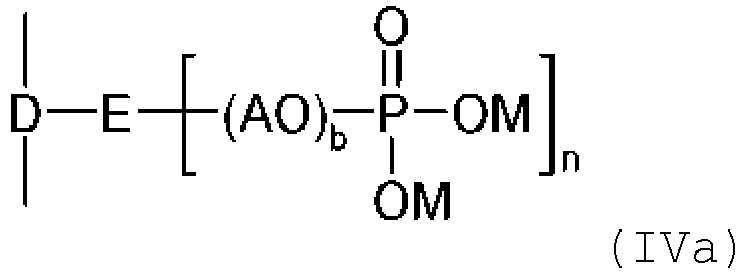 D représente un radical phényle substitué ou non substitué, un radical naphtyle substitué ou non substitué ou un radical hétéroaromatique substitué ou non substitué comprenant 5 à 10 atomes de cycle, dont 1 ou 2 atomes sont des hétéroatomes qui sont choisis parmi N, O et S ;E représente N, NH ou O, à condition que m représente 2 lorsque E représente N et à condition que m représente 1 lorsque E représente NH ou O ;A représente CxH2x, où x = 2, 3, 4 ou 5, ou CH2CH(C6H5) ;b représente un nombre entier de 1 à 300 ;M représente, indépendamment, H ou un équivalent cationique ;dans laquelle
 V représente un radical phényle substitué ou non substitué ou un radical naphtyle substitué ou non substitué ;R7 représente COOM, OCH2COOM, SO3M ou OPO3M2 ;M représente H ou un équivalent cationique ;les radicaux phényle, naphtyle ou hétéroaromatiques mentionnés étant le cas échéant substitués par 1 ou deux radicaux qui sont choisis parmi R8, OH, OR8, (CO)R8, COOM, COOR8, SO3R8 et NO2 ; etR8 représente C1-C4-alkyle, phényle, naphtyle, phényl-C1-C4-alkyle ou C1-C4-alkylphényle.
 - Procédé selon l'une des revendications précédentes, la densité de charge dudit au moins un dispersant polymère (PD) valant 1,65 mEq/g à 10,0 mEq/g.
- Procédé selon l'une des revendications précédentes, dans lequel, dans l'étape de procédé a), la préparation de la dispersion aqueuse est réalisée en ce qu'une solution aqueuse dudit au moins un dispersant polymère (PD), qui comprend plus de 70%, de préférence plus de 80%, dudit au moins un dispersant polymère utilisé, est disposée au préalable et ledit au moins un polysaccharide (PS est ajouté à la solution aqueuse dudit au moins un dispersant polymère (PD), le polysaccharide (PS) étant de préférence ajouté sous forme solide.
- Procédé selon l'une des revendications précédentes, le polysaccharide (PS) étant a) un éther de cellulose et choisi dans le groupe des alkylcelluloses, des hydroxyalkylcelluloses ou des alkylhydroxyalkylcelluloses ou b) un éther d'amidon non ionique ou c) un polysaccharide préparé par voie microbiologique, à chaque fois un ou plusieurs des polysaccharides susmentionnés pouvant être utilisés.
- Procédé selon l'une des revendications précédentes, la teneur en eau de la dispersion aqueuse constituée par le dispersant polymère (PD) et le polysaccharide (PS) de l'étape a) étant supérieure à 35% en poids et inférieure à 65% en poids.
- Procédé selon l'une des revendications précédentes, la dispersion aqueuse de l'étape a), contenant le ou les dispersants polymères (PD) et le ou les polysaccharides, contenant moins de 5% en poids de silicate de calcium hydraté.
- Composition sous forme de poudre, obtenue par l'un des procédés selon les revendications 1 à 10.
- Composition de matériau de construction, contenant la composition sous forme de poudre selon la revendication 11 et au moins un liant inorganique choisi dans le groupe constitué par le ciment, le sulfate de calcium hémihydraté, l'anhydrite, le laitier granulé, les cendres volantes, la poussière de silice, le métakaolin, les pouzzolanes naturelles, le schiste bitumineux calciné, le ciment d'aluminate de calcium ou le ciment de sulfoaluminate de calcium.
- Utilisation de la composition sous forme de poudre selon la revendication 11 comme additif rhéologique pour des mélanges de matériau de construction contenant du ciment, du sulfate de calcium hémihydraté, de l'anhydrite, du laitier granulé, des cendres volantes, de la poussière de silice, du métakaolin, des pouzzolanes naturelles, du schiste bitumineux calciné, du ciment d'aluminate de calcium ou du ciment de sulfoaluminate de calcium, un ou plusieurs des liants mentionnés se trouvant dans les mélanges de matériau de construction.
- Utilisation de la composition sous forme de poudre de la revendication 11 pour préparer des mélanges de mortier sec, afin d'empêcher une séparation du mélange du dispersant polymère (PD) et du polysaccharide (PS) dans le mortier sec.
Applications Claiming Priority (2)
| Application Number | Priority Date | Filing Date | Title |
|---|---|---|---|
| EP17198744 | 2017-10-27 | ||
| PCT/EP2018/079092 WO2019081548A1 (fr) | 2017-10-27 | 2018-10-24 | Procédé de séchage par pulvérisation |
Publications (2)
| Publication Number | Publication Date |
|---|---|
| EP3700967A1 EP3700967A1 (fr) | 2020-09-02 |
| EP3700967B1 true EP3700967B1 (fr) | 2024-04-03 |
Family
ID=60409107
Family Applications (1)
| Application Number | Title | Priority Date | Filing Date |
|---|---|---|---|
| EP18792930.2A Active EP3700967B1 (fr) | 2017-10-27 | 2018-10-24 | Procédé de séchage par pulvérisation |
Country Status (5)
| Country | Link |
|---|---|
| US (1) | US11926715B2 (fr) |
| EP (1) | EP3700967B1 (fr) |
| CN (1) | CN111278897B (fr) |
| RU (1) | RU2020116525A (fr) |
| WO (1) | WO2019081548A1 (fr) |
Families Citing this family (1)
| Publication number | Priority date | Publication date | Assignee | Title |
|---|---|---|---|---|
| US12291485B2 (en) * | 2021-09-20 | 2025-05-06 | United States Gypsum Company | Gypsum cement compositions with aggregate stabilizers and methods for forming floor underlayment |
Family Cites Families (7)
| Publication number | Priority date | Publication date | Assignee | Title |
|---|---|---|---|---|
| DE102004050395A1 (de) | 2004-10-15 | 2006-04-27 | Construction Research & Technology Gmbh | Polykondensationsprodukt auf Basis von aromatischen oder heteroaromatischen Verbindungen, Verfahren zu seiner Herstellung und dessen Verwendung |
| PL2664596T3 (pl) * | 2008-09-02 | 2019-05-31 | Construction Research & Tech Gmbh | Sposób wytwarzania kompozycji środka przyspieszającego utwardzanie zawierającej plastyfikator |
| EP2759337A1 (fr) * | 2013-01-25 | 2014-07-30 | Basf Se | Additif pour masses à prise hydraulique |
| EP2695866B1 (fr) * | 2013-05-24 | 2019-04-24 | Basf Se | Additif de rhéologie modifié |
| EP2886580A1 (fr) | 2013-12-20 | 2015-06-24 | Construction Research & Technology GmbH | Additif pour améliorer la rhéologie des liants inorganiques |
| EP2896603A1 (fr) * | 2014-01-21 | 2015-07-22 | Basf Se | Composition de sulfate de calcium comprenant un additif |
| US10144673B2 (en) * | 2015-04-21 | 2018-12-04 | Basf Se | Method for producing a calcium silicate hydrate-comprising hardening accelerator in powder form |
-
2018
- 2018-10-24 WO PCT/EP2018/079092 patent/WO2019081548A1/fr not_active Ceased
- 2018-10-24 EP EP18792930.2A patent/EP3700967B1/fr active Active
- 2018-10-24 US US16/759,339 patent/US11926715B2/en active Active
- 2018-10-24 CN CN201880069447.0A patent/CN111278897B/zh active Active
- 2018-10-24 RU RU2020116525A patent/RU2020116525A/ru unknown
Also Published As
| Publication number | Publication date |
|---|---|
| EP3700967A1 (fr) | 2020-09-02 |
| WO2019081548A1 (fr) | 2019-05-02 |
| US20200283584A1 (en) | 2020-09-10 |
| CN111278897A (zh) | 2020-06-12 |
| CN111278897B (zh) | 2023-05-05 |
| RU2020116525A (ru) | 2021-11-29 |
| US11926715B2 (en) | 2024-03-12 |
Similar Documents
| Publication | Publication Date | Title |
|---|---|---|
| EP2948239B1 (fr) | Additif pour masses à prise hydraulique | |
| EP4082736B1 (fr) | Procédé d'impression en 3d de compositions de liant minérales | |
| EP1154967B1 (fr) | Compositions polymeres en poudre a base de polyethercarboxylates | |
| EP1507819B1 (fr) | Utilisation de polymeres hydrosolubles en tant qu'agents dessechants auxiliaires pour la production de dispersants polymeres | |
| AT404730B (de) | Acryl-copolymere und polymerzusammensetzungen sowie deren verwendung als additive oder beimischungen zur verbesserung der eigenschaften von dispersionen und baustoffen | |
| EP1258464B1 (fr) | Utilisation d'une composition pulvérulente comme additif rhéologique à effet viscosifiant | |
| DE202009017741U1 (de) | Fließmittelhaltige Erhärtungsbeschleunigerzusammensetzung | |
| WO2001058994A1 (fr) | Composition pulverulente a base de polymeres solubles dans l'eau | |
| EP1966103A1 (fr) | Produits de polycondensation pulverulents | |
| EP3768648A1 (fr) | Fabrication de nanoparticules d'hydroxyde de calcium et leur utilisation comme accélérateur dans des compositions minérales de liant | |
| EP2152647B2 (fr) | Préparations aqueuses d'accélérateurs de prise modifiés par des polymères et leur utilisation dans le domaine de la construction | |
| EP2609055B1 (fr) | Accélérateur | |
| EP3700967B1 (fr) | Procédé de séchage par pulvérisation | |
| EP2695866B1 (fr) | Additif de rhéologie modifié | |
| EP2150509A2 (fr) | Procédé de production de matières solides à base d'agents de revêtement à prise hydraulique | |
| EP3538499B1 (fr) | Accélérateur de durcissement | |
| EP3268327B1 (fr) | Procédé de fabrication d'un dispersant | |
| EP3152179A1 (fr) | Composition à base de silicate de calcium hydraté | |
| EP2784040A1 (fr) | Composition sous forme de poudre pouvant être rapidement mise en suspension | |
| WO2009130334A1 (fr) | Utilisation d’hydrocarbures comme additifs pour réduire le dégagement de poussière de produits chimiques de construction | |
| DE10322786A1 (de) | Verfahren zur Herstellung von Polymerpulvern |
Legal Events
| Date | Code | Title | Description |
|---|---|---|---|
| STAA | Information on the status of an ep patent application or granted ep patent |
Free format text: STATUS: UNKNOWN |
|
| STAA | Information on the status of an ep patent application or granted ep patent |
Free format text: STATUS: THE INTERNATIONAL PUBLICATION HAS BEEN MADE |
|
| PUAI | Public reference made under article 153(3) epc to a published international application that has entered the european phase |
Free format text: ORIGINAL CODE: 0009012 |
|
| STAA | Information on the status of an ep patent application or granted ep patent |
Free format text: STATUS: REQUEST FOR EXAMINATION WAS MADE |
|
| 17P | Request for examination filed |
Effective date: 20200527 |
|
| AK | Designated contracting states |
Kind code of ref document: A1 Designated state(s): AL AT BE BG CH CY CZ DE DK EE ES FI FR GB GR HR HU IE IS IT LI LT LU LV MC MK MT NL NO PL PT RO RS SE SI SK SM TR |
|
| AX | Request for extension of the european patent |
Extension state: BA ME |
|
| DAV | Request for validation of the european patent (deleted) | ||
| DAX | Request for extension of the european patent (deleted) | ||
| STAA | Information on the status of an ep patent application or granted ep patent |
Free format text: STATUS: EXAMINATION IS IN PROGRESS |
|
| 17Q | First examination report despatched |
Effective date: 20230628 |
|
| GRAP | Despatch of communication of intention to grant a patent |
Free format text: ORIGINAL CODE: EPIDOSNIGR1 |
|
| STAA | Information on the status of an ep patent application or granted ep patent |
Free format text: STATUS: GRANT OF PATENT IS INTENDED |
|
| INTG | Intention to grant announced |
Effective date: 20231113 |
|
| GRAS | Grant fee paid |
Free format text: ORIGINAL CODE: EPIDOSNIGR3 |
|
| GRAA | (expected) grant |
Free format text: ORIGINAL CODE: 0009210 |
|
| STAA | Information on the status of an ep patent application or granted ep patent |
Free format text: STATUS: THE PATENT HAS BEEN GRANTED |
|
| AK | Designated contracting states |
Kind code of ref document: B1 Designated state(s): AL AT BE BG CH CY CZ DE DK EE ES FI FR GB GR HR HU IE IS IT LI LT LU LV MC MK MT NL NO PL PT RO RS SE SI SK SM TR |
|
| REG | Reference to a national code |
Ref country code: GB Ref legal event code: FG4D Free format text: NOT ENGLISH |
|
| REG | Reference to a national code |
Ref country code: CH Ref legal event code: EP |
|
| REG | Reference to a national code |
Ref country code: IE Ref legal event code: FG4D Free format text: LANGUAGE OF EP DOCUMENT: GERMAN |
|
| REG | Reference to a national code |
Ref country code: DE Ref legal event code: R096 Ref document number: 502018014389 Country of ref document: DE |
|
| REG | Reference to a national code |
Ref country code: LT Ref legal event code: MG9D |
|
| REG | Reference to a national code |
Ref country code: NL Ref legal event code: MP Effective date: 20240403 |
|
| PG25 | Lapsed in a contracting state [announced via postgrant information from national office to epo] |
Ref country code: NL Free format text: LAPSE BECAUSE OF FAILURE TO SUBMIT A TRANSLATION OF THE DESCRIPTION OR TO PAY THE FEE WITHIN THE PRESCRIBED TIME-LIMIT Effective date: 20240403 |
|
| PG25 | Lapsed in a contracting state [announced via postgrant information from national office to epo] |
Ref country code: NL Free format text: LAPSE BECAUSE OF FAILURE TO SUBMIT A TRANSLATION OF THE DESCRIPTION OR TO PAY THE FEE WITHIN THE PRESCRIBED TIME-LIMIT Effective date: 20240403 |
|
| PG25 | Lapsed in a contracting state [announced via postgrant information from national office to epo] |
Ref country code: IS Free format text: LAPSE BECAUSE OF FAILURE TO SUBMIT A TRANSLATION OF THE DESCRIPTION OR TO PAY THE FEE WITHIN THE PRESCRIBED TIME-LIMIT Effective date: 20240803 |
|
| PG25 | Lapsed in a contracting state [announced via postgrant information from national office to epo] |
Ref country code: BG Free format text: LAPSE BECAUSE OF FAILURE TO SUBMIT A TRANSLATION OF THE DESCRIPTION OR TO PAY THE FEE WITHIN THE PRESCRIBED TIME-LIMIT Effective date: 20240403 |
|
| PG25 | Lapsed in a contracting state [announced via postgrant information from national office to epo] |
Ref country code: HR Free format text: LAPSE BECAUSE OF FAILURE TO SUBMIT A TRANSLATION OF THE DESCRIPTION OR TO PAY THE FEE WITHIN THE PRESCRIBED TIME-LIMIT Effective date: 20240403 Ref country code: FI Free format text: LAPSE BECAUSE OF FAILURE TO SUBMIT A TRANSLATION OF THE DESCRIPTION OR TO PAY THE FEE WITHIN THE PRESCRIBED TIME-LIMIT Effective date: 20240403 |
|
| PG25 | Lapsed in a contracting state [announced via postgrant information from national office to epo] |
Ref country code: GR Free format text: LAPSE BECAUSE OF FAILURE TO SUBMIT A TRANSLATION OF THE DESCRIPTION OR TO PAY THE FEE WITHIN THE PRESCRIBED TIME-LIMIT Effective date: 20240704 |
|
| PG25 | Lapsed in a contracting state [announced via postgrant information from national office to epo] |
Ref country code: PT Free format text: LAPSE BECAUSE OF FAILURE TO SUBMIT A TRANSLATION OF THE DESCRIPTION OR TO PAY THE FEE WITHIN THE PRESCRIBED TIME-LIMIT Effective date: 20240805 |
|
| PG25 | Lapsed in a contracting state [announced via postgrant information from national office to epo] |
Ref country code: ES Free format text: LAPSE BECAUSE OF FAILURE TO SUBMIT A TRANSLATION OF THE DESCRIPTION OR TO PAY THE FEE WITHIN THE PRESCRIBED TIME-LIMIT Effective date: 20240403 |
|
| PG25 | Lapsed in a contracting state [announced via postgrant information from national office to epo] |
Ref country code: CZ Free format text: LAPSE BECAUSE OF FAILURE TO SUBMIT A TRANSLATION OF THE DESCRIPTION OR TO PAY THE FEE WITHIN THE PRESCRIBED TIME-LIMIT Effective date: 20240403 |
|
| PG25 | Lapsed in a contracting state [announced via postgrant information from national office to epo] |
Ref country code: PL Free format text: LAPSE BECAUSE OF FAILURE TO SUBMIT A TRANSLATION OF THE DESCRIPTION OR TO PAY THE FEE WITHIN THE PRESCRIBED TIME-LIMIT Effective date: 20240403 |
|
| PG25 | Lapsed in a contracting state [announced via postgrant information from national office to epo] |
Ref country code: LV Free format text: LAPSE BECAUSE OF FAILURE TO SUBMIT A TRANSLATION OF THE DESCRIPTION OR TO PAY THE FEE WITHIN THE PRESCRIBED TIME-LIMIT Effective date: 20240403 |
|
| PG25 | Lapsed in a contracting state [announced via postgrant information from national office to epo] |
Ref country code: PT Free format text: LAPSE BECAUSE OF FAILURE TO SUBMIT A TRANSLATION OF THE DESCRIPTION OR TO PAY THE FEE WITHIN THE PRESCRIBED TIME-LIMIT Effective date: 20240805 Ref country code: PL Free format text: LAPSE BECAUSE OF FAILURE TO SUBMIT A TRANSLATION OF THE DESCRIPTION OR TO PAY THE FEE WITHIN THE PRESCRIBED TIME-LIMIT Effective date: 20240403 Ref country code: NO Free format text: LAPSE BECAUSE OF FAILURE TO SUBMIT A TRANSLATION OF THE DESCRIPTION OR TO PAY THE FEE WITHIN THE PRESCRIBED TIME-LIMIT Effective date: 20240703 Ref country code: LV Free format text: LAPSE BECAUSE OF FAILURE TO SUBMIT A TRANSLATION OF THE DESCRIPTION OR TO PAY THE FEE WITHIN THE PRESCRIBED TIME-LIMIT Effective date: 20240403 Ref country code: IS Free format text: LAPSE BECAUSE OF FAILURE TO SUBMIT A TRANSLATION OF THE DESCRIPTION OR TO PAY THE FEE WITHIN THE PRESCRIBED TIME-LIMIT Effective date: 20240803 Ref country code: HR Free format text: LAPSE BECAUSE OF FAILURE TO SUBMIT A TRANSLATION OF THE DESCRIPTION OR TO PAY THE FEE WITHIN THE PRESCRIBED TIME-LIMIT Effective date: 20240403 Ref country code: GR Free format text: LAPSE BECAUSE OF FAILURE TO SUBMIT A TRANSLATION OF THE DESCRIPTION OR TO PAY THE FEE WITHIN THE PRESCRIBED TIME-LIMIT Effective date: 20240704 Ref country code: FI Free format text: LAPSE BECAUSE OF FAILURE TO SUBMIT A TRANSLATION OF THE DESCRIPTION OR TO PAY THE FEE WITHIN THE PRESCRIBED TIME-LIMIT Effective date: 20240403 Ref country code: ES Free format text: LAPSE BECAUSE OF FAILURE TO SUBMIT A TRANSLATION OF THE DESCRIPTION OR TO PAY THE FEE WITHIN THE PRESCRIBED TIME-LIMIT Effective date: 20240403 Ref country code: CZ Free format text: LAPSE BECAUSE OF FAILURE TO SUBMIT A TRANSLATION OF THE DESCRIPTION OR TO PAY THE FEE WITHIN THE PRESCRIBED TIME-LIMIT Effective date: 20240403 Ref country code: BG Free format text: LAPSE BECAUSE OF FAILURE TO SUBMIT A TRANSLATION OF THE DESCRIPTION OR TO PAY THE FEE WITHIN THE PRESCRIBED TIME-LIMIT Effective date: 20240403 Ref country code: RS Free format text: LAPSE BECAUSE OF FAILURE TO SUBMIT A TRANSLATION OF THE DESCRIPTION OR TO PAY THE FEE WITHIN THE PRESCRIBED TIME-LIMIT Effective date: 20240703 |
|
| REG | Reference to a national code |
Ref country code: DE Ref legal event code: R097 Ref document number: 502018014389 Country of ref document: DE |
|
| PG25 | Lapsed in a contracting state [announced via postgrant information from national office to epo] |
Ref country code: DK Free format text: LAPSE BECAUSE OF FAILURE TO SUBMIT A TRANSLATION OF THE DESCRIPTION OR TO PAY THE FEE WITHIN THE PRESCRIBED TIME-LIMIT Effective date: 20240403 |
|
| PG25 | Lapsed in a contracting state [announced via postgrant information from national office to epo] |
Ref country code: EE Free format text: LAPSE BECAUSE OF FAILURE TO SUBMIT A TRANSLATION OF THE DESCRIPTION OR TO PAY THE FEE WITHIN THE PRESCRIBED TIME-LIMIT Effective date: 20240403 |
|
| PG25 | Lapsed in a contracting state [announced via postgrant information from national office to epo] |
Ref country code: SK Free format text: LAPSE BECAUSE OF FAILURE TO SUBMIT A TRANSLATION OF THE DESCRIPTION OR TO PAY THE FEE WITHIN THE PRESCRIBED TIME-LIMIT Effective date: 20240403 Ref country code: RO Free format text: LAPSE BECAUSE OF FAILURE TO SUBMIT A TRANSLATION OF THE DESCRIPTION OR TO PAY THE FEE WITHIN THE PRESCRIBED TIME-LIMIT Effective date: 20240403 |
|
| PG25 | Lapsed in a contracting state [announced via postgrant information from national office to epo] |
Ref country code: SM Free format text: LAPSE BECAUSE OF FAILURE TO SUBMIT A TRANSLATION OF THE DESCRIPTION OR TO PAY THE FEE WITHIN THE PRESCRIBED TIME-LIMIT Effective date: 20240403 |
|
| PG25 | Lapsed in a contracting state [announced via postgrant information from national office to epo] |
Ref country code: SM Free format text: LAPSE BECAUSE OF FAILURE TO SUBMIT A TRANSLATION OF THE DESCRIPTION OR TO PAY THE FEE WITHIN THE PRESCRIBED TIME-LIMIT Effective date: 20240403 Ref country code: SK Free format text: LAPSE BECAUSE OF FAILURE TO SUBMIT A TRANSLATION OF THE DESCRIPTION OR TO PAY THE FEE WITHIN THE PRESCRIBED TIME-LIMIT Effective date: 20240403 Ref country code: RO Free format text: LAPSE BECAUSE OF FAILURE TO SUBMIT A TRANSLATION OF THE DESCRIPTION OR TO PAY THE FEE WITHIN THE PRESCRIBED TIME-LIMIT Effective date: 20240403 Ref country code: EE Free format text: LAPSE BECAUSE OF FAILURE TO SUBMIT A TRANSLATION OF THE DESCRIPTION OR TO PAY THE FEE WITHIN THE PRESCRIBED TIME-LIMIT Effective date: 20240403 Ref country code: DK Free format text: LAPSE BECAUSE OF FAILURE TO SUBMIT A TRANSLATION OF THE DESCRIPTION OR TO PAY THE FEE WITHIN THE PRESCRIBED TIME-LIMIT Effective date: 20240403 |
|
| PLBE | No opposition filed within time limit |
Free format text: ORIGINAL CODE: 0009261 |
|
| STAA | Information on the status of an ep patent application or granted ep patent |
Free format text: STATUS: NO OPPOSITION FILED WITHIN TIME LIMIT |
|
| 26N | No opposition filed |
Effective date: 20250106 |
|
| PG25 | Lapsed in a contracting state [announced via postgrant information from national office to epo] |
Ref country code: SI Free format text: LAPSE BECAUSE OF FAILURE TO SUBMIT A TRANSLATION OF THE DESCRIPTION OR TO PAY THE FEE WITHIN THE PRESCRIBED TIME-LIMIT Effective date: 20240403 |
|
| GBPC | Gb: european patent ceased through non-payment of renewal fee |
Effective date: 20241024 |
|
| PG25 | Lapsed in a contracting state [announced via postgrant information from national office to epo] |
Ref country code: MC Free format text: LAPSE BECAUSE OF FAILURE TO SUBMIT A TRANSLATION OF THE DESCRIPTION OR TO PAY THE FEE WITHIN THE PRESCRIBED TIME-LIMIT Effective date: 20240403 |
|
| PG25 | Lapsed in a contracting state [announced via postgrant information from national office to epo] |
Ref country code: GB Free format text: LAPSE BECAUSE OF NON-PAYMENT OF DUE FEES Effective date: 20241024 |
|
| PG25 | Lapsed in a contracting state [announced via postgrant information from national office to epo] |
Ref country code: LU Free format text: LAPSE BECAUSE OF NON-PAYMENT OF DUE FEES Effective date: 20241024 Ref country code: BE Free format text: LAPSE BECAUSE OF NON-PAYMENT OF DUE FEES Effective date: 20241031 |
|
| REG | Reference to a national code |
Ref country code: BE Ref legal event code: MM Effective date: 20241031 |
|
| PG25 | Lapsed in a contracting state [announced via postgrant information from national office to epo] |
Ref country code: SE Free format text: LAPSE BECAUSE OF FAILURE TO SUBMIT A TRANSLATION OF THE DESCRIPTION OR TO PAY THE FEE WITHIN THE PRESCRIBED TIME-LIMIT Effective date: 20240403 |
|
| PG25 | Lapsed in a contracting state [announced via postgrant information from national office to epo] |
Ref country code: IE Free format text: LAPSE BECAUSE OF NON-PAYMENT OF DUE FEES Effective date: 20241024 |
|
| REG | Reference to a national code |
Ref country code: CH Ref legal event code: U11 Free format text: ST27 STATUS EVENT CODE: U-0-0-U10-U11 (AS PROVIDED BY THE NATIONAL OFFICE) Effective date: 20251101 |
|
| REG | Reference to a national code |
Ref country code: AT Ref legal event code: MM01 Ref document number: 1672278 Country of ref document: AT Kind code of ref document: T Effective date: 20241024 |
|
| PGFP | Annual fee paid to national office [announced via postgrant information from national office to epo] |
Ref country code: DE Payment date: 20251028 Year of fee payment: 8 |
|
| PG25 | Lapsed in a contracting state [announced via postgrant information from national office to epo] |
Ref country code: AT Free format text: LAPSE BECAUSE OF NON-PAYMENT OF DUE FEES Effective date: 20241024 |
|
| PGFP | Annual fee paid to national office [announced via postgrant information from national office to epo] |
Ref country code: IT Payment date: 20251022 Year of fee payment: 8 |
|
| PGFP | Annual fee paid to national office [announced via postgrant information from national office to epo] |
Ref country code: FR Payment date: 20251027 Year of fee payment: 8 |
|
| PGFP | Annual fee paid to national office [announced via postgrant information from national office to epo] |
Ref country code: CH Payment date: 20251101 Year of fee payment: 8 |
|
| PG25 | Lapsed in a contracting state [announced via postgrant information from national office to epo] |
Ref country code: CY Free format text: LAPSE BECAUSE OF FAILURE TO SUBMIT A TRANSLATION OF THE DESCRIPTION OR TO PAY THE FEE WITHIN THE PRESCRIBED TIME-LIMIT; INVALID AB INITIO Effective date: 20181024 |
|
| PG25 | Lapsed in a contracting state [announced via postgrant information from national office to epo] |
Ref country code: HU Free format text: LAPSE BECAUSE OF FAILURE TO SUBMIT A TRANSLATION OF THE DESCRIPTION OR TO PAY THE FEE WITHIN THE PRESCRIBED TIME-LIMIT; INVALID AB INITIO Effective date: 20181024 |