EP3701043B1 - Nichtinvasiver molekularer takt für die fötale entwicklung zur vorhersage des gestationsalters und einer frühgeburt - Google Patents
Nichtinvasiver molekularer takt für die fötale entwicklung zur vorhersage des gestationsalters und einer frühgeburt Download PDFInfo
- Publication number
- EP3701043B1 EP3701043B1 EP18871519.7A EP18871519A EP3701043B1 EP 3701043 B1 EP3701043 B1 EP 3701043B1 EP 18871519 A EP18871519 A EP 18871519A EP 3701043 B1 EP3701043 B1 EP 3701043B1
- Authority
- EP
- European Patent Office
- Prior art keywords
- genes
- expression
- preterm
- seq
- maternal
- Prior art date
- Legal status (The legal status is an assumption and is not a legal conclusion. Google has not performed a legal analysis and makes no representation as to the accuracy of the status listed.)
- Active
Links
Images







Classifications
-
- G—PHYSICS
- G16—INFORMATION AND COMMUNICATION TECHNOLOGY [ICT] SPECIALLY ADAPTED FOR SPECIFIC APPLICATION FIELDS
- G16B—BIOINFORMATICS, i.e. INFORMATION AND COMMUNICATION TECHNOLOGY [ICT] SPECIALLY ADAPTED FOR GENETIC OR PROTEIN-RELATED DATA PROCESSING IN COMPUTATIONAL MOLECULAR BIOLOGY
- G16B20/00—ICT specially adapted for functional genomics or proteomics, e.g. genotype-phenotype associations
-
- C—CHEMISTRY; METALLURGY
- C12—BIOCHEMISTRY; BEER; SPIRITS; WINE; VINEGAR; MICROBIOLOGY; ENZYMOLOGY; MUTATION OR GENETIC ENGINEERING
- C12Q—MEASURING OR TESTING PROCESSES INVOLVING ENZYMES, NUCLEIC ACIDS OR MICROORGANISMS; COMPOSITIONS OR TEST PAPERS THEREFOR; PROCESSES OF PREPARING SUCH COMPOSITIONS; CONDITION-RESPONSIVE CONTROL IN MICROBIOLOGICAL OR ENZYMOLOGICAL PROCESSES
- C12Q1/00—Measuring or testing processes involving enzymes, nucleic acids or microorganisms; Compositions therefor; Processes of preparing such compositions
- C12Q1/68—Measuring or testing processes involving enzymes, nucleic acids or microorganisms; Compositions therefor; Processes of preparing such compositions involving nucleic acids
- C12Q1/6876—Nucleic acid products used in the analysis of nucleic acids, e.g. primers or probes
- C12Q1/6883—Nucleic acid products used in the analysis of nucleic acids, e.g. primers or probes for diseases caused by alterations of genetic material
-
- C—CHEMISTRY; METALLURGY
- C12—BIOCHEMISTRY; BEER; SPIRITS; WINE; VINEGAR; MICROBIOLOGY; ENZYMOLOGY; MUTATION OR GENETIC ENGINEERING
- C12Q—MEASURING OR TESTING PROCESSES INVOLVING ENZYMES, NUCLEIC ACIDS OR MICROORGANISMS; COMPOSITIONS OR TEST PAPERS THEREFOR; PROCESSES OF PREPARING SUCH COMPOSITIONS; CONDITION-RESPONSIVE CONTROL IN MICROBIOLOGICAL OR ENZYMOLOGICAL PROCESSES
- C12Q1/00—Measuring or testing processes involving enzymes, nucleic acids or microorganisms; Compositions therefor; Processes of preparing such compositions
- C12Q1/68—Measuring or testing processes involving enzymes, nucleic acids or microorganisms; Compositions therefor; Processes of preparing such compositions involving nucleic acids
- C12Q1/6876—Nucleic acid products used in the analysis of nucleic acids, e.g. primers or probes
-
- A—HUMAN NECESSITIES
- A61—MEDICAL OR VETERINARY SCIENCE; HYGIENE
- A61P—SPECIFIC THERAPEUTIC ACTIVITY OF CHEMICAL COMPOUNDS OR MEDICINAL PREPARATIONS
- A61P15/00—Drugs for genital or sexual disorders; Contraceptives
-
- G—PHYSICS
- G01—MEASURING; TESTING
- G01N—INVESTIGATING OR ANALYSING MATERIALS BY DETERMINING THEIR CHEMICAL OR PHYSICAL PROPERTIES
- G01N33/00—Investigating or analysing materials by specific methods not covered by groups G01N1/00 - G01N31/00
- G01N33/48—Biological material, e.g. blood, urine; Haemocytometers
- G01N33/50—Chemical analysis of biological material, e.g. blood, urine; Testing involving biospecific ligand binding methods; Immunological testing
- G01N33/68—Chemical analysis of biological material, e.g. blood, urine; Testing involving biospecific ligand binding methods; Immunological testing involving proteins, peptides or amino acids
- G01N33/689—Chemical analysis of biological material, e.g. blood, urine; Testing involving biospecific ligand binding methods; Immunological testing involving proteins, peptides or amino acids related to pregnancy or the gonads
-
- G—PHYSICS
- G16—INFORMATION AND COMMUNICATION TECHNOLOGY [ICT] SPECIALLY ADAPTED FOR SPECIFIC APPLICATION FIELDS
- G16H—HEALTHCARE INFORMATICS, i.e. INFORMATION AND COMMUNICATION TECHNOLOGY [ICT] SPECIALLY ADAPTED FOR THE HANDLING OR PROCESSING OF MEDICAL OR HEALTHCARE DATA
- G16H50/00—ICT specially adapted for medical diagnosis, medical simulation or medical data mining; ICT specially adapted for detecting, monitoring or modelling epidemics or pandemics
- G16H50/20—ICT specially adapted for medical diagnosis, medical simulation or medical data mining; ICT specially adapted for detecting, monitoring or modelling epidemics or pandemics for computer-aided diagnosis, e.g. based on medical expert systems
-
- C—CHEMISTRY; METALLURGY
- C12—BIOCHEMISTRY; BEER; SPIRITS; WINE; VINEGAR; MICROBIOLOGY; ENZYMOLOGY; MUTATION OR GENETIC ENGINEERING
- C12Q—MEASURING OR TESTING PROCESSES INVOLVING ENZYMES, NUCLEIC ACIDS OR MICROORGANISMS; COMPOSITIONS OR TEST PAPERS THEREFOR; PROCESSES OF PREPARING SUCH COMPOSITIONS; CONDITION-RESPONSIVE CONTROL IN MICROBIOLOGICAL OR ENZYMOLOGICAL PROCESSES
- C12Q2600/00—Oligonucleotides characterized by their use
- C12Q2600/158—Expression markers
-
- C—CHEMISTRY; METALLURGY
- C12—BIOCHEMISTRY; BEER; SPIRITS; WINE; VINEGAR; MICROBIOLOGY; ENZYMOLOGY; MUTATION OR GENETIC ENGINEERING
- C12Q—MEASURING OR TESTING PROCESSES INVOLVING ENZYMES, NUCLEIC ACIDS OR MICROORGANISMS; COMPOSITIONS OR TEST PAPERS THEREFOR; PROCESSES OF PREPARING SUCH COMPOSITIONS; CONDITION-RESPONSIVE CONTROL IN MICROBIOLOGICAL OR ENZYMOLOGICAL PROCESSES
- C12Q2600/00—Oligonucleotides characterized by their use
- C12Q2600/16—Primer sets for multiplex assays
-
- G—PHYSICS
- G01—MEASURING; TESTING
- G01N—INVESTIGATING OR ANALYSING MATERIALS BY DETERMINING THEIR CHEMICAL OR PHYSICAL PROPERTIES
- G01N2800/00—Detection or diagnosis of diseases
- G01N2800/36—Gynecology or obstetrics
- G01N2800/368—Pregnancy complicated by disease or abnormalities of pregnancy, e.g. preeclampsia, preterm labour
-
- G—PHYSICS
- G01—MEASURING; TESTING
- G01N—INVESTIGATING OR ANALYSING MATERIALS BY DETERMINING THEIR CHEMICAL OR PHYSICAL PROPERTIES
- G01N2800/00—Detection or diagnosis of diseases
- G01N2800/50—Determining the risk of developing a disease
-
- G—PHYSICS
- G01—MEASURING; TESTING
- G01N—INVESTIGATING OR ANALYSING MATERIALS BY DETERMINING THEIR CHEMICAL OR PHYSICAL PROPERTIES
- G01N2800/00—Detection or diagnosis of diseases
- G01N2800/60—Complex ways of combining multiple protein biomarkers for diagnosis
-
- G—PHYSICS
- G16—INFORMATION AND COMMUNICATION TECHNOLOGY [ICT] SPECIALLY ADAPTED FOR SPECIFIC APPLICATION FIELDS
- G16B—BIOINFORMATICS, i.e. INFORMATION AND COMMUNICATION TECHNOLOGY [ICT] SPECIALLY ADAPTED FOR GENETIC OR PROTEIN-RELATED DATA PROCESSING IN COMPUTATIONAL MOLECULAR BIOLOGY
- G16B40/00—ICT specially adapted for biostatistics; ICT specially adapted for bioinformatics-related machine learning or data mining, e.g. knowledge discovery or pattern finding
- G16B40/20—Supervised data analysis
Definitions
- the invention is in the field of medicine.
- HCG human chorionic gonadotropin
- AFP alpha-fetoprotein
- WO 2015/010442 A1 describes a method for determining increased risk of premature birth in a pregnant woman by detecting altered expression levels of one or more marker genes in the woman's blood.
- Heng et al, PLOS ONE, 9, 5, 14 May 2014, pages 1-13 describes the study of differential whole blood gene expression associated with spontaneous preterm birth.
- WO 2009/134452 A2 describes the identification and use of a plurality of biomarkers to provide a risk assessment of a woman for preterm delivery, and products and processes related thereto.
- Heng et al, PLOS ONE, 11, 6, 22 June 2016, page e0155191 describes the investigation of maternal whole blood gene expression profiles associated with spontaneous preterm birth.
- WO 2014/105985 A1 describes biomarkers of preterm birth, biomarkers of term birth, and methods of use thereof.
- WO 2017/096405 A1 describes proteomic biomarkers of spontaneous preterm birth, proteomic biomarkers of term birth, and methods of use thereof.
- the invention provides a method for assessing risk of preterm delivery by a pregnant woman as defined by claim 1.
- the invention also provides a method performed using a computer for assessing risk of preterm delivery by a pregnant woman as defined by claim 14.
- the invention also provides a computer system as defined by claim 15.
- Risk of preterm delivery may be determined by (a) generating an expression profile using cfRNA (or protein) from a maternal sample, and (b) determining whether the expression profile is or is not characteristic of a population with a history of preterm delivery and/or whether the expression profile is or is not characteristic of a population with a history of full-term delivery.
- the method includes determining the expression profile by measuring cell-free RNAs (cfRNAs) in the maternal sample. In some embodiments, the method includes determining the expression profile by measuring placental proteins in the maternal sample.
- cfRNAs cell-free RNAs
- the method includes a maternal sample from blood, blood plasma, blood serum, or urine. In some embodiments, the method includes a maternal sample obtained from the mother during the third trimester of pregnancy. In some embodiments, the method includes a maternal sample obtained from the mother during the second trimester of pregnancy.
- the method includes one or more reference expression levels for the full-term population are established using a machine learning technique.
- the method further includes obtaining a plurality of training samples, each labeled as preterm or full-term, obtaining one or more measured expression levels for the panel of genes for each of the plurality of training samples, and iteratively adjusting the one or more reference expression levels using the machine learning technique to increase a number of the training samples that are classified correctly as a result of comparing the one or more measured expression levels to the one or more reference expression levels.
- the method further includes the steps: comparing the expression levels to other reference expression levels for the panel of genes, wherein the other reference expression levels are obtained from a preterm delivery population, to determine whether the maternal expression profile is similar to, or is different from, the other reference expression levels within a threshold.
- the invention provides a method for assessing risk of preterm delivery by a pregnant woman comprising, analyzing a maternal sample to determine an expression profile from a panel comprising RAB27B and two or more genes selected from PPBP, DAPP1, RGS18, CLCN3, MAP3K7CL, MOB1B, POLE2, LYPLAL1, and TBC1D15.
- the method includes genes having higher expression levels in a preterm population than in a term population.
- the method includes genes selected from: RAB27B and two or more genes selected from CLCN3, DAPP1, POLE2, PPBP, LYPLAL1, MAP3K7CL, MOB1B, RGS18, and TBC1D15, or from: CLCN3, DAPP1, PPBP, MAP3K7CL, MOB1B, and RGS18.
- the method includes a panel comprising three genes selected from: RAB27B and two genes selected from CLCN3, DAPP1, POLE2, PPBP, LYPLAL1, MAP3K7CL, MOB1B, RGS18, and TBC1D15 (ten transcript panel), or from: CLCN3, DAPP1, PPBP, MAP3K7CL, MOB1B, and RGS18 (seven transcript panel).
- the method includes the expression profiles in which a panel of three to ten genes are determined. In some embodiments, the method includes the expression profile in which a panel comprising exactly three genes are determined.
- the method includes, determining the expression profile by measuring cell-free RNAs (cfRNAs) in the maternal sample. In some embodiments, the method includes determining the expression profile by measuring proteins in the maternal sample.
- cfRNAs cell-free RNAs
- the method includes a maternal sample from blood, blood plasma, blood serum, or urine. In some embodiments, the method includes a maternal sample obtained more than 28 days prior to preterm delivery. In some embodiments, the method includes a maternal sample obtained more than 45 days prior to preterm delivery. In some embodiments, the method includes a maternal sample obtained after the second month and prior to the eighth month of pregnancy. In some embodiments, the method includes a maternal sample obtained during the second trimester of pregnancy.
- a maternal sample is obtained during the third trimester of pregnancy.
- the method of the first aspect includes, a maternal sample obtained at a specified week of pregnancy, comprising the steps: comparing the expression profile to a time matched reference profile, wherein the time matched reference profile is characteristic of a normal term pregnancy at the specified week of pregnancy, and identifying the pregnant woman as an elevated risk for preterm delivery if the expression profile differs significantly from the time matched reference profile within a threshold.
- the method of the first aspect includes a maternal sample obtained at a specified week of pregnancy, comprising the steps: comparing the expression profile to a time matched reference profile, wherein the time matched reference profile is characteristic of a preterm pregnancy, and identifying the pregnant woman as an elevated risk for preterm delivery if the expression profile is significantly similar to the time matched reference profile within a threshold.
- the disclosure provides a method for assessing risk of preterm delivery of a pregnant woman comprising the steps: (a) obtaining a maternal expression profile for a sample, comprising expression levels for a panel of genes according to the first aspect of the disclosure, and (b) comparing the expression levels to reference expression levels for the panel of genes, wherein the reference expression levels are obtained from a preterm delivery population, a full-term delivery population, or both populations, to determine whether the maternal expression profile is similar to, or is different from, the reference expression levels within a threshold.
- the method one or more reference levels are established using a machine learning technique.
- the methods of the first or second aspect are carried out by a computer.
- the method includes carrying out the steps provided in the first or second aspect with two or more maternal samples obtained at different times during the course of a pregnancy.
- the method includes a maternal sample from blood, blood plasma, blood serum, or urine.
- the method includes a maternal sample obtained from the mother during the third trimester of pregnancy.
- the method includes a maternal sample obtained from the mother during the second trimester of pregnancy.
- RNA cell free RNA
- cfRNA refers to RNA, especially mRNA, expressed by cells of the mother, fetus and/or placenta and recoverable from the non-cellular fraction of maternal blood, and includes fragments of full-length RNA transcripts.
- cfRNA does not include rRNA.
- cfRNA does not include miRNA.
- cfRNA refers to mRNA. Cf RNA can also be recovered from maternal urine.
- placental gene refers to a gene or corresponding gene product that is expressed in the placenta but not expressed (or expressed at significantly lower levels) by maternal or fetal tissues.
- placental genes include databases such as Tissue-Specific Gene Expression and Regulation (TiGER) which identifies 377 RefSeq (NCBI Reference Sequence Database) genes as being preferentially expressed in the placenta (http://bioinfo.wilmer.jhu.edu/tiger).
- Other databases such as Expression Atlas (https://www.ebi.ac.uk/gxa/home) can also be used to identify placental genes.
- Placental gene products include mRNA and protein.
- the term "expression profile,” refers to the level of expression of one or a plurality of gene products obtained from a maternal sample.
- the gene products may be cfRNAs or proteins.
- expression levels may be expressed as the number of transcripts of a specified RNA per mL maternal plasma, mass of a specified polypeptide per mL maternal plasma, transcript count calculated from RNA-Seq, or any other suitable units.
- Analogous units may be used for gene products obtained from other maternal samples, such as urine.
- Expression of gene products may be determined using any suitable method ( e.g ., as described below). Measured values are typically normalized to account for variations in the quantity and quality of the sample, reverse-transcription efficiency, and the like.
- an expression profile reflects expression from multiple different gene products (e.g ., different cfRNA transcripts) the gene products may be given different weights when generating or comparing expression profiles or reference profiles. For example, when comparing an expression profile comprising cfRNA 1 and cfRNA 2 in a sample from a pregnant woman with a reference profile (discussed below), a 2-fold difference in values for cfRNA 1 may be given more weight than a 2-fold difference in values for cfRNA 2 in determining a degree of similarity or difference between the expression profile and the reference profile.
- An expression profile from a maternal ( e.g ., patient) sample is sometimes referred to as a "maternal expression profile” and a maternal expression profile from a sample collected at a specified time may be referred to as a "[time] maternal expression profile,” e.g., a "24 week maternal expression profile.”
- a "reference profile” is an expression profile derived from a reference population.
- reference populations are pregnant women, pregnant women who delivered at term, or pregnant women who delivered prematurely.
- the reference population is a subpopulation of pregnant women characterized by maternal age (e.g., women 20-25 years old who delivered at term), race or ethnicity (e.g., African-American women who delivered at term), and the like.
- a reference profile is generated by combining expression profiles of a statistically significant number of women in the population and, for a specified gene product, may reflect the mean transcript level in the population, the median transcript level in the population, or may be determined using any of a number of methods known in the fields of epidemiology and medicine.
- a reference population will typically comprise at least 10 subjects (e.g., 10-200 subjects), sometimes 50 or more subjects, and sometimes 1000 or more subjects.
- the term "profile panel” refers to the set of gene products measured in a particular assay. For example, in an assay for six (6) different cfRNAs ("RNAs A-F"), those six cfRNAs would be the profile panel. Likewise, in an assay for six (6) different proteins from maternal plasma or urine, those six proteins would be the profile panel. As another illustration, in an assay in which expression data are collected for transcripts of a large number of genes (e.g., the entire transcriptome, or a large number of placental gene transcripts) the subset used for estimating gestational age or time to delivery, or assessing risk of preterm delivery may be referred to as the profile panel.
- RNAs or proteins not included in the panel may be used as controls, to normalize measurements within or across samples, or for similar uses.
- a profile panel may include a set of gene products that includes both cfRNAs and proteins. A profile panel is sometimes referred to as a "panel.”
- preterm pregnancy As used herein, the terms "preterm pregnancy,” “preterm delivery,” “full-term pregnancy,” “full-term delivery,” and “normal term pregnancy” have their normal meanings.
- Full-term refers to delivery after the fetus reached a gestational age of 37 weeks and preterm refers to delivery prior to the fetus reaching a gestational age of 37 weeks.
- preterm refers to delivery in the period from 16 weeks to 35 weeks gestational age or 24 weeks to 30 weeks gestational age.
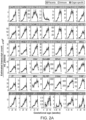
- Preterm populations used in the studies discussed below delivered a fetus prior to 29 weeks gestational age in one case (Pennsylvania cohort) and 33 weeks gestational age in another (Alabama cohort). See Fig. 1 .
- maternal sample refers sample of a body fluid obtained from a pregnant woman.
- the body fluid is typically serum, plasma, or urine, and is usually serum.
- a sample of a different body fluid may be used, such as saliva, cerebrospinal fluid, pleural effusions, and the like.
- Maternal samples may be obtained at multiple different time points during pregnancy and stored (e.g., frozen) until assayed. It will be appreciated that the date of collection of a maternal sample is an integral property of the sample.
- time to delivery refers to the number of weeks from a specified time (present time, date of maternal sample collection) to the delivery date or predicted delivery date. Time to delivery is calculated as (gestational age at delivery) minus (gestational age at sample collection).
- protein and “polypeptide” are used interchangeably. Reference to a protein obtained from a maternal sample does not necessarily imply that the protein is a full-length gene expression product. Portions, fragments, and cleavage products may be detected and identifed according to the invention.
- the invention relates to discovery of a high resolution molecular clock for fetal development and the invention of methods to establish time to delivery (not claimed), fetal gestational age (not claimed), and risk of preterm delivery.
- methods and materials for estimating gestational age or time to delivery of a fetus using expression profiles of placental gene(s) are described.
- methods and materials for assessing risk of preterm delivery are described.
- gestational age or time to delivery may be determined by (a) generating an expression profile using cfRNA (or protein) from a maternal sample and (b) comparing the expression profile with one or more reference profiles that reflect an expression profile characteristic of a defined gestational age.
- the maternal expression profile is compared to 37 reference profiles (characteristic of 1 through 37 weeks of gestational age) and gestational age or time to delivery is estimated based on the relatedness of the maternal expression profile to one of the 37 reference profiles.
- risk of preterm delivery may be determined by (a) generating an expression profile using cfRNA (or protein) from a maternal sample and (b) determining whether the expression profile is or is not characteristic of a population with a history of preterm delivery and/or whether the expression profile is or is not characteristic of a population with a history of full-term delivery.
- machine learning e.g,. random forest regression, support vector machines, elastic net, lasso
- risk of prematurity based on the maternal expression profile generated from a maternal sample.
- a maternal sample e.g., plasma or urine
- cfRNA may be isolated from the sample immediately or after storage. See Example 1 below.
- Art-known methods may be employed to guard the RNA fraction against degradation including, for example, use of special collection tubes (e.g. PAXgene RNA tubes from Preanalytix, Tempus Blood RNA tubes from Applied Biosystems) or additives (e.g. RNAlater from Ambion, RNAsin from Promega) that stabilize the RNA fraction.
- special collection tubes e.g. PAXgene RNA tubes from Preanalytix, Tempus Blood RNA tubes from Applied Biosystems
- additives e.g. RNAlater from Ambion, RNAsin from Promega
- maternal samples can be collected each trimester, or monthly for a period during the course of pregnancy (e.g., months 3-8).
- maternal samples may be collected more frequently.
- gestational age or time to delivery may be monitored frequently (e.g., biweekly) as a method for monitoring fetal health.
- a woman identified at 24 weeks as at risk of preterm delivery may elect biweekly assays to monitor risk.
- a maternal sample may be obtained after the initiation of the intervention to assess whether the intervention has changed the maternal expression profile.
- methods of the invention may be used to accurately discriminate women at risk of preterm delivery up to two months in advance of labor. See Example 6.
- a maternal sample is obtained more than 28 days prior to the preterm delivery.
- a maternal sample is obtained more than 45 days prior to the preterm delivery.
- a maternal sample is obtained after the second month and prior to the eighth month of pregnancy.
- a maternal sample is obtained during the second trimester of pregnancy In some embodiments a maternal sample is obtained during the third trimester of pregnancy. As discussed above, in many cases a maternal sample may be obtained and assayed more than once during the course of a pregnancy.
- RNA can be isolated from a maternal sample using techniques well known in the art. See Example 1 below. Isolation of cfRNA from blood or blood fractions is described in Qin et al., BMC Res. Notes., 26;6:380 (2013 ) and Mersy et al., Clin. Chem., 61(12)1515-23 (2015 ). Kits for isolating cfRNA from blood are known and are commercially available (e.g., PaxGene Blood RNA kit (Qiagen, Catalog No. 762164).
- Kits for isolating cfRNA from plasma/serum are known and are commercially available (e.g., Plasma/Serum RNA Purification Kit from Norgen Biotek Corporation, Canada, Catalog No.: 56900 and Quick-cfRNA TM Serum & Plasma from Zymo Research, Catalog No.: R1059; NextPrep Magnazol cfRNA Isolation Kit (Bioo Scientific); Quick-cfRNA TM Serum & Plasma Kit (Zymo Research), and the QIAamp ® Circulating Nucleic Acid Kit (Qiagen).
- Plasma/Serum RNA Purification Kit from Norgen Biotek Corporation, Canada, Catalog No.: 56900 and Quick-cfRNA TM Serum & Plasma from Zymo Research, Catalog No.: R1059; NextPrep Magnazol cfRNA Isolation Kit (Bioo Scientific); Quick-cfRNA TM Serum & Plasma Kit (Zymo Research), and the QIAamp ® Circulating Nucleic Acid Kit
- Kits for isolating cfRNA from urine are known and are commercially available (e.g., Urine Cell Free Circulating RNA Purification Kit from Norgen Biotek Corporation, Canada, Catalog No.: 56900).
- Quantification of specific transcripts from a cell free RNA sample can be accomplished in a variety of ways including, but not limited to, array-based methods, amplification-based methods (e.g., RT-qPCR), and high-throughput sequencing (RNA-Seq).
- array-based methods e.g., array-based methods, amplification-based methods (e.g., RT-qPCR), and high-throughput sequencing (RNA-Seq).
- RNA-Seq high-throughput sequencing
- RNA is transcribed into complementary DNA (cDNA) by reverse transcriptase from total RNA or messenger RNA (mRNA).
- cDNA is generated using template-specific primers specific for selected RNA transcripts (e.g., one of more of SEQ ID NOS:1-19). The cDNA is then used as the template for the qPCR reaction.
- RT-qPCR can be performed in a one-step or a two-step assay.
- One-step assays combine reverse transcription and PCR in a single tube and buffer, using a reverse transcriptase along with a DNA polymerase.
- One-step RT-qPCR only utilizes sequence-specific primers.
- the reverse transcription and PCR steps are performed in separate tubes, with different optimized buffers, reaction conditions, and priming strategies (such as random primers, oligo-(dT) or sequence specific primers in the reverse transcription followed by sequence specific primers in the qPCR step.
- priming strategies such as random primers, oligo-(dT) or sequence specific primers in the reverse transcription followed by sequence specific primers in the qPCR step.
- reference to RT-qPCR herein includes either a one or two step RT-qPCR assay.
- RT-qPCR can be performed using various buffers and optimizations. See Example 1 below. Isolation of cfRNA from blood and subsequent analysis by RT-qPCR is known in the art (for example, see US Patent Publication No.: 20140199681 ). Kits for performing one step RT-qPCR are known and are commercially available (e.g., TaqPath TM 1-step RT-qPCR Master Mix, CG (Thermo Fisher Scientific, Catalog No. A15299). Kits for performing two step RT-qPCR are known and are commercially available (e.g., Maxima First Strand cDNA Synthesis Kit for RT-qPCR (Thermo Fisher Scientific, Catalog No. K1641).
- Kits for performing one step RT-qPCR are known and are commercially available (e.g., TaqPath TM 1-step RT-qPCR Master Mix, CG (Thermo Fisher Scientific, Catalog No. A15299). Kits for performing two step RT-qPCR are known and are commercially
- RNA-Seq RNA-sequencing assays also known as whole transcriptome shotgun sequencing uses next-generation sequencing (NGS) to reveal the presence and quantity of RNA in a sample at a given point in time (see, Zhong et al. Not. Rev. Gen. 10 (1): 57-63 (2009 ) ) .
- NGS next-generation sequencing
- RNA-Seq assays are described in Example 1, below.
- RNA-Seq facilitates the ability to look at changes in gene expression over time or differences in gene expression in different groups or treatments (see, Maher et al. Nature. 458 (7234): 97-101 (2009 ) ) .
- cfRNAs are isolated from a maternal sample, for example using sequence specific primers, oligo(dT) or random primers to generate cDNA molecules.
- cDNA is generated using template-specific primers specific for selected RNA transcripts (e.g., corresponding to genes listed in TABLES 1 and 2; one of more of SEQ ID NOS:1-19).
- the cDNA molecules can be fragmented and optimized such that sequencing linkers are added to the 3' and 5' ends of the cDNA molecules to produce a sequencing library. Fragmentation is typically not needed for cfRNA.
- the optimized cDNAs are then sequenced using an NGS sequencing platform.
- kits for amplifying cDNA and analyzing sequencing products in accordance with the methods of the invention include, for example, the Ovation TM RNA-Seq System (NuGen).
- NuGen Ovation TM RNA-Seq System
- Other methods for preparing RNA-Seq libraries for use with a sequencing platform are known such as Podnar et al., 2014, "Next-Generation Sequencing RNA-Seq Library Construction” Curr Protoc Mol Biol. 2014 Apr 14;106:4.21.1-19. doi: 10.1002/0471142727.mb0421s106 ; Schuierer et al., 2017, "A comprehensive assessment of RNA-Seq protocols for degraded and low-quantity samples. BMC Genomics. 2017 Jun 5;18(1):442.
- Sequencing libraries suitable for use with RNA-Seq assays can include cDNAs derived from cfRNAs isolated from a maternal sample. It will also be apparent that the sequencing libraries can include cDNAs derived from other RNA species (e.g., miRNAs) that may have been collected during total RNA isolation rather than a cfRNA isolation procedure. Accordingly, either a partial or complete transcriptome analysis can be performed on the RNA content obtained from the maternal sample. In one embodiment, it is preferred that only cfRNAs obtained from the maternal sample are used as the input material for preparing cDNAs suitable for RNA-Seq.
- miRNAs e.g., miRNAs
- multiple different profile panels are used during the course of a woman's pregnancy.
- a first profile panel may be used in the second trimester and a different profile panel may be used in the third trimester.
- a method for estimating gestational age or time to delivery of a fetus by analyzing a maternal sample to determine an expression profile of placental genes e.g., cfRNA or protein encoded by a placental gene
- placental genes e.g., cfRNA or protein encoded by a placental gene
- the panel may include one, at least 2, or at least 3 placental genes.
- the profile panel can include at least 1, 2, 3, 4, 5, 6, 7, 8, 9, 10, 11, 12, 13, 14, 15, 16, 17, 18, 19, or 20 placental genes.
- the profile panel can include exactly 1, 2, 3, 4, 5, 6, 7, 8, 9, 10, 11, 12, 13, 14, 15, 16, 17, 18, 19, or 20 placental genes.
- the profile panel may include fewer than 100 genes, e.g., fewer than 100 placental genes, sometimes fewer than 50 placental genes, sometimes fewer than 20 placental genes, sometimes fewer than 15 placental genes, sometimes fewer than 10 placental genes, and sometimes fewer than 5 placental genes.
- the expression level of each of the placental genes in the profile panel may change during the course of pregnancy. See Examples below. Thus, the expression level of at least one placental gene in the panel may be higher in the first trimester compared to the third trimester. The expression levels of most or all placental genes in the panel may be higher in the first trimester compared to the third trimester. The expression level of at least one placental gene may be lower in the first trimester compared to the third trimester. The expression levels of most or all placental genes in the panel may be lower in the first trimester compared to the third trimester
- At least one placental gene may be selected from genes in TABLE 1. All of the placental genes in a profile panel may be genes listed TABLE 1.
- the expression profile may include at least 1, at least 2, at least 3, at least 4, at least 5, at least 6, at least 7, at least 8, or 9 genes selected from CGA [SEQ ID NO:1], CAPN6 [SEQ ID NO:2], CGB [SEQ ID NO:3], ALPP [SEQ ID NO:4], CSHL1 [SEQ ID NO:5], PLAC4 [SEQ ID NO:6], PSG7 [SEQ ID NO:7], PAPPA [SEQ ID NO:8], and LGALS14 [SEQ ID NO:9].
- the expression profile may include 1, 2, 3, 4, 5, 6, 7, 8, or 9 genes selected from CGA [SEQ ID NO:1], CAPN6 [SEQ ID NO:2], CGB [SEQ ID NO:3], ALPP [SEQ ID NO:4], CSHL1 [SEQ ID NO:5], PLAC4 [SEQ ID NO:6], PSG7 [SEQ ID NO:7], PAPPA [SEQ ID NO:8], and LGALS14 [SEQ ID NO:9].
- the set of placental genes includes at least one gene other than CGA and CGB.
- the profile panel comprises from three (3) to nine (9) cfRNAs selected from SEQ ID NOS:1-9.
- Gestational age may be determined using a profile panel profile of 9 genes: CGA, CAPN6, CGB, ALPP, CSHL1, PLAC4, PSG7, PAPPA, and LGALS14.
- We trained several distinct models on subpopulations of women i.e., nulliparous or multiparous women, women carrying male or female fetuses
- Training 4 distinct models for women carrying male or female fetuses and nulliparous or multiparous women revealed that 2 of the 9 genes identified in the main text were sufficient to (CGA, CSHL1) or female (CGA, CAPN6) fetuses and multiparous (CGA, CSHL1) women.
- all 9 genes were necessary to optimally predict time until delivery for nulliparous women, highlighting the importance of the transcriptomic signature identified.
- the panel comprises CGA and CSHL1 or CGA and CAPN6.
- the nine transcripts used to predict gestational age were weighted by the model in the following order of importance (from most to least): CGA, CAPN6, CGB, ALPP, CSHL1, PLAC4, PSG7, PAPPA, and LGALS14.
- the determined level of expression for individual genes may be given different weights (or coefficients) when compared to expression in a reference profile. For example, when all 9, or a subset comprising fewer than 9 genes in this group (e.g., 2, 3, 4, 5, 6, 7 or 8) expression values for each gene are ranked CGA > CAPN6 > CGB > ALPP > CSHL1 > PLAC4 > PSG7 > PAPPA > LGALS14.
- the panel may include one, at least 2, or at least 3 genes from TABLE 1.
- the profile panel can include at least 1, 2, 3, 4, 5, 6, 7, 8, 9, 10, 11, 12, 13, 14, 15, 16, 17, 18, 19, or 20 genes from TABLE 1.
- the profile panel can include exactly 1, 2, 3, 4, 5, 6, 7, 8, 9, 10, 11, 12, 13, 14, 15, 16, 17, 18, 19, or 20 genes from TABLE 1.
- the profile panel may include fewer than 100 genes, sometimes fewer than 50 genes, sometimes fewer than 20 genes, sometimes fewer than 15 genes, sometimes fewer than 10 genes, and sometimes fewer than 5 genes. In certain approaches the profile panel comprises a number of genes in the range 1-100 genes, 1-50 genes, 1-25 genes, 3-100 genes, 3-50 genes, 3-25 genes, or 3-10 genes.
- the placental genes are selected from genes in TABLE 1.
- the placental genes may be selected from CGA, CAPN6, CGB, ALPP, CSHL1, PLAC4, PSG7, PAPPA, and LGALS14.
- the genes may include at least one gene other than CGA.
- the genes may include at least two, three, four, five, six, seven or eight genes other than CGA.
- the genes may include at least one gene other than CGB.
- the genes may include at least two, three, four, five, six, seven or eight genes other than CGB.
- the genes may include at least one gene other than CGA and CGB.
- the method may include determining the expression profile for three (3) to nine placental genes.
- the invention provides a method for estimating risk of preterm delivery by analyzing a maternal sample to determine an expression profile.
- the profile panel used for such a determination comprises one or more cfRNA transcripts with higher expression levels in a preterm population than in a term population.
- a preterm population refers to a set of women who delivered a fetus prior to 37 weeks gestational age.
- a preterm population refers to women who delivered a fetus prior to 33 weeks gestational age.
- a preterm population refers to women who delivered a fetus prior to 29 weeks gestational age.
- a preterm population refers to women who delivered a fetus between 12 and 33 weeks gestational age. In another embodiment, a preterm population refers to a set of women who delivered a fetus between 16 and 29 weeks gestational age. In an embodiment, a preterm population refers to a set of women who delivered a fetus between 16 and 33 weeks gestational age. As noted above, one preterm population used in the Examples consisted of women who delivered a fetus prior to 29 weeks gestational age and this population (or subpopulations thereof) is preferred for making reference profiles characteristic of high risk of prematurity. The Examples also show that biomarkers discovered in a population of women who delivered a fetus prior to 29 weeks are applicable in a population of women who delivered a fetus prior to 33 weeks gestational age.
- the profile panel includes 3 or more, genes listed in TABLE 2, as defined in claim 1.
- the profile panel includes three (3) or more genes are selected from the ten transcript panel, comprising RAB27b [SEQ ID NO: 17] and two or more genes selected from CLCN3 [SEQ ID NO:10], DAPP1 [SEQ ID NO:11], POLE2 [SEQ ID NO:12], PPBP [SEQ ID NO:13], LYPLAL1 [SEQ ID NO:14], MAP3K7CL [SEQ ID NO:15], MOB1B [SEQ ID NO:16], RGS18 [SEQ ID NO:18], and TBC1D15 [SEQ ID NO:19].
- the profile panel comprises three (3) or more genes selected from SEQ ID NO: 17 and two or more genes selected from SEQ ID NOS:10-16 and SEQ ID NOS: 18-19.
- the profile panel comprises exactly three (3) genes including SEQ ID NO: 17 and two or more genes selected from SEQ ID NOS:10-16 and SEQ ID NOS: 18-19. In some embodiments the panel comprises only SEQ ID NO: 17 and two or more genes selected from SEQ ID NOS:10-16 and SEQ ID NOS: 18-19.
- the profile panel will comprise the following combinations: (i) MAP3K7CL, MOB1B, RAB27B; (ii) MOB1B, RAB27B, RGS18; and (iii) RAB27B, RGS18, TBC1D15. It will be appreciated that the full list of combinations of 3 genes selected from SEQ ID NOS:10-19 is easily generated, and this paragraph is intended to convey possession of each said combination of 3 genes.
- the profile panel includes three (3) or more genes are selected from the seven transcript panel and include RAB27B [SEQ ID NO: 17] and two or more genes selected from CLCN3 [SEQ ID NO:10], DAPP1 [SEQ ID NO:11], PPBP [SEQ ID NO:13], MAP3K7CL [SEQ ID NO:15], MOB1B [SEQ ID NO:16 and RGS18 [SEQ ID NO:18] .
- the profile panel comprises three (3) or more genes including SEQ ID NO: 17 and two or more genes selected from SEQ ID NOS: 10, 11, 13, 15, 16, and-18.
- the profile panel comprises exactly three (3) genes including SEQ ID NO: 17 and two or more genes selected from SEQ ID NOS: 10, 11, 13, 15, 16, and-18.
- the panel comprises only SEQ ID NO: 17 and two or more genes selected from SEQ ID NOS: 10, 11, 13, 15, 16, and-18.
- the profile panel comprises exactly three genes including SEQ ID NO: 17 and two or more genes selected from SEQ ID NOS:10-16 and SEQ ID NOS: 18-19. In one approach the profile panel comprises exactly three genes including SEQ ID NO: 17 and two or more genes selected from SEQ ID NOS: 10, 11, 13, 15, 16, and-18.
- the seven transcripts used to identify women at elevated risk or preterm delivery were weighted by the model in the following order of importance (from highest to lowest): RAB27B > PPBP > DAPP1 > RGS18 > (MOB1B, MAP3K7CL, and CLCN3), where MOB1B, MAP3K7CL, and CLCN3 are equally ranked.
- the determined level of expression for individual genes are given different weights (or coefficients) when compared to expression in a reference profile.
- the invention provides a method for determining risk of preterm delivery by analyzing a maternal sample to determine an expression profile of a set of genes (e.g ., cfRNA or protein) listed in TABLE 2, comprising SEQ ID NO: 17 and two or more genes selected from SEQ ID NOS: 10, 11, 13, 15, 16, and-18 .
- the panel includes at least three genes including SEQ ID NO: 17 and two or more genes selected from SEQ ID NOS:10-16 and SEQ ID NOS: 18-19 and one, at least 2, or at least 3 genes from TABLE 2.
- the profile panel can include at least three genes including SEQ ID NO: 17 and two or more genes selected from SEQ ID NOS:10-16 and SEQ ID NOS: 18-19 and at least 1, 2, 3, 4, 5, 6, 7, 8, 9, 10, 11, 12, 13, 14, 15, 16, 17, 18, 19, or 20 genes from TABLE 2.
- the profile panel can include exactly three genes including SEQ ID NO: 17 and two or more genes SEQ ID NOS:10-16 and SEQ ID NOS: 18-19 and 1, 2, 3, 4, 5, 6, 7, 8, 9, 10, 11, 12, 13, 14, 15, 16, 17, 18, 19, or 20 genes from TABLE 2.
- the profile panel includes fewer than 100 genes, sometimes fewer than 50 genes, sometimes fewer than 20 genes, sometimes fewer than 15 genes, sometimes fewer than 10 genes, and sometimes fewer than 5 genes.
- the profile panel comprises a number of genes in the range 1-100 genes, 1-50 genes, 1-25 genes, 3-100 genes, 3-50 genes, 3-25 genes, or 3-10 genes.
- at least one of the genes in the profile panel does not listed in FIG. 3A and/or FIG. 3B and/or FIG. 4 of US Patent Publication No. 2013/0252835 .
- a maternal sample is obtained at a specified week of pregnancy and the maternal expression profile is compared to a time matched reference profile, wherein the time matched reference profile is characteristic of a full-term pregnancy profile at the specified week of pregnancy.
- a maternal sample is obtained at a specified trimester (e.g, first, second or third trimester) of pregnancy and the maternal expression profile is compared to a time matched reference profile, wherein the time matched reference profile is characteristic of a full-term pregnancy profile at the specified trimester of pregnancy.
- Significant deviations of the maternal profile from the reference profile is indicative that the woman as at elevated risk of preterm delivery.
- a maternal sample is obtained at a specified week of pregnancy and the maternal expression profile is compared to a time matched reference profile, wherein the time matched reference profile is characteristic of a preterm pregnancy profile at the specified week of pregnancy.
- the time matched reference profile is characteristic of a preterm pregnancy profile at the specified week of pregnancy.
- Significant similarities between the maternal profile and the reference profile is indicative that the woman as at elevated risk of preterm delivery.
- a machine learning model is used to compare the maternal profile and the reference profile.
- Proteins can be isolated from a maternal sample using methods well known in the art. In one appropach total protein is from a maternal blood fraction or urine and assayed for the presence and/or quantity of particular proteins. In one approach an assay is carried out using a protein fraction (e.g., a fraction enriched for protein(s) of interest. In one approach an assay is carried out using one or more purified proteins. Isolation and fractionation of proteins can be performed using fractionation by molecular weight, protein charge, solubility/hydrophobicity, protein isoelectric point (pl), affinity purification (e.g., using a an antiligand, such as an antibody or aptamer, specific from a protein among other methods.
- a protein fraction e.g., a fraction enriched for protein(s) of interest.
- an assay is carried out using one or more purified proteins. Isolation and fractionation of proteins can be performed using fractionation by molecular weight, protein charge, solubility/hydrophobicity, protein iso
- Kits for isolating proteins from blood are known and are commercially available (e.g., Total Protein Assay Kit from ITSIBiosciences, Catalog No.: K-0014-20). Kits for isolating proteins from plasma/serum are known and are commercially available (e.g., Antibody Serum Purification Kit (Protein A) from Abcam, Catalog No.: ab109209). Kits for isolating protein and RNA from the sample are also known (e.g., Protein and RNA Isolation System (PARIS) from Thermo Fisher Scientific, Catalog No. AM1921).
- PARIS Protein and RNA Isolation System
- Specific proteins from a maternal sample can be identifed and/or quantified using well know methods, including enzyme-linked immunoadsorbent assay (ELISA); radioimmunoassay (RA) (see, e.g., Anthony et al., Ann. Clin. Biochem., 34:276-280 (1997 ) describing detection of low levels of protein undetectable using comparable ELISA conditions); proximity ligation and proximity extension assays (see, e.g., US Pat. Pub. Nos.
- ELISA enzyme-linked immunoadsorbent assay
- RA radioimmunoassay
- proximity ligation and proximity extension assays see, e.g., US Pat. Pub. Nos.
- Protein binding arrays may be used to detect and quantitate proteins, including but not limited to antibody based arrays and aptamer based arrays (see, e.g., Gold L, et al. (2010) Aptamer-Based Multiplexed Proteomic Technology for Biomarker Discovery. PLoS ONE5(12): e15004. https://doi.org/10.1371/journal.pone.0015004 ).
- An antibody array also known as antibody microarray
- An antibody microarray is a specific form of protein array.
- Antibody arrays can be used to detect protein expression from various biological fluids including serum, plasma, urine and cell or tissue lysates (see, Knickerbocker T., MacBeath G. Detecting and Quantifying Multiple Proteins in Clinical Samples in High-Throughput Using Antibody Microarrays. In: Wu C. (eds) Protein Microarray for Disease Analysis. Methods in Molecular Biology (Methods and Protocols), vol 723. Humana Press (2011 )).
- Kits for performing antibody arrays are known and are commercially available (e.g., custom designed antibody arrays or predetermined antibody arrays from RayBiotech, Norcross, GA).
- a maternal expression profile may be compared with a reference profile(s) in a variety of ways.
- a comparison between two data sets is performed to determine whether one data set differs or is similar to another data set, e.g., to within statistical significance.
- a first data set can comprise a maternal expression profile
- a second data set comprises a reference profile, where the first and second data sets include one or more data points (for example, median values) for gene expression data for one or more genes, collected over one or more time points during pregnancy (e.g., once a week or once a trimester during the course of the pregnancy).
- the second data set comprises a plurality of data points from a preterm maternal sample or a maternal sample having a known gestational age.
- a maternal data set can be a measured value of an expression level of one or more genes, where the expression level can be determined from individual expression values for each of the genes, e.g., as an average, weighted average, or median of the individual expression levels.
- the individual expression levels can be treated as different dimensions of a multi-dimensional data point, e.g., for use in clustering.
- the comparison can be between a measured expression level(s) of a maternal sample and the reference expression level(s) of each of a plurality of reference having different known gestational ages, thereby identifying a group or representative data point that is closest (e.g., least difference in a distance between the measured expression level(s) and the reference expression level(s)).
- the known gestational age of the closest reference sample (or representative data point of a group of reference samples all having a same gestational age) can be used as the gestational age or time to delivery of the maternal sample.
- Such a comparison can be performed by comprising the measured expression level(s) to a gestational function that is determined from the reference samples, e.g., a linear function that defines a functional relationship between the expression level(s) (e.g., in a multi-dimensional space when individual expression levels correspond to different dimensions or in a 2D-plot when individual expression levels are combined to provide a single metric).
- a gestational function that is determined from the reference samples, e.g., a linear function that defines a functional relationship between the expression level(s) (e.g., in a multi-dimensional space when individual expression levels correspond to different dimensions or in a 2D-plot when individual expression levels are combined to provide a single metric).
- the comparison can involve determining whether the measured expression level(s) are more similar to preterm reference level(s) or term reference level(s). Such a comparison can involve determining which cluster of reference levels is closest to the measured expression level(s). One or more values may be used for determining whether the measured expression level(s) are sufficiently close (e.g., as measured by a distance or a weight distance where differences along one dimension are weighted differently) for the measured level(s) to be considered part of either cluster of term or preterm samples. An indeterminate classification may result if the expression level(s) are not sufficiently close.
- a threshold can be used to determine whether the measured expression levels are sufficiently close to reference expression levels of a term or preterm population. A threshold can be selected based on a desired sensitivity and specificity, as will be apparent to one skilled in the art.
- a set of training samples can be labeled with different classifications, e.g., term or preterm. Then, the reference levels can be chosen as being representative of a classification or as values that separate the different classifications, e.g., as cutoffs for assigning different classifications to a new sample.
- a machine learning technique can analyze different expression levels of different genes to determine which set of expression levels (features) provide the best discrimination for an optimized set of reference levels. A tradeoff between specificity and sensitivity can be optimized, e.g., by a ROC (receiver operating characteristic) curve.
- a plurality of training samples, each labeled as preterm or full-term can be obtained.
- training samples are labeled as nulliparous, multiparous women, carrying male fetus, carrying female fetus, or the like.
- One or more measured expression levels for the panel of genes can be obtained for each of the plurality of training samples.
- the one or more reference expression levels can be iteratively adjusted to increase a number of the training samples that are classified correctly as a result of comparing the one or more measured expression levels to the one or more reference expression levels.
- the first and second data sets can be analyzed to establish relative differences or similarities (e.g., fold increase or fold decrease) between the data sets (e.g., the expression level(s) of the data sets). Such a procedure can be performed when a single expression level is determine for a panel of genes.
- a pairwise comparison of expression level(s) at each time point for each gene across the duration of pregnancy can be used to identify which reference level(s) are most similar, where each set of reference level(s) can correspond to a different gestational age.
- the pairwise comparison can include statistical analysis via a range of statistical methodologies, including but not limited to Fisher's exact test, Wilcox rank test, permutation test, linear regression, generalized linear models and quasi-likelihood tests coupled with the appropriate multiple hypothesis correction (e.g., Benjamini Hochberg).
- differentiating gene activity across the pregnancy can include using a quantile adjusted conditional maximum likelihood method, a generalized linear model (GLM) likelihood ratio test, and/or a quasi-likelihood F-test implemented in R using the edgeR software (Bioconductor, available at https://bioconductor.org/ packages/release/ bioc/html/edgeR.html).
- a sample data set can be analyzed using a random forest model (see, e.g., Chen and Ishwaran, Genomics, 99:323-329 (2012 )) that was generated using the second data set.
- Random forest is a form of machine learning that selects training sets randomly for building multiple models (e.g., decision trees or regression models) and uses the outputs of this ensemble of models to determine a final output (e.g., via majority voting for a term/preterm classification or an average when determining gestational age or time to delivery).
- Each model can have the same or different features (e.g., expression levels of genes), but have different reference levels as determined from the different training sets that are randomly selected.
- machine learning models e.g., supervised machine learning; see, for example Mohri et al. (2012) Foundations of Machine Learning, The MIT Press
- machine learning models can be developed to account for particular attributes of a population such as ethnicity and that multiple models can be prepared based on different needs (e.g., an Eastern European model versus a North African model).
- a machine learning model (e.g., to predict gestational age or time to delivery) can be prepared as follows:
- a single regression model can be determined, e.g., by fitting a line or a curve to a set of measured expression level(s) that are measured at known gestational ages.
- the regression model can be considered a gestational function, e.g., when a model (e.g., a linear or non-linear function) is fit to expression levels of a plurality of calibration samples having measured expression levels and of which a gestational age is known.
- the comparison of the maternal expression profile to the reference profile can be performed by comparing the maternal expression profile to a gestational function that provides a gestational age based on an input of one or more expression levels.
- the first and second data sets can be analyzed using SAMS (Scoring Algorithm of Molecular Subphenotypes) available at http://statweb.stanford.edu/ ⁇ tibs/SAM/ (see, Tusher et al., PNAS, 98:5116-5121 (2001 )).
- SAMS is a classification algorithm of gene expression data generated from the calculation of two scores (e.g., an up score and a down score).
- a maternal expression profile data set of the instant invention can be compared to a reference expression profile data set and a maternal sample having an up score above the median value (as compared to the reference expression profile) and a down score above the median value (as compared to the reference expression profile) can be classified as statistically significant (see., e.g., Herazo- Maya, Lancet Respir Med, September 20, (2017) doi:org/10.1016/52213-2600(17)30349-1 and Dinu et al., BMC Bioinformatics, 8:242 (2007 )).
- Other evaluations of a first data set and a second data set using SAMS can be performed according to the SAMS user manual (available at http://www-stat.stanford. edu/ ⁇ tibs/SAM/sam.pdf).
- a first and second data set directed to gene expression data e.g., preterm data set versus a maternal sample
- methods set forth by Efron and Tibshirani On Testing the Significance of Sets of Genes. Ann Appl. Stat., 1. 107-129 (2007 ) and Zhao et al. (Gene expression profiling predicts survival in conventional renal cell carcinoma, PLOS Medicine, 3. E13. 13. 10.1371/journal.pmed.0030013. (2006 )).
- comparing a maternal expression profile to a reference profile includes compiling gene expression data (e.g., the number or relative number of transcripts of a specified cfRNA sequence on a computer-readable medium) and processing said data on said computer to identify degrees of similarity and difference between said profiles.
- gene expression data e.g., the number or relative number of transcripts of a specified cfRNA sequence on a computer-readable medium
- Women identified as at risk for preterm delivery may elect medical interventions (e.g., progesterone supplementation, cervical cerclage), behavioral changes (smoking cessation), or ultrasound imaging to monitor and reduce the likelihood of preterm delivery or to extend the pregnancy for as long as possible. See Newnham et al. "Strategies to Prevent Preterm Delivery.” Frontiers in Immunology 5 (2014):584 .
- Progesterone may be used to treat and/or prevent the onset of preterm labor in women identified as at risk for preterm delivery.
- a pregnant woman may be administered an amount of progesterone, e.g., as a vaginal gel, that is sufficient to prolong gestation by delaying the shortening or effacing of cervix.
- the administration can be as infrequent as weekly, or as often as 4 times daily.
- Antibiotic treatment (amoxicillin, ampicillin, erythromycin, azithromycin, and cephalosporin) is indicated in some women with premature rupture of the membranes (PROM), a precursor of premature delivery, and may be administered to women identified as at risk for preterm delivery.
- PROM premature rupture of the membranes
- the medical provider may recommend an ultrasound examination at least once per four week period, biweekely, or weekly.
- the methods described herein are used for theranosis.
- a first maternal expression profile is obtained from a woman at risk of preterm delivery at a first point in time, medically appropriate steps (e.g., medical interventions) are initiated or carried out, and then a second maternal expression profile is obtained from the woman at a second point in time.
- Each maternal expression profile is compared to an appropriate reference profile (e.g., time matched, population matched, etc.). If the difference between the second maternal expression profile and the appropriate corresponding reference profile is less than the difference between the first maternal expression profile and its appropriate corresponding reference profile this is an indication that the steps carried out have a beneficial therapeutic effect.
- the first and second maternal expression profiles are compared to the same reference profile. In one approach the process is carried out without any medical intervention, in which case a spontaneous improvement may be observed.
- the methods described herein are used for prognosis. It is believed that certain maternal expression profiles are indicative of particular prognoses. For example, certain maternal expression profiles may be used to estimate time until preterm delivery (absent intervention). Reference profiles for this purpose can be generated from sub-populations grouped by specific pregnancy outcomes (dates of prematurity), by genetic risk, or by phenotypic factors such as age and previous pregnancy history. The methods disclosed herein may also be used for identifying and monitoring fetuses having congenital defects; in some cases the methods may be used to inform decisions about in utero treatment.
- Maternal expression profiles can be used to estimate time to delivery and gestational age for the fetus, and the results used for providing advice or treatment for either the mother or the fetus. Similarly, with appropriately chosen genes such profiles can be used to estimate the risk of adverse events such as preterm delivery.
- a computer-based system refers to the hardware means, software means, and data storage means used to analyze the information of the present invention.
- the minimum hardware of the computer-based systems of the present invention comprises a central processing unit (CPU), input means, output means, and data storage means.
- CPU central processing unit
- input means input means
- output means output means
- data storage means may comprise any manufacture comprising a recording of the present information as described above, or a memory access means that can access such a manufacture.
- a database comprising reference profiles is used in methods of the invention.
- a database comprising expression data from a plurality of women, and optionally different subpopulations of women is provided. Accordingly, aspects of the invention provide systems and methods for the use and development of a database. In some approaches the database is used in combination with an algorithm that enables generation of new reference profiles selected based on characteristics of an individual woman.
- a computer system includes a single computer apparatus, where the subsystems can be the components of the computer apparatus.
- a computer system can include multiple computer apparatuses, each being a subsystem, with internal components.
- a computer system can include desktop and laptop computers, tablets, mobile phones and other mobile devices.
- a computer system can include a plurality of the same components or subsystems, e.g., connected together by external interface, by an internal interface, or via removable storage devices that can be connected and removed from one component to another component.
- computer systems, subsystem, or apparatuses can communicate over a network.
- one computer can be considered a client and another computer a server, where each can be part of a same computer system.
- a client and a server can each include multiple systems, subsystems, or components.
- aspects of embodiments can be implemented in the form of control logic using hardware circuitry (e.g. an application specific integrated circuit or field programmable gate array) and/or using computer software with a generally programmable processor in a modular or integrated manner.
- a processor can include a single-core processor, multi-core processor on a same integrated chip, or multiple processing units on a single circuit board or networked, as well as dedicated hardware.
- Any of the software components or functions described in this application may be implemented as software code to be executed by a processor using any suitable computer language such as, for example, Java, C, C++, C#, Objective-C, Swift, or scripting language such as Perl or Python using, for example, conventional or object-oriented techniques.
- the software code may be stored as a series of instructions or commands on a computer readable medium for storage and/or transmission.
- a suitable non-transitory computer readable medium can include random access memory (RAM), a read only memory (ROM), a magnetic medium such as a hard-drive or a floppy disk, or an optical medium such as a compact disk (CD) or DVD (digital versatile disk), flash memory, and the like.
- the computer readable medium may be any combination of such storage or transmission devices.
- the databases may be provided in a variety of forms or media to facilitate their use.
- Media refers to a manufacture that contains the expression information of the present invention.
- the databases of the present invention can be recorded on computer readable media, e.g. any medium that can be read and accessed directly by a computer (e.g., an internet database).
- Such media include, but are not limited to: magnetic storage media, such as floppy discs, hard disc storage medium, and magnetic tape; optical storage media such as CD-ROM; electrical storage media such as RAM and ROM; and hybrids of these categories such as magnetic/optical storage media.
- magnetic storage media such as floppy discs, hard disc storage medium, and magnetic tape
- optical storage media such as CD-ROM
- electrical storage media such as RAM and ROM
- hybrids of these categories such as magnetic/optical storage media.
- Recorded refers to a process for storing information on computer readable medium, using any such methods as known in the art. Any convenient data storage structure may be chosen, based on the means used to access the stored information. A variety of data processor programs and formats can be used for storage, e.g. word processing text file, database format, etc.
- Such programs may also be encoded and transmitted using carrier signals adapted for transmission via wired, optical, and/or wireless networks conforming to a variety of protocols, including the Internet.
- a computer readable medium may be created using a data signal encoded with such programs.
- Computer readable media encoded with the program code may be packaged with a compatible device or provided separately from other devices (e.g., via Internet download). Any such computer readable medium may reside on or within a single computer product (e.g. a hard drive, a CD, or an entire computer system), and may be present on or within different computer products within a system or network.
- a computer system may include a monitor, printer, or other suitable display for providing any of the results mentioned herein to a user.
- any of the methods described herein may be totally or partially performed with a computer system including one or more processors, which can be configured to perform the steps.
- embodiments can be directed to computer systems configured to perform the steps of any of the methods described herein, potentially with different components performing a respective step or a respective group of steps.
- steps of methods herein can be performed at a same time or at different times or in a different order. Additionally, portions of these steps may be used with portions of other steps from other methods. Also, all or portions of a step may be optional. Additionally, any of the steps of any of the methods can be performed with modules, units, circuits, or other means of a system for performing these steps.
- Primers and probes that specifically hybridize to or amplify cfRNA from placental genes may be used in the practice of aspects of the invention.
- useful primers and probes include those that specifically hybridize to or amplify SEQ ID NOS: 1-19. These primers and probes are used for amplification (including multiplex PCR, multiplex RT-qPCR, or other amplification methods), for reverse transcription, for construction of sequencing libraries (e.g., RNA-seq libraries), for addition of adaptor sequences, for hybrid capture of RNAs of interest, for construction nucleic acid arrays, for primer extension and for other uses known to the practitioner with knowledge of the art.
- sequencing libraries e.g., RNA-seq libraries
- probes and primers for their intended uses, taking into account methods of amplification (e.g., addition of adaptors or universal primers), target sequence composition, base composition, avoiding artifacts such as primer dimer formation, as well as the fragmented nature of cfRNA.
- Probes may be nucleic acid probes, such as RNA or DNA probes. Primers or probes may be immobilized (e.g., for capture based enrichment) or detectably labeled (e.g., with fluorescent, enzymatic, or chemiluminescent moieties or the like).
- Primers for multiplex amplification of at least 3 and not more than 50, optionally no more than 25, optionally no more than 10 genes, selected from genes in TABLE 1 are described.
- Primers for multiplex amplification of at least 3 mRNA transcripts provided in TABLE 1 are described.
- Primers for multiplex amplification of any combination of at least 3 mRNA transcripts selected from SEQ ID NOS:1-9 are described.
- the primers may by for multiplex amplification, wherein the primers may comprise at least one pair, and optionally three or more primer pairs. Exemplary primer pairs are provided in TABLE 3.
- the primers for multiplex amplification may comprise at least three and no more than 100 primer pairs, optionally no more than 50, optionally no more than 25, optionally no more than 10 primer pairs selected from any of the primer pairs provided in TABLE 3.
- compositions comprising primer(s) or primer pair(s) as described above are described.
- the composition may be an admixture.
- the composition may be a solution.
- the composition may additionally contain one or more of (a) maternal cfRNA, (b) buffer, (c) enzymes (e.g., one or a combination of reverse transcriptase, DNA polymerase, RNA or DNA ligase), (d) dNTPs.
- compositions comprising (1) cfRNAs with cfRNA sequences corresponding to at least 2 genes in TABLE 1, or amplicons of, or cDNAs from, said cfRNA sequences and (2) primers for amplifying said cfRNA sequences or amplicons or cDNAs, or probes for detecting said cfRNA sequences or amplicons or cDNAs, with the proviso that the composition does not comprise primers for amplifying more than a threshold number of different genes, amplicons or cDNAs; and does not comprise probes for detecting more than the threshold number of different cfRNA sequences or amplicons or cDNAs.
- the composition may not comprise cfRNAs with cfRNA sequences corresponding to more than the a threshold number of different genes from the human genome, or amplicons of, or cDNAs from more than the threshold number of different genes.
- the threshold number may be 200.
- the threshold number may be 150.
- Tthe threshold number may be 100.
- the threshold number may be 50.
- the threshold number may be 25.
- Nucleic acid arrays comprising primer(s), primer pair(s), or probes as described above are provided.
- Primers for multiplex amplification of at least 3 and no more than 100 genes, optionally no more than 50, optionally no more than 25, optionally no more than 10 genes, selected from genes in TABLE 2 are described.
- Primers for multiplex amplification of at least 3 mRNA transcripts provided in TABLE 2 i.e., RefSeq identifiers
- Primers for multiplex amplification of any combination of at least 3 mRNA transcripts selected from SEQ ID NOS:10-19, or, alternatively at least 3 mRNA transcripts selected from SEQ ID NOS: 10, 11, 13, and 15-18 are described.
- the primers may be for multiplex amplification, wherein the primers comprise at least one pair, and optionally three or more primer pairs.
- primers for multiplex amplification may comprise at least three and no more than 100 primer pairs, optionally no more than 50, optionally no more than 25, optionally no more than 10 pairs selected from any of the primer pairs provided in TABLE 3.
- compositions comprising primer(s) or primer pair(s) as described above are described.
- the composition may be an admixture.
- the composition may be a solution.
- the composition may additionally contain one or more of (a) maternal cfRNA, (b) buffer, (c) enzymes (e.g., reverse transcriptase, DNA polymerase, RNA or DNA ligase), (d) dNTPs.
- Kits comprising primer(s) or primer pair(s) as described above packaged together are described. In one approach, a mixture of different primers are combined in a single mixture. In another approach, primers specific for individual cfRNAs are packaged together in separate vials.
- the kit may additionally contain one or more of (a) maternal cfRNA, (b) buffer, (c) enzymes (e.g., reverse transcriptase, DNA polymerase, RNA or DNA ligase), (d) dNTPs.
- a composition comprising (1) cfRNAs with cfRNA sequences corresponding to at least 2 genes in TABLE 2, or amplicons of, or cDNAs from, said cfRNA sequences and (2) primers for amplifying said cfRNA sequences or amplicons or cDNAs, or probes for detecting said cfRNA sequences or amplicons or cDNAs, with the proviso that the composition does not comprise primers for amplifying more than a threshold number of different genes, amplicons or cDNAs; and does not comprise probes for detecting more than the threshold number of different cfRNA sequences or amplicons or cDNAs.
- Tthe composition may not comprise cfRNAs with cfRNA sequences corresponding to more than the a threshold number of different genes from the human genome, or amplicons of, or cDNAs from more than the threshold number of different genes.
- the threshold number may be 200.
- the threshold number may be 150.
- the threshold number may be 100.
- the threshold number may be 50.
- the threshold number may be 25.
- Nucleic acid arrays comprising primer(s) or primer pair(s) as described above are described.
- a maternal sample(s) is collected, frozen, and shipped to a centralized laboratory for analysis.
- methods of the invention are carried out in a local medical facility (e.g., hospital lab) optionally using a kit for isolation of cfRNA, production of cDNA, qPCR and/or sequencing.
- the kit includes reagent for cfRNA isolation.
- the use of a standardized kit is advantageous in ensuring uniformity of sample collection, cfRNA isolation, and analysis by qPCR or transcriptome sequencing.
- the kit may contain reagents for cfRNA, production of cDNA, qPCR and/or sequencing as well as primers or probes described herein for determining expression levels of cfRNA transcripts or combinations of transcripts described herein.
- cfRNA, cDNA, or a library is produced and shipped to a centralized laboratory for analysis.
- a maternal sample(s) is collected and an expression profile is determined using a distributed system including client systems and server systems communicating over a computer network server-client, frozen, and shipped to a centralized laboratory for analysis.
- the server system may comprise databases of reference profiles and may receive data (e.g., expression profile information) from a client system.
- the expression profile information from the patient is compared to the reference profile using a computer product, e.g., comprising a computer readable medium storing a plurality of instructions for controlling a computer system to perform a method of the invention. the method of any one of the preceding claims.
- the databases of reference profiles may be produced using the machine learning approaches described herein.
- as expression profiles from individual patients is collected that information may be used as training data. This may be particularly useful when training and validation data are collected from demographically distinct patient populations (e.g., populations identified by age, race or ethnicity, geographical location, or other criteria).
- the invention involves (1) collecting cfRNA from a pregnant woman one or multiple times during pregnancy, determining an expression profile using the cfRNA (i.e., an expression profile corresponding to a set of genes identified herein, e.g., genes from TABLE 1, TABLE 2, or TABLE 6 or combinations or subsets described herein); and recording the expression profile, e.g., on a suitable non-transitory computer readable medium; and then (2) determining the delivery date for the woman, categorizing the delivery as term or preterm (and if preterm, by how many days) or otherwise characterizing the outcome of the pregnancy, and (3) associating the information in (2) with the expression profiles in (1), e.g., by linking the information and expression profile(s) in the computer readable medium.
- a method performed using a computer for estimating gestational age of a fetus comprising: (a) obtaining one or more expression profiles from a maternal sample of a pregnant woman carrying a fetus, wherein the expression profile(s) corresponds to the expression of cfRNA transcripts from a first panel of genes; (b) comparing, using a computer system, the expression profile(s) to one or more reference profile(s) characteristic of a defined gestational age(s) to estimate the gestational age of the fetus, wherein the reference profile(s) characteristic of the defined gestational age(s) are determined using a machine learning model that analyzes first training samples that are cfRNA expression profiles labeled with a defined gestational age; (c) updating, using the computer system, the reference profile(s) by: (1) receiving second training samples, wherein the second training samples are cfRNA expression profiles labeled with a defined gestational age, and (2) iteratively adjusting the reference profile
- the reference profiles can form a line or curve or be discrete values.
- the first panel of genes may comprise any combination of genes disclosed herein as predictive of gestational age, including placental genes, placental genes listed in Table 1, and at least 1, at least 2, at least 3, at least 4, at least 5, at least 6, at least 7, at least 8, or 9 genes selected from CGA [SEQ ID NO:1], CAPN6 [SEQ ID NO:2], CGB [SEQ ID NO:3], ALPP [SEQ ID NO:4], CSHL1 [SEQ ID NO:5], PLAC4 [SEQ ID NO:6], PSG7 [SEQ ID NO:7], PAPPA [SEQ ID NO:8], and LGALS14 [SEQ ID NO:9].
- a computer system comprising: (a) a database comprising reference profile(s), each including a level of expression in a population of pregnant women of cfRNA transcripts corresponding to a first panel of genes and corresponding to a defined gestational age; (b) a user interface configured to interact with a client computer over a network and to receive expression profile(s) including the level of expression in a pregnant woman carrying a fetus of cfRNA transcripts corresponding to the first panel of genes; and (c) one or more processors configured to analyze the reference profile and expression profile, including comparing the reference profile(s) and expression profile(s) to determine gestational age of the fetus; and (d) a network interface that transmits the gestational age of the fetus to the client computer.
- the reference profile(s) and expression profile(s) may comprise expression levels of a panel of cfRNAs in any combination disclosed herein, including transcripts from placental genes; placental genes listed in Table 1; and at least 1, at least 2, at least 3, at least 4, at least 5, at least 6, at least 7, at least 8, or 9 genes selected from CGA [SEQ ID NO:1], CAPN6 [SEQ ID NO:2], CGB [SEQ ID NO:3], ALPP [SEQ ID NO:4], CSHL1 [SEQ ID NO:5], PLAC4 [SEQ ID NO:6], PSG7 [SEQ ID NO:7], PAPPA [SEQ ID NO:8], and LGALS14 [SEQ ID NO:9].
- a method performed using a computer for assessing risk of preterm delivery by a pregnant woman comprising: (a) obtaining one or more expression profiles from a maternal sample of a pregnant woman, wherein the expression profile(s) corresponds to the expression of a plurality of cfRNA transcripts from a first panel of genes; (b) comparing, using a computer system, the expression profile(s) to one or more reference profile(s) characteristic of a woman with (a) a high risk of preterm delivery or (b) a low risk of preterm delivery, or characteristic of a woman with a defined length of pregnancy, wherein the one or more reference profiles are determined using a machine learning model that analyzes first training samples that are cfRNA expression profiles preterm or full-term, or labeled with a length of pregnancy; and (c) updating, using the computer system, the one or more reference profile) by: (1) receiving second training samples, wherein the second training samples are cfRNA expression profiles labeled as preterm or full-term or labeled
- the first panel of genes comprises RAB27B and two or more genes selected from PPBP, DAPP1, RGS18, CLCN3, MAP3K7CL, MOB1B, POLE2, LYPLAL1, and TBC1D15 and any combination of any combination of genes disclosed herein as predictive of risk of premature delivery, including genes listed in Table 1, and at least 2, at least 3, at least 4, at least 5, at least 6, at least 7, at least 8, or 9 genes selected from CGA [SEQ ID NO:1], CAPN6 [SEQ ID NO:2], CGB [SEQ ID NO:3], ALPP [SEQ ID NO:4], CSHL1 [SEQ ID NO:5], PLAC4 [SEQ ID NO:6], PSG7 [SEQ ID NO:7], PAPPA [SEQ ID NO:8], and LGALS14 [SEQ ID NO:9] or at least least 2, at least 3, at least 4, at least 5, at least 6, or 7 genes selected from CLCN3 [SEQ
- the first panel of genes comprises at least one combination selected from (1) RGS18; RAB27B; PPBP; (2) DAPP1; RAB27B; PPBP; (3) RAB27B; MOB1B; PPBP; (4) RAB27B; PPBP; MAP3K7CL; (5) RAB27B; PPBP; CLCN3.
- maternal samples can be labeled "preterm” and "term”; or with the gestational age of the child at birth; or with the length of the pregnancy (e.g., week of delivery), combinations of these, or labels suitable for quantitatively or qualitatively distinguishing a full-term delivery from a preterm delivery.
- a computer system comprising: (a) a database comprising one or more reference profiles, each including (i) a level of expression in a population of pregnant women of cfRNA transcripts corresponding to a first panel of genes and (ii) a risk of preterm delivery; (b) a user interface configured to interact with a client computer over a network and to receive one or more expression profiles including the level of expression in a pregnant woman of cfRNA transcripts corresponding to the first panel of genes; and (c) one or more processors configured to analyze the one or more reference profile and the one or more expression profile, including comparing the one or more reference profiles and one or more expression profiles to determine the risk of preterm delivery; and (d) a network interface that transmits the risk of preterm delivery to the client computer, wherein the first panel of genes comprises RAB27B and two or more genes selected from PPBP, DAPP1, RGS18, CLCN3, MAP3K7CL, MOB1B, POLE2, LYPLAL1, and TBC1D15.
- the reference profile(s) and expression profile(s) comprise expression levels of a panel of cfRNAs in any combination disclosed herein, including genes listed in Table 1 and at least 2, at least 3, at least 4, at least 5, at least 6, at least 7, at least 8, or 9 genes selected from CGA [SEQ ID NO:1], CAPN6 [SEQ ID NO:2], CGB [SEQ ID NO:3], ALPP [SEQ ID NO:4], CSHL1 [SEQ ID NO:5], PLAC4 [SEQ ID NO:6], PSG7 [SEQ ID NO:7], PAPPA [SEQ ID NO:8], and LGALS14 [SEQ ID NO:9] or at least least 2, at least 3, at least 4, at least 5, at least 6, or 7 genes selected from CLCN3 [SEQ ID NO:10], DAPP1 [SEQ ID NO:11], PPBP [SEQ ID NO:13], MAP3K7CL [SEQ ID NO:15], MOB1B [SEQ ID NO:16], RAB27B [SEQ ID NO:
- Blood samples from pregnant Danish women were collected weekly (high-resolution cohort) and at one time point during the second or third trimester from the University of Pennsylvania (preterm discovery cohort) and the University of Alabama at Birmingham (preterm validation cohort) under an Institutional Review Board-approved protocol. Women who participated in the study in Pennsylvania and Alabama were at elevated risk for spontaneous premature delivery. All women who delivered preterm except one patient from Pennsylvania (preeclampsia) experienced spontaneous preterm birth. As per the standard of care, all women with a history of preterm delivery received weekly progesterone injections. The blood samples were collected into EDTA-coated Vacutainer tubes (Becton Dickinson, NJ). Plasma was separated from blood using standard clinical blood centrifugation protocol.
- RT-qPCR assays consist of two main reactions: reverse transcription/preamplification of extracted cfRNA and qPCR of pre-amplified cDNA.
- the primers for our gene panels were designed and synthesized by Fluidigm Corporation, CA (TABLE 3). Either 1-2 ⁇ l or 10 ⁇ l out of the 12 ⁇ l of total purified RNA was used for reverse transcription/preamplification reaction using the CellsDirect TM One-Step RT-qPCR Kit (Invitrogen, CA, Catalog No. 11753-100) and a pool of 96 primer pairs from TABLE 3. Preamplification was performed for 20 cycles and residual primers of the reaction were digested using exonuclease I treatment.
- RNA sequencing library was prepared by SMARTer Stranded Total RNAseq - Pico Input Mammalian kit (Clontech, CA, Catalog No. 634413) from 6 ⁇ l of eluted cfRNA according to the manufacturer's manual. Short read sequencing was performed on Illumina NextSeq TM (2x75 bp) platform (Illumina, CA) to the depth of more than 10 million reads per samples.
- Raw C t values were quantified in absolute terms. Absolute quantification estimated the transcript counts contained in each sample based on cycle thresholds for known quantities of ERCC ( FIG. 9 ). Estimated transcript counts were then adjusted for dilution, sample volume, and normalized by the volume of processed plasma.
- Recursive feature selection and model construction were performed in R using the caret package. Longitudinal data was smoothed using a 3-week centered moving average and divided into a 21 patient training set and a 10 patient validation set. Model selection was performed using 10-fold cross validation repeated 10 times.
- Expected delivery dates were derived from random forest model predictions. Longitudinal data for this application were not smoothed using a centered moving average. For any given sampling period (second trimester (T2), third trimester (T3), or both (T2&T3), time to delivery estimates were shifted to a specified reference time point and then averaged using the median to establish an expected delivery date.
- Absolute RT-qPCR values were normalized using a modified multiple of the median approach as applied in Rose and Mennuti (Fetal Medicine, West J Med., 1993; 159:312-317 that is both time and epidemiologically invariant, allowing for consistent comparisons across cohorts of different ethnicities. At-term patient medians were quantified by trimester on a cohort level for each gene. Biomarker discovery was performed using the combined criterion of an effect size and significance value threshold calculated using Hedges' g and the Fisher exact test, respectively, as described in Sweeney et al. ( J. Pediatric Infect. Dis. Soc., 2017, doi: 10.1093/jpids/pix021).
- cfRNA provides a window into the phenotypic state of the pregnancy by providing information about gene expression in fetal, placental and maternal tissues.
- Koh et al. described using tissue-specific genes for direct measurement of tissue health and physiology, and that these measurements are concordant with the known physiology of pregnancy and fetal development at low time resolution ( Koh et al. PNAS, Vol. 111, 20:7361-7366, (2014 )).
- tissue-specific transcripts in the instant samples enabled us to follow fetal and placental development with high resolution and sensitivity, and also to detect gene-specific response of the maternal immune system to pregnancy.
- the data from the present study establishes a "clock" for normal human development and enables a direct molecular approach to establish time to delivery and gestational age using nine placental genes.
- cfRNA samples from both the second and third trimesters of pregnancy can predict expected delivery date with comparable accuracy to ultrasound, creating the basis for a portable, inexpensive dating method.
- the random forest model selects placental genes as most predictive of time from sample collection until delivery and gestational age. Although several of these genes show similar time trajectories, their detection rate early on pregnancy varies, suggesting that redundancy may improve accuracy at early time points, when both placental and fetal cfRNA are low and lead to drop-out effects. As cfRNA increases during gestation, the accuracy of the model improves. This is in contrast with the efficacy of ultrasound dating, which relies on a constant fetal growth rate, an assumption that deteriorates over time (Savitz et al. 2002; Papageorghiou et al. 2016).
- CGA and CGB are the two subunits of HCG, known to play a major role in pregnancy initiation and progression and involved in trophoblast differentiation (Jaffe et al. 1969). The trend observed for these two genes is compatible with what is known from protein levels during pregnancy (Cocquebert et al. 2012).
- Free CGB and PAPPA are also used as biochemical markers for at risk of Down Syndrome in the first trimester (Wald and Winshaw 1997), and other genes selected by the model are related to trophoblast development (e.g., LGALS14, PAPPA).
- RNAseq data suggested that nearly 40 genes could separate term from preterm with statistical significance (p ⁇ 0.001) (see, FIG. 3A and FIGS. 10A-10D ). When recalculated to exclude one preeclamptic woman (see Examples) it was determined that 37 genes could separate term from preterm with statistical significance.
- this independent validation cohort shows that it is possible to discriminate preterm from term pregnancy up to 2 months in advance of labor with an AUC of 0.74 ( FIG. 3C ).
- Several of the genes in the response signature were individually significantly more highly expressed in women who delivered preterm (FDR ⁇ 5%, Hedge's g ⁇ 0.8), demonstrating the robustness of their effect ( FIG. 3B ).
- Our data suggests that the genes associated with spontaneous preterm birth are distinct from those found to be most predictive for gestational age and normal time to delivery.
- one or more of the following panels is used to assess the likelihood of full-term, or preterm, delivery: (1) RGS18; DAPP1; PPBP; (2) RGS18; RAB27B; PPBP; (3) RGS18; MOB1B; PPBP; (4) RGS18; PPBP; MAP3K7CL; (5) RGS18; PPBP; CLCN3; (6) DAPP1; RAB27B; PPBP; (7) DAPP1; MOB1B; PPBP; (8) DAPP1; PPBP; CLCN3; (9) RAB27B; MOB1B; PPBP; (10) RAB27B; PPBP; MAP3K7CL; (11) RAB27B; PPBP; CLCN3; (12) MOB1B; PPBP; MAP3K7CL; and (13) MOB
- a panel comprising one or more of the following combination of genes is used to determine of the following panels
- a panel comprising one or more of the following combinations of genes is used to assess the likelihood of full-term, or preterm, delivery: (1) RGS18; RAB27B; PPBP; (2) DAPP1; RAB27B; PPBP; (3) RAB27B; MOB1B; PPBP; (4) RAB27B; PPBP; MAP3K7CL; (5) RAB27B; PPBP; CLCN3.
- BMI Body mass index
- cfRNA cell-free RNA
Landscapes
- Health & Medical Sciences (AREA)
- Life Sciences & Earth Sciences (AREA)
- Engineering & Computer Science (AREA)
- Chemical & Material Sciences (AREA)
- Proteomics, Peptides & Aminoacids (AREA)
- General Health & Medical Sciences (AREA)
- Organic Chemistry (AREA)
- Physics & Mathematics (AREA)
- Analytical Chemistry (AREA)
- Biomedical Technology (AREA)
- Molecular Biology (AREA)
- Medical Informatics (AREA)
- Bioinformatics & Cheminformatics (AREA)
- Biotechnology (AREA)
- Immunology (AREA)
- Genetics & Genomics (AREA)
- Public Health (AREA)
- Pathology (AREA)
- Wood Science & Technology (AREA)
- Zoology (AREA)
- Biophysics (AREA)
- Microbiology (AREA)
- Biochemistry (AREA)
- Data Mining & Analysis (AREA)
- Hematology (AREA)
- Urology & Nephrology (AREA)
- Epidemiology (AREA)
- Databases & Information Systems (AREA)
- General Engineering & Computer Science (AREA)
- Medicinal Chemistry (AREA)
- Reproductive Health (AREA)
- Evolutionary Biology (AREA)
- Spectroscopy & Molecular Physics (AREA)
- Theoretical Computer Science (AREA)
- Bioinformatics & Computational Biology (AREA)
- Primary Health Care (AREA)
- Pregnancy & Childbirth (AREA)
- Cell Biology (AREA)
- General Physics & Mathematics (AREA)
- Food Science & Technology (AREA)
Claims (14)
- Verfahren zum Bewerten des Risikos einer Frühgeburt bei einer schwangeren Frau, umfassend Analysieren einer mütterlichen Probe der schwangeren Frau, um ein Expressionsprofil aus einem Panel zu bestimmen, das RAB27B und zwei oder mehr Gene ausgewählt aus PPBP, DAPP1, RGS18, CLCN3, MAP3K7CL, MOB1B, POLE2, LYPLAL1 und TBC1D15 umfasst, wobei die drei oder mehr Gene höhere Expressionsniveaus in der Frühgeborenenpopulation als in einer normalen Population aufweisen.
- Verfahren nach Anspruch 1 oder 2, wobei die mütterliche Probe mütterliches Blut, mütterliches Blutplasma, mütterliches Blutserum oder Urin ist.
- Verfahren nach Anspruch 2, wobei die mütterliche Probe das mütterliche Blutserum ist.
- Verfahren nach Anspruch 2, wobei die mütterliche Probe das mütterliche Blutplasma ist.
- Verfahren nach einem der Ansprüche 1 bis 4, wobei das Panel RAB27B, PPBP und DAPP1 umfasst.
- Verfahren nach einem der Ansprüche 1 bis 5, wobei das Expressionsprofil durch Messen von zellfreien RNAs (cfRNAs) in der mütterlichen Probe bestimmt wird.
- Verfahren nach Anspruch 6, wobei das Expressionsprofil Expressionsniveaus von einzelnen Genen umfasst, die durch qPCR oder massiv parallele Sequenzierung bestimmt werden.
- Verfahren nach Anspruch 1, wobei das Expressionsprofil durch Messen von Proteinen in der mütterlichen Probe bestimmt wird, wobei optional die Proteine durch Massenspektrometrie gemessen werden.
- Verfahren nach einem der Ansprüche 1 bis 8, wobei die mütterliche Probe aus dem zweiten Schwangerschaftstrimester ist.
- Verfahren nach einem der Ansprüche 1 bis 8, wobei die mütterliche Probe aus dem dritten Schwangerschaftstrimester ist.
- Verfahren nach einem der Ansprüche 1 bis 8, wobei die mütterliche Probe von mehr als 28 Tagen vor Frühgeburt ist oder von mehr als 45 Tagen vor Frühgeburt ist.
- Verfahren nach einem der Ansprüche 1 bis 11, ferner umfassend Analysieren von zwei oder mehr mütterlichen Proben der schwangeren Frau von unterschiedlichen Zeiten während des Verlaufs einer Schwangerschaft.
- Verfahren, durchgeführt unter Verwendung eines Computers zum Bewerten des Risikos einer Frühgeburt bei einer schwangeren Frau, umfassend:(a) Erhalten von einem oder mehreren Expressionsprofilen aus einer mütterlichen Probe der schwangeren Frau, wobei das eine oder die mehreren Expressionsprofile der Expression einer Vielzahl von zellfreien RNA(cfRNA-)Transkripten aus einem ersten Panel von Genen entsprechen;(b) Vergleichen, unter Verwendung eines Computersystems, des einen oder der mehreren Expressionsprofile mit einem oder mehreren Referenzprofilen, die für eine Frau mit (a) einem hohen Risiko einer Frühgeburt oder (b) einem niedrigen Risiko einer Frühgeburt charakteristisch sind, oder für eine Frau mit einer definierten Schwangerschaftslänge charakteristisch sind, wobei das eine oder die mehreren Referenzprofile unter Verwendung eines Modells für maschinelles Lernen bestimmt werden, das erste Trainingsproben analysiert, die cfRNA-Expressionsprofile sind, die als Frühgeburt oder voll ausgetragen markiert sind oder mit einer Schwangerschaftslänge markiert sind; und(c) Aktualisieren, unter Verwendung des Computersystems, des einen oder der mehreren Referenzprofile durch:wobei das erste Panel von Genen RAB27B und zwei oder mehr Gene ausgewählt aus PPBP, DAPP1, RGS18, CLCN3, MAP3K7CL, MOB1B, POLE2, LYPLAL1 und TBC1D15 umfasst.(1) Empfangen von zweiten Trainingsproben, wobei die zweiten Trainingsproben cfRNA-Expressionsprofile sind, die als Frühgeburt oder voll ausgetragen markiert sind oder mit einer Schwangerschaftslänge markiert sind, und(2) iteratives Anpassen des einen oder der mehreren Referenzprofile unter Verwendung eines Modells für maschinelles Lernen, um die Anzahl der ersten Trainingsproben und der zweiten Trainingsproben, die korrekt klassifiziert sind, zu erhöhen,
- Computersystem, umfassend: (a) eine Datenbank, die ein oder mehrere Referenzprofile umfasst, jeweils beinhaltend (i) ein Niveau an Expression von zellfreien RNA(cfRNA-)Transkripten in einer Population von schwangeren Frauen, die einem ersten Panel von Genen entsprechen, und (ii) ein Risiko einer Frühgeburt; (b) eine Benutzerschnittstelle, die konfiguriert ist, um mit einem Client-Computer über ein Netzwerk zu interagieren und um ein oder mehrere Expressionsprofile zu empfangen, beinhaltend das Niveau an Expression von cfRNA-Transkripten, die dem ersten Panel von Genen entsprechen, bei einer schwangeren Frau; und (c) einen oder mehrere Prozessoren, die konfiguriert sind, um das eine oder die mehreren Referenzprofile und das eine oder die mehreren Expressionsprofile zu analysieren, beinhaltend Vergleichen des einen oder der mehreren Referenzprofile mit dem einen oder den mehreren Expressionsprofilen, um das Risiko einer Frühgeburt zu bestimmen; und (d) eine Netzwerkschnittstelle, die das Risiko einer Frühgeburt an den Client-Computer überträgt,
wobei das erste Panel von Genen RAB27B und zwei oder mehr Gene ausgewählt aus PPBP, DAPP1, RGS18, CLCN3, MAP3K7CL, MOB1B, POLE2, LYPLAL1 und TBC1D15 umfasst.
Applications Claiming Priority (3)
| Application Number | Priority Date | Filing Date | Title |
|---|---|---|---|
| US201762576033P | 2017-10-23 | 2017-10-23 | |
| US201762578360P | 2017-10-27 | 2017-10-27 | |
| PCT/US2018/057142 WO2019084033A1 (en) | 2017-10-23 | 2018-10-23 | NON-INVASIVE MOLECULAR CLOCK RELATING TO FETAL DEVELOPMENT AND PREDICTING GESTATIONAL AGE AND PREMATURE DELIVERY |
Publications (3)
| Publication Number | Publication Date |
|---|---|
| EP3701043A1 EP3701043A1 (de) | 2020-09-02 |
| EP3701043A4 EP3701043A4 (de) | 2021-11-17 |
| EP3701043B1 true EP3701043B1 (de) | 2023-11-22 |
Family
ID=66247703
Family Applications (1)
| Application Number | Title | Priority Date | Filing Date |
|---|---|---|---|
| EP18871519.7A Active EP3701043B1 (de) | 2017-10-23 | 2018-10-23 | Nichtinvasiver molekularer takt für die fötale entwicklung zur vorhersage des gestationsalters und einer frühgeburt |
Country Status (5)
| Country | Link |
|---|---|
| US (1) | US12444478B2 (de) |
| EP (1) | EP3701043B1 (de) |
| JP (1) | JP7319553B2 (de) |
| CN (1) | CN111566228A (de) |
| WO (1) | WO2019084033A1 (de) |
Families Citing this family (16)
| Publication number | Priority date | Publication date | Assignee | Title |
|---|---|---|---|---|
| WO2020148757A1 (en) * | 2019-01-14 | 2020-07-23 | Gynisus Ltd. | System and method for selecting required parameters for predicting or detecting a medical condition of a patient |
| US12346831B2 (en) * | 2020-01-31 | 2025-07-01 | Kpn Innovations Llc | Methods and systems for physiologically informed gestational inquiries |
| MX2023001781A (es) * | 2020-08-13 | 2023-04-26 | Mirvie Inc | Metodos y sistemas para determinar un estado relacionado con el embarazo de un sujeto. |
| WO2022082436A1 (zh) * | 2020-10-20 | 2022-04-28 | 深圳华大基因股份有限公司 | 确定孕妇的孕期状态的方法 |
| EP4241089A4 (de) * | 2020-11-06 | 2024-09-18 | The Board of Trustees of the Leland Stanford Junior University | Systeme und verfahren zur gestationsalterdierung und anwendungen davon |
| US20230298758A1 (en) * | 2020-11-06 | 2023-09-21 | The Board Of Trustees Of The Leland Stanford Junior University | Systems and Methods for Evaluating Gestational Progress and Applications Thereof |
| US12426782B2 (en) * | 2020-11-06 | 2025-09-30 | The Board Of Trustees Of The Leland Stanford Junior University | Systems and temporal alignment methods for evaluation of gestational age and time to delivery |
| WO2022185320A1 (en) * | 2021-03-04 | 2022-09-09 | Tel Hashomer Medical Research Infrastructure And Services Ltd. | Machine learning models for prediction of unplanned cesarean delivery |
| US20230038921A1 (en) * | 2021-06-03 | 2023-02-09 | Tata Consultancy Services Limited | System and method for estimation of delivery date of pregnant subject using microbiome data |
| CN115612727B (zh) * | 2021-07-16 | 2026-02-24 | 长沙福因生物科技有限公司 | 一种多核苷酸、试剂盒、等温检测方法及预测早产的方法 |
| WO2023023475A1 (en) * | 2021-08-17 | 2023-02-23 | Birth Model, Inc. | Predicting time to vaginal delivery |
| EP4426861A4 (de) * | 2021-11-04 | 2025-12-17 | Mirvie Inc | Verfahren und systeme zur bestimmung eines schwangerschaftsbedingten zustandes einer person |
| CN114592074A (zh) * | 2022-04-12 | 2022-06-07 | 苏州市立医院 | 一种与胎龄相关的靶标基因组合及其应用 |
| IL320862A (en) | 2022-11-15 | 2025-07-01 | Calico Life Sciences Llc | Anti-PAPP-A antibodies and methods of using them |
| WO2025055728A1 (en) * | 2023-09-12 | 2025-03-20 | The Chinese University Of Hong Kong | Circulating markers for parturition |
| WO2025085722A1 (en) * | 2023-10-19 | 2025-04-24 | Cz Biohub Sf, Llc | Noninvasive profiling of rna in human urine |
Family Cites Families (22)
| Publication number | Priority date | Publication date | Assignee | Title |
|---|---|---|---|---|
| US4591570A (en) | 1983-02-02 | 1986-05-27 | Centocor, Inc. | Matrix of antibody-coated spots for determination of antigens |
| US4829010A (en) | 1987-03-13 | 1989-05-09 | Tanox Biosystems, Inc. | Immunoassay device enclosing matrixes of antibody spots for cell determinations |
| US5100777A (en) | 1987-04-27 | 1992-03-31 | Tanox Biosystems, Inc. | Antibody matrix device and method for evaluating immune status |
| US7306904B2 (en) | 2000-02-18 | 2007-12-11 | Olink Ab | Methods and kits for proximity probing |
| WO2009134452A2 (en) | 2008-05-01 | 2009-11-05 | Swedish Health Services | Preterm delivery diagnostic assay |
| GB2460660B (en) | 2008-06-04 | 2013-05-22 | Alere Switzerland Gmbh | Assay reader device & method for measuring hCG |
| WO2012057689A1 (en) | 2010-10-29 | 2012-05-03 | Ge Healthcare Bio-Sciences Ab | Proximity ligation technology for western blot applications |
| GB201107863D0 (en) | 2011-05-11 | 2011-06-22 | Olink Ab | Method and product |
| US10597701B2 (en) | 2011-05-11 | 2020-03-24 | Navinci Diagnostics Ab | Unfolding proximity probes and methods for the use thereof |
| GB201108678D0 (en) | 2011-05-24 | 2011-07-06 | Olink Ab | Multiplexed proximity ligation assay |
| HK1211624A1 (en) * | 2012-01-27 | 2016-05-27 | The Board Of Trustees Of The University Of The Leland Stanford Junior University | Methods for profiling and quantitating cell-free rna |
| US10670610B2 (en) * | 2012-06-15 | 2020-06-02 | Wayne State University | Biomarker test for prediction or early detection of preeclampsia and/or HELLP syndrome |
| EP2920324B1 (de) | 2012-11-14 | 2017-12-27 | Olink Bioscience AB | Lokalisiertes rca-basiertes verstärkungsverfahren |
| US20160369321A1 (en) | 2012-11-14 | 2016-12-22 | Olink Ab | RCA Reporter Probes and Their Use in Detecting Nucleic Acid Molecules |
| US10928402B2 (en) * | 2012-12-28 | 2021-02-23 | Nx Prenatal Inc. | Treatment of spontaneous preterm birth |
| US20140186332A1 (en) | 2012-12-28 | 2014-07-03 | NX Pharmagen | Biomarkers of preterm birth |
| CA2839051A1 (en) | 2013-01-14 | 2014-07-14 | Streck, Inc. | Blood collection device for stabilizing cell-free rna in blood during sample shipping and storage |
| KR20160027212A (ko) * | 2013-07-24 | 2016-03-09 | 더 차이니즈 유니버시티 오브 홍콩 | 조산에 대한 바이오 마커 |
| GB201320145D0 (en) | 2013-11-14 | 2014-01-01 | Olink Ab | Localised RCA-based amplification method using a padlock-probe |
| US10166210B2 (en) * | 2014-06-12 | 2019-01-01 | Nsabp Foundation, Inc. | Methods of subtyping CRC and their association with treatment of colon cancer patients with oxaliplatin |
| EP3175239A1 (de) * | 2014-07-30 | 2017-06-07 | Matthew Cooper | Verfahren und zusammensetzungen zur diagnose, prognose und bestätigung von präeklampsie |
| WO2017096405A1 (en) | 2015-12-04 | 2017-06-08 | Nx Prenatal Inc. | Use of circulating microparticles to stratify risk of spontaneous preterm birth |
-
2018
- 2018-10-23 EP EP18871519.7A patent/EP3701043B1/de active Active
- 2018-10-23 WO PCT/US2018/057142 patent/WO2019084033A1/en not_active Ceased
- 2018-10-23 JP JP2020524103A patent/JP7319553B2/ja active Active
- 2018-10-23 CN CN201880076096.6A patent/CN111566228A/zh active Pending
- 2018-10-23 US US16/758,844 patent/US12444478B2/en active Active
Also Published As
| Publication number | Publication date |
|---|---|
| CN111566228A (zh) | 2020-08-21 |
| US12444478B2 (en) | 2025-10-14 |
| EP3701043A4 (de) | 2021-11-17 |
| WO2019084033A1 (en) | 2019-05-02 |
| US20230140653A1 (en) | 2023-05-04 |
| EP3701043A1 (de) | 2020-09-02 |
| JP2021500061A (ja) | 2021-01-07 |
| JP7319553B2 (ja) | 2023-08-02 |
Similar Documents
| Publication | Publication Date | Title |
|---|---|---|
| EP3701043B1 (de) | Nichtinvasiver molekularer takt für die fötale entwicklung zur vorhersage des gestationsalters und einer frühgeburt | |
| US11851706B2 (en) | Methods and systems for determining a pregnancy-related state of a subject | |
| US20230332229A1 (en) | Methods and systems for determining a pregnancy-related state of a subject | |
| Tarca et al. | Maternal whole blood mRNA signatures identify women at risk of early preeclampsia: a longitudinal study | |
| Tarca et al. | Targeted expression profiling by RNA-Seq improves detection of cellular dynamics during pregnancy and identifies a role for T cells in term parturition | |
| Camunas-Soler et al. | Predictive RNA profiles for early and very early spontaneous preterm birth | |
| BRPI0913924B1 (pt) | método para determinação da probabilidade de que um indivíduo do sexo feminino irá experimentar um evento de nascimento com vida | |
| CN110191963A (zh) | 用于预测由于早产胎膜早破相对于特发性自然分娩所造成的早产的生物标志物 | |
| US20240352527A1 (en) | Methods and systems for determining a pregnancy-related state of a subject | |
| CN121569350A (zh) | 用于确定对象妊娠相关状态的方法与系统 | |
| US20240150837A1 (en) | Methods and systems for methylation profiling of pregnancy-related states | |
| CN118510911A (zh) | 用于确定对象的妊娠相关状态的方法和系统 | |
| US20170342495A1 (en) | Markers of preterm birth | |
| GB2607578A (en) | Biomarker | |
| Chaemsaithong et al. | Omics and perinatal medicinePreeclampsia | |
| HK40036472A (en) | A noninvasive molecular clock for fetal development predicts gestational age and preterm delivery |
Legal Events
| Date | Code | Title | Description |
|---|---|---|---|
| STAA | Information on the status of an ep patent application or granted ep patent |
Free format text: STATUS: THE INTERNATIONAL PUBLICATION HAS BEEN MADE |
|
| PUAI | Public reference made under article 153(3) epc to a published international application that has entered the european phase |
Free format text: ORIGINAL CODE: 0009012 |
|
| STAA | Information on the status of an ep patent application or granted ep patent |
Free format text: STATUS: REQUEST FOR EXAMINATION WAS MADE |
|
| 17P | Request for examination filed |
Effective date: 20200522 |
|
| AK | Designated contracting states |
Kind code of ref document: A1 Designated state(s): AL AT BE BG CH CY CZ DE DK EE ES FI FR GB GR HR HU IE IS IT LI LT LU LV MC MK MT NL NO PL PT RO RS SE SI SK SM TR |
|
| AX | Request for extension of the european patent |
Extension state: BA ME |
|
| DAV | Request for validation of the european patent (deleted) | ||
| DAX | Request for extension of the european patent (deleted) | ||
| RIC1 | Information provided on ipc code assigned before grant |
Ipc: C12Q 1/68 20180101AFI20210708BHEP Ipc: G01N 33/50 20060101ALI20210708BHEP Ipc: C12Q 1/6883 20180101ALI20210708BHEP |
|
| A4 | Supplementary search report drawn up and despatched |
Effective date: 20211015 |
|
| RIC1 | Information provided on ipc code assigned before grant |
Ipc: C12Q 1/6883 20180101ALI20211011BHEP Ipc: G01N 33/50 20060101ALI20211011BHEP Ipc: C12Q 1/68 20180101AFI20211011BHEP |
|
| RAP1 | Party data changed (applicant data changed or rights of an application transferred) |
Owner name: STATENS SERUM INSTITUT Owner name: THE BOARD OF TRUSTEES OF THE LELAND STANFORD JUNIOR UNIVERSITY Owner name: CZ BIOHUB SF, LLC |
|
| GRAP | Despatch of communication of intention to grant a patent |
Free format text: ORIGINAL CODE: EPIDOSNIGR1 |
|
| STAA | Information on the status of an ep patent application or granted ep patent |
Free format text: STATUS: GRANT OF PATENT IS INTENDED |
|
| INTG | Intention to grant announced |
Effective date: 20230724 |
|
| GRAS | Grant fee paid |
Free format text: ORIGINAL CODE: EPIDOSNIGR3 |
|
| GRAA | (expected) grant |
Free format text: ORIGINAL CODE: 0009210 |
|
| STAA | Information on the status of an ep patent application or granted ep patent |
Free format text: STATUS: THE PATENT HAS BEEN GRANTED |
|
| P01 | Opt-out of the competence of the unified patent court (upc) registered |
Effective date: 20231006 |
|
| AK | Designated contracting states |
Kind code of ref document: B1 Designated state(s): AL AT BE BG CH CY CZ DE DK EE ES FI FR GB GR HR HU IE IS IT LI LT LU LV MC MK MT NL NO PL PT RO RS SE SI SK SM TR |
|
| REG | Reference to a national code |
Ref country code: GB Ref legal event code: FG4D |
|
| REG | Reference to a national code |
Ref country code: CH Ref legal event code: EP Ref country code: DE Ref legal event code: R096 Ref document number: 602018061614 Country of ref document: DE |
|
| REG | Reference to a national code |
Ref country code: IE Ref legal event code: FG4D |
|
| REG | Reference to a national code |
Ref country code: LT Ref legal event code: MG9D |
|
| REG | Reference to a national code |
Ref country code: NL Ref legal event code: MP Effective date: 20231122 |
|
| PG25 | Lapsed in a contracting state [announced via postgrant information from national office to epo] |
Ref country code: GR Free format text: LAPSE BECAUSE OF FAILURE TO SUBMIT A TRANSLATION OF THE DESCRIPTION OR TO PAY THE FEE WITHIN THE PRESCRIBED TIME-LIMIT Effective date: 20240223 |
|
| PG25 | Lapsed in a contracting state [announced via postgrant information from national office to epo] |
Ref country code: IS Free format text: LAPSE BECAUSE OF FAILURE TO SUBMIT A TRANSLATION OF THE DESCRIPTION OR TO PAY THE FEE WITHIN THE PRESCRIBED TIME-LIMIT Effective date: 20240322 |
|
| PG25 | Lapsed in a contracting state [announced via postgrant information from national office to epo] |
Ref country code: LT Free format text: LAPSE BECAUSE OF FAILURE TO SUBMIT A TRANSLATION OF THE DESCRIPTION OR TO PAY THE FEE WITHIN THE PRESCRIBED TIME-LIMIT Effective date: 20231122 |
|
| REG | Reference to a national code |
Ref country code: AT Ref legal event code: MK05 Ref document number: 1633895 Country of ref document: AT Kind code of ref document: T Effective date: 20231122 |
|
| PG25 | Lapsed in a contracting state [announced via postgrant information from national office to epo] |
Ref country code: NL Free format text: LAPSE BECAUSE OF FAILURE TO SUBMIT A TRANSLATION OF THE DESCRIPTION OR TO PAY THE FEE WITHIN THE PRESCRIBED TIME-LIMIT Effective date: 20231122 |
|
| PG25 | Lapsed in a contracting state [announced via postgrant information from national office to epo] |
Ref country code: AT Free format text: LAPSE BECAUSE OF FAILURE TO SUBMIT A TRANSLATION OF THE DESCRIPTION OR TO PAY THE FEE WITHIN THE PRESCRIBED TIME-LIMIT Effective date: 20231122 |
|
| PG25 | Lapsed in a contracting state [announced via postgrant information from national office to epo] |
Ref country code: ES Free format text: LAPSE BECAUSE OF FAILURE TO SUBMIT A TRANSLATION OF THE DESCRIPTION OR TO PAY THE FEE WITHIN THE PRESCRIBED TIME-LIMIT Effective date: 20231122 |
|
| PG25 | Lapsed in a contracting state [announced via postgrant information from national office to epo] |
Ref country code: NL Free format text: LAPSE BECAUSE OF FAILURE TO SUBMIT A TRANSLATION OF THE DESCRIPTION OR TO PAY THE FEE WITHIN THE PRESCRIBED TIME-LIMIT Effective date: 20231122 Ref country code: LT Free format text: LAPSE BECAUSE OF FAILURE TO SUBMIT A TRANSLATION OF THE DESCRIPTION OR TO PAY THE FEE WITHIN THE PRESCRIBED TIME-LIMIT Effective date: 20231122 Ref country code: IS Free format text: LAPSE BECAUSE OF FAILURE TO SUBMIT A TRANSLATION OF THE DESCRIPTION OR TO PAY THE FEE WITHIN THE PRESCRIBED TIME-LIMIT Effective date: 20240322 Ref country code: GR Free format text: LAPSE BECAUSE OF FAILURE TO SUBMIT A TRANSLATION OF THE DESCRIPTION OR TO PAY THE FEE WITHIN THE PRESCRIBED TIME-LIMIT Effective date: 20240223 Ref country code: ES Free format text: LAPSE BECAUSE OF FAILURE TO SUBMIT A TRANSLATION OF THE DESCRIPTION OR TO PAY THE FEE WITHIN THE PRESCRIBED TIME-LIMIT Effective date: 20231122 Ref country code: BG Free format text: LAPSE BECAUSE OF FAILURE TO SUBMIT A TRANSLATION OF THE DESCRIPTION OR TO PAY THE FEE WITHIN THE PRESCRIBED TIME-LIMIT Effective date: 20240222 Ref country code: AT Free format text: LAPSE BECAUSE OF FAILURE TO SUBMIT A TRANSLATION OF THE DESCRIPTION OR TO PAY THE FEE WITHIN THE PRESCRIBED TIME-LIMIT Effective date: 20231122 Ref country code: PT Free format text: LAPSE BECAUSE OF FAILURE TO SUBMIT A TRANSLATION OF THE DESCRIPTION OR TO PAY THE FEE WITHIN THE PRESCRIBED TIME-LIMIT Effective date: 20240322 |
|
| PG25 | Lapsed in a contracting state [announced via postgrant information from national office to epo] |
Ref country code: SE Free format text: LAPSE BECAUSE OF FAILURE TO SUBMIT A TRANSLATION OF THE DESCRIPTION OR TO PAY THE FEE WITHIN THE PRESCRIBED TIME-LIMIT Effective date: 20231122 Ref country code: RS Free format text: LAPSE BECAUSE OF FAILURE TO SUBMIT A TRANSLATION OF THE DESCRIPTION OR TO PAY THE FEE WITHIN THE PRESCRIBED TIME-LIMIT Effective date: 20231122 Ref country code: PL Free format text: LAPSE BECAUSE OF FAILURE TO SUBMIT A TRANSLATION OF THE DESCRIPTION OR TO PAY THE FEE WITHIN THE PRESCRIBED TIME-LIMIT Effective date: 20231122 Ref country code: NO Free format text: LAPSE BECAUSE OF FAILURE TO SUBMIT A TRANSLATION OF THE DESCRIPTION OR TO PAY THE FEE WITHIN THE PRESCRIBED TIME-LIMIT Effective date: 20240222 Ref country code: LV Free format text: LAPSE BECAUSE OF FAILURE TO SUBMIT A TRANSLATION OF THE DESCRIPTION OR TO PAY THE FEE WITHIN THE PRESCRIBED TIME-LIMIT Effective date: 20231122 Ref country code: HR Free format text: LAPSE BECAUSE OF FAILURE TO SUBMIT A TRANSLATION OF THE DESCRIPTION OR TO PAY THE FEE WITHIN THE PRESCRIBED TIME-LIMIT Effective date: 20231122 |
|
| PG25 | Lapsed in a contracting state [announced via postgrant information from national office to epo] |
Ref country code: DK Free format text: LAPSE BECAUSE OF FAILURE TO SUBMIT A TRANSLATION OF THE DESCRIPTION OR TO PAY THE FEE WITHIN THE PRESCRIBED TIME-LIMIT Effective date: 20231122 |
|
| PG25 | Lapsed in a contracting state [announced via postgrant information from national office to epo] |
Ref country code: CZ Free format text: LAPSE BECAUSE OF FAILURE TO SUBMIT A TRANSLATION OF THE DESCRIPTION OR TO PAY THE FEE WITHIN THE PRESCRIBED TIME-LIMIT Effective date: 20231122 |
|
| PG25 | Lapsed in a contracting state [announced via postgrant information from national office to epo] |
Ref country code: SK Free format text: LAPSE BECAUSE OF FAILURE TO SUBMIT A TRANSLATION OF THE DESCRIPTION OR TO PAY THE FEE WITHIN THE PRESCRIBED TIME-LIMIT Effective date: 20231122 |
|
| PG25 | Lapsed in a contracting state [announced via postgrant information from national office to epo] |
Ref country code: SM Free format text: LAPSE BECAUSE OF FAILURE TO SUBMIT A TRANSLATION OF THE DESCRIPTION OR TO PAY THE FEE WITHIN THE PRESCRIBED TIME-LIMIT Effective date: 20231122 Ref country code: SK Free format text: LAPSE BECAUSE OF FAILURE TO SUBMIT A TRANSLATION OF THE DESCRIPTION OR TO PAY THE FEE WITHIN THE PRESCRIBED TIME-LIMIT Effective date: 20231122 Ref country code: RO Free format text: LAPSE BECAUSE OF FAILURE TO SUBMIT A TRANSLATION OF THE DESCRIPTION OR TO PAY THE FEE WITHIN THE PRESCRIBED TIME-LIMIT Effective date: 20231122 Ref country code: IT Free format text: LAPSE BECAUSE OF FAILURE TO SUBMIT A TRANSLATION OF THE DESCRIPTION OR TO PAY THE FEE WITHIN THE PRESCRIBED TIME-LIMIT Effective date: 20231122 Ref country code: EE Free format text: LAPSE BECAUSE OF FAILURE TO SUBMIT A TRANSLATION OF THE DESCRIPTION OR TO PAY THE FEE WITHIN THE PRESCRIBED TIME-LIMIT Effective date: 20231122 Ref country code: DK Free format text: LAPSE BECAUSE OF FAILURE TO SUBMIT A TRANSLATION OF THE DESCRIPTION OR TO PAY THE FEE WITHIN THE PRESCRIBED TIME-LIMIT Effective date: 20231122 Ref country code: CZ Free format text: LAPSE BECAUSE OF FAILURE TO SUBMIT A TRANSLATION OF THE DESCRIPTION OR TO PAY THE FEE WITHIN THE PRESCRIBED TIME-LIMIT Effective date: 20231122 |
|
| REG | Reference to a national code |
Ref country code: DE Ref legal event code: R097 Ref document number: 602018061614 Country of ref document: DE |
|
| PLBE | No opposition filed within time limit |
Free format text: ORIGINAL CODE: 0009261 |
|
| STAA | Information on the status of an ep patent application or granted ep patent |
Free format text: STATUS: NO OPPOSITION FILED WITHIN TIME LIMIT |
|
| PG25 | Lapsed in a contracting state [announced via postgrant information from national office to epo] |
Ref country code: SI Free format text: LAPSE BECAUSE OF FAILURE TO SUBMIT A TRANSLATION OF THE DESCRIPTION OR TO PAY THE FEE WITHIN THE PRESCRIBED TIME-LIMIT Effective date: 20231122 |
|
| 26N | No opposition filed |
Effective date: 20240823 |
|
| PG25 | Lapsed in a contracting state [announced via postgrant information from national office to epo] |
Ref country code: SI Free format text: LAPSE BECAUSE OF FAILURE TO SUBMIT A TRANSLATION OF THE DESCRIPTION OR TO PAY THE FEE WITHIN THE PRESCRIBED TIME-LIMIT Effective date: 20231122 |
|
| REG | Reference to a national code |
Ref country code: CH Ref legal event code: PL |
|
| PG25 | Lapsed in a contracting state [announced via postgrant information from national office to epo] |
Ref country code: MC Free format text: LAPSE BECAUSE OF FAILURE TO SUBMIT A TRANSLATION OF THE DESCRIPTION OR TO PAY THE FEE WITHIN THE PRESCRIBED TIME-LIMIT Effective date: 20231122 |
|
| PG25 | Lapsed in a contracting state [announced via postgrant information from national office to epo] |
Ref country code: LU Free format text: LAPSE BECAUSE OF NON-PAYMENT OF DUE FEES Effective date: 20241023 Ref country code: BE Free format text: LAPSE BECAUSE OF NON-PAYMENT OF DUE FEES Effective date: 20241031 |
|
| PG25 | Lapsed in a contracting state [announced via postgrant information from national office to epo] |
Ref country code: CH Free format text: LAPSE BECAUSE OF NON-PAYMENT OF DUE FEES Effective date: 20241031 |
|
| REG | Reference to a national code |
Ref country code: BE Ref legal event code: MM Effective date: 20241031 |
|
| PG25 | Lapsed in a contracting state [announced via postgrant information from national office to epo] |
Ref country code: FI Free format text: LAPSE BECAUSE OF FAILURE TO SUBMIT A TRANSLATION OF THE DESCRIPTION OR TO PAY THE FEE WITHIN THE PRESCRIBED TIME-LIMIT Effective date: 20231122 |
|
| PGFP | Annual fee paid to national office [announced via postgrant information from national office to epo] |
Ref country code: GB Payment date: 20250904 Year of fee payment: 8 |
|
| PGFP | Annual fee paid to national office [announced via postgrant information from national office to epo] |
Ref country code: FR Payment date: 20250908 Year of fee payment: 8 |
|
| PG25 | Lapsed in a contracting state [announced via postgrant information from national office to epo] |
Ref country code: IE Free format text: LAPSE BECAUSE OF NON-PAYMENT OF DUE FEES Effective date: 20241023 |
|
| PGFP | Annual fee paid to national office [announced via postgrant information from national office to epo] |
Ref country code: DE Payment date: 20250827 Year of fee payment: 8 |
|
| PG25 | Lapsed in a contracting state [announced via postgrant information from national office to epo] |
Ref country code: CY Free format text: LAPSE BECAUSE OF FAILURE TO SUBMIT A TRANSLATION OF THE DESCRIPTION OR TO PAY THE FEE WITHIN THE PRESCRIBED TIME-LIMIT; INVALID AB INITIO Effective date: 20181023 |
|
| PG25 | Lapsed in a contracting state [announced via postgrant information from national office to epo] |
Ref country code: HU Free format text: LAPSE BECAUSE OF FAILURE TO SUBMIT A TRANSLATION OF THE DESCRIPTION OR TO PAY THE FEE WITHIN THE PRESCRIBED TIME-LIMIT; INVALID AB INITIO Effective date: 20181023 |