EP3702156A2 - Procédé de fabrication d'une feuille composite plane perméable à la vapeur - Google Patents
Procédé de fabrication d'une feuille composite plane perméable à la vapeur Download PDFInfo
- Publication number
- EP3702156A2 EP3702156A2 EP20153164.7A EP20153164A EP3702156A2 EP 3702156 A2 EP3702156 A2 EP 3702156A2 EP 20153164 A EP20153164 A EP 20153164A EP 3702156 A2 EP3702156 A2 EP 3702156A2
- Authority
- EP
- European Patent Office
- Prior art keywords
- layer
- adhesive layer
- adhesive
- composite film
- nozzle arrangement
- Prior art date
- Legal status (The legal status is an assumption and is not a legal conclusion. Google has not performed a legal analysis and makes no representation as to the accuracy of the status listed.)
- Granted
Links
Images







Classifications
-
- B—PERFORMING OPERATIONS; TRANSPORTING
- B32—LAYERED PRODUCTS
- B32B—LAYERED PRODUCTS, i.e. PRODUCTS BUILT-UP OF STRATA OF FLAT OR NON-FLAT, e.g. CELLULAR OR HONEYCOMB, FORM
- B32B37/00—Methods or apparatus for laminating, e.g. by curing or by ultrasonic bonding
- B32B37/12—Methods or apparatus for laminating, e.g. by curing or by ultrasonic bonding characterised by using adhesives
- B32B37/1284—Application of adhesive
- B32B37/1292—Application of adhesive selectively, e.g. in stripes, in patterns
-
- B—PERFORMING OPERATIONS; TRANSPORTING
- B32—LAYERED PRODUCTS
- B32B—LAYERED PRODUCTS, i.e. PRODUCTS BUILT-UP OF STRATA OF FLAT OR NON-FLAT, e.g. CELLULAR OR HONEYCOMB, FORM
- B32B37/00—Methods or apparatus for laminating, e.g. by curing or by ultrasonic bonding
- B32B37/14—Methods or apparatus for laminating, e.g. by curing or by ultrasonic bonding characterised by the properties of the layers
- B32B37/15—Methods or apparatus for laminating, e.g. by curing or by ultrasonic bonding characterised by the properties of the layers with at least one layer being manufactured and immediately laminated before reaching its stable state, e.g. in which a layer is extruded and laminated while in semi-molten state
-
- B—PERFORMING OPERATIONS; TRANSPORTING
- B32—LAYERED PRODUCTS
- B32B—LAYERED PRODUCTS, i.e. PRODUCTS BUILT-UP OF STRATA OF FLAT OR NON-FLAT, e.g. CELLULAR OR HONEYCOMB, FORM
- B32B2307/00—Properties of the layers or laminate
- B32B2307/70—Other properties
- B32B2307/724—Permeability to gases, adsorption
- B32B2307/7242—Non-permeable
- B32B2307/7246—Water vapor barrier
Definitions
- the present invention relates to a method for producing a water-vapor-permeable sheet-like composite film, an adhesive layer being applied to a carrier layer by means of a nozzle arrangement and a, preferably monolithic, functional layer, in particular onto the adhesive layer, being extruded.
- the present invention further relates to a water vapor permeable composite film with a carrier layer, an adhesive layer applied to the carrier layer and a, preferably monolithic, functional layer.
- the present invention also relates to a device for producing a sheet-like composite film which is permeable to water vapor.
- the device has a first roller and a second roller as well as a nozzle arrangement for applying an adhesive.
- the present invention relates to the technical field of composite films, in particular structural composite films.
- the invention relates to a composite film with a multilayer structure.
- Diffusion-open multilayer composite films are usually made up of a diffusion-open functional layer in the form of a plastic membrane and a reinforcing fleece or fabric.
- the composite generally has a two- to four-layer structure, with two- and three-layer variants being more common than four-layer variants.
- the membrane is applied to one side of a carrier layer in the form of a fleece or a fabric, while in a three-layer composite the membrane is usually applied to the top and bottom of the carrier material or the top and bottom of the membrane each with a carrier layer is applied.
- carrier layers or reinforcing fabrics are often used, so that four-layer composites are generally only used for special applications for which particularly hard-wearing composite films are required.
- Microporous membranes usually consist of a film of a hydrophobic polymer, such as polyethylene or polypropylene, which has small pores, so-called micropores.
- a hydrophobic polymer such as polyethylene or polypropylene
- micropores small pores
- Knudsen diffusion the pores are dimensioned in such a way that individual water molecules can diffuse through the pores of the membrane, but liquid water cannot penetrate the membrane under normal conditions up to a water column of 20 m.
- microporous membranes however, if the surface tension of the water changes, for example due to impurities, the maximum water column up to which protection against the passage of liquid water is guaranteed also changes. Under unfavorable conditions, especially in the presence of wetting agents such as surfactants, the water column tends to zero, i.e. there is no longer any protection against liquid water.
- a prerequisite for diffusion ie the transport of water molecules through the membrane, is a concentration gradient of the water between the surfaces of the membrane, so that the water molecules migrate from the more highly concentrated side to the less concentrated side.
- Monolithic membranes are used in the construction sector in particular for the production of two-layer composite films - having a carrier layer, in particular a fleece, and a functional layer applied to it in the form of the monolithic membrane.
- the monolithic membrane usually consists of thermoplastic polyurethane (TPU), polyether-ester elastomers or polyamides.
- the foils are used in the shelf in such a way that the functional layer, i.e. H. the monolithic membrane that is exposed to weathering.
- the function of the film is to protect the underlying structure, in particular a facade or a roof structure, from moisture, for example from condensate under a roof covering, drifting snow and dirt.
- the membrane is neither attacked nor destroyed by external mechanical influences nor by extensive outdoor weathering, extreme temperatures, microorganisms, hydrolysis or media that cause corrosion.
- Monolithic membranes for building composite films should therefore be as insensitive as possible to outdoor weathering, chemicals and mechanical damage.
- thermoplastic polyurethanes which have a number of positive properties.
- thermoplastic polyurethanes form monolithic, diffusion-open membranes.
- the large number of known and technically used thermoplastic polyurethanes are mechanically resistant and in particular have inherently flame-retardant properties.
- thermoplastic polyurethanes show only inadequate weathering behavior or are extremely cost-intensive to produce.
- the disadvantage of the EP 3 124 242 known method is that the water vapor permeable web has a comparatively high sd value and can thus ensure the water vapor permeability required for the purpose of use as a composite building film, if at all, only sufficiently or insufficiently.
- the object of the present invention is to overcome the problems and disadvantages of the prior art outlined above.
- the aforementioned object is achieved in a method of the type mentioned at the outset in that the adhesive layer is removed from the nozzle arrangement by means of a plurality of longitudinal strips running in the longitudinal direction of the carrier layer is applied. Adjacent longitudinal strips are spaced apart from one another.
- the functional layer can, preferably directly, be extruded onto the carrier layer and / or the adhesive layer.
- the functional layer is extruded onto a roller (in particular a second roller - which will be explained later) and / or into a roller gap.
- the longitudinal direction of the carrier layer extends at least essentially in conveying bwz.
- Production direction of the composite film and runs in particular along or parallel to the longitudinal extension of the carrier layer and / or the composite film.
- the adhesive layer in the form of spaced-apart longitudinal strips, a significantly improved water vapor permeability can be achieved in comparison to composite films known from the prior art.
- the water vapor permeability of the composite film can be improved by up to 70% - that is, the sd value in the invention can be considerably reduced and varied, depending on the distance between adjacent longitudinal strips.
- the composite adhesion can likewise be improved and / or ensured sufficiently well in comparison with the composite films known from the prior art. This very good bond can be ensured even after considerable aging, especially after several months to years.
- the composite film produced by the method according to the invention has a high resistance to the penetration of water and is both aging and UV-stable, in particular when used in outdoor weathering.
- the method according to the invention makes it possible, in a comparatively simple manner, to achieve high water vapor permeability while at the same time making the composite film watertight. Furthermore, when the invention came about, it was found that applying the adhesive layer in the form of a longitudinal strip or using an adhesive layer that is not completely continuous improves the water vapor permeability of the composite film can be. In particular, when the invention came about in connection with tests carried out, it was found that ultimately the adhesive layer reduces the water vapor permeability of the composite film. It is therefore desirable to provide the adhesive layer only in certain areas on the carrier layer. According to the invention, this is achieved very easily by applying the adhesive layer in strips or in strips.
- the formation or arrangement of the longitudinal strips of the adhesive layer is to be understood according to the invention in particular in such a way that they can be in the form of strips, punctiform and / or grid-shaped, so that there is a regional application of the adhesive layer on the carrier layer, which is applied by the nozzle arrangement.
- the longitudinal strips can be designed continuously and / or segment-like.
- the form of a dot pattern and / or a grid of the adhesive layer can in principle also be provided on the carrier layer.
- the nozzle arrangement is constructed in such a way that longitudinal strips can be produced.
- the area of the carrier layer covered with the adhesive is small or as small as possible. to keep it small and at the same time to enable a good bond between the carrier layer and the functional layer and also to obtain a high sd value.
- a further carrier layer is applied to the side of the functional layer facing away from the carrier layer.
- the functional layer and the further carrier layer are connected to one another, in particular firmly, by means of a further adhesive layer.
- the further adhesive layer can - like the adhesive layer - be applied by a further nozzle arrangement by means of a plurality of longitudinal strips running in the longitudinal direction of the carrier layer - that is, in the conveying direction.
- the further adhesive layer is first applied and then the connection and / or gluing to the further carrier layer takes place.
- the further adhesive layer can be applied to the side of the functional layer facing away from the carrier layer and / or to the further carrier layer.
- the aforementioned method step or the method steps make it possible for the functional layer to be surrounded on both sides by a carrier layer, preferably designed as a carrier fleece.
- the functional layer of the composite film is thus protected by the carrier layers.
- the further carrier layer can be connected to the functional layer after or before pressing the functional layer and the carrier layer with the carrier composite that has already been created, in particular pressed.
- the further carrier layer may be designed as a grid, carrier fleece and / or protective film.
- the nozzle arrangement and / or the further nozzle arrangement is preferably moved back and forth during the application of the longitudinal strips transversely to the longitudinal direction, in particular transversely to the conveying direction of the web to be produced, of the carrier layer. Due to the ultimately in particular oscillating movement of the nozzle arrangement and / or the further nozzle arrangement, an at least essentially undulating application of the adhesive layer can be made possible.
- Such an application of the adhesive layer is particularly advantageous, since it does not reduce the feel and / or the nail pull-out resistance of the web by the application of an adhesive layer. Ultimately, it can be avoided that elevations occur at the same points on the surface of the finished composite film, which ultimately reduce the feel.
- the adhesive layer is always arranged in different areas on the surface of the carrier layer, so that in the end it is not “predetermined” or established at which points on the web the adhesive layer is present. Ultimately, this benefits the nail pull-out resistance or the nail tightness.
- the adhesive of the adhesive layer and / or of the further adhesive layer is foamed, preferably by means of a thickening agent, in particular carbon dioxide.
- a physical and / or chemical blowing agent is preferably provided for foaming the adhesive layer and / or the further adhesive layer.
- the adhesive layer can be foamed during application or after application of the adhesive layer and / or the further adhesive layer.
- foaming of the adhesive layer and / or the further adhesive layer enables pores to be formed in the adhesive layer, at least in some areas and / or the further adhesive layer can be introduced. This makes it possible in particular to improve the water vapor permeability of the composite film produced.
- an open-pored adhesive layer and / or further adhesive layer can be provided in this way.
- the surface of the composite film is preferably perforated, preferably by perforated rollers during a pressing process.
- the longitudinal strips of the adhesive layer and the longitudinal strips of the further adhesive layer are applied in such a way that they completely and / or at least partially overlap after production of the composite film.
- the overlap should be such that free areas still remain between the applied longitudinal strips of both layers across the web (i.e. viewed from above).
- the regional or at least substantially complete overlap enables the largest possible free space to be created on the composite film not covered with adhesive.
- an alternating application of the adhesive layer and / or the further adhesive layer or a back and forth movement of the nozzle arrangement when applying the adhesive layer and / or the further adhesive layer relative to the surface of the carrier layer is found to be advantageous. In this way it can be ensured that the further adhesive layer is not arranged in the areas left free by the adhesive layer.
- a network-like structure of the adhesive layer and / or the further adhesive layer - seen in cross section or in a plan view of the upper side of the web - is made possible, with good water vapor permeability of the entire composite film being made possible.
- a network structure of the adhesive layer and the further adhesive layer does not necessarily have to be designed in such a way that the adhesive layer is arranged directly on the further adhesive layer. Rather, the adhesive layer is through the optionally multilayer functional layer spaced or separated from the further adhesive layer.
- the adhesive of the further adhesive layer differs from the adhesive of the adhesive layer and / or the further adhesive layer is applied chronologically and / or in the process direction or conveying direction following the adhesive layer.
- the further nozzle arrangement preferably moves back and forth at a different frequency than the nozzle arrangement and / or oscillates at a different frequency.
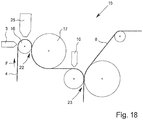
- the carrier layer is fed to a first roller or first roller arrangement and / or that the layer structure is pressed at least from the functional layer, the adhesive layer and the carrier layer.
- the compression can be made possible in a roller gap which can be formed by the interaction of the first roller and a second roller.
- Pressing the further carrier layer and the further adhesive layer with the - as yet unpressed - layer structure of at least the functional layer, the adhesive layer and the carrier layer can be carried out together with the pressing process of the aforementioned layer structure.
- a further pressing process takes place in which the further adhesive layer and the further carrier layer are pressed with the already pressed layer structure of at least the functional layer, the adhesive layer and the carrier layer.
- This further pressing process can be made possible in a further roller gap of a further roller arrangement.
- the pressed composite of at least the carrier layer, the adhesive layer and the functional layer is cooled.
- a cooling process is provided following the pressing, in particular following the pressing process and / or the further pressing process.
- a corona pretreatment of the surface of the carrier layer and / or further carrier layer can take place.
- the corona pretreatment of the carrier layer takes place before the extrusion of the functional layer and / or upstream of the application of the adhesive layer in the conveying direction.
- the corona pretreatment of the further carrier layer can in particular take place before the application of the further adhesive layer.
- the corona pretreatment enables better composite adhesion of the carrier layer to the adhesive layer and / or of the further carrier layer to the further adhesive layer and thus better composite adhesion of the individual layers of the entire composite film.
- the corona pretreatment enables improved adhesion of the adhesive layers.
- the surface to be treated is exposed to an electrical corona discharge for a short time. This creates polar molecules on the surface to which the adhesives, for example, can attach.
- the nozzle arrangement in particular designed as a slot nozzle, rests on the carrier layer and / or is at least substantially in contact with the carrier layer, so that an "adhesive tear” is caused, in particular whereby a “torn open “Adhesive applied.
- the functional layer is particularly preferably made for the functional layer to be built up in multiple layers.
- the composite film according to the invention is thus preferably obtained in such a way that the functional layer is extruded onto the carrier layer, in particular by coextrusion.
- the multi-layer functional layer preferably has at least two layers and / or three layers. The individual layers can be produced by extrusion.
- the layers of the functional layer particularly preferably contain a thermoplastic polyurethane.
- a multilayer extrusion of the functional layer can preferably take place, wherein, for example, a layer structure in the form of the layers ABA or ABB can take place.
- the layers A and / or B are at least essentially each designed to be structurally identical.
- At least one layer of the functional layer particularly preferably contains an adhesion promoter for improved composite adhesion of the layers of the functional layer.
- the layers of the functional layer or the layers of the functional layer differ with regard to the thermoplastic polyurethane used.
- the present invention also relates to a flat composite film that is permeable to water vapor.
- the composite film can in particular have been produced by a method of the aforementioned type.
- the composite film has a carrier layer, an adhesive layer applied to the carrier layer and a, preferably monolithic, functional layer.
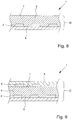
- the adhesive layer has a plurality of longitudinal strips running in the longitudinal direction of the composite film, adjacent longitudinal strips being spaced from one another. The distance between adjacent strips should be between 1 mm and 20 mm, each discrete individual value in the aforementioned interval being possible.
- the adhesive layer is only arranged in regions on the surface of the carrier layer, so that in the overall structure of the composite film - seen in cross section - there are regions in which at least essentially no adhesive layer or no adhesive is arranged.
- the composite film according to the invention is distinguished in particular by the fact that a significantly improved water vapor permeability can be made possible compared to the prior art.
- the sd value for composite films known from the prior art can be improved by up to 60% with a simultaneous very good bond between the layers of the composite film.
- a composite film with a high long-term resistance and very good UV stability in particular when used in outdoor weathering, which is also characterized by a high resistance to the penetration of water.
- the composite film according to the invention enables, for example, the production of composite building films, in particular facade membranes, sub-roof membranes and sub-roof membranes, which are mechanically resistant, stable to hydrolysis and resistant to chemicals.
- At least one longitudinal strip of the adhesive layer is preferably designed parallel to a longitudinal edge of the carrier layer and / or as a wave-shaped and / or as an uninterrupted or segment-like strip.
- the adhesive layer can ultimately be strip-shaped, point-shaped and / or grid-shaped. As a result, however, there are always stripes that run in the longitudinal direction of the web or the carrier layer.
- the adhesive layer is applied in regions to the surface of the carrier layer, in particular the carrier fleece.
- the adhesive layer it is also possible for the adhesive layer to be applied only to the longitudinal edges and / or to at least one longitudinal edge of the carrier layer. Thus, a larger free space - which is free of adhesive - can be guaranteed on the carrier layer.
- areas of the carrier layer - in particular in the cross section of the film - can be provided with an area-wise application of the adhesive layer and further areas that are completely free of the adhesive layer.
- the composite film has an sd value of less than or equal to 0.15 m, preferably less than or equal to 0.1 m, more preferably less than or equal to 0.09 m.
- an sd value in the aforementioned ranges enables the composite film to have very good water vapor permeability, which is particularly advantageous when used as a composite structural film or when used in the construction industry.
- the aforementioned sd value is ultimately determined by the width of the longitudinal strips, which is preferably between 1 mm and 50 mm and the defined distance between adjacent longitudinal strips, which is preferably between 1 mm and 20 mm, is achieved.
- Construction foils which are permeable to water vapor are used, for example, in the roof area, the water vapor permeability enabling water vapor to escape from the interior of a building via the construction film. At the same time, however, protection from rain can be made possible by the waterproof design of the composite film.
- a non-reactive and / or a reactive, in particular hotmelt, adhesive and / or a thermoplastic adhesive and / or a PUR adhesive can be provided as the adhesive for the adhesive layer.
- a reactive adhesive can react with atmospheric moisture or when heated to temperatures well above the processing temperature to form a crosslinked polymer.
- a non-reactive adhesive it is provided in particular that it dries out before bonding.
- the composite film has a further carrier layer.
- the further carrier layer can be arranged on the side of the in particular multi-layer functional layer facing away from the carrier layer.
- the carrier layer can also be designed as a carrier fleece.
- the further carrier layer can be connected to the carrier layer by means of a further adhesive layer.
- the further adhesive layer has a plurality of longitudinal strips which run in the longitudinal direction of the carrier layer and are spaced apart from one another.
- the longitudinal strips of the further adhesive layer can at least essentially correspond to the aforementioned configurations of the longitudinal strips of the adhesive layer. To avoid unnecessary repetitions, reference may be made to the previous statements.
- the further carrier layer it is also possible for the further carrier layer to be firmly connected to the functional layer without a further adhesive layer.
- the longitudinal strips of the adhesive layer and the longitudinal strips of the further adhesive layer overlap at least partially or completely.
- an overlap of the strips of the adhesive layer and the further adhesive layer can be seen in relation to the overall structure of the composite film.
- the, preferably multilayer, functional layer can be arranged between the adhesive layer and the further adhesive layer.
- the arrangement of the adhesive layer and the further adhesive layer is designed in such a way that, viewed in the transverse direction, i.e. from the top of the composite film to its underside, free spaces or adhesive-free areas are formed that have neither the adhesive layer nor the further adhesive layer.
- Such a structure of the composite film enables in particular a very high water vapor permeability.
- the arrangement or configuration or the pattern of the adhesive layer and the further adhesive layer differ from one another.
- the functional layer preferably has at least two layers. It is very particularly preferred that the first layer and / or the second layer has and / or consists of a thermoplastic polyurethane.
- the water vapor permeability of the multi-layer functional layer that is to say the second layer of the composite and thus the composite film as a whole, can be adjusted in a targeted manner by specifically coordinating the thermoplastic polyurethanes in the first and second layers.
- a concentration gradient for water in the membrane can be set which favors and promotes water vapor transport in one direction, so that preferably only water vapor is transported from a building to the environment and not vice versa.
- thermoplastic polyurethanes as the outer layer, ie as a layer which is exposed to the weather.
- the composite film according to the invention it is possible to produce only a thin cover layer from the particularly weatherproof and UV-resistant polyurethanes and to arrange a layer made of a significantly cheaper material underneath.
- thermoplastic polyurethanes with different degrees of hardness can also ensure that parts of the carrier material, in particular filament fibers, are prevented, especially when the multi-layer film is applied from the melt to the carrier material or the carrier layer, for example by coextrusion Fleeces that penetrate, damage or weaken the monolithic membrane.
- thermoplastic polyurethane with low hardness is arranged between a thermoplastic polyurethane with greater hardness and the carrier material (carrier layer).
- carrier layer the carrier material
- the softer layer of thermoplastic polyurethane acts as a connection or adhesive layer and enables an intimate connection between the individual materials.
- thermoplastic polyurethanes By specifically coordinating the thermoplastic polyurethanes used, it is also possible to produce cost-effective composite films which not only have a special mechanical resistance, but also have flame-retardant properties.
- the chemical resistance of the resulting composite film can also be specifically adjusted.
- a layer or a ply is to be understood as an almost two-dimensional planar structure.
- Such flat structures are usually designed in web form and thus have only two surfaces, that is to say the layer thickness of the respective layer, layer or web is negligible compared to the areal expansion.
- aromatic thermoplastic polyurethanes of the ether type, the polyester type and the polyester-ether type, also called the ester-ether type, have hitherto usually been used.
- thermoplastic polyurethane is to be understood as meaning a thermoplastic elastomer which is formed from polyurethane.
- thermoplastic elastomers are plastics that show elastomeric behavior at room temperature, but show thermoplastic behavior when heat is applied.
- a particular advantage of thermoplastic elastomers is that, compared to pure elastomers, they can be reversibly reshaped at any time due to the influence of heat.
- Thermoplastic polyurethanes are polyurethanes which have a hard segment and a soft segment, the soft segment usually being formed by an oligomeric or polymeric polyol and the hard segment being formed from a diisocyanate which has short-chain diols as chain extenders.
- short-chain bifunctional substances in particular diol, whose molecular weight is usually between 18 and 350 g / mol, are used as chain extenders.
- Short-chain diols are preferably used as chain extenders.
- the chain extenders are usually dihydric alcohols, in particular selected from the group of 1,2-ethanediol, 1,2-propanediol, 1,4-butanediol, 2,3-butanediol, 1,5-pentanediol, 1,6 -Hexanediol, 1,8-octanediol, diethylene glycol, triethylene glycol, tetraethylene glycol and higher oligoethylene glycols, dipropylene glycol and higher oligopropylene glycols, dibutylene glycol, higher oligoethylene glycols and mixtures thereof.
- an aliphatic or an aromatic polyurethane is to be understood as meaning a polyurethane whose hard segment contains aliphatic or aromatic diisocyanates or is obtained from them by reaction with the chain extenders.
- the aromatic diisocyanates are preferably TDI (toluene 2,4-diisocyanate), NDI (naphthylene-1,5-diisocyanate), MDI (methylene di (phenyl isocyanate), PDI (polymeric diphenylmethane diisocyanate) or mixtures thereof.
- Aliphatic diisocyanates are preferably selected from H12MDI (1-isocyanato-4 - [(4-isocyanotocyclohexyl) methyl] cyclohexane), HDI (1,6-hexamethylene diisocyanate), IPDI (3-isocyanatomethyl-3,5,5-trimethylcyclohexyl isocyanate), TMXDI (Tetramethylxylydiisocyanat) and CHDI (1,4-Cylcohexyldiisocyanat) and their mixtures.
- thermoplastic polyurethane of the ether type or an ether TPU is to be understood as meaning a thermoplastic polyurethane whose soft segment is made up of polyethers.
- polyethers are preferably made from polyether alcohols, in particular with the hydroxyl functionality 2, i.e. H. available from diols.
- the polyether alcohols are usually obtained by polymerization of short-chain precursors, in particular, for example, by anionic polymerization with alkali hydroxides, such as sodium or potassium hydroxide, or alkali alcoholates, such as sodium methylate, sodium or potassium ethylate or potassium isopropylate as catalysts, or by cationic polymerization with Lewis Acids, such as antimony pentachloride, boron fluid etherate, available as catalysts from one or more alkylene oxides or cyclic ethers with preferably 2 to 4 carbon atoms in the alkylene radical.
- alkali hydroxides such as sodium or potassium hydroxide
- alkali alcoholates such as sodium methylate, sodium or potassium ethylate or potassium isopropylate
- Lewis Acids such as antimony pentachloride, boron fluid etherate, available as catalysts from one or more alkylene oxides or cyclic ethers with preferably 2 to 4 carbon atoms in the alkylene radical.
- Particularly suitable compounds for the polymerization are, for example, tetrahydrofuran, 1,3-propylene oxide, 1,2- and 2,3-butylene oxide, 1,4-butylene oxide, ethylene oxide and 1,2-propylene oxide.
- the alkylene oxides can be used individually, alternately or as a mixture in the polymerization.
- thermoplastic ether-polyurethanes are subdivided, with C2-ether-polyurethanes, C3-ether-polyurethanes and C4-ether-polyurethanes being the most widespread.
- C2 ether polyurethanes can be obtained, for example, by polymerizing ethylene oxide, 1,2-propylene oxide, 1,2- and 2,3-butylene oxide.
- C3 ether polyurethanes can be obtained, for example, by polymerizing 1,3-propylene oxide.
- C4 ether polyurethanes can be obtained by polymerizing 1,4-butylene oxide.
- thermoplastic polyurethane of the polyester type or a polyester TPU is to be understood as meaning a thermoplastic polyurethane, the soft segment of which is formed from polyester polyols, in particular polyester diols.
- thermoplastic polyurethane of the ether-ester type or an ether-ester TPU is a polyurethane whose soft segment is formed from polyethers or oligoethers and polyesters.
- thermoplastic polyurethane of the carbonate type or a carbonate TPU is formed by a polyol, in particular diol, which has a structural element of a carbonic acid diester.
- thermoplastic polyurethanes which, when summarized, each have the following properties.
- Aromatic ester TPUs as well as aromatic ether-ester TPUs are sensitive to hydrolysis and have only moderate weathering properties. However, they have an inherent flame retardant effect and good mechanical properties, such as. B. low further tear resistance and high abrasion resistance.
- Aromatic C4 ether TPUs also have moderate weathering properties, but are not sensitive to hydrolysis and have inherently flame-retardant properties. Aromatic C4 ether TPUs are often found in roof underlays.
- Aromatic C2 and / or C3 ether TPUs are the cheapest thermoplastic polyurethanes. They are not sensitive to hydrolysis and are inherently flame retardant. However, the weathering properties are not satisfactory, so that building films for outdoor applications are usually not based on C2 or C3 ether TPUs.
- Aromatic carbonate TPUs have an excellent inherent flame-retardant effect and very good weathering stability and are also highly resistant to hydrolysis and hot storage. However, they are aromatic Carbonate TPUs are cost-intensive to manufacture, which is why they have only been used sporadically in special applications so far.
- aliphatic TPUs have excellent weather resistance and do not yellow when exposed to light. However, they do not have an inherently flame-retardant effect, have a high tendency to swell when water is absorbed and, moreover, are extremely cost-intensive. Due to these disadvantages, aliphatic TPUs are almost not used in the construction sector.
- thermoplastic polyurethanes In particular when using multilayer composite films which have at least two layers of thermoplastic polyurethanes, the material properties of the aforementioned thermoplastic polyurethanes can be supplemented in such a way that the advantages of the individual thermoplastic polyurethanes are retained and even complement each other, while disadvantages can be compensated for.
- the layers of the multilayer functional layer are often also characterized by the layer structures AB, ABC or ABA, in which case A usually contains the first layer containing a thermoplastic polyurethane and B the second layer containing a identifies thermoplastic polyurethane.
- the layer C is then usually a third layer, made of a thermoplastic polyurethane, the thermoplastic polyurethane of which is different from the layer B and either corresponds to the layer A, so that the layer sequence ABA results as a special case of the layer structure ABC, or a third thermoplastic polyurethane is so that a layer sequence ABC with three layers of different thermoplastic polyurethanes results.
- thermoplastic polyurethane is selected from aliphatic and aromatic polyurethanes of the ether type, the polyester type, the ether-polyester type and the carbonate type. Particularly good results are obtained in this connection when the thermoplastic polyurethane is selected from aromatic polyurethanes of the ether type, the polyester type, the ether-polyester type and the carbonate type.
- thermoplastic polyurethane is selected from aromatic polyurethanes of the ether type, the polyester type, the ether-polyester type and the carbonate type.
- waterproof but diffusion-open monolithic membranes can be provided, which have excellent weathering properties, are mechanically resistant and resistant to chemicals and have a flame-retardant effect and are inexpensive to access.
- the ether-type polyurethane is usually selected from C2 to C4 ether TPUs, in particular C2 and / or C3 ether TPUs or C4 ethers -TPUs.
- first and the second layer of the multi-layer functional layer in particular the first layer A and the second layer B, contain different thermoplastic polyurethanes.
- Different thermoplastic polyurethanes are to be understood as meaning that the layers have different polyurethane polymers and / or that the layers have different proportions of additives and fillers or different additives and fillers, so that the layers of the multilayer functional layer (film) differ in their chemical and / or different physical properties.
- the material properties of the resulting multi-layer functional layer in particular a monolithic functional layer based on thermoplastic polyurethanes, can be specifically adapted to the respective application properties.
- the material properties of the individual layer of the multilayer functional layer are set by selecting the thermoplastic polyurethanes and / or by adding additives.
- different material properties can also be obtained by adding different amounts of additives, for example fillers or stabilizers, to the same thermoplastic polyurethanes.
- the first and the second layer of the multi-layer functional layer consist of thermoplastic polyurethane.
- “consisting of a thermoplastic polyurethane” relates in particular solely to the polymer component of the respective layer of the multilayer functional layer, ie the individual layers of the multilayer functional layers can contain additives or fillers in addition to the thermoplastic polymer in the form of a thermoplastic polyurethane.
- thermoplastic polyurethanes in different layers of a multilayer functional layer - as already shown above - to tailor the properties of a multilayer functional layer based on thermoplastic polyurethanes to the respective application and, compared to thermoplastic functional layers, from individual ones to improve thermoplastic polyurethanes or other polymers significantly.
- polymer blends or copolymers which are complex to produce and which contain thermoplastic polyurethanes can be dispensed with in the context of the present invention, since the properties of the multilayer functional layer and thus the composite film as a whole can be specifically manipulated and adjusted.
- the multilayer functional layer is obtained by coextrusion, in particular by multilayer coextrusion.
- Coextrusion in particular multi-layer coextrusion or multi-layer coextrusion, achieves a particularly close bond between the individual layers of the multi-layer functional layer, which, for example, is free of air inclusions and cannot be delaminated without destroying the functional layer.
- the multi-layer functional layer on at least one surface of the carrier material or. the carrier layer is arranged.
- multi-layer film are used synonymously with multi-layer functional layer and carrier layer are used synonymously with carrier material.
- the composite film is waterproof and / or water vapor permeable, it being particularly preferred if the composite film is waterproof and water vapor permeable.
- the composite film is in particular both waterproof and permeable to water vapor, so that on the one hand liquid water, in particular rain or melting snow, is prevented from penetrating a building structure, but on the other hand moisture from the interior through the Diffuse composite film and can be released into the environment.
- the composite film is airtight.
- the composite film is used to produce an airtight layer in buildings, in particular, for example, in the production or renovation of roofs.
- the multilayer film has an air permeability according to DIN EN 12114 at a pressure difference of 50 Pa of less than 0.1 m 3 / (m 2 h), in particular 0.01 m 3 / (m 2 h) , preferably 0.005 m 3 / (m 2 h), preferably 0.001 m 3 / (m 2 h).
- Films with the aforementioned air permeability can be used to produce airtight layers in buildings, in particular in roof structures.
- the composite film is stable to hydrolysis.
- hydrolysis-stable with regard to a film is to be understood in the context of the present invention that the elongation at break of the film after storage for 12 weeks at 70 ° C. and 90% humidity is at least 80% of the initial value.
- the multilayer film has a water tightness according to DIN EN 20811: 1992 of more than 2,000 mm, in particular more than 10,000 mm, preferably more than 25,000 mm. It is likewise preferred in the context of the present invention if the multilayer film has a water tightness according to DIN EN 20811: 1992 of 2,000 to 25,000 mm, in particular 5,000 to 20,000 mm, preferably 10,000 to 15,000 mm.
- the multilayer film used in the context of the present invention thus has a high level of water tightness.
- the multilayer film has an Sd value according to DIN EN ISO 12572 of less than 0.15 m, in particular less than 0.1 m, preferably less than or equal to 0.09 m , having.
- the multilayer film preferably has a high level of water vapor permeability.
- At least one layer of the multilayer film is designed as a monolithic layer.
- both the first and the second layer of the multi-layer film in particular all layers which contain or consist of a thermoplastic polyurethane, are designed as monolithic layers.
- a multi-layer film in the form of a monolithic membrane which has a high level of water and air tightness, but is on the other hand permeable to water vapor.
- at least the layer of the multilayer film which is exposed to weathering should therefore be designed as a monolithic membrane.
- the entire multilayer film, i.e. H. all layers, designed as a monolithic membrane since this way an improved water transport through the membrane is achieved.
- the multilayer film has a weight per unit area of 10 to 150 g / m 2 , in particular 20 to 100 g / m 2 , preferably 30 to 80 g / m 2 .
- At least one layer in particular the layer of the multilayer film arranged closer to the carrier material, has a hardness of less than 90 Shore A, in particular less than 85 Shore A, preferably less than 80 Shore A.
- the layer which is preferably arranged closer to the carrier material, is in particular the previously described first layer or layer A of the multilayer film.
- this soft layer of the multilayer film preferably consists of an aromatic thermoplastic polyurethane of the ether type, in particular an aromatic C4 ether TPU, or an aromatic thermoplastic polyurethane of the ester type and / or ether ester -Type.
- the layer which is directly connected to the carrier material, it is achieved that a particularly intimate bond between the carrier material and the layer, in particular the first layer, preferably layer A, of the multilayer film is achieved, since fibers or filaments, for example of the carrier material are particularly well wetted and enclosed by this soft layer of the multilayer film.
- At least one layer in particular the layer of the multilayer film arranged further away from the carrier material, has a hardness greater than 80 Shore A, in particular greater than 85 Shore A, preferably greater than 90 Shore A.
- This layer is preferably the second layer, in particular layer B, of the multilayer film, which is either directly exposed to weathering or, for example, forms a further layer, in particular a middle layer in layer structures of the ABC or ABA type, of the multilayer film.
- the layer with a relatively high hardness protects the multilayer film from damage and also prevents, for example, fibers or filaments of the carrier material from penetrating the multilayer film and thus weakening or destroying the structure of the film as a whole.
- the material for the harder layer of the multilayer film is preferably an aromatic polyurethane of the carbonate type.
- the layer arranged closer to the carrier material, preferably the layer applied directly to the carrier material, of the multilayer film has a lower Shore A hardness than the layer of the multilayer film that is further away from the carrier material. In this way it can be prevented that when the multi-layer film is applied to the carrier material, in particular by coextrusion, the carrier material penetrates the multi-layer film.
- first and the second layer of the multilayer film are arranged directly on top of one another.
- first and the second layer of the multilayer film are preferably produced from the melt by coextrusion and form a composite material.
- thermoplastic polyurethane has at least one additive, in particular at least one stabilizer. If the thermoplastic polyurethane has an additive, in particular a stabilizer, the thermoplastic polyurethane contains the additive, in particular the stabilizer, in amounts of 0.05 to 10% by weight, preferably 0.5 to 8% by weight, in particular 1 to 6% by weight, based on the thermoplastic polyurethane.
- the additive in particular the stabilizer, is selected from UV absorbers, UV quenchers, radical scavengers and hydroperoxide decomposers.
- the resistance of the thermoplastic polyurethane, in particular of the thermoplastic polyurethane, which is increasingly exposed to weathering, to UV radiation is increased.
- the layer of the multilayer film provided as the outer layer in the application case has a higher proportion of additives, in particular of stabilizers, than the other layers of the multilayer film.
- the layer of the multilayer film provided as the outer layer has a higher proportion of additives, in particular stabilizers, since in particular the layer of the multilayer film provided as the outer layer is exposed to weathering and UV radiation and thus protects the entire composite against weathering.
- thermoplastic polyurethane of the layer of the multilayer film provided as the outer layer in the application case contains the additive, in particular the stabilizer, in amounts of 0.5 to 10% by weight, preferably 1 to 8% by weight. %, in particular 2 to 6% by weight, based on the thermoplastic polyurethane.
- thermoplastic polyurethane of a layer of the multilayer film that is not provided as the outer layer in the application case contains the additive, in particular the stabilizer, in amounts of 0.05 to 5% by weight, preferably 0.5 to 4% by weight. -%, in particular 1 to 3% by weight, based on the thermoplastic polyurethane.
- the layer of the carrier material is formed from a fleece, a woven fabric, a knitted fabric or a knitted fabric, in particular a fleece.
- a fleece is used and the fleece is a needle-jet or wet-jet bonded fleece, a polyolefin fleece, in particular a polyethylene fleece or a polypropylene fleece, a polyester fleece, in particular a polyethylene terephthalate fleece, a natural fiber fleece , a polyamide fleece, a bicomponent fleece or a PLA fleece, preferably a polyamide fleece.
- a PLA fleece is understood to mean a fleece based on polylactide.
- the carrier layer can in particular be designed as an inner protective layer and / or the further carrier layer as an outer protective layer, or vice versa.
- At least two first layers are provided in the form of a carrier material.
- the two further first layers can be designed as an outer protective layer and an inner protective layer.
- the outer protective layer and the inner protective layer are preferably designed as a nonwoven layer comprising a polyolefin.
- the outer protective layer and / or the inner protective layer have at least one bicomponent fiber with a first component and a second component, the first component comprising a first polymer and the second component comprising a second polymer as a constituent.
- the outer protective layer and the inner protective layer are formed as a nonwoven layer comprising polyethylene terephthalate (PET).
- PET polyethylene terephthalate
- the outer protective layer and / or the inner protective layer have at least one bicomponent fiber with a first component and a second component, the first component having a first polymer and the second component having a second polymer as a constituent.
- the outer protective layer is designed as a nonwoven layer comprising a polyolefin and the inner protective layer is designed as a nonwoven layer comprising polyester.
- the outer protective layer and / or the inner protective layer has at least one bicomponent fiber with a first component and a second component, the first component being a first polymer and the second component being a second Has polymer as a component.
- the outer protective layer can be understood to mean that protective layer which faces the weathering side - provided the composite film is used for protection from the weather. In principle, it is also conceivable that the composite film is not used for weather protection. In this case, the arrangement of the outer protective layer and the inner protective layer would be interchangeable. In particular, however, the inner protective layer faces the item to be protected, for example the interior of the building, the building material or the like.
- the overall strength of the composite film can be increased significantly, preferably by at least 10%, more preferably between 20% to 70%.
- the protective layer comprising the bicomponent fiber is opposite to nonwoven layers known from the prior art, in particular polypropylene or polyethylene nonwoven layers, advantageous in that it ensures increased mechanical strength.
- the protective layer comprising the bicomponent fiber can be made hydrophobic (water-repellent). Improved strength is found to be advantageous especially in the case of long-term and / or increased mechanical stress on the composite film. If, for example, the composite film is used as a roofing membrane, in particular a sarking membrane and / or a sarking membrane, then it is exposed to mechanical stresses not only during installation but also when the roof is walked on, for example by roofers.
- the bond to the second layer can preferably be improved, in particular by up to 15% compared to nonwoven layers known from the prior art.
- the outer protective layer and / or the inner protective layer can be embodied as a, preferably thermally bonded or needle-bonded or wet-jet bonded, nonwoven layer.
- a polyolefinic fleece can be provided as the fleece layer, in particular a fleece layer comprising and / or consisting of polypropylene is provided. It is very particularly preferred to design the outer protective layer and / or the inner protective layer as a polypropylene needle felt layer.
- the fleece layer in particular ensures the mechanical properties of the composite film and also ensures protection of the functional layer enclosed between the protective layers.
- the outer protective layer and / or the inner protective layer is particularly preferably designed as a spunbond layer.
- a spunbonded nonwoven or a spunbonded nonwoven layer has a nonwoven made of fibers with at least essentially unlimited length - that is, with long fibers.
- the fibers of the spunbonded layer provided in the outer and / or inner protective layer are preferably designed as bicomponent fibers.
- the spunbond layer made from continuous fibers can be made from bicomponent continuous fibers.
- the weight per unit area or the grammage of the outer protective layer and / or the inner protective layer can be less than or equal to 250 g / m 2 .
- the aforementioned weight per unit area is preferably between 1 g / m 2 to 250 g / m 2 , more preferably between 10 g / m 2 and 150 g / m 2 , preferably between 20 g / m 2 to 120 g / m 2 and in particular between 30 g / m 2 and 100 g / m 2 .
- the grammage of the protective layers is selected in such a way that with the lowest possible total weight per unit area of the composite film, the required properties of the composite film, in particular the elasticity, stability, tear resistance and / or tear strength, can still be adequately ensured, the composite film due to the external protective layers that can also be referred to as carrier layers, enables mechanical protection of the functional layer.
- the inner and outer protective layers can have a different grammage and / or a different weight per unit area, material composition and / or bicomponent fibers that differ from one another. As an alternative or in addition, it can be provided that the inner and outer protective layers are at least substantially identical and / or identical.
- the protective layers have the same surface properties, the same material and / or material composition and / or the same grammage.
- the outer and inner protective layers can have the same function, in particular the weight per unit area of the identical protective layers deviating from one another by less than 5 g / m 2 .
- a symmetrical structure of the layers of the composite film is preferably provided.
- outer protective layer and / or the inner protective layer can be designed as a mechanically, chemically and / or thermally, preferably thermally, consolidated nonwoven layer.
- a fleece layer is characterized in particular because of the low production costs with a high mechanical resistance to external influences.
- the inner protective layer and / or the outer protective layer has at least one bicomponent fiber or has a bicomponent fiber structure.
- the inner and / or outer protective layer designed as a fleece layer is designed as a fleece layer made of bicomponent fibers.
- a bicomponent fiber spunbond layer is provided.
- Bicomponent fibers of the type in question usually have a first component made from a first polymer and a second component made from a second polymer.
- Bicomponent fibers in which the first component surrounds and thus encloses the second component in the cross section of the fiber are referred to as core-sheath fibers.
- Bicomponent fibers, in which both the first component and the second component form part of the fiber surface in the cross section of the fiber are referred to as side-by-side fibers.
- Fibers with structures in which several strands of one component are embedded in one strand of the other component, so that in cross-section an image that is pronounced of a plurality of islands formed from one component, are called island-in-the-sea fibers designated.
- Bicomponent fibers, in which a plurality of areas of the respective component are present in cross section and form the outer fiber surface, are referred to as segmented pie fibers, since the areas of the individual components regularly have a pie-like division in cross section.
- Bicomponent fibers in the context of the present application are also expressly to be understood as those fibers which have more than two components.
- the purpose of the bicomponent fibers is to improve the properties of the fibers or the properties of the spunbonded nonwovens made from the fibers.
- the properties of a spunbond fabric depend on a large number of influencing factors. Some of these influencing factors on the properties of a spunbond are properties of the fibers used, such as their strength.
- a widespread and at least fundamentally recognized theory is that the properties of the resulting bicomponent fiber are then a combination of the properties of the individual components of the bicomponent fiber in which the properties of the individual components complement each other to the extent that the advantages of the properties of both components are combined in the bicomponent fiber.
- a fiber that has both high strength and exhibits advantageous behavior when connecting the fibers to one another in the manufacture of the nonwoven, then it is advisable to combine a first component with high strength with a second component that has good connectivity , to combine.
- additives are often added to the polymers.
- the additives can be a wide variety of substances. These can be used, for example, for coloring, for thermal stabilization, for flame retardancy, for hydrophilization or for hydrophobization or for UV stabilization.
- the additives are regularly distributed evenly in the phase.
- the first polymer and the second polymer can be embodied at least essentially identically, in particular wherein the first component and the second component have additives and / or additive compositions and / or additive quantities that differ from one another.
- the first component preferably has an additive, the mass fraction of the additive in the second component being smaller than in the first component. According to the invention, the first component can thus have an additive for influencing or improving properties.
- the mass fraction of the additive of the first component in the second component is preferably at most 66.6%, more preferably at most 50% and in particular at most 33.3%.
- the additive is very particularly preferably not present in the second component.
- the mass fraction of the first component in the bicomponent fiber is preferably at most 50%, preferably 25%, particularly preferably 10%, very particularly preferably 5%.
- the bicomponent fiber is particularly preferably a core-sheath fiber, the first component forming the sheath.
- the advantage of concentrating the additives in the first component surrounding the second component is that it has been shown that the amount of The additive required in the second component can be lower than with the usual uniform distribution of the additive in the two components if the same or an improved effect of the additive is to be produced.
- Additive in this sense is understood to mean additives which are added to the polymer in the respective component in order to modify and thereby improve the properties of the resulting fiber or of the spunbonded nonwoven obtained from the fiber.
- the additives which are added to the polymers in low concentrations, generally represent a contamination of the polymer with regard to the fiber production. In the case of contamination there is always the risk that the behavior of the components during the production of the fiber will change due to this contamination. Therefore, from the point of view of the person skilled in the art, an uneven distribution of the additives in the components of the bicomponent fiber initially entails the risk that the quality of the bicomponent fiber or the stability of the manufacturing process will deteriorate. In addition, from the point of view of the person skilled in the art, it is usually not important that an additive is concentrated in a specific zone of the fiber. This is due to the small thickness of the fibers in question.
- the difference between the melting points of the first component and the second component is advantageously less than or equal to 8 ° C. It should be pointed out that the specified intervals contain any individual intervals or individual values and are to be regarded as disclosed as being essential to the invention, even if they are not mentioned in detail.
- the positive effects of the present invention also include the fact that the proportion of recycled material that can be added to one of the components in the production of the bicomponent fiber is increased compared to conventional fibers. It has been shown that when using components with melting points combined according to the invention, the change in the properties of a component, which is caused by the addition of recycled material, is far less than with conventional fibers.
- the component with the lower melting point in the cross section of the fiber preferably forms the outer surface of the fiber.
- the component with the lower melting point surrounds the component with the higher melting point.
- the difference in the melting points of the first component and the second component is at most 6 ° C or between 1 ° C and 8 ° C, preferably between 1 ° C and 6 ° C. In these advantageous parameter ranges, the positive effects of the present invention are significantly more pronounced.
- the mass fraction of the component with the lower melting point in the bicomponent fiber is preferably at most 50%, more preferably at most 25%, preferably at most 10%, in particular at most 5%.
- the bicomponent fiber is particularly preferably a core-sheath fiber, the component with the lower melting point forming the sheath.
- the difference between the melt flow indices of the first component and the second component is advantageously less than or equal to 25 g / 10 min, with the melt flow indices (hereinafter MFI) of the first component and the second component each being less than or equal to 50 g / 10 min.
- MFI melt flow indices
- the difference between the melt flow indices of the first component and the second component is preferably less than or equal to 20 g / 10 min, particularly preferably 15 g / 10 min and / or the MFIs of the first component and the second component are each less than or equal 40 g / 10 min.
- the MFI is measured according to ISO 1133 with a test load of 2.16 kg and a test temperature of 230 ° C.
- the MFI is also referred to as the melt flow index or the melt mass flow rate (MFR).
- MFR melt mass flow rate
- the determination is carried out according to ISO 1133 by melting the material in a heatable cylinder and pressing it through a defined nozzle using the test load.
- the MFI is a measure of the viscosity of the melt of the respective polymer-containing component.
- the viscosity is related to the degree of polymerization, which corresponds to the average number of monomer units in each molecule of a polymer.
- the positive influence of the advantageous differences between the MFIs essentially affects the specific tear force and the specific nail pull-out force.
- These two characteristic values of a spunbonded nonwoven fabric produced from the fibers can be improved by the advantageously selected MFIs. In this case, it is even possible to increase both characteristic values at the same time, but in any case one of the two characteristic values can be improved without the other characteristic value deteriorating. This is also noticeable positively in the haptic properties. In this way the specific tear strength can be increased without the softness and the so-called "textile handle" being negatively affected.
- a textile handle is understood to mean a feeling of touch that is perceived as pleasant.
- the mass fraction of the component with the higher MFI in the bicomponent fiber is preferably at most 50%, more preferably at most 25%, preferably at most 10%, in particular at most 5%.
- the bicomponent fiber is particularly preferably a core-sheath fiber, the component with the higher MFI forming the sheath.
- the polymer of one of the two components has advantageously been polymerized with a metallocene catalyst and the polymer of the other component has been polymerized with a Ziegler-Natta catalyst and subjected to a subsequent visbreaking treatment.
- the polymer is preferably a polyolefin, in particular polypropylene, polyethylene or their copolymer or a mixture thereof.
- the other polymer is preferred also polyolefin or a polyolefin copolymer. It is particularly advantageous if both polymers are built up from the same monomer or are at least predominantly built up from the same monomer.
- Metallocene catalysts are structurally uniform catalysts that contain transition metals coordinated by cyclopentadiene ligands. Such catalysts are detailed in U.S. 5,374,696 and the U.S. 5,064,802 described. Express reference is made to the relevant disclosure.
- the advantage of these catalysts is that the polymers produced with these catalysts have a narrow molecular weight distribution.
- the narrow molecular weight distribution leads to nonwovens with high elongation at break.
- the elongation at break is the elongation of the fibers that results at the maximum of the tensile force that is applied when a strip of fleece is torn. Above all, however, a narrow molecular weight distribution leads to an increase in process reliability in the manufacture of the spunbonded nonwovens.
- the frequency of spinning disorders is reduced. Furthermore, a higher drawing of the fibers is possible, higher spinning speeds can be achieved and the titers that can be achieved are lower. Lower titers mean higher fineness of the fibers and / or of the yarns obtained from the fibers.
- metallocene catalysts or the polymers produced by means of metallocene catalysts is that the residual content of the catalyst in the polymer is very low.
- the residual content of the catalyst in the polymer constitutes an impurity in the polymer and can lead to the properties of the polymer being changed in an undesirable manner. For example, discoloration can occur during processing of the polymer.
- metallocene catalysts are their price, which is slightly higher than that of the Ziegler-Natta catalysts. Furthermore, thermal consolidation of the fibers in the manufacture of nonwovens can be made more difficult when using metallocene catalysts. This can be the case when the possibilities opened up by the use of metallocene catalysts of increasing the crystallinity and strength of the individual fibers through their higher stretchability are used to a large extent.
- Ziegler-Natta catalysts are heterogeneous mixed catalysts, the organometallic compounds of main group elements and transition metal compounds contain. In particular, elements of the first to third main groups are used as main group elements.
- the transition metal compounds contain in particular metals of the titanium group. There are a large number of variants of these catalysts.
- the Ziegler-Natta catalysts are defined essentially by their differentiation from the metallocene catalysts.
- the Ziegler-Natta catalysts are more economical than the metallocene catalysts, but the polymers produced with the Ziegler-Natta catalysts have a significantly broader molecular weight distribution than polymers produced with metallocene catalysts.
- the polymers produced with Ziegler-Natta catalysts are therefore usually post-treated. This post-treatment is known as "visbreaking".
- visbreaking During the visbreaking treatment, polymer chains are split, which reduces the molecular weight of the individual molecules and increases the number of molecules. This also reduces the breadth of the molecular weight distribution.
- the cleavage of the polymer chains is brought about by heat, radiation, the addition of peroxide or similar measures. Examples of such visbreaking treatments are in the U.S. 4,282,076 and the U.S. 5,723,217 described.
- Such a visbreaking treatment cannot, however, achieve either the narrow molecular weight distribution of the polymers produced with metallocene catalysts or the good stretchability of the fibers obtained from these polymers.
- Polymers produced with Ziegler-Natta catalysts also have a higher content of impurities than polymers produced with metallocene catalysts. This is due, on the one hand, to the fact that the production of the polymer with a Ziegler-Natta catalyst requires a comparatively higher catalyst content, which results in a comparatively higher proportion of catalyst residues in the polymer and, on the other hand, of auxiliaries added during the visbreaking treatment making them an additional source of contaminants in the final polymer.
- the mass fraction of the component, the polymer of which has been polymerized with a metallocene catalyst, of the bicomponent fiber is preferably at most 50%, more preferably at most 25%, preferably at most 10%, in particular at most 5%.
- the bicomponent fiber is particularly preferably a core-sheath fiber, the component whose polymer has been polymerized with a metallocene catalyst forms the sheath.
- the first polymer and / or the second polymer is advantageously a polyolefin or a polyolefin copolymer, preferably a polymer and / or copolymer of ethylene, propylene, butylene, hexene or octene and / or a mixture and / or a Blend from it. It has been shown that these polymers are particularly suitable for producing the bicomponent fibers according to the invention from them.
- a copolymer is to be understood as a polymer which has been produced from at least two different types of monomers, the mass fraction of the monomer which is decisive for naming the copolymer being at least 50%.
- the first polymer and / or the second polymer can preferably be polyethylene terephthalate (PET) and / or a polyethylene terephthalate copolymer, in particular the first and / or the second polymer consists of PET and / or co-PET.
- PET polyethylene terephthalate
- a polyethylene terephthalate copolymer in particular the first and / or the second polymer consists of PET and / or co-PET.
- a material composition for the first and the second component of polypropylene and / or polyethylene and polyethylene terephthalate and / or polyethylene terephthalate copolymer is particularly preferred for the bicomponent fiber.
- Either the first or the second polymer can have and / or consist of polypropylene and / or polyethylene.
- the second or first polymer which does not contain PP and / or PE, has and / or consists of PET and / or Co-PET. If the first polymer consequently has PP and / or PET, then the second polymer has PET and / or Co-PET and vice versa.
- the bicomponent fiber is designed as a core-sheath fiber, the core comprising polyactide (PLA) as material and / or the sheath comprising polyethylene terephthalate and / or polyethylene terephthalate copolymer as material.
- PLA polyactide
- sheath comprising polyethylene terephthalate and / or polyethylene terephthalate copolymer as material.
- the required hydrolysis resistance can be ensured with such a structure of the bicomponent fiber.
- the bicomponent fiber is preferably a core-sheath fiber, the mass fraction of the core being 50% to 98%, preferably 60% to 95%, particularly preferably 70% to 95%, very particularly preferably 80% to 90%. It has been shown that the advantages of the bicomponent fiber according to the invention, if it is a core-sheath fiber, occur to a particular extent with these advantageous mass parts of the core.
- the bicomponent fiber is designed as a core-sheath fiber, the core having polyethylene furanoate (PEF) as material and / or the sheath as polyethylene terephthalate copolymer material, in particular at a melting point of 240 ° C +/- 10 ° C.
- polyethylene furanoate is made from at least essentially 100% renewable raw materials, so that a high level of ecological compatibility can be achieved.
- Polyethylene furanoate can have a melting point of 235 ° C +/- 10 ° C. Due to the high rigidity of polyethylene furanoate, in particular in comparison to PET, a nonwoven layer with particularly high tensile strength can be expected in the case of a protective layer having a bicomponent fiber of the aforementioned type.
- the inner protective layer preferably has a bicomponent fiber which has polyethylene terephthalate as the first polymer and polyethylene terephthalate copolymer and / or polyethylene and / or polypropylene as the second polymer.
- the mass ratio of the two components is in the range from 10:90 to 90:10, preferably in the range from 70:30 to 30:70, particularly preferably in the range from 60:40 to 40:60.
- the bicomponent fiber is a multilobal, in particular a tetralobal or trilobal fiber. Due to their cross-sectional geometry, these fibers offer a higher specific surface area than comparable fibers with circular cross-sections. In connection with these, the advantages of the fibers according to the invention can be used particularly efficiently, in particular when the different properties of the components that are to be optimized by the bicomponent fiber according to the invention are properties which relate to the surface of the fiber.
- the diameter of the bicomponent fiber is advantageously between 1 ⁇ m and 50 ⁇ m, preferably between 5 ⁇ m and 30 ⁇ m, particularly preferably between 8 ⁇ m and 20 ⁇ m. It has been shown that especially with fiber diameters that lie in these advantageous ranges, the combination of two components in a bicomponent fiber leads to a particular degree of synergy effects.
- the outer protective layer and / or the inner protective layer is designed as a spunbonded fabric with bicomponent fibers according to the invention.
- the spunbond can have the advantages and / or properties described below.
- a higher strength in particular a strength improved by up to 20%, can be achieved in comparison to a polypropylene spunbonded nonwoven. Furthermore, very good weather stability properties, in particular, improved UV and hydrolysis properties are provided.
- Two properties that play a special role in spunbonded fabrics are the specific tear strength of the spunbonded nonwoven and the specific nail pull-out force of the spunbonded nonwoven.
- a desirable high specific tear strength is achieved by fibers with high strength.
- good connectivity is understood to mean that when the fibers are connected during the production of a spunbond, the mobility of the fibers in the spunbond can be adjusted as precisely as possible.
- the targeted setting of the mobility of the fibers in the fleece which depends on the strength of the connection between the fibers, is the prerequisite for the production of a spunbonded fleece with high specific tear strength and at the same time high specific nail pull-out force.
- bicomponent fibers according to the invention are particularly suitable for enabling a high specific tear force and a high specific nail pull-out force of a spunbonded nonwoven, since the bicomponent fibers according to the invention can be optimized with regard to a combination of good connectivity and high strength.
- Such a nonwoven fabric produced from the fibers according to the invention is suitable for numerous applications, for example in medicine, in the hygiene sector, in the automotive industry, in the clothing sector, in home and technical textiles and especially in the construction sector and agriculture.
- the area of application of the nonwoven material overlaps with the area of application of the composite film.
- Possible applications also include the use in filters and membranes, battery separators and as a support fleece for laminates and as a carrier for coatings of all kinds.
- the specific tensile strength of the spunbonded web is advantageously at least 1.8 N / g ⁇ 5 cm in the machine direction and / or at least 1.3 N / g ⁇ 5 cm in the transverse direction, preferably 2.0 N / g ⁇ 5 cm in the machine direction and / or at least 1.5 N / g 5 cm in the transverse direction, preferably at least 2.2 N / g 5 cm in the machine direction and / or at least 2.0 N / g 5 cm in the transverse direction, particularly preferably at least 2.4 N / g x 5 cm in the machine direction and / or at least 1.9 N / g x 5 cm in the cross direction.
- the specific tear strength is measured according to EN 12311-1.
- the specific nail pull-out force of the spunbonded nonwoven is advantageously at least 1.0 N / g in the machine direction and / or at least 1.2 N / g in the transverse direction, preferably at least 1.4 N / g in the machine direction and / or at least 1.5 N / g in Cross direction, preferably at least 1.6 N / g in the machine direction and / or at least 1.8 N / g in the cross direction, particularly preferably at least 1.8 N / g in the machine direction and / or at least 2.1 N / g in the cross direction.
- the specific nail pull-out force is the maximum force that occurs when a fleece strip is torn when the fleece strip already has a given damage, namely a nail that has been pushed through the fleece.
- the specific nail pull-out force is measured according to EN 12310-1. It has been shown that the specified minimum values for the specific nail pull-out force of the spunbonded nonwoven can be aimed for without the specific tear strength of the spunbonded nonwoven dropping disproportionately if bicomponent fibers according to the invention are optimized accordingly with regard to their connectivity and strength. In particular, it is also possible to implement a combination of the specific, advantageous nail pull-out forces mentioned and the previously mentioned, advantageous specific minimum pull-out forces.
- spunbond which in terms of its mechanical properties for a Variety of applications is suitable.
- a spunbonded nonwoven can be used, for example, in the construction sector, where it is often necessary to fasten the spunbonded webs by nailing, stapling or screwing.
- the spunbonded fleece must not tear off or tear off when it is attached to a roof, for example.
- geotextiles In any case, geotextiles must have a high tolerance for punctual damage, as can be caused, for example, by sharp stones.
- thermoplastic hotmelt and / or a reactive polyurethane hotmelt can be provided as the adhesive for the adhesive layer and / or the further adhesive layer.
- the present invention relates to a device for producing a water-vapor-permeable flat composite film.
- the device for performing the method according to the invention is designed according to one of the aforementioned embodiments.
- the device has a first roller and a second roller.
- the device comprises a nozzle arrangement for applying an adhesive, in particular for applying the adhesive layer.
- the nozzle arrangement has a plurality of nozzle openings, in particular transversely to the conveying direction, arranged and spaced from one another in such a way that the adhesive can be applied in the form of a plurality of longitudinal strips running in the conveying direction.
- the nozzle openings are spaced from one another in such a way that there is a distance of between 1 mm and 20 mm between adjacent longitudinal strips.
- the conveying direction also corresponds to the longitudinal direction of the carrier layer of the composite film.
- An arrangement transverse to the conveying direction is to be understood in particular as such that the nozzle arrangement can be arranged at least substantially transversely to the conveying device - that is to say in particular at an angle of 90 ° ⁇ 30 °.
- the nozzle openings can be arranged in such a way that they are arranged transversely to the main extension of the composite film or the carrier layer.
- the majority of the spaced apart nozzle openings succeeds in ultimately producing the strip-like formation of the adhesive layer in one process step, in particular with the strip-like alignment occurring in the main extent of the composite film or in the conveying direction. It is thus possible, in a very simple manner in terms of construction, to provide a composite film which has improved water vapor permeability compared to composite films known from the prior art.
- the nozzle arrangement has at least one slot nozzle which is oriented or arranged transversely to the conveying direction and has a plurality of nozzle openings which are spaced apart from one another.
- the slot nozzle is designed in such a way that a thin adhesive layer with longitudinal stripes can be applied to the web-shaped carrier layer. The slot nozzle not only works reliably, it is also easy to operate.
- the slot nozzle can also ensure that the adhesive layer is free of bubbles.
- the slot nozzle can in particular be designed such that the working width corresponds at least substantially to the width of the carrier layer. Furthermore, it can be provided that the width of the slot nozzle is smaller than the width of the carrier layer, which is particularly the case with a wide slot nozzle moving back and forth is advantageous. It can thus be ensured that the adhesive is only applied to the surface of the carrier layer, so that there is no loss of adhesive during production.
- the slot nozzle can have closed and open comb-like segments which are arranged in the interior of the nozzle.
- the open segments have the nozzle openings of the nozzle arrangement and / or form these.
- the open segments can allow the adhesive to exit, the closed segments of the slot nozzle ensuring the spacing of the longitudinal strips of the adhesive layer.
- An open segment of the slot die is preferably provided immediately adjacent to at least one closed segment.
- An alternating arrangement of the open and closed segments is also preferably provided.
- Several or all of the segments can also be part of a one-piece strip that can be inserted into the slot die and mounted therein.
- the advantage of such a slot nozzle is that a separate insert can be provided for slot nozzles known and also used in the prior art, which insert has the open and closed comb-like segments and thus enables the adhesive layer to be formed in strips on the carrier layer.
- separating means designed as a comb, in particular wherein the separating means can be inserted into the slot die.
- a slot nozzle can be "converted" into a slot nozzle according to the invention in a comparatively simple manner.
- the nozzle arrangement may have a plurality of separate individual nozzles arranged next to one another and spaced apart from one another.
- the design of the individual nozzles is in particular an alternative according to the invention to the slot nozzle having the comb-like segments.
- the individual nozzles that are spaced apart from one another can also reliably ensure that the adhesive is applied in the conveying direction or in the longitudinal direction of the carrier layer.
- the individual nozzles can also be connected to one another, so that they can in particular also be moved back and forth together.
- the first and the second roller form a roller gap for pressing the layer structure of the composite film.
- the roller gap is provided for pressing the layer structure made up of at least the functional layer, the carrier layer and the adhesive layer.
- the layers or the layers of the layer structure can be firmly connected to one another in the roller gap.
- a further nozzle arrangement for applying a further adhesive.
- the further nozzle arrangement has a plurality of nozzle openings, preferably arranged transversely to the conveying direction, and spaced apart from one another, so that the further adhesive can be applied in the form of a plurality of longitudinal strips running in the conveying direction.
- the further nozzle arrangement makes it possible according to the invention to provide the functional layer on both sides with at least one carrier layer, so that the functional layer of the composite film is protected on both sides, in particular from mechanical stresses.
- the inventive design of the further nozzle arrangement is advantageous in that the further adhesive layer formed by the further adhesive is also not formed over the entire surface of the carrier layer and thus ensures the low sd value or the high water vapor permeability.
- the further nozzle arrangement is preferably arranged downstream of the nozzle arrangement in the conveying direction - that is to say in the end it is provided behind the nozzle arrangement in the conveying direction.
- the further nozzle arrangement is connected upstream of the roller gap and / or a further roller gap - that is to say is arranged in front of the roller gap and / or the further roller gap in the conveying direction.
- An arrangement of the further nozzle arrangement in front of the roller gap proves to be advantageous if, in the roller gap formed by the first and second roller, not only the layer composite of at least the functional layer, the adhesive layer and the carrier layer is to be pressed, but also the other The carrier layer and the further adhesive layer with the aforementioned layer structure are to be pressed in one process step.
- a further roller gap which is formed by further rollers, is provided for pressing the layer structure of at least the functional layer, the carrier layer and the adhesive layer with the further adhesive layer and the further carrier layer.
- the already pressed layer structure comprising at least the functional layer, the carrier layer and the adhesive layer can be pressed with the further adhesive layer and the further carrier layer.
- an adjusting device is provided for the nozzle arrangement and / or the further nozzle arrangement, the adjusting device being designed such that it adjusts the nozzle arrangement and / or the further nozzle arrangement transversely to the conveying direction for reciprocating movement can.
- the actuating device can in particular enable an oscillating movement of the nozzle arrangement and / or the further nozzle arrangement to take place.
- the actuating device then has a device which enables the nozzle arrangement and, if necessary, also the further nozzle arrangement to oscillate or traverse at a predetermined frequency.
- At least one corona pretreatment device is preferably provided, which serves for the corona pretreatment of the surface of the carrier layer and / or the further carrier layer of the composite film.
- the corona pretreatment device can be connected upstream of the nozzle arrangement and / or further nozzle arrangement.
- the device preferably has an extrusion device, in particular having at least one extruder nozzle, for extrusion and / or coextrusion of the functional layer.
- the extrusion device can be arranged in such a way that it can apply the functional layer to the carrier layer provided with the adhesive.
- the extrusion device can be connected upstream of the roller gap in the conveying direction and / or connected downstream of the nozzle arrangement in the conveying direction.
- the extrusion device can be designed for multi-layer application or extrusion (i.e. coextrusion) of the functional layer.
- intervals and range limits contain any intermediate intervals and individual values and are to be regarded as disclosed as being essential to the invention, even if these intermediate intervals and individual values are not specifically specified.
- Fig. 1 schematically shows individual steps of the method for producing a water-vapor-permeable flat composite film 1.
- step A a carrier layer 4 is first supplied, which is coated in process step B by means of an adhesive layer 2.
- the adhesive layer 2 is applied to the carrier layer 4 by means of a nozzle arrangement 3.
- step C an, in particular monolithic, functional layer 5 is extruded onto the carrier layer 4 provided with the adhesive layer 2.
- the functional layer 5 is extruded onto the carrier layer 4 and / or onto a second roller 17 and / or into a roller gap 22.
- step C the application of the adhesive layer 2 is provided in such a way that the adhesive layer 2 is applied by the nozzle arrangement 3 by means of a plurality of spaced apart longitudinal strips 6 running in the longitudinal direction L of the carrier layer 4.
- the longitudinal strips 6 of the adhesive layer 2 running in the longitudinal direction L are shown, inter alia, in FIG Fig. 4 shown.
- An application of the adhesive layer 2 through the nozzle arrangement 3 is also, for example, in the Figures 12 and 13 shown.
- the nozzle arrangement 3 can be designed as a slot nozzle 19. What is not shown is that the slot nozzle 19 rests on the carrier layer 4 and / or at least essentially directly adjoins it and this results in an "adhesive tear".
- the in Fig. 2 The schematic process sequence shown also provides for the arrangement of a further carrier layer 8.
- the further carrier layer 8 is in Fig. 9 shown.
- Fig. 9 further shows that the further carrier layer 8 is applied to the side 7 of the functional layer 5 facing away from the carrier layer 4.
- the further carrier layer 8 and the functional layer 5 are connected to one another via a further adhesive layer 9.
- Fig. 2 Process steps A to C shown correspond to process steps A to C of FIG Fig. 1 .
- a further adhesive layer 9 is applied to the functional layer 5 by means of a further nozzle arrangement 10 through longitudinal strips 6 running in the longitudinal direction L of the carrier layer 4 or in the conveying direction F.
- the longitudinal strips 6 are spaced apart from one another, so that directly adjacent longitudinal strips 6 have or include a distance 11 from one another.
- the further adhesive layer 9 can also be applied to the further carrier layer 8, in particular on the side of the further carrier layer 8 facing the functional layer 5.
- the further carrier layer 8 is arranged on the functional layer 5 provided with the further adhesive layer 9, the layer composite or layer structure 12 comprising at least the functional layer 5, the carrier layer 4 and the adhesive layer 2 as well as the further adhesive layer 9 and the further carrier layer 8 are pressed in process step F.
- the layer structure 12 made up of at least the adhesive layer 2, the functional layer 5 and the carrier layer 4 is pressed, with method steps D to F being provided below.
- FIGS 12 and 13 show by the movement arrow in the transverse direction Q schematically that the nozzle arrangement 3 is moved back and forth transversely to the longitudinal direction L or in the conveying direction F during the application of the longitudinal strips 6 of the adhesive layer 2. Moving the nozzle arrangement 3 back and forth results, for example, in an embodiment of the longitudinal strips 6, which are schematically composed of the Figures 5 to 7 can be seen.
- the longitudinal strips 6 of the embodiments of Figures 5 to 7 are ultimately produced by different frequencies when traversing or when moving the nozzle arrangement 3 back and forth.
- the further nozzle arrangement 10 can also move back and forth during the application of the further adhesive layer 9, whereby an application of the further adhesive layer 9 is also obtained in an at least essentially undulating course. This is for example in Fig. 20 shown.
- the adhesive layer 2 can be foamed by adding a blowing agent, in particular carbon dioxide.
- foaming of the adhesive is provided after application, whereby pores are formed in the adhesive layer 2 and / or the further adhesive layer 9.
- FIG. 11 and 20th show schematically that the longitudinal strips 6 of the adhesive layer 2 and the longitudinal strips 6 of the further adhesive layer 9 are applied in such a way that they overlap completely or at least in regions after the composite film has been produced.
- a region-wise overlapping of the longitudinal strips 6 of the adhesive layer 2 and the further adhesive layer 9 is illustrated in FIG Fig. 11 shown cross-section. Due to the aforementioned arrangement of the adhesive layer 2 and the further adhesive layer 9 are in the direction of the The upper side of the web and the underside of the web are free spaces in the composite film 1 that have neither the adhesive layer 2 nor the further adhesive layer 9.
- the further adhesive layer 9 can be applied with a different frequency of the further nozzle arrangement 10 when moving to and fro compared to the frequency of moving the nozzle arrangement 3 to and fro. Ultimately, different wave shapes of the longitudinal strips 6 can be generated in this way.
- Fig. 7 shows schematically that the longitudinal strips 6 of the adhesive layer 2 can only be applied to the carrier layer 4 in regions, for example in the longitudinal edge regions.
- Fig. 16 shows schematically that the carrier layer 4 is fed to a first roller 16.
- the adhesive layer 2 can be applied to the carrier layer 4 through the nozzle arrangement 3.
- the functional layer 5 is then extruded or coextruded.
- the functional layer 5 can be extruded in such a way that a multilayered layer structure of the functional layer 5 is produced.
- the in Fig. 16 The illustrated process sequence of the layer structure 12 from at least the functional layer 5, the adhesive layer 2 and the carrier layer 4 is pressed.
- the pressing is provided in a roller gap 22 which is formed by the interaction of the first roller 16 with a second roller 17.
- steps A 'to C' ultimately correspond to method steps A to C of the in Fig. 1 correspond to the process sequence shown.
- the layer structure 12 is pressed in process step D ′.
- cooling of the pressed composite or of the pressed layer structure 12 is provided in method step E ′.
- a corona pretreatment of the surface of the carrier layer 4 and / or of the further carrier layer 8 takes place.
- the corona pretreatment of the carrier layer 4 takes place in particular in the conveying direction F before the application of the adhesive layer 2.
- a corona pretreatment of the further carrier layer 8 can take place before the application of the further adhesive layer 9.
- the Figs. 8-11 show a two-dimensional composite film 1 which is permeable to water vapor.
- the composite film 1 can be produced by a method of the aforementioned type.
- the composite film 1 has a carrier layer 4, an adhesive layer 2 applied to the carrier layer 4 and a, preferably monolithic, functional layer 5.
- the adhesive layer 2 has a plurality of longitudinal strips 6 running in the longitudinal direction L of the composite film 1, immediately adjacent longitudinal strips 6 being spaced apart from one another.
- the longitudinal strips 6 of the composite film 1 are, for example, from the Fig. 19 and 20th evident.
- Fig. 4 shows that directly adjacent longitudinal strips 6 have a distance 11 of 1 mm to 20 mm.
- the strip width 26 can be between 1 mm and 50 mm.
- the distance 11 and / or the strip width 26 of the longitudinal strips 6 of the adhesive layer 2 and / or a further adhesive layer 9 is at least essentially the same and / or deviates from one another by a maximum of ⁇ 5%.
- Fig. 4 shows schematically that at least one longitudinal strip 6 of the adhesive layer 2, in the illustrated exemplary embodiment all of the longitudinal strips 6 of the adhesive layer 2, run parallel to a longitudinal edge 14 of the carrier layer 4.
- a wave-shaped course of the longitudinal strips 6 of the adhesive layer 2 is provided, the main direction of extent of the waves also being parallel to the longitudinal edge 14.
- the longitudinal strips 6 of the adhesive layer 2 can be designed as segment-like or interrupted strips. Ultimately, the longitudinal strips 6 of the adhesive layer 2 can have a point-like and / or grid-like design or have been applied.
- the interrupted longitudinal strips 6 can be obtained by deliberately tearing off at the nozzle gap and / or through the nozzle arrangement 3.
- the longitudinal strips 6 are designed as at least substantially uninterrupted strips.
- the uninterrupted strip or longitudinal strip 6 is produced by continuous operation of the nozzle arrangement 3 with continuous application of the adhesive layer 2 or the individual longitudinal strips 6.
- the composite film 1 shown is provided that it has an sd value of less than or equal to 0.1 m. In further embodiments, the sd value can vary in particular between 0.15 m to 0.01 m.
- a non-reactive and / or reactive and / or a thermoplastic adhesive in particular PUR
- the adhesive can be foamed, as a result of which a foam structure (i.e. having pores) of the adhesive layer 2 can be present.
- a further adhesive layer 9 is provided in the layer structure 12 of the composite film 1.
- the further adhesive layer 9 can, as in FIG Fig. 20 also have a plurality of longitudinal strips 6 running in the longitudinal direction L of the composite film 1.
- the longitudinal strips 6 of the further adhesive layer 9 can be designed in accordance with the aforementioned possible embodiments of the longitudinal strips 6 of the adhesive layer 2.
- Fig. 20 shows that the longitudinal strips 6 of the adhesive layer 2 are arranged so as to overlap with the longitudinal strips 6 of the further adhesive layer 9 at least in regions. What is not shown is that the longitudinal strips 6 of the adhesive layer 2 can also be arranged so as to completely overlap with the longitudinal strips 6 of the further adhesive layer 9.
- the functional layer 5 can be arranged between the adhesive layers 2, 9, as shown in FIGS Fig. 9 and 11 evident.
- the functional layer 5 can also be formed in multiple layers, as in FIG Figures 10 and 11 shown.
- the layers of the functional layer 5 can also be different, whereby, for example, a layer structure of the layers ABA or ABB can be produced.
- the multi-layer functional layer 5 can be applied by coextrusion.
- Thermoplastic polyurethane can be provided as the material for the functional layer 5.
- the various material compositions of the functional layer 5 have already been discussed in detail at the beginning. In this context, reference may be made to the previous statements.
- Fig. 16 shows a device 15 for producing a water-vapor-permeable flat composite film 1.
- the device 15 is provided for carrying out a method according to one of the aforementioned embodiment.
- the device 15 has a first roller 16 and a second roller 17 as well as a nozzle arrangement 3.
- the nozzle arrangement 3 is provided for applying an adhesive.
- the Figures 12 and 13 show schematically that the nozzle arrangement 3 has a plurality of nozzle openings 18. Adjacent nozzle openings 18 are spaced from one another and are arranged transversely to the conveying or production direction in such a way that the adhesive can be applied in the form of a plurality of longitudinal strips 6 running in the conveying direction F. The application of the adhesive in longitudinal strips 6 is also shown schematically in FIG Figures 12 and 13 shown.
- the conveying direction F can ultimately run in the longitudinal direction L of the carrier layer 4.
- the nozzle arrangement 3 has at least one slot nozzle 19.
- the slot nozzle 19 is arranged transversely to the conveying direction F.
- Fig. 15 shows schematically that the slot nozzle 19 has open and closed comb-like segments 20.
- the open segments 20 form the nozzle openings 18 from which the adhesive emerges from the nozzle arrangement 3.
- the open segments 20 and the nozzle openings 18 are spaced apart from one another by closed, comb-like segments 20.
- the comb-like segments 20 can be formed by a separating means designed as a comb, which can be inserted into the slot nozzle 19.
- the separation means results in the distance 11 between the longitudinal strips 6 when the adhesive is applied.
- Fig. 13 shows schematically that the nozzle arrangement 3 has a plurality of separate individual nozzles 21 arranged next to one another and spaced from one another. Adhesive for forming the adhesive layer 2 can emerge from the respective individual nozzles 21.
- Fig. 16 shows that a roller gap 22 is formed between the first roller 16 and the second roller 17, in which the layer structure 12 composed of at least the functional layer 5, the carrier layer 4 and the adhesive layer 2 can be pressed.
- a further nozzle arrangement 10 is arranged behind the nozzle arrangement 3 in the conveying direction F.
- the further nozzle arrangement 10 can be arranged such that a further adhesive layer 9 can be applied to the functional layer 5.
- the further nozzle arrangement 10 is also provided for applying an adhesive.
- the further nozzle arrangement 10 can be designed in accordance with at least one of the aforementioned embodiments of the nozzle arrangement 3.
- the further nozzle arrangement 10 shown has a plurality of nozzle openings 18 which are spaced apart from one another, so that the adhesive can be applied in the form of a plurality of longitudinal strips 6 running in the conveying direction F.
- the further nozzle arrangement 10 can apply the adhesive to the further carrier layer 8.
- the further nozzle arrangement 10 can be arranged in such a way that it can apply the adhesive for forming the further adhesive layer 9 to the side 7 of the functional layer 5 facing away from the carrier layer 4 and / or to the further carrier layer 8.
- FIG. 17 and 18th show that the further nozzle arrangement 10 is arranged downstream of the nozzle arrangement 3 in the conveying direction, with FIG Fig. 17 it is provided that the further nozzle arrangement 10 is connected upstream of the roller gap 22 in the conveying direction F.
- the device 15 shown is provided that the further nozzle arrangement 10 is connected downstream of the roller gap 22 in the conveying direction F.
- the further nozzle arrangement 10 is in the in Fig. 18 Device 15 shown upstream of a further nip 23.
- the further roller gap 23 which is formed by the interaction of at least two rollers, a pressing of the layer structure 12 or the already pressed layer structure 12 from at least the functional layer 5, the adhesive layer 2 and the carrier layer 4 with the further carrier layer 8 and the further adhesive layer 9 take place.
- the further nozzle arrangement 10 can alternatively or additionally apply the adhesive to the further carrier layer 8.
- Fig. 14 shows schematically that an adjusting device 24 for the nozzle arrangement 3 and the further nozzle arrangement 10 is provided.
- the actuating device 24 can also be provided only for the nozzle arrangement 3 or further nozzle arrangement 10.
- the adjusting device 24 is designed such that it can adjust the nozzle arrangement 3 and / or the further nozzle arrangement 10 transversely to the conveying direction F for reciprocating movement at a predetermined frequency.
- the actuating device 24 can control the movement of the nozzle arrangement 3 and / or the further nozzle arrangement 10, as shown schematically in FIGS Figures 12 and 13 visible, control and / or regulate.
- the nozzle arrangement 3 and the further nozzle arrangement 10 can ultimately form two adhesive application stations.
- a corona pretreatment device can be provided.
- the corona pretreatment device can be arranged in such a way that it is connected upstream of the nozzle arrangement 3 and / or the further nozzle arrangement 10 in the conveying direction F, so that ultimately a pretreatment of the surface of the carrier layer 4 and / or the further carrier layer 8 before the arrangement of the adhesive layer 2 and / or the further adhesive layer 9 can take place.
- the extrusion device 25 can be designed in such a way that it can produce a coextrusion of the functional layer 5 - that is, a multilayer functional layer 5.
- a functional layer with approx. 30 g / m 2 TPU is embedded between two polypropylene nonwovens with a grammage of about 70 g / m 2 and 35 g / m 2 .
- An aromatic C4 ether TPU is intended as the thermoplastic polyurethane.
- the polypropylene nonwovens are subjected to a corona pretreatment.
- a functional layer comprising thermoplastic polyurethane is arranged between two polypropylene nonwovens. No adhesive is used to connect the functional layer and the polypropylene fleece.
- a functional layer with approx. 30 g / m 2 TPU is embedded between two polypropylene nonwovens (carrier layers), which have a grammage of about 70 g / m 2 and 35 g / m 2 , in an extrusion process.
- the intended thermoplastic polyurethane is aromatic C4 ether TPU. After extrusion, the layers are laminated together.
- the polypropylene nonwovens are subjected to a corona pretreatment in the process and then a melted adhesive (hotmelt adhesive) is applied by means of a slot nozzle.
- a melted adhesive hotmelt adhesive
- the adhesive layer is placed on the carrier layer (polypropylene fleece).
- the adhesive layer is not intended to be applied over the entire area.
- the surface of the carrier layer has free spaces which are adhesive-free. However, these free spaces are not controllable or undefined and are caused by the slot nozzle in the continuous process or with continuous application of the adhesive by "tearing open”.
- adhesive around 80% of the surface of the carrier layer is covered with adhesive.
- the functional layer is glued between two polypropylene fleeces due to the aforementioned structure.
- a functional layer with approx. 30 g / m 2 TPU is embedded on the polypropylene nonwoven in an extrusion process.
- a lamination of the layer structure of the composite film is provided.
- the polypropylene nonwovens are subjected to a corona pretreatment. After the corona pretreatment, a melted adhesive (hotmelt adhesive) is applied by means of a slot nozzle.
- a melted adhesive hotmelt adhesive
- the slot die has spaced apart openings, in particular in the form of comb-like closed and open segments, which are designed such that the adhesive layer is applied in longitudinal strips in the longitudinal direction of the carrier layer. Between the open, comb-like segments of the slot nozzle, which form the nozzle openings of the nozzle arrangement, there are closed, comb-like segments from which no adhesive emerges.
- a “tearing open” of the individual longitudinal strips can also be provided by the continuous operation of the application of the adhesive layer through the slot die.
- the adhesive layer is applied to the carrier layer and a further adhesive layer is applied to the further carrier layer.
- a further adhesive layer is applied to the further carrier layer.
- the TPU functional layer is therefore glued between two polypropylene nonwovens.
- the method according to the invention is used to produce the composite film thus obtained.
- the evaluation of the comparative examples gives the following: The composite films obtained according to Comparative Examples 1 and 2 and Example 3 (according to the invention) are analyzed with regard to different properties.
- the sd value which indicates the water vapor permeability, is measured in accordance with EN 12572 (as of February 2019).
- the bond between the individual layers is measured by peeling tests on the samples produced. Bond adhesion of the aged samples (336 h QUV and 70 days 70 ° C) is measured in accordance with EN 13859-1 (as of February 2019).
- the aged samples were exposed to the QUV tester, a tester for accelerated weathering, for approx. 336 h and for 70 days and also to a temperature of approx. 70 ° C.
- the application according to the invention of the adhesive layer or the further adhesive layer (Example 3) enables a lower sd value to be obtained. According to the invention, the sd value could therefore be reduced from 0.15 m to 0.09 m.
- Comparative example 1 has a very low sd value of 0.05 m, but the bond strength is to be assessed as inadequate and, after aging, no longer sufficient for permanent use of the composite film as a building composite film.
- good composite adhesion of the bonded functional layer can be achieved, while at the same time a low sd value can also be ensured.
Landscapes
- Laminated Bodies (AREA)
Applications Claiming Priority (1)
| Application Number | Priority Date | Filing Date | Title |
|---|---|---|---|
| DE102019001343.3A DE102019001343A1 (de) | 2019-02-26 | 2019-02-26 | Verfahren zur Herstellung einer wasserdampfdurchlässigen flächigen Verbundfolie |
Publications (3)
| Publication Number | Publication Date |
|---|---|
| EP3702156A2 true EP3702156A2 (fr) | 2020-09-02 |
| EP3702156A3 EP3702156A3 (fr) | 2020-12-02 |
| EP3702156B1 EP3702156B1 (fr) | 2022-09-14 |
Family
ID=69187681
Family Applications (1)
| Application Number | Title | Priority Date | Filing Date |
|---|---|---|---|
| EP20153164.7A Active EP3702156B1 (fr) | 2019-02-26 | 2020-01-22 | Procédé de fabrication d'une feuille composite plane perméable à la vapeur |
Country Status (3)
| Country | Link |
|---|---|
| EP (1) | EP3702156B1 (fr) |
| DE (1) | DE102019001343A1 (fr) |
| PL (1) | PL3702156T3 (fr) |
Citations (5)
| Publication number | Priority date | Publication date | Assignee | Title |
|---|---|---|---|---|
| US4282076A (en) | 1979-09-17 | 1981-08-04 | Hercules Incorporated | Method of visbreaking polypropylene |
| US5064802A (en) | 1989-09-14 | 1991-11-12 | The Dow Chemical Company | Metal complex compounds |
| US5374696A (en) | 1992-03-26 | 1994-12-20 | The Dow Chemical Company | Addition polymerization process using stabilized reduced metal catalysts |
| US5723217A (en) | 1993-05-25 | 1998-03-03 | Exxon Chemical Patents Inc. | Polyolefin fibers and their fabrics |
| EP3124242A1 (fr) | 2015-07-28 | 2017-02-01 | SML Maschinengesellschaft m.b.H. | Procédé et dispositif de fabrication d'une bande perméable à la vapeur d'eau |
Family Cites Families (6)
| Publication number | Priority date | Publication date | Assignee | Title |
|---|---|---|---|---|
| DE19636691A1 (de) * | 1996-09-10 | 1998-04-09 | Mildenberger & Willing Verpack | Mehrschichtige Folie und Verfahren zu ihrer Herstellung |
| US6395383B1 (en) * | 1999-12-13 | 2002-05-28 | Gore Enterprise Holdings, Inc. | Chemical protective covering |
| US20040157051A1 (en) * | 2003-02-11 | 2004-08-12 | Trent John S. | Sheet material and method of manufacture thereof |
| DE102006044754A1 (de) * | 2006-08-18 | 2008-02-21 | Ewald Dörken Ag | Bahn und Klebeband |
| SG11201606628SA (en) * | 2014-02-18 | 2016-09-29 | 3M Innovative Properties Co | Method and apparatus for forming articles with non-uniform coatings |
| DE102015009553A1 (de) * | 2015-07-28 | 2017-02-02 | Sml Maschinengesellschaft M.B.H. | Verfahren und Vorrichtung zur Herstellung einer wasserdampfdurchlässigen flächigen Bahn |
-
2019
- 2019-02-26 DE DE102019001343.3A patent/DE102019001343A1/de not_active Ceased
-
2020
- 2020-01-22 EP EP20153164.7A patent/EP3702156B1/fr active Active
- 2020-01-22 PL PL20153164.7T patent/PL3702156T3/pl unknown
Patent Citations (6)
| Publication number | Priority date | Publication date | Assignee | Title |
|---|---|---|---|---|
| US4282076A (en) | 1979-09-17 | 1981-08-04 | Hercules Incorporated | Method of visbreaking polypropylene |
| US5064802A (en) | 1989-09-14 | 1991-11-12 | The Dow Chemical Company | Metal complex compounds |
| US5374696A (en) | 1992-03-26 | 1994-12-20 | The Dow Chemical Company | Addition polymerization process using stabilized reduced metal catalysts |
| US5723217A (en) | 1993-05-25 | 1998-03-03 | Exxon Chemical Patents Inc. | Polyolefin fibers and their fabrics |
| EP3124242A1 (fr) | 2015-07-28 | 2017-02-01 | SML Maschinengesellschaft m.b.H. | Procédé et dispositif de fabrication d'une bande perméable à la vapeur d'eau |
| EP3124242B1 (fr) | 2015-07-28 | 2018-09-19 | SML Maschinengesellschaft m.b.H. | Procede et dispositif de fabrication d'une bande permeable a la vapeur d'eau |
Also Published As
| Publication number | Publication date |
|---|---|
| DE102019001343A1 (de) | 2020-08-27 |
| EP3702156A3 (fr) | 2020-12-02 |
| PL3702156T3 (pl) | 2023-01-16 |
| EP3702156B1 (fr) | 2022-09-14 |
Similar Documents
| Publication | Publication Date | Title |
|---|---|---|
| EP3676088B1 (fr) | Film composite | |
| EP3668710B1 (fr) | Feuille composite | |
| DE19642252C2 (de) | Diffusionsoffene Dachunterspannbahn und Verfahren zum Herstellen derselben | |
| EP2197952B1 (fr) | Mélange de polypropylènes | |
| EP2605908B1 (fr) | Matériau composite comportant un matériau de revêtement | |
| EP3710250A1 (fr) | Film composite de construction | |
| EP3860845B1 (fr) | Feuille composite | |
| EP2065534A1 (fr) | Matériau de construction comprenant un matériau multicouche avec une stabilisation durable contre les UV | |
| EP4225575B1 (fr) | Filet d'étanchéité résistant au vieillissement | |
| DE202008010258U1 (de) | Trägereinlage und beschichtete Dachbahnen | |
| DE202004007543U1 (de) | Abdichtungsbahn für Gebäude | |
| DE29805622U1 (de) | Diffusionsoffene und wasserdichte Dachunterspannbahn | |
| EP3728725B1 (fr) | Bande d'étancheité | |
| EP3999677B1 (fr) | Non-tissé de fibre à deux composants et feuille composite comprenant un non-tissé de fibre à deux composants | |
| EP0700779A2 (fr) | Bandes perméables pour la construction et procédé pour leurs fabrications | |
| EP3702156B1 (fr) | Procédé de fabrication d'une feuille composite plane perméable à la vapeur | |
| DE102020101661B4 (de) | Spinnvlies aus zwei unterschiedlichen Filamenten | |
| DE10116477B4 (de) | Dampfdiffusionsoffene und wasserdichte Dachunterspannbahn | |
| EP1462558A1 (fr) | Tissu laminé avec elasticité transversale et son procédé de production | |
| WO2023094040A1 (fr) | Film composite pour le secteur de la construction | |
| DE19956926A1 (de) | Textile Oberflächen auf Reissfaserbasis | |
| DE19755229A1 (de) | Vorrichtung und Verfahren zur Herstellung einer diffusionsoffenen Unterspannbahn | |
| DE20105797U1 (de) | Dampfdiffusionsoffene und wasserdichte Dachunterspannbahn |
Legal Events
| Date | Code | Title | Description |
|---|---|---|---|
| PUAI | Public reference made under article 153(3) epc to a published international application that has entered the european phase |
Free format text: ORIGINAL CODE: 0009012 |
|
| STAA | Information on the status of an ep patent application or granted ep patent |
Free format text: STATUS: THE APPLICATION HAS BEEN PUBLISHED |
|
| AK | Designated contracting states |
Kind code of ref document: A2 Designated state(s): AL AT BE BG CH CY CZ DE DK EE ES FI FR GB GR HR HU IE IS IT LI LT LU LV MC MK MT NL NO PL PT RO RS SE SI SK SM TR |
|
| AX | Request for extension of the european patent |
Extension state: BA ME |
|
| PUAL | Search report despatched |
Free format text: ORIGINAL CODE: 0009013 |
|
| AK | Designated contracting states |
Kind code of ref document: A3 Designated state(s): AL AT BE BG CH CY CZ DE DK EE ES FI FR GB GR HR HU IE IS IT LI LT LU LV MC MK MT NL NO PL PT RO RS SE SI SK SM TR |
|
| AX | Request for extension of the european patent |
Extension state: BA ME |
|
| RIC1 | Information provided on ipc code assigned before grant |
Ipc: B32B 37/12 20060101AFI20201023BHEP Ipc: B32B 37/15 20060101ALI20201023BHEP |
|
| STAA | Information on the status of an ep patent application or granted ep patent |
Free format text: STATUS: REQUEST FOR EXAMINATION WAS MADE |
|
| 17P | Request for examination filed |
Effective date: 20210510 |
|
| RBV | Designated contracting states (corrected) |
Designated state(s): AL AT BE BG CH CY CZ DE DK EE ES FI FR GB GR HR HU IE IS IT LI LT LU LV MC MK MT NL NO PL PT RO RS SE SI SK SM TR |
|
| STAA | Information on the status of an ep patent application or granted ep patent |
Free format text: STATUS: EXAMINATION IS IN PROGRESS |
|
| 17Q | First examination report despatched |
Effective date: 20210928 |
|
| GRAP | Despatch of communication of intention to grant a patent |
Free format text: ORIGINAL CODE: EPIDOSNIGR1 |
|
| STAA | Information on the status of an ep patent application or granted ep patent |
Free format text: STATUS: GRANT OF PATENT IS INTENDED |
|
| GRAS | Grant fee paid |
Free format text: ORIGINAL CODE: EPIDOSNIGR3 |
|
| INTG | Intention to grant announced |
Effective date: 20220712 |
|
| GRAA | (expected) grant |
Free format text: ORIGINAL CODE: 0009210 |
|
| STAA | Information on the status of an ep patent application or granted ep patent |
Free format text: STATUS: THE PATENT HAS BEEN GRANTED |
|
| AK | Designated contracting states |
Kind code of ref document: B1 Designated state(s): AL AT BE BG CH CY CZ DE DK EE ES FI FR GB GR HR HU IE IS IT LI LT LU LV MC MK MT NL NO PL PT RO RS SE SI SK SM TR |
|
| REG | Reference to a national code |
Ref country code: GB Ref legal event code: FG4D Free format text: NOT ENGLISH |
|
| REG | Reference to a national code |
Ref country code: CH Ref legal event code: EP |
|
| REG | Reference to a national code |
Ref country code: DE Ref legal event code: R096 Ref document number: 502020001677 Country of ref document: DE |
|
| REG | Reference to a national code |
Ref country code: NL Ref legal event code: FP Ref country code: IE Ref legal event code: FG4D Free format text: LANGUAGE OF EP DOCUMENT: GERMAN |
|
| REG | Reference to a national code |
Ref country code: AT Ref legal event code: REF Ref document number: 1518467 Country of ref document: AT Kind code of ref document: T Effective date: 20221015 |
|
| REG | Reference to a national code |
Ref country code: LT Ref legal event code: MG9D |
|
| PG25 | Lapsed in a contracting state [announced via postgrant information from national office to epo] |
Ref country code: SE Free format text: LAPSE BECAUSE OF FAILURE TO SUBMIT A TRANSLATION OF THE DESCRIPTION OR TO PAY THE FEE WITHIN THE PRESCRIBED TIME-LIMIT Effective date: 20220914 Ref country code: RS Free format text: LAPSE BECAUSE OF FAILURE TO SUBMIT A TRANSLATION OF THE DESCRIPTION OR TO PAY THE FEE WITHIN THE PRESCRIBED TIME-LIMIT Effective date: 20220914 Ref country code: NO Free format text: LAPSE BECAUSE OF FAILURE TO SUBMIT A TRANSLATION OF THE DESCRIPTION OR TO PAY THE FEE WITHIN THE PRESCRIBED TIME-LIMIT Effective date: 20221214 Ref country code: LV Free format text: LAPSE BECAUSE OF FAILURE TO SUBMIT A TRANSLATION OF THE DESCRIPTION OR TO PAY THE FEE WITHIN THE PRESCRIBED TIME-LIMIT Effective date: 20220914 Ref country code: LT Free format text: LAPSE BECAUSE OF FAILURE TO SUBMIT A TRANSLATION OF THE DESCRIPTION OR TO PAY THE FEE WITHIN THE PRESCRIBED TIME-LIMIT Effective date: 20220914 Ref country code: FI Free format text: LAPSE BECAUSE OF FAILURE TO SUBMIT A TRANSLATION OF THE DESCRIPTION OR TO PAY THE FEE WITHIN THE PRESCRIBED TIME-LIMIT Effective date: 20220914 |
|
| PG25 | Lapsed in a contracting state [announced via postgrant information from national office to epo] |
Ref country code: HR Free format text: LAPSE BECAUSE OF FAILURE TO SUBMIT A TRANSLATION OF THE DESCRIPTION OR TO PAY THE FEE WITHIN THE PRESCRIBED TIME-LIMIT Effective date: 20220914 Ref country code: GR Free format text: LAPSE BECAUSE OF FAILURE TO SUBMIT A TRANSLATION OF THE DESCRIPTION OR TO PAY THE FEE WITHIN THE PRESCRIBED TIME-LIMIT Effective date: 20221215 |
|
| PG25 | Lapsed in a contracting state [announced via postgrant information from national office to epo] |
Ref country code: SM Free format text: LAPSE BECAUSE OF FAILURE TO SUBMIT A TRANSLATION OF THE DESCRIPTION OR TO PAY THE FEE WITHIN THE PRESCRIBED TIME-LIMIT Effective date: 20220914 Ref country code: RO Free format text: LAPSE BECAUSE OF FAILURE TO SUBMIT A TRANSLATION OF THE DESCRIPTION OR TO PAY THE FEE WITHIN THE PRESCRIBED TIME-LIMIT Effective date: 20220914 Ref country code: PT Free format text: LAPSE BECAUSE OF FAILURE TO SUBMIT A TRANSLATION OF THE DESCRIPTION OR TO PAY THE FEE WITHIN THE PRESCRIBED TIME-LIMIT Effective date: 20230116 Ref country code: ES Free format text: LAPSE BECAUSE OF FAILURE TO SUBMIT A TRANSLATION OF THE DESCRIPTION OR TO PAY THE FEE WITHIN THE PRESCRIBED TIME-LIMIT Effective date: 20220914 |
|
| PG25 | Lapsed in a contracting state [announced via postgrant information from national office to epo] |
Ref country code: SK Free format text: LAPSE BECAUSE OF FAILURE TO SUBMIT A TRANSLATION OF THE DESCRIPTION OR TO PAY THE FEE WITHIN THE PRESCRIBED TIME-LIMIT Effective date: 20220914 Ref country code: IS Free format text: LAPSE BECAUSE OF FAILURE TO SUBMIT A TRANSLATION OF THE DESCRIPTION OR TO PAY THE FEE WITHIN THE PRESCRIBED TIME-LIMIT Effective date: 20230114 Ref country code: EE Free format text: LAPSE BECAUSE OF FAILURE TO SUBMIT A TRANSLATION OF THE DESCRIPTION OR TO PAY THE FEE WITHIN THE PRESCRIBED TIME-LIMIT Effective date: 20220914 |
|
| REG | Reference to a national code |
Ref country code: DE Ref legal event code: R097 Ref document number: 502020001677 Country of ref document: DE |
|
| PG25 | Lapsed in a contracting state [announced via postgrant information from national office to epo] |
Ref country code: AL Free format text: LAPSE BECAUSE OF FAILURE TO SUBMIT A TRANSLATION OF THE DESCRIPTION OR TO PAY THE FEE WITHIN THE PRESCRIBED TIME-LIMIT Effective date: 20220914 |
|
| P01 | Opt-out of the competence of the unified patent court (upc) registered |
Effective date: 20230613 |
|
| PLBE | No opposition filed within time limit |
Free format text: ORIGINAL CODE: 0009261 |
|
| STAA | Information on the status of an ep patent application or granted ep patent |
Free format text: STATUS: NO OPPOSITION FILED WITHIN TIME LIMIT |
|
| PG25 | Lapsed in a contracting state [announced via postgrant information from national office to epo] |
Ref country code: DK Free format text: LAPSE BECAUSE OF FAILURE TO SUBMIT A TRANSLATION OF THE DESCRIPTION OR TO PAY THE FEE WITHIN THE PRESCRIBED TIME-LIMIT Effective date: 20220914 |
|
| 26N | No opposition filed |
Effective date: 20230615 |
|
| PG25 | Lapsed in a contracting state [announced via postgrant information from national office to epo] |
Ref country code: SI Free format text: LAPSE BECAUSE OF FAILURE TO SUBMIT A TRANSLATION OF THE DESCRIPTION OR TO PAY THE FEE WITHIN THE PRESCRIBED TIME-LIMIT Effective date: 20220914 |
|
| PG25 | Lapsed in a contracting state [announced via postgrant information from national office to epo] |
Ref country code: LU Free format text: LAPSE BECAUSE OF NON-PAYMENT OF DUE FEES Effective date: 20230122 |
|
| PG25 | Lapsed in a contracting state [announced via postgrant information from national office to epo] |
Ref country code: IE Free format text: LAPSE BECAUSE OF NON-PAYMENT OF DUE FEES Effective date: 20230122 |
|
| PG25 | Lapsed in a contracting state [announced via postgrant information from national office to epo] |
Ref country code: IT Free format text: LAPSE BECAUSE OF FAILURE TO SUBMIT A TRANSLATION OF THE DESCRIPTION OR TO PAY THE FEE WITHIN THE PRESCRIBED TIME-LIMIT Effective date: 20220914 |
|
| PG25 | Lapsed in a contracting state [announced via postgrant information from national office to epo] |
Ref country code: MC Free format text: LAPSE BECAUSE OF FAILURE TO SUBMIT A TRANSLATION OF THE DESCRIPTION OR TO PAY THE FEE WITHIN THE PRESCRIBED TIME-LIMIT Effective date: 20220914 |
|
| PG25 | Lapsed in a contracting state [announced via postgrant information from national office to epo] |
Ref country code: MC Free format text: LAPSE BECAUSE OF FAILURE TO SUBMIT A TRANSLATION OF THE DESCRIPTION OR TO PAY THE FEE WITHIN THE PRESCRIBED TIME-LIMIT Effective date: 20220914 |
|
| GBPC | Gb: european patent ceased through non-payment of renewal fee |
Effective date: 20240122 |
|
| PG25 | Lapsed in a contracting state [announced via postgrant information from national office to epo] |
Ref country code: GB Free format text: LAPSE BECAUSE OF NON-PAYMENT OF DUE FEES Effective date: 20240122 |
|
| PG25 | Lapsed in a contracting state [announced via postgrant information from national office to epo] |
Ref country code: GB Free format text: LAPSE BECAUSE OF NON-PAYMENT OF DUE FEES Effective date: 20240122 |
|
| PG25 | Lapsed in a contracting state [announced via postgrant information from national office to epo] |
Ref country code: BG Free format text: LAPSE BECAUSE OF FAILURE TO SUBMIT A TRANSLATION OF THE DESCRIPTION OR TO PAY THE FEE WITHIN THE PRESCRIBED TIME-LIMIT Effective date: 20220914 |
|
| PG25 | Lapsed in a contracting state [announced via postgrant information from national office to epo] |
Ref country code: BG Free format text: LAPSE BECAUSE OF FAILURE TO SUBMIT A TRANSLATION OF THE DESCRIPTION OR TO PAY THE FEE WITHIN THE PRESCRIBED TIME-LIMIT Effective date: 20220914 |
|
| PG25 | Lapsed in a contracting state [announced via postgrant information from national office to epo] |
Ref country code: CY Free format text: LAPSE BECAUSE OF FAILURE TO SUBMIT A TRANSLATION OF THE DESCRIPTION OR TO PAY THE FEE WITHIN THE PRESCRIBED TIME-LIMIT; INVALID AB INITIO Effective date: 20200122 |
|
| PG25 | Lapsed in a contracting state [announced via postgrant information from national office to epo] |
Ref country code: HU Free format text: LAPSE BECAUSE OF FAILURE TO SUBMIT A TRANSLATION OF THE DESCRIPTION OR TO PAY THE FEE WITHIN THE PRESCRIBED TIME-LIMIT; INVALID AB INITIO Effective date: 20200122 |
|
| PG25 | Lapsed in a contracting state [announced via postgrant information from national office to epo] |
Ref country code: TR Free format text: LAPSE BECAUSE OF FAILURE TO SUBMIT A TRANSLATION OF THE DESCRIPTION OR TO PAY THE FEE WITHIN THE PRESCRIBED TIME-LIMIT Effective date: 20220914 |
|
| REG | Reference to a national code |
Ref country code: CH Ref legal event code: U11 Free format text: ST27 STATUS EVENT CODE: U-0-0-U10-U11 (AS PROVIDED BY THE NATIONAL OFFICE) Effective date: 20260201 |
|
| PGFP | Annual fee paid to national office [announced via postgrant information from national office to epo] |
Ref country code: NL Payment date: 20260121 Year of fee payment: 7 |
|
| PGFP | Annual fee paid to national office [announced via postgrant information from national office to epo] |
Ref country code: DE Payment date: 20260120 Year of fee payment: 7 |
|
| PGFP | Annual fee paid to national office [announced via postgrant information from national office to epo] |
Ref country code: AT Payment date: 20260122 Year of fee payment: 7 |
|
| PGFP | Annual fee paid to national office [announced via postgrant information from national office to epo] |
Ref country code: BE Payment date: 20260121 Year of fee payment: 7 |
|
| PGFP | Annual fee paid to national office [announced via postgrant information from national office to epo] |
Ref country code: FR Payment date: 20260123 Year of fee payment: 7 |
|
| PGFP | Annual fee paid to national office [announced via postgrant information from national office to epo] |
Ref country code: CH Payment date: 20260201 Year of fee payment: 7 Ref country code: CZ Payment date: 20260114 Year of fee payment: 7 |
|
| PGFP | Annual fee paid to national office [announced via postgrant information from national office to epo] |
Ref country code: PL Payment date: 20260108 Year of fee payment: 7 |