EP3702935A1 - System zur analyse und auswertung von mindestens einem datenstrom sowie verfahren zur kombination von datenfragmenten - Google Patents
System zur analyse und auswertung von mindestens einem datenstrom sowie verfahren zur kombination von datenfragmenten Download PDFInfo
- Publication number
- EP3702935A1 EP3702935A1 EP19160120.2A EP19160120A EP3702935A1 EP 3702935 A1 EP3702935 A1 EP 3702935A1 EP 19160120 A EP19160120 A EP 19160120A EP 3702935 A1 EP3702935 A1 EP 3702935A1
- Authority
- EP
- European Patent Office
- Prior art keywords
- data
- fragments
- module
- data fragments
- extraction modules
- Prior art date
- Legal status (The legal status is an assumption and is not a legal conclusion. Google has not performed a legal analysis and makes no representation as to the accuracy of the status listed.)
- Pending
Links
Images

Classifications
-
- G—PHYSICS
- G06—COMPUTING OR CALCULATING; COUNTING
- G06F—ELECTRIC DIGITAL DATA PROCESSING
- G06F16/00—Information retrieval; Database structures therefor; File system structures therefor
- G06F16/20—Information retrieval; Database structures therefor; File system structures therefor of structured data, e.g. relational data
- G06F16/24—Querying
- G06F16/245—Query processing
- G06F16/2455—Query execution
- G06F16/24553—Query execution of query operations
- G06F16/24554—Unary operations; Data partitioning operations
- G06F16/24556—Aggregation; Duplicate elimination
-
- G—PHYSICS
- G06—COMPUTING OR CALCULATING; COUNTING
- G06F—ELECTRIC DIGITAL DATA PROCESSING
- G06F16/00—Information retrieval; Database structures therefor; File system structures therefor
- G06F16/20—Information retrieval; Database structures therefor; File system structures therefor of structured data, e.g. relational data
- G06F16/24—Querying
- G06F16/245—Query processing
- G06F16/2455—Query execution
- G06F16/24568—Data stream processing; Continuous queries
-
- G—PHYSICS
- G06—COMPUTING OR CALCULATING; COUNTING
- G06F—ELECTRIC DIGITAL DATA PROCESSING
- G06F16/00—Information retrieval; Database structures therefor; File system structures therefor
- G06F16/20—Information retrieval; Database structures therefor; File system structures therefor of structured data, e.g. relational data
- G06F16/25—Integrating or interfacing systems involving database management systems
- G06F16/254—Extract, transform and load [ETL] procedures, e.g. ETL data flows in data warehouses
-
- G—PHYSICS
- G06—COMPUTING OR CALCULATING; COUNTING
- G06F—ELECTRIC DIGITAL DATA PROCESSING
- G06F16/00—Information retrieval; Database structures therefor; File system structures therefor
- G06F16/20—Information retrieval; Database structures therefor; File system structures therefor of structured data, e.g. relational data
- G06F16/25—Integrating or interfacing systems involving database management systems
- G06F16/258—Data format conversion from or to a database
Definitions
- the invention relates to a system for analyzing and interpreting at least one data stream. Further, the invention relates to a method of combining data fragments.
- data streams comprise several events that contain data, also called data fragments, wherein the events are processed individually and independently of each other without any linkage between the events processed.
- data fragments wherein the events are processed individually and independently of each other without any linkage between the events processed.
- the systems use a data model that is decoder specific so that each decoder type requires its own data model.
- the values of the data namely the decoded values, are of semantic type. Therefore, it is not possible to link data decoded by different decoder types. Put another way, a single value decoded from the data stream does not have a defined relationship to another value. Thus, only the order of the values may be of importance.
- the data is streamed continuously so that certain matching information may hit a rule engine too late, which in turn requires a memory consuming aggregation within the decoder.
- the aggregation may be done in the decoder only in parts. Thus, certain information might be missed due to the limited memory capacities.
- the decoder that receives and processes the data streams has to keep all information gathered until the end of the respective data flow occurred.
- this concept still requires high memory capacities that increase the overall costs of the system.
- the invention provides a system for analyzing and interpreting at least one data stream.
- the system comprises at least two extraction modules and at least one aggregation module that is configured to receive tagged data fragments from the at least two extraction modules.
- the aggregation module is configured to combine the tagged data fragments received from the at least two extraction modules to one session data.
- the invention provides a method of combining data fragments, with the following steps:
- data streams also called data flows
- data flows may be processed by different extraction modules, which ensures a higher scalability.
- a scalability of Tbit/s may be obtained by the system due to the different extraction modules each processing data streams, wherein the extracted data fragments are combined by the subsequent aggregation module.
- the aggregation module is configured to output the session data encompassing the tagged data fragments extracted and tagged by the at least two extraction modules. Hence, tagged data fragments that originate from different extraction modules are processed by the aggregation module simultaneously such that a single session data is provided by the aggregation module.
- At least one decoding unit is assigned to the at least two extraction modules, wherein the at least one decoding unit is configured to decode data fragments of the data stream.
- the decoding unit is configured to identify and extract the single data fragments of the respective data stream processed.
- two decoding units may be provided that process the data streams.
- the at least two extraction modules each comprise at least one decoding unit.
- each extraction module has its own decoding unit such that the data streams received by the different extraction modules are processed by dedicated decoding units.
- At least one tagging unit is assigned to the at least two extraction modules, wherein the at least one tagging unit is configured to tag the data fragments based on a unitary tagging data model.
- the at least one tagging unit is configured to tag single data fragments decoded previously. Hence, the identified and extracted data fragments are individually tagged by the at least one tagging unit.
- each extraction module comprises at least one tagging unit.
- each extraction module comprises a decoding unit as well as a corresponding tagging unit such that the decoded single data fragments are tagged in each extraction module appropriately.
- the at least one decoding unit and the at least one tagging unit may be connected with each other. Hence, the single data fragments decoded in the respective decoding unit are forwarded to the tagging unit directly such that the single data fragments decoded are tagged directly.
- the tag assigned to a single data fragment defines a relation between data fragments.
- the tag may correspond to a unitary tagging data model or rather a unitary tagging data structure.
- each of the extraction modules decodes data fragments of a data stream received. Hence, the data fragments forwarded to the aggregation module are obtained by a decoding step previously.
- each of the extraction modules tags the data fragments decoded in order to obtain tagged data fragments.
- the tagging also takes place by the extraction modules which identify and extract data fragments that will be tagged thereinafter. Then, the respective tagged data fragments are forwarded to the aggregation module for aggregating the tagged data fragments that may relate to different data streams.
- the data fragments may correspond to application data fragments in the respective data stream.
- the at least one decoder unit may be configured to decode different application protocols.
- the data streams may be internet protocol data streams, for instance data streams assigned to Voice over Internet Protocol (VoIP), also called IP telephony, e-mail and/or hypertext transfer protocol (http).
- VoIP Voice over Internet Protocol
- http hypertext transfer protocol
- the extraction module may receive different data streams, wherein tagged data fragments are outputted.
- the tagged data fragments including the structure data are forwarded to the aggregation module for aggregating the data fragments.
- the decoder unit may define the unitary tagging data model or rather the unitary tagging data structure, wherein the unitary tagging data structure is announced by the decoder unit.
- the unitary tagging data model or rather the unitary tagging data structure may generally relate to contexts, data fields and relations.
- the unitary tagging data model/structure may comprise context identifications (context IDs) that are globally unique. This ensures that the context IDs can be assigned in an unambiguous manner.
- the decoder unit of the extraction module may stream the different data fields as they become available.
- the data fields originating from the same decoder unit may have a common root context, which identifies the processing decoder unit.
- a system may be provided that is configured to look for certain information and to spit out everything related to it in a structured way.
- a system may be provided that is configured to retrieve data fragments, for instance metadata, content and/or raw data, from monitored data, namely data streams, related to at least one matching rule in a structured way.
- the system may use a rule engine to structure the data in accordance with the at least one matching rule.
- an event based data processing model also called context data model, may be provided that is used by the system.
- the system for analyzing and interpreting at least one data stream may correspond to a network traffic processing system.
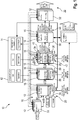
- Figure 1 shows a system 10 that is configured to analyze and interpret at least one data stream, wherein the data stream processed by the system 10 comprises data, for instance metadata, raw data and/or content.
- the system 10 comprises a plurality of modules 12, namely a management module 14 as well as several data processing modules 16.
- the data processing modules 16 are arranged in a serial module chain 18 that has an input 20 and an output 22.
- the input 20 of the module chain 18 is configured to receive data of the data streams, also called interception data, whereas the output 22 of the module chain 18 is configured to output structured interception data.
- the several data processing modules 16 assigned to the serial module chain 18 are configured to structure the interception data received via the input 20.
- the data processing modules 16 comprise at least one balance controller module 24, at least one flow filter module 26, at least one extraction module 28 as well as at least one aggregation module 30.
- each kind of module 24 - 30 is provided several times defining a certain processing layer S1 - S4.
- At least one collection gateway module 32 as well as at least one converter module 33 may be provided that are located downstream and upstream of the serial module chain 18, respectively.
- the upstream located converter module 33 may receive non-Ethernet frames that are converted into Ethernet frames and Link metadata which is inputted in the serial module chain 18 together with the Ethernet frames and the Link metadata as shown in Figure 1 .
- the collection gateway module 32 receives aggregated data fragments from the aggregation module 30 as will be described later.
- the at least one collection gateway module 32 as well as at least one converter module 33 may also be provided several times defining processing layers S0, S5.
- the extraction module 28 For processing the data of the data streams, the extraction module 28 has at least one decoder unit 34 as well as a tagging unit 36.
- the decoder unit 34 is configured to decode data fragments of the data stream received, namely the interception data. In other words, the respective decoder unit 34 identifies and extracts data fragments from the data stream processed by the extraction module 28.
- the tagging unit 36 of the respective extraction module 28 is configured to tag the data fragments decoded based on a unitary tagging data model, also called unitary tagging data structure, that is schematically shown in Figure 2 .
- the extraction module 28 is configured to output extracted data fragments that were initially encompassed within the data stream.
- the extracted data fragments comprise a tag according to the unitary tagging data model/structure, which defines a relation between data fragments.
- a plurality of decoder units 34 are provided that are generally configured to process different data streams.
- the plurality of decoder units 34 may be assigned to dedicated extraction modules 28.
- the tagging unit 36 is assigned to the plurality of decoder units 34 such that the tagging unit 36 is configured to tag data fragments of different data streams that were decoded by the plurality of decoder units 34 previously.
- the respective tags define a relation between data fragments originating from different data streams.
- a single tagging unit 36 may be provided.
- one tagging unit 36 per extraction module 28 is provided.
- the tagging unit 36 that uses the unitary tagging data model/structure is generally configured to apply this tagging data model to the data fragments of the different data streams decoded by the plurality of decoder units 34.
- the unitary tagging data model may be adapted for every decoder unit 34 individually. This depends on the decoder unit 34 as well as the intended use.
- the tag may comprise information with regard to the respective decoder unit 34, namely a decoder identification (decoder ID).
- the data fragments may correspond to application data fragments that are processed by the system 10.
- the at least one decoder unit 34 may be configured to decode different application protocols.
- several decoder units 34 may be provided that are assigned to a certain (application) protocol.
- the extraction module 28 As the extraction module 28 is located within the module chain 18, the extraction module 28 has its own input 38 as well as its own output 40.
- the extraction module 28 receives via its input 38 different data streams, particularly Ethernet frames, that are processed by the extraction module 28 as described above, namely by using the at least one decoder unit 34 as well as the tagging unit 36. Thus, the extraction module 28 outputs via its output 40 tagged data fragments for further processing, particularly metadata, content and frames.
- the extraction module 28 is directly connected with the aggregation module 30.
- the aggregation module 30 receives the tagged data fragments from the extraction module 28 for aggregation purposes.
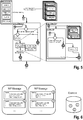
- the extraction module 28 applies the unitary tagging data model on the data fragments, at least one single data fragment (“DF”) is outputted that includes structure data ("Str.”), as indicated in Figure 4 , for instance.
- the structure data (“Str.”) may be assigned to the unitary tagging data model/structure applied, which is shown in Figures 2 and 3 for an example concerning e-mail data.
- the extraction module 28 is configured to output a plurality of single data fragments ("DF") each including structure data ("Str.”), wherein relationships between the single data fragments are defined by the corresponding structure data.
- DF single data fragments
- Str structure data
- the tagging data model/structure provides different types of relations, namely sibling relation as well as parent relation.
- the sibling relation may correspond to different information that relates to an e-mail header such as addressee ("to”), sender ("from”) and/or subject.
- the parent relation may correspond to the relation of data fragments with regard to the hierarchy such as "Addressee ("to”) - Header - Mail", “Sender ("from”) - Header - Mail” and/or "Subject - Header - Mail”.
- Each of the above mentioned data fragments are assigned to values that may be of semantic type (addressee ("to"), sender ("from") and/or subject) and/or data type (string, number, Boolean and so on).
- the unitary tagging data model/structure applied provides a structure that may put values assigned to data fields or rather data fragments in relation to each other, wherein the structure data/information corresponds to the above-mentioned context.
- the unitary tagging data model/structure used comprises a unique identifier for a specific context identification (ID) and a type of context that defines how to interpret a data fragment associated with it, as shown in Figures 2 and 3 .
- ID a specific context identification
- type of context that defines how to interpret a data fragment associated with it
- the unitary tagging data model/structure is shown for e-mail data that comprises context (structure data) which relates to the mail, the header as well as the body, whereas the data fragments are assigned to data fields associated with the header or rather the body.
- Figure 3 shows that the respective structure of the data fragments can be described by vectors, namely context vector or rather context type vectors.
- each single data fragment has a corresponding structure data (context) wherein the structure data may be defined by the respective vectors.
- the structure data corresponds to a data tree format or a data graph.
- the unitary format used may be identical for different data streams processed by the system 10.
- the extraction module 28 that processes several data streams may output several data fragments with at least partially identical structure data within one message that is forwarded to the aggregation module 30.
- the data fragments assigned to the values "A", “B”, “C” may have partially identical structure data as they are assigned to the same context vector [47834, 37834, 11234, as well as the same context type vector [1, 2, 4], as the respective data fragments relate to header information, namely the same context.
- Figure 3 also reveals that a root context as well as a root context ID are provided, which refer to the first element of the respective vector. In fact, this indicates the respective instance.
- the data fragments may be outputted by the extraction module 28 continuously such that the tagged data fragments are directly forwarded or rather streamed without any buffering.
- a rule engine 42 may be provided, particularly integrated in the extraction module 28.
- the rule engine 42 forwards the (extracted) data fragments including the structure data to the aggregation module 30 for further processing if certain criteria will be fulfilled.
- the rule engine 42 is configured to forward the data fragments including the structure data and input data stream, namely the raw data, to the aggregation module 30 for further processing if certain criteria will be fulfilled.
- the aggregation module 30 is configured to receive the outputted data fragments from the extraction module 28, namely the data fragments including the structure data as described above.
- the aggregation module 30 is configured to aggregate the data fragments received according to one predefined structure data for different protocols, data streams and/or decoder units 34 that are assigned to the at least one extraction module 28.
- the data fragments ("DF") including structure data (“Str.”) are forwarded to the aggregation module 30 for aggregation.
- the aggregation module 30 is configured to aggregate the data fragments ("DF") including structure data ("Str.”) according to one predefined structure data as shown in Figure 4 .
- the structure data ("Str.") of the data fragments (“DF”) influence the aggregation done by the aggregation module 30.
- the predefined structure data may relate to different protocols, data streams and/or decoder units 34 assigned to the at least one extraction module 28.
- the aggregation module 30 comprises at least one output 44 via which the aggregated data fragments, namely the data fragments including structure data processed by the aggregation module 30, are outputted as shown in Figures 1 and 4 . Hence, aggregated metadata, content and/or frames are outputted.
- the aggregation module 30 may have several outputs such that different aggregated data fragments may be outputted via the outputs 44 wherein the output data comprise at least in parts identical data.
- the aggregated data fragments are typically outputted together with corresponding raw data from the respective data stream inputted in the extraction module 28.
- the data of the data streams is outputted by the aggregation module 30, namely the respective data fields ("DF") or rather their values as shown in Figure 4 .
- the aggregation module 30 may convert the data fragments received into a different (application) protocol with respect to the receiving (application) protocol. This may simplify further processing of the aggregated data fragments, for instance by the collection gateway module 32.
- the receiving protocol used for communication between the extraction module 28 and the aggregation module 30 may generally be compatible to at least two different types of decoder units 34.
- At least two different types of decoder units 34 may be used for processing different data streams wherein the decoded data fragments are forwarded to the aggregation module 30.
- the aggregation module 30 is configured to receive the tagged data fragments from at least two different types of decoder units 34 that may be assigned to at least two different extraction modules 28.
- the tagged data fragments may relate to the unitary data model/structure even though they were identified and extracted by different extraction modules 28, particularly different types of decoder units 34.
- the different data streams may be processed by different extraction modules 28, wherein the aggregation module 30 is configured to combine the tagged data fragments received from the different extraction modules 28 to one single session data that is outputted.
- the aggregation module 30 is configured to output the single session data that encompasses the tagged data fragments extracted and tagged by the at least two different extraction modules 28.
- each extraction module 28 processes the data streams in a manner as described above, wherein the unitary data model/structure is applied that might be adapted with regard to the decoder identification (decoder ID) as already mentioned, which identifies the respective decoder unit 34 in a unique manner.
- decoder ID decoder identification
- multi data flows namely different data streams, that relate to different (application) protocols can be processed by the different extraction modules 28 or rather the decoder units 34, which ensures a higher scalability since the information gathered, namely the data, is distributed among the extraction modules 28 or rather the decoder units 34.
- the scalability can be improved up to Tbit/s.
- Sessions Initiation Protocol (SIP) data packets may arrive which are processed by the at least one extraction module 28.
- Respective correlation information concerning the data stream arrived may be broadcasted among different extraction modules 28, namely within the processing layer S3.
- the respective decoder units 34 of the at least one extraction module 28 may share relevant correlation information, for instance via broadcast mechanism.
- RTP Real-Time Transport Protocol
- the rule engine 42 may relate to forwarding context if RTP data packets and SIP data packets arrive.
- the aggregation module 30 is configured to aggregate the data fragments received for a predefined time.
- Figure 5 shows that the data fragments including the structure data are assigned to context information which groups all information together.
- the context information encompasses the decoder identification (decoder ID), the context vector, the context type vector, the data field type, the data field value as well as the rule ID and the mandate ID, which trigger the forwarding of the data field from the extraction module 28 to the aggregation module 30.
- the context vector as well as the context type vector relate to the structure data that provides relative information with regard to the respective data fragment.
- the aggregation module 30 is configured to apply an aggregation function on the context information, wherein the aggregation function comprises aggregation function parameters as illustrated in Figure 5 .
- the aggregation function parameters relate to the decoder identification (decoder ID), the context type vector prefix as well as the aggregation timeout relating to the predefined time.
- the aggregation function parameters relate to a tuple of values as indicated above.
- the aggregation module 30 is configured to create at least one pile for a matching parameter set while processing the aggregation function as well as the context information.
- the matching condition of the aggregation function is assigned to the decoder ID and the context type vector prefix (CtxTVP) being part of the context type vector (CtxTV).
- parameters are assigned to a single pile that have matching parameters, particularly matching decoder identification and context type vector prefix.
- the respective pile comprises at least one data field with common context vector prefix.
- secondary data like rule ID and/or mandate ID may be assigned to the respective pile.
- the aggregation module 30 is configured to output aggregated data fragments that are structured, namely by piles that relate to the respective structure data such as context type vector and context vector.
- Figure 6 shows an example for aggregation wherein a decoder type corresponds to a "Mail-Decoder", the context type vector prefix is equal to "Mail” and the aggregation timeout corresponds to "30 seconds".
- the context type vector prefix may be equal to "Mail - Header”. Then, the data fields assigned to "1" and “2" would only be aggregated, as the context vector of data field labelled with "4" is assigned to the context vector [302, 364] corresponding to the context type vector prefix "Mail - Body”.
- the system 10 comprises the management module 14.
- the serial module chain 18 processes the data only in direction from its input 20 to its output 22.
- Each of the data processing modules 16 in the serial module chain 18 provides capability information that is used in data flow direction for configuring the following data processing modules 16.
- each of the data processing modules 16 announces information with regard to its own capability.
- the respective information is forwarded/distributed in data flow direction such that subsequent data processing modules 16 obtain the respective information.
- Each data processing module 16 that receives the respective capability information of one of the previous data processing modules 16 is configured to adjust its own capability based on the capability information received from the previous one.
- the respective capability information may relate to semantic information and/or processing information.
- replacing one of the several data processing modules 16 within the serial module chain 18 does not require to reconfigure the whole system 10 manually since the respective capability information of the new several data processing module(s) 16 is distributed to the subsequent data processing modules 16 effectively.
- the respective capability information announced is received by the subsequent data processing modules 16 that adapt their settings appropriately with regard to the capability information announced such that a reconfiguration of the whole system 10 takes place.
- the management module 14 As the management module 14 is connected to the serial module chain 18, in particular each of the several data processing modules 16, the management module 14 also receives the respective capability information of each data processing module 16.
- the management module 14 has a graphical user interface (GUI), wherein the management module 14 is enabled to adjust the respective graphical user interface based on the capability information received from the data processing module(s) 16.
- GUI graphical user interface
- the user interface is adapted to the current capability of the whole system 10.
- management module 14 may receive log and health information from the several data processing module(s) 16 that may be processed by the management module 14.
- management module 14 controls the several data processing module(s) 16 based on the log and health information and/or the capability information received from the data processing module(s) 16.
Landscapes
- Engineering & Computer Science (AREA)
- Theoretical Computer Science (AREA)
- Databases & Information Systems (AREA)
- Data Mining & Analysis (AREA)
- Physics & Mathematics (AREA)
- General Engineering & Computer Science (AREA)
- General Physics & Mathematics (AREA)
- Computational Linguistics (AREA)
- Data Exchanges In Wide-Area Networks (AREA)
Priority Applications (2)
| Application Number | Priority Date | Filing Date | Title |
|---|---|---|---|
| EP19160120.2A EP3702935A1 (de) | 2019-02-28 | 2019-02-28 | System zur analyse und auswertung von mindestens einem datenstrom sowie verfahren zur kombination von datenfragmenten |
| US16/777,015 US11755587B2 (en) | 2019-02-28 | 2020-01-30 | System for analyzing and interpreting at least one data stream as well as method of combining data fragments |
Applications Claiming Priority (1)
| Application Number | Priority Date | Filing Date | Title |
|---|---|---|---|
| EP19160120.2A EP3702935A1 (de) | 2019-02-28 | 2019-02-28 | System zur analyse und auswertung von mindestens einem datenstrom sowie verfahren zur kombination von datenfragmenten |
Publications (1)
| Publication Number | Publication Date |
|---|---|
| EP3702935A1 true EP3702935A1 (de) | 2020-09-02 |
Family
ID=65766800
Family Applications (1)
| Application Number | Title | Priority Date | Filing Date |
|---|---|---|---|
| EP19160120.2A Pending EP3702935A1 (de) | 2019-02-28 | 2019-02-28 | System zur analyse und auswertung von mindestens einem datenstrom sowie verfahren zur kombination von datenfragmenten |
Country Status (2)
| Country | Link |
|---|---|
| US (1) | US11755587B2 (de) |
| EP (1) | EP3702935A1 (de) |
Citations (3)
| Publication number | Priority date | Publication date | Assignee | Title |
|---|---|---|---|---|
| EP1772992A1 (de) * | 2005-10-06 | 2007-04-11 | Alcatel Lucent | Vorrichtung und Verfahren zur Analyse von Paketdatenströmen |
| US7242681B1 (en) * | 2002-05-17 | 2007-07-10 | Sandstorm Enterprises, Inc. | System and method for intercepting and authenticating packets during one or more communication sessions and automatically recognizing content |
| US20150293954A1 (en) * | 2014-04-15 | 2015-10-15 | Splunk Inc. | Grouping and managing event streams generated from captured network data |
Family Cites Families (7)
| Publication number | Priority date | Publication date | Assignee | Title |
|---|---|---|---|---|
| US8069190B2 (en) * | 2007-12-27 | 2011-11-29 | Cloudscale, Inc. | System and methodology for parallel stream processing |
| US9098310B2 (en) * | 2009-10-29 | 2015-08-04 | International Business Machines Corporation | Constructing and deploying patterns of flows |
| US20160291847A1 (en) * | 2015-03-31 | 2016-10-06 | Mckesson Corporation | Method and Apparatus for Providing Application Context Tag Communication Framework |
| US9936239B2 (en) * | 2016-06-28 | 2018-04-03 | Intel Corporation | Multiple stream tuning |
| US10880254B2 (en) * | 2016-10-31 | 2020-12-29 | Actiance, Inc. | Techniques for supervising communications from multiple communication modalities |
| US11051073B2 (en) * | 2017-05-25 | 2021-06-29 | Turner Broadcasting System, Inc. | Client-side overlay of graphic items on media content |
| US20190108282A1 (en) * | 2017-10-09 | 2019-04-11 | Facebook, Inc. | Parsing and Classifying Search Queries on Online Social Networks |
-
2019
- 2019-02-28 EP EP19160120.2A patent/EP3702935A1/de active Pending
-
2020
- 2020-01-30 US US16/777,015 patent/US11755587B2/en active Active
Patent Citations (3)
| Publication number | Priority date | Publication date | Assignee | Title |
|---|---|---|---|---|
| US7242681B1 (en) * | 2002-05-17 | 2007-07-10 | Sandstorm Enterprises, Inc. | System and method for intercepting and authenticating packets during one or more communication sessions and automatically recognizing content |
| EP1772992A1 (de) * | 2005-10-06 | 2007-04-11 | Alcatel Lucent | Vorrichtung und Verfahren zur Analyse von Paketdatenströmen |
| US20150293954A1 (en) * | 2014-04-15 | 2015-10-15 | Splunk Inc. | Grouping and managing event streams generated from captured network data |
Also Published As
| Publication number | Publication date |
|---|---|
| US20200278974A1 (en) | 2020-09-03 |
| US11755587B2 (en) | 2023-09-12 |
Similar Documents
| Publication | Publication Date | Title |
|---|---|---|
| US8311045B2 (en) | System and method for selectively applying a service to a network packet using a preexisting packet header | |
| CN101874384B (zh) | 用于从在高速网际协议(ip)通信链路上传递的网络业务中收集数据的方法、系统和计算机可读介质 | |
| US7843826B2 (en) | Automatic detection and re-configuration of priority status in telecommunications networks | |
| CN108882008B (zh) | 一种数据转换的方法和设备 | |
| CN108141387B (zh) | 对于分组报头采样的长度控制 | |
| CN110838930B (zh) | 业务逻辑拓扑的生成方法及装置 | |
| CN105706425A (zh) | 用于分发组播源的标识符的方法 | |
| CN110431807A (zh) | Iptv业务质量检测的方法、装置及系统 | |
| CN109889373A (zh) | 一种告警信息的传输方法、装置和系统 | |
| CN108965040A (zh) | 一种视联网的业务监控方法和装置 | |
| CN110380946A (zh) | 一种通信方法和通信装置 | |
| CN109068186A (zh) | 丢包率的处理方法和装置 | |
| CN110505204A (zh) | 一种即时语音通信方法、装置、电子设备及可读存储介质 | |
| CN109818776A (zh) | 微服务模块异常定位方法和装置 | |
| CN109889420A (zh) | 业务处理方法和装置 | |
| CN1258899C (zh) | 在包含以太网的网络中发送信令的方法、设备和系统 | |
| CN109889779A (zh) | 一种报文乱序的处理方法和装置 | |
| EP3702935A1 (de) | System zur analyse und auswertung von mindestens einem datenstrom sowie verfahren zur kombination von datenfragmenten | |
| EP3703341B1 (de) | System zur analyse und auswertung von mindestens einem datenstrom sowie verfahren zur automatischen konfiguration eines systems | |
| EP3702933A1 (de) | System zur analyse und auswertung von mindestens einem datenstrom sowie verfahren zur markierung von datenfragmenten | |
| EP3702934A1 (de) | System zur analyse und auswertung von mindestens einem datenstrom und verfahren zum aggregieren von datenfragmenten | |
| CN110493658A (zh) | 一种网络带宽侦测方法、设备及存储设备 | |
| CN109587432A (zh) | 一种会议发言终端切换方法及系统 | |
| CN110430168A (zh) | 一种数据压缩的方法和装置 | |
| CN110505077A (zh) | 一种升级的方法和装置 |
Legal Events
| Date | Code | Title | Description |
|---|---|---|---|
| PUAI | Public reference made under article 153(3) epc to a published international application that has entered the european phase |
Free format text: ORIGINAL CODE: 0009012 |
|
| STAA | Information on the status of an ep patent application or granted ep patent |
Free format text: STATUS: THE APPLICATION HAS BEEN PUBLISHED |
|
| AK | Designated contracting states |
Kind code of ref document: A1 Designated state(s): AL AT BE BG CH CY CZ DE DK EE ES FI FR GB GR HR HU IE IS IT LI LT LU LV MC MK MT NL NO PL PT RO RS SE SI SK SM TR |
|
| AX | Request for extension of the european patent |
Extension state: BA ME |
|
| STAA | Information on the status of an ep patent application or granted ep patent |
Free format text: STATUS: REQUEST FOR EXAMINATION WAS MADE |
|
| 17P | Request for examination filed |
Effective date: 20210224 |
|
| RBV | Designated contracting states (corrected) |
Designated state(s): AL AT BE BG CH CY CZ DE DK EE ES FI FR GB GR HR HU IE IS IT LI LT LU LV MC MK MT NL NO PL PT RO RS SE SI SK SM TR |
|
| P01 | Opt-out of the competence of the unified patent court (upc) registered |
Effective date: 20230525 |
|
| STAA | Information on the status of an ep patent application or granted ep patent |
Free format text: STATUS: EXAMINATION IS IN PROGRESS |
|
| 17Q | First examination report despatched |
Effective date: 20240102 |