EP3704833B1 - Verfahren zum anwenden eines patchs auf eine zu aktualisierende virtualisierte netzwerkfunktion - Google Patents
Verfahren zum anwenden eines patchs auf eine zu aktualisierende virtualisierte netzwerkfunktion Download PDFInfo
- Publication number
- EP3704833B1 EP3704833B1 EP18808422.2A EP18808422A EP3704833B1 EP 3704833 B1 EP3704833 B1 EP 3704833B1 EP 18808422 A EP18808422 A EP 18808422A EP 3704833 B1 EP3704833 B1 EP 3704833B1
- Authority
- EP
- European Patent Office
- Prior art keywords
- network
- virtual
- virtualized
- virtualized network
- dependent
- Prior art date
- Legal status (The legal status is an assumption and is not a legal conclusion. Google has not performed a legal analysis and makes no representation as to the accuracy of the status listed.)
- Active
Links
Images


Classifications
-
- H—ELECTRICITY
- H04—ELECTRIC COMMUNICATION TECHNIQUE
- H04L—TRANSMISSION OF DIGITAL INFORMATION, e.g. TELEGRAPHIC COMMUNICATION
- H04L41/00—Arrangements for maintenance, administration or management of data switching networks, e.g. of packet switching networks
- H04L41/08—Configuration management of networks or network elements
- H04L41/0803—Configuration setting
- H04L41/0813—Configuration setting characterised by the conditions triggering a change of settings
- H04L41/082—Configuration setting characterised by the conditions triggering a change of settings the condition being updates or upgrades of network functionality
-
- G—PHYSICS
- G06—COMPUTING OR CALCULATING; COUNTING
- G06F—ELECTRIC DIGITAL DATA PROCESSING
- G06F8/00—Arrangements for software engineering
- G06F8/60—Software deployment
- G06F8/65—Updates
-
- G—PHYSICS
- G06—COMPUTING OR CALCULATING; COUNTING
- G06F—ELECTRIC DIGITAL DATA PROCESSING
- G06F9/00—Arrangements for program control, e.g. control units
- G06F9/06—Arrangements for program control, e.g. control units using stored programs, i.e. using an internal store of processing equipment to receive or retain programs
- G06F9/44—Arrangements for executing specific programs
- G06F9/455—Emulation; Interpretation; Software simulation, e.g. virtualisation or emulation of application or operating system execution engines
- G06F9/45533—Hypervisors; Virtual machine monitors
-
- H—ELECTRICITY
- H04—ELECTRIC COMMUNICATION TECHNIQUE
- H04L—TRANSMISSION OF DIGITAL INFORMATION, e.g. TELEGRAPHIC COMMUNICATION
- H04L41/00—Arrangements for maintenance, administration or management of data switching networks, e.g. of packet switching networks
- H04L41/06—Management of faults, events, alarms or notifications
- H04L41/0604—Management of faults, events, alarms or notifications using filtering, e.g. reduction of information by using priority, element types, position or time
- H04L41/0627—Management of faults, events, alarms or notifications using filtering, e.g. reduction of information by using priority, element types, position or time by acting on the notification or alarm source
-
- H—ELECTRICITY
- H04—ELECTRIC COMMUNICATION TECHNIQUE
- H04L—TRANSMISSION OF DIGITAL INFORMATION, e.g. TELEGRAPHIC COMMUNICATION
- H04L41/00—Arrangements for maintenance, administration or management of data switching networks, e.g. of packet switching networks
- H04L41/08—Configuration management of networks or network elements
- H04L41/0866—Checking the configuration
-
- H—ELECTRICITY
- H04—ELECTRIC COMMUNICATION TECHNIQUE
- H04L—TRANSMISSION OF DIGITAL INFORMATION, e.g. TELEGRAPHIC COMMUNICATION
- H04L41/00—Arrangements for maintenance, administration or management of data switching networks, e.g. of packet switching networks
- H04L41/08—Configuration management of networks or network elements
- H04L41/0896—Bandwidth or capacity management, i.e. automatically increasing or decreasing capacities
- H04L41/0897—Bandwidth or capacity management, i.e. automatically increasing or decreasing capacities by horizontal or vertical scaling of resources, or by migrating entities, e.g. virtual resources or entities
-
- H—ELECTRICITY
- H04—ELECTRIC COMMUNICATION TECHNIQUE
- H04L—TRANSMISSION OF DIGITAL INFORMATION, e.g. TELEGRAPHIC COMMUNICATION
- H04L41/00—Arrangements for maintenance, administration or management of data switching networks, e.g. of packet switching networks
- H04L41/40—Arrangements for maintenance, administration or management of data switching networks, e.g. of packet switching networks using virtualisation of network functions or resources, e.g. SDN or NFV entities
-
- H—ELECTRICITY
- H04—ELECTRIC COMMUNICATION TECHNIQUE
- H04L—TRANSMISSION OF DIGITAL INFORMATION, e.g. TELEGRAPHIC COMMUNICATION
- H04L43/00—Arrangements for monitoring or testing data switching networks
- H04L43/08—Monitoring or testing based on specific metrics, e.g. QoS, energy consumption or environmental parameters
- H04L43/0805—Monitoring or testing based on specific metrics, e.g. QoS, energy consumption or environmental parameters by checking availability
- H04L43/0817—Monitoring or testing based on specific metrics, e.g. QoS, energy consumption or environmental parameters by checking availability by checking functioning
-
- H—ELECTRICITY
- H04—ELECTRIC COMMUNICATION TECHNIQUE
- H04L—TRANSMISSION OF DIGITAL INFORMATION, e.g. TELEGRAPHIC COMMUNICATION
- H04L45/00—Routing or path finding of packets in data switching networks
- H04L45/58—Association of routers
- H04L45/586—Association of routers of virtual routers
-
- H—ELECTRICITY
- H04—ELECTRIC COMMUNICATION TECHNIQUE
- H04L—TRANSMISSION OF DIGITAL INFORMATION, e.g. TELEGRAPHIC COMMUNICATION
- H04L41/00—Arrangements for maintenance, administration or management of data switching networks, e.g. of packet switching networks
- H04L41/06—Management of faults, events, alarms or notifications
- H04L41/0681—Configuration of triggering conditions
-
- H—ELECTRICITY
- H04—ELECTRIC COMMUNICATION TECHNIQUE
- H04L—TRANSMISSION OF DIGITAL INFORMATION, e.g. TELEGRAPHIC COMMUNICATION
- H04L43/00—Arrangements for monitoring or testing data switching networks
- H04L43/08—Monitoring or testing based on specific metrics, e.g. QoS, energy consumption or environmental parameters
-
- H—ELECTRICITY
- H04—ELECTRIC COMMUNICATION TECHNIQUE
- H04L—TRANSMISSION OF DIGITAL INFORMATION, e.g. TELEGRAPHIC COMMUNICATION
- H04L43/00—Arrangements for monitoring or testing data switching networks
- H04L43/20—Arrangements for monitoring or testing data switching networks the monitoring system or the monitored elements being virtualised, abstracted or software-defined entities, e.g. SDN or NFV
-
- H—ELECTRICITY
- H04—ELECTRIC COMMUNICATION TECHNIQUE
- H04L—TRANSMISSION OF DIGITAL INFORMATION, e.g. TELEGRAPHIC COMMUNICATION
- H04L43/00—Arrangements for monitoring or testing data switching networks
- H04L43/50—Testing arrangements
Definitions
- the present invention relates to the field of network virtualization, and more particularly to the anticipation of failures when applying patches to virtualized network functions running in a virtual production environment.
- a virtual network topology When a virtual network topology is instantiated for a user or a group of users, or for a particular service, we speak of a “network slice” (or “network slice” in French).
- Users are for example virtual infrastructure providers, companies, end users, etc.
- network slices independent of each other, can coexist and rely on the same hardware infrastructure.
- a user such as a company, only has a view of his slice and only accesses his network slice.
- a virtual infrastructure operator who provides virtual networks guarantees the isolation of the virtual networks from each other.
- ETSI has defined a reference model, known as "MANO", which describes all the entities allowing the orchestration of network functions offered by such an infrastructure, such as the creation, deployment, migration, etc., virtual machines underlying.
- This model introduces components such as virtualized network functions, or "VNF” (for "Virtual Network Function”), which perform a specific network function and which are implemented by one or more virtual machines which contain a software suite and options needed to perform these functions.
- VNF virtualized network functions
- the MANO model also defines the "VIM” (for "Virtual Infrastructure Management”), which corresponds to the management layer of the hardware infrastructure, the virtualization layer and the virtual layer.
- Network virtualization thus allows great flexibility in network offers.
- a user such as a company or an administration, etc., has his network as if he had a conventional physical network.
- Network virtualization virtualizes entire network topologies servers, routers, switches, and firewalls to all run on a single hardware platform, without additional investment in network hardware.
- the application of patches is traditionally based on test procedures. It is usual for the implementation of these procedures to define a set of tests that is as exhaustive as possible, to apply this set of tests to the patched function, that is to say the function to be updated which integrates the patch, then, once the tests have been successfully passed, to patch, or to apply the patch to the function to be updated which runs in its production environment.
- the tests are generally carried out in a test environment, isolated from the production environment and supposed to reproduce the production environment of the function to be updated.
- patent publication US2016/132420 describes a system for testing in an environment an update of a first virtual machine. A second clone virtual machine of the first is created and then updated. Tests are then run on the second virtual machine.
- One of the aims of the invention is to remedy shortcomings/disadvantages of the state of the art and/or to make improvements thereto.
- the method described here makes it possible to anticipate failures when applying patches to virtualized network functions to be updated and running in a production environment.
- the creation of the test virtual network is done without stopping or disturbing the production virtual network. Indeed, the virtual machine(s) that implement the virtualized network function(s) that are intended to be part of the test virtual network are duplicated, or “hot” cloned, that is to say without interrupting their execution. .
- This cloning results in virtualized network functions and underlying virtual machines that have the same system state as the virtualized network functions and underlying virtual machines running in the production virtual network.
- the test conditions thus created in the test virtual network are therefore similar to those of the production network and therefore ideal for testing the virtualized network function to be updated.
- test conditions are such that they correspond to the operational environment associated with the production virtual network. Indeed, input packets of the dependent virtualized network functions are copied and routed to the test virtual network. Thus, it is not necessary to provide a specific test set since the test virtual network works in some way in parallel with the production virtual network and receives the same packets as those received by the dependent virtualized network functions in the environment. of production.
- test virtual network strongly correlated to the production network, since any incoming packet destined for a virtualized network function of the set of dependent functions is duplicated and routed to the corresponding virtualized network functions in the virtual network of test, makes it possible to take into account anomalies in the incoming packets which would be attributable to previous virtualized network functions, that is to say virtualized network functions which are traversed by the packets which are then routed to the virtualized network functions at update or more generally to a dependent virtualized network function.
- the test of the patch is done in an optimum manner, without fearing the incompleteness of the test set at this level, that is to say at the level of the content of the incoming packets.
- the set of dependent virtualized network functions also comprises at least one other virtualized network function functionally dependent on the virtualized network function to be updated.
- the set of dependent virtualized network functions that are identified are those that are likely to be disrupted when the patch is applied to the virtualized network function to be updated. They are in fact all functionally dependent on the virtualized network function to be updated. They are therefore all likely to be impacted by the fix.
- these dependent functions are identified by a manager of the production network, based on the knowledge that the latter has of his production network.
- a virtual infrastructure manager making available to a client to which the first virtual network has been allocated, an interface of the network hypervisor so that the client can control the first virtual network, said client thus exercising a so-called indirect control of the first virtual network, the identification of a packet at the input of a virtualized network function of the set of dependent virtualized network functions, the duplication and the routing of said duplicated packet to the test network comprises, when the virtualized network function of the set of dependent virtualized network functions and the clone of the corresponding virtualized network function included in the second network are hosted by the same host server: installing a configuration rule on a forwarding network equipment of the host server, said forwarding network equipment being adapted to forward the packet to the virtualized network function of the set of dependent virtualized network functions, said configuration comprising duplicating the input packet of the virtualized network function of the set of dependent virtualized network functions, and sending said duplicated packet to the clone of the corresponding virtualized network function included in the second network and hosted by the host server.
- the network hypervisor receives from an operator of the first virtual network a rule intended to be installed in a routing network equipment, said rule modifying an identifier of the first virtual network included in a packet intended to be routed to the test virtual network, in an identifier of the test virtual network, said rule being installed on the equipment by the hypervisor when the test virtual network is dedicated to testing virtualized network functions and that the first virtual network and the test virtual network belong to the same tenant.
- a virtualized connection management network function makes it possible, in the case of connection-oriented communication protocols, to manage the connections specific to the protocol used transparently for the client. This management is necessary because of the routing of the incoming packets of the set of virtualized network functions towards the corresponding virtualized network functions of the test environment. Connection management is centralized at the level of a virtualized connection management network function capable of identifying whether such management is necessary, that is to say identifying whether the type of protocol used requires specific connection management, and to manage all the connections so that the method of applying the patch applies without further modification.
- the invention also relates to a computer program on a data medium and loadable into the memory of a computer server, comprising program code instructions intended to control the execution of the steps of the method of applying a patch to a virtualized network function to test the update of said virtualized network function in a virtual network as described previously, when the program is executed on said server.
- VN A virtual production network
- the virtual infrastructure is part of a network virtualization context and is adapted to offer different customers virtual network topologies independent of each other, or “network slice” (“network slice” in French), and which run on top of the same hardware infrastructure.
- the virtual network VN A is arranged to host one or more services, depending on the customer's needs.
- a service that runs in the production virtual network VN A comprises a logical set of virtualized network functions, or "VNF" (standing for "Virtual Network Function").
- Each virtualized network function is adapted to perform specific processing, for example packet routing processing, firewall processing, address translation processing, etc. These virtualized network functions communicate by exchanging packets in order to provide the expected service.
- Each virtualized network function is implemented by one or more virtual machines, or “VMs” (standing for “Virtual Machine”).
- VMs virtual machines
- the customer's virtual production network VN A relies on a set of hardware resources distributed over one or more host devices, such as computer servers and possibly dedicated network devices, such as routers, switches, etc
- the functions of dedicated network equipment can also be rendered by software modules, the hardware infrastructure in this case is composed exclusively of computer servers.
- the client accesses its virtual network VN A through a software module called virtual network operator.
- a network hypervisor controlled by the infrastructure manager, interfaces between the infrastructure hardware resources and the customer-controlled virtual network operator, and between the virtual network operator and the production virtual network NV A of the customer.
- the network hypervisor allocates the virtual network VN A of the client the hardware resources it needs transparently for the client.
- the customer via the virtual network operator, only has a view of his virtual network VN A ; it does not access the underlying hardware resources.
- the customer can control their virtual network through the network operator in different ways.
- the network hypervisor which interfaces between the operator of the virtual network and the virtual network VN A of the client, makes available to the latter ci an interface, or “API” (for “Application Programming Interface”) adapted to receive requests from the client and to apply them to the virtualized network functions of the virtual network VN A of the client.
- API Application Programming Interface
- This API offers the customer a view of all the virtualized network functions and virtual machines of his VN A virtual network.
- the network hypervisor translates client requests into configuration for the underlying hardware infrastructure. When the network hypervisor makes such an interface available to the client to access its virtual network, it is said that the client exercises indirect control of its network.
- the physical topology is completely hidden from the customer, and the customer only sees the virtualized network functions and virtual machines of their virtual network.
- This approach provides great flexibility to the network hypervisor in how it provides isolation between virtual networks. How packets are routed between virtual machines and/or virtualized network functions in the network to satisfy the customer-defined configuration is controlled by the network hypervisor and not determined by the customer.
- the network hypervisor can set up tunnels to encapsulate the data between the virtual machines of the same virtual network instead of defining virtual local networks (“VLAN” for Virtual Local Area Network “in English). It is subsequently assumed that the client exercises indirect control of its virtual network VN A .
- an initial step E0 of identifying a virtualized network function to be updated and developing a patch the customer identifies in his production virtual network VN A a virtualized network function to be updated.
- VNF A virtualized network function
- performance degradation or occasional malfunctions have been observed on the VNF A virtualized network function.
- the customer has a monitoring tool suitable for detecting such a failure.
- a security flaw has been published; this flaw concerns the virtualized network function without the flaw having been exploited and having impacted the virtual production network VN A .
- a step E1 of supplying a configuration for the test the client communicates to the manager of the virtual infrastructure a list of dependent virtualized network functions which includes the virtualized network function to be updated VNF A , as well as a set of virtualized network functions of virtual network VN A identified as being functionally dependent on virtualized network function VNF A to be updated.
- This set of dependent virtualized network functions which includes the virtualized network function to be updated VNF A and, where applicable, the virtualized network functions functionally dependent on the virtualized network function to be updated VNF A comprises the set of virtualized network functions that participate in the processing a packet from the virtualized network function VNF A to be updated; this set is denoted VNF DePA ; it is provided by the customer to the network hypervisor in the form of a list of identifiers of the functions in their production environment VN A .
- a network administrator of the customer's virtual network VN A production has sufficient knowledge of the architecture of the virtual network VN A to provide the list of identifiers of the dependent virtualized network functions VNF DePA which includes the network function virtualized network to update VNF A and, if necessary, the virtualized network functions that functionally depend on it.
- the network hypervisor creates a second virtual network, or network slice VN B , called “virtual test network", specific to the client, on the basis of the configuration provided previously.
- This test virtual network VN B is intended to test the patch to be applied to the virtualized network function to be updated VNF A in a test environment similar to part of the production environment that constitutes the virtual network VN A , in the species to the subnet that includes the VNF DepA set of dependent virtualized network functions.
- the network hypervisor controls the cloning, or the duplication, of all the virtual machines which implement the virtualized network functions from the list of dependent virtualized network functions VNF DePA provided during the previous step E1.
- VNF DePA dependent virtualized network functions
- the virtual machine obtained, or clone of the virtual machine has the same characteristics as the virtual machine: same network address, same MAC address; it has the same amount of resources, etc. However, it is installed on different memory pages. Cloned virtual machines are therefore distinct from virtual machines while offering identical functionalities.
- the duplicate virtual machines are attached to the test virtual network VNB B .
- the test virtual network VN B therefore comprises all the virtualized network functions dependent VNF DePA , the list of which was provided during step E1. More specifically, the VN B test network includes the set of clones of virtual machines that implement the virtualized network functions of the VNF DePA list.
- VNF DePB the list of virtualized network functions which are implemented by the set of cloned virtual machines.
- VNF DePB the list of virtualized network functions which are implemented by the set of cloned virtual machines.
- the clones of the virtualized network functions VNF DepB are the corresponding virtualized network functions of the dependent virtualized network functions VNF DePA in the test network VN B .
- the network hypervisor configures the network equipment of the underlying hardware infrastructure so as to interconnect the VNF DepB set of clones of the virtualized network functions, included in the virtual network of NV B test.
- the clones of the virtualized network functions dependent on the VNF list DepB are interconnected in the test network VN B in the same way as the virtualized network functions dependent on the VNF list DepA of the production network VN A are. Note that this step does not require bypassing the network isolation since the virtual networks VN A and VN B are completely disjoint at this stage.
- the network hypervisor identifies incoming data packets of the set consisting of the virtualized network functions dependent VNF DepA of the virtual network VN A and duplicates these packets in order to to also route them as input to the set consisting of the corresponding virtualized network functions VNF DepB of the virtual test network VN B .
- the identified packets were sent in the production network VN A by a virtualized network function external to the VNF DePA set.
- Duplicating the input packets of the VNF DePA dependent virtualized network function set and routing the duplicate packets to the corresponding VNF DepB virtualized network function set in the VN B test network requires modifying the network hypervisor. Indeed, such processing goes beyond the isolation between the networks since a packet, initially routed inside the virtual network VN A also happens to be routed in another virtual network, in this case the test virtual network VN B.
- the network hypervisor modifies the API it makes available to the client so that packets that are destined for the dependent virtualized network function set VNF DePA in the production virtual network VNF A are also routed to the set clones of VNF DepB virtualized network functions from the VNB B test network.
- This modification although going against network isolation, is under the control of the network hypervisor and is intended to set up a test environment in parallel with the production environment in which the faulty virtualized network function VNF A evolves, without disturbing the operation of this one.
- This modification results in the definition of a new configuration action, accessible by the client from the API, and intended to command that a packet received by a virtualized network function from the VNF DepA list be duplicated and also routed to the clone of this virtualized network function, or corresponding virtualized network function from the VNF DepB list of the VN B test network.
- This action configured at the API level by the client, translates for the network hypervisor into an action for configuring the underlying hardware resources.
- the network hypervisor configures a routing network equipment located upstream of a virtualized network function of the VNF DepA set, denoted VNF x , of the production virtual network VN A which receives an incoming packet from a virtualized network function external to the assembly.
- this routing equipment is the one that routes packets to the virtualized network function VNF x in the production network VN A.
- the equipment is for example a network switch (or "switch" in English), arranged to connect several segments in a network and which makes it possible to create virtual circuits, or a network router, when it is a question of interconnecting networks.
- the routing equipment can be dedicated network equipment or software equipment hosted by a host server which implements functions of the equipment. It should be noted that the virtualized network function VNF x can receive packets from different origins, which can result in routing implemented by several routing devices.
- the setting then consists of setting these multiple routing devices so that the virtualized network function corresponding to VNF x in the test network VN B receives all the packets intended for the virtualized network function VNF x of the production network VN A .
- the configuration consists in duplicating all the packets intended for the virtualized network function VNF x and in routing the duplicated packets to the corresponding virtualized network function of the test network VNB B .
- the routing network equipment is parameterized in such a way as to allow the duplication and the sending of the packet to the virtual test network VN B .
- any packet destined for virtualized network function VNF x in production virtual network VN A is duplicated into a duplicate packet that is routed to the corresponding virtualized network function in the VN B test virtual network; this corresponding virtualized network function is denoted VNF x′ .
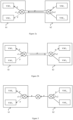
- FIG. 2a a first example of underlying hardware configuration, illustrated by the figure 2a , there virtualized network function VNF x of the production network VN A and the corresponding virtualized network function in the test virtual network VN B , VNF x′ , are hosted on the same host server h1. More precisely, the virtual machines which implement the virtualized network functions VNF x and VNF x′ are hosted by the same server h1.
- the network hypervisor installs a rule on a switch-type routing network equipment s1 located immediately upstream of the virtualized network function VNF x in production network VN A so that any packet destined for VNF x is duplicated and routed to VNF x' .
- the virtualized network function VNF x of the production network VN A is hosted by a first host server h1 and the corresponding virtualized network function VNF x′ in the test network VN B is hosted by a second host server h2.
- a tunnel (dotted on the figure 2b ) is established between the two host servers h1, h2, the switch s1 located immediately upstream of the virtualized network function VNF x and which routes packets to this virtualized network function is configured so that a packet intended for the VNF function x is duplicated and routed to the corresponding virtualized network function VNF x' through the tunnel configured for this purpose. It may be necessary to configure a switch s2 of the second host server h2 when several virtualized network functions are hosted by the second host server h2.
- a patch application step E5 the customer of the production virtual network VN A which controls the virtual network VN A and the test virtual network VN B , controls the application of the patch obtained during step E0 identification of a virtualized network function to be updated and development of a patch, to the clone of the virtualized network function to be updated VNF A , denoted VNF A , in the test network VN B .
- VNF A virtualized network function
- tools make it possible to apply such a patch without needing to restart the underlying virtual machine(s) of the virtualized network function VNF A′ , or more generally of the test network VN B .
- Ksplice an open source solution for Linux.
- a following supervision step E6 the customer supervises the operation of the virtualized network functions VNF DePA of the virtual production network VN A and the corresponding virtualized network functions VNF DepB of the virtual test network VN B .
- System and network performance indicators are thus collected at the level of all the virtualized network functions VNF DePA and the corresponding virtualized network functions VNF DepB .
- the same indicators are collected at the level of the virtual production network VN A and the virtual test network VN B .
- the network indicators include, for example, the number of packets or bytes transmitted, for a given connection or over a given period of time, the duration of the connections, the number of packets lost where applicable. Such network indicators are collected periodically and are accessible in a centralized infrastructure database.
- System indicators can be collected at the level of the virtualized network functions, in particular by means of system logs (or “logs” files in English). These other indicators include error codes and rates specific to the application implemented by the virtualized network function; they finely characterize the application that is executed.
- System indicators include for example a time or percentage of use of a CPU, of a memory, of a disk, etc. Such system indicators are collected by the manager of the virtual infrastructure, for example OpenStack.
- an analysis module of the network hypervisor proceeds to a comparison and an analysis of the various performance indicators collected on the one hand at the level of all the virtualized network functions VNF DePA and of the set of corresponding virtualized network functions VNF DepB of the test virtual network VN2 in which the security patch was applied to the clone VNF A , of the virtualized network function to be updated VNF A .
- the analysis module uses known analysis algorithms.
- the canonical correlation analysis algorithm better known by its English name “Canonical Correlation Analysis”, or “CCA”, is used.
- CCA Canononical Correlation Analysis
- the algorithm is thus applied to the values of the indicators collected on the one hand to all the virtualized network functions VNF DePA and on the other hand to all the corresponding virtualized network functions VNF DepB of the virtual test network VN2, more precisely to a virtualized network function of the VNF set DepA and its clone in the test virtual network VN B .
- the analysis is thus adapted to reveal different behaviors, with regard to performance, between a virtualized network function of the VNF set DepA of the production virtual network VN A and its clone in the test virtual network VN B .
- an alert is sent to the client when the behavior of a virtualized network function of the set of virtualized network functions VNF DePA differs from the behavior of its clone in the test virtual network VN B in concerns the performance measured by the performance indicators.
- Such an alert representative of an unsatisfactory patch, leads the customer, or an entity in charge of testing the patch, to launch a more in-depth analysis in order to understand the origin of this alert and to remedy it.
- the analysis can be manual.
- the invention has been described in the case of indirect control of the virtual networks by the clients, that is to say in a case where tunnels are established and managed by the network hypervisor to route packets between different functions virtualized network hosted by servers different hosts.
- the invention also applies to the case where the customer exercises so-called direct control of his virtual production network VN A .
- the hypervisor In the case of direct control by the client over his virtual network, the hypervisor allows the client to install rules in the routing network equipment so that he has end-to-end control over his network. This gives the client the impression of directly controlling the underlying physical network.
- the packets circulating for this purpose between the client's network controller and the hardware infrastructure are transparently intercepted by the network hypervisor which modifies control packets in order to ensure isolation between virtual networks.
- the hypervisor it is usual for the hypervisor to assign and manage a virtual network identifier, specific to the client's virtual network but not known to the latter.
- a rule on a routing network equipment for example a rule for copying packets between two virtualized network functions of its virtual network
- the network hypervisor intercepts the rule and add an identifier of the virtual network before the rule is installed on the routing network equipment so that the rule only applies to packets in the customer's virtual network.
- the network hypervisor In order to implement the steps of the method for applying the patch as described above in the case of direct control of the virtual network by the client, the network hypervisor must allow the installation of rules in the network equipment of routing so that it is possible to change the virtual network identifier of routed packets. Indeed, according to the steps of the method a packet, in this case a duplicate packet, can pass from the production network VN A to the test network VN B . This change must only be authorized by the network hypervisor if the test network VN B is dedicated to testing and if the production network VN A , in which the packets intended to be routed in the test network circulate, and the VN B test network belong to the same customer.
- the network hypervisor leaves the identifier of the virtual network in responses from the routing network equipment, so that the network operator is aware of this identifier and orders, for packets comprising this identifier, a route to the test virtual network.
- the hypervisor in the case of a conventional hypervisor, that is to say not modified for the purposes of implementing the steps of the method, it is usual for the hypervisor to remove this information from the responses received from the network equipment of routing for network isolation purposes.
- the hypervisor translates these identifiers into pseudo-identifiers. Only the hypervisor knows which virtual network identifier corresponds to a pseudo virtual network identifier. This solution guarantees a certain security to the hypervisor which does not disclose these identifiers qualified as sensitive.
- the example embodiment described above applies particularly well to services which are based on a transport protocol which is not connection-oriented, such as the UDP (User Datagram Protocol) protocol.
- UDP User Datagram Protocol
- two entities communicate in a simple way: a packet is transmitted from a sender to a recipient, unidirectionally, without the recipient being notified beforehand of the reception of a packet and without the latter not acknowledgment of the packet to the sender.
- a session In the case of a connection-oriented protocol, such as the transport protocol TCP (for “Transmission Control Protocol”), a session must be established between two entities which wish to exchange data.
- TCP Transmission Control Protocol
- a session In a connection establishment request prior to a data exchange, a first entity, called “client”, sends a second entity, called “server”, a “SYN” type synchronization packet.
- the server sends an acknowledgment in the form of a "SYN-ACK” packet.
- the client then sends an acknowledgment of receipt, in the form of an “ACK” packet corresponding to an acceptance message.
- the client and the server have established a session and are ready to communicate.
- the exchange of messages between the client and the server during the establishment of a session uses a sequence number generated from a secret value which can depend on a hardware random source.
- the secret value can also be derived from the exact arrival date of the packet, in which case if a virtualized network function of the set of dependent virtualized network functions in the operational virtual network receives a packet an instant before the corresponding virtualized network function in the test virtual network VN B then the two virtualized network functions do not have the same secret value.
- a session established with a virtualized network function of the virtual production network VN A within the framework of the execution of a service, is not established in a completely similar way with the corresponding virtualized network function in the virtual network of VN B test, due to this random component which may be different.
- the virtualized network function in production network VN A and its clone in test network VN B do not respond with the same sequence number when establishing this connection.
- Copying a packet intended for the virtualized network function of the first VN A network and routing it to its clone in the second network therefore does not allow the connection to be established with the clone because the sequence number generated at the clone level is inconsistent with the sequence number used by the virtualized network function in the first network VN A and therefore with the expected response.
- VNF GC virtualized connection management network function
- VNF GC intercepts any packet intended for a virtualized network function dependent on the production network VN A and which is duplicated by the network hypervisor then routed to the clone of the virtualized network function in the test network VN B .
- the virtualized network function for managing connections VNF GC is arranged to identify the communication protocol used in the current packet exchange and to apply a specific management of connections when the protocol is connection-oriented. It is also arranged to allow any other packet to pass without modification in the other cases.
- connection management virtualization network function The steps of a connection management method by the connection management virtualization network function, according to an exemplary embodiment, will now be described in relation to the figure 4 .
- a client for example another virtualized network function of the production network VN A , sends in a step E40 a packet synchronization in order to initiate the establishment of a connection with the virtualized network function VNF A in the production network VN A .
- the packet is duplicated by forwarding network equipment (not shown in figure).
- the VNF GC connection management virtualized network function intercepts this message.
- the virtualized network function for managing VNF connections GC identifies that this is a connection establishment request packet of a connection-oriented protocol and that it is necessary to apply a particular treatment. To this end, the virtualized network function for managing VNF GC connections analyzes the header of the packet.
- the virtualized network function for managing the VNF connections GC routes the connection establishment request packet to the clone VNF A , of the virtualized network function VNF A in the test network VN B .
- the virtualized network function VNF A responds to the connection establishment request by sending a first acknowledgment in a TCP SYN ACK packet comprising a first sequence number y1, generated from a random source.
- the VNF A clone of the virtualized network function sends in response a second acknowledgment in a TCP SYN ACK packet comprising a second sequence number y2 generated from a random source which can be different from the source used to generate the first sequence number y1.
- the virtualized network function for managing VNF connections GC stores the second sequence number y2 in association with the connection identifier Id cnx obtained during step E41.
- a third response step E45 the client CL sends to the virtualized network function VNF A an acknowledgment of receipt in the form of a TCP ACK packet comprising an acknowledgment number corresponding to the first sequence number y1 incremented by 1.
- the packet is duplicated and intended to be transmitted to the VNF clone A , of the virtualized network function in the test network VN B .
- the virtualized network function for managing VNF GC connections intercepts this packet and in a search and replace step E46, it identifies, from the 4-uple included in the packet, the connection Id cnx concerned and identifies the sequence number y2 stored in association with the TCP connection identifier Id cnx during step E44.
- the establishment of a TCP connection in the production network VN A which involves a virtualized network function of the set of dependent functions VNF DePA is implemented in a manner consistent with the method of applying the patch in the VNB test network B .
- the sequence and acknowledgment numbers are managed by the virtualized network function for managing VNF GC connections through which passes any packet that is duplicated and routed to a clone of a virtualized network function of the production network involved in the patch application process.
- a server capable of implementing the steps of the method for applying a patch to a virtualized network function to be updated, according to an exemplary embodiment, will now be described in relation to the figure 5 .
- the network hypervisor 54, the identification module 55, the creation module 56, the interconnection module 57, the identification, duplication and routing module 58, the application module 59 and the module 60 collection and comparison are preferably software modules comprising software instructions for implementing the steps of the method for applying a patch to a virtualized network function to be updated, as described previously, which are executed by the network hypervisor 54 hosted by server 50.
Landscapes
- Engineering & Computer Science (AREA)
- Computer Networks & Wireless Communication (AREA)
- Signal Processing (AREA)
- Software Systems (AREA)
- Theoretical Computer Science (AREA)
- General Engineering & Computer Science (AREA)
- Physics & Mathematics (AREA)
- General Physics & Mathematics (AREA)
- Environmental & Geological Engineering (AREA)
- Computer Security & Cryptography (AREA)
- Data Exchanges In Wide-Area Networks (AREA)
Claims (7)
- Verfahren zur Anwendung eines Patchs auf eine virtualisierte Netzwerkfunktion (VNFA), um die Aktualisierung der in einem ersten virtuellen Netzwerk (VNA) enthaltenen virtualisierten Netzwerkfunktion zu testen, wobei ein Netzwerk-Hypervisor sich über eine Schnittstelle zwischen dem ersten virtuellen Netzwerk und einer Einheit von mindestens einer Hardware-Ressource verbindet, die fähig ist, notwendige Ressourcen an das erste virtuelle Netzwerk zu liefern, wobei das vom Netzwerk-Hypervisor durchgeführte Verfahren enthält:- Identifizierung (E1) einer Einheit von im ersten virtuellen Netzwerk enthaltenen abhängigen virtualisierten Netzwerkfunktionen, wobei die Einheit mindestens die zu aktualisierende virtualisierte Netzwerkfunktion und mindestens eine funktional von der zu aktualisierenden Netzwerkfunktion abhängende Netzwerkfunktion enthält,- Erzeugung (E2) eines zweiten virtuellen Netzwerks (VNB), "virtuelles Testnetzwerk" genannt, wobei das virtuelle Testnetzwerk Klone von virtuellen Maschinen enthält, die die abhängigen virtualisierten Netzwerkfunktionen der Einheit durchführen, wobei die geklonten virtuellen Maschinen Klone der abhängigen virtualisierten Netzwerkfunktionen der Einheit bilden, wobei die geklonten virtuellen Maschinen über einen Systemzustand gleich dem der virtuellen Maschinen verfügen, die die abhängigen virtualisierten Netzwerkfunktionen der Einheit im ersten Netzwerk durchführen,- Zusammenschaltung (E3) der Klone der abhängigen virtualisierten Netzwerkfunktionen der Einheit im virtuellen Testnetzwerk, wobei die Zusammenschaltung gleich einer Zusammenschaltung der abhängigen virtualisierten Netzwerkfunktionen der Einheit im ersten Netzwerk ist,- Identifizierung (E4) mindestens eines Datenpakets am Eingang einer virtualisierten Netzwerkfunktion der Einheit von abhängigen virtualisierten Netzwerkfunktionen, Duplizierung des identifizierten Pakets und Weiterleitung des duplizierten Pakets an das virtuelle Testnetzwerk,- Anwendung (E5) des Patchs auf den Klon der zu aktualisierenden virtualisierten Netzwerkfunktion im Testnetzwerk,- Sammeln und Vergleich (E6, E7) von Werten mindestens eines ersten und eines zweiten Leistungsindikators, wobei ein erster Indikator einen Leistungswert an einer virtualisierten Netzwerkfunktion der Einheit bei der Weiterleitung von Paketen am Eingang der virtualisierten Netzwerkfunktion im ersten virtuellen Netzwerk misst, und ein zweiter Indikator den Leistungswert am Klon der entsprechenden virtualisierten Netzwerkfunktion bei der Weiterleitung von duplizierten Paketen am Eingang der entsprechenden virtualisierten Netzwerkfunktion im virtuellen Testnetzwerk misst, wobei ein Alarm ausgelöst wird, wenn die Werte der ersten und zweiten Indikatoren sich unterscheiden.
- Verfahren nach Anspruch 1, wobei, wenn ein Manager einer virtuellen Infrastruktur einem Kunden, dem das erste virtuelle Netzwerk zugewiesen wurde, eine Schnittstelle des Netzwerk-Hypervisors zur Verfügung stellt, damit der Kunde das erste virtuelle Netzwerk kontrolliert, wobei der Kunde so eine so genannte indirekte Kontrolle des ersten virtuellen Netzwerks ausübt, die Identifizierung eines Pakets am Eingang einer virtualisierten Netzwerkfunktion der Einheit von abhängigen virtualisierten Netzwerkfunktionen, die Duplizierung und die Weiterleitung des duplizierten Pakets zum Testnetzwerk, wenn die virtualisierte Netzwerkfunktion der Einheit von abhängigen virtualisierten Netzwerkfunktionen und der Klon der im zweiten Netzwerk enthaltenen entsprechenden virtualisierten Netzwerkfunktion von einem gleichen Host-Server (h1) gehostet werden, enthält:
die Installierung einer Konfigurationsregel auf einer Weiterleitungs-Netzwerkausrüstung des Host-Servers, wobei die Weiterleitungs-Netzwerkausrüstung geeignet ist, das Paket an die virtualisierte Netzwerkfunktion der Einheit von abhängigen virtualisierten Netzwerkfunktionen zu übertragen, wobei die Konfigurationsregel eine Duplizierung des Pakets am Eingang der virtualisierten Netzwerkfunktion der Einheit von abhängigen virtualisierten Netzwerkfunktionen und ein Senden des duplizierten Pakets an den Klon der im zweiten Netzwerk enthaltenen und vom Host-Server gehosteten entsprechenden virtualisierten Netzwerkfunktion enthält. - Verfahren nach Anspruch 1, wobei, wenn ein Manager einer virtuellen Infrastruktur einem Kunden, dem das erste virtuelle Netzwerk zugewiesen wurde, eine Schnittstelle des Netzwerk-Hypervisors zur Verfügung stellt, damit der Kunde das erste virtuelle Netzwerk kontrolliert, wobei der Kunde so eine so genannte indirekte Kontrolle des ersten virtuellen Netzwerks ausübt, die Identifizierung eines Pakets am Eingang einer virtualisierten Netzwerkfunktion der Einheit von abhängigen virtualisierten Netzwerkfunktionen, die Duplizierung und die Weiterleitung des duplizierten Pakets zur entsprechenden Netzwerkfunktion im Testnetzwerk, wenn die virtualisierte Netzwerkfunktion der Einheit von abhängigen virtualisierten Netzwerkfunktionen von einem ersten Host-Server (h1) gehostet wird und der Klon der im zweiten Netzwerk enthaltenen entsprechenden virtualisierten Netzwerkfunktion von einem zweiten Host-Server (h2) gehostet wird, enthält:
die Installierung einer ersten Konfigurationsregel auf einer ersten Weiterleitungs-Netzwerkausrüstung (s1) des ersten Host-Servers, wobei die erste Weiterleitungs-Netzwerkausrüstung geeignet ist, das Paket an die virtualisierte Netzwerkfunktion der Einheit von abhängigen virtualisierten Netzwerkfunktionen zu übertragen, wobei die Konfigurationsregel eine Duplizierung des Pakets am Eingang der virtualisierten Netzwerkfunktion der Einheit von abhängigen virtualisierten Netzwerkfunktionen und ein Senden des duplizierten Pakets an den zweiten Server enthält, wobei eine zweite Konfigurationsregel auf einer im zweiten Host-Server enthaltenen zweiten Weiterleitungs-Netzwerkausrüstung (s2) installiert wird, wobei die zweite Konfigurationsregel das Senden des Pakets an den Klon der entsprechenden virtualisierten Netzwerkfunktion enthält, die im zweiten Netzwerk enthalten ist und vom zweiten Host-Server gehostet wird. - Verfahren nach Anspruch 1, wobei der Netzwerk-Hypervisor von einem Betreiber des ersten virtuellen Netzwerks eine Regel empfängt, die dazu bestimmt ist, in einer Weiterleitungs-Netzwerkausrüstung installiert zu werden, wobei die Regel eine Kennung des ersten virtuellen Netzwerks, die in einem Paket enthalten ist, das dazu bestimmt ist, zum virtuellen Testnetzwerk weitergeleitet zu werden, in eine Kennung des virtuellen Testnetzwerks ändert, wobei die Regel in der Ausrüstung vom Hypervisor installiert wird, wenn das virtuelle Testnetzwerk den Tests virtualisierter Netzwerkfunktionen dediziert ist und das erste virtuelle Netzwerk und das virtuelle Testnetzwerk dem gleichen Kunden gehören.
- Verfahren nach einem der vorhergehenden Ansprüche, wobei, wenn ein verbindungsorientiertes Kommunikationsprotokoll verwendet wird, um mit einer abhängigen virtualisierten Netzwerkfunktion der Einheit zu kommunizieren, der Schritt der Identifizierung, der Duplizierung und der Weiterleitung eines Pakets zum Testnetzwerk in einer Aufbauphase einer Verbindung enthält:- Empfang (E41) eines Synchronisationspakets, wobei das Paket von der abhängigen virtualisierten Netzwerkfunktion empfangen, dupliziert und dazu bestimmt wurde, zur entsprechenden virtualisierten Netzwerkfunktion im Testnetzwerk weitergeleitet zu werden, wobei das Paket eine Verbindungskennung (Idcnx) enthält, und Weiterleitung des Synchronisationspakets zur entsprechenden virtualisierten Netzwerkfunktion im Testnetzwerk,- Empfang (E44) von der entsprechenden virtualisierten Netzwerkfunktion kommend eines ersten Quittierungspakets, das eine erste Folgenummer (y2) enthält, und Zuordnung der im Quittierungspaket enthaltenen ersten Folgenummer (y2) zur Verbindungskennung (Idcnx), und Weiterleitung des Quittierungspakets,- Empfang (E46) eines zweiten Quittierungspakets, wobei das zweite Quittierungspaket vorher von der abhängigen virtualisierten Netzwerkfunktion empfangen, dupliziert und dazu bestimmt wurde, zur entsprechenden virtualisierten Netzwerkfunktion im Testnetzwerk weitergeleitet zu werden, wobei das Paket die Verbindungskennung (Idcnx) und eine erste Quittierungsnummer (y1+1) enthält, die durch Inkrementieren einer vorher generierten und von der abhängigen virtualisierten Netzwerkfunktion übertragenen zweiten Folgenummer berechnet wird, und Ersetzen in dem zweiten Quittierungspaket der ersten Quittierungsnummer (y1+1) durch eine zweite Quittierungsnummer, die durch Inkrementieren der ersten Folgenummer (y2+1) berechnet wurde, und Weiterleiten des zweiten Quittierungspakets an die entsprechende virtualisierte Netzwerkfunktion im Testnetzwerk.
- Server (50), der einen Netzwerk-Hypervisor enthält, der sich über eine Schnittstelle zwischen einem ersten virtuellen Netzwerk und einer Einheit von mindestens einer Hardware-Ressource verbindet, die fähig ist, an das erste virtuelle Netzwerk notwendige Ressourcen zu liefern, wobei der Hypervisor geeignet ist, die Aktualisierung einer in dem ersten virtuellen Netzwerk (VNA) enthaltenen zu aktualisierenden virtualisierten Netzwerkfunktion (VNFA) durch Anwendung eines Patchs zu testen, wobei der Server enthält:- erste Identifizierungseinrichtungen, die eingerichtet sind, eine Einheit von im ersten virtuellen Netzwerk enthaltenen abhängigen virtualisierten Netzwerkfunktionen zu identifizieren, wobei die Einheit mindestens die zu aktualisierende virtualisierte Netzwerkfunktion und mindestens eine Netzwerkfunktion enthält, die funktional von der zu aktualisierenden Netzwerkfunktion abhängt,- Erzeugungseinrichtungen, die eingerichtet sind, ein zweites virtuelles Netzwerk (VNB) zu erzeugen, "virtuelles Testnetzwerk" genannt, wobei das virtuelle Testnetzwerk Klone von virtuellen Maschinen enthält, die die abhängigen virtualisierten Netzwerkfunktionen der Einheit durchführen, wobei die geklonten virtuellen Maschinen Klone der abhängigen virtualisierten Netzwerkfunktionen der Einheit bilden, wobei die geklonten virtuellen Maschinen über einen Systemzustand verfügen, der gleich demjenigen der virtuellen Maschinen ist, die die abhängigen virtualisierten Netzwerkfunktionen der Einheit im ersten Netzwerk durchführen,- Zusammenschaltungseinrichtungen, die eingerichtet sind, um im virtuellen Testnetzwerk Klone der abhängigen virtualisierten Netzwerkfunktionen der Einheit zusammenzuschalten, wobei die Zusammenschaltung der Klone der abhängigen virtualisierten Netzwerkfunktionen der Einheit gleich einer Zusammenschaltung der abhängigen virtualisierten Netzwerkfunktionen der Einheit im ersten Netzwerk ist,- Identifizierungs-, Duplizierungs- und Weiterleitungseinrichtungen, die eingerichtet sind, mindestens ein Datenpaket am Eingang einer virtualisierten Netzwerkfunktion der Einheit von abhängigen virtualisierten Netzwerkfunktionen zu identifizieren, das identifizierte Paket zu duplizieren und das duplizierte Paket zum virtuellen Testnetzwerk weiterzuleiten,- Anwendungseinrichtungen, die eingerichtet sind, den Patch auf den Klon der zu aktualisierenden virtualisierten Netzwerkfunktion im Testnetzwerk anzuwenden,- Sammel- und Vergleichseinrichtungen, die eingerichtet sind, Werte mindestens eines ersten und eines zweiten Leistungsindikators zu sammeln und zu vergleichen, wobei ein erster Indikator einen Leistungswert auf einer virtualisierten Netzwerkfunktion der Einheit bei der Weiterleitung von Paketen am Eingang der virtualisierten Netzwerkfunktion im ersten virtuellen Netzwerk misst, und ein zweiter Indikator den Leistungswert auf dem Klon der entsprechenden virtualisierten Netzwerkfunktion bei der Weiterleitung duplizierter Pakete am Eingang der entsprechenden virtualisierten Funktion im virtuellen Testnetzwerk misst, wobei ein Alarm ausgelöst wird, wenn die Werte der ersten und zweiten Indikatoren sich unterscheiden.
- Computerprogramm auf einem Datenträger und in den Speicher eines Computerservers ladbar, das Programmcodeanweisungen enthält, die dazu bestimmt sind, die Ausführung der Schritte des Anwendungsverfahrens eines Patchs auf eine virtualisierte Netzwerkfunktion, um die Aktualisierung der virtualisierten Netzwerkfunktion in einem virtuellen Netzwerk zu testen, nach einem der Ansprüche 1 bis 5 zu befehlen, wenn das Programm auf dem Server ausgeführt wird.
Applications Claiming Priority (2)
| Application Number | Priority Date | Filing Date | Title |
|---|---|---|---|
| FR1760280A FR3073108A1 (fr) | 2017-10-31 | 2017-10-31 | Procede d'application d'un correctif sur une fonction reseau virtualisee a mettre a jour. |
| PCT/FR2018/052638 WO2019086783A1 (fr) | 2017-10-31 | 2018-10-24 | Procédé d'application d'un correctif sur une fonction réseau virtualisée à mettre à jour |
Publications (2)
| Publication Number | Publication Date |
|---|---|
| EP3704833A1 EP3704833A1 (de) | 2020-09-09 |
| EP3704833B1 true EP3704833B1 (de) | 2023-03-29 |
Family
ID=61750222
Family Applications (1)
| Application Number | Title | Priority Date | Filing Date |
|---|---|---|---|
| EP18808422.2A Active EP3704833B1 (de) | 2017-10-31 | 2018-10-24 | Verfahren zum anwenden eines patchs auf eine zu aktualisierende virtualisierte netzwerkfunktion |
Country Status (4)
| Country | Link |
|---|---|
| US (1) | US11218370B2 (de) |
| EP (1) | EP3704833B1 (de) |
| FR (1) | FR3073108A1 (de) |
| WO (1) | WO2019086783A1 (de) |
Families Citing this family (9)
| Publication number | Priority date | Publication date | Assignee | Title |
|---|---|---|---|---|
| US11483762B2 (en) * | 2019-02-22 | 2022-10-25 | Vmware, Inc. | Virtual service networks |
| US11469942B2 (en) | 2019-08-15 | 2022-10-11 | At&T Intellectual Property I, L.P. | System and method for SDN orchestration validation |
| US11303517B2 (en) * | 2020-01-07 | 2022-04-12 | International Business Machines Corporation | Software patch optimization |
| US12500778B2 (en) * | 2020-05-26 | 2025-12-16 | Verizon Patent And Licensing Inc. | Systems and methods for managing public key infrastructure certificates for components of a network |
| EP4420324A1 (de) * | 2021-10-22 | 2024-08-28 | Dish Wireless L.L.C. | Systeme und verfahren für cloud-natives netzwerk-slicing und testen als dienst mit kontinuierlicher integration und kontinuierlicher bereitstellung (ci/cd)-kapazität |
| US12561122B2 (en) * | 2022-03-24 | 2026-02-24 | International Business Machines Corporation | Software package update handling |
| CN114816998A (zh) * | 2022-03-29 | 2022-07-29 | 深圳市华迅光通信有限公司 | 一种测试光猫可靠性的自动化测试方法 |
| EP4643252A1 (de) * | 2022-12-29 | 2025-11-05 | Telefonaktiebolaget LM Ericsson (publ) | Bestimmung der ausgabe aus einer doppelnetzwerkfunktion |
| WO2025052404A1 (en) * | 2023-09-08 | 2025-03-13 | Jio Platforms Limited | Method and system for facilitating routing in a network |
Family Cites Families (7)
| Publication number | Priority date | Publication date | Assignee | Title |
|---|---|---|---|---|
| US10063453B1 (en) * | 2014-08-07 | 2018-08-28 | Amdocs Development Limited | System, method, and computer program for tag based testing of virtual services |
| GB2523338A (en) * | 2014-02-20 | 2015-08-26 | Ng4T Gmbh | Testing a virtualised network function in a network |
| US9594649B2 (en) * | 2014-10-13 | 2017-03-14 | At&T Intellectual Property I, L.P. | Network virtualization policy management system |
| US20160132420A1 (en) * | 2014-11-10 | 2016-05-12 | Institute For Information Industry | Backup method, pre-testing method for environment updating and system thereof |
| CN104410672B (zh) * | 2014-11-12 | 2017-11-24 | 华为技术有限公司 | 网络功能虚拟化应用升级的方法、转发业务的方法及装置 |
| CN107534571B (zh) * | 2015-10-30 | 2020-12-01 | 慧与发展有限责任合伙企业 | 用于管理虚拟网络功能的方法、系统和计算机可读介质 |
| US10489180B2 (en) * | 2016-10-31 | 2019-11-26 | Hewlett Packard Enterprise Development Lp | Determining virtual network function configurations |
-
2017
- 2017-10-31 FR FR1760280A patent/FR3073108A1/fr not_active Withdrawn
-
2018
- 2018-10-24 WO PCT/FR2018/052638 patent/WO2019086783A1/fr not_active Ceased
- 2018-10-24 US US16/760,308 patent/US11218370B2/en active Active
- 2018-10-24 EP EP18808422.2A patent/EP3704833B1/de active Active
Also Published As
| Publication number | Publication date |
|---|---|
| WO2019086783A1 (fr) | 2019-05-09 |
| US20210021462A1 (en) | 2021-01-21 |
| EP3704833A1 (de) | 2020-09-09 |
| FR3073108A1 (fr) | 2019-05-03 |
| US11218370B2 (en) | 2022-01-04 |
Similar Documents
| Publication | Publication Date | Title |
|---|---|---|
| EP3704833B1 (de) | Verfahren zum anwenden eines patchs auf eine zu aktualisierende virtualisierte netzwerkfunktion | |
| CN108141380B (zh) | 基于网络的资源配置发现服务 | |
| EP2457159B1 (de) | Dynamische migration von computernetzwerken | |
| US20160212012A1 (en) | System and method of network functions virtualization of network services within and across clouds | |
| US20070274285A1 (en) | System and method for configuring a router | |
| EP3485610A1 (de) | Erweiterung eines netzwerksteuerungssystems in eine öffentliche cloud | |
| US20070274230A1 (en) | System and method for modifying router firmware | |
| CN113014427A (zh) | 网络管理方法和设备,及存储介质 | |
| US12470520B2 (en) | Wildcard based private application access | |
| EP2168358B1 (de) | Verfahren und vorrichtung zur kommunikation diagnostischer daten in einem echtzeit-kommunikationsnetzwerk | |
| US20250112893A1 (en) | Centralized identity redistribution | |
| US20230040377A1 (en) | Autonomous distributed wide area network having control plane and order management on a blockchain | |
| US20250335172A1 (en) | Method and system for automated deployment of a computing infrastructure | |
| EP2847939A1 (de) | Datenübertragungssystem | |
| US20100250737A1 (en) | Detecting and controlling peer-to-peer traffic | |
| Alatalo | Cisco Secure Network Analytics (Stealthwatch) | |
| US12348488B2 (en) | Devices, methods, and computer-readable media for deploying modular network architecture | |
| US20230164114A1 (en) | System and method for managing and securing an enterprise network associated with an organization | |
| EP4620156A1 (de) | Zentralisierte identitätsumverteilung | |
| de Vos | Time-Sensitive Networking IEEE 802.1 CB: Security and Reliability | |
| Haga | Towards 5g network slice isolation with wireguard and open source mano | |
| FAIZAL | OPTIMIZATION OF VIRTUAL NETWORK QUALITY THROUGH PROTOCOL ANALYSIS | |
| EP4066460A1 (de) | Unterstützungsverfahren zur verwaltung eines cyber-angriffs sowie vorrichtung und system dafür | |
| Pleschiutschnig | The effects on system security and provisioning process flows caused by a dynamic trivial file transfer protocol service in large service provider networks | |
| CA2547448A1 (en) | System and method for configuring a router |
Legal Events
| Date | Code | Title | Description |
|---|---|---|---|
| STAA | Information on the status of an ep patent application or granted ep patent |
Free format text: STATUS: UNKNOWN |
|
| STAA | Information on the status of an ep patent application or granted ep patent |
Free format text: STATUS: THE INTERNATIONAL PUBLICATION HAS BEEN MADE |
|
| PUAI | Public reference made under article 153(3) epc to a published international application that has entered the european phase |
Free format text: ORIGINAL CODE: 0009012 |
|
| STAA | Information on the status of an ep patent application or granted ep patent |
Free format text: STATUS: REQUEST FOR EXAMINATION WAS MADE |
|
| 17P | Request for examination filed |
Effective date: 20200527 |
|
| AK | Designated contracting states |
Kind code of ref document: A1 Designated state(s): AL AT BE BG CH CY CZ DE DK EE ES FI FR GB GR HR HU IE IS IT LI LT LU LV MC MK MT NL NO PL PT RO RS SE SI SK SM TR |
|
| AX | Request for extension of the european patent |
Extension state: BA ME |
|
| DAV | Request for validation of the european patent (deleted) | ||
| DAX | Request for extension of the european patent (deleted) | ||
| STAA | Information on the status of an ep patent application or granted ep patent |
Free format text: STATUS: EXAMINATION IS IN PROGRESS |
|
| 17Q | First examination report despatched |
Effective date: 20210428 |
|
| RAP3 | Party data changed (applicant data changed or rights of an application transferred) |
Owner name: ORANGE |
|
| REG | Reference to a national code |
Ref country code: DE Ref legal event code: R079 Ref document number: 602018047829 Country of ref document: DE Free format text: PREVIOUS MAIN CLASS: H04L0012240000 Ipc: H04L0041082000 |
|
| GRAP | Despatch of communication of intention to grant a patent |
Free format text: ORIGINAL CODE: EPIDOSNIGR1 |
|
| STAA | Information on the status of an ep patent application or granted ep patent |
Free format text: STATUS: GRANT OF PATENT IS INTENDED |
|
| RIC1 | Information provided on ipc code assigned before grant |
Ipc: G06F 9/455 20180101ALI20220610BHEP Ipc: H04L 41/40 20220101ALI20220610BHEP Ipc: H04L 41/0897 20220101ALI20220610BHEP Ipc: G06F 8/65 20180101ALI20220610BHEP Ipc: H04L 41/0866 20220101ALI20220610BHEP Ipc: H04L 41/0681 20220101ALI20220610BHEP Ipc: H04L 43/50 20220101ALI20220610BHEP Ipc: H04L 43/08 20220101ALI20220610BHEP Ipc: H04L 41/082 20220101AFI20220610BHEP |
|
| INTG | Intention to grant announced |
Effective date: 20220701 |
|
| GRAJ | Information related to disapproval of communication of intention to grant by the applicant or resumption of examination proceedings by the epo deleted |
Free format text: ORIGINAL CODE: EPIDOSDIGR1 |
|
| STAA | Information on the status of an ep patent application or granted ep patent |
Free format text: STATUS: EXAMINATION IS IN PROGRESS |
|
| GRAP | Despatch of communication of intention to grant a patent |
Free format text: ORIGINAL CODE: EPIDOSNIGR1 |
|
| STAA | Information on the status of an ep patent application or granted ep patent |
Free format text: STATUS: GRANT OF PATENT IS INTENDED |
|
| INTC | Intention to grant announced (deleted) | ||
| INTG | Intention to grant announced |
Effective date: 20221114 |
|
| GRAS | Grant fee paid |
Free format text: ORIGINAL CODE: EPIDOSNIGR3 |
|
| GRAA | (expected) grant |
Free format text: ORIGINAL CODE: 0009210 |
|
| STAA | Information on the status of an ep patent application or granted ep patent |
Free format text: STATUS: THE PATENT HAS BEEN GRANTED |
|
| AK | Designated contracting states |
Kind code of ref document: B1 Designated state(s): AL AT BE BG CH CY CZ DE DK EE ES FI FR GB GR HR HU IE IS IT LI LT LU LV MC MK MT NL NO PL PT RO RS SE SI SK SM TR |
|
| REG | Reference to a national code |
Ref country code: CH Ref legal event code: EP |
|
| REG | Reference to a national code |
Ref country code: DE Ref legal event code: R096 Ref document number: 602018047829 Country of ref document: DE |
|
| REG | Reference to a national code |
Ref country code: AT Ref legal event code: REF Ref document number: 1557443 Country of ref document: AT Kind code of ref document: T Effective date: 20230415 |
|
| REG | Reference to a national code |
Ref country code: IE Ref legal event code: FG4D Free format text: LANGUAGE OF EP DOCUMENT: FRENCH |
|
| REG | Reference to a national code |
Ref country code: LT Ref legal event code: MG9D |
|
| PG25 | Lapsed in a contracting state [announced via postgrant information from national office to epo] |
Ref country code: RS Free format text: LAPSE BECAUSE OF FAILURE TO SUBMIT A TRANSLATION OF THE DESCRIPTION OR TO PAY THE FEE WITHIN THE PRESCRIBED TIME-LIMIT Effective date: 20230329 Ref country code: NO Free format text: LAPSE BECAUSE OF FAILURE TO SUBMIT A TRANSLATION OF THE DESCRIPTION OR TO PAY THE FEE WITHIN THE PRESCRIBED TIME-LIMIT Effective date: 20230629 Ref country code: LV Free format text: LAPSE BECAUSE OF FAILURE TO SUBMIT A TRANSLATION OF THE DESCRIPTION OR TO PAY THE FEE WITHIN THE PRESCRIBED TIME-LIMIT Effective date: 20230329 Ref country code: LT Free format text: LAPSE BECAUSE OF FAILURE TO SUBMIT A TRANSLATION OF THE DESCRIPTION OR TO PAY THE FEE WITHIN THE PRESCRIBED TIME-LIMIT Effective date: 20230329 Ref country code: HR Free format text: LAPSE BECAUSE OF FAILURE TO SUBMIT A TRANSLATION OF THE DESCRIPTION OR TO PAY THE FEE WITHIN THE PRESCRIBED TIME-LIMIT Effective date: 20230329 |
|
| REG | Reference to a national code |
Ref country code: NL Ref legal event code: MP Effective date: 20230329 |
|
| REG | Reference to a national code |
Ref country code: AT Ref legal event code: MK05 Ref document number: 1557443 Country of ref document: AT Kind code of ref document: T Effective date: 20230329 |
|
| PG25 | Lapsed in a contracting state [announced via postgrant information from national office to epo] |
Ref country code: SE Free format text: LAPSE BECAUSE OF FAILURE TO SUBMIT A TRANSLATION OF THE DESCRIPTION OR TO PAY THE FEE WITHIN THE PRESCRIBED TIME-LIMIT Effective date: 20230329 Ref country code: NL Free format text: LAPSE BECAUSE OF FAILURE TO SUBMIT A TRANSLATION OF THE DESCRIPTION OR TO PAY THE FEE WITHIN THE PRESCRIBED TIME-LIMIT Effective date: 20230329 Ref country code: GR Free format text: LAPSE BECAUSE OF FAILURE TO SUBMIT A TRANSLATION OF THE DESCRIPTION OR TO PAY THE FEE WITHIN THE PRESCRIBED TIME-LIMIT Effective date: 20230630 Ref country code: FI Free format text: LAPSE BECAUSE OF FAILURE TO SUBMIT A TRANSLATION OF THE DESCRIPTION OR TO PAY THE FEE WITHIN THE PRESCRIBED TIME-LIMIT Effective date: 20230329 |
|
| PG25 | Lapsed in a contracting state [announced via postgrant information from national office to epo] |
Ref country code: SM Free format text: LAPSE BECAUSE OF FAILURE TO SUBMIT A TRANSLATION OF THE DESCRIPTION OR TO PAY THE FEE WITHIN THE PRESCRIBED TIME-LIMIT Effective date: 20230329 Ref country code: RO Free format text: LAPSE BECAUSE OF FAILURE TO SUBMIT A TRANSLATION OF THE DESCRIPTION OR TO PAY THE FEE WITHIN THE PRESCRIBED TIME-LIMIT Effective date: 20230329 Ref country code: PT Free format text: LAPSE BECAUSE OF FAILURE TO SUBMIT A TRANSLATION OF THE DESCRIPTION OR TO PAY THE FEE WITHIN THE PRESCRIBED TIME-LIMIT Effective date: 20230731 Ref country code: ES Free format text: LAPSE BECAUSE OF FAILURE TO SUBMIT A TRANSLATION OF THE DESCRIPTION OR TO PAY THE FEE WITHIN THE PRESCRIBED TIME-LIMIT Effective date: 20230329 Ref country code: EE Free format text: LAPSE BECAUSE OF FAILURE TO SUBMIT A TRANSLATION OF THE DESCRIPTION OR TO PAY THE FEE WITHIN THE PRESCRIBED TIME-LIMIT Effective date: 20230329 Ref country code: AT Free format text: LAPSE BECAUSE OF FAILURE TO SUBMIT A TRANSLATION OF THE DESCRIPTION OR TO PAY THE FEE WITHIN THE PRESCRIBED TIME-LIMIT Effective date: 20230329 |
|
| PG25 | Lapsed in a contracting state [announced via postgrant information from national office to epo] |
Ref country code: SK Free format text: LAPSE BECAUSE OF FAILURE TO SUBMIT A TRANSLATION OF THE DESCRIPTION OR TO PAY THE FEE WITHIN THE PRESCRIBED TIME-LIMIT Effective date: 20230329 Ref country code: PL Free format text: LAPSE BECAUSE OF FAILURE TO SUBMIT A TRANSLATION OF THE DESCRIPTION OR TO PAY THE FEE WITHIN THE PRESCRIBED TIME-LIMIT Effective date: 20230329 Ref country code: IS Free format text: LAPSE BECAUSE OF FAILURE TO SUBMIT A TRANSLATION OF THE DESCRIPTION OR TO PAY THE FEE WITHIN THE PRESCRIBED TIME-LIMIT Effective date: 20230729 |
|
| REG | Reference to a national code |
Ref country code: DE Ref legal event code: R097 Ref document number: 602018047829 Country of ref document: DE |
|
| PG25 | Lapsed in a contracting state [announced via postgrant information from national office to epo] |
Ref country code: DK Free format text: LAPSE BECAUSE OF FAILURE TO SUBMIT A TRANSLATION OF THE DESCRIPTION OR TO PAY THE FEE WITHIN THE PRESCRIBED TIME-LIMIT Effective date: 20230329 Ref country code: CZ Free format text: LAPSE BECAUSE OF FAILURE TO SUBMIT A TRANSLATION OF THE DESCRIPTION OR TO PAY THE FEE WITHIN THE PRESCRIBED TIME-LIMIT Effective date: 20230329 |
|
| PLBE | No opposition filed within time limit |
Free format text: ORIGINAL CODE: 0009261 |
|
| STAA | Information on the status of an ep patent application or granted ep patent |
Free format text: STATUS: NO OPPOSITION FILED WITHIN TIME LIMIT |
|
| 26N | No opposition filed |
Effective date: 20240103 |
|
| PG25 | Lapsed in a contracting state [announced via postgrant information from national office to epo] |
Ref country code: SI Free format text: LAPSE BECAUSE OF FAILURE TO SUBMIT A TRANSLATION OF THE DESCRIPTION OR TO PAY THE FEE WITHIN THE PRESCRIBED TIME-LIMIT Effective date: 20230329 |
|
| PG25 | Lapsed in a contracting state [announced via postgrant information from national office to epo] |
Ref country code: SI Free format text: LAPSE BECAUSE OF FAILURE TO SUBMIT A TRANSLATION OF THE DESCRIPTION OR TO PAY THE FEE WITHIN THE PRESCRIBED TIME-LIMIT Effective date: 20230329 Ref country code: IT Free format text: LAPSE BECAUSE OF FAILURE TO SUBMIT A TRANSLATION OF THE DESCRIPTION OR TO PAY THE FEE WITHIN THE PRESCRIBED TIME-LIMIT Effective date: 20230329 Ref country code: MC Free format text: LAPSE BECAUSE OF FAILURE TO SUBMIT A TRANSLATION OF THE DESCRIPTION OR TO PAY THE FEE WITHIN THE PRESCRIBED TIME-LIMIT Effective date: 20230329 |
|
| REG | Reference to a national code |
Ref country code: CH Ref legal event code: PL |
|
| REG | Reference to a national code |
Ref country code: BE Ref legal event code: MM Effective date: 20231031 |
|
| PG25 | Lapsed in a contracting state [announced via postgrant information from national office to epo] |
Ref country code: LU Free format text: LAPSE BECAUSE OF NON-PAYMENT OF DUE FEES Effective date: 20231024 |
|
| PG25 | Lapsed in a contracting state [announced via postgrant information from national office to epo] |
Ref country code: LU Free format text: LAPSE BECAUSE OF NON-PAYMENT OF DUE FEES Effective date: 20231024 |
|
| PG25 | Lapsed in a contracting state [announced via postgrant information from national office to epo] |
Ref country code: CH Free format text: LAPSE BECAUSE OF NON-PAYMENT OF DUE FEES Effective date: 20231031 |
|
| PG25 | Lapsed in a contracting state [announced via postgrant information from national office to epo] |
Ref country code: CH Free format text: LAPSE BECAUSE OF NON-PAYMENT OF DUE FEES Effective date: 20231031 |
|
| PG25 | Lapsed in a contracting state [announced via postgrant information from national office to epo] |
Ref country code: BE Free format text: LAPSE BECAUSE OF NON-PAYMENT OF DUE FEES Effective date: 20231031 |
|
| PG25 | Lapsed in a contracting state [announced via postgrant information from national office to epo] |
Ref country code: IE Free format text: LAPSE BECAUSE OF NON-PAYMENT OF DUE FEES Effective date: 20231024 |
|
| PG25 | Lapsed in a contracting state [announced via postgrant information from national office to epo] |
Ref country code: IE Free format text: LAPSE BECAUSE OF NON-PAYMENT OF DUE FEES Effective date: 20231024 |
|
| PG25 | Lapsed in a contracting state [announced via postgrant information from national office to epo] |
Ref country code: BG Free format text: LAPSE BECAUSE OF FAILURE TO SUBMIT A TRANSLATION OF THE DESCRIPTION OR TO PAY THE FEE WITHIN THE PRESCRIBED TIME-LIMIT Effective date: 20230329 |
|
| PG25 | Lapsed in a contracting state [announced via postgrant information from national office to epo] |
Ref country code: BG Free format text: LAPSE BECAUSE OF FAILURE TO SUBMIT A TRANSLATION OF THE DESCRIPTION OR TO PAY THE FEE WITHIN THE PRESCRIBED TIME-LIMIT Effective date: 20230329 |
|
| PG25 | Lapsed in a contracting state [announced via postgrant information from national office to epo] |
Ref country code: CY Free format text: LAPSE BECAUSE OF FAILURE TO SUBMIT A TRANSLATION OF THE DESCRIPTION OR TO PAY THE FEE WITHIN THE PRESCRIBED TIME-LIMIT; INVALID AB INITIO Effective date: 20181024 |
|
| PG25 | Lapsed in a contracting state [announced via postgrant information from national office to epo] |
Ref country code: HU Free format text: LAPSE BECAUSE OF FAILURE TO SUBMIT A TRANSLATION OF THE DESCRIPTION OR TO PAY THE FEE WITHIN THE PRESCRIBED TIME-LIMIT; INVALID AB INITIO Effective date: 20181024 |
|
| PGFP | Annual fee paid to national office [announced via postgrant information from national office to epo] |
Ref country code: GB Payment date: 20250923 Year of fee payment: 8 |
|
| PGFP | Annual fee paid to national office [announced via postgrant information from national office to epo] |
Ref country code: FR Payment date: 20250924 Year of fee payment: 8 |
|
| PG25 | Lapsed in a contracting state [announced via postgrant information from national office to epo] |
Ref country code: TR Free format text: LAPSE BECAUSE OF FAILURE TO SUBMIT A TRANSLATION OF THE DESCRIPTION OR TO PAY THE FEE WITHIN THE PRESCRIBED TIME-LIMIT Effective date: 20230329 |
|
| PGFP | Annual fee paid to national office [announced via postgrant information from national office to epo] |
Ref country code: DE Payment date: 20250923 Year of fee payment: 8 |