EP3706494B1 - Appareil et procédé d'attribution de ressources pour des canaux de données et de commande dans un système de communication sans fil - Google Patents
Appareil et procédé d'attribution de ressources pour des canaux de données et de commande dans un système de communication sans fil Download PDFInfo
- Publication number
- EP3706494B1 EP3706494B1 EP20170843.5A EP20170843A EP3706494B1 EP 3706494 B1 EP3706494 B1 EP 3706494B1 EP 20170843 A EP20170843 A EP 20170843A EP 3706494 B1 EP3706494 B1 EP 3706494B1
- Authority
- EP
- European Patent Office
- Prior art keywords
- resource
- control channel
- resource blocks
- information
- control
- Prior art date
- Legal status (The legal status is an assumption and is not a legal conclusion. Google has not performed a legal analysis and makes no representation as to the accuracy of the status listed.)
- Active
Links
Images


Classifications
-
- H—ELECTRICITY
- H04—ELECTRIC COMMUNICATION TECHNIQUE
- H04W—WIRELESS COMMUNICATION NETWORKS
- H04W72/00—Local resource management
- H04W72/50—Allocation or scheduling criteria for wireless resources
- H04W72/54—Allocation or scheduling criteria for wireless resources based on quality criteria
-
- H—ELECTRICITY
- H04—ELECTRIC COMMUNICATION TECHNIQUE
- H04L—TRANSMISSION OF DIGITAL INFORMATION, e.g. TELEGRAPHIC COMMUNICATION
- H04L5/00—Arrangements affording multiple use of the transmission path
- H04L5/003—Arrangements for allocating sub-channels of the transmission path
- H04L5/0053—Allocation of signalling, i.e. of overhead other than pilot signals
-
- H—ELECTRICITY
- H04—ELECTRIC COMMUNICATION TECHNIQUE
- H04W—WIRELESS COMMUNICATION NETWORKS
- H04W72/00—Local resource management
- H04W72/20—Control channels or signalling for resource management
- H04W72/23—Control channels or signalling for resource management in the downlink direction of a wireless link, i.e. towards a terminal
-
- H—ELECTRICITY
- H04—ELECTRIC COMMUNICATION TECHNIQUE
- H04L—TRANSMISSION OF DIGITAL INFORMATION, e.g. TELEGRAPHIC COMMUNICATION
- H04L5/00—Arrangements affording multiple use of the transmission path
- H04L5/0091—Signalling for the administration of the divided path, e.g. signalling of configuration information
- H04L5/0094—Indication of how sub-channels of the path are allocated
-
- H—ELECTRICITY
- H04—ELECTRIC COMMUNICATION TECHNIQUE
- H04W—WIRELESS COMMUNICATION NETWORKS
- H04W72/00—Local resource management
- H04W72/50—Allocation or scheduling criteria for wireless resources
- H04W72/51—Allocation or scheduling criteria for wireless resources based on terminal or device properties
Definitions
- the present invention relates generally to a wireless cellular communication system, and more particularly, to an Orthogonal Frequency Division Multiple Access (OFDMA) wireless communication system, wherein control and data channels for a particular User Equipment (UE) are time-division multiplexed.
- OFDMA Orthogonal Frequency Division Multiple Access
- a Physical Downlink Control CHannel (PDCCH) is presented in several initial Orthogonal Frequency Division Multiplexing (OFDM) symbols.
- the number of OFDM symbols used for the PDCCH is indicated in a Physical Control Format Indication CHannel (PCFICH) in a first OFDM symbol.
- PCFICH Physical Control Format Indication CHannel
- Each CCE includes 9 Resource Element Group (REG) spreading on the transmission bandwidth.
- the UE Upon receiving the PDCCH, the UE blindly attempts decoding the PDCCH on its search space.
- the search space contains multiple possible CCE starting indexes and CCE aggregation levels.
- the UE attempts to decode an expected Downlink Control Information (DCI) format based in this assumption. If a Cyclic Redundancy Check (CRC) passes, the UE assumes a DCI format is successfully received.
- DCI Downlink Control Information
- CRC Cyclic Redundancy Check
- the PDCCH is transmitted using transmit diversity when multiple antennas are available, and the UE uses common reference signals inside the PDCCH region for decoding.
- the common reference signals are cell-specific.
- WO 2010/129605 A1 discloses systems and methodologies facilitate defining a new control region over resources allocated for communicating general non-control data in a legacy network specification.
- US 2011/0085457 A1 discloses techniques for supporting communication for different user equipment on different system bandwidths.
- the downlink transmission method includes determining, by the base station, whether resources for a terminal are restricted; determining a sub-set of resource blocks for the terminal from among all resource blocks, if the resources for the terminal are restricted; transmitting information about the sub-set of the resource blocks to the terminal; and allocating a first sub-sub-set of the sub-set of the resource blocks for control channel transmission, and a second sub-sub-set of the sub-set of the resource blocks for data channel transmission.
- An aspect of the present invention is to provide apparatuses and methods for a wireless system to schedule both control and data channel within the same bandwidth, wherein resource blocks in the frequency domain are assigned to a UE, and the assigned resource blocks are selected such that the UE will have better channel gain on those selected resource blocks.
- An aspect of the present invention is to provide apparatuses and methods for a wireless system to schedule both control and data channel within the same bandwidth, wherein resource blocks in the frequency domain are assigned to a UE, and the assigned resource blocks are selected such that the UE will have better channel gain on those selected resource blocks.
- Another aspect of the present invention is to impose a constraint on resource scheduling for both control and data channels, such that a resource allocated to a data channel must be overlapped by at least a resource block used by a control channel.
- the number of information bits needed to be carried by the DCI can be reduced, reducing system overhead and improving system performance.
- a method by a user equipment in a wireless communication system is provided according to claim 1.
- a method by a base station in a wireless communication system is provided according to claim 5.
- a user equipment in a wireless communication system is provided according to claim 9.
- a base station in a wireless communication system is provided according to claim 11.
- the PDCCH might be further extended into the legacy data channel region.
- a system can either assign one or a few OFDM symbols, e.g., a next one or two OFDM symbols following the legacy PDCCH symbols in a subframe, or assign a sub-set of Resource Blocks (RBs) for extended PDCCH.
- RBs Resource Blocks
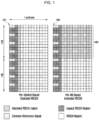
- FIG. 1 illustrates two examples of a subframe including extended PDCCH regions.
- each of the symbols to the right of those indicated as being within the legacy PDCCH region, except those indicated as common reference signals, can be considered as being part of the legacy data channel region.
- the PDCCH is extended into the legacy data channel region, by assigning a next symbol following the symbols of the legacy PDCCH region as an extended PDCCH region.
- the PDCCH is extended into the legacy data channel region, by assigning all of the symbols of the legacy data channel region in RB 103 as an extended PDCCH region.
- the extended PDCCH because it can be either locally or distributed located in the frequency domain, a system can exploit multi-user gain by scheduling preferable sub-bands with better channel gain to respective users.
- the resources available for the PDCCH are extended, in particular for carrier aggregation as well as for other features that also increase the required resources for the PDCCH, such as multiple user multiple input/multiple output (MU-MIMO).
- MU-MIMO multiple user multiple input/multiple output
- interference mitigation of the PDCCH for heterogeneous networks might be performed as the extended PDCCH is defined in the PDSCH region, and therefore RB-based interference management and coordination can be performed.
- a subset of RBs included in the full bandwidth are selected for a particular UE.
- the subset may be different from UE to UE, and the size of the subset, i.e., the number of RBs included in the subset, may vary.
- a base station determines whether or not resource restriction should be applied to a UE and selects RBs for the UE based on information and feedback of the UE, e.g., channel information on a subband, expected traffic for the UE, channel status feedback information, etc.
- the eNB sends a configuration message to the UE, informing the UE of its assigned control and data channels.
- the configuration message can be transmitted via high layer Radio Resource Control (RRC) message, hereinafter referred to as an RRC resource restriction message.
- RRC Radio Resource Control
- the RB sub-set configuration may be semi-statically configured, i.e., once configured, it is not to be expected to be reconfigured for a certain period of time, e.g., several radio frames.
- the UE After the UE is allocated with the RB sub-set restriction, it assumes all control and data payload will be transmitted using the allocated RBs. Basically, the UE assumes the allocated subset of RBs as a virtual system bandwidth, and the resource partitioning and assignment will be done based on this assumption.
- the bits used for resource allocation can be accordingly reduced.
- the RRC configuration can be an N RB -bit bitmap indicated, if each RB is allocated for the UE.
- N RB -bit bitmap indicated, if each RB is allocated for the UE.
- the number of bits used for resource allocation within an RB subset is reduced as shown below.
- N RB Subset , u the restricted values of N RB Subset , u will depend on the system bandwidth.
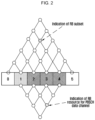
- FIG. 2 illustrates resource allocation restriction for a PDCCH and PDSCH according to the present invention. Specifically, FIG. 2 illustrates an example of type 2 resource allocation, where a 6-RB system is presented.
- the RRC resource restriction message indicates that RBs 1-4 are allocated as the RB subset for UE u, and a field for indicating the PDSCH data resource in a DCI format assigns RBs 2-4 for PDSCH transmission.
- 1 bit (RB 1) is saved for DCI format for downlink allocation. The savings will be more significant if the system bandwidth increases and the subset size decreases.
- FIG. 3A is a flowchart illustrating an evolved Node B (eNB) method of resource allocation restriction according to the present invention
- eNB evolved Node B
- the eNB performs initial access for a UE in step 305.
- the eNB and UE can set up communication as defined in the legacy systems.
- the eNB collects UE's feedback and other information.
- the other information may include at least one of channel information on a subband, expected traffic of the UE, and channel status feedback information.
- the eNB Based on the collected information, the eNB performs scheduling for the UE in step 315, and determines whether or not resource restriction should be applied to the UE in step 320.
- the eNB When resource restriction is applied (or modified from a previous restriction), the eNB sends a message, i.e., an RRC resource restriction message, to the UE to activate( or update) the resource restriction in step 325.
- the RRC resource restriction message can be a bitmap indicating which RBs or which predefined sub-bands are allocated to the UE.
- the RRC resource restriction message can also take a compressed version for RB indication, e.g., the tree structure indication illustrated in FIG. 2 , where each node indicates all the branches under it.
- step 330 the eNB transmits PDCCH and PDSCH payload to the UE using the restricted resources.
- step 320 When resource restriction is not applied in step 320, legacy operations are performed without sending any configuration to the UE in step 335.
- the eNB can indicate all of the RBs or subbands included in the system bandwidth, such that no resource restriction is applied.
- step 340 the eNB determines whether communication between the eNB and the UE is finished. When the communication is not finished, the method returns to step 310, where the eNB collects the UE's feedback and other information. When the communication is finished, the method ends.
- FIG. 3B is a flowchart illustrating a UE method of resource allocation restriction according to the present invention.
- the UE performs initial access for the eNB in step 355.
- the UE and the eNB can set up communication as defined in the legacy systems.
- the UE transmits feedback and other information to the eNB.
- the other information may include channel information on a subband, expected traffic of the UE, channel status feedback information, etc.
- the UE receives a message from the eNB.
- the message may be an RRC resource restriction message, such as a bitmap indicating which RBs or which predefined sub-bands are allocated to the UE.
- step 370 the UE decodes the message and determines whether or not resource restriction is applied to the UE.
- the UE When the UE receives the RRC resource restriction message, the UE re-indexes its available RBs and re-partitions resources for potential extended PDCCH usage based on the RRC resource restriction message in step 375.
- the UE decodes PDCCH and PDSCH payload received within the restricted resources. More specifically, the eNB sends both the control and data channels to the UE, as scheduled by the RRC resource restriction message. The UE first tries extended PDCCH blind decoding on the modified search spaces, which are restricted in the RB subset. Because the PDSCH data channel transmission will also be restricted within the RB subset, the size of related DCI format will also be changed. The UE also takes this into account when doing the control channel blind decoding. After decoding the extended PDCCH, the UE locates its assigned PDSCH resource within the RB subset, and then decodes the data carried therein.
- step 370 When the UE does not receive an RRC resource restriction message in step 370, legacy reception for PDCCH and PDSCH is performed in step 385.
- the UE could receive an indication that all of the RBs or subbands of the system bandwidth are available, so that no resource restriction is applied.
- step 390 the UE determines whether communication between the UE and the eNB is finished. If the communication is not finished, the method returns to step 360; otherwise, the method is ended.
- a system can mandate common resources for both control and data channels, such that the resources for the two channels can be bonded in frequncy domain, and the resource allocation indication field size can be reduced accordingly.
- the resource block of control channel and the resurce block of data channel have at least one resource block in common
- a common resource can be defined such that a PDSCH must include at least a first RB in which an extended PDCCH is located.
- a common resource can be defined such that a PDSCH must include at least a first few RBs (e.g., in granularity of a RB group as defined in 3GPP specification) in which an extended PDCCH is located.
- a common resource can also be defined such that a PDSCH must include all of the RBs occupied by the extended PDCCH.
- the neighboring one or several RBs next to the first extended PDCCH RB can be mandated to be included in PDSCH resource.
- FIG. 4 illustrates resource allocation mandating a PDCCH RB to include a PDSCH resource according to the present invention. Specifically, FIG. 4 illustrates two RBs used for extended PDCCH transmission.
- a size of a resource allocation field size depends on a starting location of a PDCCH. Further, when the UE is attempting blind decoding, the UE will assume different DCI format size for each search space.
- FIG. 5A is a flow chart illustrating an eNB resource allocation mandating method according to an embodiment of the present invention.
- the eNB performs initial access for the UE in step 505.
- the eNB and UE can set up communication as defined in the legacy systems.
- the eNB collects UE's feedback and other information.
- the other information may include channel information on a subband, expected traffic of the UE, channel status feedback information, etc.
- the eNB Based on the collected information, the eNB performs scheduling for the UE in step 515, and determines whether or not resource mandating should be applied to the UE in step 520
- the eNB When resource mandating is applied (or modified from a previous mandate), the eNB sends a message to the UE to activate (or update) the resource mandating in step 525.
- the message may be an RRC message, which includes a short flag indicating whether a resource mandating mode is on or off. Additionally, there can be another independent RRC message restricting the resource to be used by the PDCCH.
- the eNB transmits PDCCH and PDSCH payloads using the mandated resources.
- step 520 When resource mandating is not applied in step 520, legacy operations are performed, without sending any configuration to the UE in step 535.
- the eNB may indicate all RBs or subbands of the system bandwidth, so that no resource mandating is applied.
- step 540 the eNB determines whether or not communication between the eNB and the UE is finished. If the communication is not finished, the method returns to step 510, where the eNB collects the UE's feedback and other information
- FIG. 5B is a flow chart illustrating a UE resource allocation mandating method according to the present invention.
- the UE performs initial access for the eNB in step 555.
- the UE and the eNB can set up communication as defined in the legacy systems.
- the UE transmits feedback of the UE and other information.
- the other information may include channel information on a subband, expected traffic of the UE, channel status feedback information, etc.
- the UE receives a message from the eNB.
- the message may include resource mandating information, i.e., the message may be a RRC message for resource mandating.
- step 570 the UE decodes the received message and determines whether or not resource mandating is applied to the UE.
- the UE When resource mandating is applied, the UE assumes that the PDSCH resource allocated to it will be mandated as indicated therein. Accordingly, in step 575, the user re-generates search spaces and respective DCI sizes, based on the message.
- the UE decodes the PDCCH and PDSCH payload included in the mandated resources. More specifically, the eNB sends both the control and data channels to the UE as scheduled by the RRC signals. After decoding the extended PDCCH, the UE locates its assigned PDSCH resource within an RB subset, and then decodes the data carried therein.
- legacy reception is performed for the PDCCH and the PDSCH in step 585.
- the eNB may indicate all of the RBs or subbands of the system bandwidth, so that no resource mandating is applied.
- step 590 the UE determines whether or not communication between the UE and the eNB is finished. If the communication is not finished, the method returns to step 560; otherwise, the method ends.
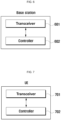
- FIG. 6 is a block diagram illustrating a base station according to the present invention.
- the base station (or eNB) includes a transceiver 601 and a controller 602.
- the transceiver 601 transmits and receives signals, e.g., with a UE.
- FIG. 7 is a block diagram illustrating a UE according to the present invention.
- the UE includes a transceiver 701 and a controller 702.
- the transceiver 701 transmits and receives signals, e.g., with an eNB.
Landscapes
- Engineering & Computer Science (AREA)
- Signal Processing (AREA)
- Computer Networks & Wireless Communication (AREA)
- Quality & Reliability (AREA)
- Mobile Radio Communication Systems (AREA)
Claims (12)
- Procédé par un équipement utilisateur, UE, dans un système de communication sans fil, le procédé comprenant :recevoir (365) des informations de table de bits sur un ensemble de blocs de ressources par l'intermédiaire d'une signalisation de contrôle de ressources radio, RRC, d'une station de base, où des blocs de ressources pour un canal de commande pour l'UE sont limités par l'ensemble de blocs de ressources ;recevoir (380), de la station de base, des informations de commande pour des données de liaison descendante sur le canal de commande identifié sur la base des informations de table de bits ; etrecevoir (380), de la station de base, les données de liaison descendante sur un canal de données sur la base des informations de commande,où les informations de commande sont reçues sur au moins une ressource de canal de commande, l'au moins une ressource de canal de commande étant incluse dans l'ensemble de blocs de ressources, etoù un espace de recherche pour le canal de commande de l'UE est défini sur la base d'un niveau d'agrégation, d'un nombre de l'au moins une ressource de canal de commande incluse dans l'ensemble de blocs de ressources, et d'un nombre de candidats associés au canal de commande.
- Procédé selon la revendication 1, où l'au moins une ressource de canal de commande est mappée par un procédé distribué ou localisé dans l'ensemble de blocs de ressources, par l'intermédiaire de la signalisation RRC de la station de base.
- Procédé selon la revendication 1, où les informations de durée pour recevoir les informations de commande sont en outre identifiées par l'intermédiaire de la signalisation RRC de la station de base, les informations de durée étant indiquées par un nombre de symboles de multiplexage par répartition orthogonale de la fréquence, OFDM.
- Procédé selon la revendication 1, où les informations de table de bits sont associées à un ensemble de 6 blocs de ressources.
- Procédé par une station de base dans un système de communication sans fil, le procédé comprenant :identifier des informations de table de bits sur un ensemble de blocs de ressources, où les blocs de ressources pour un canal de commande pour un équipement utilisateur, UE, sont limités par l'ensemble de blocs de ressources ;transmettre (325, 525), à l'UE, les informations de table de bits par l'intermédiaire d'une signalisation de contrôle de ressources radio, RRC ;transmettre (330, 530), à l'UE, des informations de commande pour des données de liaison descendante sur le canal de commande identifié sur la base des informations de table de bits ; ettransmettre (330, 530), à l'UE, les données de liaison descendante sur un canal de données sur la base des informations de commande,où les informations de commande sont transmises sur au moins une ressource de canal de commande, l'au moins une ressource de canal de commande étant incluse dans l'ensemble de blocs de ressources, etoù un espace de recherche pour le canal de commande de l'UE est défini sur la base d'un niveau d'agrégation, d'un nombre de l'au moins une ressource de canal de commande dans l'ensemble de blocs de ressources, et d'un nombre de candidats associés au canal de commande.
- Procédé selon la revendication 5, où l'au moins une ressource de canal de commande est mappée par un procédé distribué ou localisé dans l'ensemble de blocs de ressources, par l'intermédiaire de la signalisation RRC de la station de base.
- Procédé selon la revendication 5, où les informations de durée pour recevoir les informations de commande sont en outre identifiées par l'intermédiaire de la signalisation RRC de la station de base, les informations de durée étant indiquées par un nombre de symboles de multiplexage par répartition orthogonale de la fréquence, OFDM.
- Procédé selon la revendication 5, où les informations de table de bits sont associées à un ensemble de 6 blocs de ressources.
- Équipement utilisateur, UE, dans un système de communication sans fil, l'UE comprenant :un émetteur-récepteur ; etun contrôleur couplé à l'émetteur-récepteur et configuré pour :recevoir (365) des informations de table de bits sur un ensemble de blocs de ressources par l'intermédiaire d'une signalisation de contrôle de ressources radio, RRC, d'une station de base, où des blocs de ressources pour un canal de commande pour l'UE sont limités par l'ensemble de blocs de ressources ;recevoir (380), de la station de base via l'émetteur-récepteur, des informations de commande pour des données de liaison descendante sur le canal de commande identifié sur la base des informations de table de bits ; etrecevoir (380), de la station de base via l'émetteur-récepteur, les données de liaison descendante sur un canal de données sur la base des informations de commande,où les informations de commande sont reçues sur au moins une ressource de canal de commande, l'au moins une ressource de canal de commande étant incluse dans l'ensemble de blocs de ressources, etoù un espace de recherche pour le canal de commande de l'UE est défini sur la base d'un niveau d'agrégation, d'un nombre de l'au moins une ressource de canal de commande incluse dans l'ensemble de blocs de ressources, et d'un nombre de candidats associés au canal de commande.
- UE selon la revendication 9, où l'au moins une ressource de canal de commande est mappée par un procédé distribué ou localisé dans l'ensemble de blocs de ressources, par l'intermédiaire de la signalisation RRC de la station de base,où les informations de durée pour recevoir les informations de commande sont en outre identifiées par l'intermédiaire de la signalisation RRC de la station de base, les informations de durée étant indiquées par un nombre de symboles de multiplexage par répartition orthogonale de la fréquence, OFDM, etoù les informations de table de bits sont associées à un ensemble de 6 blocs de ressources.
- Station de base dans un système de communication sans fil, la station de base comprenant :un émetteur-récepteur ; etun contrôleur couplé à l'émetteur-récepteur et configuré pour :identifier des informations de table de bits sur un ensemble de blocs de ressources, où les blocs de ressources pour un canal de commande pour un équipement utilisateur, UE, sont limités par l'ensemble de blocs de ressources ;transmettre (325), à l'UE via l'émetteur-récepteur, les informations de table de bits par l'intermédiaire d'une signalisation de contrôle de ressources radio, RRC ;transmettre (330), à l'UE via l'émetteur-récepteur, des informations de commande pour des données de liaison descendante sur le canal de commande identifié sur la base des informations de table de bits ; ettransmettre (330), à l'UE via l'émetteur-récepteur, les données de liaison descendante sur un canal de données sur la base des informations de commande,où les informations de commande sont transmises sur au moins une ressource de canal de commande, l'au moins une ressource de canal de commande étant incluse dans l'ensemble de blocs de ressources, etoù un espace de recherche pour le canal de commande de l'UE est défini sur la base d'un niveau d'agrégation, d'un nombre de l'au moins une ressource de canal de commande dans l'ensemble de blocs de ressources, et d'un nombre de candidats associés au canal de commande.
- Station de base selon la revendication 11, où l'au moins une ressource de canal de commande est mappée par un procédé distribué ou localisé dans l'ensemble de blocs de ressources, par l'intermédiaire de la signalisation RRC de la station de base,où les informations de durée pour recevoir les informations de commande sont en outre identifiées par l'intermédiaire de la signalisation RRC de la station de base, les informations de durée étant indiquées par un nombre de symboles de multiplexage par répartition orthogonale de la fréquence, OFDM, etoù les informations de table de bits sont associées à un ensemble de 6 blocs de ressources.
Applications Claiming Priority (3)
| Application Number | Priority Date | Filing Date | Title |
|---|---|---|---|
| US201161480809P | 2011-04-29 | 2011-04-29 | |
| EP12776463.7A EP2702819B1 (fr) | 2011-04-29 | 2012-04-30 | Appareil et procédé d'attribution de ressources pour des canaux de données et de commande dans un système de communication sans fil |
| PCT/KR2012/003364 WO2012148244A2 (fr) | 2011-04-29 | 2012-04-30 | Appareil et procédé d'attribution de ressources pour des canaux de données et de commande dans un système de communication sans fil |
Related Parent Applications (2)
| Application Number | Title | Priority Date | Filing Date |
|---|---|---|---|
| EP12776463.7A Division EP2702819B1 (fr) | 2011-04-29 | 2012-04-30 | Appareil et procédé d'attribution de ressources pour des canaux de données et de commande dans un système de communication sans fil |
| EP12776463.7A Division-Into EP2702819B1 (fr) | 2011-04-29 | 2012-04-30 | Appareil et procédé d'attribution de ressources pour des canaux de données et de commande dans un système de communication sans fil |
Publications (2)
| Publication Number | Publication Date |
|---|---|
| EP3706494A1 EP3706494A1 (fr) | 2020-09-09 |
| EP3706494B1 true EP3706494B1 (fr) | 2025-01-29 |
Family
ID=47067851
Family Applications (2)
| Application Number | Title | Priority Date | Filing Date |
|---|---|---|---|
| EP20170843.5A Active EP3706494B1 (fr) | 2011-04-29 | 2012-04-30 | Appareil et procédé d'attribution de ressources pour des canaux de données et de commande dans un système de communication sans fil |
| EP12776463.7A Active EP2702819B1 (fr) | 2011-04-29 | 2012-04-30 | Appareil et procédé d'attribution de ressources pour des canaux de données et de commande dans un système de communication sans fil |
Family Applications After (1)
| Application Number | Title | Priority Date | Filing Date |
|---|---|---|---|
| EP12776463.7A Active EP2702819B1 (fr) | 2011-04-29 | 2012-04-30 | Appareil et procédé d'attribution de ressources pour des canaux de données et de commande dans un système de communication sans fil |
Country Status (3)
| Country | Link |
|---|---|
| US (4) | US10219282B2 (fr) |
| EP (2) | EP3706494B1 (fr) |
| WO (1) | WO2012148244A2 (fr) |
Families Citing this family (23)
| Publication number | Priority date | Publication date | Assignee | Title |
|---|---|---|---|---|
| GB2499747B (en) | 2010-11-22 | 2014-04-09 | Seven Networks Inc | Aligning data transfer to optimize connections established for transmission over a wireless network |
| US8879667B2 (en) | 2011-07-01 | 2014-11-04 | Intel Corporation | Layer shifting in open loop multiple-input, multiple-output communications |
| WO2013015835A1 (fr) | 2011-07-22 | 2013-01-31 | Seven Networks, Inc. | Optimisation de trafic d'application mobile |
| US9991998B2 (en) * | 2011-11-25 | 2018-06-05 | Avago Technologies General Ip (Singapore) Pte. Ltd. | Ratio resource sharing and contention scheme for device-to-device communication in white space spectrum bands |
| EP3454594B1 (fr) | 2013-06-11 | 2020-11-04 | Seven Networks, LLC | Délestage de trafic d'application vers un canal de communication partagé pour une optimisation de signal dans un réseau sans fil, pour un trafic utilisant des protocoles propriétaires et non propriétaires |
| CN104584661B (zh) * | 2013-07-30 | 2018-11-09 | 华为技术有限公司 | 控制信道的检测与发送方法及设备 |
| WO2016088726A1 (fr) | 2014-12-01 | 2016-06-09 | 株式会社 東芝 | Terminal de communication sans fil et procédé de communication sans fil |
| EP3229543B1 (fr) * | 2014-12-01 | 2021-05-05 | Kabushiki Kaisha Toshiba | Dispositif de communication sans fil |
| JPWO2016121251A1 (ja) * | 2015-01-29 | 2017-11-09 | ソニー株式会社 | 装置及び方法 |
| US10966180B2 (en) | 2015-07-07 | 2021-03-30 | Kabushiki Kaisha Toshiba | Wireless device and wireless communication method |
| KR102421484B1 (ko) * | 2015-10-26 | 2022-07-15 | 삼성전자주식회사 | 무선 통신 시스템에서 데이터 스케쥴링 방법 및 장치 |
| US10420148B2 (en) | 2015-10-30 | 2019-09-17 | Kabushiki Kaisha Toshiba | Wireless communication terminal and wireless communication method |
| EP3163783B1 (fr) | 2015-10-30 | 2019-12-18 | Kabushiki Kaisha Toshiba | Dispositif et procédé de communication sans fil |
| JP6619311B2 (ja) | 2015-10-30 | 2019-12-11 | 株式会社東芝 | 無線通信装置および無線通信方法 |
| JP6402121B2 (ja) | 2016-01-06 | 2018-10-10 | 株式会社東芝 | 無線通信装置および無線通信方法 |
| CN109314616B (zh) * | 2016-06-01 | 2021-04-20 | 华为技术有限公司 | 一种信道估计方法、相关设备及系统 |
| WO2018024205A1 (fr) * | 2016-08-02 | 2018-02-08 | Chou Chie Ming | Procédé de signalisation d'indice de profil ran et équipement de communication radio utilisant ledit procédé de signalisation d'indice de profil ran |
| CN113115463B (zh) | 2016-08-11 | 2024-09-27 | 三星电子株式会社 | 下一代蜂窝网络中的数据传输的方法和装置 |
| CN108401294B (zh) * | 2017-02-04 | 2021-10-26 | 华为技术有限公司 | 控制信息的发送和接收方法、接入网设备和终端设备 |
| CN109495966B (zh) * | 2017-09-11 | 2022-04-29 | 大唐移动通信设备有限公司 | 用于传输下行数据的资源的确定和配置方法、终端和基站 |
| EP3509373B1 (fr) * | 2018-01-09 | 2023-03-08 | Comcast Cable Communications LLC | Sélection de faisceau dans une retransmission de demande de reprise après défaillance de faisceau |
| CN110677911B (zh) * | 2018-07-03 | 2022-05-20 | 大唐移动通信设备有限公司 | 一种发送物理下行控制信道的配置信息的方法及装置 |
| CN114641012B (zh) * | 2020-12-15 | 2024-08-13 | 中国移动通信集团山东有限公司 | 信道动态配置方法及装置、网络设备、存储介质 |
Family Cites Families (23)
| Publication number | Priority date | Publication date | Assignee | Title |
|---|---|---|---|---|
| JP4476968B2 (ja) | 2006-06-19 | 2010-06-09 | 株式会社エヌ・ティ・ティ・ドコモ | 移動通信システムにおける基地局、ユーザ装置、送信方法及び受信方法 |
| JP4913641B2 (ja) | 2007-03-20 | 2012-04-11 | 株式会社エヌ・ティ・ティ・ドコモ | 基地局、通信端末、送信方法、受信方法、通信システム |
| GB2464987A (en) * | 2008-11-03 | 2010-05-05 | Nec Corp | Methods for designating resource allocation |
| US9673952B2 (en) * | 2009-04-10 | 2017-06-06 | Qualcomm Inc. | Method and apparatus for supporting user equipments on different system bandwidths |
| US9622228B2 (en) * | 2009-05-04 | 2017-04-11 | Qualcomm Incorporated | Data and control multiplexing in wireless communications |
| WO2011000440A1 (fr) * | 2009-07-03 | 2011-01-06 | Nokia Siemens Networks Oy | Extension de couverture de canal de commande de liaison descendante physique |
| US8861424B2 (en) | 2009-07-06 | 2014-10-14 | Qualcomm Incorporated | Downlink control channel for relay resource allocation |
| KR101641388B1 (ko) * | 2009-08-19 | 2016-07-21 | 엘지전자 주식회사 | 중계국의 참조신호 이용 방법 및 상기 방법을 이용하는 중계국 |
| US20110069637A1 (en) * | 2009-09-18 | 2011-03-24 | Futurewei Technologies, Inc. | System and Method for Control Channel Search Space Location Indication for a Relay Backhaul Link |
| KR20110038994A (ko) * | 2009-10-09 | 2011-04-15 | 삼성전자주식회사 | 다중 안테나를 이용하는 무선 통신 시스템에서 다중 사용자 제어 채널 송수신 방법 및 장치 |
| KR20110065329A (ko) * | 2009-12-09 | 2011-06-15 | 엘지전자 주식회사 | 반송파 집성 시스템에서 제어정보 전송 방법, 수신 방법 및 단말 |
| US8804586B2 (en) * | 2010-01-11 | 2014-08-12 | Blackberry Limited | Control channel interference management and extended PDCCH for heterogeneous network |
| US20110222491A1 (en) * | 2010-03-09 | 2011-09-15 | Qualcomm Incorporated | Method and apparatus for sending control information with enhanced coverage in a wireless network |
| CN102083096B (zh) * | 2010-03-22 | 2014-06-04 | 电信科学技术研究院 | 回程链路上的控制信令发送及信令检测方法、系统和设备 |
| WO2011124028A1 (fr) * | 2010-04-07 | 2011-10-13 | Nokia Corporation | Configuration d'espace de recherche de canal de commande de relais |
| WO2011137383A1 (fr) * | 2010-04-30 | 2011-11-03 | Interdigital Patent Holdings, Inc. | Commande de liaison descendante dans réseaux hétérogènes |
| US20120054258A1 (en) * | 2010-08-27 | 2012-03-01 | Futurewei Technologies, Inc. | System and Method for Transmitting a Control Channel |
| US9295038B2 (en) * | 2010-11-16 | 2016-03-22 | Telefonaktiebolaget L M Ericsson (Publ) | Control channel configuration in a wireless communications system |
| CN115767752A (zh) * | 2011-02-11 | 2023-03-07 | 交互数字专利控股公司 | 用于增强型控制信道的系统和方法 |
| EP3522579B1 (fr) * | 2011-02-14 | 2021-02-03 | Huawei Technologies Co., Ltd. | Système et procédé de transmission et de réception de canal de commande |
| WO2012118270A1 (fr) * | 2011-03-01 | 2012-09-07 | 엘지전자 주식회사 | Procédé et appareil de recherche d'informations de commande par un terminal dans un système multi-nœud |
| US10178605B2 (en) * | 2011-04-01 | 2019-01-08 | Intel Corporation | Enhanced node B and method of transmitting physical-downlink control channels (PDCCHs) in a LTE-A system |
| US10638464B2 (en) * | 2011-04-01 | 2020-04-28 | Futurewei Technologies, Inc. | System and method for transmission and reception of control channels in a communications system |
-
2012
- 2012-04-30 EP EP20170843.5A patent/EP3706494B1/fr active Active
- 2012-04-30 EP EP12776463.7A patent/EP2702819B1/fr active Active
- 2012-04-30 WO PCT/KR2012/003364 patent/WO2012148244A2/fr not_active Ceased
- 2012-04-30 US US13/459,907 patent/US10219282B2/en active Active
-
2019
- 2019-02-26 US US16/286,001 patent/US10701704B2/en active Active
- 2019-11-08 US US16/678,577 patent/US10863517B2/en active Active
-
2020
- 2020-12-07 US US17/114,039 patent/US11758569B2/en active Active
Also Published As
| Publication number | Publication date |
|---|---|
| US20200077408A1 (en) | 2020-03-05 |
| EP2702819A4 (fr) | 2014-11-12 |
| US11758569B2 (en) | 2023-09-12 |
| US20190191438A1 (en) | 2019-06-20 |
| WO2012148244A2 (fr) | 2012-11-01 |
| EP2702819A2 (fr) | 2014-03-05 |
| EP2702819B1 (fr) | 2023-01-25 |
| US20210092746A1 (en) | 2021-03-25 |
| WO2012148244A3 (fr) | 2013-01-24 |
| US10863517B2 (en) | 2020-12-08 |
| US10701704B2 (en) | 2020-06-30 |
| US10219282B2 (en) | 2019-02-26 |
| US20120275405A1 (en) | 2012-11-01 |
| EP3706494A1 (fr) | 2020-09-09 |
Similar Documents
| Publication | Publication Date | Title |
|---|---|---|
| US11758569B2 (en) | Apparatus and method of resource allocation for data and control channels in a wireless communication system | |
| EP3840278B1 (fr) | Procédé et appareil de transmission de liaison montante dans un système de communication sans fil | |
| TWI678936B (zh) | 進行超低延遲進程的方法與用戶設備 | |
| KR102522569B1 (ko) | 협대역 시스템에서 통신 방법 및 장치 | |
| EP3097737B1 (fr) | Réseau de communications mobiles, dispositif de communications et procédés | |
| EP1758327B1 (fr) | Allocation de ressources dans un système de communication cellulaire OFDM | |
| EP4236544A2 (fr) | Signalisation d'allocation de ressource | |
| US20140369292A1 (en) | Wireless Communication Method and Communication Apparatus | |
| US20130051356A1 (en) | Device and method for transmitting downlink control information in a wireless communication system | |
| EP2439995A2 (fr) | Appareil et procédé de mise en correspondance de ressources dans un système de communication sans fil | |
| JP5366962B2 (ja) | 異なるtddシステム間でリソースをスケジューリングするための方法および装置 | |
| CN103733710B (zh) | 基站装置、终端装置、发送方法及接收方法 | |
| CN108551388B (zh) | 供扩展控制信道使用的无线电网络节点、用户设备和方法 | |
| CN102395205B (zh) | 一种扩展物理层控制信道资源数量的方法和系统 | |
| EP3641443B1 (fr) | Procédé et appareil d'envoi et de réception de données | |
| EP3958497A1 (fr) | Circuit intégré pour dispositif de communication | |
| EP3247067B1 (fr) | Dispositif et procédé permettant de partager des signaux de référence de démodulation de liaison descendante | |
| EP4270889A1 (fr) | Transmission de signal de données dans un système de communication sans fil à latence de bout en bout réduite | |
| WO2021070310A1 (fr) | Terminal et procédé de communication | |
| WO2021065013A1 (fr) | Terminal et procédé de communication | |
| CN109690999B (zh) | 具有降低的延迟的无线通信系统中的数据传输 | |
| US11317429B2 (en) | Method for transmitting and receiving scheduling information in communication system | |
| CN106788897B (zh) | 下行控制信息的管理方法、管理装置、基站及终端 | |
| CN106793143B (zh) | 下行控制信息的管理方法、管理装置及基站 | |
| EP2352241A1 (fr) | Station de base, procédé de communication, procédé d'allocation de sous-porteuse et programme d'allocation de sous-porteuse |
Legal Events
| Date | Code | Title | Description |
|---|---|---|---|
| PUAI | Public reference made under article 153(3) epc to a published international application that has entered the european phase |
Free format text: ORIGINAL CODE: 0009012 |
|
| STAA | Information on the status of an ep patent application or granted ep patent |
Free format text: STATUS: REQUEST FOR EXAMINATION WAS MADE |
|
| 17P | Request for examination filed |
Effective date: 20200422 |
|
| AC | Divisional application: reference to earlier application |
Ref document number: 2702819 Country of ref document: EP Kind code of ref document: P |
|
| AK | Designated contracting states |
Kind code of ref document: A1 Designated state(s): AL AT BE BG CH CY CZ DE DK EE ES FI FR GB GR HR HU IE IS IT LI LT LU LV MC MK MT NL NO PL PT RO RS SE SI SK SM TR |
|
| STAA | Information on the status of an ep patent application or granted ep patent |
Free format text: STATUS: EXAMINATION IS IN PROGRESS |
|
| 17Q | First examination report despatched |
Effective date: 20211005 |
|
| REG | Reference to a national code |
Ref country code: DE Ref legal event code: R079 Free format text: PREVIOUS MAIN CLASS: H04W0072080000 Ipc: H04W0072540000 Ref country code: DE Ref legal event code: R079 Ref document number: 602012081348 Country of ref document: DE Free format text: PREVIOUS MAIN CLASS: H04W0072080000 Ipc: H04W0072540000 |
|
| GRAP | Despatch of communication of intention to grant a patent |
Free format text: ORIGINAL CODE: EPIDOSNIGR1 |
|
| STAA | Information on the status of an ep patent application or granted ep patent |
Free format text: STATUS: GRANT OF PATENT IS INTENDED |
|
| RIC1 | Information provided on ipc code assigned before grant |
Ipc: H04W 72/51 20230101ALN20241105BHEP Ipc: H04W 72/23 20230101ALI20241105BHEP Ipc: H04W 72/54 20230101AFI20241105BHEP |
|
| INTG | Intention to grant announced |
Effective date: 20241114 |
|
| GRAS | Grant fee paid |
Free format text: ORIGINAL CODE: EPIDOSNIGR3 |
|
| GRAA | (expected) grant |
Free format text: ORIGINAL CODE: 0009210 |
|
| STAA | Information on the status of an ep patent application or granted ep patent |
Free format text: STATUS: THE PATENT HAS BEEN GRANTED |
|
| AC | Divisional application: reference to earlier application |
Ref document number: 2702819 Country of ref document: EP Kind code of ref document: P |
|
| AK | Designated contracting states |
Kind code of ref document: B1 Designated state(s): AL AT BE BG CH CY CZ DE DK EE ES FI FR GB GR HR HU IE IS IT LI LT LU LV MC MK MT NL NO PL PT RO RS SE SI SK SM TR |
|
| REG | Reference to a national code |
Ref country code: GB Ref legal event code: FG4D |
|
| REG | Reference to a national code |
Ref country code: CH Ref legal event code: EP |
|
| REG | Reference to a national code |
Ref country code: DE Ref legal event code: R096 Ref document number: 602012081348 Country of ref document: DE |
|
| REG | Reference to a national code |
Ref country code: IE Ref legal event code: FG4D |
|
| REG | Reference to a national code |
Ref country code: NL Ref legal event code: FP |
|
| PGFP | Annual fee paid to national office [announced via postgrant information from national office to epo] |
Ref country code: NL Payment date: 20250321 Year of fee payment: 14 |
|
| PGFP | Annual fee paid to national office [announced via postgrant information from national office to epo] |
Ref country code: FR Payment date: 20250321 Year of fee payment: 14 |
|
| PGFP | Annual fee paid to national office [announced via postgrant information from national office to epo] |
Ref country code: IT Payment date: 20250321 Year of fee payment: 14 |
|
| PG25 | Lapsed in a contracting state [announced via postgrant information from national office to epo] |
Ref country code: RS Free format text: LAPSE BECAUSE OF FAILURE TO SUBMIT A TRANSLATION OF THE DESCRIPTION OR TO PAY THE FEE WITHIN THE PRESCRIBED TIME-LIMIT Effective date: 20250429 |
|
| PG25 | Lapsed in a contracting state [announced via postgrant information from national office to epo] |
Ref country code: FI Free format text: LAPSE BECAUSE OF FAILURE TO SUBMIT A TRANSLATION OF THE DESCRIPTION OR TO PAY THE FEE WITHIN THE PRESCRIBED TIME-LIMIT Effective date: 20250129 |
|
| PG25 | Lapsed in a contracting state [announced via postgrant information from national office to epo] |
Ref country code: PL Free format text: LAPSE BECAUSE OF FAILURE TO SUBMIT A TRANSLATION OF THE DESCRIPTION OR TO PAY THE FEE WITHIN THE PRESCRIBED TIME-LIMIT Effective date: 20250129 |
|
| PGFP | Annual fee paid to national office [announced via postgrant information from national office to epo] |
Ref country code: DE Payment date: 20250320 Year of fee payment: 14 |
|
| PG25 | Lapsed in a contracting state [announced via postgrant information from national office to epo] |
Ref country code: ES Free format text: LAPSE BECAUSE OF FAILURE TO SUBMIT A TRANSLATION OF THE DESCRIPTION OR TO PAY THE FEE WITHIN THE PRESCRIBED TIME-LIMIT Effective date: 20250129 |
|
| REG | Reference to a national code |
Ref country code: LT Ref legal event code: MG9D |
|
| PG25 | Lapsed in a contracting state [announced via postgrant information from national office to epo] |
Ref country code: IS Free format text: LAPSE BECAUSE OF FAILURE TO SUBMIT A TRANSLATION OF THE DESCRIPTION OR TO PAY THE FEE WITHIN THE PRESCRIBED TIME-LIMIT Effective date: 20250529 Ref country code: NO Free format text: LAPSE BECAUSE OF FAILURE TO SUBMIT A TRANSLATION OF THE DESCRIPTION OR TO PAY THE FEE WITHIN THE PRESCRIBED TIME-LIMIT Effective date: 20250429 |
|
| REG | Reference to a national code |
Ref country code: AT Ref legal event code: MK05 Ref document number: 1764659 Country of ref document: AT Kind code of ref document: T Effective date: 20250129 |
|
| PG25 | Lapsed in a contracting state [announced via postgrant information from national office to epo] |
Ref country code: HR Free format text: LAPSE BECAUSE OF FAILURE TO SUBMIT A TRANSLATION OF THE DESCRIPTION OR TO PAY THE FEE WITHIN THE PRESCRIBED TIME-LIMIT Effective date: 20250129 |
|
| PG25 | Lapsed in a contracting state [announced via postgrant information from national office to epo] |
Ref country code: PT Free format text: LAPSE BECAUSE OF FAILURE TO SUBMIT A TRANSLATION OF THE DESCRIPTION OR TO PAY THE FEE WITHIN THE PRESCRIBED TIME-LIMIT Effective date: 20250529 Ref country code: LV Free format text: LAPSE BECAUSE OF FAILURE TO SUBMIT A TRANSLATION OF THE DESCRIPTION OR TO PAY THE FEE WITHIN THE PRESCRIBED TIME-LIMIT Effective date: 20250129 |
|
| PG25 | Lapsed in a contracting state [announced via postgrant information from national office to epo] |
Ref country code: BG Free format text: LAPSE BECAUSE OF FAILURE TO SUBMIT A TRANSLATION OF THE DESCRIPTION OR TO PAY THE FEE WITHIN THE PRESCRIBED TIME-LIMIT Effective date: 20250129 Ref country code: GR Free format text: LAPSE BECAUSE OF FAILURE TO SUBMIT A TRANSLATION OF THE DESCRIPTION OR TO PAY THE FEE WITHIN THE PRESCRIBED TIME-LIMIT Effective date: 20250430 |
|
| PG25 | Lapsed in a contracting state [announced via postgrant information from national office to epo] |
Ref country code: AT Free format text: LAPSE BECAUSE OF FAILURE TO SUBMIT A TRANSLATION OF THE DESCRIPTION OR TO PAY THE FEE WITHIN THE PRESCRIBED TIME-LIMIT Effective date: 20250129 |
|
| PG25 | Lapsed in a contracting state [announced via postgrant information from national office to epo] |
Ref country code: SE Free format text: LAPSE BECAUSE OF FAILURE TO SUBMIT A TRANSLATION OF THE DESCRIPTION OR TO PAY THE FEE WITHIN THE PRESCRIBED TIME-LIMIT Effective date: 20250129 |
|
| PG25 | Lapsed in a contracting state [announced via postgrant information from national office to epo] |
Ref country code: SM Free format text: LAPSE BECAUSE OF FAILURE TO SUBMIT A TRANSLATION OF THE DESCRIPTION OR TO PAY THE FEE WITHIN THE PRESCRIBED TIME-LIMIT Effective date: 20250129 |
|
| PG25 | Lapsed in a contracting state [announced via postgrant information from national office to epo] |
Ref country code: DK Free format text: LAPSE BECAUSE OF FAILURE TO SUBMIT A TRANSLATION OF THE DESCRIPTION OR TO PAY THE FEE WITHIN THE PRESCRIBED TIME-LIMIT Effective date: 20250129 |
|
| PG25 | Lapsed in a contracting state [announced via postgrant information from national office to epo] |
Ref country code: CZ Free format text: LAPSE BECAUSE OF FAILURE TO SUBMIT A TRANSLATION OF THE DESCRIPTION OR TO PAY THE FEE WITHIN THE PRESCRIBED TIME-LIMIT Effective date: 20250129 Ref country code: EE Free format text: LAPSE BECAUSE OF FAILURE TO SUBMIT A TRANSLATION OF THE DESCRIPTION OR TO PAY THE FEE WITHIN THE PRESCRIBED TIME-LIMIT Effective date: 20250129 |
|
| PG25 | Lapsed in a contracting state [announced via postgrant information from national office to epo] |
Ref country code: RO Free format text: LAPSE BECAUSE OF FAILURE TO SUBMIT A TRANSLATION OF THE DESCRIPTION OR TO PAY THE FEE WITHIN THE PRESCRIBED TIME-LIMIT Effective date: 20250129 |
|
| PG25 | Lapsed in a contracting state [announced via postgrant information from national office to epo] |
Ref country code: SK Free format text: LAPSE BECAUSE OF FAILURE TO SUBMIT A TRANSLATION OF THE DESCRIPTION OR TO PAY THE FEE WITHIN THE PRESCRIBED TIME-LIMIT Effective date: 20250129 |
|
| REG | Reference to a national code |
Ref country code: DE Ref legal event code: R097 Ref document number: 602012081348 Country of ref document: DE |
|
| REG | Reference to a national code |
Ref country code: CH Ref legal event code: H13 Free format text: ST27 STATUS EVENT CODE: U-0-0-H10-H13 (AS PROVIDED BY THE NATIONAL OFFICE) Effective date: 20251125 |
|
| PLBE | No opposition filed within time limit |
Free format text: ORIGINAL CODE: 0009261 |
|
| STAA | Information on the status of an ep patent application or granted ep patent |
Free format text: STATUS: NO OPPOSITION FILED WITHIN TIME LIMIT |
|
| PG25 | Lapsed in a contracting state [announced via postgrant information from national office to epo] |
Ref country code: LU Free format text: LAPSE BECAUSE OF NON-PAYMENT OF DUE FEES Effective date: 20250430 |
|
| PG25 | Lapsed in a contracting state [announced via postgrant information from national office to epo] |
Ref country code: MC Free format text: LAPSE BECAUSE OF FAILURE TO SUBMIT A TRANSLATION OF THE DESCRIPTION OR TO PAY THE FEE WITHIN THE PRESCRIBED TIME-LIMIT Effective date: 20250129 |
|
| REG | Reference to a national code |
Ref country code: BE Ref legal event code: MM Effective date: 20250430 |
|
| 26N | No opposition filed |
Effective date: 20251030 |
|
| PG25 | Lapsed in a contracting state [announced via postgrant information from national office to epo] |
Ref country code: BE Free format text: LAPSE BECAUSE OF NON-PAYMENT OF DUE FEES Effective date: 20250430 |
|
| PG25 | Lapsed in a contracting state [announced via postgrant information from national office to epo] |
Ref country code: CH Free format text: LAPSE BECAUSE OF NON-PAYMENT OF DUE FEES Effective date: 20250430 |
|
| PGFP | Annual fee paid to national office [announced via postgrant information from national office to epo] |
Ref country code: GB Payment date: 20260324 Year of fee payment: 15 |
|
| PG25 | Lapsed in a contracting state [announced via postgrant information from national office to epo] |
Ref country code: IE Free format text: LAPSE BECAUSE OF NON-PAYMENT OF DUE FEES Effective date: 20250430 |